Thermochemistry The Nature of Energy Kinetic Energy and




- Slides: 47
Thermochemistry
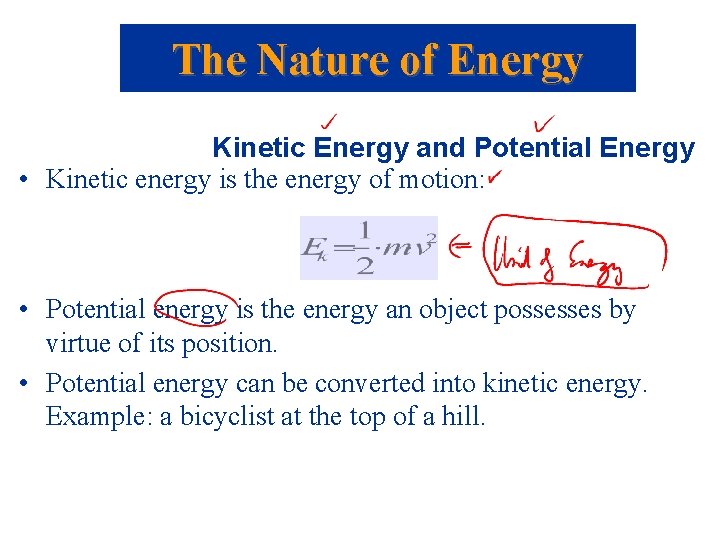
The Nature of Energy Kinetic Energy and Potential Energy • Kinetic energy is the energy of motion: • Potential energy is the energy an object possesses by virtue of its position. • Potential energy can be converted into kinetic energy. Example: a bicyclist at the top of a hill.
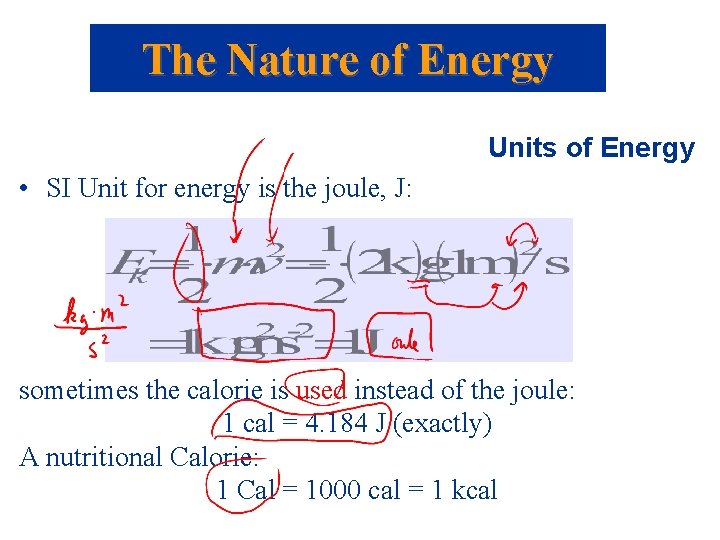
The Nature of Energy Units of Energy • SI Unit for energy is the joule, J: sometimes the calorie is used instead of the joule: 1 cal = 4. 184 J (exactly) A nutritional Calorie: 1 Cal = 1000 cal = 1 kcal
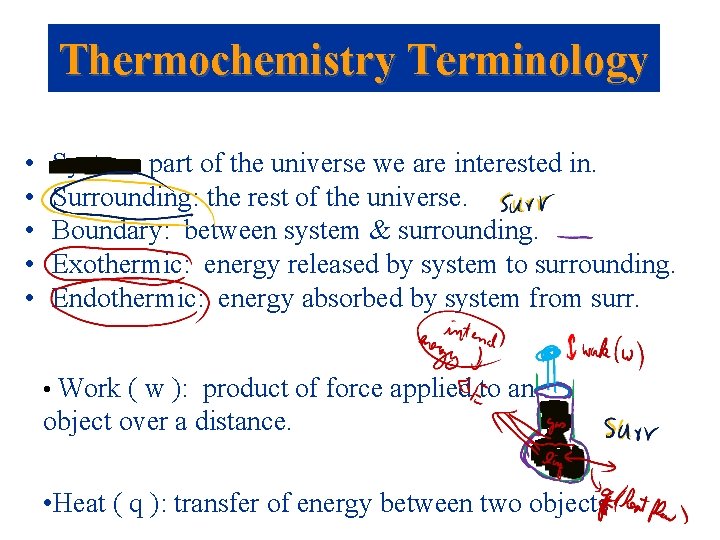
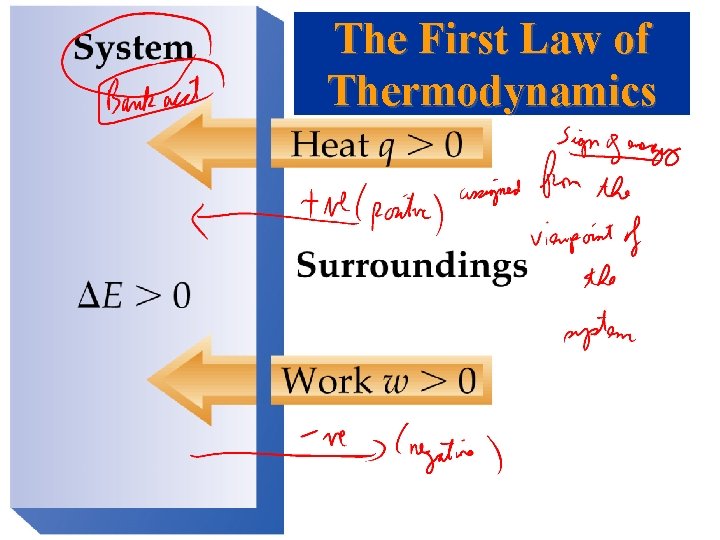
Thermochemistry Terminology • • • System: part of the universe we are interested in. Surrounding: the rest of the universe. Boundary: between system & surrounding. Exothermic: energy released by system to surrounding. Endothermic: energy absorbed by system from surr. • Work ( w ): product of force applied to an object over a distance. • Heat ( q ): transfer of energy between two objects
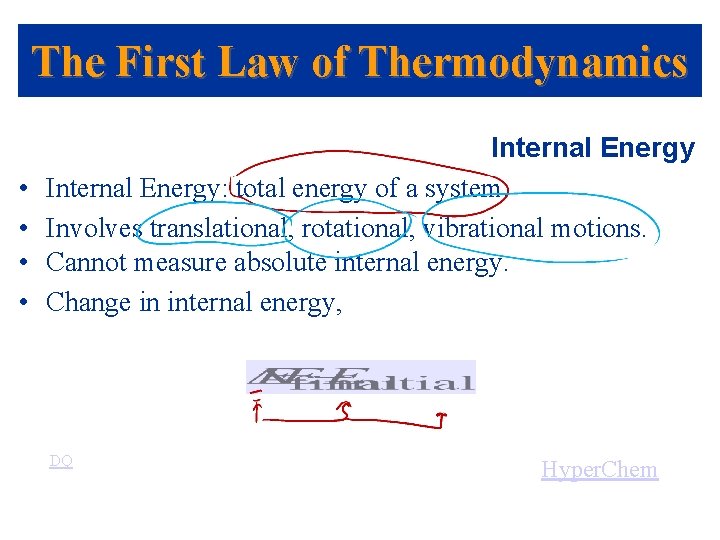
The First Law of Thermodynamics • • Internal Energy: total energy of a system. Involves translational, rotational, vibrational motions. Cannot measure absolute internal energy. Change in internal energy, DQ Hyper. Chem
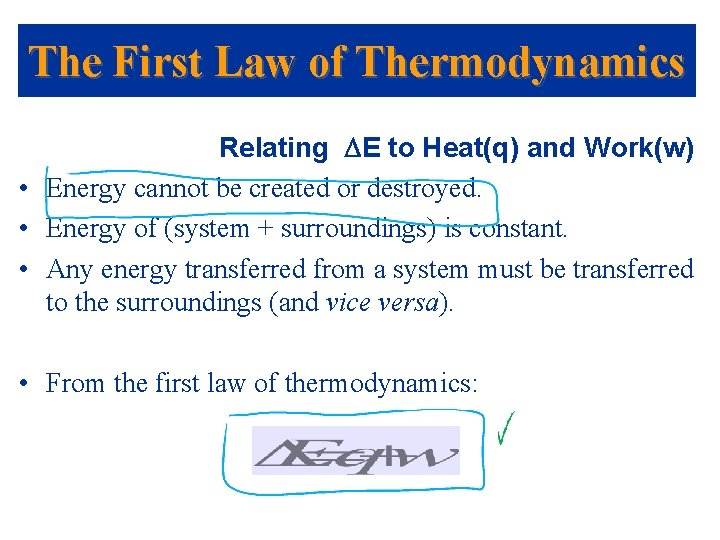
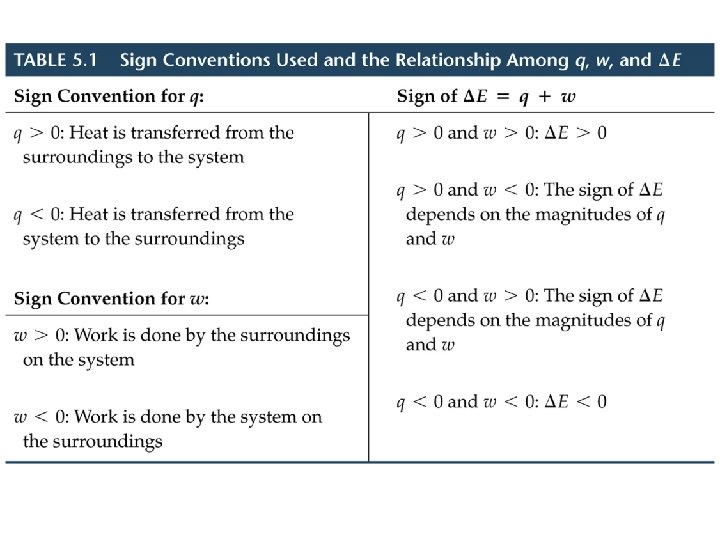
The First Law of Thermodynamics Relating DE to Heat(q) and Work(w) • Energy cannot be created or destroyed. • Energy of (system + surroundings) is constant. • Any energy transferred from a system must be transferred to the surroundings (and vice versa). • From the first law of thermodynamics:
The First Law of Thermodynamics
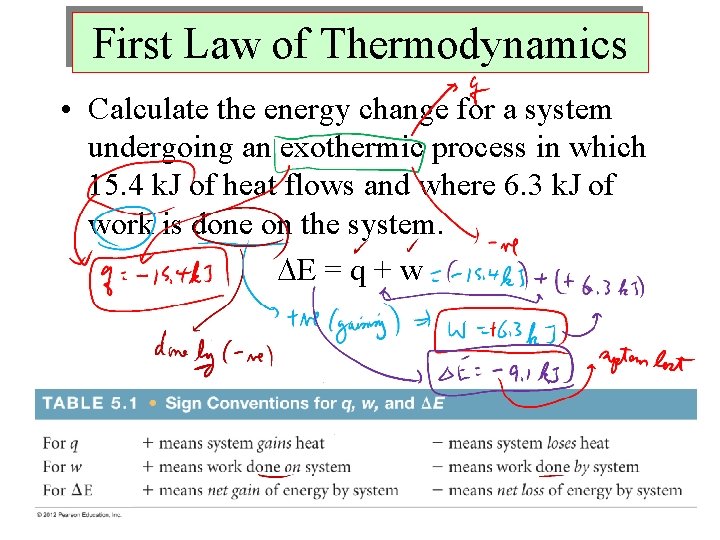
First Law of Thermodynamics • Calculate the energy change for a system undergoing an exothermic process in which 15. 4 k. J of heat flows and where 6. 3 k. J of work is done on the system. E = q + w
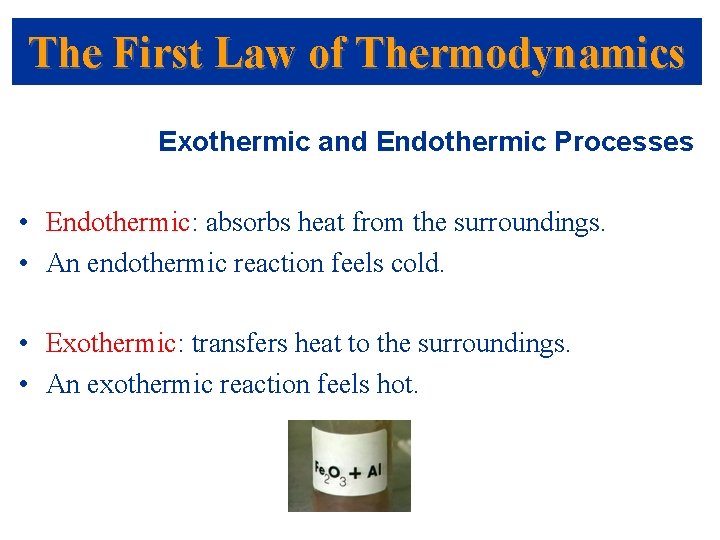
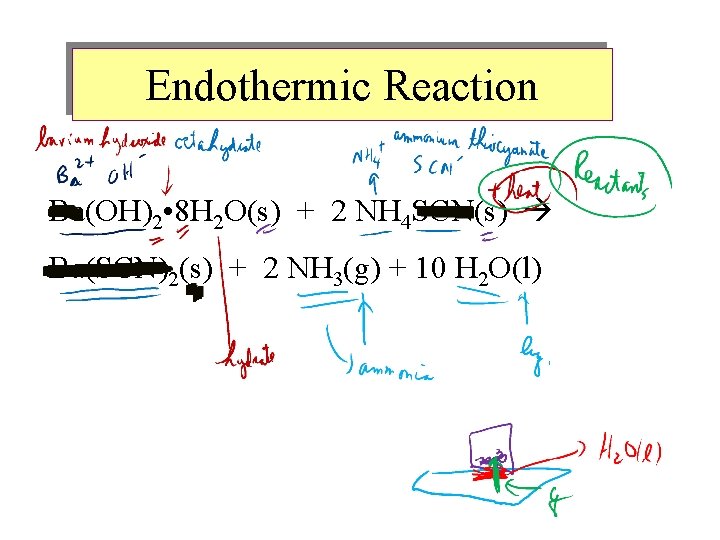
The First Law of Thermodynamics Exothermic and Endothermic Processes • Endothermic: absorbs heat from the surroundings. • An endothermic reaction feels cold. • Exothermic: transfers heat to the surroundings. • An exothermic reaction feels hot.
Endothermic Reaction Ba(OH)2 • 8 H 2 O(s) + 2 NH 4 SCN(s) Ba(SCN)2(s) + 2 NH 3(g) + 10 H 2 O(l)
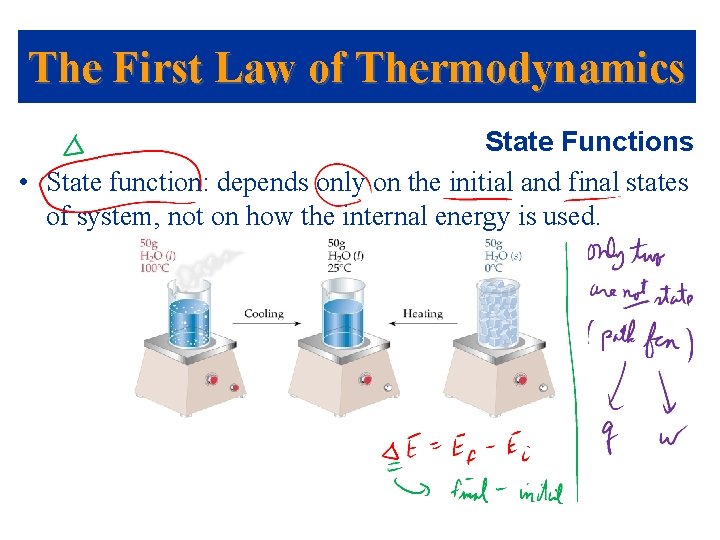
The First Law of Thermodynamics State Functions • State function: depends only on the initial and final states of system, not on how the internal energy is used.
The First Law of Thermodynamics
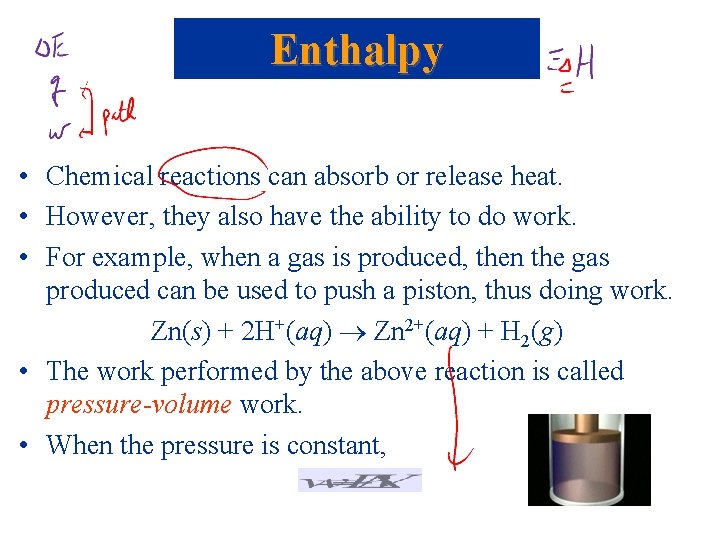
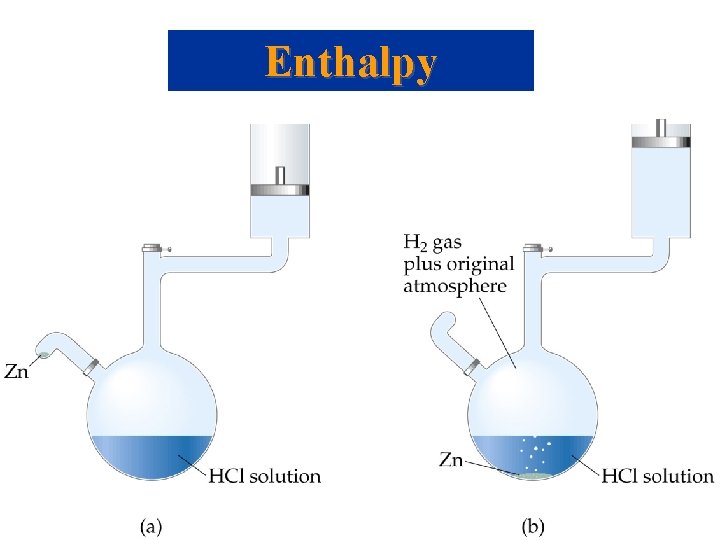
Enthalpy • Chemical reactions can absorb or release heat. • However, they also have the ability to do work. • For example, when a gas is produced, then the gas produced can be used to push a piston, thus doing work. Zn(s) + 2 H+(aq) Zn 2+(aq) + H 2(g) • The work performed by the above reaction is called pressure-volume work. • When the pressure is constant,
Enthalpy
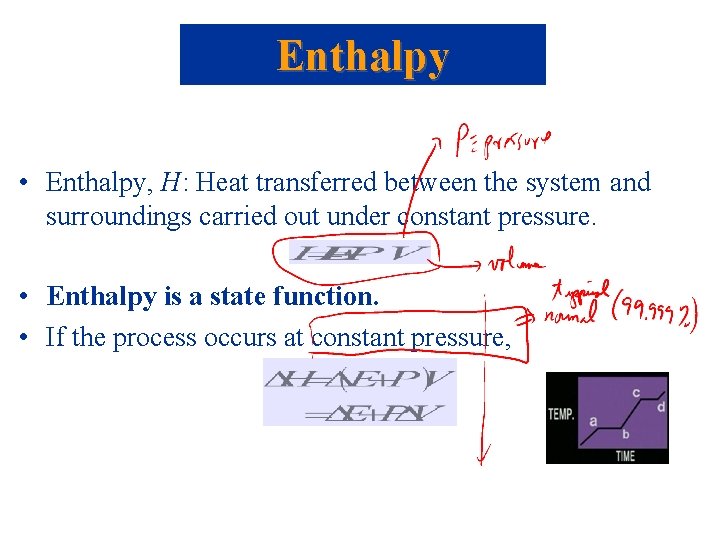
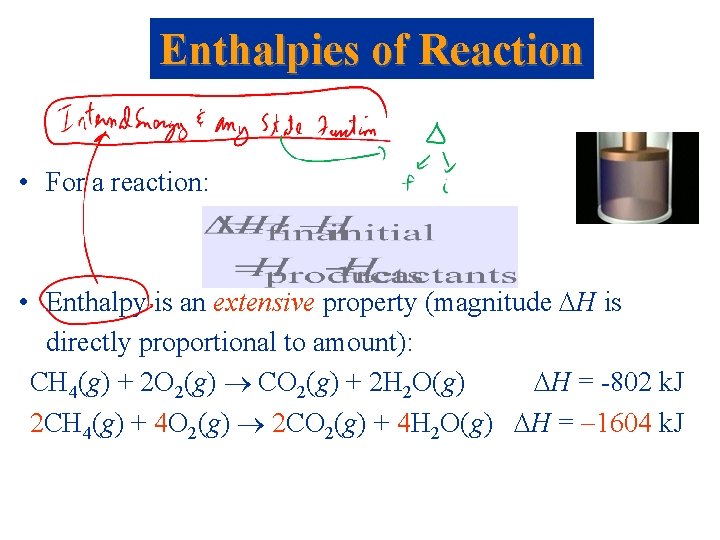
Enthalpy • Enthalpy, H: Heat transferred between the system and surroundings carried out under constant pressure. • Enthalpy is a state function. • If the process occurs at constant pressure,
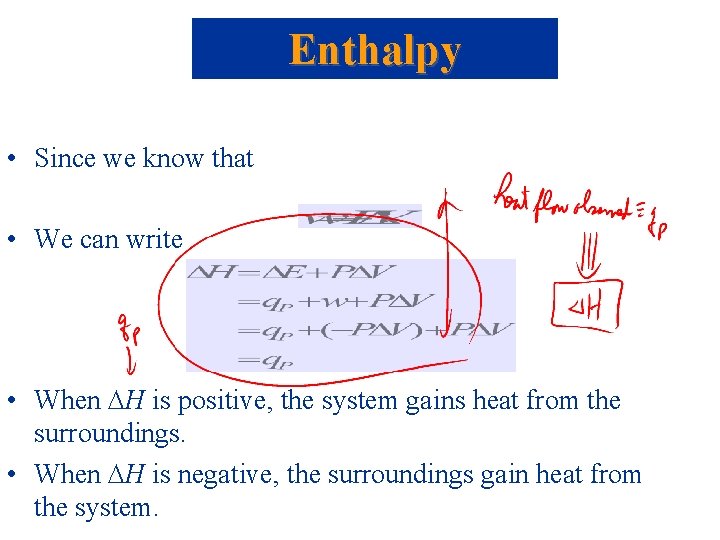
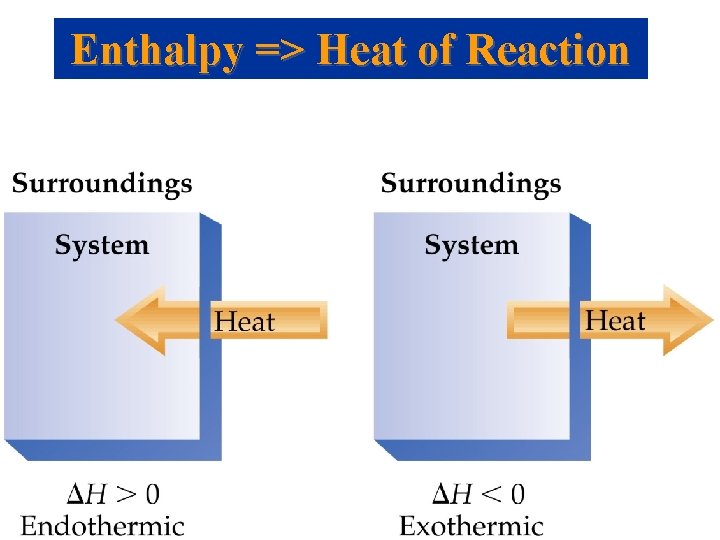
Enthalpy • Since we know that • We can write • When H is positive, the system gains heat from the surroundings. • When H is negative, the surroundings gain heat from the system.
Enthalpy => Heat of Reaction
Enthalpies of Reaction • For a reaction: • Enthalpy is an extensive property (magnitude H is directly proportional to amount): CH 4(g) + 2 O 2(g) CO 2(g) + 2 H 2 O(g) H = -802 k. J 2 CH 4(g) + 4 O 2(g) 2 CO 2(g) + 4 H 2 O(g) H = -1604 k. J
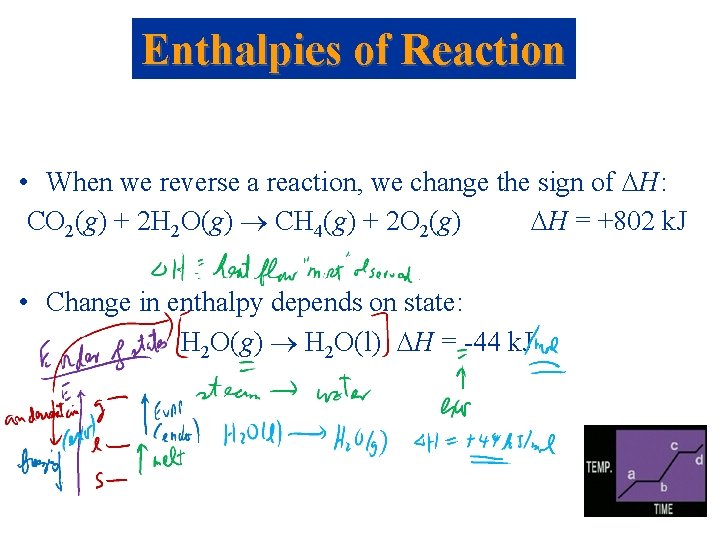
Enthalpies of Reaction • When we reverse a reaction, we change the sign of H: CO 2(g) + 2 H 2 O(g) CH 4(g) + 2 O 2(g) H = +802 k. J • Change in enthalpy depends on state: H 2 O(g) H 2 O(l) H = -44 k. J
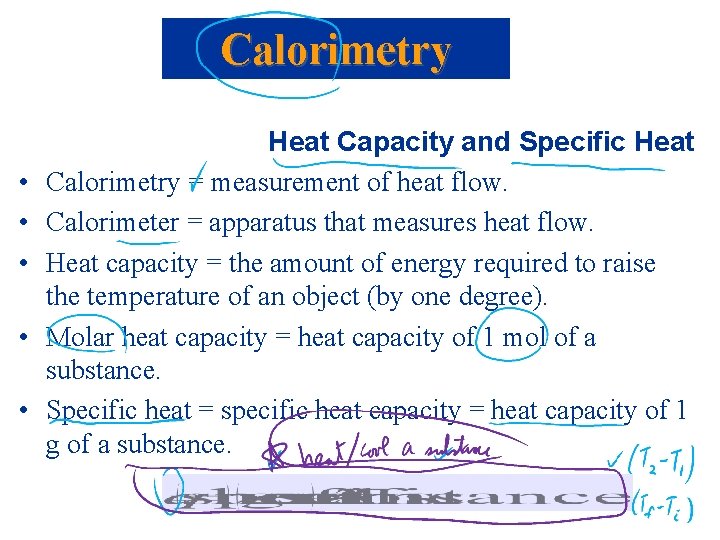
Calorimetry • • • Heat Capacity and Specific Heat Calorimetry = measurement of heat flow. Calorimeter = apparatus that measures heat flow. Heat capacity = the amount of energy required to raise the temperature of an object (by one degree). Molar heat capacity = heat capacity of 1 mol of a substance. Specific heat = specific heat capacity = heat capacity of 1 g of a substance.
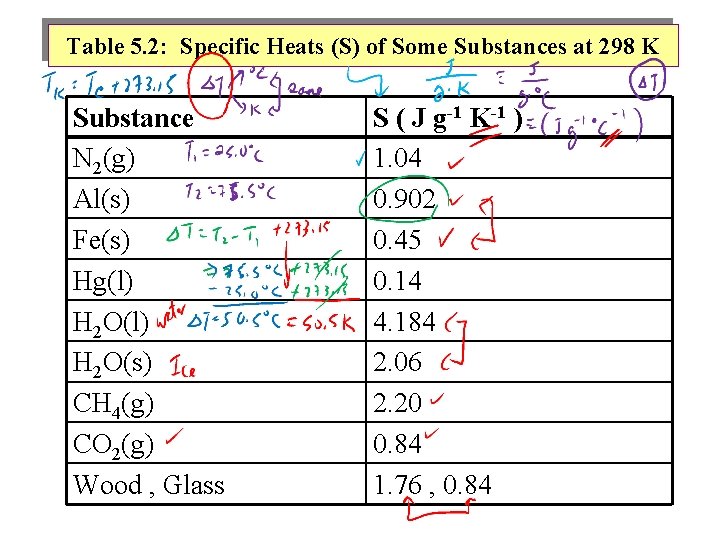
Table 5. 2: Specific Heats (S) of Some Substances at 298 K Substance N 2(g) Al(s) Fe(s) Hg(l) H 2 O(s) CH 4(g) CO 2(g) Wood , Glass S ( J g-1 K-1 ) 1. 04 0. 902 0. 45 0. 14 4. 184 2. 06 2. 20 0. 84 1. 76 , 0. 84
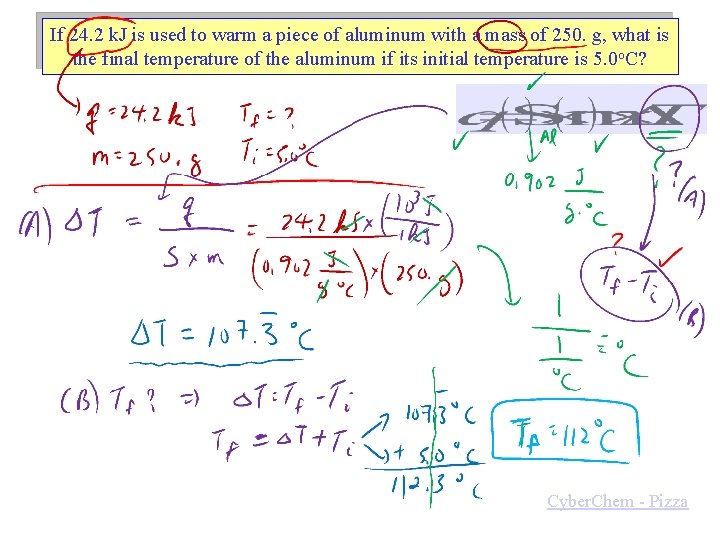
If 24. 2 k. J is used to warm a piece of aluminum with a mass of 250. g, what is the final temperature of the aluminum if its initial temperature is 5. 0 o. C? Cyber. Chem - Pizza
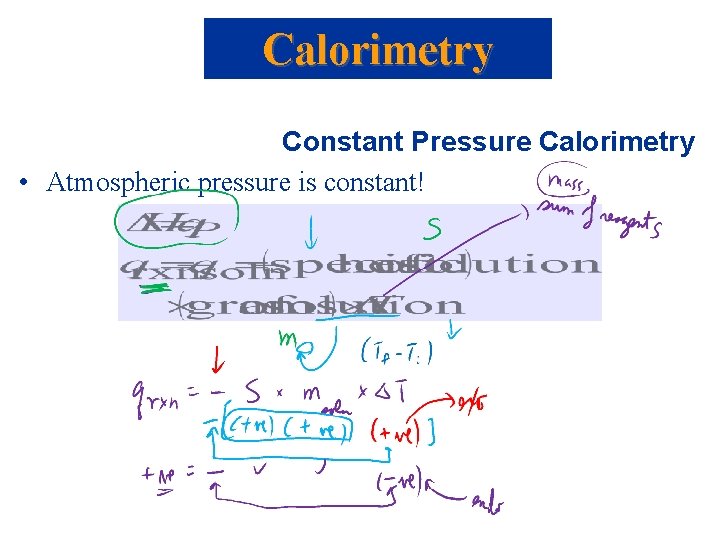
Calorimetry Constant Pressure Calorimetry • Atmospheric pressure is constant!
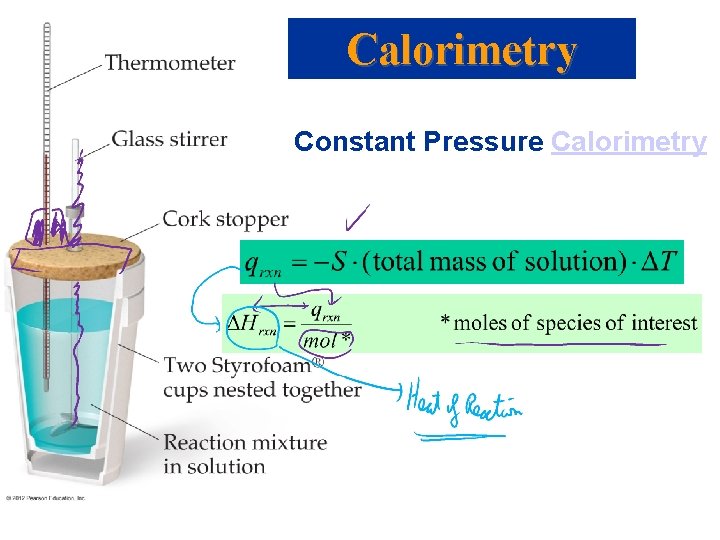
Calorimetry Constant Pressure Calorimetry
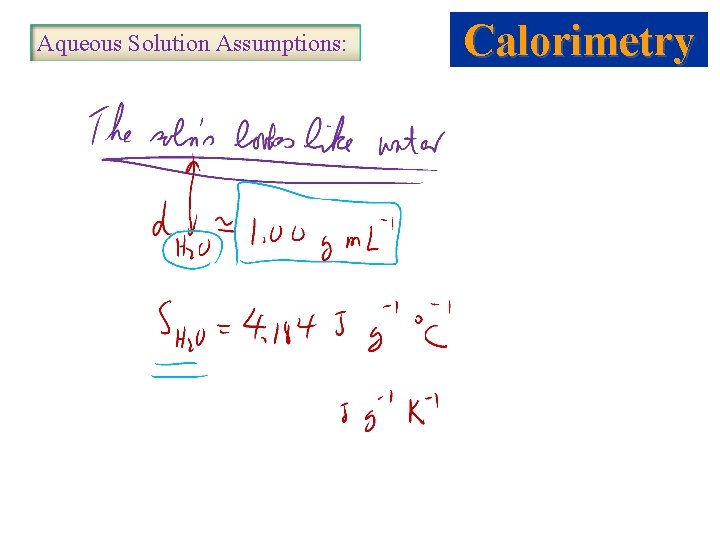
Aqueous Solution Assumptions: Calorimetry
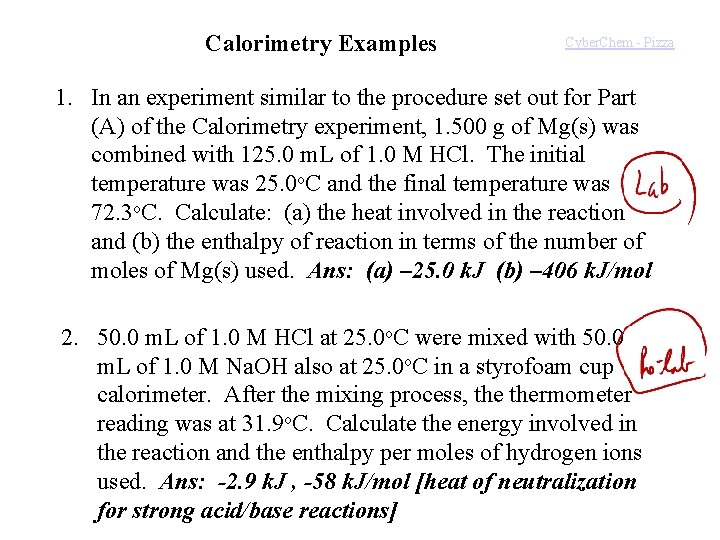
Calorimetry Examples Cyber. Chem - Pizza 1. In an experiment similar to the procedure set out for Part (A) of the Calorimetry experiment, 1. 500 g of Mg(s) was combined with 125. 0 m. L of 1. 0 M HCl. The initial temperature was 25. 0 o. C and the final temperature was 72. 3 o. C. Calculate: (a) the heat involved in the reaction and (b) the enthalpy of reaction in terms of the number of moles of Mg(s) used. Ans: (a) – 25. 0 k. J (b) – 406 k. J/mol 2. 50. 0 m. L of 1. 0 M HCl at 25. 0 o. C were mixed with 50. 0 m. L of 1. 0 M Na. OH also at 25. 0 o. C in a styrofoam cup calorimeter. After the mixing process, thermometer reading was at 31. 9 o. C. Calculate the energy involved in the reaction and the enthalpy per moles of hydrogen ions used. Ans: -2. 9 k. J , -58 k. J/mol [heat of neutralization for strong acid/base reactions]
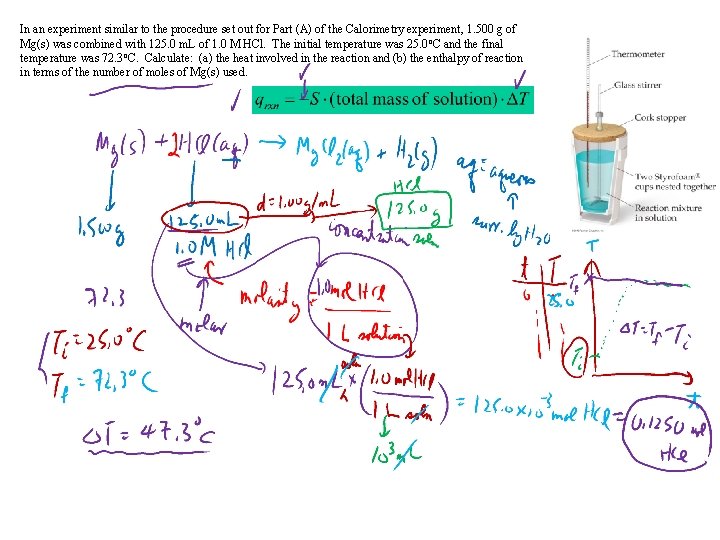
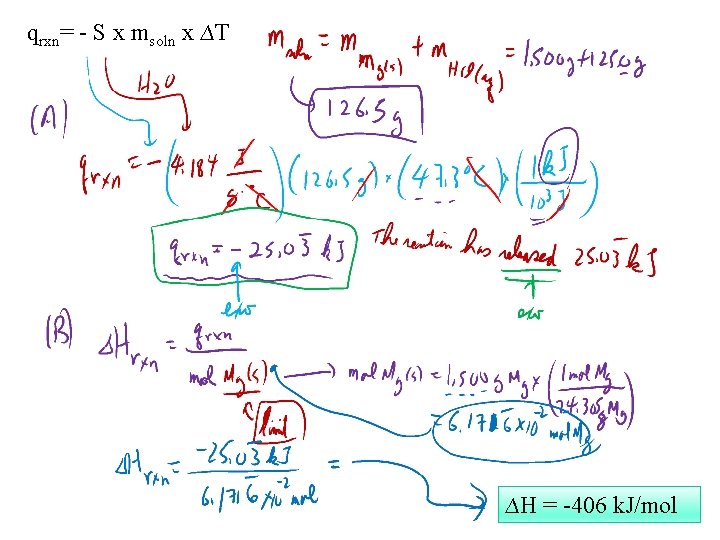
In an experiment similar to the procedure set out for Part (A) of the Calorimetry experiment, 1. 500 g of Mg(s) was combined with 125. 0 m. L of 1. 0 M HCl. The initial temperature was 25. 0 o. C and the final temperature was 72. 3 o. C. Calculate: (a) the heat involved in the reaction and (b) the enthalpy of reaction in terms of the number of moles of Mg(s) used.
qrxn= - S x msoln x ∆T ∆H = -406 k. J/mol
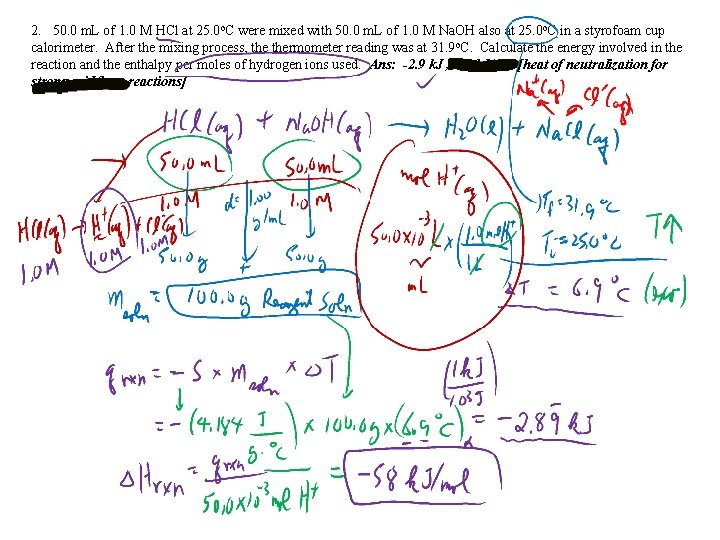
2. 50. 0 m. L of 1. 0 M HCl at 25. 0 o. C were mixed with 50. 0 m. L of 1. 0 M Na. OH also at 25. 0 o. C in a styrofoam cup calorimeter. After the mixing process, thermometer reading was at 31. 9 o. C. Calculate the energy involved in the reaction and the enthalpy per moles of hydrogen ions used. Ans: -2. 9 k. J , -58 k. J/mol [heat of neutralization for strong acid/base reactions]
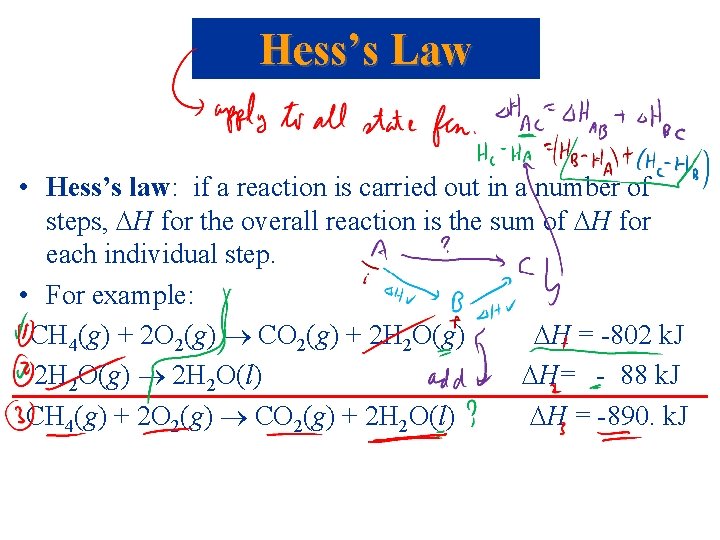
Hess’s Law • Hess’s law: if a reaction is carried out in a number of steps, H for the overall reaction is the sum of H for each individual step. • For example: CH 4(g) + 2 O 2(g) CO 2(g) + 2 H 2 O(g) H = -802 k. J 2 H 2 O(g) 2 H 2 O(l) H= - 88 k. J CH 4(g) + 2 O 2(g) CO 2(g) + 2 H 2 O(l) H = -890. k. J
Another Example of Hess’s Law Given: C(s) + ½ O 2(g) CO(g) H = -110. 5 k. J CO 2(g) CO(g) + ½ O 2(g) H = 283. 0 k. J Calculate H for: C(s) + O 2(g) CO 2(g)
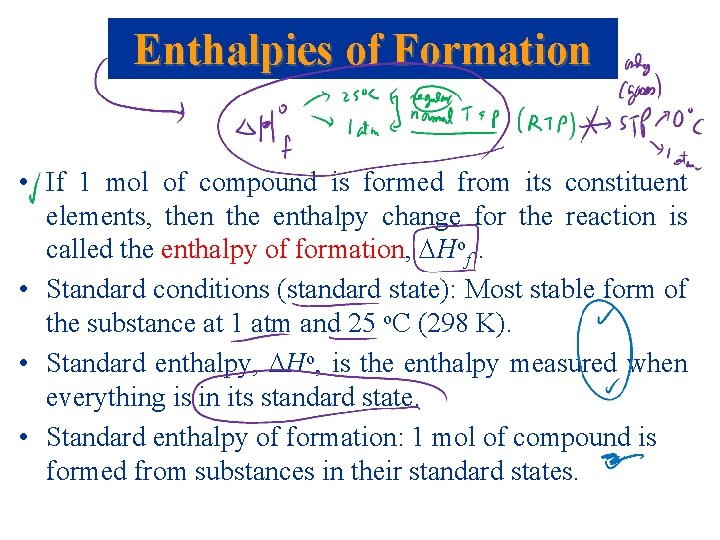
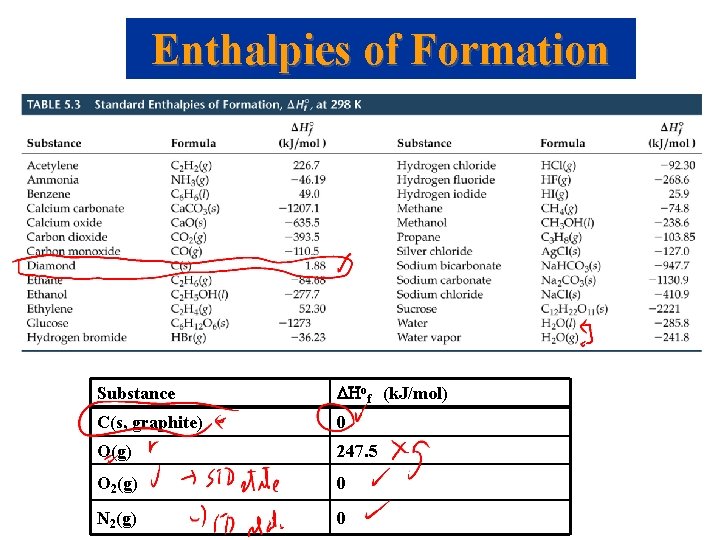
Enthalpies of Formation • If 1 mol of compound is formed from its constituent elements, then the enthalpy change for the reaction is called the enthalpy of formation, Hof. • Standard conditions (standard state): Most stable form of the substance at 1 atm and 25 o. C (298 K). • Standard enthalpy, Ho, is the enthalpy measured when everything is in its standard state. • Standard enthalpy of formation: 1 mol of compound is formed from substances in their standard states.
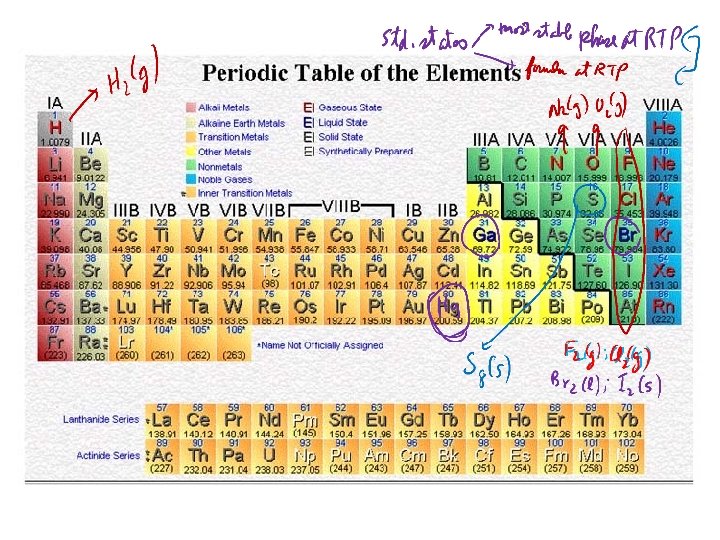
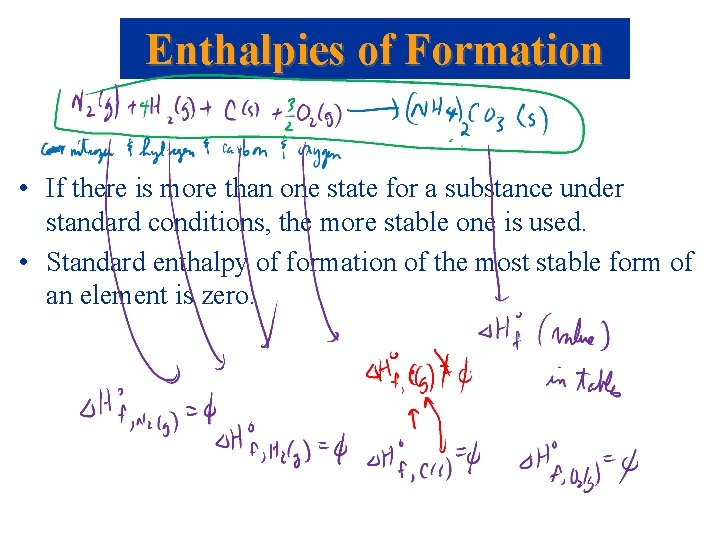
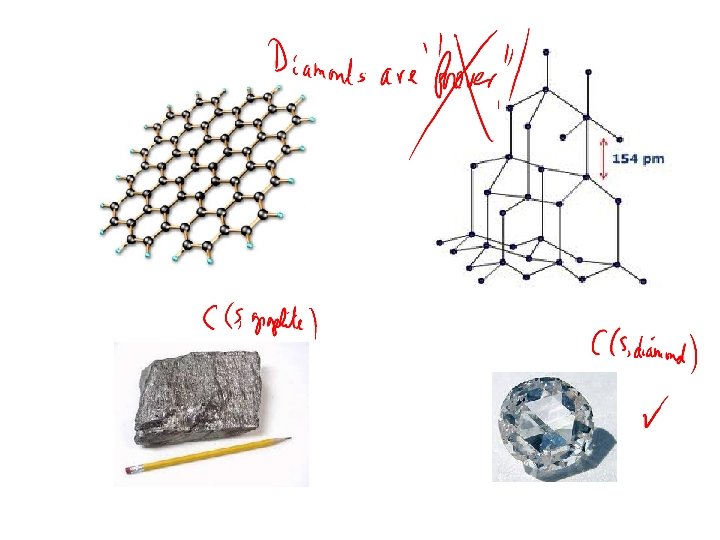
Enthalpies of Formation • If there is more than one state for a substance under standard conditions, the more stable one is used. • Standard enthalpy of formation of the most stable form of an element is zero.
Enthalpies of Formation Substance DHof (k. J/mol) C(s, graphite) 0 O(g) 247. 5 O 2(g) 0 N 2(g) 0
Bucky Ball drawn by Hyper. Chem
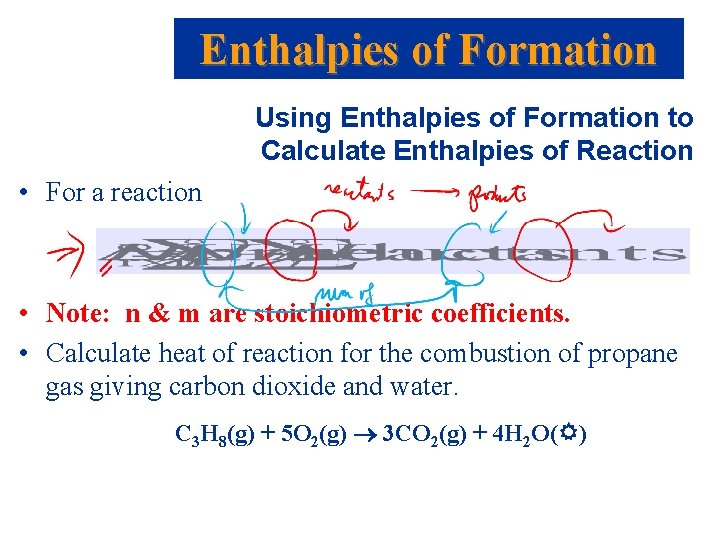
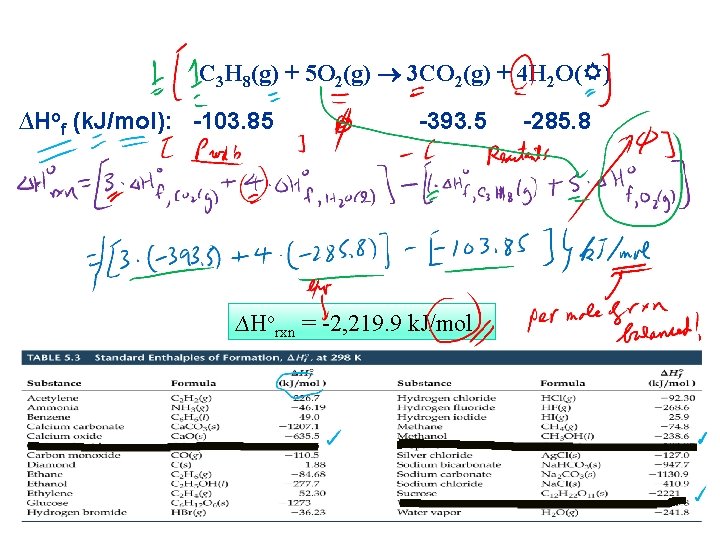
Enthalpies of Formation Using Enthalpies of Formation to Calculate Enthalpies of Reaction • For a reaction • Note: n & m are stoichiometric coefficients. • Calculate heat of reaction for the combustion of propane gas giving carbon dioxide and water. C 3 H 8(g) + 5 O 2(g) 3 CO 2(g) + 4 H 2 O( )
C 3 H 8(g) + 5 O 2(g) 3 CO 2(g) + 4 H 2 O( ) ∆Hof (k. J/mol): -103. 85 -393. 5 ∆Horxn = -2, 219. 9 k. J/mol -285. 8
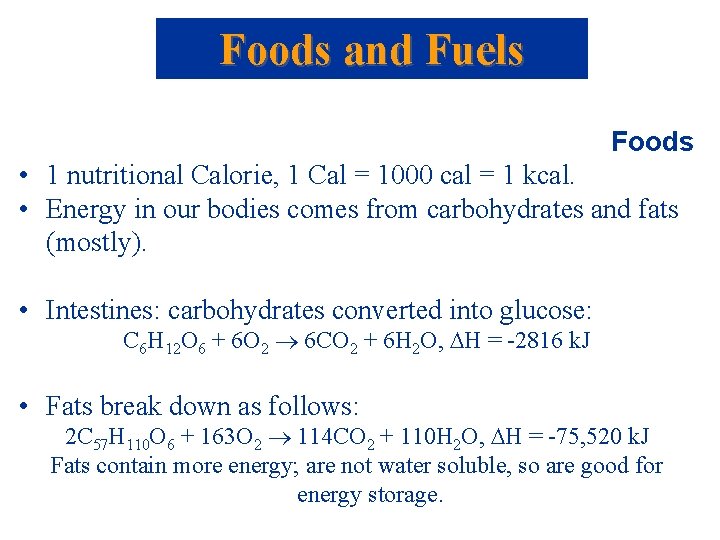
Foods and Fuels Foods • 1 nutritional Calorie, 1 Cal = 1000 cal = 1 kcal. • Energy in our bodies comes from carbohydrates and fats (mostly). • Intestines: carbohydrates converted into glucose: C 6 H 12 O 6 + 6 O 2 6 CO 2 + 6 H 2 O, H = -2816 k. J • Fats break down as follows: 2 C 57 H 110 O 6 + 163 O 2 114 CO 2 + 110 H 2 O, H = -75, 520 k. J Fats contain more energy; are not water soluble, so are good for energy storage.
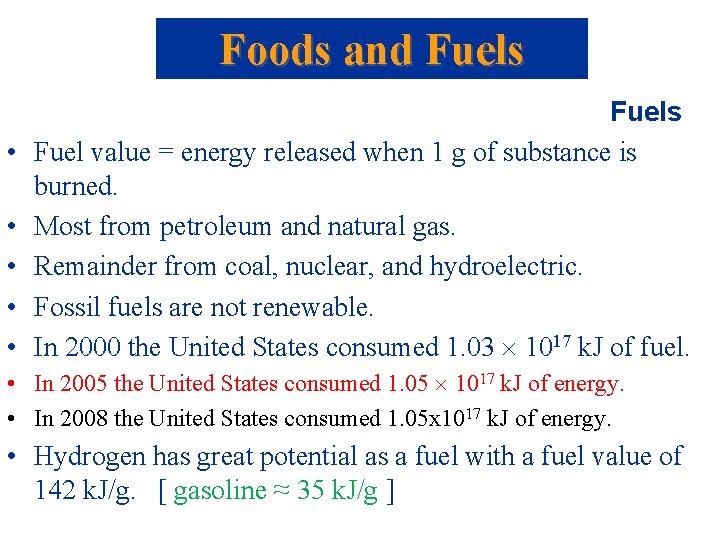
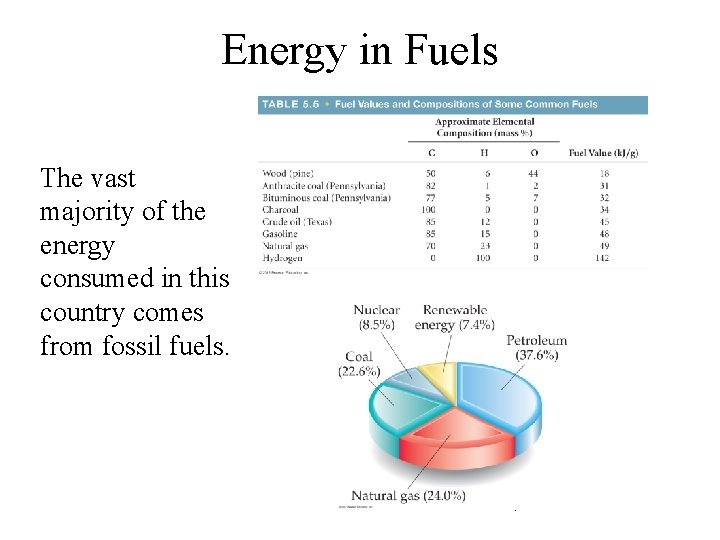
Foods and Fuels • • • Fuels Fuel value = energy released when 1 g of substance is burned. Most from petroleum and natural gas. Remainder from coal, nuclear, and hydroelectric. Fossil fuels are not renewable. In 2000 the United States consumed 1. 03 1017 k. J of fuel. • In 2005 the United States consumed 1. 05 1017 k. J of energy. • In 2008 the United States consumed 1. 05 x 1017 k. J of energy. • Hydrogen has great potential as a fuel with a fuel value of 142 k. J/g. [ gasoline ≈ 35 k. J/g ]
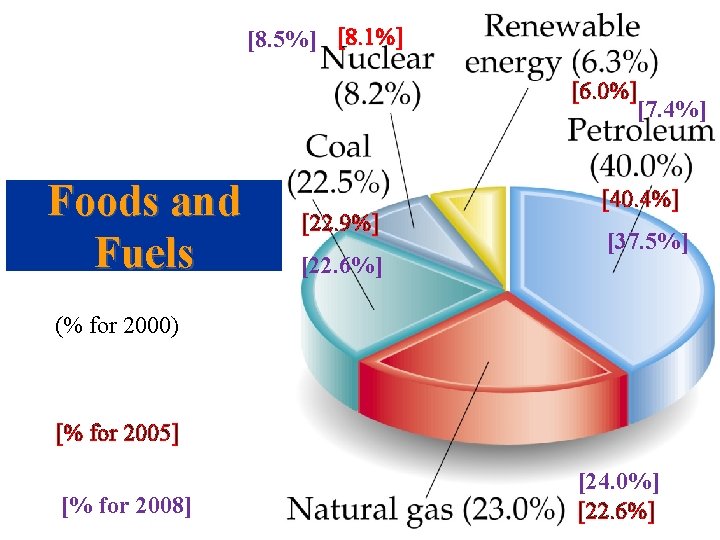
[8. 5%] [8. 1%] [6. 0%] Foods and Fuels [22. 9%] [22. 6%] [7. 4%] [40. 4%] [37. 5%] (% for 2000) [% for 2005] [% for 2008] [24. 0%] [22. 6%]
Energy in Fuels The vast majority of the energy consumed in this country comes from fossil fuels. © 2012 Pearson Education, Inc.
Cyber. Chem - Pizza Thermochemistry