
Chapter 2 The First Law Unit 4 thermochemistry
- Slides: 28
Chapter 2 The First Law Unit 4 thermochemistry Spring 2009
Thermochemistry • The study of the energy transferred as heat during the course of chemical reactions is called thermochemistry.
Thermochemistry • we can use calorimetry to measure the energy supplied or discarded as heat by a reaction. • We can identify q with a change in internal energy DU (if the reaction occurs at constant volume) or a change in enthalpy DH (if the reaction occurs at constant pressure).
Thermochemistry • an exothermic process at constant pressure ∆H < 0. • an endothermic process at constant pressure ∆H > 0.
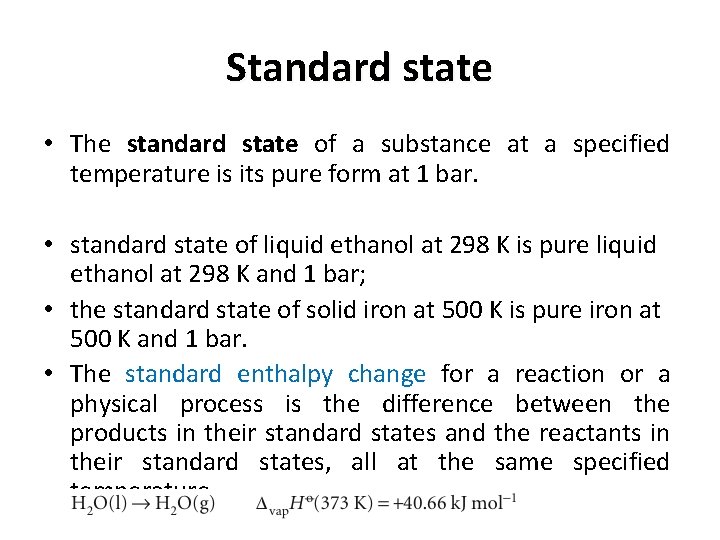
Standard state • The standard state of a substance at a specified temperature is its pure form at 1 bar. • standard state of liquid ethanol at 298 K is pure liquid ethanol at 298 K and 1 bar; • the standard state of solid iron at 500 K is pure iron at 500 K and 1 bar. • The standard enthalpy change for a reaction or a physical process is the difference between the products in their standard states and the reactants in their standard states, all at the same specified temperature.
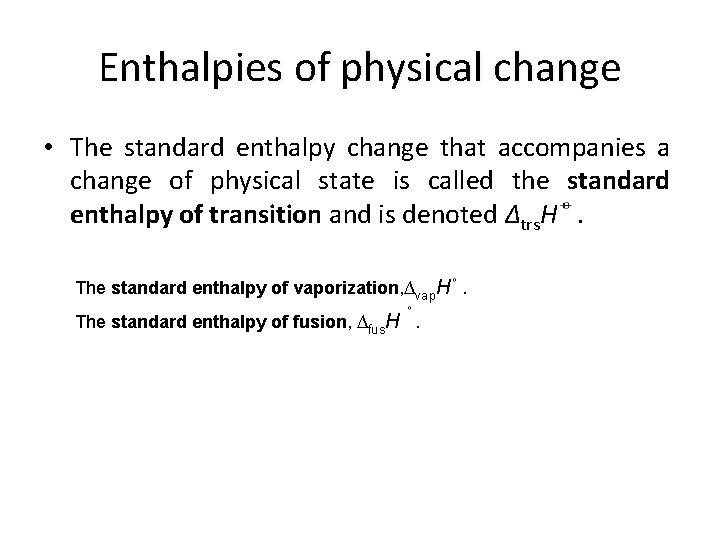
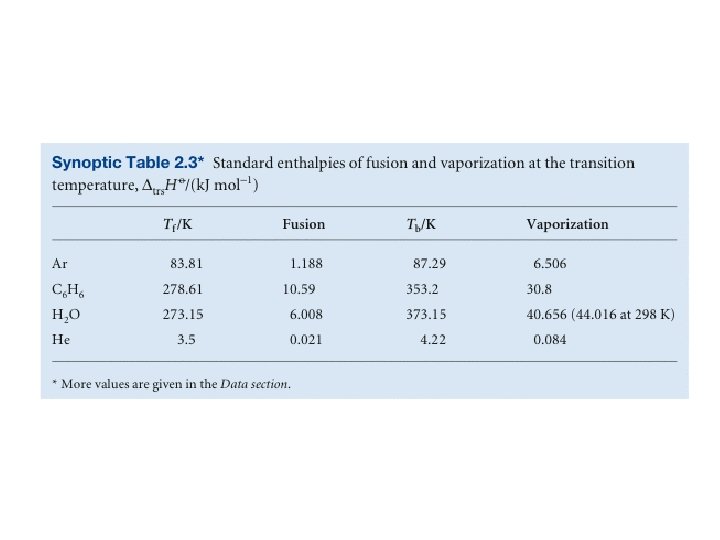
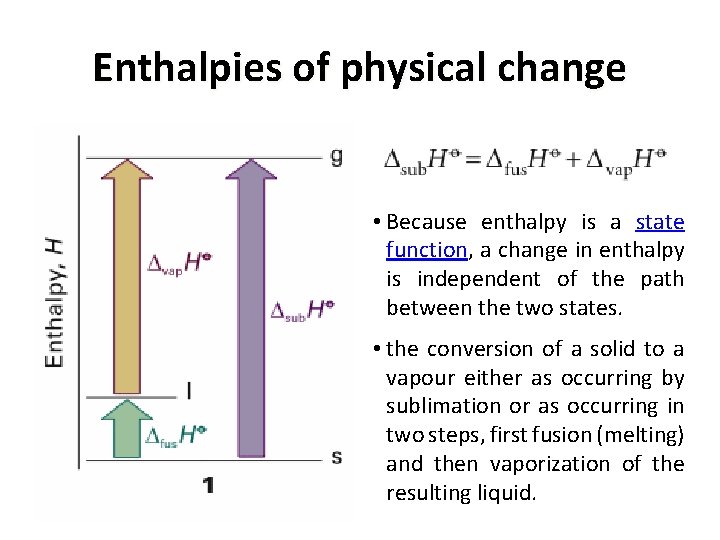
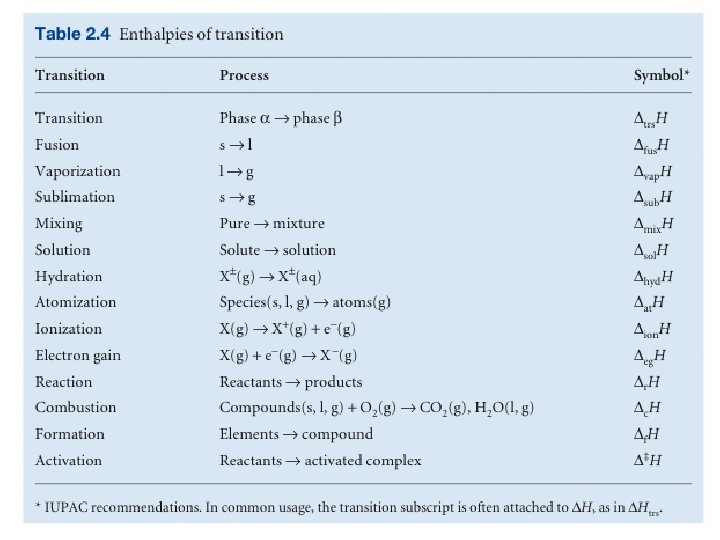
Enthalpies of physical change • The standard enthalpy change that accompanies a change of physical state is called the standard enthalpy of transition and is denoted ∆trs. H. The standard enthalpy of vaporization, ∆vap. H. The standard enthalpy of fusion, ∆fus. H .
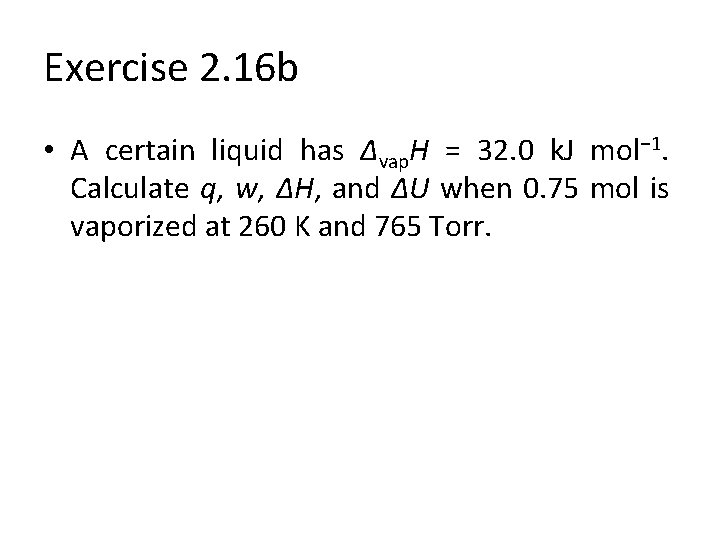
Exercise 2. 16 b • A certain liquid has ∆vap. H = 32. 0 k. J mol− 1. Calculate q, w, ∆H, and ∆U when 0. 75 mol is vaporized at 260 K and 765 Torr.
Enthalpies of physical change • Because enthalpy is a state function, a change in enthalpy is independent of the path between the two states. • the conversion of a solid to a vapour either as occurring by sublimation or as occurring in two steps, first fusion (melting) and then vaporization of the resulting liquid.
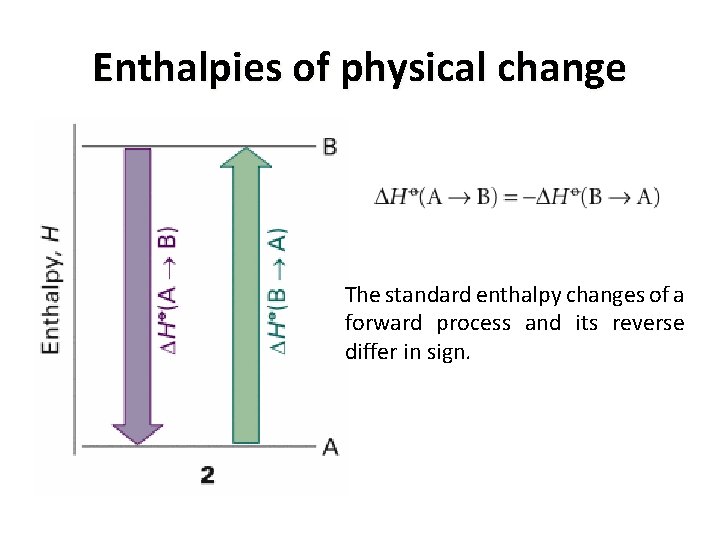
Enthalpies of physical change The standard enthalpy changes of a forward process and its reverse differ in sign.
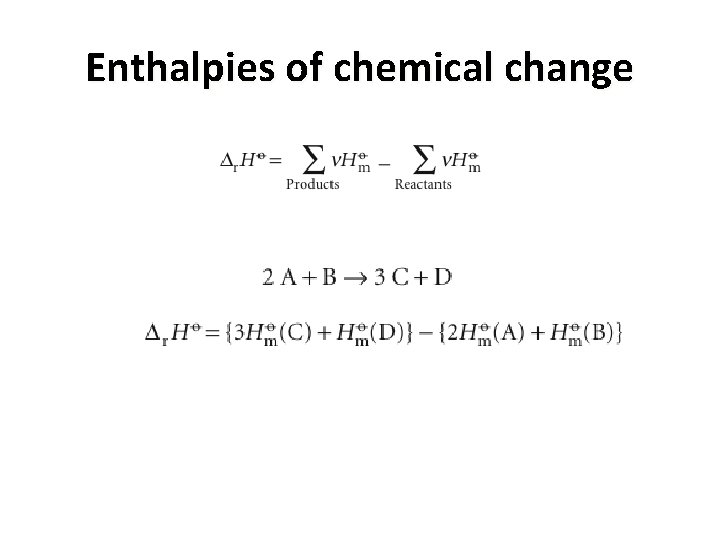
Enthalpies of chemical change
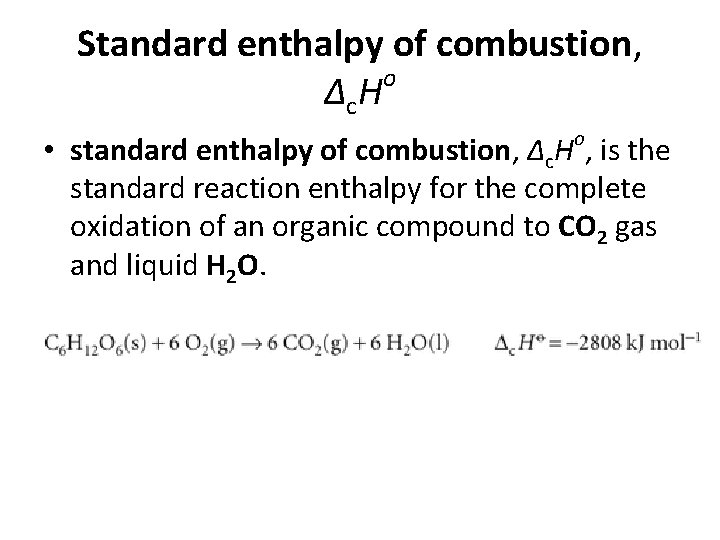
Standard enthalpy of combustion, o ∆c. H • standard enthalpy of combustion, ∆c. Ho, is the standard reaction enthalpy for the complete oxidation of an organic compound to CO 2 gas and liquid H 2 O.
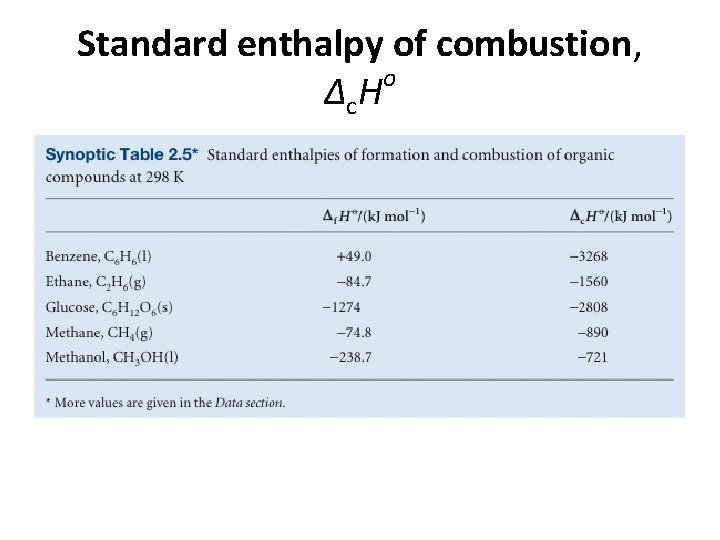
Standard enthalpy of combustion, o ∆c. H
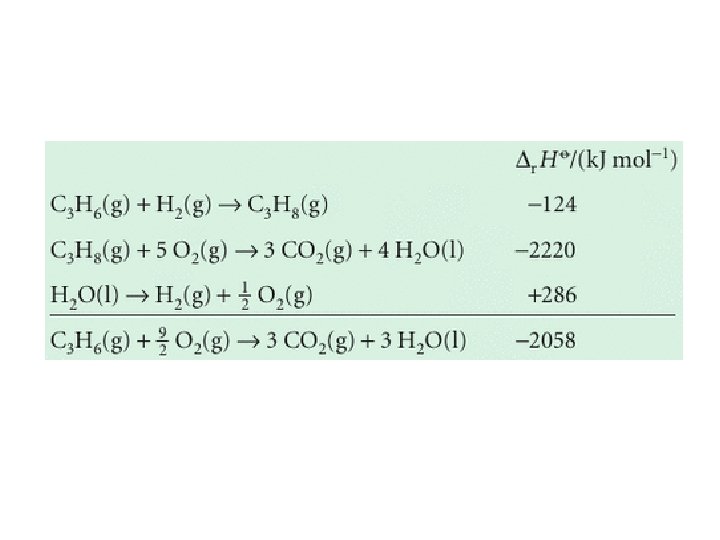
Hess’s law • The standard enthalpy of an overall reaction is the sum of the standard enthalpies of the individual reactions into which a reaction may be divided.
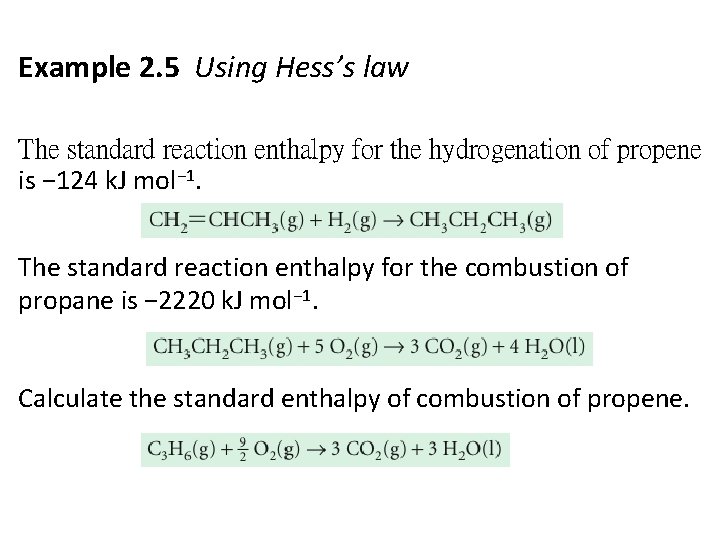
Example 2. 5 Using Hess’s law The standard reaction enthalpy for the hydrogenation of propene is − 124 k. J mol− 1. The standard reaction enthalpy for the combustion of propane is − 2220 k. J mol− 1. Calculate the standard enthalpy of combustion of propene.
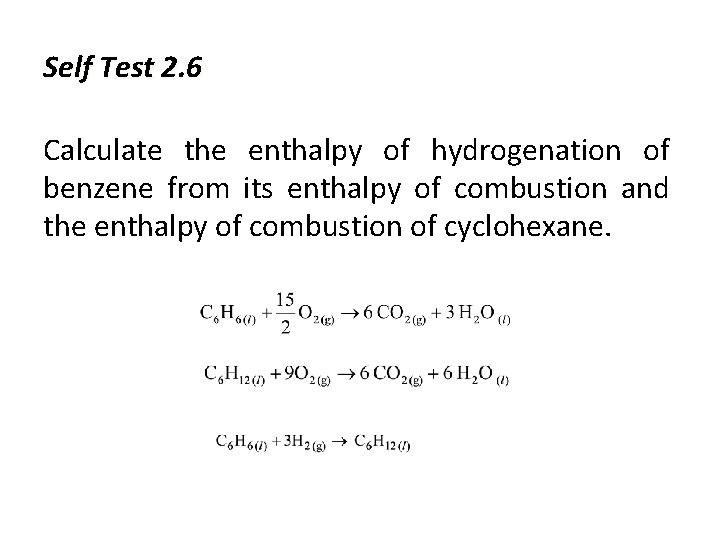
Self Test 2. 6 Calculate the enthalpy of hydrogenation of benzene from its enthalpy of combustion and the enthalpy of combustion of cyclohexane.
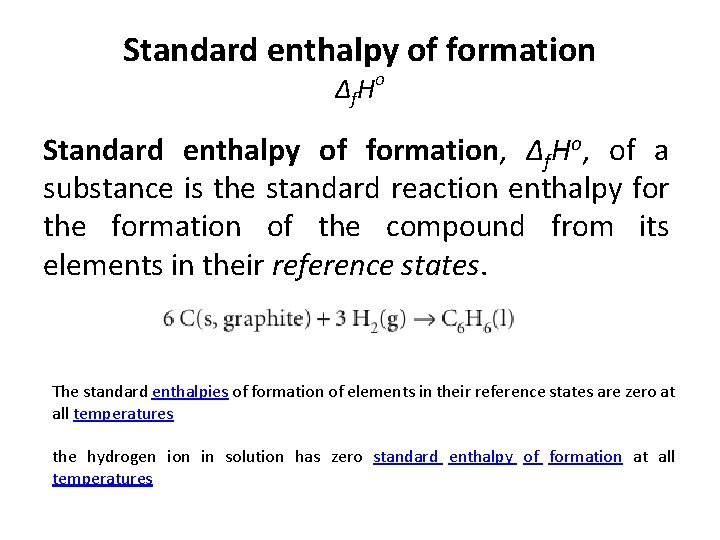
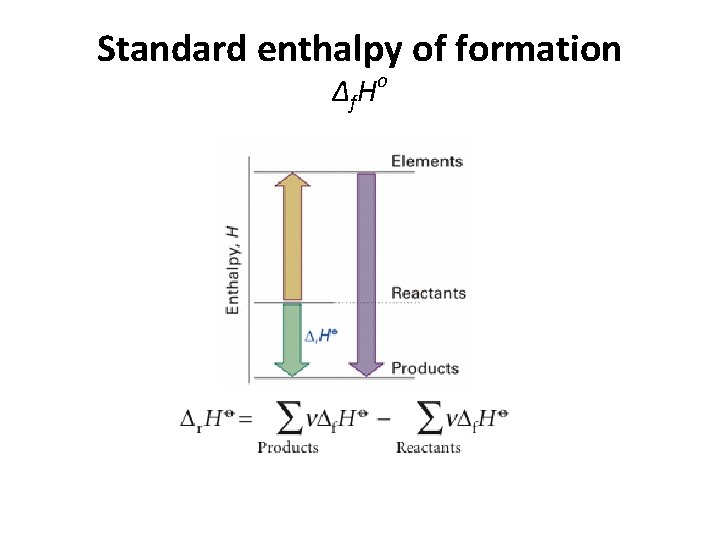
Standard enthalpy of formation ∆ f Ho Standard enthalpy of formation, ∆f. Ho, of a substance is the standard reaction enthalpy for the formation of the compound from its elements in their reference states. The standard enthalpies of formation of elements in their reference states are zero at all temperatures the hydrogen ion in solution has zero standard enthalpy of formation at all temperatures
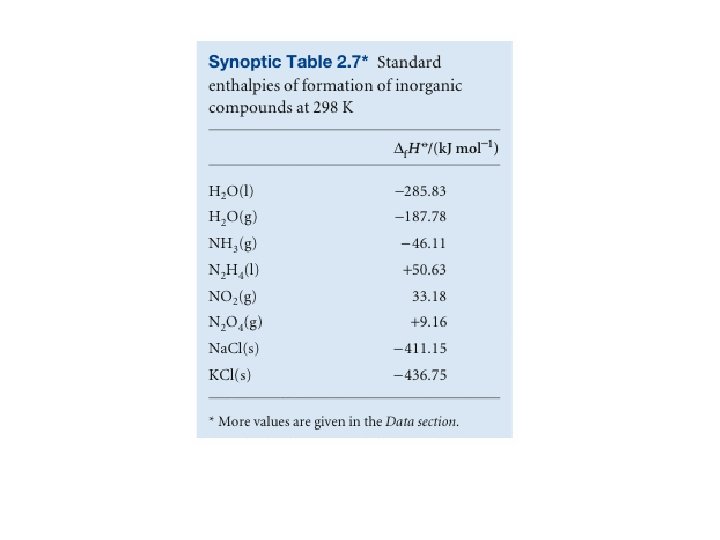
Standard enthalpy of formation ∆ f. H o
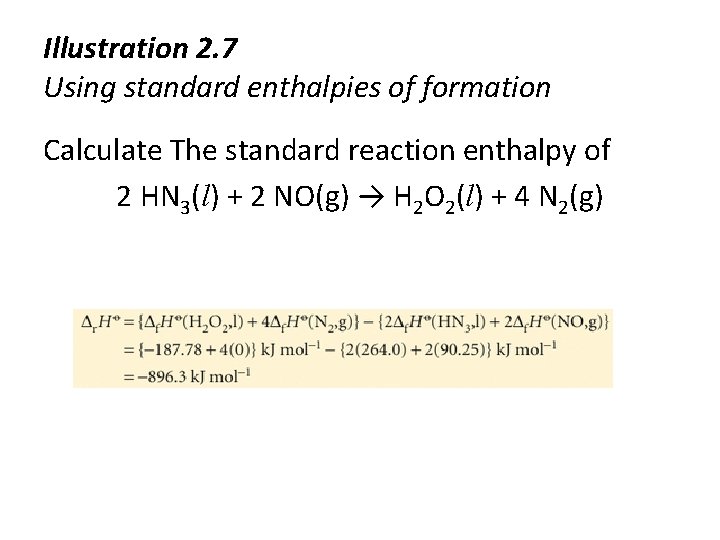
Illustration 2. 7 Using standard enthalpies of formation Calculate The standard reaction enthalpy of 2 HN 3(l) + 2 NO(g) → H 2 O 2(l) + 4 N 2(g)
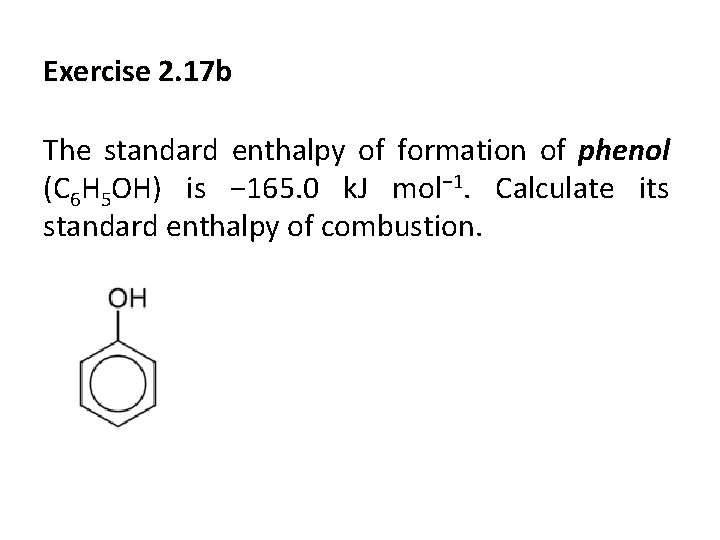
Exercise 2. 17 b The standard enthalpy of formation of phenol (C 6 H 5 OH) is − 165. 0 k. J mol− 1. Calculate its standard enthalpy of combustion.
Exercise 2. 18 a The standard enthalpy of combustion of cyclopropane is − 2091 k. J mol− 1 at 25°C. From this information and enthalpy of formation data for CO 2(g) and H 2 O(g), (a) calculate the enthalpy of formation of cyclopropane. (b) The enthalpy of formation of propene is +20. 42 k. J mol− 1. Calculate the enthalpy of isomerization of cyclopropane to propene.
Exercise 2. 18 a • From the following data, determine ∆f. H for diborane, B 2 H 6(g), at 298 K:
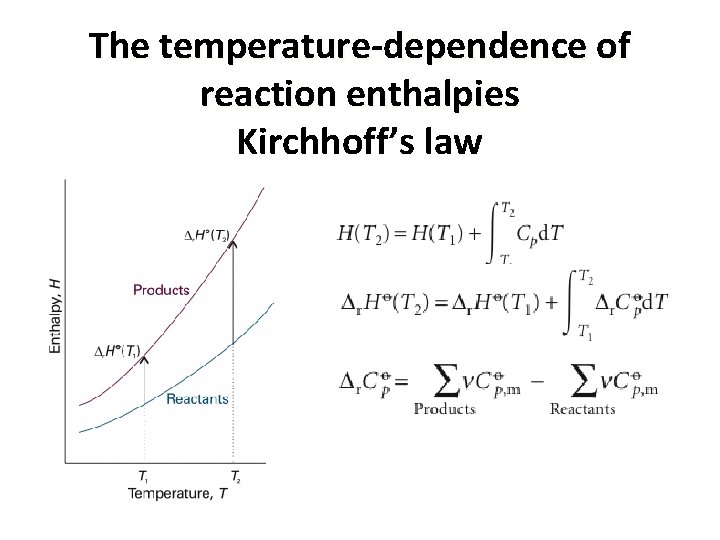
The temperature-dependence of reaction enthalpies Kirchhoff’s law
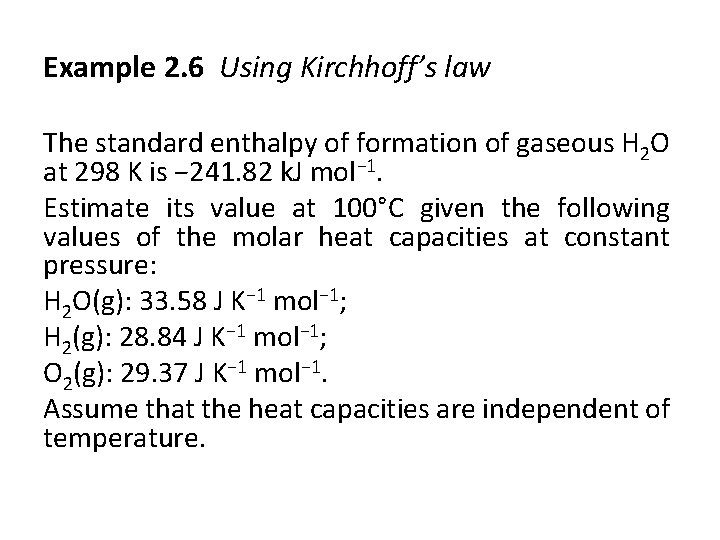
Example 2. 6 Using Kirchhoff’s law The standard enthalpy of formation of gaseous H 2 O at 298 K is − 241. 82 k. J mol− 1. Estimate its value at 100°C given the following values of the molar heat capacities at constant pressure: H 2 O(g): 33. 58 J K− 1 mol− 1; H 2(g): 28. 84 J K− 1 mol− 1; O 2(g): 29. 37 J K− 1 mol− 1. Assume that the heat capacities are independent of temperature.
• Estimate the standard enthalpy of formation of cyclohexene at 400 K.