
Thermochemistry The study of the changes in heat

- Slides: 9
Thermochemistry The study of the changes in heat energy that accompany chemical reactions and physical changes
Thermochemistry • Heat • a form of energy. • can be transferred between samples • heat flows from matter at a higher temperature to matter at a lower temperature • Temperature • a measure of the average kinetic energy of the particles in a sample.
Thermochemistry • Units of Heat • Joule (SI unit) • calorie • cal • the amount of energy required to raise the temperature of one gram of water one degree Celsius. • Calorie • Cal • a dietary calorie. • kilocalorie, kcal (1, 000 calories)
Thermochemistry • Enthalpy • the heat content of a system • represented by H • only changes in enthalpy can be measured • ∴ ΔH is used
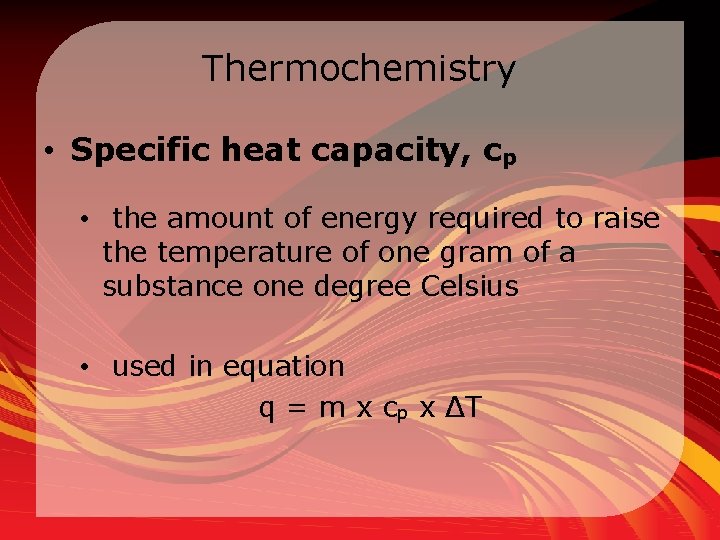
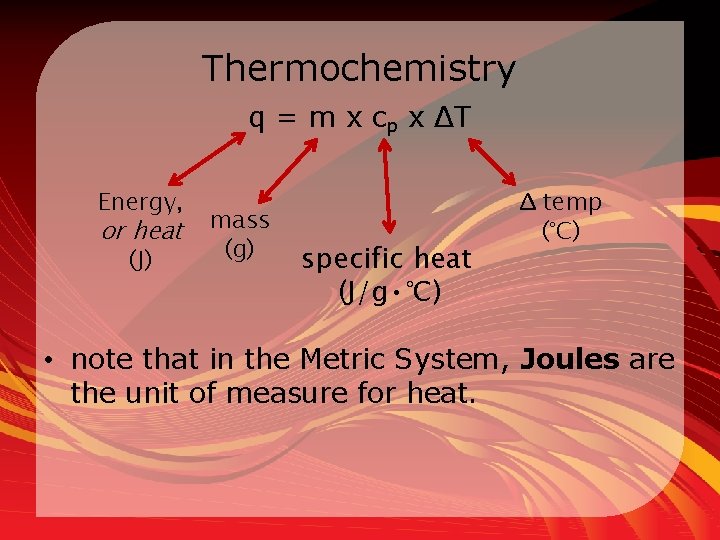
Thermochemistry • Specific heat capacity, cp • the amount of energy required to raise the temperature of one gram of a substance one degree Celsius • used in equation q = m x cp x ΔT
Thermochemistry q = m x cp x ΔT Energy, or heat (J) mass (g) specific heat (J/g • °C) Δ temp (°C) • note that in the Metric System, Joules are the unit of measure for heat.
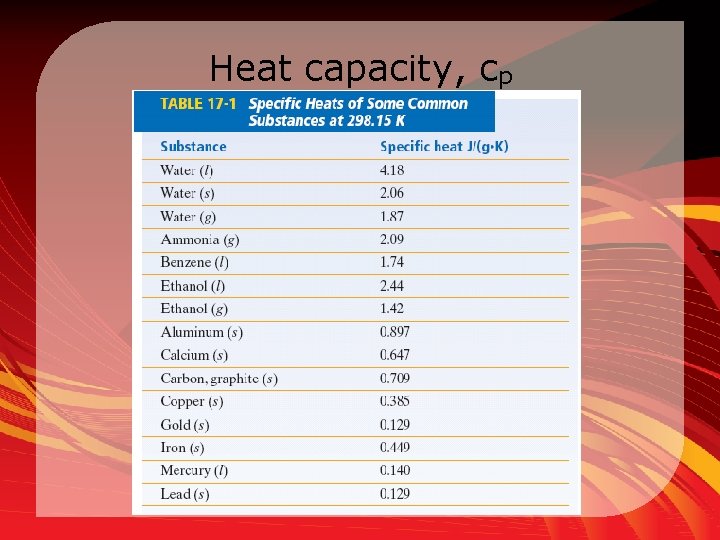
Heat capacity, cp
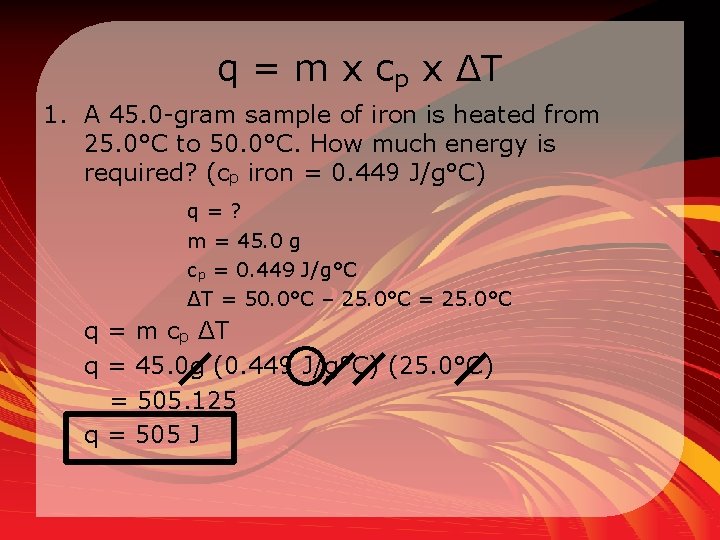
q = m x cp x ΔT 1. A 45. 0 -gram sample of iron is heated from 25. 0°C to 50. 0°C. How much energy is required? (cp iron = 0. 449 J/g°C) q=? m = 45. 0 g cp = 0. 449 J/g°C ΔT = 50. 0°C – 25. 0°C = 25. 0°C q = m cp ΔT q = 45. 0 g (0. 449 J/g°C) (25. 0°C) = 505. 125 q = 505 J
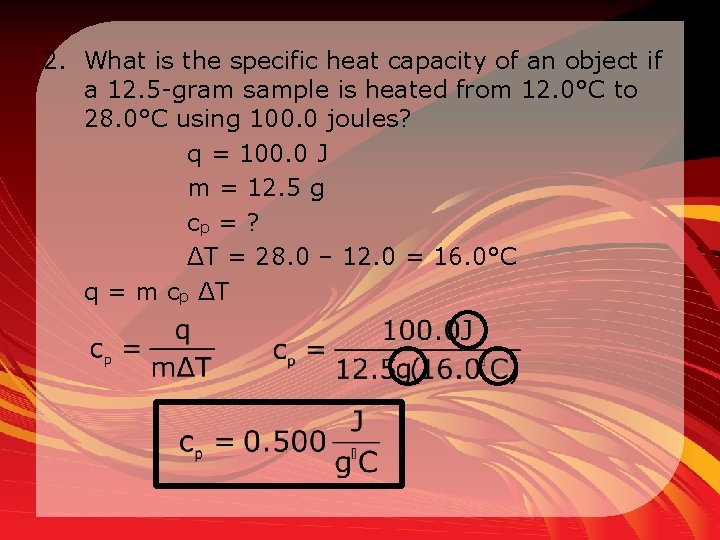
2. What is the specific heat capacity of an object if a 12. 5 -gram sample is heated from 12. 0°C to 28. 0°C using 100. 0 joules? q = 100. 0 J m = 12. 5 g cp = ? ΔT = 28. 0 – 12. 0 = 16. 0°C q = m cp ΔT