
Ch 6 Energy and Thermochemistry Energy Ability to
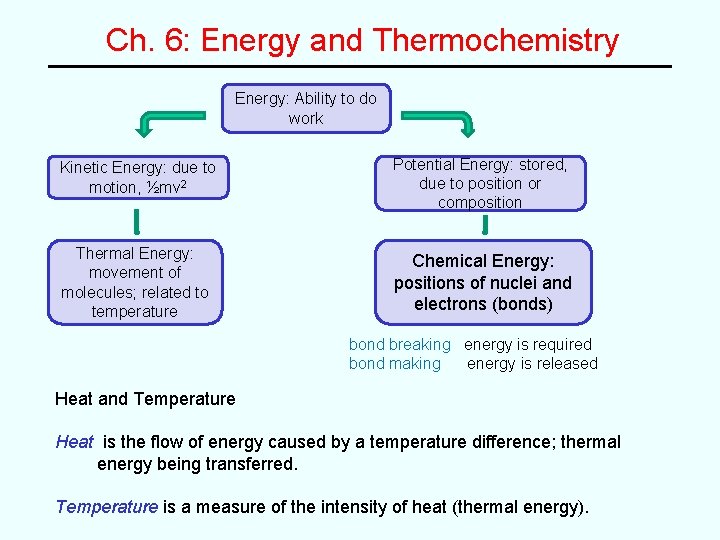
Ch. 6: Energy and Thermochemistry Energy: Ability to do work Kinetic Energy: due to motion, ½mv 2 Potential Energy: stored, due to position or composition Thermal Energy: movement of molecules; related to temperature Chemical Energy: positions of nuclei and electrons (bonds) bond breaking energy is required bond making energy is released Heat and Temperature Heat is the flow of energy caused by a temperature difference; thermal energy being transferred. Temperature is a measure of the intensity of heat (thermal energy).
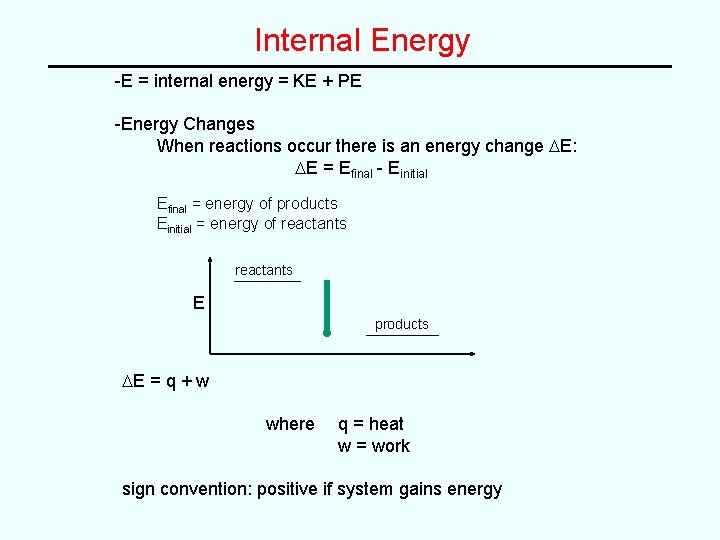
Internal Energy -E = internal energy = KE + PE -Energy Changes When reactions occur there is an energy change DE: DE = Efinal - Einitial Efinal = energy of products Einitial = energy of reactants E products DE = q + w where q = heat w = work sign convention: positive if system gains energy

Measuring Thermal Energy 1. Units of Energy (see Table 6. 1) kg • m 2/s 2 SI: 1 J = 1 1 cal = 4. 184 joule 1 kcal = 1 “Cal” memorize! (½mv 2) (exactly) 2. Heat Capacity, C --amount of heat required to raise the temp of substance by 1 °C units: energy/temp (J/°C or k. J/°C or cal/°C) quantity of heat = (heat capacity) x Dt 3. Specific Heat, Cs Heat Capacity of specified mass of substance (1 gram) units: usually J/g °C or cal/g °C e. g. specific heat of water = 1. 00 cal/g °C = 4. 18 J/g °C quantity of heat = (specific heat) x mass x Dt 4. Molar Heat Capacity: – Heat Capacity per mole of a substance – e. g. molar heat capacity of water = 18. 0 cal/mole °C = J/g °C x g x °C
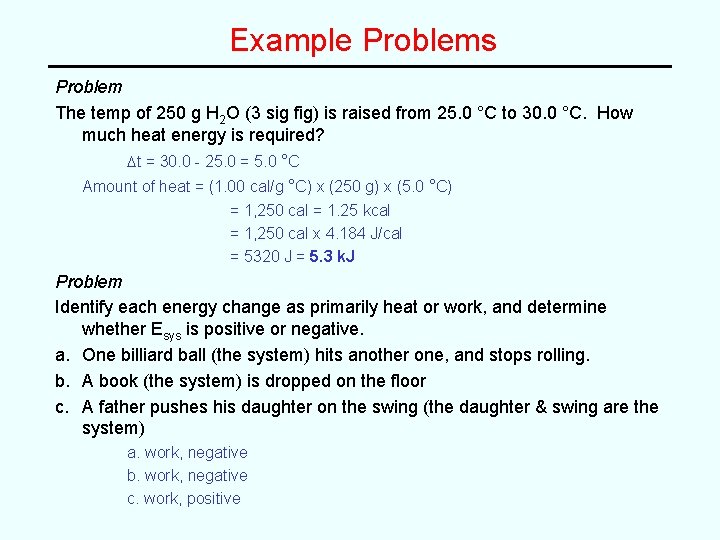
Example Problems Problem The temp of 250 g H 2 O (3 sig fig) is raised from 25. 0 °C to 30. 0 °C. How much heat energy is required? Dt = 30. 0 - 25. 0 = 5. 0 °C Amount of heat = (1. 00 cal/g °C) x (250 g) x (5. 0 °C) = 1, 250 cal = 1. 25 kcal = 1, 250 cal x 4. 184 J/cal = 5320 J = 5. 3 k. J Problem Identify each energy change as primarily heat or work, and determine whether Esys is positive or negative. a. One billiard ball (the system) hits another one, and stops rolling. b. A book (the system) is dropped on the floor c. A father pushes his daughter on the swing (the daughter & swing are the system) a. work, negative b. work, negative c. work, positive

Thermal Energy Transfer Thermal energy flows from matter at higher temperature to matter at lower temp, until thermal equilibrium. q. A = –q. B Example Problem A 3. 35 g iron rod, initially at 22. 7 °C, is submerged into an unknown mass of H 2 O at 63. 2 °C, in an insulated container. The final temp of the mixture is 59. 5 °C. What is the mass of the water? (Cs iron = 0. 449 J/g∙ °C, Cs water = 4. 18 J/g ∙ °C) m x CS, Fe x DTFe = –m x CS, H 2 O x DTH 2 O DTFe = 59. 5 – 22. 7 = 36. 8 °C for Fe DTH 2 O = 59. 5 – 63. 2 = – 3. 7 °C for H 2 O (3. 35)(0. 449)(36. 8) = –m(4. 18)(– 3. 7) m = (3. 35)(0. 449)(36. 8)/(4. 18)(3. 7) = 3. 6 g

Internal Energy and Enthalpy E = internal energy = KE + PE H = enthalpy = E + PV DE = total energy change DH = total heat change (when P is constant) (see book for derivation) Bomb Calorimeter constant V; measures DE Coffee-Cup Calorimeter constant P; measures DH Internal energy and enthalpy are state functions. The energy change (DE) and heat change (DH) of a reaction depend only on the initial and final states of the system -- not on the specific pathway.
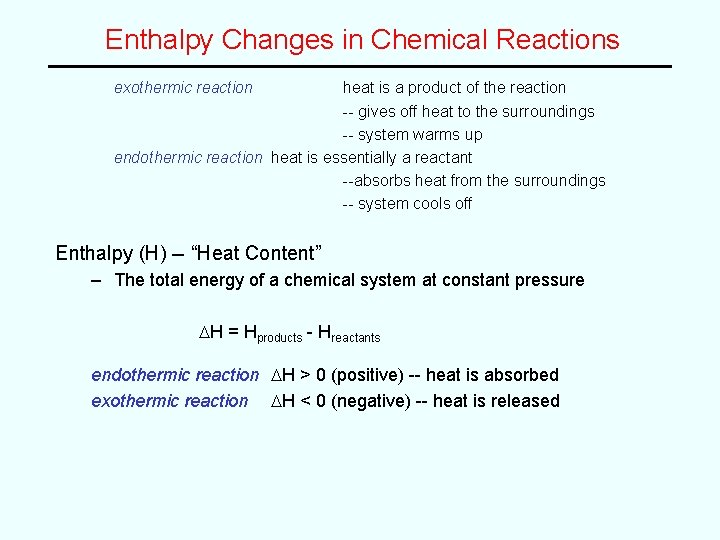
Enthalpy Changes in Chemical Reactions exothermic reaction heat is a product of the reaction -- gives off heat to the surroundings -- system warms up endothermic reaction heat is essentially a reactant --absorbs heat from the surroundings -- system cools off Enthalpy (H) -- “Heat Content” – The total energy of a chemical system at constant pressure DH = Hproducts - Hreactants endothermic reaction DH > 0 (positive) -- heat is absorbed exothermic reaction DH < 0 (negative) -- heat is released
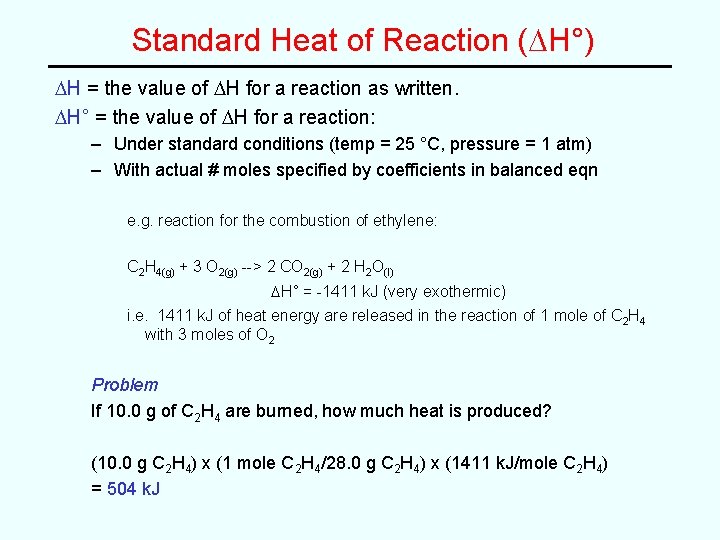
Standard Heat of Reaction (DH°) DH = the value of DH for a reaction as written. DH° = the value of DH for a reaction: – Under standard conditions (temp = 25 °C, pressure = 1 atm) – With actual # moles specified by coefficients in balanced eqn e. g. reaction for the combustion of ethylene: C 2 H 4(g) + 3 O 2(g) --> 2 CO 2(g) + 2 H 2 O(l) DH° = -1411 k. J (very exothermic) i. e. 1411 k. J of heat energy are released in the reaction of 1 mole of C 2 H 4 with 3 moles of O 2 Problem If 10. 0 g of C 2 H 4 are burned, how much heat is produced? (10. 0 g C 2 H 4) x (1 mole C 2 H 4/28. 0 g C 2 H 4) x (1411 k. J/mole C 2 H 4) = 504 k. J
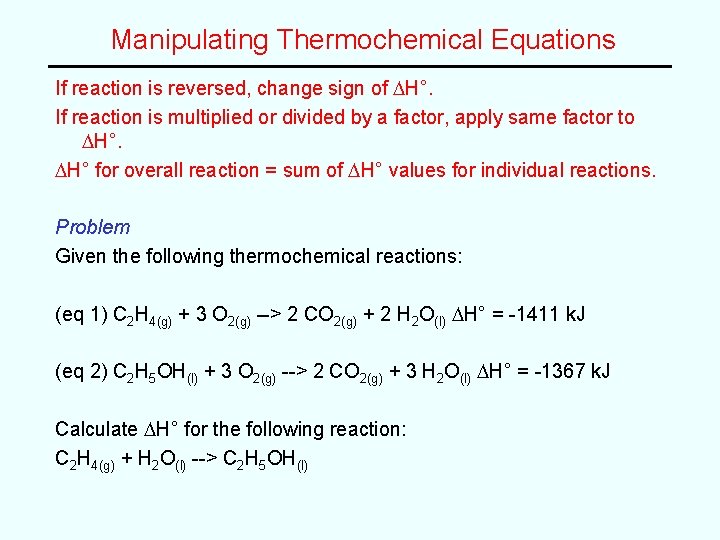
Manipulating Thermochemical Equations If reaction is reversed, change sign of DH°. If reaction is multiplied or divided by a factor, apply same factor to DH° for overall reaction = sum of DH° values for individual reactions. Problem Given the following thermochemical reactions: (eq 1) C 2 H 4(g) + 3 O 2(g) --> 2 CO 2(g) + 2 H 2 O(l) DH° = -1411 k. J (eq 2) C 2 H 5 OH(l) + 3 O 2(g) --> 2 CO 2(g) + 3 H 2 O(l) DH° = -1367 k. J Calculate DH° for the following reaction: C 2 H 4(g) + H 2 O(l) --> C 2 H 5 OH(l)
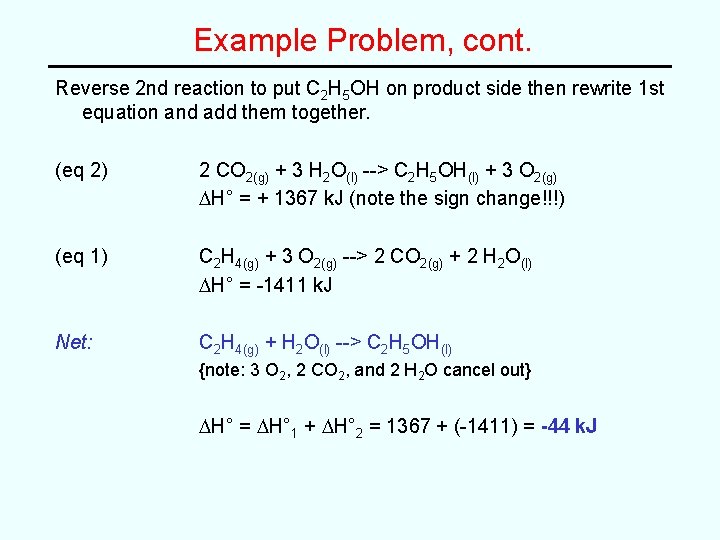
Example Problem, cont. Reverse 2 nd reaction to put C 2 H 5 OH on product side then rewrite 1 st equation and add them together. (eq 2) 2 CO 2(g) + 3 H 2 O(l) --> C 2 H 5 OH(l) + 3 O 2(g) DH° = + 1367 k. J (note the sign change!!!) (eq 1) C 2 H 4(g) + 3 O 2(g) --> 2 CO 2(g) + 2 H 2 O(l) DH° = -1411 k. J Net: C 2 H 4(g) + H 2 O(l) --> C 2 H 5 OH(l) {note: 3 O 2, 2 CO 2, and 2 H 2 O cancel out} DH° = DH° 1 + DH° 2 = 1367 + (-1411) = -44 k. J

Standard Heat of Formation • Standard heat (enthalpy) of formation of a substance: DH°f = DH° for the formation of one mole of substance from the elements in their standard states a “formation” reaction H 2(g) + 1/2 O 2(g) --> H 2 O(l) DH°f (liq water) = -286 k. J/mole DH°f is a property of a substance -- see text for examples • Practice writing formation reactions -- e. g. Na 2 SO 4 2 Na(s) + 2 O 2(g) + S(s) --> Na 2 SO 4(s) DH°f = -1385 k. J/mole
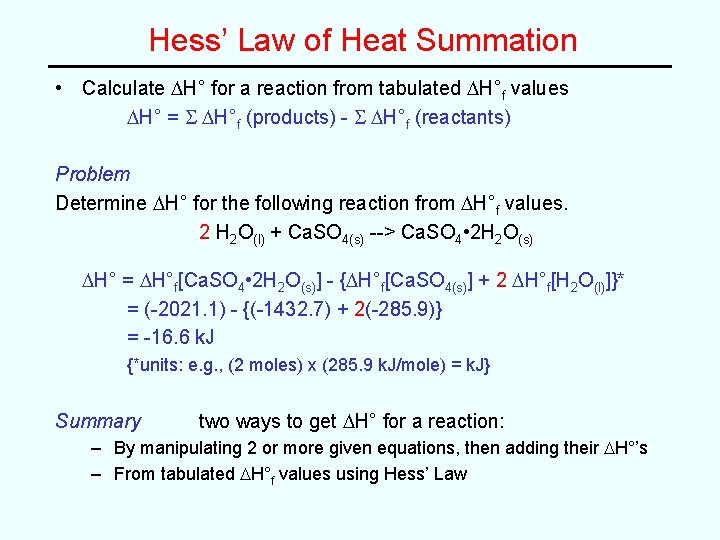
Hess’ Law of Heat Summation • Calculate DH° for a reaction from tabulated DH°f values DH° = S DH°f (products) - S DH°f (reactants) Problem Determine DH° for the following reaction from DH°f values. 2 H 2 O(l) + Ca. SO 4(s) --> Ca. SO 4 • 2 H 2 O(s) DH° = DH°f[Ca. SO 4 • 2 H 2 O(s)] - {DH°f[Ca. SO 4(s)] + 2 DH°f[H 2 O(l)]}* = (-2021. 1) - {(-1432. 7) + 2(-285. 9)} = -16. 6 k. J {*units: e. g. , (2 moles) x (285. 9 k. J/mole) = k. J} Summary two ways to get DH° for a reaction: – By manipulating 2 or more given equations, then adding their DH°’s – From tabulated DH°f values using Hess’ Law
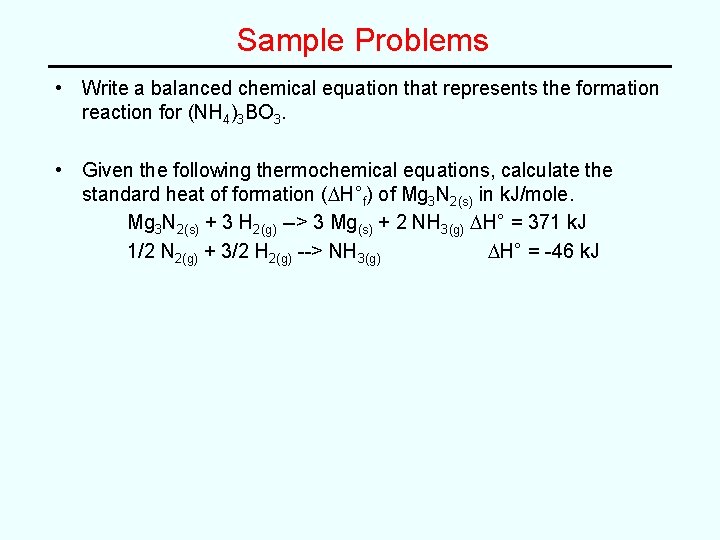
Sample Problems • Write a balanced chemical equation that represents the formation reaction for (NH 4)3 BO 3. • Given the following thermochemical equations, calculate the standard heat of formation (DH°f) of Mg 3 N 2(s) in k. J/mole. Mg 3 N 2(s) + 3 H 2(g) --> 3 Mg(s) + 2 NH 3(g) DH° = 371 k. J 1/2 N 2(g) + 3/2 H 2(g) --> NH 3(g) DH° = -46 k. J
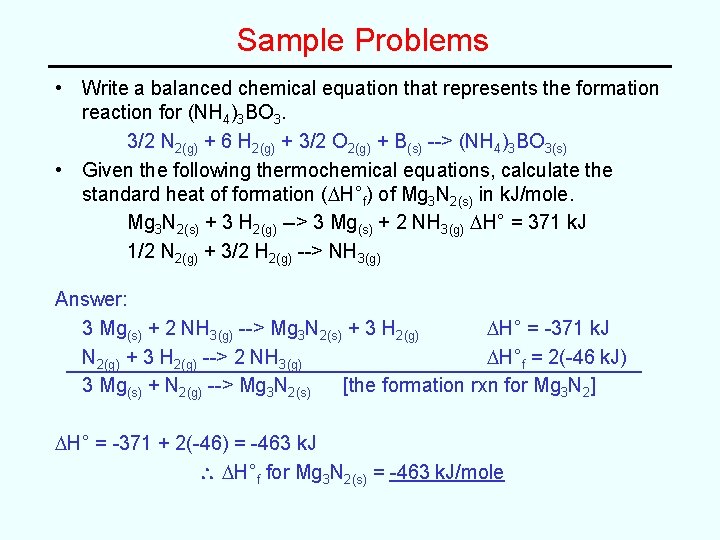
Sample Problems • Write a balanced chemical equation that represents the formation reaction for (NH 4)3 BO 3. 3/2 N 2(g) + 6 H 2(g) + 3/2 O 2(g) + B(s) --> (NH 4)3 BO 3(s) • Given the following thermochemical equations, calculate the standard heat of formation (DH°f) of Mg 3 N 2(s) in k. J/mole. Mg 3 N 2(s) + 3 H 2(g) --> 3 Mg(s) + 2 NH 3(g) DH° = 371 k. J 1/2 N 2(g) + 3/2 H 2(g) --> NH 3(g) Answer: 3 Mg(s) + 2 NH 3(g) --> Mg 3 N 2(s) + 3 H 2(g) DH° = -371 k. J N 2(g) + 3 H 2(g) --> 2 NH 3(g) DH°f = 2(-46 k. J) 3 Mg(s) + N 2(g) --> Mg 3 N 2(s) [the formation rxn for Mg 3 N 2] DH° = -371 + 2(-46) = -463 k. J DH°f for Mg 3 N 2(s) = -463 k. J/mole
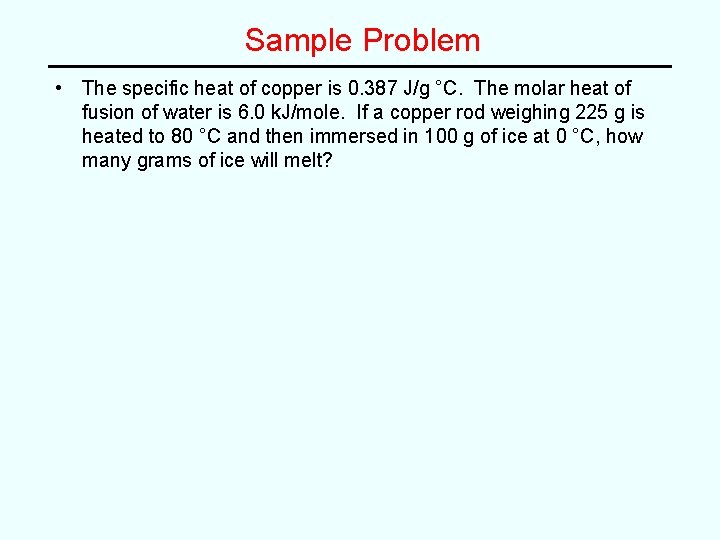
Sample Problem • The specific heat of copper is 0. 387 J/g °C. The molar heat of fusion of water is 6. 0 k. J/mole. If a copper rod weighing 225 g is heated to 80 °C and then immersed in 100 g of ice at 0 °C, how many grams of ice will melt?
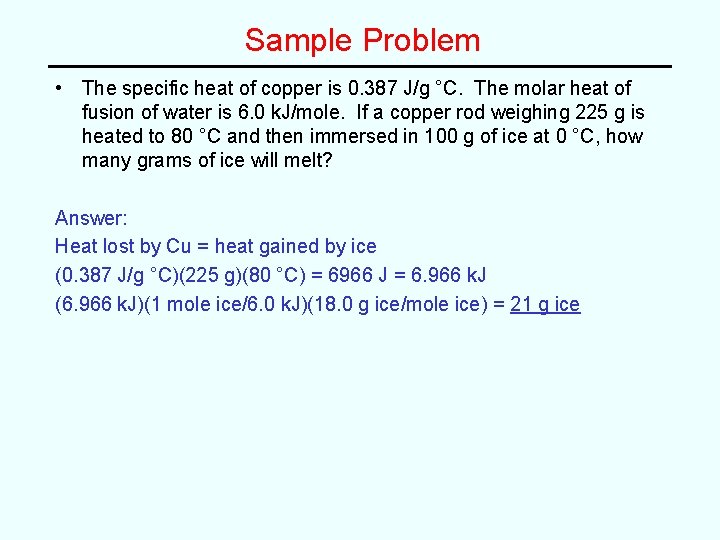
Sample Problem • The specific heat of copper is 0. 387 J/g °C. The molar heat of fusion of water is 6. 0 k. J/mole. If a copper rod weighing 225 g is heated to 80 °C and then immersed in 100 g of ice at 0 °C, how many grams of ice will melt? Answer: Heat lost by Cu = heat gained by ice (0. 387 J/g °C)(225 g)(80 °C) = 6966 J = 6. 966 k. J (6. 966 k. J)(1 mole ice/6. 0 k. J)(18. 0 g ice/mole ice) = 21 g ice
- Slides: 16