
Chapter 16 1 thermochemistry the study of transfers
- Slides: 15
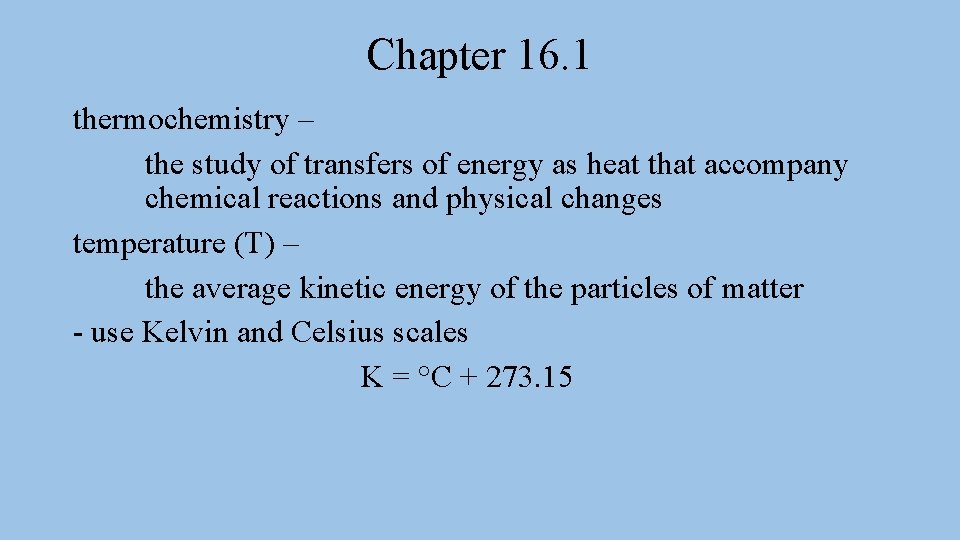
Chapter 16. 1 thermochemistry – the study of transfers of energy as heat that accompany chemical reactions and physical changes temperature (T) – the average kinetic energy of the particles of matter - use Kelvin and Celsius scales K = °C + 273. 15
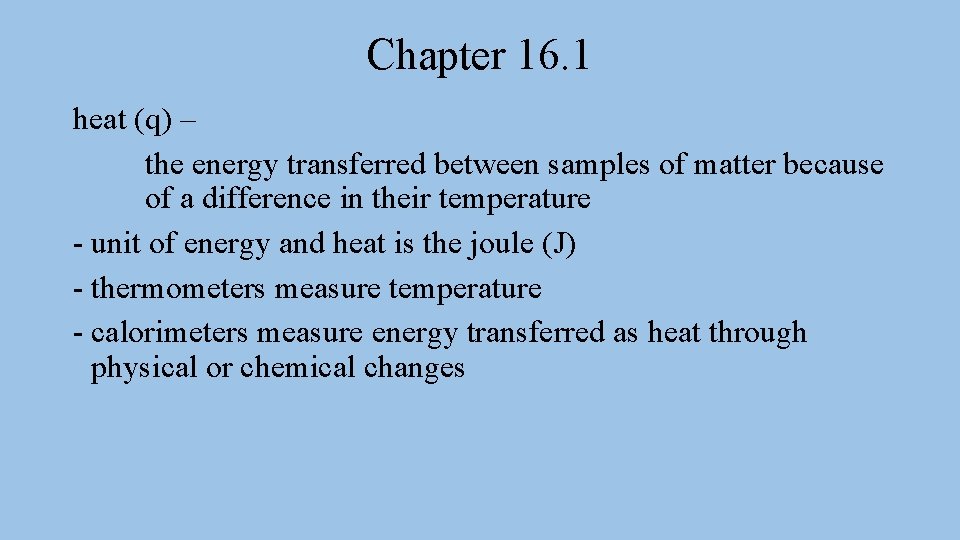
Chapter 16. 1 heat (q) – the energy transferred between samples of matter because of a difference in their temperature - unit of energy and heat is the joule (J) - thermometers measure temperature - calorimeters measure energy transferred as heat through physical or chemical changes
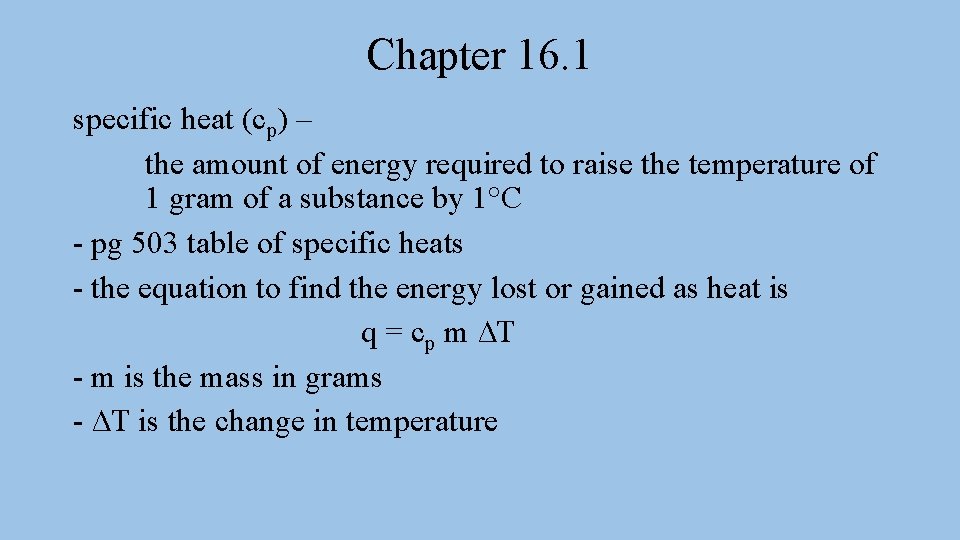
Chapter 16. 1 specific heat (cp) – the amount of energy required to raise the temperature of 1 gram of a substance by 1°C - pg 503 table of specific heats - the equation to find the energy lost or gained as heat is q = cp m ∆T - m is the mass in grams - ∆T is the change in temperature
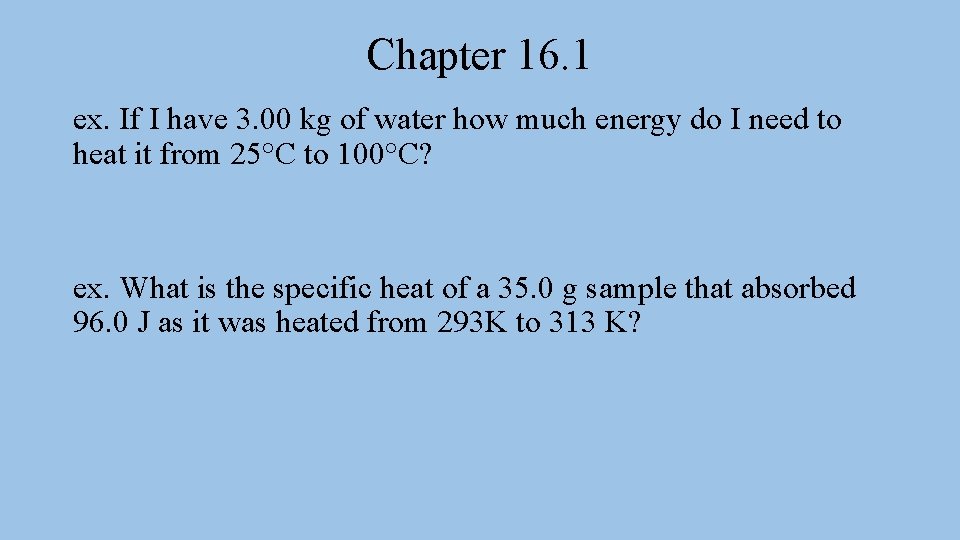
Chapter 16. 1 ex. If I have 3. 00 kg of water how much energy do I need to heat it from 25°C to 100°C? ex. What is the specific heat of a 35. 0 g sample that absorbed 96. 0 J as it was heated from 293 K to 313 K?
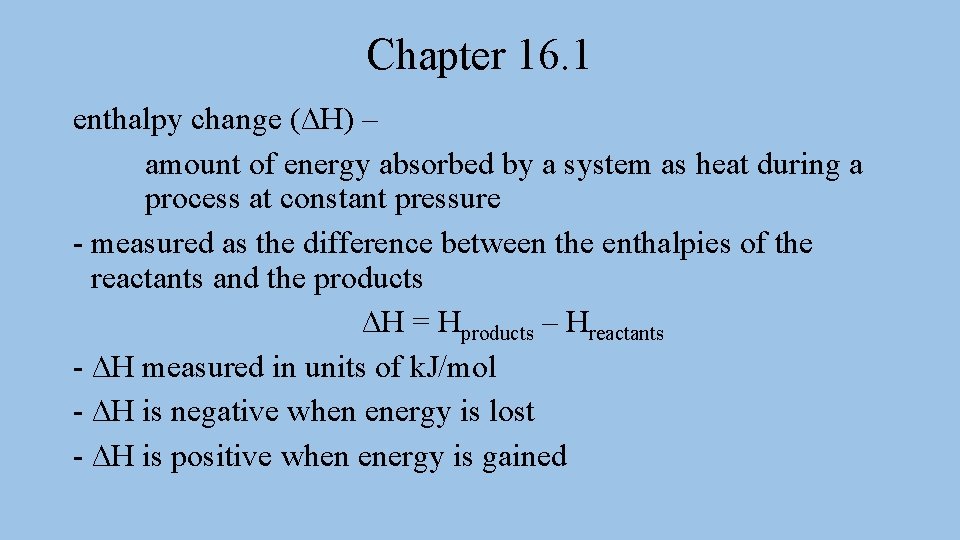
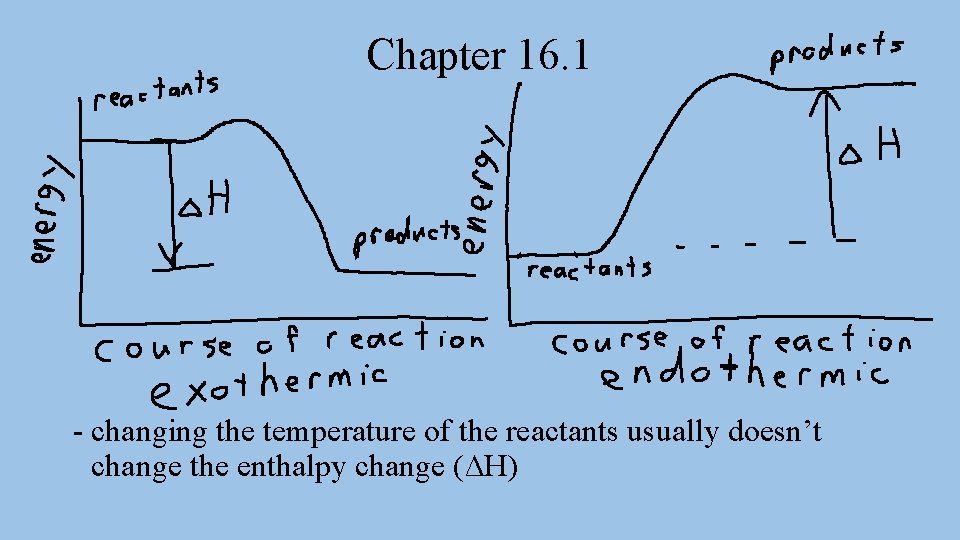
Chapter 16. 1 enthalpy change (∆H) – amount of energy absorbed by a system as heat during a process at constant pressure - measured as the difference between the enthalpies of the reactants and the products ∆H = Hproducts – Hreactants - ∆H measured in units of k. J/mol - ∆H is negative when energy is lost - ∆H is positive when energy is gained
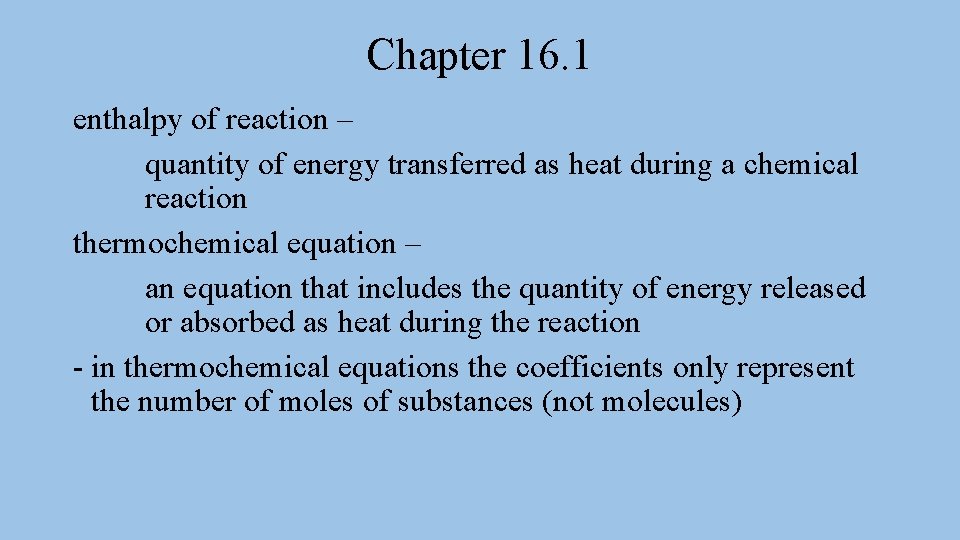
Chapter 16. 1 enthalpy of reaction – quantity of energy transferred as heat during a chemical reaction thermochemical equation – an equation that includes the quantity of energy released or absorbed as heat during the reaction - in thermochemical equations the coefficients only represent the number of moles of substances (not molecules)
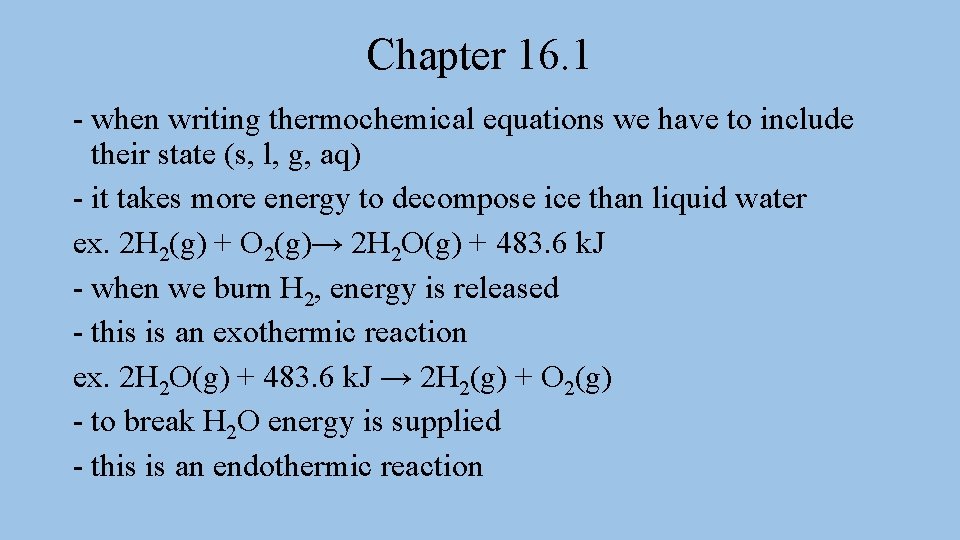
Chapter 16. 1 - when writing thermochemical equations we have to include their state (s, l, g, aq) - it takes more energy to decompose ice than liquid water ex. 2 H 2(g) + O 2(g)→ 2 H 2 O(g) + 483. 6 k. J - when we burn H 2, energy is released - this is an exothermic reaction ex. 2 H 2 O(g) + 483. 6 k. J → 2 H 2(g) + O 2(g) - to break H 2 O energy is supplied - this is an endothermic reaction
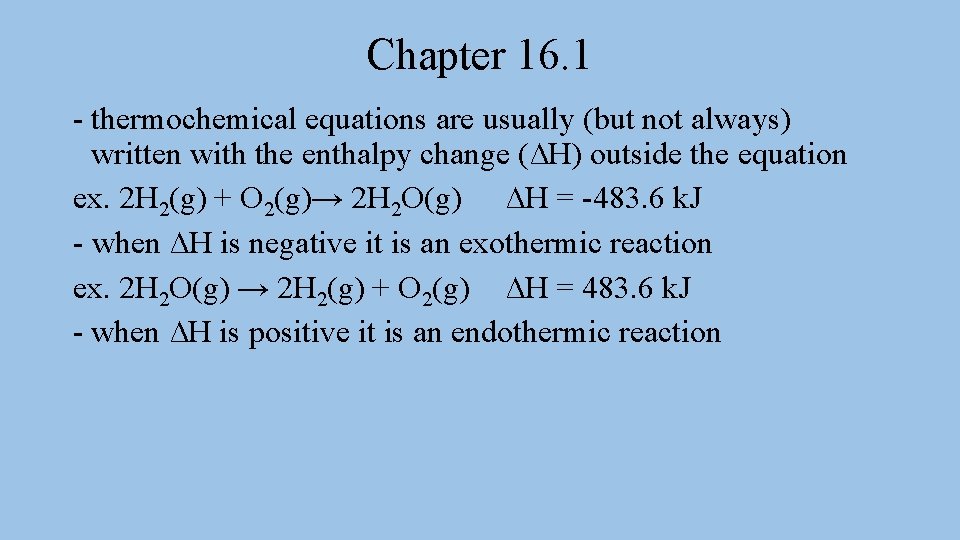
Chapter 16. 1 - thermochemical equations are usually (but not always) written with the enthalpy change (∆H) outside the equation ex. 2 H 2(g) + O 2(g)→ 2 H 2 O(g) ∆H = -483. 6 k. J - when ∆H is negative it is an exothermic reaction ex. 2 H 2 O(g) → 2 H 2(g) + O 2(g) ∆H = 483. 6 k. J - when ∆H is positive it is an endothermic reaction
Chapter 16. 1 - changing the temperature of the reactants usually doesn’t change the enthalpy change (∆H)
Chapter 16. 1 molar enthalpy of formation (∆Hf°) – enthalpy change that occurs when one mole of a compound is formed from its elements in their standard state at 25°C and 1 atm - they are found in table B-14 in the back of the book - we add ° to ∆H to specify that it is at standard state - standard state is 25°C and 1 atm enthalpy of formation – make 1 mole of a substance
Chapter 16. 1 - when ∆Hf° is negative the reaction is exothermic and the compound that is created is stable - when ∆Hf° is positive the reaction is endothermic and the products are typically unstable, sometimes explosively so - ∆Hf° of a pure element is zero - remember that ∆Hf° comes from when a compound is made from the elements that make it up, not when it is formed by other compounds
Chapter 16. 1 enthalpy of combustion (∆Hc°) – enthalpy change that occurs during the complete combustion of one mole of a substance - to combust, oxygen must be a reactant and the products must be CO 2 (g) and/or H 2 O (g) - found in table B-5 in the back of the book enthalpy of combustion – burn 1 mole of a substance
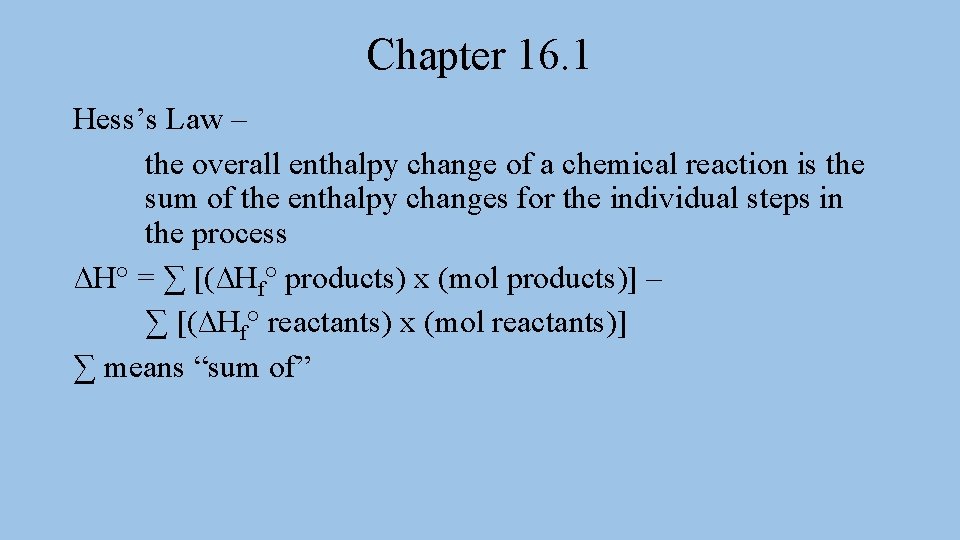
Chapter 16. 1 Hess’s Law – the overall enthalpy change of a chemical reaction is the sum of the enthalpy changes for the individual steps in the process ∆H° = ∑ [(∆Hf° products) x (mol products)] – ∑ [(∆Hf° reactants) x (mol reactants)] ∑ means “sum of”
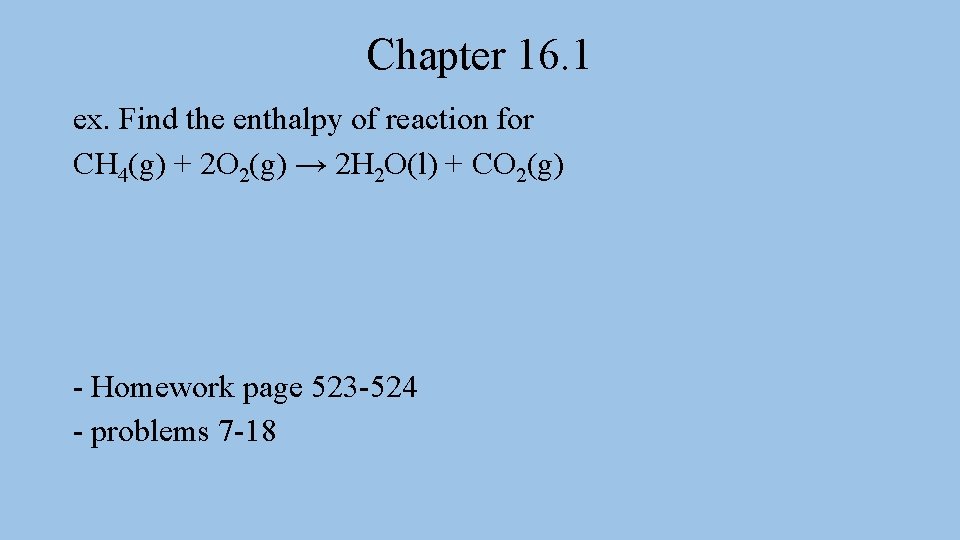
Chapter 16. 1 ex. Find the enthalpy of reaction for CH 4(g) + 2 O 2(g) → 2 H 2 O(l) + CO 2(g) - Homework page 523 -524 - problems 7 -18
Chapter 16. 1