WELCOME TO THE GOSPEL OF ST MATTHEW A

- Slides: 98
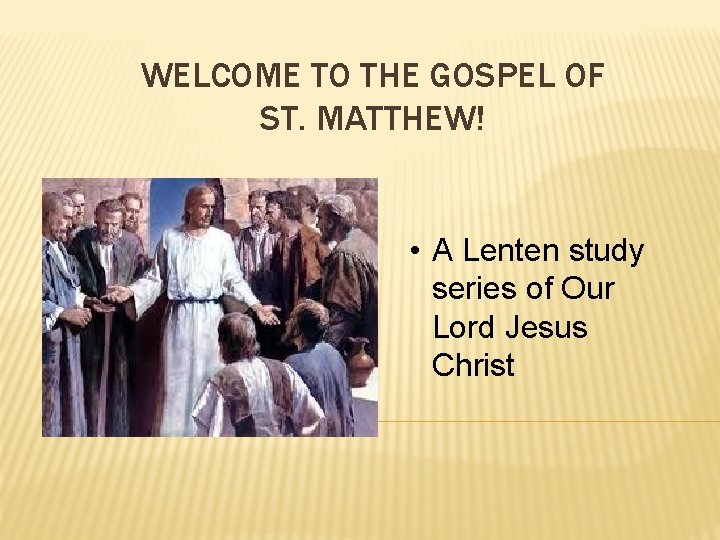
WELCOME TO THE GOSPEL OF ST. MATTHEW! • A Lenten study series of Our Lord Jesus Christ
TONIGHT'S GOALS � � Structure Who is this author? � Who is his audience? When was this gospel written? � What is the purpose of this gospel? � Walk through the gospel to understand know what the Lord taught, understand where he walked, and to conform our lives to his. � Chapters 1 and 2 �
WHAT DO WE KNOW ABOUT THIS AUTHOR? � Before we begin to dive into the gospel, it is important to know a little about it’s author. � Why is this important? The more you know about a person, the more you follow them and try to understand their strategies. � Matthew has a few strategies to help us understand his gospel better
WHAT DO YOU MEAN? � Someone who follows their favorite sports team, has a reason they like that team. Many times, there is a key player in that sport, that they want to follow, to understand how they excel at a certain aspect of their game. � When one knows the player, they know how they will respond to certain game time decisions, especially in a crunch. � We know when they will play defense � We know when they will be aggressive on offense.
GIVE US AN EXAMPLE �I am a fan of the Minnesota Twins. I have been a fan ever since I was a child. Players have come and gone, like Puckett, Hrbek, Gaetti, Gladden, Viola have all come and gone since winning the National Titles in 1987 and 1991. � Now as a Twins fan, I like to follow Joe Mauer. � To be a fan, I will know some of his tactics as to how he approaches the game.
JOE MAUER � As a catcher, you know when he will react to try and pick players off of the bases. � As a first basemen, he knows which bases he has to cover on different plays. � On offense, you know when he will try to hit for power, or just simply try to get on base. � Why? The more one studies a player the more interested you become in following him and his team.
THE SAME IS TRUE WITH THE GOSPELS? � Obviously, there are four different Gospel writers that we hear when we go to Mass. They all have different strategies and audiences that they are trying to reach. Who are the gospel writers? They are: Matthew � Mark � Luke � John � � The more we know about each of them, the more we will become involved in their writings and understanding to the message that they are trying to convey.
MATTHEW… � The author of the first gospel account is Matthew (Greek name), also known as Levi (Hebrew name). He was a tax collector who accepted Jesus' call to discipleship (Matthew 9: 9 -13; Mark 2: 14 -17; Luke 5: 27 -32) and later became one of the Lord's twelve apostles (Matthew 10: 1 -4). Thus, he was a first hand witness of the events he records.
WHO IS MATTHEW? � � � We can see in the gospel of Matthew that he is 1. A tax collector. Matthew 9: 9 -13 As Jesus passed on from there he saw a man named Matthew sitting at the customs post. (Many would pass by him every day) He said to him, “Follow me. ” And he got up and followed him. While he was at table in his house, many tax collectors and sinners came and sat with Jesus and his disciples. The Pharisees saw this and said to his disciples, “Why does your teacher eat with tax collectors and sinners? ” He heard this and said, “Those who are well do not need a physician, but the sick do. Go and learn the meaning of the words ‘I desire mercy, not sacrifice. ’ I did not come to call the righteous but sinners. ”
WHAT IMPLICATIONS ARE THERE OF A TAX COLLECTOR? This is the only gospel of the four gospels that refers to St. Matthew as a tax collector � What is problematic about this? � �A person who calls themselves a tax collector, they would be despised by the Jewish people. � The Jewish people would have known him, seen him regularly and avoided him. � The Jewish people would want to avoid Matthew, because he would be sitting there and asking them for money. � Compare this to a bill collecting agency.
WHO ELSE IS MATTHEW? � 2. He is an apostle. � � An apostle is someone who is sent forth or sent out by the Lord for a mission. The 12 apostles were chosen from among the 72 disciples (students) of Jesus. Matt. 10: 1 -4 - Then he summoned his twelve disciples and gave them authority over unclean spirits to drive them out and to cure every disease and every illness. The names of the twelve apostles are these: first, Simon called Peter, and his brother Andrew; James, the son of Zebedee, and his brother John; Philip and Bartholomew, Thomas and Matthew the tax collector; James, the son of Alphaeus, and Thaddeus; Simon the Cananean, and Judas Iscariot who betrayed him. 3. He is an eyewitness to the events he writes about � His message is similar but yet diverse from the other gospels
WHO IS THIS GOSPEL INTENDED FOR? � First of all, this Gospel was not necessarily written to a certain whole community, but it was written for the church � In the mind of St. Matthew, this record of the gospel, (meaning Good News) was meant to be dispersed, � copied � and passed around from church to church � Remember at this time, there was still not a printing press at this point. � That comes much later
WHO IS MATTHEW’S AUDIENCE? � The audience at the time of Christ that this gospel was written for was the Jewish community. � To understand Matthew’s Gospel, we have to understand who he is writing to, that is the Jewish people, and what his message to them entails. That is why He uses the phrase “and so it was fulfilled” over and over again.
WHAT IS BEING FULFILLED? � St. Matthew has a heavy concentration on the fulfilment of the purposes of God as revealed in the Old Testament, and on the fact that they are being brought to completion in Jesus Christ. � � It may be said that Matthew sees in Jesus Christ the complete flowering of the Old Testament buds. He sees in Jesus not only the continuation of the Old Testament story but the capping of it in every part. � � In other words, Matthew is writing to show the Jewish people, and to persuade them to understand that the Old Testament is being fulfilled in the New Testament. All over the Old Testament are buds which are opening up. In the coming of Jesus Christ we have the full flowering. This shows a Jewish audience that it is fulfilled, so no one misses the point
AN EXAMPLE OF THE FULFILLMENT! � � � A good example of Matthew’s approach can be found in Matthew 2. 15, where the words of Hosea 11. 1 are quoted by him, ‘out of Egypt have I called My son’. These originally referred to the deliverance of Israel from Egypt, and are then said by Matthew to be ‘fulfilled’ in terms of Jesus’ coming out of Egypt. Now at first sight, until we look at the context in Hosea, this appears strange. We might quite reasonably ask, how could a declaration about the children of Israel coming out of Egypt refer to Someone born over twelve hundred years later, just because He also came out of Egypt? And the problem is that many then simply stop there. As a result they suggest that Matthew has simply taken the words totally out of context, looking at them as though Hosea was acting like a fortune-teller and was ‘foretelling’ what was to happen in the future, and has then simply referred them to Jesus without any real justification.
BUT MORE COULD BE SAID � � � But we would suggest that to interpret him in that way is to be guilty of the same naiveté as they credit to him, for it is a complete misrepresentation of Matthew’s thought, and is to ignore the real context of the words in Hosea, as we shall see presently. For, as we shall see, Hosea’s whole point in Hosea 11 is to make clear that the calling of Israel out of Egypt was not just referring to one incident, but to an enduring principle on which God was acting through history, which He would necessarily one day bring to completion because it was part of His will and purposes. And we must repeat that it is Hosea himself who makes that quite clear once the whole chapter is read and considered. But before pursuing this matter further let us consider what Matthew actually meant when he spoke of something as ‘being fulfilled’.
BEING FULFILLED? � For example in Matthew 5. 17 -18 he says, quoting words of Jesus, ““Do not think that I came to abolish the Law or the Prophets; I did not come to abolish but to fulfill. For truly I say to you, until heaven and earth pass away, not the smallest letter or stroke shall pass from the Law until all is accomplished. � And then he goes on to show Jesus amplified the Law in such a way as to bring out its deeper significance. He was ‘filling it to the full’.
TO FULFILL IS TO BRING ABOUT COMPLETENESS � So however else these words are to be interpreted it is clear that they are not just to be seen as referring to a ‘foretelling’ which will now be seen as ‘having happened’. � To ‘fulfill’ here signifies far more than just that something that was foretold would finally happen. � The idea is rather that in some way or other what was spoken in the past will be given deeper meaning and that the buds will flower. They will come to their final completion in a fully satisfactory way.
ANOTHER EXAMPLE FROM JESUS Matthew 3: 13 -15 - Then Jesus came from Galilee to John at the Jordan to be baptized by him. John tried to prevent him, saying, I need to be baptized by you, and yet you are coming to me? Jesus said to him in reply, Allow it now, for thus it is fitting for us to fulfill all righteousness. Then he allowed him. � “Allow it to be so now, for thus it becomes us to fulfil all righteousness’ (Matthew 3. 15), He is not speaking of the fulfilment of a prophecy that has been foretold beforehand. He is again rather speaking of something that ‘fills to the full’. It is an indication that He intends to reveal a complete righteousness which is lacking in nothing. �
STILL YET ANOTHER EXAMPLE Matthew 23. 29 -36. There Jesus tells the Scribes and Pharisees to ‘fill up the measure of your fathers’ who slew the prophets, informs them of the messengers that He will send out whom they themselves will cruelly mistreat and even kill, and in comparison cites Old Testament examples, all of which illustrates what is to come on the present generation because of their similar, and even worse, behavior. Here the verb clearly indicates ‘filling up to the full’. � What their fathers have done, they will fill to the full �
SO WHEN WE THINK ABOUT MATTHEW AND HIS WORDS � So in view of this, when considering Matthew’s words, we should at least stop ourselves short and ask ourselves, is this what Matthew also means when he elsewhere speaks of ‘fulfilment’. Is he also in those verses looking at something additional which can be seen as ‘filling to the full’ and ‘completing’ what has gone before? In order to consider the matter further we shall first of all list these verses and consider what Matthew is trying to do through them.
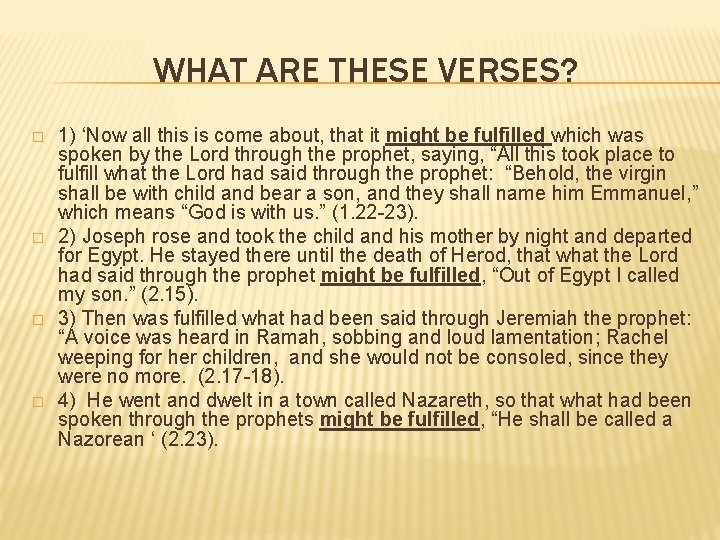
WHAT ARE THESE VERSES? � � 1) ‘Now all this is come about, that it might be fulfilled which was spoken by the Lord through the prophet, saying, “All this took place to fulfill what the Lord had said through the prophet: “Behold, the virgin shall be with child and bear a son, and they shall name him Emmanuel, ” which means “God is with us. ” (1. 22 -23). 2) Joseph rose and took the child and his mother by night and departed for Egypt. He stayed there until the death of Herod, that what the Lord had said through the prophet might be fulfilled, “Out of Egypt I called my son. ” (2. 15). 3) Then was fulfilled what had been said through Jeremiah the prophet: “A voice was heard in Ramah, sobbing and loud lamentation; Rachel weeping for her children, and she would not be consoled, since they were no more. (2. 17 -18). 4) He went and dwelt in a town called Nazareth, so that what had been spoken through the prophets might be fulfilled, “He shall be called a Nazorean ‘ (2. 23).
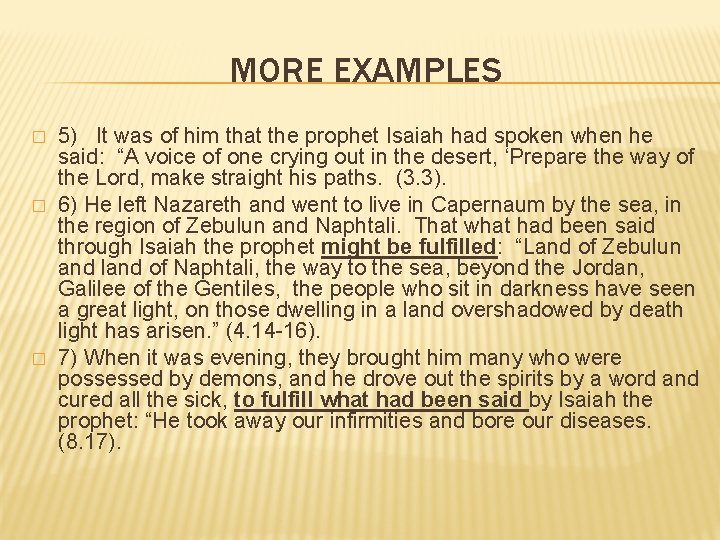
MORE EXAMPLES � � � 5) It was of him that the prophet Isaiah had spoken when he said: “A voice of one crying out in the desert, ‘Prepare the way of the Lord, make straight his paths. (3. 3). 6) He left Nazareth and went to live in Capernaum by the sea, in the region of Zebulun and Naphtali. That what had been said through Isaiah the prophet might be fulfilled: “Land of Zebulun and land of Naphtali, the way to the sea, beyond the Jordan, Galilee of the Gentiles, the people who sit in darkness have seen a great light, on those dwelling in a land overshadowed by death light has arisen. ” (4. 14 -16). 7) When it was evening, they brought him many who were possessed by demons, and he drove out the spirits by a word and cured all the sick, to fulfill what had been said by Isaiah the prophet: “He took away our infirmities and bore our diseases. (8. 17).
EXAMPLES OF BEING FULFILLED � � 8) This was to fulfill what had been spoken through Isaiah the prophet: Behold, my servant whom I have chosen, my beloved in whom I delight; I shall place my spirit upon him, and he will proclaim justice to the Gentiles. He will not contend or cry out, nor will anyone hear his voice in the streets. A bruised reed he will not break, a smoldering wick he will not quench, until he brings justice to victory. And in his name the Gentiles will hope. (12. 1721). 9) Isaiah’s prophecy is fulfilled in them, which says: ‘You shall indeed hear but not understand you shall indeed look but never see. Gross is the heart of this people, they will hardly hear with their ears, they have closed their eyes, lest they see with their eyes and hear with their ears and understand with their heart and be converted, and I heal them. ’ (13. 14 -17).
ARE YOU FULFILLED? � � 10) All these things Jesus spoke to the crowds in parables. He spoke to them only in parables, to fulfill what had been said through the prophet: “I will open my mouth in parables, I will announce what has lain hidden from the foundation [of the world (13. 35). 11) Hypocrites, well did Isaiah prophesy about you when he said: ‘This people honors me with their lips, but their hearts are far from me; 9 e in vain do they worship me, teaching as doctrines human precepts. (15. 7 -9). 12) This happened so that what had been spoken through the prophet might be fulfilled: “Say to daughter Zion, ‘Behold, your king comes to you, meek and riding on an ass, and on a colt, the foal of a beast of burden. (21. 4 -5). 13) Jesus said to them, “Did you never read in the scriptures: ‘The stone that the builders rejected has become the cornerstone; by the Lord has this been done, and it is wonderful in our eyes’? (21. 42).
FINAL 3 EXAMPLES… � � � 14) But then how would the scriptures be fulfilled which say that it must come to pass in this way? ” (26. 54). 15) At that hour Jesus said to the crowds, “Have you come out as against a robber, with swords and clubs to seize me? Day after day I sat teaching in the temple area, yet you did not arrest me. But all this has come to pass that the writings of the prophets may be fulfilled. ” Then all the disciples left him and fled(26. 55 -56). 16) Then was fulfilled what had been said through Jeremiah the prophet, “And they took the thirty pieces of silver, the value of a man with a price on his head, a price set by some of the Israelites, and they paid it out for the potter’s field just as the Lord had commanded me. ”(27. 910).
OUR EXAMPLES � � � Twice he says, ‘that it might be fulfilled what was spoken by the Lord through the prophet, saying’ (1 & 2), and we should note that in each case where this formula is used it refers to the bringing forth of a ‘son’. God is now acting in the world through His chosen representative. Twice he says ‘then was fulfilled that which was spoken through Jeremiah the prophet saying’ (3 & 16). Thus he uses a specific formula for Jeremiah which is different from the one he uses for others, and mentions Jeremiah by name, for Jeremiah is the weeping prophet, and the prophet who specifically declared judgment on the Temple. Once he says, ‘that it might be fulfilled which was spoken by the prophets , that --’ (4). (Note the plural).
CHRIST THE FULFILLMENT � Once he says ‘this is He who was spoken of through Isaiah the prophet, saying’ (5). � Three times he says ‘that it might be fulfilled which was spoken through the prophet/Isaiah the prophet, saying’ (6, 8 & 12). � Twice he says ‘that it might be fulfilled which was spoken by the prophet/Isaiah the prophet, saying’ (7 & 10). � Once he says, ‘to them is fulfilled the prophecy of Isaiah which says --’ (9).
AND FINALLY � � � Once he says, ‘Well did Isaiah prophesy of you saying --’ (11). Once Jesus says, “Have you never read in the Scriptures --” (13). Once Jesus says, ‘how then should the Scripture be fulfilled that thus it must be’ (14). Once Jesus says, ‘all this is come about that the Scriptures might be fulfilled’ (15). He also shows Jesus as referring to ‘it is written’ or ‘have you never read’ or similar, in 4. 4, 7, 10; 21. 16, 42; 22. 43, and refers more indirectly to the Scriptures in a number of other cases, including the voice from Heaven in 3. 17.
WHO ELSE IS THIS BOOK WRITTEN FOR? � This book looks on not only followers of Christ today, and Jewish people, but also it enhances a Gentile mission, � • Magi � • Centurion – Matthew 8 � • Canaanite woman � These groups of people would represent the Gentile world. Who are the Gentiles? � People who are NOT Jews
WHERE WAS THIS BOOK WRITTEN? � Many believe this gospel was written in either the Holy Land or in Syria which is a neighbor to Israel. Some scholars say it was written at Antioch in Syria. � Either way, where it was written it was influenced by the Jewish culture.
WHEN WAS THIS GOSPEL WRITTEN? � � � Dating the gospels is very important. It can be said that the gospel of Matthew was written early, before 70 AD, but after 50 AD (world influenced by Jewish traditions addressed by Matthew). Why this dating? � 1. It is written by an eyewitness, who was a reliable source, with accuracy, and authenticity. � � Those who were alive at the time would have critiqued the events written down. 2. No mention of the destruction of the temple in 70 AD. Jesus prophesied this in Matt. 24: 1. The temple was destroyed by the Romans in 70 AD. � If this was written later, this was such a big event that it would have been included.
MAIN PURPOSE � � Matthew’s main purpose is to prove to his Jewish readers that Jesus is their Messiah. He does this primarily by showing how Jesus in his life and ministry fulfilled the OT Scriptures. Although all the Gospel writers quote the OT, Matthew includes nine proof texts unique to his Gospel (1: 22– 23; 2: 15; 2: 17– 18; 2: 23; 4: 14– 16; 8: 17; 12: 17– 21; 13: 35; 27: 9– 10) to drive home his basic theme: � � � Jesus is the fulfillment of the OT predictions of the Messiah. Matthew even finds the history of God’s people in the OT recapitulated in some aspects of Jesus’ life (Hosea example 11: 1 in 2: 15). To accomplish his purpose Matthew also emphasizes Jesus’ Davidic lineage (see Recipients. Chapter 1 Matthew writes to evangelize especially Jews and Gentiles Matthew wants the reader to focus on Christ and His Church Matthew also likes to educate and give the teachings of Christ – ie sermon on the mount
WHAT IS THE PURPOSE OF THIS GOSPEL? Matthew's account of the life of Christ is well placed at the very beginning of the New Testament, since it helps tie the Old and New Testaments together. � This gospel shows how Jesus fulfills the Old Testament as the Messiah (Christ) promised by the prophets. � Matthew wrote to strengthen Jewish Christians in their faith, � to refute their opponents, � and to prove that the gospel, rather than contradicting the Old Testament, fulfills it. � � Matthew is the gospel to the Jews.
WHAT IS HIS PLAN TO FULFILL THE PURPOSE? � � � � A number of peculiarities of Matthew demonstrate this purpose. Matthew traces the lineage of Christ from Abraham through David (1: 1 -17). Matthew quotes or alludes to the Old Testament about sixty-five times. Matthew uses the term "kingdom" fifty times and the phrase "kingdom of heaven" thirty-three times. He uses the phrase "kingdom of God" only five times, in deference to the Jewish hesitancy to directly mention God. He assigns the title "Son of David" to Jesus nine times. Matthew repeatedly recognizes Jesus as King (2: 2; 21: 5; 22: 11; 25: 34; 27: 11, 37, 42). He records Jesus' claim to fulfill the law (5: 17 -20),
PURPOSE CONTINUED � � � His denunciations of the Pharisees (cf. 15: 1 -14; 23: 1 -36), and His rejection of national Israel (ch's 21 - 24). Matthew alone wrote of the Jews' acceptance of the guilt of the blood of Christ (27: 25). He alone refutes the Jewish claim that the disciples stole the body of Jesus (27: 62 -66; 28: 11 -15). Matthew records Jesus' great lessons on the nature of the kingdom of heaven (ch's. 5 -7, 13). Though Matthew wrote in Greek, even his style of writing is Jewish. Matthew emphasizes the righteousness of the kingdom (cf. 5: 20). The terms "righteous" and "righteousness" occur more in Matthew than in the other three accounts combined
STRUCTURE � � The way the material is arranged reveals an artistic touch. The whole Gospel is woven around five great discourses: � � � � (1) chs. 5– 7; (2) ch. 10; (3) ch. 13; (4) ch. 18; (5) chs. 24– 25. That this is deliberate is clear from the refrain that concludes each discourse: “When Jesus had finished saying these things, ” or similar words (7: 28; 11: 1; 13: 53; 19: 1; 26: 1). The narrative sections, in each case, appropriately lead up to the discourses. The Gospel has a fitting prologue (chs. 1– 2) and a challenging epilogue (28: 16– 20). The fivefold division may suggest that Matthew has modeled his book on the structure of the Pentateuch (the first five books of the OT). He may also be presenting the gospel as a new Law (Torah) and Jesus as a new and greater Moses.
STRUCTURAL OVERVIEW OF MATTHEW � � � � � 1. Prologue/Infancy Narrative (1: 1 -2: 23) 2. The Good News of the Kingdom Appears (3: 1 -4: 25) 3. The Way of the Kingdom (5: 1 -7: 29) 4. Manifestation of the Kingdom’s Power and Authority (8: 1 -11: 1) 5. Mounting Offense toward Jesus / Signs of a coming New Israel (11: 2 -16: 12) 6. Promise of a New Israel / Jesus’ Journey to Jerusalem (16: 1320: 34) 7. Jesus’ Royal Entry / Signs of the End of the Age (21: 1 -25: 46) 8. Passion and Death (26: 1 -27: 66) 9. Resurrection (28: 1 -15) 10. The Great Commission (28: 16 -20)
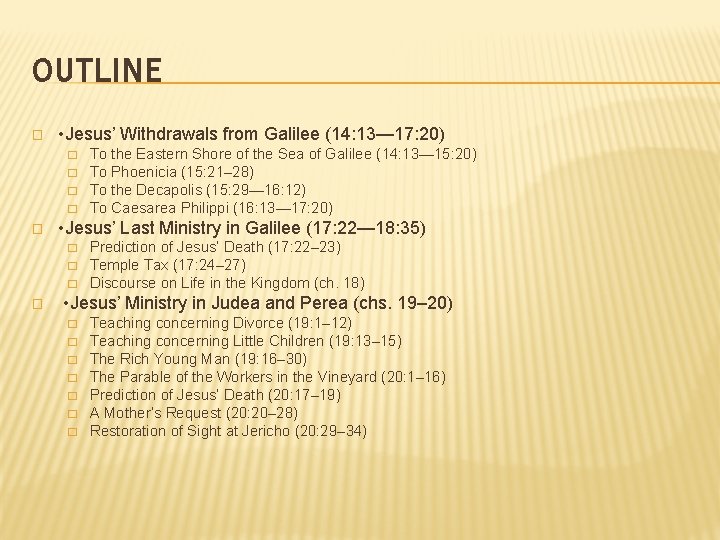
OUTLINE � • The Birth and Early Years of Jesus (chs. 1– 2) � � • The Beginnings of Jesus’ Ministry (3: 1— 4: 11) � � His Genealogy (1: 1– 17) His Birth (1: 18— 2: 12) His Sojourn in Egypt (2: 13– 23) His Forerunner (3: 1– 12) His Baptism (3: 13– 17) His Temptation (4: 1– 11) • Jesus’ Ministry in Galilee (4: 12— 14: 12) � � � � The Beginning of the Galilean Campaign (4: 12– 25) The Sermon on the Mount (chs. 5– 7) A Collection of Miracles (chs. 8– 9) The Commissioning of the 12 Apostles (ch. 10) Ministry throughout Galilee (chs. 11– 12) The Parables of the Kingdom (ch. 13) Herod’s Reaction to Jesus’ Ministry (14: 1– 12)
OUTLINE � • Jesus’ Withdrawals from Galilee (14: 13— 17: 20) � � � • Jesus’ Last Ministry in Galilee (17: 22— 18: 35) � � To the Eastern Shore of the Sea of Galilee (14: 13— 15: 20) To Phoenicia (15: 21– 28) To the Decapolis (15: 29— 16: 12) To Caesarea Philippi (16: 13— 17: 20) Prediction of Jesus’ Death (17: 22– 23) Temple Tax (17: 24– 27) Discourse on Life in the Kingdom (ch. 18) • Jesus’ Ministry in Judea and Perea (chs. 19– 20) � � � � Teaching concerning Divorce (19: 1– 12) Teaching concerning Little Children (19: 13– 15) The Rich Young Man (19: 16– 30) The Parable of the Workers in the Vineyard (20: 1– 16) Prediction of Jesus’ Death (20: 17– 19) A Mother’s Request (20: 20– 28) Restoration of Sight at Jericho (20: 29– 34)
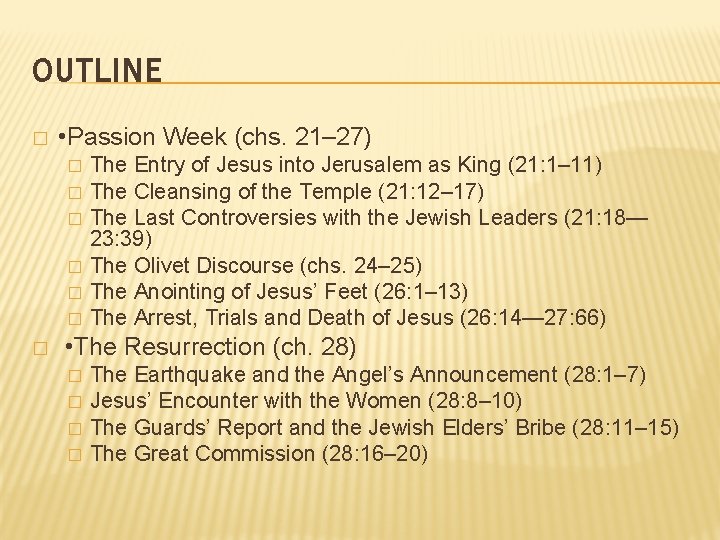
OUTLINE � • Passion Week (chs. 21– 27) � � � � The Entry of Jesus into Jerusalem as King (21: 1– 11) The Cleansing of the Temple (21: 12– 17) The Last Controversies with the Jewish Leaders (21: 18— 23: 39) The Olivet Discourse (chs. 24– 25) The Anointing of Jesus’ Feet (26: 1– 13) The Arrest, Trials and Death of Jesus (26: 14— 27: 66) • The Resurrection (ch. 28) � � The Earthquake and the Angel’s Announcement (28: 1– 7) Jesus’ Encounter with the Women (28: 8– 10) The Guards’ Report and the Jewish Elders’ Bribe (28: 11– 15) The Great Commission (28: 16– 20)
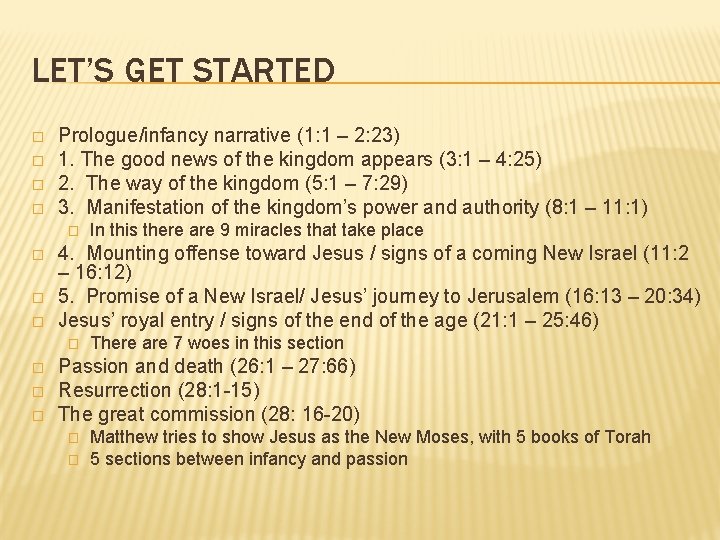
LET’S GET STARTED � � Prologue/infancy narrative (1: 1 – 2: 23) 1. The good news of the kingdom appears (3: 1 – 4: 25) 2. The way of the kingdom (5: 1 – 7: 29) 3. Manifestation of the kingdom’s power and authority (8: 1 – 11: 1) � � 4. Mounting offense toward Jesus / signs of a coming New Israel (11: 2 – 16: 12) 5. Promise of a New Israel/ Jesus’ journey to Jerusalem (16: 13 – 20: 34) Jesus’ royal entry / signs of the end of the age (21: 1 – 25: 46) � � In this there are 9 miracles that take place There are 7 woes in this section Passion and death (26: 1 – 27: 66) Resurrection (28: 1 -15) The great commission (28: 16 -20) � � Matthew tries to show Jesus as the New Moses, with 5 books of Torah 5 sections between infancy and passion
OUR APPROACH � Pictures � Maps � Gain an understanding of the context of each passage � What are your impressions you have? � What stands out in each passage? � What key words do you notice? � Is there anything that needs to be clarified?
OUR APPROACH � Read � Ask the story yourself questions � Who? � What? � When? � Where? � How? � Why? � These are important
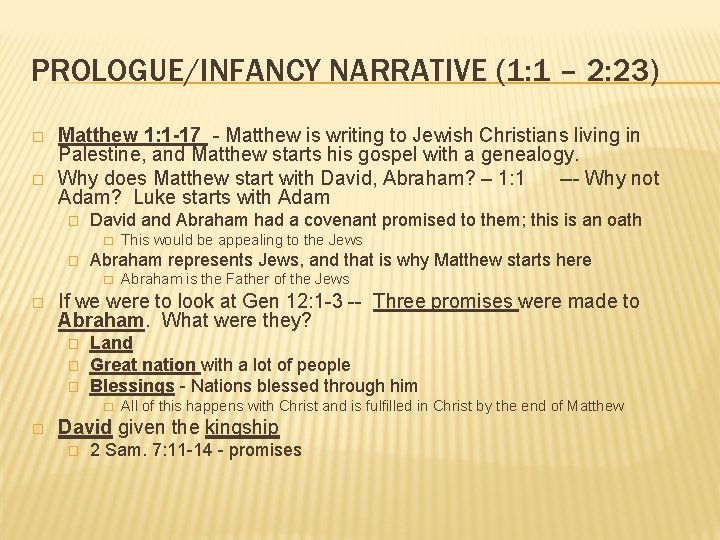
PROLOGUE/INFANCY NARRATIVE (1: 1 – 2: 23) � � Matthew 1: 1 -17 - Matthew is writing to Jewish Christians living in Palestine, and Matthew starts his gospel with a genealogy. Why does Matthew start with David, Abraham? – 1: 1 --- Why not Adam? Luke starts with Adam � David and Abraham had a covenant promised to them; this is an oath � � Abraham represents Jews, and that is why Matthew starts here � � Abraham is the Father of the Jews If we were to look at Gen 12: 1 -3 -- Three promises were made to Abraham. What were they? � � � Land Great nation with a lot of people Blessings - Nations blessed through him � � This would be appealing to the Jews All of this happens with Christ and is fulfilled in Christ by the end of Matthew David given the kingship � 2 Sam. 7: 11 -14 - promises
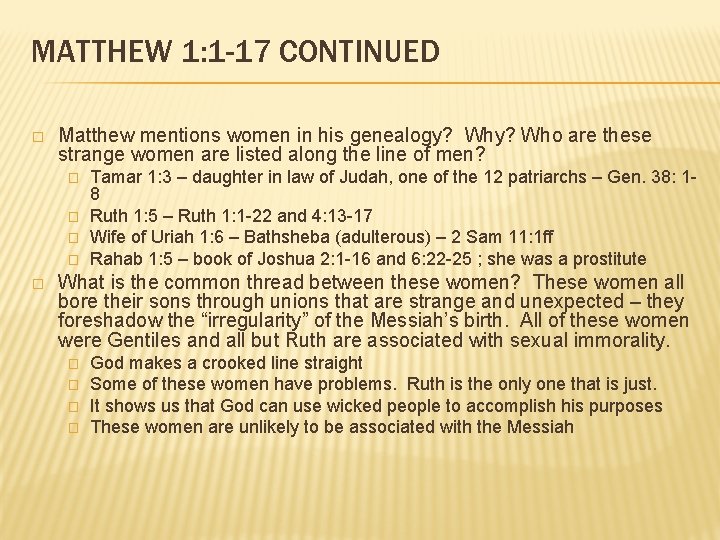
MATTHEW 1: 1 -17 CONTINUED � Matthew mentions women in his genealogy? Who are these strange women are listed along the line of men? � � � Tamar 1: 3 – daughter in law of Judah, one of the 12 patriarchs – Gen. 38: 18 Ruth 1: 5 – Ruth 1: 1 -22 and 4: 13 -17 Wife of Uriah 1: 6 – Bathsheba (adulterous) – 2 Sam 11: 1 ff Rahab 1: 5 – book of Joshua 2: 1 -16 and 6: 22 -25 ; she was a prostitute What is the common thread between these women? These women all bore their sons through unions that are strange and unexpected – they foreshadow the “irregularity” of the Messiah’s birth. All of these women were Gentiles and all but Ruth are associated with sexual immorality. � � God makes a crooked line straight Some of these women have problems. Ruth is the only one that is just. It shows us that God can use wicked people to accomplish his purposes These women are unlikely to be associated with the Messiah
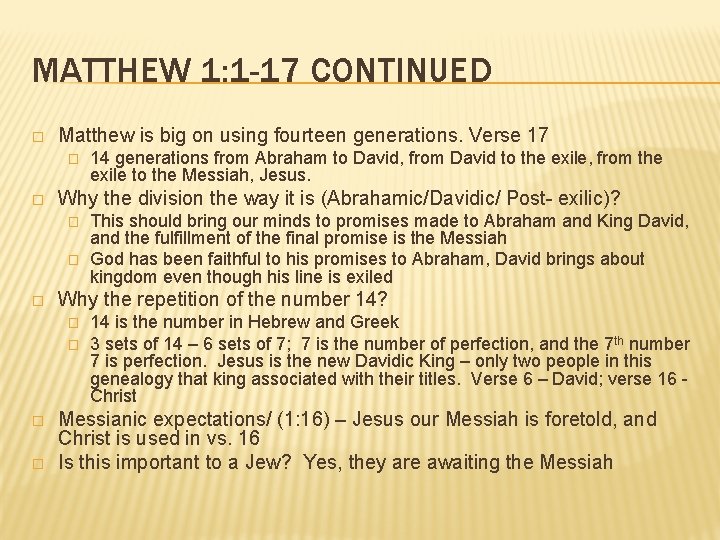
MATTHEW 1: 1 -17 CONTINUED � Matthew is big on using fourteen generations. Verse 17 � � Why the division the way it is (Abrahamic/Davidic/ Post- exilic)? � � � This should bring our minds to promises made to Abraham and King David, and the fulfillment of the final promise is the Messiah God has been faithful to his promises to Abraham, David brings about kingdom even though his line is exiled Why the repetition of the number 14? � � 14 generations from Abraham to David, from David to the exile, from the exile to the Messiah, Jesus. 14 is the number in Hebrew and Greek 3 sets of 14 – 6 sets of 7; 7 is the number of perfection, and the 7 th number 7 is perfection. Jesus is the new Davidic King – only two people in this genealogy that king associated with their titles. Verse 6 – David; verse 16 Christ Messianic expectations/ (1: 16) – Jesus our Messiah is foretold, and Christ is used in vs. 16 Is this important to a Jew? Yes, they are awaiting the Messiah
THE BIRTH OF JESUS 1: 18 -25 � This was foretold in Matthew 1: 16 � If we look closely at this passage, we will note there is an angelic announcement of the Lord’s birth! Is this a big deal? Is this unusual? � How often do we hear in the Old Testament where angels show up and announce the birth of somebody? � We find this in Isaac, Samuel, Samson, and John the Baptist to name just a few!
THE BIRTH OF JESUS IN BETHLEHEM � � � In verse 20, tells us how utterly unique this birth will be What is unique? This child will be conceived through the Holy Spirit. Every other person in the world is conceived through an act of a human father and mother. This conception will take place not with a human father. 1: 23 – his name is Emmanuel which means God is with us Some scholars didn’t think this was there, and was added much later. They think they had no clue it was God. – wrong idea held by them this is there from the beginning as Jesus fulfills the prophecy in Isaiah 7: 14 Emmanuel is alluded to at the end of the gospel where Jesus assures his disciples of his continual presence with them, � Mat. 28: 20 – I am with you always, until the end of the age
WHAT IS THE MISSION OF THE SON? � The Mission of the Son is found in 1: 21; He will save us from our sins (1: 21; Jesus = saves) In what sense does he save from sins? � � In what sense did Old Testament Joshua “save” his people from their sins? Jesus is the Greek name equivalent of the Hebrew name Joshua which means “Yahweh saves” � � He will offer atonement from the double effects of guilt and punishment He will learn to live free from sins’ power He will undo the effects of Adam as a new Adam who is sinless. He brought his people through the desert with milk and honey Joshua a very ‘unblemished’ OT figure How is Jesus a “new Joshua”? In review, Jesus is given two names! Verse 21 and verse 23 � Christ and Emmanuel
WHAT ABOUT THE BETROTHAL TO JOSEPH? 1: 18 – this was the first part of the marriage unlike modern day engagements. This was an agreement by promise to marry. It was a time up to one year between the covenant of marriage itself and the time when spouses lived together. A betrothal could only be terminated by death or divorce. (Duet. 24: 1 -4) � The betrothal would be followed by the man some months later taking the woman, his wife into his home, this is when the married life began. � Infidelity during this period would have been considered adultery. �
REVIEW OF CHAPTER 1 � Matthew’s gospel begins with an introduction giving the Messianic credentials of jesus in the form of a genealogy establsihing him as the long awaited Messiah, the Annointed One, the Son of David, and the Son of Abraham, heir to the royal throne of Israel. � The universality of his reign is hinted at by the four gentile women in this lineage. � If you lived in the 1 st century Palestine, what effect would Matthew’s proclamation on you or the Jewish leaders? Ordinary people? Romans?
CHAPTER 1 APPLICATION � Meditate on the significance and importance of the fact that Jesus Christ is Emmanuel, “God with us. ” � How is he still with us today? � Is it ever hard to believe that God is with us, is there anything in this lesson to increase your faith? � Dear Lord….
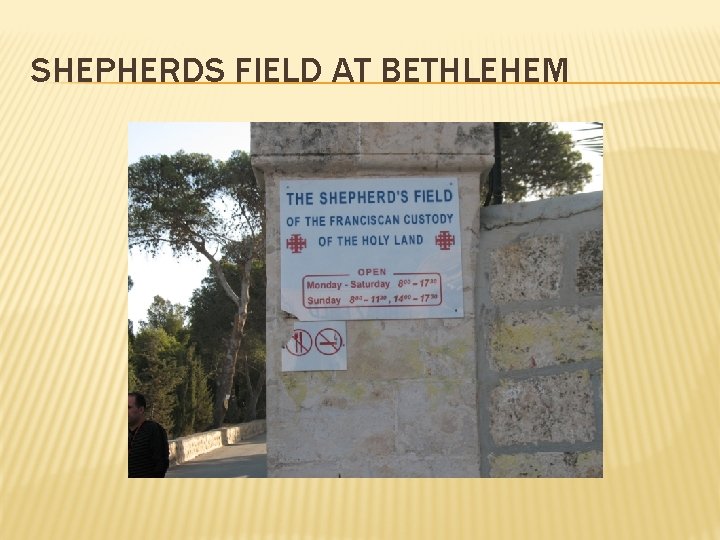
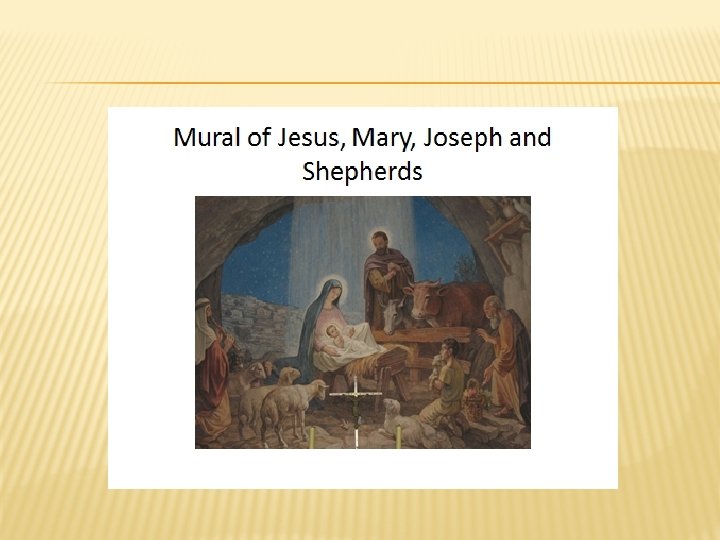
SHEPHERDS FIELD AT BETHLEHEM
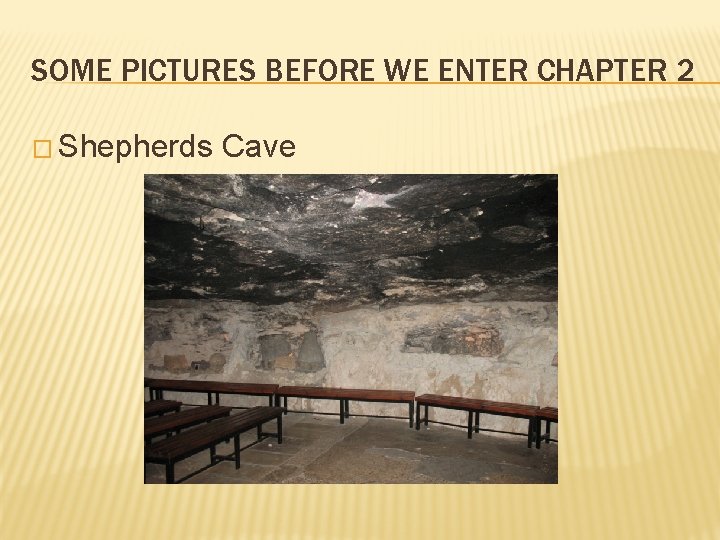
SOME PICTURES BEFORE WE ENTER CHAPTER 2 � Shepherds Cave
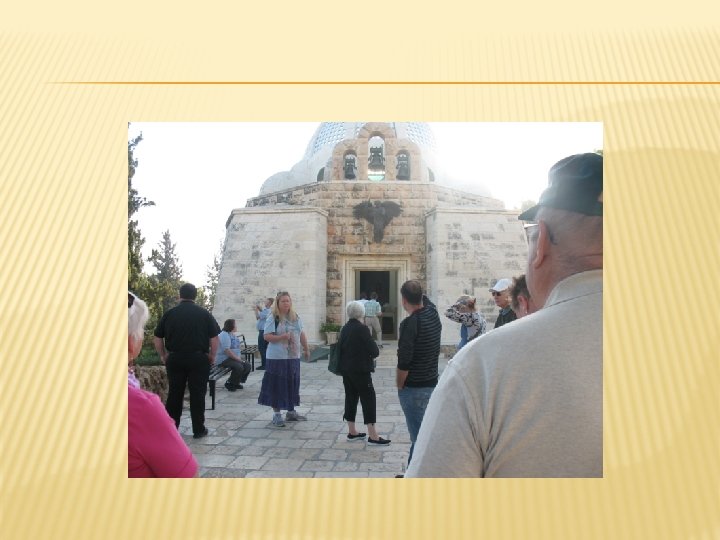
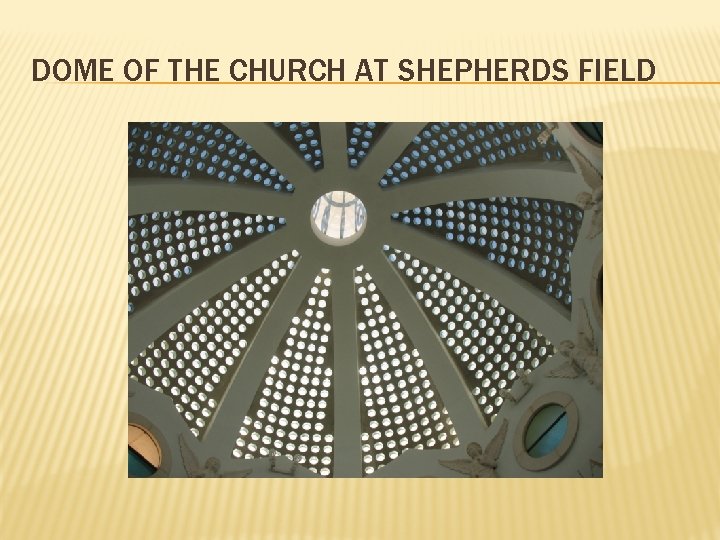
DOME OF THE CHURCH AT SHEPHERDS FIELD
CHAPTER 2 – THE VISIT OF THE WISE MEN � � � � Four parts to chapter 2 - Visit of the magi/ escape to Egypt/ Massacre of the innocents/ return to Nazareth (2: 1 -23) Some highlights in this section Our Lord was rejected by a deceitful King Herod Generous gentile response of Kings to the manger leads to a blessing for the gentile magi (seek and you shall find) – Matthew 5: 33; Matthew 7: 7 -8) Jesus’ escape from King Herod, as well as His descent and return from Egypt recalls Moses and Israel’s’ Exodus and foreshadows the New Exodus at Jesus’ death/ resurrection/ ascension (A new Israel) Israel’s vocation was to be a light to the nations; through their life and the gifts that God had given them, that God would manifest himself to them compare to the rest of the world Lots of angelic activity in this section – tokens of God’s providence
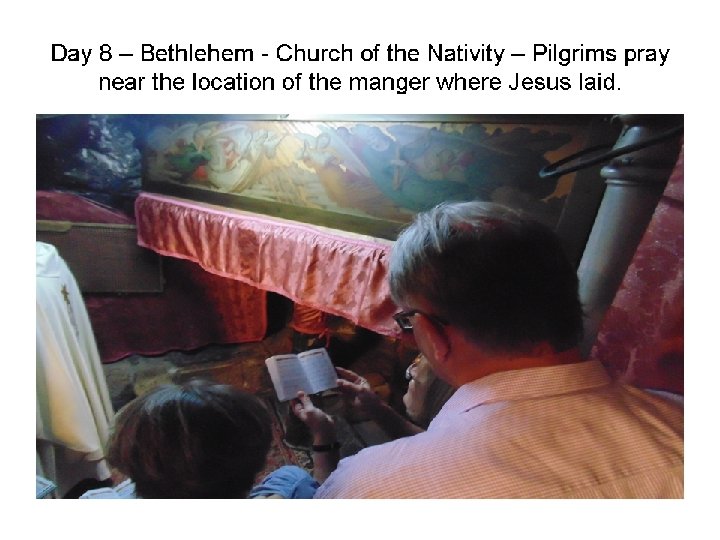
THE VISIT OF THE MAGI � � � Jesus was born in Bethlehem of Judea. (2: 1) - look at the map In Hebrew, Bethlehem means “house of bread”. Bethlehem is also the city of David (Lk. 2: 4) As the new Davidic King, Jesus is born in the hometown of David and his family. (1 Sam 16: 1) Bethlehem is also the site where David was anointed King. 1 Sam: 16: 4 -13 Where else is Bethlehem noted: � � Micah 5: 1 -4 – prophet said from Bethlehem will come the king, he will born there, and he will shepherd his flock Jeremiah 23: 5 -6 – days will come when the righteous shoot of David will reign and govern wisely
HEROD IS KING? ? ? � Herod was king – (2; 1) – Herod the great was the ruler of Palestine. He was part of the Edomite family, that was non-Jewish and had political favor with Rome. � He was anointed king by Rome in 37 BC to replace the collapsing Jewish priestly rulers. � He was known for massive building projects, like renovating the Jewish temple in Jerusalem. � He was harsh, stubborn, and inflexible. � He gained little favor from the Jews because of his allegiance to Rome.
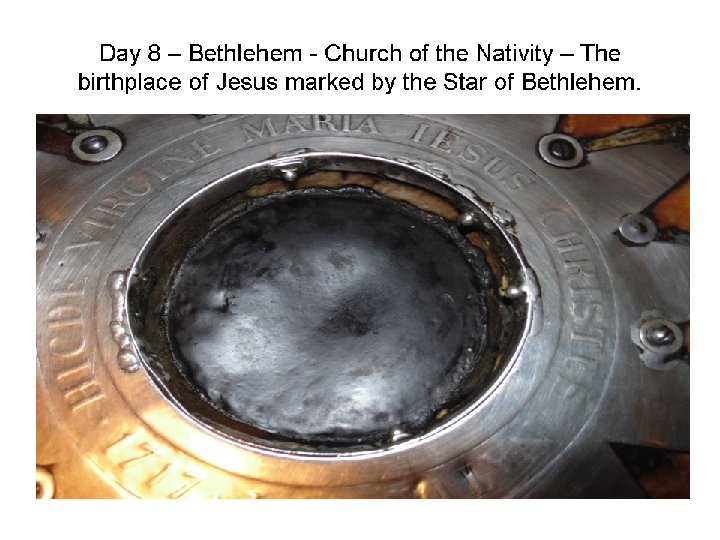
WHAT ABOUT THE STAR IN 2: 2? � The star recalls the Old Testament prophecy about the Messiah. � In Numbers 24: 17 – Balaam predicted “a star shall come forth out of Jacob, and a scepter shall rise out of Israel. ” � In 2: 3 – Herod was troubled by the star, knowing that the same passage from Numbers foretold the disaster of his family in Num. 24: 18 – Edom shall be dispossessed. He was an Edomite.
THE MAGI AND WISE MEN � 2: 1 – magi from the east came to give him homage. � The speculation is that the wise men came from the East, they were Persian. They may have come from as far as Iraq, or Saudi Arabia, or even Jordan. � The wise men were more than likely astrologers, and this would explain their interest in the extraordinary star. � It was a common ancient belief that a new star appeared at the time of a ruler’s birth.
HEROD INQUIRES UPON THEIR ARRIVAL � 2: 4 - Herod called all of the chief priests and the scribes to inquire where the Messiah was to be born. � The leaders responded as they knew the prophecies of Micah 5: 1, and 2 Sam. 5: 2 – which say, ‘and you Bethlehem, land of Judah are by no means least among the rulers of Judah; since from you shall come a ruler, who is to shepherd my people Israel. � These well. � Jewish leaders would have known the prophecies very This completes the idea the Jewish legend that Moses in which the “sacred scribes” warn Pharaoh about the imminent birth of one who will deliver Israel from Egypt and the king makes plans to destroy him.
HEROD INQUIRES AND THEN HE SENDS THE KINGS � After their audience with Herod they sent out, and the star preceded them to where the child was. � Herod wanted them to return to tell him the information so he could destroy the child, but when they found the child their hearts were forever changed, and they went home a different route.
UPON THEIR ARRIVAL… � They went to him and entered his house and did him homage and saw his mother. � � This suggests that the event might have taken place after Jesus’ presence in the manger, and the earlier visit of the shepherds. (Lk. 2: 15). This time lapse is reflected that the Epiphany takes place two weeks after our Christmas liturgy celebration. Then they opened their gifts of gold, frankincense, and myrrh. Psalm 72: 10– 15 – the kings of Tarsish, Arabia, and Seba will offer gifts and bow before him � Isaiah 60: 6 – caravans of camels will come Midian and Ephah will come with gifts of gold, frankincense and myrrh. �
WHAT ABOUT GOLD, FRANKINCENSE AND MYRRH � Gold and frankincense were brought to the God of Israel (Tob. 13: 11 and Ps. 72: 10 -15) � Myrrh was an anointing oil � It was used to consecrate Levitical priests and the wilderness Tabernacle (Ex. 30: 23 -33) � It was used as burial ointment (John 19: 39 -40)
ONE OTHER WAY TO LOOK AT IT… � Gold – a symbol of royalty, representing the kingship of Christ � Frankincense –used in worship of God, pointing to his divinity. � Myrrh – a burial ointment, signifying the humanity of Christ, that he would suffer and die
STILL ANOTHER WAY TO LOOK AT IT � Gold – is Christ’s wisdom, which shines in us � Frankincense – is the prayer and adoration we give him (Rev. 8: 3 -4) � Myrrh – is our daily sacrifices where we die to self that he may live (Rom. 12: 1)
4 GROUPS � In Matthew, four groups of people are shown reacting to the news of the King. Who are they and what is their responses?
WHO ARE THEY? � The four groups who react or respond to Christ the newborn king 1. wise men – they left home and they travel far to worship the new king. They persist even when the Jewish leaders won’t show them the way, even though the star stands in an unlikely humble place � 2. Herod – He is troubled. He plots to kill all boys two years and under in Bethlehem � 3. All Jerusalem – they are troubled. � 4. Chief priests and scribes – while they know the location is Bethlehem, they are not interested nor excited, no do they try to find the young king who was prophesied to them. �
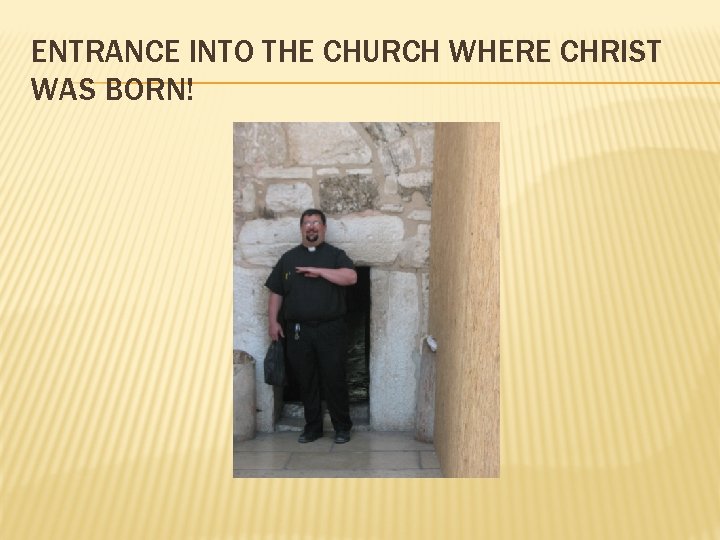
ENTRANCE INTO THE CHURCH WHERE CHRIST WAS BORN!
THE FLIGHT TO EGYPT (2: 13 -15) � In verse 2: 14, Joseph was instructed to rise and take the child and his mother to Egypt. � God works within the structures of the family: Joseph is instructed by the angel because he is the head of the Holy Family (Jesus, Mary, and Joseph) and the one most responsible for their well being. (Eph. 5: 21 -6: 3)
OUT OF EGYPT I CALLED YOU � 2: 15 – when Matthew says in 2: 15 – “Out of Egypt have I called my son”, he is quoting the Old Testament prophet Hosea 11: 1. � What point is Matthew making? � Israel's deliverance by God from slavery was the great touchstone in their history. Here Matthew brings that liberation to mind and puts Jesus forward as the ultimate redeemer of God’s children. � Hosea’s reference is to God’s delivery of his children from Egyptian slavery.
WHAT IS THE SIGNIFICANCE OF EGYPT? � 2: 13 – Egypt was a place of refuge in the Old Testament, � Gen. 12: 10, � Gen 46: 4, � 1 Kings 11: 40, � Jer. 26: 21 � All of these events is where the Israelites fled when they were threatened or endangered. � The main reason why Jesus was called to Egypt is that he may relive the Exodus experience that liberated God’s first born son “Israel” Ex. 4: 22).
IMPLICATIONS � Israel was delivered from slavery under the oppressive Pharaoh. � Matthew could also see this text as looking ahead. When Jesus, the eternal first born Son is delivered from the tyrant Herod and later brought out of Egypt escaping Herod.
THE MASSACRE OF THE INNOCENTS 2: 16 -18 � Herod found out that he was deceived and became furious. � Not the first time he was outraged? � He murdered � his favorite wife, � three of his own sons, � and others who threatened his throne � Now he seeking to kill the males two years and less in Bethlehem. 2: 16
THE HOLY INNOCENTS � The church considers those children of Bethlehem the first Christian martyrs. There feast day is celebrated on December 28.
WHAT IS MATTHEW DOING HERE? � Matthew in this passage begins to portray Jesus as a new and greater Moses. How? 6 ways � 1. the lives of both Jesus and Moses are threatened in their infancy by rulers to kill Hebrew children. (Ex. 1: 15– 16) Pharaoh and Herod. � 2. both were saved from the decree by the intervention of a family member, Joseph vs. 13, and Ex. 2: 1 -10 – Pharaoh's daughter � 3. Both found protection for a time in Egypt (Mat. 2: 14 -15, and Ex. 2: 5 -10
JESUS THE NEW MOSES � 4. both were called back to their respective birth places after a time of flight and exile. (Mat. 2: 20 and Ex. 4: 19 – Midian � 5. both spent 40 days and nights fasting alone in the wilderness. (Mat 4: 2 and Ex. 34: 28) � 6. both were commissioned by God to promulgate his covenant Law (Mat. 5 -7, and Duet. 5: 1 -21) – the 8 beatitudes and the 10 Commandments.
MASSACRE FORETOLD BY JEREMIAH �A voice was heard in Ramah, (Jer. 31: 15) � Ramah is a city about 5 or 6 miles north of Jerusalem. � Rachel’s sobbing is so great over the lost of her children that it is heard off in a far distance. � Ramah is north of Jerusalem, Bethlehem is south of Jerusalem, the weeping could be heard in Ramah, a city of sorrow and exile.
WHAT ELSE IS KNOWN ABOUT RAMAH? � The Assyrian armies first devastated and destroyed northern Israel 8 centuries BC, as they swept through the land engulfing the city (Is. 10: 29; Hos 5: 8); � Later the Babylonians conquered the southern tribes in the 6 th century BC, and Ramah became the assembly point for hauling away captives. (Jer. 40: 1) � Who is Rachel? She is the wife of Jacob who wept for her children who were exiled in Jer. 31: 15.
THE RETURN FROM EGYPT! 2: 19 – 23 � When Herod had died, the angel appeared to Joseph in a dream and told him to take the child and his mother and go to the land of Israel. � After Herod’s death, the Roman emperor Augustus divided his kingdom among his three sons. � Archelaus – vs. 22 – was given Judea, Idumea, and Samaria, and he had a similar reputation to his father, so Joseph took Mary and Jesus north to the district of Galilee to Nazareth.
WHAT IS SIGNIFICANT ABOUT NAZARETH? � � 2: 23 – Nazareth is a Galilean village nowhere mentioned in the Old Testament. In fact, many Jews thought it was insignificant (Jn. 1: 46). The last sentence of chapter 2 says, He shall be called a Nazorean. Matthew says this is to fulfill what was spoken through the prophets. � � No prophets have mentioned he shall be called a Nazorean, why would Matthew say this? He says it as an accumulation “through the prophets” paraphrasing the message of the prophets that a shoot shall sprout from the stump of Jesse. � � We need to remember the line of David was exiled, and is back to bear more fruit through the line of King David. Jesus is the root of Jesse. Is. 11: 1 – a shoot shall sprout from the root of Jesse. Mary is the stem and the flower is Christ.
TO THE MAP � As we read 2: 19 -23, certain cities and regions are pointed out. � Judea – around Jerusalem � Galilee – the northern region � Nazareth – a city in the Galilean region
QUESTIONS TO PONDER � Why doesn’t the Holy Family return to Bethlehem? � The Holy family does not return to Bethlehem because it is still dangerous for them in the Judah region after Herod’s death. Instead, having been warned in a dream, tradition has it they went to Haifa, then to a town called Nazareth, up north toward the sea of Galilee.
PROLOGUE WRAP UP � Would anyone like to summarize the prologue of Matthew, chapters 1 -2. the point is not to find the correct answer but to lay out major points of the chapters. His real gospel will start next week � What has Matthew established about the new king he is introducing? � How does he fulfill prophecy? � What will his mission entail?
CHAPTERS 1 -2 ARE THE PROLOGUE � Themes that will help our understanding in Matthew’s prologue and infancy passages � 1. With the coming of Jesus comes the arrival (though not consummation) of the goal of Salvation History, the restoration / transformation of the Adamic / Davidic Kingdom � The past is recalled by Matthew as a foundation for future hope. There is no question of striving for some remote ideal. There is no striving to bring back these past events. The question is not of return, but of a new creation, and how Christ fulfills it.
JESUS IS… � 1. the fulfillment of OT prophecies, via the Matthew fulfillment formula which is only found in Matthew, “and thus was fulfilled what was spoken by the prophet. . . ” [see Matt 1: 22; 2: 15, 17, 23; 4: 14; 8: 17; 12: 17; 13: 35; 21: 4; 26: 56; 27: 9] � 2. the fulfillment of Old Testament oaths: to Abraham and David � 3. the fulfillment of Old Testament people e. g. , Joshua, Moses, David
MORE THEMES FROM THE PROLOGUE � 2. Jesus is the promised and long-awaited Savior and Messiah. � As “Son of ____”, what is suggested is not only that Jesus in some way carries on and fulfills the career and fortunes of these Old Testament figures, but that He is also heir to the specific patrimony he represents that had been granted by God to them in ancient times.
JESUS’ TITLES How would you characterize each specific “patrimony”? ? � The most common “Son of ____” Title by far in Matt? � Jesus’ favorite self-referential title, The Son of Man � � This is used 28 times beginning in chapter 8. Other titles used for Jesus � • (1) Son of David (2) Son of Abraham � • (3) Son of Joseph (4) a new Joshua � • (5) a new Moses (6) star of Baalam � • (7) Savior (=Jesus) (8) Immanuel � • (9) Son of God (10) Ruler of Israel � • (11) King of Jews (12) a Nazarene �
OTHER THEMES ALREADY PRESENT � 3. God is provident over history (and salvation history in particular) accomplishing his purposes in unexpected ways � 4. God’s family will be widened to include the Gentiles � 5. Later opposition to Jesus is already foreshadowed
CHAPTER TWO APPLICATION � Have you ever felt like a stump where everything that meant anything to you or showed promise to you was cut off? � Did the future look bleak? � Meditate on and praise the God who raised a “Branch of new life from the stump that Israel had become. � Do you believe he can do a new work in you?
WHAT DOES THIS CLASS LOOK LIKE WEEK BY WEEK � � � Next week – March 17 we will cover - The good news of the kingdom appears (3: 1 – 4: 25) and the way of the kingdom (5: 1 – 7: 29). March 24 – we will look at the 9 miracles in Manifestation of the kingdom’s power and authority (8: 1 – 11: 1) and the mounting offense toward Jesus / signs of a coming New Israel (11: 2 – 16: 12) March 31 – parish mission we will not gather April 7 – the promise of a New Israel/ Jesus’ journey to Jerusalem (16: 13 – 20: 34) and Jesus’ royal entry / signs of the end of the age (21: 1 – 25: 46)- and the 7 woes in this section April 14 – Holy Week Monday it is the Passion and death (26: 1 – 27: 66) and Resurrection (28: 1 -15) of our Lord April 21 – Easter Monday – we will look at the great commission (28: 16 -20)
FOR NEXT WEEK… � Read Matthew 3 – 7: 29, � We will show more pictures of the spots from our recent trips. We will use maps, to help gain an understanding of the context of each passage � Things to note � What are your impressions you have? � What stands out in each passage? � What key words do you notice? � Is there anything that needs to be clarified? � Write these things down!
AS YOU READ ASK THESE QUESTIONS � Ask yourself questions � Who? � What? � When? � Where? � How? � Why? � These are important, and hopefully this gospel will come to life for you, that is the goal.