The Gospels of Matthew and Luke Tuesday January





- Slides: 51
The Gospels of Matthew and Luke Tuesday, January 23, 2007
REVIEW } Learned that NT gospel writers were interpreters and not historians } Learned that there is a literary relationship between the synoptic gospels (Matthew, Mark and Luke) } According to the four-source hypothesis (see next slide) the Gospel of Mark was written first and Matthew and Luke copied from it when writing their own versions } Mark was written to offer hope during crisis of the Fall of the Temple and subsequent persecution and to counter criticism against Jesus as “messiah”
THE FOUR-SOURCE HYPOTHESIS
AGENDA The Gospel According to Matthew I. Authorship and Date II. The Literary Structure III. Theological Themes The Gospel According to Luke I. Authorship and Date II. The Literary Structure III. Theological Themes Tutorial: Healing of the Leper (Form criticism)
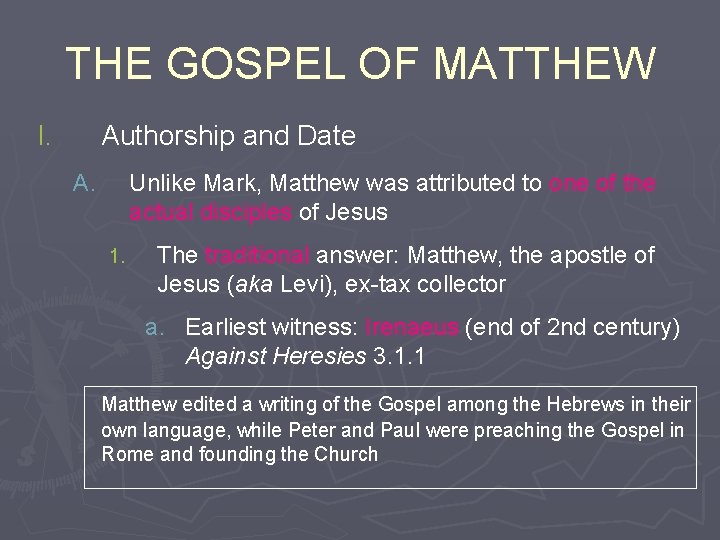
THE GOSPEL OF MATTHEW I. Authorship and Date A. Unlike Mark, Matthew was attributed to one of the actual disciples of Jesus 1. The traditional answer: Matthew, the apostle of Jesus (aka Levi), ex-tax collector a. Earliest witness: Irenaeus (end of 2 nd century) Against Heresies 3. 1. 1 Matthew edited a writing of the Gospel among the Hebrews in their own language, while Peter and Paul were preaching the Gospel in Rome and founding the Church
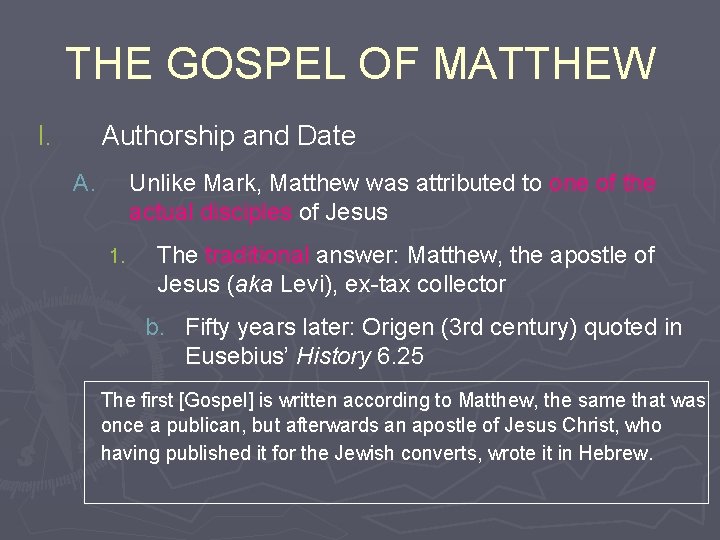
THE GOSPEL OF MATTHEW I. Authorship and Date A. Unlike Mark, Matthew was attributed to one of the actual disciples of Jesus 1. The traditional answer: Matthew, the apostle of Jesus (aka Levi), ex-tax collector b. Fifty years later: Origen (3 rd century) quoted in Eusebius’ History 6. 25 The first [Gospel] is written according to Matthew, the same that was once a publican, but afterwards an apostle of Jesus Christ, who having published it for the Jewish converts, wrote it in Hebrew.
THE GOSPEL OF MATTHEW I. Authorship and Date A. Unlike Mark, Matthew was attributed to one of the actual disciples of Jesus 2. The critical answer: an unnamed Jewish-Christian a. Look at the call of Matthew (see next slide)
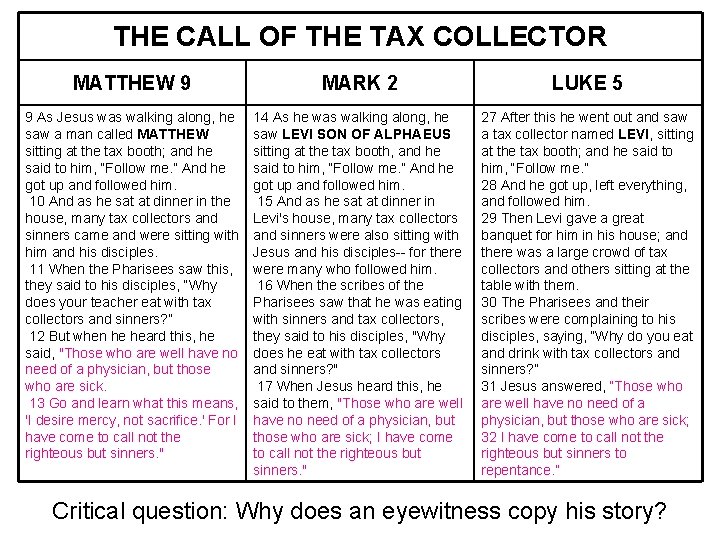
THE CALL OF THE TAX COLLECTOR MATTHEW 9 MARK 2 LUKE 5 9 As Jesus walking along, he saw a man called MATTHEW sitting at the tax booth; and he said to him, “Follow me. ” And he got up and followed him. 10 And as he sat at dinner in the house, many tax collectors and sinners came and were sitting with him and his disciples. 11 When the Pharisees saw this, they said to his disciples, “Why does your teacher eat with tax collectors and sinners? ” 12 But when he heard this, he said, "Those who are well have no need of a physician, but those who are sick. 13 Go and learn what this means, 'I desire mercy, not sacrifice. ' For I have come to call not the righteous but sinners. " 14 As he was walking along, he saw LEVI SON OF ALPHAEUS sitting at the tax booth, and he said to him, “Follow me. ” And he got up and followed him. 15 And as he sat at dinner in Levi's house, many tax collectors and sinners were also sitting with Jesus and his disciples-- for there were many who followed him. 16 When the scribes of the Pharisees saw that he was eating with sinners and tax collectors, they said to his disciples, "Why does he eat with tax collectors and sinners? " 17 When Jesus heard this, he said to them, "Those who are well have no need of a physician, but those who are sick; I have come to call not the righteous but sinners. " 27 After this he went out and saw a tax collector named LEVI, sitting at the tax booth; and he said to him, “Follow me. ” 28 And he got up, left everything, and followed him. 29 Then Levi gave a great banquet for him in his house; and there was a large crowd of tax collectors and others sitting at the table with them. 30 The Pharisees and their scribes were complaining to his disciples, saying, “Why do you eat and drink with tax collectors and sinners? ” 31 Jesus answered, “Those who are well have no need of a physician, but those who are sick; 32 I have come to call not the righteous but sinners to repentance. ” Critical question: Why does an eyewitness copy his story?
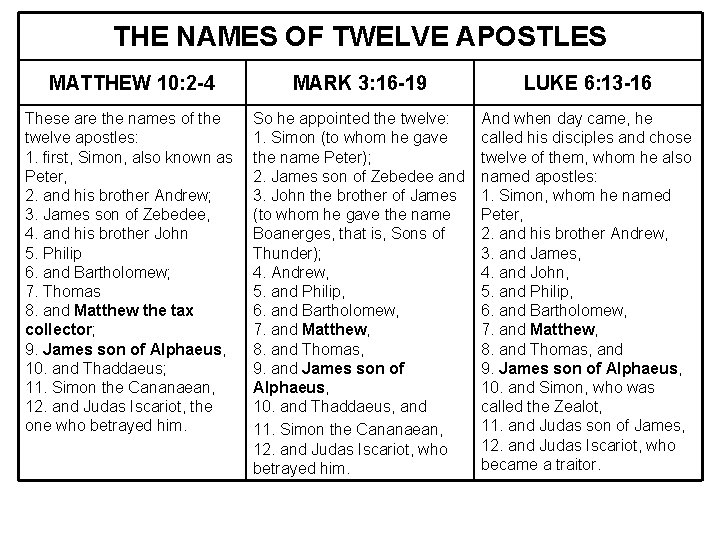
THE NAMES OF TWELVE APOSTLES MATTHEW 10: 2 -4 MARK 3: 16 -19 LUKE 6: 13 -16 These are the names of the twelve apostles: 1. first, Simon, also known as Peter, 2. and his brother Andrew; 3. James son of Zebedee, 4. and his brother John 5. Philip 6. and Bartholomew; 7. Thomas 8. and Matthew the tax collector; 9. James son of Alphaeus, 10. and Thaddaeus; 11. Simon the Cananaean, 12. and Judas Iscariot, the one who betrayed him. So he appointed the twelve: 1. Simon (to whom he gave the name Peter); 2. James son of Zebedee and 3. John the brother of James (to whom he gave the name Boanerges, that is, Sons of Thunder); 4. Andrew, 5. and Philip, 6. and Bartholomew, 7. and Matthew, 8. and Thomas, 9. and James son of Alphaeus, 10. and Thaddaeus, and 11. Simon the Cananaean, 12. and Judas Iscariot, who betrayed him. And when day came, he called his disciples and chose twelve of them, whom he also named apostles: 1. Simon, whom he named Peter, 2. and his brother Andrew, 3. and James, 4. and John, 5. and Philip, 6. and Bartholomew, 7. and Matthew, 8. and Thomas, and 9. James son of Alphaeus, 10. and Simon, who was called the Zealot, 11. and Judas son of James, 12. and Judas Iscariot, who became a traitor.
THE GOSPEL OF MATTHEW I. Authorship and Date A. Unlike Mark, Matthew was attributed to one of the actual disciples of Jesus 2. The critical answer: an unnamed Jewish-Christian b. Eighty percent of Matthew has been copied from either Mark or Q § Which begs the critical question: Why would an eyewitness tell his story by copying someone else?
THE GOSPEL OF MATTHEW I. Authorship and Date B. Author was likely a Jewish-Christian writing in a Jewish environment (perhaps the city of Antioch) C. The most likely date of writing: 80 -95 C. E. § Writer’s use of Mark (written ca. 70 C. E. ) § Writer assumes the existence of a church (16: 18; 18: 15, 17, 21) § Writer’s polemic against the Pharisees (esp. ch. 23)
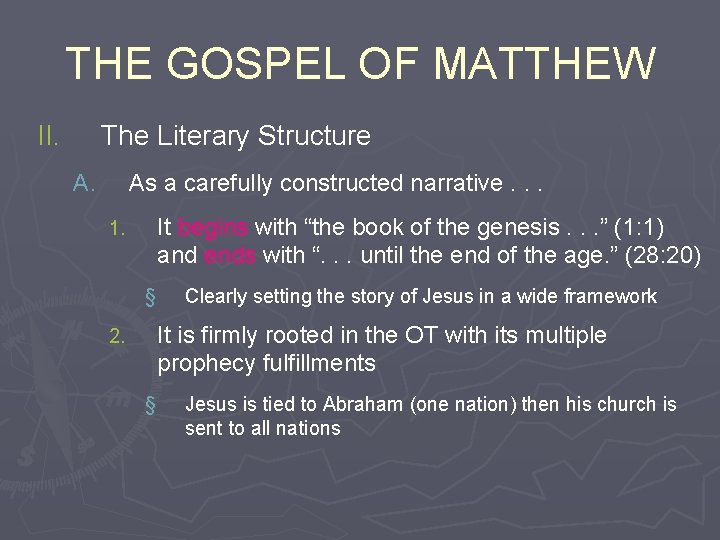
THE GOSPEL OF MATTHEW II. The Literary Structure A. As a carefully constructed narrative. . . 1. It begins with “the book of the genesis. . . ” (1: 1) and ends with “. . . until the end of the age. ” (28: 20) § 2. Clearly setting the story of Jesus in a wide framework It is firmly rooted in the OT with its multiple prophecy fulfillments § Jesus is tied to Abraham (one nation) then his church is sent to all nations
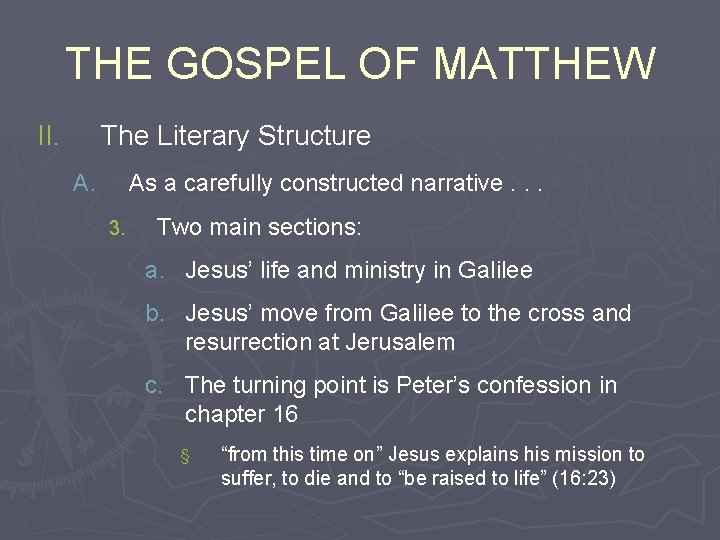
THE GOSPEL OF MATTHEW II. The Literary Structure A. As a carefully constructed narrative. . . 3. Two main sections: a. Jesus’ life and ministry in Galilee b. Jesus’ move from Galilee to the cross and resurrection at Jerusalem c. The turning point is Peter’s confession in chapter 16 § “from this time on” Jesus explains his mission to suffer, to die and to “be raised to life” (16: 23)
THE GOSPEL OF MATTHEW II. The Literary Structure A. As a carefully constructed narrative. . . 4. Five significant discourse each followed by “when Jesus had finished these saying” a. 5 -7 The Sermon on the Mount A new Torah? A new Moses? b. 10 Instructing the Twelve c. 13 Parables of the Kingdom d. 18 Church life and order discourse e. 24 -25 Mount of Olives discourse
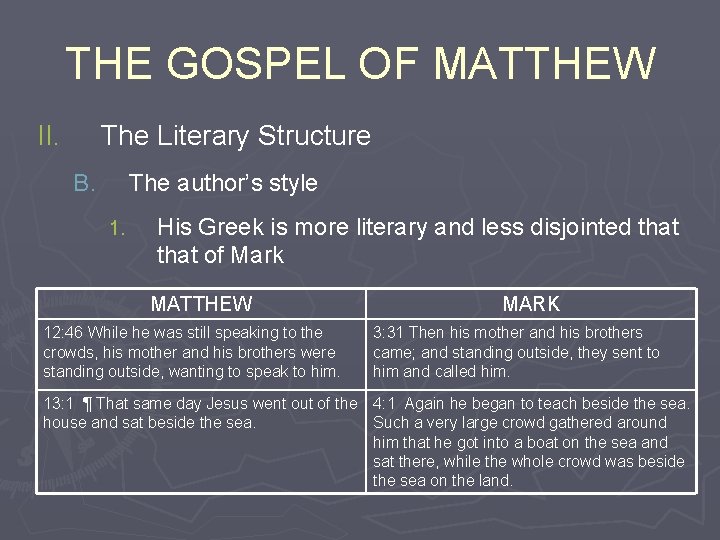
THE GOSPEL OF MATTHEW II. The Literary Structure B. The author’s style 1. His Greek is more literary and less disjointed that of Mark MATTHEW 12: 46 While he was still speaking to the crowds, his mother and his brothers were standing outside, wanting to speak to him. MARK 3: 31 Then his mother and his brothers came; and standing outside, they sent to him and called him. 13: 1 ¶ That same day Jesus went out of the 4: 1 Again he began to teach beside the sea. house and sat beside the sea. Such a very large crowd gathered around him that he got into a boat on the sea and sat there, while the whole crowd was beside the sea on the land.
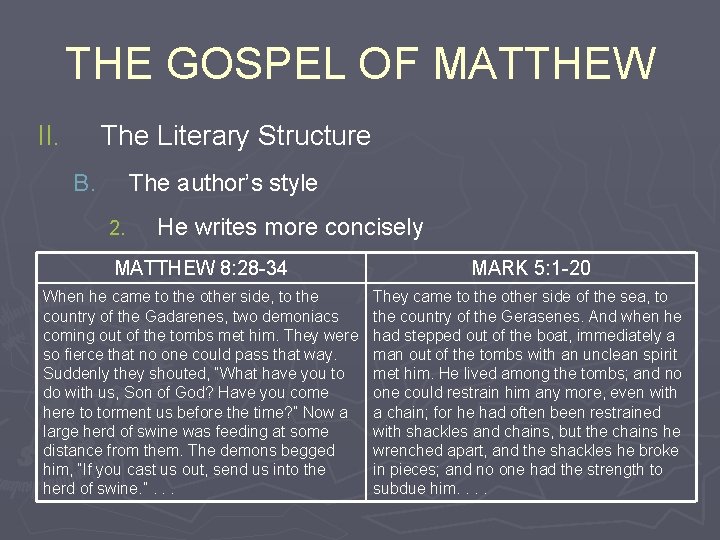
THE GOSPEL OF MATTHEW II. The Literary Structure B. The author’s style 2. He writes more concisely MATTHEW 8: 28 -34 MARK 5: 1 -20 When he came to the other side, to the country of the Gadarenes, two demoniacs coming out of the tombs met him. They were so fierce that no one could pass that way. Suddenly they shouted, “What have you to do with us, Son of God? Have you come here to torment us before the time? ” Now a large herd of swine was feeding at some distance from them. The demons begged him, “If you cast us out, send us into the herd of swine. ”. . . They came to the other side of the sea, to the country of the Gerasenes. And when he had stepped out of the boat, immediately a man out of the tombs with an unclean spirit met him. He lived among the tombs; and no one could restrain him any more, even with a chain; for he had often been restrained with shackles and chains, but the chains he wrenched apart, and the shackles he broke in pieces; and no one had the strength to subdue him. .
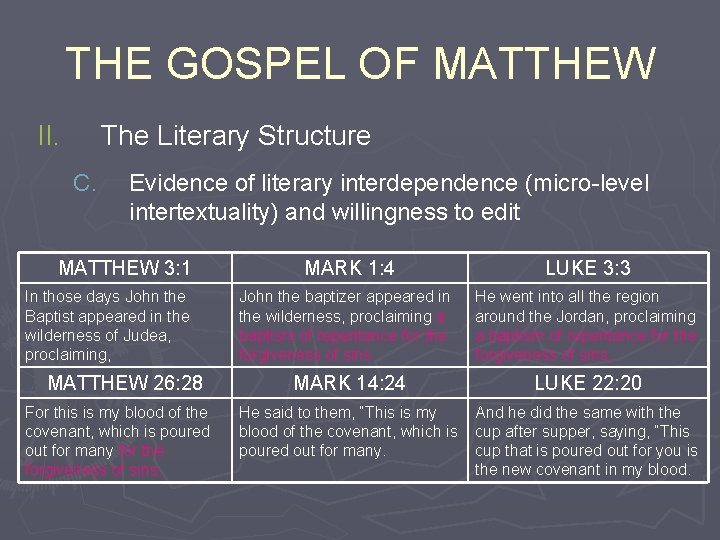
THE GOSPEL OF MATTHEW II. The Literary Structure C. Evidence of literary interdependence (micro-level intertextuality) and willingness to edit MATTHEW 3: 1 In those days John the Baptist appeared in the wilderness of Judea, proclaiming, MATTHEW 26: 28 For this is my blood of the covenant, which is poured out for many for the forgiveness of sins. MARK 1: 4 John the baptizer appeared in the wilderness, proclaiming a baptism of repentance for the forgiveness of sins. LUKE 3: 3 He went into all the region around the Jordan, proclaiming a baptism of repentance for the forgiveness of sins, MARK 14: 24 LUKE 22: 20 He said to them, “This is my blood of the covenant, which is poured out for many. And he did the same with the cup after supper, saying, “This cup that is poured out for you is the new covenant in my blood.
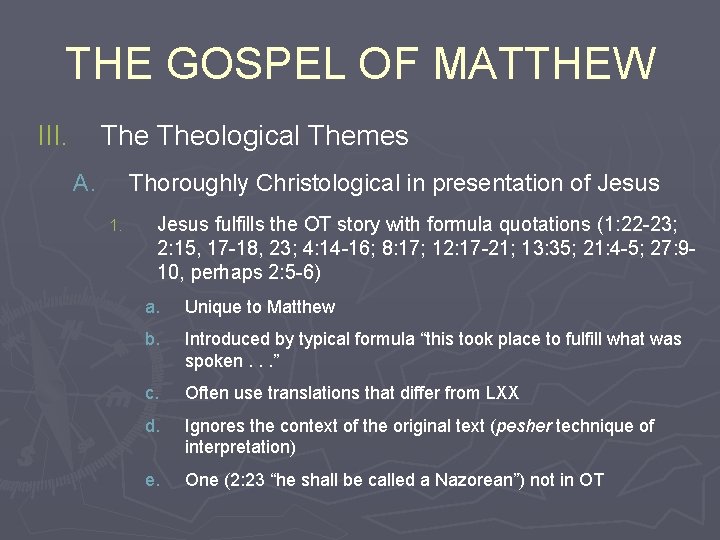
THE GOSPEL OF MATTHEW III. Theological Themes A. Thoroughly Christological in presentation of Jesus 1. Jesus fulfills the OT story with formula quotations (1: 22 -23; 2: 15, 17 -18, 23; 4: 14 -16; 8: 17; 12: 17 -21; 13: 35; 21: 4 -5; 27: 910, perhaps 2: 5 -6) a. Unique to Matthew b. Introduced by typical formula “this took place to fulfill what was spoken. . . ” c. Often use translations that differ from LXX d. Ignores the context of the original text (pesher technique of interpretation) e. One (2: 23 “he shall be called a Nazorean”) not in OT
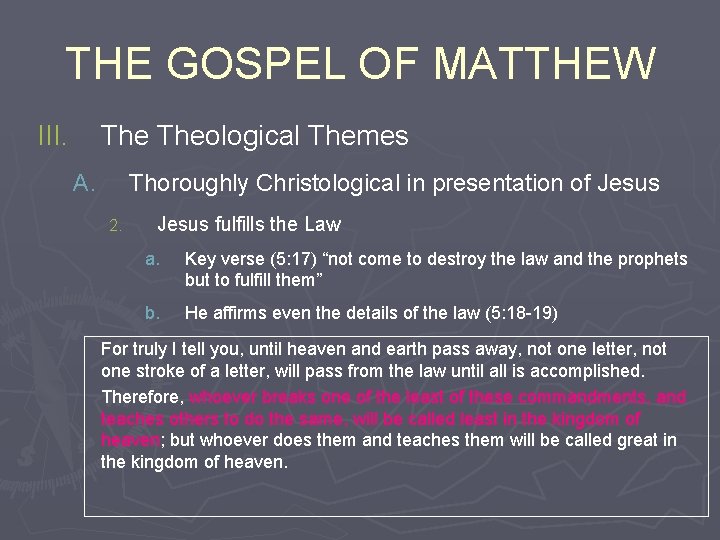
THE GOSPEL OF MATTHEW III. Theological Themes A. Thoroughly Christological in presentation of Jesus 2. Jesus fulfills the Law a. Key verse (5: 17) “not come to destroy the law and the prophets but to fulfill them” b. He affirms even the details of the law (5: 18 -19) For truly I tell you, until heaven and earth pass away, not one letter, not one stroke of a letter, will pass from the law until all is accomplished. Therefore, whoever breaks one of the least of these commandments, and teaches others to do the same, will be called least in the kingdom of heaven; but whoever does them and teaches them will be called great in the kingdom of heaven.
THE GOSPEL OF MATTHEW III. Theological Themes A. Thoroughly Christological in presentation of Jesus 2. Jesus fulfills the Law c. He demands a level of righteousness that goes beyond the letter of the Law
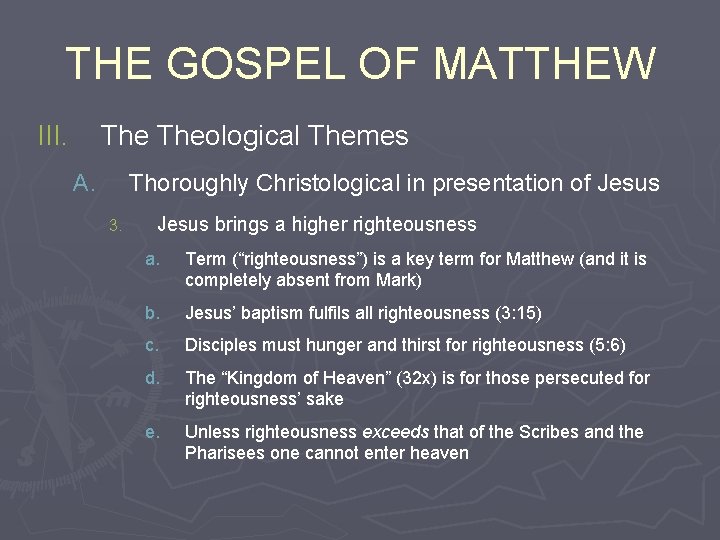
THE GOSPEL OF MATTHEW III. Theological Themes A. Thoroughly Christological in presentation of Jesus 3. Jesus brings a higher righteousness a. Term (“righteousness”) is a key term for Matthew (and it is completely absent from Mark) b. Jesus’ baptism fulfils all righteousness (3: 15) c. Disciples must hunger and thirst for righteousness (5: 6) d. The “Kingdom of Heaven” (32 x) is for those persecuted for righteousness’ sake e. Unless righteousness exceeds that of the Scribes and the Pharisees one cannot enter heaven
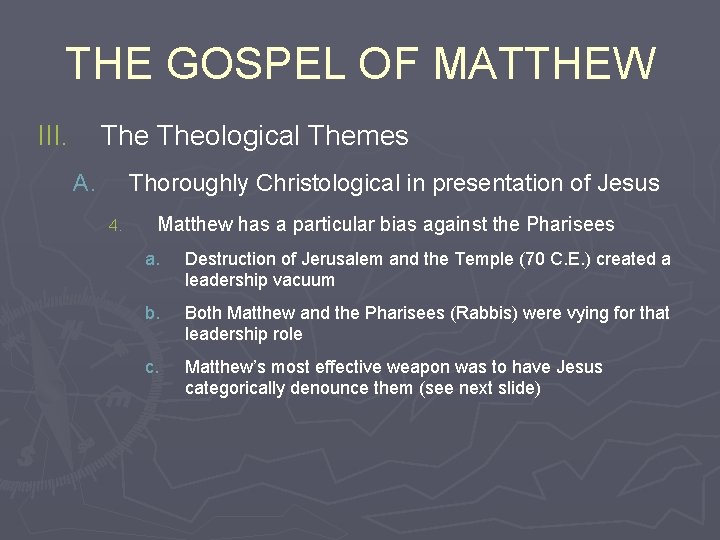
THE GOSPEL OF MATTHEW III. Theological Themes A. Thoroughly Christological in presentation of Jesus 4. Matthew has a particular bias against the Pharisees a. Destruction of Jerusalem and the Temple (70 C. E. ) created a leadership vacuum b. Both Matthew and the Pharisees (Rabbis) were vying for that leadership role c. Matthew’s most effective weapon was to have Jesus categorically denounce them (see next slide)
• Both Matthew and Luke use Q material to provide the words of John the Baptist • But, as with most if not all oral material, the context must be constructed by the author • How does Matthew demonstrate a polemic against the Pharisees?
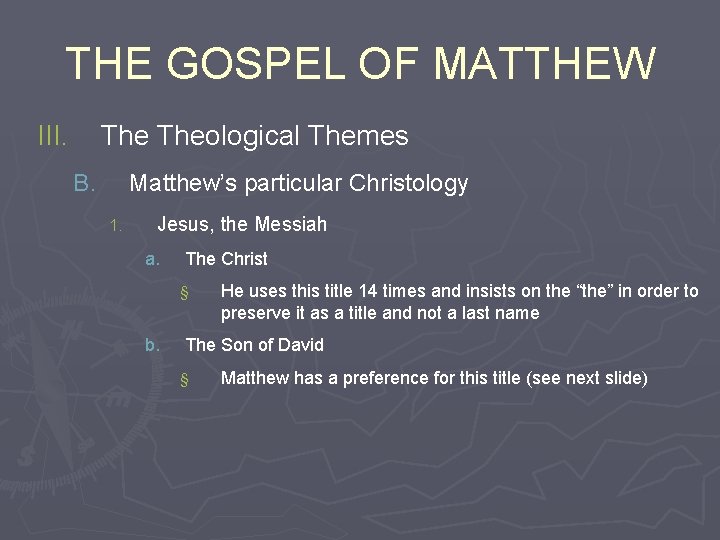
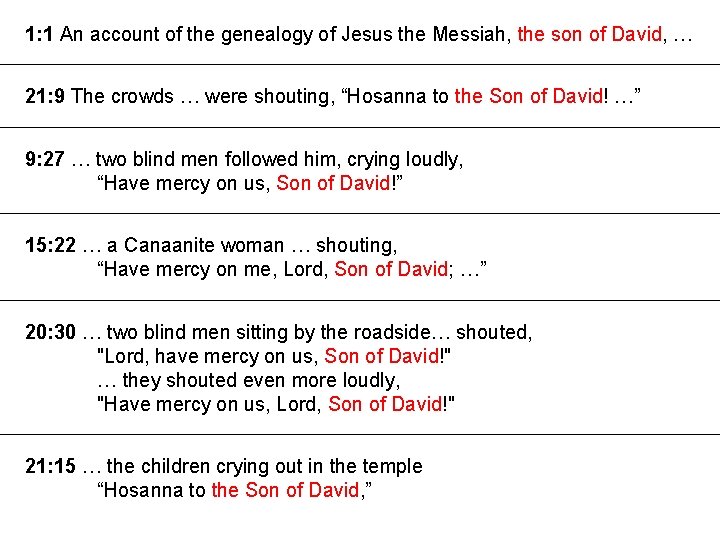
THE GOSPEL OF MATTHEW III. Theological Themes B. Matthew’s particular Christology 1. Jesus, the Messiah a. The Christ § b. He uses this title 14 times and insists on the “the” in order to preserve it as a title and not a last name The Son of David § Matthew has a preference for this title (see next slide)
1: 1 An account of the genealogy of Jesus the Messiah, the son of David, … 21: 9 The crowds … were shouting, “Hosanna to the Son of David! …” 9: 27 … two blind men followed him, crying loudly, “Have mercy on us, Son of David!” 15: 22 … a Canaanite woman … shouting, “Have mercy on me, Lord, Son of David; …” 20: 30 … two blind men sitting by the roadside… shouted, "Lord, have mercy on us, Son of David!" … they shouted even more loudly, "Have mercy on us, Lord, Son of David!" 21: 15 … the children crying out in the temple “Hosanna to the Son of David, ”
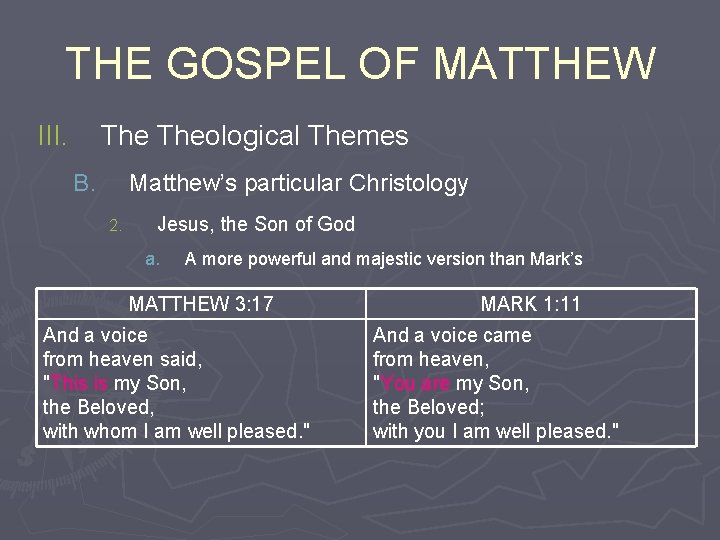
THE GOSPEL OF MATTHEW III. Theological Themes B. Matthew’s particular Christology 2. Jesus, the Son of God a. A more powerful and majestic version than Mark’s MATTHEW 3: 17 And a voice from heaven said, "This is my Son, the Beloved, with whom I am well pleased. " MARK 1: 11 And a voice came from heaven, "You are my Son, the Beloved; with you I am well pleased. "
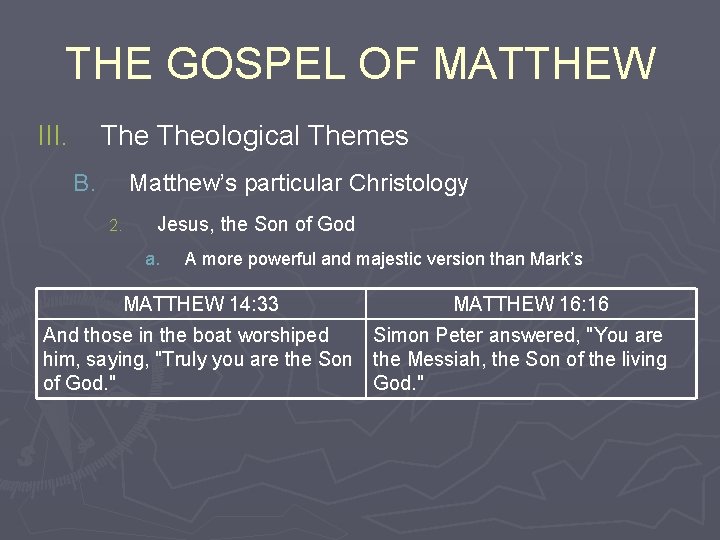
THE GOSPEL OF MATTHEW III. Theological Themes B. Matthew’s particular Christology 2. Jesus, the Son of God a. A more powerful and majestic version than Mark’s MATTHEW 14: 33 MATTHEW 16: 16 And those in the boat worshiped Simon Peter answered, "You are him, saying, "Truly you are the Son the Messiah, the Son of the living of God. "
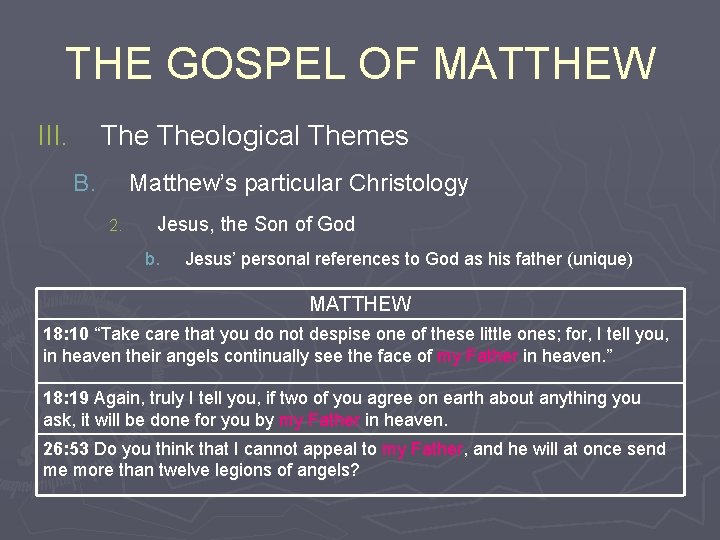
THE GOSPEL OF MATTHEW III. Theological Themes B. Matthew’s particular Christology 2. Jesus, the Son of God b. Jesus’ personal references to God as his father (unique) MATTHEW 18: 10 “Take care that you do not despise one of these little ones; for, I tell you, in heaven their angels continually see the face of my Father in heaven. ” 18: 19 Again, truly I tell you, if two of you agree on earth about anything you ask, it will be done for you by my Father in heaven. 26: 53 Do you think that I cannot appeal to my Father, and he will at once send me more than twelve legions of angels?
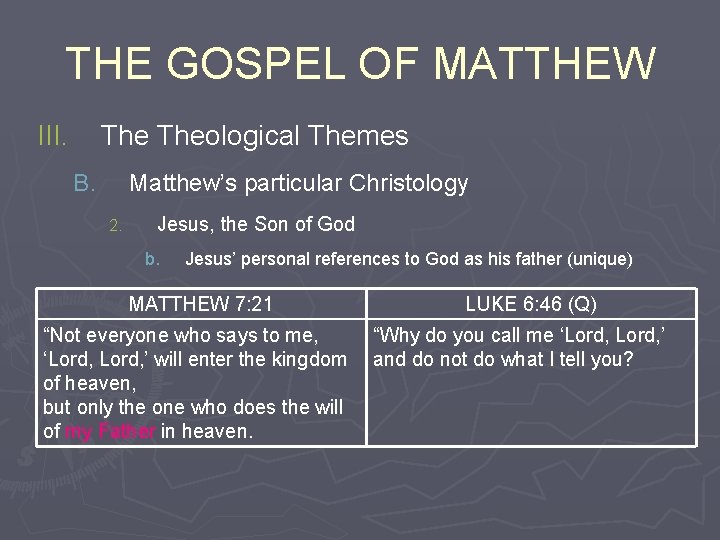
THE GOSPEL OF MATTHEW III. Theological Themes B. Matthew’s particular Christology 2. Jesus, the Son of God b. Jesus’ personal references to God as his father (unique) MATTHEW 7: 21 “Not everyone who says to me, ‘Lord, ’ will enter the kingdom of heaven, but only the one who does the will of my Father in heaven. LUKE 6: 46 (Q) “Why do you call me ‘Lord, ’ and do not do what I tell you?
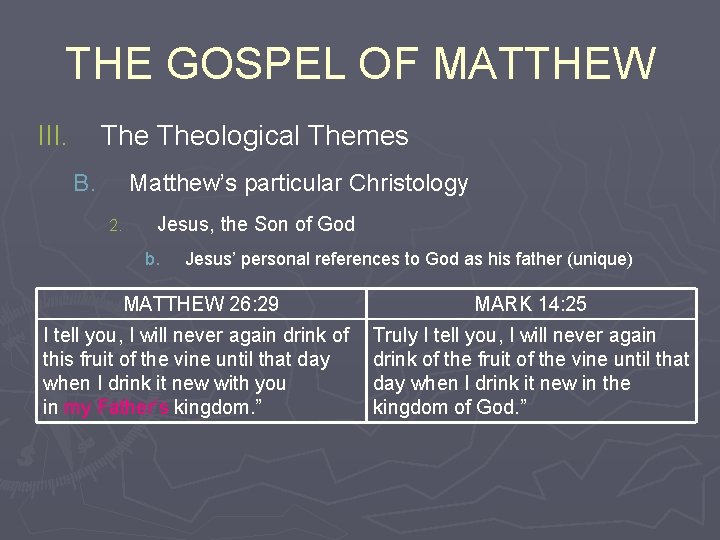
THE GOSPEL OF MATTHEW III. Theological Themes B. Matthew’s particular Christology 2. Jesus, the Son of God b. Jesus’ personal references to God as his father (unique) MATTHEW 26: 29 MARK 14: 25 I tell you, I will never again drink of this fruit of the vine until that day when I drink it new with you in my Father’s kingdom. ” Truly I tell you, I will never again drink of the fruit of the vine until that day when I drink it new in the kingdom of God. ”
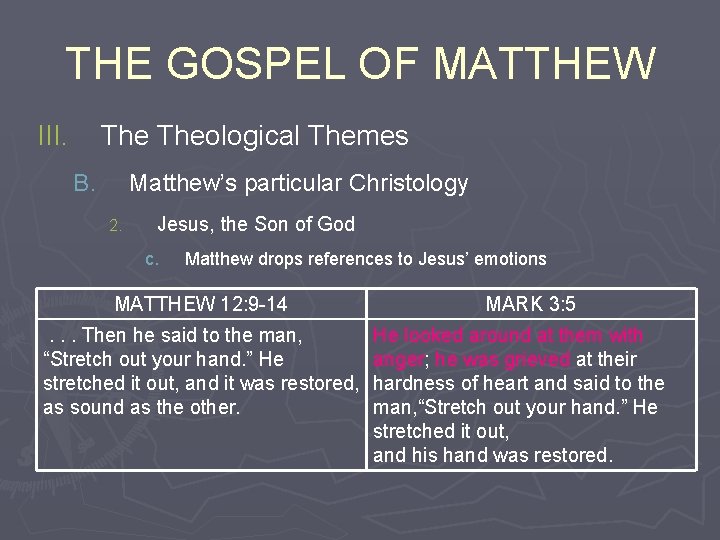
THE GOSPEL OF MATTHEW III. Theological Themes B. Matthew’s particular Christology 2. Jesus, the Son of God c. Matthew drops references to Jesus’ emotions MATTHEW 12: 9 -14. . . Then he said to the man, “Stretch out your hand. ” He stretched it out, and it was restored, as sound as the other. MARK 3: 5 He looked around at them with anger; he was grieved at their hardness of heart and said to the man, “Stretch out your hand. ” He stretched it out, and his hand was restored.
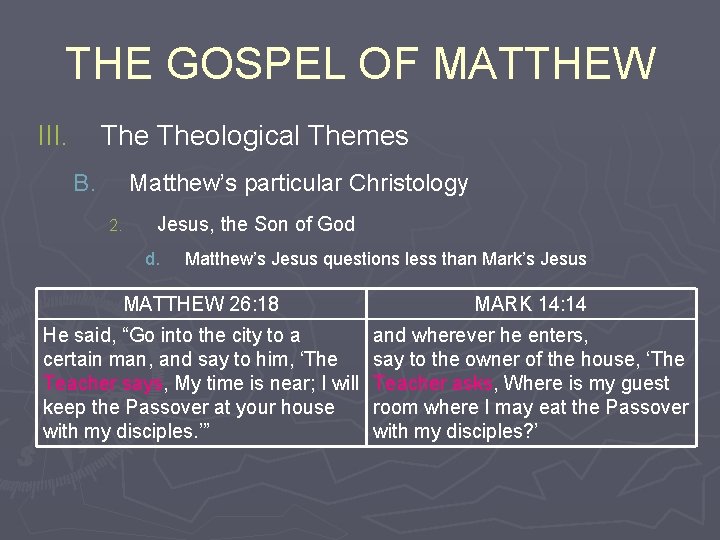
THE GOSPEL OF MATTHEW III. Theological Themes B. Matthew’s particular Christology 2. Jesus, the Son of God d. Matthew’s Jesus questions less than Mark’s Jesus MATTHEW 26: 18 MARK 14: 14 He said, “Go into the city to a certain man, and say to him, ‘The Teacher says, My time is near; I will keep the Passover at your house with my disciples. ’” and wherever he enters, say to the owner of the house, ‘The Teacher asks, Where is my guest room where I may eat the Passover with my disciples? ’
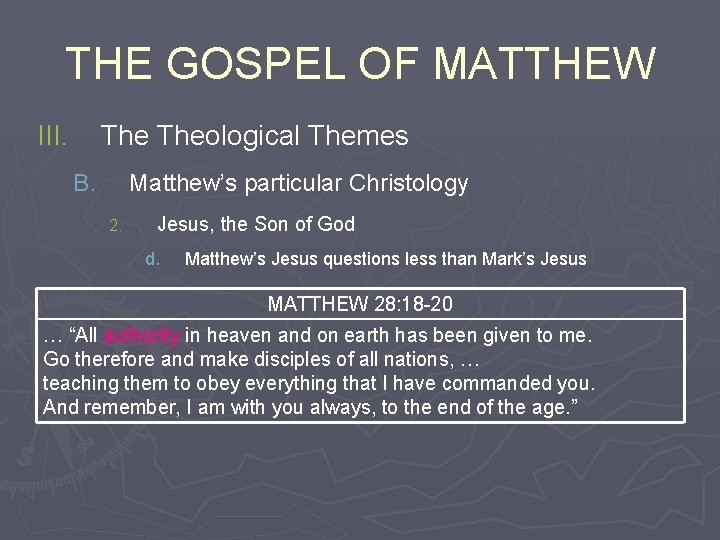
THE GOSPEL OF MATTHEW III. Theological Themes B. Matthew’s particular Christology 2. Jesus, the Son of God d. Matthew’s Jesus questions less than Mark’s Jesus MATTHEW 28: 18 -20 … “All authority in heaven and on earth has been given to me. Go therefore and make disciples of all nations, … teaching them to obey everything that I have commanded you. And remember, I am with you always, to the end of the age. ”
THE GOSPEL OF MATTHEW III. Theological Themes B. Matthew’s particular Christology 2. Jesus, the Son of God e. A less human and more kingly Jesus
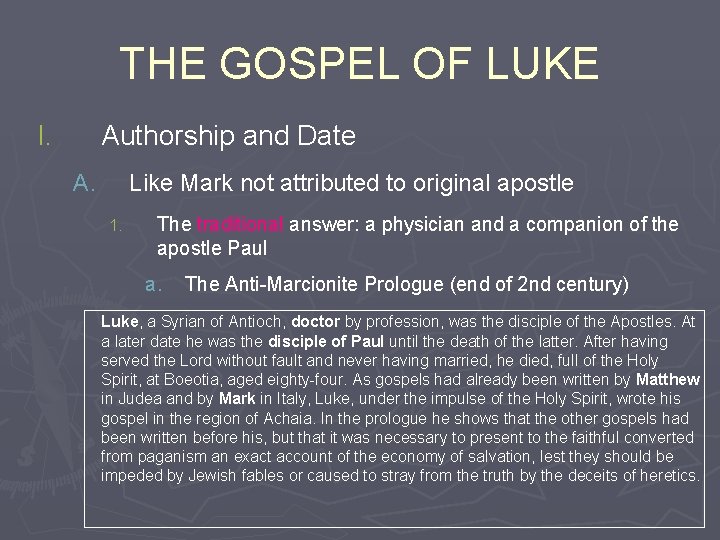
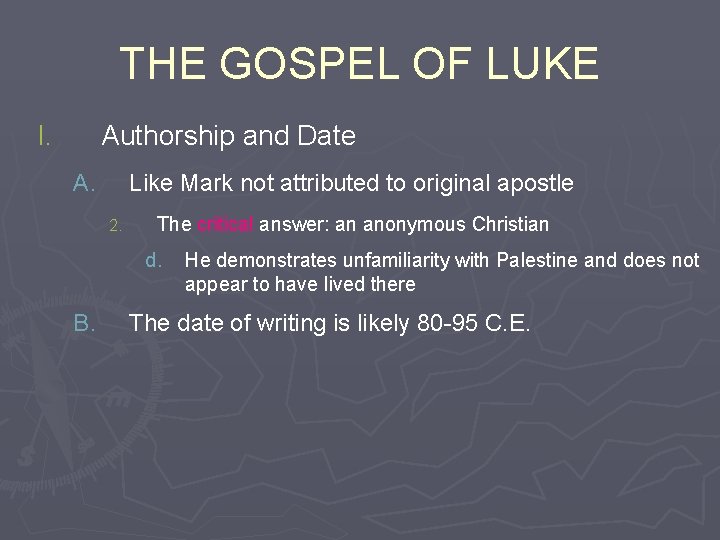
THE GOSPEL OF LUKE I. Authorship and Date A. Like Mark not attributed to original apostle 1. The traditional answer: a physician and a companion of the apostle Paul a. The Anti-Marcionite Prologue (end of 2 nd century) Luke, a Syrian of Antioch, doctor by profession, was the disciple of the Apostles. At a later date he was the disciple of Paul until the death of the latter. After having served the Lord without fault and never having married, he died, full of the Holy Spirit, at Boeotia, aged eighty-four. As gospels had already been written by Matthew in Judea and by Mark in Italy, Luke, under the impulse of the Holy Spirit, wrote his gospel in the region of Achaia. In the prologue he shows that the other gospels had been written before his, but that it was necessary to present to the faithful converted from paganism an exact account of the economy of salvation, lest they should be impeded by Jewish fables or caused to stray from the truth by the deceits of heretics.
THE GOSPEL OF LUKE I. Authorship and Date A. Like Mark not attributed to original apostle 1. The traditional answer: a physician and a companion of the apostle Paul b. Irenaeus (end of 2 nd century) Luke, the companion of Paul, wrote the latter’s gospel in a book
THE GOSPEL OF LUKE I. Authorship and Date A. Like Mark not attributed to original apostle 1. The traditional answer: a physician and a companion of the apostle Paul c. Yet there is no significant Pauline influence detectable in any of the gospel d. There are no references to or quotations of Paul’s letters
THE GOSPEL OF LUKE I. Authorship and Date A. Like Mark not attributed to original apostle 2. The critical answer: an anonymous Christian a. Presupposes Mark b. Expands Mark 13 (Jesus’ last days prophecy) i. By mentioning Jerusalem LUKE 21: 24 they will fall by the edge of the sword and be taken away as captives among all nations; and Jerusalem will be trampled on by the Gentiles, until the times of the Gentiles are fulfilled.
THE GOSPEL OF LUKE I. Authorship and Date A. Like Mark not attributed to original apostle 2. The critical answer: an anonymous Christian a. Presupposes Mark b. Expands Mark 13 (Jesus’ last days prophecy) ii. By replacing “desolating sacrilege” with “desolation” to emphasize the city MARK 13: 14 LUKE 21: 20 “But when you see the desolating “When you see Jerusalem surrounded sacrilege set up where it ought not to be by armies, then know that its desolation. . . , then those in Judea must flee to the has come near. mountains;
THE GOSPEL OF LUKE I. Authorship and Date A. Like Mark not attributed to original apostle 2. The critical answer: an anonymous Christian c. He pushes the Parousia further into the future LUKE 19: 11 As they were listening to this, he went on to tell a parable, because he was near Jerusalem, and because they supposed that the kingdom of God was to appear immediately
THE GOSPEL OF LUKE I. Authorship and Date A. Like Mark not attributed to original apostle 2. The critical answer: an anonymous Christian d. B. He demonstrates unfamiliarity with Palestine and does not appear to have lived there The date of writing is likely 80 -95 C. E.
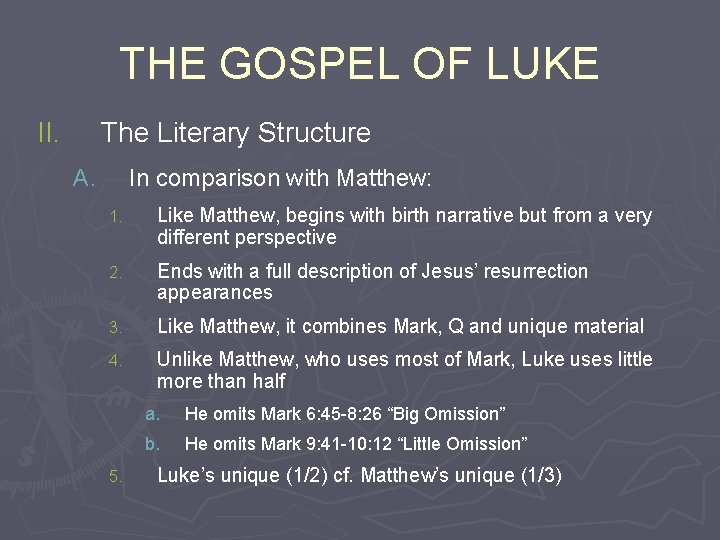
THE GOSPEL OF LUKE II. The Literary Structure A. In comparison with Matthew: 1. Like Matthew, begins with birth narrative but from a very different perspective 2. Ends with a full description of Jesus’ resurrection appearances 3. Like Matthew, it combines Mark, Q and unique material 4. Unlike Matthew, who uses most of Mark, Luke uses little more than half 5. a. He omits Mark 6: 45 -8: 26 “Big Omission” b. He omits Mark 9: 41 -10: 12 “Little Omission” Luke’s unique (1/2) cf. Matthew’s unique (1/3)
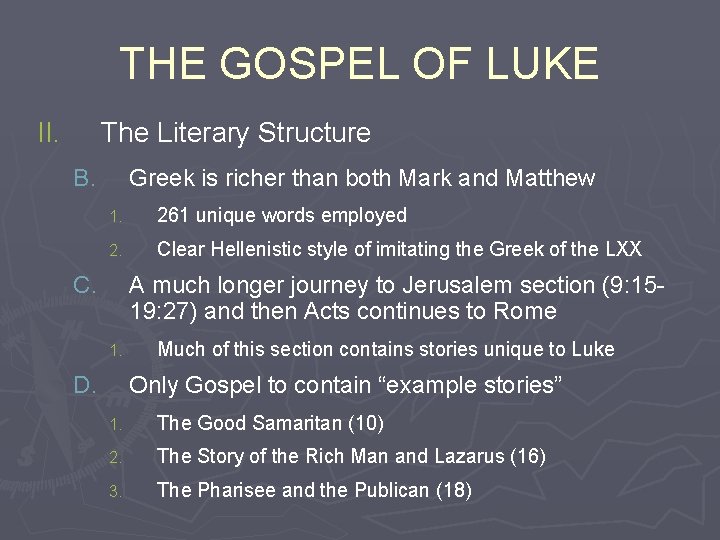
THE GOSPEL OF LUKE II. The Literary Structure B. Greek is richer than both Mark and Matthew 1. 261 unique words employed 2. Clear Hellenistic style of imitating the Greek of the LXX C. A much longer journey to Jerusalem section (9: 1519: 27) and then Acts continues to Rome 1. D. Much of this section contains stories unique to Luke Only Gospel to contain “example stories” 1. The Good Samaritan (10) 2. The Story of the Rich Man and Lazarus (16) 3. The Pharisee and the Publican (18)
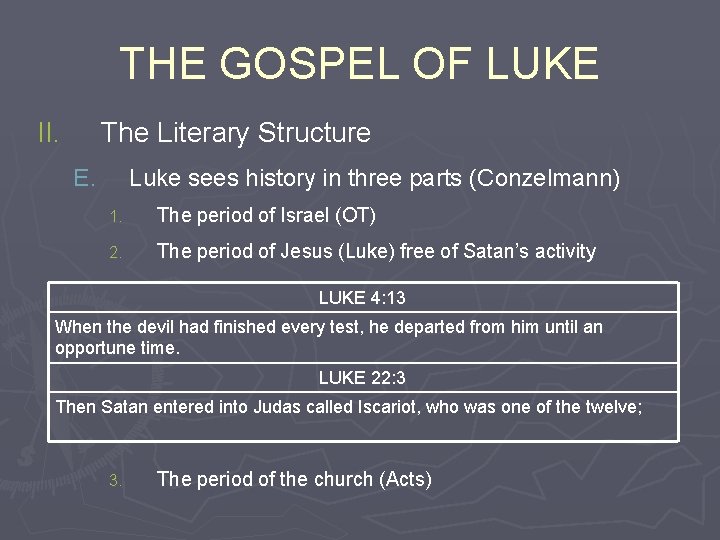
THE GOSPEL OF LUKE II. The Literary Structure E. Luke sees history in three parts (Conzelmann) 1. The period of Israel (OT) 2. The period of Jesus (Luke) free of Satan’s activity LUKE 4: 13 When the devil had finished every test, he departed from him until an opportune time. LUKE 22: 3 Then Satan entered into Judas called Iscariot, who was one of the twelve; 3. The period of the church (Acts)
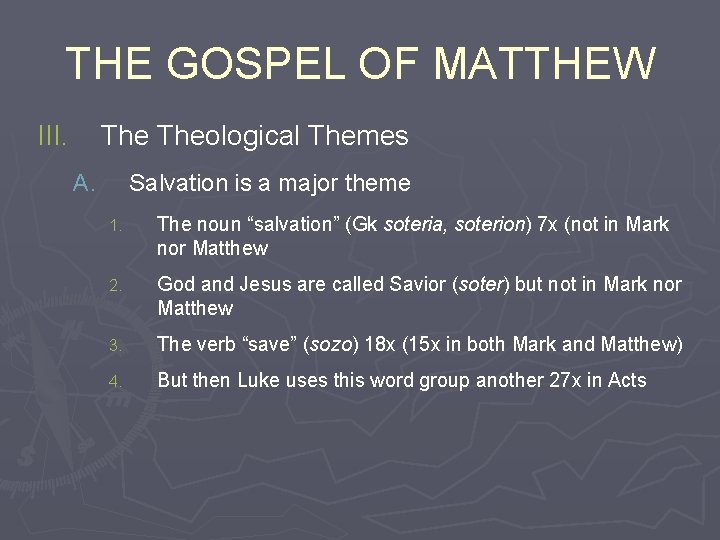
THE GOSPEL OF MATTHEW III. Theological Themes A. Salvation is a major theme 1. The noun “salvation” (Gk soteria, soterion) 7 x (not in Mark nor Matthew 2. God and Jesus are called Savior (soter) but not in Mark nor Matthew 3. The verb “save” (sozo) 18 x (15 x in both Mark and Matthew) 4. But then Luke uses this word group another 27 x in Acts
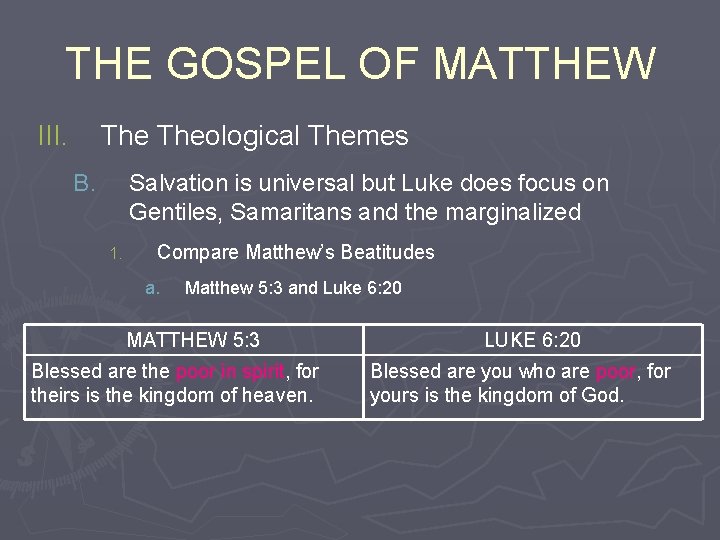
THE GOSPEL OF MATTHEW III. Theological Themes B. Salvation is universal but Luke does focus on Gentiles, Samaritans and the marginalized 1. Compare Matthew’s Beatitudes a. Matthew 5: 3 and Luke 6: 20 MATTHEW 5: 3 Blessed are the poor in spirit, for theirs is the kingdom of heaven. LUKE 6: 20 Blessed are you who are poor, for yours is the kingdom of God.
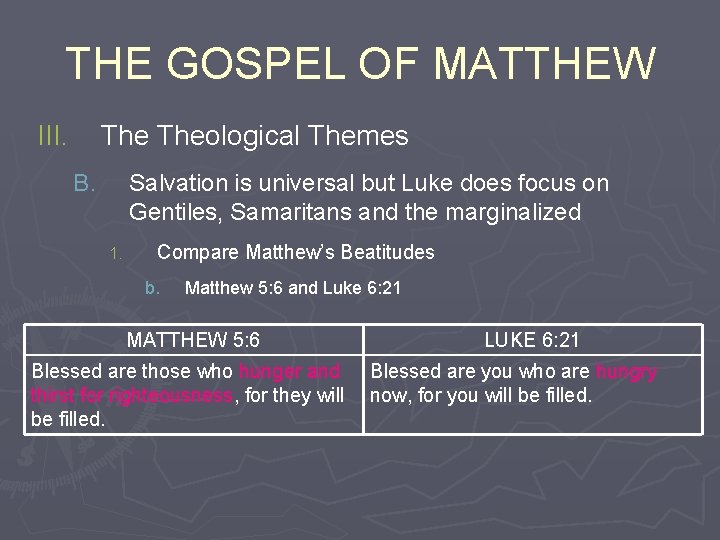
THE GOSPEL OF MATTHEW III. Theological Themes B. Salvation is universal but Luke does focus on Gentiles, Samaritans and the marginalized 1. Compare Matthew’s Beatitudes b. Matthew 5: 6 and Luke 6: 21 MATTHEW 5: 6 Blessed are those who hunger and thirst for righteousness, for they will be filled. LUKE 6: 21 Blessed are you who are hungry now, for you will be filled.
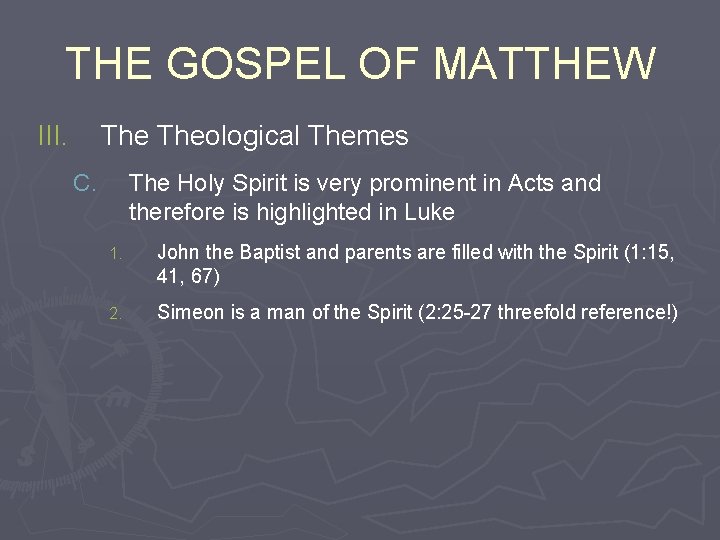
THE GOSPEL OF MATTHEW III. Theological Themes C. The Holy Spirit is very prominent in Acts and therefore is highlighted in Luke 1. John the Baptist and parents are filled with the Spirit (1: 15, 41, 67) 2. Simeon is a man of the Spirit (2: 25 -27 threefold reference!)
THE GOSPEL OF MATTHEW III. Theological Themes C. The Holy Spirit is very prominent in Acts and therefore is highlighted in Luke Jesus is the man of the Spirit 3. a. Conceived by it (1: 35) b. Empowered by it (3: 22; 4: 1, 14, 18) c. Baptizer of others with the Spirit (3: 16) d. Teaches that Father gives the Spirit (11: 13, cf. Matt 7: 11) e. Warns against blasphemy against the Spirit (12: 10) f. Promises disciples to be instructed by the Spirit (12: 12, cf. Acts 4: 8; 6: 10; 7: 2, 55) g. Promises Spirit to come after resurrection (24: 49)
THE GOSPEL OF MATTHEW III. Theological Themes D. Jesus and Women 1. Ch 1 -2 parallels men and women (Mary & Zachariah; Anna & Simeon) 2. Mary Magdalene, Joanna, Susanna, Mary and Martha (8: 1 -3; 10: 3842) 3. Healing the widow (7: 11 -15), the woman with the alabaster jar (7: 37 -50); the woman with hemorrhage (8: 43 -48); the crippled woman (13: 11 -13) 4. Story of the women with 10 coins (15: 8 -10), the widow seeking justice (18: 1 -8), widow with copper coins (21: 1 -4), daughters of Jerusalem (23: 27 -31), women witnesses (23: 49, 55 compared to Peter 22: 54 -62) 5. Women witnesses to the resurrection (24: 1 -12 compare reactions of the men and women)
TUTORIAL } Read and compare the story of the Healing of the Leper as given in Mark 1: 40 -45 and Matthew 8: 1 -4. 1. What details are the same? 2. What details are different? 3. What significance can you find in these and other details? 4. Can you suggest why Matthew makes the changes that he does?