Welcome to AP Psychology Sit at the desk








- Slides: 78
Welcome to AP Psychology! Sit at the desk with your name on it This Photo by Unknown Author is licensed under CC BY-NC 1
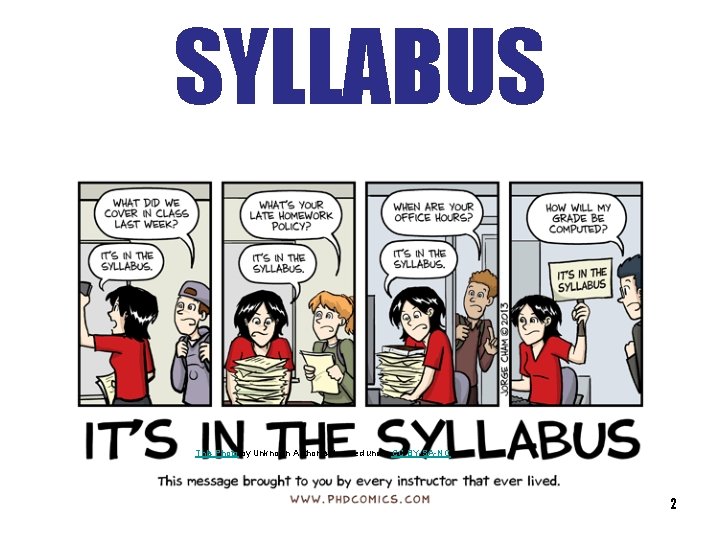
SYLLABUS This Photo by Unknown Author is licensed under CC BY-SA-NC 2
PARENT LETTER This Photo by Unknown Author is licensed under CC BY-NC-ND HW FOR YOUR PARENTS!! 3
Google Classroom Codes 4
SUMMER ASSIGNMENT This Photo by Unknown Author is licensed under CC BY-NCND You know… that thing you had all summer to due 5
6
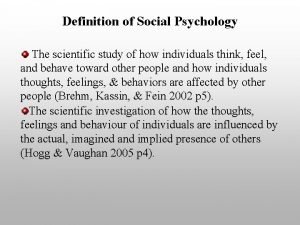
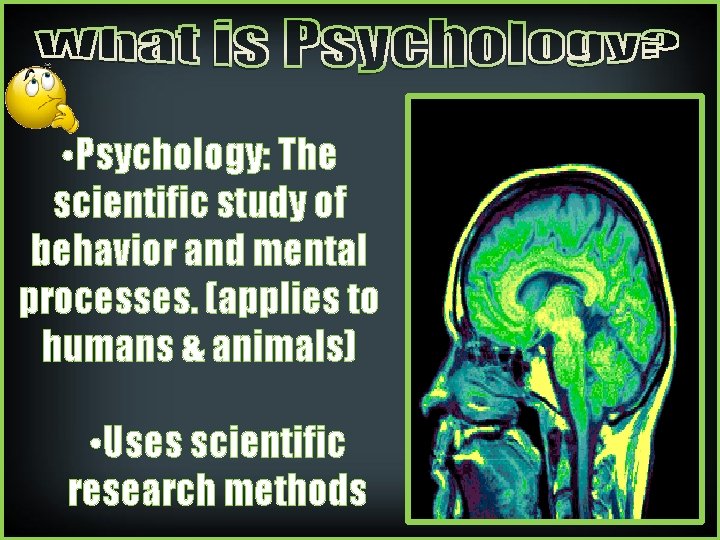
• Psychology: The scientific study of behavior and mental processes. (applies to humans & animals) • Uses scientific research methods
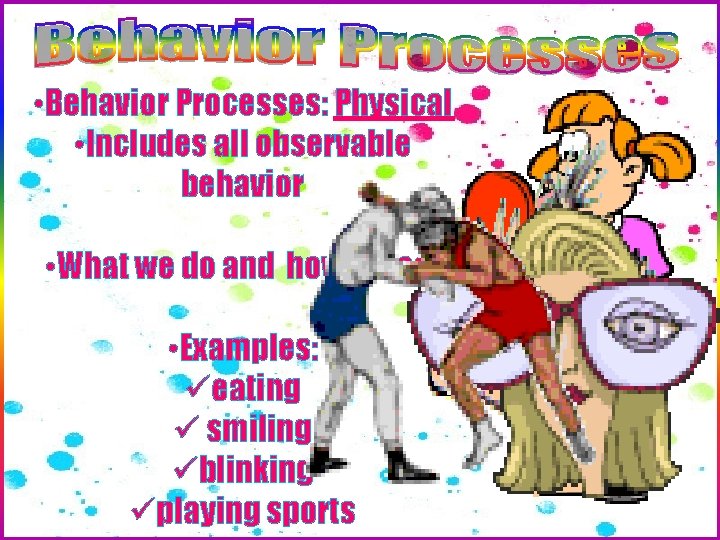
• Behavior Processes: Physical • Includes all observable behavior • What we do and how we act • Examples: üeating ü smiling üblinking üplaying sports
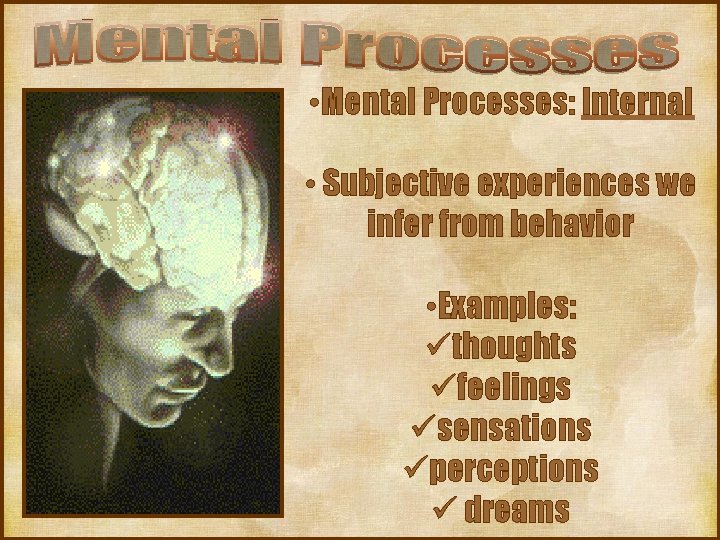
• Mental Processes: Internal • Subjective experiences we infer from behavior • Examples: üthoughts üfeelings üsensations üperceptions ü dreams
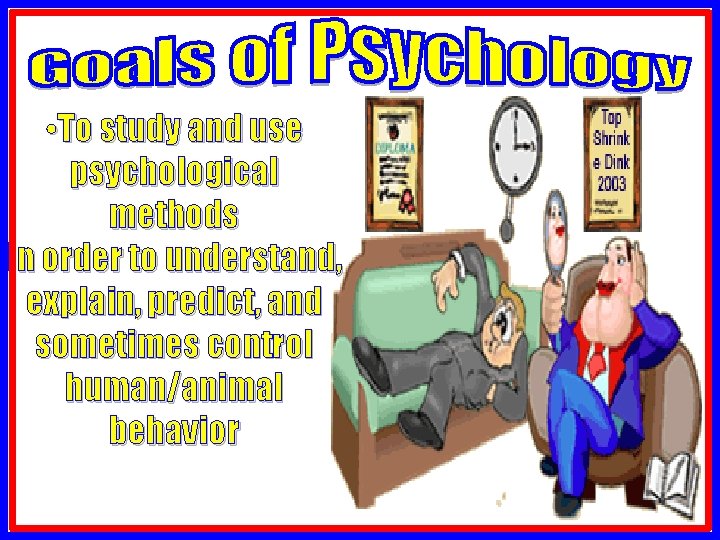
• To study and use psychological methods in order to understand, explain, predict, and sometimes control human/animal behavior
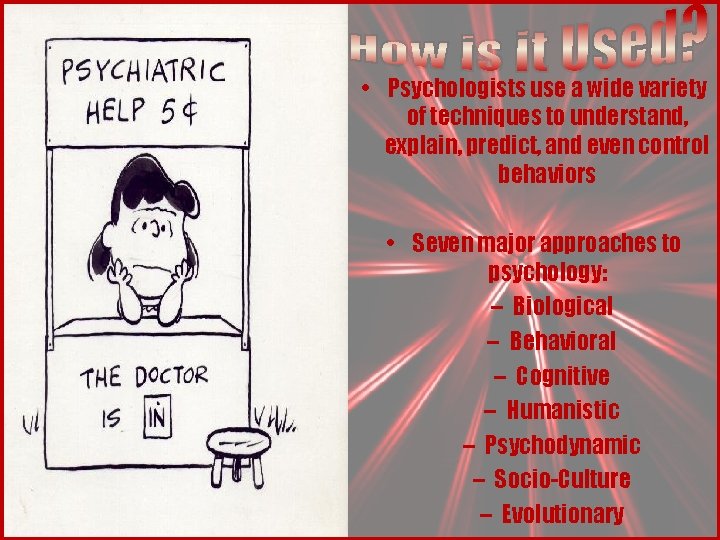
• Psychologists use a wide variety of techniques to understand, explain, predict, and even control behaviors • Seven major approaches to psychology: – Biological – Behavioral – Cognitive – Humanistic – Psychodynamic – Socio-Culture – Evolutionary
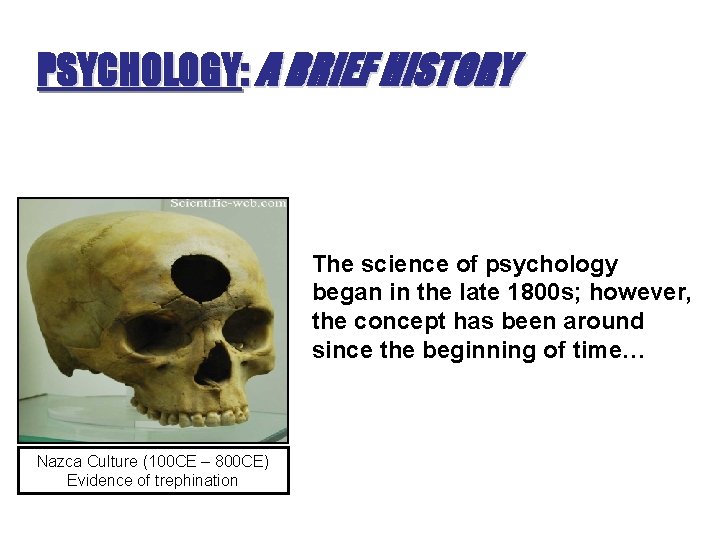
PSYCHOLOGY: A BRIEF HISTORY The science of psychology began in the late 1800 s; however, the concept has been around since the beginning of time… Nazca Culture (100 CE – 800 CE) Evidence of trephination
13
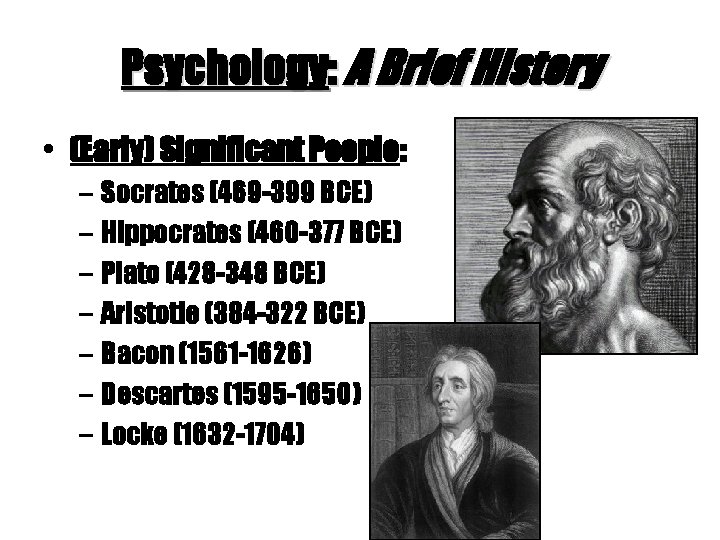
Psychology: A Brief History • (Early) Significant People: – Socrates (469 -399 BCE) – Hippocrates (460 -377 BCE) – Plato (428 -348 BCE) – Aristotle (384 -322 BCE) – Bacon (1561 -1626) – Descartes (1595 -1650) – Locke (1632 -1704)
• Francis Bacon & John Locke’s later works founded empiricism • Empiricism: a view that knowledge originates in experience • Strongly believed science should rely on observation and experimentation
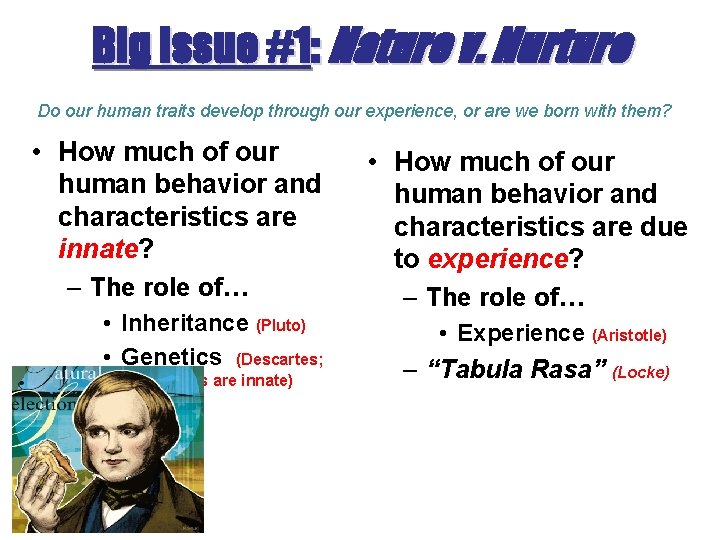
Big Issue #1: Nature v. Nurture Do our human traits develop through our experience, or are we born with them? • How much of our human behavior and characteristics are innate? – The role of… • Inheritance (Pluto) • Genetics (Descartes; some ideas are innate) • How much of our human behavior and characteristics are due to experience? – The role of… • Experience (Aristotle) – “Tabula Rasa” (Locke)
Big Issue #2: Mind & Body • What is the relationship between the mind & the body? – Does the mind control the body or does the body control the mind? – Is the mind nothing more than the body? – Might the body itself be a product of the mind?
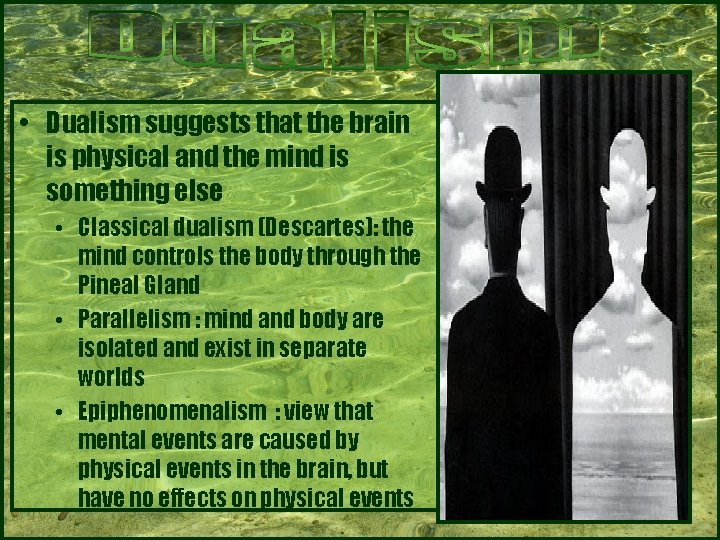
• Dualism suggests that the brain is physical and the mind is something else • Classical dualism (Descartes): the mind controls the body through the Pineal Gland • Parallelism : mind and body are isolated and exist in separate worlds • Epiphenomenalism : view that mental events are caused by physical events in the brain, but have no effects on physical events
• Monism: mind and Body are not separate • Idealism: the mind and body both exist in a mental realm • Solipsism: suggests that the whole world exists in the mind • Materialism: mind and body are both physical, there is no nonphysical, mental world
HW- (Yes HW- welcome to AP) 1. Get your parents to sign the letter 2. Submit you summer assignment through google classroom 3. Get all of your materials 4. Read chapter 1 and take notes 20
DO NOW: With your group discuss the following: 1. How would you explain what psychology is? 2. Explain psychology’s biggest issues. 3. Have your signed contract on your desk as well as the notes you took for HW 4. Your summer assignments were due through 21 google classroom
What are we doing today? Objectives Agenda 1. Define Psychology and trace its historical development 2. Compare and contrast the psychological perspectives 1. Do now 2. History and approaches of Psychology PPT 3. Scenarios 22
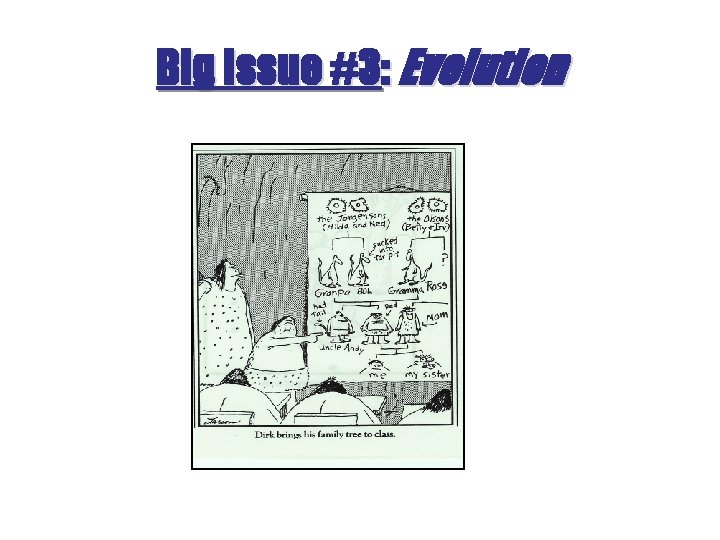
Big Issue #3: Evolution
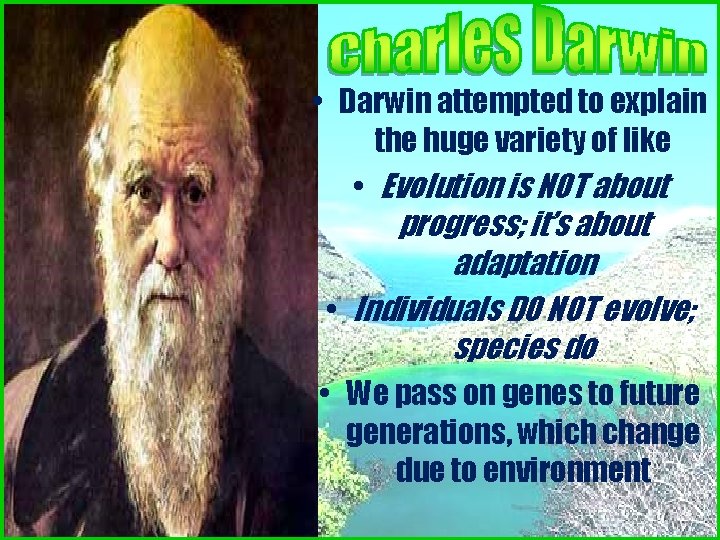
• Darwin attempted to explain the huge variety of like • Evolution is NOT about progress; it’s about adaptation • Individuals DO NOT evolve; species do • We pass on genes to future generations, which change due to environment 24
Throughout its history, Psychology has experienced FIVE distinct “waves” of thought 1. Introspection (Structuralism & Functionalism) 2. Psychoanalysis 3. Behaviorism 4. Gestalt Psychology 5. Eclectic Psychology 25
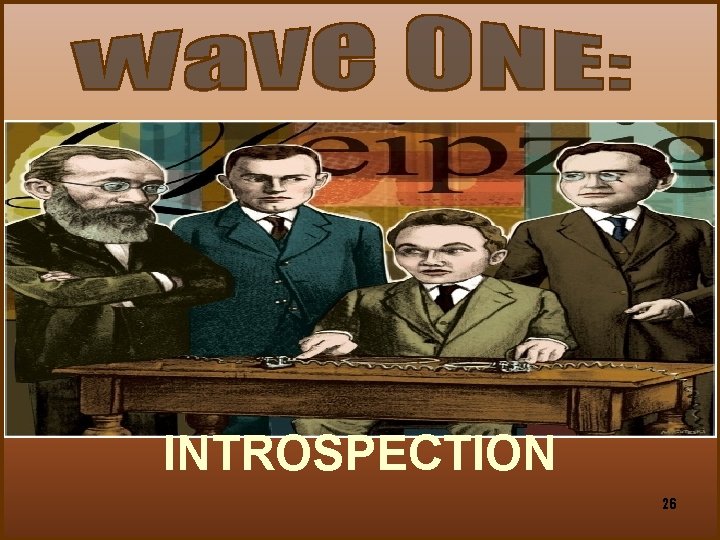
INTROSPECTION 26
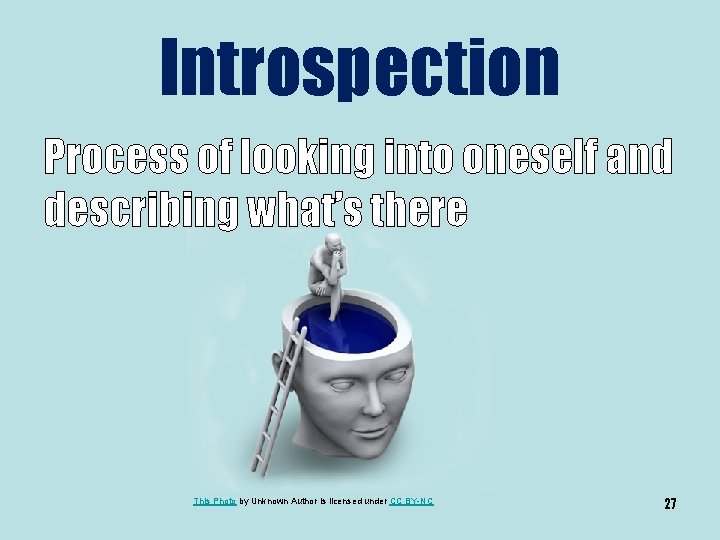
Introspection Process of looking into oneself and describing what’s there This Photo by Unknown Author is licensed under CC BY-NC 27
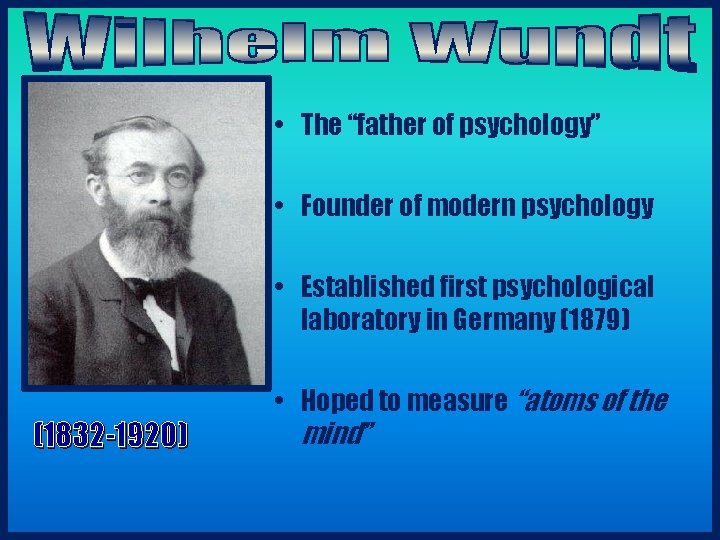
• The “father of psychology” • Founder of modern psychology • Established first psychological laboratory in Germany (1879) (1832 -1920) • Hoped to measure “atoms of the mind”
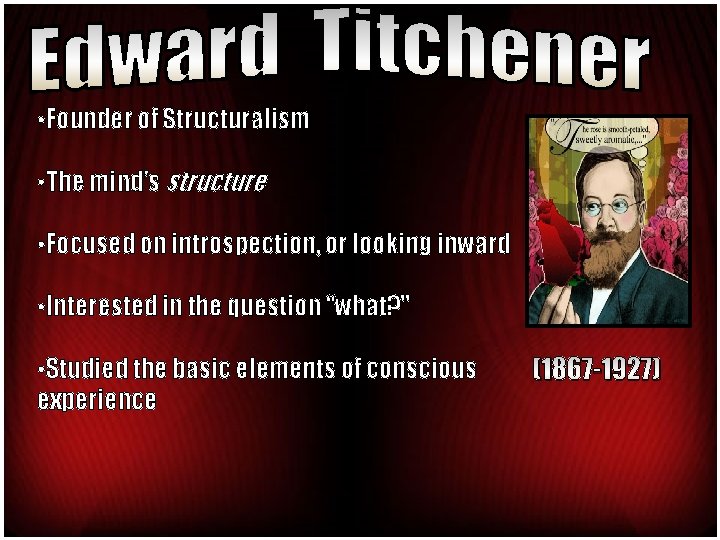
• Founder of Structuralism • The mind’s structure • Focused on introspection, or looking inward • Interested in the question “what? ” • Studied the basic elements of conscious experience (1867 -1927)
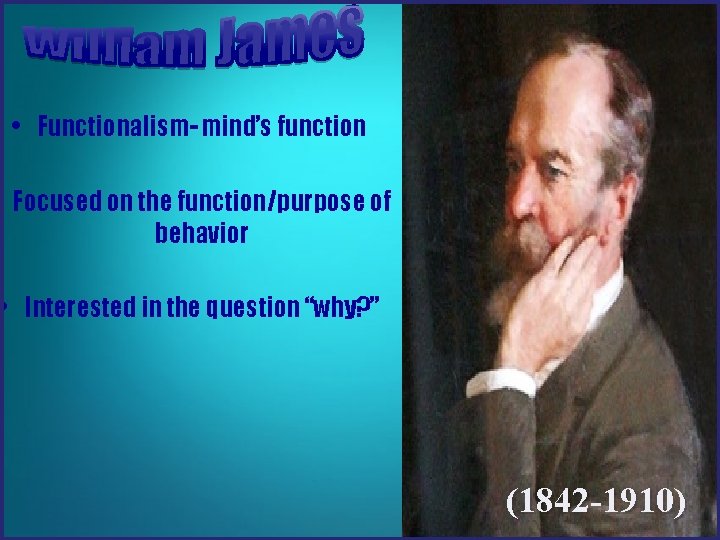
• Functionalism- mind’s function Focused on the function/purpose of behavior • Interested in the question “why? ” (1842 -1910)
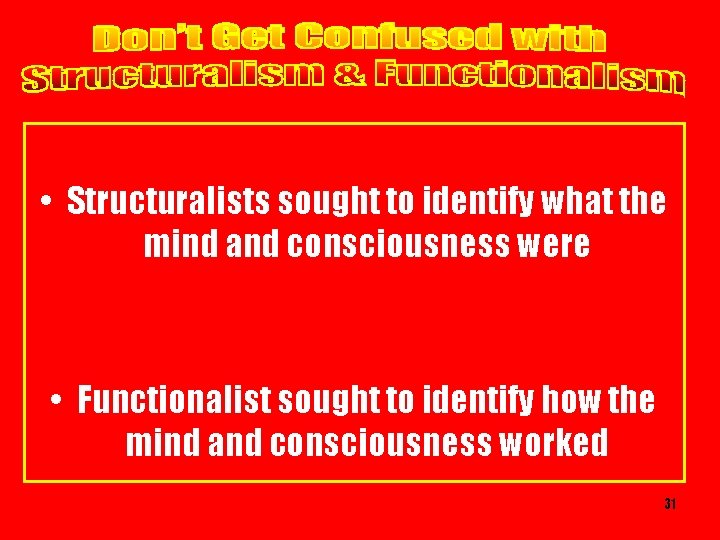
• Structuralists sought to identify what the mind and consciousness were • Functionalist sought to identify how the mind and consciousness worked 31
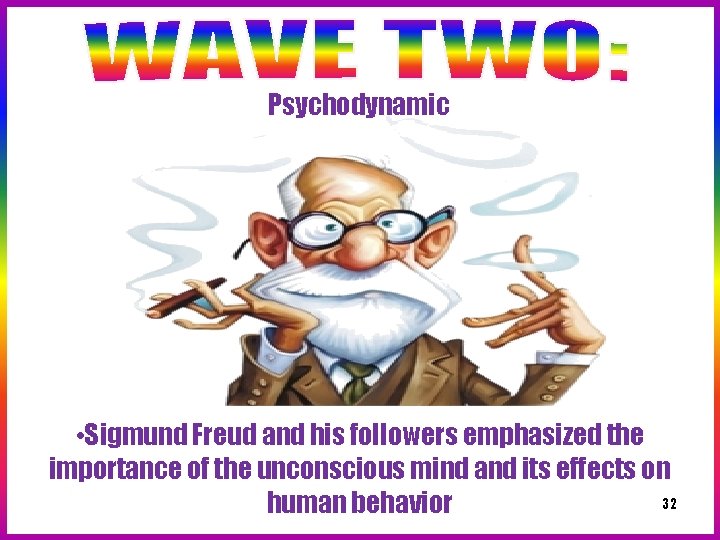
Psychodynamic • Sigmund Freud and his followers emphasized the importance of the unconscious mind and its effects on 32 human behavior
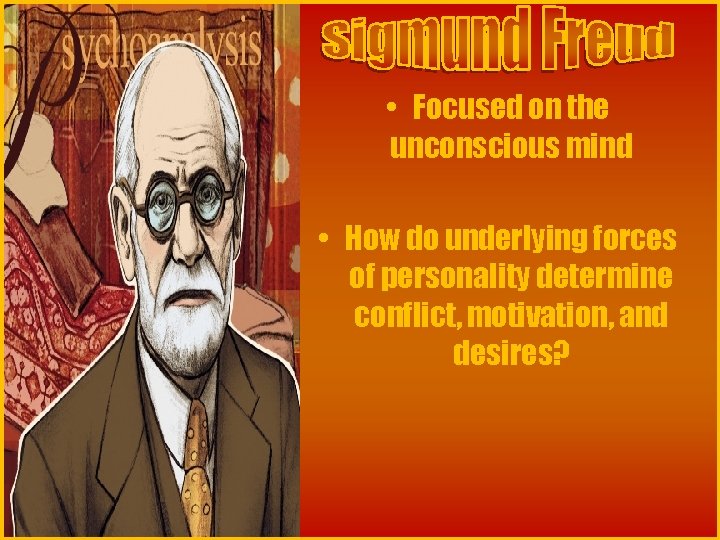
• Focused on the unconscious mind • How do underlying forces of personality determine conflict, motivation, and desires?
34
Behaviorism 35
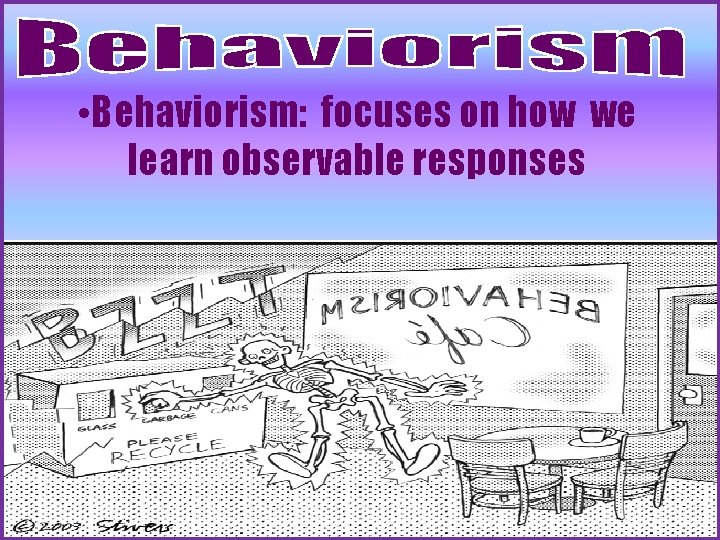
• Behaviorism: focuses on how we learn observable responses
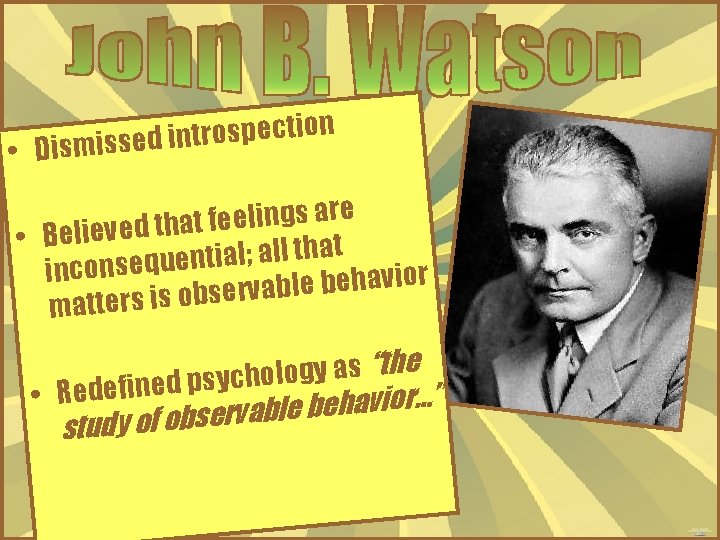
n o i t c e p s o r t n • Dismissed i e r a s g n i l e e f t a h t d e v e i l e B • t a h t l l a ; l a i t n e inconsequ r o i v a h e b e l b a rv e s b o s i s r e t t ma • e h t “ s a y g o l o h c y s p d e n i f e d e R stud ” … r o i v a h e b e y of observabl
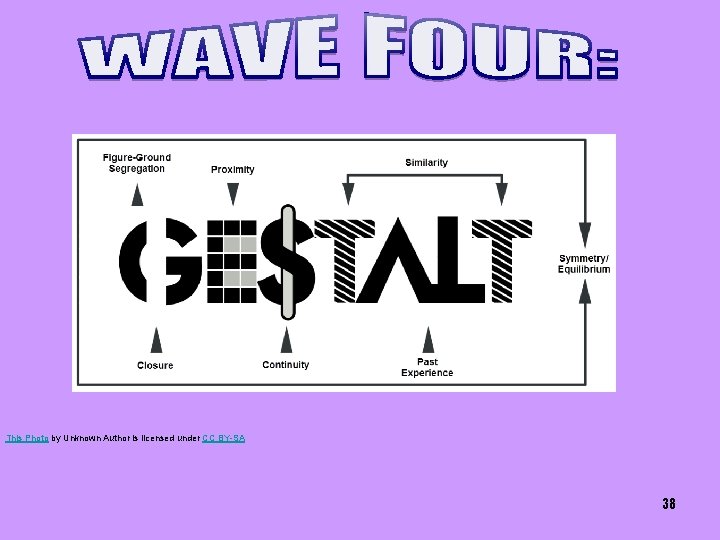
This Photo by Unknown Author is licensed under CC BY-SA 38
• In Germany, Max Wertheimer founded Gestalt psychology • Gestalt Psychology: The study of thinking, learning, & perception • Focused on the ways in which people interpret sensory information to acquire knowledge • “The whole is different from the sum of its parts…”
Eclectic Psychology • Modern psychologists tend to be more eclectic than predecessors. • Use ideas, theories and research from multiple perspectives according to the needs of their clients 40
QUIZ WIZ How did the philosophical roots of psychology change over time ? Early psychologists were focused on moral philosophy rather than natural or scientific
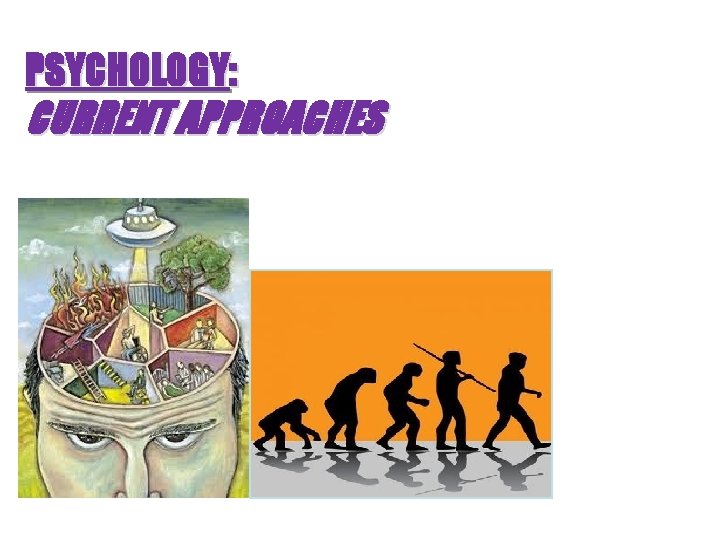
PSYCHOLOGY: CURRENT APPROACHES
Psychological Perspectives • Method of classifying a collection of ideas • Also called “schools of thought” or “psychological approaches” • To view behavior from a particular perspective
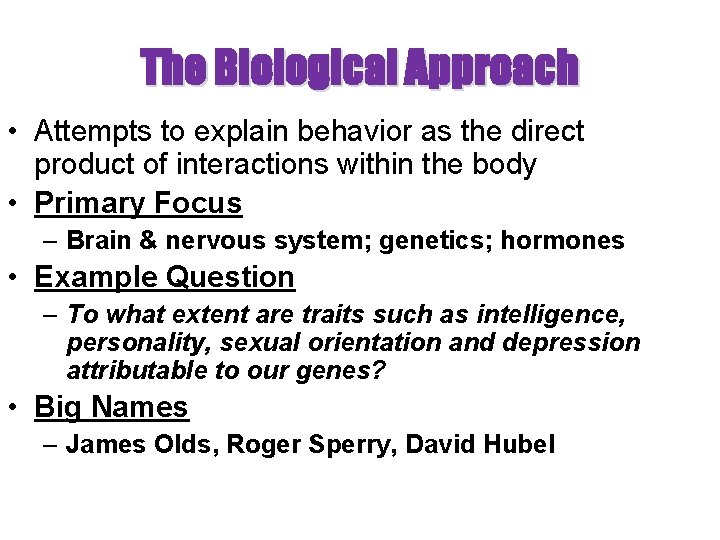
The Biological Approach • Attempts to explain behavior as the direct product of interactions within the body • Primary Focus – Brain & nervous system; genetics; hormones • Example Question – To what extent are traits such as intelligence, personality, sexual orientation and depression attributable to our genes? • Big Names – James Olds, Roger Sperry, David Hubel
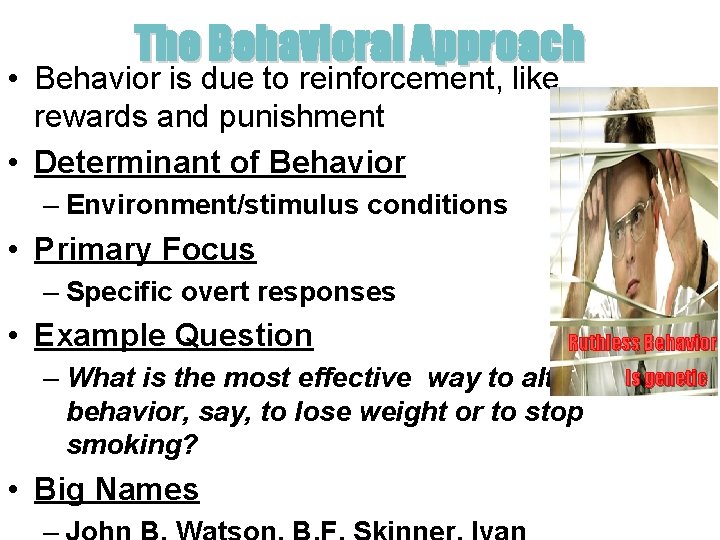
The Behavioral Approach • Behavior is due to reinforcement, like rewards and punishment • Determinant of Behavior – Environment/stimulus conditions • Primary Focus – Specific overt responses • Example Question Ruthless Behavior – What is the most effective way to alter behavior, say, to lose weight or to stop smoking? • Big Names Is genetic
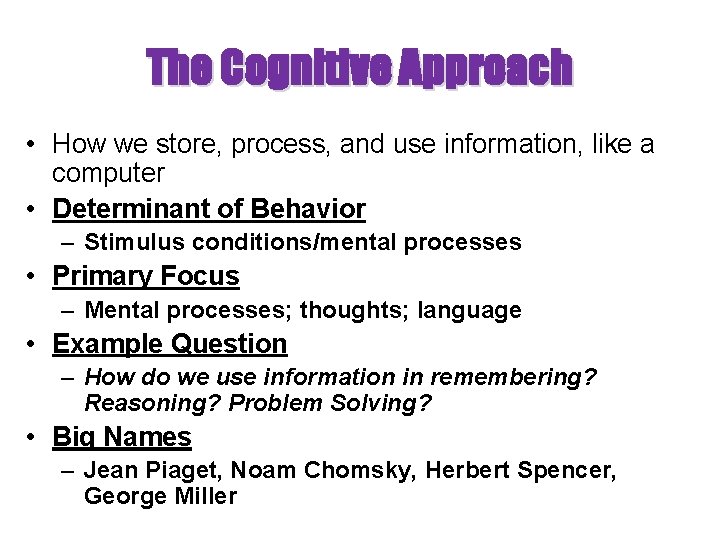
The Cognitive Approach • How we store, process, and use information, like a computer • Determinant of Behavior – Stimulus conditions/mental processes • Primary Focus – Mental processes; thoughts; language • Example Question – How do we use information in remembering? Reasoning? Problem Solving? • Big Names – Jean Piaget, Noam Chomsky, Herbert Spencer, George Miller
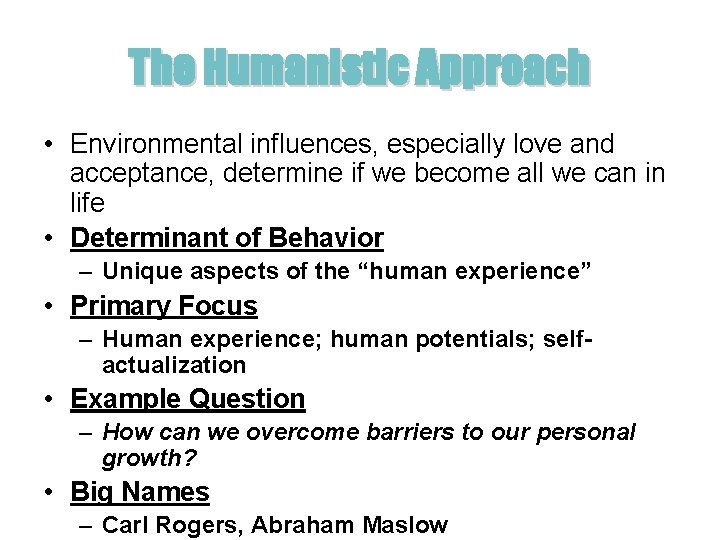
The Humanistic Approach • Environmental influences, especially love and acceptance, determine if we become all we can in life • Determinant of Behavior – Unique aspects of the “human experience” • Primary Focus – Human experience; human potentials; selfactualization • Example Question – How can we overcome barriers to our personal growth? • Big Names – Carl Rogers, Abraham Maslow
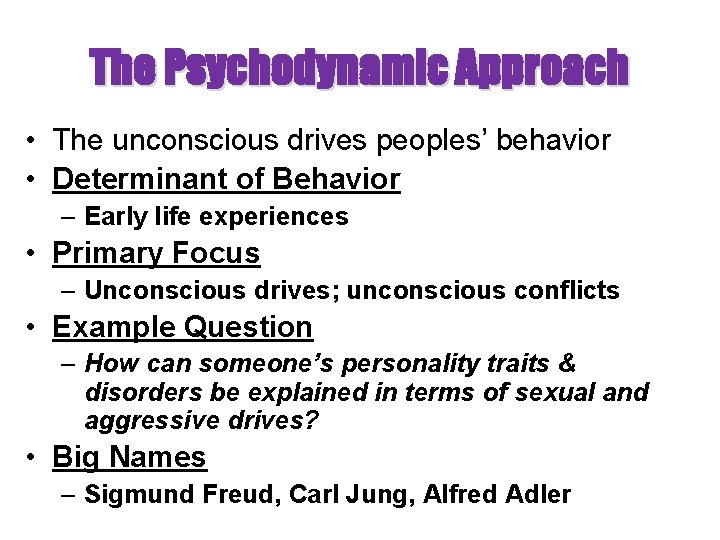
The Psychodynamic Approach • The unconscious drives peoples’ behavior • Determinant of Behavior – Early life experiences • Primary Focus – Unconscious drives; unconscious conflicts • Example Question – How can someone’s personality traits & disorders be explained in terms of sexual and aggressive drives? • Big Names – Sigmund Freud, Carl Jung, Alfred Adler
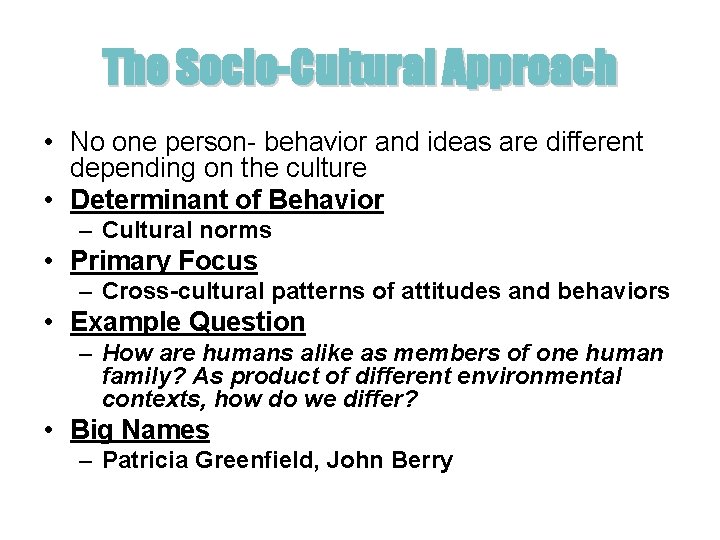
The Socio-Cultural Approach • No one person- behavior and ideas are different depending on the culture • Determinant of Behavior – Cultural norms • Primary Focus – Cross-cultural patterns of attitudes and behaviors • Example Question – How are humans alike as members of one human family? As product of different environmental contexts, how do we differ? • Big Names – Patricia Greenfield, John Berry
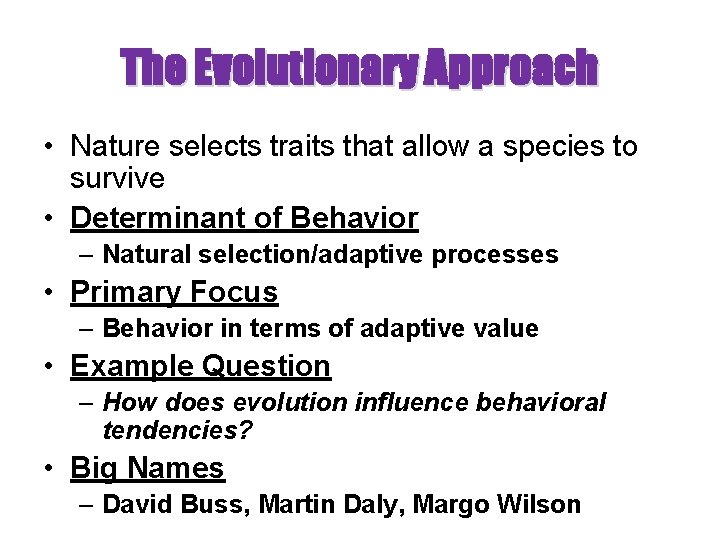
The Evolutionary Approach • Nature selects traits that allow a species to survive • Determinant of Behavior – Natural selection/adaptive processes • Primary Focus – Behavior in terms of adaptive value • Example Question – How does evolution influence behavioral tendencies? • Big Names – David Buss, Martin Daly, Margo Wilson
) ACTIVITY STOP & THINK Which psychological Perspective do you feel Is the most accurate in Identifying behavior and Mental processes?
PSYCHOLOGY: SUBFIELDS
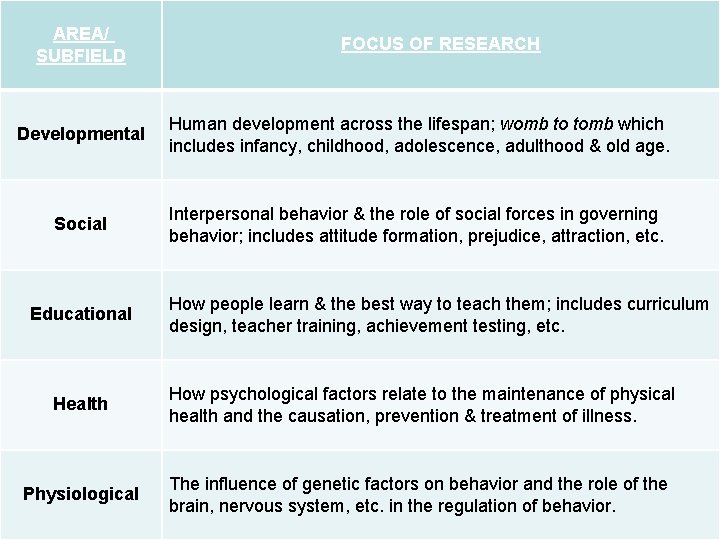
AREA/ SUBFIELD FOCUS OF RESEARCH Developmental Human development across the lifespan; womb to tomb which includes infancy, childhood, adolescence, adulthood & old age. Social Interpersonal behavior & the role of social forces in governing behavior; includes attitude formation, prejudice, attraction, etc. Educational How people learn & the best way to teach them; includes curriculum design, teacher training, achievement testing, etc. Health How psychological factors relate to the maintenance of physical health and the causation, prevention & treatment of illness. Physiological The influence of genetic factors on behavior and the role of the brain, nervous system, etc. in the regulation of behavior.
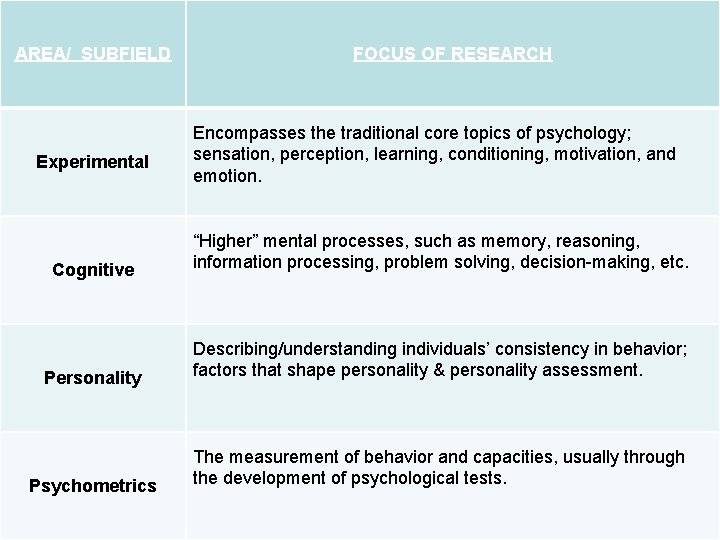
AREA/ SUBFIELD Experimental FOCUS OF RESEARCH Encompasses the traditional core topics of psychology; sensation, perception, learning, conditioning, motivation, and emotion. Cognitive “Higher” mental processes, such as memory, reasoning, information processing, problem solving, decision-making, etc. Personality Describing/understanding individuals’ consistency in behavior; factors that shape personality & personality assessment. Psychometrics The measurement of behavior and capacities, usually through the development of psychological tests.
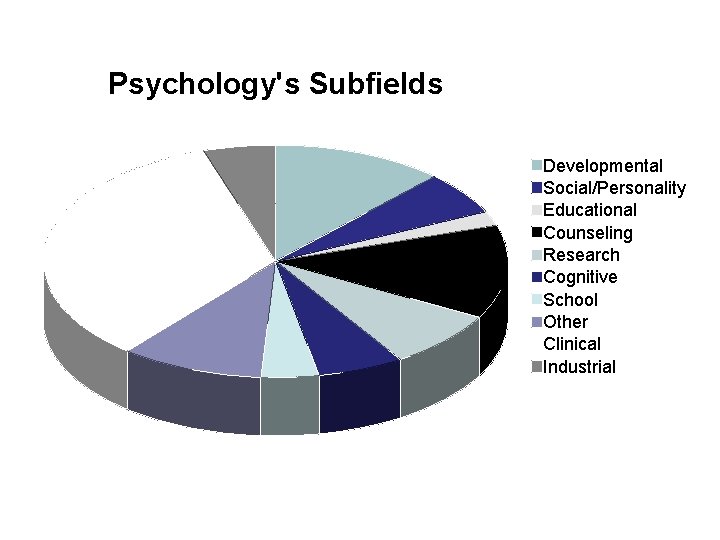
Psychology's Subfields Developmental Social/Personality Educational Counseling Research Cognitive School Other Clinical Industrial
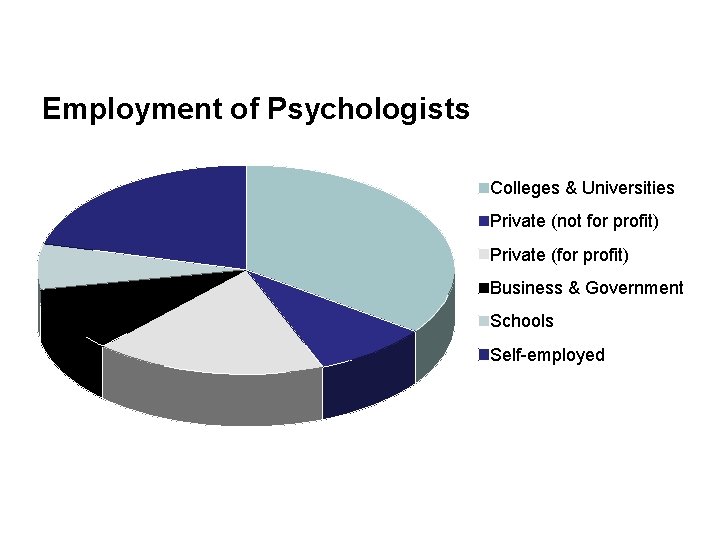
Employment of Psychologists Colleges & Universities Private (not for profit) Private (for profit) Business & Government Schools Self-employed
The Story of Andrea Yates Video 57
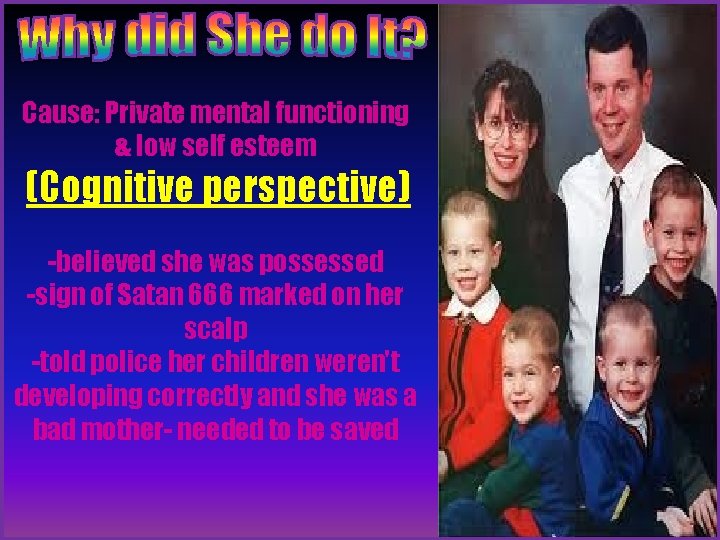
Cause: Private mental functioning & low self esteem (Cognitive perspective) -believed she was possessed -sign of Satan 666 marked on her scalp -told police her children weren't developing correctly and she was a bad mother- needed to be saved 58
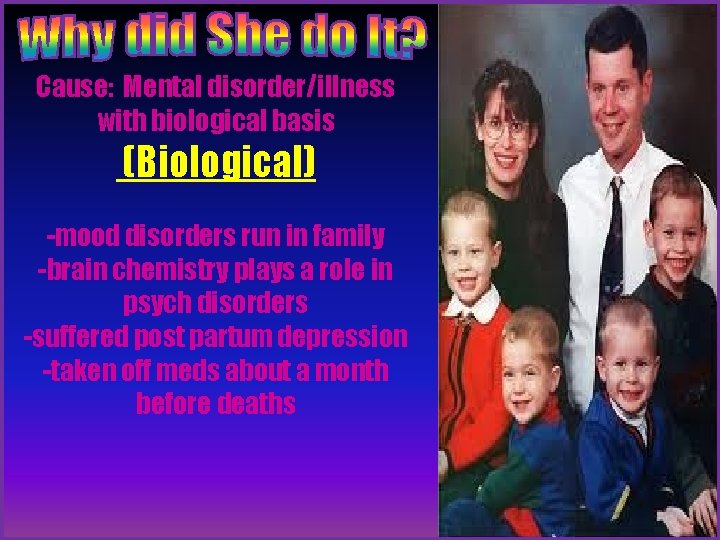
Cause: Mental disorder/illness with biological basis (Biological) -mood disorders run in family -brain chemistry plays a role in psych disorders -suffered post partum depression -taken off meds about a month before deaths 59
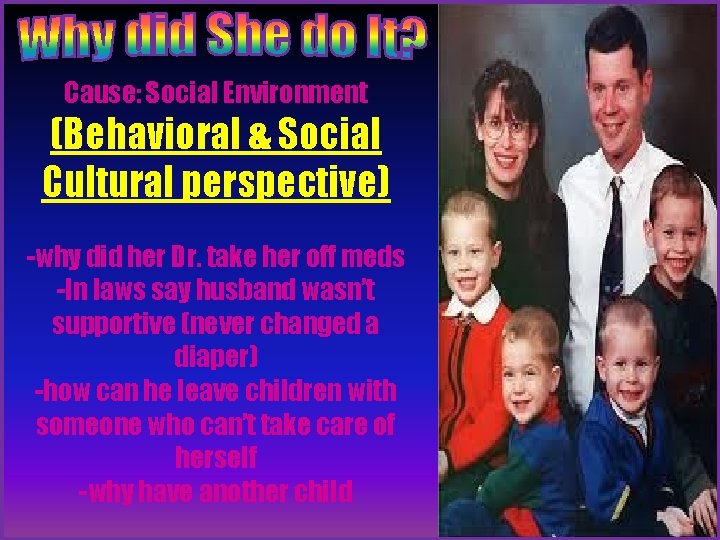
Cause: Social Environment (Behavioral & Social Cultural perspective) -why did her Dr. take her off meds -In laws say husband wasn’t supportive (never changed a diaper) -how can he leave children with someone who can’t take care of herself -why have another child 60
HW- (Yes HW- welcome to AP) 1. Read and takes notes on pages 19 -33 61
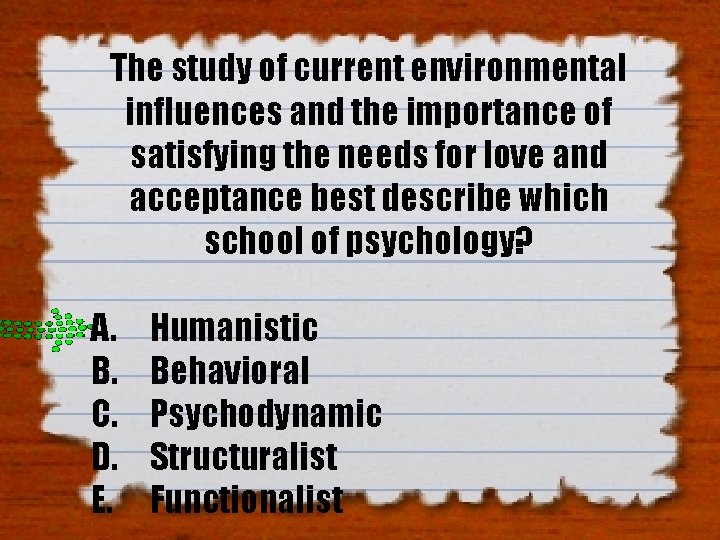
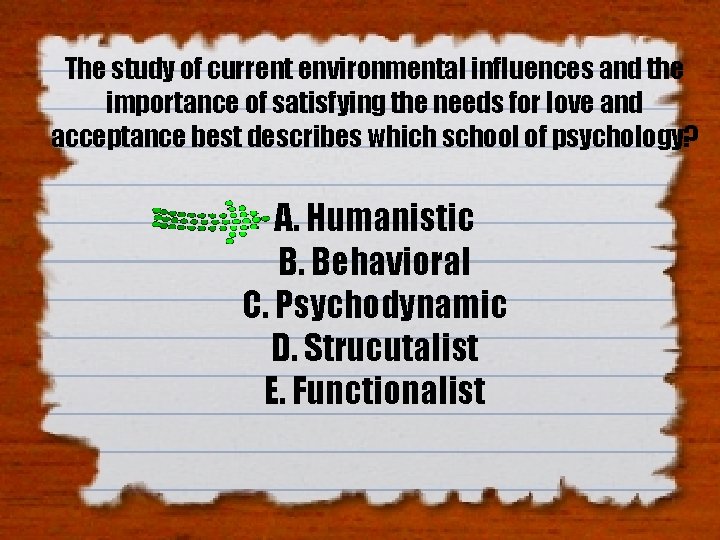
The study of current environmental influences and the importance of satisfying the needs for love and acceptance best describe which school of psychology? A. B. C. D. E. Humanistic Behavioral Psychodynamic Structuralist Functionalist
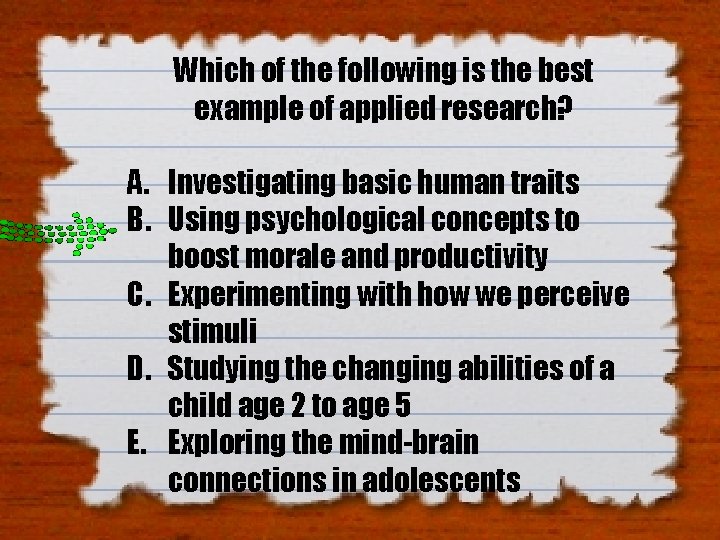
Which of the following is the best example of applied research? A. Investigating basic human traits B. Using psychological concepts to boost morale and productivity C. Experimenting with how we perceive stimuli D. Studying the changing abilities of a child age 2 to age 5 E. Exploring the mind-brain connections in adolescents
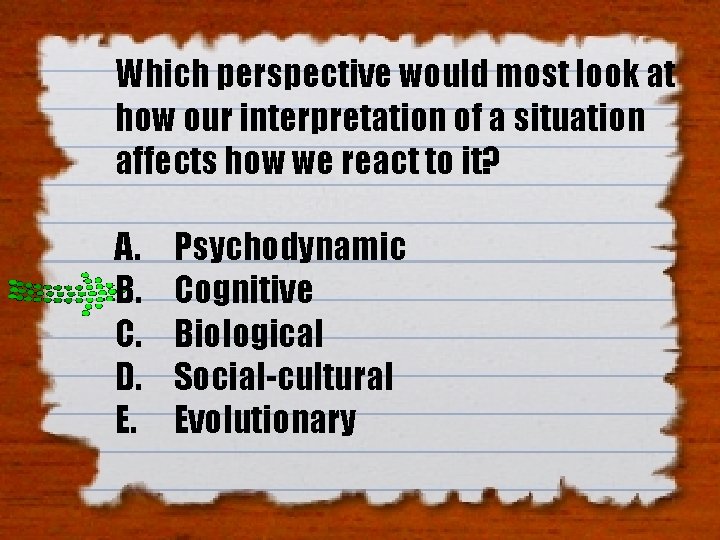
Which perspective would most look at how our interpretation of a situation affects how we react to it? A. B. C. D. E. Psychodynamic Cognitive Biological Social-cultural Evolutionary
Which perspective would most likely explain anger as “ an outlet for unconscious hostility”? A. Social-cultural B. Psychodynamic C. Behavioral D. Functionalist E. Biological
The debate on the relative contributions of biology and experience to human development is more often referred to as A. Evolutionary analysis B. Behaviorism C. The cognitive analysis D. The nature-nurture issue E. Natural selection
Which of the following professionals is also a medical doctor? A. Psychiatrist B. Psychologist C. Clinical D. Counselor E. Biologist
Which of the following psychologists would most likely explore how we view and effect each other? A. Developmental B. Biological C. Social D. Cognitive E. Personality
For behaviorists, psychological science is rooted in A. Inspection B. Observation C. Cultural influences D. Growth potential E. Basic needs
Which of the following psychologists would most likely conduct psychotherapy? A. Biological B. Clinical C. Industrial-organizational D. Cognitive E. Evolutionary
The study of mental activity linked with brain activity best describes A. Humanistic psychology B. Gestalt psychology C. Cognitive neuroscience D. The psychodynamic perspective E. The evolutionary perspective
The first psychological laboratory opened in 1879, belonged to A. Charles Darwin B. Sigmund Freud C. Rene Descartes D. Wilhelm Wundt E. William James
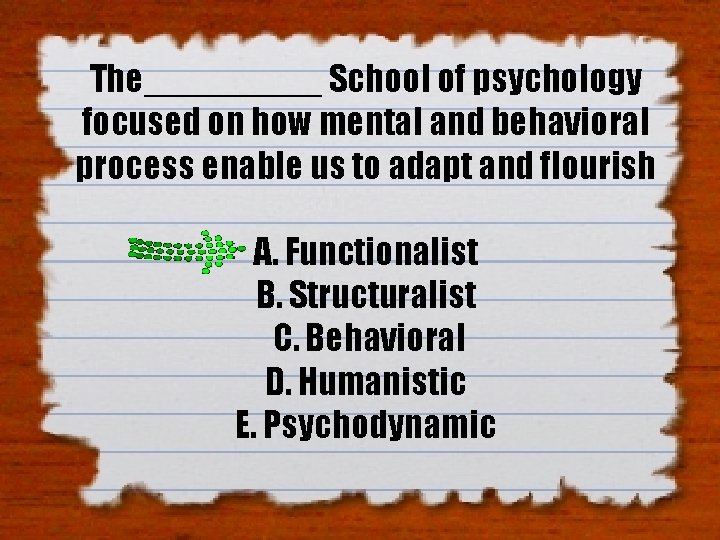
The_____ School of psychology focused on how mental and behavioral process enable us to adapt and flourish A. Functionalist B. Structuralist C. Behavioral D. Humanistic E. Psychodynamic
The study of current environmental influences and the importance of satisfying the needs for love and acceptance best describes which school of psychology? A. Humanistic B. Behavioral C. Psychodynamic D. Strucutalist E. Functionalist
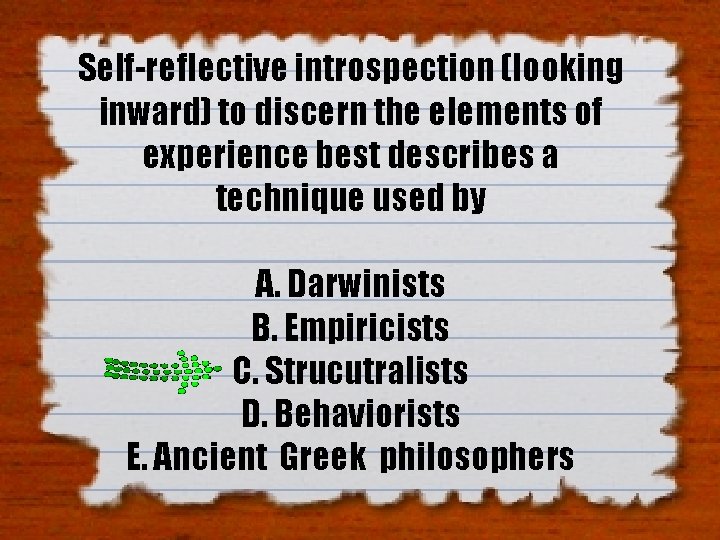
Self-reflective introspection (looking inward) to discern the elements of experience best describes a technique used by A. Darwinists B. Empiricists C. Strucutralists D. Behaviorists E. Ancient Greek philosophers
77
78