Origin Scenarios for Multiple Planet Systems Alice Quillen

- Slides: 64
Origin Scenarios for Multiple Planet Systems Alice Quillen University of Rochester
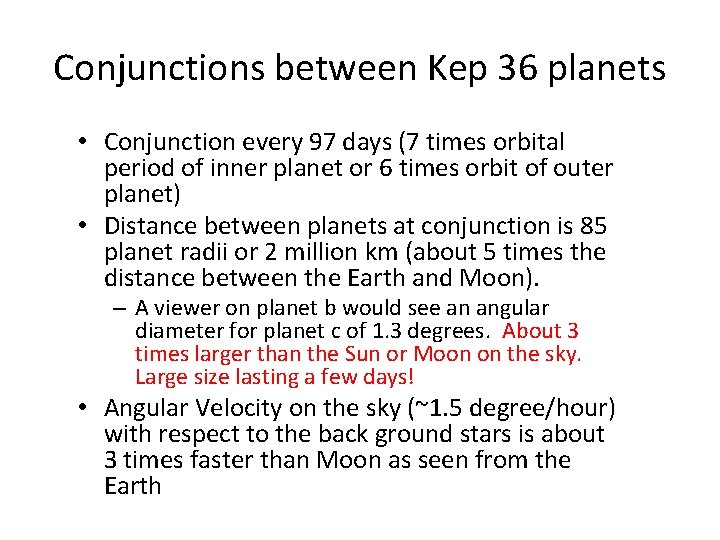
Conjunctions between Kep 36 planets • Conjunction every 97 days (7 times orbital period of inner planet or 6 times orbit of outer planet) • Distance between planets at conjunction is 85 planet radii or 2 million km (about 5 times the distance between the Earth and Moon). – A viewer on planet b would see an angular diameter for planet c of 1. 3 degrees. About 3 times larger than the Sun or Moon on the sky. Large size lasting a few days! • Angular Velocity on the sky (~1. 5 degree/hour) with respect to the back ground stars is about 3 times faster than Moon as seen from the Earth
In collaboration with • • Alex Moore Imran Hasan Eva Bodman Richard Edgar
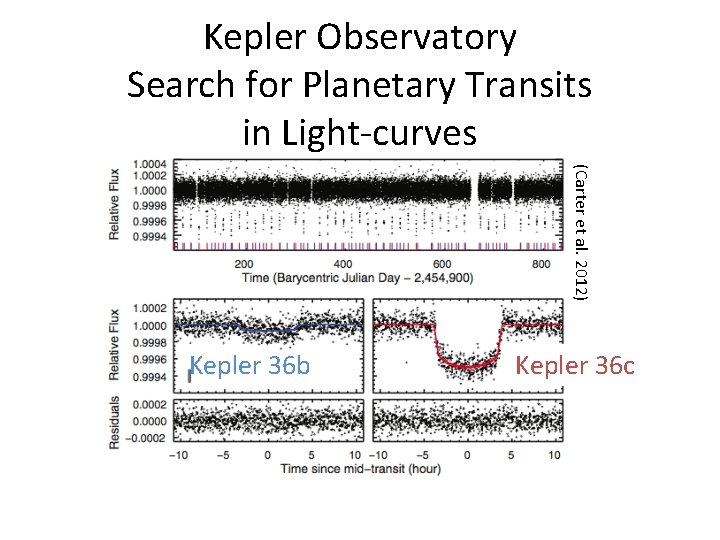
Kepler Observatory Search for Planetary Transits in Light-curves (Carter et al. 2012) Kepler 36 b Kepler 36 c
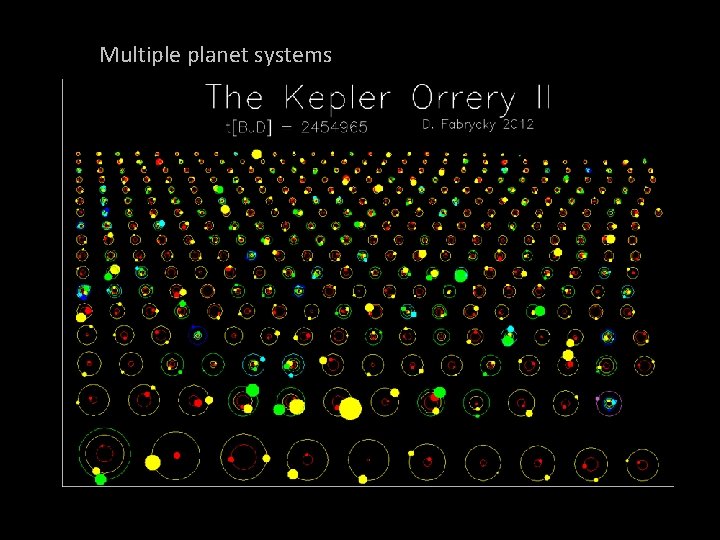
Multiple planet systems
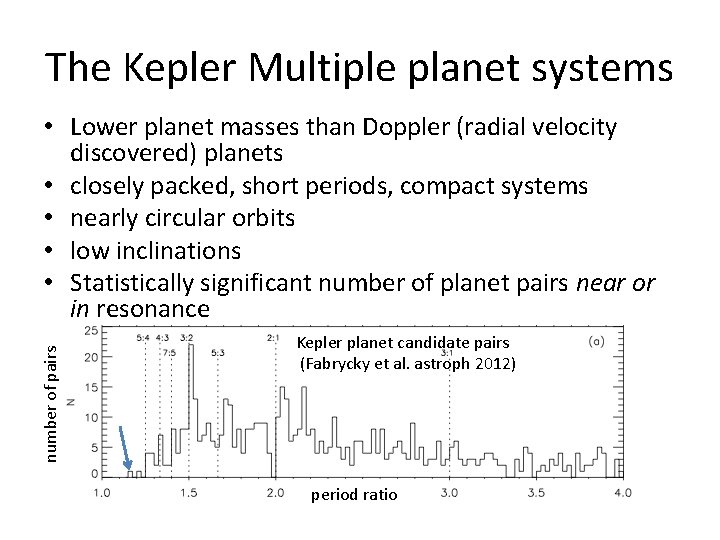
The Kepler Multiple planet systems number of pairs • Lower planet masses than Doppler (radial velocity discovered) planets • closely packed, short periods, compact systems • nearly circular orbits • low inclinations • Statistically significant number of planet pairs near or in resonance Kepler planet candidate pairs (Fabrycky et al. astroph 2012) period ratio
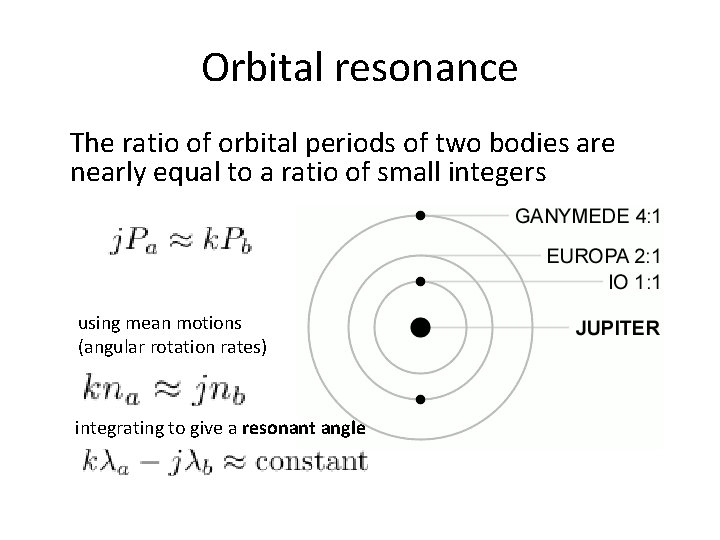
Orbital resonance The ratio of orbital periods of two bodies are nearly equal to a ratio of small integers using mean motions (angular rotation rates) integrating to give a resonant angle
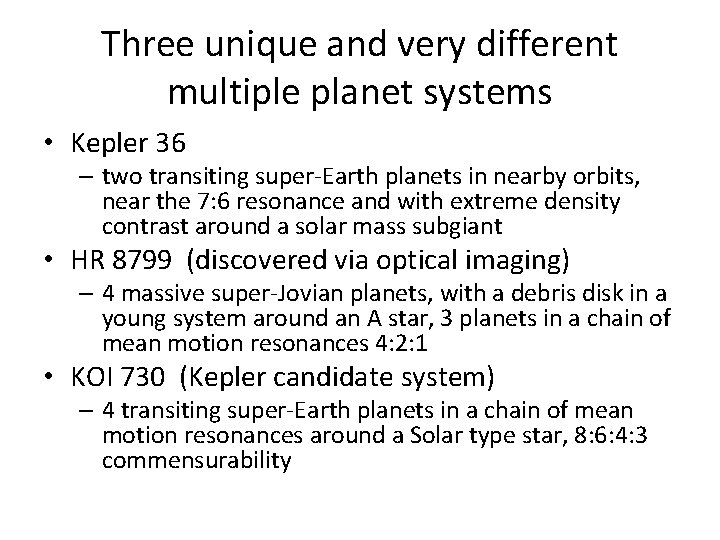
Three unique and very different multiple planet systems • Kepler 36 – two transiting super-Earth planets in nearby orbits, near the 7: 6 resonance and with extreme density contrast around a solar mass subgiant • HR 8799 (discovered via optical imaging) – 4 massive super-Jovian planets, with a debris disk in a young system around an A star, 3 planets in a chain of mean motion resonances 4: 2: 1 • KOI 730 (Kepler candidate system) – 4 transiting super-Earth planets in a chain of mean motion resonances around a Solar type star, 8: 6: 4: 3 commensurability
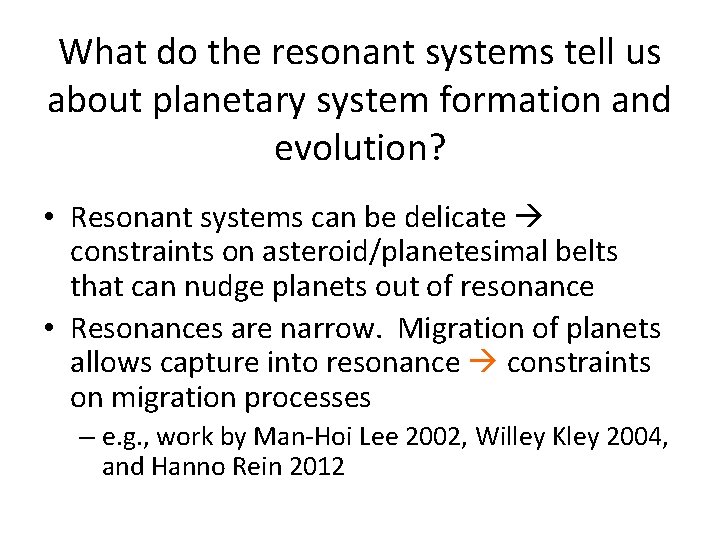
What do the resonant systems tell us about planetary system formation and evolution? • Resonant systems can be delicate constraints on asteroid/planetesimal belts that can nudge planets out of resonance • Resonances are narrow. Migration of planets allows capture into resonance constraints on migration processes – e. g. , work by Man-Hoi Lee 2002, Willey Kley 2004, and Hanno Rein 2012
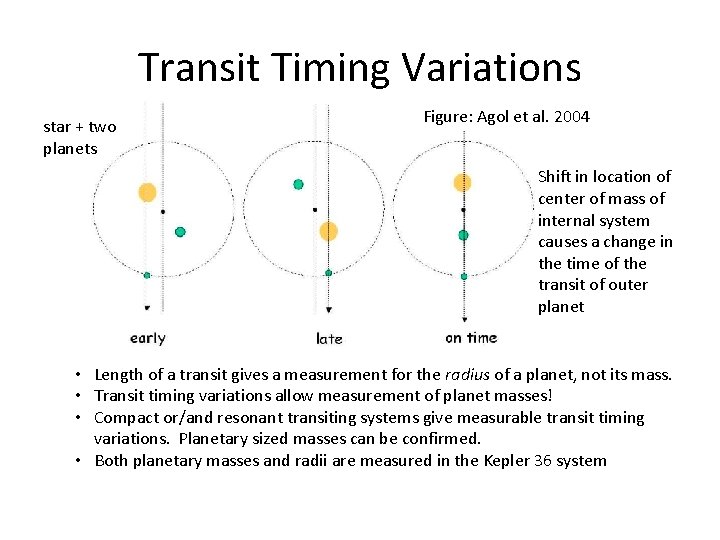
Transit Timing Variations star + two planets Figure: Agol et al. 2004 Shift in location of center of mass of internal system causes a change in the time of the transit of outer planet • Length of a transit gives a measurement for the radius of a planet, not its mass. • Transit timing variations allow measurement of planet masses! • Compact or/and resonant transiting systems give measurable transit timing variations. Planetary sized masses can be confirmed. • Both planetary masses and radii are measured in the Kepler 36 system
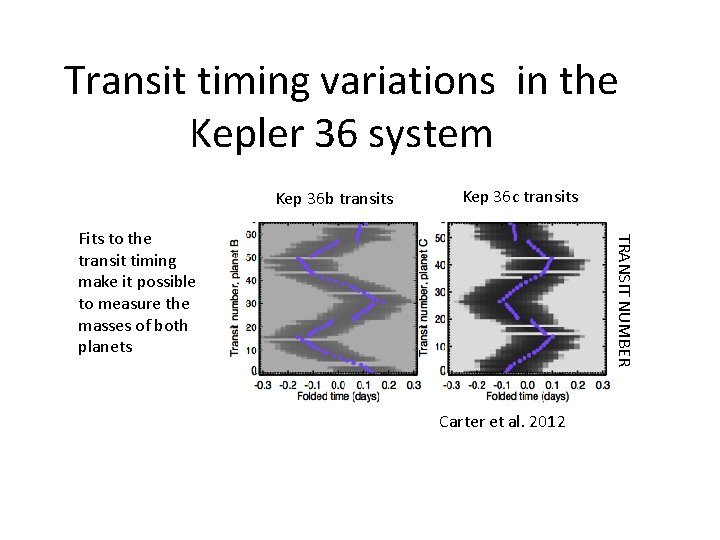
Transit timing variations in the Kepler 36 system Kep 36 b transits Kep 36 c transits TRANSIT NUMBER Fits to the transit timing make it possible to measure the masses of both planets Carter et al. 2012
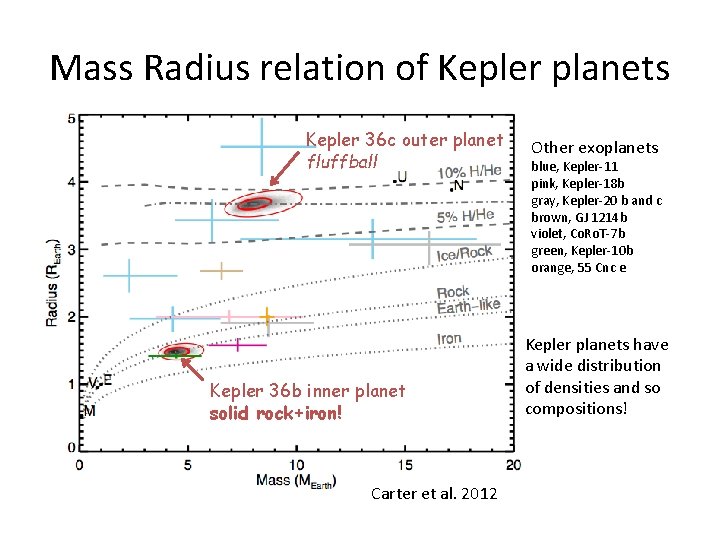
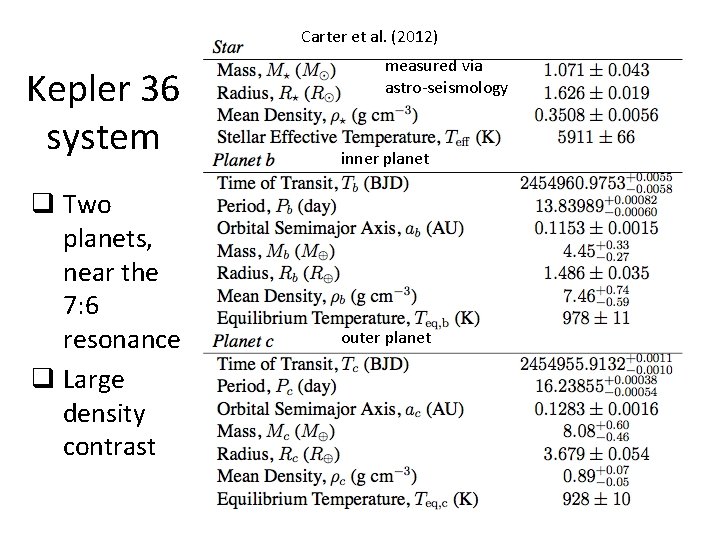
Mass Radius relation of Kepler planets Kepler 36 c outer planet fluffball Kepler 36 b inner planet solid rock+iron! Carter et al. 2012 Other exoplanets blue, Kepler-11 pink, Kepler-18 b gray, Kepler-20 b and c brown, GJ 1214 b violet, Co. Ro. T-7 b green, Kepler-10 b orange, 55 Cnc e Kepler planets have a wide distribution of densities and so compositions!
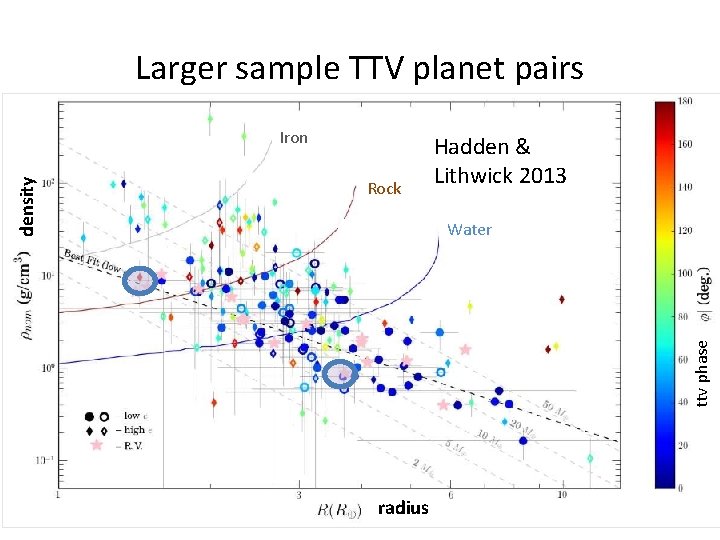
Larger sample TTV planet pairs Rock Hadden & Lithwick 2013 Water ttv phase density Iron radius
Carter et al. (2012) Kepler 36 system q Two planets, near the 7: 6 resonance q Large density contrast measured via astro-seismology inner planet outer planet
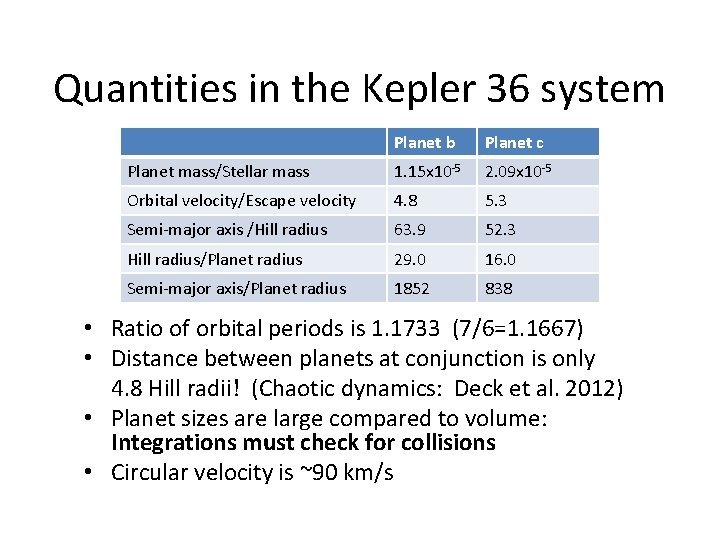
Quantities in the Kepler 36 system Planet b Planet c Planet mass/Stellar mass 1. 15 x 10 -5 2. 09 x 10 -5 Orbital velocity/Escape velocity 4. 8 5. 3 Semi-major axis /Hill radius 63. 9 52. 3 Hill radius/Planet radius 29. 0 16. 0 Semi-major axis/Planet radius 1852 838 • Ratio of orbital periods is 1. 1733 (7/6=1. 1667) • Distance between planets at conjunction is only 4. 8 Hill radii! (Chaotic dynamics: Deck et al. 2012) • Planet sizes are large compared to volume: Integrations must check for collisions • Circular velocity is ~90 km/s
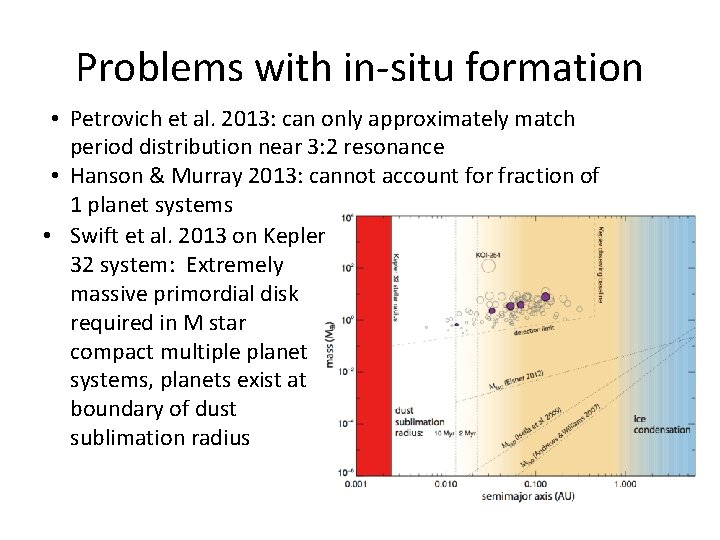
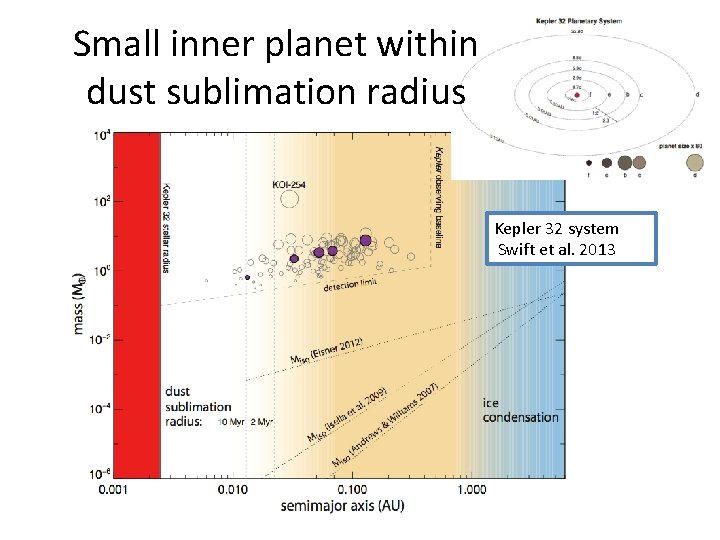
Problems with in-situ formation • Petrovich et al. 2013: can only approximately match period distribution near 3: 2 resonance • Hanson & Murray 2013: cannot account for fraction of 1 planet systems • Swift et al. 2013 on Kepler 32 system: Extremely massive primordial disk required in M star compact multiple planet systems, planets exist at boundary of dust sublimation radius
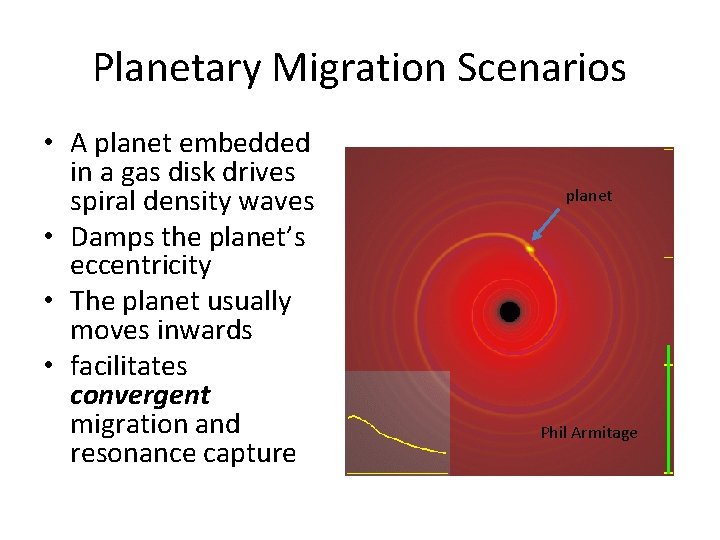
Planetary Migration Scenarios • A planet embedded in a gas disk drives spiral density waves • Damps the planet’s eccentricity • The planet usually moves inwards • facilitates convergent migration and resonance capture planet Phil Armitage
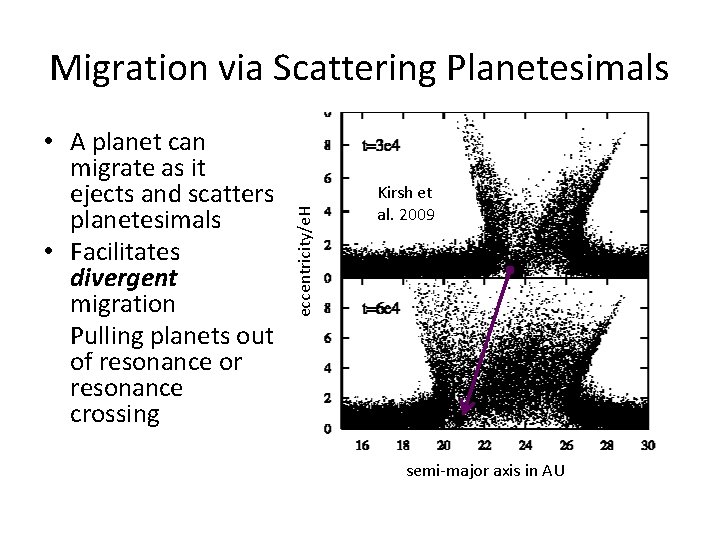
• A planet can migrate as it ejects and scatters planetesimals • Facilitates divergent migration Pulling planets out of resonance or resonance crossing eccentricity/e. H Migration via Scattering Planetesimals Kirsh et al. 2009 semi-major axis in AU
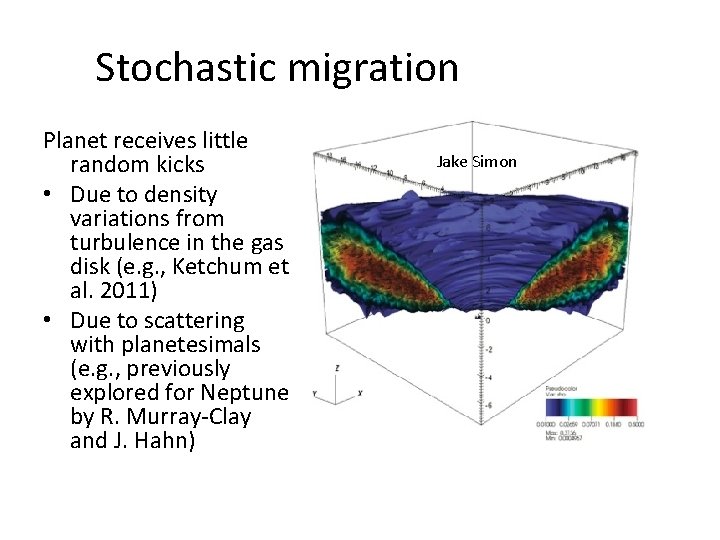
Stochastic migration Planet receives little random kicks • Due to density variations from turbulence in the gas disk (e. g. , Ketchum et al. 2011) • Due to scattering with planetesimals (e. g. , previously explored for Neptune by R. Murray-Clay and J. Hahn) Jake Simon
Mean motion Resonances Can be modeled with a pendulum-like Hamiltonian θ Resonant angle. Two types of motion, librating/oscillating in or out of resonance Level curves showing orbits expand Kepler Hamiltonian This model gives: resonant width, strength, libration frequency, adiabatic limit, eccentricity variation in resonance, probability of capture due to two-planet interactions
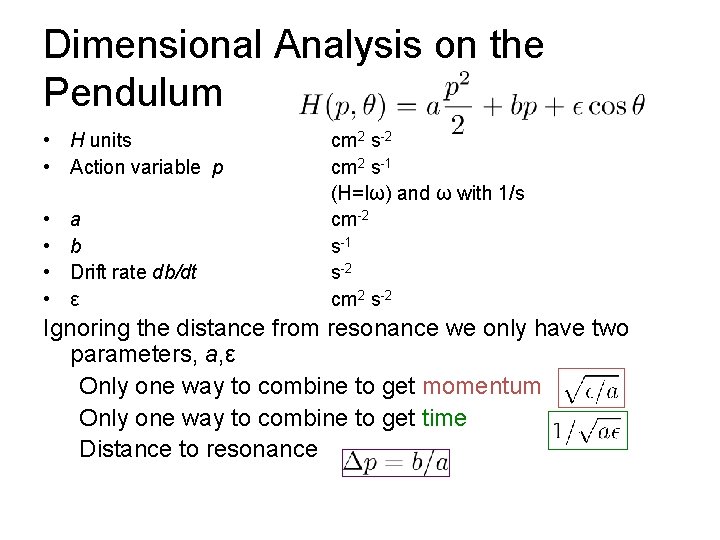
Dimensional Analysis on the Pendulum • H units • Action variable p • • a b Drift rate db/dt ε cm 2 s-2 cm 2 s-1 (H=Iω) and ω with 1/s cm-2 s-1 s-2 cm 2 s-2 Ignoring the distance from resonance we only have two parameters, a, ε Only one way to combine to get momentum Only one way to combine to get time Distance to resonance
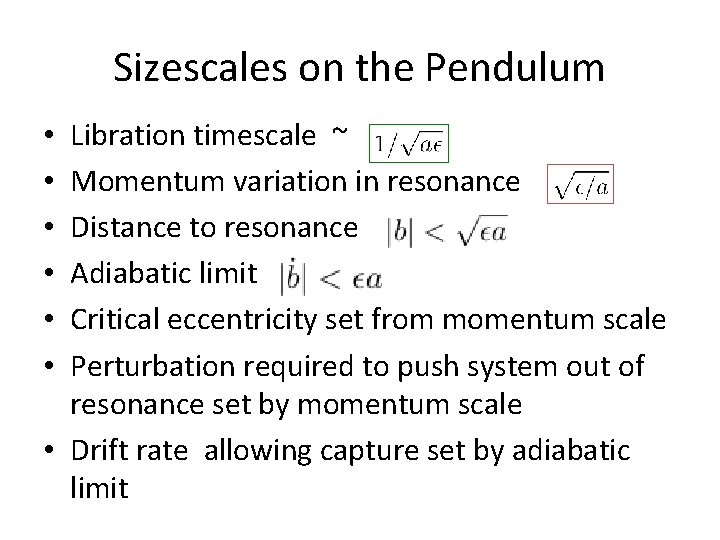
Sizescales on the Pendulum Libration timescale ~ Momentum variation in resonance Distance to resonance Adiabatic limit Critical eccentricity set from momentum scale Perturbation required to push system out of resonance set by momentum scale • Drift rate allowing capture set by adiabatic limit • • •
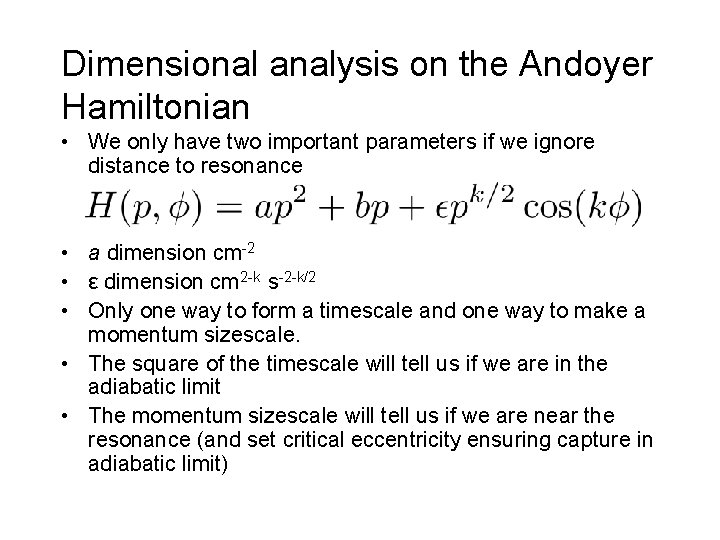
Dimensional analysis on the Andoyer Hamiltonian • We only have two important parameters if we ignore distance to resonance • a dimension cm-2 • ε dimension cm 2 -k s-2 -k/2 • Only one way to form a timescale and one way to make a momentum sizescale. • The square of the timescale will tell us if we are in the adiabatic limit • The momentum sizescale will tell us if we are near the resonance (and set critical eccentricity ensuring capture in adiabatic limit)
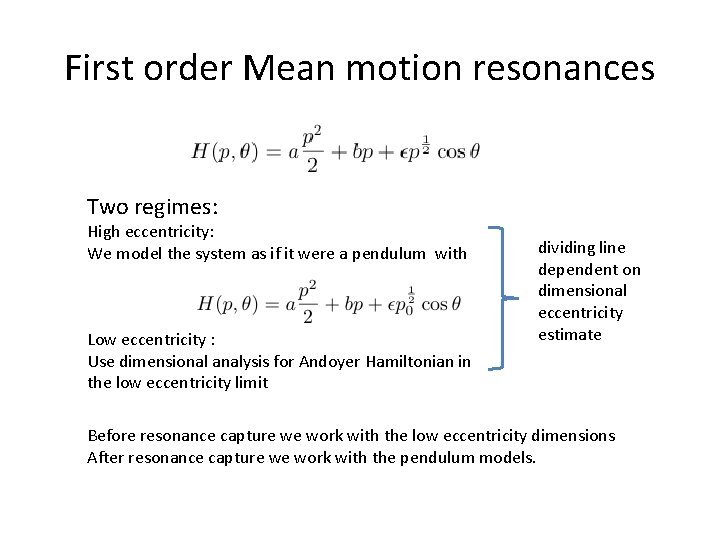
First order Mean motion resonances Two regimes: High eccentricity: We model the system as if it were a pendulum with Low eccentricity : Use dimensional analysis for Andoyer Hamiltonian in the low eccentricity limit dividing line dependent on dimensional eccentricity estimate Before resonance capture we work with the low eccentricity dimensions After resonance capture we work with the pendulum models.
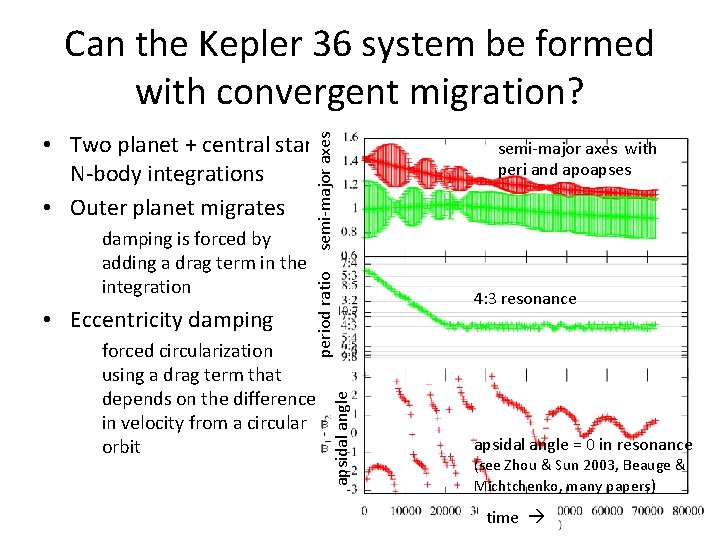
• Eccentricity damping forced circularization using a drag term that depends on the difference in velocity from a circular orbit apsidal angle damping is forced by adding a drag term in the integration period ratio • Two planet + central star N-body integrations • Outer planet migrates semi-major axes Can the Kepler 36 system be formed with convergent migration? semi-major axes with peri and apoapses 4: 3 resonance apsidal angle = 0 in resonance (see Zhou & Sun 2003, Beauge & Michtchenko, many papers) time
Drift rates and Resonant strengths • If migration is too fast, resonance capture does not occur • Closer resonances are stronger. Only adiabatic (slow) drifts allow resonance capture. • Can we adjust the drift rate so that 4: 3, 5: 4, 6: 5 resonances are bypassed but capture into the 7: 6 is allowed? • Yes: but it is a fine tuning problem. The difference between critical drift rates is only about 20%
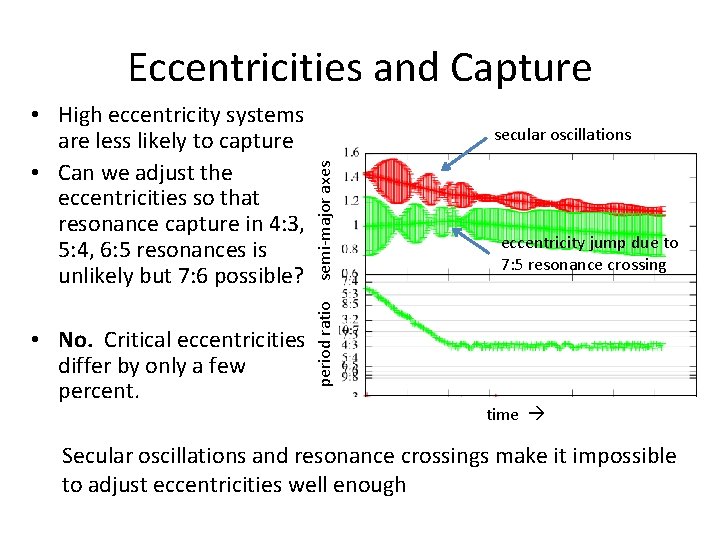
Eccentricities and Capture • No. Critical eccentricities differ by only a few percent. semi-major axes secular oscillations period ratio • High eccentricity systems are less likely to capture • Can we adjust the eccentricities so that resonance capture in 4: 3, 5: 4, 6: 5 resonances is unlikely but 7: 6 possible? eccentricity jump due to 7: 5 resonance capture into 3: 2 crossing prevented eccentricities resonancesbyare bypassed because of eccentricities time Secular oscillations and resonance crossings make it impossible to adjust eccentricities well enough
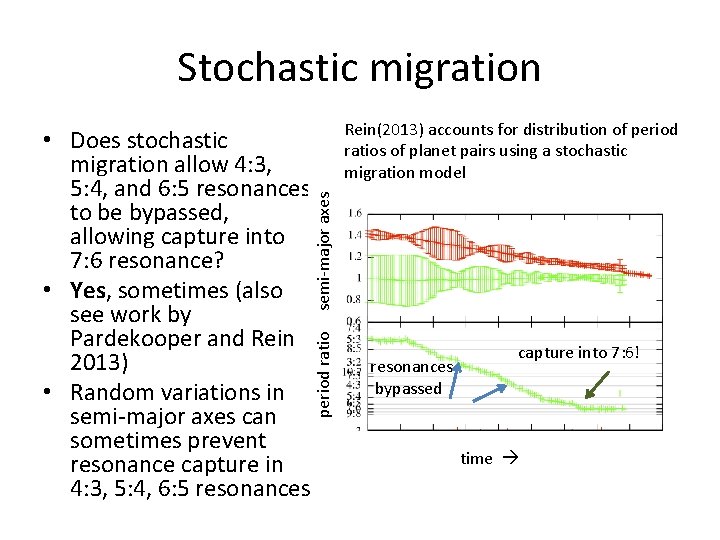
Stochastic migration semi-major axes period ratio • Does stochastic migration allow 4: 3, 5: 4, and 6: 5 resonances to be bypassed, allowing capture into 7: 6 resonance? • Yes, sometimes (also see work by Pardekooper and Rein 2013) • Random variations in semi-major axes can sometimes prevent resonance capture in 4: 3, 5: 4, 6: 5 resonances Rein(2013) accounts for distribution of period ratios of planet pairs using a stochastic migration model resonances bypassed capture into 7: 6! time
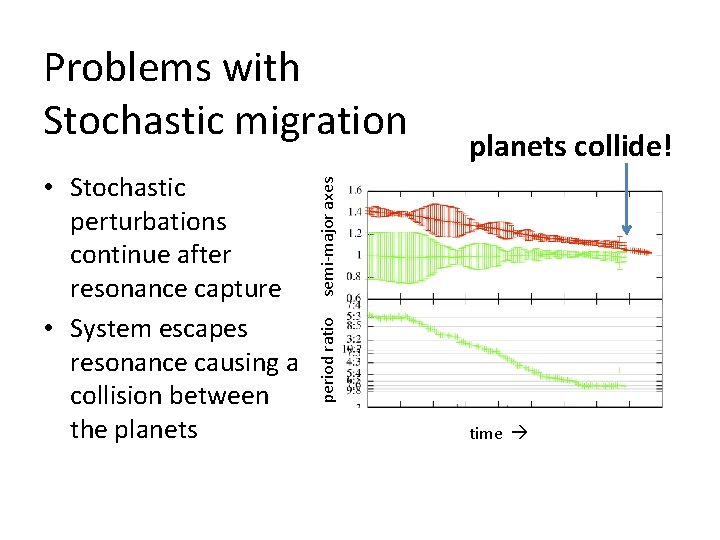
period ratio • Stochastic perturbations continue after resonance capture • System escapes resonance causing a collision between the planets collide! semi-major axes Problems with Stochastic migration time
Problems with Stochastic migration • If a gas disk causes both migration and stochastic forcing, then planets will not remain in resonance • Timescale for escape can be estimated using a diffusive argument at equilibrium eccentricity after resonance capture • Timescale for migration is similar to timescale for resonance escape Disk must be depleted soon after resonance capture to account for a system in the 7: 6 resonance --- yet another fine tuning problem • Density difference in planets not explained
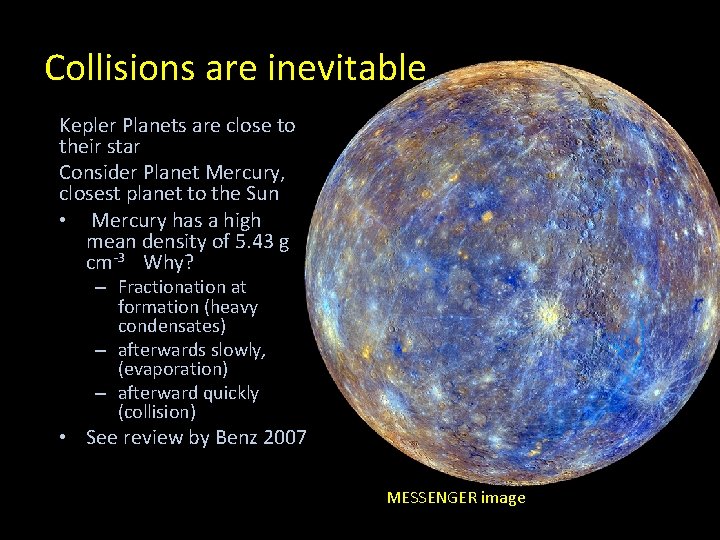
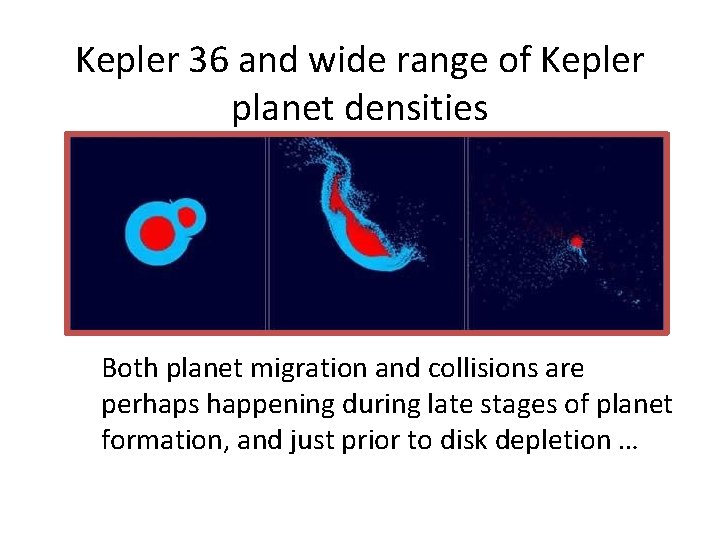
Collisions are inevitable Kepler Planets are close to their star Consider Planet Mercury, closest planet to the Sun • Mercury has a high mean density of 5. 43 g cm-3 Why? – Fractionation at formation (heavy condensates) – afterwards slowly, (evaporation) – afterward quickly (collision) • See review by Benz 2007 MESSENGER image
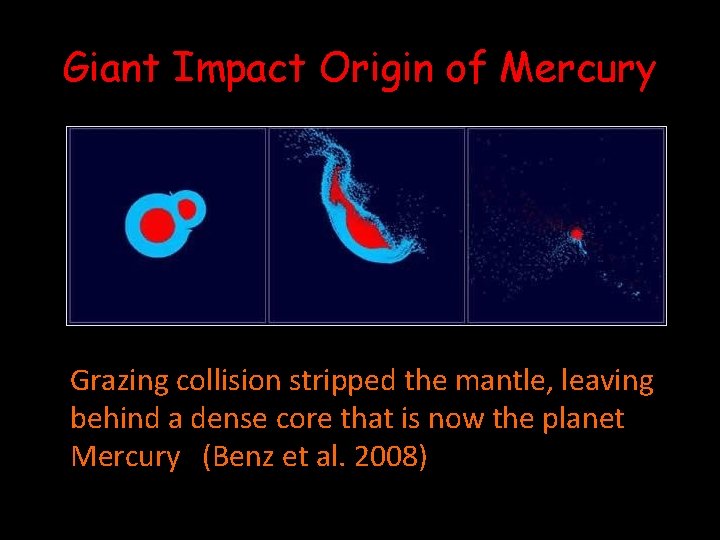
Giant Impact Origin of Mercury Grazing collision stripped the mantle, leaving behind a dense core that is now the planet Mercury (Benz et al. 2008)
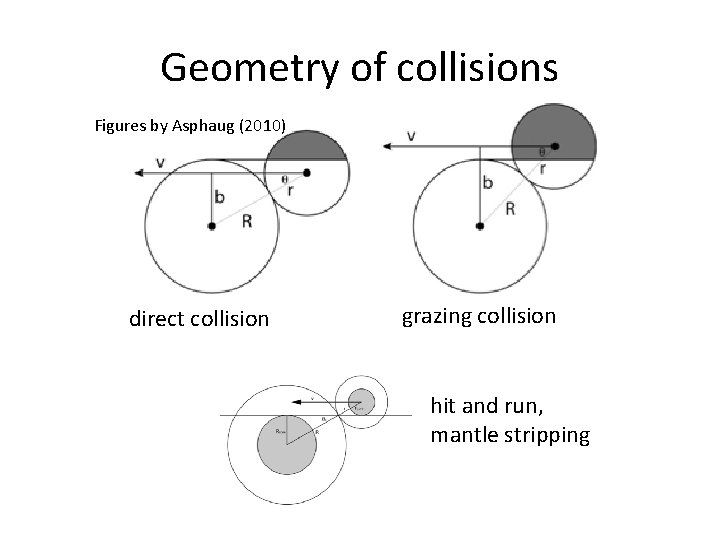
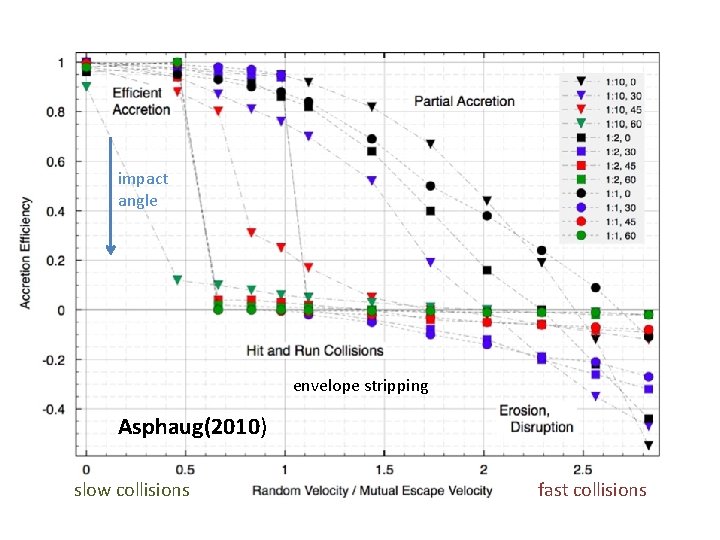
Geometry of collisions Figures by Asphaug (2010) direct collision grazing collision hit and run, mantle stripping
impact angle envelope stripping Asphaug(2010) slow collisions fast collisions
Alternate scenarios/mechanisms for density variations Photoevaporation and atmospheric escape Owen & Wu 2013, Lopez & Fortney 2013 – Critically dependent on core mass. However: densities of Kepler planets are NOT strongly dependent on semi-major axis (Hadden & Lithwick 2013) there are other processes affecting planetary density
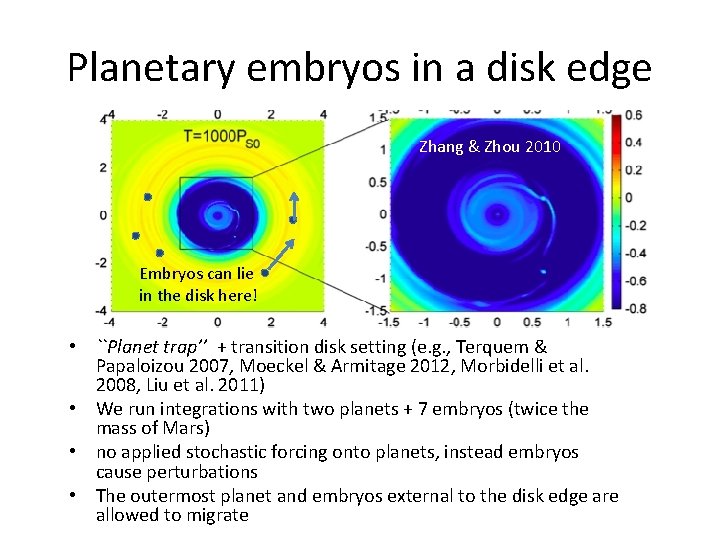
Planetary embryos in a disk edge Zhang & Zhou 2010 Embryos can lie in the disk here! • ``Planet trap’’ + transition disk setting (e. g. , Terquem & Papaloizou 2007, Moeckel & Armitage 2012, Morbidelli et al. 2008, Liu et al. 2011) • We run integrations with two planets + 7 embryos (twice the mass of Mars) • no applied stochastic forcing onto planets, instead embryos cause perturbations • The outermost planet and embryos external to the disk edge are allowed to migrate
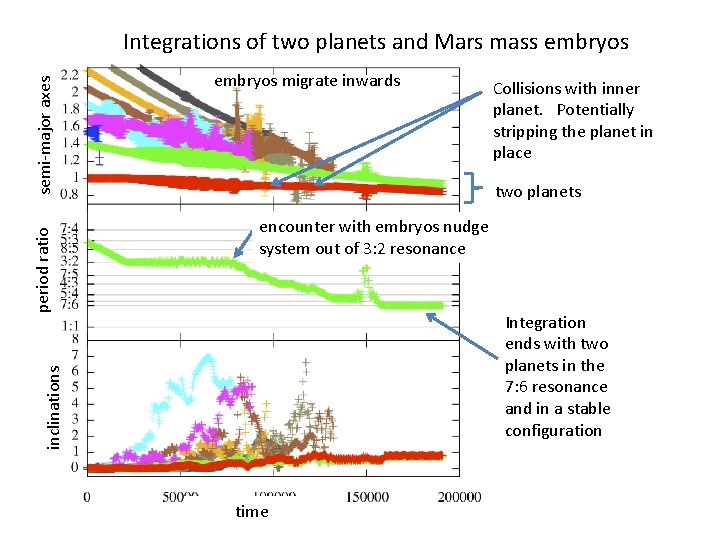
embryos migrate inwards Collisions with inner planet. Potentially stripping the planet in place two planets encounter with embryos nudge system out of 3: 2 resonance Integration ends with two planets in the 7: 6 resonance and in a stable configuration inclinations period ratio semi-major axes Integrations of two planets and Mars mass embryos time
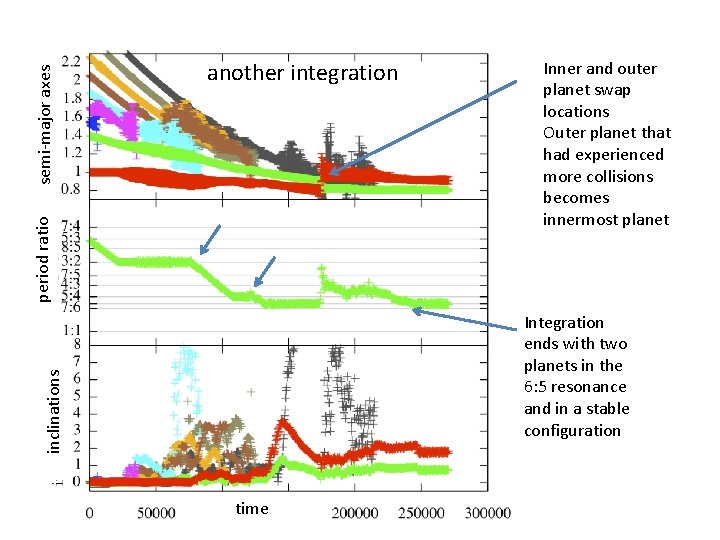
encounters with embryos nudge system out of 3: 2, 5: 4 resonances semi-major axes Inner and outer planet swap locations Outer planet that had experienced more collisions becomes innermost planet Integration ends with two planets in the 6: 5 resonance and in a stable configuration inclinations period ratio another integration time
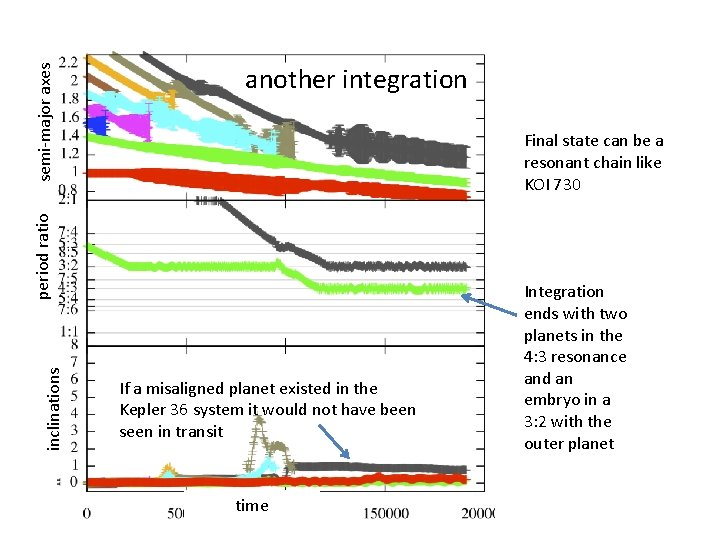
Final state can be a resonant chain like KOI 730 inclinations period ratio semi-major axes another integration If a misaligned planet existed in the Kepler 36 system it would not have been seen in transit time Integration ends with two planets in the 4: 3 resonance and an embryo in a 3: 2 with the outer planet
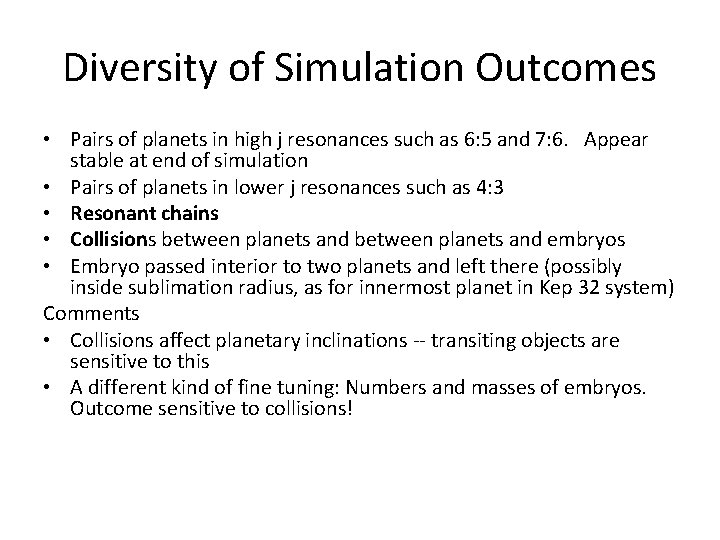
Diversity of Simulation Outcomes • Pairs of planets in high j resonances such as 6: 5 and 7: 6. Appear stable at end of simulation • Pairs of planets in lower j resonances such as 4: 3 • Resonant chains • Collisions between planets and embryos • Embryo passed interior to two planets and left there (possibly inside sublimation radius, as for innermost planet in Kep 32 system) Comments • Collisions affect planetary inclinations -- transiting objects are sensitive to this • A different kind of fine tuning: Numbers and masses of embryos. Outcome sensitive to collisions!
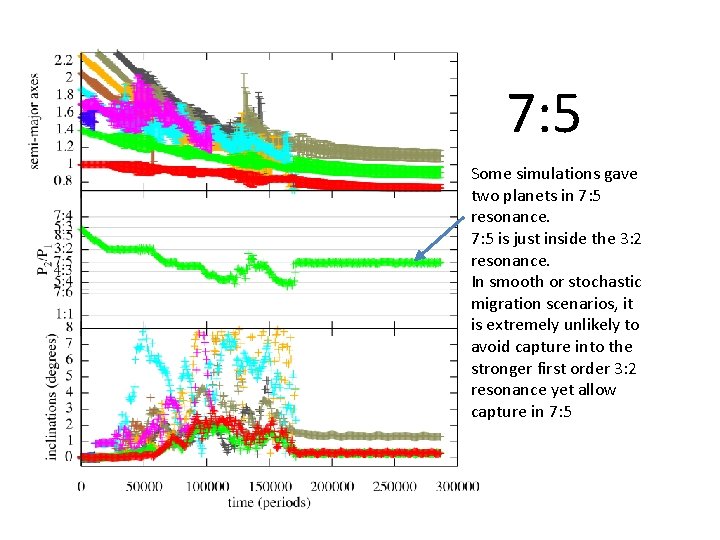
7: 5 Some simulations gave two planets in 7: 5 resonance. 7: 5 is just inside the 3: 2 resonance. In smooth or stochastic migration scenarios, it is extremely unlikely to avoid capture into the stronger first order 3: 2 resonance yet allow capture in 7: 5
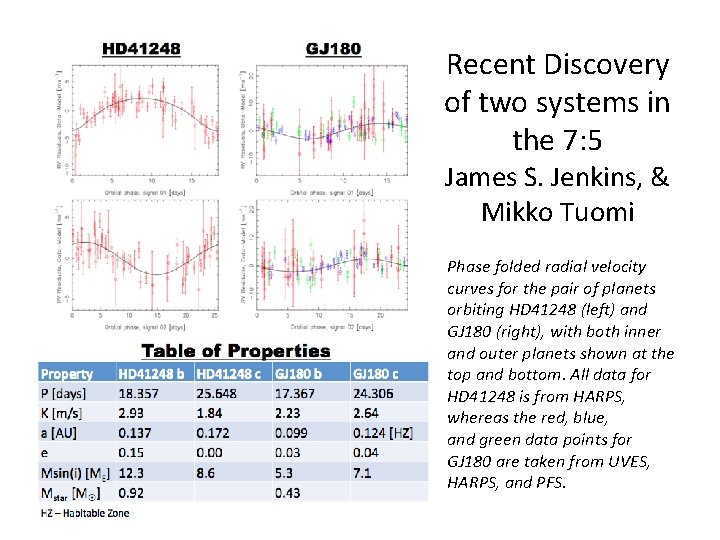
Recent Discovery of two systems in the 7: 5 James S. Jenkins, & Mikko Tuomi Phase folded radial velocity curves for the pair of planets orbiting HD 41248 (left) and GJ 180 (right), with both inner and outer planets shown at the top and bottom. All data for HD 41248 is from HARPS, whereas the red, blue, and green data points for GJ 180 are taken from UVES, HARPS, and PFS.
Small inner planet within dust sublimation radius Kepler 32 system Swift et al. 2013
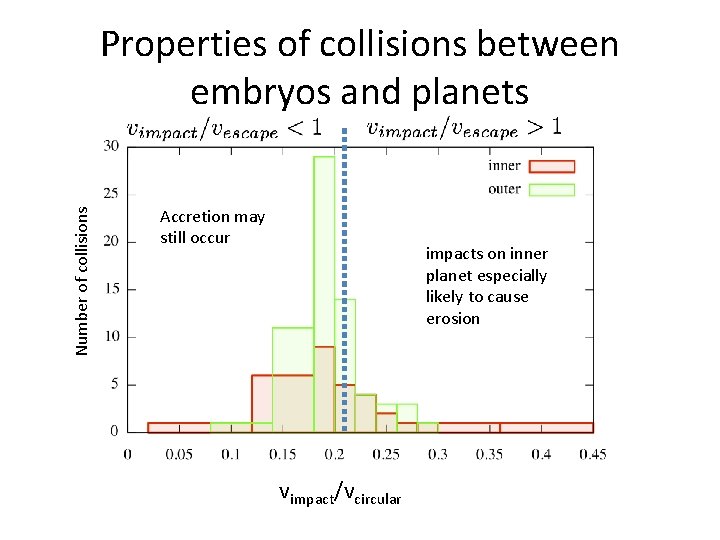
Number of collisions Properties of collisions between embryos and planets Accretion may still occur impacts on inner planet especially likely to cause erosion vimpact/vcircular
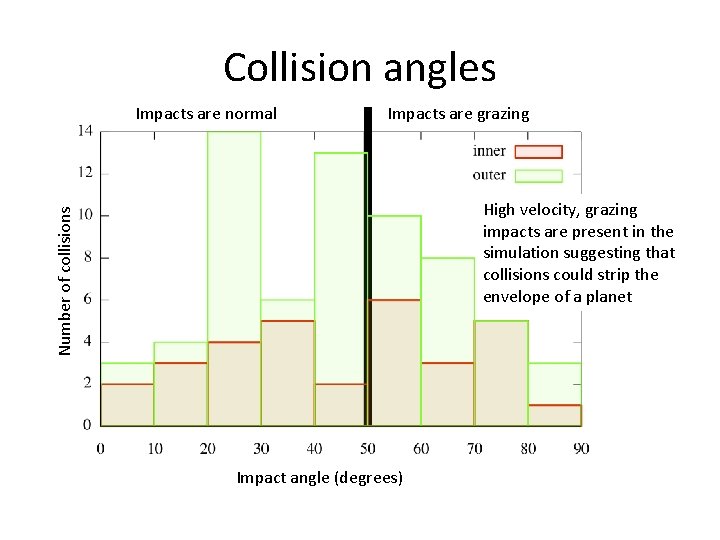
Collision angles Impacts are normal Impacts are grazing Number of collisions High velocity, grazing impacts are present in the simulation suggesting that collisions could strip the envelope of a planet Impact angle (degrees)
Kepler 36 and wide range of Kepler planet densities Both planet migration and collisions are perhaps happening during late stages of planet formation, and just prior to disk depletion …
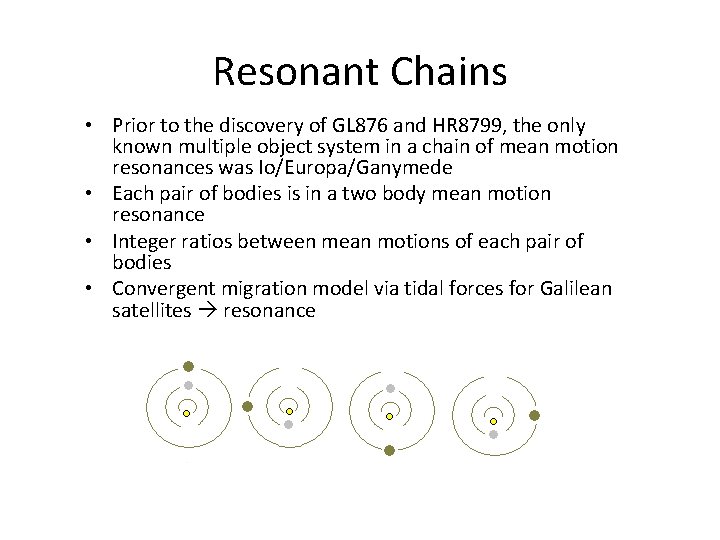
Resonant Chains • Prior to the discovery of GL 876 and HR 8799, the only known multiple object system in a chain of mean motion resonances was Io/Europa/Ganymede • Each pair of bodies is in a two body mean motion resonance • Integer ratios between mean motions of each pair of bodies • Convergent migration model via tidal forces for Galilean satellites resonance
Resonant Chains • Systems in chains of resonances drifted there by convergent migration through interaction with a gaseous disk (e. g. Wang et al. 2012) • Scattering with planetesimals usually causes planet orbits to diverge and so leave resonance What constraints can resonant chain systems HR 8799 and KOI 730 give us on their post gaseous disk depletion evolution?
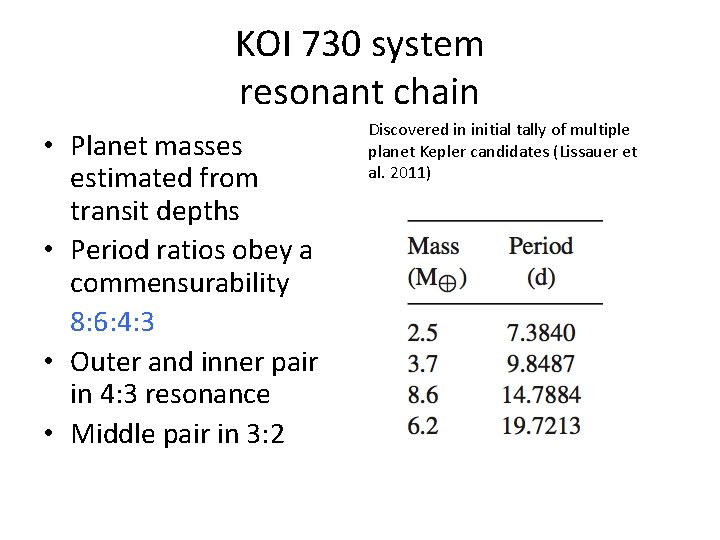
KOI 730 system resonant chain • Planet masses estimated from transit depths • Period ratios obey a commensurability 8: 6: 4: 3 • Outer and inner pair in 4: 3 resonance • Middle pair in 3: 2 Discovered in initial tally of multiple planet Kepler candidates (Lissauer et al. 2011)
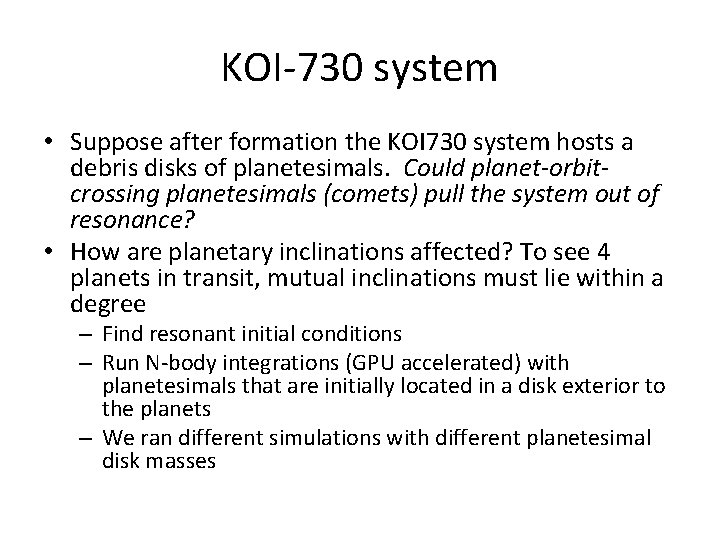
KOI-730 system • Suppose after formation the KOI 730 system hosts a debris disks of planetesimals. Could planet-orbitcrossing planetesimals (comets) pull the system out of resonance? • How are planetary inclinations affected? To see 4 planets in transit, mutual inclinations must lie within a degree – Find resonant initial conditions – Run N-body integrations (GPU accelerated) with planetesimals that are initially located in a disk exterior to the planets – We ran different simulations with different planetesimal disk masses
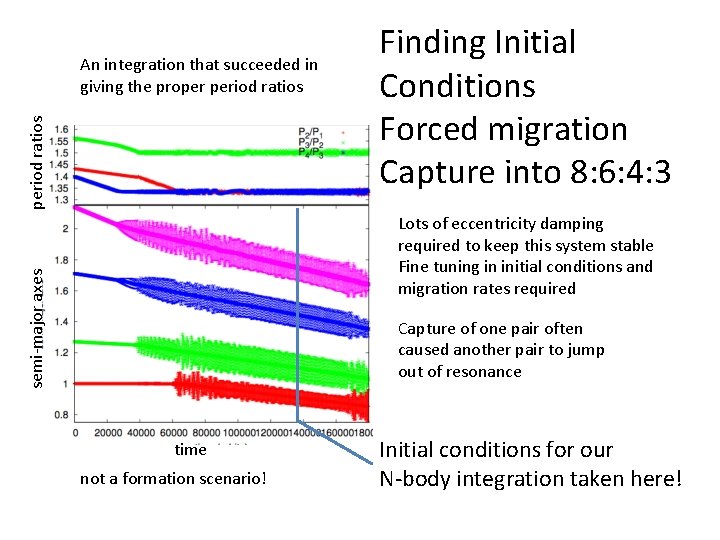
period ratios An integration that succeeded in giving the proper period ratios Finding Initial Conditions Forced migration Capture into 8: 6: 4: 3 semi-major axes Lots of eccentricity damping required to keep this system stable Fine tuning in initial conditions and migration rates required Capture of one pair often caused another pair to jump out of resonance time not a formation scenario! Initial conditions for our N-body integration taken here!
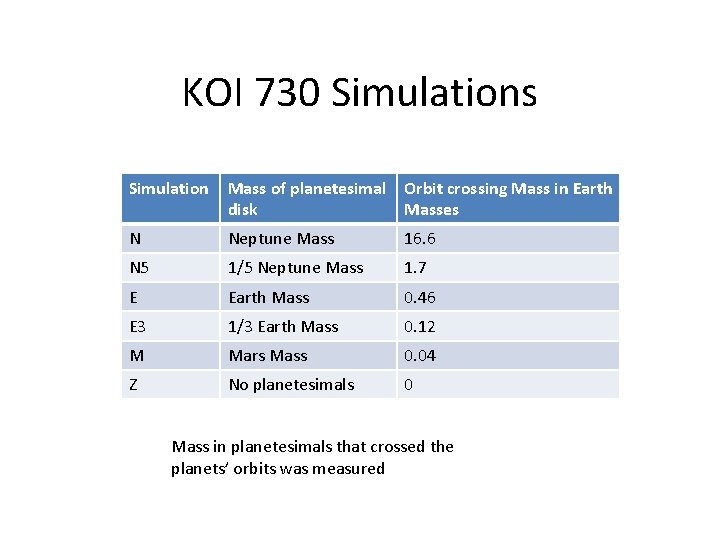
KOI 730 Simulations Simulation Mass of planetesimal Orbit crossing Mass in Earth disk Masses N Neptune Mass 16. 6 N 5 1/5 Neptune Mass 1. 7 E Earth Mass 0. 46 E 3 1/3 Earth Mass 0. 12 M Mars Mass 0. 04 Z No planetesimals 0 Mass in planetesimals that crossed the planets’ orbits was measured
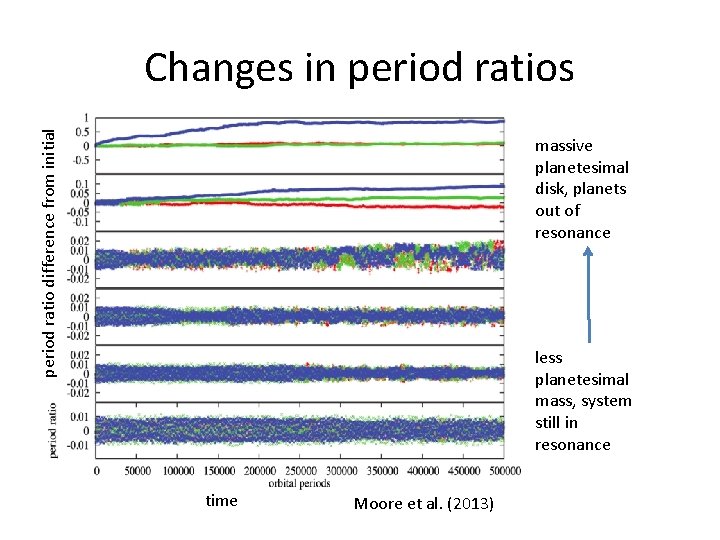
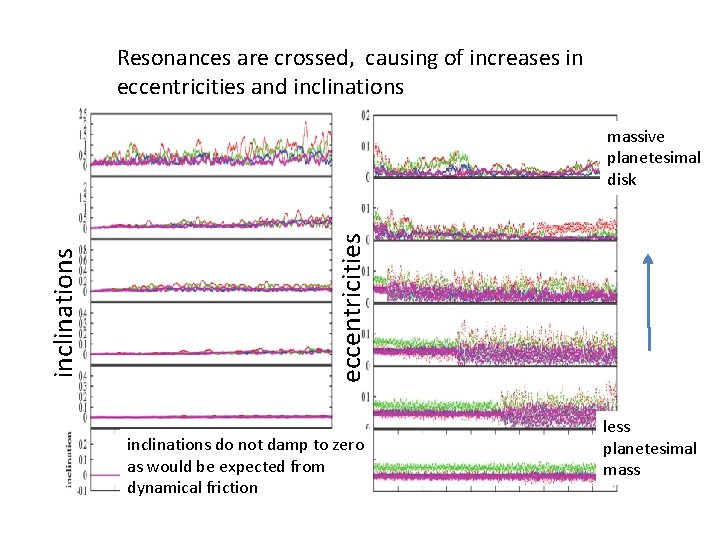
period ratio difference from initial Changes in period ratios massive planetesimal disk, planets out of resonance less planetesimal mass, system still in resonance time Moore et al. (2013)
Resonances are crossed, causing of increases in eccentricities and inclinations eccentricities inclinations massive planetesimal disk inclinations do not damp to zero as would be expected from dynamical friction less planetesimal mass
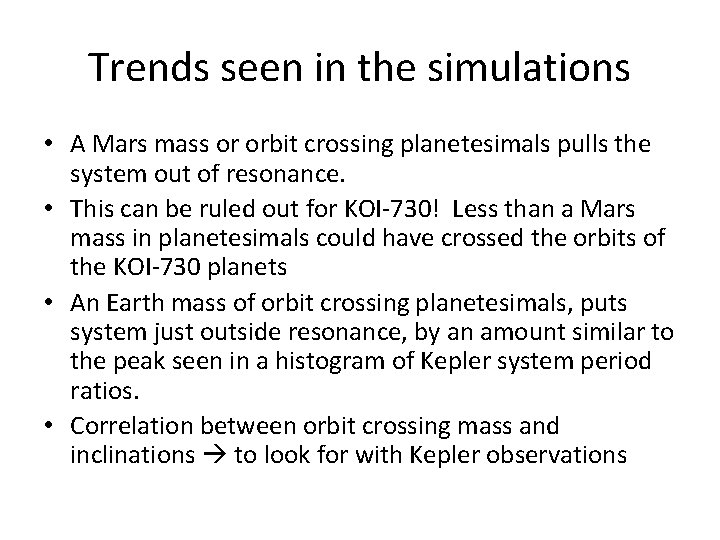
Trends seen in the simulations • A Mars mass or orbit crossing planetesimals pulls the system out of resonance. • This can be ruled out for KOI-730! Less than a Mars mass in planetesimals could have crossed the orbits of the KOI-730 planets • An Earth mass of orbit crossing planetesimals, puts system just outside resonance, by an amount similar to the peak seen in a histogram of Kepler system period ratios. • Correlation between orbit crossing mass and inclinations to look for with Kepler observations
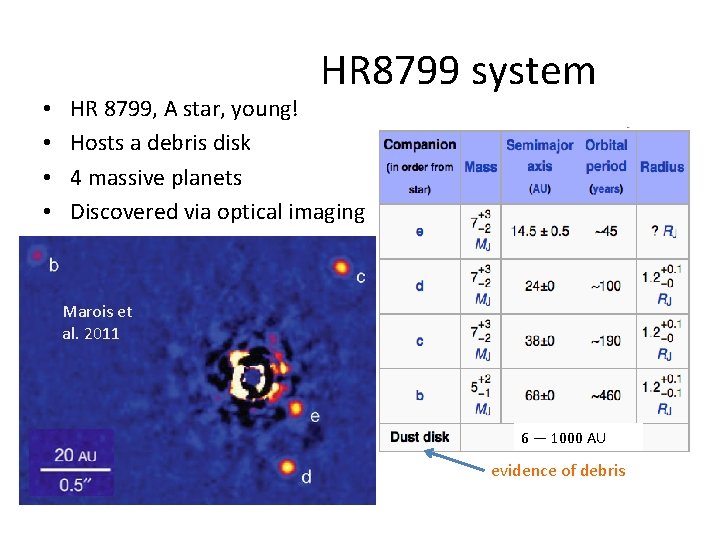
• • HR 8799 system HR 8799, A star, young! Hosts a debris disk 4 massive planets Discovered via optical imaging Marois et al. 2011 6 — 1000 AU evidence of debris
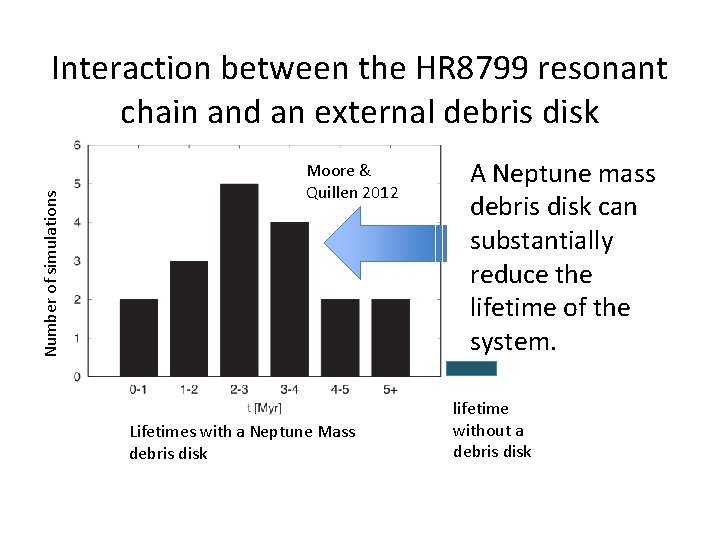
HR 8799 simulations • Using orbital elements based on observed positions of planets • Different mass planetesimal disks • Start with an unstable planetary configuration. Can the planetesimal disk can stabilize the system via eccentricity damping? No: Too much disk mass is required to make this possible • Start with a stable planetary configuration. Can the planetesimals pull it out of resonance, causing instability?
Number of simulations Interaction between the HR 8799 resonant chain and an external debris disk Moore & Quillen 2012 Lifetimes with a Neptune Mass debris disk A Neptune mass debris disk can substantially reduce the lifetime of the system. lifetime without a debris disk
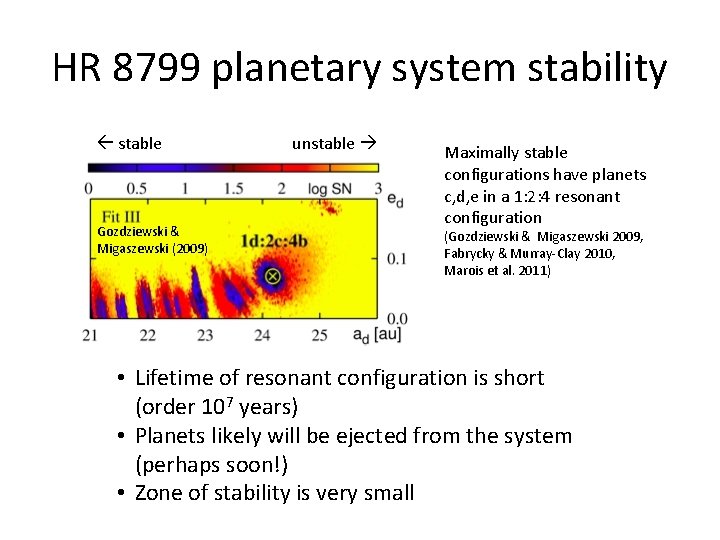
HR 8799 planetary system stability stable Gozdziewski & Migaszewski (2009) unstable Maximally stable configurations have planets c, d, e in a 1: 2: 4 resonant configuration (Gozdziewski & Migaszewski 2009, Fabrycky & Murray-Clay 2010, Marois et al. 2011) • Lifetime of resonant configuration is short (order 107 years) • Planets likely will be ejected from the system (perhaps soon!) • Zone of stability is very small
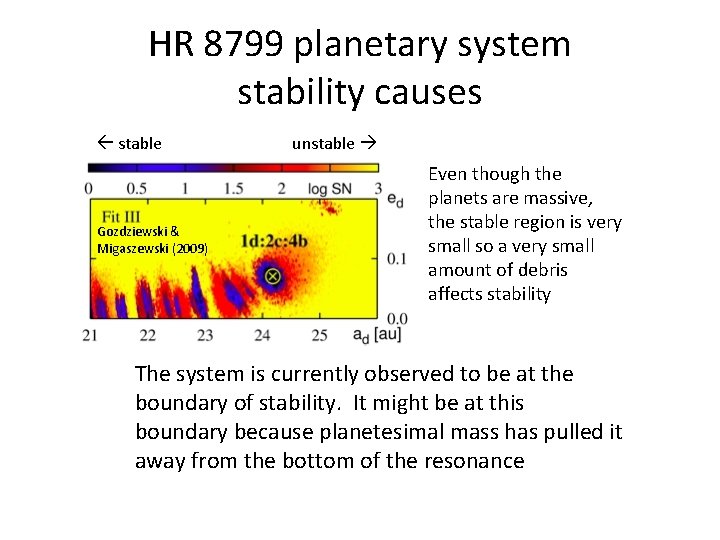
HR 8799 planetary system stability causes stable Gozdziewski & Migaszewski (2009) unstable Even though the planets are massive, the stable region is very small so a very small amount of debris affects stability The system is currently observed to be at the boundary of stability. It might be at this boundary because planetesimal mass has pulled it away from the bottom of the resonance
Summary: Kepler 36 Origins • Stochastic migration scenarios to account for Kepler 36’s origin require fine tuning so that planets can bypass 4: 3, 5: 4, 6: 5 resonances and capture into the 7: 6 resonance. Stochastic forcing would pull the system out of resonance unless the gas disk is depleted soon after capture • Encounters with planetary embryos can remove two planets from outer resonances allowing them to end up in adjacent orbits like Kepler 36 b, c. Impacts with embryos can have high enough velocity and impact angles that the mantle of a planet could be stripped, leaving behind a high density core. This scenario could account for both the proximity of the Kepler 36 planets and their high density contrast
Summary: Constraints on planetesimal disks • KOI-730: Less than a Mars mass of planetesimals could have crossed the orbits of planets, otherwise the 4 planet system would be pulled out of resonance, and planet inclinations increased past those observed A compact Kepler system never interacted with debris after the disk depleted (no solar system shake up) • HR 8799: Is near instability, a 1/10 th of a planet mass can pull the system out of resonance causing it to fall apart Its debris disk (observed) could be responsible for system’s current location at the edge of stability
Not discussed today: Pulling things out of resonance • Tidal force eccentricity damping (Lithwick, Wu, Batygin) • However, pair period distributions not strongly dependent on semi-major axis!