
Resonance Capture generalization to nonadiabatic regime Alice Quillen
Resonance Capture generalization to nonadiabatic regime Alice Quillen University of Rochester Observatoire de Cote d’Azur , Jan 2007
This Talk • Resonance Capture – extension to nonadiabatic regime – when do resonances capture? • Astrophysical settings: – Dust spiraling inward when collisions are not important – Neptune or exoplanet or satellite migrating outward – Jupiter or exoplanet migrating inward – Multiple exoplanets in resonance
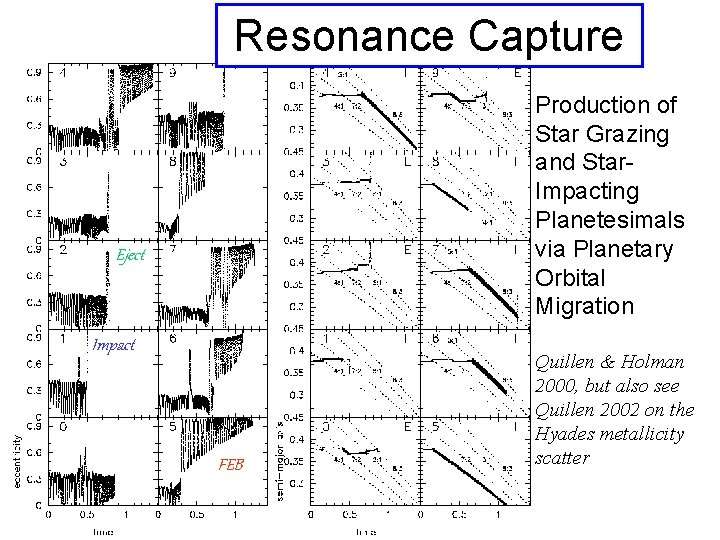
Resonance Capture Production of Star Grazing and Star. Impacting Planetesimals via Planetary Orbital Migration Eject Impact FEB Quillen & Holman 2000, but also see Quillen 2002 on the Hyades metallicity scatter
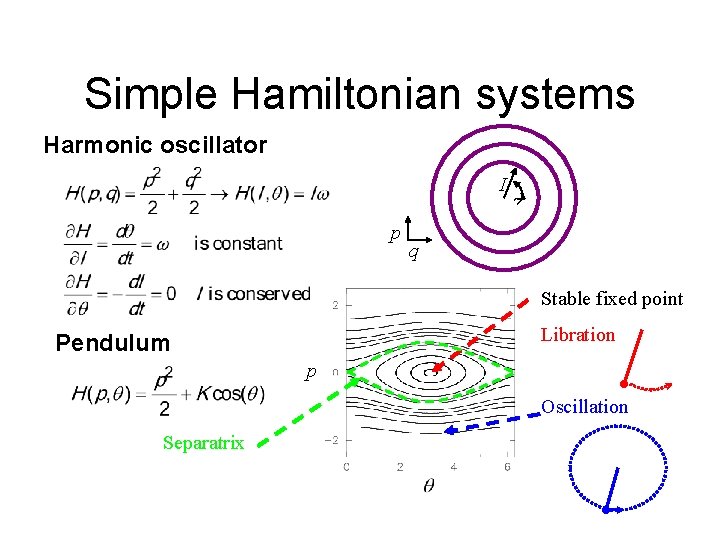
Simple Hamiltonian systems Harmonic oscillator I p q Stable fixed point Libration Pendulum p Oscillation Separatrix
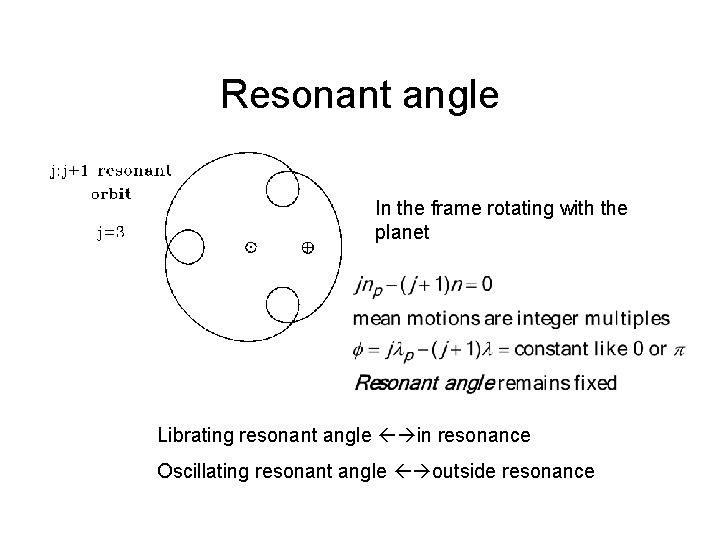
Resonant angle In the frame rotating with the planet Librating resonant angle in resonance Oscillating resonant angle outside resonance
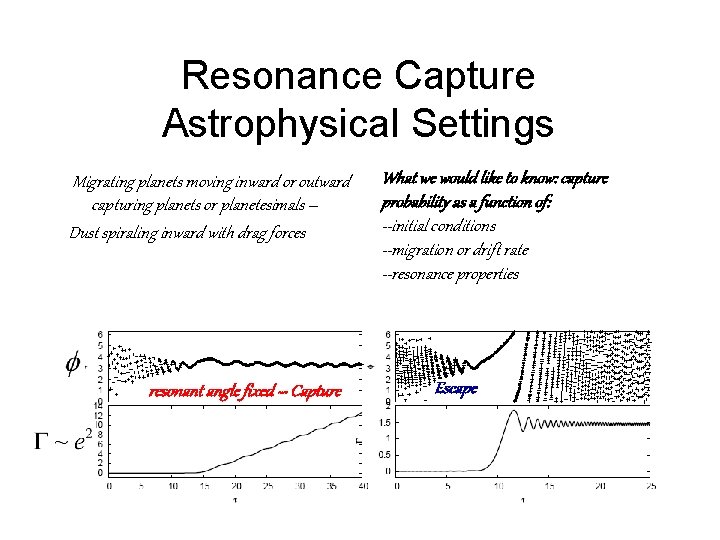
Resonance Capture Astrophysical Settings Migrating planets moving inward or outward capturing planets or planetesimals – Dust spiraling inward with drag forces resonant angle fixed -- Capture What we would like to know: capture probability as a function of: --initial conditions --migration or drift rate --resonance properties Escape
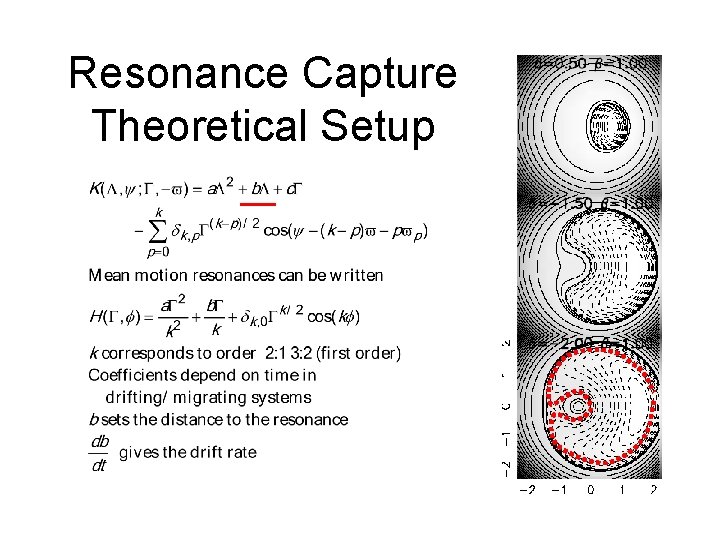
Resonance Capture Theoretical Setup
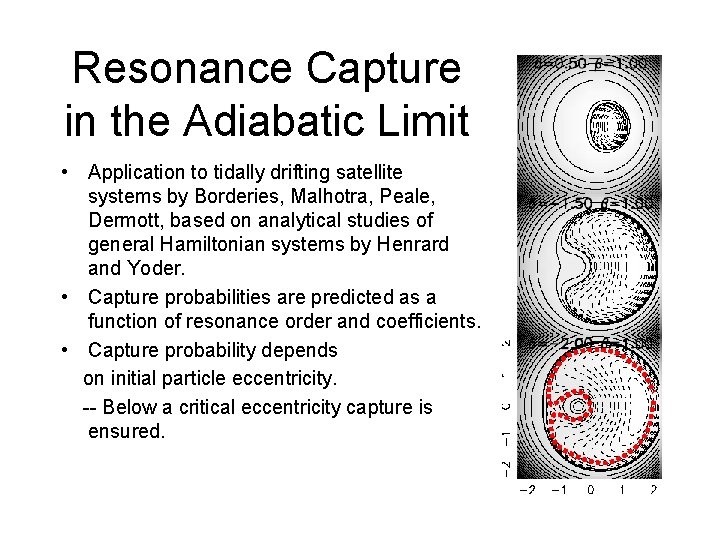
Resonance Capture in the Adiabatic Limit • Application to tidally drifting satellite systems by Borderies, Malhotra, Peale, Dermott, based on analytical studies of general Hamiltonian systems by Henrard and Yoder. • Capture probabilities are predicted as a function of resonance order and coefficients. • Capture probability depends on initial particle eccentricity. -- Below a critical eccentricity capture is ensured.
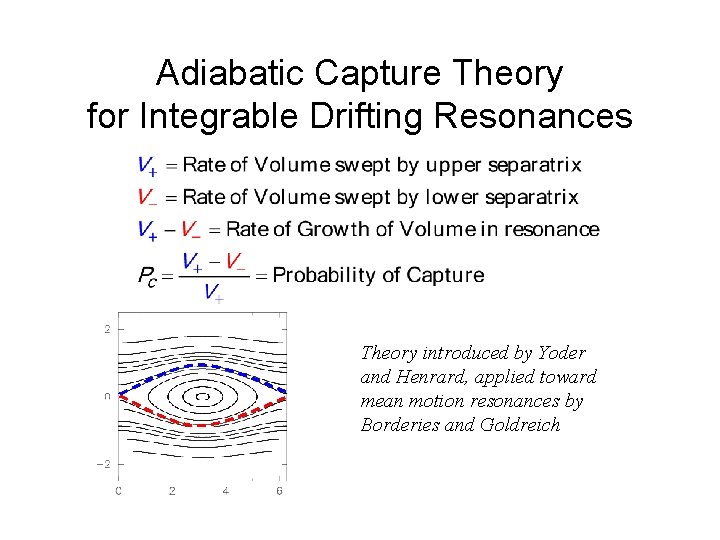
Adiabatic Capture Theory for Integrable Drifting Resonances Theory introduced by Yoder and Henrard, applied toward mean motion resonances by Borderies and Goldreich
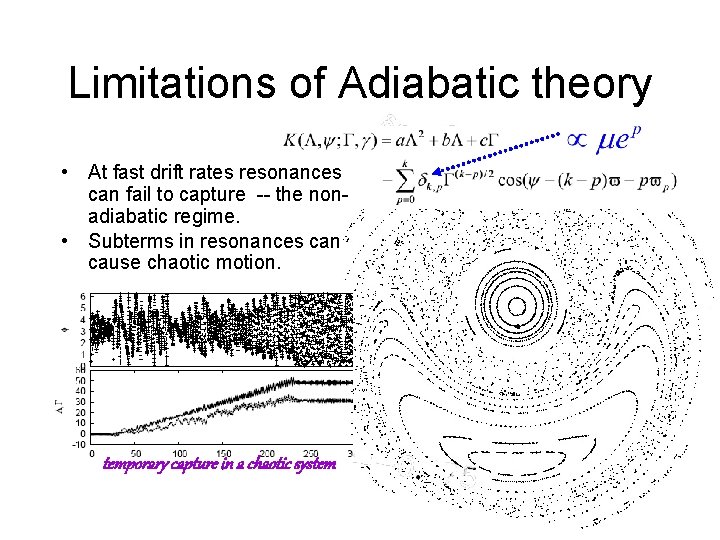
Limitations of Adiabatic theory • At fast drift rates resonances can fail to capture -- the nonadiabatic regime. • Subterms in resonances can cause chaotic motion. temporary capture in a chaotic system
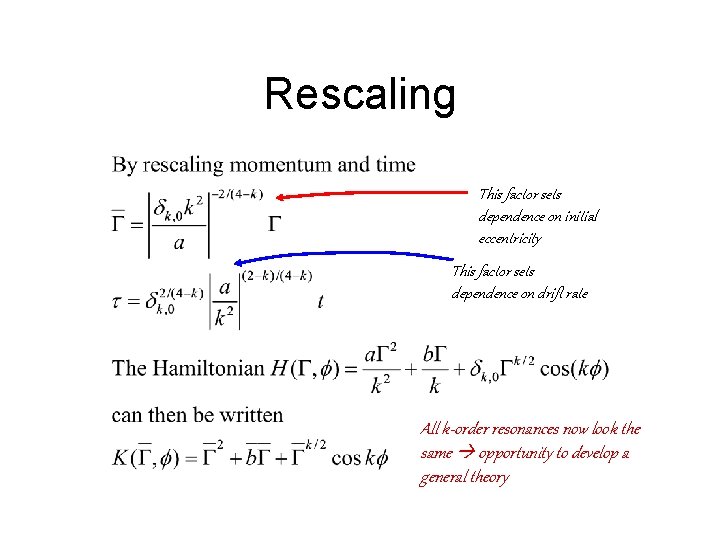
Rescaling This factor sets dependence on initial eccentricity This factor sets dependence on drift rate All k-order resonances now look the same opportunity to develop a general theory
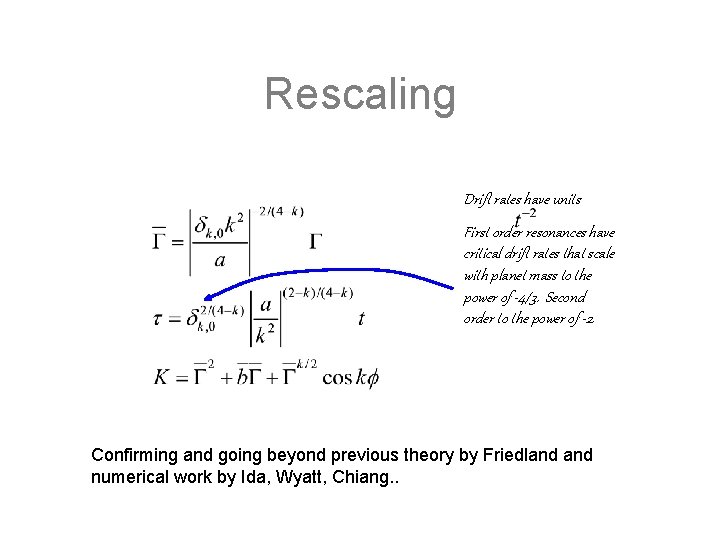
Rescaling Drift rates have units First order resonances have critical drift rates that scale with planet mass to the power of -4/3. Second order to the power of -2. Confirming and going beyond previous theory by Friedland numerical work by Ida, Wyatt, Chiang. .
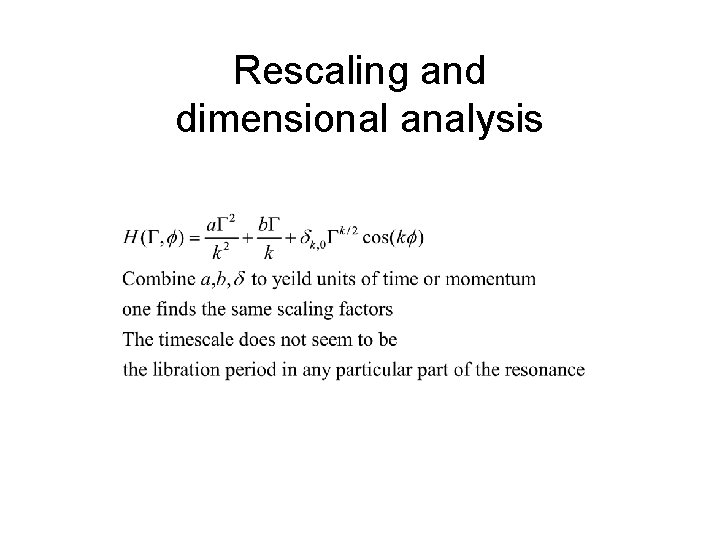
Rescaling and dimensional analysis
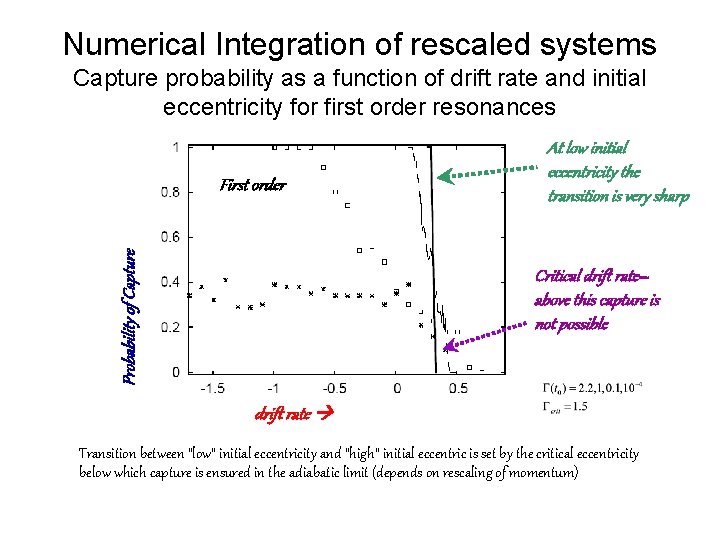
Numerical Integration of rescaled systems Capture probability as a function of drift rate and initial eccentricity for first order resonances Probability of Capture First order At low initial eccentricity the transition is very sharp Critical drift rate– above this capture is not possible drift rate Transition between “low” initial eccentricity and “high” initial eccentric is set by the critical eccentricity below which capture is ensured in the adiabatic limit (depends on rescaling of momentum)
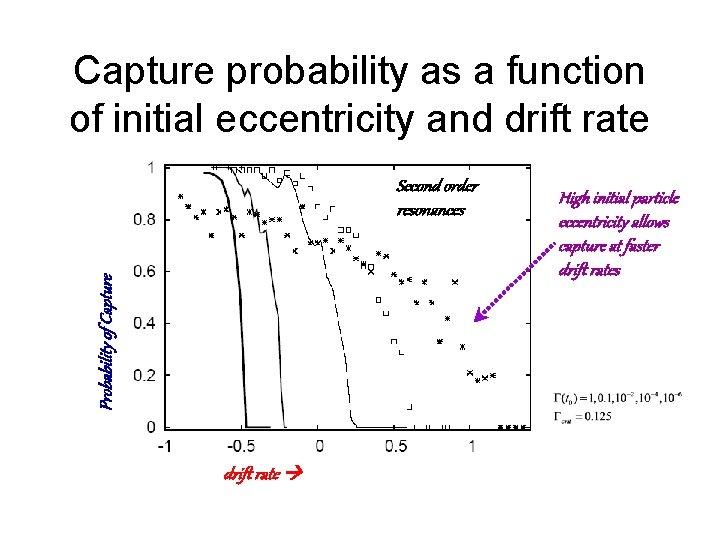
Capture probability as a function of initial eccentricity and drift rate Probability of Capture Second order resonances drift rate High initial particle eccentricity allows capture at faster drift rates
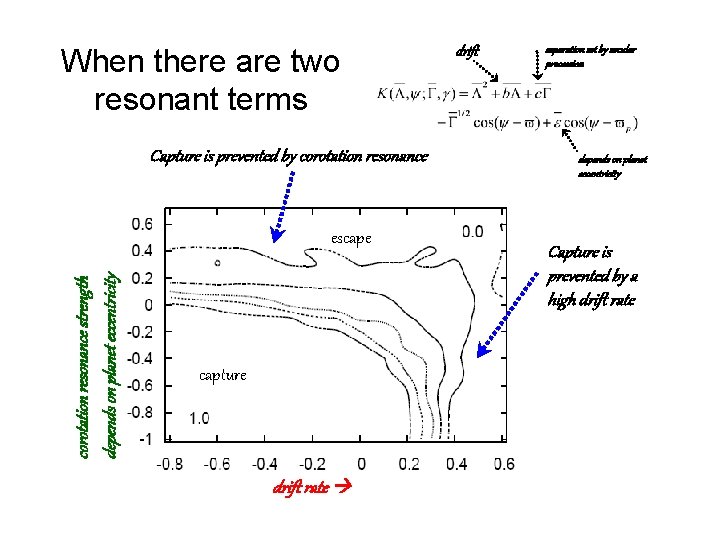
When there are two resonant terms Capture is prevented by corotation resonance strength depends on planet eccentricity escape capture drift rate drift separation set by secular precession depends on planet eccentricity Capture is prevented by a high drift rate
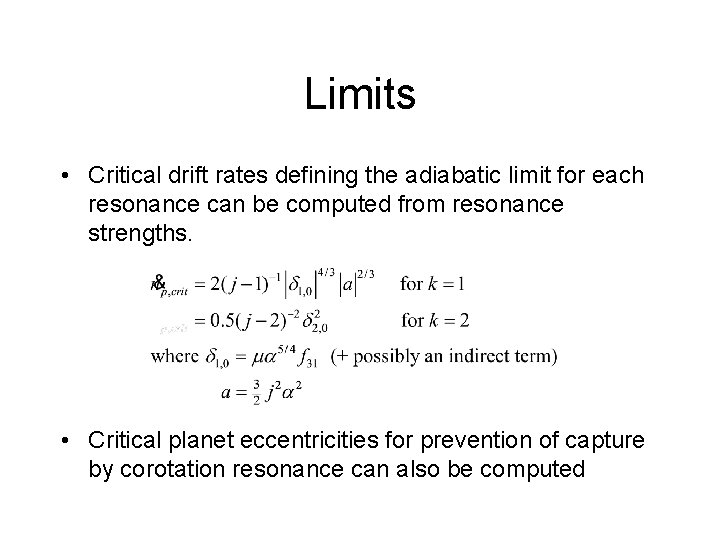
Limits • Critical drift rates defining the adiabatic limit for each resonance can be computed from resonance strengths. • Critical planet eccentricities for prevention of capture by corotation resonance can also be computed
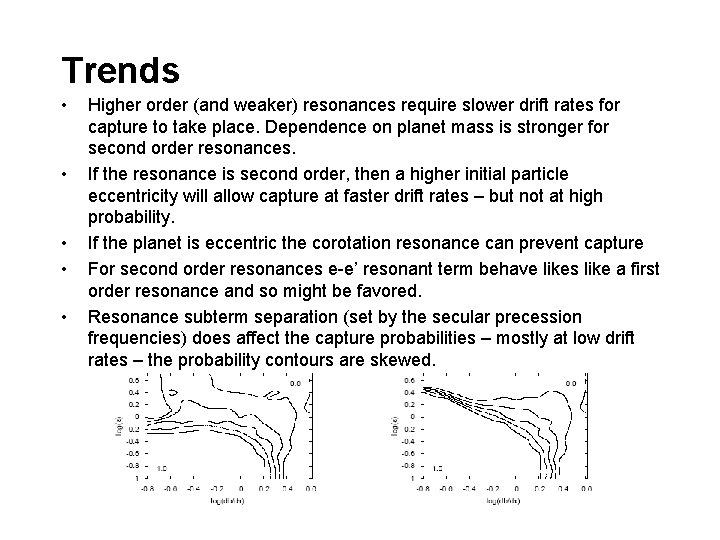
Trends • • • Higher order (and weaker) resonances require slower drift rates for capture to take place. Dependence on planet mass is stronger for second order resonances. If the resonance is second order, then a higher initial particle eccentricity will allow capture at faster drift rates – but not at high probability. If the planet is eccentric the corotation resonance can prevent capture For second order resonances e-e’ resonant term behave likes like a first order resonance and so might be favored. Resonance subterm separation (set by the secular precession frequencies) does affect the capture probabilities – mostly at low drift rates – the probability contours are skewed.
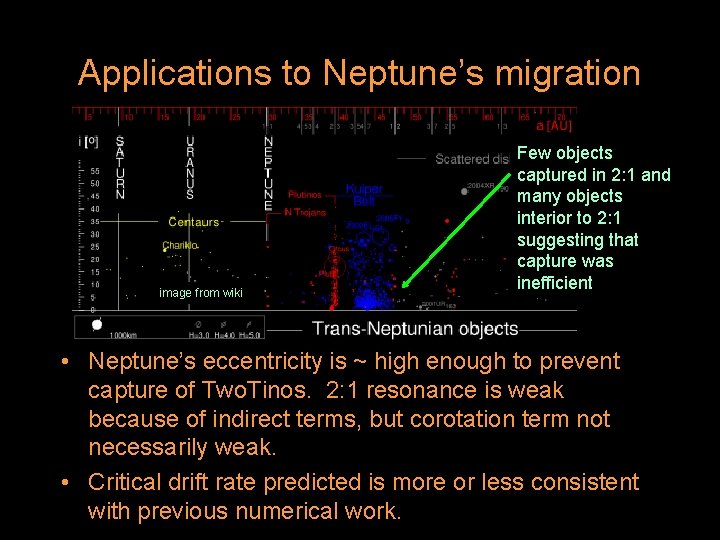
Applications to Neptune’s migration image from wiki Few objects captured in 2: 1 and many objects interior to 2: 1 suggesting that capture was inefficient • Neptune’s eccentricity is ~ high enough to prevent capture of Two. Tinos. 2: 1 resonance is weak because of indirect terms, but corotation term not necessarily weak. • Critical drift rate predicted is more or less consistent with previous numerical work.
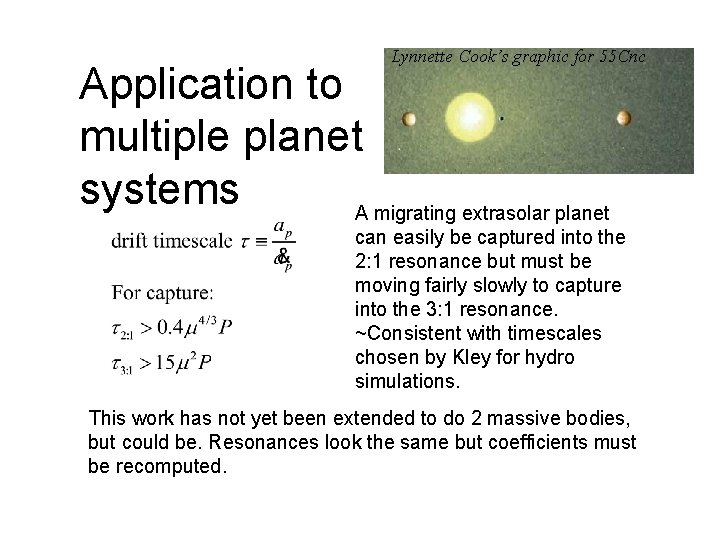
Lynnette Cook’s graphic for 55 Cnc Application to multiple planet systems A migrating extrasolar planet can easily be captured into the 2: 1 resonance but must be moving fairly slowly to capture into the 3: 1 resonance. ~Consistent with timescales chosen by Kley for hydro simulations. This work has not yet been extended to do 2 massive bodies, but could be. Resonances look the same but coefficients must be recomputed.
Future Applications • Formalism is very general – if you look up resonance coefficients, critical drift rates for non adiabatic limit can be estimated for any resonance : (Quillen 2006 MNRAS 365, 1367) See my website for errata! • Particle distribution could be predicted following migration given an initial eccentricity distribution and a drift rate. • Drifting dust particles can be sorted by size.
Future work • Extension to consider stochastic migration? • While we have progress in predicting the probability of resonance capture we still lack good theory for predicting lifetimes. • This theory has not yet been checked numerically --- more work needs to be done to relate critical eccentricities to those actually present in simulations
- Slides: 22