Middle of the Year Assessment and Accommodations Decision












- Slides: 85
Middle of the Year Assessment and Accommodations Decision Making Process 2019 -2020 BILINGUAL/ESL DEPARTMENT
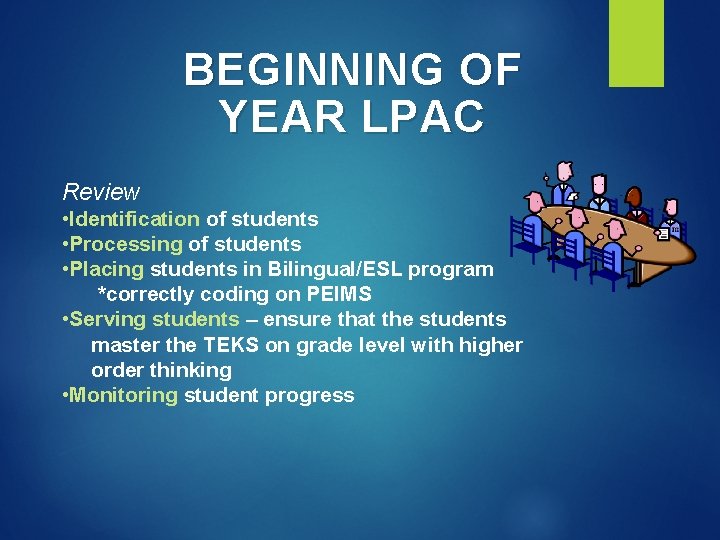
BEGINNING OF YEAR LPAC Review • Identification of students • Processing of students • Placing students in Bilingual/ESL program *correctly coding on PEIMS • Serving students – ensure that the students master the TEKS on grade level with higher order thinking • Monitoring student progress
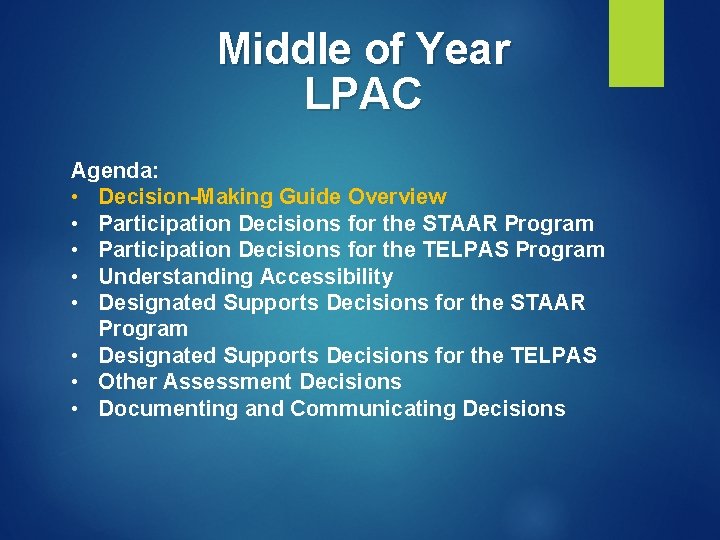
Middle of Year LPAC Agenda: • Decision-Making Guide Overview • Participation Decisions for the STAAR Program • Participation Decisions for the TELPAS Program • Understanding Accessibility • Designated Supports Decisions for the STAAR Program • Designated Supports Decisions for the TELPAS • Other Assessment Decisions • Documenting and Communicating Decisions
2019 -2020 Decision-Making Guide for LPACs NEW § One combined guide for STAAR and TELPAS programs § Condensed § User friendly
Decision-Making Guide: Overview § The regulatory procedural guide is based on: • 19 TAC Chapter 101, Subchapter AA for STAAR, and • (TAC) Section 101. 1003 for TELPAS and TELPAS Alternate • LPACs should be familiar with these Commissioner of Education rules LPACs are responsible for — • following administrative procedures in the guide • making decisions on an individual student basis • working as a committee to make decisions • maintaining required documentation
Overview: LPAC Responsibilities LPACs must review each section of the decision- making guide. The decision-making guide includes the following: • Overview • Test Participation Decisions • Designated Supports Decisions • Other Assessment Decisions • Documenting and Communicating Decisions
Middle of Year LPAC Agenda: • Decision-Making Guide Overview • Participation Decisions for the STAAR Program • Participation Decisions for the TELPAS Program • Understanding Accessibility • Designated Supports Decisions for the STAAR Program • Designated Supports Decisions for the TELPAS • Other Assessment Decisions • Documenting and Communicating Decisions
The STAAR Program Encompasses… STAAR Spanish (3 -5) STAAR Alt. 2 LPACs are required to make and document assessment decisions for English Learners (ELs) based on the participation criteria for each assessment.
STAAR, STAAR Spanish, STAAR Alt. 2 § Grades 3– 8 • Mathematics (3 -8), Reading (3 -8), Writing (4/7), Science (8), and Social Studies (8) § STAAR end-of-course (EOC) • Algebra I, Biology, English II, and U. S. History
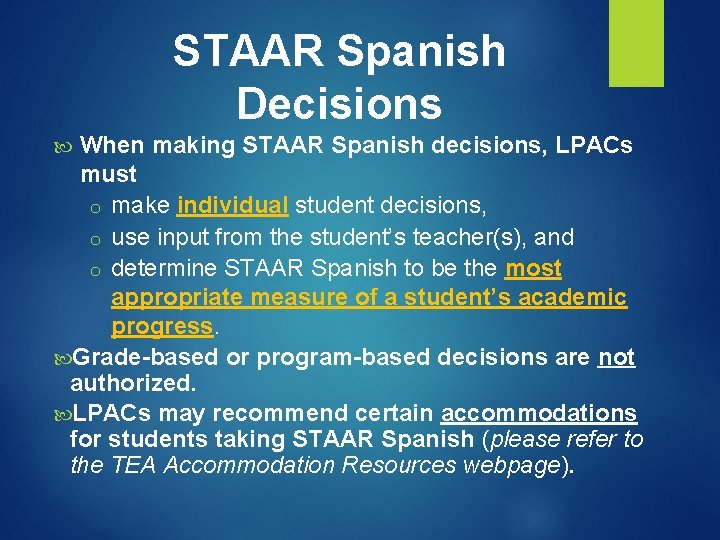
STAAR Spanish Decisions When making STAAR Spanish decisions, LPACs must o make individual student decisions, o use input from the student’s teacher(s), and o determine STAAR Spanish to be the most appropriate measure of a student’s academic progress. Grade-based or program-based decisions are not authorized. LPACs may recommend certain accommodations for students taking STAAR Spanish (please refer to the TEA Accommodation Resources webpage).
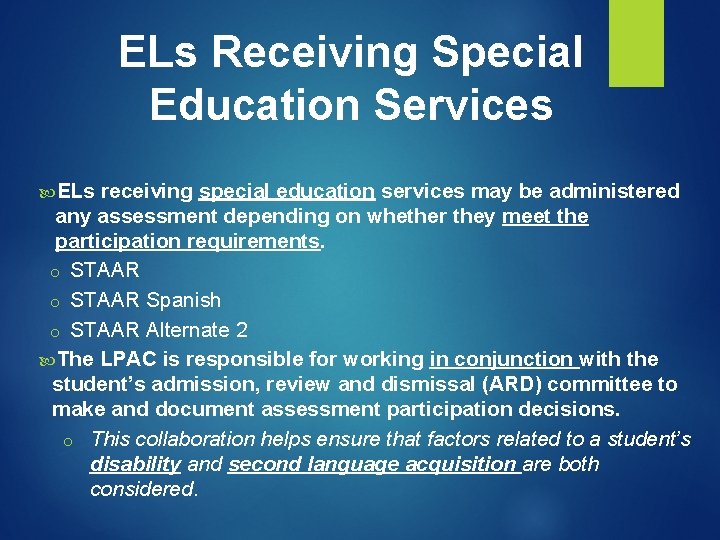
ELs Receiving Special Education Services ELs receiving special education services may be administered any assessment depending on whether they meet the participation requirements. o STAAR Spanish o STAAR Alternate 2 The LPAC is responsible for working in conjunction with the student’s admission, review and dismissal (ARD) committee to make and document assessment participation decisions. o This collaboration helps ensure that factors related to a student’s disability and second language acquisition are both considered.
Middle of Year LPAC Agenda: • Decision-Making Guide Overview • Participation Decisions for the STAAR Program • Participation Decisions for the TELPAS Program • Understanding Accessibility • Designated Supports Decisions for the STAAR Program • Designated Supports Decisions for the TELPAS • Other Assessment Decisions • Documentation
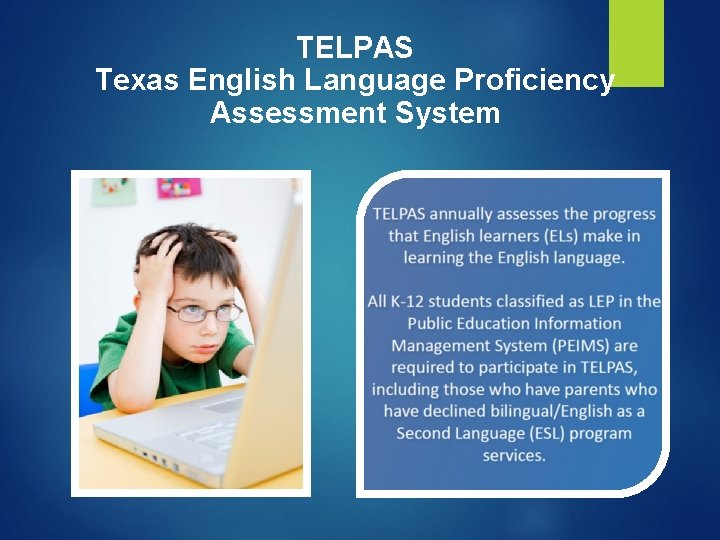
TELPAS Texas English Language Proficiency Assessment System
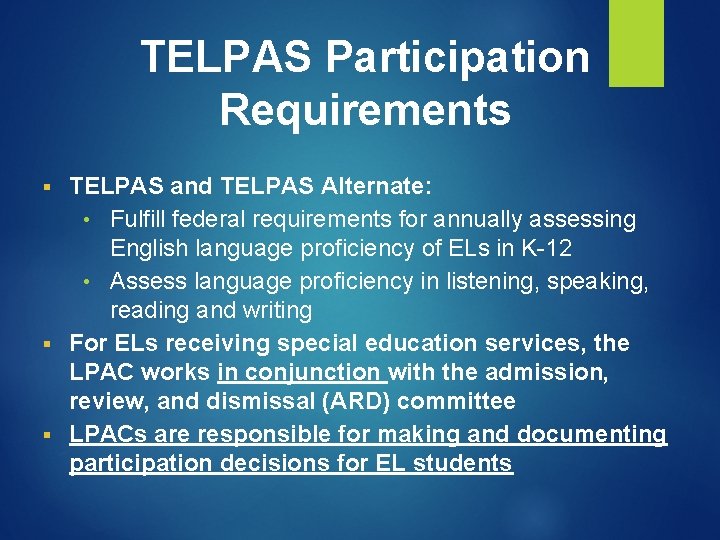
TELPAS Participation Requirements TELPAS and TELPAS Alternate: • Fulfill federal requirements for annually assessing English language proficiency of ELs in K-12 • Assess language proficiency in listening, speaking, reading and writing § For ELs receiving special education services, the LPAC works in conjunction with the admission, review, and dismissal (ARD) committee § LPACs are responsible for making and documenting participation decisions for EL students §
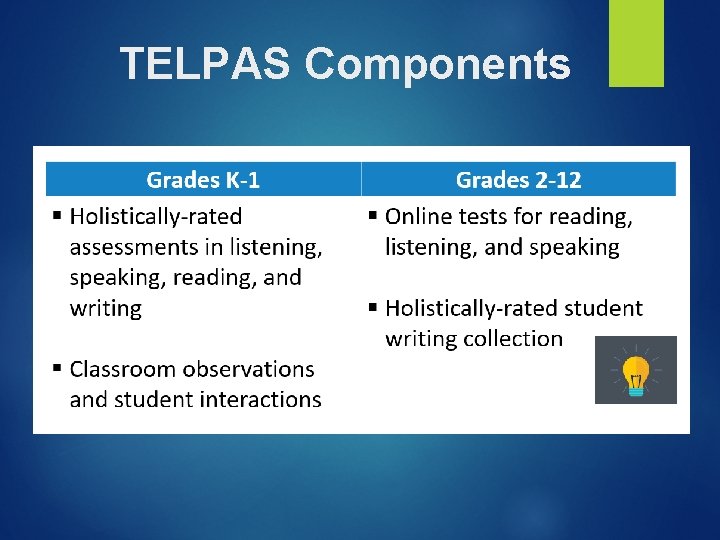
TELPAS Components
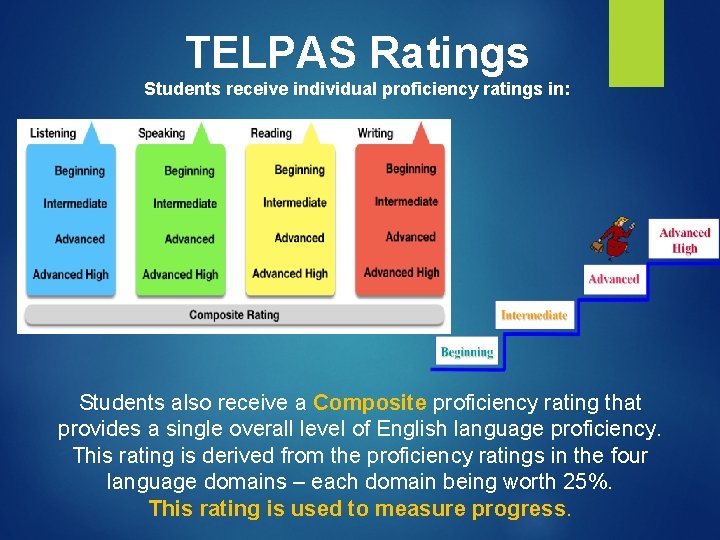
TELPAS Ratings Students receive individual proficiency ratings in: Students also receive a Composite proficiency rating that provides a single overall level of English language proficiency. This rating is derived from the proficiency ratings in the four language domains – each domain being worth 25%. This rating is used to measure progress.
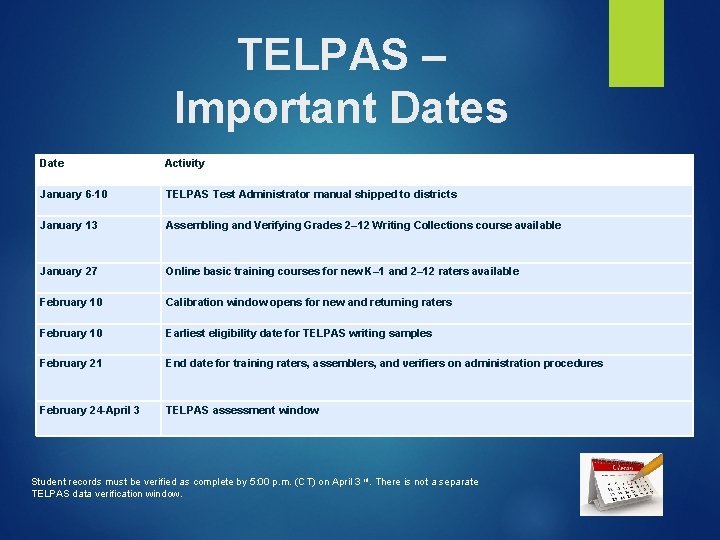
TELPAS – Important Dates Date Activity January 6 -10 TELPAS Test Administrator manual shipped to districts January 13 Assembling and Verifying Grades 2– 12 Writing Collections course available January 27 Online basic training courses for new K– 1 and 2– 12 raters available February 10 Calibration window opens for new and returning raters February 10 Earliest eligibility date for TELPAS writing samples February 21 End date for training raters, assemblers, and verifiers on administration procedures February 24 -April 3 TELPAS assessment window Student records must be verified as complete by 5: 00 p. m. (CT) on April 3 rd. There is not a separate TELPAS data verification window.
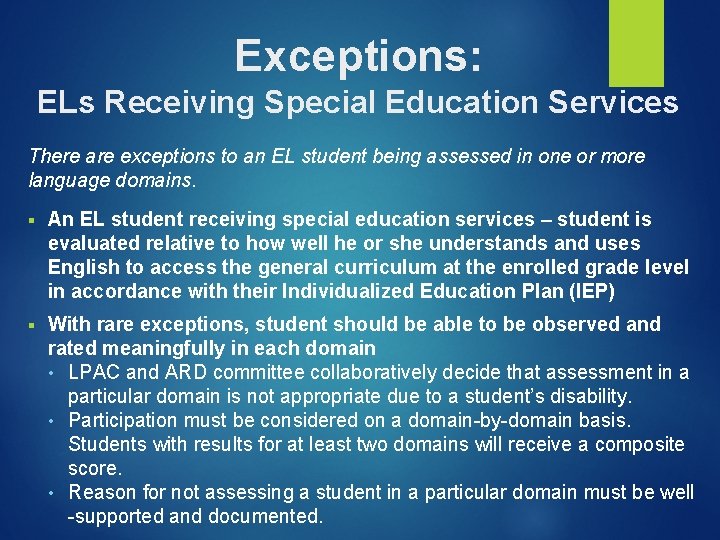
Exceptions: ELs Receiving Special Education Services There are exceptions to an EL student being assessed in one or more language domains. § An EL student receiving special education services – student is evaluated relative to how well he or she understands and uses English to access the general curriculum at the enrolled grade level in accordance with their Individualized Education Plan (IEP) § With rare exceptions, student should be able to be observed and rated meaningfully in each domain • LPAC and ARD committee collaboratively decide that assessment in a particular domain is not appropriate due to a student’s disability. • Participation must be considered on a domain-by-domain basis. Students with results for at least two domains will receive a composite score. • Reason for not assessing a student in a particular domain must be well -supported and documented.
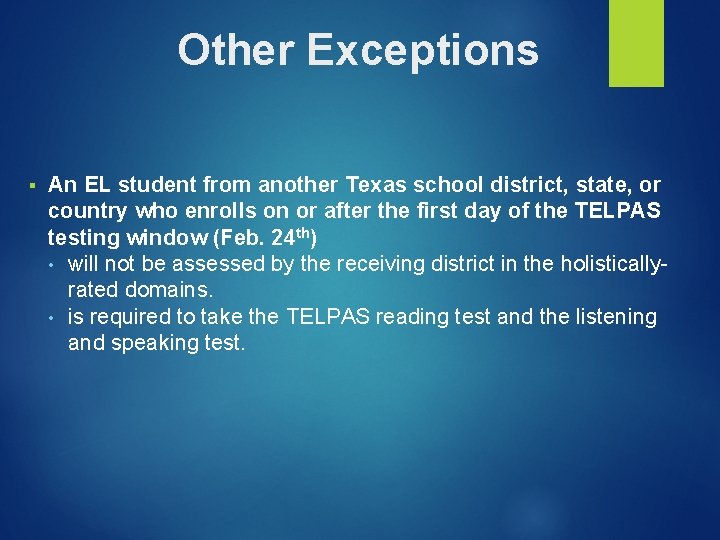
Other Exceptions § An EL student from another Texas school district, state, or country who enrolls on or after the first day of the TELPAS testing window (Feb. 24 th) • will not be assessed by the receiving district in the holisticallyrated domains. • is required to take the TELPAS reading test and the listening and speaking test.
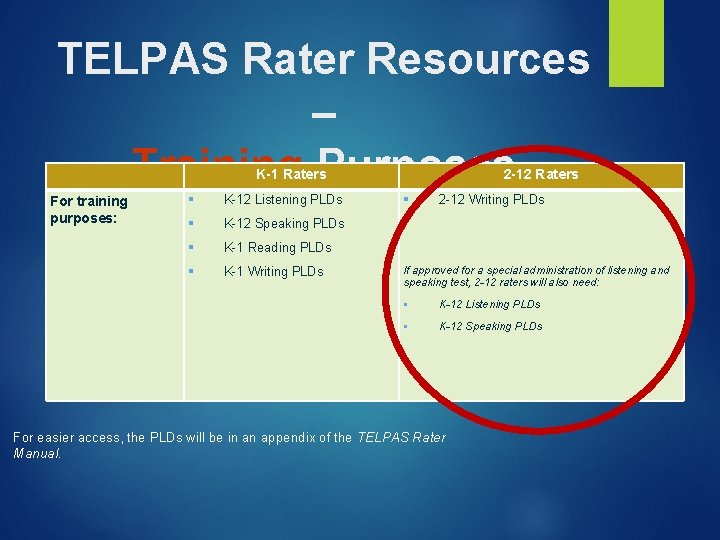
TELPAS Rater Resources – Training Purposes K-1 Raters For training purposes: § K-12 Listening PLDs § K-12 Speaking PLDs § K-1 Reading PLDs § K-1 Writing PLDs 2 -12 Raters § 2 -12 Writing PLDs If approved for a special administration of listening and speaking test, 2 -12 raters will also need: § K-12 Listening PLDs § K-12 Speaking PLDs For easier access, the PLDs will be in an appendix of the TELPAS Rater Manual.
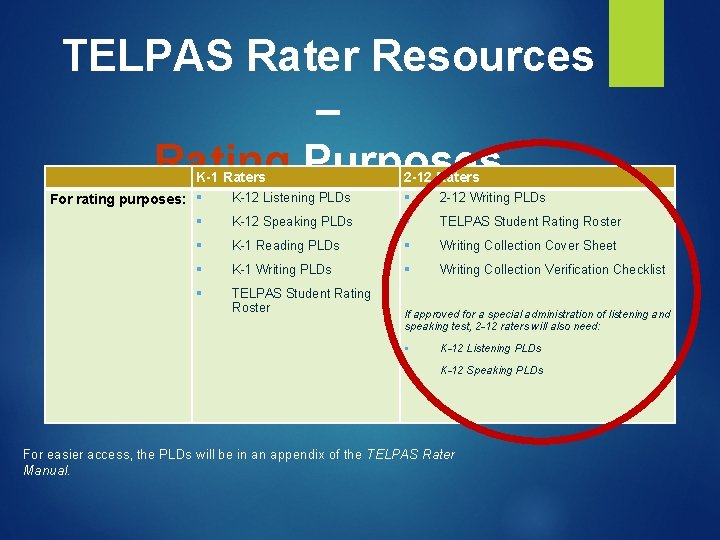
TELPAS Rater Resources – Rating Purposes K-1 Raters K-12 Listening PLDs For rating purposes: § 2 -12 Raters § 2 -12 Writing PLDs § K-12 Speaking PLDs § TELPAS Student Rating Roster § K-1 Reading PLDs § Writing Collection Cover Sheet § K-1 Writing PLDs § Writing Collection Verification Checklist § TELPAS Student Rating Roster If approved for a special administration of listening and speaking test, 2 -12 raters will also need: § K-12 Listening PLDs § K-12 Speaking PLDs For easier access, the PLDs will be in an appendix of the TELPAS Rater Manual.
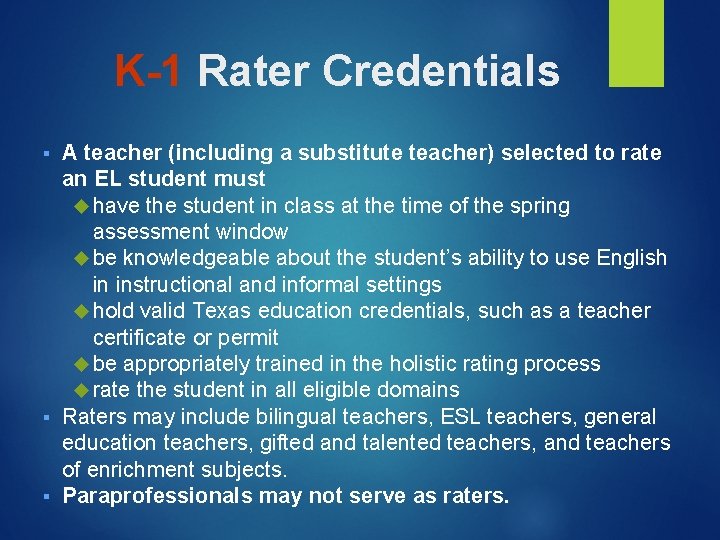
K-1 Rater Credentials A teacher (including a substitute teacher) selected to rate an EL student must have the student in class at the time of the spring assessment window be knowledgeable about the student’s ability to use English in instructional and informal settings hold valid Texas education credentials, such as a teacher certificate or permit be appropriately trained in the holistic rating process rate the student in all eligible domains § Raters may include bilingual teachers, ESL teachers, general education teachers, gifted and talented teachers, and teachers of enrichment subjects. § Paraprofessionals may not serve as raters. §
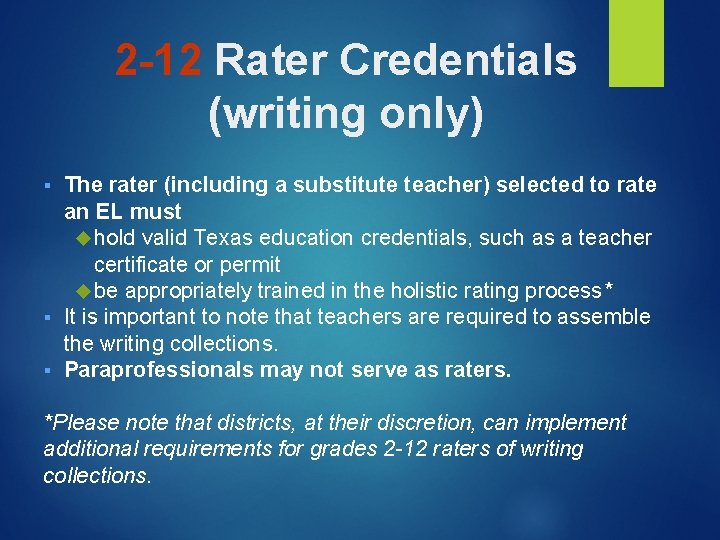
2 -12 Rater Credentials (writing only) The rater (including a substitute teacher) selected to rate an EL must hold valid Texas education credentials, such as a teacher certificate or permit be appropriately trained in the holistic rating process* § It is important to note that teachers are required to assemble the writing collections. § Paraprofessionals may not serve as raters. § *Please note that districts, at their discretion, can implement additional requirements for grades 2 -12 raters of writing collections.
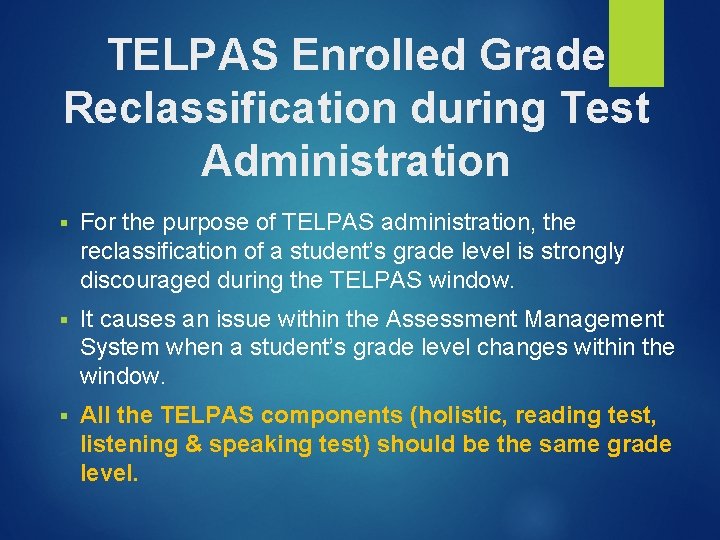
TELPAS Enrolled Grade Reclassification during Test Administration § For the purpose of TELPAS administration, the reclassification of a student’s grade level is strongly discouraged during the TELPAS window. § It causes an issue within the Assessment Management System when a student’s grade level changes within the window. § All the TELPAS components (holistic, reading test, listening & speaking test) should be the same grade level.
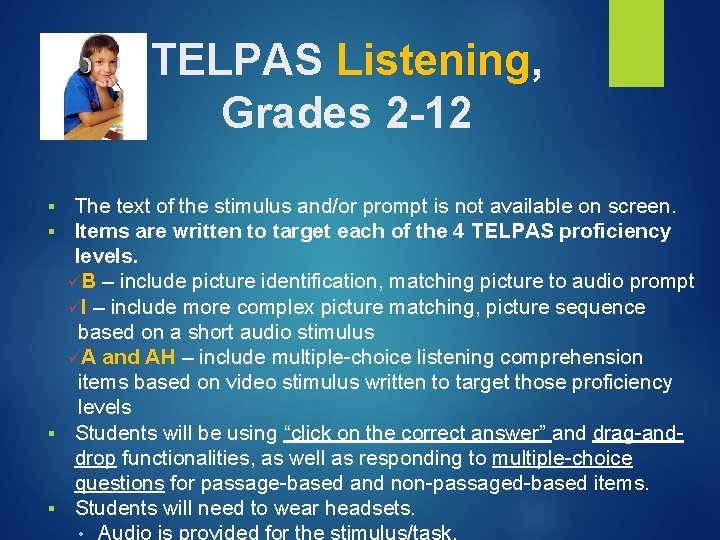
TELPAS Listening, Grades 2 -12 The text of the stimulus and/or prompt is not available on screen. Items are written to target each of the 4 TELPAS proficiency levels. üB – include picture identification, matching picture to audio prompt üI – include more complex picture matching, picture sequence based on a short audio stimulus üA and AH – include multiple-choice listening comprehension items based on video stimulus written to target those proficiency levels § Students will be using “click on the correct answer” and drag-anddrop functionalities, as well as responding to multiple-choice questions for passage-based and non-passaged-based items. § Students will need to wear headsets. § §
TELPAS Speaking, Grades 2 -12 Some speaking prompts are intended to solicit shorter responses; others are intended to solicit longer responses. • For simple prompts, students have 45 seconds to respond. • For open-ended, more complex prompts, students have 90 seconds. • The student’s responses to the prompts determine the student’s proficiency level. § Students have two opportunities to record a response. • To interact with speaking items, students will use audio capture functionality to record a response, listen to the response, and delete and re-record if not satisfied with their first response. §
TELPAS Speaking Rubrics § Speaking prompts are scored according to a 2 -point rubric or 4 -point rubric depending on the item type. Two-point item types are fairly simple, such as making a prediction based on a picture stimulus or using a simple map to provide directions. Four-point item types are more open ended, such as using a series of pictures to explain a multi-step process, comparing and contrasting, or taking a position on an issue and defending that position.
TELPAS Listening and Speaking Practice Sets § Will be in four grade bands (2 -3, 4 -5, 6 -8, and 9 -12) § Will still be accessed through the Test. Nav app § Are solely for practice (should not be used to predict success on TELPAS) § Created to help students become familiar with online listening and speaking items § Include sample items comparable to what is on the actual test • • should not be treated like released tests not a true reflection of the various difficulty levels of items on the test § Allow students to practice listening to test items § Allow students to practice recording speaking responses • • should have multiple opportunities to interact with microphone encourage students to plan their speaking response before actually recording it (using online notepad or scratch paper)
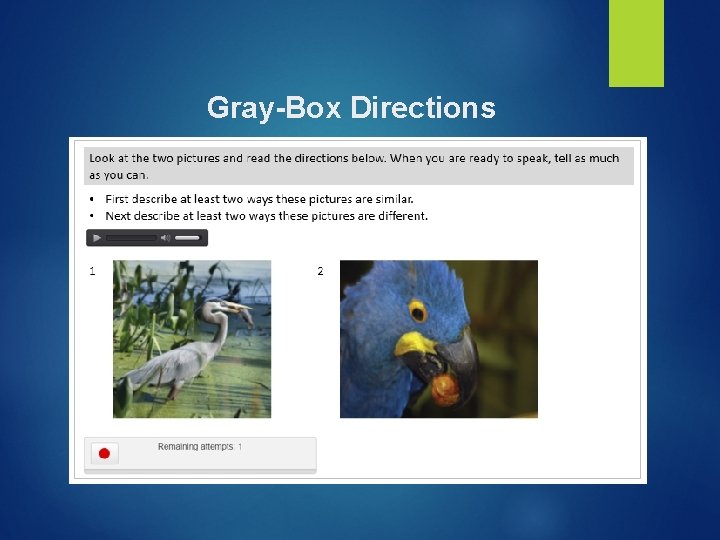
TELPAS Testing: Allowable Activities § Test Administrators: TAs may read the directions in the gray-box directions. • § § § The gray-box directions may be read, clarified, and/or translated to student at the student’s request. Students: Students may prepare their spoken response by planning or writing out their response using either the notepad tool in Test. Nav or using the scratch paper and pencil provided during the test administration. Best practice – Check your answers, such as making sure an answer is selected for the reading and listening items and listen to his/her spoken responses to make sure the responses are audible. Listen to the recorded prompts as many times as needed.
Gray-Box Directions
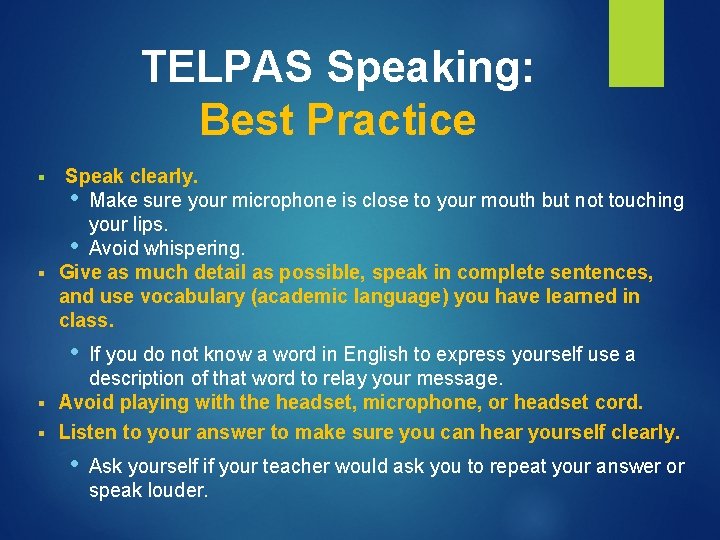
TELPAS Speaking: Best Practice Speak clearly. • Make sure your microphone is close to your mouth but not touching your lips. • Avoid whispering. § Give as much detail as possible, speak in complete sentences, and use vocabulary (academic language) you have learned in class. § • If you do not know a word in English to express yourself use a description of that word to relay your message. § Avoid playing with the headset, microphone, or headset cord. § Listen to your answer to make sure you can hear yourself clearly. • Ask yourself if your teacher would ask you to repeat your answer or speak louder.
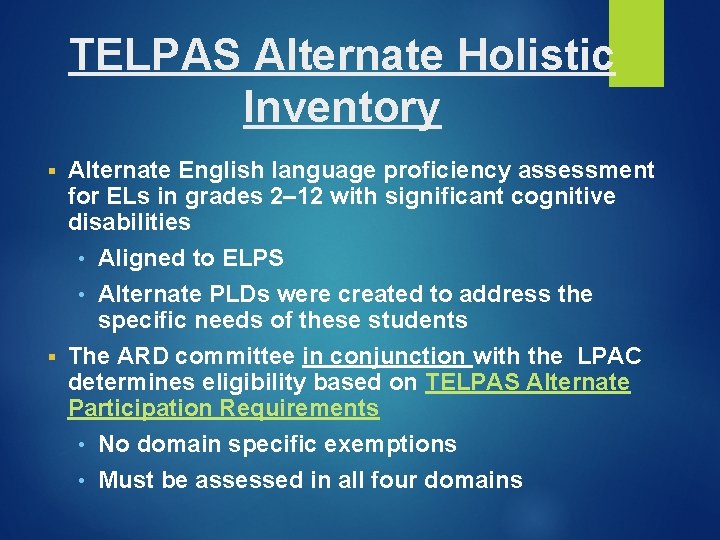
TELPAS Alternate Holistic Inventory Alternate English language proficiency assessment for ELs in grades 2– 12 with significant cognitive disabilities • Aligned to ELPS • Alternate PLDs were created to address the specific needs of these students § The ARD committee in conjunction with the LPAC determines eligibility based on TELPAS Alternate Participation Requirements • No domain specific exemptions • Must be assessed in all four domains §
Remember
Planning Ahead is Key! • Teacher Resources • Headsets • Student Practice for Online Testing • Designated Supports • Student Conferences (Where are you? Where do you need to be? ) • Spacing Considerations • Scheduling Considerations • Selection of Monitors/Proctors • TELPAS Calendar (don’t rush through the process)
Middle of Year LPAC Agenda: • Decision-Making Guide Overview • Participation Decisions for the STAAR Program • Participation Decisions for the TELPAS Program • Understanding Accessibility • Designated Supports Decisions for the STAAR Program • Designated Supports Decisions for the TELPAS • Other Assessment Decisions • Documenting and Communicating Decisions
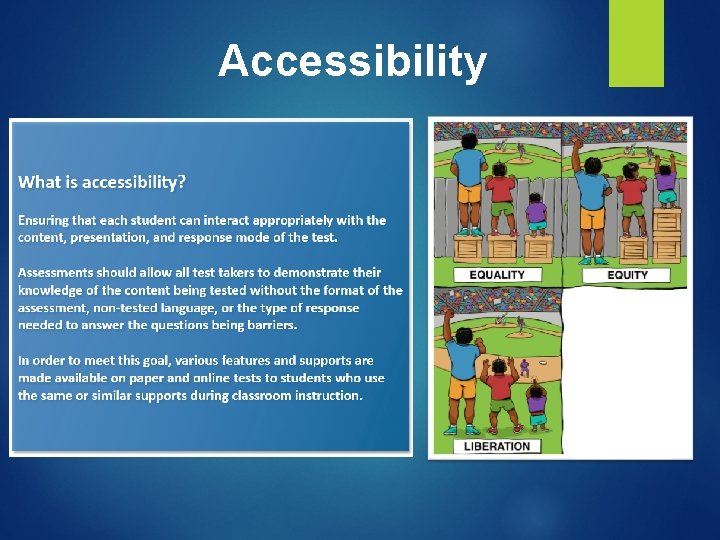
Accessibility
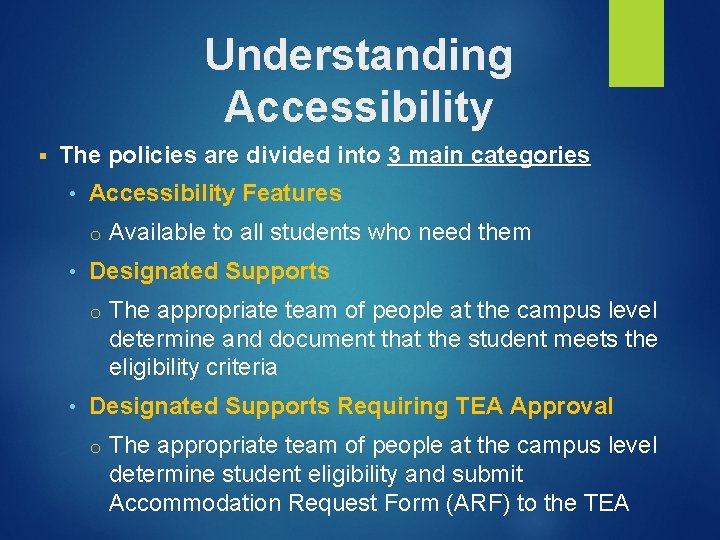
Understanding Accessibility § The policies are divided into 3 main categories • Accessibility Features o • Designated Supports o • Available to all students who need them The appropriate team of people at the campus level determine and document that the student meets the eligibility criteria Designated Supports Requiring TEA Approval o The appropriate team of people at the campus level determine student eligibility and submit Accommodation Request Form (ARF) to the TEA
Accessibility Features
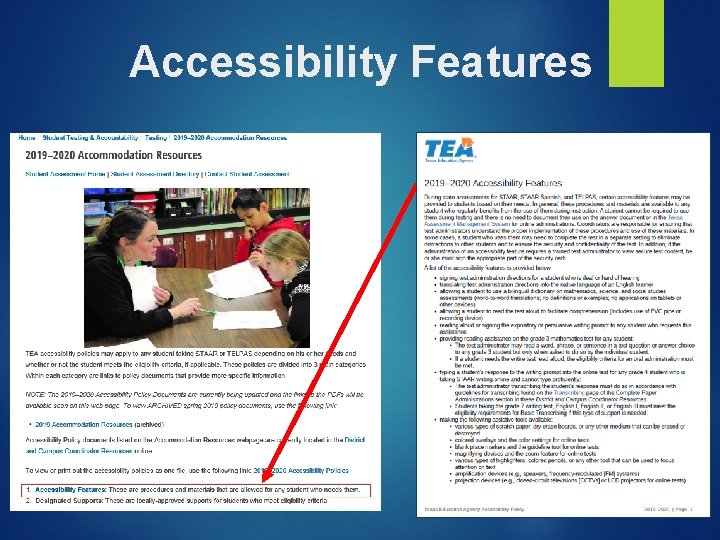
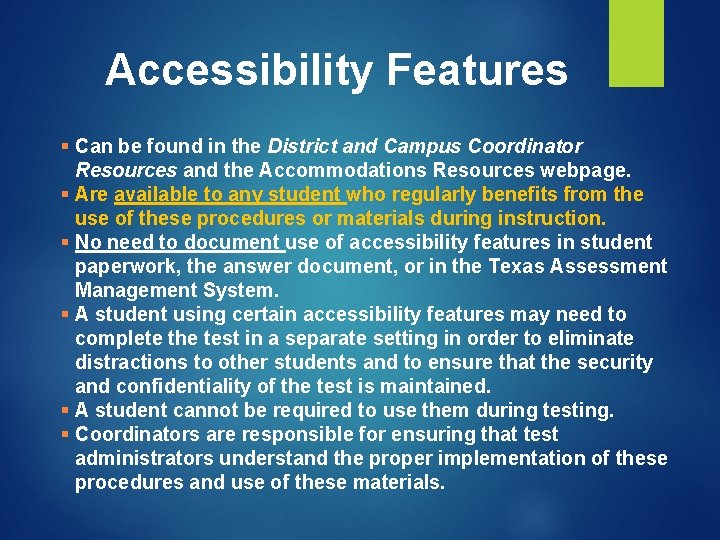
Accessibility Features § Can be found in the District and Campus Coordinator Resources and the Accommodations Resources webpage. § Are available to any student who regularly benefits from the use of these procedures or materials during instruction. § No need to document use of accessibility features in student paperwork, the answer document, or in the Texas Assessment Management System. § A student using certain accessibility features may need to complete the test in a separate setting in order to eliminate distractions to other students and to ensure that the security and confidentiality of the test is maintained. § A student cannot be required to use them during testing. § Coordinators are responsible for ensuring that test administrators understand the proper implementation of these procedures and use of these materials.
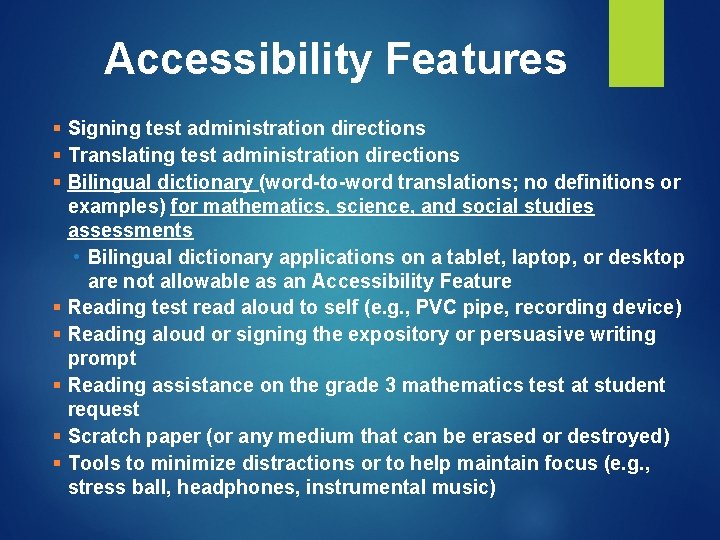
Accessibility Features § Signing test administration directions § Translating test administration directions § Bilingual dictionary (word-to-word translations; no definitions or examples) for mathematics, science, and social studies assessments • Bilingual dictionary applications on a tablet, laptop, or desktop are not allowable as an Accessibility Feature § Reading test read aloud to self (e. g. , PVC pipe, recording device) § Reading aloud or signing the expository or persuasive writing prompt § Reading assistance on the grade 3 mathematics test at student request § Scratch paper (or any medium that can be erased or destroyed) § Tools to minimize distractions or to help maintain focus (e. g. , stress ball, headphones, instrumental music)
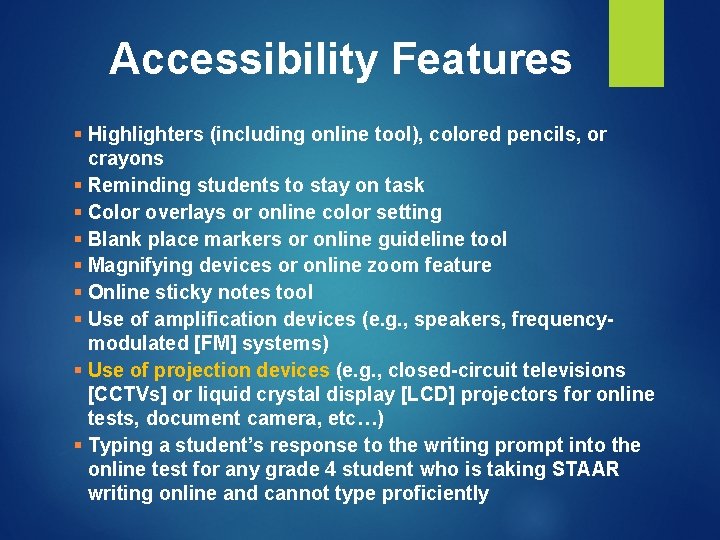
Accessibility Features § Highlighters (including online tool), colored pencils, or crayons § Reminding students to stay on task § Color overlays or online color setting § Blank place markers or online guideline tool § Magnifying devices or online zoom feature § Online sticky notes tool § Use of amplification devices (e. g. , speakers, frequencymodulated [FM] systems) § Use of projection devices (e. g. , closed-circuit televisions [CCTVs] or liquid crystal display [LCD] projectors for online tests, document camera, etc…) § Typing a student’s response to the writing prompt into the online test for any grade 4 student who is taking STAAR writing online and cannot type proficiently
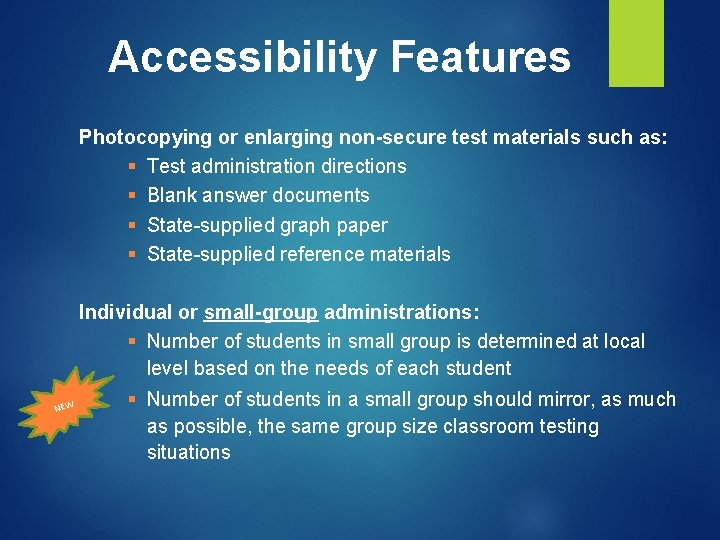
Accessibility Features Photocopying or enlarging non-secure test materials such as: § Test administration directions § Blank answer documents § State-supplied graph paper § State-supplied reference materials Individual or small-group administrations: § Number of students in small group is determined at local level based on the needs of each student NEW § Number of students in a small group should mirror, as much as possible, the same group size classroom testing situations
Middle of Year LPAC Agenda: • Decision-Making Guide Overview • Participation Decisions for the STAAR Program • Participation Decisions for the TELPAS Program • Understanding Accessibility • Designated Supports Decisions for the STAAR Program • Designated Supports Decisions for the TELPAS • Other Assessment Decisions • Documenting and Communicating Decisions
LPAC Responsibilities with Designated Supports Decisions LPACs are responsible for making appropriate designated supports decisions: § Coordinate with the content area teachers of ELs § Make designated supports decisions in accordance with the TEA policies in the • Educator Guide to Accessibility within the STAAR Program, • Accessibility Policy Documents on TEA’s 2019 -2020 Accommodation Resources webpage or on the DCCR, and • 2019 -2020 Decision-Making Guide for LPACs § Maintain required documentation of decisions
Designated Supports Decisions for STAAR § The LPAC’s designated supports decisions must be made on an individual student basis. Decisions must be based on— • a student’s particular needs for second language acquisition support, and • whether the student is routinely provided the support in classroom instruction and testing. § Providing unfamiliar supports may hinder rather than help a student. § Designated supports decisions should be made as close as possible to the assessment to account for the student’s progress in acquiring the English language. §
Designated Supports for ELs Receiving Special Education Services § LPACs are responsible for making designated supports decisions for the STAAR program in conjunction with the student’s ARD committee, Section 504 committee, RTI team, or other applicable committee. • Designated supports decisions related to the student’s particular needs for second language acquisition support • Designated supports decisions related to the student’s disability or need § Committees should become familiar with all information on the TEA’s Accommodation Resources webpage.
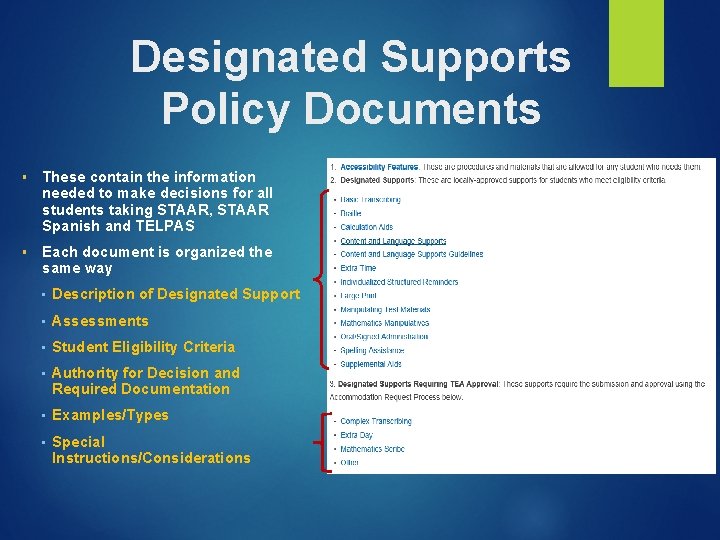
Designated Supports Policy Documents § These contain the information needed to make decisions for all students taking STAAR, STAAR Spanish and TELPAS § Each document is organized the same way • Description of Designated Support • Assessments • Student Eligibility Criteria • Authority for Decision and Required Documentation • Examples/Types • Special Instructions/Considerations
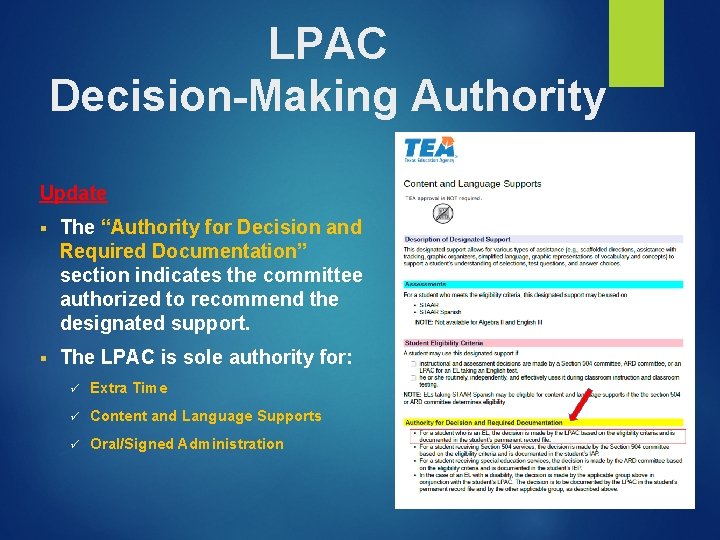
LPAC Decision-Making Authority Update § The “Authority for Decision and Required Documentation” section indicates the committee authorized to recommend the designated support. § The LPAC is sole authority for: ü Extra Time ü Content and Language Supports ü Oral/Signed Administration
*LPAC as Sole Authority * * *
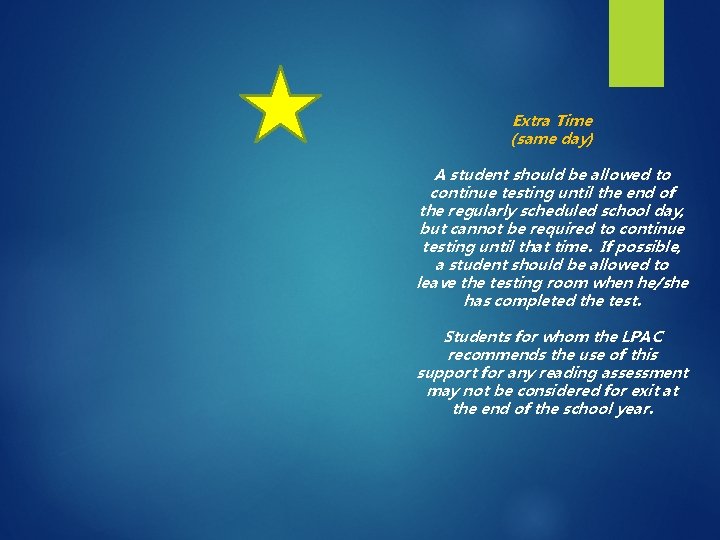
Extra Time (same day) A student should be allowed to continue testing until the end of the regularly scheduled school day, but cannot be required to continue testing until that time. If possible, a student should be allowed to leave the testing room when he/she has completed the test. Students for whom the LPAC recommends the use of this support for any reading assessment may not be considered for exit at the end of the school year.
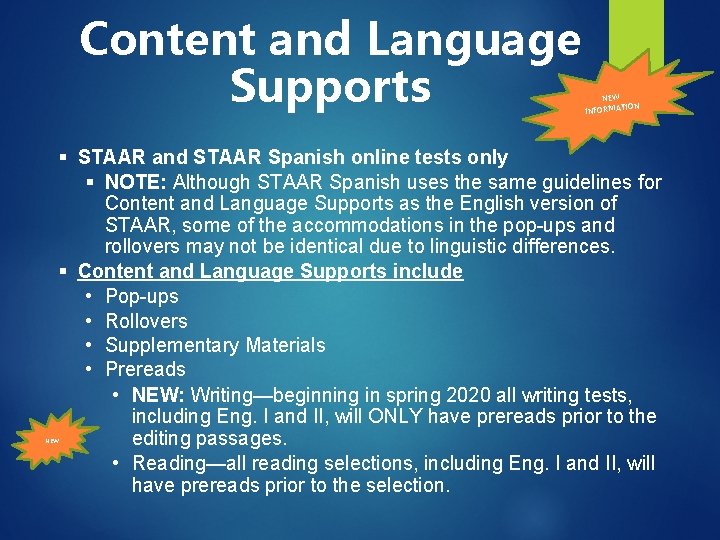
Content and Language Supports Students for whom the LPAC recommends the use of this support for any reading assessment, may not be considered for exit at the end of the school year.
Content and Language Supports NEW N INFORMATIO § STAAR and STAAR Spanish online tests only § NOTE: Although STAAR Spanish uses the same guidelines for Content and Language Supports as the English version of STAAR, some of the accommodations in the pop-ups and rollovers may not be identical due to linguistic differences. § Content and Language Supports include • Pop-ups • Rollovers • Supplementary Materials • Prereads • NEW: Writing—beginning in spring 2020 all writing tests, including Eng. I and II, will ONLY have prereads prior to the editing passages. • Reading—all reading selections, including Eng. I and II, will have prereads prior to the selection. NEW
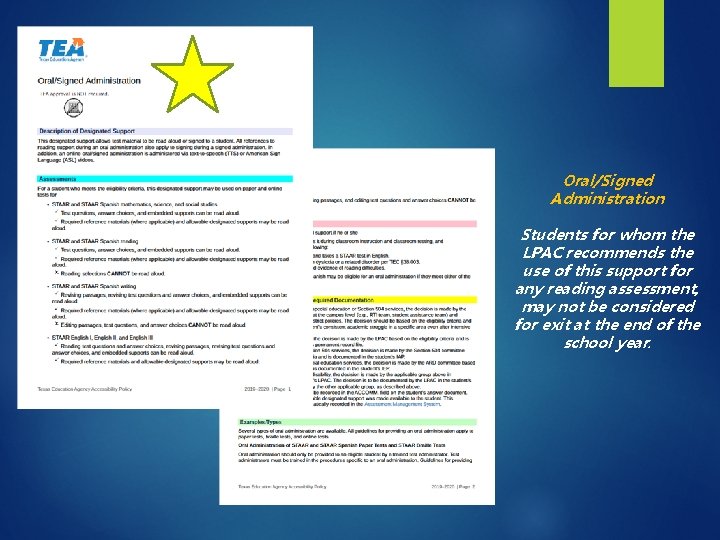
Oral/Signed Administration Students for whom the LPAC recommends the use of this support for any reading assessment, may not be considered for exit at the end of the school year.
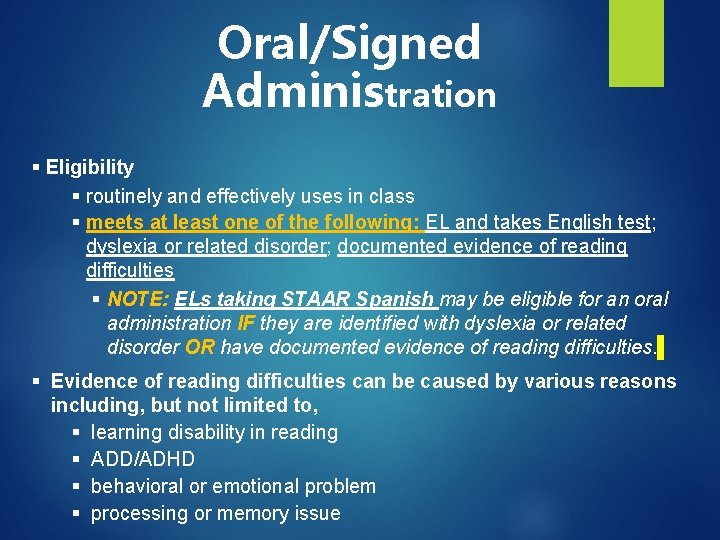
Oral/Signed Administration § Eligibility § routinely and effectively uses in class § meets at least one of the following: EL and takes English test; dyslexia or related disorder; documented evidence of reading difficulties § NOTE: ELs taking STAAR Spanish may be eligible for an oral administration IF they are identified with dyslexia or related disorder OR have documented evidence of reading difficulties. § Evidence of reading difficulties can be caused by various reasons including, but not limited to, § learning disability in reading § ADD/ADHD § behavioral or emotional problem § processing or memory issue
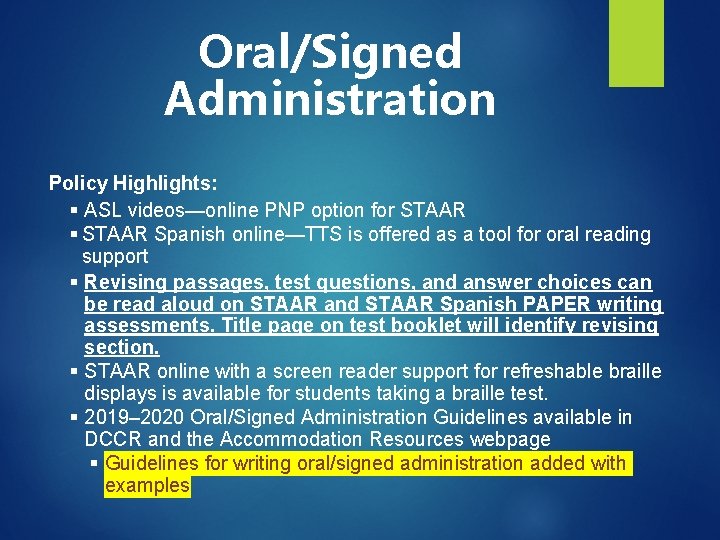
Oral/Signed Administration Policy Highlights: § ASL videos—online PNP option for STAAR § STAAR Spanish online—TTS is offered as a tool for oral reading support § Revising passages, test questions, and answer choices can be read aloud on STAAR and STAAR Spanish PAPER writing assessments. Title page on test booklet will identify revising section. § STAAR online with a screen reader support for refreshable braille displays is available for students taking a braille test. § 2019– 2020 Oral/Signed Administration Guidelines available in DCCR and the Accommodation Resources webpage § Guidelines for writing oral/signed administration added with examples
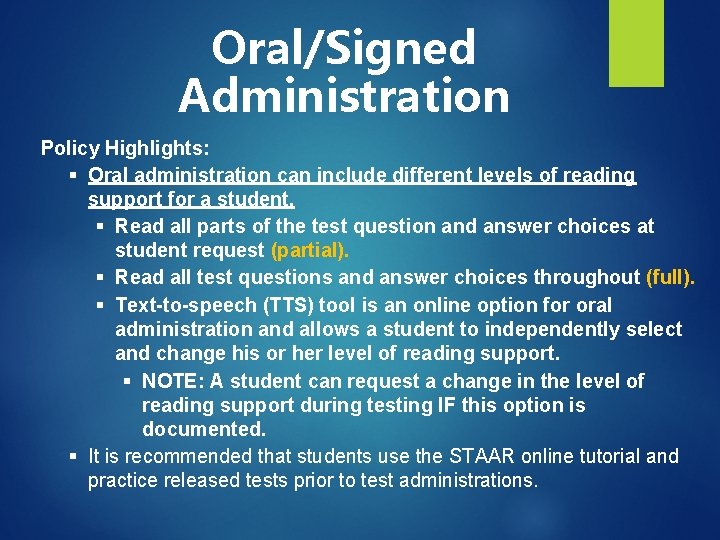
Oral/Signed Administration Policy Highlights: § Oral administration can include different levels of reading support for a student. § Read all parts of the test question and answer choices at student request (partial). § Read all test questions and answer choices throughout (full). § Text-to-speech (TTS) tool is an online option for oral administration and allows a student to independently select and change his or her level of reading support. § NOTE: A student can request a change in the level of reading support during testing IF this option is documented. § It is recommended that students use the STAAR online tutorial and practice released tests prior to test administrations.
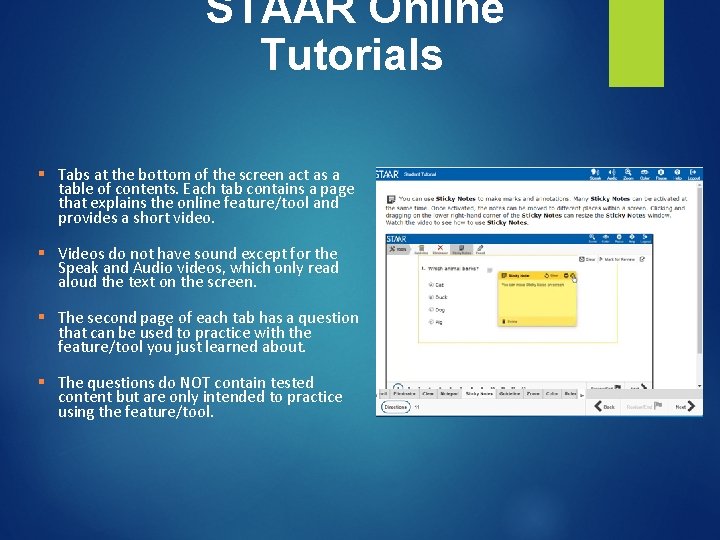
STAAR Online Tutorials § When you open the STAAR Online Testing Platform (SOTP), you will see a menu of options, including “Tutorials. ” § Once you select “Tutorials, ” you will be taken to a screen with several drop-down menus. § Choose the grade, subject, and test (i. e. , available supports) you want to view.
STAAR Online Tutorials § Tabs at the bottom of the screen act as a table of contents. Each tab contains a page that explains the online feature/tool and provides a short video. § Videos do not have sound except for the Speak and Audio videos, which only read aloud the text on the screen. § The second page of each tab has a question that can be used to practice with the feature/tool you just learned about. § The questions do NOT contain tested content but are only intended to practice using the feature/tool.
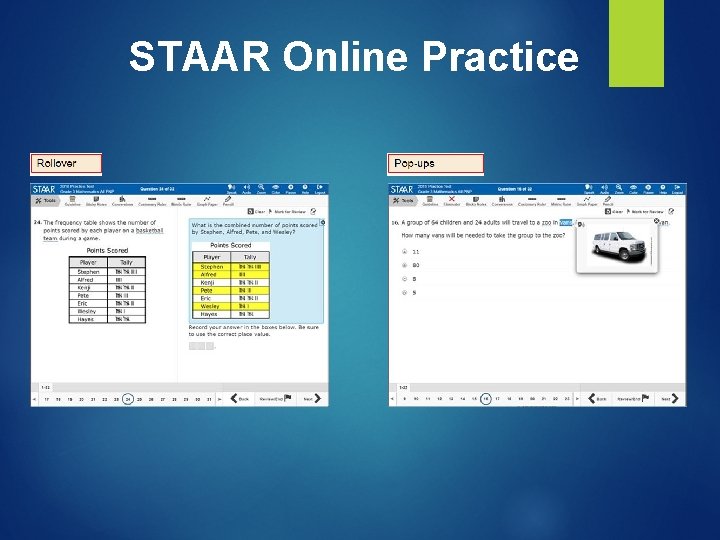
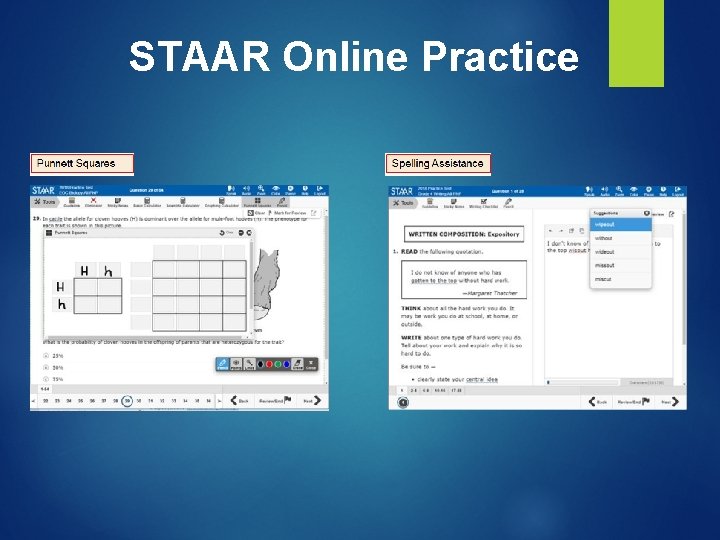
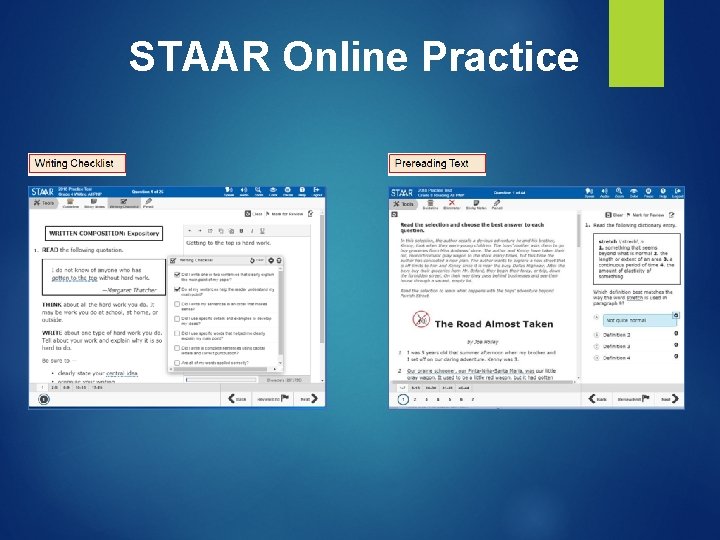
STAAR Online Practice § When you open the STAAR Online Testing Platform (SOTP), you will see a menu of options, including “Practice. ” § Here you will find released tests for 2017 and 2018. § All PNP will include the following supports: • Text-to-Speech (when available) • Spelling Assistance (writing compositions only) • Content and Language Supports
STAAR Online Practice
STAAR Online Practice
STAAR Online Practice
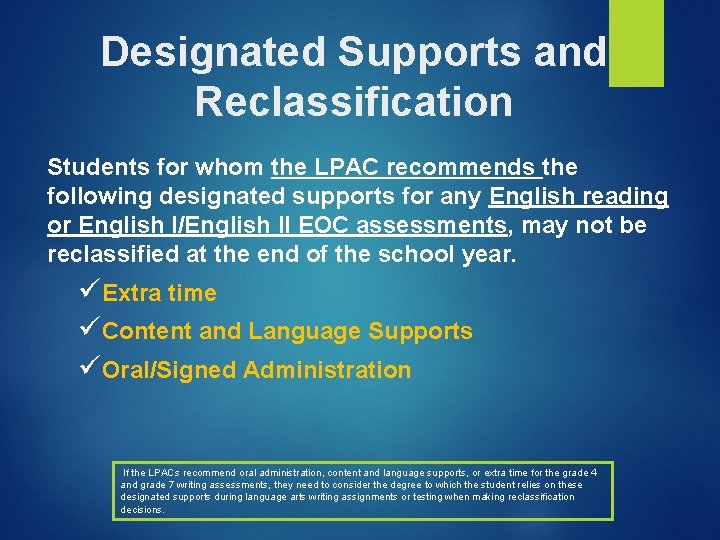
Designated Supports and Reclassification Students for whom the LPAC recommends the following designated supports for any English reading or English I/English II EOC assessments, may not be reclassified at the end of the school year. üExtra time üContent and Language Supports üOral/Signed Administration If the LPACs recommend oral administration, content and language supports, or extra time for the grade 4 and grade 7 writing assessments, they need to consider the degree to which the student relies on these designated supports during language arts writing assignments or testing when making reclassification decisions.
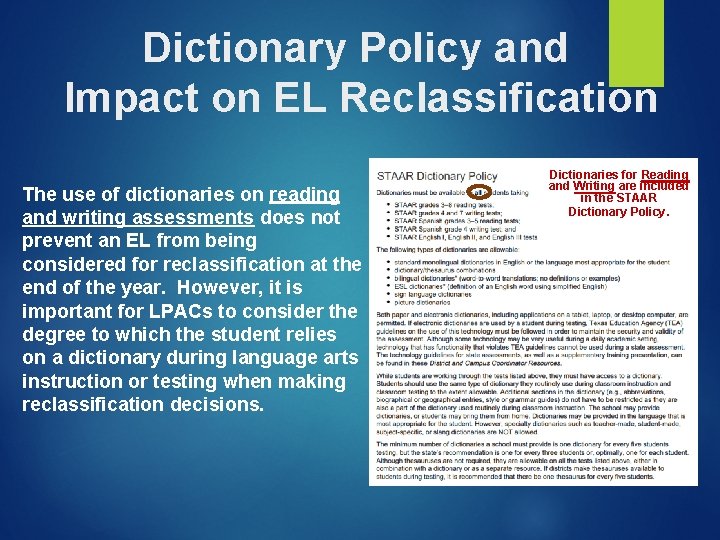
Dictionary Policy and Impact on EL Reclassification The use of dictionaries on reading and writing assessments does not prevent an EL from being considered for reclassification at the end of the year. However, it is important for LPACs to consider the degree to which the student relies on a dictionary during language arts instruction or testing when making reclassification decisions. Dictionaries for Reading and Writing are included in the STAAR Dictionary Policy.
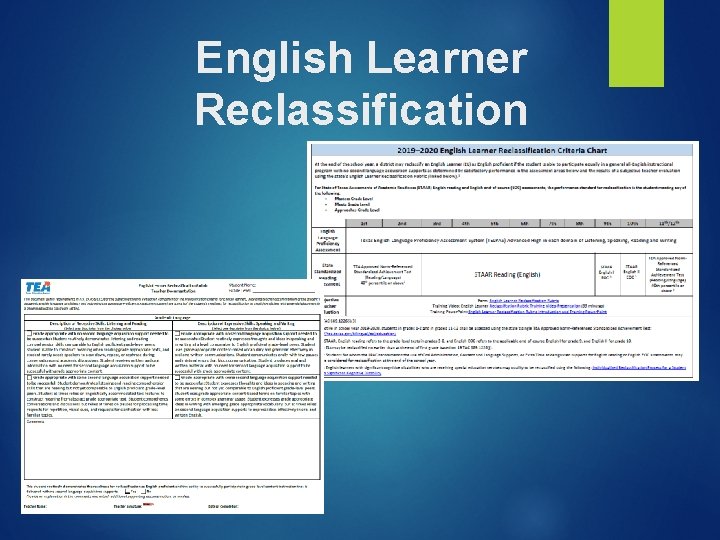
English Learner Reclassification
Middle of Year LPAC Agenda: • Decision-Making Guide Overview • Participation Decisions for the STAAR Program • Participation Decisions for the TELPAS Program • Understanding Accessibility • Designated Supports Decisions for the STAAR Program • Designated Supports Decisions for the TELPAS • Other Assessment Decisions • Documenting and Communicating Decisions
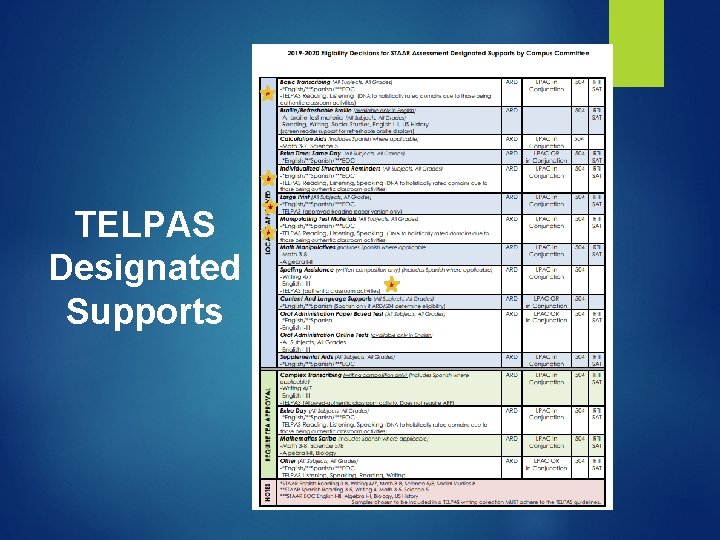
TELPAS Designated Supports
TELPAS and TELPAS Alternate § For TELPAS, all designated supports decisions MUST be made in conjunction with the ARD committee, Section 504 committee, or appropriate team of people at the campus level (e. g. , RTI team or student assistance team). § For TELPAS Alternate, the student performance described in the Observable Behaviors occurs while students have access to the instructional accommodations indicated in their individualized education program (IEP).
Data Collection for Spring In addition to years in U. S. schools, other information that will be collected includes: § Unschooled asylees/refugees • These students typically lack literacy skills in their first language and basic subject-matter knowledge and skills. They may also lack basic social skills and have experienced emotional trauma as a result of their previous circumstances. § Students with Interrupted Formal Education (SIFE) • These ELs attend school in the U. S. , withdraw and leave the U. S. for a period of time, and then return to the U. S. The period of time outside the U. S. or the number of times the student is withdrawn from U. S. schools is significant enough that growth in English and learning of subject matter are affected. • These ELs may come to the U. S. with limited or no prior schooling. They typically lack literacy skills in their first language, basic subject-matter knowledge and skills, or basic social skills. For the purpose of this data collection, include ELs who did not attend school for a period of time such that the ability to learn English and new grade level subject-matter knowledge and skills is significantly affected.
Middle of Year LPAC Agenda: • Decision-Making Guide Overview • Participation Decisions for the STAAR Program • Participation Decisions for the TELPAS Program • Understanding Accessibility • Designated Supports Decisions for the STAAR Program • Designated Supports Decisions for the TELPAS • Other Assessment Decisions • Documenting and Communicating Decisions
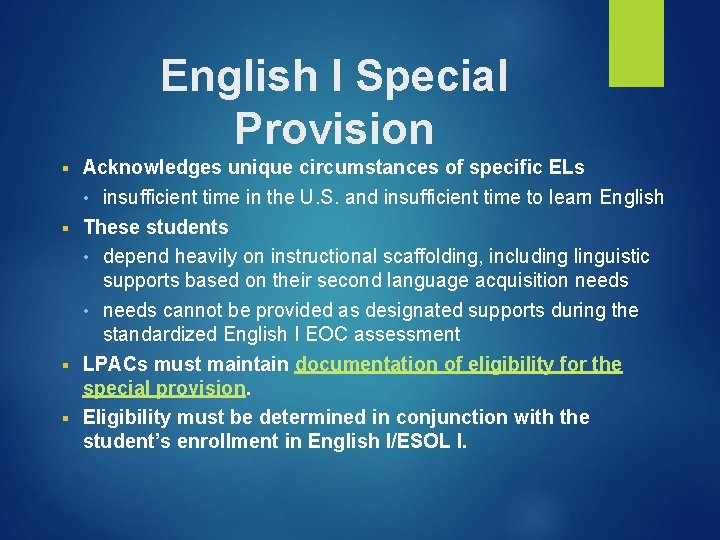
English I Special Provision Acknowledges unique circumstances of specific ELs • insufficient time in the U. S. and insufficient time to learn English § These students • depend heavily on instructional scaffolding, including linguistic supports based on their second language acquisition needs • needs cannot be provided as designated supports during the standardized English I EOC assessment § LPACs must maintain documentation of eligibility for the special provision. § Eligibility must be determined in conjunction with the student’s enrollment in English I/ESOL I. §
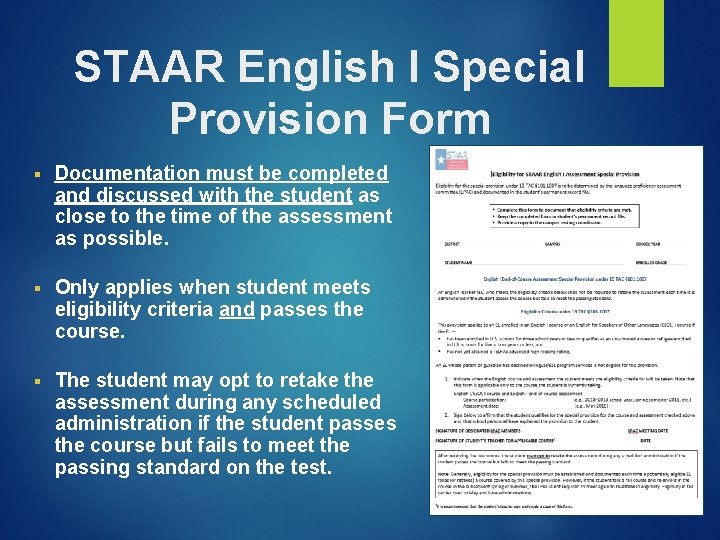
STAAR English I Special Provision Form § Documentation must be completed and discussed with the student as close to the time of the assessment as possible. § Only applies when student meets eligibility criteria and passes the course. § The student may opt to retake the assessment during any scheduled administration if the student passes the course but fails to meet the passing standard on the test.
ELs with Parent Denials LPACs may not recommend designated supports, special assessment considerations, or accountability provisions for an EL whose parents have denied bilingual or ESL services. This includes: § No designated supports § No testing in Spanish § No English I special provision § No unschooled asylee/refugee provisions
Middle of Year LPAC Agenda: • Decision-Making Guide Overview • Participation Decisions for the STAAR Program • Participation Decisions for the TELPAS Program • Understanding Accessibility • Designated Supports Decisions for the STAAR Program • Designated Supports Decisions for the TELPAS • Other Assessment Decisions • Documenting and Communicating Decisions
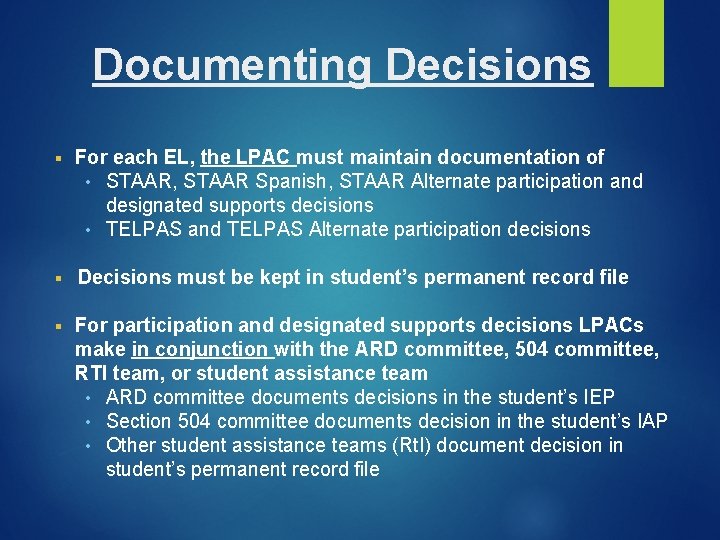
Documenting Decisions § For each EL, the LPAC must maintain documentation of • STAAR, STAAR Spanish, STAAR Alternate participation and designated supports decisions • TELPAS and TELPAS Alternate participation decisions § Decisions must be kept in student’s permanent record file § For participation and designated supports decisions LPACs make in conjunction with the ARD committee, 504 committee, RTI team, or student assistance team • ARD committee documents decisions in the student’s IEP • Section 504 committee documents decision in the student’s IAP • Other student assistance teams (Rt. I) document decision in student’s permanent record file
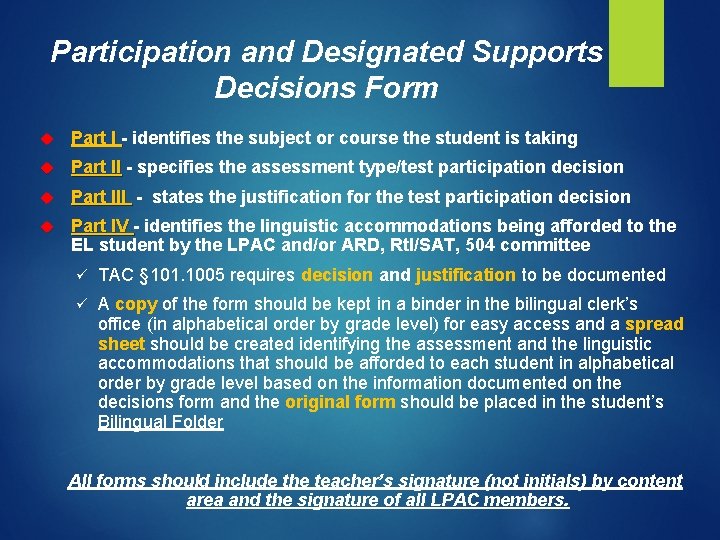
Participation and Designated Supports Decisions Form Part I identifies the subject or course the student is taking Part II - specifies the assessment type/test participation decision Part III - states the justification for the test participation decision Part IV - identifies the linguistic accommodations being afforded to the Part IV EL student by the LPAC and/or ARD, Rt. I/SAT, 504 committee ü TAC § 101. 1005 requires decision and justification to be documented ü A copy of the form should be kept in a binder in the bilingual clerk’s office (in alphabetical order by grade level) for easy access and a spread sheet should be created identifying the assessment and the linguistic accommodations that should be afforded to each student in alphabetical order by grade level based on the information documented on the decisions form and the original form should be placed in the student’s Bilingual Folder All forms should include the teacher’s signature (not initials) by content area and the signature of all LPAC members.
LISD STAAR Form
LISD TELPAS Form
Collaboration with Testing Coordinators, LPACs, ARD committees, Section 504 committees and Rt. I committees must coordinate so that participation and designated supports decisions for EL students are available in time to make testing arrangements.
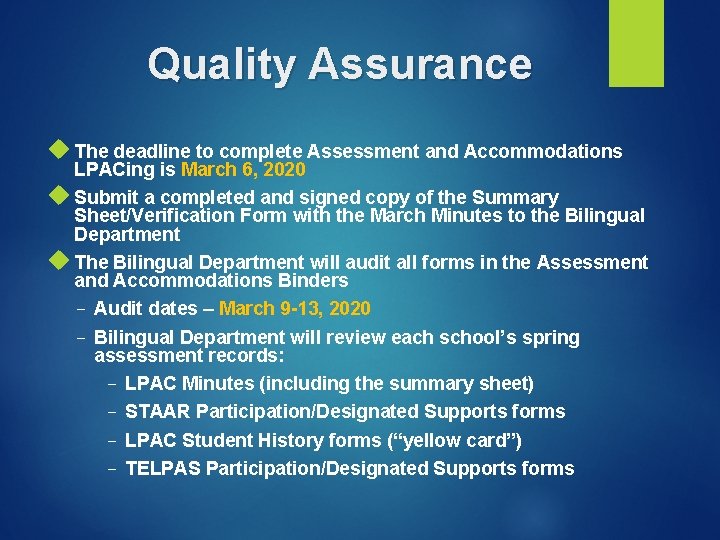
Quality Assurance The deadline to complete Assessment and Accommodations LPACing is March 6, 2020 Submit a completed and signed copy of the Summary Sheet/Verification Form with the March Minutes to the Bilingual Department The Bilingual Department will audit all forms in the Assessment and Accommodations Binders – Audit dates – March 9 -13, 2020 – Bilingual Department will review each school’s spring assessment records: – LPAC Minutes (including the summary sheet) – STAAR Participation/Designated Supports forms – LPAC Student History forms (“yellow card”) – TELPAS Participation/Designated Supports forms
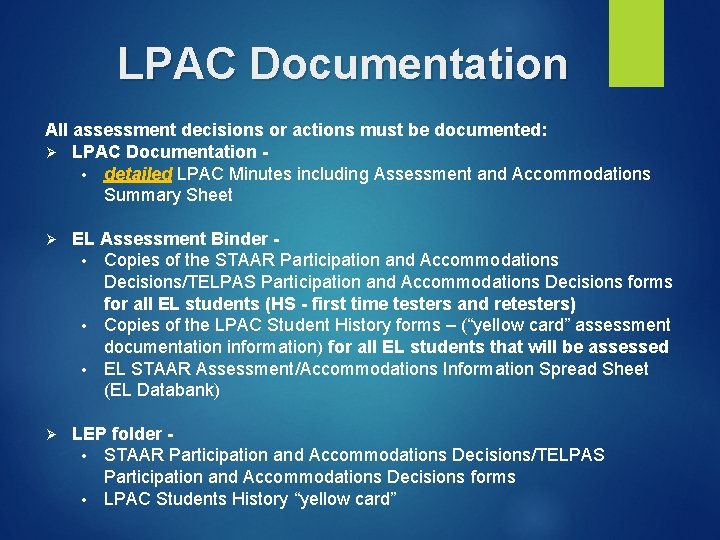
LPAC Documentation All assessment decisions or actions must be documented: Ø LPAC Documentation • detailed LPAC Minutes including Assessment and Accommodations Summary Sheet Ø EL Assessment Binder - • Copies of the STAAR Participation and Accommodations Decisions/TELPAS Participation and Accommodations Decisions forms for all EL students (HS - first time testers and retesters) • Copies of the LPAC Student History forms – (“yellow card” assessment documentation information) for all EL students that will be assessed • EL STAAR Assessment/Accommodations Information Spread Sheet (EL Databank) Ø LEP folder • STAAR Participation and Accommodations Decisions/TELPAS Participation and Accommodations Decisions forms • LPAC Students History “yellow card”
Questions
THANK YOU FOR YOUR PARTICIPATION!!!