Walk the Walk and Talk the Talk Meeting
- Slides: 55
Walk the Walk and Talk the Talk: Meeting the Inspector with Confidence! Sharon S. Ehrmeyer, Ph. D. UNIVERSITY OF WISCONSIN MEDICAL SCHOOL MADISON, WI
Successful Strategy #1 Know your inspection agency’s requirements!
Regulatory reality CLIA regulations must be met through accreditation with: q CLIA, q JCAHO, q CAP or
General Regulatory Requirements q Follow manufacturer’s protocols q Validate method before routine use Ø Accuracy, q Have precision, reportable range, etc. authorized operators Ø Initial (documented) training and on-going competency assessment q Include patient and operator identification q Monitor instrument functions
General Regulatory Requirements Perform required maintenance q Perform and evaluate QC at appropriate intervals q Ø q Perform corrective actions Provide an audit trail Ø From testing to patient record Participate in regulatory proficiency testing q Document all information q Ø QC, QA checks, PT results, maintenance, etc.
Who’s on first? q What regulations to follow; who inspects depends on CLIA certificate arrangement: Ø JCAHO accreditation – Accepts CAP and COLA inspections – Reinspects waived POCT every 3 years Ø CAP accreditation – CAP must inspect Ø CMS for CLIA compliance – Sites not seeking specific accreditation
CLIA’ 03 Final QC Regulations q Good news!! Ø Allows one survey cycle (2 years) to: – Permit labs to comply – CMS to develop revised surveyor/lab guidelines q Bad news!! Ø Ø Ø No comments solicited Regulation is final Still not complete; other subparts will follow ä Judy Yost, CMS 2003
JCAHO Comprehensive Accreditation Manual (Pathology and Clinical Laboratory Services) Beyond 2003
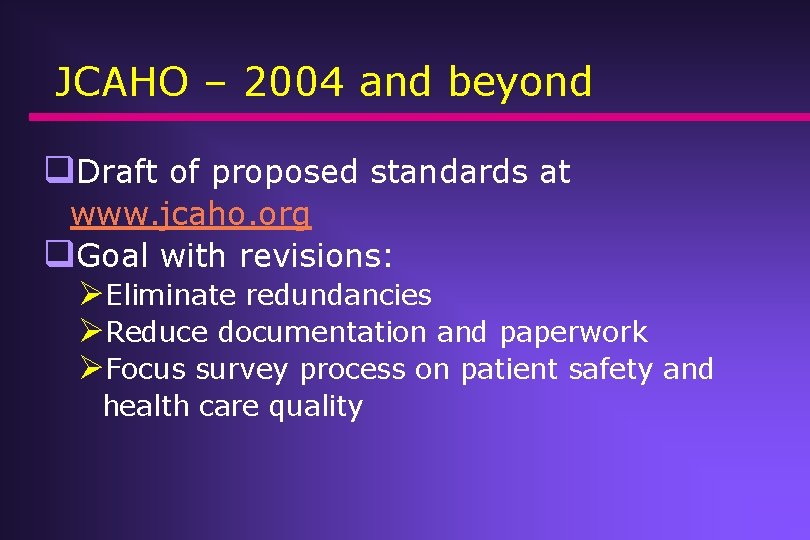
JCAHO – 2004 and beyond q. Draft of proposed standards at www. jcaho. org q. Goal with revisions: ØEliminate redundancies ØReduce documentation and paperwork ØFocus survey process on patient safety and health care quality
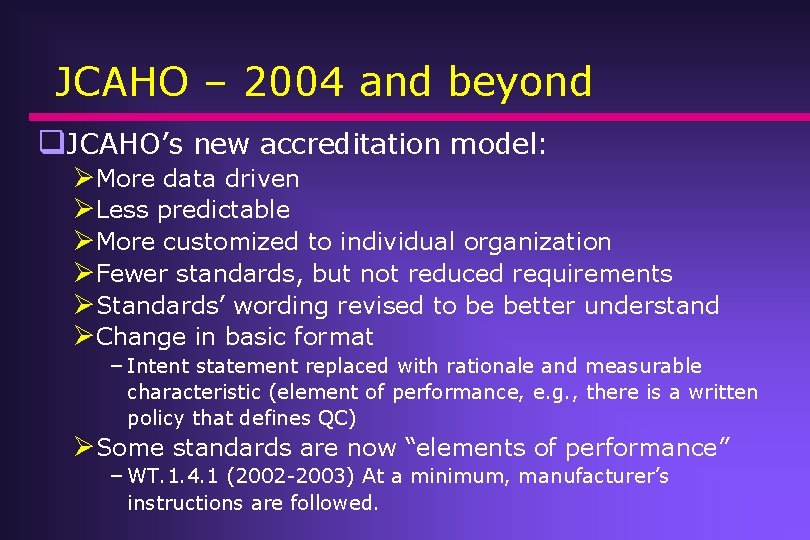
JCAHO – 2004 and beyond q. JCAHO’s new accreditation model: ØMore data driven ØLess predictable ØMore customized to individual organization ØFewer standards, but not reduced requirements ØStandards’ wording revised to be better understand ØChange in basic format – Intent statement replaced with rationale and measurable characteristic (element of performance, e. g. , there is a written policy that defines QC) ØSome standards are now “elements of performance” – WT. 1. 4. 1 (2002 -2003) At a minimum, manufacturer’s instructions are followed.
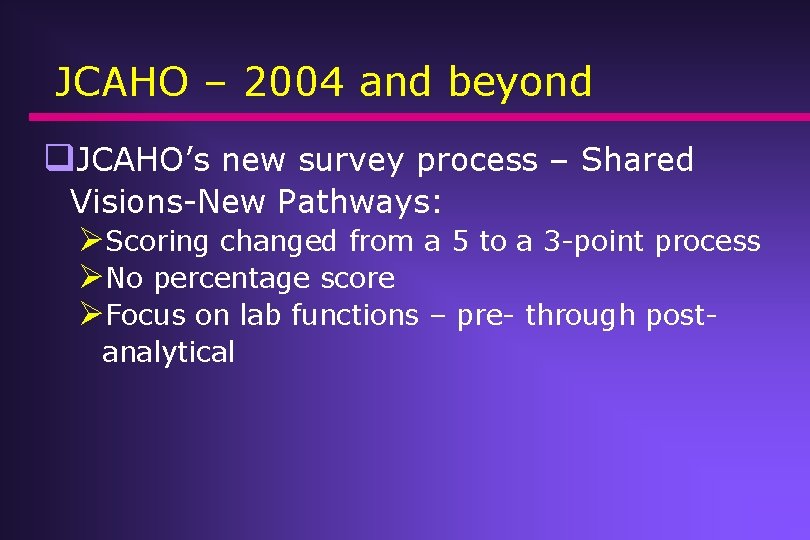
JCAHO – 2004 and beyond q. JCAHO’s new survey process – Shared Visions-New Pathways: ØScoring changed from a 5 to a 3 -point process ØNo percentage score ØFocus on lab functions – pre- through postanalytical
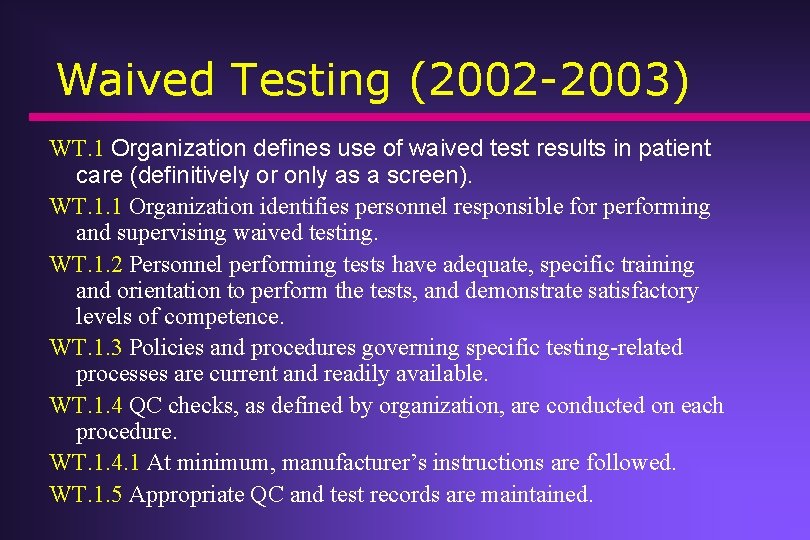
Waived Testing (2002 -2003) WT. 1 Organization defines use of waived test results in patient care (definitively or only as a screen). WT. 1. 1 Organization identifies personnel responsible for performing and supervising waived testing. WT. 1. 2 Personnel performing tests have adequate, specific training and orientation to perform the tests, and demonstrate satisfactory levels of competence. WT. 1. 3 Policies and procedures governing specific testing-related processes are current and readily available. WT. 1. 4 QC checks, as defined by organization, are conducted on each procedure. WT. 1. 4. 1 At minimum, manufacturer’s instructions are followed. WT. 1. 5 Appropriate QC and test records are maintained.
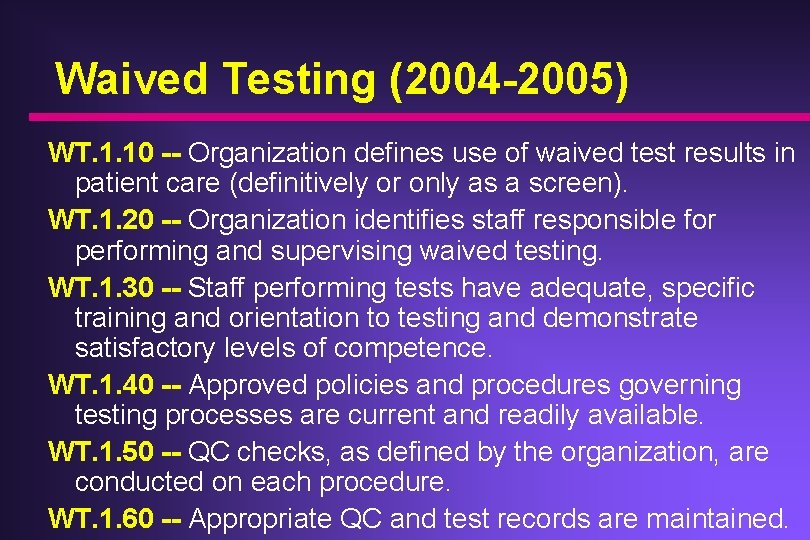
Waived Testing (2004 -2005) WT. 1. 10 -- Organization defines use of waived test results in patient care (definitively or only as a screen). WT. 1. 20 -- Organization identifies staff responsible for performing and supervising waived testing. WT. 1. 30 -- Staff performing tests have adequate, specific training and orientation to testing and demonstrate satisfactory levels of competence. WT. 1. 40 -- Approved policies and procedures governing testing processes are current and readily available. WT. 1. 50 -- QC checks, as defined by the organization, are conducted on each procedure. WT. 1. 60 -- Appropriate QC and test records are maintained.
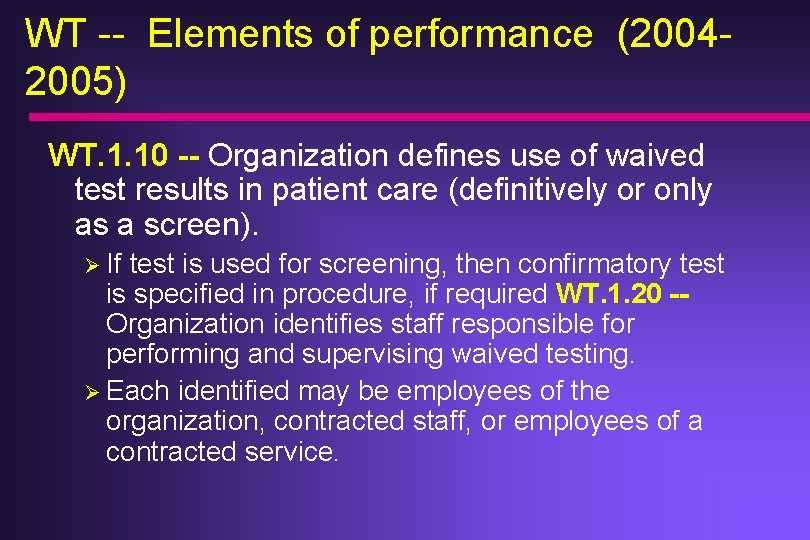
WT -- Elements of performance (20042005) WT. 1. 10 -- Organization defines use of waived test results in patient care (definitively or only as a screen). Ø If test is used for screening, then confirmatory test is specified in procedure, if required WT. 1. 20 -Organization identifies staff responsible for performing and supervising waived testing. Ø Each identified may be employees of the organization, contracted staff, or employees of a contracted service.
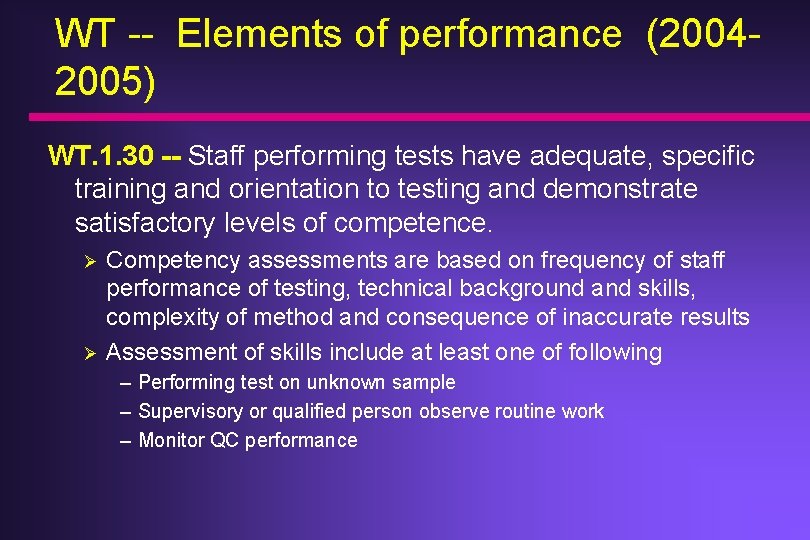
WT -- Elements of performance (20042005) WT. 1. 30 -- Staff performing tests have adequate, specific training and orientation to testing and demonstrate satisfactory levels of competence. Ø Ø Competency assessments are based on frequency of staff performance of testing, technical background and skills, complexity of method and consequence of inaccurate results Assessment of skills include at least one of following – Performing test on unknown sample – Supervisory or qualified person observe routine work – Monitor QC performance
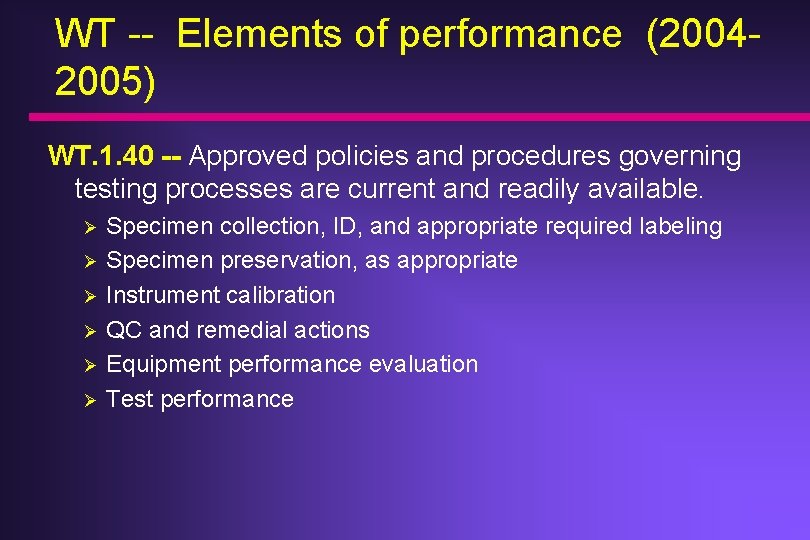
WT -- Elements of performance (20042005) WT. 1. 40 -- Approved policies and procedures governing testing processes are current and readily available. Ø Ø Ø Specimen collection, ID, and appropriate required labeling Specimen preservation, as appropriate Instrument calibration QC and remedial actions Equipment performance evaluation Test performance
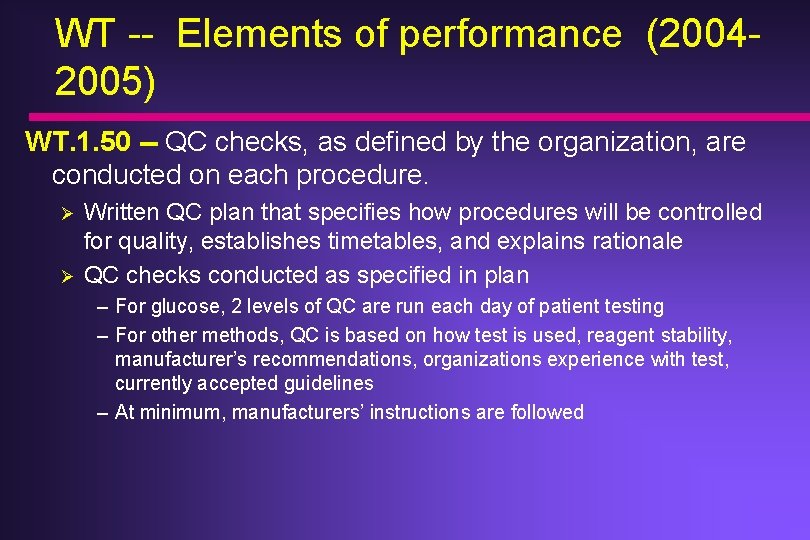
WT -- Elements of performance (20042005) WT. 1. 50 -- QC checks, as defined by the organization, are conducted on each procedure. Ø Ø Written QC plan that specifies how procedures will be controlled for quality, establishes timetables, and explains rationale QC checks conducted as specified in plan – For glucose, 2 levels of QC are run each day of patient testing – For other methods, QC is based on how test is used, reagent stability, manufacturer’s recommendations, organizations experience with test, currently accepted guidelines – At minimum, manufacturers’ instructions are followed
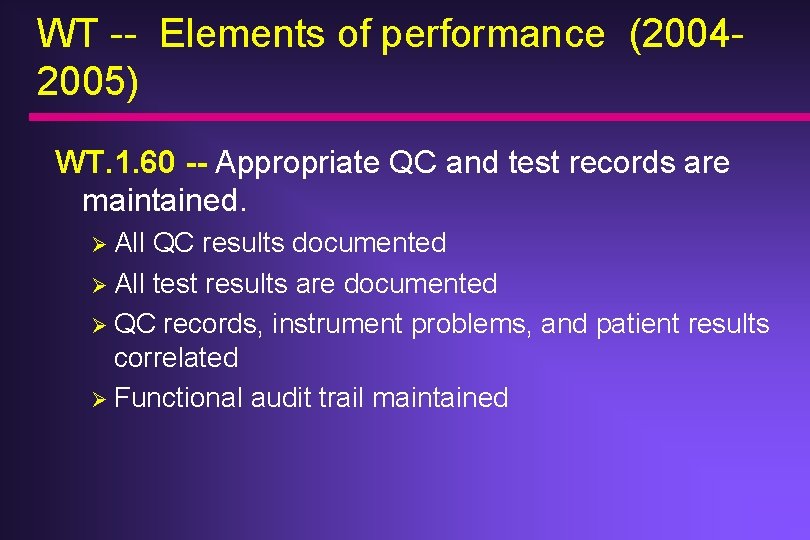
WT -- Elements of performance (20042005) WT. 1. 60 -- Appropriate QC and test records are maintained. Ø All QC results documented Ø All test results are documented Ø QC records, instrument problems, and patient results correlated Ø Functional audit trail maintained
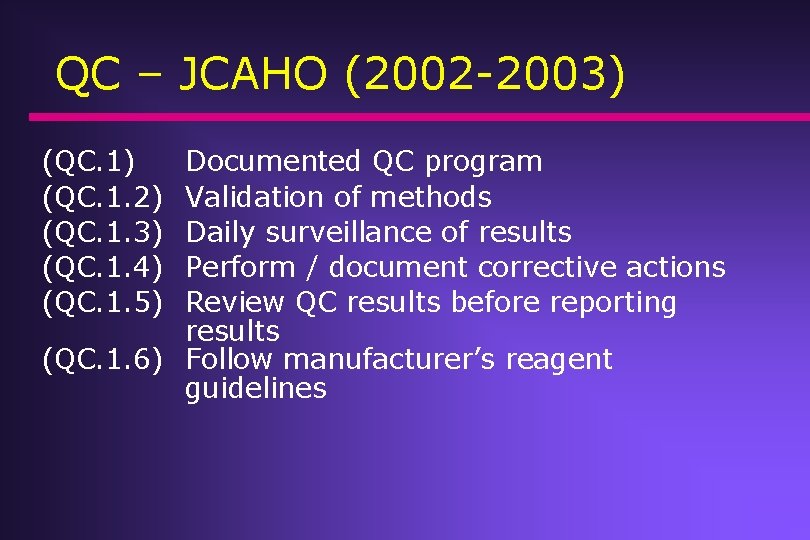
QC – JCAHO (2002 -2003) (QC. 1. 2) (QC. 1. 3) (QC. 1. 4) (QC. 1. 5) Documented QC program Validation of methods Daily surveillance of results Perform / document corrective actions Review QC results before reporting results (QC. 1. 6) Follow manufacturer’s reagent guidelines
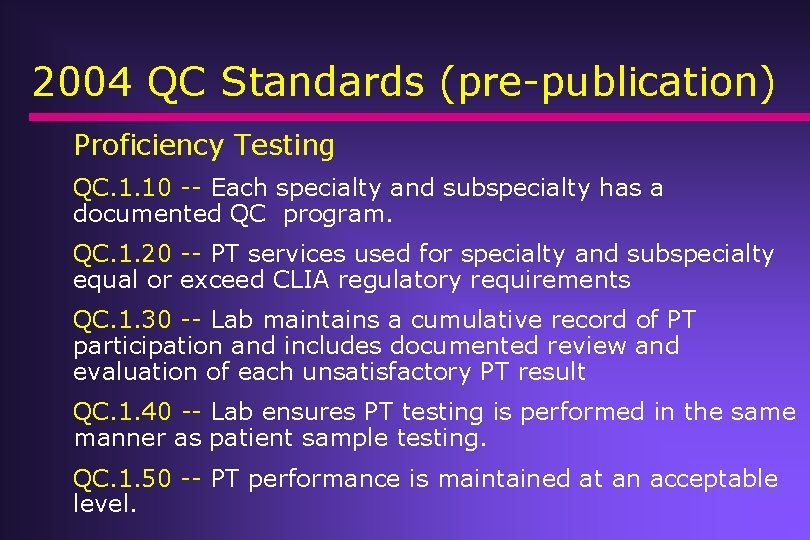
2004 QC Standards (pre-publication) Proficiency Testing QC. 1. 10 -- Each specialty and subspecialty has a documented QC program. QC. 1. 20 -- PT services used for specialty and subspecialty equal or exceed CLIA regulatory requirements QC. 1. 30 -- Lab maintains a cumulative record of PT participation and includes documented review and evaluation of each unsatisfactory PT result QC. 1. 40 -- Lab ensures PT testing is performed in the same manner as patient sample testing. QC. 1. 50 -- PT performance is maintained at an acceptable level.
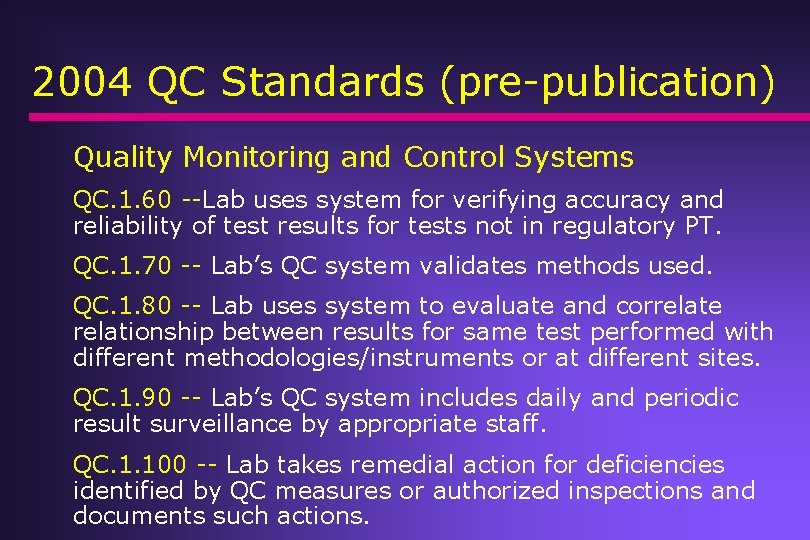
2004 QC Standards (pre-publication) Quality Monitoring and Control Systems QC. 1. 60 --Lab uses system for verifying accuracy and reliability of test results for tests not in regulatory PT. QC. 1. 70 -- Lab’s QC system validates methods used. QC. 1. 80 -- Lab uses system to evaluate and correlate relationship between results for same test performed with different methodologies/instruments or at different sites. QC. 1. 90 -- Lab’s QC system includes daily and periodic result surveillance by appropriate staff. QC. 1. 100 -- Lab takes remedial action for deficiencies identified by QC measures or authorized inspections and documents such actions.
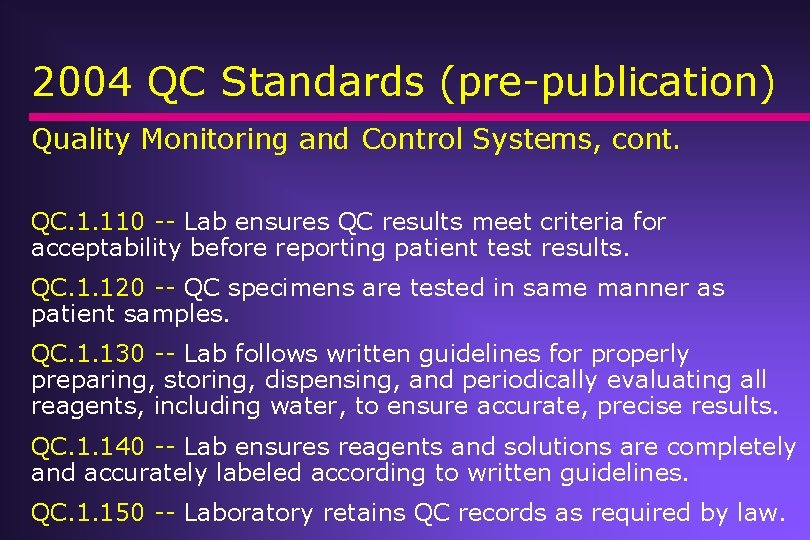
2004 QC Standards (pre-publication) Quality Monitoring and Control Systems, cont. QC. 1. 110 -- Lab ensures QC results meet criteria for acceptability before reporting patient test results. QC. 1. 120 -- QC specimens are tested in same manner as patient samples. QC. 1. 130 -- Lab follows written guidelines for properly preparing, storing, dispensing, and periodically evaluating all reagents, including water, to ensure accurate, precise results. QC. 1. 140 -- Lab ensures reagents and solutions are completely and accurately labeled according to written guidelines. QC. 1. 150 -- Laboratory retains QC records as required by law.
JCAHO – QC standards (2004 and beyond) q. Like for WT, each standard has elements of performance for guidance in meeting the standard q. Specialty and subspecialty sections to follow (depends on testing performed) ØClinical chemistry ØHematology and coagulation ØClinical microscopy (urinalysis)
JCAHO – 2004 and Beyond Checkout proposed standards at: www. jcaho. org Also think about 100% compliance 100% of time for patient safety
Successful Strategy #2 Apply the Regulations Identify Problems (Concerns) in YOUR laboratory
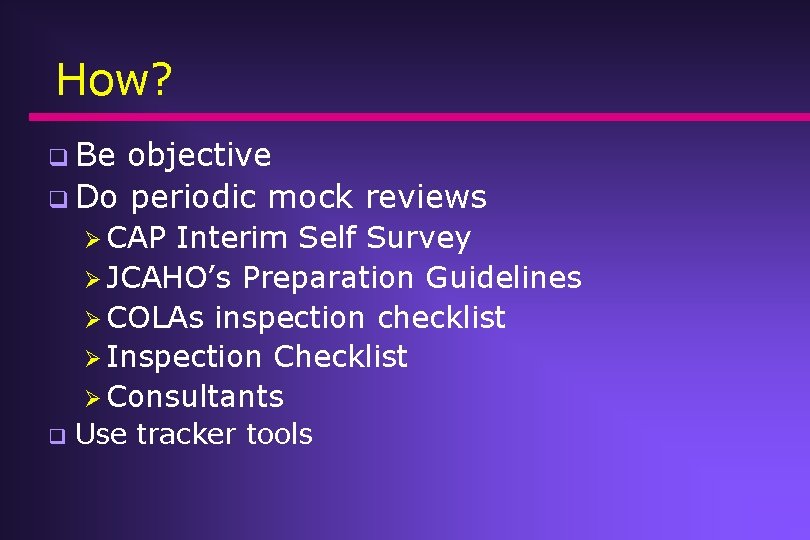
How? q Be objective q Do periodic mock reviews Ø CAP Interim Self Survey Ø JCAHO’s Preparation Guidelines Ø COLAs inspection checklist Ø Inspection Checklist Ø Consultants q Use tracker tools
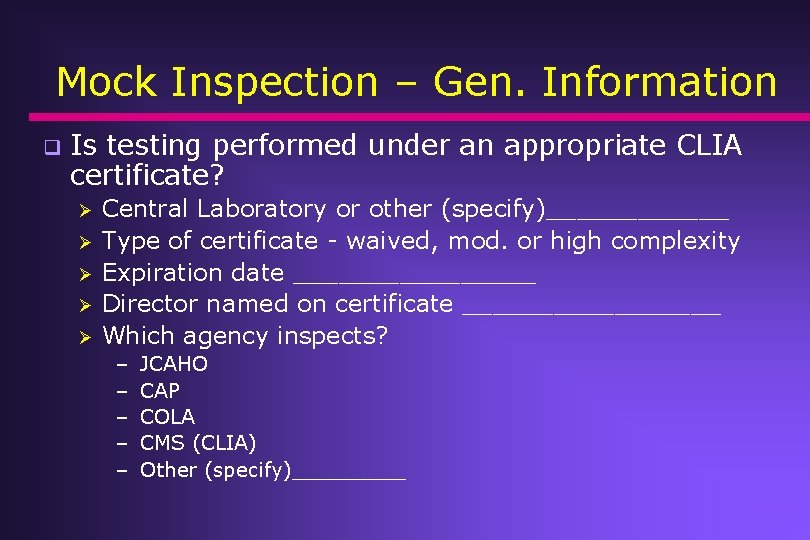
Mock Inspection – Gen. Information q Is testing performed under an appropriate CLIA certificate? Ø Ø Ø Central Laboratory or other (specify)______ Type of certificate - waived, mod. or high complexity Expiration date ________ Director named on certificate _________ Which agency inspects? – – – JCAHO CAP COLA CMS (CLIA) Other (specify)_____
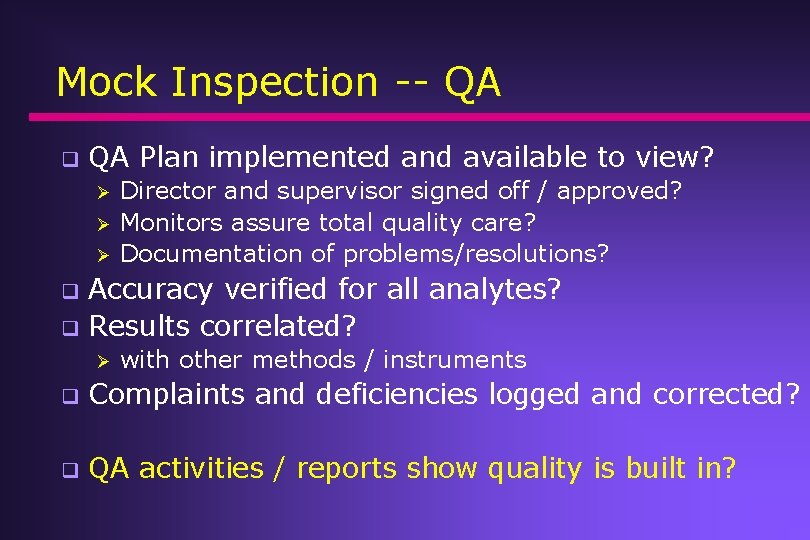
Mock Inspection -- QA q QA Plan implemented and available to view? Ø Ø Ø Director and supervisor signed off / approved? Monitors assure total quality care? Documentation of problems/resolutions? Accuracy verified for all analytes? q Results correlated? q Ø with other methods / instruments q Complaints and deficiencies logged and corrected? q QA activities / reports show quality is built in?
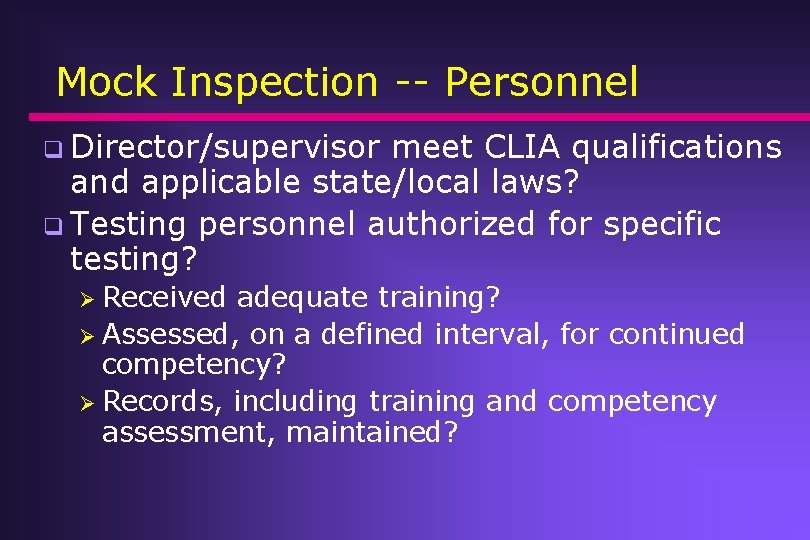
Mock Inspection -- Personnel q Director/supervisor meet CLIA qualifications and applicable state/local laws? q Testing personnel authorized for specific testing? Ø Received adequate training? Ø Assessed, on a defined interval, for continued competency? Ø Records, including training and competency assessment, maintained?
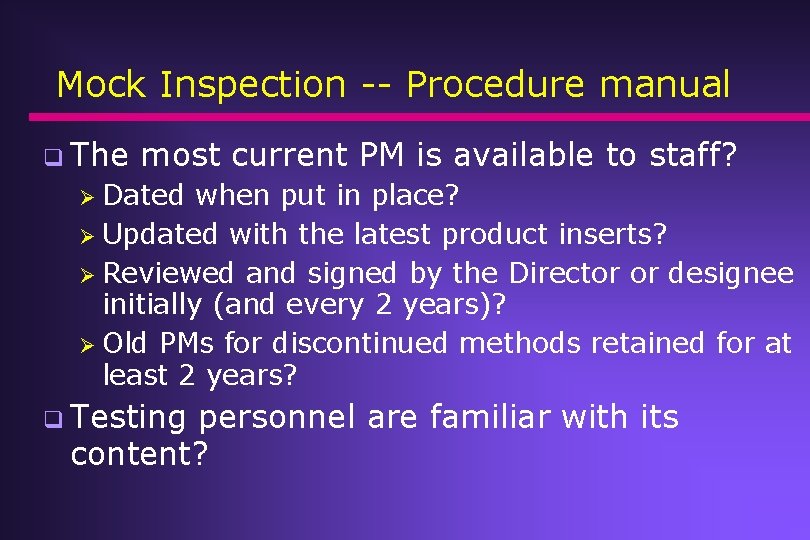
Mock Inspection -- Procedure manual q The most current PM is available to staff? Ø Dated when put in place? Ø Updated with the latest product inserts? Ø Reviewed and signed by the Director or designee initially (and every 2 years)? Ø Old PMs for discontinued methods retained for at least 2 years? q Testing personnel are familiar with its content?
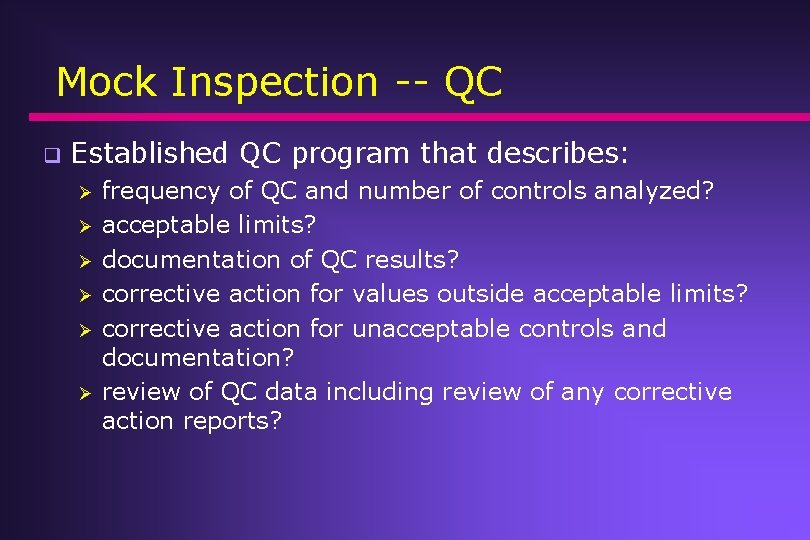
Mock Inspection -- QC q Established QC program that describes: Ø Ø Ø frequency of QC and number of controls analyzed? acceptable limits? documentation of QC results? corrective action for values outside acceptable limits? corrective action for unacceptable controls and documentation? review of QC data including review of any corrective action reports?
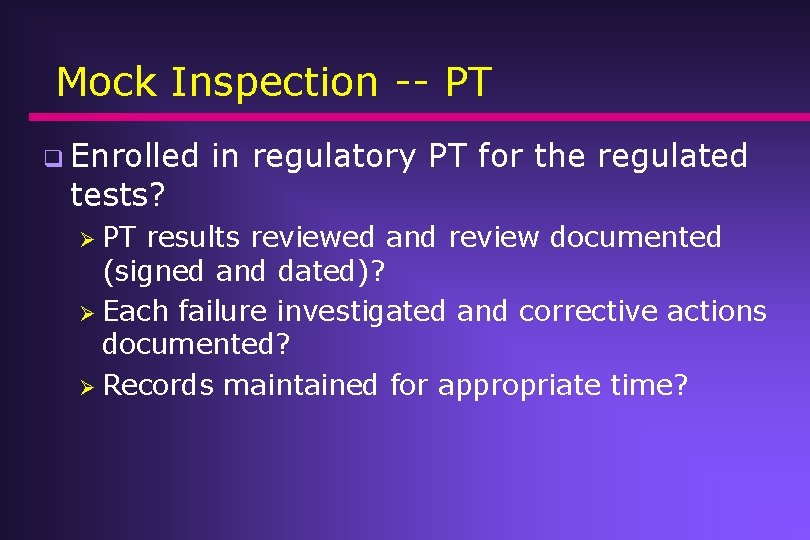
Mock Inspection -- PT q Enrolled tests? Ø PT in regulatory PT for the regulated results reviewed and review documented (signed and dated)? Ø Each failure investigated and corrective actions documented? Ø Records maintained for appropriate time?
Mock Inspection -- Reagents q Kept in original container? Ø Stored as directed by manufacturer? – If a specific temperature range is required, temperature must be monitored. q Not used beyond indicated expiration dates?
Mock Inspection -- Lab safety q Safety Ø Does manual available to staff? it contain: – general institutional requirements? – instructions to minimize the risk of exposure to HIV, hepatitis, etc. ? – fire prevention and control? – electrical safety? – hazardous waste disposal including sharp/needle disposal? – internal and external disaster plans?
Tracker Tools* to ID Problems q. System to evaluate ØPre-analytic processes ØAnalytic processes ØPost-analytic *Anne Belanger, MA, MT(ASCP) Consultant, Laboratory Accreditation
Tracker Tools* q Ordering q Specimen collection q Specimen processing q Sample testing q Resulting *Tools apply to all testing
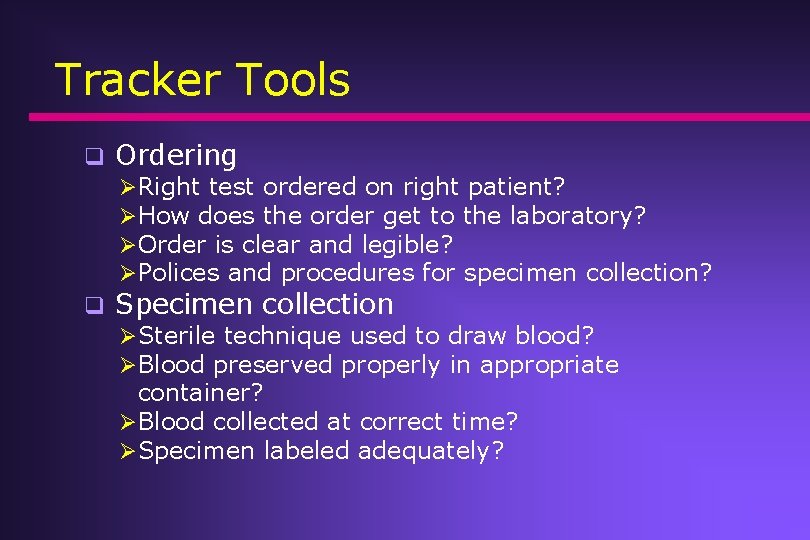
Tracker Tools q Ordering ØRight test ordered on right patient? ØHow does the order get to the laboratory? ØOrder is clear and legible? ØPolices and procedures for specimen collection? q Specimen collection ØSterile technique used to draw blood? ØBlood preserved properly in appropriate container? ØBlood collected at correct time? ØSpecimen labeled adequately?
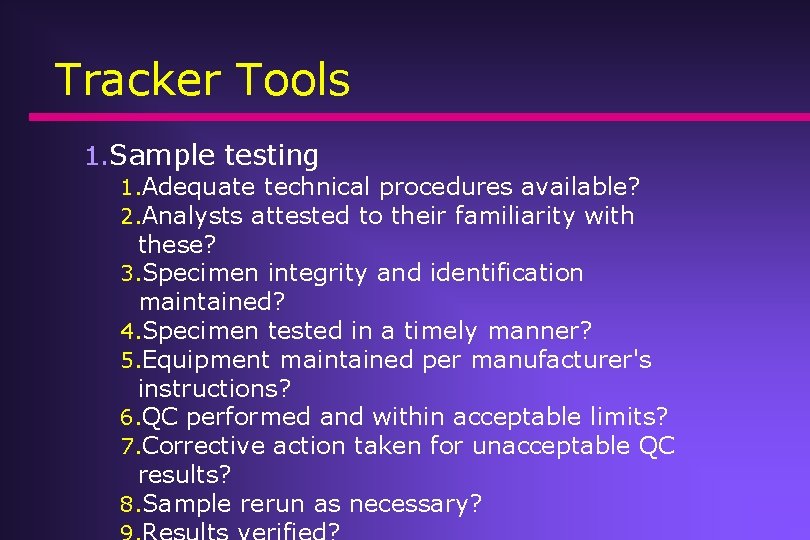
Tracker Tools 1. Sample testing 1. Adequate technical procedures available? 2. Analysts attested to their familiarity with these? 3. Specimen integrity and identification maintained? 4. Specimen tested in a timely manner? 5. Equipment maintained per manufacturer's instructions? 6. QC performed and within acceptable limits? 7. Corrective action taken for unacceptable QC results? 8. Sample rerun as necessary?
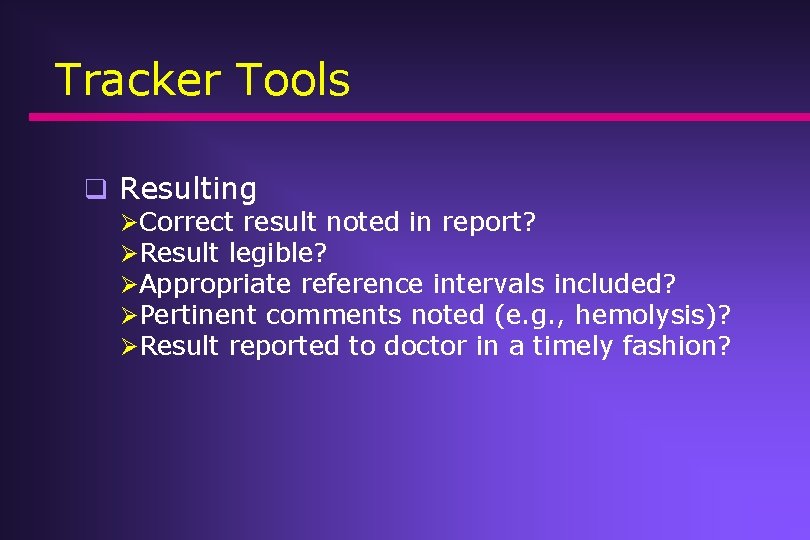
Tracker Tools q Resulting ØCorrect result noted in report? ØResult legible? ØAppropriate reference intervals included? ØPertinent comments noted (e. g. , hemolysis)? ØResult reported to doctor in a timely fashion?
Fix Problems Identified q. Prioritize q. Assign q. Correct
Successful Strategy #3 Keep it simple; Work Smarter Don’t forget everything you learned by just focusing on the rules!
Don’t get caught in the trap! Avoid common citations
Common citations q q Following manufacturer’s directions QC – Perform at appropriate frequency – Corrective actions for out-of-control situations q QA – Have a plan – Monitor for effectiveness q q q 2 X / year, comparisons and accuracy assessments Personnel competency Proficiency testing – Participation – Review of results – Corrective actions q Documentation
Fail-safe Inspection Tips q. Things that should never occur: ØDirty laboratory ØMessy storage areas ØUnsafe practices – Pre through post-analytical ØUncorrected old citations – Always have a plan! ØStaff who are not in the loop
ADVICE FROM INSPECTED LABS q Know and understand inspecting agency’s regulations Ø Follow to the “nth” degree Have documentation for everything q Have all manuals, records and files current and understandable q Have an overall plan that states the lab’s approach to QA q Educate the staff -- everyone is on the same page q
ADVICE FROM INSPECTED LABS q With inspectors: Ø Ø Be courteous Be honest – Don’t volunteer extra information, but don’t get “dingy” Ø Be ready to explain the why and how – Don’t argue, explain in writing – With areas of concern, ask for suggestions Ø Ø Be professional Be confident; act confident
INSPECTION DOs AND DON’T q Don’t procrastinate Ø Paperwork, personnel reviews, records, etc. Do maintain an up-to-date QA program q Do come to the table prepared q Ø q Prepare everyone Don’t operate a “sloppy ship” Ø Ø Follow all rules – always Make compliance a requirement for continued employment
INSPECTION DOs AND DON’T q Don’t delegate inspection duties to unprepared staff Ø Unknowledgeable staff communicating with the inspector is a disaster Do have an alternative plan if the assigned staff member (to be with inspector) becomes unavailable q Do present an organized front q Ø Have “private space” for inspector to review materials and documentation
Organized documentation Document, Document Inspectors don’t want to see that you have the ability to produce quality results, they want: PROOF OF A QUALITY OPERATION Documentation must be organized and easy to understand
Documentation -- Personnel q. Job descriptions q. Personnel records (including licenses as applicable) Ø OSHA bloodborne pathogen testing Ø Hepatitis B vaccination record or declination form Ø Immunization/health/accident/incident records q. Orientation/in-service/cont. education records q. Performance evaluations q. Orientation and competence assessment
Documentation- policies/procedures q. Administrative q. Technical q. Safety Ø Ø Ø General Fire Disaster Chemical hygiene Infection control
Documentation- policies/procedures q. Specimen collection q. Computer (including backup), as applicable q. Procedure manuals q. Inpatient and outpatient records q. CQI activities
Documentation- records q. Test validation protocols and records q. Proficiency testing results (2 years) q. Accuracy data, if not in PT q. Quality control results q. Method correlation records
Documentation- records q Function checks and calibration, maintenance, and repair records for all equipment q Temperature records Ø only when relevant – regents must be stored at specified temperature q Corrective action records for PT, QC
After the inspection q. Final decision usually up to regulator's oversight function, e. g. , its board q. Review all citations q. Perform follow up per regulator's guidelines Ø Prepare plan of correction Ø Implement needed corrections Ø Provide evidence to regulator per guidelines q. Keep inspection ready