The Pain of Dementia Dr Paula Moffat Geriatrician
- Slides: 78
“The Pain of Dementia” Dr Paula Moffat Geriatrician and Palliative Care Physician
Outline • • What is pain? Pain in RCF and in those with dementia Consequences / Barriers Aims of assessment – Recent publications • Management • Case studies
How big is the problem • Aging population with increasing numbers of people with dementia • 154, 872 people using residential aged care services at 30 June 2006 [1]. • Aged population are more susceptible to multiple comorbidities / chronic disease • Pain increases in prevalence with age, but it is not inherent part of the aging process • Australian study of NH residents: range of 27. 8% - 86% experienced chronic pain [2, 3] • Prevalence of pain >60 yo = 250 per 1000 [4] • Prevalence of pain <60 = 125 per 1000 [4]
Pain in those with dementia • Often under recognised and under treated in those with cognitive impairment, communication problems and residents of RCF – Cognitive impairment is the strongest predictor not to self report pain [5] – >40% of NH residents are unable to report pain due to poor cognition [2] • Pain [6] : cross sectional study of 2779 >65 yo community patients in Canada – >75 yo, chronic health conditions, cognitive impairment and req interpreter received less opioid alone or in combination
Additional facts • Older people receive less analgesia than younger individuals with similar conditions • Those with cognitive impairment receive less analgesics than those that are cognitively intact – Horgas and Tsai – cognitively impaired NH residents are administered less analgesic medication than those without cognitive impairment [7]
What don’t we know • Extent of the problem: lack of research especially of pain in those with dementia in RCF – Amount of research is increasing • We don’t know what the best way to detect pain is in those who have dementia
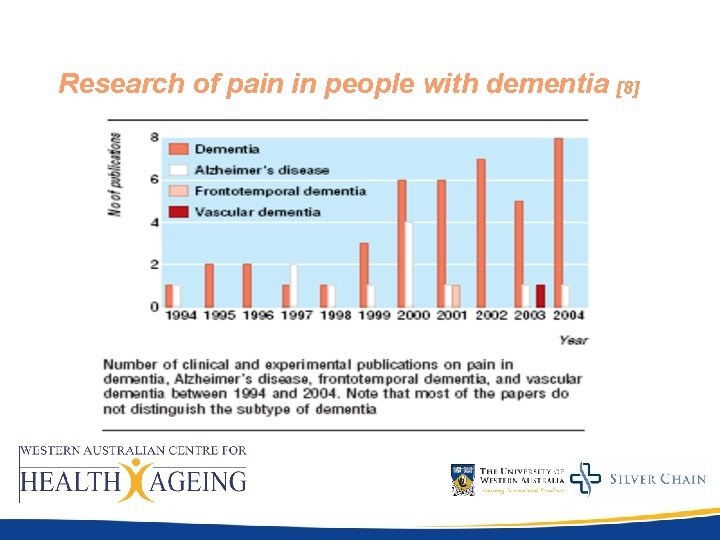
Research of pain in people with dementia [8]
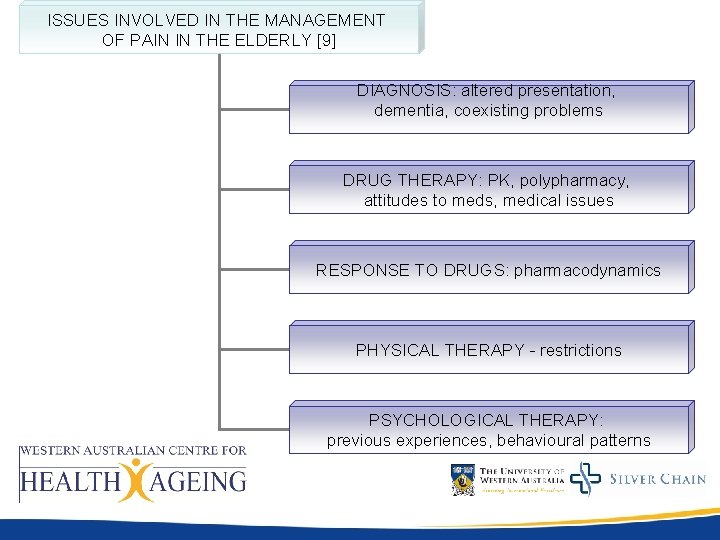
ISSUES INVOLVED IN THE MANAGEMENT OF PAIN IN THE ELDERLY [9] DIAGNOSIS: altered presentation, dementia, coexisting problems DRUG THERAPY: PK, polypharmacy, attitudes to meds, medical issues RESPONSE TO DRUGS: pharmacodynamics PHYSICAL THERAPY - restrictions PSYCHOLOGICAL THERAPY: previous experiences, behavioural patterns
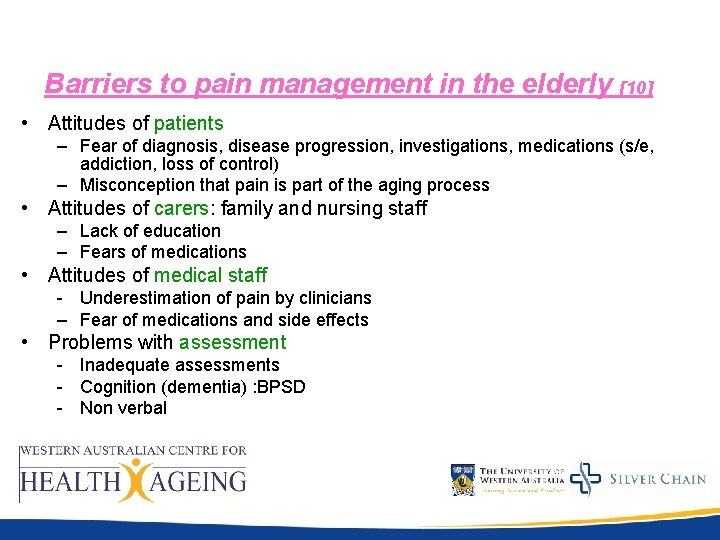
Barriers to pain management in the elderly [10] • Attitudes of patients – Fear of diagnosis, disease progression, investigations, medications (s/e, addiction, loss of control) – Misconception that pain is part of the aging process • Attitudes of carers: family and nursing staff – Lack of education – Fears of medications • Attitudes of medical staff - Underestimation of pain by clinicians – Fear of medications and side effects • Problems with assessment - Inadequate assessments - Cognition (dementia) : BPSD - Non verbal
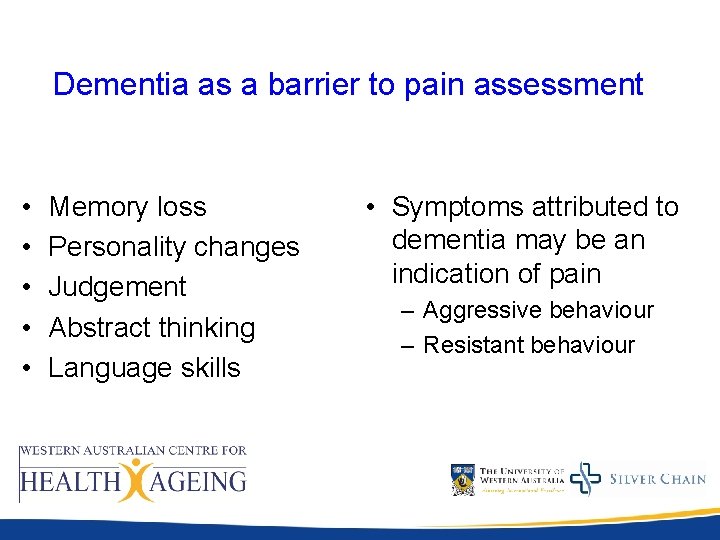
Dementia as a barrier to pain assessment • • • Memory loss Personality changes Judgement Abstract thinking Language skills • Symptoms attributed to dementia may be an indication of pain – Aggressive behaviour – Resistant behaviour
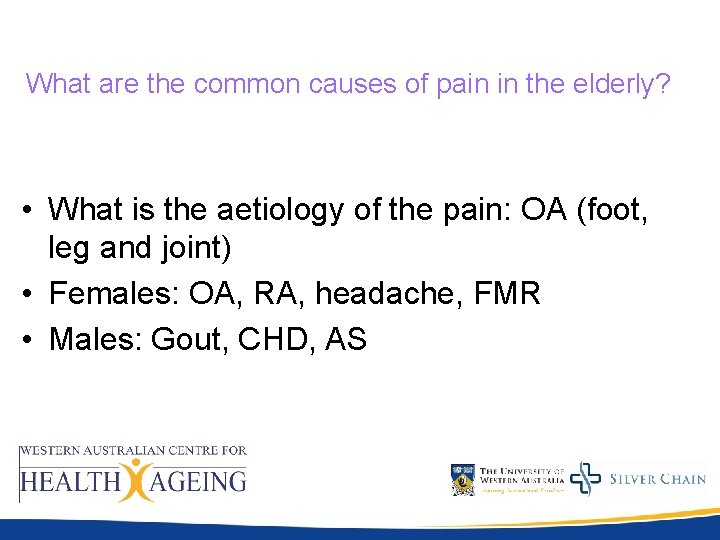
What are the common causes of pain in the elderly? • What is the aetiology of the pain: OA (foot, leg and joint) • Females: OA, RA, headache, FMR • Males: Gout, CHD, AS
What is pain? ?
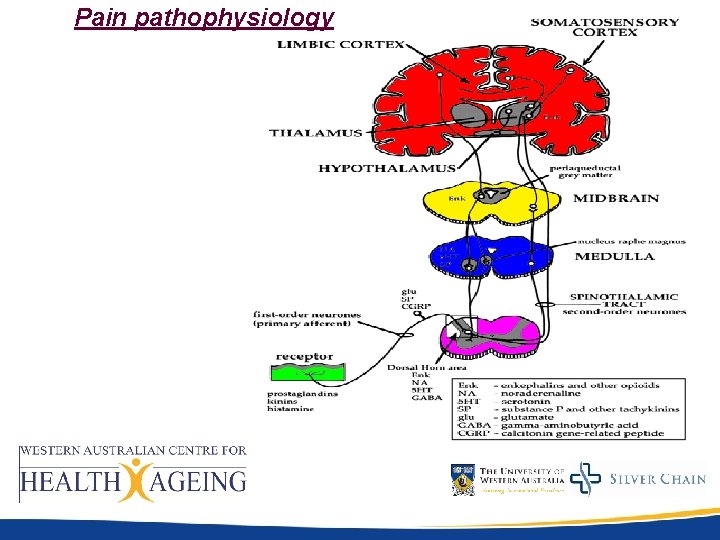
Pain pathophysiology
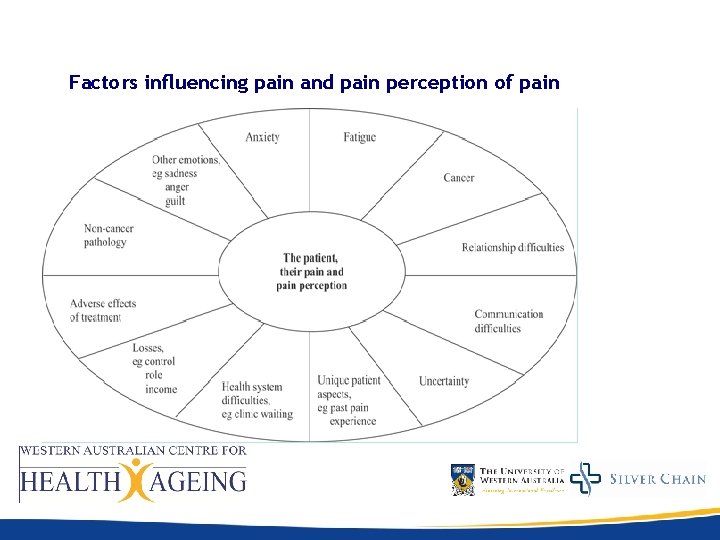
Factors influencing pain and pain perception of pain
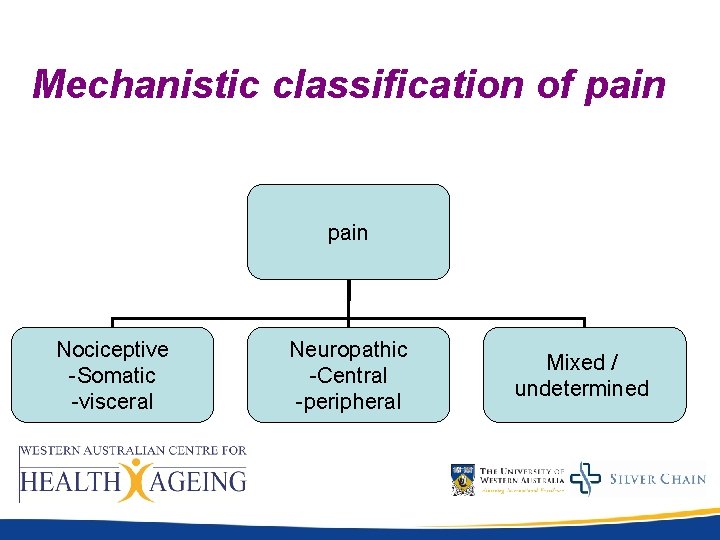
Mechanistic classification of pain Nociceptive -Somatic -visceral Neuropathic -Central -peripheral Mixed / undetermined
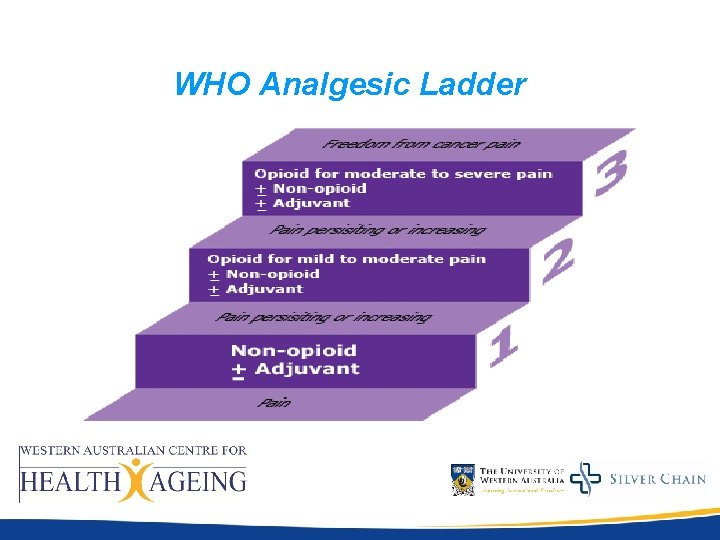
WHO Analgesic Ladder
Is there changes in PERCEPTION of pain in the elderly • No strong evidence that their perception is any different • Small psychological studies: pain related changes in increase pain threshold (may be assoc with under reporting of pain and increased risk of undiagnosed or ongoing injury) [11] • Reduced efficacy of the endogenous analgesic system and greater senitisability of pain processing pathways – may contribute to greater persistence and anatomical spread of pain [12]
Future study …. [13] • Placebo effect is lacking in those with cognitive impairment • Prof Mc. Lachlan heading a 3 yr study into determining blood levels and pain responses to work out better dosing guidelines
Consequences of pain in people with dementia • Impaired mobility & ability to self care • Decreased socialisation • Anxiety • Sleep disturbances • Impaired appetite and memory • Depression • Weight loss • • • Agitation Resistant behaviour Aggression Calling out Delirium
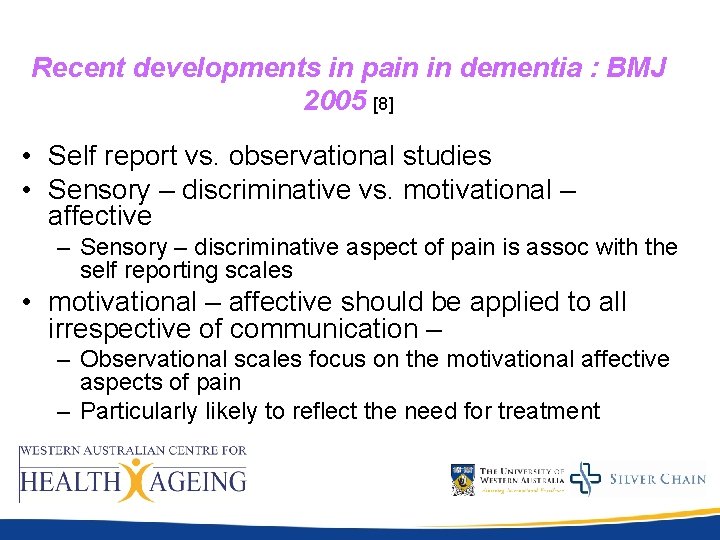
Recent developments in pain in dementia : BMJ 2005 [8] • Self report vs. observational studies • Sensory – discriminative vs. motivational – affective – Sensory – discriminative aspect of pain is assoc with the self reporting scales • motivational – affective should be applied to all irrespective of communication – – Observational scales focus on the motivational affective aspects of pain – Particularly likely to reflect the need for treatment
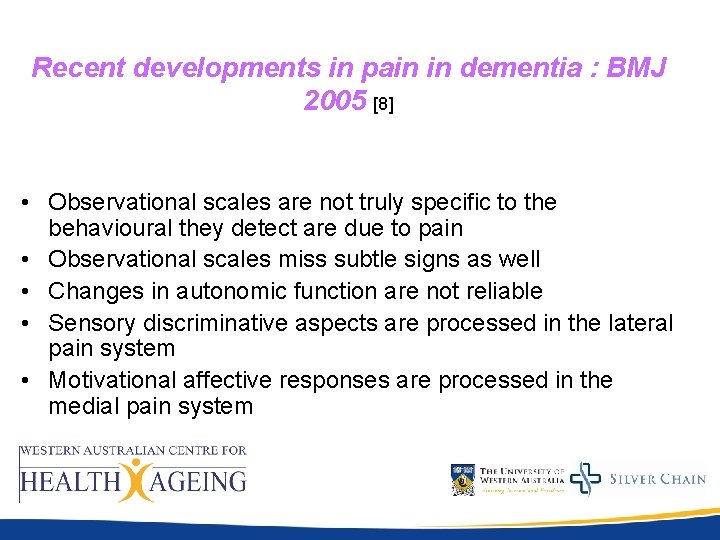
Recent developments in pain in dementia : BMJ 2005 [8] • Observational scales are not truly specific to the behavioural they detect are due to pain • Observational scales miss subtle signs as well • Changes in autonomic function are not reliable • Sensory discriminative aspects are processed in the lateral pain system • Motivational affective responses are processed in the medial pain system
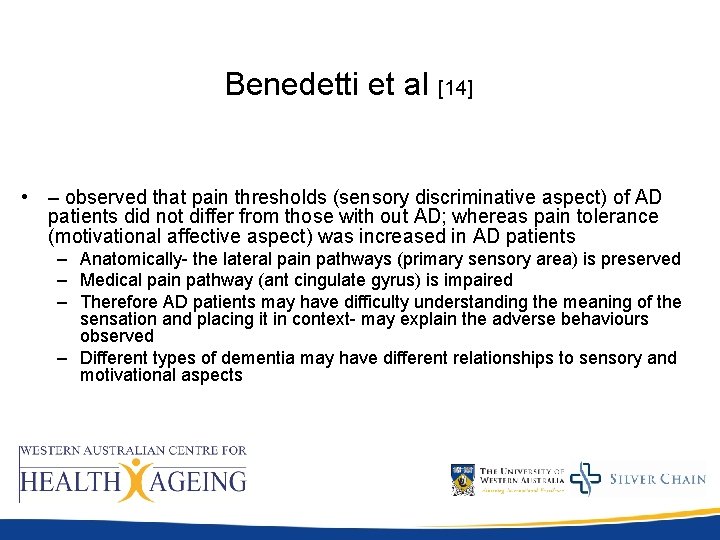
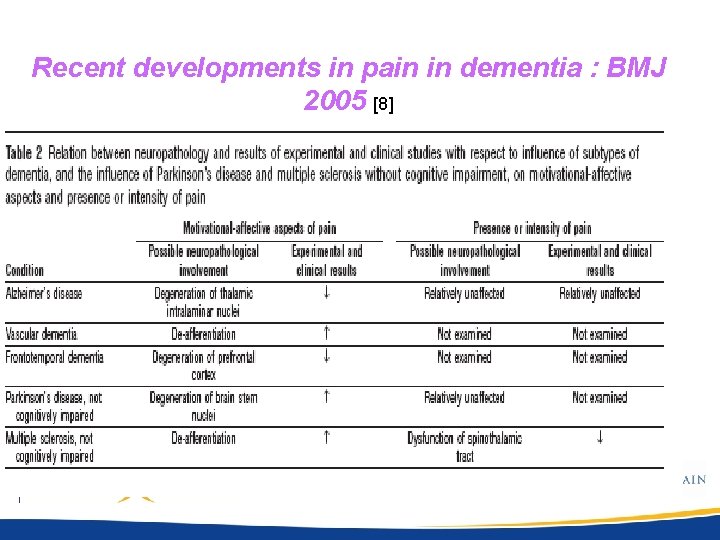
Benedetti et al [14] • – observed that pain thresholds (sensory discriminative aspect) of AD patients did not differ from those with out AD; whereas pain tolerance (motivational affective aspect) was increased in AD patients – Anatomically- the lateral pain pathways (primary sensory area) is preserved – Medical pain pathway (ant cingulate gyrus) is impaired – Therefore AD patients may have difficulty understanding the meaning of the sensation and placing it in context- may explain the adverse behaviours observed – Different types of dementia may have different relationships to sensory and motivational aspects
Recent developments in pain in dementia : BMJ 2005 [8]
Assessment of pain “the 5 th vital sign’
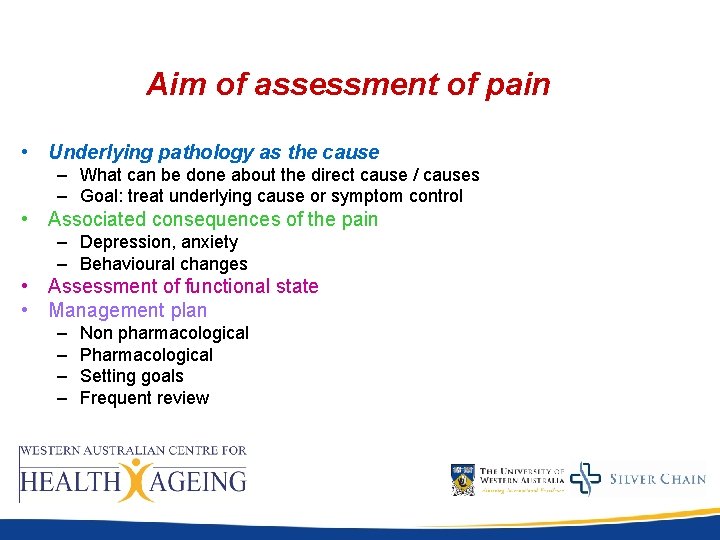
Aim of assessment of pain • Underlying pathology as the cause – What can be done about the direct cause / causes – Goal: treat underlying cause or symptom control • Associated consequences of the pain – Depression, anxiety – Behavioural changes • Assessment of functional state • Management plan – – Non pharmacological Pharmacological Setting goals Frequent review
What is the best way to assess pain in the elderly?
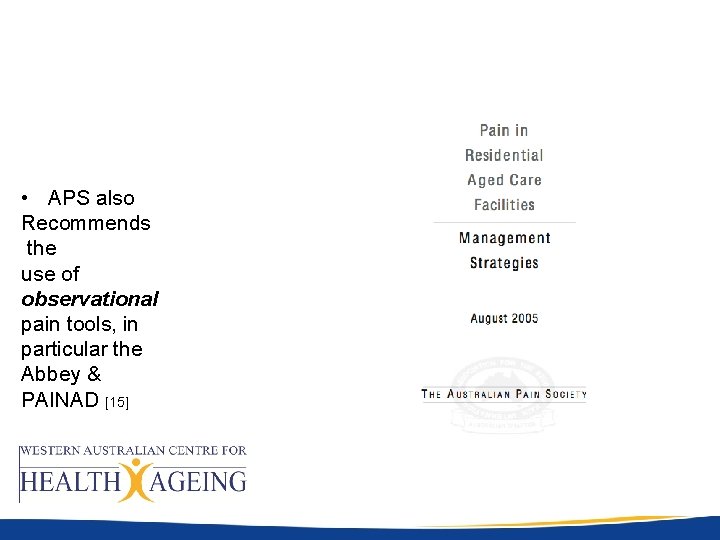
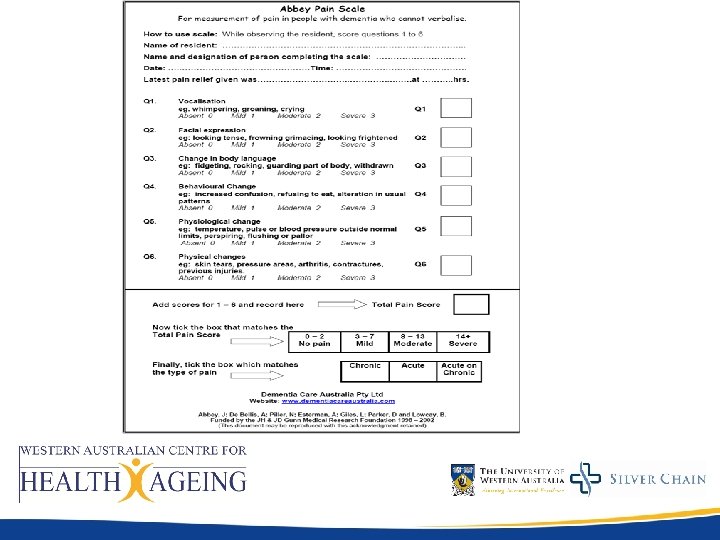
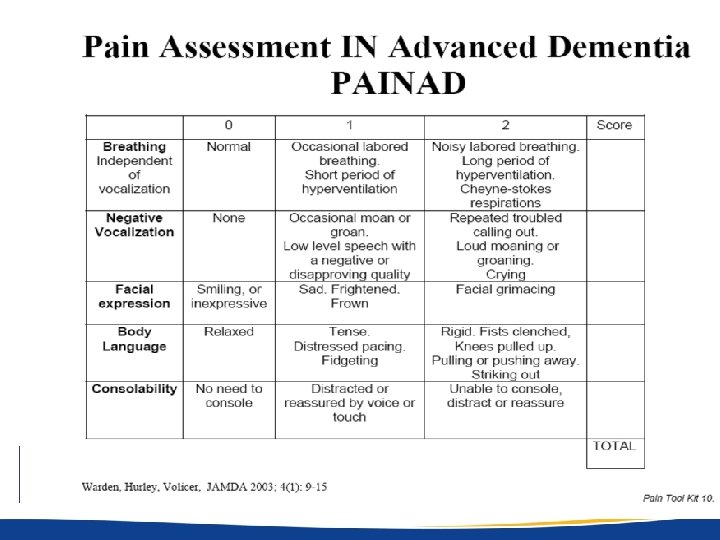
• APS also Recommends the use of observational pain tools, in particular the Abbey & PAINAD [15]
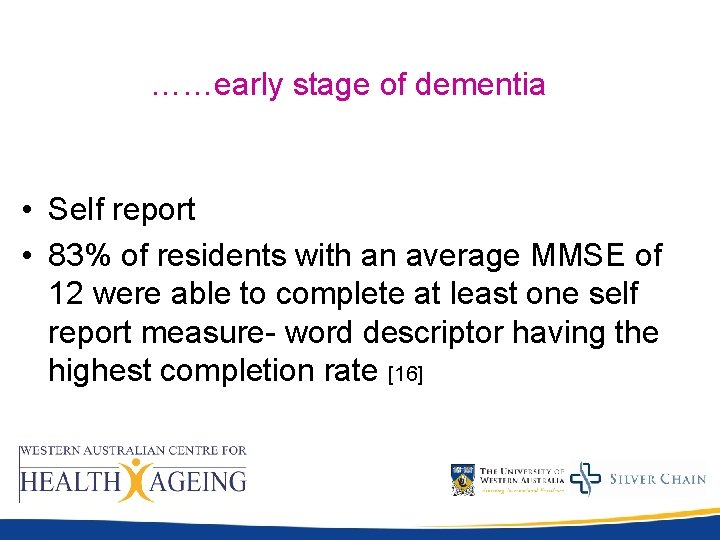
……early stage of dementia • Self report • 83% of residents with an average MMSE of 12 were able to complete at least one self report measure- word descriptor having the highest completion rate [16]
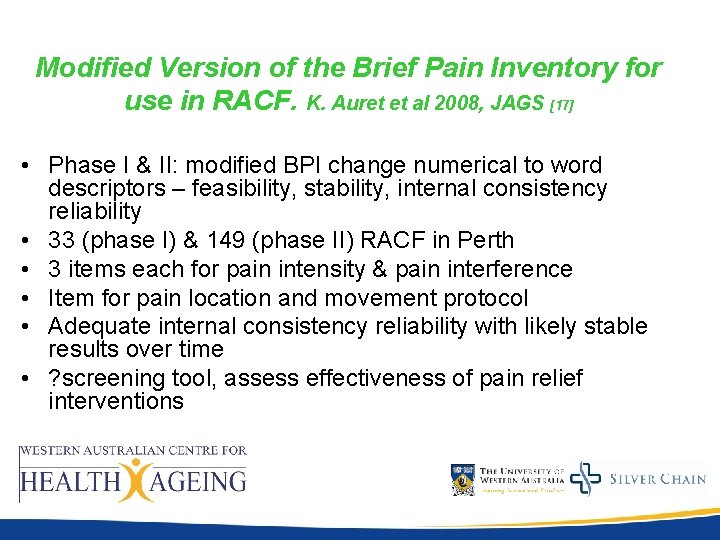
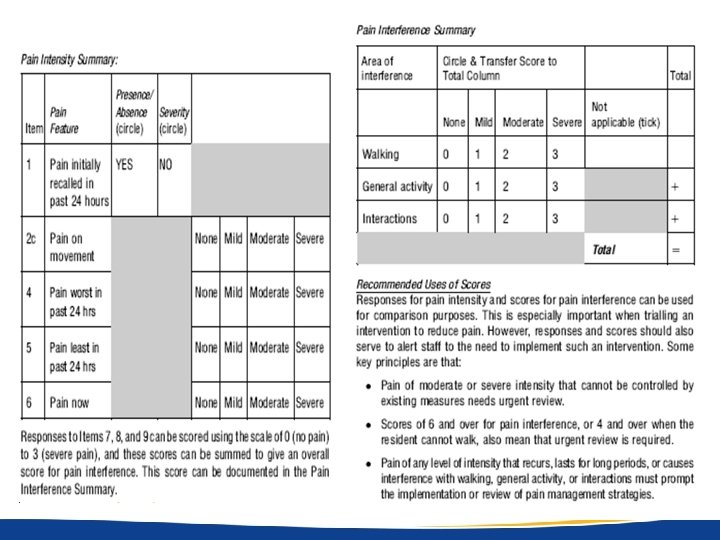
Modified Version of the Brief Pain Inventory for use in RACF. K. Auret et al 2008, JAGS [17] • Phase I & II: modified BPI change numerical to word descriptors – feasibility, stability, internal consistency reliability • 33 (phase I) & 149 (phase II) RACF in Perth • 3 items each for pain intensity & pain interference • Item for pain location and movement protocol • Adequate internal consistency reliability with likely stable results over time • ? screening tool, assess effectiveness of pain relief interventions
…. severe dementia • APS recommends ABBEY or PAINAD
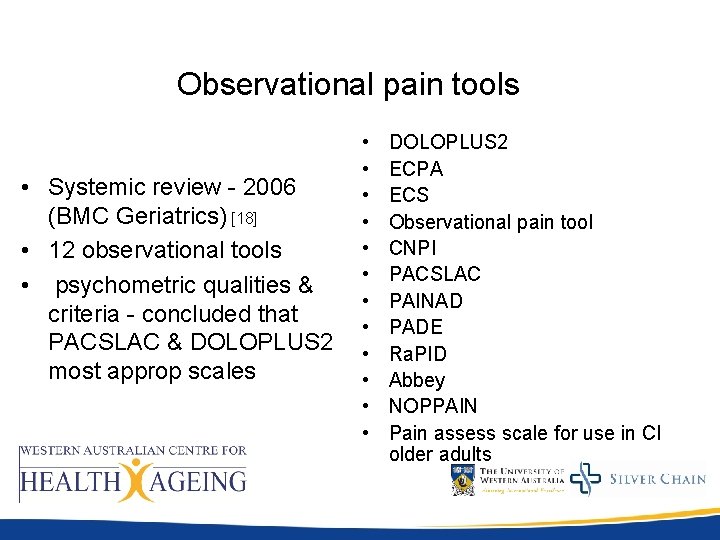
Observational pain tools • Systemic review - 2006 (BMC Geriatrics) [18] • 12 observational tools • psychometric qualities & criteria - concluded that PACSLAC & DOLOPLUS 2 most approp scales • • • DOLOPLUS 2 ECPA ECS Observational pain tool CNPI PACSLAC PAINAD PADE Ra. PID Abbey NOPPAIN Pain assess scale for use in CI older adults
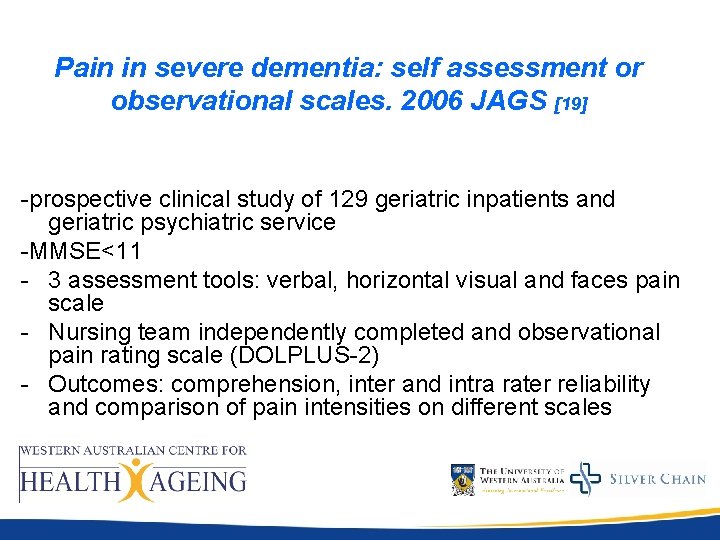
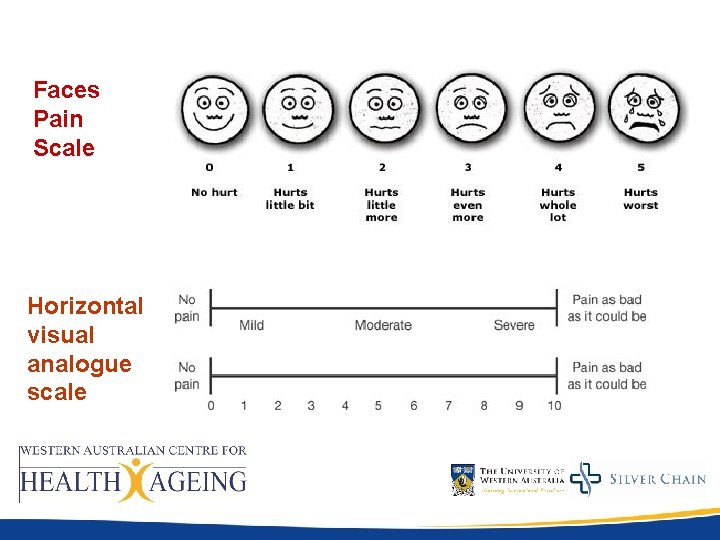
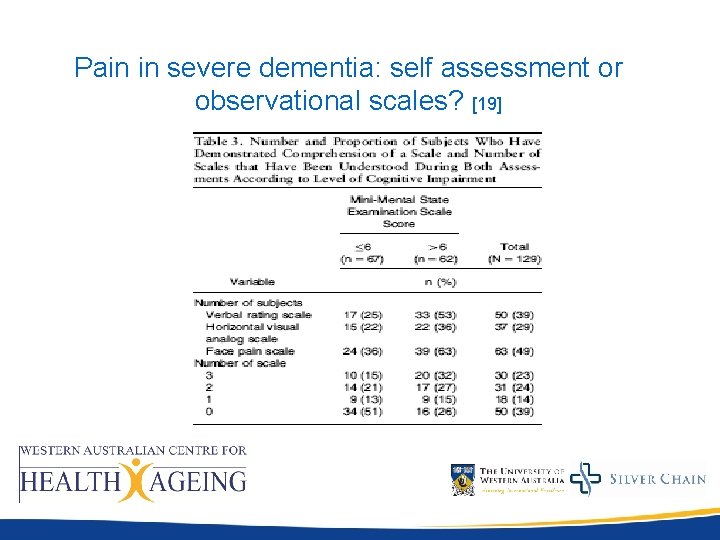
Pain in severe dementia: self assessment or observational scales. 2006 JAGS [19] -prospective clinical study of 129 geriatric inpatients and geriatric psychiatric service -MMSE<11 - 3 assessment tools: verbal, horizontal visual and faces pain scale - Nursing team independently completed and observational pain rating scale (DOLPLUS-2) - Outcomes: comprehension, inter and intra rater reliability and comparison of pain intensities on different scales
Faces Pain Scale Horizontal visual analogue scale
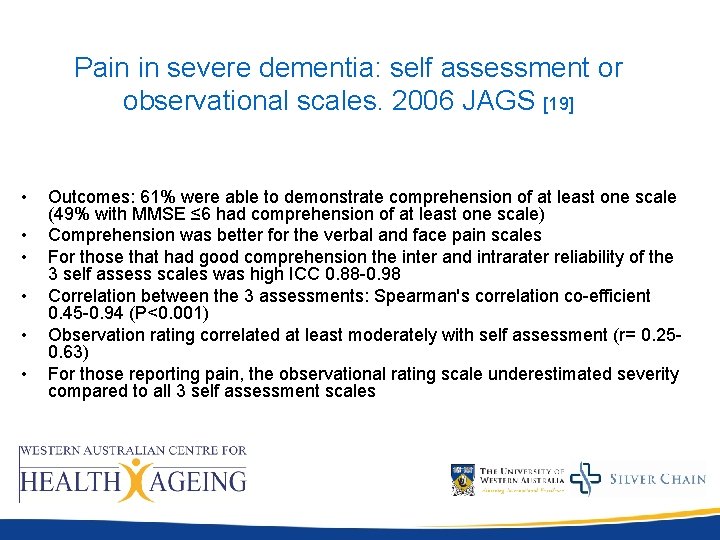
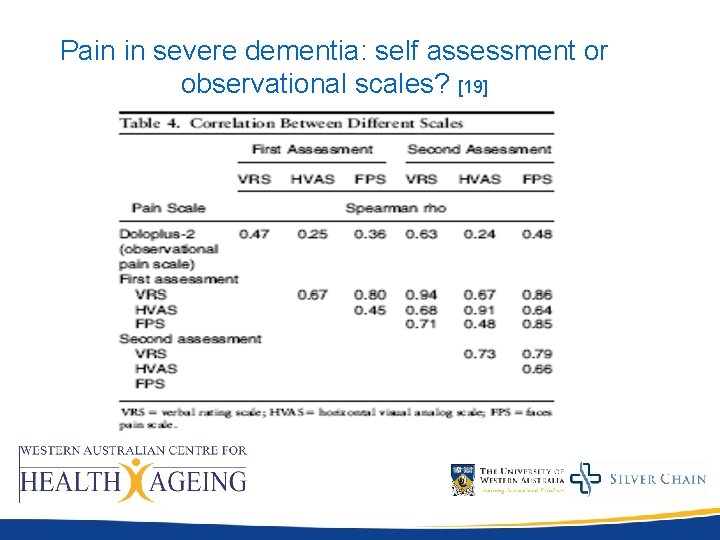
Pain in severe dementia: self assessment or observational scales. 2006 JAGS [19] • • • Outcomes: 61% were able to demonstrate comprehension of at least one scale (49% with MMSE ≤ 6 had comprehension of at least one scale) Comprehension was better for the verbal and face pain scales For those that had good comprehension the inter and intrarater reliability of the 3 self assess scales was high ICC 0. 88 -0. 98 Correlation between the 3 assessments: Spearman's correlation co-efficient 0. 45 -0. 94 (P<0. 001) Observation rating correlated at least moderately with self assessment (r= 0. 250. 63) For those reporting pain, the observational rating scale underestimated severity compared to all 3 self assessment scales
Pain in severe dementia: self assessment or observational scales? [19]
Pain in severe dementia: self assessment or observational scales? [19]
EVALUATING PAIN in those with DEMENTIA: Comparison of a PHYSICIANS EXAMINATION with OBSERVATIONAL PAIN TOOLS (ABBEY & PAINAD) Authors: P. Moffat, K. Auret, C. Toye
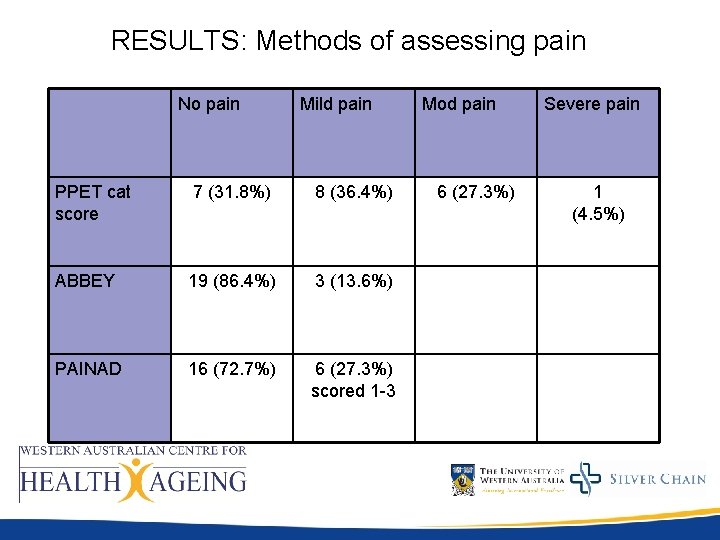
AIM • To describe any correlations in detecting pain by means of a physical examination (Physicians Pain Examination Tool: PPET) and [recommended] observational pain tools: Abbey and PAINAD in nursing home residents with dementia
RESULTS: Methods of assessing pain No pain Mild pain PPET cat score 7 (31. 8%) 8 (36. 4%) ABBEY 19 (86. 4%) 3 (13. 6%) PAINAD 16 (72. 7%) 6 (27. 3%) scored 1 -3 Mod pain 6 (27. 3%) Severe pain 1 (4. 5%)
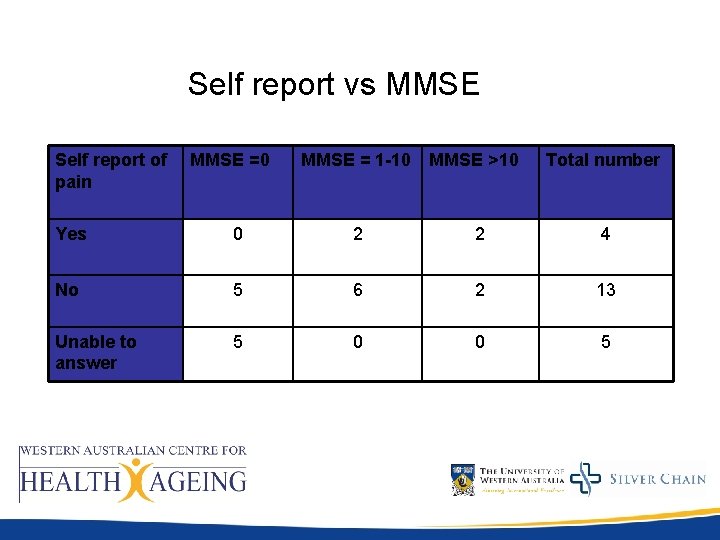
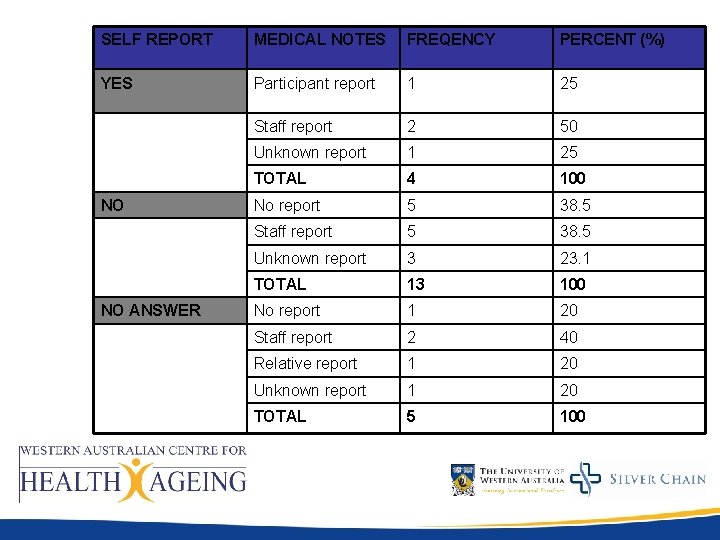
Self report vs MMSE Self report of pain MMSE =0 MMSE = 1 -10 MMSE >10 Total number Yes 0 2 2 4 No 5 6 2 13 Unable to answer 5 0 0 5
SELF REPORT MEDICAL NOTES FREQENCY PERCENT (%) YES Participant report 1 25 Staff report 2 50 Unknown report 1 25 TOTAL 4 100 No report 5 38. 5 Staff report 5 38. 5 Unknown report 3 23. 1 TOTAL 13 100 No report 1 20 Staff report 2 40 Relative report 1 20 Unknown report 1 20 TOTAL 5 100 NO NO ANSWER
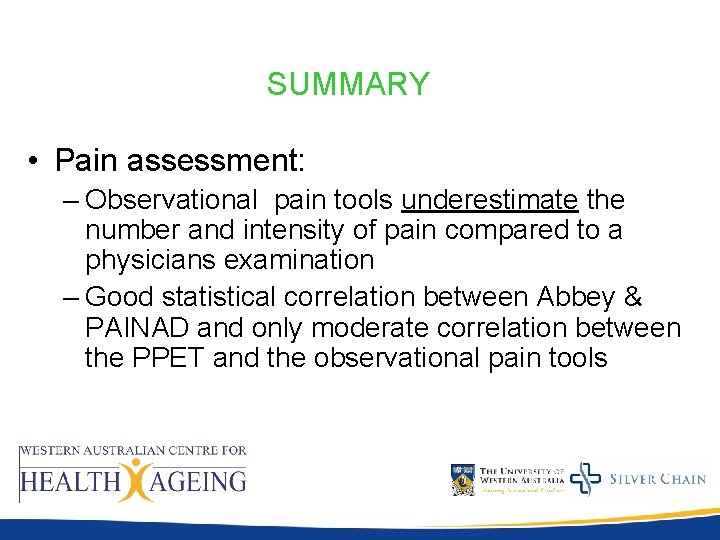
SUMMARY • Pain assessment: – Observational pain tools underestimate the number and intensity of pain compared to a physicians examination – Good statistical correlation between Abbey & PAINAD and only moderate correlation between the PPET and the observational pain tools
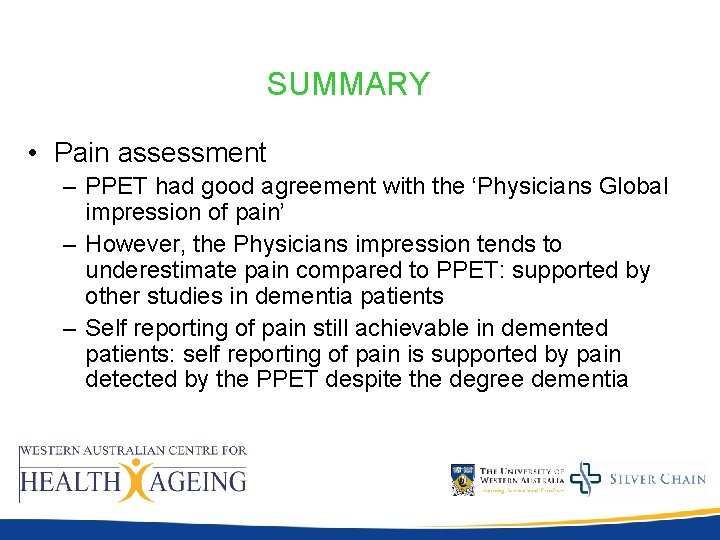
SUMMARY • Pain assessment – PPET had good agreement with the ‘Physicians Global impression of pain’ – However, the Physicians impression tends to underestimate pain compared to PPET: supported by other studies in dementia patients – Self reporting of pain still achievable in demented patients: self reporting of pain is supported by pain detected by the PPET despite the degree dementia
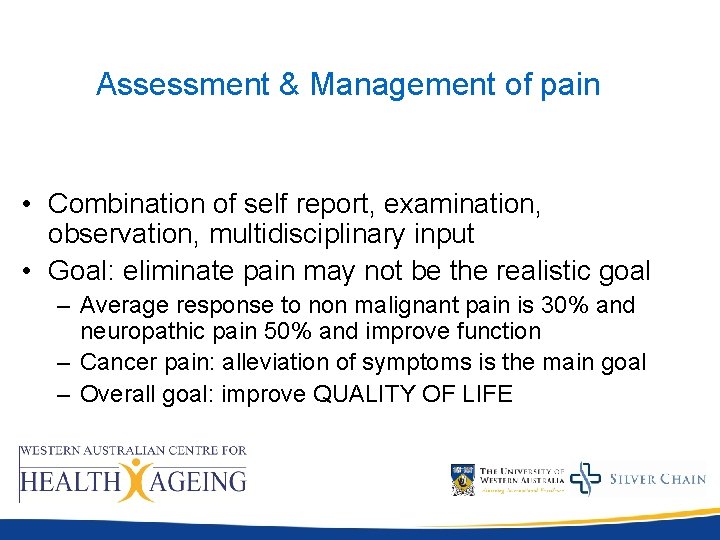
Assessment & Management of pain • Combination of self report, examination, observation, multidisciplinary input • Goal: eliminate pain may not be the realistic goal – Average response to non malignant pain is 30% and neuropathic pain 50% and improve function – Cancer pain: alleviation of symptoms is the main goal – Overall goal: improve QUALITY OF LIFE
Medications • paracetamol: metabolized by glucuronidation (not altered by age) – First line: good safety profile, hepatotoxicity is rare – more common in malnourished & alcoholics – Buffum et al 2004 JAGS: prn vs. reg paracetamol in severe dementia • Nil significant difference in discomfort scores in the 2 groups • Regular paracetamol may be inadequate relief for the treatment of pain
• NSAIDS: increased elimination secondary to decrease in GFR – Superior to paracetamol in OA – Renal impairment & other medications affecting renal impairment – GIT S/E (2/3 of elderly will not have symptoms of bleeding/ perforation) – Cardiovascular events esp. COX 2 but also non COX specific agents – Confusion, tinnitus, agitation, fluid retention
Tramadol • Dual modes of action: mu receptor and inhibits the reuptake of serotonin and nor adr • Partially antagonised by naloxone • Tolerance and dependence • Useful for nociceptive and neuropathic pain • High adverse effects: n, v, dizziness, constipation, delirium • Serotonin syndrome by itself and other serotonergic drugs SSRI or MAO Inh
Opioids • sedative & nausea dissipates within days usually • Constipation, hallucinations and gastric stasis are not self limiting – Importance of prescribing an antiemetic and laxative – Elderly sensitive to effects of sedation, confusion, falls, poor balance, constipation, nausea – Which opioid? – renal function, others – Codeine: 10% of Caucasians don’t convert to morphine – Route of administration: orally mostly, topically • In setting of chronic pain : iv contraindicated • Small proportion of patients with opioid sensitive pain that have significant s/e: spinal administration may be effective
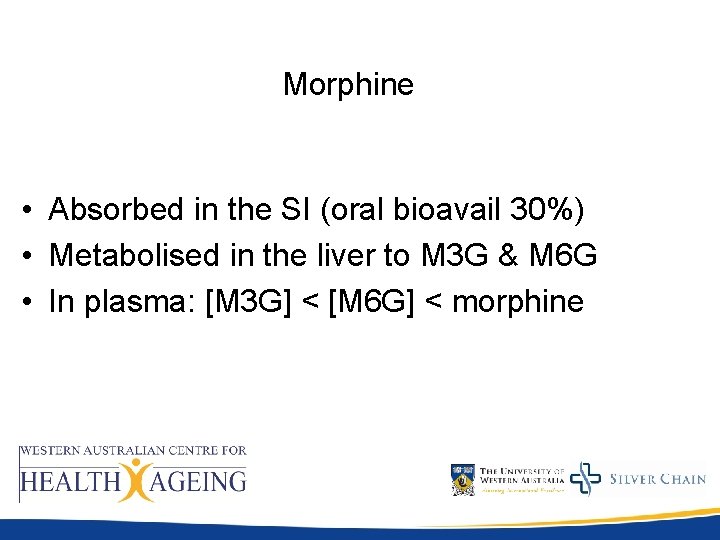
Morphine • Absorbed in the SI (oral bioavail 30%) • Metabolised in the liver to M 3 G & M 6 G • In plasma: [M 3 G] < [M 6 G] < morphine
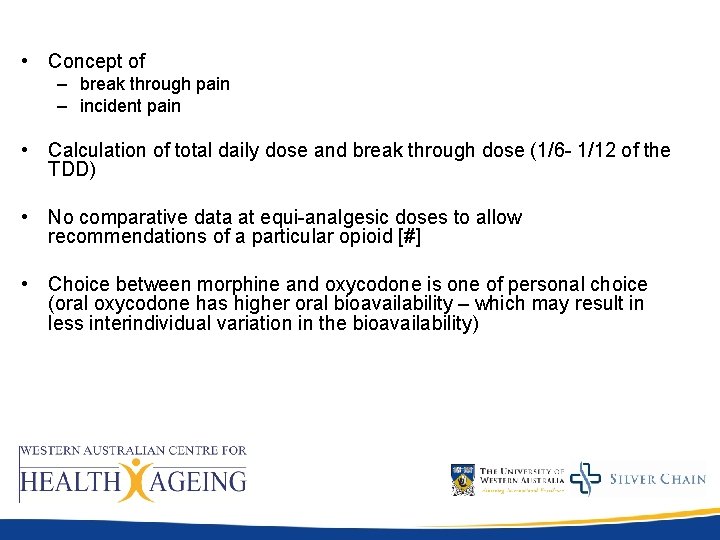
• Concept of – break through pain – incident pain • Calculation of total daily dose and break through dose (1/6 - 1/12 of the TDD) • No comparative data at equi-analgesic doses to allow recommendations of a particular opioid [#] • Choice between morphine and oxycodone is one of personal choice (oral oxycodone has higher oral bioavailability – which may result in less interindividual variation in the bioavailability)
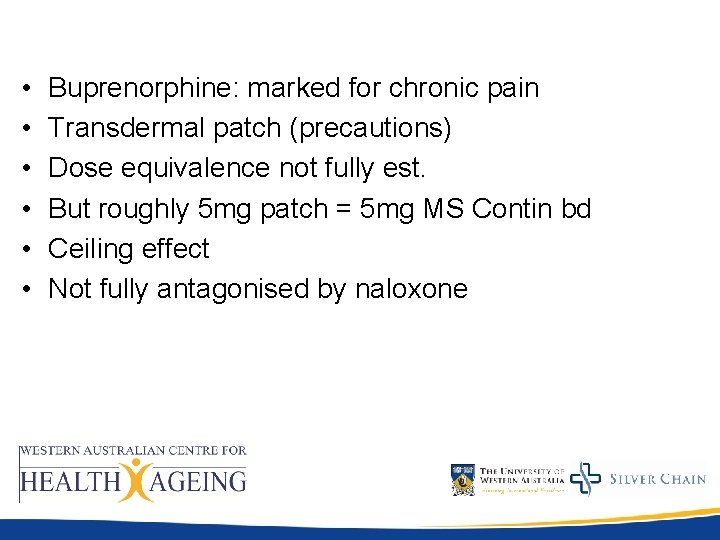
• • • Buprenorphine: marked for chronic pain Transdermal patch (precautions) Dose equivalence not fully est. But roughly 5 mg patch = 5 mg MS Contin bd Ceiling effect Not fully antagonised by naloxone
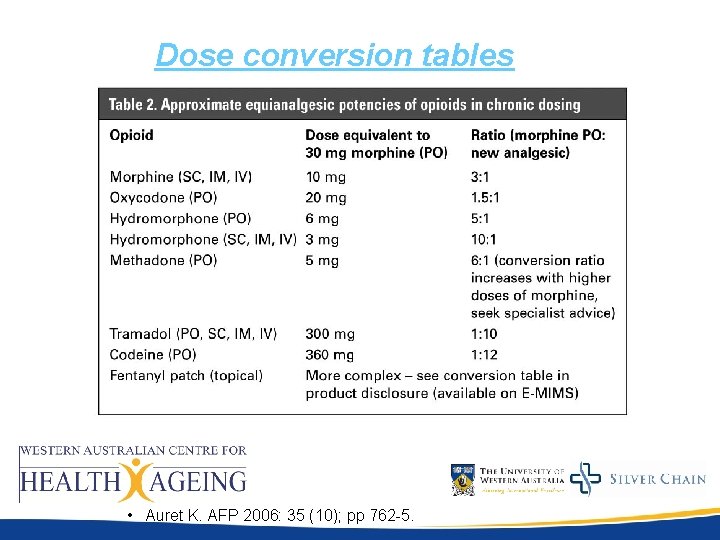
Dose conversion tables • Auret K. AFP 2006: 35 (10); pp 762 -5.
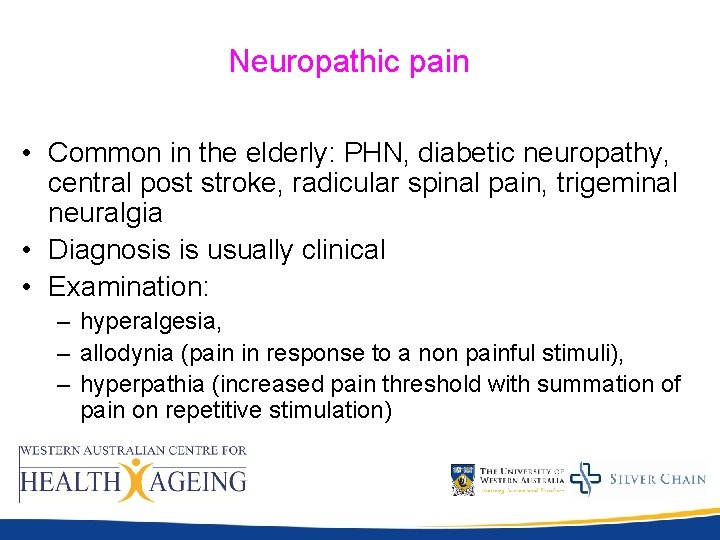
Neuropathic pain • Common in the elderly: PHN, diabetic neuropathy, central post stroke, radicular spinal pain, trigeminal neuralgia • Diagnosis is usually clinical • Examination: – hyperalgesia, – allodynia (pain in response to a non painful stimuli), – hyperpathia (increased pain threshold with summation of pain on repetitive stimulation)
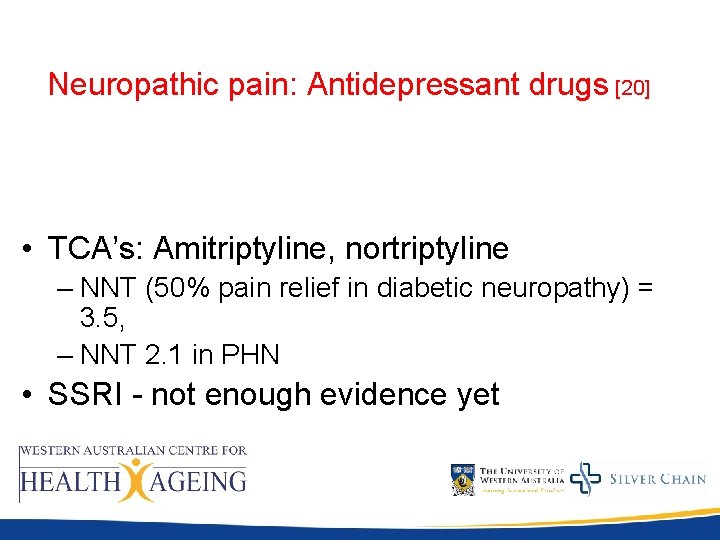
Neuropathic pain: Antidepressant drugs [20] • TCA’s: Amitriptyline, nortriptyline – NNT (50% pain relief in diabetic neuropathy) = 3. 5, – NNT 2. 1 in PHN • SSRI - not enough evidence yet
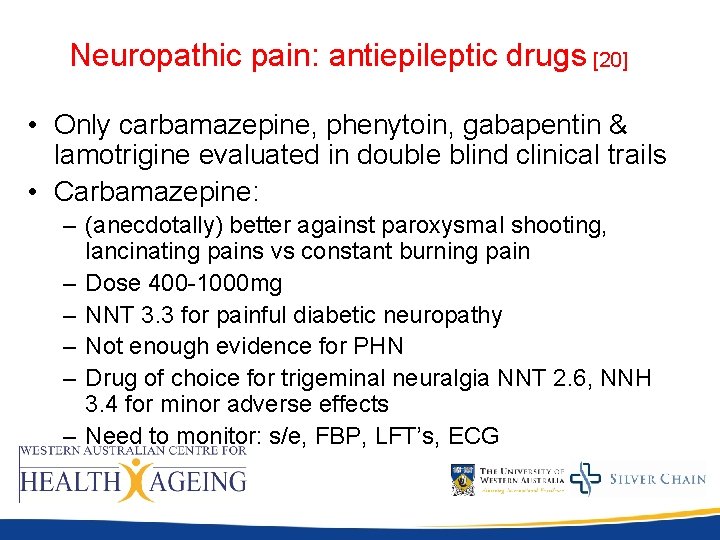
Neuropathic pain: antiepileptic drugs [20] • Only carbamazepine, phenytoin, gabapentin & lamotrigine evaluated in double blind clinical trails • Carbamazepine: – (anecdotally) better against paroxysmal shooting, lancinating pains vs constant burning pain – Dose 400 -1000 mg – NNT 3. 3 for painful diabetic neuropathy – Not enough evidence for PHN – Drug of choice for trigeminal neuralgia NNT 2. 6, NNH 3. 4 for minor adverse effects – Need to monitor: s/e, FBP, LFT’s, ECG
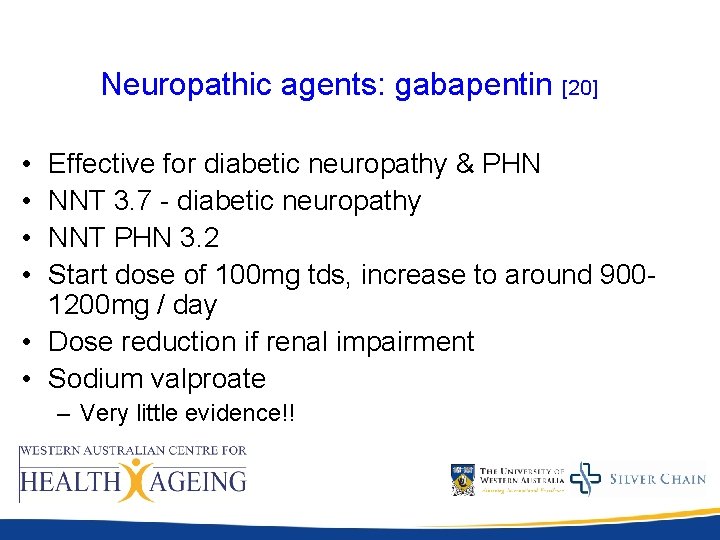
Neuropathic agents: gabapentin [20] • • Effective for diabetic neuropathy & PHN NNT 3. 7 - diabetic neuropathy NNT PHN 3. 2 Start dose of 100 mg tds, increase to around 9001200 mg / day • Dose reduction if renal impairment • Sodium valproate – Very little evidence!!
– Other agents • Mexilitine (oral analogue of lignocaine), clonidine – side effects limit use in the elderly • Ketamine • Capsaicin • Lignocaine patches
Local therapies • PERIPHERAL NV BLOCKS • Nerve blocks – May precede neurolysis – Somatic nvs, plexuses, sensory, sympathetic, visceral nvs or ganglia • chemical or physical neurolysis • joint injections • CENTRAL NEUROAXIAL PHARMACOTHERAPY • Opioids • Local anaesthetics • Clonidine • baclofen
Local therapies cont • Spinal surgical techniques • Degenerative conditions precipitating spinal stenosis, herniated discs, foraminal stenosis • sugery • Epidural steriods
• Physical therapy: heat & cold, TENS, massage • Physiotherapy • Occupational therapy
Practical tips
Practical tips • On admission: proforma? – PMHx, – current examination – Self report • Encourage family and staff to have input with regards to pain assessment • Observational screening tool? • Medications: start low, go slow, monitor for s/e • Examination 3 months in those who don’t have pain • Pain clinics / geriatric clinics or referral
Take home messages • Pain in the elderly with dementia is common • Use multidisciplinary input for the assessment and management • May use screening tools – but no substitute for self report and examination with repeated reviews • Trail of interventions / medications with regular review
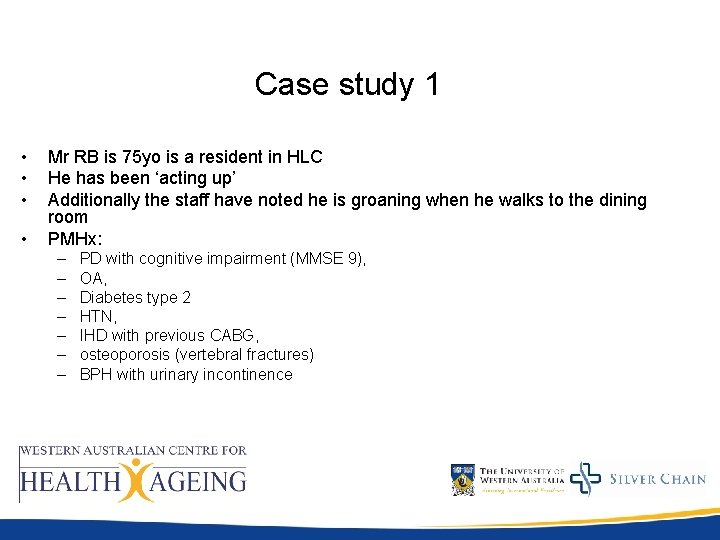
Case study 1 • • Mr RB is 75 yo is a resident in HLC He has been ‘acting up’ Additionally the staff have noted he is groaning when he walks to the dining room PMHx: – – – – PD with cognitive impairment (MMSE 9), OA, Diabetes type 2 HTN, IHD with previous CABG, osteoporosis (vertebral fractures) BPH with urinary incontinence
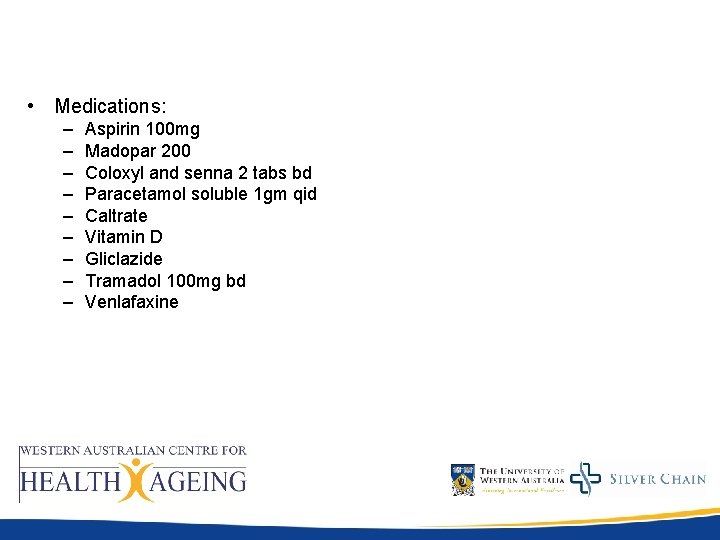
• Medications: – – – – – Aspirin 100 mg Madopar 200 Coloxyl and senna 2 tabs bd Paracetamol soluble 1 gm qid Caltrate Vitamin D Gliclazide Tramadol 100 mg bd Venlafaxine
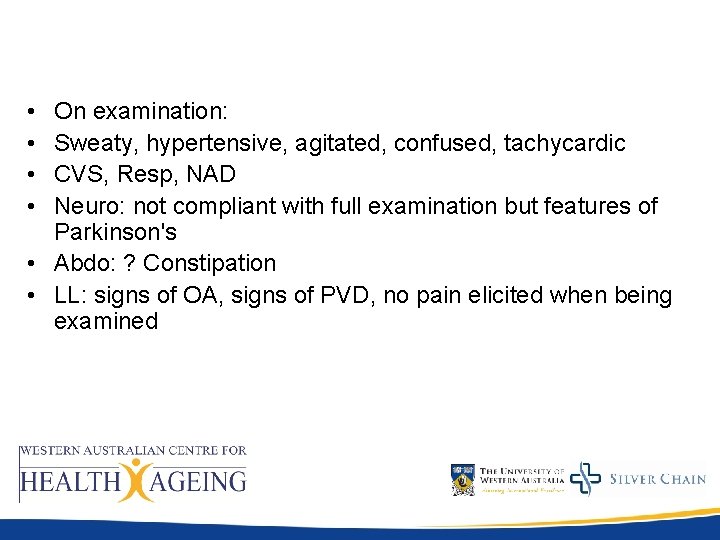
• • On examination: Sweaty, hypertensive, agitated, confused, tachycardic CVS, Resp, NAD Neuro: not compliant with full examination but features of Parkinson's • Abdo: ? Constipation • LL: signs of OA, signs of PVD, no pain elicited when being examined
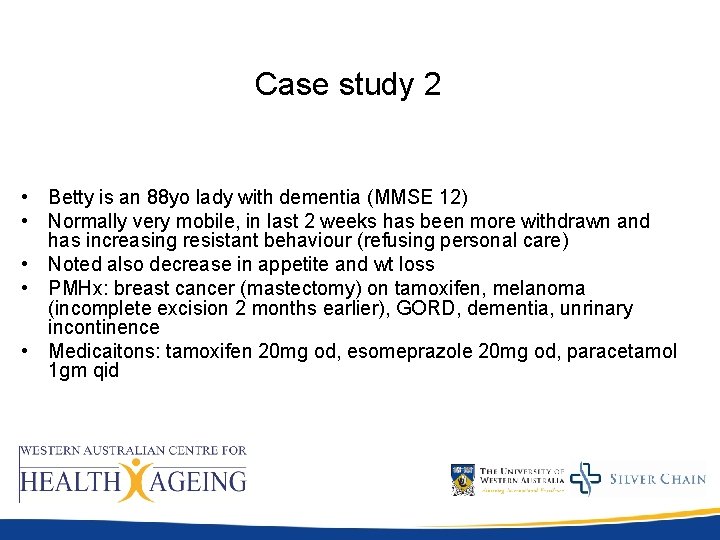
Case study 2 • Betty is an 88 yo lady with dementia (MMSE 12) • Normally very mobile, in last 2 weeks has been more withdrawn and has increasing resistant behaviour (refusing personal care) • Noted also decrease in appetite and wt loss • PMHx: breast cancer (mastectomy) on tamoxifen, melanoma (incomplete excision 2 months earlier), GORD, dementia, unrinary incontinence • Medicaitons: tamoxifen 20 mg od, esomeprazole 20 mg od, paracetamol 1 gm qid
• Family also been saying that they feel she is in pain: back /abdominal pain, • O/E: cachetic BMI 19 (on admission 23 1 yr previous) , oral thrush, epigastic tenderness, tender hepatomegaly and distended abdomen • vertebral tenderness at T 9
• What would be your management plan – Additional information – Investigations – appropriateness – Non pharmacological – Pharmacological management
REFERENCES • 1. Australian Bureau of Statistics www. abs. gov. au • 2. Majar I, Higgins IJ. Unrecognized pain in nursing home residents. Veterans Health 1997; 60: 13 -15 • 3. Fox PL et al. Prevalence and treatment of pain in older adults in nursing homes and other long term care institutions. A systematic review. Can Med Assoc J 1999; 160: 329 -333 • 4. Crook et al. The prevalence of pain complaints in the general population. Pain 1984; 18(3): 299 -314 • 5. Weiner DK et al. Predictors of pain self report in nursing home residents. Aging Clinical and Experimental Research 1998; 10(5): 411420 • 6. Maxwell CJ et al. The prevalence and management of current daily pain among older home care clients. Pain 2008
References cont • 9. Horgas AL et al. Analgesic drug prescription and use in cognitively impaired nursing home residents. Nurs Res 1998; 47: 235 -242 • 8. Scherder E et al. Recent developments in pain in dementia. BMJ 2005; 330: 461 -464 • 9. Workman BS. Management of chronic pain in older people. Aust J of Hospital Pharm. 1998; 28(5): 361 -367 • 10. Peterson G et al. Analgesia in the elderly: should not be a painful experience. Aust Pharm 2006; 25(1): 52 -60 • 11. Edwards RE. Age assoc differences in pain perception and pain processing. Pain in older persons, progress in pain research and management. Seattle: IASP Press; 2005 p 45 -65 • 12. Gibson SP. Pain and aging: the experience over the adult life span. Proceedings of the 10 th World Congress on Pain, Progress in pain research & Management. Seattle: IASP Press; 2003 p 767 -90
References cont. . . • 13. Martin K. The painful side of dementia. Aust J of Pharm. 2007; 88: 32 -34 • 14. Benedetti F et al. Pain threshold and tolarance in Alzheimers Disease. Pain 1999; 80: 377 -82. • 15. The Australian Pain Society. Pain in Residential Aged Care Facilities: Management Strategies 2005. www. apsoc. org. au • 16. Ferrell BA et al. Pain in cognitively impaired nursing home residents. J Pain Symptom Manage 1995; 10: 591 -8 • 17. Auret K et al. Development and Testing of a Modified Version of the Brief Pain Inventory for Use in Residential Aged Care Facilities. JAGS. 2008; 56: 301 -306
References cont… • 18. Zwakjalen SMG, et al. Pain in elderly people with severe dementia: A systemic review of behavioural pain assessment tools. BMC Geriatrics. 2006; 6: 3 • 19. S Plaxiu • 20. Ahmad M, Goucke CR. Management Strategies for the treatment of neuropathic pain in the elderly. Drugs Aging 2002; 19(12): 929 -945