Sundowning Delirium Francisco Fernandez M D USF Health








- Slides: 81
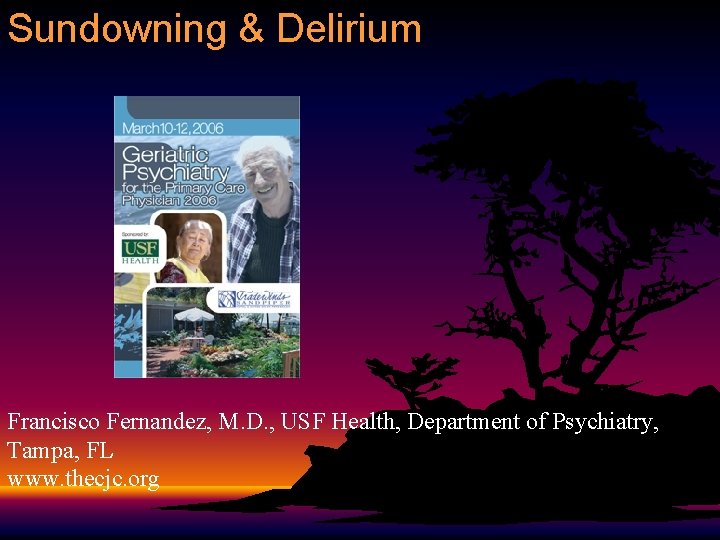
Sundowning & Delirium Francisco Fernandez, M. D. , USF Health, Department of Psychiatry, Tampa, FL www. thecjc. org
Sundowning: Definition • • Sundowning a group of behaviors occurring in some older patients with or without dementia at the time of nightfall or sunset. BEHAVIORS: • • • Confusion Anxiety, agitation, or aggressiveness Psychomotor agitation (pacing, wandering) Disruptive, resistance to redirection Increased verbal activity Overlap with dementia, delirium, and sleep disturbance.
Epidemiology of Sundowning Syndrome • • • Not uncommon phenomenon Exact prevalence unknown Reports have ranged between 2. 4% and 25% • In patients with Alzheimer’s disease or dementia, the range is widened up to 66%
Risk Factors for Sundowning: Physiologic Factors • Circadian abnormalities in elderly and in patients with Alzheimer’s disease progress concomitantly with their behavioral and cognitive dysfunction. • Sundowning is more common in Az. D. • Neurofibrillary tangles found in the hypothalamus of patients with Alzheimer’s may lead to the behavioral changes of sundowning through mechanical disruption of brain tissue. • Pathologic damage to the suprachiasmatic nucleus (SCN) is believed to result in disruptive behaviors associated with sundowning.
Risk Factors for Sundowning: Environmental Factors • • • Amount of daily light exposure Activities during the day Noise level Disruptions at night Medications Medical comorbidities • Nursing home residents with sundowning were more likely to • • Recent admission Moved to a new room Staff shift changes Low levels of lighting during the day and bright hallway lighting during the night • Increased naptime during daytime hours and reduced nighttime sleep
Etiology of Sundowning • Dysfunction of the circadian rhythm result in disturbed sleep and agitation • Deterioration of the SCN seen in patients with Alzheimer’s disease is actively investigated to be an important factor in the disruption of the circadian rhythms. • Suprachiasmatic nucleus volume and cell number are found to be decreased in those between the ages of 80 and 100 years. • Melatonin is found to be decreased in the cerebrospinal fluid levels of patients with Alzheimer’s disease.
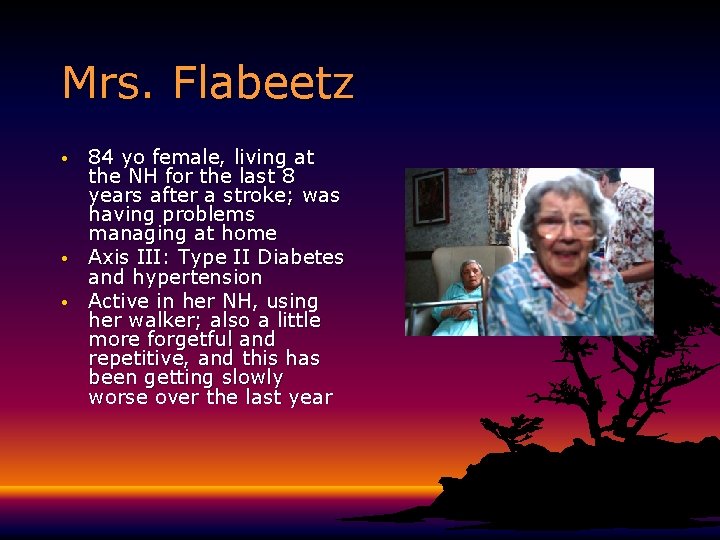
Mrs. Flabeetz • • • 84 yo female, living at the NH for the last 8 years after a stroke; was having problems managing at home Axis III: Type II Diabetes and hypertension Active in her NH, using her walker; also a little more forgetful and repetitive, and this has been getting slowly worse over the last year
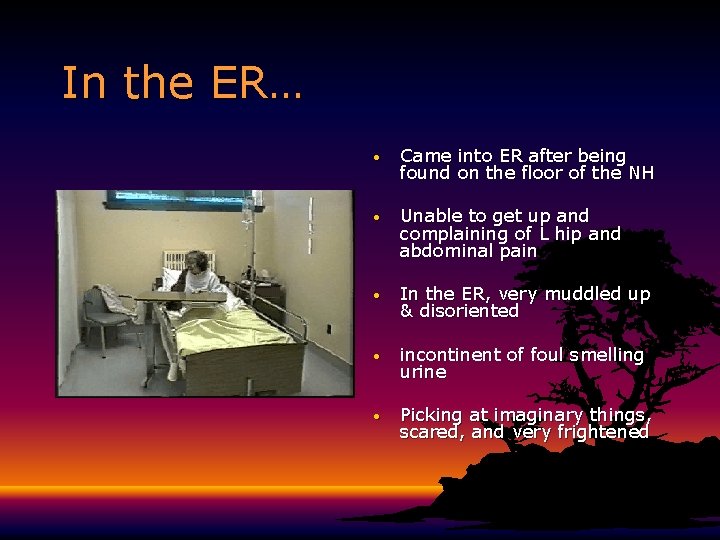
In the ER… • Came into ER after being found on the floor of the NH • Unable to get up and complaining of L hip and abdominal pain • In the ER, very muddled up & disoriented • incontinent of foul smelling urine • Picking at imaginary things, scared, and very frightened
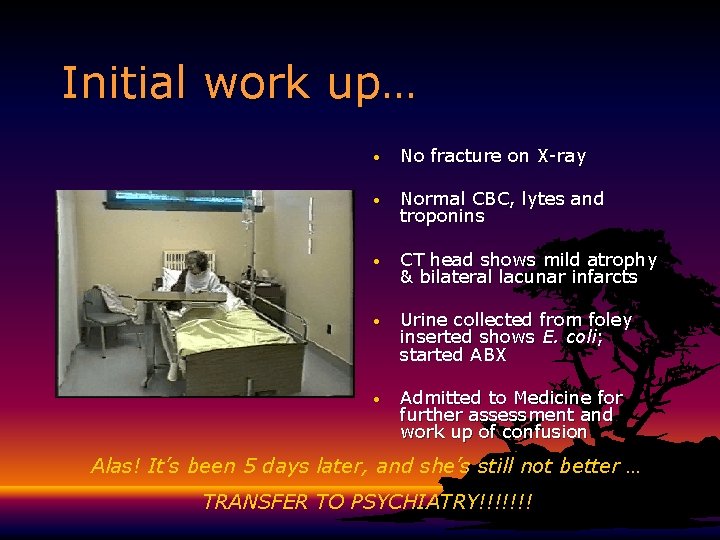
Initial work up… • No fracture on X-ray • Normal CBC, lytes and troponins • CT head shows mild atrophy & bilateral lacunar infarcts • Urine collected from foley inserted shows E. coli; started ABX • Admitted to Medicine for further assessment and work up of confusion Alas! It’s been 5 days later, and she’s still not better … TRANSFER TO PSYCHIATRY!!!!!!!
What would you do? Is this Delirium? Dementia? ? Or something else? ? ? Would you transfer to Psychiatry Service?
Delirium • • Most common psychiatric disorder in the medically ill Point prevalence - 20% of all admissions • • • 30% new onset among medical inpatients 50% medical and surgical patients > 60 yo 89% of patients with known dementia Higher prevalence with increasing age, CNS disease, CABG, and THR NOT a benign condition - sign of impending death in 25% cases Etiology - multifactorial Rothschild et al, Arch Int Med 2000; Burns et al, JNNP 2004
Diagnostic Criteria: DSM-IV • Disturbance of consciousness (reduced clarity of awareness of environment) • Reduced ability to focus, sustain or shift attention • A change in cognition (memory, disorientation, language disturbance) or the development of a perceptual disturbance that is not better accounted by dementia
Diagnostic Criteria: DSM-IV • • The disturbance develops over a short period of time (usually hours to days) All abnormalities tend to fluctuate during the course of the day
Diagnostic Criteria: DSM-IV • There is evidence from the medical history, physical examination, or laboratory findings of: 1. A general medical condition etiologically related • 2. 3. 4. Sepsis, seizures, tumor, hypercalcemia, hypoglycemia Substance induced intoxication or withdrawal More than one etiology NOS
“Motoric” Subtypes Various levels of psychomotor activity are associated with delirium: 1. Hypoactive 2. Hyperactive 3. Mixed
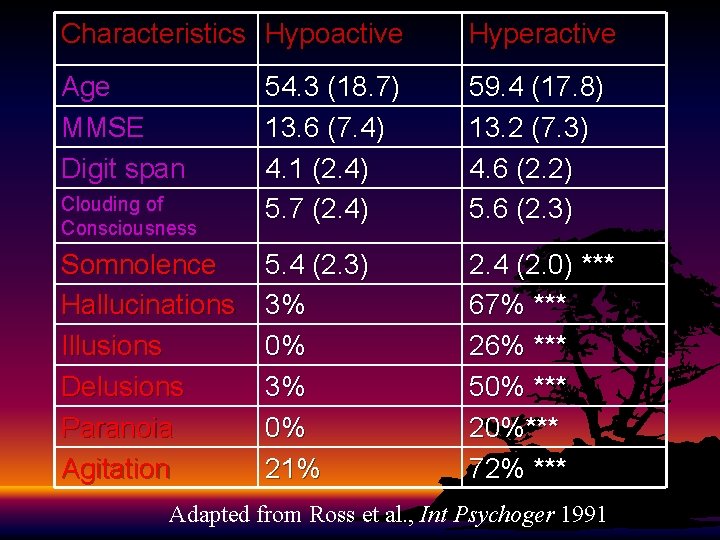
Characteristics Hypoactive Hyperactive Age MMSE Digit span 54. 3 (18. 7) 13. 6 (7. 4) 4. 1 (2. 4) 5. 7 (2. 4) 59. 4 (17. 8) 13. 2 (7. 3) 4. 6 (2. 2) 5. 6 (2. 3) 5. 4 (2. 3) 3% 0% 21% 2. 4 (2. 0) *** 67% *** 26% *** 50% *** 20%*** 72% *** Clouding of Consciousness Somnolence Hallucinations Illusions Delusions Paranoia Agitation Adapted from Ross et al. , Int Psychoger 1991
“Motoric” Subtypes • • Subtyping not fully accepted by all disciplines Subtyping may have implications for treatment
Epidemiology & Risk Factors • Depending on the cohort, the prevalence of delirium ranges from 8% to 80% • Post-surgical rates > general medical patients • Advancing age increases the risk (> 60 yoa) • 15 -20% of patients on a medical surgical ward have an undetected delirious process Burns et al, JNNP 2004; Kales et al, JNNP 2002; van. Zyl & Davidson, Can J Psych 2003
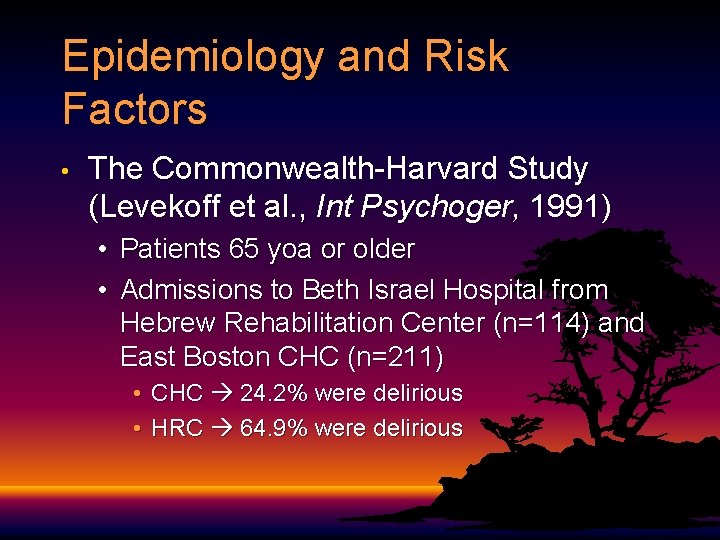
Epidemiology and Risk Factors • The Commonwealth-Harvard Study (Levekoff et al. , Int Psychoger, 1991) • Patients 65 yoa or older • Admissions to Beth Israel Hospital from Hebrew Rehabilitation Center (n=114) and East Boston CHC (n=211) • CHC 24. 2% were delirious • HRC 64. 9% were delirious
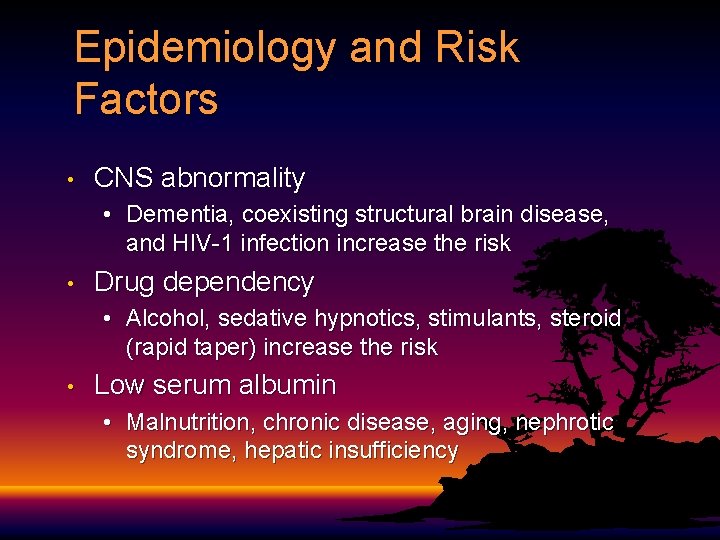
Epidemiology and Risk Factors • CNS abnormality • Dementia, coexisting structural brain disease, and HIV-1 infection increase the risk • Drug dependency • Alcohol, sedative hypnotics, stimulants, steroid (rapid taper) increase the risk • Low serum albumin • Malnutrition, chronic disease, aging, nephrotic syndrome, hepatic insufficiency
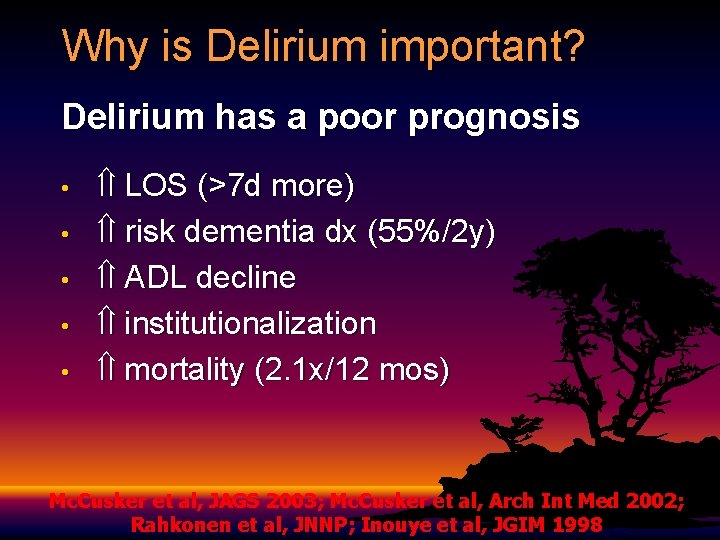
Why is Delirium important? Delirium has a poor prognosis • • • Ý LOS (>7 d more) Ý risk dementia dx (55%/2 y) Ý ADL decline Ý institutionalization Ý mortality (2. 1 x/12 mos) Mc. Cusker et al, JAGS 2003; Mc. Cusker et al, Arch Int Med 2002; Rahkonen et al, JNNP; Inouye et al, JGIM 1998
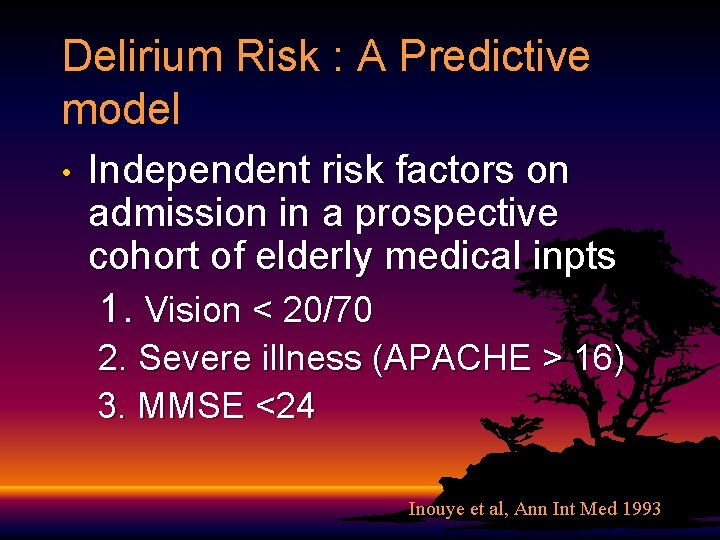
Delirium Risk : A Predictive model • Independent risk factors on admission in a prospective cohort of elderly medical inpts 1. Vision < 20/70 2. Severe illness (APACHE > 16) 3. MMSE <24 Inouye et al, Ann Int Med 1993
Diagnosis • Rapid recognition of either prodromal or fully developed clinical features • “A, B, C’s” of Neuropsychiatry (Affect, Behavior and Cognition) • Prodromal features • Restlessness, anxiety, irritability, sleeplessness, hypervigilance, distractibility, fatigue, disinterest, hypersomnolence, inattentiveness, depressed, disillusionment
Diagnosing Delirium Sx Interview 1. Orientation 2. Sleep disturbance 3. Perceptual disturbance 4. Speech disturbance 5. Disturbance of consciousness 6. Psychomotor activity 7. Affect & behavior Albert et al, J Ger Psych Neurol 1992
Diagnosis: MSE • Mental status examination • Cognitive history chart review • What changes (consciousness, restlessness, anxiety, moodiness) • When did changes occur (starting/stopping drug, fever, hypotension, deteriorating renal function, rhythm changes) • MMSE, focused NBE
Diagnosis Testing - Standard MMSE & CDT -Not designed for delirium -Useful at separating “normal” from “abnormal” -Not specific for distinguishing delirium from dementia -May be useful as change from baseline -Overkill add TMT-A, TMT-B
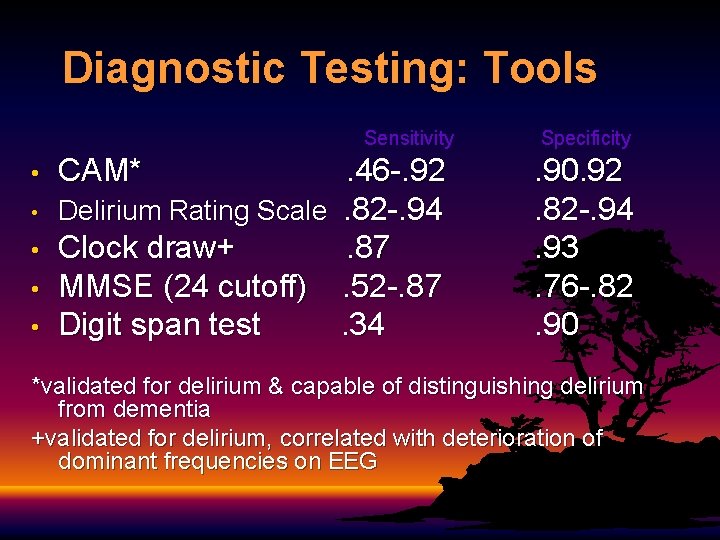
Diagnostic Testing: Tools Sensitivity Specificity • • • CAM* . 46 -. 92 Delirium Rating Scale . 82 -. 94 Clock draw+ . 87 MMSE (24 cutoff) . 52 -. 87 Digit span test . 34 . 90. 92 . 82 -. 94 . 93 . 76 -. 82 . 90 *validated for delirium & capable of distinguishing delirium from dementia +validated for delirium, correlated with deterioration of dominant frequencies on EEG
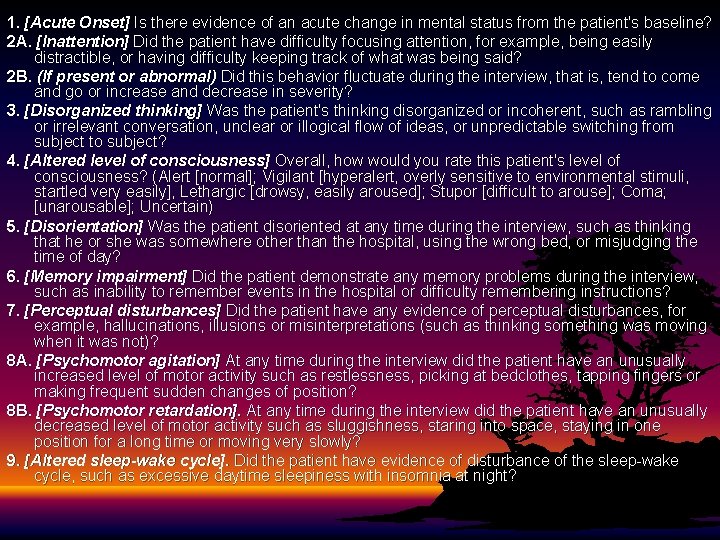
1. [Acute Onset] Is there evidence of an acute change in mental status from the patient's baseline? 2 A. [Inattention] Did the patient have difficulty focusing attention, for example, being easily distractible, or having difficulty keeping track of what was being said? 2 B. (If present or abnormal) Did this behavior fluctuate during the interview, that is, tend to come and go or increase and decrease in severity? 3. [Disorganized thinking] Was the patient's thinking disorganized or incoherent, such as rambling or irrelevant conversation, unclear or illogical flow of ideas, or unpredictable switching from subject to subject? 4. [Altered level of consciousness] Overall, how would you rate this patient's level of consciousness? (Alert [normal]; Vigilant [hyperalert, overly sensitive to environmental stimuli, startled very easily], Lethargic [drowsy, easily aroused]; Stupor [difficult to arouse]; Coma; [unarousable]; Uncertain) 5. [Disorientation] Was the patient disoriented at any time during the interview, such as thinking that he or she was somewhere other than the hospital, using the wrong bed, or misjudging the time of day? 6. [Memory impairment] Did the patient demonstrate any memory problems during the interview, such as inability to remember events in the hospital or difficulty remembering instructions? 7. [Perceptual disturbances] Did the patient have any evidence of perceptual disturbances, for example, hallucinations, illusions or misinterpretations (such as thinking something was moving when it was not)? 8 A. [Psychomotor agitation] At any time during the interview did the patient have an unusually increased level of motor activity such as restlessness, picking at bedclothes, tapping fingers or making frequent sudden changes of position? 8 B. [Psychomotor retardation]. At any time during the interview did the patient have an unusually decreased level of motor activity such as sluggishness, staring into space, staying in one position for a long time or moving very slowly? 9. [Altered sleep-wake cycle]. Did the patient have evidence of disturbance of the sleep-wake cycle, such as excessive daytime sleepiness with insomnia at night?
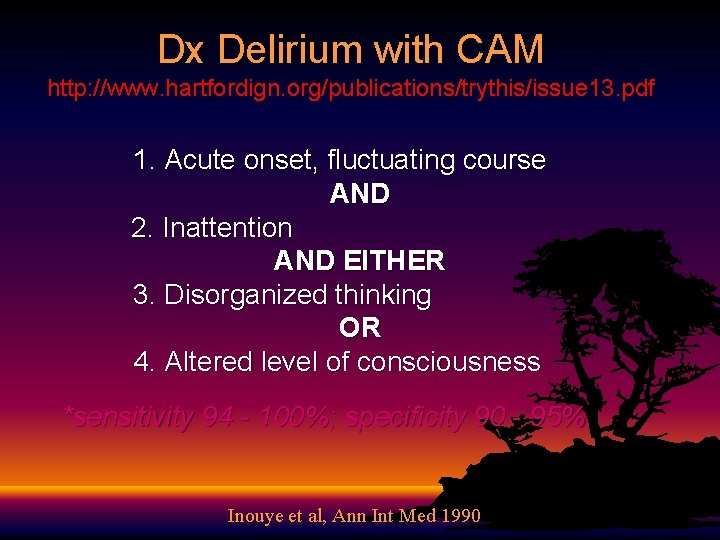
Dx Delirium with CAM http: //www. hartfordign. org/publications/trythis/issue 13. pdf 1. Acute onset, fluctuating course AND 2. Inattention AND EITHER 3. Disorganized thinking OR 4. Altered level of consciousness *sensitivity 94 - 100%; specificity 90 - 95% Inouye et al, Ann Int Med 1990
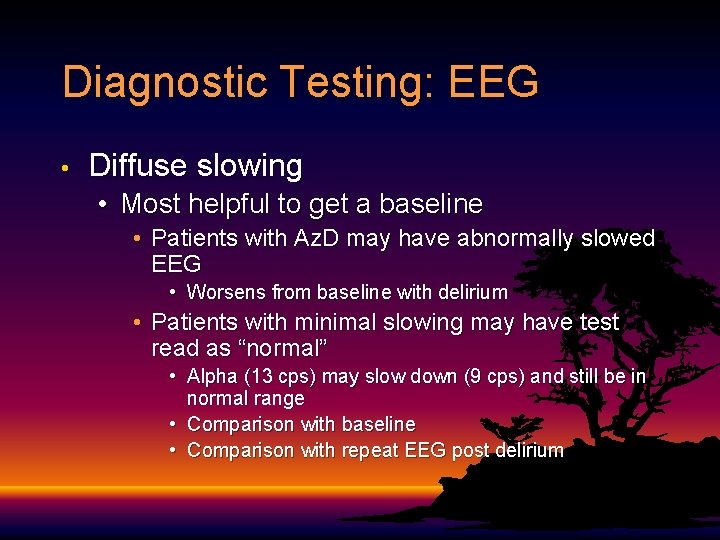
Diagnostic Testing: EEG • Diffuse slowing • Most helpful to get a baseline • Patients with Az. D may have abnormally slowed EEG • Worsens from baseline with delirium • Patients with minimal slowing may have test read as “normal” • Alpha (13 cps) may slow down (9 cps) and still be in normal range • Comparison with baseline • Comparison with repeat EEG post delirium
What Causes Delirium? The Importance of DDx
Differential Diagnosis: Urgent • When in doubt, throw out the • • • Wernicke’s Withdrawal Hypoxia Hypoglycemia Hyper- hypotension Infection Intracranial bleed Meningitis Poisoning • Failure to make these diagnoses may lead to permanent CNS damage
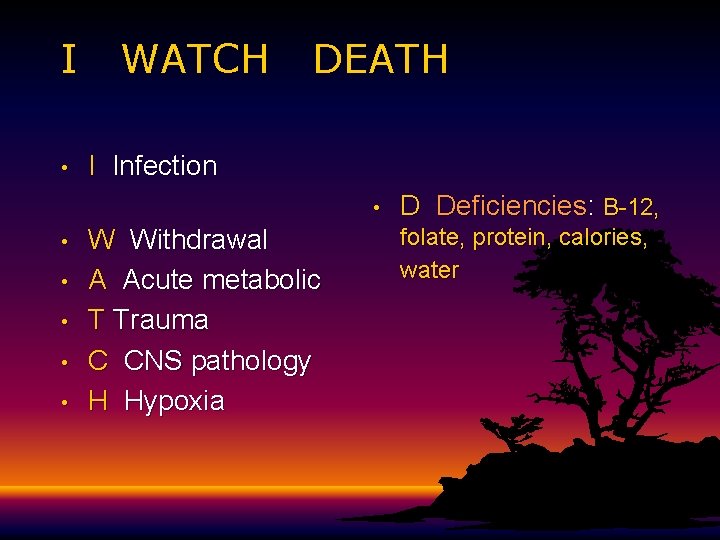
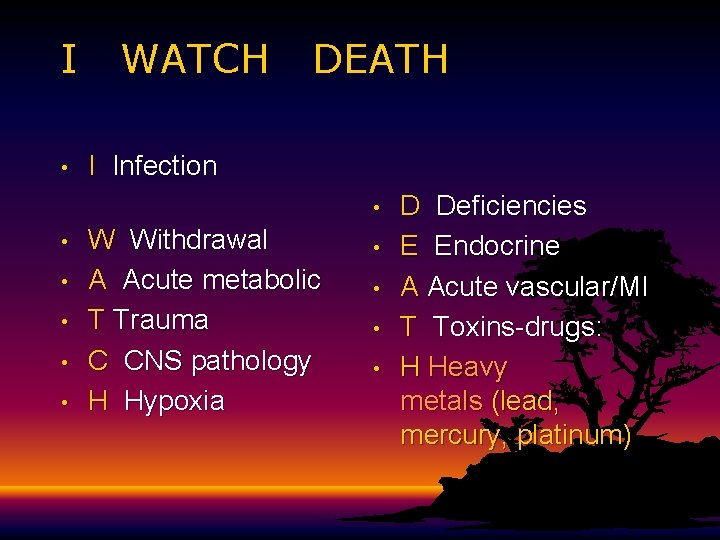
I WATCH • I Infection: Most DEATH common are pneumonias & UTI in elderly, but sepsis, cellulitis, SBE and meningitis can also occur
I WATCH • I Infection • W Withdrawal: benzodiazapines, ETOH, opiates DEATH
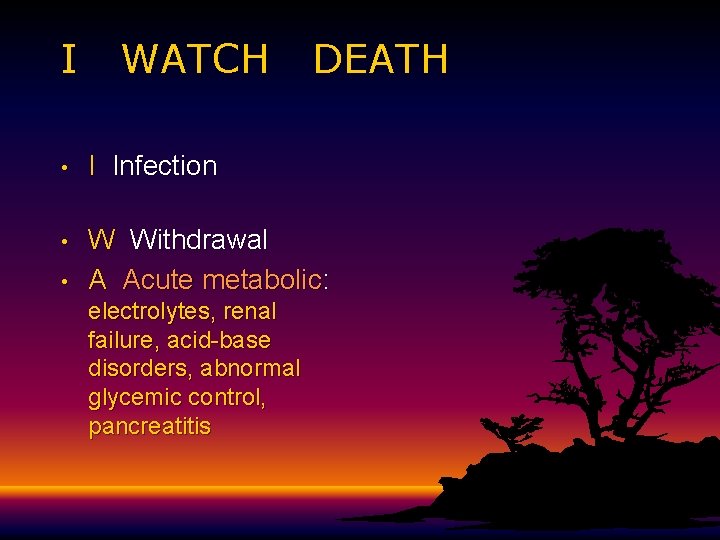
I WATCH DEATH • I Infection • W Withdrawal A Acute metabolic: • electrolytes, renal failure, acid-base disorders, abnormal glycemic control, pancreatitis
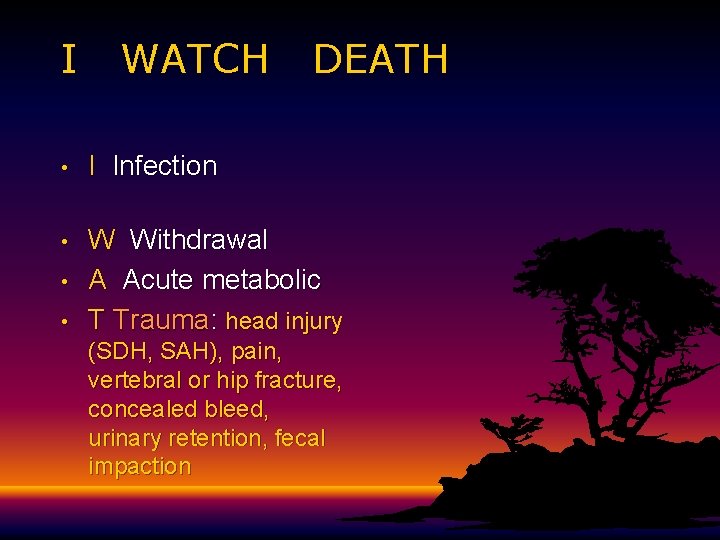
I WATCH DEATH • I Infection • W Withdrawal A Acute metabolic T Trauma: head injury • • (SDH, SAH), pain, vertebral or hip fracture, concealed bleed, urinary retention, fecal impaction
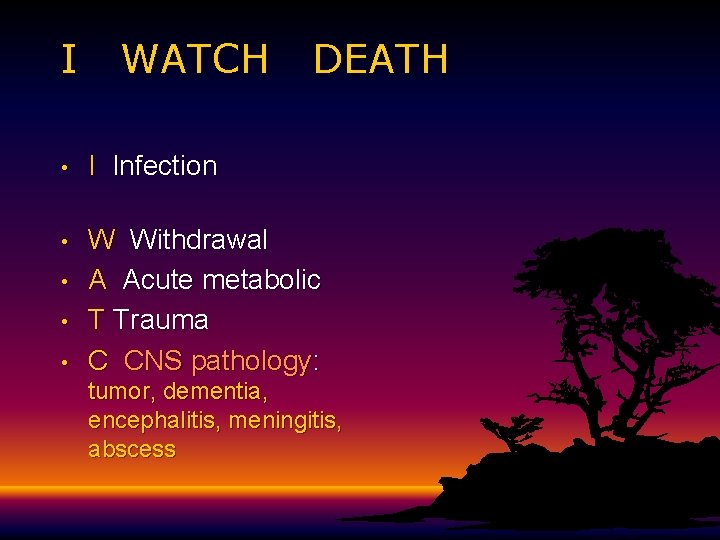
I WATCH DEATH • I Infection • W Withdrawal A Acute metabolic T Trauma C CNS pathology: • • • tumor, dementia, encephalitis, meningitis, abscess
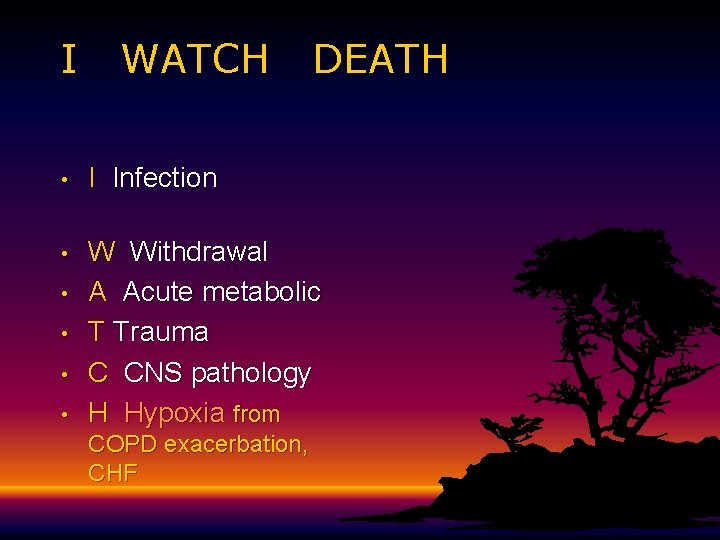
I WATCH DEATH • I Infection • W Withdrawal A Acute metabolic T Trauma C CNS pathology H Hypoxia from • • COPD exacerbation, CHF
I • WATCH DEATH I Infection • • • W Withdrawal A Acute metabolic T Trauma C CNS pathology H Hypoxia D Deficiencies: B-12, folate, protein, calories, water
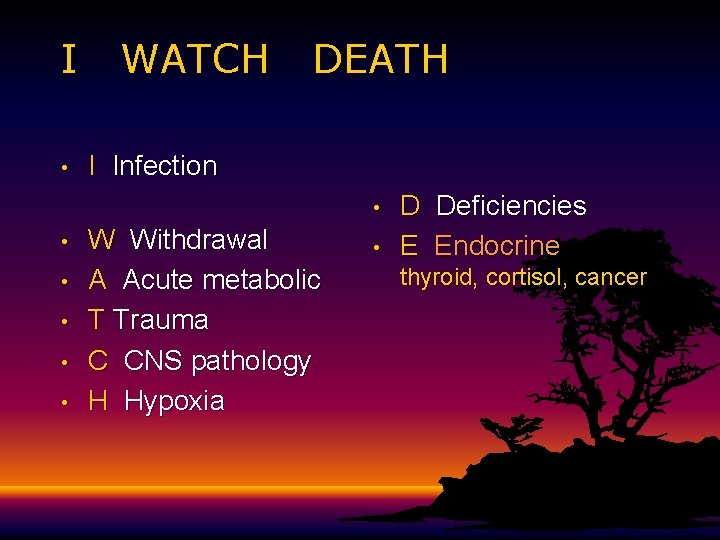
I • WATCH DEATH I Infection • • • W Withdrawal A Acute metabolic T Trauma C CNS pathology H Hypoxia • D Deficiencies E Endocrine thyroid, cortisol, cancer
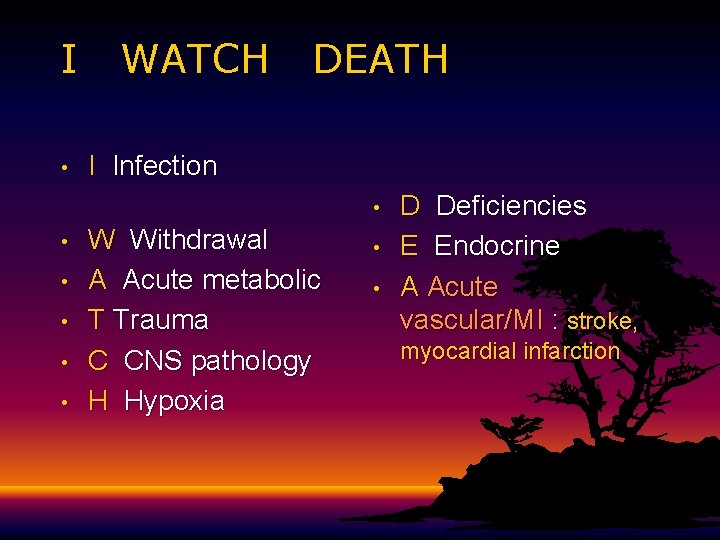
I • WATCH DEATH I Infection • • • W Withdrawal A Acute metabolic T Trauma C CNS pathology H Hypoxia • • D Deficiencies E Endocrine A Acute vascular/MI : stroke, myocardial infarction
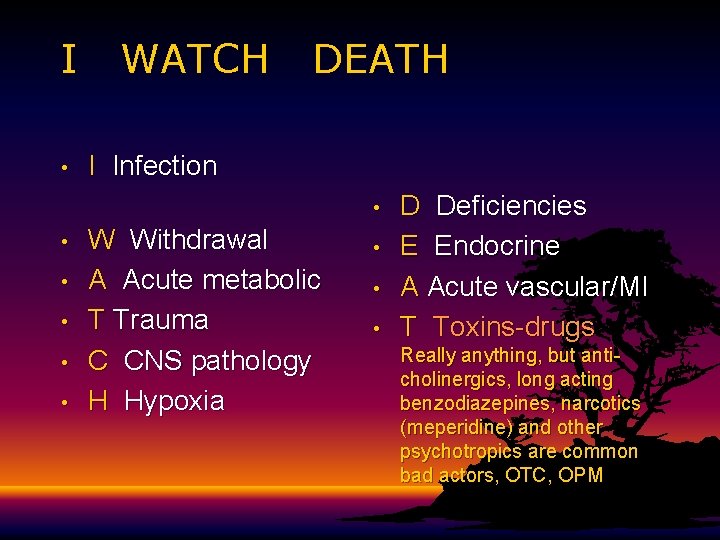
I • WATCH DEATH I Infection • • • W Withdrawal A Acute metabolic T Trauma C CNS pathology H Hypoxia • • • D Deficiencies E Endocrine A Acute vascular/MI T Toxins-drugs Really anything, but anticholinergics, long acting benzodiazepines, narcotics (meperidine) and other psychotropics are common bad actors, OTC, OPM
I • WATCH DEATH I Infection • • • W Withdrawal A Acute metabolic T Trauma C CNS pathology H Hypoxia • • D Deficiencies E Endocrine A Acute vascular/MI T Toxins-drugs: H Heavy metals (lead, mercury, platinum)
Dementia and Delirium • • Dementia is a risk factor for delirium Diagnosis of delirium in context of dementia is often missed • Of 2000 consecutive admissions: • 9. 1% of patients had diagnosis of dementia • 41. 4% of these demented patients had delirious process on admission Erkinjuntii et al. , Arch Int Med, 1986
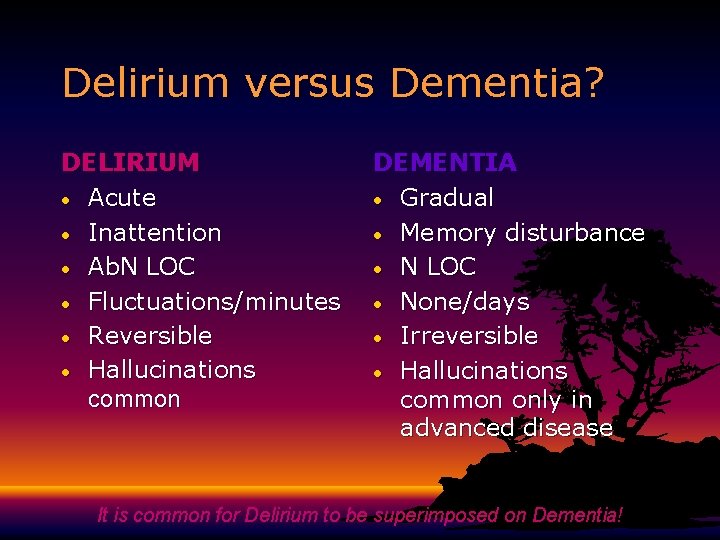
Delirium versus Dementia? DELIRIUM • Acute • Inattention • Ab. N LOC • Fluctuations/minutes • Reversible • Hallucinations common DEMENTIA • Gradual • Memory disturbance • N LOC • None/days • Irreversible • Hallucinations common only in advanced disease It is common for Delirium to be superimposed on Dementia!
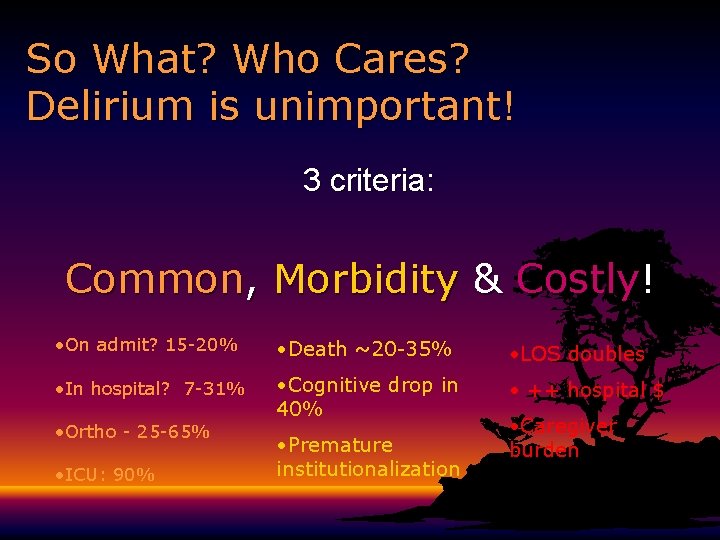
So What? Who Cares? Delirium is unimportant! 3 criteria: Common, Morbidity & Costly! • On admit? 15 -20% • Death ~20 -35% • LOS doubles • In hospital? 7 -31% • Cognitive drop in 40% • ++ hospital $ • Ortho - 25 -65% • ICU: 90% • Premature institutionalization • Caregiver burden
What can trigger Delirium? ANYTHING!!!
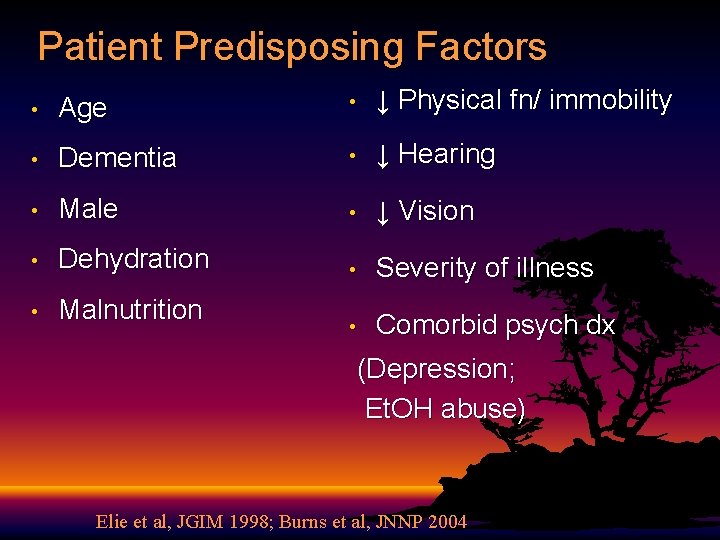
Patient Predisposing Factors • Age • ↓ Physical fn/ immobility • Dementia • ↓ Hearing • Male • ↓ Vision • Dehydration • Severity of illness • Malnutrition • Comorbid psych dx (Depression; Et. OH abuse) Elie et al, JGIM 1998; Burns et al, JNNP 2004
Environmental Predisposing Factors • # of room changes • Bladder catheter • Absent clock/watch • ICU or LTC • Absent reading glasses • Restraints • Absence of family Mc. Cusker et al, JAGS 2001
Delirium Precipitants Prospective study incidence of delirium 229 elderly medical inpatients • • Fluid/ electrolyte dysfunction (40%) Infection (40%) Drugs (30%) Metabolic/Endo (26%) Sensory/ Environmental (24%) ß perfusion/ß O 2 (14%) Neurological Et. OH/Drug Withdrawal **No clear precipitant in 15 – 25% Francis et al, JAMA 1990
Delirium Workup History: time course of mental status changes association with other events (i. e. . meds, illness) Pre-existing impairments of cognition or sensory modalities
Physical Exam • Vitals: normal range of BP, HR, p. O 2, Temp • Good physical exam: particular emphasis on Cardiac, pulmonary and neurological systems • Hydration status (dry axilla = dehyd!) • Also rule out • fecal impaction • urinary retention (bladder U/S, in-and-out catheter) • Infected decubitis ulcer
Treatment and Management • Identify and “correct the correctibles” • Multiple causes in elderly • Careful monitoring • Place patient near nursing station (1: 1) • VS, I & O, O 2 • Reduce psychiatric symptomatology • Agitation • Psychosis • Discontinue nonessential medication • Drug toxicity and drug induced delirium is most common • See Medical Letter - Drugs that cause psychiatric symptoms • (Larsen et al. , J Gerontol, 1985)
Treatment and Management • ENVIRONMENTAL • Restraints often indicated: posies, vests, mitts, helmets, geri-chairs, locked leathers • Provide cognitive structure, emotional support to patient and loved ones • Make sure behavioral monitoring is adequate and if empathy exists • Soft light, clock, familiar objects from home
Nonspecific Treatment of Delirium, Mild Agitation, Lability, and Psychosis A Case for Psychopharmacology
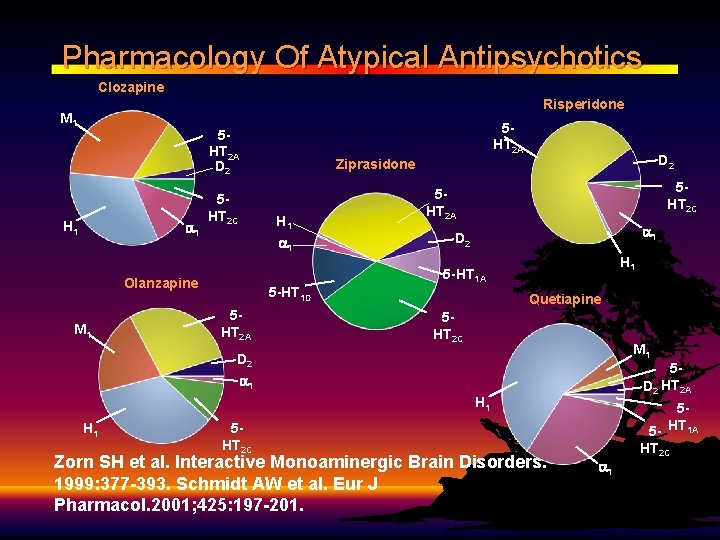
Pharmacology Of Atypical Antipsychotics Clozapine Risperidone M 1 5 HT 2 A D 2 1 H 1 5 HT 2 C H 1 1 5 HT 2 C 5 HT 2 A 1 D 2 H 1 5 -HT 1 A Olanzapine M 1 D 2 Ziprasidone 5 -HT 1 D 5 HT 2 A Quetiapine 5 HT 2 C M 1 D 2 5 D 2 HT 2 A 1 H 1 5 HT 2 C Zorn SH et al. Interactive Monoaminergic Brain Disorders. 1999: 377 -393. Schmidt AW et al. Eur J Pharmacol. 2001; 425: 197 -201. 1 55 - HT 1 A HT 2 C
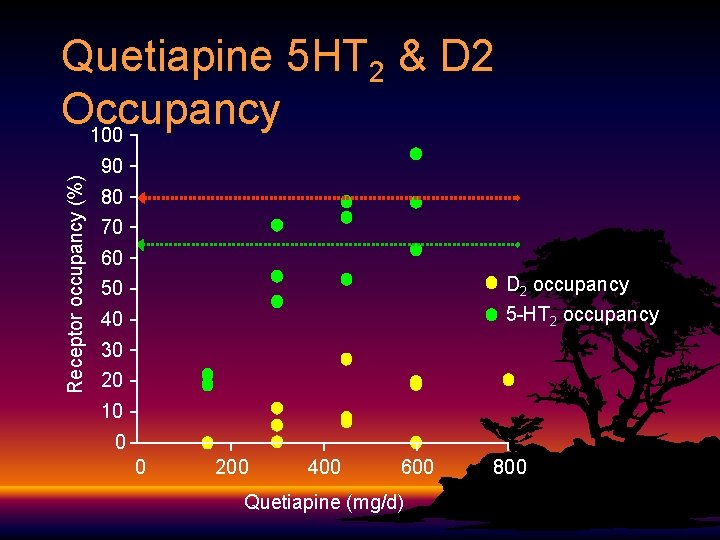
Receptor occupancy (%) Quetiapine 5 HT 2 & D 2 Occupancy 100 90 80 70 60 D 2 occupancy 5 -HT 2 occupancy 50 40 30 20 10 0 0 200 400 600 Quetiapine (mg/d) 800
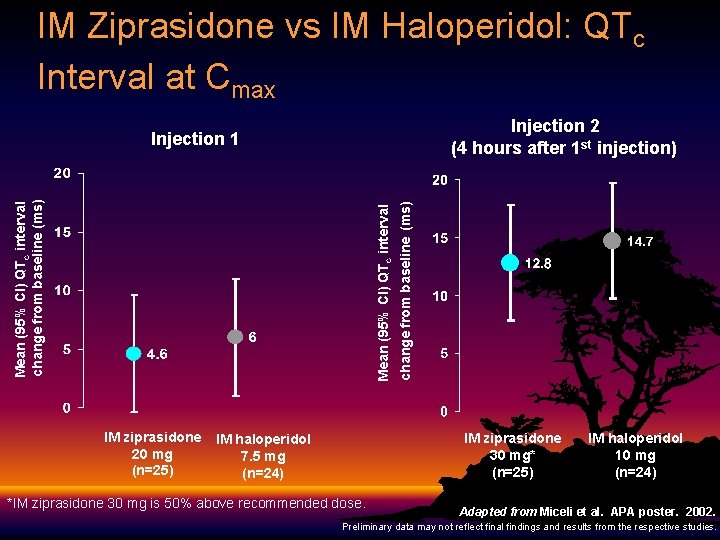
IM Ziprasidone vs IM Haloperidol: QTc Interval at Cmax Injection 2 (4 hours after 1 st injection) IM ziprasidone 20 mg (n=25) change from baseline (ms) Mean (95% CI) QTc interval change from baseline (ms) Injection 1 IM ziprasidone 30 mg* (n=25) IM haloperidol 7. 5 mg (n=24) *IM ziprasidone 30 mg is 50% above recommended dose. IM haloperidol 10 mg (n=24) Adapted from Miceli et al. APA poster. 2002. Preliminary data may not reflect final findings and results from the respective studies.
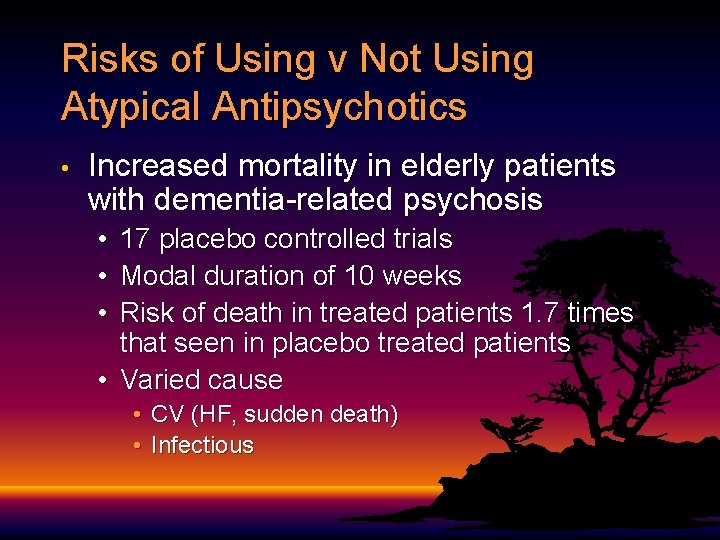
Risks of Using v Not Using Atypical Antipsychotics • Increased mortality in elderly patients with dementia-related psychosis • • • 17 placebo controlled trials Modal duration of 10 weeks Risk of death in treated patients 1. 7 times that seen in placebo treated patients • Varied cause • CV (HF, sudden death) • Infectious
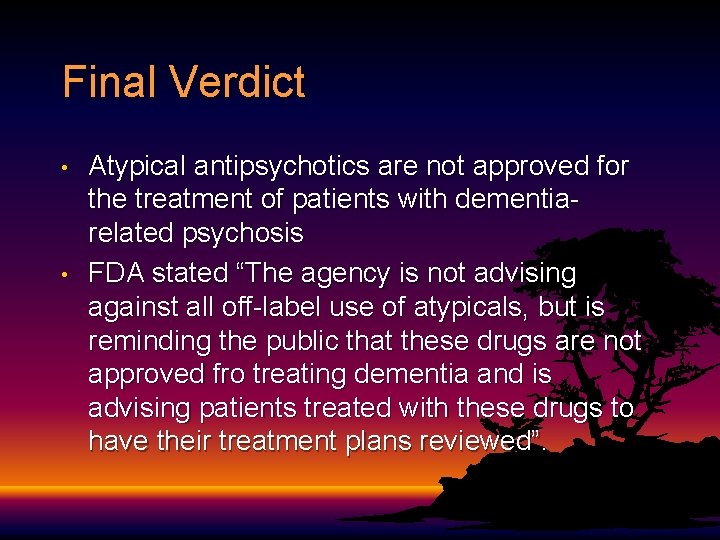
Final Verdict • • Atypical antipsychotics are not approved for the treatment of patients with dementiarelated psychosis FDA stated “The agency is not advising against all off-label use of atypicals, but is reminding the public that these drugs are not approved fro treating dementia and is advising patients treated with these drugs to have their treatment plans reviewed”.
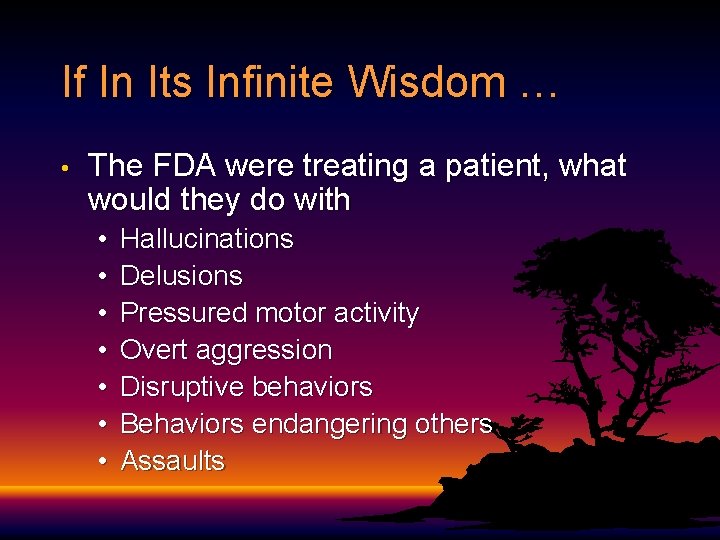
If In Its Infinite Wisdom … • The FDA were treating a patient, what would they do with • • Hallucinations Delusions Pressured motor activity Overt aggression Disruptive behaviors Behaviors endangering others Assaults
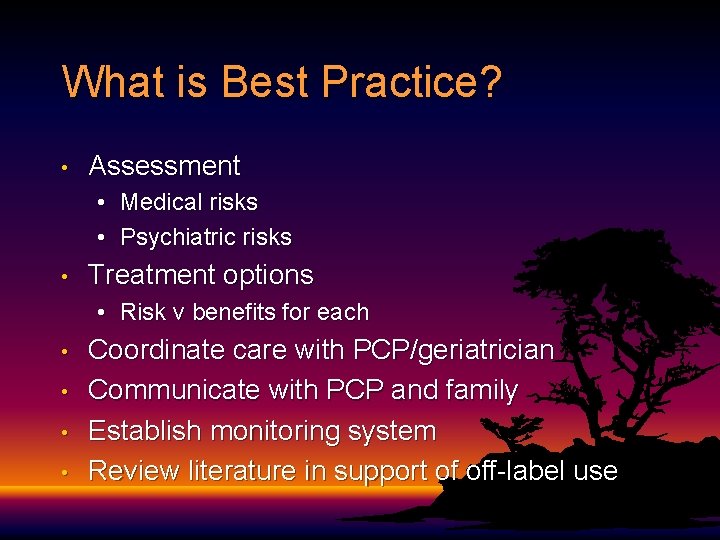
What is Best Practice? • Assessment • Medical risks • Psychiatric risks • Treatment options • Risk v benefits for each • • Coordinate care with PCP/geriatrician Communicate with PCP and family Establish monitoring system Review literature in support of off-label use
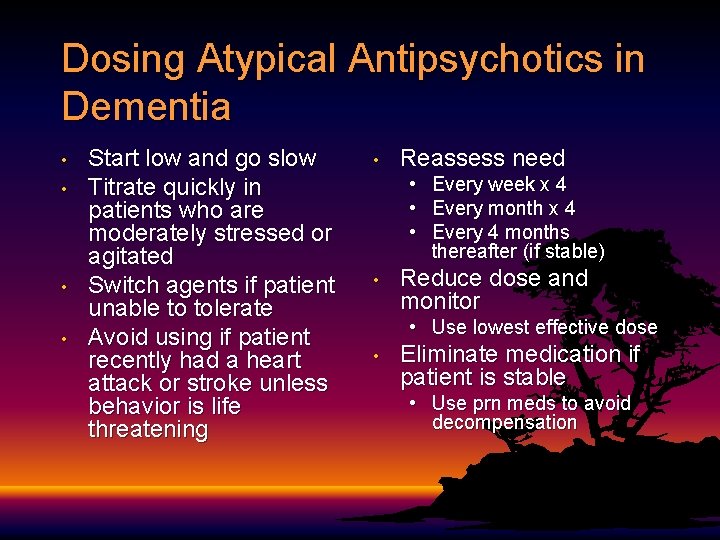
Dosing Atypical Antipsychotics in Dementia • • Start low and go slow Titrate quickly in patients who are moderately stressed or agitated Switch agents if patient unable to tolerate Avoid using if patient recently had a heart attack or stroke unless behavior is life threatening • Reassess need • Every week x 4 • Every month x 4 • Every 4 months thereafter (if stable) • Reduce dose and monitor • Use lowest effective dose • Eliminate medication if patient is stable • Use prn meds to avoid decompensation
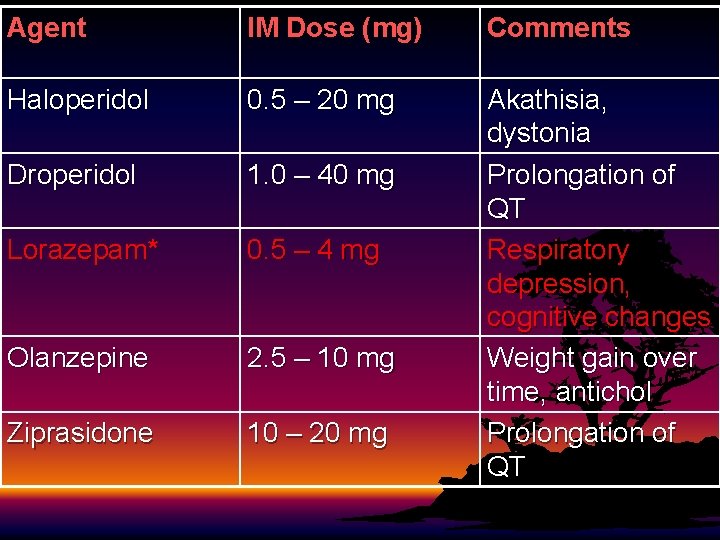
Agent IM Dose (mg) Comments Haloperidol 0. 5 – 20 mg Droperidol 1. 0 – 40 mg Lorazepam* 0. 5 – 4 mg Olanzepine 2. 5 – 10 mg Ziprasidone 10 – 20 mg Akathisia, dystonia Prolongation of QT Respiratory depression, cognitive changes Weight gain over time, antichol Prolongation of QT
Nonspecific Treatment of Moderate to Severe Delirium, Agitation, Lability, and Psychosis A Case for Psychopharmacology
IV-Haloperidol drug of choice • • Virtually no anticholinergic or hypotensive properties Generally does not suppress respirations Minimal cardiotoxicity Can be given parenterally without added toxicity
Treatment of Agitation: Protocol IV-HALOPERIDOL PROTOCOL • Mild: 1 -2 mg haloperidol iv • Moderate: 5 mg haloperidol iv • Severe: 10 mg haloperidol iv
Treatment of Agitation: Protocol MGH Protocol • Keep doubling the dose of iv haloperidol until calm • May require “mega” doses (2 grams/day) • When calm, administer 2/3 total in divided doses • Taper by 10 -20% day MDAH Protocol • • Fix IV-H dose at 10 mg & add lorazepam Fix lorazepam dose at 10 mg THI Variant • Add opiate • Buprenorphine (0. 1 -0. 3 mg) to haloperidol-lorazepam • Hydropmorphone (0. 5 -2 mg) to haloperidol-lorazepam
Treatment of Severe Agitation: Protocol • If previous IV-H protocols fail • Trial of continous intravenous infusion of IV-H • 10 -50 mg/hour • 1 - 2 gms/day • Trial of droperidol but greater propensity for hypotension limits use in cardiovascular patients • Add opiate • Propofol (FDA approved) • Paralysis
Non-pharmacological Interventions A Case For Risk Factor Reduction
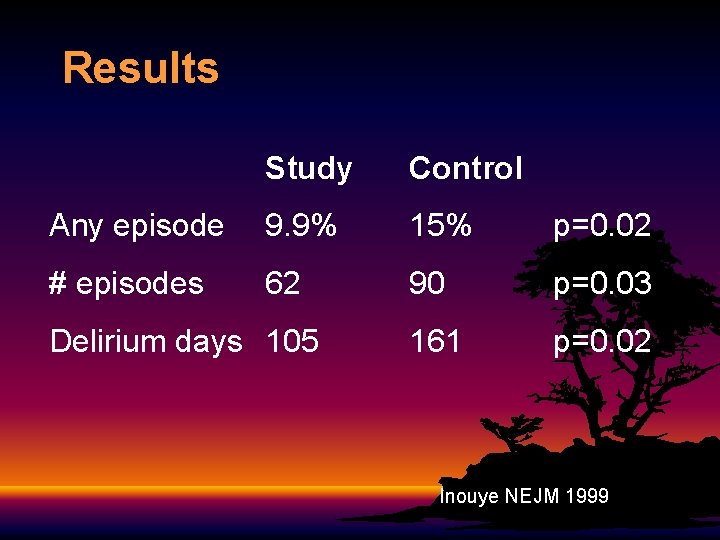
Interventions To Prevent Delirium • • • 852 patients aged 70+ Prospective matching of patients on intervention unit with patients on 2 usual care units Risk factor reduction strategy targetting: • • • cognitive impairment sleep deprivation immobility visual impairment dehydration
Treatment and Management • Unambiguous communication • • • Glasses, hearing aids etc. . . Avoid medical jargon Communicate succinctly & clearly Make contact while communicating Translators if necessary Cole et al, CMAJ 2002; Conn & Lieff, Can Fam Phys 2001; Inouye et al, JAGS 2000
Treatment and Management • Provide cognitive structure, emotional support to patient and loved ones • • • Same staff Quiet; avoid excess noise/stimulation Simplify space Maximize uninterrupted sleep Restraints as last resort for patient safety Make sure behavioral monitoring is adequate and if empathy exists Cole et al, CMAJ 2002; Conn & Lieff, Can Fam Phys 2001; Inouye et al, JAGS 2000
Treatment and Management • Maintain function • • Fluid balance and hydration Adequate nutrition Encourage self-care Walk with assistance or range of motion • Minimum – 3 times/day Cole et al, CMAJ 2002; Conn & Lieff, Can Fam Phys 2001; Inouye et al, JAGS 2000
Results Study Control Any episode 9. 9% 15% p=0. 02 # episodes 62 90 p=0. 03 161 p=0. 02 Delirium days 105 Inouye NEJM 1999
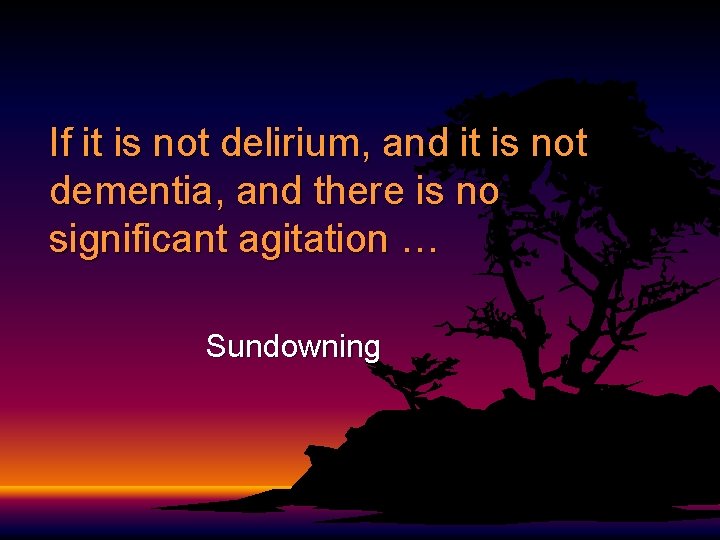
If it is not delirium, and it is not dementia, and there is no significant agitation … Sundowning
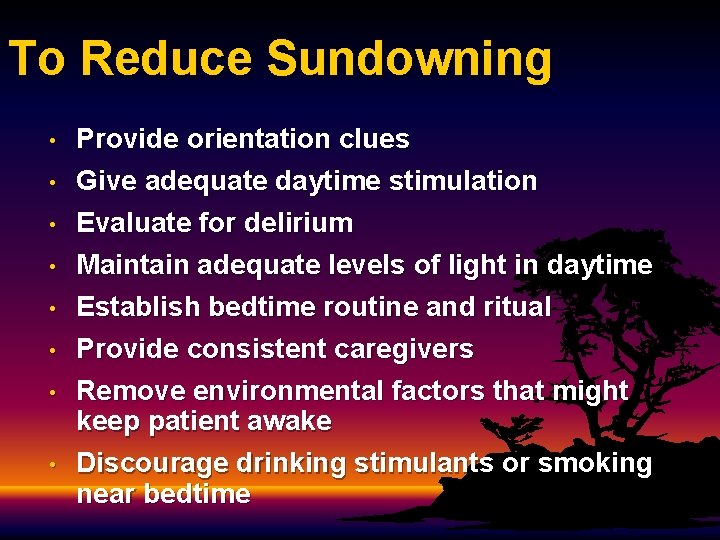
To Reduce Sundowning • • Provide orientation clues Give adequate daytime stimulation Evaluate for delirium Maintain adequate levels of light in daytime Establish bedtime routine and ritual Provide consistent caregivers Remove environmental factors that might keep patient awake Discourage drinking stimulants or smoking near bedtime
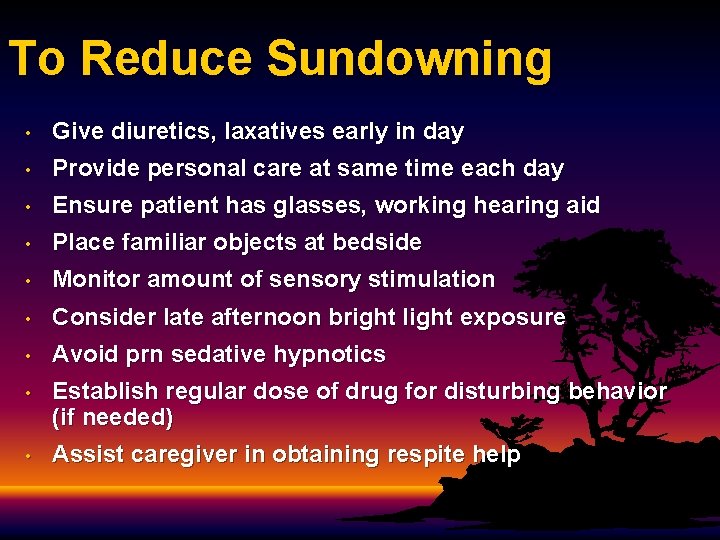
To Reduce Sundowning • Give diuretics, laxatives early in day • Provide personal care at same time each day • Ensure patient has glasses, working hearing aid • Place familiar objects at bedside • Monitor amount of sensory stimulation • Consider late afternoon bright light exposure • Avoid prn sedative hypnotics • Establish regular dose of drug for disturbing behavior (if needed) • Assist caregiver in obtaining respite help
If You Want to Run With the Texas Wild Dogs …. You Can’t Pee Like a Puppy!