
The Geopolitics of Military Bases Author Menry Fernndez
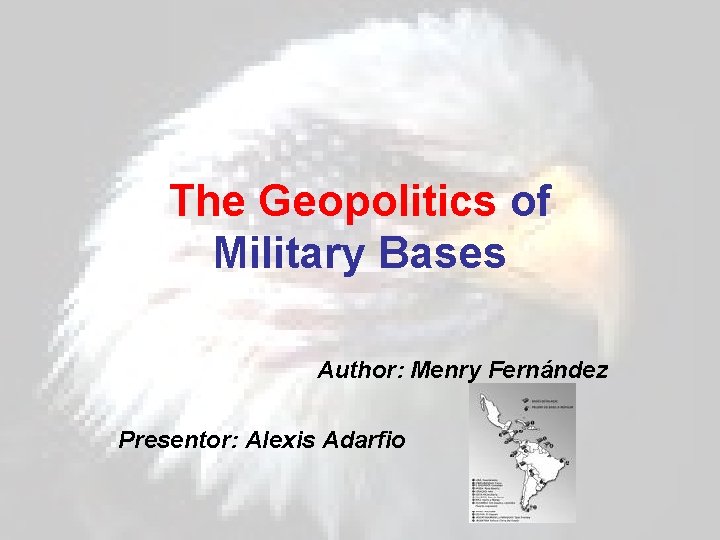
The Geopolitics of Military Bases Author: Menry Fernández Presentor: Alexis Adarfio
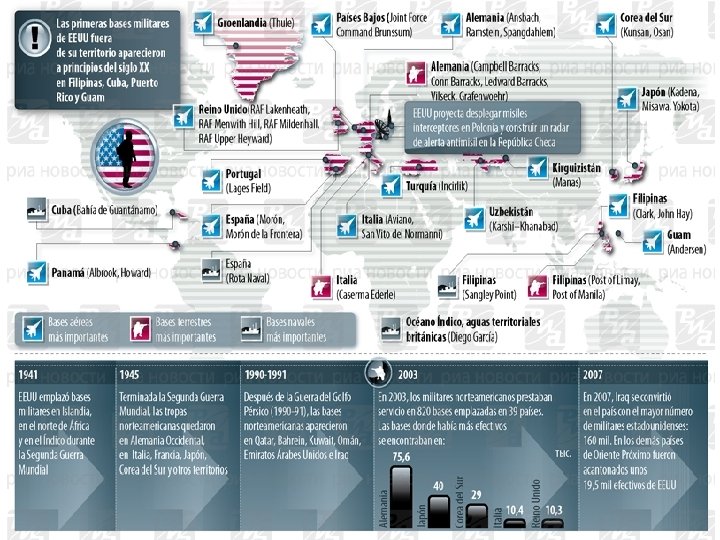
INTERESTING DATA IMPERIALIST BASES FOR WAR • In 2005, the US has 737 military bases. • With the situation in Afghanistan and the war strategy against Iran, the number of overseas bases continues to grow. • In 2005, thirty-eight (38) medium and large sized U. S military installations (mostly composed of air and naval bases) almost exactly match the thirty-six (36) British garrisons and naval bases in the zenith of its imperial period in 1898.
INTERESTING DATA IMPERIALIST BASES FOR WAR • The Roman Empire at its height, in 117 AC, needed thirtyseven (37) large facilities to guard their possessions from Britain to Egypt, from Spain to Armenia. • Perhaps the optimum number of great forts and garrisons for an imperialist aspiring to dominate the world is around thirtyfive (35) and forty (40). • For the fiscal year 2005, the Pentagon bureaucrats had calculated the value of its overseas bases to at least 127, 000 million dollars, exceeding the GDP of many countries.
INTERESTING DATA IMPERIALIST BASES FOR WAR • In 2005, total U. S. military personnel worldwide was 1, 840, 062, aided by 473, 306 civil servants from the Department of Defense and 203, 528 local hires. • Its overseas bases, according to the Pentagon, have 32, 327 barracks, hangars, hospitals and other buildings it owns, and 16, 527 more for rent. • The size of these facilities, reflected in the inventory, took 2, 782, 693, 309 m 2 on the outside, making the Pentagon the largest landowner in the world. • The Base Structure Report (Report on the Structure of Bases) of 2005 does not reflect, for instance, any garrisons in Kosovo, despite being the seat of the huge Camp Bondsteel, built in 1999 and maintained ever since by the multinational KBR (formerly known as Kellogg Brown & Root), a subsidiary of Halliburton Corporation of Houston.
INTERESTING DATA IMPERIALIST BASES FOR WAR • The report also excludes bases in Afghanistan and Iraq (106 garrisons in May 2005), Israel, Qatar and Uzbekistan, among others, although the U. S. military has established colossal base structures in the region of Persian Gulf and Central Asia from September 11. • As an excuse, a note in the preface says that "the facilities offered by other countries in foreign locations" are not included, although this is not strictly true. The report includes twenty facilities in Turkey, all owned by the Turkish government and jointly operated with the Americans.
INTERESTING DATA IMPERIALIST BASES FOR WAR • After the collapse of the Soviet Union in 1991, it was obvious to many that the huge concentrations of military forces in Germany, Italy, Japan and South Korea were no longer needed to face any military threat since there would be future wars with the Soviet Union or any other country in the area. • In 1991, the first Bush administration should have begun decommissioning or redeploying the remaining troops. In fact, the Clinton administration closed some bases in Germany. But there was really nothing in those years to plan new strategy to reposition the U. S. military outside the United States.
INTERESTING DATA IMPERIALIST BASES FOR WAR • In the late 1990 s, the neoconservatives were developing their grandiose theories to promote openly the imperialism of the "lone superpower, " which included preemptive, preventive and unilateral military actions, spreading democracy abroad at gunpoint, to obstruct the growth any country or bloc of countries that might pose a challenge to U. S. military supremacy and the idea of a Middle East "democracy" that supplies all the oil we need. • One component of this great project was the redeployment and strengthening the US military airlift capability. • The events of September 11 and the Global War on Terror were the “perfect excuse". . .
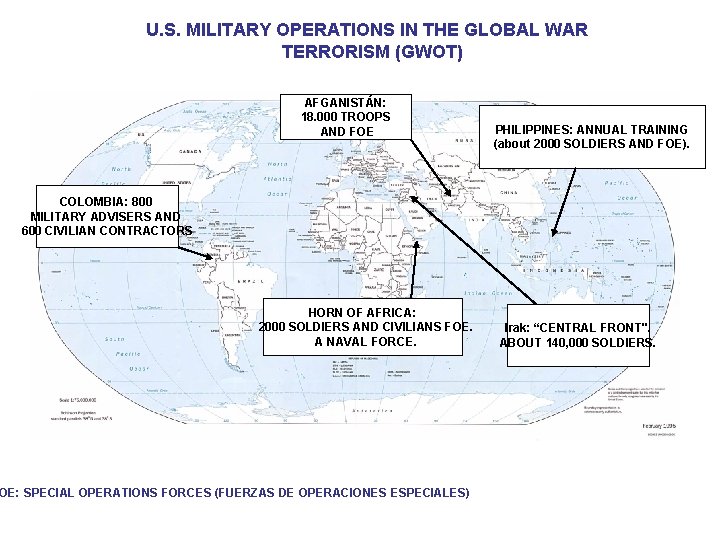
U. S. MILITARY OPERATIONS IN THE GLOBAL WAR TERRORISM (GWOT) AFGANISTÁN: 18. 000 TROOPS AND FOE PHILIPPINES: ANNUAL TRAINING (about 2000 SOLDIERS AND FOE). COLOMBIA: 800 MILITARY ADVISERS AND 600 CIVILIAN CONTRACTORS HORN OF AFRICA: 2000 SOLDIERS AND CIVILIANS FOE. A NAVAL FORCE. OE: SPECIAL OPERATIONS FORCES (FUERZAS DE OPERACIONES ESPECIALES) Irak: “CENTRAL FRONT". ABOUT 140, 000 SOLDIERS.
AMERICAN BASES IN THE WORLD In previous times, one could establish the extent of imperialism by counting colonies. The U. S. version of the colony is the military base and if we observe changes in global political basis, we can learn much about the expansion of the "footprints" of imperialism and the militarism that grows with them.
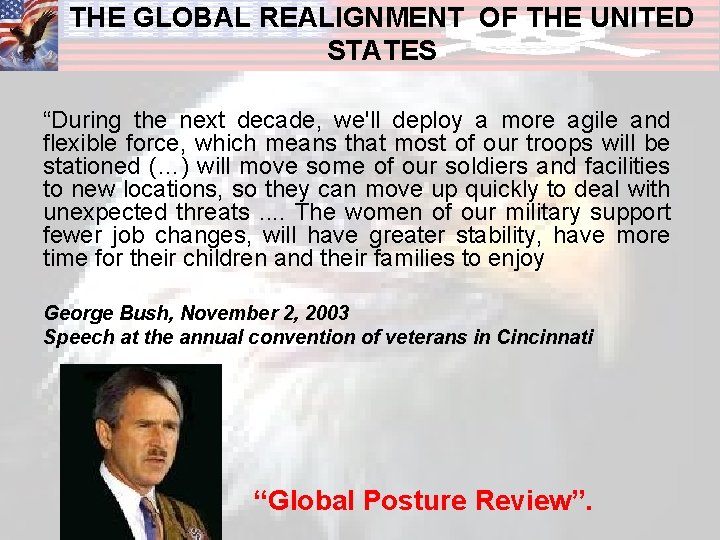
THE GLOBAL REALIGNMENT OF THE UNITED STATES “During the next decade, we'll deploy a more agile and flexible force, which means that most of our troops will be stationed (…) will move some of our soldiers and facilities to new locations, so they can move up quickly to deal with unexpected threats. . The women of our military support fewer job changes, will have greater stability, have more time for their children and their families to enjoy George Bush, November 2, 2003 Speech at the annual convention of veterans in Cincinnati “Global Posture Review”.
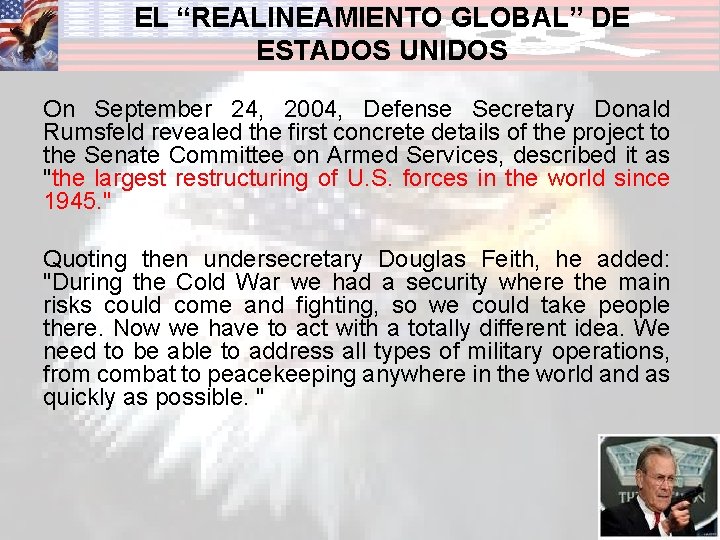
EL “REALINEAMIENTO GLOBAL” DE ESTADOS UNIDOS On September 24, 2004, Defense Secretary Donald Rumsfeld revealed the first concrete details of the project to the Senate Committee on Armed Services, described it as "the largest restructuring of U. S. forces in the world since 1945. " Quoting then undersecretary Douglas Feith, he added: "During the Cold War we had a security where the main risks could come and fighting, so we could take people there. Now we have to act with a totally different idea. We need to be able to address all types of military operations, from combat to peacekeeping anywhere in the world and as quickly as possible. "
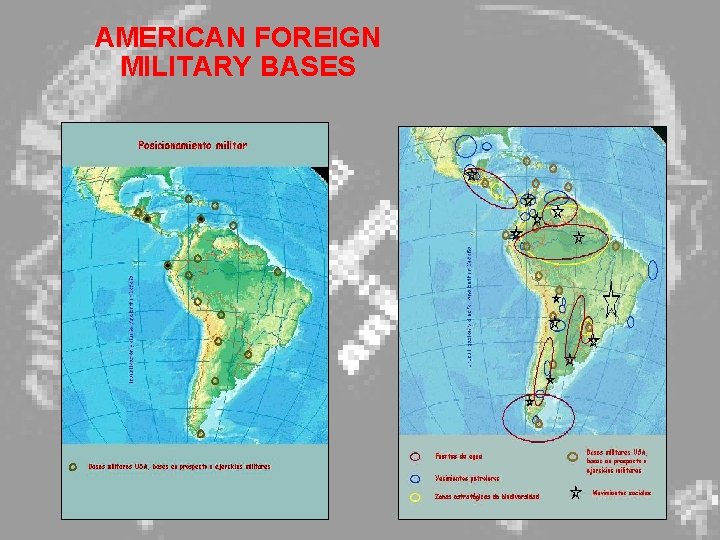
AMERICAN FOREIGN MILITARY BASES
PLATOFORM OF IMPERIAL AGGRESSION AGAINST LATIN AMERICA • The United States has gradually restructured to have a platform of imperialist aggression against the "democratic spring" continental and especially against the liberation processes in Venezuela, Ecuador, Bolivia, Nicaragua and the formidable social movements in Brazil and Peru. • Platform to export senile imperialism, militarization to address its risis and lack of essential natural resources: oil, coal, water, biodiversity, strategic minerals which they greedily want to control. • Platform of aggression from a string of U. S. military bases designed to relaunch the regional counter-plan and military occupation of the Amazon, for which they immediately proposed to try to crush a popular insurgency and strong civil resistance and reversing the process in Venezuela, Ecuador and Bolivia, change the balance of forces in Brazil in favor of the hard right and contain the possibility of turning to the left in Peru.
LA PLATAFORMA DE AGRESIÓN IMPERIAL CONTRA AMERICA LATINA • Bases are a powerful imperialist platform, reinforced by troops and highly specialized units from the regular U. S. forces and privatized bodies, and located in various countries of our continent endowed with sophisticated techniques of war, in collusion with national oligarchies and open violation of national sovereignty. • Armed Services Platform are also acting as an army of occupation in each of their countries, very large and fanatical, experienced for decades in wars of low and medium intensity. Now operating in two levels: internal and external, with many paramilitary units in the process of recovery and expansion, and with plenty of resources available.
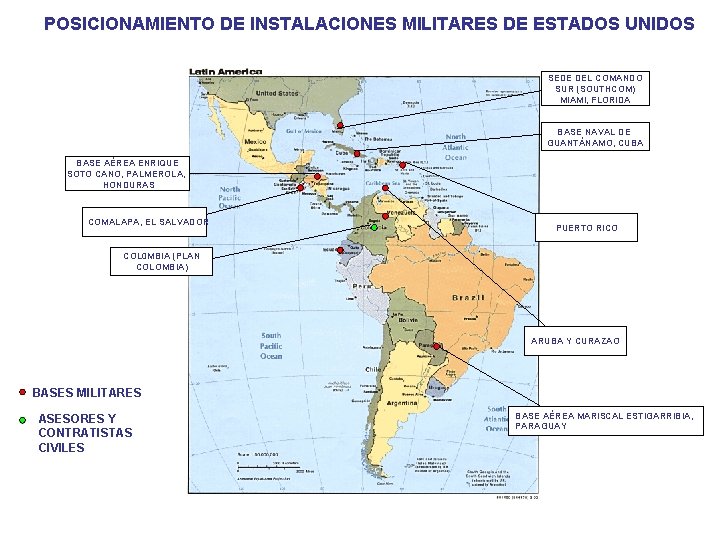
POSICIONAMIENTO DE INSTALACIONES MILITARES DE ESTADOS UNIDOS SEDE DEL COMANDO SUR (SOUTHCOM) MIAMI, FLORIDA BASE NAVAL DE GUANTÁNAMO, CUBA BASE AÉREA ENRIQUE SOTO CANO, PALMEROLA, HONDURAS COMALAPA, EL SALVADOR PUERTO RICO COL 0 MBIA (PLAN COLOMBIA) ARUBA Y CURAZAO BASES MILITARES ASESORES Y CONTRATISTAS CIVILES BASE AÉREA MARISCAL ESTIGARRIBIA, PARAGUAY
LA COMPLICIDAD IMPERIAL COLOMBIANA In some cases, foreign countries themselves have tried to keep secret its U. S. bases for fear of the consequences of revealing their complicity with U. S. imperialism. In others, the Pentagon encouraged the construction of geopolitical efforts to control sources of energy or maintain a network of bases to make it possible to impose its hegemony regardless of the wishes of any government.
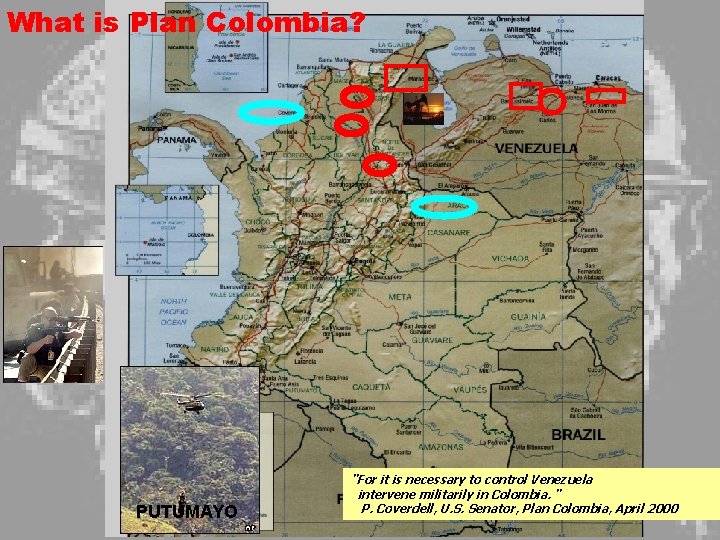
What is Plan Colombia? PUTUMAYO "For it is necessary to control Venezuela intervene militarily in Colombia. " P. Coverdell, U. S. Senator, Plan Colombia, April 2000
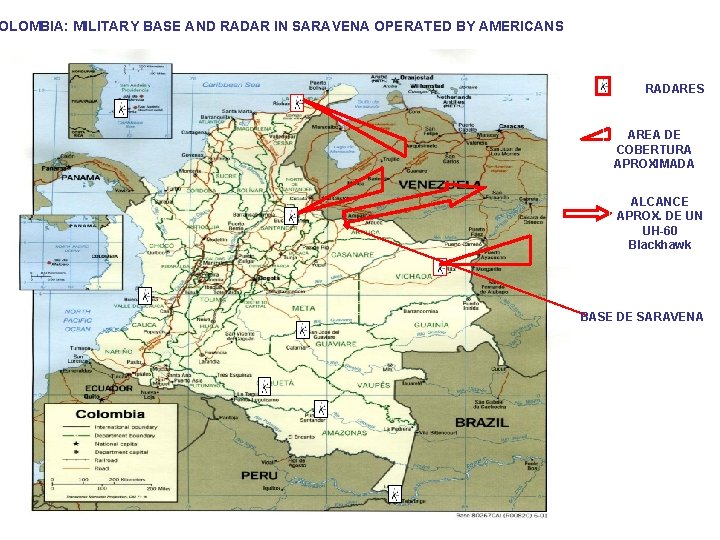
OLOMBIA: MILITARY BASE AND RADAR IN SARAVENA OPERATED BY AMERICANS RADARES AREA DE COBERTURA APROXIMADA ALCANCE APROX. DE UN UH-60 Blackhawk BASE DE SARAVENA
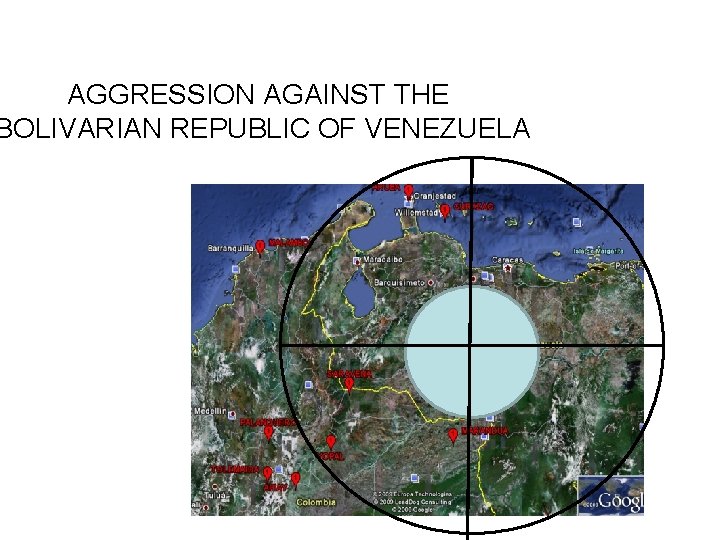
AGGRESSION AGAINST THE BOLIVARIAN REPUBLIC OF VENEZUELA
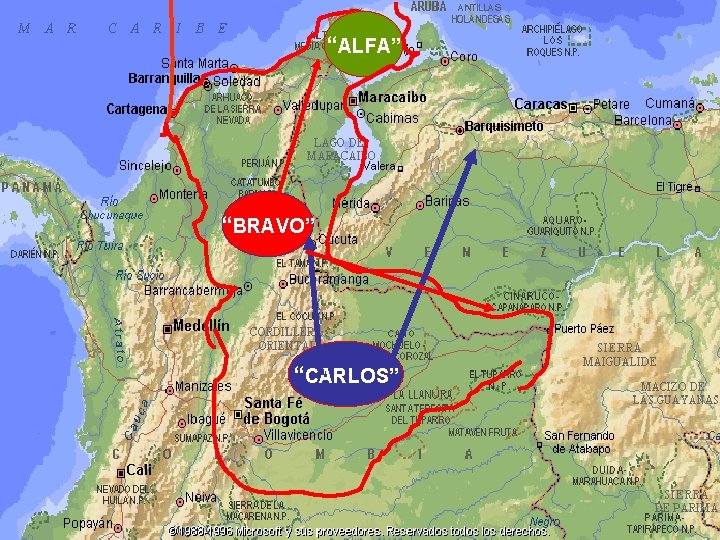
“ALFA” “BRAVO” “CARLOS”
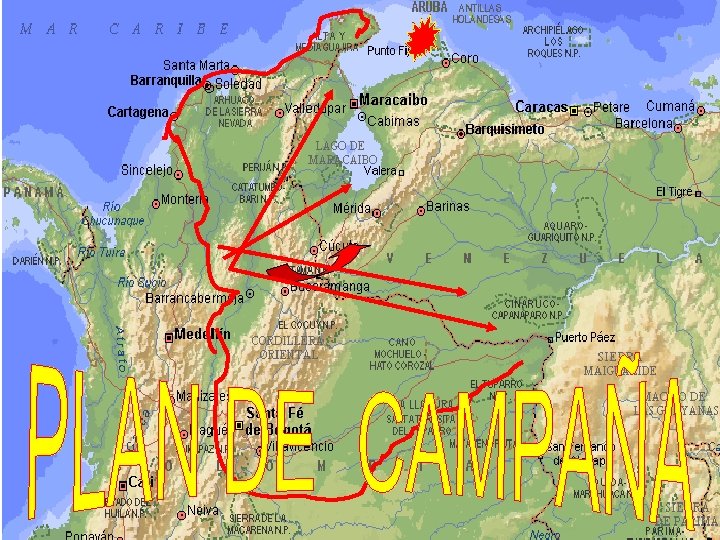
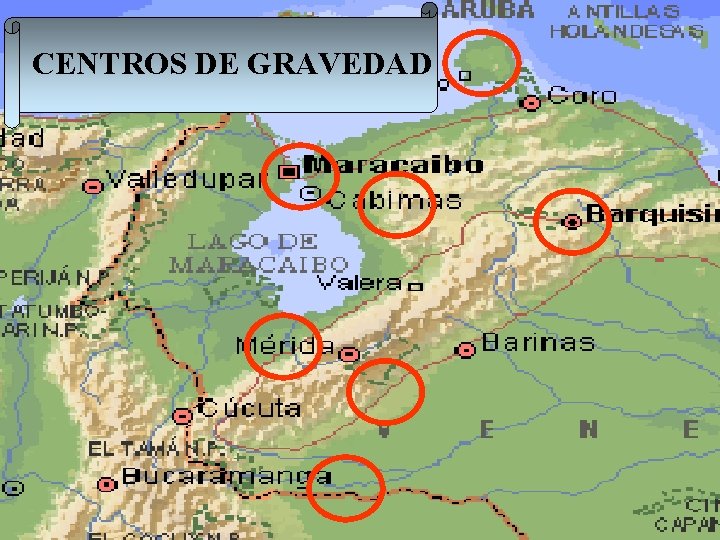
CENTROS DE GRAVEDAD
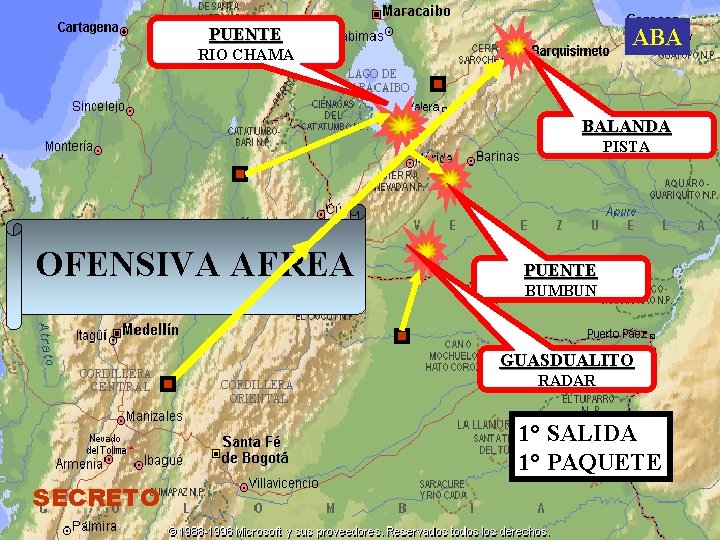
ABA PUENTE RIO CHAMA BALANDA PISTA 7 0 7 B- OFENSIVA AEREA PUENTE BUMBUN GUASDUALITO RADAR 1° SALIDA 1° PAQUETE SECRETO
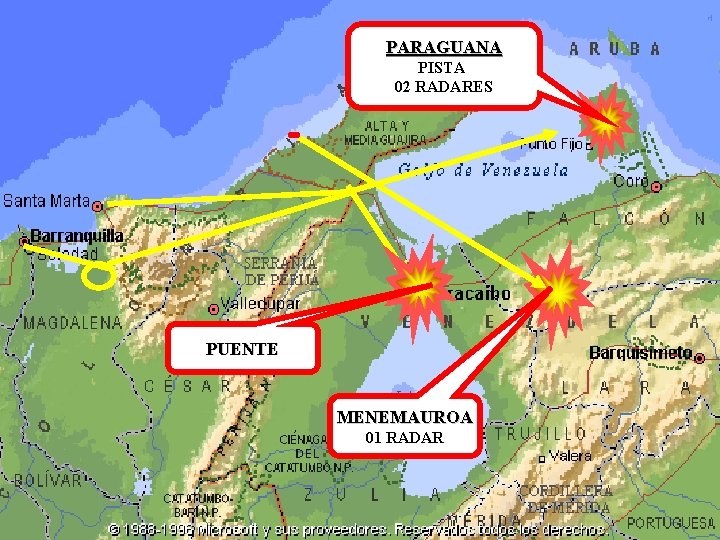
PARAGUANA PISTA 02 RADARES PUENTE MENEMAUROA 01 RADAR
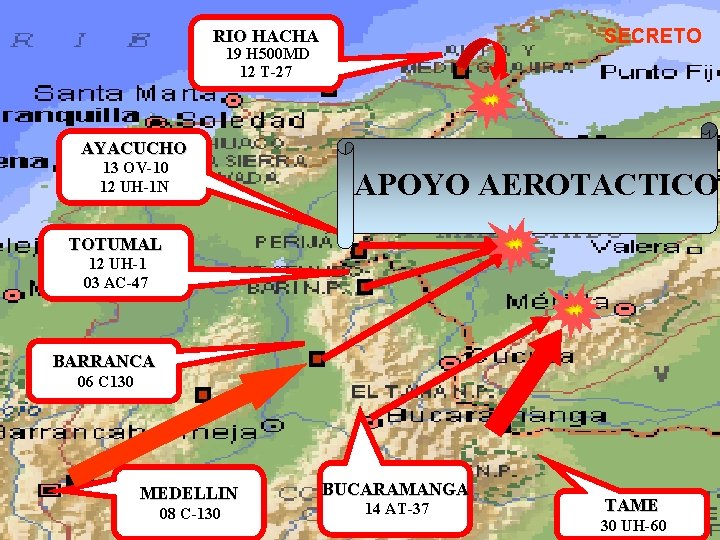
SECRETO RIO HACHA 19 H 500 MD 12 T-27 AYACUCHO 13 OV-10 12 UH-1 N APOYO AEROTACTICO TOTUMAL 12 UH-1 03 AC-47 BARRANCA 06 C 130 MEDELLIN 08 C-130 BUCARAMANGA 14 AT-37 TAME 30 UH-60

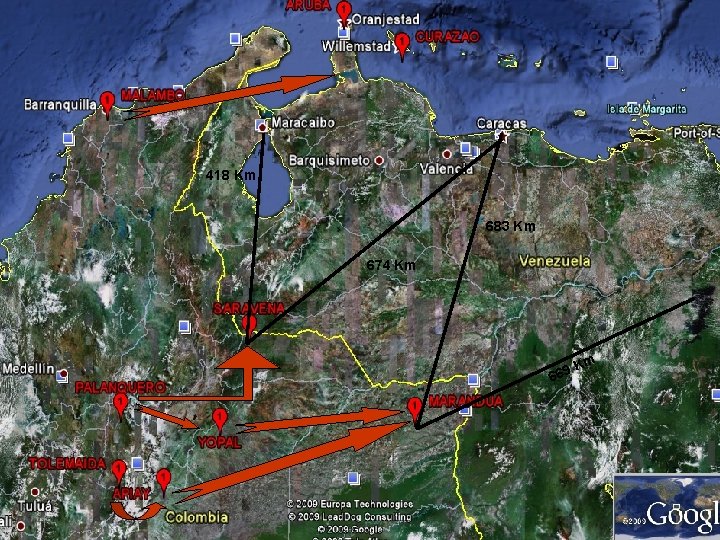
418 Km 683 Km 674 Km 669 Km
LA “DIPLOMACIA COLOMBIANA” DE LAS BASES MILITARES • The Colombian state power and the pro-imperialist oligarchy that supports it, the gangster government that administers it, have used a pro-imperialist violent and aggressive strategy which runs counter to the peace and integration of Latin American peoples under the banner of Bolivar. • Uribe's move to accept U. S. military bases on its territory not only coincides with the coup in Honduras and with the resumption in the country of the era of repressive stateterrorism, but is the same strategy of imperialist recolonization to submit the neighboring countries that have gotten out of hand prevent the progressive changes in gestation in other South American nations.
¿QUÉ HACER CON ESTA POLÍTICA PROIMPERIAL COLOMBIANA? • What should we do with this anti-Bolivarian, counterrevolutionary and anti-democratic monster? • Should we treat it as a "democracy" because they had "elections" and there the institutions are "elected"? • Will they consider a "respectable" state and government of a neighboring country? • How should we treat a "good neighbor"? • How should we respect sovereign decisions?
¿QUÉ HACER CON ESTA POLÍTICA PROIMPERIAL COLOMBIANA? • It's time to discuss things further. • The Colombian government should not be treated according to their simulations, or from simple diplomatic formalities. • The Colombian government should be condemned, rejected, isolated and politically harassed by all peace loving forces, freedom, democracy, justice and sovereignty. These forces are in government or outside, be they political, social, cultural or religious. Bases para la Paz
CONCLUSIONES • When the United States is not present in a country as a conqueror or a savior (as happened in Germany, Japan and Italy at the end of World War II and in South Korea after the armistice of 1953 in the Korean War) it is much more difficult to ensure the kind of agreements that allow the Pentagon to do what you want to force the host to take over much of the costs. • When not based on conquest, the structure of the U. S. empire of bases seems extremely fragile
CONCLUSIONES • In relation to the military siege that free and sovereign in Latin America popular governments are in, it is required to (as is becoming the commander Chavez) to strengthen and modernize the armies of the nations through appropriate military agreements such delicate circumstances (with Russia, China. . . ). • It requires above all a design and preparation for the popular war of resistance (or of all people threatened) to deter aggressors in their war plans or unable to impose, if they dare unleash.
CONCLUSIONES • Besides the importance and the relative value of efforts to reduce the enormous digital divide from the logic of war between regular armies, is shown only from a perspective of people's war of resistance would be possible to counteract and render the military-technical superiority huge and by large U. S. bases located close to our countries war. • It is necessary to advance rapidly in the South American Defense Council and the Military ALBA agreements.
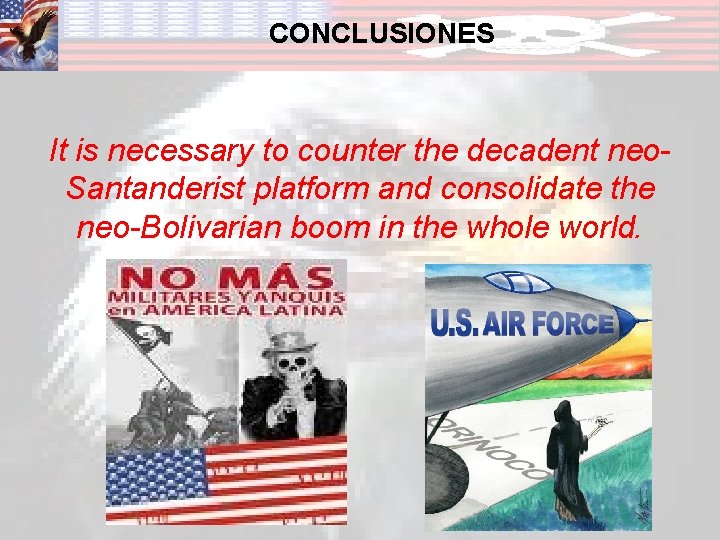
CONCLUSIONES It is necessary to counter the decadent neo. Santanderist platform and consolidate the neo-Bolivarian boom in the whole world.
- Slides: 35