
The Competition Model Eva M Fernndez Queens College
- Slides: 29
The Competition Model Eva M. Fernández Queens College & Graduate Center City University of New York
Historical backdrop Questions about how two languages coexist pinned against questions about how a second language is acquired § Pre-Chomskyan era: § Language = speech § Language is a set of habits, learned by exposure and practice § Operant conditioning: rewards and punishments
Historical backdrop § L 1 acquisition research: § Developmental stages common to all children § Developmental errors, even when ungrammatical forms don’t occur in the environment § L 2 acquisition research: § Learner errors are highly suggestive of internal development: § Errors resemble those made by children § Errors aren’t always traceable to L 1
Historical backdrop § Intellectual motivation: Chomsky (and others): § Language is not habit formation: it’s implicit, mental, and biological § Proof: § Competence ~ performance § Competence (grammar) very similar across languages, hugely complex, vastly underrepresented in the stimulus § Plato’s problem: solved by the proposal that most of what you know about language is innate
Historical backdrop § Chomskyan research program: study competence via the idealized speaker/hearer, whose competence developed: § Instantly § In a purely homogeneous speech community § Without memory/performance limitations § Huh? !
Historical backdrop § Interlanguage, and attention returns to transfer: § During acquisition § At the steady state § At different levels of analysis: phonology, syntax, semantics, lexicon § Competition Model is one model set up to account for transfer effects, more sophisticated than most, because transfer isn’t unidirectional, L 1 L 2
Competition Model (CM) § Kathryn Bates, Brian Mac. Whinney 1970 s, 1980 s-ff. § Cues compete, and the processor weighs them, to arrive at the interpretation of sentences § Cross-linguistic differences in how cues are weighed by speakers of different languages § Such differences bear on the way bilinguals process their two languages
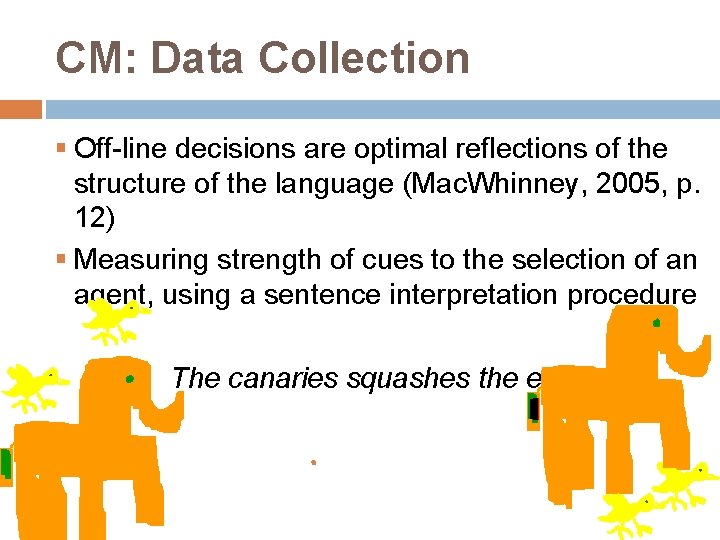
CM: Data Collection § Off-line decisions are optimal reflections of the structure of the language (Mac. Whinney, 2005, p. 12) § Measuring strength of cues to the selection of an agent, using a sentence interpretation procedure The canaries squashes the elephant.
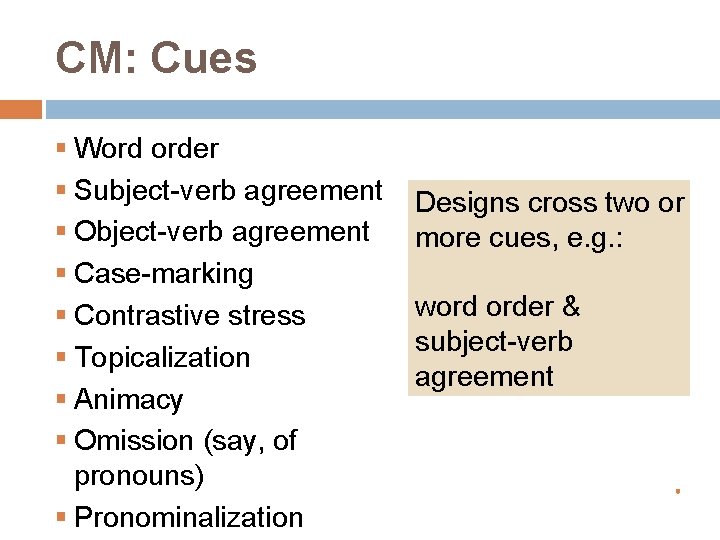
CM: Cues § Word order § Subject-verb agreement § Object-verb agreement § Case-marking § Contrastive stress § Topicalization § Animacy § Omission (say, of pronouns) § Pronominalization Designs cross two or more cues, e. g. : word order & subject-verb agreement
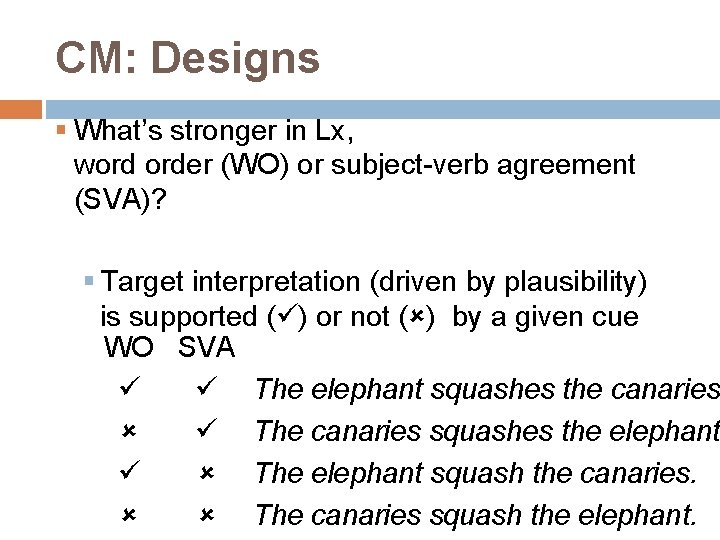
CM: Designs § What’s stronger in Lx, word order (WO) or subject-verb agreement (SVA)? § Target interpretation (driven by plausibility) is supported ( ) or not ( ) by a given cue WO SVA The elephant squashes the canaries The canaries squashes the elephant The elephant squash the canaries. The canaries squash the elephant.
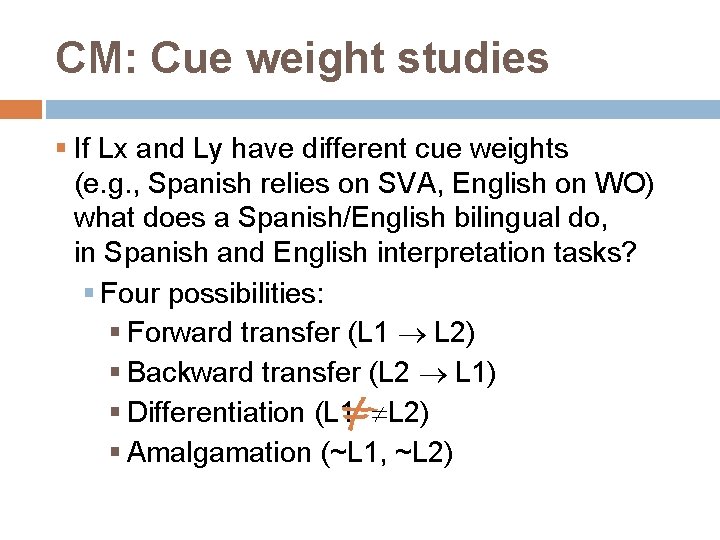
CM: Cue weight studies § If Lx and Ly have different cue weights (e. g. , Spanish relies on SVA, English on WO) what does a Spanish/English bilingual do, in Spanish and English interpretation tasks? § Four possibilities: § Forward transfer (L 1 L 2) § Backward transfer (L 2 L 1) § Differentiation (L 1 L 2) § Amalgamation (~L 1, ~L 2)
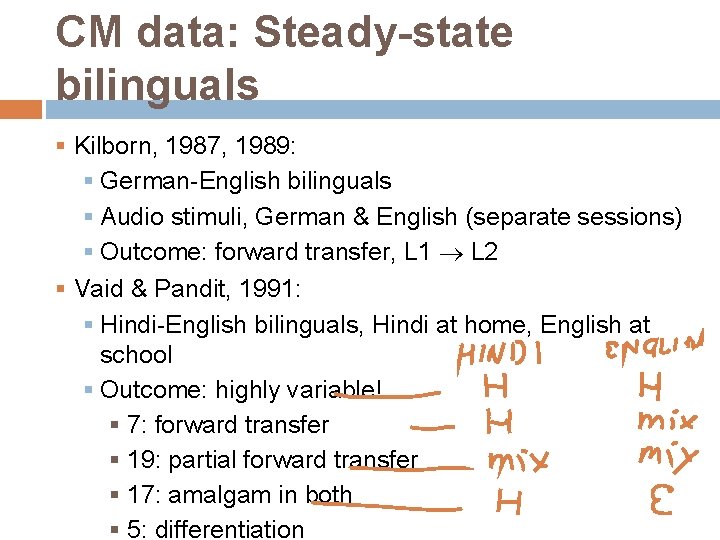
CM data: Steady-state bilinguals § Kilborn, 1987, 1989: § German-English bilinguals § Audio stimuli, German & English (separate sessions) § Outcome: forward transfer, L 1 L 2 § Vaid & Pandit, 1991: § Hindi-English bilinguals, Hindi at home, English at school § Outcome: highly variable! § 7: forward transfer § 19: partial forward transfer § 17: amalgam in both § 5: differentiation
CM data: Interlanguages in flux § Mc. Donald, 1987, 1989 (see Figs. 2 -3, Mac. Whinney): § Late English-French billinguals, 1 st-4 th semester § Clear forward transfer throughout, but by 4 th semester, strategies look like for adult bilinguals § Liu et al. , 1992: § Chinese-English, English-Chinese, L 2 acquired early or late § Late acquirers: forward transfer
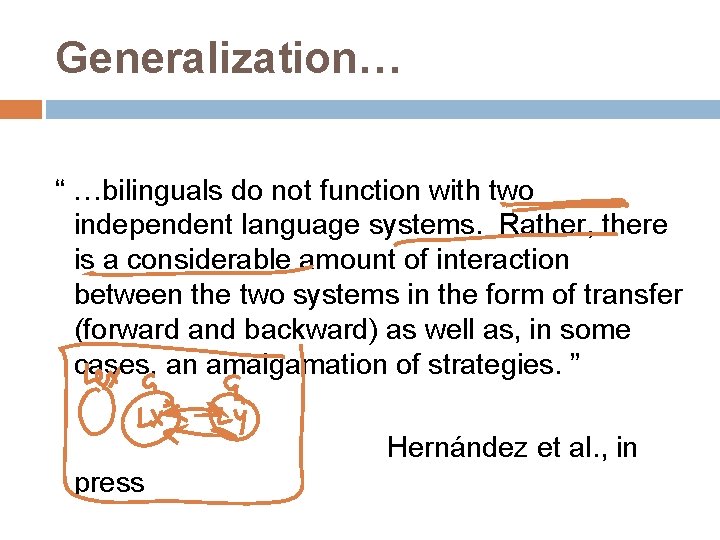
Generalization… “ …bilinguals do not function with two independent language systems. Rather, there is a considerable amount of interaction between the two systems in the form of transfer (forward and backward) as well as, in some cases, an amalgamation of strategies. ” Hernández et al. , in press
Mac. Whinney’s Unified Model § Beyond cue competition concepts that are core in CM, the Unified Model is meant to account for: § Language acquisition § Childhood multilingualism § Second language acquisition § Adult monolingualism § Is it meant to be a TOE*? * TOE = Theory of Everything
Cues and competition § PRODUCTION: Cues (forms) compete to express functions § PERCEPTION: Functions compete based on cues from surface forms § The outcome of such competition is determined by the relative strength of cues § Akin to Optimality Theory?
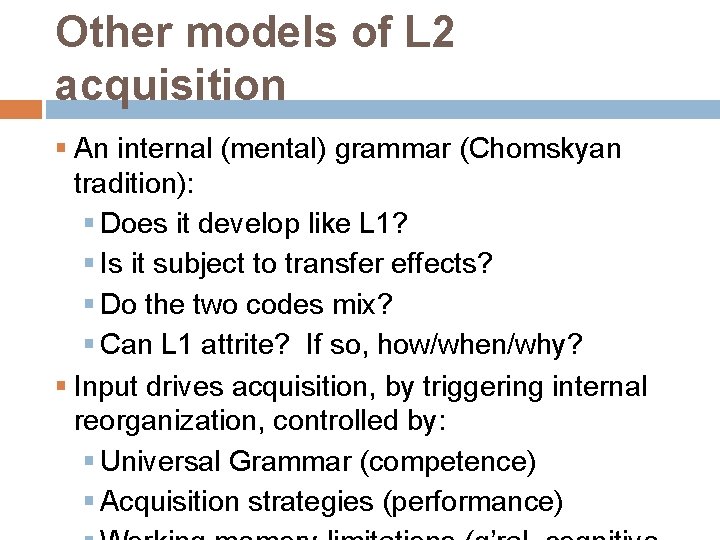
Other models of L 2 acquisition § An internal (mental) grammar (Chomskyan tradition): § Does it develop like L 1? § Is it subject to transfer effects? § Do the two codes mix? § Can L 1 attrite? If so, how/when/why? § Input drives acquisition, by triggering internal reorganization, controlled by: § Universal Grammar (competence) § Acquisition strategies (performance)
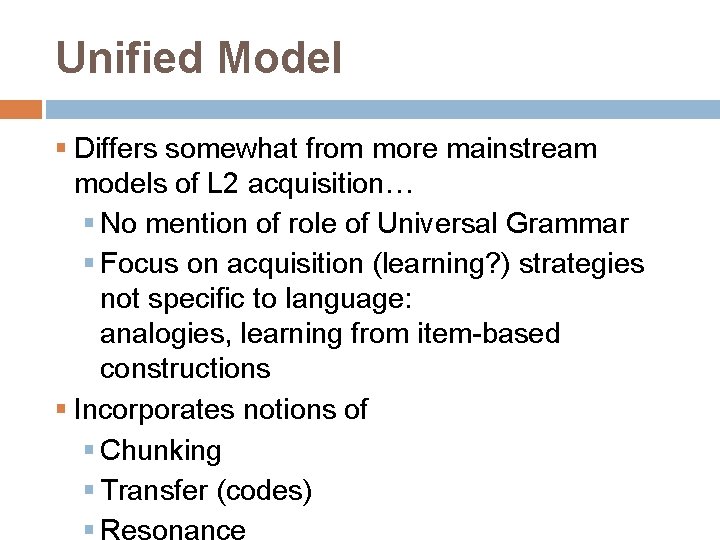
Unified Model § Differs somewhat from more mainstream models of L 2 acquisition… § No mention of role of Universal Grammar § Focus on acquisition (learning? ) strategies not specific to language: analogies, learning from item-based constructions § Incorporates notions of § Chunking § Transfer (codes)
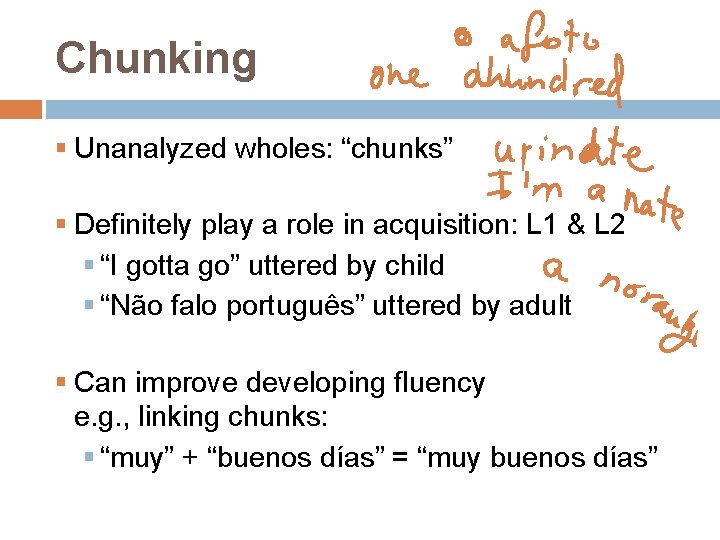
Chunking § Unanalyzed wholes: “chunks” § Definitely play a role in acquisition: L 1 & L 2 § “I gotta go” uttered by child § “Não falo português” uttered by adult § Can improve developing fluency e. g. , linking chunks: § “muy” + “buenos días” = “muy buenos días”
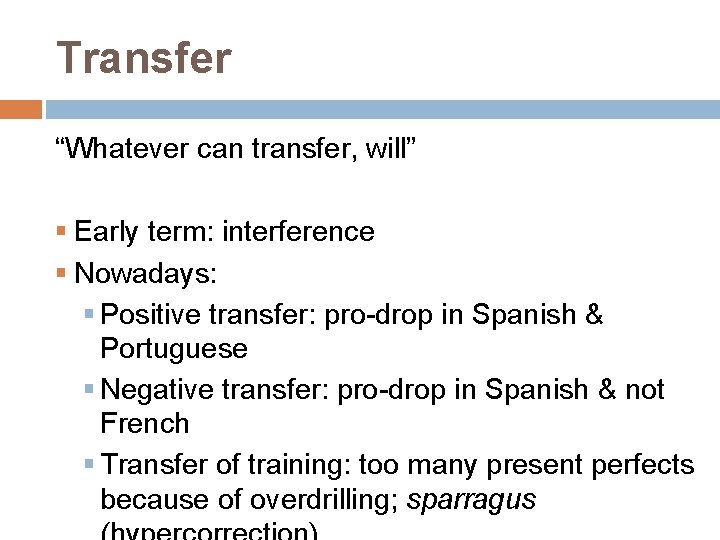
Transfer “Whatever can transfer, will” § Early term: interference § Nowadays: § Positive transfer: pro-drop in Spanish & Portuguese § Negative transfer: pro-drop in Spanish & not French § Transfer of training: too many present perfects because of overdrilling; sparragus
Transfer: Audition § In bilingual acquisition, Lx and Ly prosodies are recognized as different early on § Until 18 months, infants have superb phoneme recognition abilities; by 18 months, their phonemic repertoire is locked (Janet Werker and colleagues) § Comprehension in very young children is massively sophisticated, even before a productive vocabulary has developed § Early stages of L 2 acquisition: listening routines, with L 1 bias
Transfer: Articulation § Much harder than audition! § Involves multiple muscles § Emerged late in evolutionary timeline § Yet by age 5, most L 1 acquirers have it § For L 2 (children and adults) § Early on, massive transfer of L 1 patterns, leading to short-term gains, but long-term liabilities § Age effects: Neuronal flexibility? Input? Affect? § Training and rehearsal could help
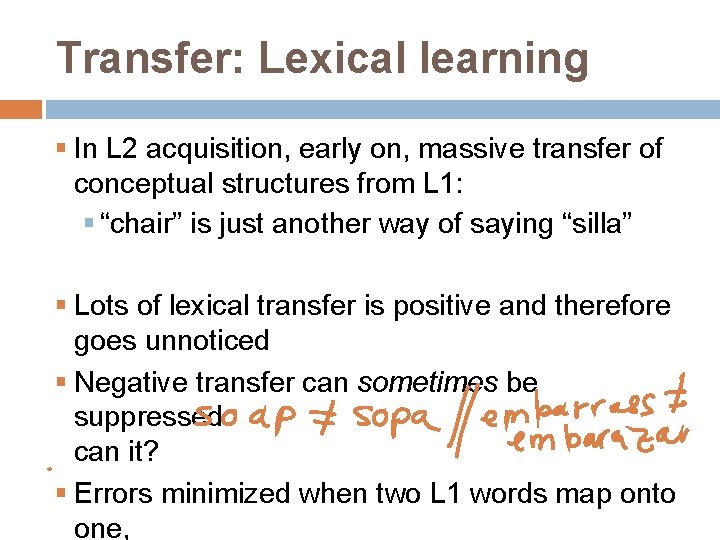
Transfer: Lexical learning § In L 2 acquisition, early on, massive transfer of conceptual structures from L 1: § “chair” is just another way of saying “silla” § Lots of lexical transfer is positive and therefore goes unnoticed § Negative transfer can sometimes be suppressed: can it? § Errors minimized when two L 1 words map onto one,
Transfer: Sentence comprehension § Evidence discussed earlier: § Studies of steady-state bilinguals § Studies of language acquirers § “…learning sentence processing cues in a second language is a gradual process … [that] begins with L 2 cue weight settings that are close to those for L 1. Over time, these settings change in the direction of the native speakers’ settings for L 2” (p. 23)
Transfer: Pragmatics § Greetings, leave-takings, promises, turn-taking, honorifics, terms of endearment… § Mostly very language-specific § Cooperative principle: language universal? § Not much research on L 2 pragmatics! (Brazilians acquirers of English: Fernando Naditch, recent NYU dissertation)
Transfer: Morphology § Transfer close to impossible? § L 1 Chinese can’t use knowledge about classifiers to learn, say, Spanish as L 2 § L 1 ers of languages without determiners (Chinese, Russian) have a hard time learning determiners in L 2 § If a morphological feature is structurally mapable from L 1 to L 2, perhaps § “my computer, she’s very slow” § “die Mond” (<“la luna”)
Resonance § Covert inner speech, used to: § process new input § relate new forms to other forms “… repeated coactivation of reciprocal connections. As the set of resonant connections grows, the possibilities for crossassociations and mutual activations grow and the language starts to form a coherent coactivating neural circuit” (p. 31)
Resonance § Might account for delays in behavioral measures: § Lx, if more frequently used internally than Ly, is in a higher state of activation than Ly (recall Frenck-Mestre & Pynte’s quantitative differences in eye movements between L 1 and L 2) § Might account for intuition that “practice makes perfect”: strategic resonance facilitates encoding new forms
Age effects § “… repeated use of L 1 leads to its ongoing entrenchment… [which] operates differentially across linguistic areas, with the strongest entrenchement occurring in output phonology and the least entrenchment in the area of lexicon, where new learning continues to occur in L 1 in any case” (p. 37) § Learning is highly strategic, therefore high variability in L 2 A… § but why not also in L 1 A?