Lecture 11 Mental Disorders Overview 1 Defining Psychopathology

- Slides: 65
Lecture 11 - Mental Disorders Overview 1. Defining Psychopathology 2. Cognitive Disorders Dementia Delirium 3. Other Mental Disorders Depression Anxiety (see text)
Lecture 11 - Mental Disorders Overview 4. Clinical Concerns Elder Abuse Suicide (see text) 5. Psychological Issues in Long-Term Care 6. Myth Busting: Facts on Aging Revisited
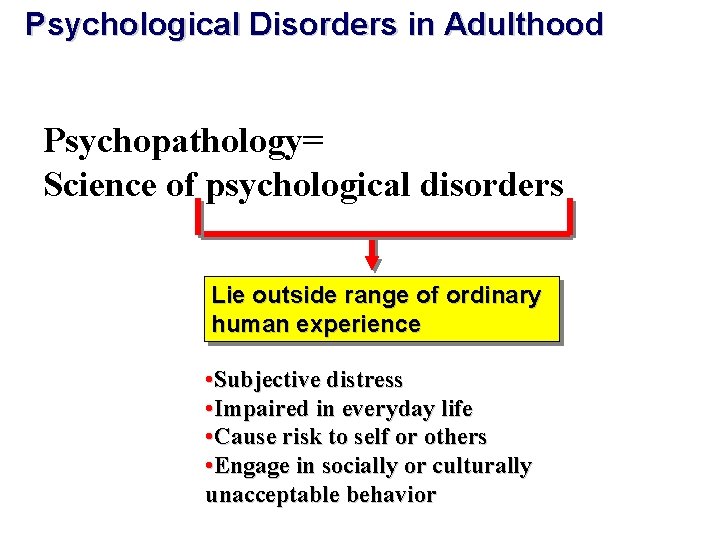
Psychological Disorders in Adulthood Psychopathology= Science of psychological disorders Lie outside range of ordinary human experience • Subjective distress • Impaired in everyday life • Cause risk to self or others • Engage in socially or culturally unacceptable behavior
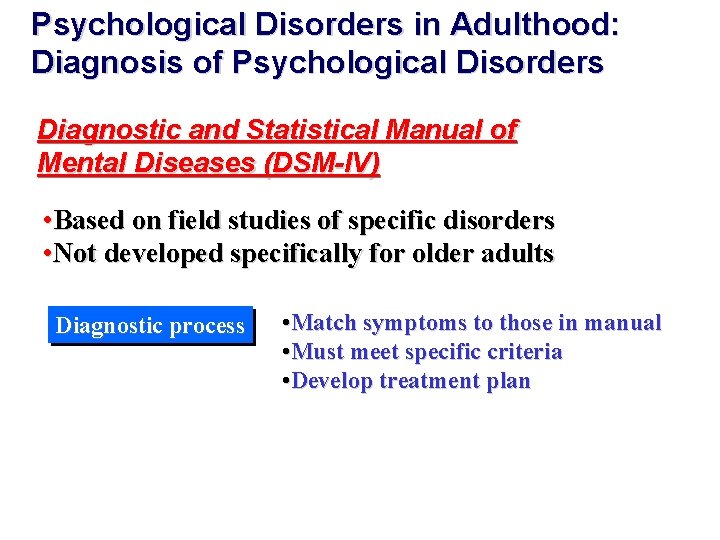
Psychological Disorders in Adulthood: Diagnosis of Psychological Disorders Diagnostic and Statistical Manual of Mental Diseases (DSM-IV) • Based on field studies of specific disorders • Not developed specifically for older adults Diagnostic process • Match symptoms to those in manual • Must meet specific criteria • Develop treatment plan
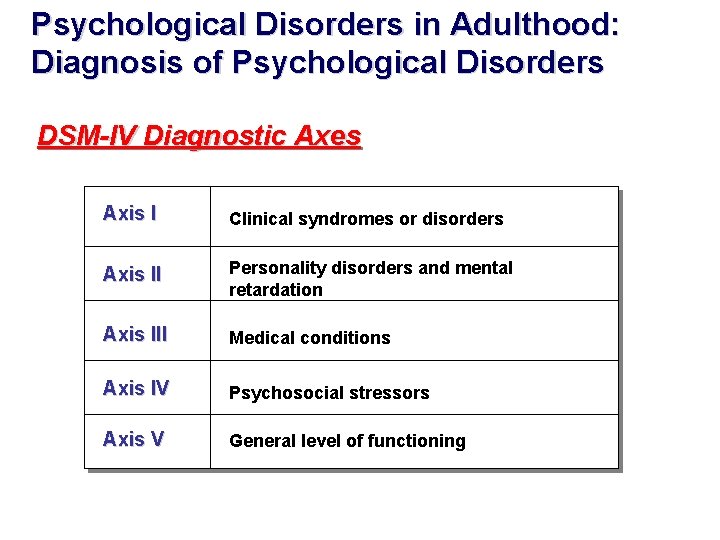
Psychological Disorders in Adulthood: Diagnosis of Psychological Disorders DSM-IV Diagnostic Axes Axis I Clinical syndromes or disorders Axis II Personality disorders and mental retardation Axis III Medical conditions Axis IV Psychosocial stressors Axis V General level of functioning
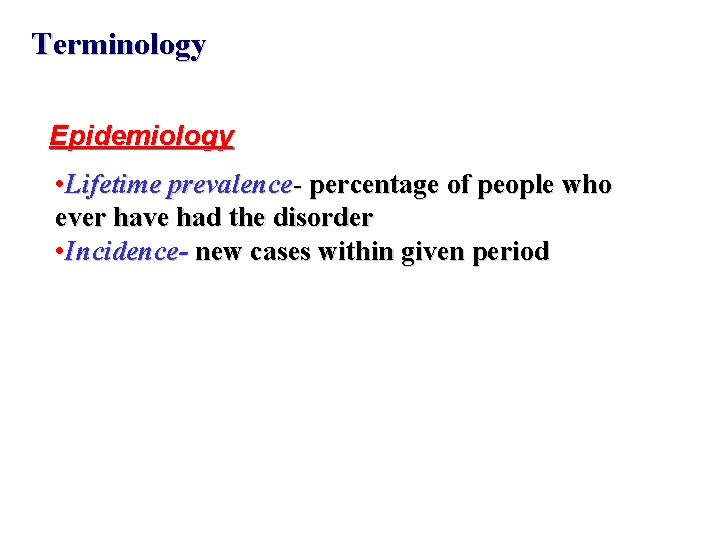
Terminology Epidemiology • Lifetime prevalence- percentage of people who ever have had the disorder • Incidence- new cases within given period
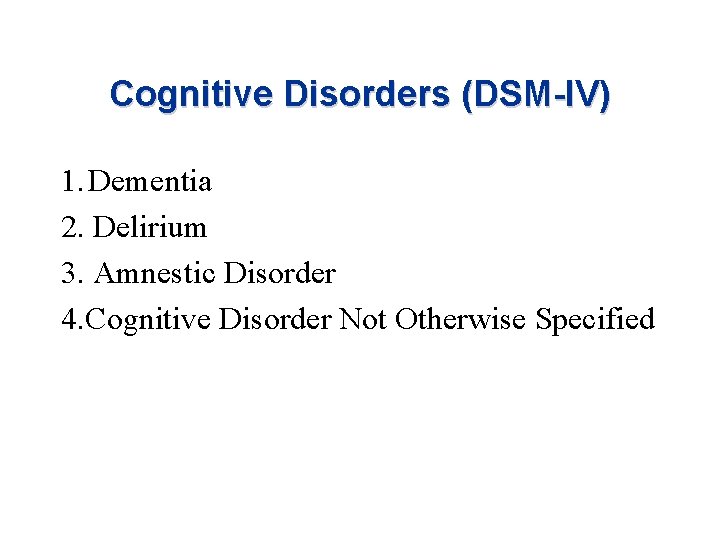
Cognitive Disorders (DSM-IV) 1. Dementia 2. Delirium 3. Amnestic Disorder 4. Cognitive Disorder Not Otherwise Specified
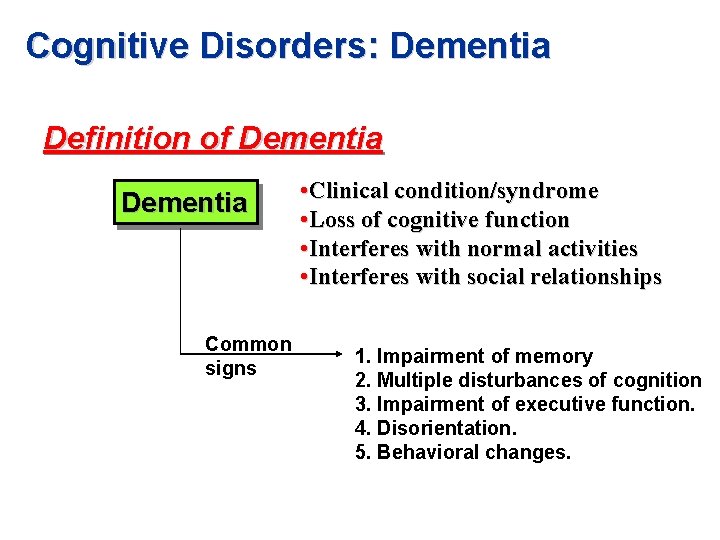
Cognitive Disorders: Dementia Definition of Dementia Common signs • Clinical condition/syndrome • Loss of cognitive function • Interferes with normal activities • Interferes with social relationships 1. Impairment of memory 2. Multiple disturbances of cognition 3. Impairment of executive function. 4. Disorientation. 5. Behavioral changes.
Dementia: Causes 1. Reversible 2. Irreversible
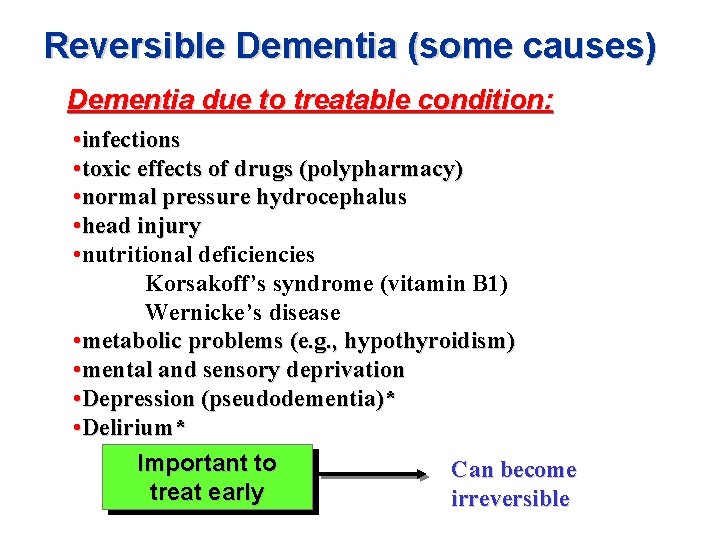
Reversible Dementia (some causes) Dementia due to treatable condition: • infections • toxic effects of drugs (polypharmacy) • normal pressure hydrocephalus • head injury • nutritional deficiencies Korsakoff’s syndrome (vitamin B 1) Wernicke’s disease • metabolic problems (e. g. , hypothyroidism) • mental and sensory deprivation • Depression (pseudodementia)* • Delirium* Important to Can become treat early irreversible
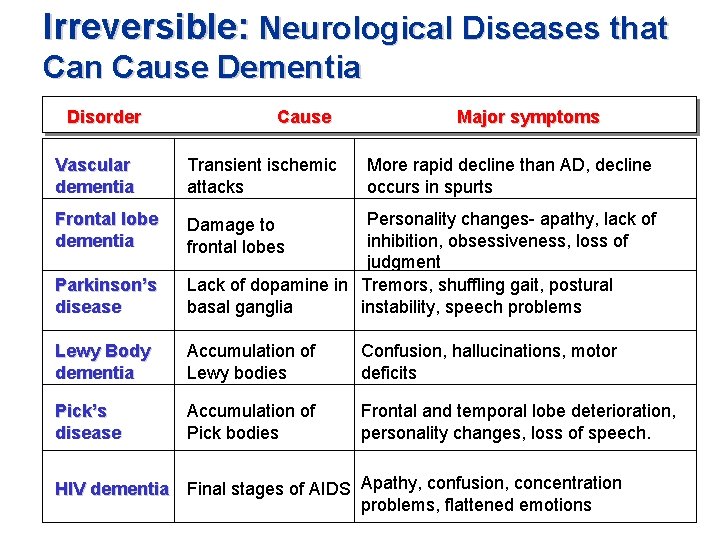
Irreversible: Neurological Diseases that Can Cause Dementia Disorder Cause Vascular dementia Transient ischemic attacks Frontal lobe dementia Damage to frontal lobes Major symptoms More rapid decline than AD, decline occurs in spurts Parkinson’s disease Personality changes- apathy, lack of inhibition, obsessiveness, loss of judgment Lack of dopamine in Tremors, shuffling gait, postural basal ganglia instability, speech problems Lewy Body dementia Accumulation of Lewy bodies Confusion, hallucinations, motor deficits Pick’s disease Accumulation of Pick bodies Frontal and temporal lobe deterioration, personality changes, loss of speech. HIV dementia Final stages of AIDS Apathy, confusion, concentration problems, flattened emotions
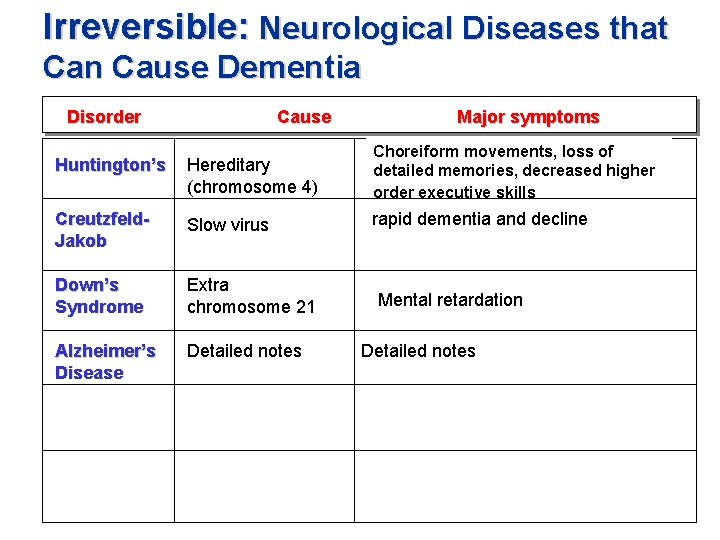
Irreversible: Neurological Diseases that Can Cause Dementia Disorder Cause Major symptoms Huntington’s Hereditary (chromosome 4) Choreiform movements, loss of detailed memories, decreased higher order executive skills Creutzfeld. Jakob Slow virus rapid dementia and decline Down’s Syndrome Extra chromosome 21 Alzheimer’s Disease Detailed notes Mental retardation Detailed notes
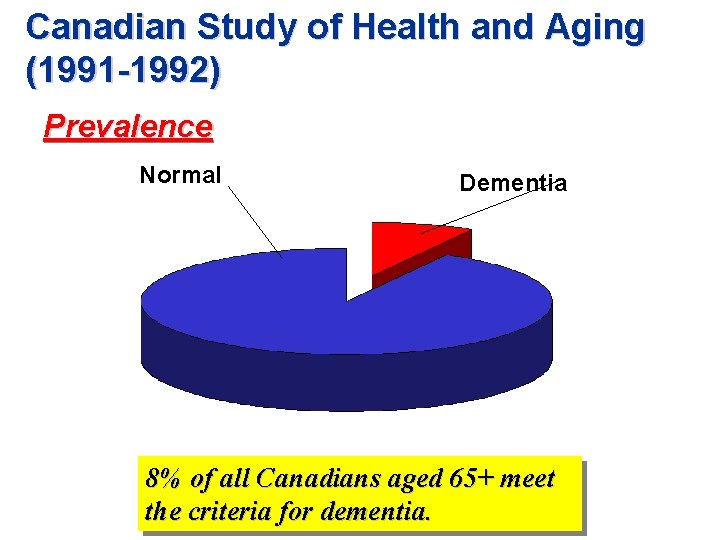
Canadian Study of Health and Aging (1991 -1992) Prevalence Normal Dementia 8% of all Canadians aged 65+ meet the criteria for dementia.
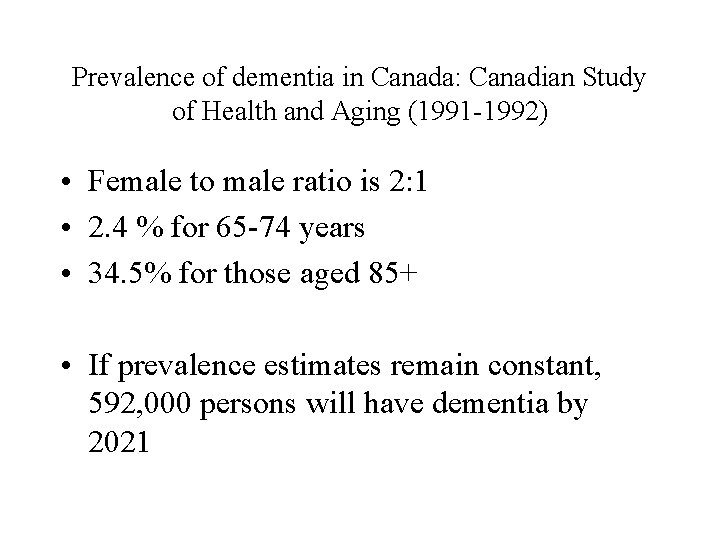
Prevalence of dementia in Canada: Canadian Study of Health and Aging (1991 -1992) • Female to male ratio is 2: 1 • 2. 4 % for 65 -74 years • 34. 5% for those aged 85+ • If prevalence estimates remain constant, 592, 000 persons will have dementia by 2021
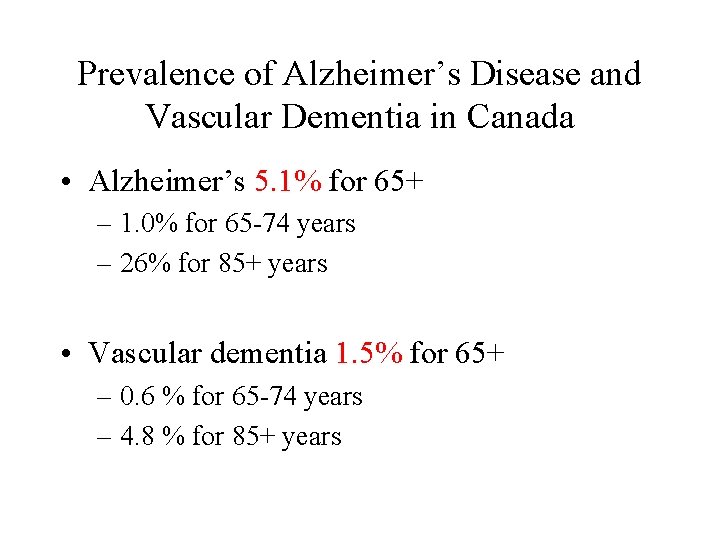
Prevalence of Alzheimer’s Disease and Vascular Dementia in Canada • Alzheimer’s 5. 1% for 65+ – 1. 0% for 65 -74 years – 26% for 85+ years • Vascular dementia 1. 5% for 65+ – 0. 6 % for 65 -74 years – 4. 8 % for 85+ years
Dementia: Vascular Dementia Features • Associated with damage to the cerebral blood vessels through arteriosclerosis • found in middle and later life (age of onset between 50 -70) • accumulated effect of multiple cortical and subcortical infarcts lead to clinical presentation • incidence higher in men • first sign delirium or small stroke
Dementia: Vascular Dementia Clinical Presentation • Abrupt onset • step-wise deterioration • somatic complaints • emotional incontinence • history of hypertension • history of cebrovascular accidents • focal neurological symptoms • focal neurological signs
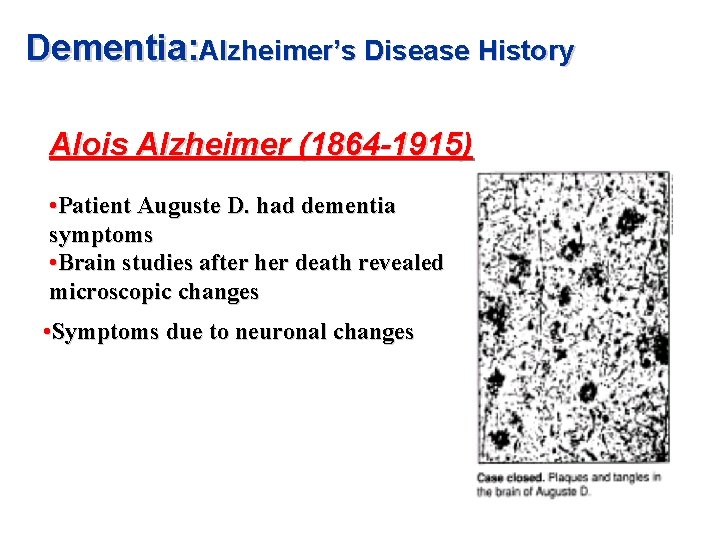
Dementia: Alzheimer’s Disease History Alois Alzheimer (1864 -1915) • Patient Auguste D. had dementia symptoms • Brain studies after her death revealed microscopic changes • Symptoms due to neuronal changes
Dementia and Related Neurological Disorders: Alzheimer’s Disease NINCDS/ADRDA Guidlines Criteria for probable Alzheimer’s diagnosis= • Dementia • Significant cognitive deficiencies • Progressive deterioration • No loss of consciousness • 40 -90 years of age • No other diseases Also includes • Medical tests • Family history • Brain scans • Other symptoms
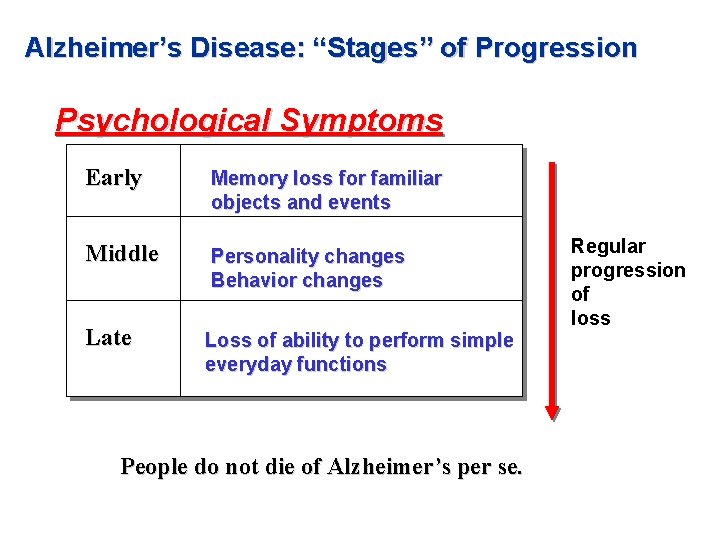
Alzheimer’s Disease: “Stages” of Progression Psychological Symptoms Early Memory loss for familiar objects and events Middle Personality changes Behavior changes Late Loss of ability to perform simple everyday functions People do not die of Alzheimer’s per se. Regular progression of loss
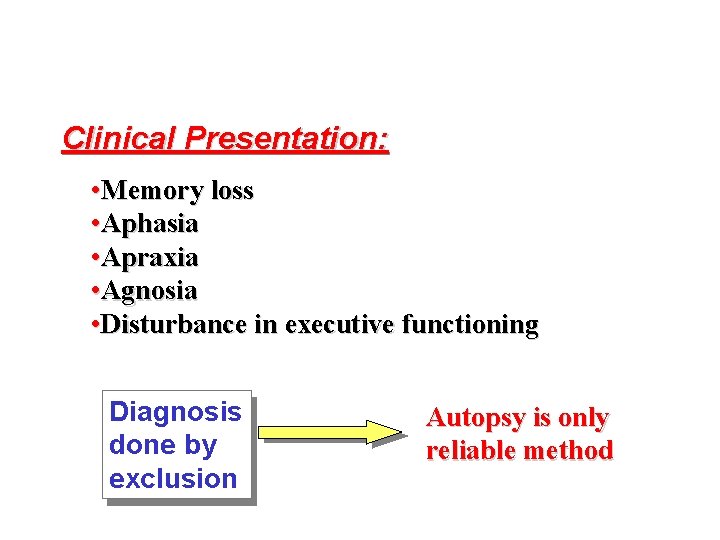
Clinical Presentation: • Memory loss • Aphasia • Apraxia • Agnosia • Disturbance in executive functioning Diagnosis done by exclusion Autopsy is only reliable method
Clinical Presentation
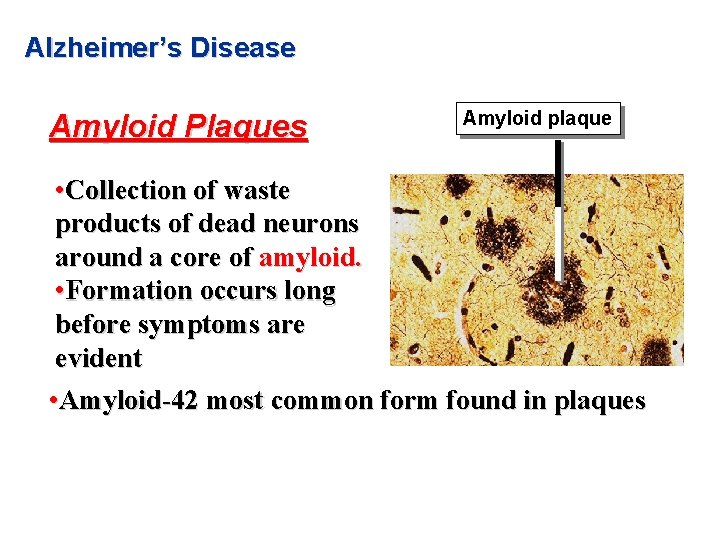
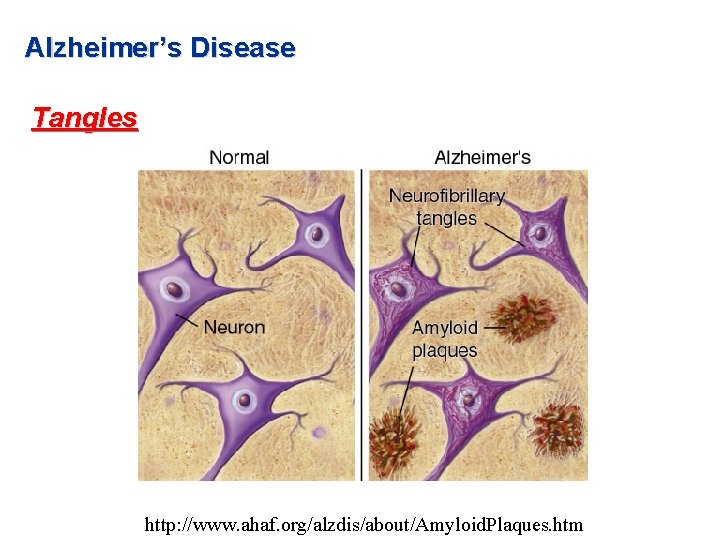
Alzheimer’s Disease Amyloid Plaques Amyloid plaque • Collection of waste products of dead neurons around a core of amyloid. • Formation occurs long before symptoms are evident • Amyloid-42 most common form found in plaques
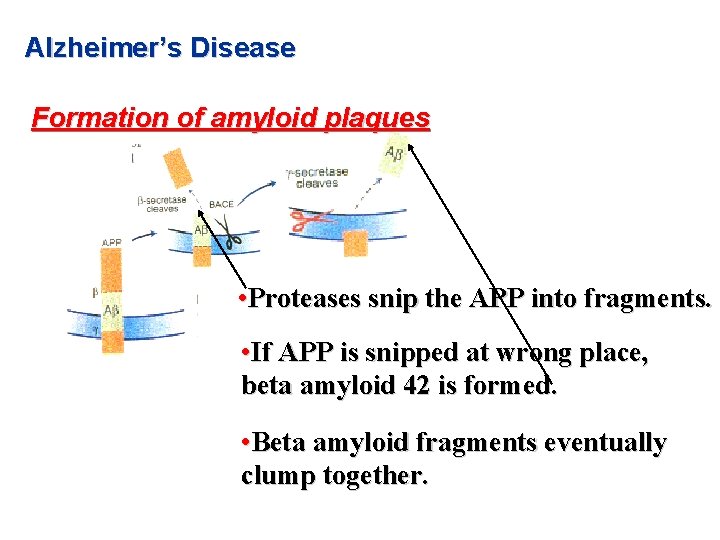
Alzheimer’s Disease Formation of amyloid plaques • Proteases snip the APP into fragments. • If APP is snipped at wrong place, beta amyloid 42 is formed. • Beta amyloid fragments eventually clump together.
Alzheimer’s Disease Tangles http: //www. ahaf. org/alzdis/about/Amyloid. Plaques. htm
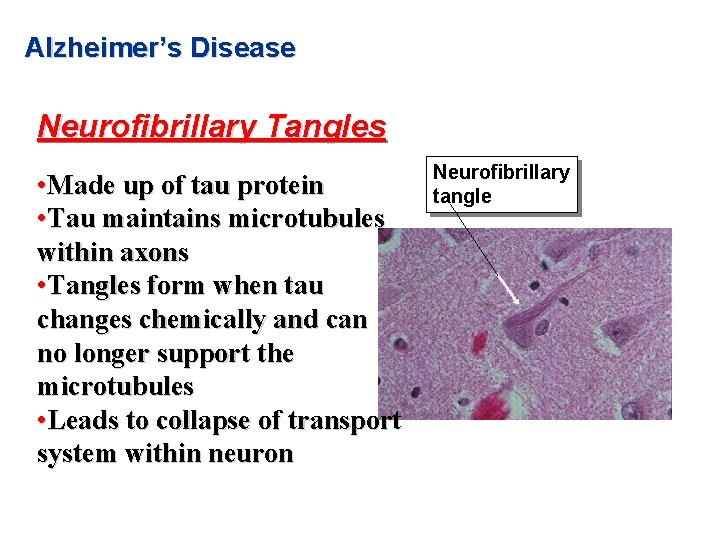
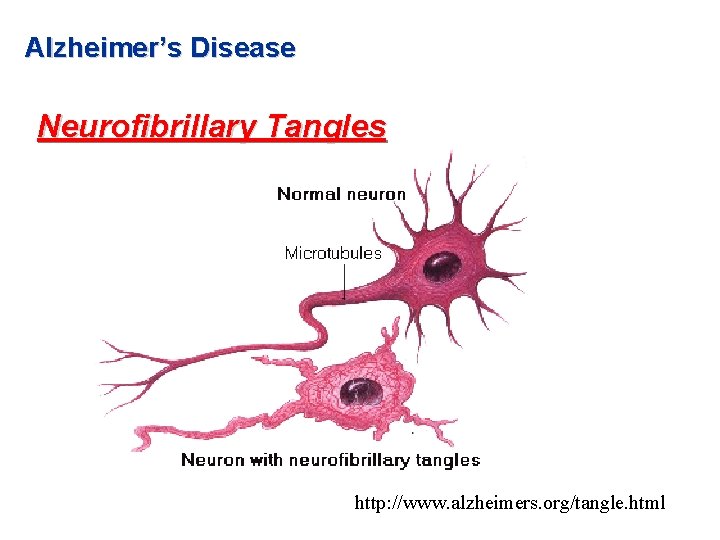
Alzheimer’s Disease Neurofibrillary Tangles • Made up of tau protein • Tau maintains microtubules within axons • Tangles form when tau changes chemically and can no longer support the microtubules • Leads to collapse of transport system within neuron Neurofibrillary tangle
Alzheimer’s Disease Neurofibrillary Tangles http: //www. alzheimers. org/tangle. html
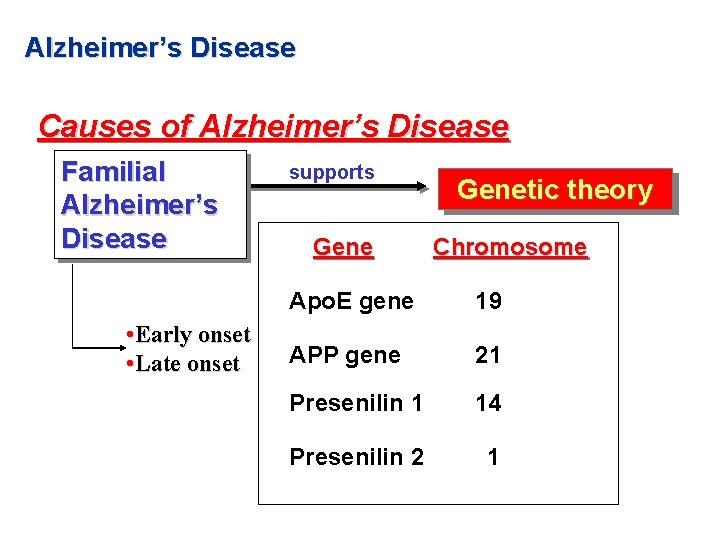
Alzheimer’s Disease Causes of Alzheimer’s Disease Familial Alzheimer’s Disease • Early onset • Late onset supports Genetic theory Chromosome Apo. E gene 19 APP gene 21 Presenilin 1 14 Presenilin 2 1
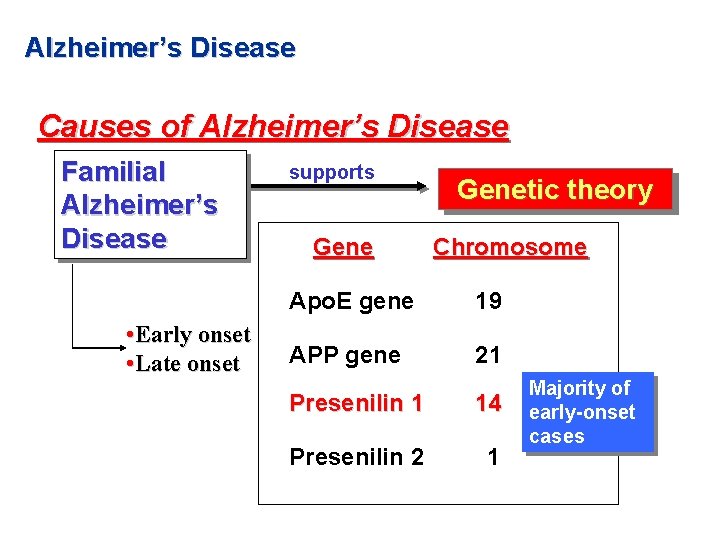
Alzheimer’s Disease Causes of Alzheimer’s Disease Familial Alzheimer’s Disease • Early onset • Late onset supports Genetic theory Chromosome Apo. E gene 19 APP gene 21 Presenilin 1 14 Presenilin 2 1 Majority of early-onset cases
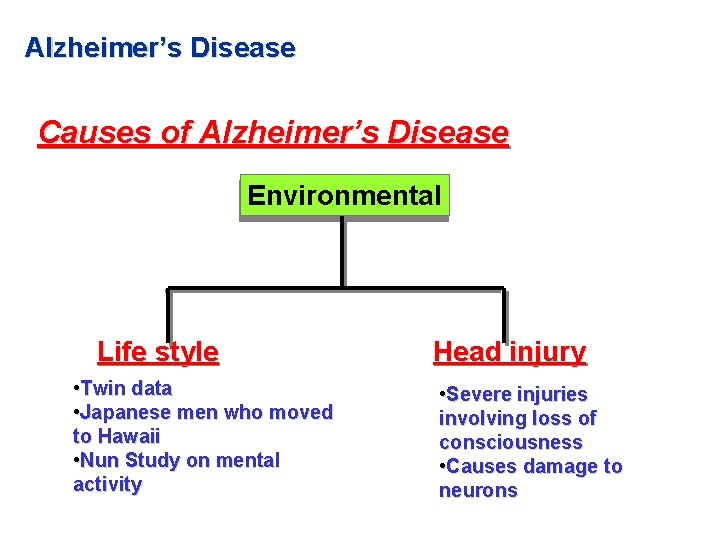
Alzheimer’s Disease Causes of Alzheimer’s Disease Environmental Life style • Twin data • Japanese men who moved to Hawaii • Nun Study on mental activity Head injury • Severe injuries involving loss of consciousness • Causes damage to neurons
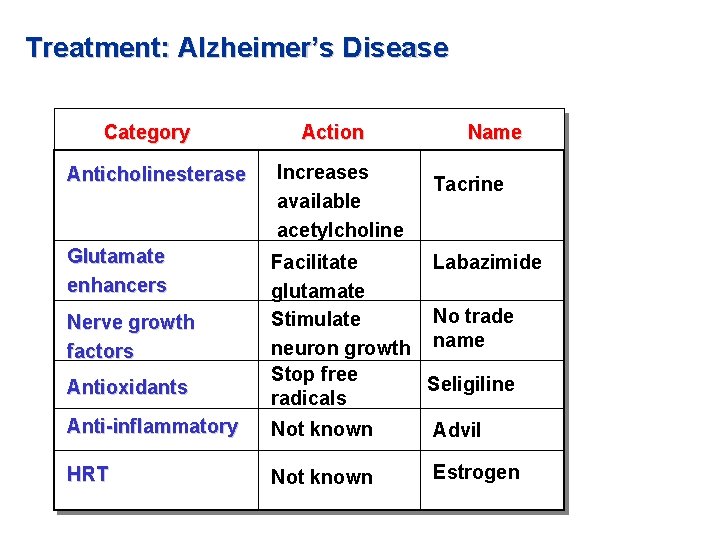
Treatment: Alzheimer’s Disease Category Action Name Anticholinesterase Increases available acetylcholine Glutamate enhancers Facilitate Labazimide glutamate No trade Stimulate neuron growth name Stop free Seligiline radicals Nerve growth factors Antioxidants Tacrine Anti-inflammatory Not known Advil HRT Not known Estrogen
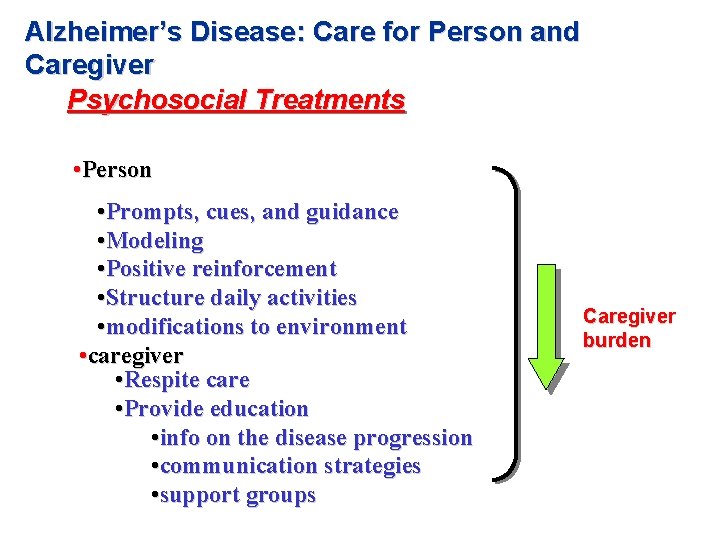
Alzheimer’s Disease: Care for Person and Caregiver Psychosocial Treatments • Person • Prompts, cues, and guidance • Modeling • Positive reinforcement • Structure daily activities • modifications to environment • caregiver • Respite care • Provide education • info on the disease progression • communication strategies • support groups Caregiver burden
Lecture 11 - Mental Disorders Overview 1. Defining Psychopathology 2. Cognitive Disorders Dementia Delirium 3. Other Mental Disorders Depression Anxiety (see text)
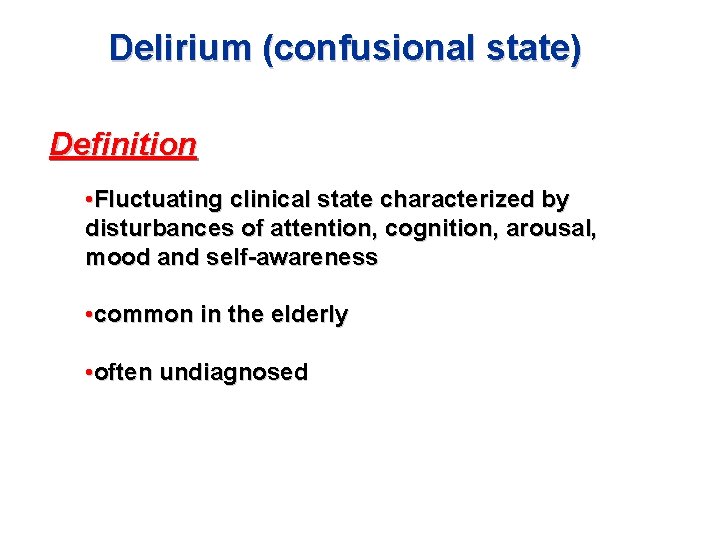
Delirium (confusional state) Definition • Fluctuating clinical state characterized by disturbances of attention, cognition, arousal, mood and self-awareness • common in the elderly • often undiagnosed
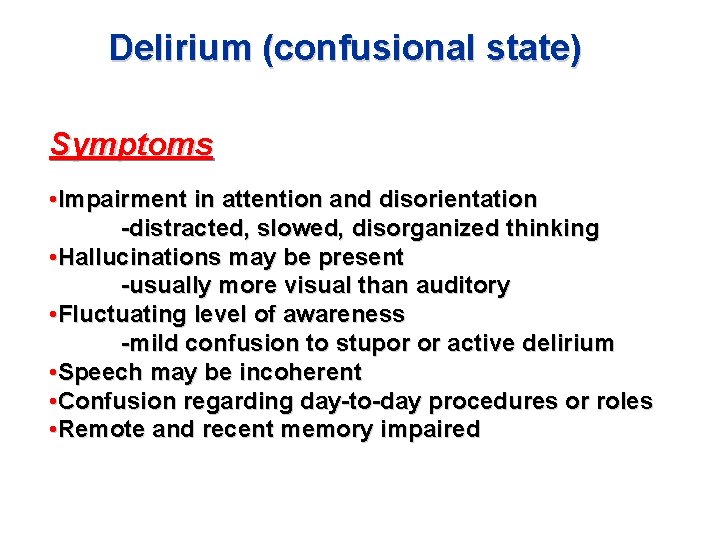
Delirium (confusional state) Symptoms • Impairment in attention and disorientation -distracted, slowed, disorganized thinking • Hallucinations may be present -usually more visual than auditory • Fluctuating level of awareness -mild confusion to stupor or active delirium • Speech may be incoherent • Confusion regarding day-to-day procedures or roles • Remote and recent memory impaired
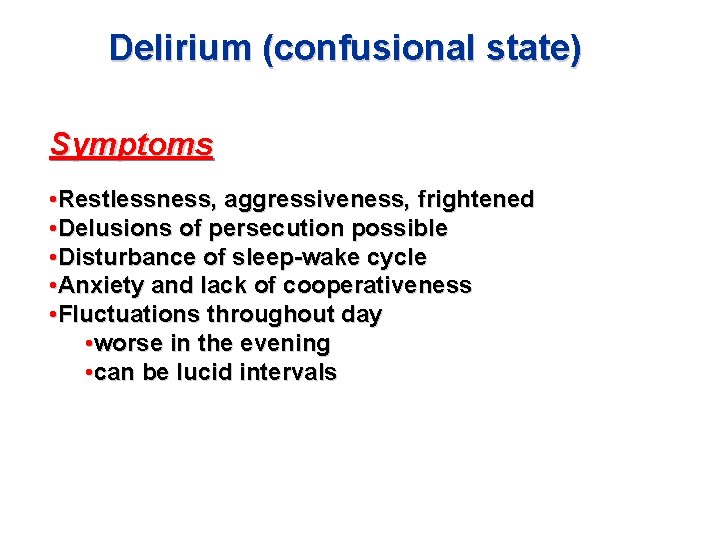
Delirium (confusional state) Symptoms • Restlessness, aggressiveness, frightened • Delusions of persecution possible • Disturbance of sleep-wake cycle • Anxiety and lack of cooperativeness • Fluctuations throughout day • worse in the evening • can be lucid intervals
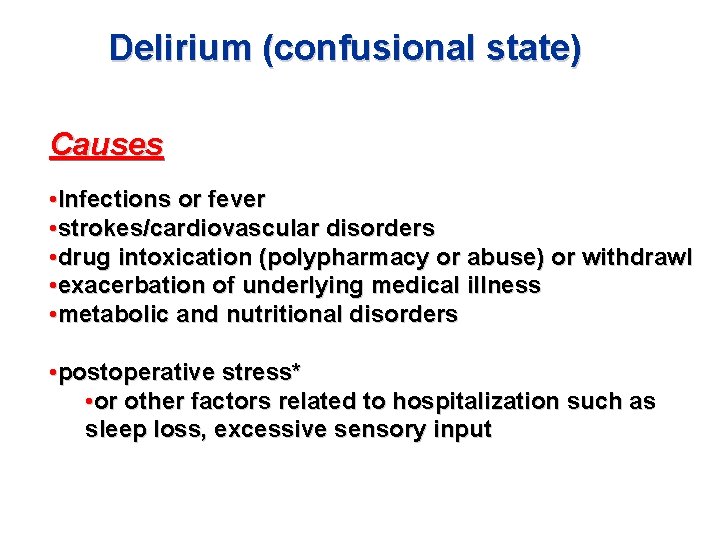
Delirium (confusional state) Causes • Infections or fever • strokes/cardiovascular disorders • drug intoxication (polypharmacy or abuse) or withdrawl • exacerbation of underlying medical illness • metabolic and nutritional disorders • postoperative stress* • or other factors related to hospitalization such as sleep loss, excessive sensory input
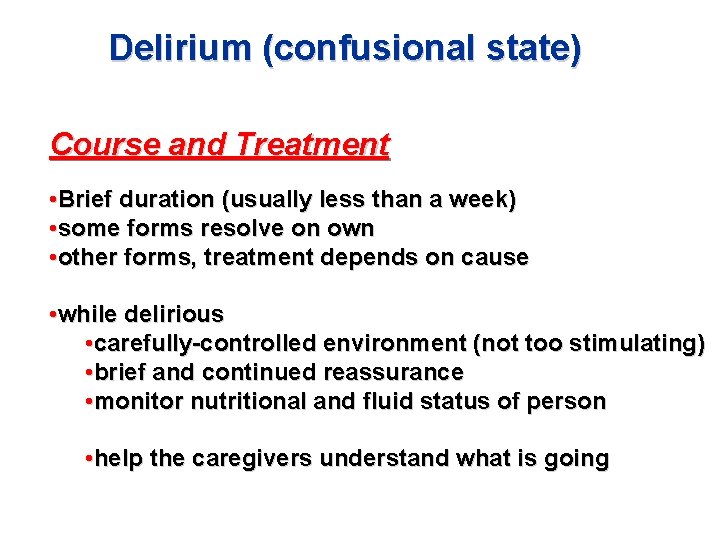
Delirium (confusional state) Course and Treatment • Brief duration (usually less than a week) • some forms resolve on own • other forms, treatment depends on cause • while delirious • carefully-controlled environment (not too stimulating) • brief and continued reassurance • monitor nutritional and fluid status of person • help the caregivers understand what is going
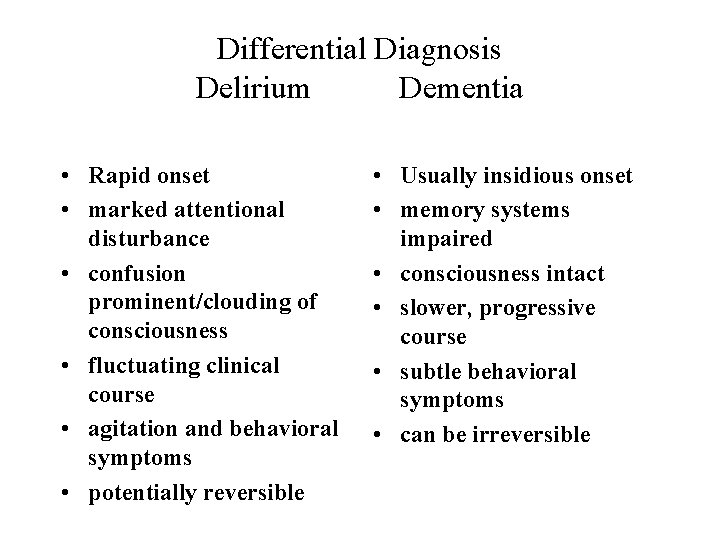
Differential Diagnosis Delirium Dementia • Rapid onset • marked attentional disturbance • confusion prominent/clouding of consciousness • fluctuating clinical course • agitation and behavioral symptoms • potentially reversible • Usually insidious onset • memory systems impaired • consciousness intact • slower, progressive course • subtle behavioral symptoms • can be irreversible
Lecture 11 - Mental Disorders Overview 1. Defining Psychopathology 2. Cognitive Disorders Dementia Delirium 3. Other Mental Disorders Depression Anxiety (see text)
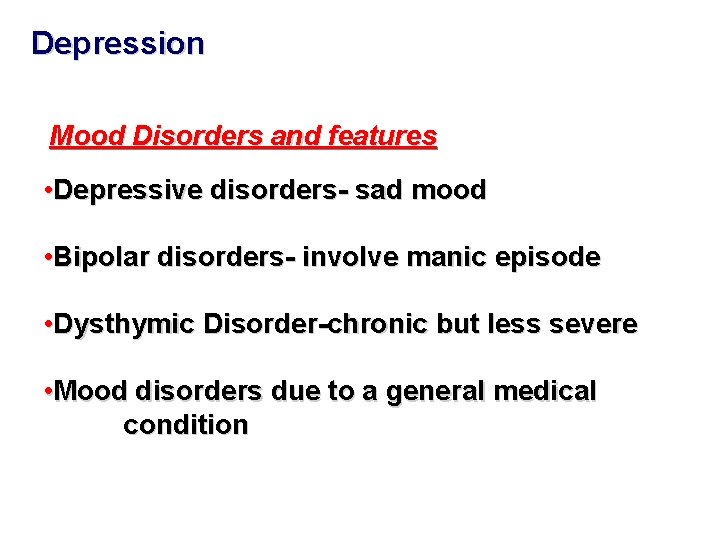
Depression Mood Disorders and features • Depressive disorders- sad mood • Bipolar disorders- involve manic episode • Dysthymic Disorder-chronic but less severe • Mood disorders due to a general medical condition
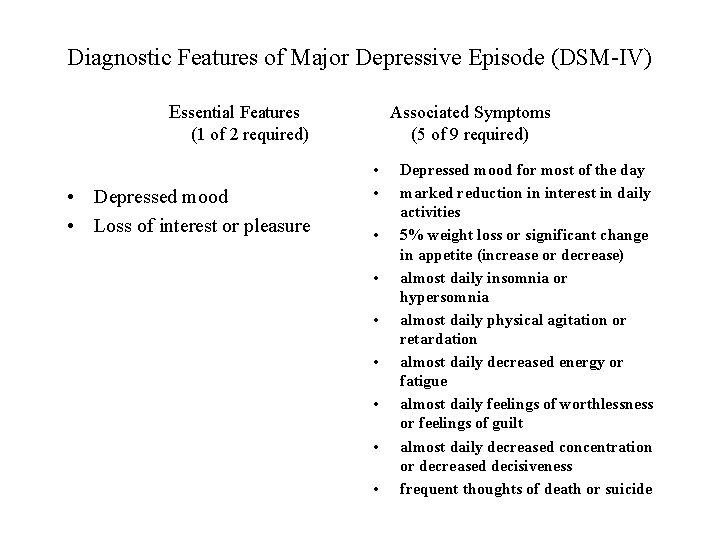
Diagnostic Features of Major Depressive Episode (DSM-IV) Essential Features Associated Symptoms (5 of 9 required) (1 of 2 required) • Depressed mood • Loss of interest or pleasure • • • Depressed mood for most of the day marked reduction in interest in daily activities 5% weight loss or significant change in appetite (increase or decrease) almost daily insomnia or hypersomnia almost daily physical agitation or retardation almost daily decreased energy or fatigue almost daily feelings of worthlessness or feelings of guilt almost daily decreased concentration or decreased decisiveness frequent thoughts of death or suicide
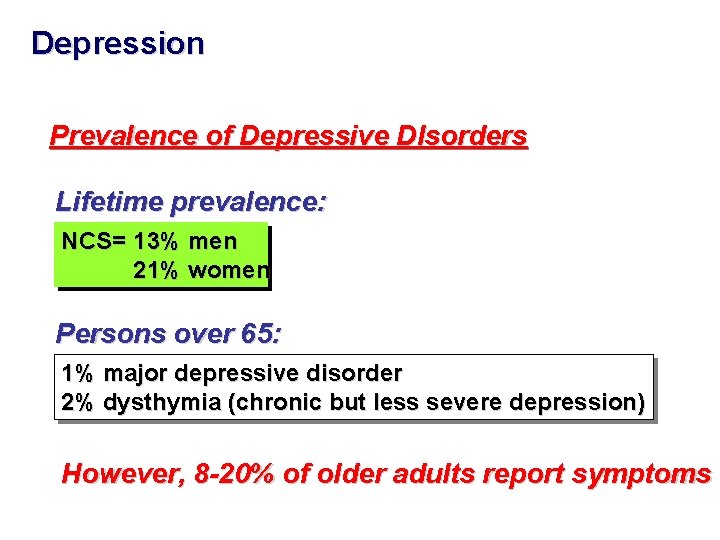
Depression Prevalence of Depressive DIsorders Lifetime prevalence: NCS= 13% men 21% women Persons over 65: 1% major depressive disorder 2% dysthymia (chronic but less severe depression) However, 8 -20% of older adults report symptoms
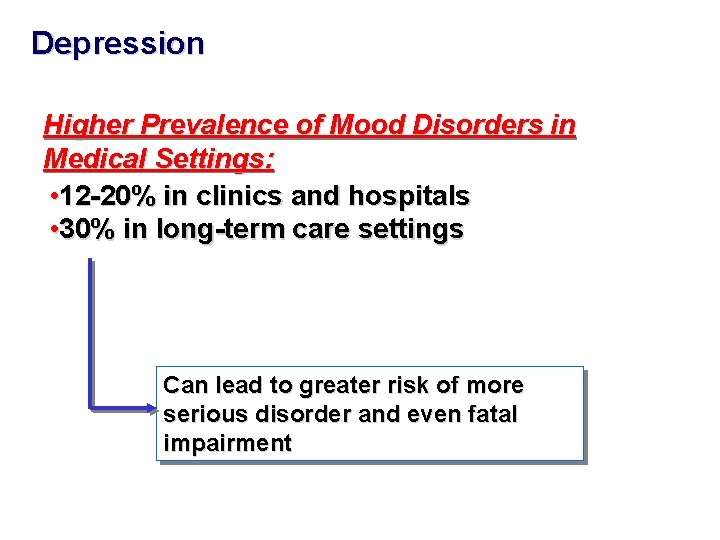
Depression Higher Prevalence of Mood Disorders in Medical Settings: • 12 -20% in clinics and hospitals • 30% in long-term care settings Can lead to greater risk of more serious disorder and even fatal impairment
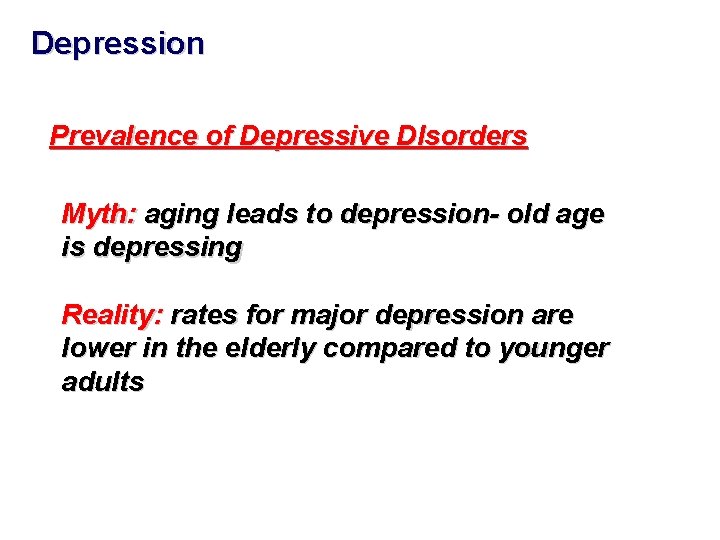
Depression Prevalence of Depressive DIsorders Myth: aging leads to depression- old age is depressing Reality: rates for major depression are lower in the elderly compared to younger adults
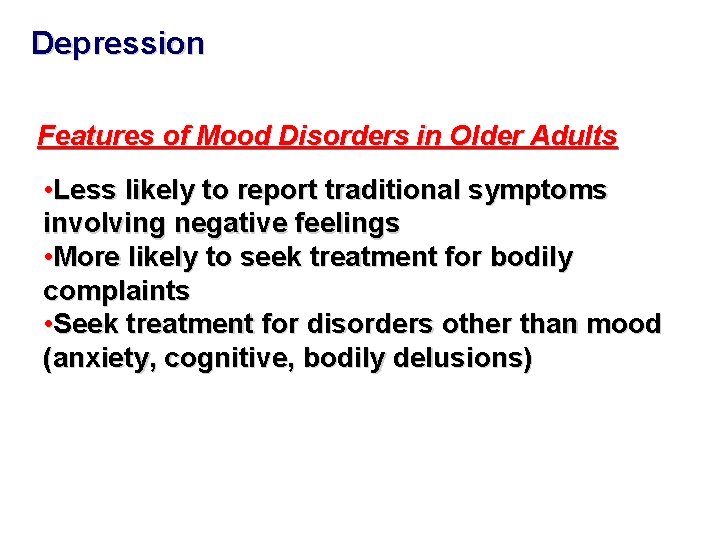
Depression Features of Mood Disorders in Older Adults • Less likely to report traditional symptoms involving negative feelings • More likely to seek treatment for bodily complaints • Seek treatment for disorders other than mood (anxiety, cognitive, bodily delusions)
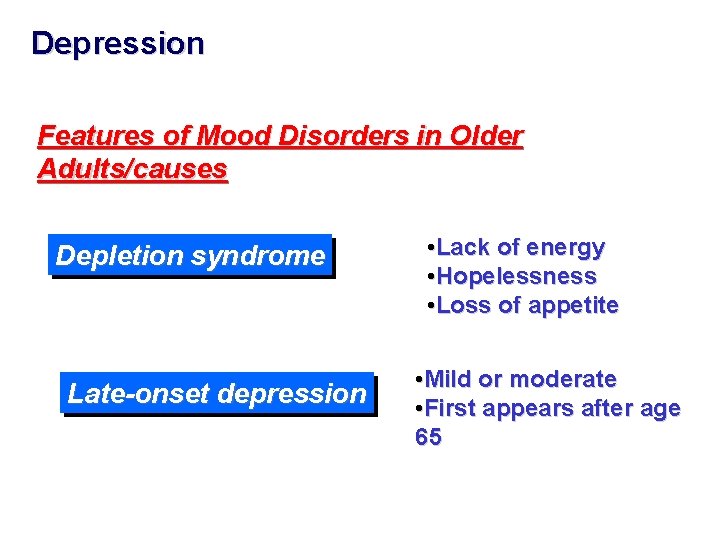
Depression Features of Mood Disorders in Older Adults/causes Depletion syndrome Late-onset depression • Lack of energy • Hopelessness • Loss of appetite • Mild or moderate • First appears after age 65
Depression Causes of Age Differences in Mood Disorders • Personality and emotional changes associated with aging • Cohort differences in experience of depression
Depression Problems in Diagnosis of Mood Disorders: • Older adults do not report symptoms accurately • Professionals not attuned to diagnosis of older adults • Not enough time spent with older adults • Wish to avoid stigmatization • Therapists unaware of benefits • cognitive difficulty can accompany depression • dementia and depression can both be present “pseudodementia”
Depression Differentiating Dementia and Pseudodementia • Dementia has insidious onset (years) • history of psychiatric problems more common in pseudodementia • dementia (mild) complains little about memory/concealmen • depressive pseudodementia complains • dementia- behavior in line with clinical severity • depression- incongruities between behavior and severity of cognitive deficit
Depression Treatment • Drug therapies • Psychotherapy
Lecture 11 - Mental Disorders Overview 4. Clinical Concerns Elder Abuse Suicide (see text) 5. Psychological Issues in Long-Term Care 6. Myth Busting: Facts on Aging Revisited
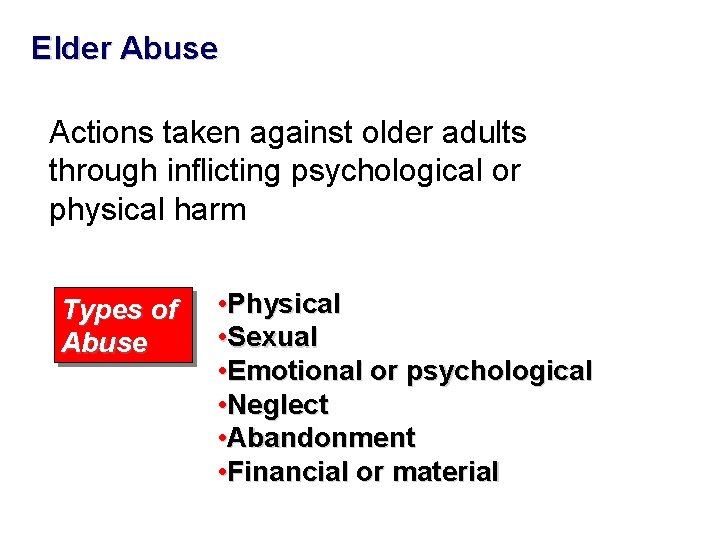
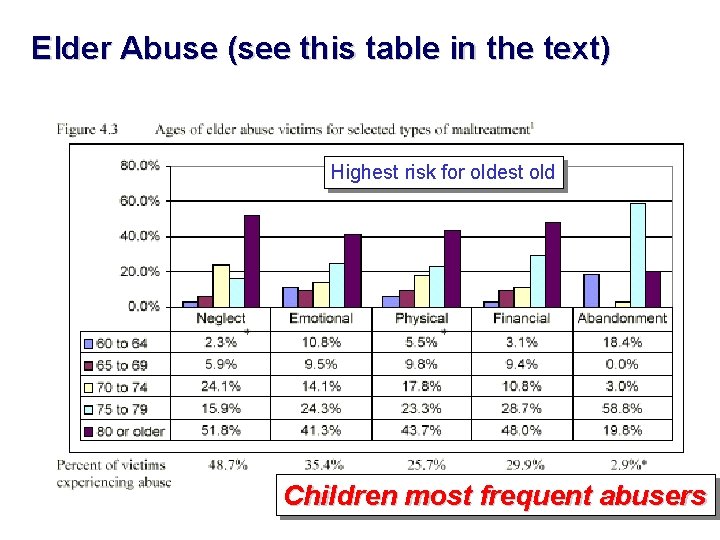
Elder Abuse Actions taken against older adults through inflicting psychological or physical harm Types of Abuse • Physical • Sexual • Emotional or psychological • Neglect • Abandonment • Financial or material
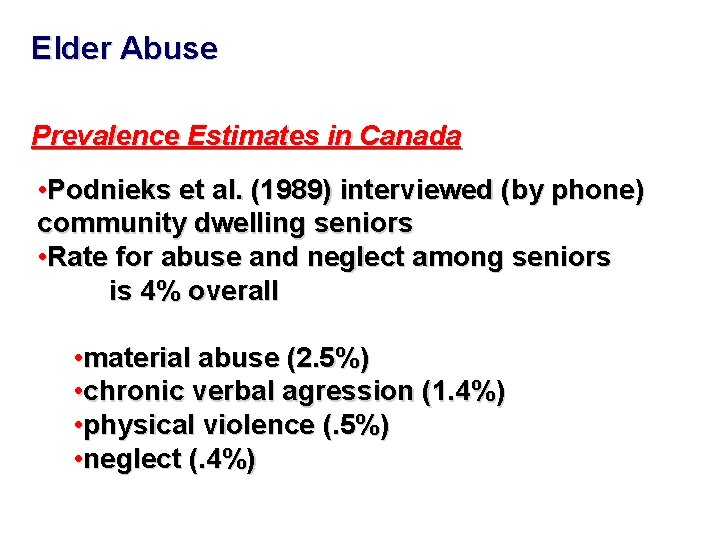
Elder Abuse Prevalence Estimates in Canada • Podnieks et al. (1989) interviewed (by phone) community dwelling seniors • Rate for abuse and neglect among seniors is 4% overall • material abuse (2. 5%) • chronic verbal agression (1. 4%) • physical violence (. 5%) • neglect (. 4%)
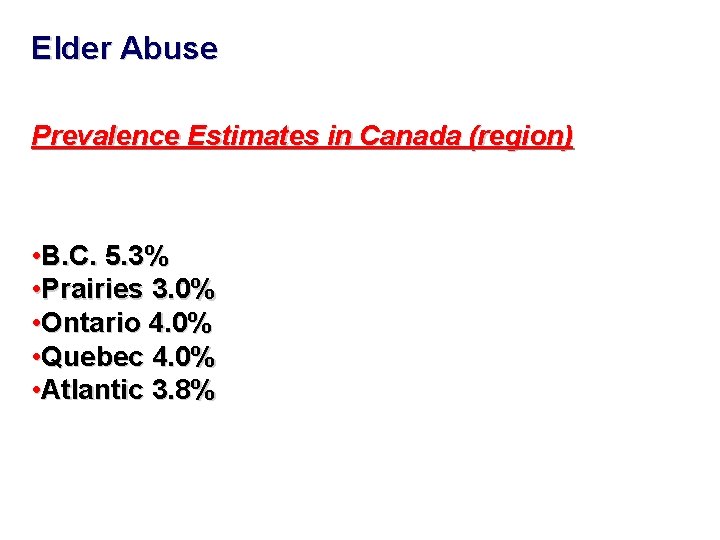
Elder Abuse Prevalence Estimates in Canada (region) • B. C. 5. 3% • Prairies 3. 0% • Ontario 4. 0% • Quebec 4. 0% • Atlantic 3. 8%
Elder Abuse (see this table in the text) Highest risk for oldest old Children most frequent abusers
Lecture 11 - Mental Disorders Overview 4. Clinical Concerns Elder Abuse Suicide (see text) 5. Psychological Issues in Long-Term Care 6. Myth Busting: Facts on Aging Revisited
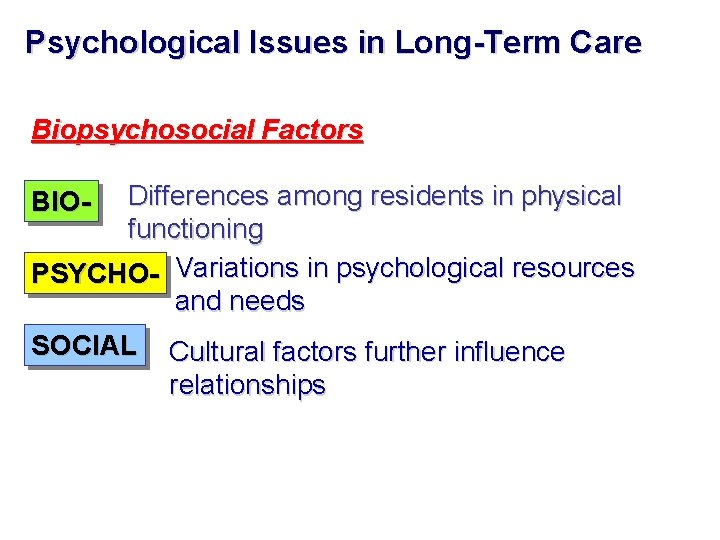
Psychological Issues in Long-Term Care Biopsychosocial Factors Differences among residents in physical functioning PSYCHO- Variations in psychological resources and needs BIO- SOCIAL Cultural factors further influence relationships
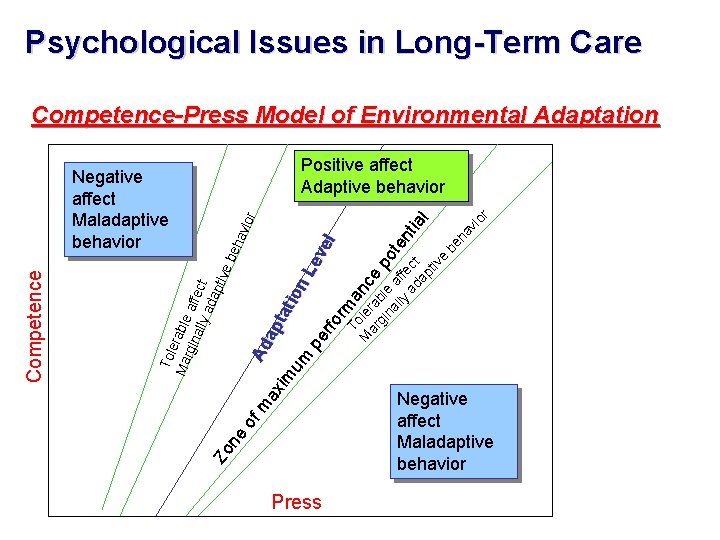
Psychological Issues in Long-Term Care Competence-Press Model of Environmental Adaptation r io ha v be iv e beh avi o r Ad m ap ax tat im ion um Le pe ve rfo l rm T a M oler nc ar a gi ble e p na a o lly ffe te ad ct nti al ap t Positive affect Adaptive behavior Negative affect Maladaptive behavior Zo ne of Tol e Ma rable rgin a ally ffect ada ptiv e Competence Negative affect Maladaptive behavior Press
Lecture 11 - Mental Disorders Overview 4. Clinical Concerns Elder Abuse Suicide (see text) 5. Psychological Issues in Long-Term Care 6. Myth Busting: Facts on Aging Revisited
Myth Busting: Facts on Aging Revisited #1 The majority of old people (age 65+) are senile (have defective memory, are disoriented, or demented) False
Myth Busting: Facts on Aging Revisited #5 The majority of old people feel miserable most of the time. False
Myth Busting: Facts on Aging Revisited #7 At least one tenth of the aged are living in long-stay institutions (such as nursing homes, mental hospitals, homes for the aged, etc. ) False (see text)
Myth Busting: Facts on Aging Revisited #10 Over three fourths of the aged are healthy enough to do their normal activities without help. True
Myth Busting: Facts on Aging Revisited #13 Depression is more frequent among the elderly than among younger people. False