
VIDEOS The bookcase analogy https www youtube comwatch
VIDEOS The bookcase analogy https: //www. youtube. com/watch? v=kkvy. Gr. OEIf. A Pathophysiology/causes/symptoms https: //www. youtube. com/watch? v=v 5 gd. H_Hydes
DEMENTIA Dr Uma Narayanan
WHAT WOULD YOU LIKE TO LEARN IN THIS SESSION?
OVERVIEW OF THE SESSION Diagnosis Risk factors Types of dementia Case studies Management What’s new Dementia and driving: role plays
WHAT IS DEMENTIA?
WHAT IS DEMENTIA? ‘Dementia describes a clinical syndrome that encompasses difficulties in memory, language cognitive processing and behaviour that leads to impairment in activities of daily living’ (BMJ 2015; 350; h 029)
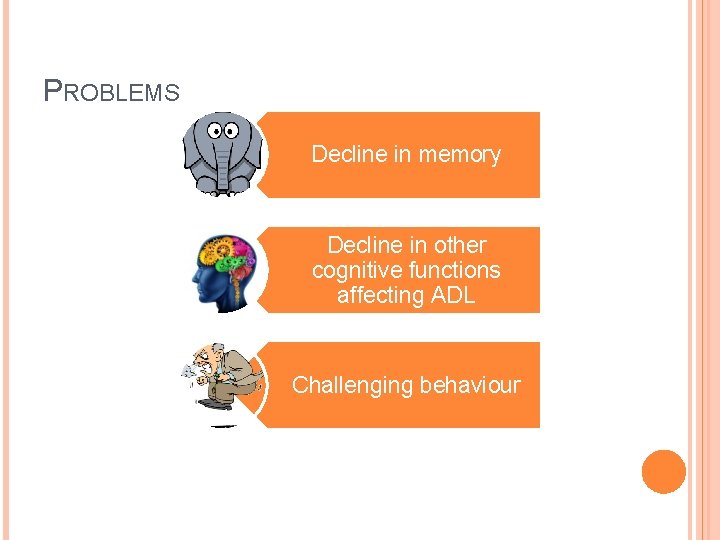
PROBLEMS Decline in memory Decline in other cognitive functions affecting ADL Challenging behaviour
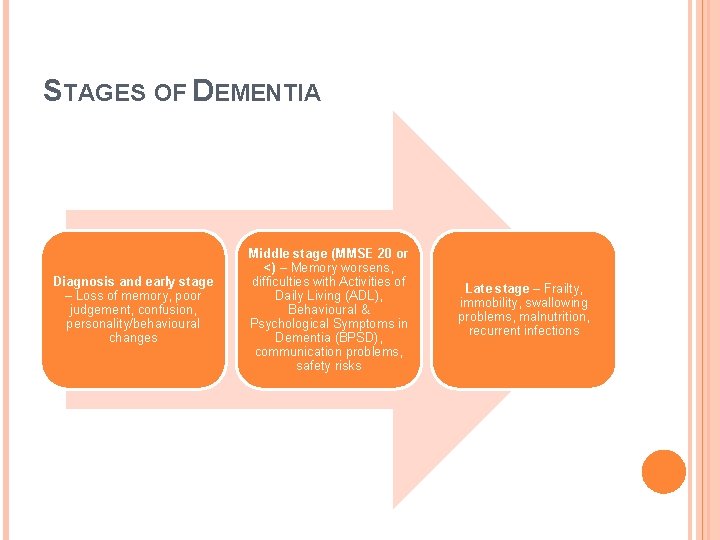
STAGES OF DEMENTIA Diagnosis and early stage – Loss of memory, poor judgement, confusion, personality/behavioural changes Middle stage (MMSE 20 or <) – Memory worsens, difficulties with Activities of Daily Living (ADL), Behavioural & Psychological Symptoms in Dementia (BPSD), communication problems, safety risks Late stage – Frailty, immobility, swallowing problems, malnutrition, recurrent infections
INCIDENCE 5% people over 65 are affected 20% of people over 80 Prevalence expected to double by 2040 Estimated 50% undiagnosed Contributes 1 in 4 hospital admissions Health and social cost more than stroke, heart disease and cancer combined Only 50% of people affected are diagnosed!
RISK FACTORS Modifiable risk Non-modifiable risk Alcohol Smoking (AD) Obesity Hypertension Head injury Educational stimulation Age Learning disability Sex
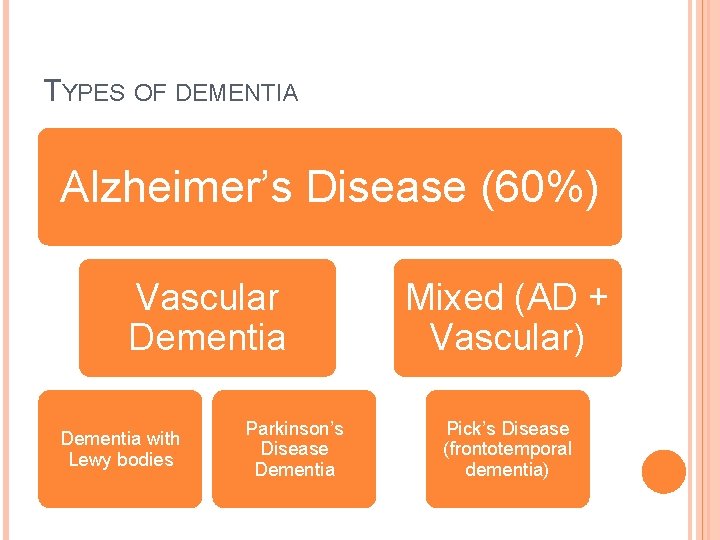
TYPES OF DEMENTIA Alzheimer’s Disease (60%) Vascular Dementia with Lewy bodies Parkinson’s Disease Dementia Mixed (AD + Vascular) Pick’s Disease (frontotemporal dementia)
WHEN TO SUSPECT Family concerned and patient denies any memory problem “Head turning sign”
DIAGNOSIS OF DEMENTIA National Dementia Strategy encourages early diagnosis Dementia does not fulfil criteria for population screening Case finding in high-risk groups, which are. . . >60 with CVD, DM, COPD, obesity, alcohol, smoking >40 with Down’s syndrome >50 with learning disability Patients with neurodegenerative diseases Any patient who presents with memory loss Dementia Enhanced Service 2015/2016
DIAGNOSIS • • Primary Care -History (Carer assessment) -Examination (Cognitive Assessment) -Blood screen Referral to Old Age Psychiatry -Neuropsychological testing -Imaging (MRI, CT) -Sub-type differentiation
ASSESSMENT TOOLS MMSE (Gold Standard, 8 mins) 6 CIT (for GPs, 90% sensitive, 100% specific, 34 mins) GP-COG (for GPs, 4 mins) www. patient. co. uk (e-copy/printable)
GP-COG Takes less than 4 minutes Multicultural population. Freely available 85% sensitive and 86% specific. Score <4 indicates cognitive impairment and 5 -6 indeterminate needing informant questionnaire.
GP-COG (BRODALY ET AL. JAGS 2002; 50: 530 -534) Name and address: for subsequent recall test Time/Orientation: what is the date? Clock Drawing – mark in numbers; mark hands to show 11: 10 Information: Can you tell me something that has happened in the news recently? Recall: What was the name and address I asked you to remember?
REFERRAL TO MEMORY CLINIC Prepare the ground Ideas, concerns. . . What do you think this might be? Discuss possible diagnosis, exploring the “D “word. Highlight complexity of diagnostic process.
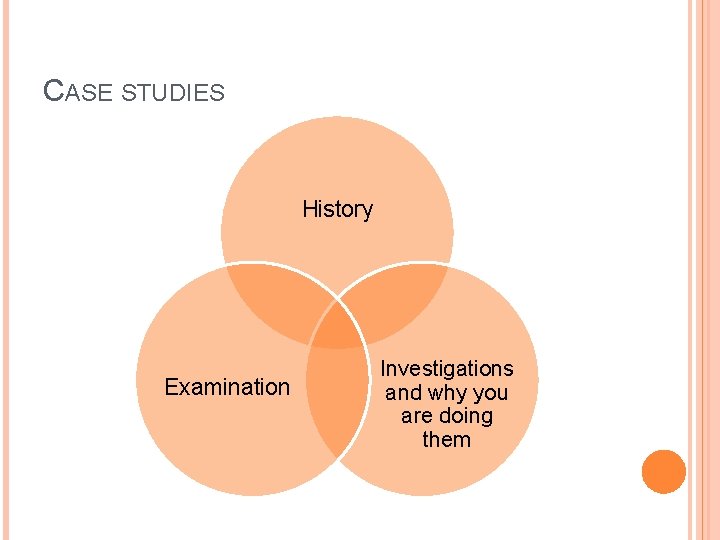
CASE STUDIES History Examination Investigations and why you are doing them
CASE 1 A 72 year old man presents in the GP surgery with his daughter. She says that he is getting forgetful and on occasions has phoned her in the middle of the night asking her when she is coming to take him shopping. He was widowed 5 years previously and is a retired policeman. She says that she is worried that he may be developing Alzheimer’s.
CASE 2 An 80 year old lady attends the surgery with her daughter. You have seen her previously at home when you attended her husband with a chest infection. The daughter says that she has lost weight and isn’t eating. She has also been found by neighbours wandering in the street on one occasion and seemed disorientated. The lady herself has no recollection of that event and denies that there is a problem with her eating. She says she feels fine and doesn’t want anyone making a fuss…after all, everyone forgets things as they get older, don’t they?
CASE 3 A 62 year old man who works in a call centre presents to the GP surgery on his own. He says that he is forgetting things and that it is making it difficult to do his job. He has had to write down his computer password (against company policy) as he cannot remember it and has on occasions had to ask his supervisor to help him to log on at the beginning of a shift. He feels down and very worried about it as his brother who is 10 years older developed Alzheimer’s disease at about the same age and this was preceded in his brother by a bout of depression. The patient has suffered with depression about one year ago.
EARLY DIAGNOSIS Benefits Disadvantages
BENEFITS: • • • Relief; End to uncertainty; Label for symptoms; Better understanding; Focus on positive; Cognitive and coping skills training; Drug treatments; Psychosocial support; Family support; Autonomy; Advanced planning and financial planning
DISADVANTAGES: • • Distress; Depression; Social isolation; Lack of cure; Stigma; Wrong diagnosis; Negative effect on function; Invalid role
EARLY DIAGNOSIS( BMJ 2013) Evidence suggests most people prefer to know! Advance care planning can reduce inappropriate hospital admissions towards end of life.
DEMENTIA– POST DIAGNOSTIC SUPPORT( 2013 - ALZHEIMERS SOCIETY) 40% lost friends 48% said they were a burden to family. 19% burden to friends 61% felt lonely 77% felt anxious/ depressed.
DEMENTIA CARE PLAN–POST DIAGNOSTIC SUPPORT(DES) General physical, mental and social review. Medication review/ side effects of medications. Advance care planning and DNAR Communication and co-ordinating arrangements for future. Identifying carers/ consent to share information.
DEMENTIA - CARE PLAN (DES) Post diagnostic support - Review understanding of diagnosis and provide written information - Information – Alzheimer’s Society, local memory cafe - Practical support: cognitive training/rehabilitation - Psychological therapy: difficulty adjusting to diagnosis -Discuss medico-legal issues eg. Driving -Information regarding financial and legal advice
CARER SUPPORT (BMJ 2011) Carers of People with Dementia: higher ‘burden’ More mental health problems Worse physical health Living bereavement NDS: Implement carers strategy Assess main carer’s needs as well as patient Educational resources for carers www. carersuk. org NICE suggesting health checks for dementia carers for QOF 2014/2015

TREATMENT Cognitive symptoms Pharmacological (NICE) Cholinesterase inhibitors Memantine Non-pharmacological Cognitive stimulation therapy (NICE) BPSD Environmental interventions Clinical interventions
TREATMENT (CONTD. ) DTB 2014: currently no intervention that cures or alters long-term progression of dementia All drugs have modest efficacy in treating cognitive function/ADL/behaviour NNT= 12 NNH=12 No evidence that one drug is more effective than others
TREATMENT (CONTD. ) Acetyl cholinesterase inhibitors (for mild-moderate AD): Donepezil Galantamine Rivastigmine Memantine (for moderate-severe AD) Combination of treatments have shown conflicting results Rivastigmine has shown modest benefits in Lewy Body, Parkinson’s and Vascular dementia (unlicensed) No benefit in MCI
MANAGEMENT OF BEHAVIOURAL & PSYCHOLOGICAL SYMPTOMS IN DEMENTIA (BPSD)
BPSD Behavioural • restlessness • physical aggression • screaming, agitation • wandering • sexual disinhibition • shadowing
BPSD Psychological • anxiety • depressed mood • delusions • hallucinations BPSD occurs in up to 90% people with dementia
BPSD More common as dementia progresses Approach should be broad, biopsychosocial approach. May need to try several management options Most cases are self limiting. So, non-pharmacological/ short term pharmacological approach is safe and effective.
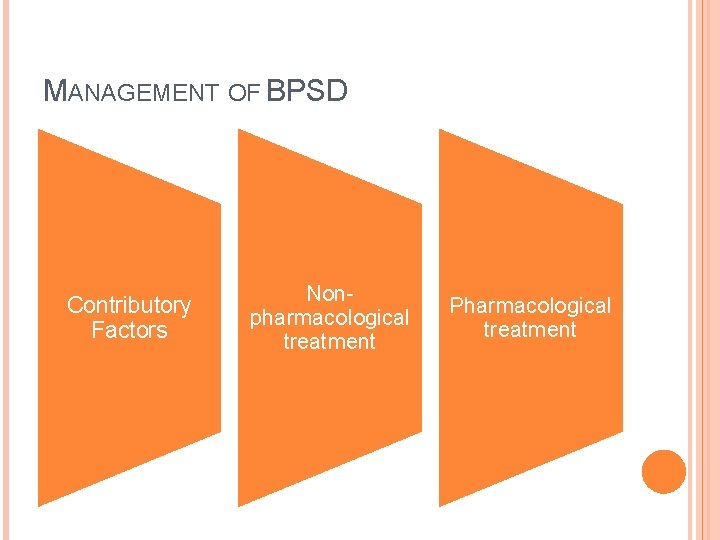
MANAGEMENT OF BPSD Contributory Factors Nonpharmacological treatment Pharmacological treatment
CONTRIBUTORY FACTORS Physical (infection, pain, constipation) Activity-related (washing, dressing) Iatrogenic (drug side-effects) Noise (loud environment) Exclude delirium
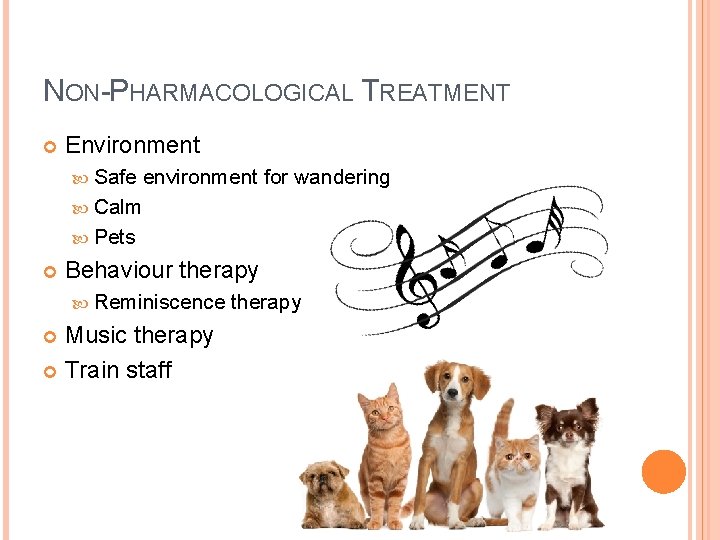
NON-PHARMACOLOGICAL TREATMENT Environment Safe environment for wandering Calm Pets Behaviour therapy Reminiscence Music therapy Train staff therapy
PHARMACOLOGICAL TREATMENTS SSRI drugs reduce agitation Sertraline Citalopram Trazodone Mirtazapine (second line drug) Anti-convulsants Carbamazapine Gabapentine Lamotrigine Topiramate Avoid benzos and long-term sedating anti-histamine
PHARMACOLOGICAL TREATMENTS (CONTD. ) Anti-psychotics in BPSD: CSM warning to AVOID PRESCRIBING Increase risk of stroke Increase mortality NEVER IN LEWY BODY/PARKINSON’S Low dose risperidone only licensed option for shortterm use for severe psychosis, agitation and aggression in moderate-severe AD
WHAT’S NEW? New drug: latrepirdine (Dimebon? ) Dementia-DES MCI (Mild Cognitive Impairment) Vitamin B and mild cognitive impairment (VITA Cog) Anti psychotics in dementia (BMJ 2012) Analgesia in BPSD (DTB summary) Anti depressants in Alzheimers (Lancet 2011) Move from secondary to primary care
MCI Impaired memory for age and education but with preservation of general cognitive function Increased risk of developing dementia (5 -10%) 25 -30% recover/improve No evidence that drugs reduce progression Cognitive stimulation effective at delaying progression VITACOG study: Vitamin B (folic acid, B 12 and B 6) Improves memory scores
INFORMATION PROVISION Alzheimer’s Society www. alzheimers. org. uk
ENHANCE KNOWLEDGE DH/RCGP e-learning for Health Care of older people 2 dementia modules www. e-lfh. org. uk/projects/egp
DEMENTIA FRIENDS Alzheimer’s Society programme Changing public perception of dementia Learning about what it is like to live with dementia Turning that understanding into action Can then volunteer to be a Champion and encourage others to learn more about dementia
OTHER BITS Advanced decisions Advanced statements LPA Driving and Demntia Mental capacity
ADVANCED DECISIONS One aspect of planning ahead Gives opportunity to make decisions about specific treatments that the patient may or may not want to receive in the future e. g. Can refuse life-sustaining treatments or blood transfusions An advanced decision is legally binding Need to fulfil certain requirements Should be valid and applicable
WHAT CAN AN ADVANCED DECISION NOT DO? Demand specific treatment Refuse basic care Refuse offering of food/drink by mouth Refuse measures designed to maintain comfort i. e. painkillers Refuse treatment for a mental disorder under Mental Health Act Ask for anything that is against the law
HOW TO MAKE AN ADVANCED DECISION Can use a form or write in own words Can be verbal but recorded on medical records by a professional Content can be simple or complex The record should have: Clear note of treatments Details about the witness Whether health professionals have heard the decision Talk to GP to make one May wish to consult a solicitor Make copies for GP, hospital, relatives, close friends Review regularly
ADVANCED STATEMENTS Not the same as an advanced decision Not legally binding Can be verbal or written General statement about wishes and views for the future (not specific treatments) e. g. where to live, type of care, support received, food preferences, personal care, religious/ spiritual needs Should be taken into account by health and social care professionals when making decisions about care or treatment
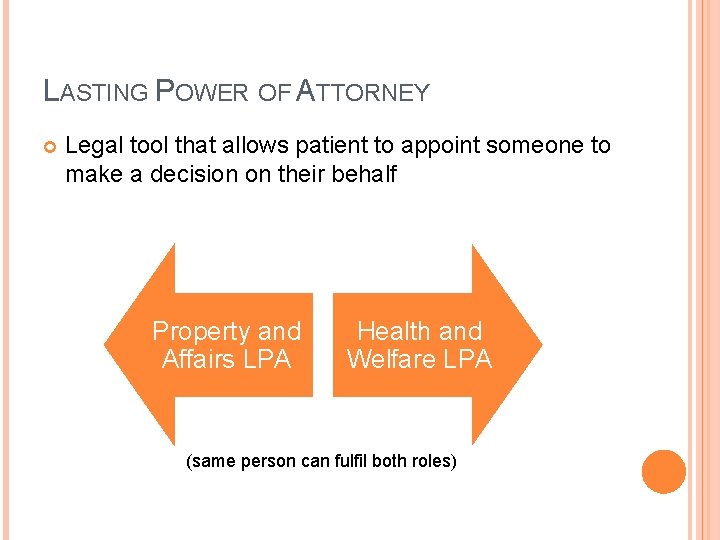
LASTING POWER OF ATTORNEY Legal tool that allows patient to appoint someone to make a decision on their behalf Property and Affairs LPA Health and Welfare LPA (same person can fulfil both roles)
LPA (CONTD. ) Has to be registered with OPG (Office of the Public Guardian) Can make one if: Over 18 MUST have mental capacity to make the decision Any adult can be an LPA (usually a relative or a friend) Complete an LPA form (separate forms for the two types) which needs a signature to certify mental capacity (signature can be from doctor/social worker/solicitor) Sign the form in front of a witness
LPA (CONTD. ) LPA is invalid if– not registered, attorney dies, applicant dies( will takes over). If applicant has a valid advance decision then attorney must follow. If applicant lacks capacity to make an LPA, option is to apply to court of protection to appoint a deputy or make a best interest decision( health and welfare only) Court appointed deputy may be a relation, someone who knows applicant well or a upstanding member of society.
DRIVING AND DEMENTIA May be able to continue driving Must fulfil certain legal requirements Inform DVLA about diagnosis who then make an assessment If unsure, can take a driving assessment
STOP DRIVING IF. . . Less confident Getting lost on familiar roads Misjudging speed/distance Straying across lanes or hitting kerbs Risk of having an accident Passenger concerns
TIPS FOR ENCOURAGING PEOPLE TO STOP DRIVING Acknowledge difficulty Encourage them to take charge of new transport arrangement Set up a taxi account Pay bills and shop online Point out benefits of not driving Saving money on petrol and car insurance Not having to find parking spaces Not getting caught in traffic Public transport can be social May want to walk which would provide exercise
MENTAL CAPACITY- 2005 Set up to clarify the legal framework around adult decision making. Based on five key principles Also stipulates that a person cannot demand a treatment or care that is inappropriate but may refuse treatment or care against medical advice.
MENTAL CAPACITY- KEY PRINCIPLES Assume capacity unless proven otherwise Help people to have capacity in all practical ways before deciding that they do no. Understand that people with capacity are entitled to make unwise, unsafe decisions. Decisions for people without capacity should be in their best interest. Capacity is decision and time specific.
CAPACITY TEST– FOUR POINTS Understand the information given. Retain sufficient information to make an informed decision. Balance, weigh up and use the information appropriately. Communicate their decision.
LACKING MENTAL CAPACITY- BEST INTEREST DECISIONS First check validity of any advanced decisions to refuse treatment and if valid then follow its requirements. Identify any power of attorney. Make best interest decision that seeks to identify what the persons decision would have been had they still the capacity to decide. Take into account any legal constraints Should not be affected by any preconceptions based on race, religion, colour. Clearly documental capacity and best interest decisions.

ROLE PLAYS
THANK YOU
- Slides: 65