The Io PHMNAO Moon Watch Project Islamic Astronomy
- Slides: 64
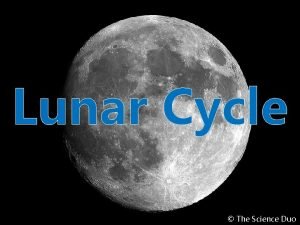
The Io. P/HMNAO Moon. Watch Project Islamic Astronomy at the Muslim World League London September 8 nd 2007 Dr. Steve Bell HMNAO/SSTD H. M. Nautical Almanac Office
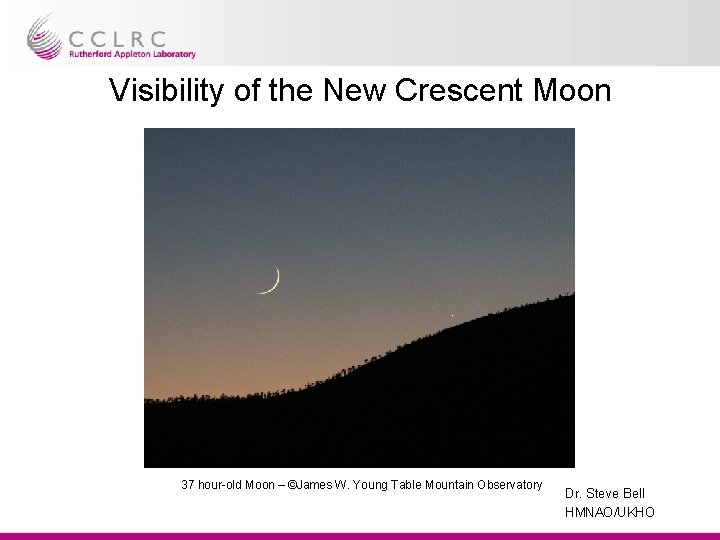
Visibility of the New Crescent Moon 37 hour-old Moon – ©James W. Young Table Mountain Observatory Dr. Steve Bell HMNAO/UKHO
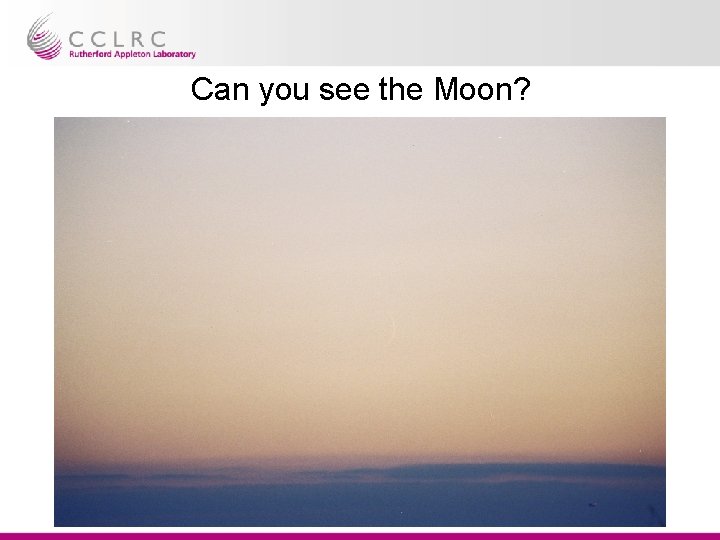
Can you see the Moon? Dr. Steve Bell HMNAO/UKHO
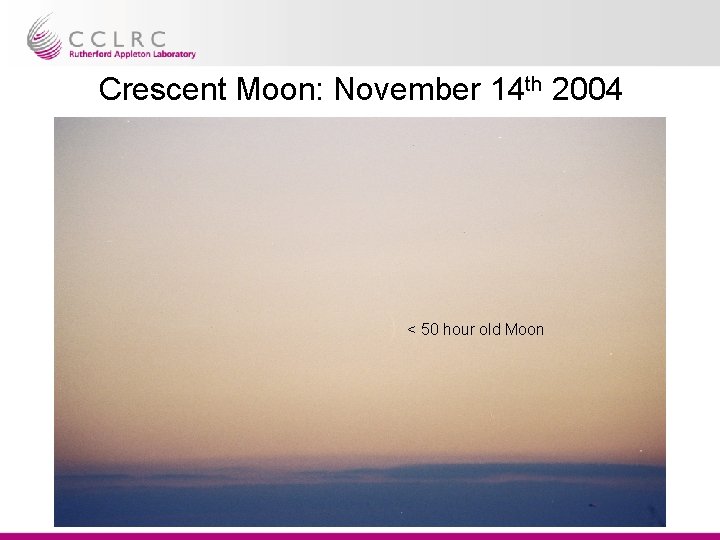
Crescent Moon: November 14 th 2004 < 50 hour old Moon Dr. Steve Bell HMNAO/UKHO
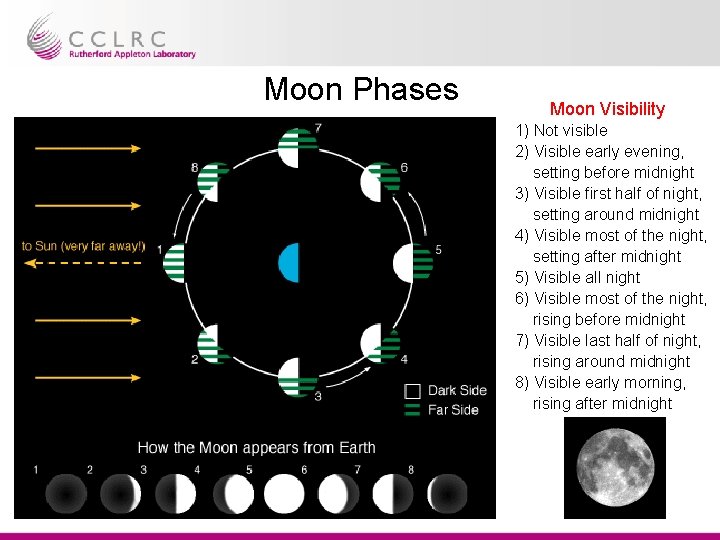
Moon Phases Moon Visibility 1) Not visible 2) Visible early evening, setting before midnight 3) Visible first half of night, setting around midnight 4) Visible most of the night, setting after midnight 5) Visible all night 6) Visible most of the night, rising before midnight 7) Visible last half of night, rising around midnight 8) Visible early morning, rising after midnight Dr. Steve Bell HMNAO/UKHO
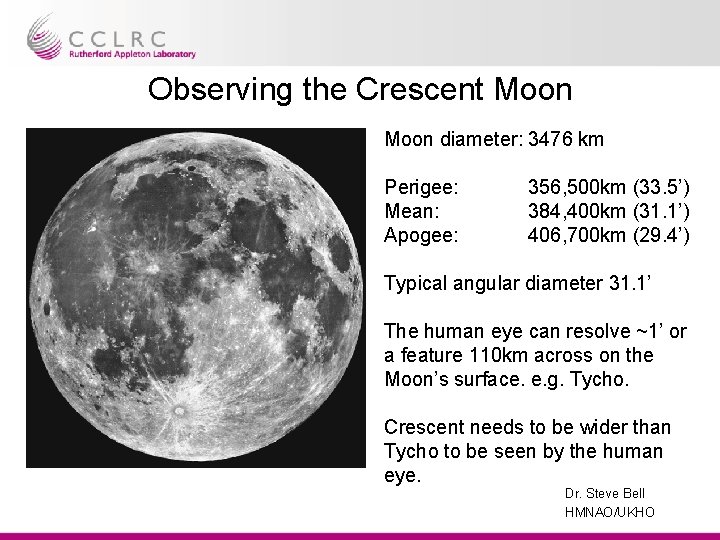
Observing the Crescent Moon diameter: 3476 km Perigee: Mean: Apogee: 356, 500 km (33. 5’) 384, 400 km (31. 1’) 406, 700 km (29. 4’) Typical angular diameter 31. 1’ The human eye can resolve ~1’ or a feature 110 km across on the Moon’s surface. e. g. Tycho. Crescent needs to be wider than Tycho to be seen by the human eye. Dr. Steve Bell HMNAO/UKHO
What do we need for sighting predictions? • • Calculate positions of the Sun & Moon Calculate rise/set times A knowledge of twilight Key quantities for calculating first sighting An algorithm to predict first sighting Generate global and local predictions Ability to improve the predictions Dr. Steve Bell HMNAO/UKHO
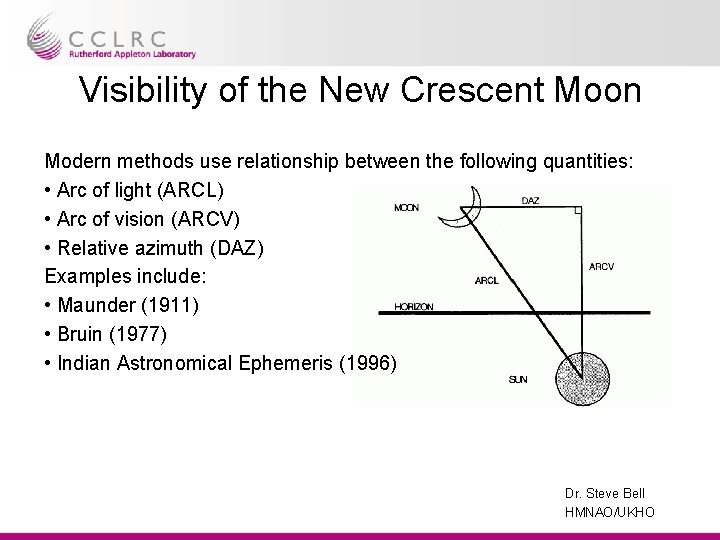
Visibility of the New Crescent Moon Modern methods use relationship between the following quantities: • Arc of light (ARCL) • Arc of vision (ARCV) • Relative azimuth (DAZ) Examples include: • Maunder (1911) • Bruin (1977) • Indian Astronomical Ephemeris (1996) Dr. Steve Bell HMNAO/UKHO
Historical Prediction criteria • Earliest observations – Age > 24 hours in temperate latitudes Equator: 16 – 25 hours Latitude 30º: 17 – 33 hours • Babylonians – lag time > 48 minutes Observations show a range of 22 – 84 minutes • Medieval Islamic – lag time > 48 minutes with ARCL > 11. 25º Dr. Steve Bell HMNAO/UKHO
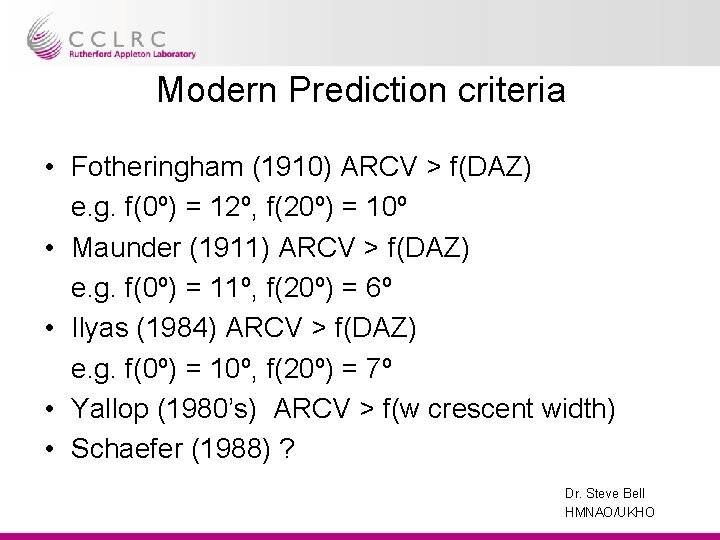
Modern Prediction criteria • Fotheringham (1910) ARCV > f(DAZ) e. g. f(0º) = 12º, f(20º) = 10º • Maunder (1911) ARCV > f(DAZ) e. g. f(0º) = 11º, f(20º) = 6º • Ilyas (1984) ARCV > f(DAZ) e. g. f(0º) = 10º, f(20º) = 7º • Yallop (1980’s) ARCV > f(w crescent width) • Schaefer (1988) ? Dr. Steve Bell HMNAO/UKHO
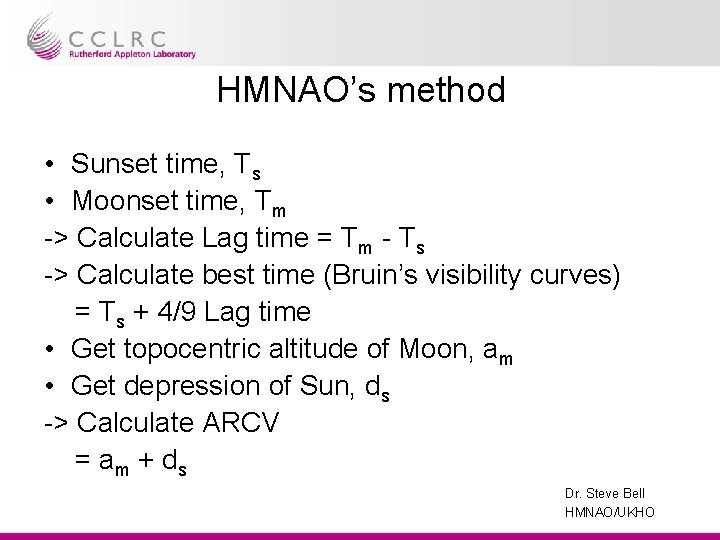
HMNAO’s method • Sunset time, Ts • Moonset time, Tm -> Calculate Lag time = Tm - Ts -> Calculate best time (Bruin’s visibility curves) = Ts + 4/9 Lag time • Get topocentric altitude of Moon, am • Get depression of Sun, ds -> Calculate ARCV = a m + ds Dr. Steve Bell HMNAO/UKHO
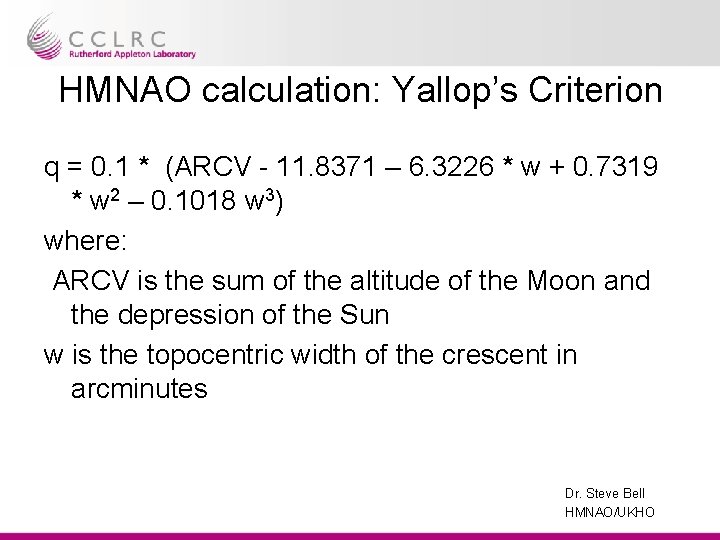
HMNAO calculation: Yallop’s Criterion q = 0. 1 * (ARCV - 11. 8371 – 6. 3226 * w + 0. 7319 * w 2 – 0. 1018 w 3) where: ARCV is the sum of the altitude of the Moon and the depression of the Sun w is the topocentric width of the crescent in arcminutes Dr. Steve Bell HMNAO/UKHO
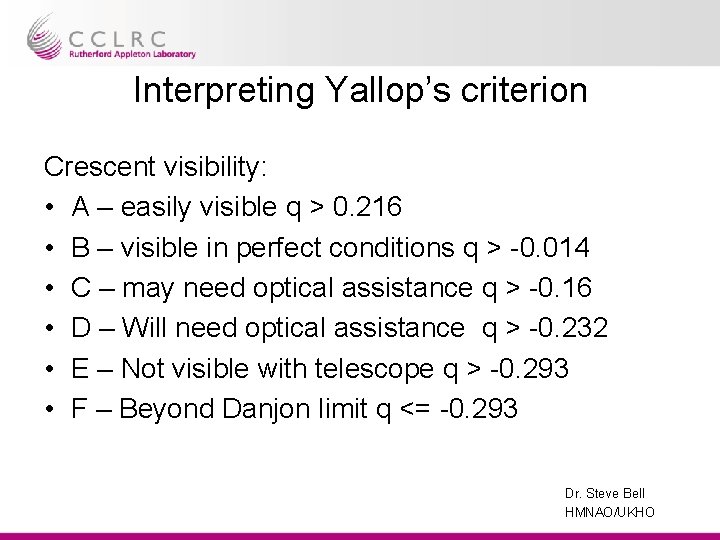
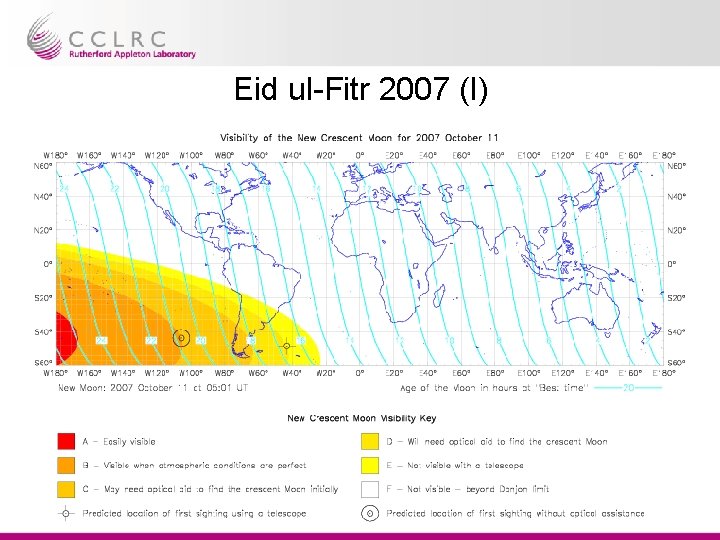
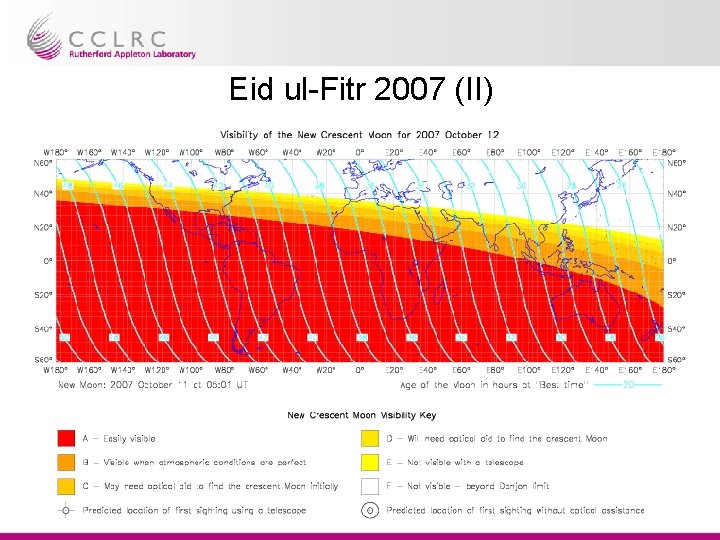
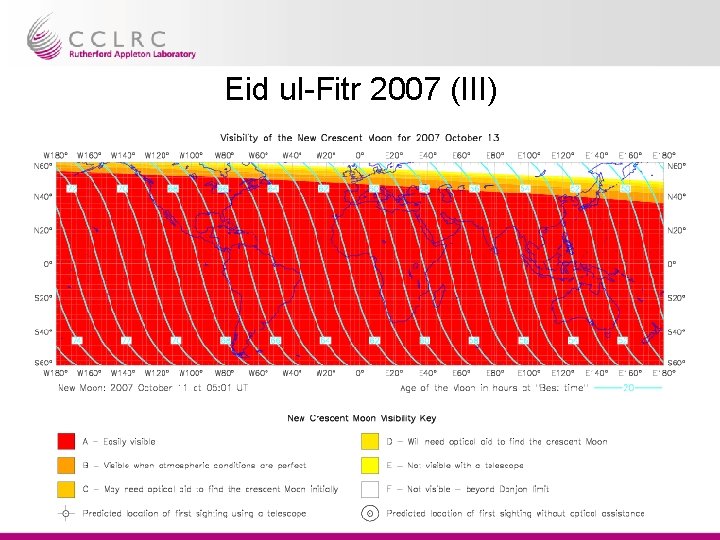
Interpreting Yallop’s criterion Crescent visibility: • A – easily visible q > 0. 216 • B – visible in perfect conditions q > -0. 014 • C – may need optical assistance q > -0. 16 • D – Will need optical assistance q > -0. 232 • E – Not visible with telescope q > -0. 293 • F – Beyond Danjon limit q <= -0. 293 Dr. Steve Bell HMNAO/UKHO
Danjon limit • ARCL <= 8º Why this value: • Rapid narrowing of the crescent near cusps • Illumination of the cusps by the Sun – foreshortening relative to equatorial regions • Shadowing of the lunar surface – rough surface illuminating at glancing angles • Earthshine comparable to crescent brightness Dr. Steve Bell HMNAO/UKHO
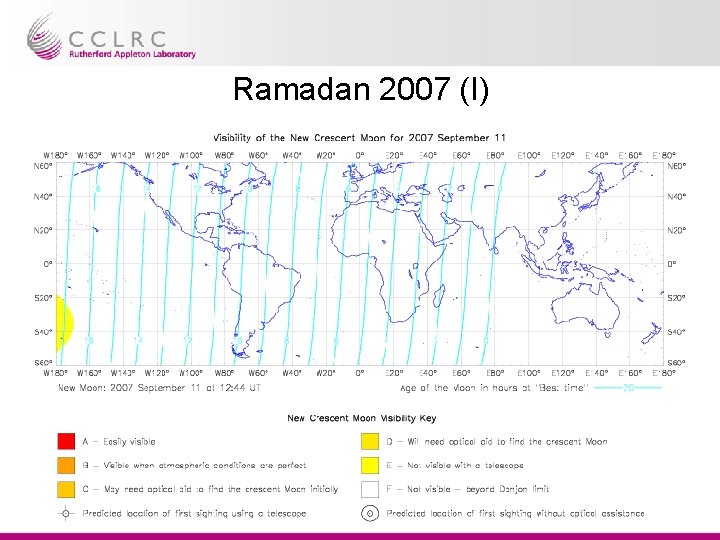
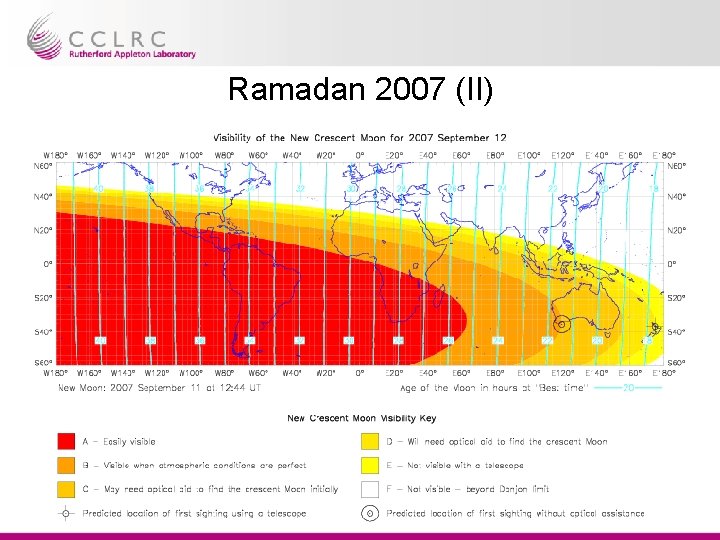
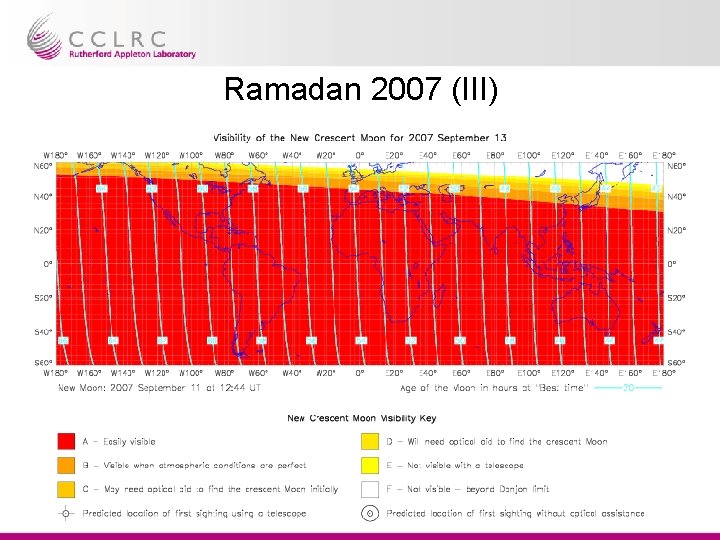
Global Visibility of the New Crescent Moon We can generate a visibility criterion for a particular location using q. What about a global view? We can generate a grid of points and treat “q” as the basis of a contour map What about the Ramadan 2007? Dr. Steve Bell HMNAO/UKHO
Making Sightings • Record naked eye sighting: 15. 4 hours • Record telescopic sighting: 12. 1 hours To make these sightings we need: • Good atmospheric transparency • Clear weather conditions • Knowing where to look • Good visual acuity • Experience of observing Dr. Steve Bell HMNAO/UKHO
Moonwatch Background • Most data for our models has been obtained at low to medium latitudes • We need data from more extreme latitudes >50° • Concentrate on non-record sightings • We need careful observers to record sightings of the new crescent moon Dr. Steve Bell HMNAO/UKHO
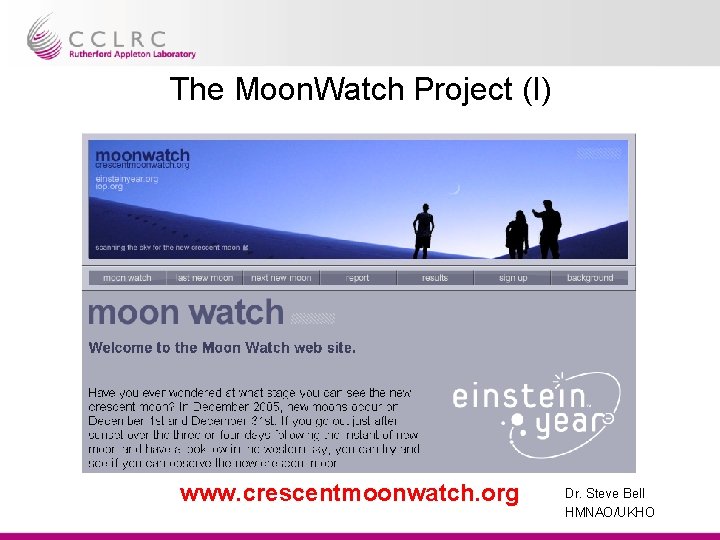
The Moon. Watch Project (I) www. crescentmoonwatch. org Dr. Steve Bell HMNAO/UKHO
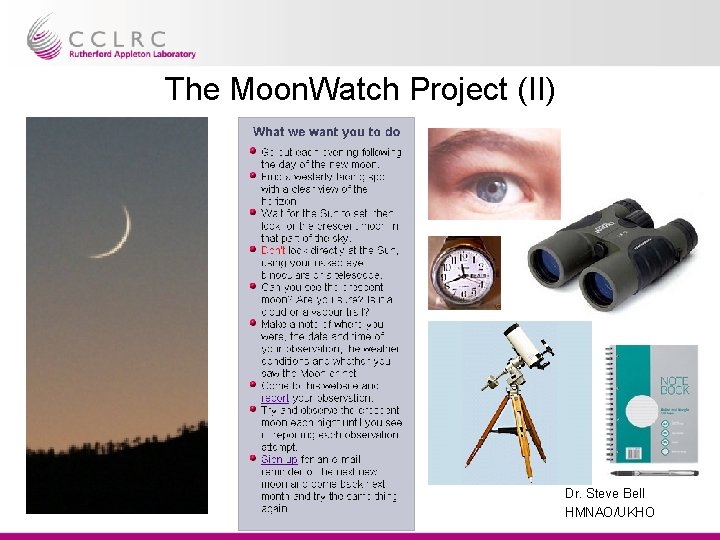
The Moon. Watch Project (II) Dr. Steve Bell HMNAO/UKHO
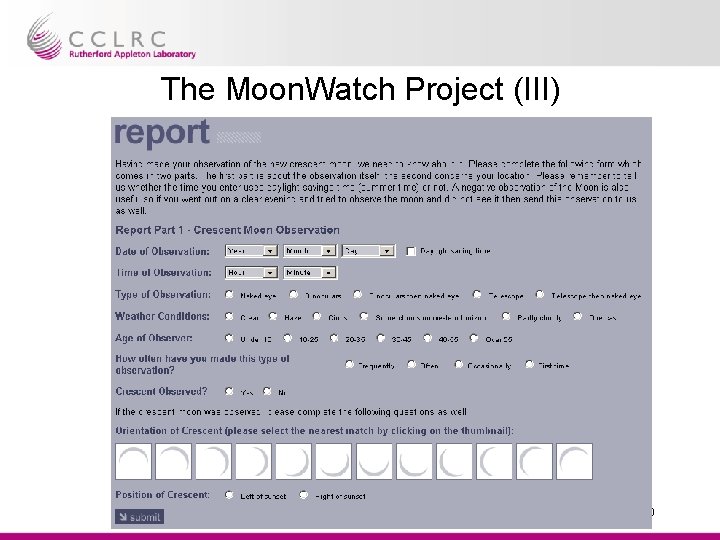
The Moon. Watch Project (III) Dr. Steve Bell HMNAO/UKHO
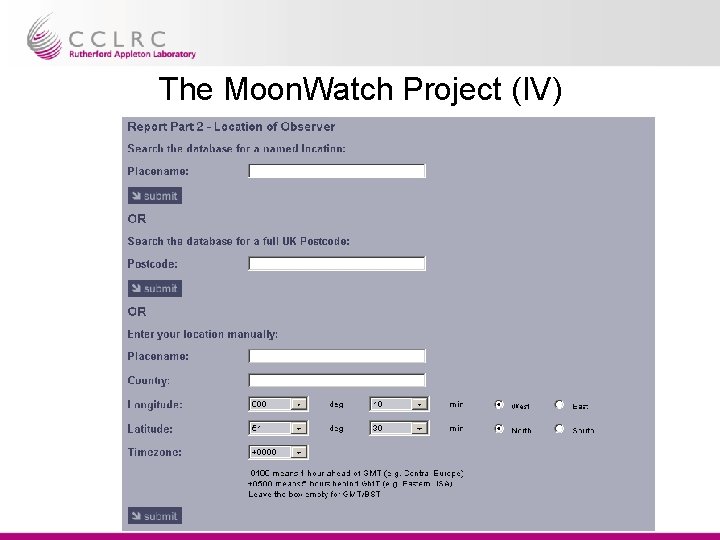
The Moon. Watch Project (IV) Dr. Steve Bell HMNAO/UKHO
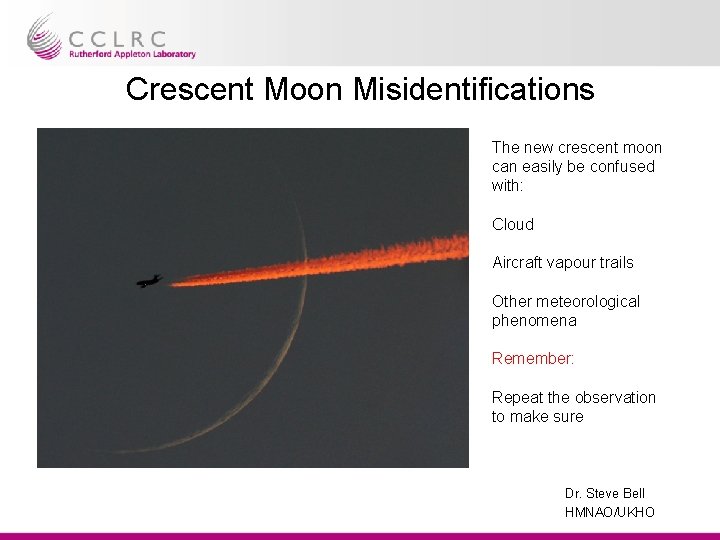
Crescent Moon Misidentifications The new crescent moon can easily be confused with: Cloud Aircraft vapour trails Other meteorological phenomena Remember: Repeat the observation to make sure Dr. Steve Bell HMNAO/UKHO
More Vapour Trails Dr. Steve Bell HMNAO/UKHO
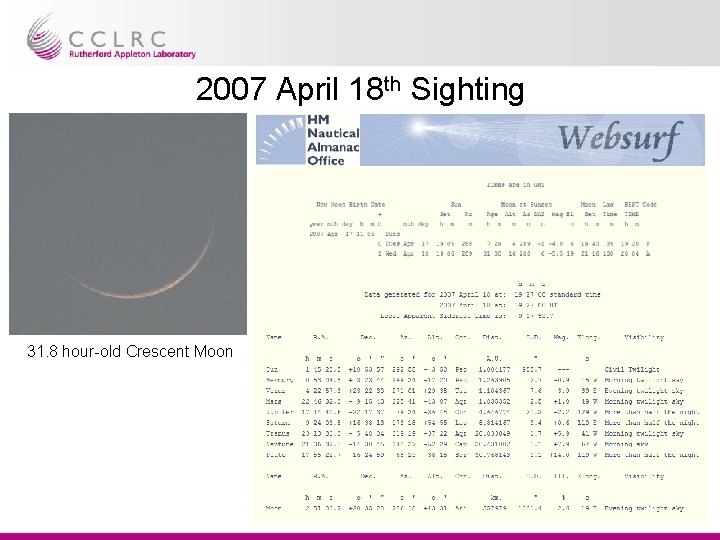
2007 April 18 th Sighting 31. 8 hour-old Crescent Moon Dr. Steve Bell HMNAO/UKHO
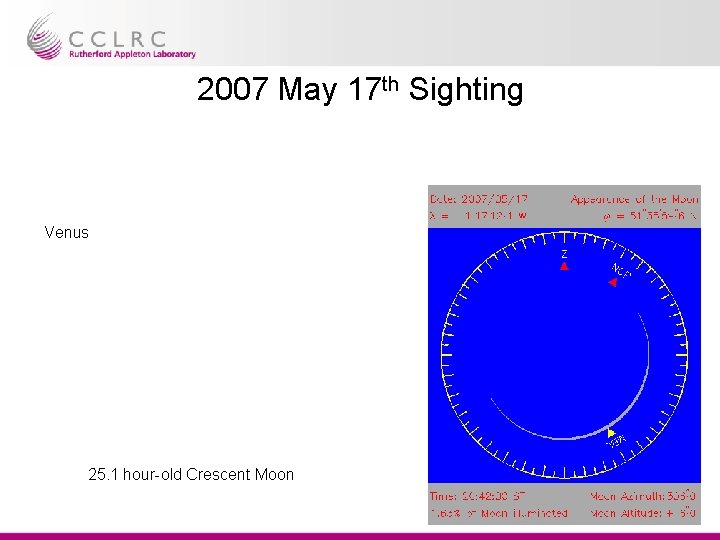
2007 May 17 th Sighting Venus 25. 1 hour-old Crescent Moon Dr. Steve Bell HMNAO/UKHO
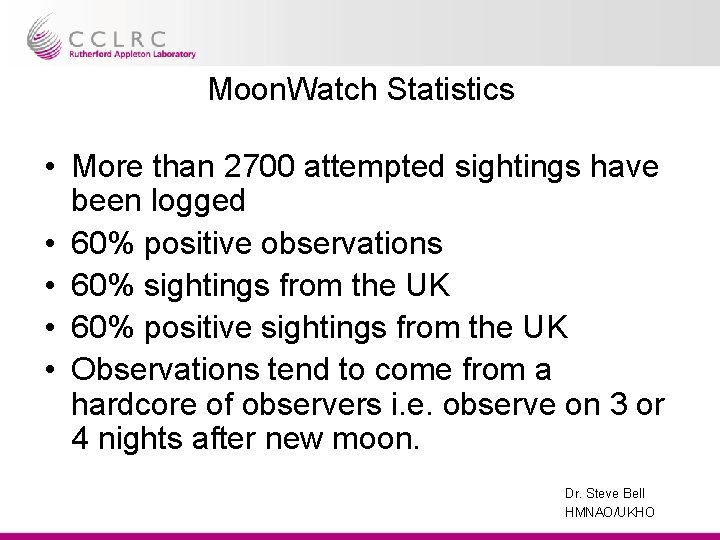
Moon. Watch Statistics • More than 2700 attempted sightings have been logged • 60% positive observations • 60% sightings from the UK • 60% positive sightings from the UK • Observations tend to come from a hardcore of observers i. e. observe on 3 or 4 nights after new moon. Dr. Steve Bell HMNAO/UKHO
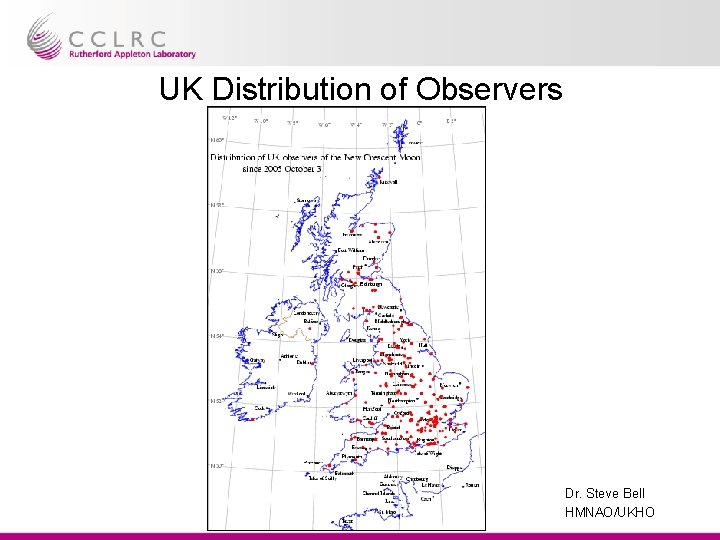
UK Distribution of Observers Dr. Steve Bell HMNAO/UKHO
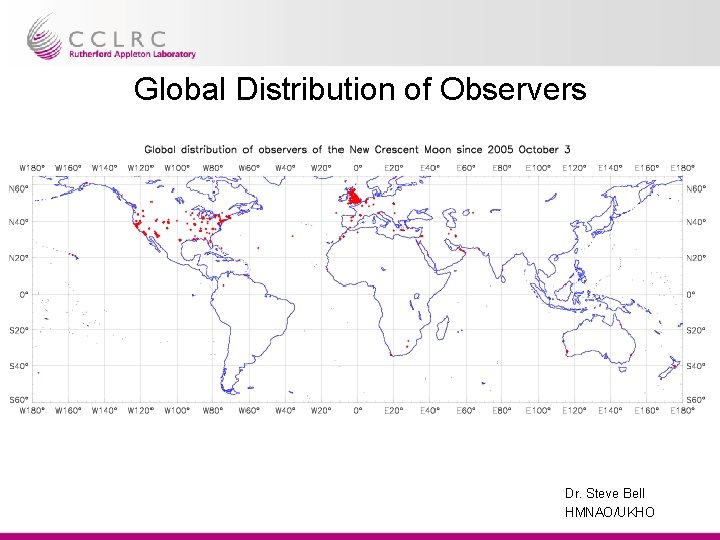
Global Distribution of Observers Dr. Steve Bell HMNAO/UKHO
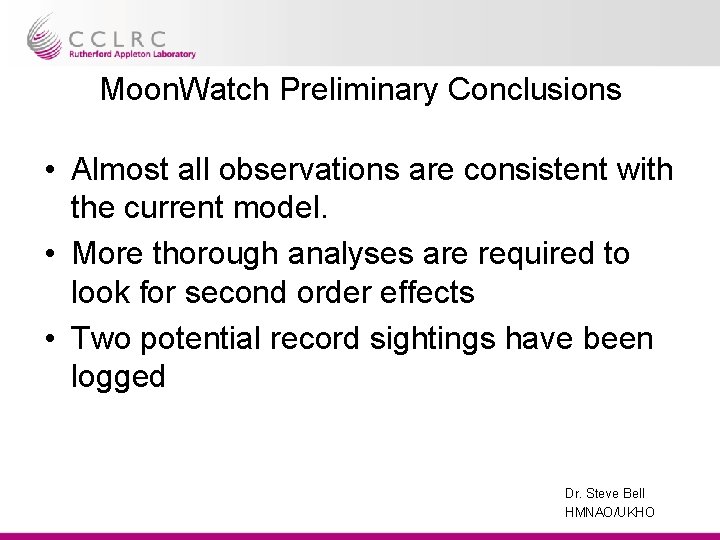
Moon. Watch Preliminary Conclusions • Almost all observations are consistent with the current model. • More thorough analyses are required to look for second order effects • Two potential record sightings have been logged Dr. Steve Bell HMNAO/UKHO
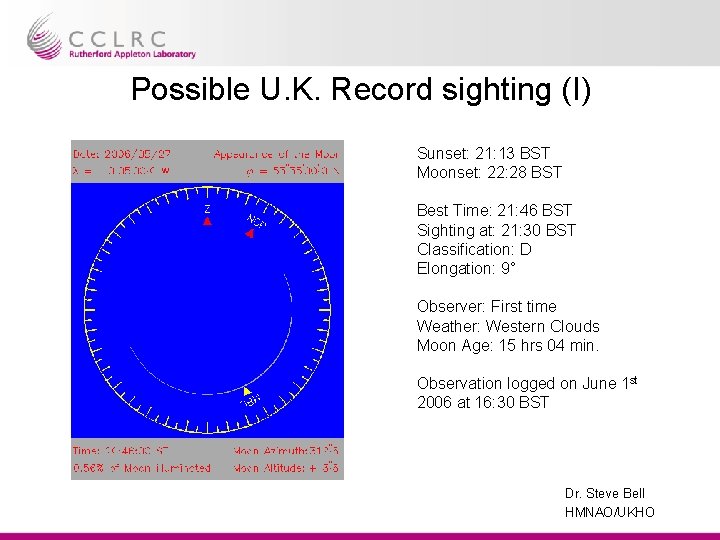
Possible U. K. Record sighting (I) Sunset: 21: 13 BST Moonset: 22: 28 BST Best Time: 21: 46 BST Sighting at: 21: 30 BST Classification: D Elongation: 9° Observer: First time Weather: Western Clouds Moon Age: 15 hrs 04 min. Observation logged on June 1 st 2006 at 16: 30 BST Dr. Steve Bell HMNAO/UKHO
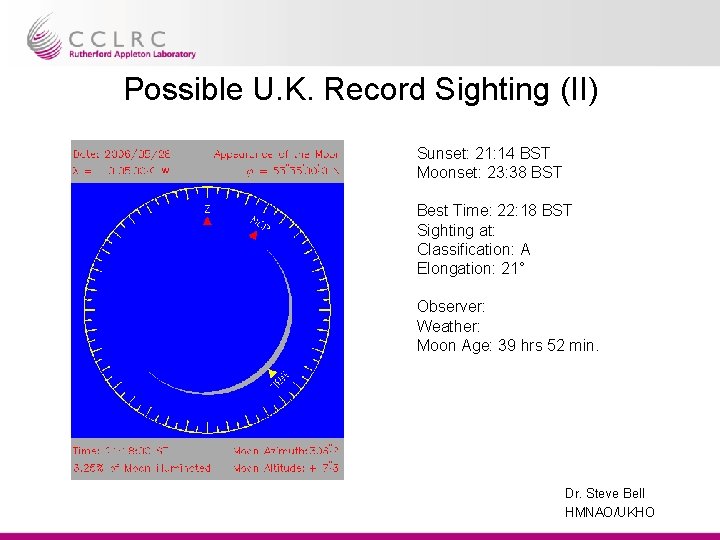
Possible U. K. Record Sighting (II) Sunset: 21: 14 BST Moonset: 23: 38 BST Best Time: 22: 18 BST Sighting at: Classification: A Elongation: 21° Observer: Weather: Moon Age: 39 hrs 52 min. Dr. Steve Bell HMNAO/UKHO
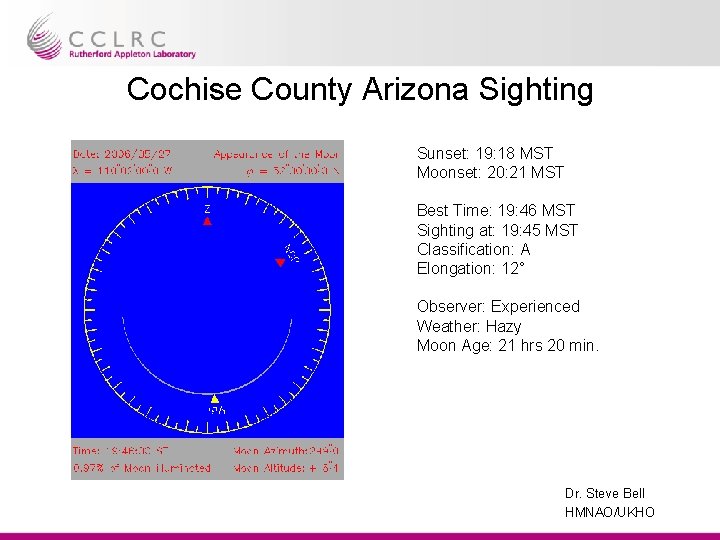
Cochise County Arizona Sighting Sunset: 19: 18 MST Moonset: 20: 21 MST Best Time: 19: 46 MST Sighting at: 19: 45 MST Classification: A Elongation: 12° Observer: Experienced Weather: Hazy Moon Age: 21 hrs 20 min. Dr. Steve Bell HMNAO/UKHO
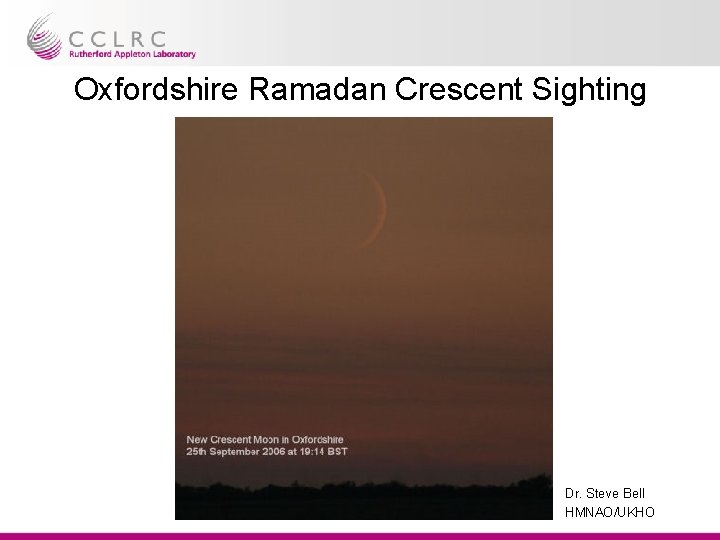
Oxfordshire Ramadan Crescent Sighting Dr. Steve Bell HMNAO/UKHO
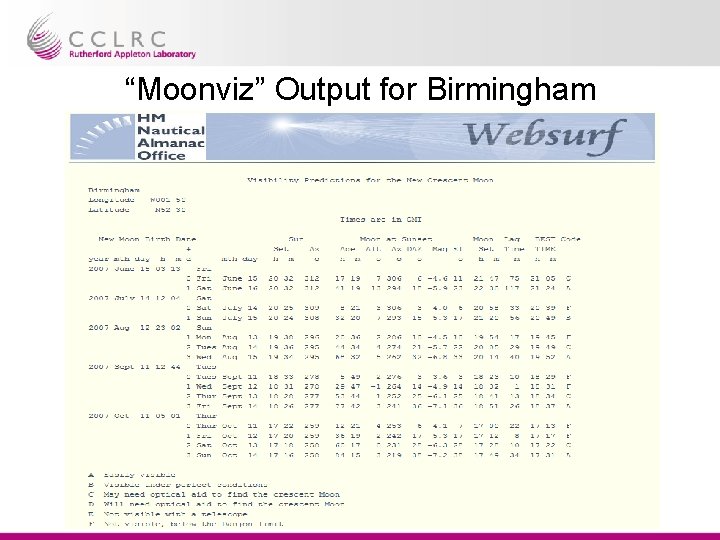
“Moonviz” Output for Birmingham Dr. Steve Bell HMNAO/UKHO
Ramadan 2007 (I) Dr. Steve Bell HMNAO/UKHO
Ramadan 2007 (II) Dr. Steve Bell HMNAO/UKHO
Ramadan 2007 (III) Dr. Steve Bell HMNAO/UKHO
Eid ul-Fitr 2007 (I) Dr. Steve Bell HMNAO/UKHO
Eid ul-Fitr 2007 (II) Dr. Steve Bell HMNAO/UKHO
Eid ul-Fitr 2007 (III) Dr. Steve Bell HMNAO/UKHO
A Final Request … • A more thorough analysis is being undertaken • More observations are needed • Please keep on observing! • Please submit your observations to www. crescentmoonwatch. org Dr. Steve Bell HMNAO/UKHO
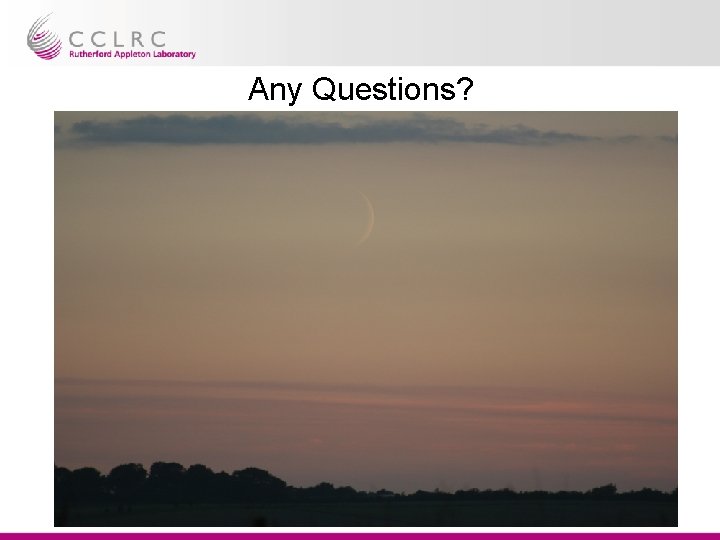
Any Questions? Dr. Steve Bell HMNAO/UKHO
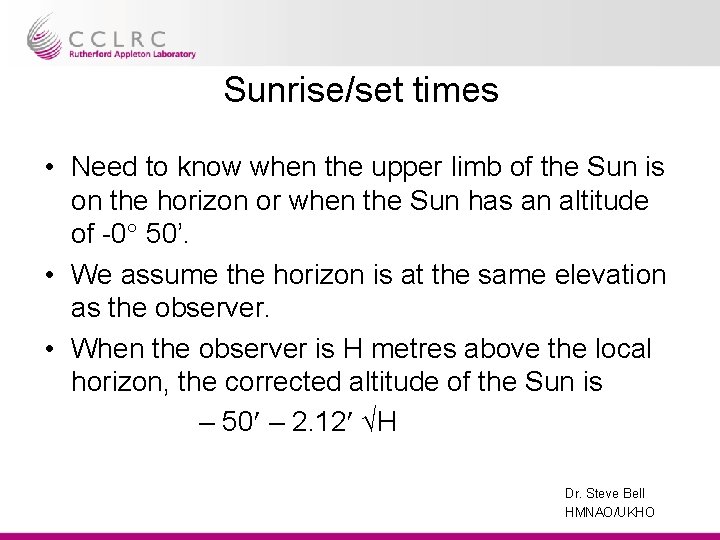
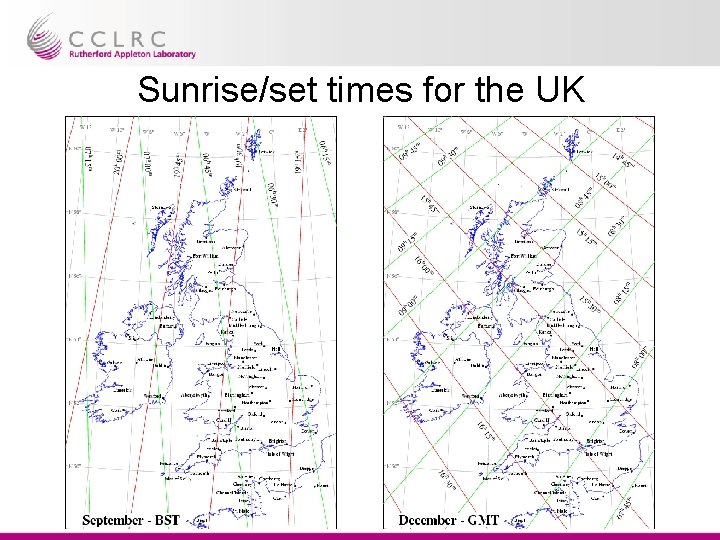
Sunrise/set times • Need to know when the upper limb of the Sun is on the horizon or when the Sun has an altitude of -0 50’. • We assume the horizon is at the same elevation as the observer. • When the observer is H metres above the local horizon, the corrected altitude of the Sun is – 50 – 2. 12 √H Dr. Steve Bell HMNAO/UKHO
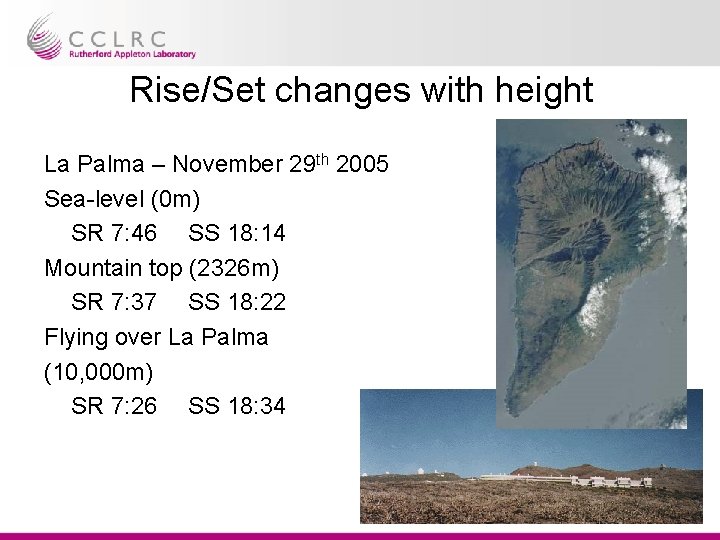
Rise/Set changes with height La Palma – November 29 th 2005 Sea-level (0 m) SR 7: 46 SS 18: 14 Mountain top (2326 m) SR 7: 37 SS 18: 22 Flying over La Palma (10, 000 m) SR 7: 26 SS 18: 34 Dr. Steve Bell HMNAO/UKHO
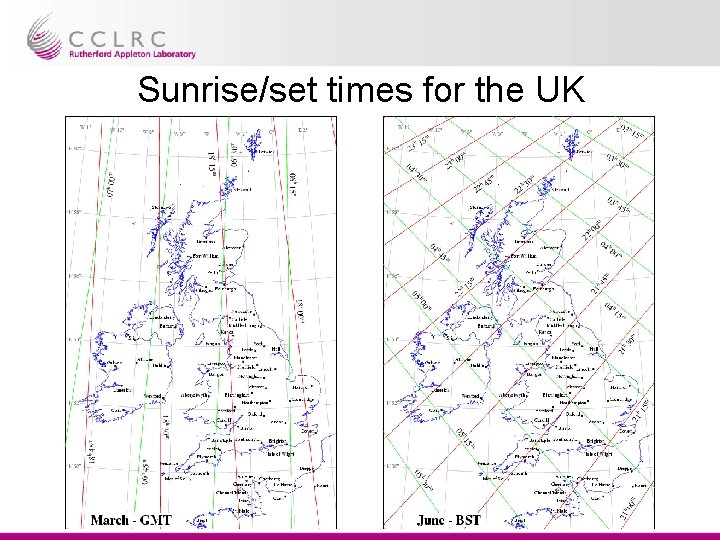
Sunrise/set times for the UK Dr. Steve Bell HMNAO/UKHO
Sunrise/set times for the UK Dr. Steve Bell HMNAO/UKHO
Sun rise/set & twilight times in the UK • Variation in sunrise/set times: East-West 30 minutes North-South 60 minutes • Latitudes for the occurrence of twilight: Astronomical < 48. 5° Nautical < 54. 5° Civil < 60. 5° Dr. Steve Bell HMNAO/UKHO
Phenomena affecting sunrise/set times • Parallax – only important due to the proximity of the Moon • Refraction – dependent on meteorological conditions, adopted value of 34’ at the horizon • Semi-diameter of Sun/Moon • Beware – refraction affected by inversion layers, extreme meteorological conditions. Dr. Steve Bell HMNAO/UKHO
Accuracy of sunrise/set times • Algorithm gives RA & Dec to 1 arcminute • Good enough for rise /set times to 1 -2 minutes • Ultimately meteorological conditions place limit on accuracy of sunrise/set times. Dr. Steve Bell HMNAO/UKHO
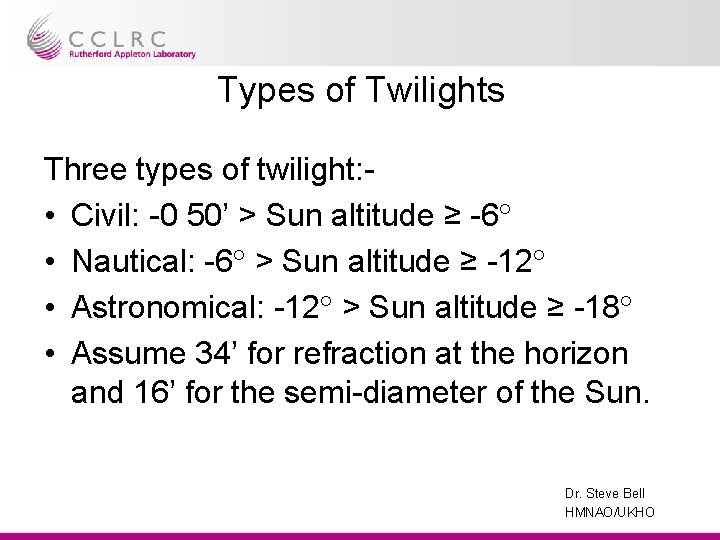
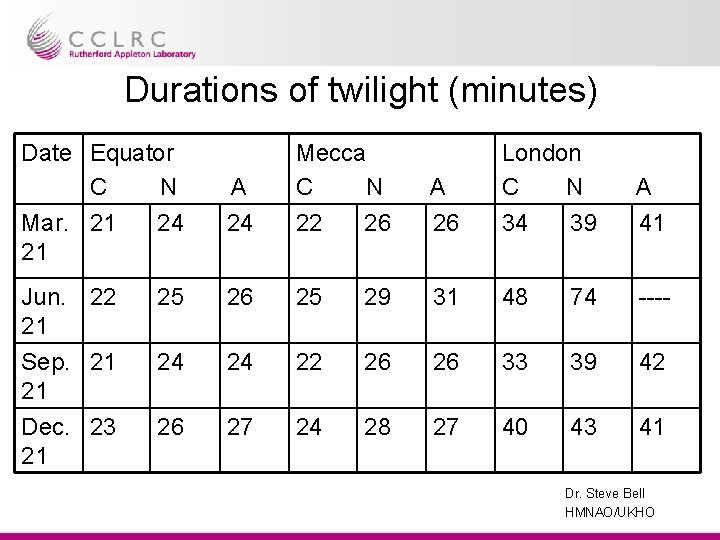
Types of Twilights Three types of twilight: • Civil: -0 50’ > Sun altitude ≥ -6 • Nautical: -6 > Sun altitude ≥ -12 • Astronomical: -12 > Sun altitude ≥ -18 • Assume 34’ for refraction at the horizon and 16’ for the semi-diameter of the Sun. Dr. Steve Bell HMNAO/UKHO
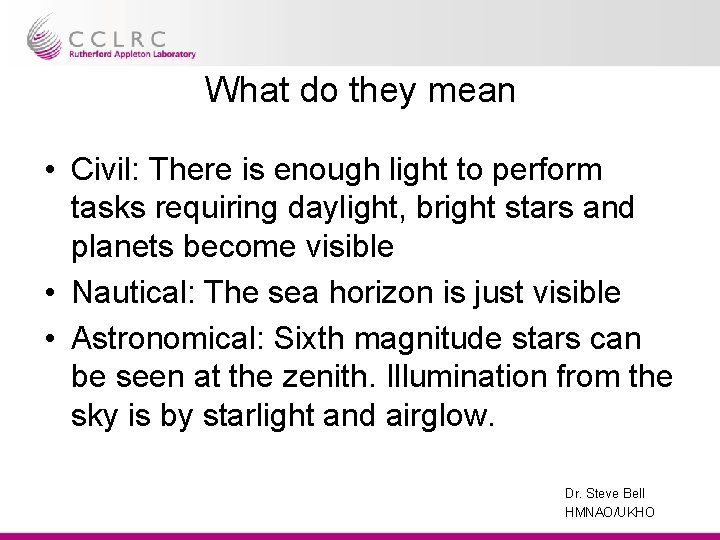
What do they mean • Civil: There is enough light to perform tasks requiring daylight, bright stars and planets become visible • Nautical: The sea horizon is just visible • Astronomical: Sixth magnitude stars can be seen at the zenith. Illumination from the sky is by starlight and airglow. Dr. Steve Bell HMNAO/UKHO
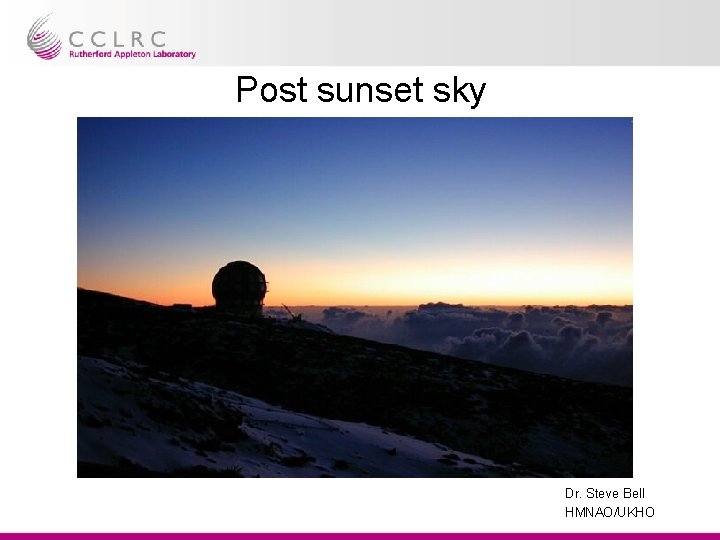
Post sunset sky Dr. Steve Bell HMNAO/UKHO
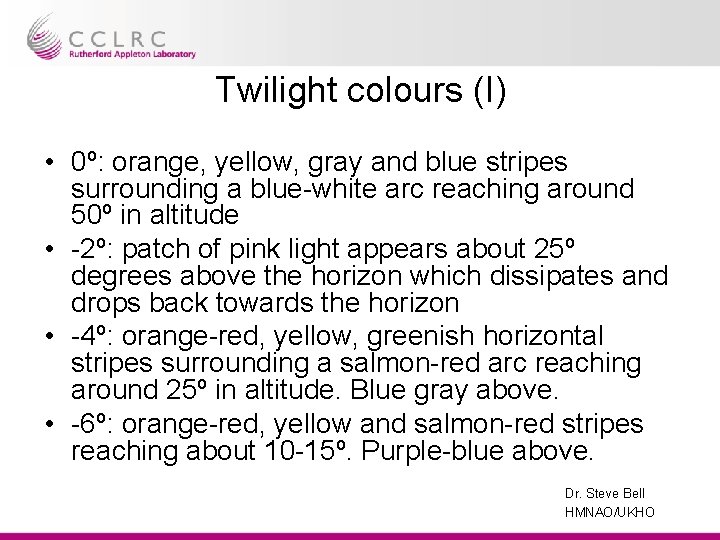
Twilight colours (I) • 0º: orange, yellow, gray and blue stripes surrounding a blue-white arc reaching around 50º in altitude • -2º: patch of pink light appears about 25º degrees above the horizon which dissipates and drops back towards the horizon • -4º: orange-red, yellow, greenish horizontal stripes surrounding a salmon-red arc reaching around 25º in altitude. Blue gray above. • -6º: orange-red, yellow and salmon-red stripes reaching about 10 -15º. Purple-blue above. Dr. Steve Bell HMNAO/UKHO
Twilight colours (II) • -9º: green-blue twilight glow up to altitude of 710º. Dark blue above. • -12º: green–blue twilight glow around 6º in altitude. Dark blue above. • -15º: green-blue twilight glow 3 -4º high. Dark blue above. • -17º: 5 th magnitude stars visible, twilight glow has all but disappeared • -18º: 6 th magnitude stars visible, twilight glow has disappeared Dr. Steve Bell HMNAO/UKHO
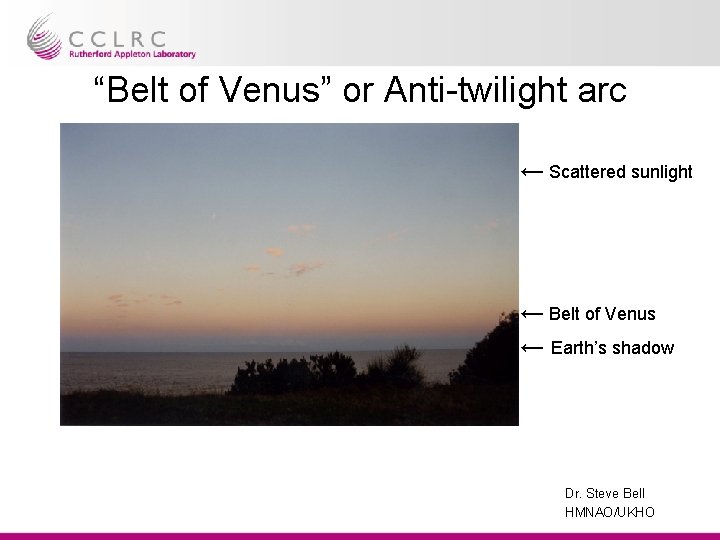
“Belt of Venus” or Anti-twilight arc ← Scattered sunlight ← Belt of Venus ← Earth’s shadow Dr. Steve Bell HMNAO/UKHO
Almanac data for Rise/Set & Twilights In the Nautical Almanac: • Sunrise/set, Moonrise/set first introduced in 1925 • Astronomical Twilight – first introduced in 1928 • Civil twilight – first introduced in 1937 • Nautical twilight – as above Dr. Steve Bell HMNAO/UKHO
What about Dawn, Dusk etc? • Dawn: Can mean morning twilight or sunrise • Dusk: Can mean evening twilight • Daybreak: Can mean twilight / sunrise • First Light: Can mean astronomical or nautical twilight Dr. Steve Bell HMNAO/UKHO
Durations of twilight (minutes) Date Equator C N Mar. 21 24 21 A 24 Mecca C N 22 26 A 26 London C N 34 39 A 41 Jun. 22 21 25 26 25 29 31 48 74 ---- Sep. 21 21 Dec. 23 21 24 24 22 26 26 33 39 42 26 27 24 28 27 40 43 41 Dr. Steve Bell HMNAO/UKHO
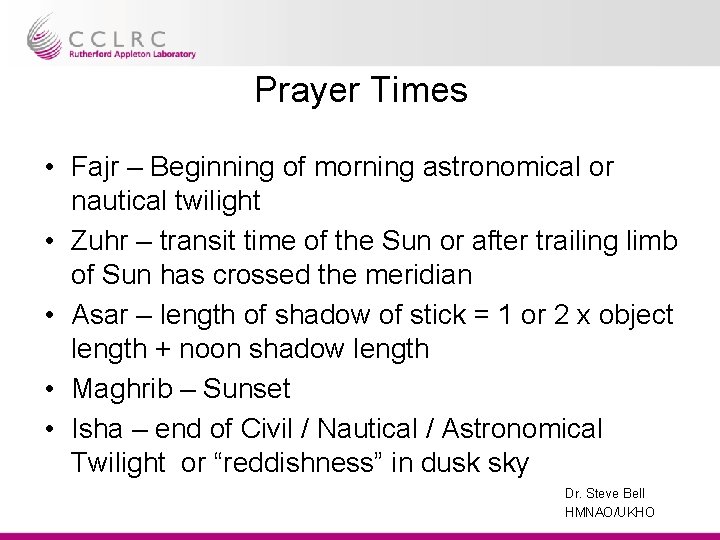
Prayer Times • Fajr – Beginning of morning astronomical or nautical twilight • Zuhr – transit time of the Sun or after trailing limb of Sun has crossed the meridian • Asar – length of shadow of stick = 1 or 2 x object length + noon shadow length • Maghrib – Sunset • Isha – end of Civil / Nautical / Astronomical Twilight or “reddishness” in dusk sky Dr. Steve Bell HMNAO/UKHO
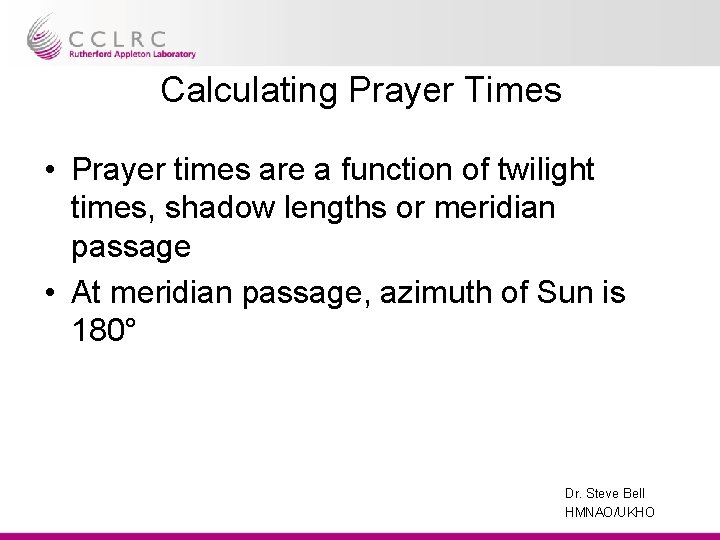
Calculating Prayer Times • Prayer times are a function of twilight times, shadow lengths or meridian passage • At meridian passage, azimuth of Sun is 180° Dr. Steve Bell HMNAO/UKHO
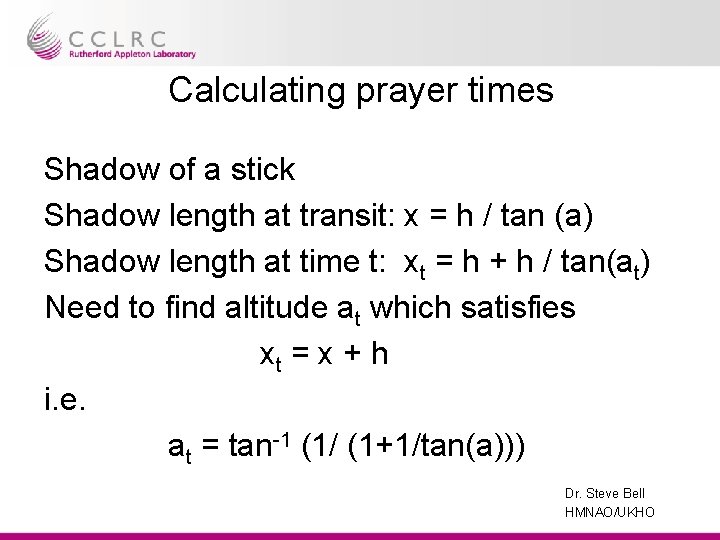
Calculating prayer times Shadow of a stick Shadow length at transit: x = h / tan (a) Shadow length at time t: xt = h + h / tan(at) Need to find altitude at which satisfies xt = x + h i. e. at = tan-1 (1/ (1+1/tan(a))) Dr. Steve Bell HMNAO/UKHO
Problems defining Prayer Times • At higher latitudes, twilights may not occur • Meteorological conditions can affect qualitative descriptions e. g. reddishness Dr. Steve Bell HMNAO/UKHO
Other options for prayer times • Use times for location where phenomena occur. • Split night into seven parts, Isha after first segment, Fajr after the sixth segment • Use data from the day the phenomena last occurred • Split the night into two. Dr. Steve Bell HMNAO/UKHO
Any Questions? Dr. Steve Bell HMNAO/UKHO