
Photometry of Type Ia Supernovae Search for the
- Slides: 15
Photometry of Type Ia Supernovae: Search for the Second Parameter Date: May 15, 2009 Author: Kevin Perot Advisor: Dr. Baron
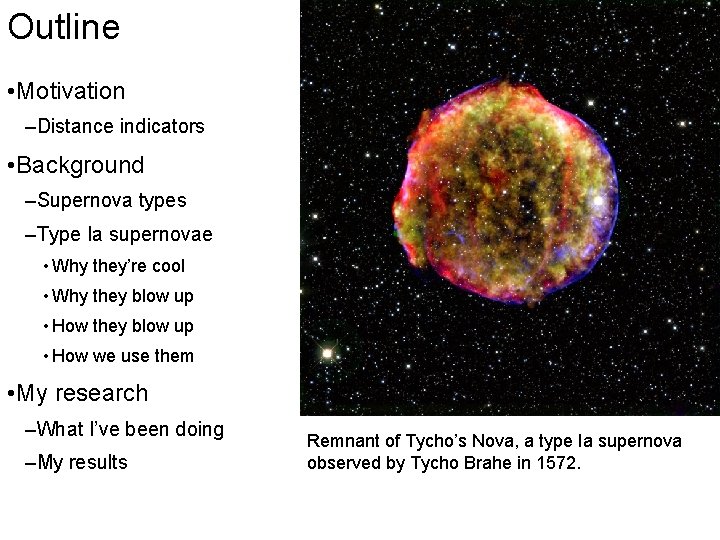
Outline • Motivation –Distance indicators • Background –Supernova types –Type Ia supernovae • Why they’re cool • Why they blow up • How we use them • My research –What I’ve been doing –My results Remnant of Tycho’s Nova, a type Ia supernova observed by Tycho Brahe in 1572.
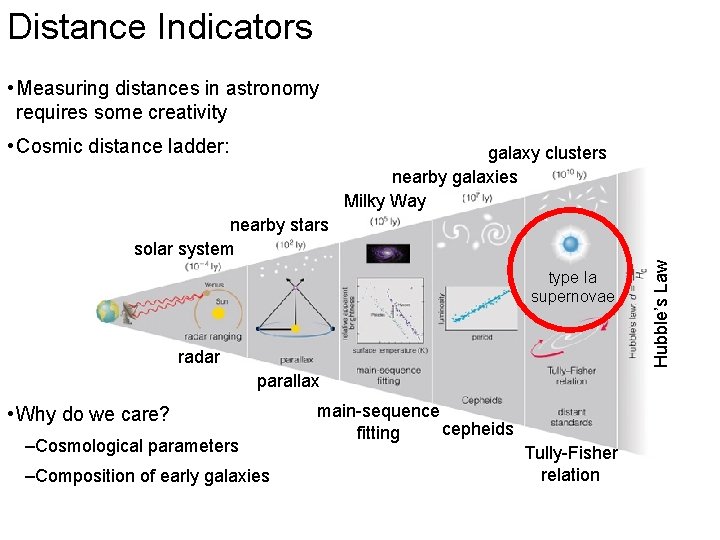
Distance Indicators • Measuring distances in astronomy requires some creativity • Cosmic distance ladder: galaxy clusters nearby galaxies Milky Way type Ia supernovae radar parallax • Why do we care? –Cosmological parameters –Composition of early galaxies main-sequence cepheids fitting Tully-Fisher relation Hubble’s Law nearby stars solar system
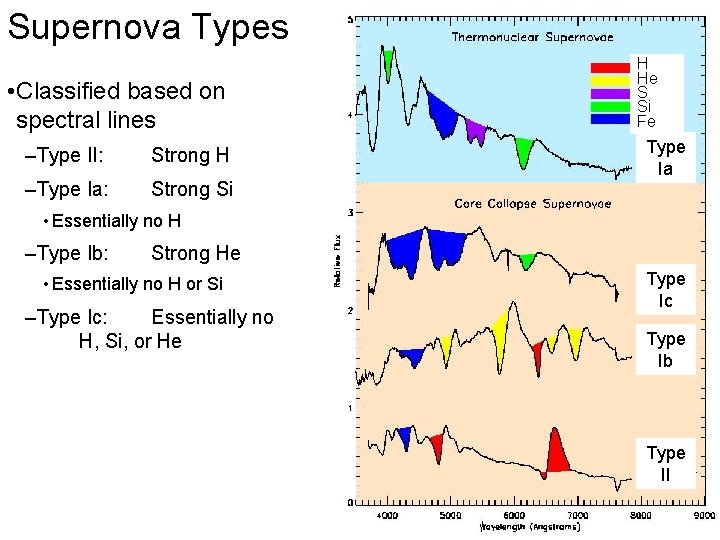
Supernova Types • Classified based on spectral lines –Type II: Strong H –Type Ia: Strong Si H He S Si Fe Type Ia • Essentially no H –Type Ib: Strong He • Essentially no H or Si –Type Ic: Essentially no H, Si, or He Type Ic Type Ib Type II
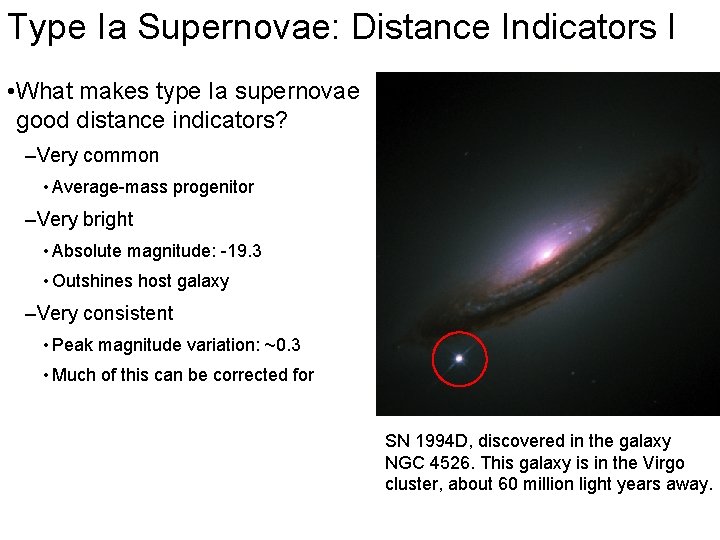
Type Ia Supernovae: Distance Indicators I • What makes type Ia supernovae good distance indicators? –Very common • Average-mass progenitor –Very bright • Absolute magnitude: -19. 3 • Outshines host galaxy –Very consistent • Peak magnitude variation: ~0. 3 • Much of this can be corrected for SN 1994 D, discovered in the galaxy NGC 4526. This galaxy is in the Virgo cluster, about 60 million light years away.
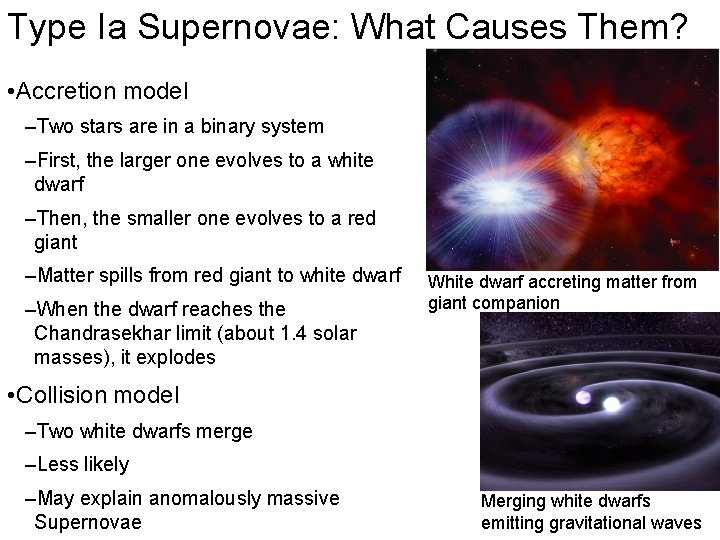
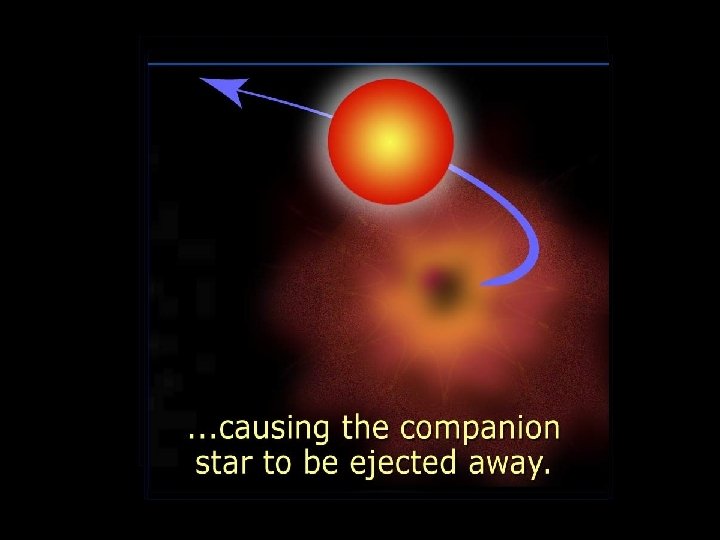
Type Ia Supernovae: What Causes Them? • Accretion model –Two stars are in a binary system –First, the larger one evolves to a white dwarf –Then, the smaller one evolves to a red giant –Matter spills from red giant to white dwarf –When the dwarf reaches the Chandrasekhar limit (about 1. 4 solar masses), it explodes White dwarf accreting matter from giant companion • Collision model –Two white dwarfs merge –Less likely –May explain anomalously massive Supernovae Merging white dwarfs emitting gravitational waves
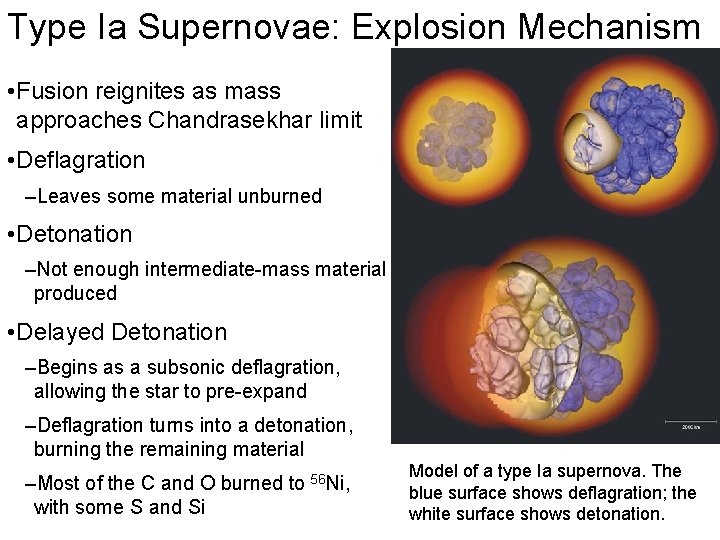
Type Ia Supernovae: Explosion Mechanism • Fusion reignites as mass approaches Chandrasekhar limit • Deflagration –Leaves some material unburned • Detonation –Not enough intermediate-mass material produced • Delayed Detonation –Begins as a subsonic deflagration, allowing the star to pre-expand –Deflagration turns into a detonation, burning the remaining material –Most of the C and O burned to 56 Ni, with some S and Si Model of a type Ia supernova. The blue surface shows deflagration; the white surface shows detonation.
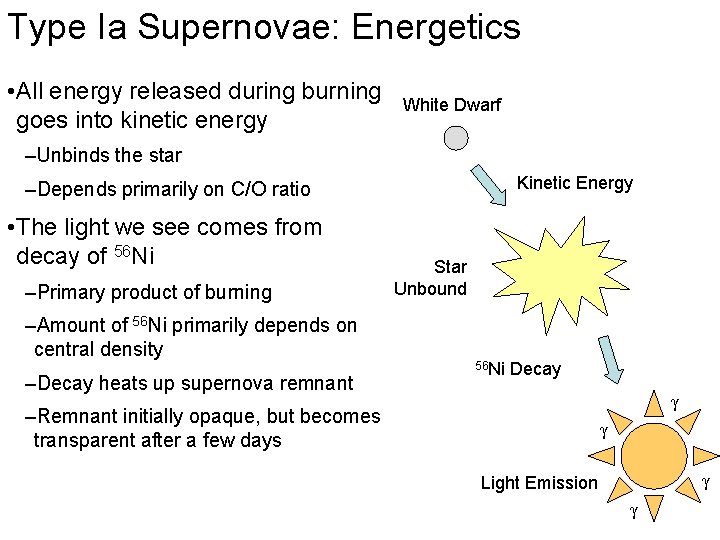
Type Ia Supernovae: Energetics • All energy released during burning goes into kinetic energy White Dwarf –Unbinds the star Kinetic Energy –Depends primarily on C/O ratio • The light we see comes from decay of 56 Ni –Primary product of burning –Amount of 56 Ni primarily depends on central density –Decay heats up supernova remnant Star Unbound 56 Ni Decay γ –Remnant initially opaque, but becomes transparent after a few days γ γ Light Emission γ
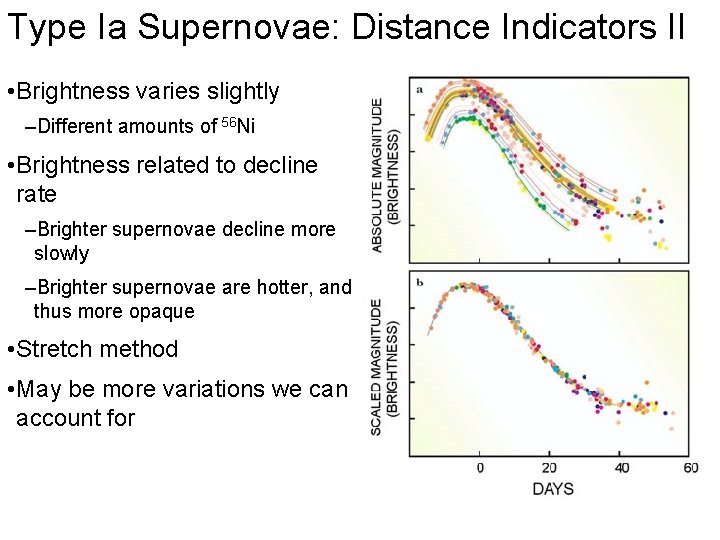
Type Ia Supernovae: Distance Indicators II • Brightness varies slightly –Different amounts of 56 Ni • Brightness related to decline rate –Brighter supernovae decline more slowly –Brighter supernovae are hotter, and thus more opaque • Stretch method • May be more variations we can account for
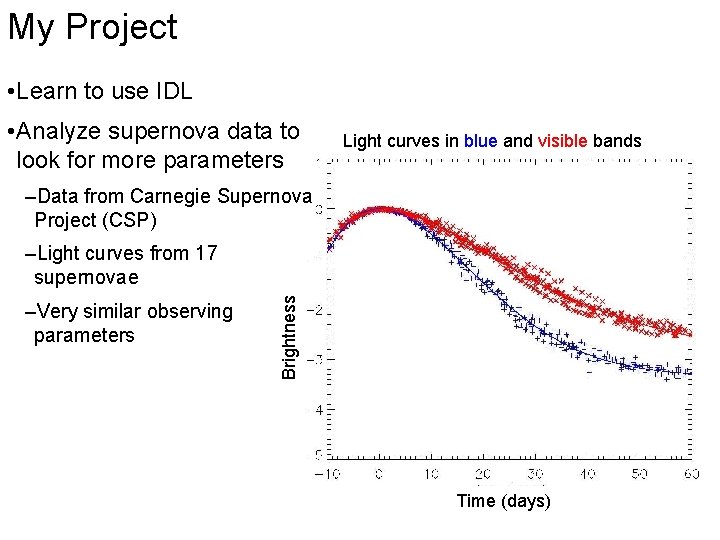
My Project • Learn to use IDL • Analyze supernova data to look for more parameters Light curves in blue and visible bands –Data from Carnegie Supernova Project (CSP) –Very similar observing parameters Brightness –Light curves from 17 supernovae Time (days)
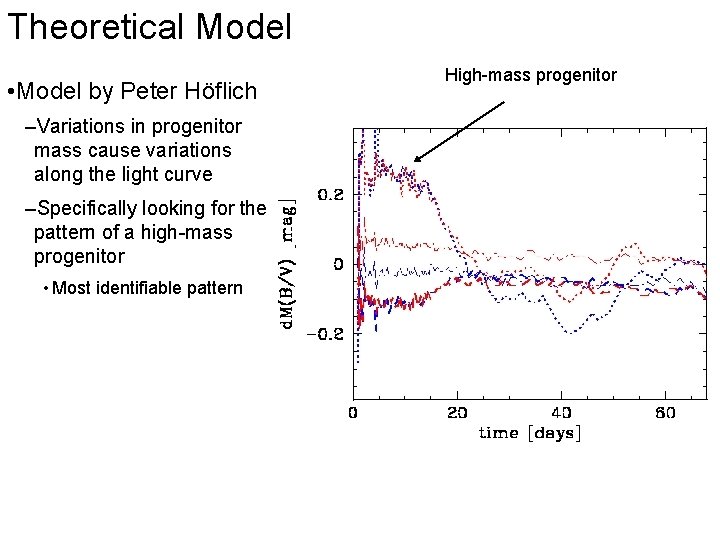
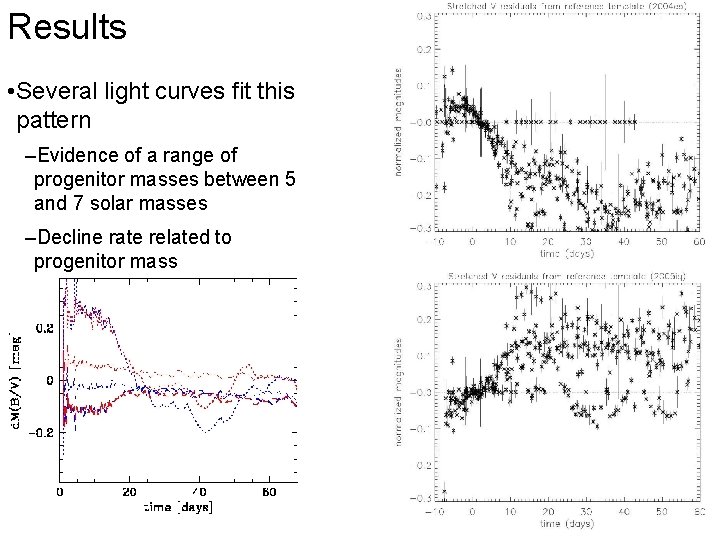
Theoretical Model • Model by Peter Höflich –Variations in progenitor mass cause variations along the light curve –Specifically looking for the pattern of a high-mass progenitor • Most identifiable pattern High-mass progenitor
Results • Several light curves fit this pattern –Evidence of a range of progenitor masses between 5 and 7 solar masses –Decline rate related to progenitor mass
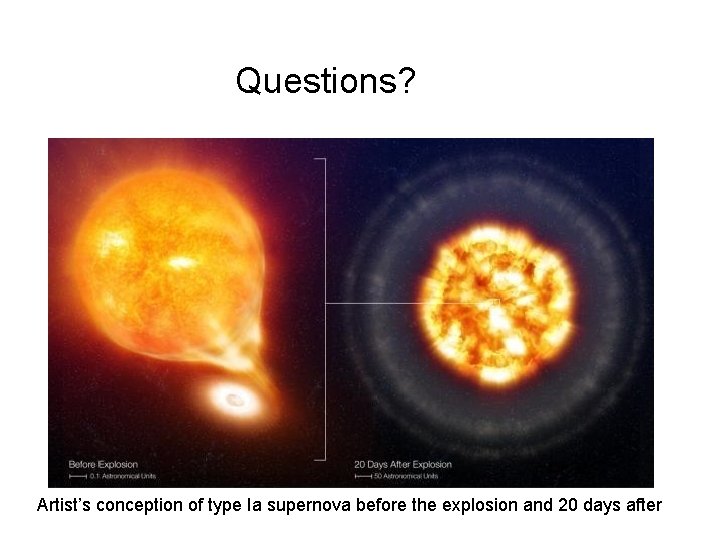
Questions? Artist’s conception of type Ia supernova before the explosion and 20 days after
Image sources –Outline – http: //upload. wikimedia. org/wikipedia/c ommons/a/ac/Main_tycho_remnant_fu ll. jpg –Supernova Types – http: //panisse. lbl. gov/~dnkasen/tutorial /graphics/sn_types. jpg –Distance Indicators – http: //www. daviddarling. info/images/di stance_ladder. jpg –Type Ia Supernovae: Distance Indicators I – http: //www. cfa. harvard. edu/supernova/ /High. Z. html –Type Ia Supernovae: What Causes Them? – http: //www. nscl. msu. edu/files/images/ 1301_800. preview. png – http: //images. astronet. ru/pubd/2005/06 /02/0001206140/wd_cxc_c 33. jpg –Slideshow – http: //www. pha. jhu. edu/~bfalck/Iaprog enitor. jpg –Type Ia Supernovae: Explosion Mechanism – http: //images. iop. org/objects/physicsw eb/world/21/12/35/PWfea 6_12 -08. jpg –Type Ia Supernovae: Distance Indicators II – http: //www. lbl. gov/Science. Articles/Archive/sabl/2005/October/str etch_correction. jpg –Questions? – http: //www. sciencedaily. com/images/2 007/07/070713234636 -large. jpg