The Solar System and Some Early Astronomers Lesson






- Slides: 34
The Solar System and Some Early Astronomers
Lesson Overview Ø The objects in the solar system Ø The significant contributions of key early astronomers Chapter 7, Lesson 1
Warm-Up Name the 8 planets and the dwarf planet Chapter 7, Lesson 1 Courtesy of Paul Almasy/Corbis
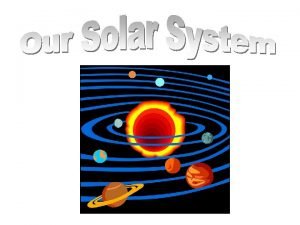
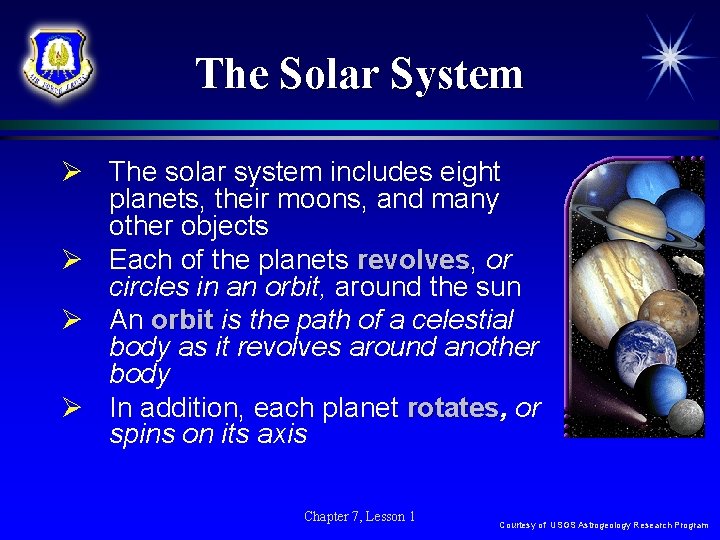
The Solar System Ø The solar system includes eight planets, their moons, and many other objects Ø Each of the planets revolves, revolves or circles in an orbit, around the sun Ø An orbit is the path of a celestial body as it revolves around another body Ø In addition, each planet rotates, rotates or spins on its axis Chapter 7, Lesson 1 Courtesy of USGS Astrogeology Research Program
The Sun Ø The sun is the largest object in the solar system Ø It contains more than 99. 8 percent of the total mass—the “stuff”—of the solar system Ø It is one of 100 billion stars in the Milky Way Galaxy Ø A galaxy is a huge mass of stars, gas, and dust clouds that exists in one area of space Chapter 7, Lesson 1
The Planets and Gravity Ø Galaxies and the solar system hold together because of gravity Ø Gravity is an invisible force that pulls all objects toward one another Ø The gravity of the sun holds the planets in place as they revolve around it Ø Likewise, the gravity of a planet holds its moons in place Chapter 7, Lesson 1
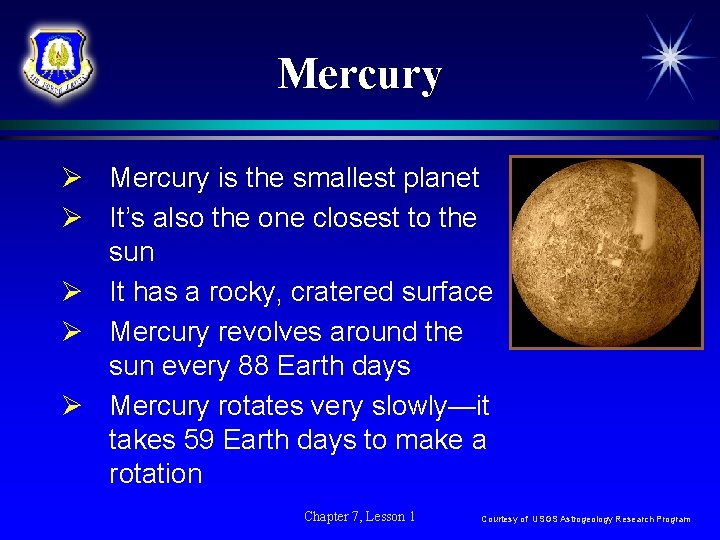
Mercury Ø Mercury is the smallest planet Ø It’s also the one closest to the sun Ø It has a rocky, cratered surface Ø Mercury revolves around the sun every 88 Earth days Ø Mercury rotates very slowly—it takes 59 Earth days to make a rotation Chapter 7, Lesson 1 Courtesy of USGS Astrogeology Research Program
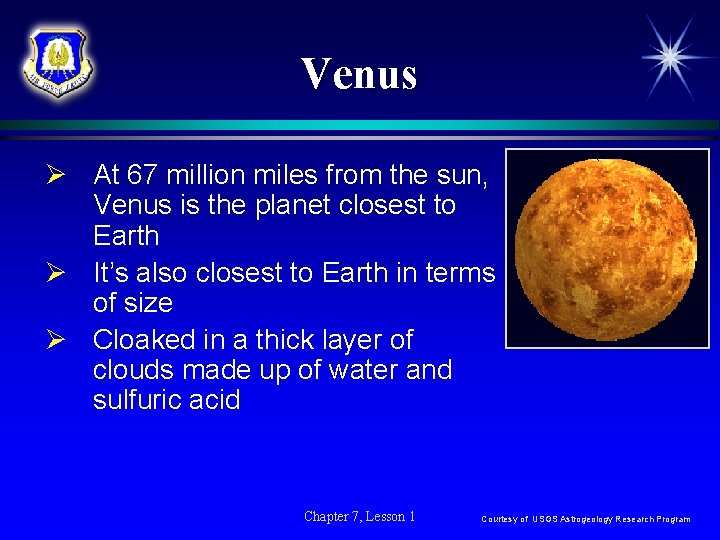
Venus Ø At 67 million miles from the sun, Venus is the planet closest to Earth Ø It’s also closest to Earth in terms of size Ø Cloaked in a thick layer of clouds made up of water and sulfuric acid Chapter 7, Lesson 1 Courtesy of USGS Astrogeology Research Program
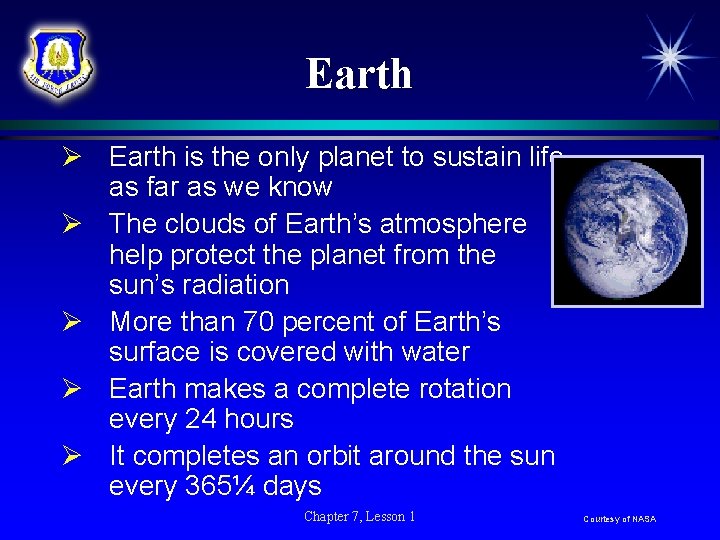
Earth Ø Earth is the only planet to sustain life as far as we know Ø The clouds of Earth’s atmosphere help protect the planet from the sun’s radiation Ø More than 70 percent of Earth’s surface is covered with water Ø Earth makes a complete rotation every 24 hours Ø It completes an orbit around the sun every 365¼ days Chapter 7, Lesson 1 Courtesy of NASA
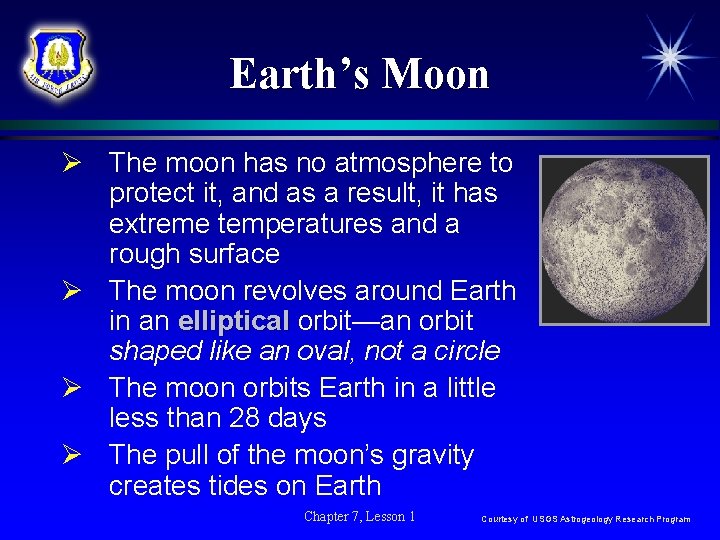
Earth’s Moon Ø The moon has no atmosphere to protect it, and as a result, it has extreme temperatures and a rough surface Ø The moon revolves around Earth in an elliptical orbit—an orbit shaped like an oval, not a circle Ø The moon orbits Earth in a little less than 28 days Ø The pull of the moon’s gravity creates tides on Earth Chapter 7, Lesson 1 Courtesy of USGS Astrogeology Research Program
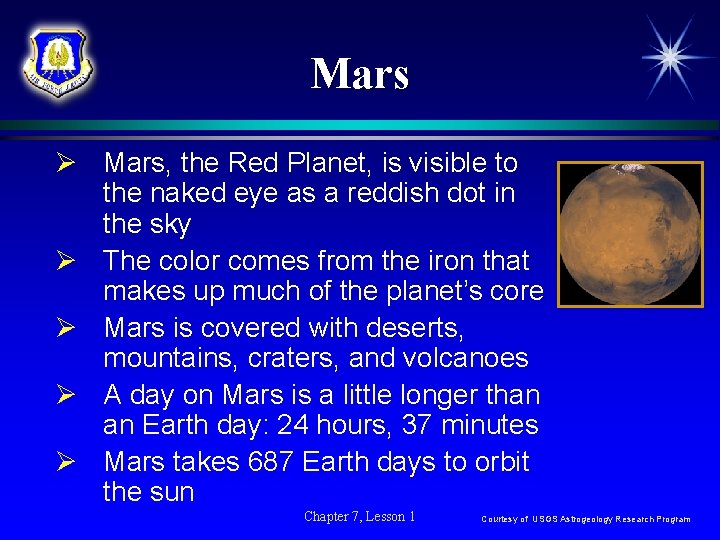
Mars Ø Mars, the Red Planet, is visible to the naked eye as a reddish dot in the sky Ø The color comes from the iron that makes up much of the planet’s core Ø Mars is covered with deserts, mountains, craters, and volcanoes Ø A day on Mars is a little longer than an Earth day: 24 hours, 37 minutes Ø Mars takes 687 Earth days to orbit the sun Chapter 7, Lesson 1 Courtesy of USGS Astrogeology Research Program
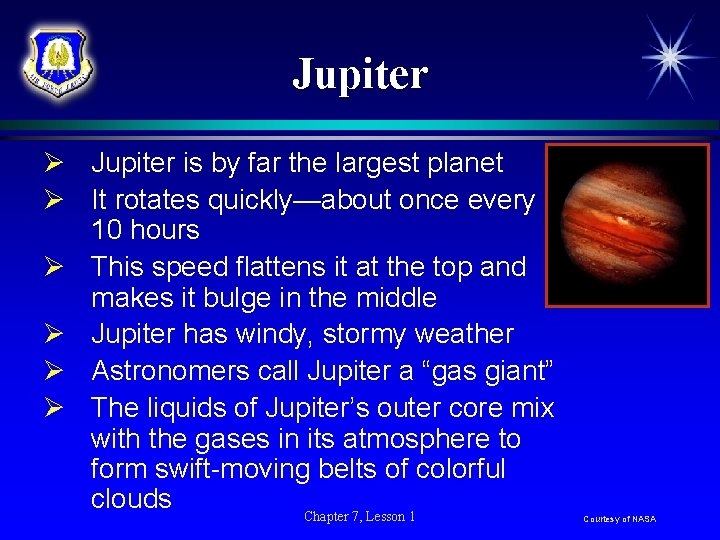
Jupiter Ø Jupiter is by far the largest planet Ø It rotates quickly—about once every 10 hours Ø This speed flattens it at the top and makes it bulge in the middle Ø Jupiter has windy, stormy weather Ø Astronomers call Jupiter a “gas giant” Ø The liquids of Jupiter’s outer core mix with the gases in its atmosphere to form swift-moving belts of colorful clouds Chapter 7, Lesson 1 Courtesy of NASA
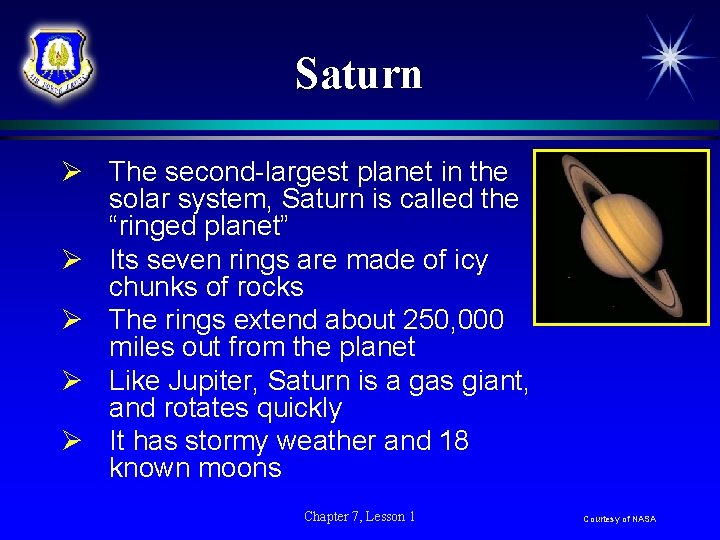
Saturn Ø The second-largest planet in the solar system, Saturn is called the “ringed planet” Ø Its seven rings are made of icy chunks of rocks Ø The rings extend about 250, 000 miles out from the planet Ø Like Jupiter, Saturn is a gas giant, and rotates quickly Ø It has stormy weather and 18 known moons Chapter 7, Lesson 1 Courtesy of NASA
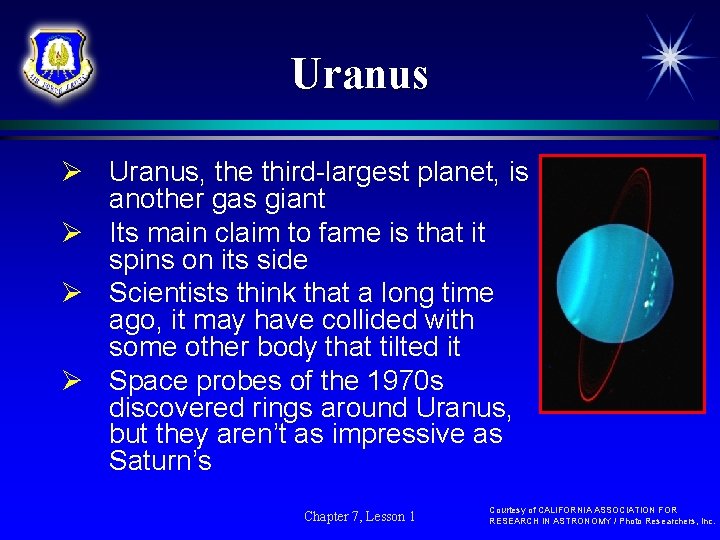
Uranus Ø Uranus, the third-largest planet, is another gas giant Ø Its main claim to fame is that it spins on its side Ø Scientists think that a long time ago, it may have collided with some other body that tilted it Ø Space probes of the 1970 s discovered rings around Uranus, but they aren’t as impressive as Saturn’s Chapter 7, Lesson 1 Courtesy of CALIFORNIA ASSOCIATION FOR RESEARCH IN ASTRONOMY / Photo Researchers, Inc.
Neptune Ø Neptune is Uranus’s smaller twin Ø Neptune is the windiest planet in the solar system Ø Its winds blow up to 1, 500 miles an hour Ø Like Jupiter, it has several dark storms, the largest of which is the Great Dark Spot Ø Neptune has eight moons Ø Neptune is a gas giant too Chapter 7, Lesson 1 Courtesy of NASA
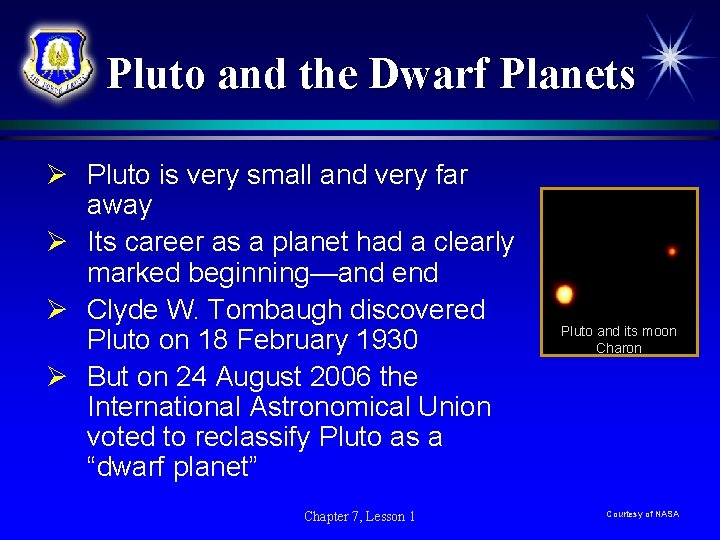
Pluto and the Dwarf Planets Ø Pluto is very small and very far away Ø Its career as a planet had a clearly marked beginning—and end Ø Clyde W. Tombaugh discovered Pluto on 18 February 1930 Ø But on 24 August 2006 the International Astronomical Union voted to reclassify Pluto as a “dwarf planet” Chapter 7, Lesson 1 Pluto and its moon Charon Courtesy of NASA
Pluto and the Dwarf Planets Ø Pluto doesn’t dominate its moon, Charon, as a planet should Ø Besides, Pluto’s orbit is not fixed Ø Sometimes it loops inside Neptune’s Ø As a dwarf planet, Pluto has lots of company Ø Scientists have identified more than 40 dwarfs and they expect to find more Chapter 7, Lesson 1
Learning Check CPS Questions 1 -11 on Planets Chapter 7, Lesson 1
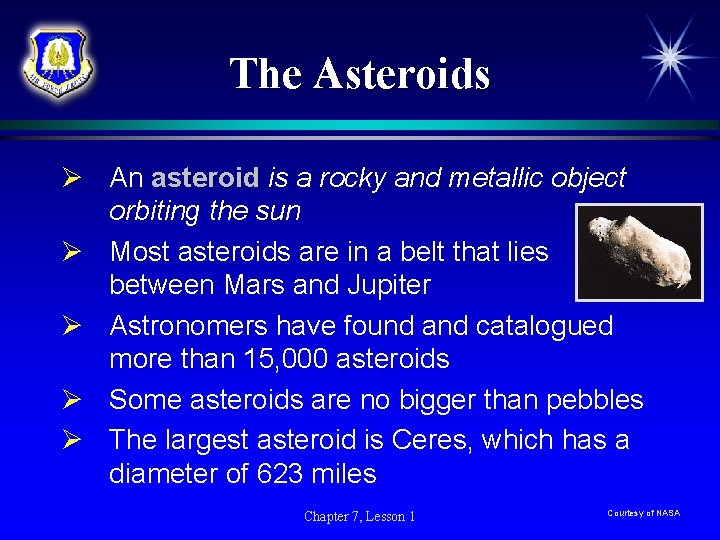
The Asteroids Ø An asteroid is a rocky and metallic object orbiting the sun Ø Most asteroids are in a belt that lies between Mars and Jupiter Ø Astronomers have found and catalogued more than 15, 000 asteroids Ø Some asteroids are no bigger than pebbles Ø The largest asteroid is Ceres, which has a diameter of 623 miles Chapter 7, Lesson 1 Courtesy of NASA
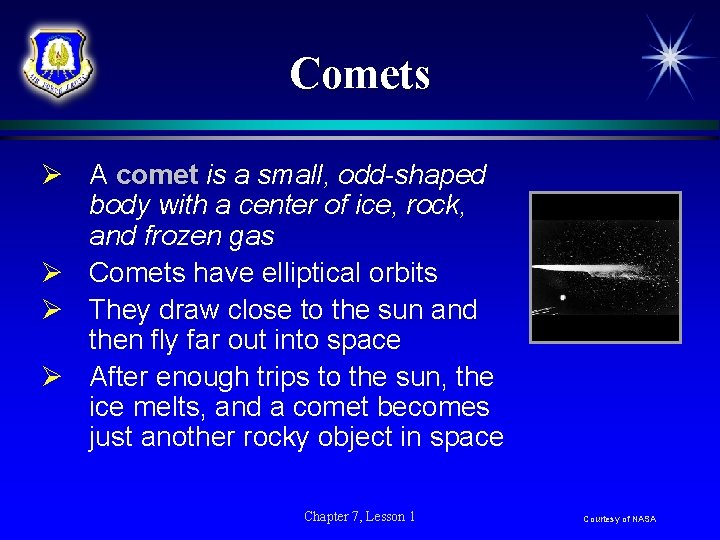
Comets Ø A comet is a small, odd-shaped body with a center of ice, rock, and frozen gas Ø Comets have elliptical orbits Ø They draw close to the sun and then fly far out into space Ø After enough trips to the sun, the ice melts, and a comet becomes just another rocky object in space Chapter 7, Lesson 1 Courtesy of NASA
Meteoroids, Meteorites, and Meteors Ø A meteoroid is a piece of rock or metal that travels in space Ø Meteoroids are the smallest objects in the solar system Ø They may be chunks of rock melting away from comets as they approach the sun Ø A meteorite is a meteoroid that lands on Earth’s surface Ø A meteor is a meteoroid passing through Earth’s atmosphere, leaving a visible trail Chapter 7, Lesson 1
Learning Check CPS Questions 12 -16 on Objects in Space Chapter 7, Lesson 1
Astronomy Ø The history of astronomy is the story of humanity’s attempts to make sense of the heavens Ø All peoples have looked up to the skies and wondered about the movements of the sun, moon, and stars Ø As time passed, people learned that heavenly bodies obey the same laws that objects on Earth do Chapter 7, Lesson 1
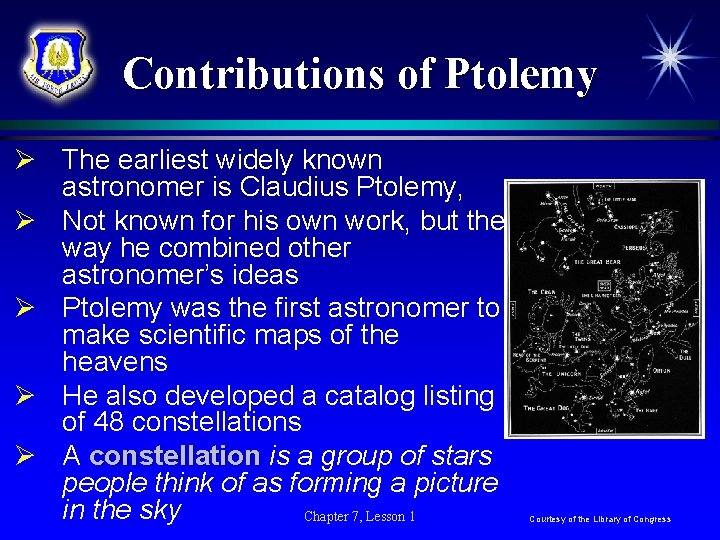
Contributions of Ptolemy Ø The earliest widely known astronomer is Claudius Ptolemy, Ø Not known for his own work, but the way he combined other astronomer’s ideas Ø Ptolemy was the first astronomer to make scientific maps of the heavens Ø He also developed a catalog listing of 48 constellations Ø A constellation is a group of stars people think of as forming a picture in the sky Chapter 7, Lesson 1 Courtesy of the Library of Congress
Contributions of Ulug Bek Ø Ulug Bek was a mathematician and an astronomer Ø He made detailed observations and calculations Ø In 1437 Ulug Bek published a catalog of the stars (Zij-i Sultani) that gave the positions of 992 stars Ø Using data he’d recorded in his observatory, Ulug Bek calculated the length of the year as 365 days, 5 hours, 49 minutes, and 15 seconds Chapter 7, Lesson 1
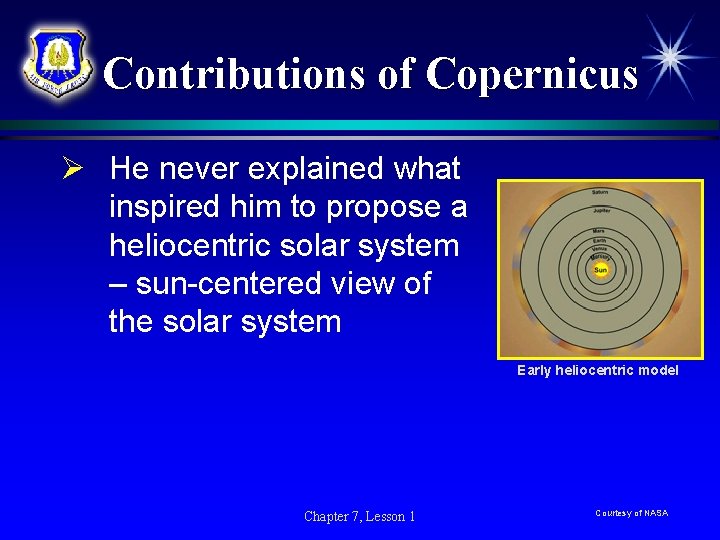
Contributions of Copernicus Ø He never explained what inspired him to propose a heliocentric solar system – sun-centered view of the solar system Early heliocentric model Chapter 7, Lesson 1 Courtesy of NASA
Contributions of Kepler Ø He showed that orbits of the planets weren’t perfect circles, but ellipses, or ovals Chapter 7, Lesson 1
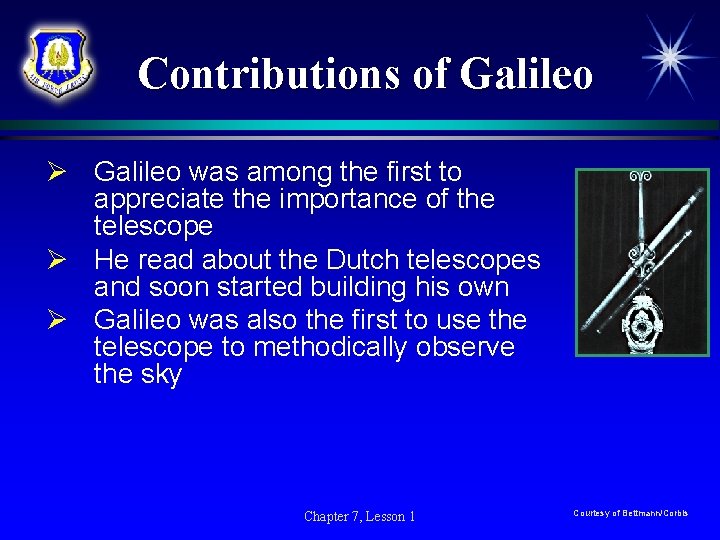
Contributions of Galileo Ø Galileo was among the first to appreciate the importance of the telescope Ø He read about the Dutch telescopes and soon started building his own Ø Galileo was also the first to use the telescope to methodically observe the sky Chapter 7, Lesson 1 Courtesy of Bettmann/Corbis
Learning Check CPS Questions 17 -19 on Astronomers Chapter 7, Lesson 1
Review Ø The solar system includes eight planets, their moons, and many other objects Ø A galaxy is a huge mass of stars, gas, and dust clouds that exists in one area of space Ø Galaxies and the solar system hold together because of gravity Ø The gravity of the sun holds the planets in place as they revolve around it Chapter 7, Lesson 1
Review Ø Earth is the only planet to sustain life as far as we know Ø On 24 August 2006 the International Astronomical Union voted to reclassify Pluto as a “dwarf planet” Ø A comet is a small, odd-shaped body with a center of ice, rock, and frozen gas Ø A meteoroid is a piece of rock or metal that travels in space Chapter 7, Lesson 1
Review Ø Ptolemy was the first astronomer to make scientific maps of the heavens Ø In 1437 Ulug Bek published a catalog of the stars (Zij-i Sultani) Ø Copernicus never explained what inspired him to propose a heliocentric solar system Ø Kepler showed that orbits of the planets weren’t perfect circles, but ellipses, or ovals Ø Galileo was among the first to appreciate the importance of the telescope Chapter 7, Lesson 1
Summary Ø The objects in the solar system Ø The significant contributions of key early astronomers Chapter 7, Lesson 1
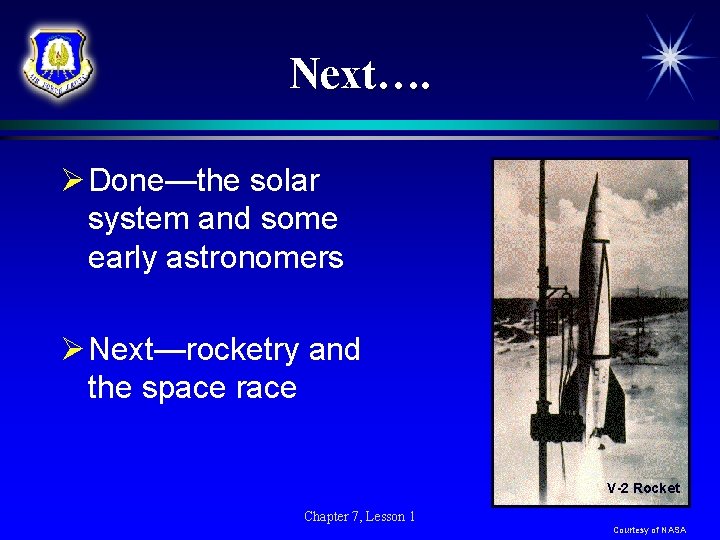
Next…. Ø Done—the solar system and some early astronomers Ø Next—rocketry and the space race V-2 Rocket Chapter 7, Lesson 1 Courtesy of NASA