
Gravity and Motion BELLRINGER Modern telescopes make it
Gravity and Motion
BELLRINGER Modern telescopes make it possible for astronomers to detect planets around distant stars. Why couldn’t astronomers detect these planets before? A The planets are much closer than the stars they orbit. B. The planets are much larger than the stars they orbit. C. The planets are much farther than the stars they orbit. D. The planets are much smaller than the stars they orbit.
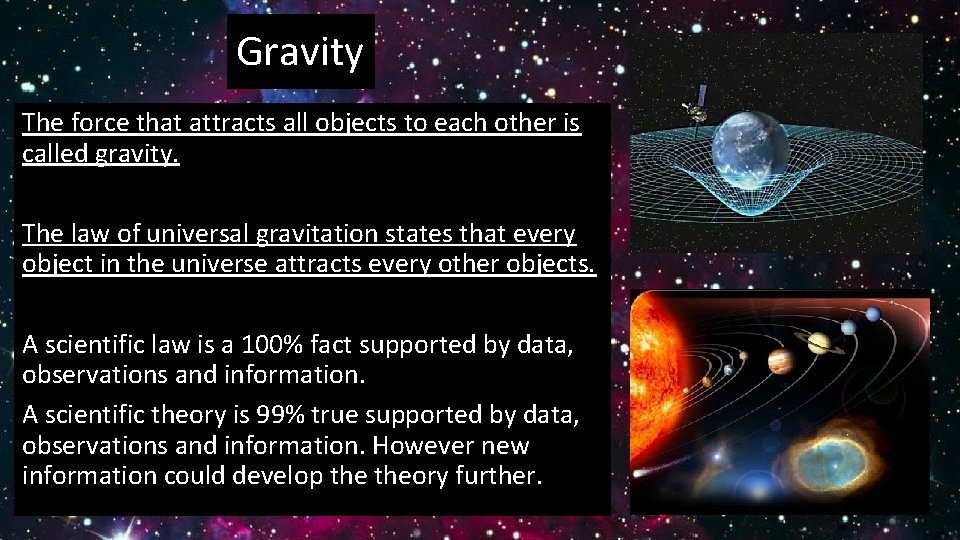
Gravity The force that attracts all objects to each other is called gravity. The law of universal gravitation states that every object in the universe attracts every other objects. A scientific law is a 100% fact supported by data, observations and information. A scientific theory is 99% true supported by data, observations and information. However new information could develop theory further.
Law of universal gravitation Law of Universal Gravitation Gravity Depends on: Gravity is strongest when: 1. Objects attract each other 1. Size of the object 1. Objects are REALLY big 2. Distance of objects 2. Objects are REALLY to each other big and CLOSE to each other
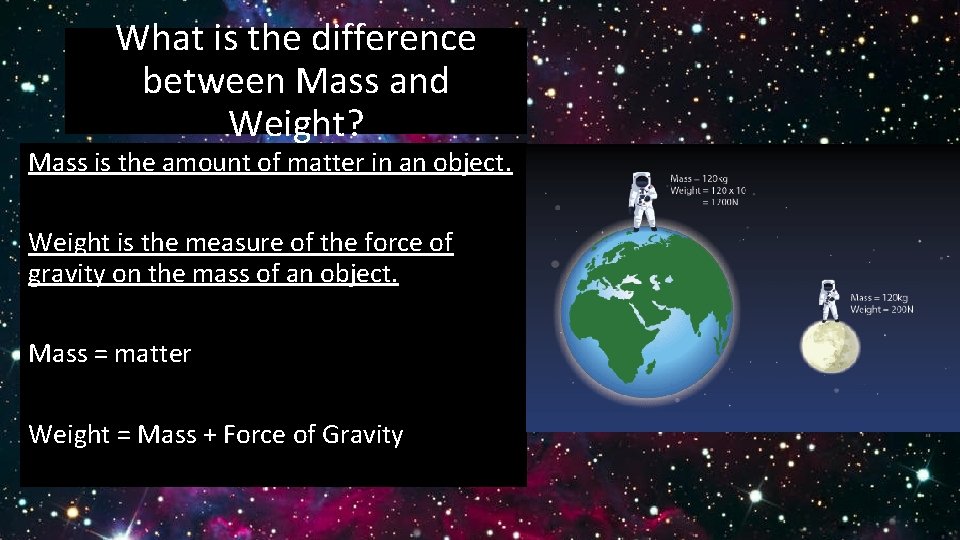
What is the difference between Mass and Weight? Mass is the amount of matter in an object. Weight is the measure of the force of gravity on the mass of an object. Mass = matter Weight = Mass + Force of Gravity
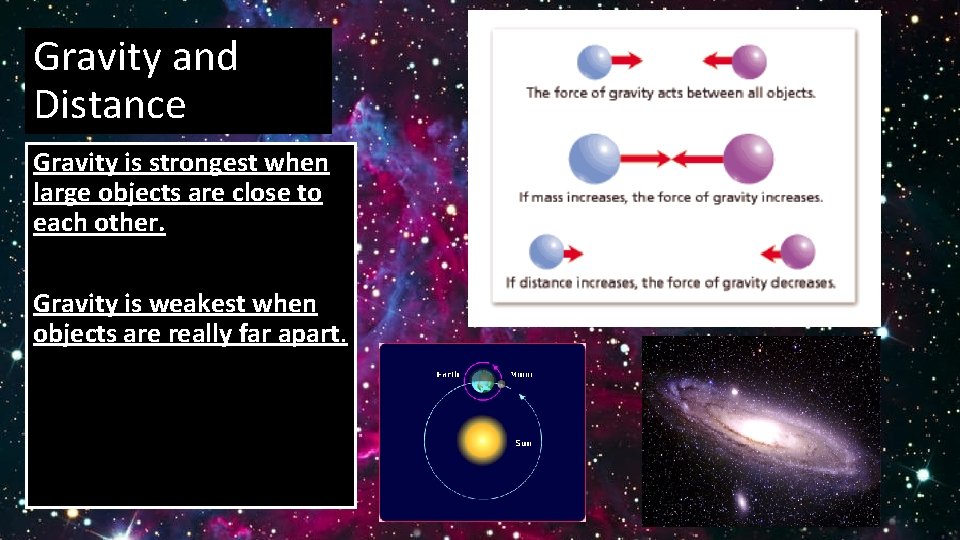
Gravity and Distance Gravity is strongest when large objects are close to each other. Gravity is weakest when objects are really far apart.
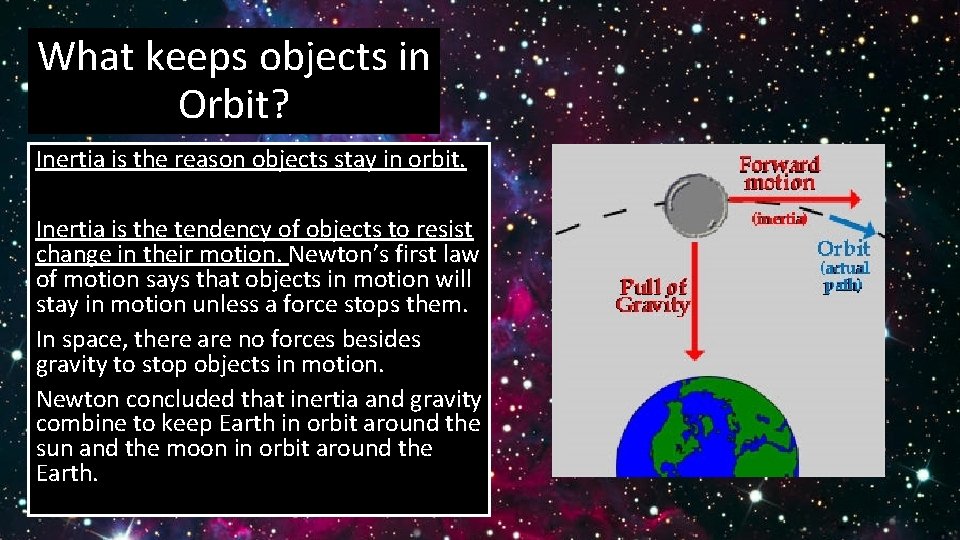
What keeps objects in Orbit? Inertia is the reason objects stay in orbit. Inertia is the tendency of objects to resist change in their motion. Newton’s first law of motion says that objects in motion will stay in motion unless a force stops them. In space, there are no forces besides gravity to stop objects in motion. Newton concluded that inertia and gravity combine to keep Earth in orbit around the sun and the moon in orbit around the Earth.
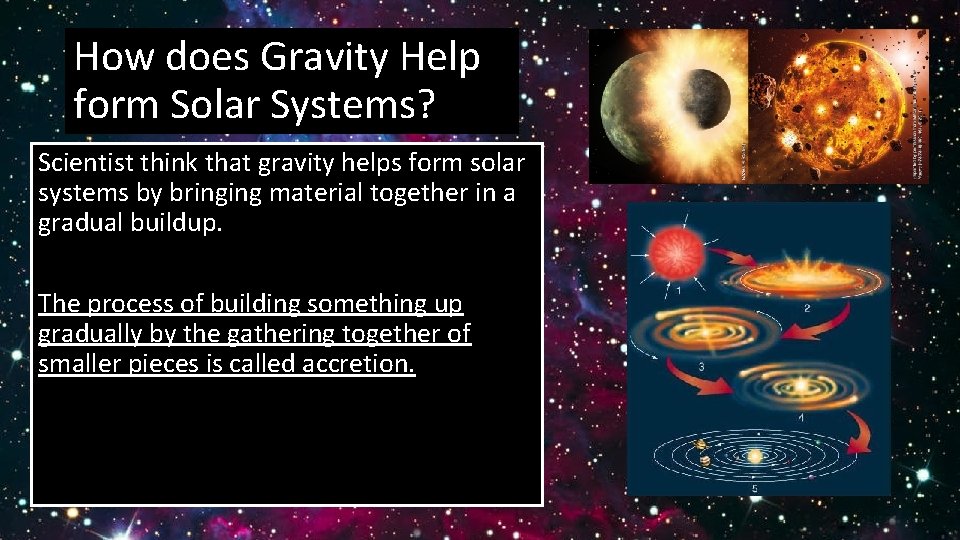
How does Gravity Help form Solar Systems? Scientist think that gravity helps form solar systems by bringing material together in a gradual buildup. The process of building something up gradually by the gathering together of smaller pieces is called accretion.
Gravity forms solar systems, stars, planets and keeps everything together Solar systems: Scientist believe solar systems started as large clouds of material. Gravity attracted large material together, as it collided and began spinning it form larger spheres. Stars: Most material in the spinning disk is pulled to the center. Material becomes tightly packed as it undergoes accretion. It gets hotter and pressure increases. Eventual pressure is so high hydrogen atoms fused to form helium and create nuclear fusion releasing energy. Planets: Some spinning disk remain outside the star and form planets instead.
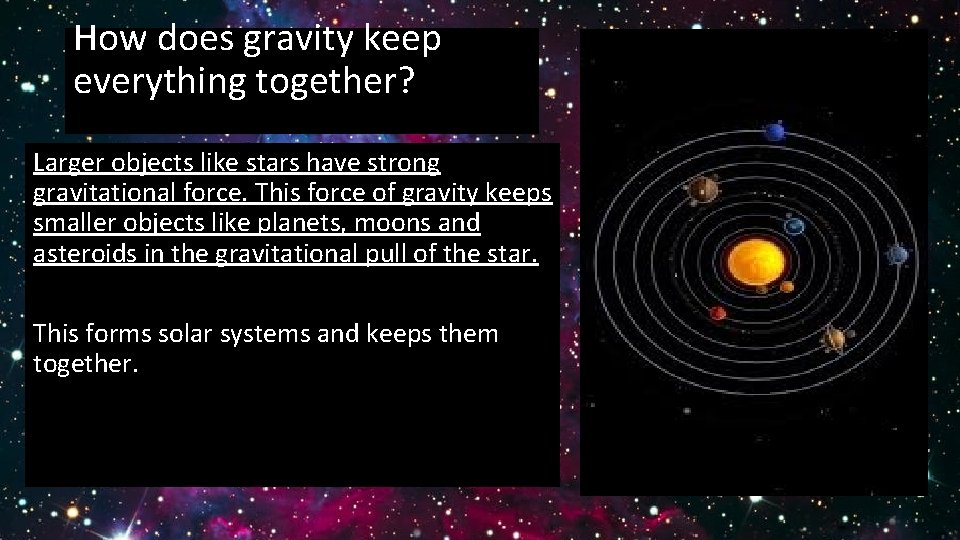
How does gravity keep everything together? Larger objects like stars have strong gravitational force. This force of gravity keeps smaller objects like planets, moons and asteroids in the gravitational pull of the star. This forms solar systems and keeps them together.
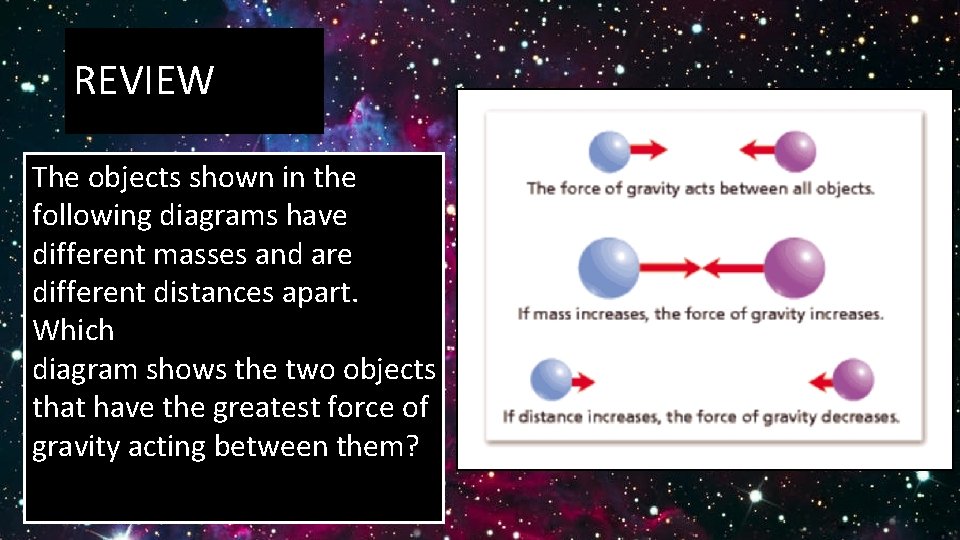
REVIEW The objects shown in the following diagrams have different masses and are different distances apart. Which diagram shows the two objects that have the greatest force of gravity acting between them?
- Slides: 11