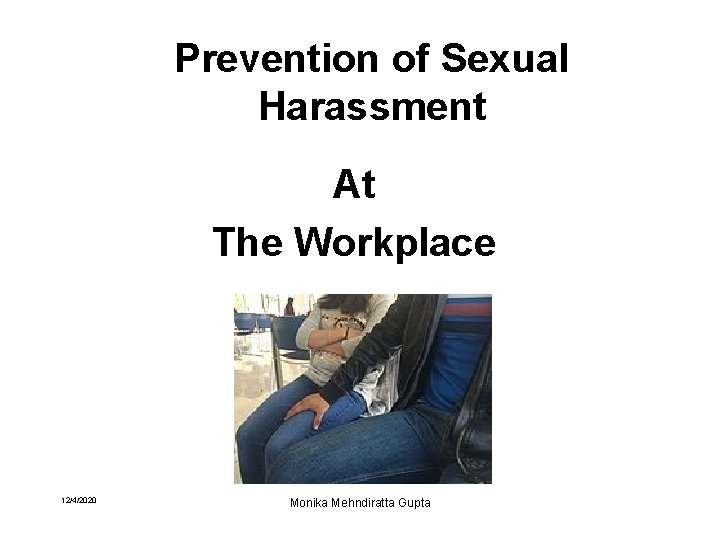
Prevention of Sexual Harassment At The Workplace 1242020




- Slides: 79
Prevention of Sexual Harassment At The Workplace 12/4/2020 Monika Mehndiratta Gupta
Sexual Harassment is not… • • • A “women’s thing” A passing fad Something to joke about Something to be ignored A cause for paranoia and fear It’s a legal requirement to prevent, prohibit and address this issue at “Workplace” 12/4/2020 Monika Mehndiratta Gupta
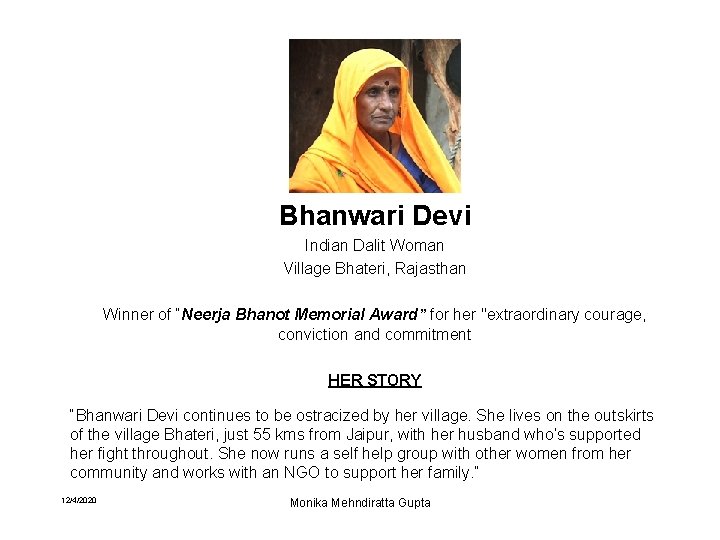
Bhanwari Devi Indian Dalit Woman Village Bhateri, Rajasthan Winner of “Neerja Bhanot Memorial Award” for her "extraordinary courage, conviction and commitment HER STORY “Bhanwari Devi continues to be ostracized by her village. She lives on the outskirts of the village Bhateri, just 55 kms from Jaipur, with her husband who’s supported her fight throughout. She now runs a self help group with other women from her community and works with an NGO to support her family. ” 12/4/2020 Monika Mehndiratta Gupta
Vishakha Guidelines Supreme Court of India Judgement 1997 (Ref: Vishakha and Ors. V State of Rajasthan) “In the absence of enacted law to provide for the effective enforcement of the basic human right of gender equality and guarantee against sexual harassment and abuse, we lay down the guidelines and norms specified hereinafter for due observance at all work places or other institutions, until a legislation is enacted for this purpose. …and it is further emphasised that this would be treated as the law declared by this Court under Art. 141 of the Constitution. ” The judgment of August 1997 provided the basic definitions of Sexual Harrasment at the workplace and provided guidelines to deal with it. It is seen as a significant legal victory for women's groups in India Estalished that “Sexual Harassment violates a woman’s right in the workplace and is thus not just a matter of personal injury” 12/4/2020 Monika Mehndiratta Gupta
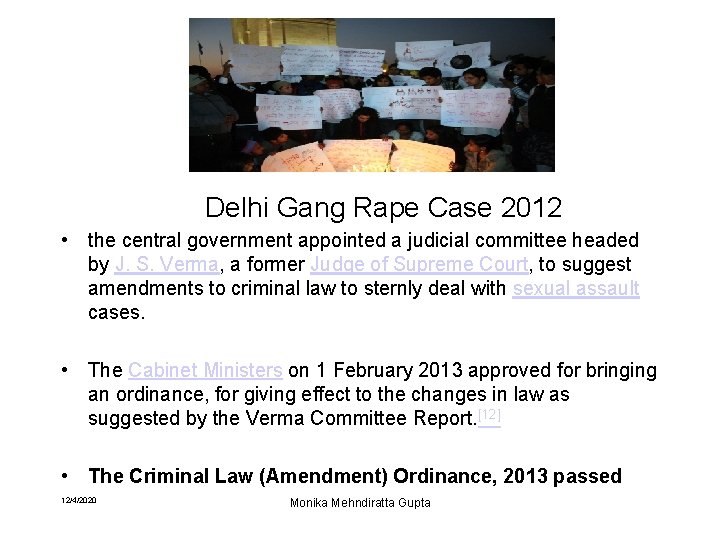
Delhi Gang Rape Case 2012 • the central government appointed a judicial committee headed by J. S. Verma, a former Judge of Supreme Court, to suggest amendments to criminal law to sternly deal with sexual assault cases. • The Cabinet Ministers on 1 February 2013 approved for bringing an ordinance, for giving effect to the changes in law as suggested by the Verma Committee Report. [12] • The Criminal Law (Amendment) Ordinance, 2013 passed 12/4/2020 Monika Mehndiratta Gupta
ADVENT OF LAW By adopting the Vishakha Guidelines and recommendations of Justice Verma Committee, the Parliament enacted the Sexual Harassment of Women at Workplace (Prevention, Prohibition and Redressal) Act in 2013 read with The Sexual Harassment of Women at Workplace (Prevention, Prohibition and Redressal) Rules, 2013 (effective Dec 2013) This statute supersedes the Vishakha Guidelines for prevention of sexual harassment introduced by the Supreme Court of India. The Statute extends to the “Whole of India” It is only for the protection of “Women at Workplace” 12/4/2020 Monika Mehndiratta Gupta
Section I BASICS 12/4/2020 Monika Mehndiratta Gupta
Preamble An Act to provide protection against sexual harassment of women at workplace and for the prevention and redressal of complaints of sexual harassment and for matters connected therewith or incidental thereto. 12/4/2020 Monika Mehndiratta Gupta
No Women Shall be Subjected to Sexual Harassment at any Workplace [sec 3(1)] 12/4/2020 Monika Mehndiratta Gupta
Understanding Basics What is - Sexual Harassment - Workplace - Aggrieved Woman 12/4/2020 Monika Mehndiratta Gupta
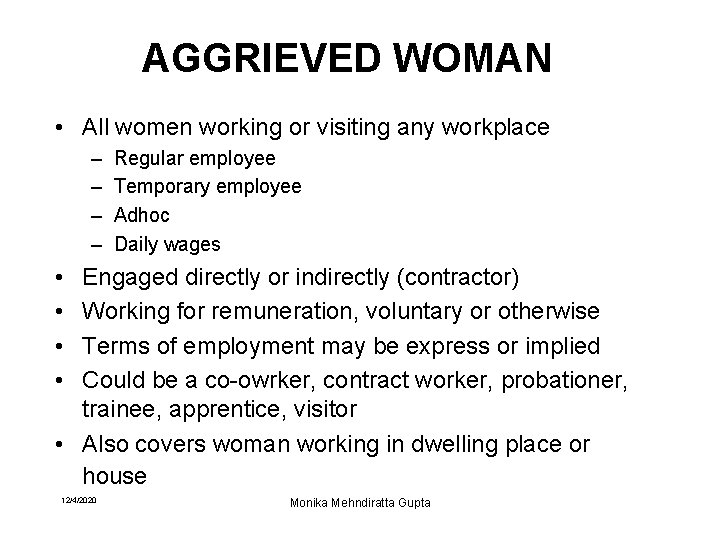
AGGRIEVED WOMAN • All women working or visiting any workplace – – Regular employee Temporary employee Adhoc Daily wages • • Engaged directly or indirectly (contractor) Working for remuneration, voluntary or otherwise Terms of employment may be express or implied Could be a co-owrker, contract worker, probationer, trainee, apprentice, visitor • Also covers woman working in dwelling place or house 12/4/2020 Monika Mehndiratta Gupta
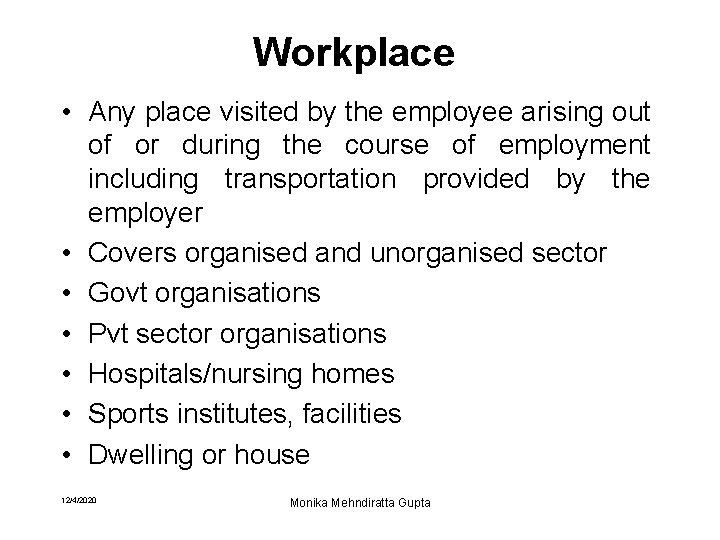
Workplace • Any place visited by the employee arising out of or during the course of employment including transportation provided by the employer • Covers organised and unorganised sector • Govt organisations • Pvt sector organisations • Hospitals/nursing homes • Sports institutes, facilities • Dwelling or house 12/4/2020 Monika Mehndiratta Gupta
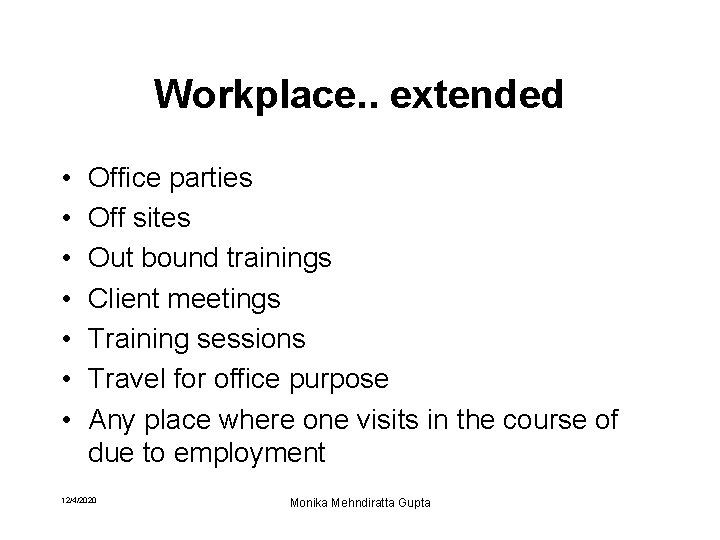
Workplace. . extended • • Office parties Off sites Out bound trainings Client meetings Training sessions Travel for office purpose Any place where one visits in the course of due to employment 12/4/2020 Monika Mehndiratta Gupta
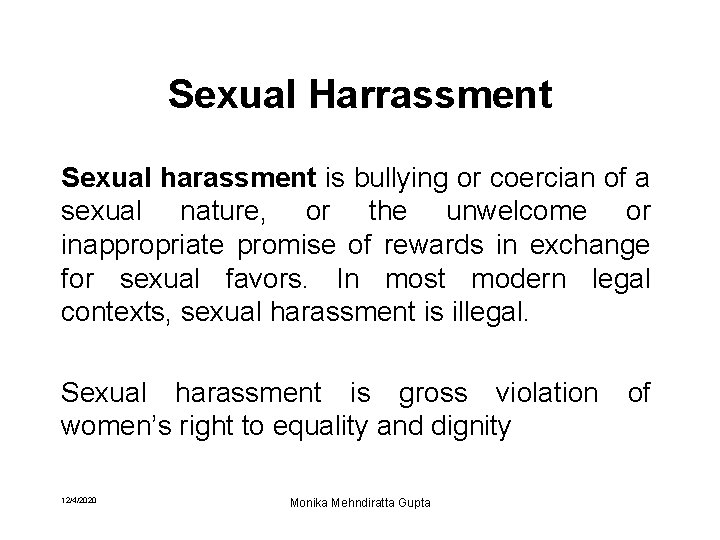
Sexual Harrassment Sexual harassment is bullying or coercian of a sexual nature, or the unwelcome or inappropriate promise of rewards in exchange for sexual favors. In most modern legal contexts, sexual harassment is illegal. Sexual harassment is gross violation of women’s right to equality and dignity 12/4/2020 Monika Mehndiratta Gupta
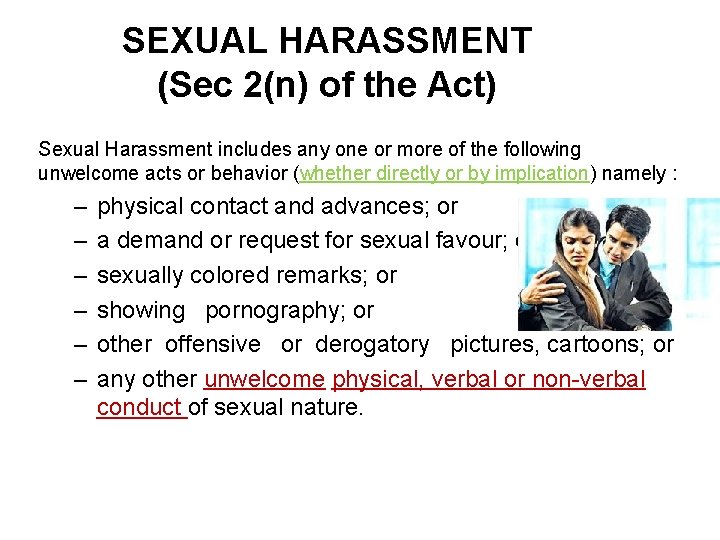
SEXUAL HARASSMENT (Sec 2(n) of the Act) Sexual Harassment includes any one or more of the following unwelcome acts or behavior (whether directly or by implication) namely : – – – physical contact and advances; or a demand or request for sexual favour; or sexually colored remarks; or showing pornography; or other offensive or derogatory pictures, cartoons; or any other unwelcome physical, verbal or non-verbal conduct of sexual nature.
Sec 3(2) of the Act Following acts when in relation to behaviour of Sexual Harassment may amount to sexual harassment (i) implied or explicit promise of preferential treatment in her employment; or (ii) implied or explicit threat of detrimental treatment in her employment: or (iii) implied or explicit threat about her present or future employment status; or (iv) interference with her work or creating an intimidating or offensive or hostile work environment for her; or (v) Humiliating treatment likely to affect her health or safety.
Forms of Workplace Sexual Harassment • Quid Pro Quo (this for that) – Implies or explicit promise of preferential / detrimental treatment in employment – Implied or express threat about her present or future employment status • Hostile Work Emviornment – Creating hostile, intimidating or an offensive work enviornment – Humiliating treatment likely to affect her health and safety 12/4/2020 Monika Mehndiratta Gupta
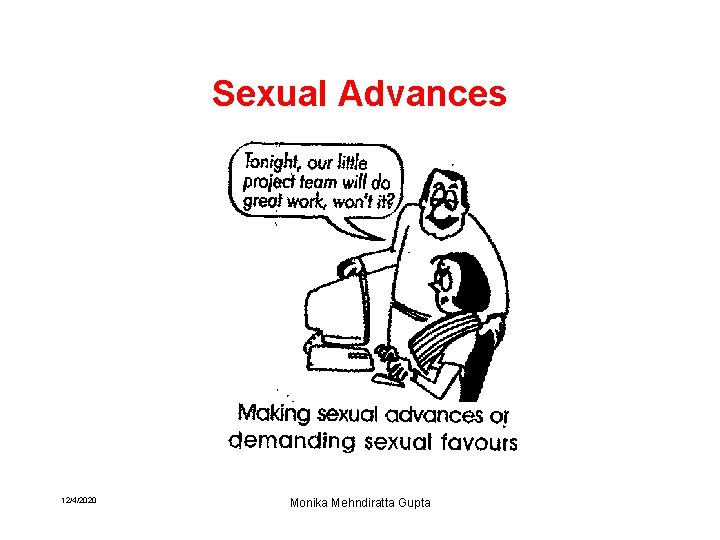
Sexual Advances 12/4/2020 Monika Mehndiratta Gupta
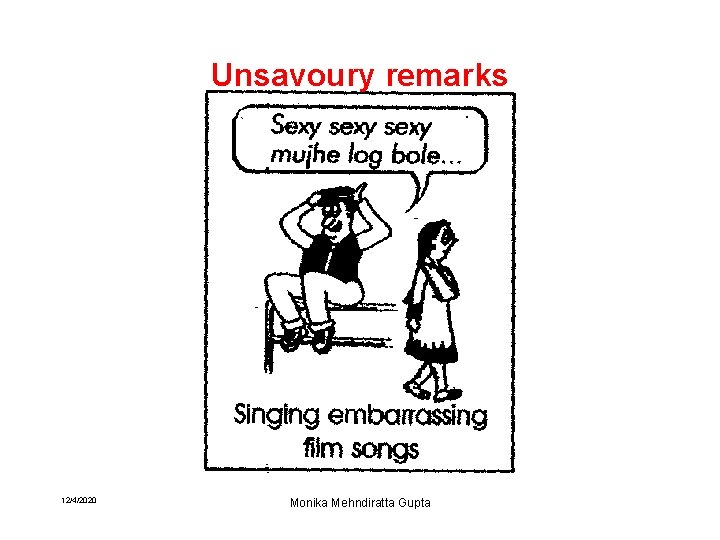
Unsavoury remarks 12/4/2020 Monika Mehndiratta Gupta
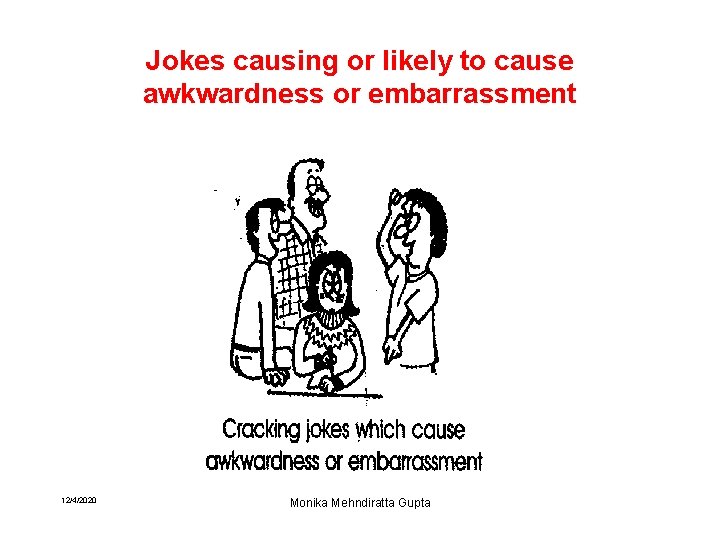
Jokes causing or likely to cause awkwardness or embarrassment 12/4/2020 Monika Mehndiratta Gupta
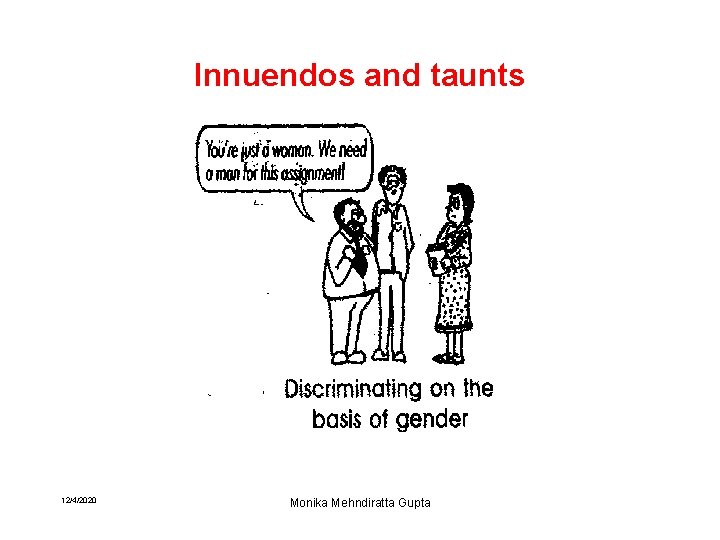
Innuendos and taunts 12/4/2020 Monika Mehndiratta Gupta
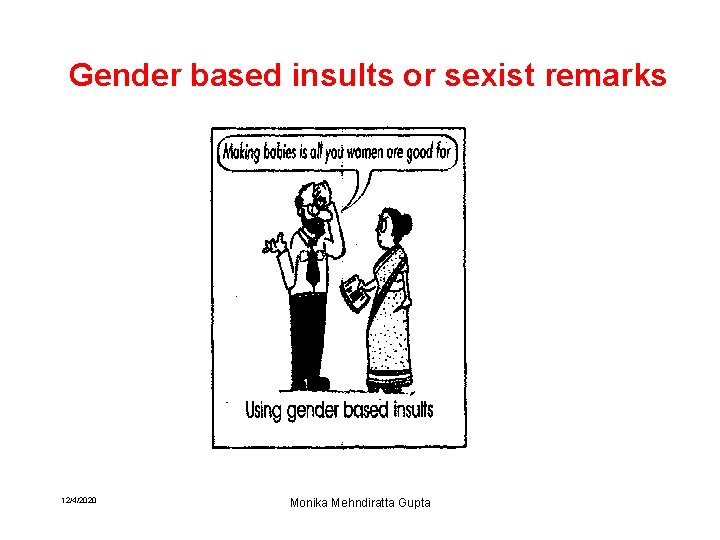
Gender based insults or sexist remarks 12/4/2020 Monika Mehndiratta Gupta
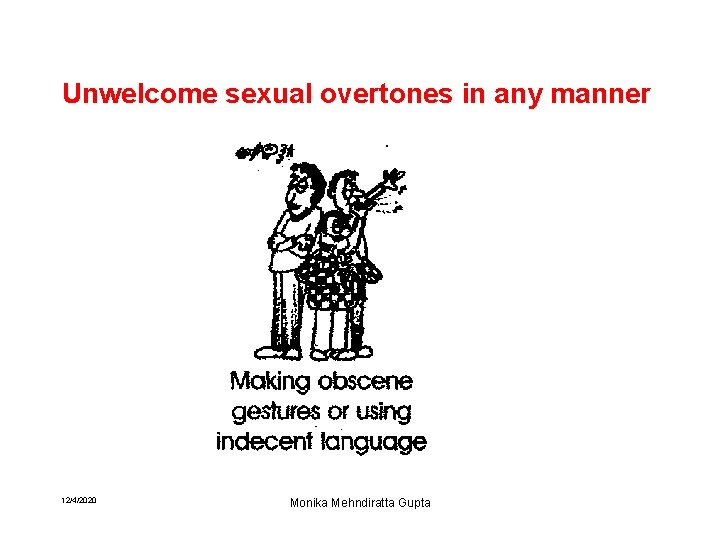
Unwelcome sexual overtones in any manner 12/4/2020 Monika Mehndiratta Gupta
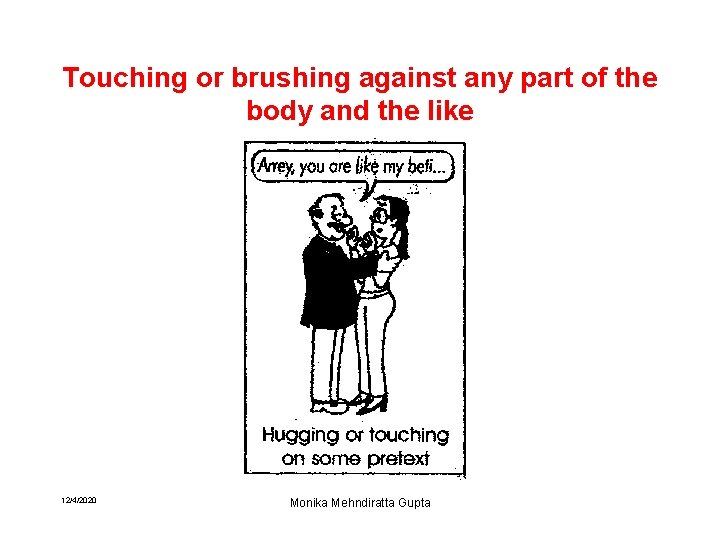
Touching or brushing against any part of the body and the like 12/4/2020 Monika Mehndiratta Gupta
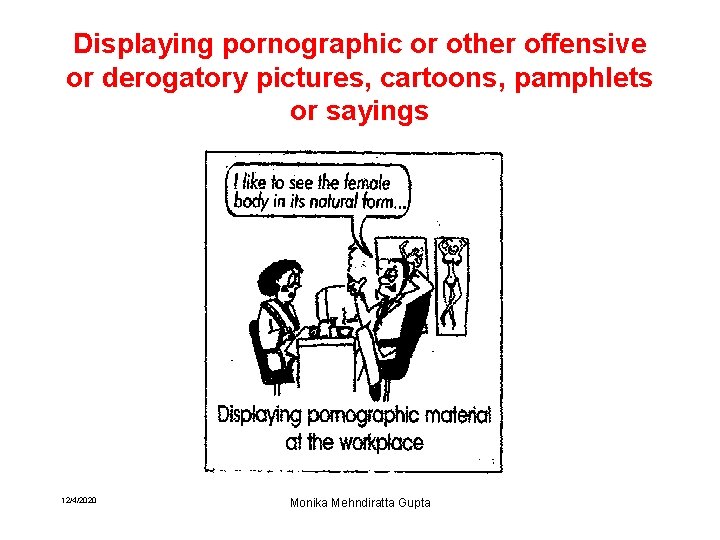
Displaying pornographic or other offensive or derogatory pictures, cartoons, pamphlets or sayings 12/4/2020 Monika Mehndiratta Gupta
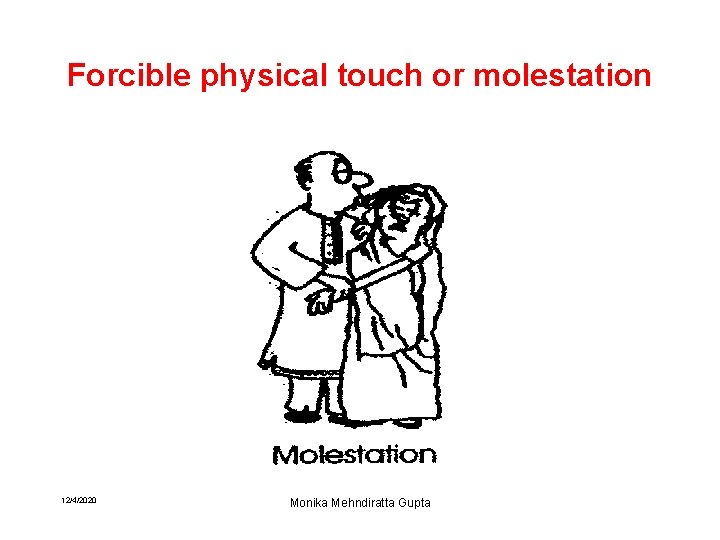
Forcible physical touch or molestation 12/4/2020 Monika Mehndiratta Gupta
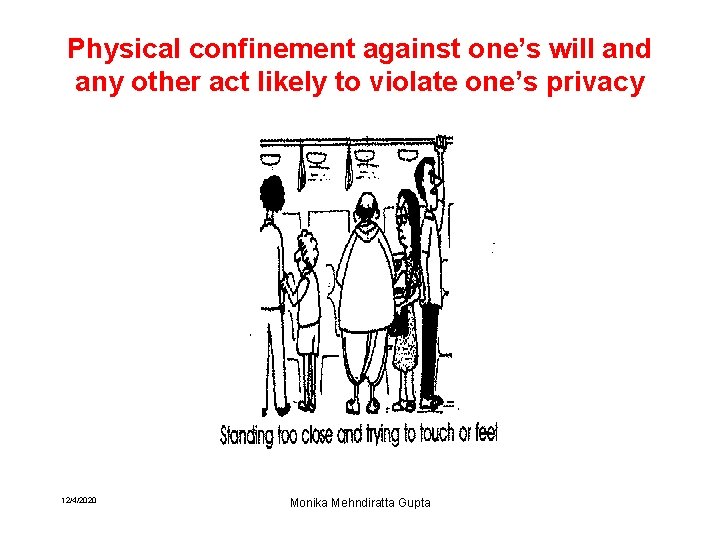
Physical confinement against one’s will and any other act likely to violate one’s privacy 12/4/2020 Monika Mehndiratta Gupta
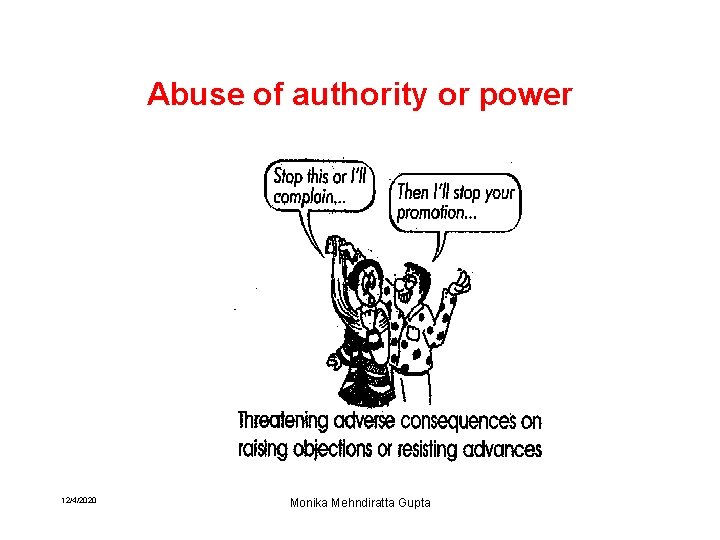
Abuse of authority or power 12/4/2020 Monika Mehndiratta Gupta
In short…. Workplace Sexual Harassment is when the behaviour is - Unwelcome - Sexual in Nature - A Subjective Experience - Impact not the intent matters 12/4/2020 Monika Mehndiratta Gupta
Workplace Sexual Harassment typically involves acts of which the victim has reasonable apprehension that they are – – – 12/4/2020 Humiliating Unsafe Unhealthy Discriminatory Career limiting Otherwise causing adverse circumstances Monika Mehndiratta Gupta
Sexual Harassment is a serious criminal offense!!! 12/4/2020 Monika Mehndiratta Gupta
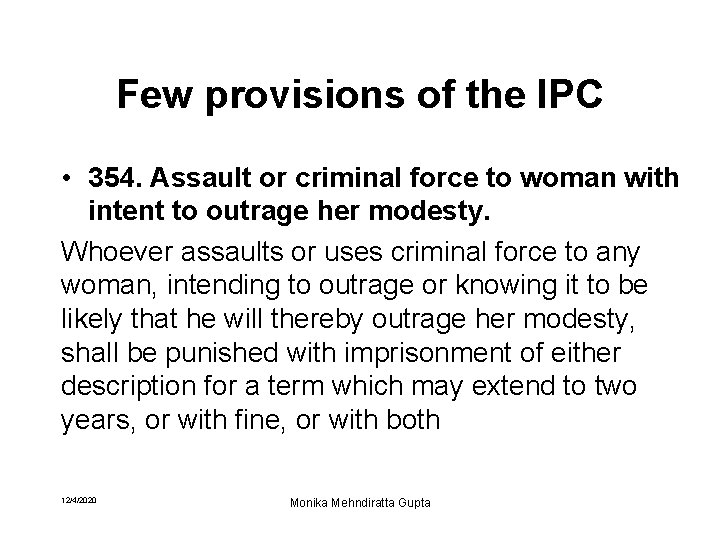
Few provisions of the IPC • 354. Assault or criminal force to woman with intent to outrage her modesty. Whoever assaults or uses criminal force to any woman, intending to outrage or knowing it to be likely that he will thereby outrage her modesty, shall be punished with imprisonment of either description for a term which may extend to two years, or with fine, or with both 12/4/2020 Monika Mehndiratta Gupta
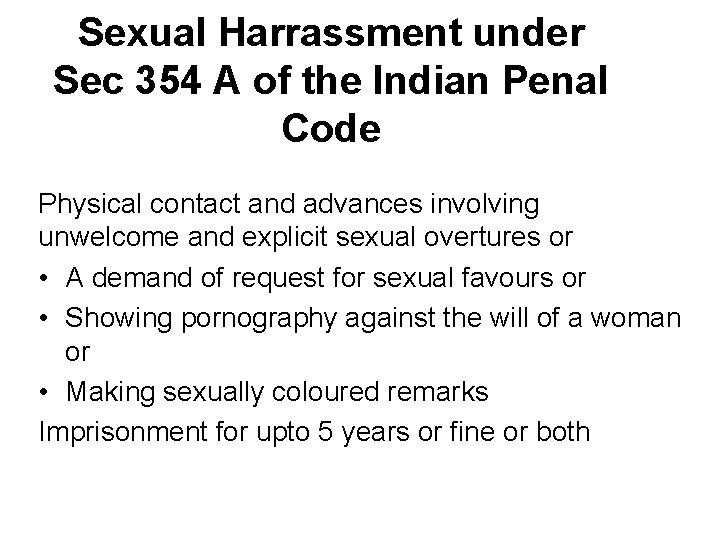
Sexual Harrassment under Sec 354 A of the Indian Penal Code Physical contact and advances involving unwelcome and explicit sexual overtures or • A demand of request for sexual favours or • Showing pornography against the will of a woman or • Making sexually coloured remarks Imprisonment for upto 5 years or fine or both
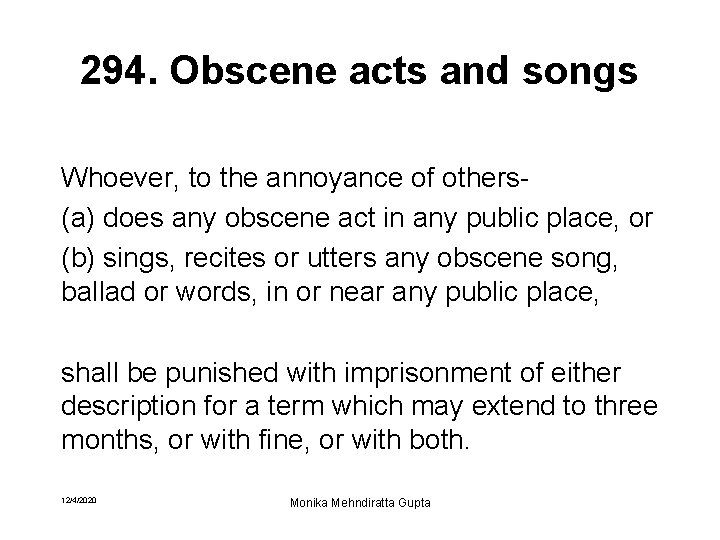
294. Obscene acts and songs Whoever, to the annoyance of others(a) does any obscene act in any public place, or (b) sings, recites or utters any obscene song, ballad or words, in or near any public place, shall be punished with imprisonment of either description for a term which may extend to three months, or with fine, or with both. 12/4/2020 Monika Mehndiratta Gupta
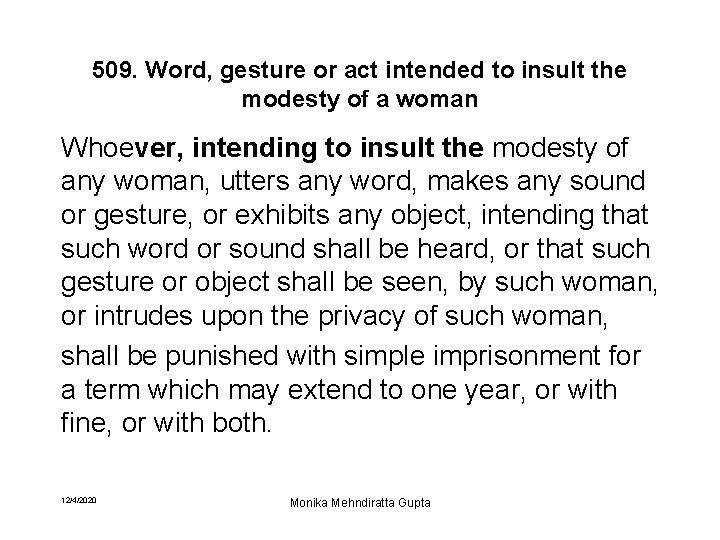
509. Word, gesture or act intended to insult the modesty of a woman Whoever, intending to insult the modesty of any woman, utters any word, makes any sound or gesture, or exhibits any object, intending that such word or sound shall be heard, or that such gesture or object shall be seen, by such woman, or intrudes upon the privacy of such woman, shall be punished with simple imprisonment for a term which may extend to one year, or with fine, or with both. 12/4/2020 Monika Mehndiratta Gupta
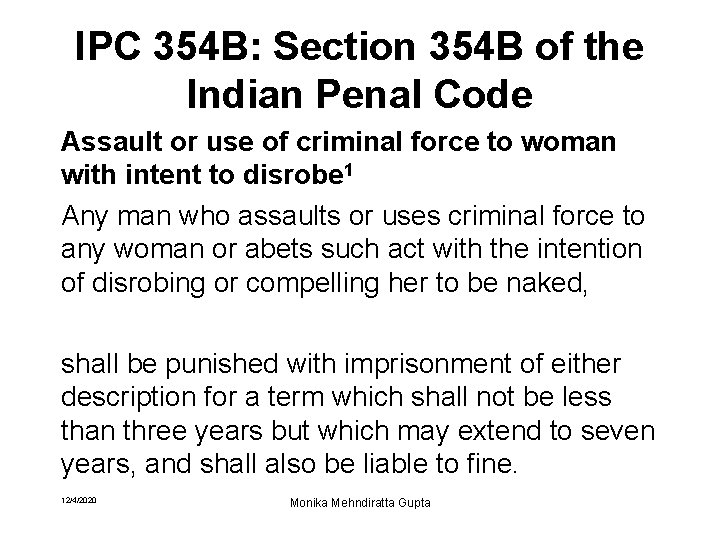
IPC 354 B: Section 354 B of the Indian Penal Code Assault or use of criminal force to woman with intent to disrobe 1 Any man who assaults or uses criminal force to any woman or abets such act with the intention of disrobing or compelling her to be naked, shall be punished with imprisonment of either description for a term which shall not be less than three years but which may extend to seven years, and shall also be liable to fine. 12/4/2020 Monika Mehndiratta Gupta
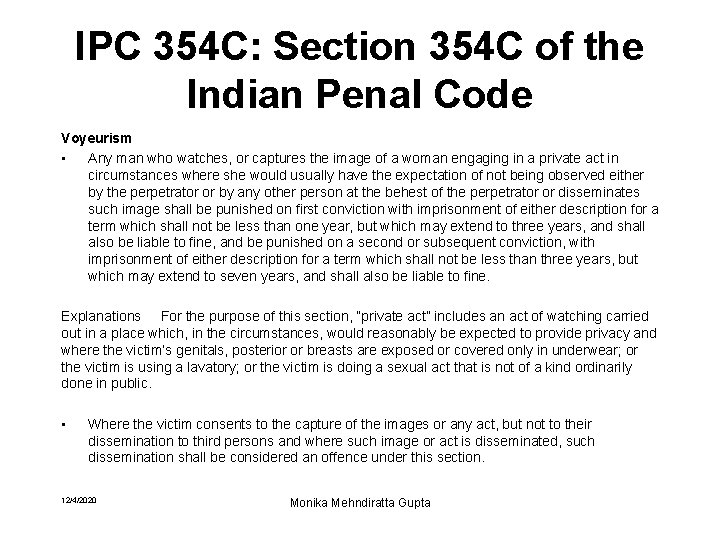
IPC 354 C: Section 354 C of the Indian Penal Code Voyeurism • Any man who watches, or captures the image of a woman engaging in a private act in circumstances where she would usually have the expectation of not being observed either by the perpetrator or by any other person at the behest of the perpetrator or disseminates such image shall be punished on first conviction with imprisonment of either description for a term which shall not be less than one year, but which may extend to three years, and shall also be liable to fine, and be punished on a second or subsequent conviction, with imprisonment of either description for a term which shall not be less than three years, but which may extend to seven years, and shall also be liable to fine. Explanations For the purpose of this section, “private act” includes an act of watching carried out in a place which, in the circumstances, would reasonably be expected to provide privacy and where the victim’s genitals, posterior or breasts are exposed or covered only in underwear; or the victim is using a lavatory; or the victim is doing a sexual act that is not of a kind ordinarily done in public. • Where the victim consents to the capture of the images or any act, but not to their dissemination to third persons and where such image or act is disseminated, such dissemination shall be considered an offence under this section. 12/4/2020 Monika Mehndiratta Gupta
IPC 354 D: Section 354 D of the Indian Penal Code Stalking (1) Any man who— follows a woman and contacts, or attempts to contact such woman to foster personal interaction repeatedly despite a clear indication of disinterest by such woman; or • monitors the use by a woman of the internet, email or any other form of electronic communication, commits the offence of stalking; • Provided that such conduct shall not amount to stalking if the man who pursued it proves that— • it was pursued for the purpose of preventing or detecting crime and the man accused of stalking had been entrusted with the responsibility of prevention and detection of crime by the State; or • it was pursued under any law or to comply with any condition or requirement imposed by any person under any law; or • in the particular circumstances such conduct was reasonable and justified. (2) Whoever commits the offence of stalking shall be punished on first conviction with imprisonment of either description for a term which may extend to three years, and shall also be liable to fine; and be punished on a second or subsequent conviction, with imprisonment of either description for a term which may extend to 12/4/2020 five years, and shall also be liable to fine. Monika Mehndiratta Gupta
Civil Remedy under the POSH Criminal Remedy under the IPC 12/4/2020 Monika Mehndiratta Gupta
Section II Prevention and prohibition 12/4/2020 Monika Mehndiratta Gupta
Who is responsible and accountable for prevention? What is the role of workplace in prohibiting and how? 12/4/2020 Monika Mehndiratta Gupta
The Employer shall create a workplace free of sexual harassment 12/4/2020 Monika Mehndiratta Gupta
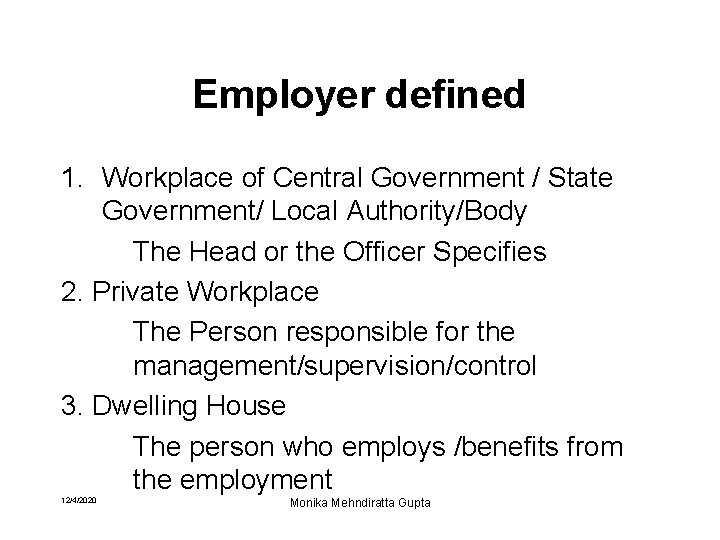
Employer defined 1. Workplace of Central Government / State Government/ Local Authority/Body The Head or the Officer Specifies 2. Private Workplace The Person responsible for the management/supervision/control 3. Dwelling House The person who employs /benefits from the employment 12/4/2020 Monika Mehndiratta Gupta
Duties of employer Every employer shall-(a) Provide a safe working environment at the workplace which shall include safety from the persons coming into contact at the workplace; (a) Display at any conspicuous place in the workplace, the penal consequences of sexual harassments: and the order constituting, the Internal Committee under this law; (b) Organize workshops and awareness programmes at regular intervals for sensitizing the employees with the provisions of the Act and orientation programmes for the members of the Internal Committee in the manner as may be prescribed; (c) Provide necessary facilities to the Internal Committee or the Local Committee, as the case may be, for dealing with the complaint and conducting an inquiry; (d) Assist in securing the attendance of respondent and witnesses before the Internal Committee or the Local Committee, as the case may be;
Duties of employer f) Make available such information to the Internal Committee or the Local Committee, as the case may be, as it may require having regard to the complaint made under this law (g) Provide assistance to the woman if she so chooses to file a complaint in relation to the offence under the Indian Penal Code(45 of 1860) or any other law for the time being in force; (h) Cause to initiate action, under the Indian Penal Code(45 of 1860) or any other law for the time being in force, against the perpetrator, or if the aggrieved woman so desires, where the perpetrator is not an employee, in the workplace at which the incident of sexual harassment took place; (i) Treat sexual harassment as a misconduct under the service rules and initiate action for such misconduct; (j) Monitor the timely submission of reports by the Internal Committee
The Employer shall • Create and communicate a detailed Policy • Ensure Awareness and Orientation on the issue • Constitute Complaints Committee • Ensure that the Complaints Committee is trained in skill and capacity • Prepare Annual Report to be submitted to the DO • Report in the Directors Report 12/4/2020 Monika Mehndiratta Gupta
It is the Employer’s responsibility to… prevent or deter the committing of any act of Sexual Harassment by means of – Creation of appropriate working conditions – Ensuring female employees are not treated as sex objects – Ensuring that no male employee or third party will outrage or insult the modesty of a female colleague – Ensuring that no male employee or third party will make any type of sexual advances to female colleagues – Establishment of a Complaints Committee 12/4/2020 Monika Mehndiratta Gupta
ICC/LCC • Members to hold office for a term not exceeding three years • ICC for each branch, offices if there are multiple • Functions – To educate and sensitize employee about the issue – To address the compliant, conduct enquiry etc. • Operates as a Quasi Judicial Body with powers to – Summon and enforce attendance – Call for evidence, documents 12/4/2020 Monika Mehndiratta Gupta
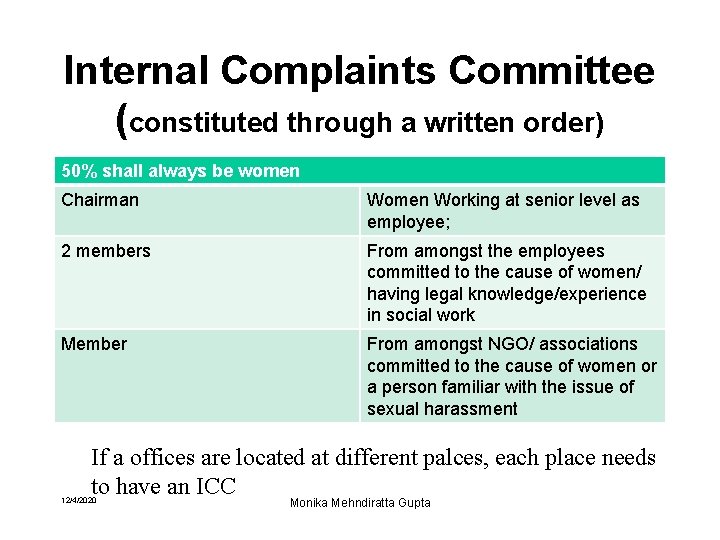
Internal Complaints Committee (constituted through a written order) 50% shall always be women Chairman Women Working at senior level as employee; 2 members From amongst the employees committed to the cause of women/ having legal knowledge/experience in social work Member From amongst NGO/ associations committed to the cause of women or a person familiar with the issue of sexual harassment If a offices are located at different palces, each place needs to have an ICC 12/4/2020 Monika Mehndiratta Gupta
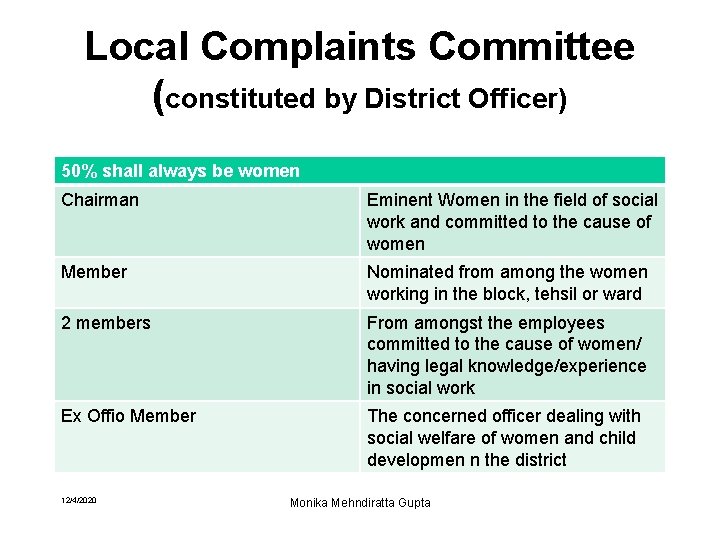
Local Complaints Committee (constituted by District Officer) 50% shall always be women Chairman Eminent Women in the field of social work and committed to the cause of women Member Nominated from among the women working in the block, tehsil or ward 2 members From amongst the employees committed to the cause of women/ having legal knowledge/experience in social work Ex Offio Member The concerned officer dealing with social welfare of women and child developmen n the district 12/4/2020 Monika Mehndiratta Gupta
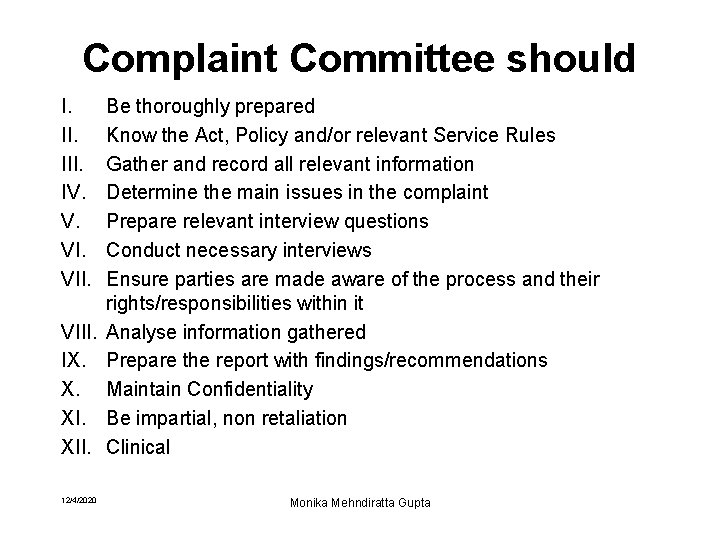
Complaint Committee should I. III. IV. V. VIII. IX. X. XII. 12/4/2020 Be thoroughly prepared Know the Act, Policy and/or relevant Service Rules Gather and record all relevant information Determine the main issues in the complaint Prepare relevant interview questions Conduct necessary interviews Ensure parties are made aware of the process and their rights/responsibilities within it Analyse information gathered Prepare the report with findings/recommendations Maintain Confidentiality Be impartial, non retaliation Clinical Monika Mehndiratta Gupta
Section III communicating 12/4/2020 Monika Mehndiratta Gupta
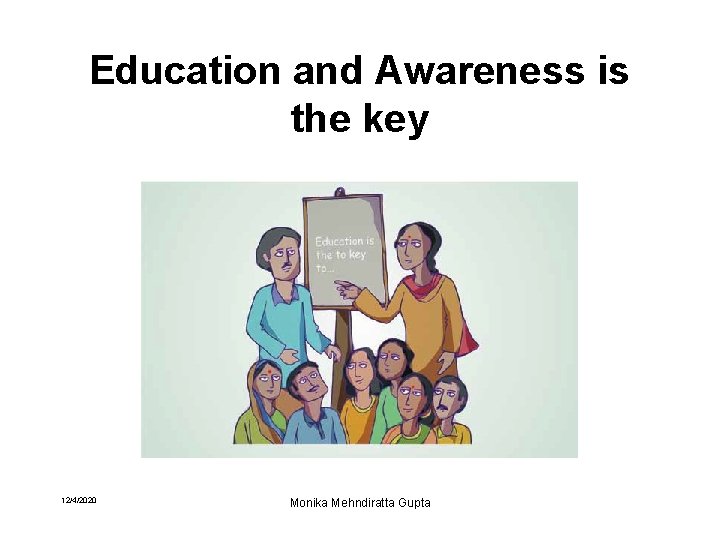
Education and Awareness is the key 12/4/2020 Monika Mehndiratta Gupta
Policy • Employer shall create a policy which – Prohibits sexual harrassment at workplace – Provides a detailed framework for the redressal of complaint • Policy to be Communicated 12/4/2020 Monika Mehndiratta Gupta
Communication • Carry out awareness and orientation for all employees • Create forums for dialogue • Ensure capacity and skill building for the Complaints Committee • Widely publicize the names and contact details of members of Complaints Committee 12/4/2020 Monika Mehndiratta Gupta
Section IV redress 12/4/2020 Monika Mehndiratta Gupta
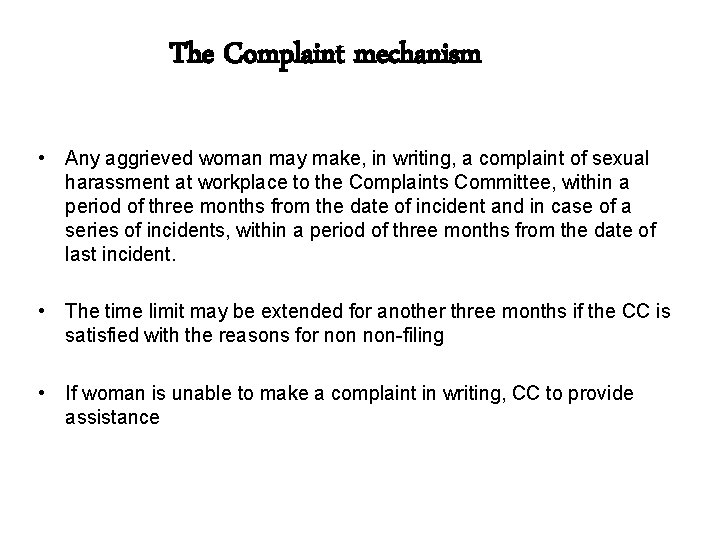
The Complaint mechanism • Any aggrieved woman may make, in writing, a complaint of sexual harassment at workplace to the Complaints Committee, within a period of three months from the date of incident and in case of a series of incidents, within a period of three months from the date of last incident. • The time limit may be extended for another three months if the CC is satisfied with the reasons for non-filing • If woman is unable to make a complaint in writing, CC to provide assistance
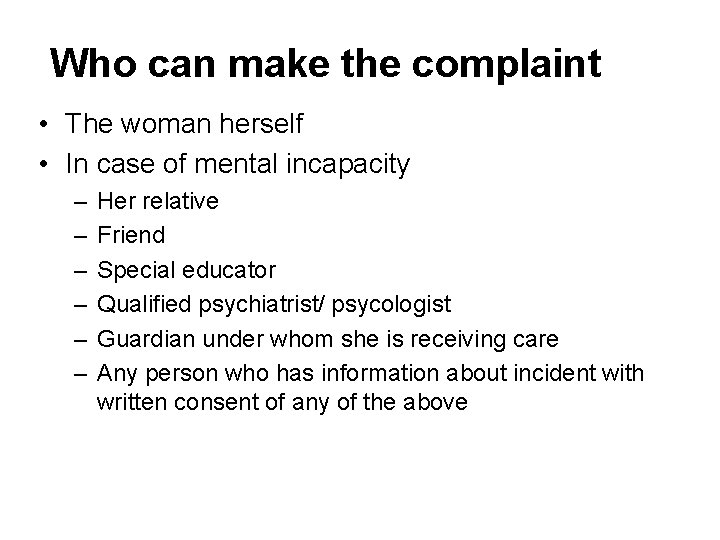
Who can make the complaint • The woman herself • In case of mental incapacity – – – Her relative Friend Special educator Qualified psychiatrist/ psycologist Guardian under whom she is receiving care Any person who has information about incident with written consent of any of the above
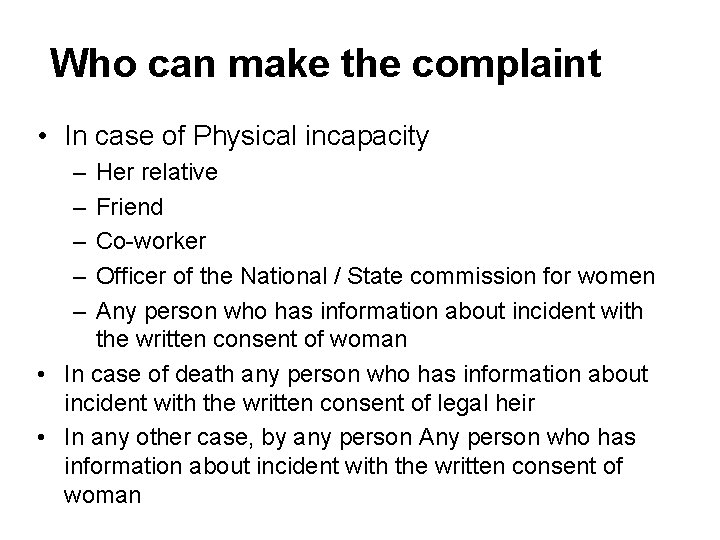
Who can make the complaint • In case of Physical incapacity – – – Her relative Friend Co-worker Officer of the National / State commission for women Any person who has information about incident with the written consent of woman • In case of death any person who has information about incident with the written consent of legal heir • In any other case, by any person Any person who has information about incident with the written consent of woman
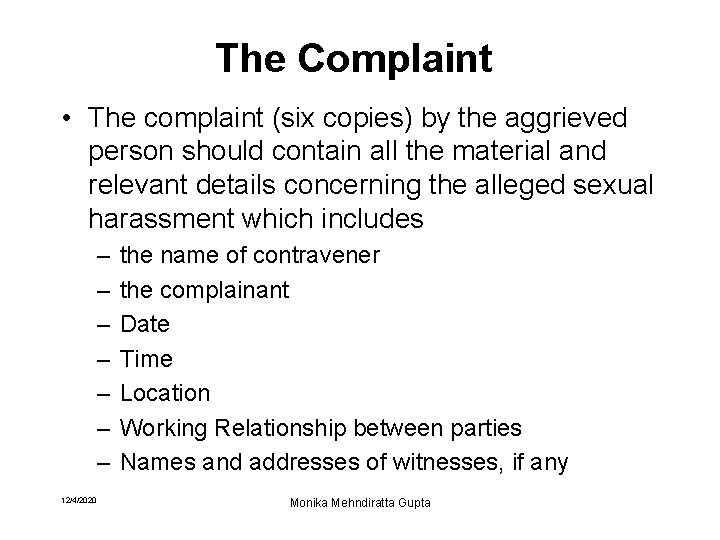
The Complaint • The complaint (six copies) by the aggrieved person should contain all the material and relevant details concerning the alleged sexual harassment which includes – – – – 12/4/2020 the name of contravener the complainant Date Time Location Working Relationship between parties Names and addresses of witnesses, if any Monika Mehndiratta Gupta
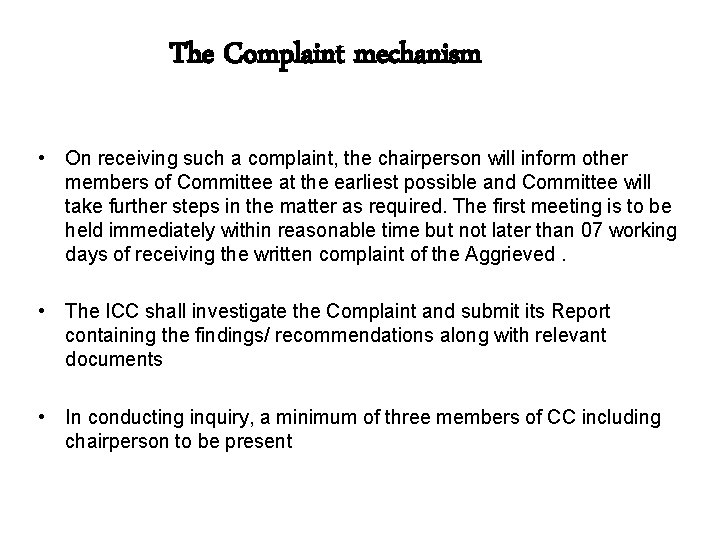
The Complaint mechanism • On receiving such a complaint, the chairperson will inform other members of Committee at the earliest possible and Committee will take further steps in the matter as required. The first meeting is to be held immediately within reasonable time but not later than 07 working days of receiving the written complaint of the Aggrieved. • The ICC shall investigate the Complaint and submit its Report containing the findings/ recommendations along with relevant documents • In conducting inquiry, a minimum of three members of CC including chairperson to be present
Upon Receipt of Complaint • Review the Complaint to ensure – It has all the information – The conduct of respondent was towards complainant and – is improper and may form SH at Workplace – The incident occurred in workplace or at any location/any event related to work • Send complaint to Respondent within seven days of receipt to respond within 10 days • Meet up with complainant for any settlement/concilliation 12/4/2020 Monika Mehndiratta Gupta
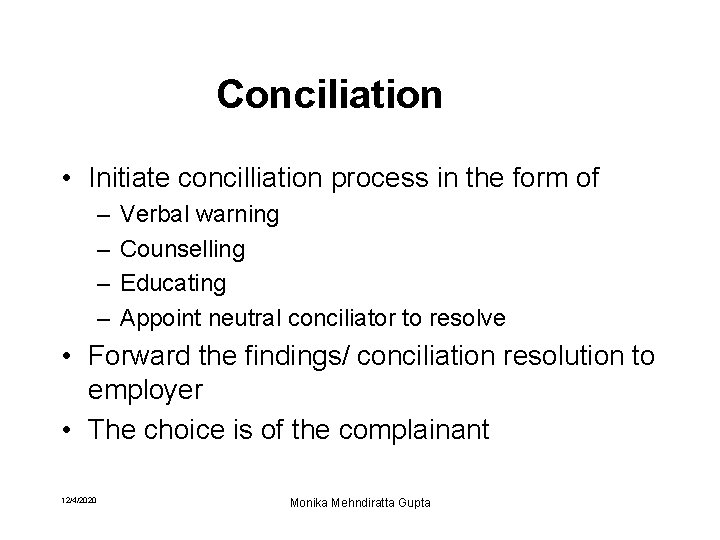
Conciliation • Initiate concilliation process in the form of – – Verbal warning Counselling Educating Appoint neutral conciliator to resolve • Forward the findings/ conciliation resolution to employer • The choice is of the complainant 12/4/2020 Monika Mehndiratta Gupta
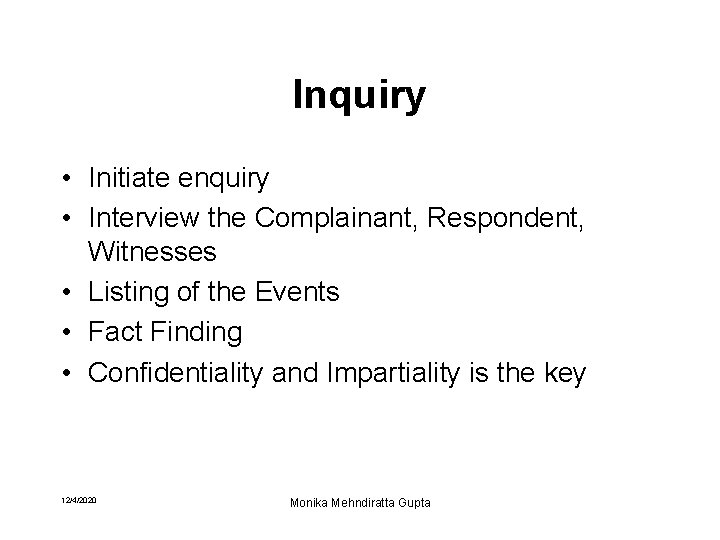
Inquiry • Initiate enquiry • Interview the Complainant, Respondent, Witnesses • Listing of the Events • Fact Finding • Confidentiality and Impartiality is the key 12/4/2020 Monika Mehndiratta Gupta
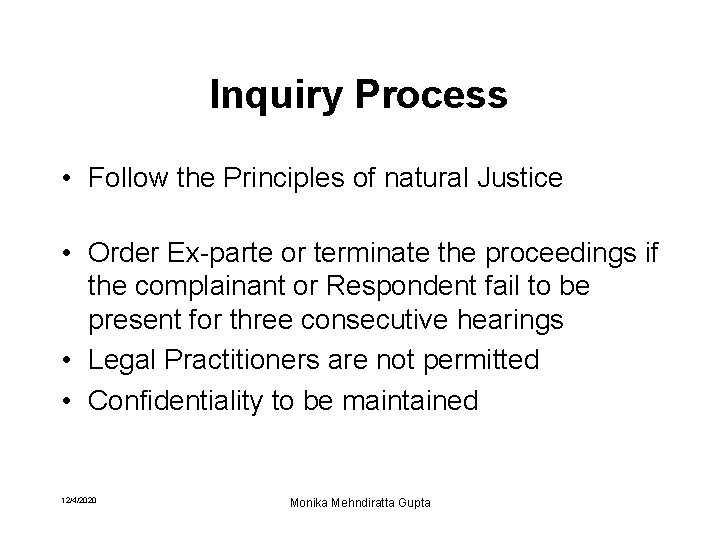
Inquiry Process • Follow the Principles of natural Justice • Order Ex-parte or terminate the proceedings if the complainant or Respondent fail to be present for three consecutive hearings • Legal Practitioners are not permitted • Confidentiality to be maintained 12/4/2020 Monika Mehndiratta Gupta
Committee must adhere to the Rules of Natural Justice There are three important rules to be observed by the Committee: • Hearing - Nobody can be condemned without being heard • Fair Play - The judge must be impartial and act fairly and in good faith • Reasoned Orders 12/4/2020 Monika Mehndiratta Gupta
Interim Measure • To prevent ongoing SH at the written request of the woman or event otherwise, CC may recommend – Restrain the respondent from • reporting on work performance of the Aggrieved woman • Writing her Confidential Report, appraisal • Supervising her academic activities – Transfer the Complainant or Respondent – Place Complainant or Respondent on Leave 12/4/2020 Monika Mehndiratta Gupta
Recommendations • In case allegations are Proven – – – – – 12/4/2020 Service Rules to be followed as for “misconduct” Disciplinary Actions like Written Apology; Warning; Reprimand With-holding of promotion With-holding of pay increase or increments Counselling Sessions Community Service Termination from services Financial Damages Additional recommendations to address underlying factors Monika Mehndiratta Gupta
False or malicious complaint › Where the Internal Committee, arrives at a conclusion that the allegation against the respondent is malicious or the aggrieved woman or any other person making the complaint has made the complaint knowing it to be false or the aggrieved woman or any other person making the complaint has produced any forged or misleading document, it may recommend to the employer, to take action against the woman or the person who has made the complaint, as the case may be, in accordance with the provisions applicable to her or him. Provided further that the malicious intent on part of the complainant has been established after an inquiry in accordance with the procedure prescribed, before any action is recommended. › If the ICC comes to the conclusion that any witness has given wrong statement or evidence, it may recommend the employer to take action against such employee as well
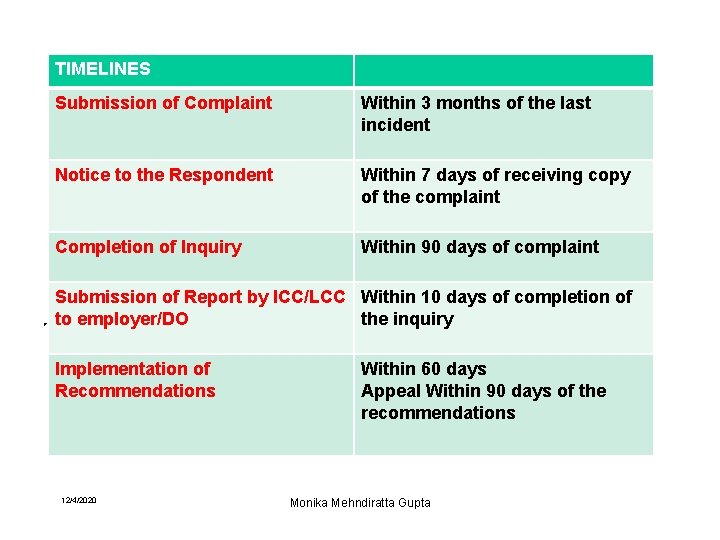
TIMELINES Submission of Complaint Within 3 months of the last incident Notice to the Respondent Within 7 days of receiving copy of the complaint Completion of Inquiry Within 90 days of complaint Submission of Report by ICC/LCC Within 10 days of completion of to employer/DO the inquiry Timelines as per the Act Implementation of Recommendations 12/4/2020 Within 60 days Appeal Within 90 days of the recommendations Monika Mehndiratta Gupta
Confidentiality The Act prohibits the disclosure of: • Contents of the complaint; • Identity and address of complainant, respondent and witnesses; • Information pertaining to conciliatory/inquiry proceedings or recommendations of the ICC/LCC; • Action taken by the employer/DO. Consequences: As per the Service Rules or Rs. 5, 000/ to be collected by the employer. 12/4/2020 Monika Mehndiratta Gupta
Section V monitoring 12/4/2020 Monika Mehndiratta Gupta
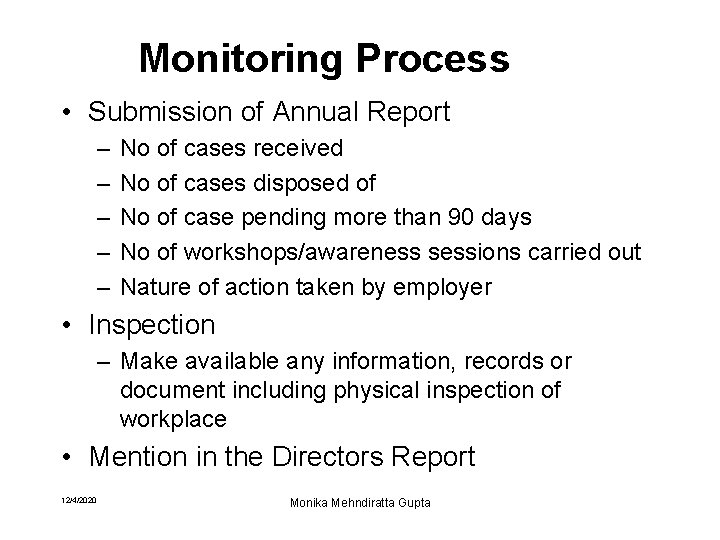
Monitoring Process • Submission of Annual Report – – – No of cases received No of cases disposed of No of case pending more than 90 days No of workshops/awareness sessions carried out Nature of action taken by employer • Inspection – Make available any information, records or document including physical inspection of workplace • Mention in the Directors Report 12/4/2020 Monika Mehndiratta Gupta
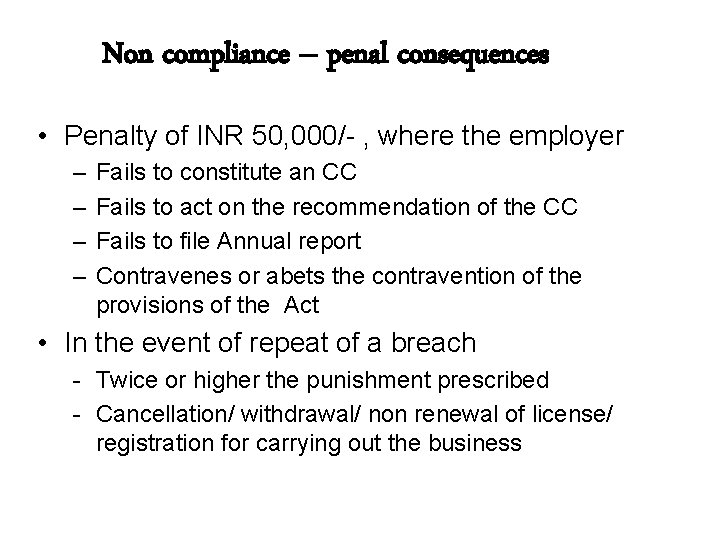
Non compliance – penal consequences • Penalty of INR 50, 000/- , where the employer – – Fails to constitute an CC Fails to act on the recommendation of the CC Fails to file Annual report Contravenes or abets the contravention of the provisions of the Act • In the event of repeat of a breach - Twice or higher the punishment prescribed - Cancellation/ withdrawal/ non renewal of license/ registration for carrying out the business
Appeal • A person Aggrieved by the orders of the CC or in the case of non-implementation of the orders may file an Appeal with appropriate authority • Either party can chose to seek justice through the regular court of justice 12/4/2020 Monika Mehndiratta Gupta
Section Vi Summary 12/4/2020 Monika Mehndiratta Gupta
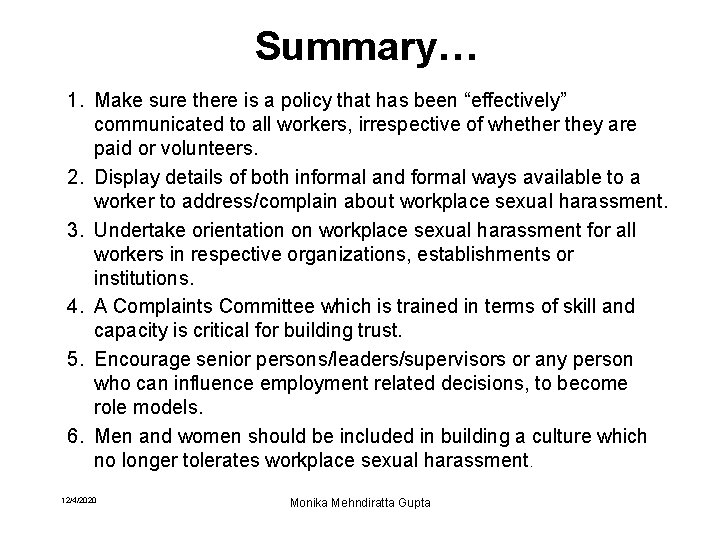
Summary… 1. Make sure there is a policy that has been “effectively” communicated to all workers, irrespective of whether they are paid or volunteers. 2. Display details of both informal and formal ways available to a worker to address/complain about workplace sexual harassment. 3. Undertake orientation on workplace sexual harassment for all workers in respective organizations, establishments or institutions. 4. A Complaints Committee which is trained in terms of skill and capacity is critical for building trust. 5. Encourage senior persons/leaders/supervisors or any person who can influence employment related decisions, to become role models. 6. Men and women should be included in building a culture which no longer tolerates workplace sexual harassment. 12/4/2020 Monika Mehndiratta Gupta
Section Vii Q&A 12/4/2020 Monika Mehndiratta Gupta
Thank you 12/4/2020 Monika Mehndiratta Gupta