
ETUCCES EGB Framework agreement on Harassment Violence at
ETUC/CES/ EGB Framework agreement on Harassment & Violence at Work Stefan CLAUWAERT, ETUI-REHS (Research) Roland GAUTHY, ETUI-REHS (Health & Safety)
Some history § Autonomous agreement on work-related stress (WRS) – October 2004 – Recognising that harassment and violence at the work place are potential work related stressors – EU social partners will explore possibility of negotiating a specific agreement on these issues – Therefore, WRS agreement does not apply to harassment, violence and post-traumatic stress § Social Partners Work Programme 2003 -2005 – Announcement to organise seminar on harassment – Seminar took place on 12 May 2005 § Parallel consultations launched by the Commission on issue of violence at work § Social Partners Work Programme 2006 -2008 – Action point 4: negotiate a framework agreement on harassment and violence
Some history (2) § § § Start negotiations 7 February 2006 9 rounds of negotiating – 10 months At 9 th round of 14 -15 December 2006 a joint text was agreed upon Dec 2006 -March 2007: Internal consultation round within all signatory parties for adoption agreement Official signing: 26 April 2007: start implementation period of three years (i. e. until April 2010)
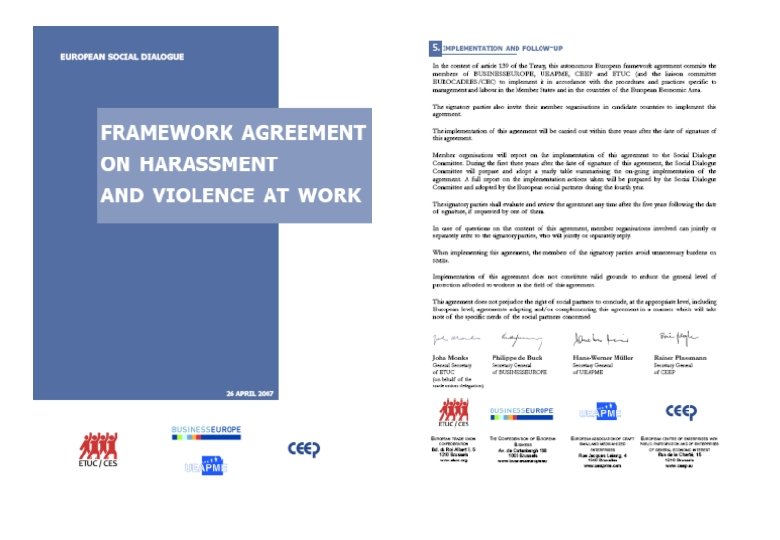
Signatory Parties John Monks Philippe de Buck Hans-Werner Müller Rainer Plassmann General Secretary of the ETUC Secretary General of BUSINESS EUROPE Secretary General of UEAPME Secretary General of CEEP ETUC: Bd du Roi Albert II, 5 - 1210 Brussels + 32 2 224 04 11 www. etuc. org BUSINESS EUROPE: Av. de Cortenbergh, 168 - 1000 Brussels + 32 2 237. 65. 11 www. businesseurope. eu UEAPME: Rue Jacques Lalaing, 4 - 1040 Brussels + 32 2 230 75 99 www. ueapme. com CEEP: Rue de la Charité, 15 - 1210 Brussels + 32 2 219 27 98 www. ceep. eu
1. Introduction Mutual respect for the dignity of others at all levels within the workplace is one of the key characteristics of successful organizations. That is why H&V are unacceptable. BUSINESS EUROPE, UEAPME, CEEP and ETUC (and the liaison committee EUROCADRES/CEC) condemn them in all their forms. They consider it is a mutual concern of employers and workers to deal with this issue, which can have serious social and economic consequences. EU & national law define the employers’ duty to protect workers against H&V in the workplace. This includes amongst others the following Directives: Directive 2000/43/EC equal treatment … racial or ethnic origin Directive 2000/78/EC equal treatment in employment and occupation Directive 2002/73/EC equal treatment for men and women… access to employment, vocational training and promotion, and working conditions Directive 89/391/EEC measures to encourage improvements in the safety and health of workers at work
§ 1 & 2 – Coverage & importance This agreement covers all forms of H&V. The initial position of the employers was to deal exclusively with harassment and not at all with violence at work. H&V can have serious social consequences (e. g. health wise, working climate, work satisfaction, etc. ) + economic repercussions the issue is of such importance to and must be tackled by the social partners together. The agreement recognises that existing legislation, EU & national, is applicable the processes / procedures foreseen by that legislation can also apply when dealing with H&V: e. g. information and consultation procedures, risk assessment methods/processes, the use of internal and external expertise, training, responsibility of the employer to protect workers, etc. Important to note is that the references to the EU legislation as it figures in the footnote concerns a non-exhaustive list of relevant EU legislation on the matter.
Different forms of harassment and violence can affect workplaces. They can be physical, psychological and/or sexual be one off incidents or more systematic patterns of behaviour, be amongst colleagues, between superiors and subordinates or by third parties such as clients, customers, patients, pupils, etc. range from minor cases of disrespect to more serious acts, including criminal offences, which require the intervention of public authorities.
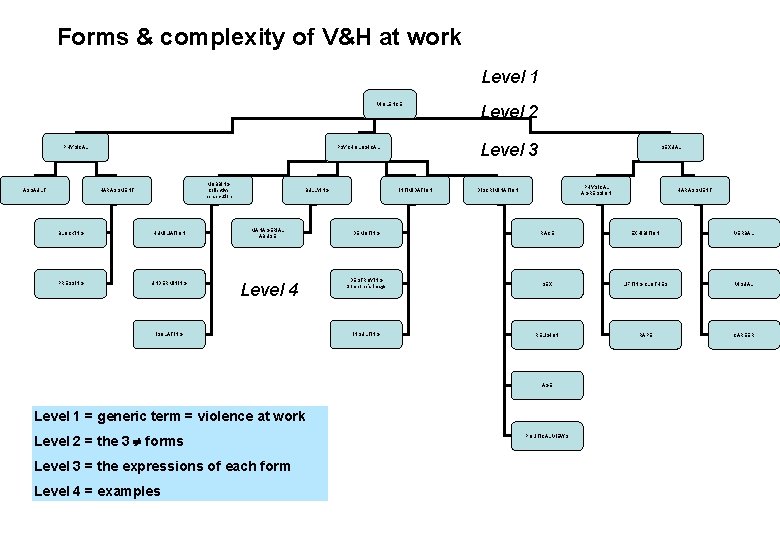
Forms & complexity of V&H at work Level 1 VIOLENCE PHYSICAL ASSAULT Level 3 PSYCHOLOGICAL MOBBING Collective persecution HARASSMENT BLOCKING HUMILIATION PRESSING UNDERMINING BULLYING MANAGERIAL ABUSE Level 4 ISOLATING Level 2 INTIMIDATION SEXUAL PHYSICAL AGRESSION DISCRIMINATION DEMOTING RACE EXHIBITION VERBAL DESTROYING Someone’s image SEX LIFTING CLOTHES VISUAL INSULTING RELIGION RAPE CAREER AGE Level 1 = generic term = violence at work Level 2 = the 3 forms Level 3 = the expressions of each form Level 4 = examples HARASSMENT POLITICAL VIEWS
…as soon as there is a link with the workplace… Description of the different forms of H&V, the possible perpetrators including 3 rd parties. ETUC's position is clear: the agreement is not dealing specifically with any type of violence, but as soon as there is a link with the workplace, violence or harassment are within the competence of the social partners who have to deal with it, so also when the perpetrator’s origin is external to the company. There are measures that can be applied generally to the different types of violence; however more specific measures should be tackled at the sectoral level. Furthermore the handling of some behaviour /acts fall fully/partially into the competences of public authorities as they form criminal offences and lie thus not as such in the remit of the social partners. Having said that, it is recognised that employers have a responsibility for action in the cases that fall under their specific responsibility and that they have to protect the workers.
The European social partners recognize that H&V can potentially affect any workplace and any worker, irrespective of the size of the company, field of activity or form of the employment contract or relationship. However, certain groups and sectors can be more at risk. In practice not all workplaces and not all workers are affected. This agreement deals with those forms of harassment and violence which are within the competence of social partners and correspond to the description made in section 3 below.
Broad coverage Every worker and every workplace, including SME’s, can be affected by V&H. Furthermore, this § stresses that certain groups and sectors can be more at risk, including concerning 3 rd party violence. The signatory parties to this agreement have a common understanding that employers cannot be held responsible for the growing violence and harassment that are present in our societies. However, this recognition should not prevent them from acting carefully and proactively in order to assess the working situation and to prevent the arising of incidents
2. The aim of the present agreement is to: increase the awareness and understanding of employers, workers and their representatives of workplace H&V, provide employers, workers and their representatives at all levels with an action-oriented framework to identify, prevent and manage problems of H&V at work.
Major aim: having H&V tackled at the workplace where all signs that can indicate the presence of H&V need to be taken into consideration workers, employers & their representatives have to understand how to assess the situation & the subtle mechanisms of e. g. hidden violence know how to react, who to involve, etc. In essence ~ an action-oriented reference document that can be used and adapted by social partners at other levels according to their speeds needs and problems. H&V at work have to be seen as collective issues/problem and not as something that is solely individually based or between individuals.
3. Description H&V are due to unacceptable behaviour by one or more individuals and can take many different forms, some of which may be more easily identified than others. The work environment can influence people’s exposure to H&V. Harassment occurs when one or more worker or manager are repeatedly and deliberately abused, threatened and/or humiliated in circumstances relating to work.
§ 1 - recognition that H&V can take many different forms, some more hidden, others more open. When e. g. it comes to the moral and social aspects, even insulting some one, preventing him/her to get due information or normal social contacts with staff and hierarchy is to do violence to him/her. There is also the recognition that the work environment -- (broad sense) including work organisation, working conditions and work content – may lead to H&V. § 2 - Due to the complexity of the issues, ETUC proposed to have two separate descriptions in order to show the difference between repetitive and once-off events: sometimes, when it e. g. concerns sexual harassment, what is usually qualified as “harassment” constitutes in fact a serious menace and in this case “once-off” is more then enough.
Violence occurs when one or more worker or manager is assaulted in circumstances relating to work. H&V may be carried out by one or more managers or workers, with the purpose or effect of violating a manager’s or worker’s dignity, affecting his/her health and /or creating a hostile work environment.
§ § 3 - H&V are always in the field of the agreement as soon as there is a link with work not limited to the personal relations between individuals. § § 4 - Possible perpetrators: the ETUC ( employer’s organisations) succeeded in having a formulation that did not explicitly exclude 3 rd party violence. § 2 to § 4 are mainly “work-related” they need to be read in conjunction with the other references to 3 rd party violence: – in particular the last sentence in Clause 4 which states that external violence is covered by the measures that indicated. – 1 st § of this clause refers to “individuals” in general and 1 st § of this clause thus not only to workers & managers.
4. Preventing, identifying and managing problems of H&V Raising awareness and appropriate training of managers and workers can reduce the likelihood of H&V at work. Enterprises need to have a clear statement outlining that H&V will not be tolerated. This statement will specify procedures to be followed where cases arise. Procedures can include an informal stage in which a person trusted by management and workers is available to give advice and assistance. Pre-existing procedures may be suitable for dealing with H&V.
§ 1 - Measures of general nature: raising awareness & training in order to be able to identify the signs & to organise preventative and/or curative actions with support to the victims. These measures should apply to everybody (managers, workers, etc. ) These measures should also cover and be applicable in relation to 3 rd party violence. § 2 - Obligation to have a zero tolerance policy towards H&V in each enterprise or organisation when this zero tolerance is trespassed: specific procedure to handle H&V cases includes the joint nomination by management, workers (& reps) of a person that is trusted by all sides (internal colleague, external adviser e. g. occupational psychologist.
A suitable procedure will be underpinned by but not confined to the following: It is in the interest of all parties to proceed with the necessary discretion to protect the dignity and privacy of all No information should be disclosed to parties not involved in the case Complaints should be investigated and dealt without undue delay All parties involved should get an impartial hearing and fair treatment Complaints should be backed up by detailed information False accusations should not be tolerated and may result in disciplinary action External assistance may help
§ 3 - Non-exhaustive list of actions 3 - That should be part of the procedure established at company level whereby the list can be considered as balanced and covering the most relevant aspects: impartiality, confidentiality & full respect of the dignity Usually, it is extremely difficult to deal with sensitive questions of H&V even in cases covered by the existing legislation, is often an external advice required (risk: long lasting psychological disorders)
If it is established that H&V has occurred, appropriate measures will be taken in relation to the perpetrator(s). This may include disciplinary action up to and including dismissal. The victim(s) will receive support and, if necessary, help with reintegration. Employers, in consultation with workers and/or their representatives, will establish, review and monitor these procedures to ensure that they are effective both in preventing problems and dealing with issues as they arise.
Disciplinary actions should be taken against the perpetrator Full recovery of the victim should be guaranteed via a total reintegration at his/her workplace which also inclusion to prevent that the victim is further submitted to intolerable relations with the perpetrator. The employer should, within the reintegration process, provide the victim(s) with help and support in order to bring the case to court when necessary and obtain reparation. Initially, the employers were reluctant to give workers and their representatives a role in the nomination of the trusted person. Finally, they accepted to include workers and their reps in the revision, the monitoring & the design of the procedures must thus be done in partnership. Note the usual concept which links the consultation of workers and/or their reps to 'according to the national practices and procedures' has been abandoned in the text of the present agreement.
Where appropriate, the provisions of this chapter can be applied to deal with cases of external violence.
§ 7 - Contributed most to the blockage of negotiations on several occasions relates to the coverage of procedures to prevent, eliminate and manage problems of H&V by third parties. By recognizing in this § 7 that the procedures can be also used in dealing with external violence, this problem is partially solved. It will depend on the capacity of the TUs, when implementing the agreement, to keep open this possibility: Colleagues of the ETUC European Industry Federations which were present in the negotiations however felt confident that the text as it stands will suffice to enable them to use the current agreement in their specific sectors as a starting point for further negotiations.
5. Implementation and follow-up In the context of article 139 of the Treaty, this autonomous European framework agreement commits the members of BUSINESS EUROPE, UEAPME, CEEP & ETUC (and the liaison committee EUROCADRES/CEC) to implement it in accordance with the procedures and practices specific to management and labour in the Member States and in the countries of the European Economic Area. The signatory parties also invite their member organisations in candidate countries to implement this agreement. The implementation of this agreement will be carried out within three years after the date of signature of this agreement.
Preliminary remarks Acquis? Argument pro: embedded in art. 139 EC Treaty (both social dialogue as such, as well as the possibility to conclude agreements) Await clarity from ECJ Voluntary? Legally binding: NO! Contractually binding: YES!! Cfr. Art 139: « May lead to contractual relations, including agreements » « Agreements concluded at Community level shall be implemented… » (also the language of COM (2004) 557 – « obligation to implement » )
ETUC's intention was to make a few steps forward in relation to the framework agreement on work-related stress. The negotiating team was aware of the difficulties since the social partners work programme 2006 -2008 foresees the joint analysis of the implementation procedures of the social dialogue instruments. The employers’ initial position was to keep this chapter unchanged. The ETUC delegation’s main concern was to delete the word 'voluntary' when referring to the nature of the agreement in order to avoid further confusions on the status of the agreements.
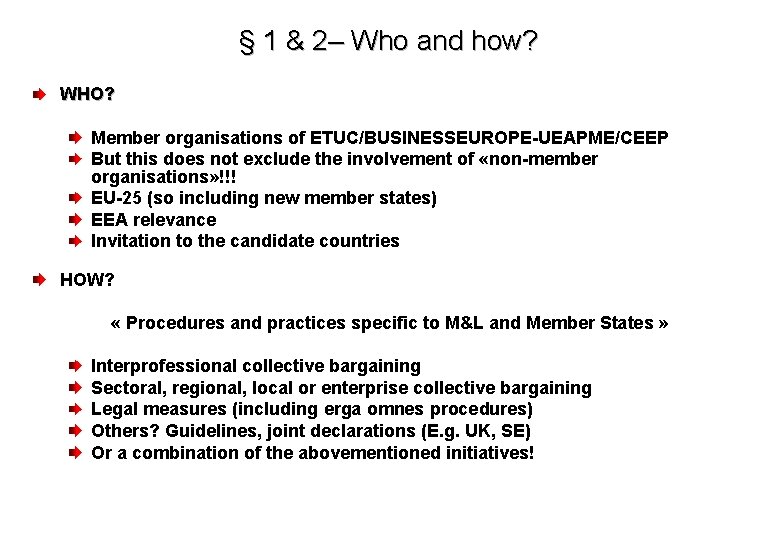
§ 1 & 2– Who and how? WHO? Member organisations of ETUC/BUSINESSEUROPE-UEAPME/CEEP But this does not exclude the involvement of «non-member organisations» !!! EU-25 (so including new member states) EEA relevance Invitation to the candidate countries HOW? « Procedures and practices specific to M&L and Member States » Interprofessional collective bargaining Sectoral, regional, local or enterprise collective bargaining Legal measures (including erga omnes procedures) Others? Guidelines, joint declarations (E. g. UK, SE) Or a combination of the abovementioned initiatives!
Member organisations will report on the implementation of this agreement to the Social Dialogue Committee. During the first three years after the date of signature of this agreement, the Social Dialogue Committee will prepare and adopt a yearly table summarising the on-going implementation of the agreement. A full report on the implementation actions taken will be prepared by the Social Dialogue Committee and adopted by the European social partners during the fourth year. The signatory parties shall evaluate and review the agreement any time after the five years following the date of signature, if requested by one of them.
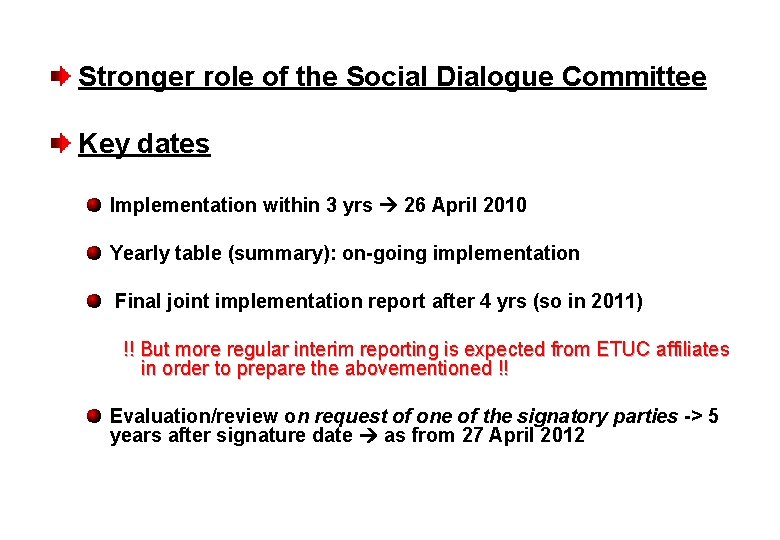
Stronger role of the Social Dialogue Committee Key dates Implementation within 3 yrs 26 April 2010 Yearly table (summary): on-going implementation Final joint implementation report after 4 yrs (so in 2011) !! But more regular interim reporting is expected from ETUC affiliates in order to prepare the abovementioned !! Evaluation/review on request of one of the signatory parties -> 5 years after signature date as from 27 April 2012
In case of questions on the content of this agreement, member organisations involved can jointly or separately refer to the signatory parties, who will jointly or separately reply.
Interpretation questions § § § Same as in telework / stress agreement Joint or separate reply possible ETUC tried (again) but was not able to get a reference in the text on the positive role national mediation, conciliation and arbitration processes can play in the implementation/interpretation process § There is the ETUC interpretation guide!
When implementing this agreement, the members of the signatory parties avoid unnecessary burdens on SMEs.
What about implementation in SME’s? § Adapted implementation for and in SME’s is allowed § BUT: this does not mean that FA should not be implemented for and in SME’s! § One but sufficient argument: “UEAPME is one of signatory parties”
Implementation of this agreement does not constitute valid grounds to reduce the general level of protection afforded to workers in the field of this agreement. This agreement does not prejudice the right of social partners to conclude, at the appropriate level, including European level, agreements adapting and/or complementing this agreement in a manner which will take note of the specific needs of the social partners concerned.
The agreement includes a non regression & an “adaptability” clause prevent any reduction in the general level of protection already given to workers on the matters being considered. -> At all levels (EU sectoral, national, sectoral, regional, local, enterprise, …) an adapted implementation is allowed but this does not mean that one can go beyond the basic principles, rights and obligations contained in this agreement!
Finally: The negotiations did not allow going further in relation to the question of disputes settlement as well as for the deletion of the clause relating to “unnecessary burdens on SMEs”. The employers did however take note of our concerns these matters will surely reappear during the discussions foreseen under the social partners' work programme 2006 -08 where, based on the implementation of the framework agreements (telework, stress at work), they will “further develop their common understanding of these instruments”.
AND REMEMBER ALSO: Directive 89/391/EEC measures to encourage improvements in the safety and health of workers at work Directive 2000/43/EC equal treatment … racial or ethnic origin Directive 2000/78/EC equal treatment in employment and occupation Directive 2002/73/EC equal treatment for men and women… access to employment, vocational training and promotion, and working conditions The preparatory documents to these directives The ECJ-case law on the Working Time Directive 93/104/EC The ECJ-case law in the Coleman case (C-306/06): “discrimination by association” See also the Annex 2 of the ETUC Interpretation Guide

Thank you for your attention !
- Slides: 41