Open Education Resource Work done as part of






- Slides: 200
Open Education Resource Work done as part of AICTE approved FDP on Use of ICT in Education for Online and Blended Learning Application of ICT in field of Basic Science FUELS Application of ICT in field of Basic Science • • Group ID. : 1208 Dr. Devendra Chouhan Dr. Swati Mehra Ms. Neetu Rawat IES IPS Academy, Rajendra Nagar, Indore (M. P. ) 452012 Application of ICT in field of Basic Science, 2017 1 IES-IPS ACADEMY, INDORE(M. P. )
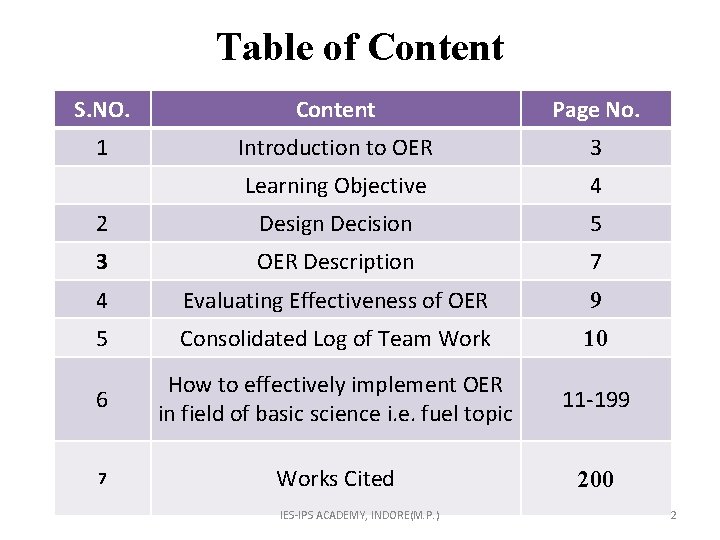
Table of Content S. NO. Content Page No. 1 Introduction to OER 3 Learning Objective 4 2 Design Decision 5 3 OER Description 7 4 Evaluating Effectiveness of OER 9 5 Consolidated Log of Team Work 10 6 How to effectively implement OER in field of basic science i. e. fuel topic 11 -199 7 Works Cited 200 IES-IPS ACADEMY, INDORE(M. P. ) 2
Introduction to OER • • • About the OER The open education resource is a collection of MOODLE Lesson activities that are useful as out-of-class activity while flipping the classroom. There are three lessons as part of this OER, and each deals with an aspect related to Concept Maps. Concept mapping is a technique that is useful across domains and can be a useful tool for: Knowledge Integration and Summary. OER is downloadable from: www. et. iitb. ac. in/~jkmadathil/et 4 et/oer. html (You may also provide your Wordpress page details if that is the webpage used for dissemination of the OER) Target Audience: First year Engineering Students (All Streams) This resource is licensed under CC-BY-SA ver 4. 0. You are free to use, distribute and modify it, including for commercial purposes, provided you acknowledge the source and share-alike. To see more details about the license visit http: //creativecommons. org/licenses/by-sa/4. 0/ Application of ICT in field of Basic Science, 2017 IES-IPS ACADEMY, INDORE(M. P. ) 3
Learning Objectives of OER Science is the foundation for all technician courses. The Basic aim of teaching science is to develop in the students the habit of scientific inquiry, ability to establish the cause and effect, relationship. Chemistry forms the part of applied science. The study of basic concepts of chemistry like fuels, chemical bonding, corrosion, water treatment, and different engineering materials like polymers, paints , lubricants, cement, Refractories etc. will help the students understanding engineering subjects where the emphasis is laid on the application of these concepts Chemistry is concerned with the changes in structure and properties of matter. Many of the process which are involved to bring out this changes forms the basis of engineering activities. Teaching of chemistry should be aimed at developing the right type of aptitude in the students and the ability to predict the result under given condition Thus good foundation in basic science will help the students in their self development, to cope up with continuous flow of innovations. IES-IPS ACADEMY, INDORE(M. P. ) 4
Design Decisions Nature of Decisions taken The design decisions involved in the creation of this OER were of broadly three types: 1. Content Decisions 2. Pedagogic Decisions 3. Technology Decisions 1. Content Decisions The content decisions related to: a. Earmarking specific segment to be covered – Decided on CMaps –What, Why and How? b. The research papers/publications and other materials to be provided 2. Pedagogic Decisions Typically in a flipped classroom strategy, there are two segments – Out-of-class segment and In-Class segment. The out-of-class segment requires student to refer to some given material (Video, Text etc) and form an understanding about the concepts that are relevant. In terms of concept marking the pedagogic decisions that were taken for the Out-of-class segment related to: IES-IPS ACADEMY, INDORE(M. P. ) 5
a. Cognitive Levels of Questions to be asked along with the resources – Mostly Recall to Apply level question for out of class and Create Level question for In-class b. Assessment Strategies – Multiple choice questions for out of class, Team. Pair-Solo strategy for in-class 3. Technology Decisions While developing the Out-of-Class and In-class activities, the major technology decisions taken were: a. Tool to be used You. Tube videos, as it had a time limit of 10 minutes. b. MOODLE Lesson Activity for setting up Out-of-Class segment as it allowed guided self-learning. IES-IPS ACADEMY, INDORE(M. P. ) 6
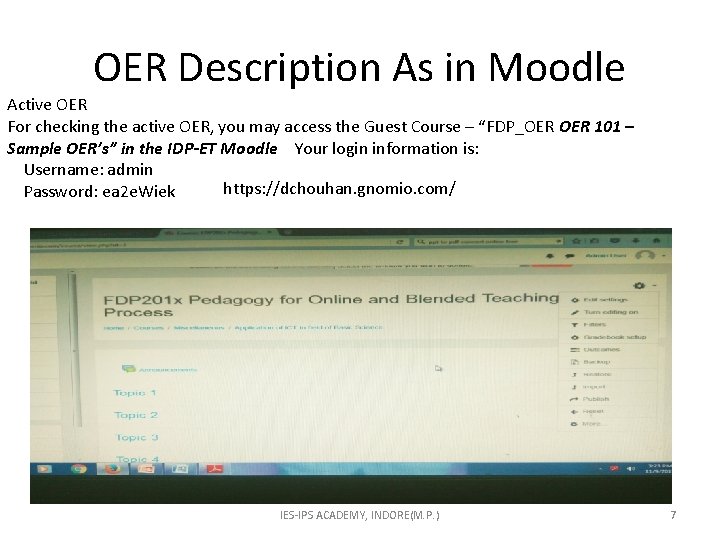
OER Description As in Moodle Active OER For checking the active OER, you may access the Guest Course – “FDP_OER 101 – Sample OER’s” in the IDP-ET Moodle Your login information is: Username: admin https: //dchouhan. gnomio. com/ Password: ea 2 e. Wiek IES-IPS ACADEMY, INDORE(M. P. ) 7
IES-IPS ACADEMY, INDORE(M. P. ) 8
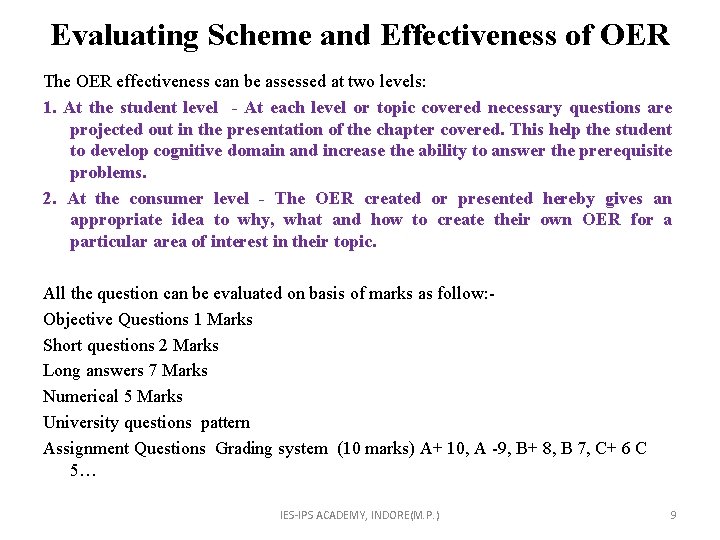
Evaluating Scheme and Effectiveness of OER The OER effectiveness can be assessed at two levels: 1. At the student level - At each level or topic covered necessary questions are projected out in the presentation of the chapter covered. This help the student to develop cognitive domain and increase the ability to answer the prerequisite problems. 2. At the consumer level - The OER created or presented hereby gives an appropriate idea to why, what and how to create their own OER for a particular area of interest in their topic. All the question can be evaluated on basis of marks as follow: Objective Questions 1 Marks Short questions 2 Marks Long answers 7 Marks Numerical 5 Marks University questions pattern Assignment Questions Grading system (10 marks) A+ 10, A -9, B+ 8, B 7, C+ 6 C 5… IES-IPS ACADEMY, INDORE(M. P. ) 9
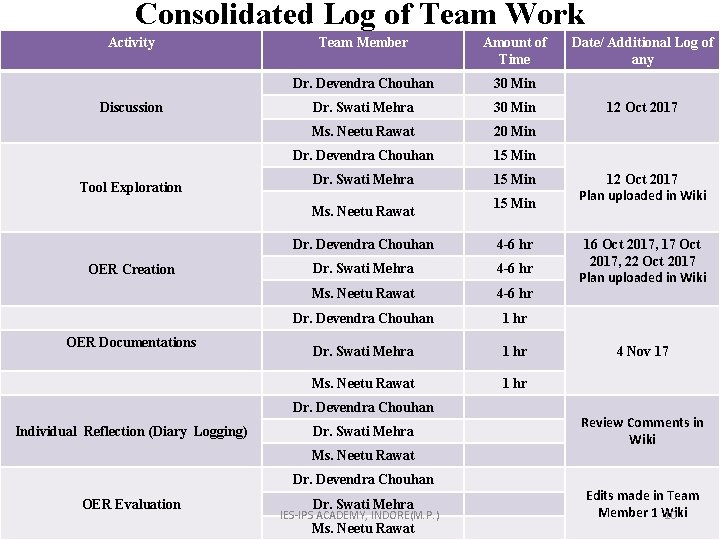
Consolidated Log of Team Work Activity Discussion Tool Exploration Team Member Amount of Time Dr. Devendra Chouhan 30 Min Dr. Swati Mehra 30 Min Ms. Neetu Rawat 20 Min Dr. Devendra Chouhan 15 Min Dr. Swati Mehra 15 Min Ms. Neetu Rawat OER Creation OER Documentations Dr. Devendra Chouhan 4 -6 hr Dr. Swati Mehra 4 -6 hr Ms. Neetu Rawat 4 -6 hr Dr. Devendra Chouhan 1 hr Dr. Swati Mehra 1 hr Ms. Neetu Rawat 1 hr Dr. Devendra Chouhan Individual Reflection (Diary Logging) Dr. Swati Mehra Ms. Neetu Rawat Dr. Devendra Chouhan OER Evaluation 15 Min Dr. Swati Mehra IES-IPS ACADEMY, INDORE(M. P. ) Ms. Neetu Rawat Date/ Additional Log of any 12 Oct 2017 Plan uploaded in Wiki 16 Oct 2017, 17 Oct 2017, 22 Oct 2017 Plan uploaded in Wiki 4 Nov 17 Review Comments in Wiki Edits made in Team Member 1 Wiki 10
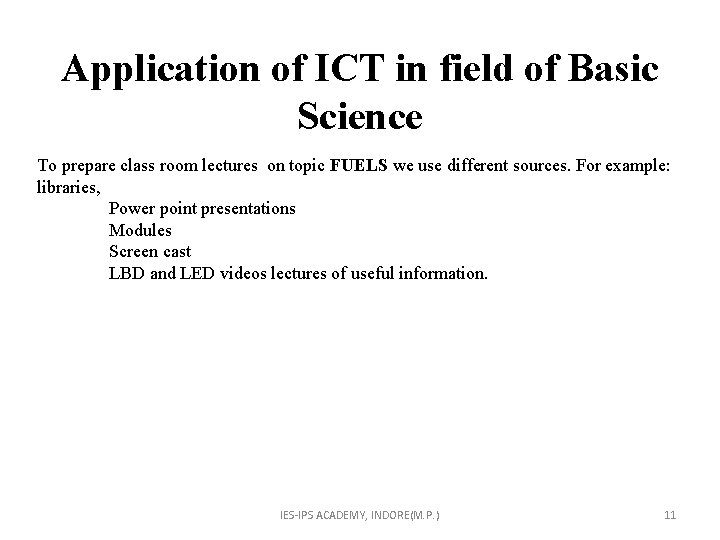
Application of ICT in field of Basic Science To prepare class room lectures on topic FUELS we use different sources. For example: libraries, Power point presentations Modules Screen cast LBD and LED videos lectures of useful information. IES-IPS ACADEMY, INDORE(M. P. ) 11
UNIT-2 : FUELS Introduction of Fuel Application of ICT in field of Basic Science, 2017 IES-IPS ACADEMY, INDORE(M. P. ) 12
UNIT-2 : FUELS Introduction of Fuel 1. Classification 2. Calorific Value IES-IPS ACADEMY, INDORE(M. P. ) 13
Topics To Be Covered Introduction of Fuel 1. Classification 2. Calorific Value BOOKS / PAGE NOS. B 2157 IES-IPS ACADEMY, INDORE(M. P. ) 14
Summary of previous lecture Alkalinity - Definition Break Point Chlorination Specification of water IES-IPS ACADEMY, INDORE(M. P. ) 15
Fuel Any combustible substance which during combustion gives large amount of heat which can be used economically for domestic and industrial purposes. • Fuel + O 2 Products + Heat (more heat) IES-IPS ACADEMY, INDORE(M. P. ) 16
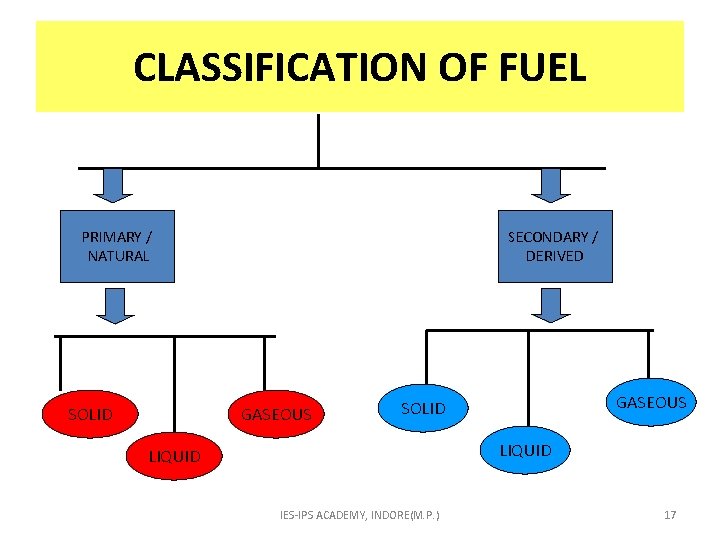
CLASSIFICATION OF FUEL PRIMARY / SECONDARY / DERIVED NATURAL SOLID GASEOUS SOLID LIQUID IES-IPS ACADEMY, INDORE(M. P. ) 17
CALORIFIC VALUE Calorific value of a fuel is defined as “the total quantity of heat liberated from the combustion of a unit mass of the fuel in air or oxygen. ” • Calorie, Kilo Calorie, B. Th. U. , C. H. U. IES-IPS ACADEMY, INDORE(M. P. ) 18
Definition of H. C. V. It is total amount of heat liberated when a unit mass or unit volume of fuel has been burnt completely and the products are cooled to room temperature. IES-IPS ACADEMY, INDORE(M. P. ) 19
Definition of L. C. V. “The net heat produced, when a unit mass or unit volume of the fuel is burnt completely and the combustion products are allowed to escape. ” IES-IPS ACADEMY, INDORE(M. P. ) 20
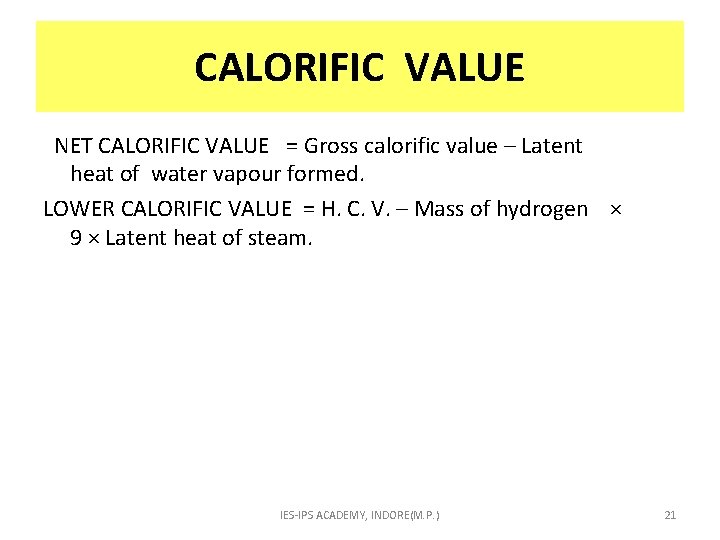
CALORIFIC VALUE NET CALORIFIC VALUE = Gross calorific value – Latent heat of water vapour formed. LOWER CALORIFIC VALUE = H. C. V. – Mass of hydrogen × 9 × Latent heat of steam. IES-IPS ACADEMY, INDORE(M. P. ) 21
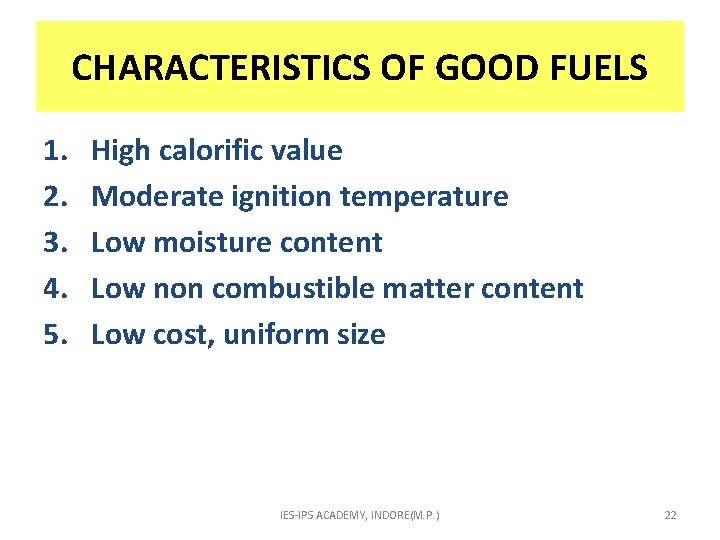
CHARACTERISTICS OF GOOD FUELS 1. 2. 3. 4. 5. High calorific value Moderate ignition temperature Low moisture content Low non combustible matter content Low cost, uniform size IES-IPS ACADEMY, INDORE(M. P. ) 22
Summary of the lecture 1. Classification 2. Calorific Value IES-IPS ACADEMY, INDORE(M. P. ) 23
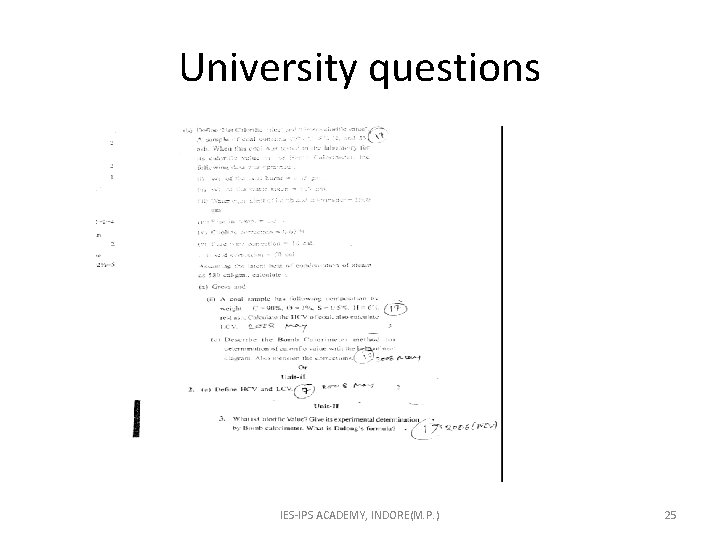
Assignment Questions • DEFINE H. C. V AND L. C. V. • Give Characteristics Of Good Fuel IES-IPS ACADEMY, INDORE(M. P. ) 24
University questions IES-IPS ACADEMY, INDORE(M. P. ) 25
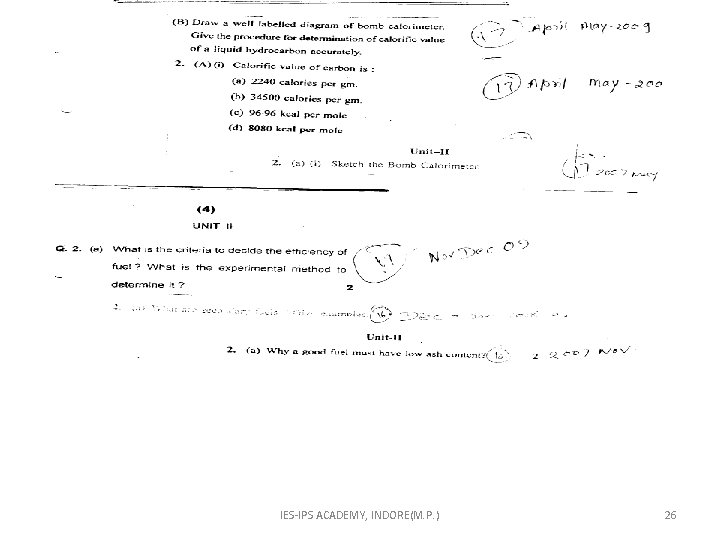
IES-IPS ACADEMY, INDORE(M. P. ) 26
Objective Questions • What is fuel? • What is calorific value and its unit? IES-IPS ACADEMY, INDORE(M. P. ) 27
Next Day Topic • Bomb Calorimeter • Numericals IES-IPS ACADEMY, INDORE(M. P. ) 28
Bomb Calorimeter & NUMERICALS IES-IPS ACADEMY, INDORE(M. P. ) 29
Topics To Be Covered Bomb Calorimeter Numericals BOOKS / PAGE NOS. B 1, 58 -59 IES-IPS ACADEMY, INDORE(M. P. ) 30
Summary of previous lecture • Introduction of Fuel • Definition of H. C. V&L. C. V. • Characteristics of good fuel IES-IPS ACADEMY, INDORE(M. P. ) 31
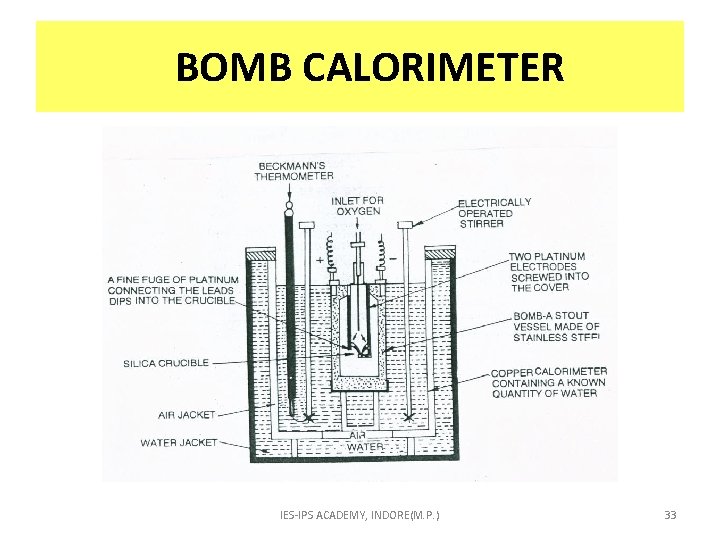
BOMB CALORIMETER • A known quantity of fuel is burnt and the quantity of heat produced is absorbed in water. Video playing time 11: 23 mins, The movie clip starts at playing time 1: 11 mins IES-IPS ACADEMY, INDORE(M. P. ) 32
BOMB CALORIMETER IES-IPS ACADEMY, INDORE(M. P. ) 33
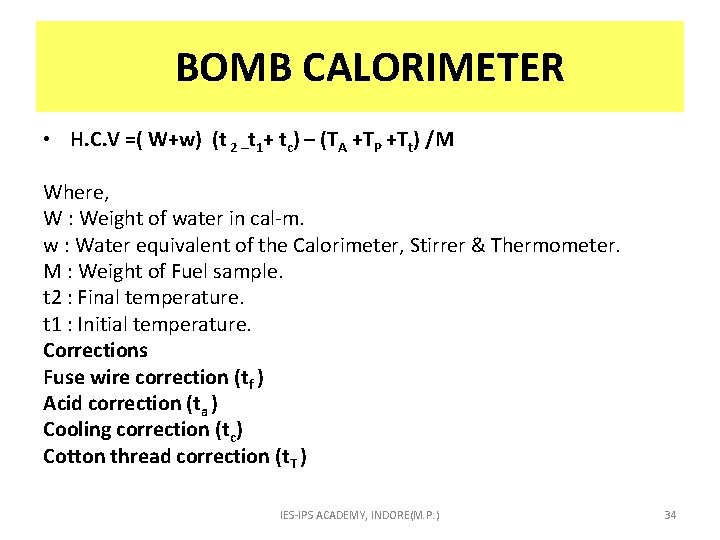
BOMB CALORIMETER • H. C. V =( W+w) (t 2 –t 1+ tc) – (TA +TP +Tt) /M Where, W : Weight of water in cal-m. w : Water equivalent of the Calorimeter, Stirrer & Thermometer. M : Weight of Fuel sample. t 2 : Final temperature. t 1 : Initial temperature. Corrections Fuse wire correction (tf ) Acid correction (ta ) Cooling correction (tc) Cotton thread correction (t. T ) IES-IPS ACADEMY, INDORE(M. P. ) 34
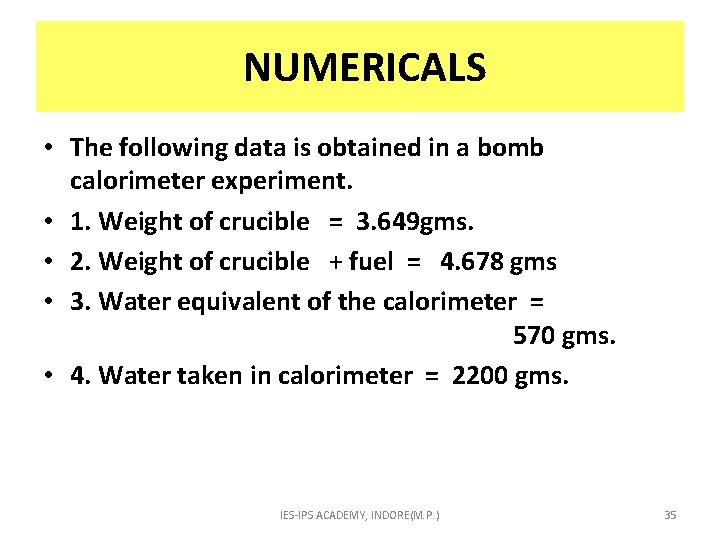
NUMERICALS • The following data is obtained in a bomb calorimeter experiment. • 1. Weight of crucible = 3. 649 gms. • 2. Weight of crucible + fuel = 4. 678 gms • 3. Water equivalent of the calorimeter = 570 gms. • 4. Water taken in calorimeter = 2200 gms. IES-IPS ACADEMY, INDORE(M. P. ) 35
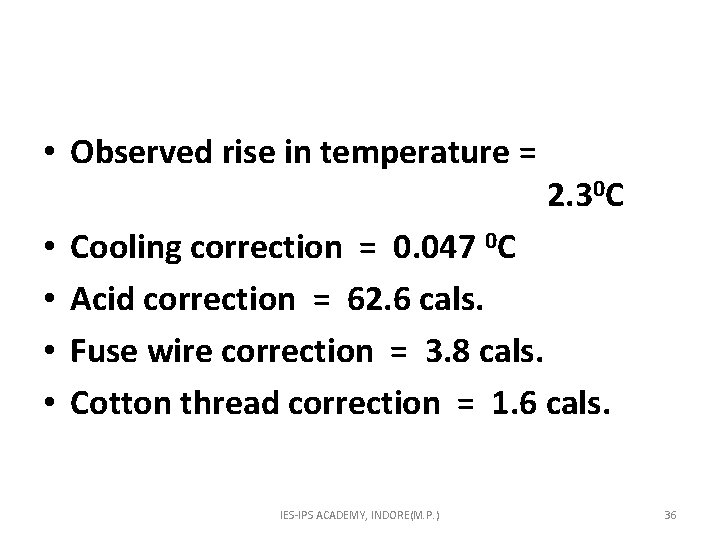
• Observed rise in temperature = 2. 30 C • Cooling correction = 0. 047 0 C • Acid correction = 62. 6 cals. • Fuse wire correction = 3. 8 cals. • Cotton thread correction = 1. 6 cals. IES-IPS ACADEMY, INDORE(M. P. ) 36
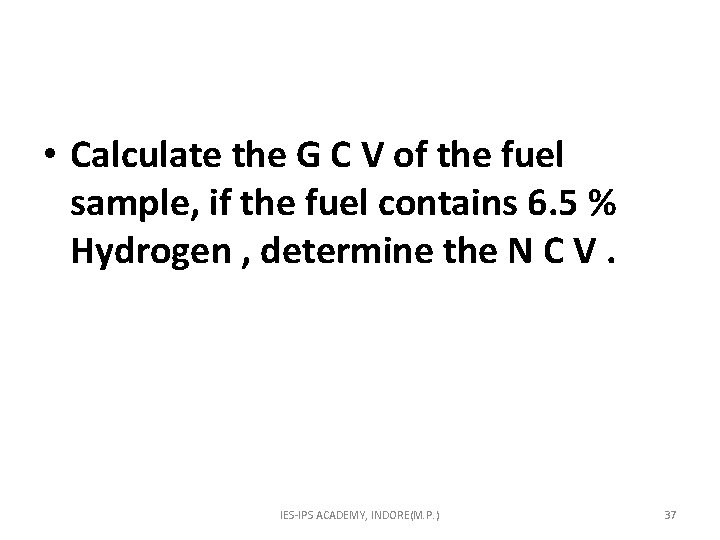
• Calculate the G C V of the fuel sample, if the fuel contains 6. 5 % Hydrogen , determine the N C V. IES-IPS ACADEMY, INDORE(M. P. ) 37
Assignment Questions Q 1. What are the corrections in Bomb calorimeter? Q 2. Draw a well labelled diagram of Bomb calorimeter. IES-IPS ACADEMY, INDORE(M. P. ) 38
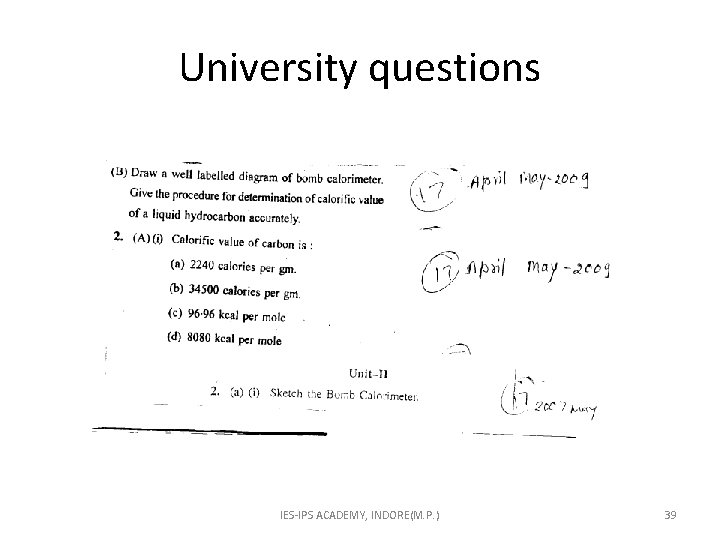
University questions IES-IPS ACADEMY, INDORE(M. P. ) 39
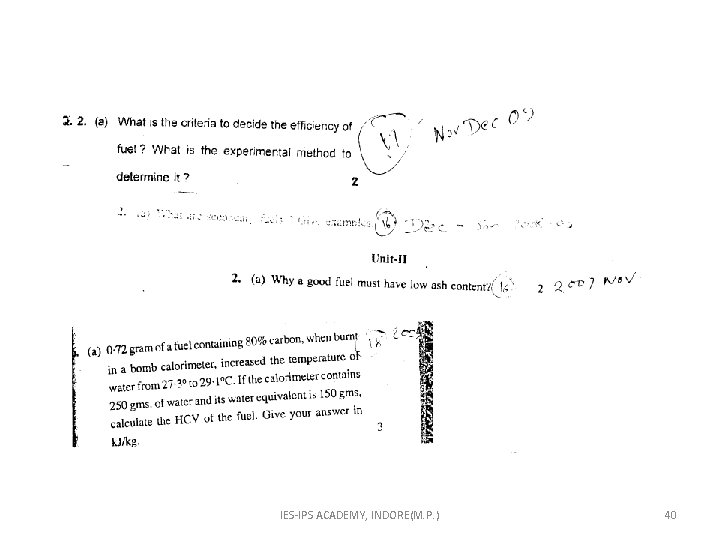
IES-IPS ACADEMY, INDORE(M. P. ) 40
Objective Questions • Give name of corrections used in bomb calorimeter? IES-IPS ACADEMY, INDORE(M. P. ) 41
Next Day Topic Combustion Principle Numerical IES-IPS ACADEMY, INDORE(M. P. ) 42
Combustion Principle Numerical IES-IPS ACADEMY, INDORE(M. P. ) 43
Topics To Be Covered Combustion Principle Numerical BOOKS / PAGE NOS. B 1, 95/B 2, 159 IES-IPS ACADEMY, INDORE(M. P. ) 44
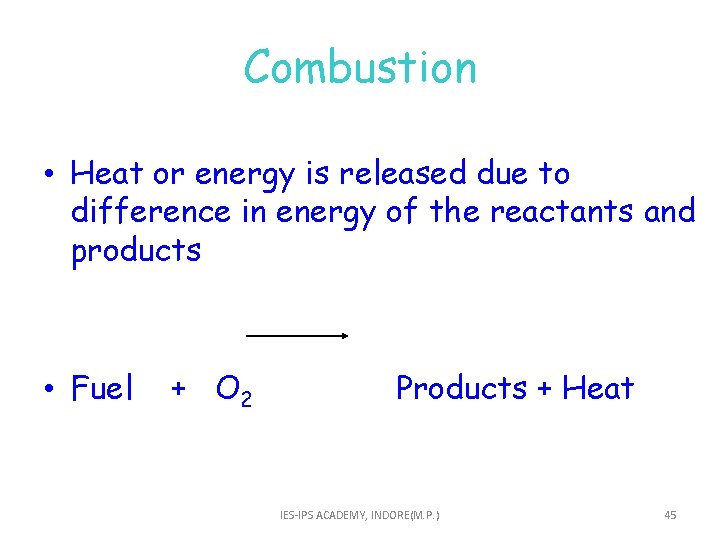
Combustion • Heat or energy is released due to difference in energy of the reactants and products • Fuel + O 2 Products + Heat IES-IPS ACADEMY, INDORE(M. P. ) 45
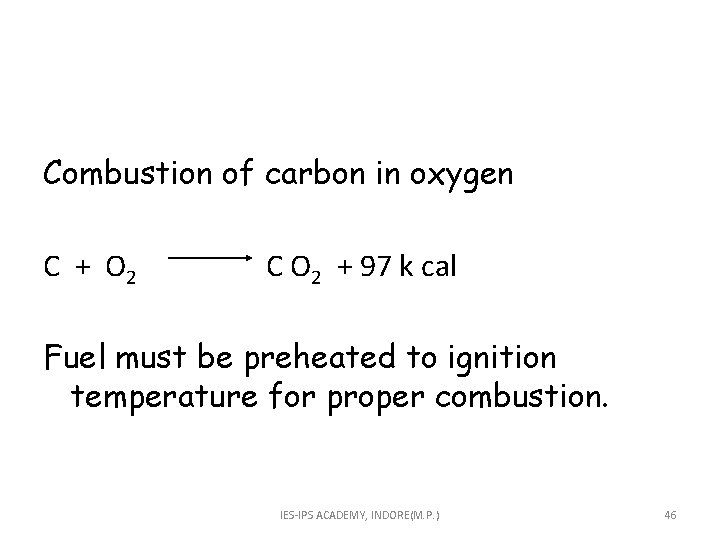
Combustion of carbon in oxygen C + O 2 C O 2 + 97 k cal Fuel must be preheated to ignition temperature for proper combustion. IES-IPS ACADEMY, INDORE(M. P. ) 46
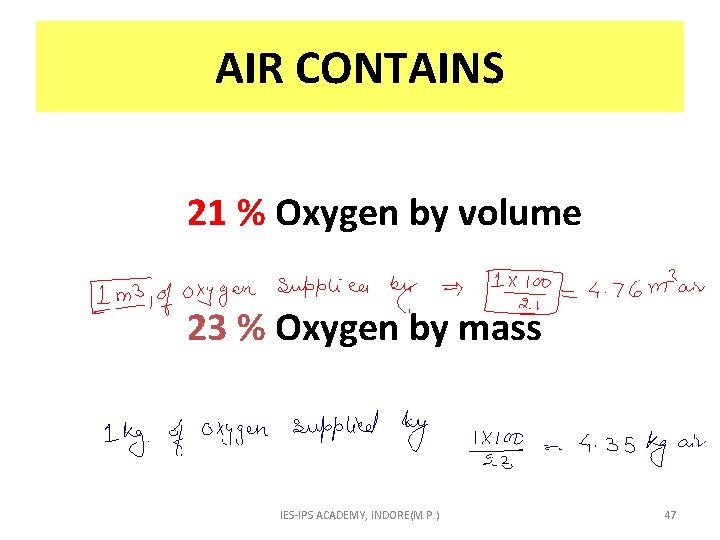
AIR CONTAINS 21 % Oxygen by volume 23 % Oxygen by mass IES-IPS ACADEMY, INDORE(M. P. ) 47
Oxygen Required For Combustion Theoretical oxygen Oxygen present required in the fuel IES-IPS ACADEMY, INDORE(M. P. ) 48
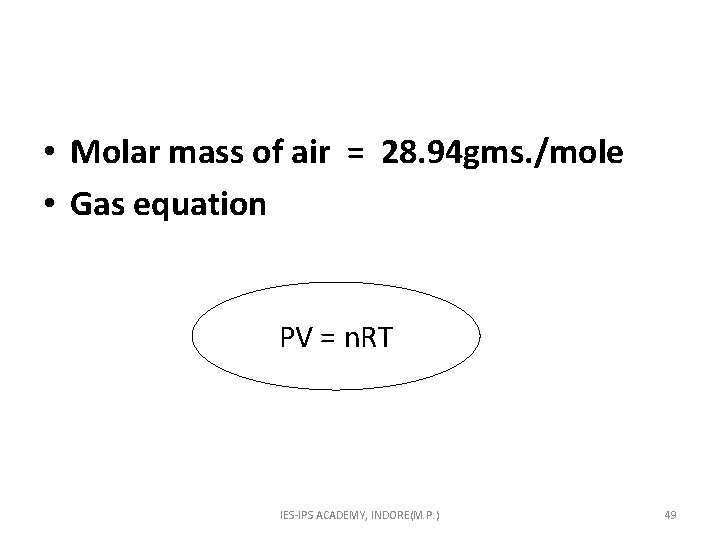
• Molar mass of air = 28. 94 gms. /mole • Gas equation PV = n. RT IES-IPS ACADEMY, INDORE(M. P. ) 49
Summary of previous lecture • Principle of combustion • Numerical IES-IPS ACADEMY, INDORE(M. P. ) 50
Assignment Questions • Write the principle of combustion ? IES-IPS ACADEMY, INDORE(M. P. ) 51
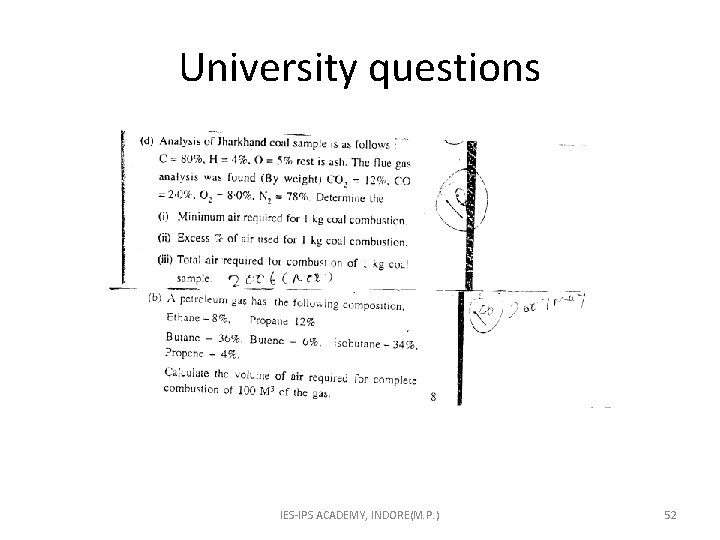
University questions IES-IPS ACADEMY, INDORE(M. P. ) 52
IES-IPS ACADEMY, INDORE(M. P. ) 53
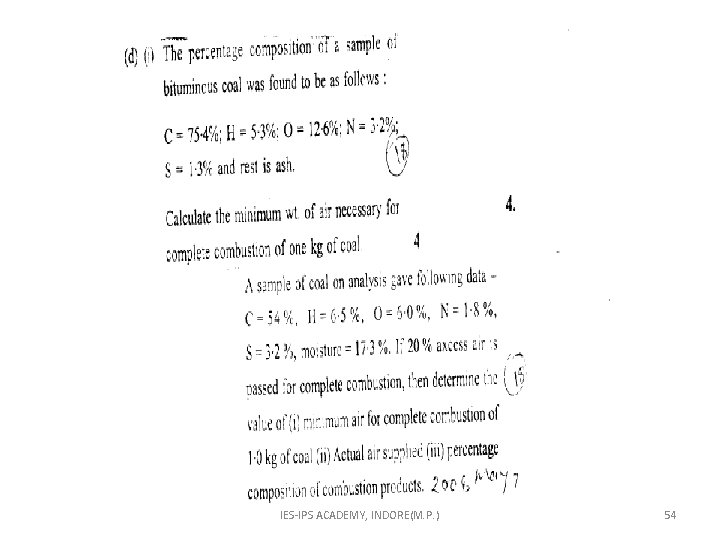
IES-IPS ACADEMY, INDORE(M. P. ) 54
Objective Questions • What is the percentage of oxygen in air by mass? • What is percentage of nitrogen ? how we calculate it ? IES-IPS ACADEMY, INDORE(M. P. ) 55
Next Day Topic Analysis of Coal Proximate Ultimate IES-IPS ACADEMY, INDORE(M. P. ) 56
Analysis of Coal Proximate Ultimate IES-IPS ACADEMY, INDORE(M. P. ) 57
Topics To Be Covered Analysis of Coal PROXIMATE &NUMERICALS ULTIMATE &NUMERICALS BOOKS / PAGE NOS. B 2, 73 IES-IPS ACADEMY, INDORE(M. P. ) 58
Summary of previous lecture Principle of combustion Numerical IES-IPS ACADEMY, INDORE(M. P. ) 59
Proximate Analysis It is not a true analysis. The results obtained from proximate analysis may vary with the procedure adopted. It gives valuable information about the practical utility of coal. This includes the determination of – • moisture, • volatile matter, • ash , • fixed carbon. IES-IPS ACADEMY, INDORE(M. P. ) 60
Analysis of moisture Moisture may present as surface or adsorbed moisture in a coal. IES-IPS ACADEMY, INDORE(M. P. ) 61
Moisture content • High % of moisture is not good – • It takes some of the liberated heat in the form of latent heat of evaporation. • It increases the cost of coal. • it increases the transportation charges. • It quenches the fire. • It lowers the calorific value of fuel. IES-IPS ACADEMY, INDORE(M. P. ) 62
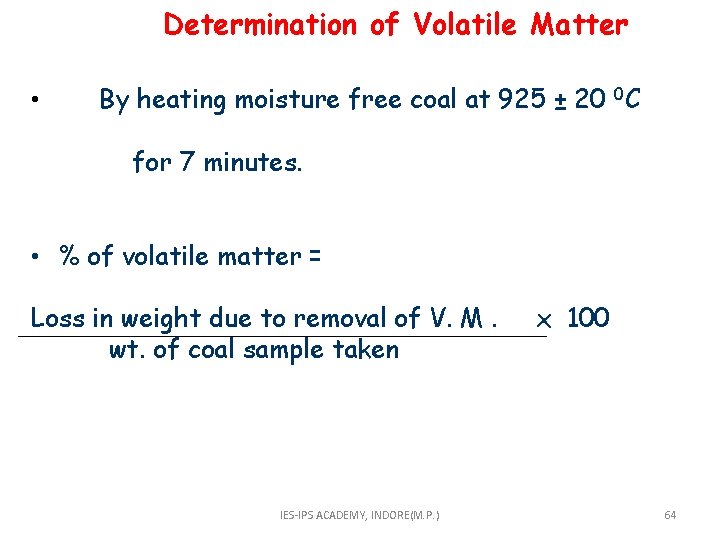
VOLATILE MATTER – The volatile matters may be combustible or noncombustible gases. – High proportion of fuel distill over as gas or vapours. Volatile matter also affects the furnace volumes. – – Coal having higher volatile matter burns with (1)long flame, (2)high smoke and (3)low calorific value. – volatile matter has special significance in coal gas plant and carbonization plants. IES-IPS ACADEMY, INDORE(M. P. ) 63
Determination of Volatile Matter • By heating moisture free coal at 925 ± 20 0 C for 7 minutes. • % of volatile matter = Loss in weight due to removal of V. M. wt. of coal sample taken IES-IPS ACADEMY, INDORE(M. P. ) x 100 64
Ash • When all combustible substances have been burnt only ash is left in coal. It is undesirable because. • • It disturbs the flow of air and heat. It increases cost of storage. It reduces calorific value of fuel. Clinkers causes obstruction to air supply. IES-IPS ACADEMY, INDORE(M. P. ) 65
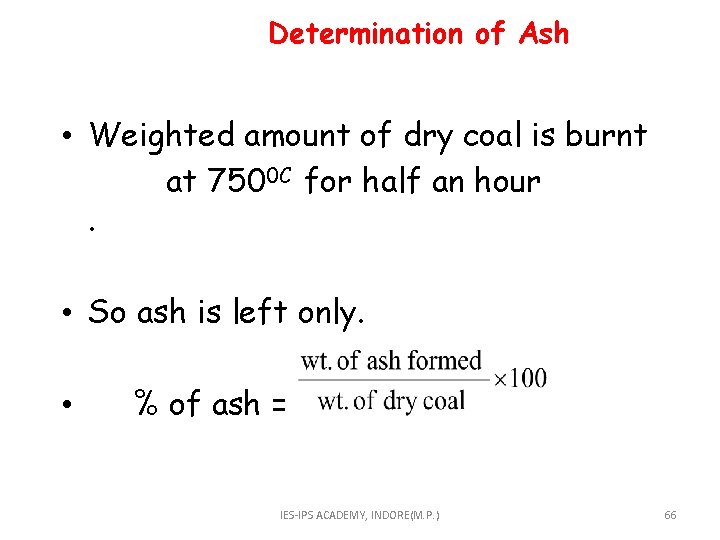
Determination of Ash • Weighted amount of dry coal is burnt at 7500 C for half an hour. • So ash is left only. • % of ash = IES-IPS ACADEMY, INDORE(M. P. ) 66
Fixed carbon • After determination of moisture, volatile matter, and ash the remaining part is fixed carbon. • Higher the % of fixed carbon greater the calorific value. IES-IPS ACADEMY, INDORE(M. P. ) 67
Ultimate Analysis • It is useful for combustion calculation. the % of C , H, N, S, ash and O are determined. IES-IPS ACADEMY, INDORE(M. P. ) 68
Determination of C & H • About 1 – 2 gm of coal sample is burnt in a current of dry oxygen. • C and H are oxidised in to CO 2 and H 2 O. • They passed through two bulbs. IES-IPS ACADEMY, INDORE(M. P. ) 69
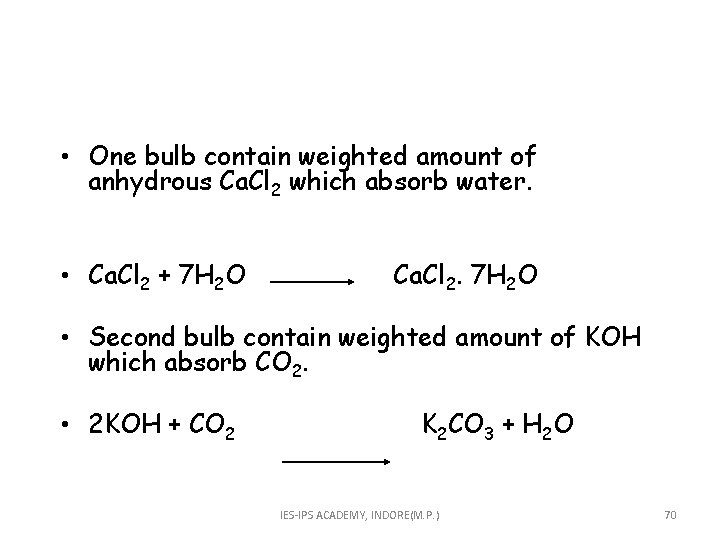
• One bulb contain weighted amount of anhydrous Ca. Cl 2 which absorb water. • Ca. Cl 2 + 7 H 2 O Ca. Cl 2. 7 H 2 O • Second bulb contain weighted amount of KOH which absorb CO 2. • 2 KOH + CO 2 K 2 CO 3 + H 2 O IES-IPS ACADEMY, INDORE(M. P. ) 70
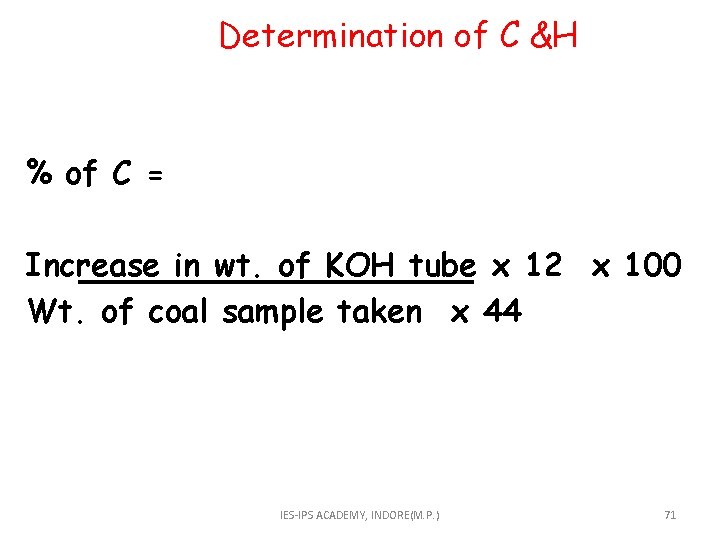
Determination of C &H % of C = Increase in wt. of KOH tube x 12 x 100 Wt. of coal sample taken x 44 IES-IPS ACADEMY, INDORE(M. P. ) 71
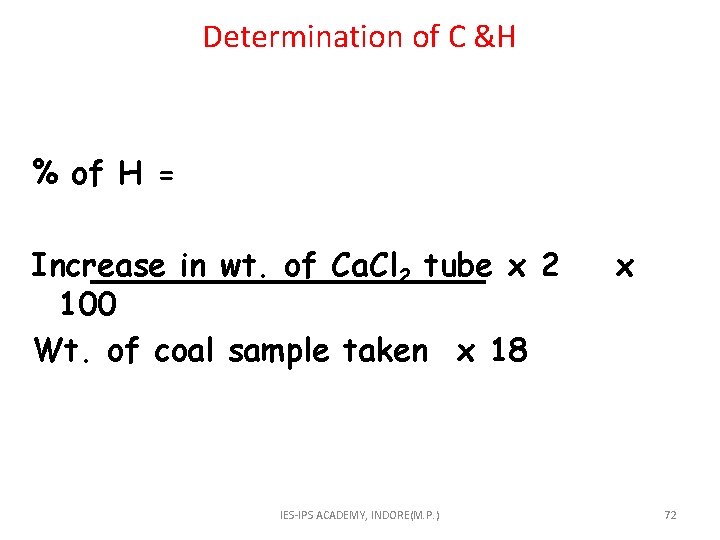
Determination of C &H % of H = Increase in wt. of Ca. Cl 2 tube x 2 100 Wt. of coal sample taken x 18 IES-IPS ACADEMY, INDORE(M. P. ) x 72
Carbon and Hydrogen Significance • Carbon % is the basis of classification of coal. • Greater the % of C and H, better is the coal and calorific value will be higher. • Hydrogen is mostly associated with volatile matter and moisture hence it effects the calorific value of coal. IES-IPS ACADEMY, INDORE(M. P. ) 73
Determination of nitrogen IES-IPS ACADEMY, INDORE(M. P. ) 74
By kjeldahl method • 1 gm of powdered coal sample is heated with conc H 2 SO 4, K 2 SO 4. , Cu. SO 4 in a long necked flask. • When clear solution is obtained it is treated with Na. OH. • Ammonia is released. • It is collected over H 2 SO 4. IES-IPS ACADEMY, INDORE(M. P. ) 75
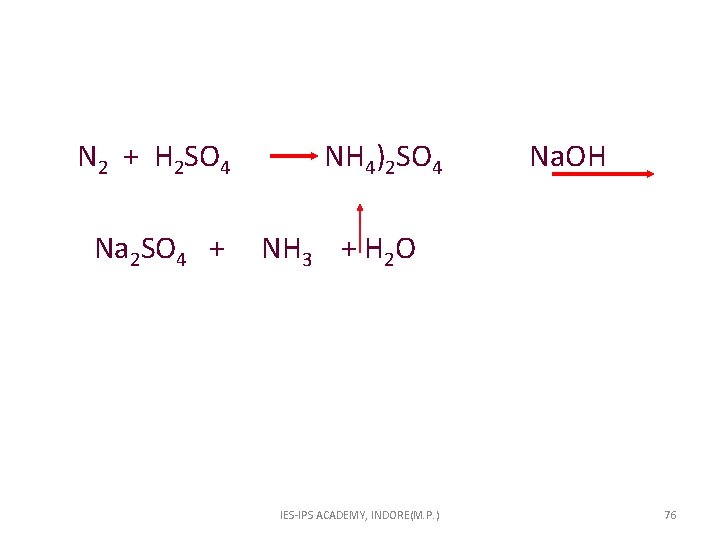
N 2 + H 2 SO 4 NH 4)2 SO 4 Na. OH Na 2 SO 4 + NH 3 + H 2 O IES-IPS ACADEMY, INDORE(M. P. ) 76
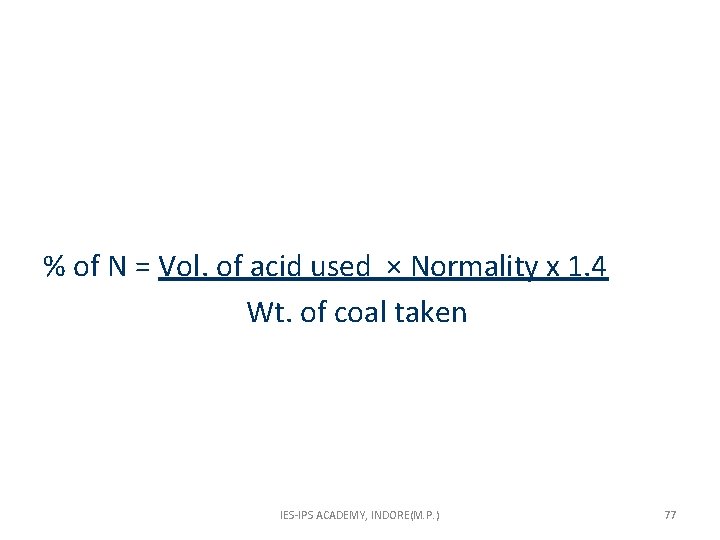
% of N = Vol. of acid used × Normality x 1. 4 Wt. of coal taken IES-IPS ACADEMY, INDORE(M. P. ) 77
• Determination of sulphur IES-IPS ACADEMY, INDORE(M. P. ) 78
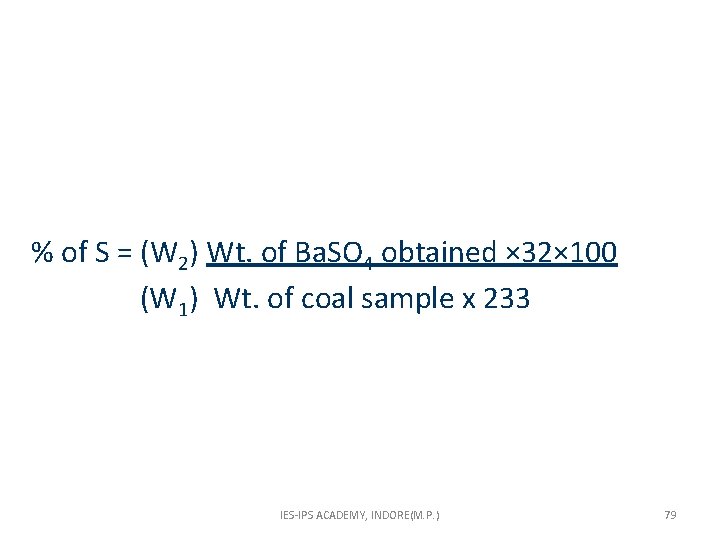
% of S = (W 2) Wt. of Ba. SO 4 obtained × 32× 100 (W 1) Wt. of coal sample x 233 IES-IPS ACADEMY, INDORE(M. P. ) 79
• Determination of ash IES-IPS ACADEMY, INDORE(M. P. ) 80
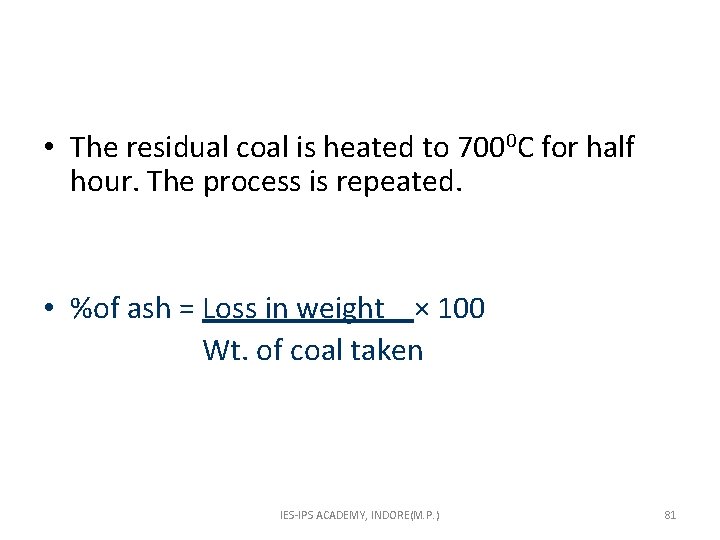
• The residual coal is heated to 7000 C for half hour. The process is repeated. • %of ash = Loss in weight × 100 Wt. of coal taken IES-IPS ACADEMY, INDORE(M. P. ) 81
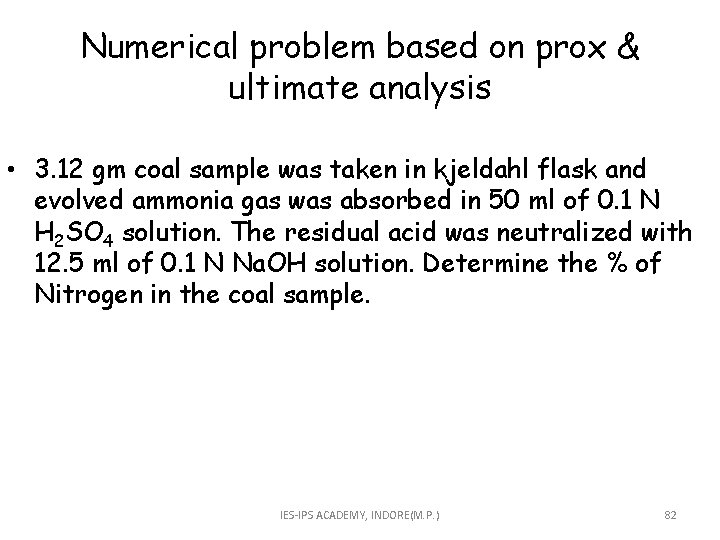
Numerical problem based on prox & ultimate analysis • 3. 12 gm coal sample was taken in kjeldahl flask and evolved ammonia gas was absorbed in 50 ml of 0. 1 N H 2 SO 4 solution. The residual acid was neutralized with 12. 5 ml of 0. 1 N Na. OH solution. Determine the % of Nitrogen in the coal sample. IES-IPS ACADEMY, INDORE(M. P. ) 82
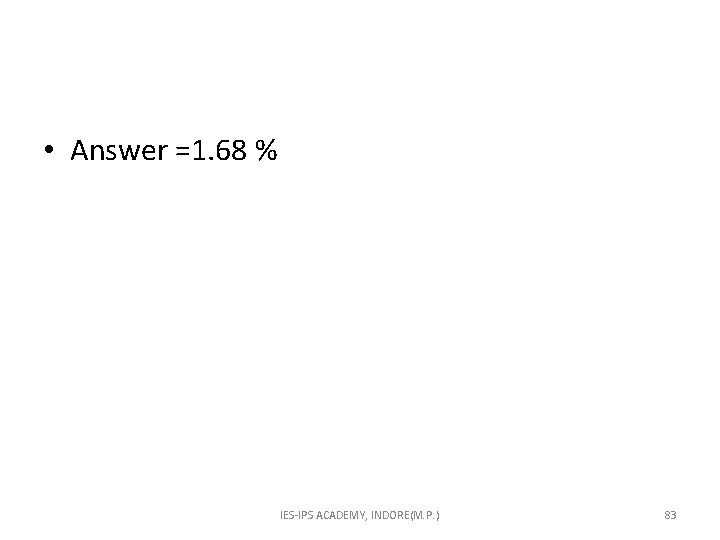
• Answer =1. 68 % IES-IPS ACADEMY, INDORE(M. P. ) 83
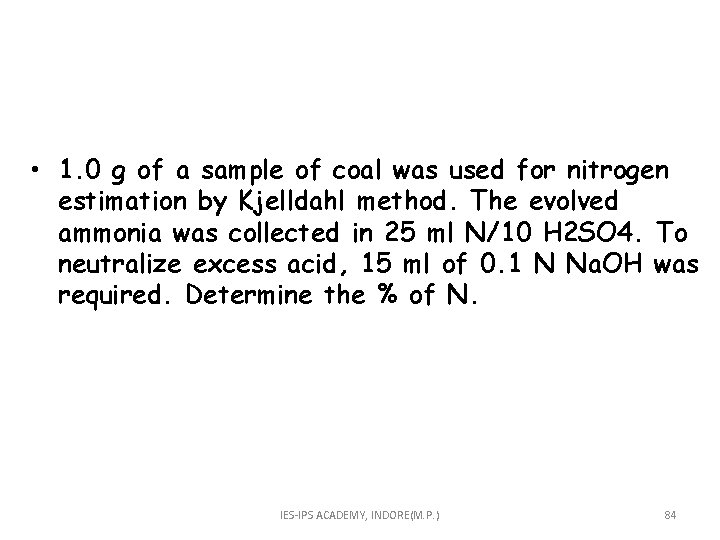
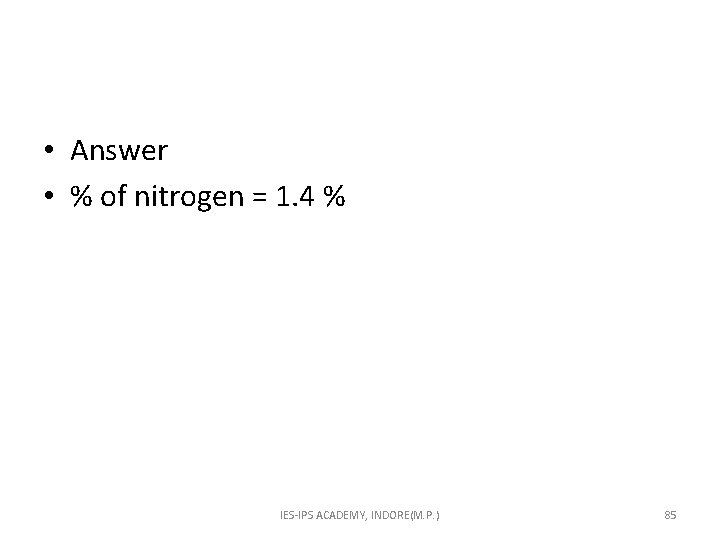
• 1. 0 g of a sample of coal was used for nitrogen estimation by Kjelldahl method. The evolved ammonia was collected in 25 ml N/10 H 2 SO 4. To neutralize excess acid, 15 ml of 0. 1 N Na. OH was required. Determine the % of N. IES-IPS ACADEMY, INDORE(M. P. ) 84
• Answer • % of nitrogen = 1. 4 % IES-IPS ACADEMY, INDORE(M. P. ) 85
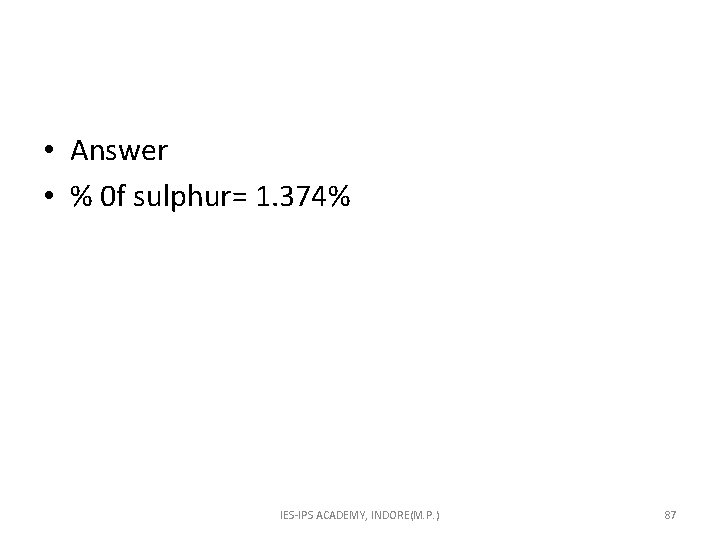
• 0. 1 gm of a coal sample was used in a bomb calorimeter for the determination of calorific value. The ash formed in the calorimeter is extracted with acid and the acid extract was heated with Ba. Cl 2 solution and a precipitate of barium Ba. SO 4 was obtained. The weight of ppt was to be 0. 01 gm. Calculate the % of S in coal sample. IES-IPS ACADEMY, INDORE(M. P. ) 86
• Answer • % 0 f sulphur= 1. 374% IES-IPS ACADEMY, INDORE(M. P. ) 87
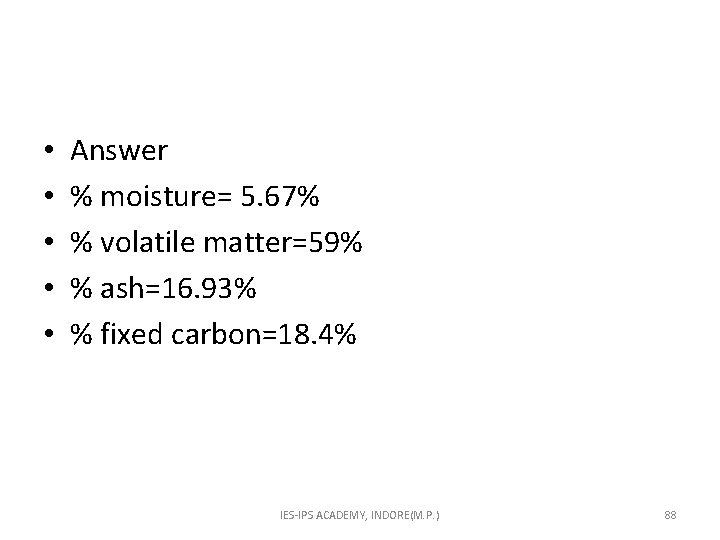
• • • Answer % moisture= 5. 67% % volatile matter=59% % ash=16. 93% % fixed carbon=18. 4% IES-IPS ACADEMY, INDORE(M. P. ) 88
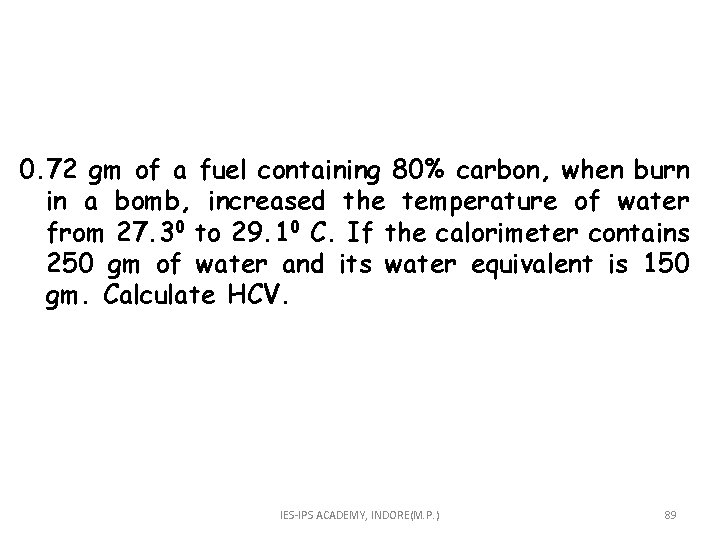
0. 72 gm of a fuel containing 80% carbon, when burn in a bomb, increased the temperature of water from 27. 30 to 29. 10 C. If the calorimeter contains 250 gm of water and its water equivalent is 150 gm. Calculate HCV. IES-IPS ACADEMY, INDORE(M. P. ) 89
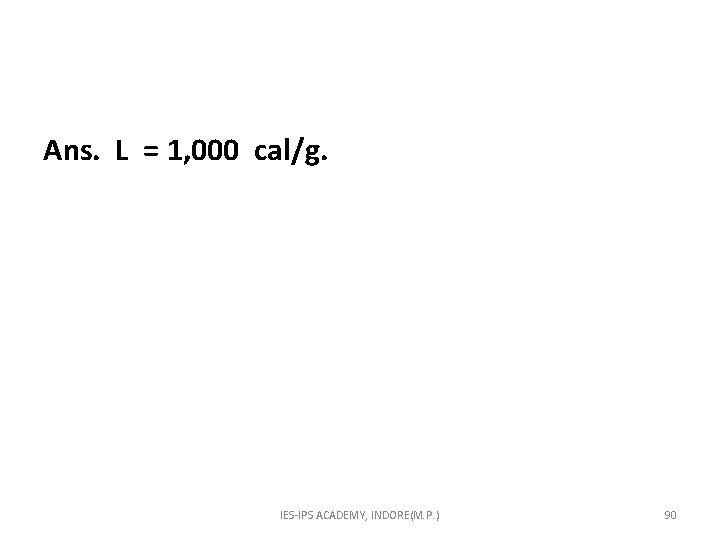
Ans. L = 1, 000 cal/g. IES-IPS ACADEMY, INDORE(M. P. ) 90
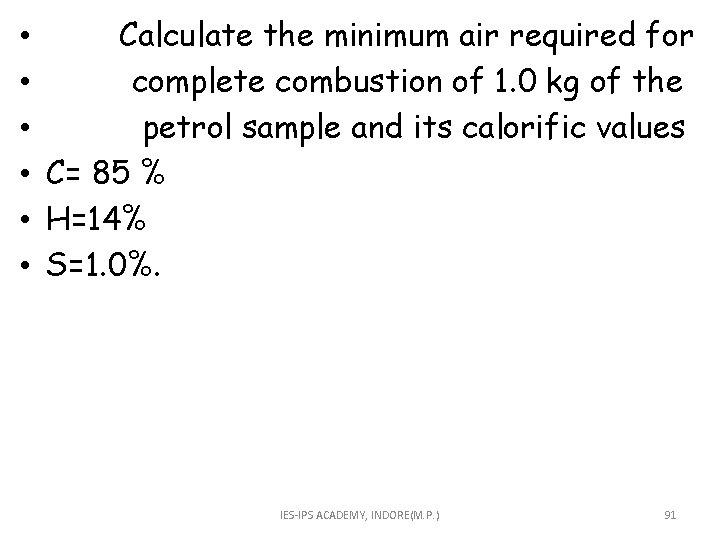
• • • Calculate the minimum air required for complete combustion of 1. 0 kg of the petrol sample and its calorific values C= 85 % H=14% S=1. 0%. IES-IPS ACADEMY, INDORE(M. P. ) 91
Summary of the lecture Analysis of Coal Proximate Ultimate IES-IPS ACADEMY, INDORE(M. P. ) 92
Assignment Questions • Write proximate analysis in detail? • Determine nitrogen in a given coal sample? IES-IPS ACADEMY, INDORE(M. P. ) 93
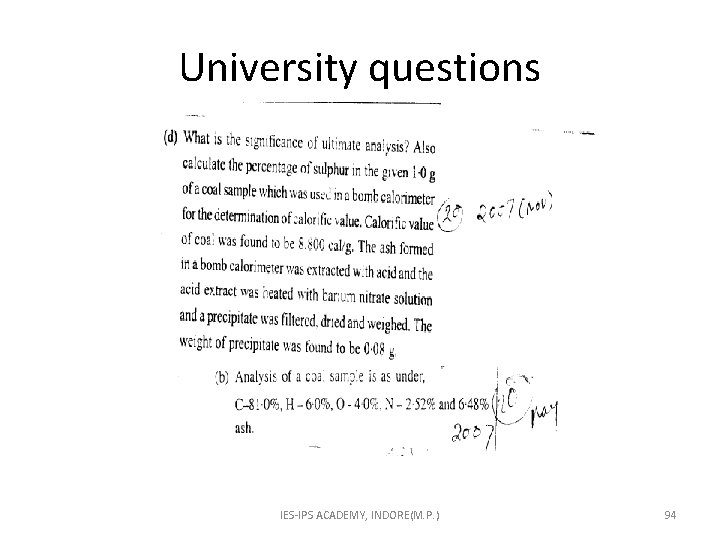
University questions IES-IPS ACADEMY, INDORE(M. P. ) 94
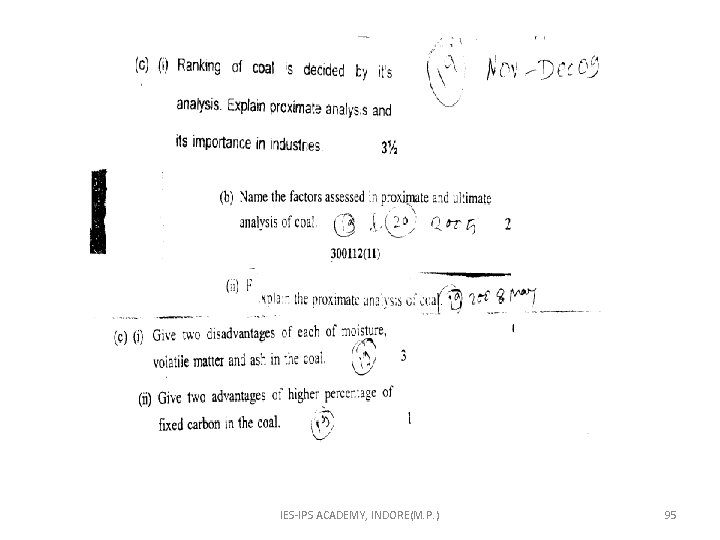
IES-IPS ACADEMY, INDORE(M. P. ) 95
Objective Questions • Coal is analyzed by which method ? • Ash analysis comes under which analysis type? • What are the methods used to determine sulphur? IES-IPS ACADEMY, INDORE(M. P. ) 96
Next Day Topic Carbonization 1. Types 2. Manufacturing Process IES-IPS ACADEMY, INDORE(M. P. ) 97
Carbonization Types: 1. Low Temperature 2. High Temperature . Manufacturing Process Otto Hoffmann: 1. Diagram 2. Recovery IES-IPS ACADEMY, INDORE(M. P. ) 98
Topics To Be Covered Carbonization Types: 1. Low Temperature 2. High Temperature . Manufacturing Process Otto Hoffmann: 1. Diagram 2. Recovery BOOKS / PAGE NOS. B 1, 69, 70, 71, 72 IES-IPS ACADEMY, INDORE(M. P. ) 99
Summary of previous lecture Analysis of Coal Proximate Ultimate IES-IPS ACADEMY, INDORE(M. P. ) 100
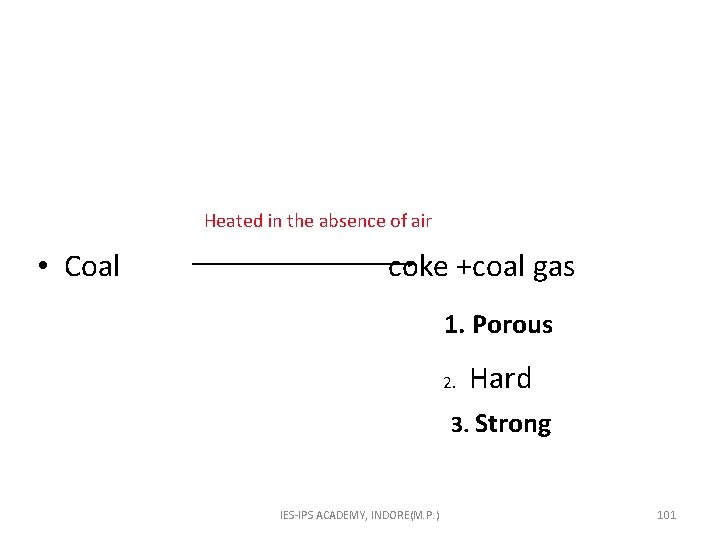
Heated in the absence of air • Coal coke +coal gas 1. Porous 2. Hard 3. Strong IES-IPS ACADEMY, INDORE(M. P. ) 101
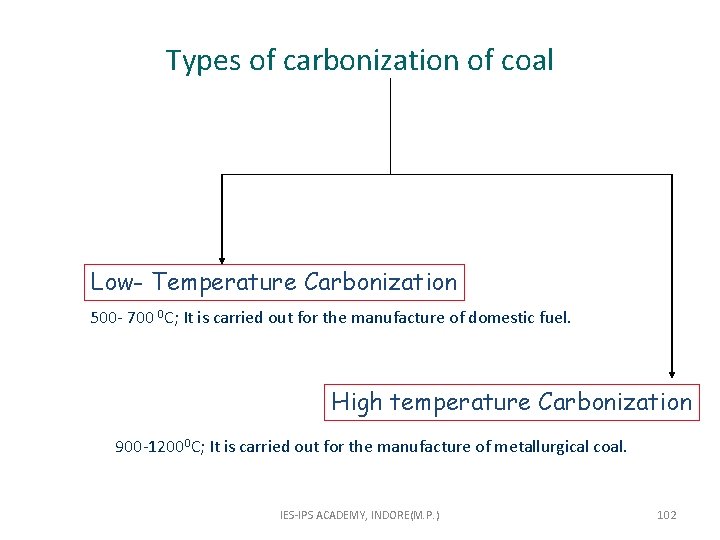
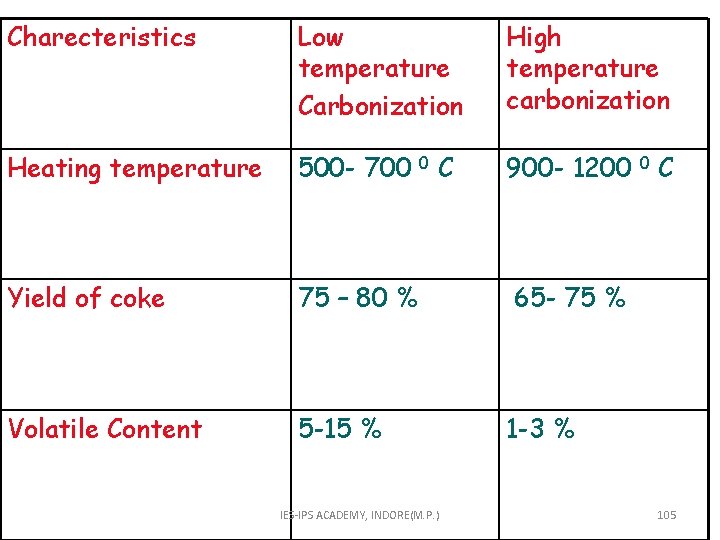
Types of carbonization of coal Low- Temperature Carbonization 500 - 700 0 C; It is carried out for the manufacture of domestic fuel. High temperature Carbonization 900 -12000 C; It is carried out for the manufacture of metallurgical coal. IES-IPS ACADEMY, INDORE(M. P. ) 102
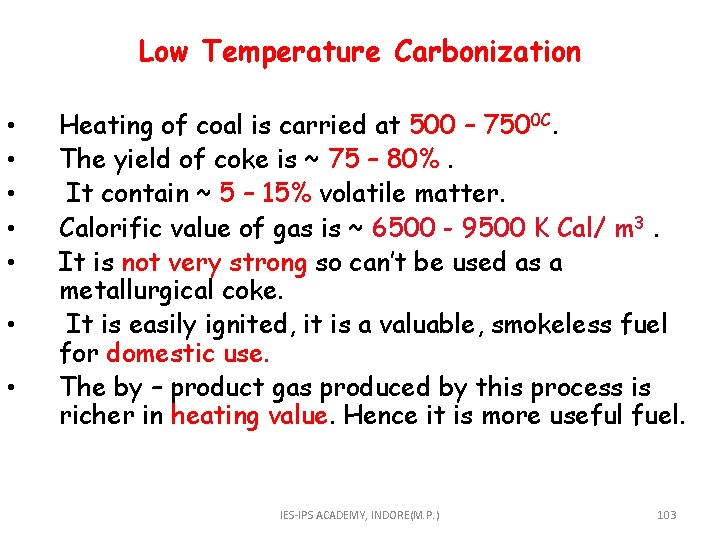
Low Temperature Carbonization • • Heating of coal is carried at 500 – 7500 C. The yield of coke is ~ 75 – 80%. It contain ~ 5 – 15% volatile matter. Calorific value of gas is ~ 6500 - 9500 K Cal/ m 3. It is not very strong so can’t be used as a metallurgical coke. It is easily ignited, it is a valuable, smokeless fuel for domestic use. The by – product gas produced by this process is richer in heating value. Hence it is more useful fuel. IES-IPS ACADEMY, INDORE(M. P. ) 103
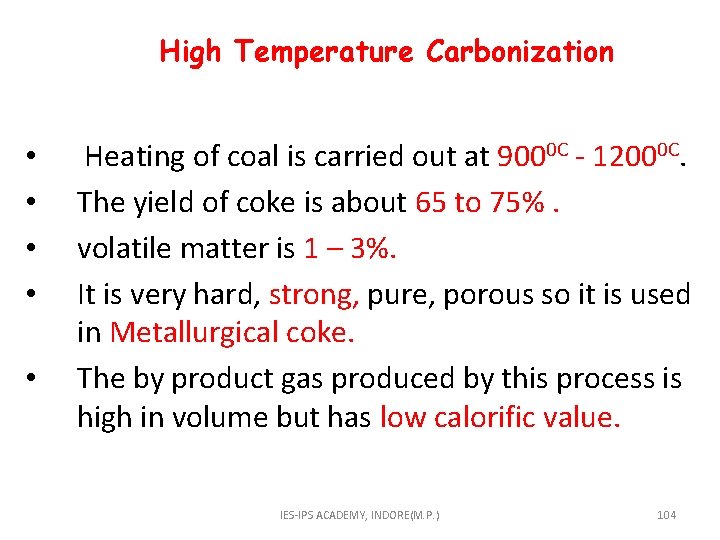
High Temperature Carbonization • • • Heating of coal is carried out at 9000 C - 12000 C. The yield of coke is about 65 to 75%. volatile matter is 1 – 3%. It is very hard, strong, pure, porous so it is used in Metallurgical coke. The by product gas produced by this process is high in volume but has low calorific value. IES-IPS ACADEMY, INDORE(M. P. ) 104
Charecteristics Low temperature Carbonization High temperature carbonization Heating temperature 500 - 700 900 - 1200 Yield of coke 75 – 80 % 65 - 75 % Volatile Content 5 -15 % 1 -3 % 0 C IES-IPS ACADEMY, INDORE(M. P. ) 0 C 105
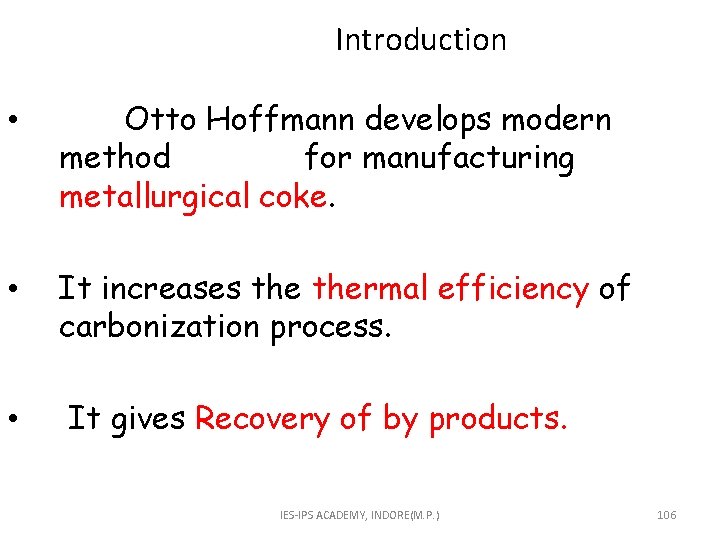
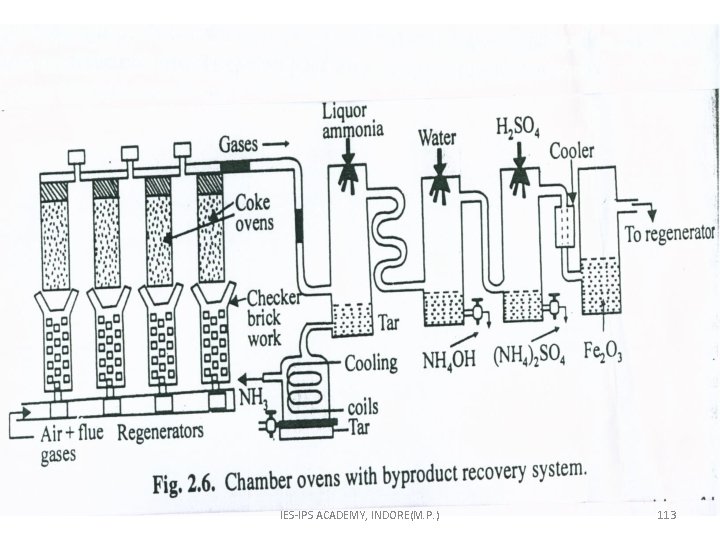
Introduction • Otto Hoffmann develops modern method for manufacturing metallurgical coke. • It increases thermal efficiency of carbonization process. • It gives Recovery of by products. IES-IPS ACADEMY, INDORE(M. P. ) 106
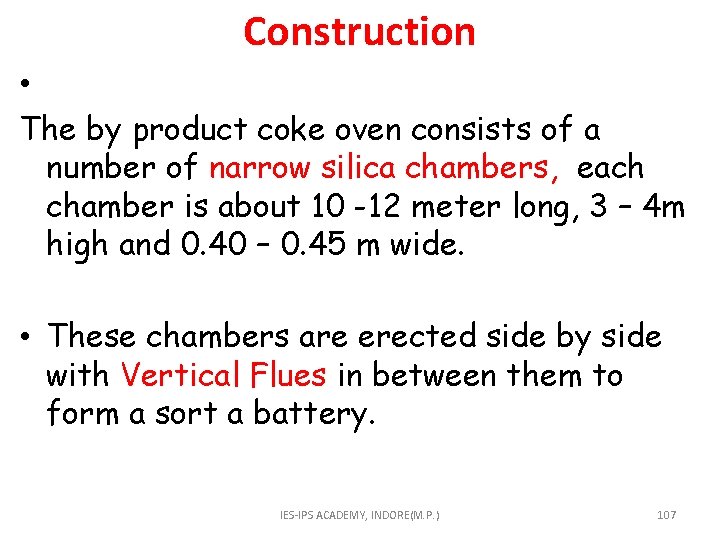
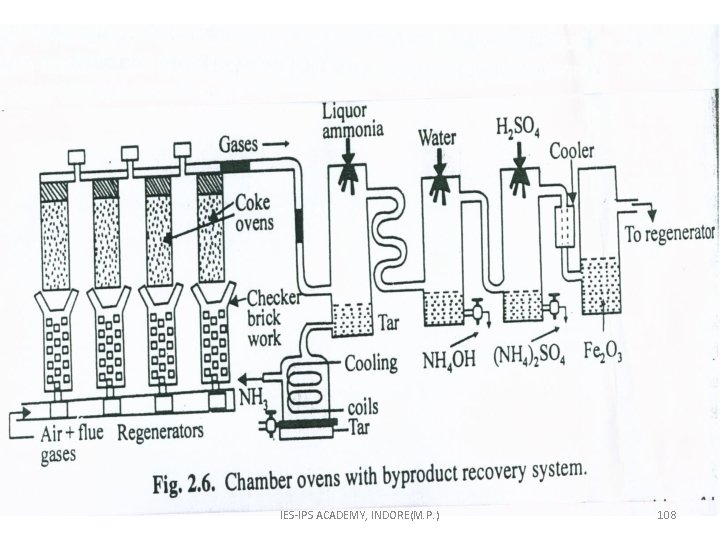
Construction • The by product coke oven consists of a number of narrow silica chambers, each chamber is about 10 -12 meter long, 3 – 4 m high and 0. 40 – 0. 45 m wide. • These chambers are erected side by side with Vertical Flues in between them to form a sort a battery. IES-IPS ACADEMY, INDORE(M. P. ) 107
IES-IPS ACADEMY, INDORE(M. P. ) 108
• Each chamber has Charging Hole at the top for charging the coal , a gas take off for the removal of volatile matter and a cast iron door at each end for discharging coke. • Heating is done on the basis of Regenerative System of heat economy, so utilizing the waste flue gases for heating the checker work of bricks. IES-IPS ACADEMY, INDORE(M. P. ) 109
Theory • Coking process is carried out in narrow ovens, which are heated from both sides because coal is poor conductor of heat. • The coals adjacent to oven walls get heated first and the plastic zone formed in the case of caking coals moves away from the walls towards the central zone. IES-IPS ACADEMY, INDORE(M. P. ) 110
• The plastic zone though mobile is such a bad conductor of heat that while the inner zones are getting heated, the semi – coke at the outer zones would have been converted into coke. IES-IPS ACADEMY, INDORE(M. P. ) 111
• The coking process also involves Contraction in volume. • Contraction at lower temp corresponds to the loss of volatile matter in the form of gas and tar while at higher temp corresponds to the solidification of the plastic mass of coal. • In this process dehydrogenation leading to aromatization in the coal structure. IES-IPS ACADEMY, INDORE(M. P. ) 112
IES-IPS ACADEMY, INDORE(M. P. ) 113
Working • Finely crushed coal is introduced through the charging holes at the top of chamber and cut the supply of air. • The ovens are heated to 12000 C by burning gaseous fuel. (producer gas). • Each oven is separated from another oven by a vertical flue in which the fuel gas burns. IES-IPS ACADEMY, INDORE(M. P. ) 114
• These ovens work on the Regenerative principle of heat economy. • The flue gases produced during combustion, before escaping to chimney, pass on their heat to one or two sets of checker brick, until this brick has been raised to temp. about 10000 C. IES-IPS ACADEMY, INDORE(M. P. ) 115
• Heating is continued, until all the volatile matter has escaped. • It takes about 11 – 18 hrs for carbonization of a charge of coal. IES-IPS ACADEMY, INDORE(M. P. ) 116
Quenching • After the completion of carbonization, the discharging doors are removed by a pusher machine crane and the red hot coke is pushed out into a coke car. • The coke carries it to quenching station where cool water is sprayed on it. IES-IPS ACADEMY, INDORE(M. P. ) 117
• In place of wet quenching, ‘dry quenching’ is more advantageous. o Because the coke produced is more strong, dense and non reactive. • Coke is cheaper, dried and contains lesser dust then ‘wet quenching’. IES-IPS ACADEMY, INDORE(M. P. ) 118
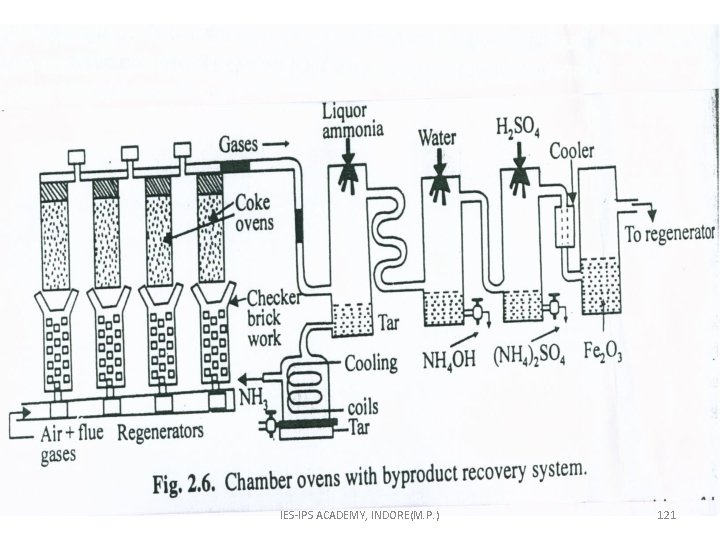
Recovery of By Products • The gas coming out from the oven is known as ‘Coke Oven Gas’. • this coal gas is impure and contains • NH 3, H 2 S, C 6 H 6, Tar, Naphthalene etc. IES-IPS ACADEMY, INDORE(M. P. ) 119
Recovery of Tar • The gas passed through a tower in which liquid ammonia is sprayed. • Here dust and tar get collected in a tank below, which is heated by steam coils to recover back ammonia. • The ammonia is used again. IES-IPS ACADEMY, INDORE(M. P. ) 120
IES-IPS ACADEMY, INDORE(M. P. ) 121
Recovery of Ammonia • The gas from the chamber is then passed a tower in which water is sprayed. Here ammonia goes into solution as NH 4 OH. IES-IPS ACADEMY, INDORE(M. P. ) 122
Recovery of Naphthalene • The gas then passed through another tower in which water is sprayed at low temp. When naphthalene gets condensed. IES-IPS ACADEMY, INDORE(M. P. ) 123
Recovery of Benzene • The gas is then sprayed with petroleum when benzene and its homologous can be recovered. IES-IPS ACADEMY, INDORE(M. P. ) 124
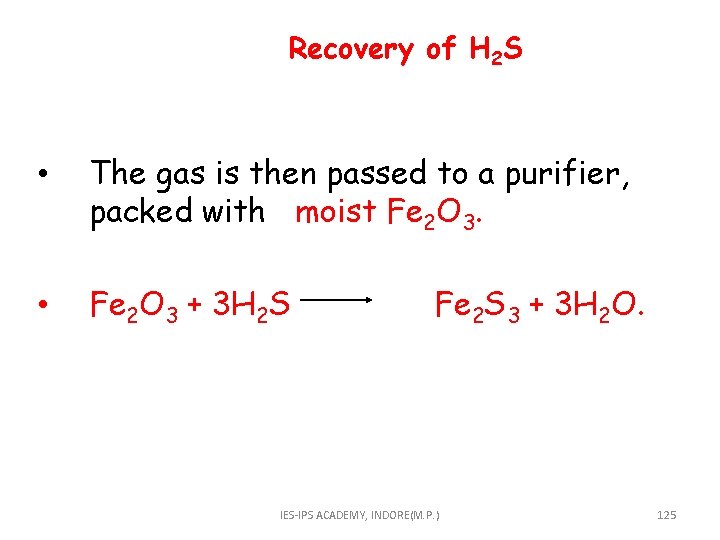
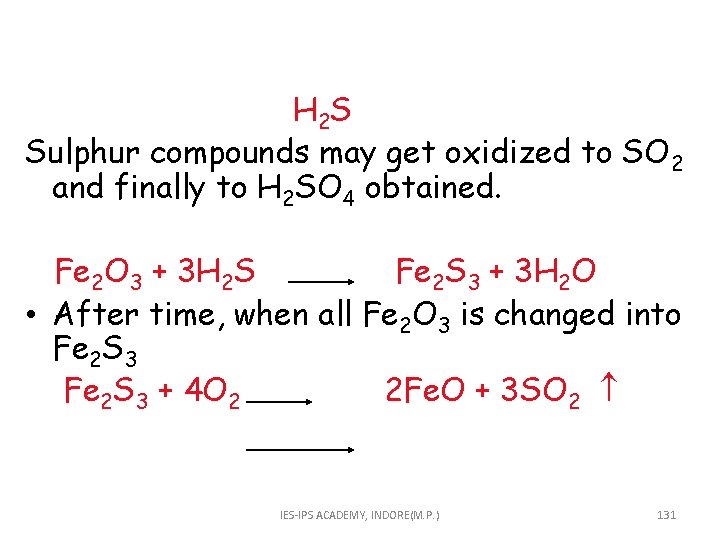
Recovery of H 2 S • The gas is then passed to a purifier, packed with moist Fe 2 O 3. • Fe 2 O 3 + 3 H 2 S Fe 2 S 3 + 3 H 2 O. IES-IPS ACADEMY, INDORE(M. P. ) 125
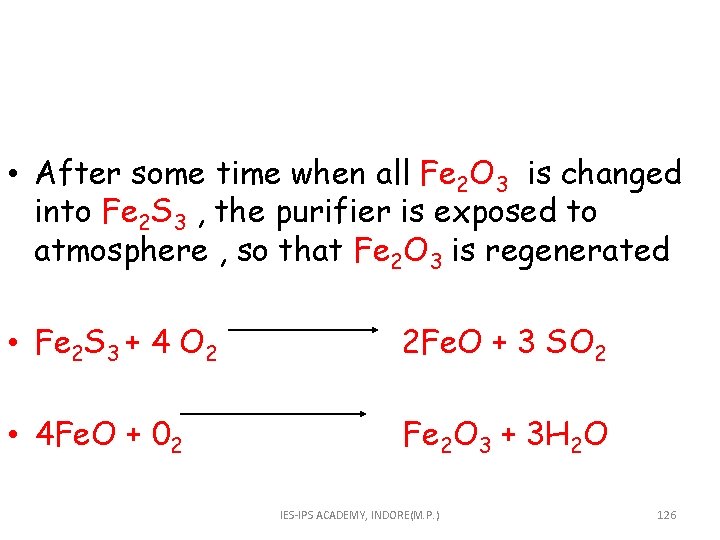
• After some time when all Fe 2 O 3 is changed into Fe 2 S 3 , the purifier is exposed to atmosphere , so that Fe 2 O 3 is regenerated • Fe 2 S 3 + 4 O 2 2 Fe. O + 3 SO 2 • 4 Fe. O + 02 Fe 2 O 3 + 3 H 2 O IES-IPS ACADEMY, INDORE(M. P. ) 126
Significance of recovery of by products IES-IPS ACADEMY, INDORE(M. P. ) 127
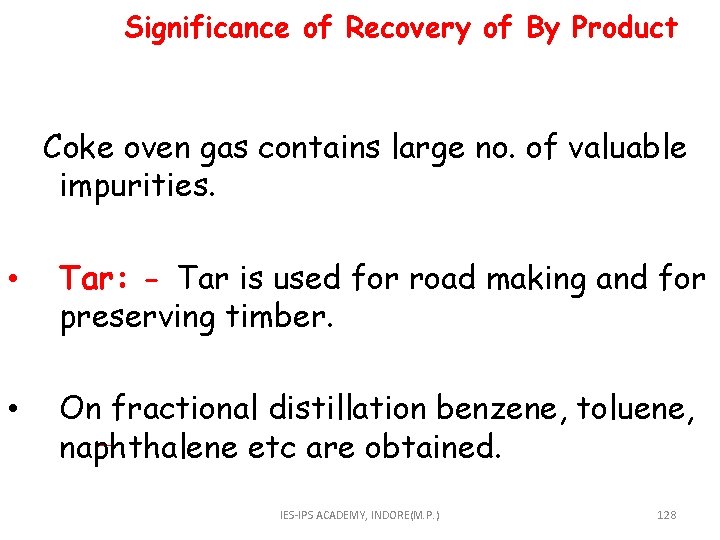
Significance of Recovery of By Product Coke oven gas contains large no. of valuable impurities. • Tar: - Tar is used for road making and for preserving timber. • On fractional distillation benzene, toluene, naphthalene etc are obtained. IES-IPS ACADEMY, INDORE(M. P. ) 128
Ammonia Its removal is necessary to avoid the blockage of gas pipes by ammonium carbonate. It is removed by 1. Using Scrubber 2. Dil H 2 SO 4 IES-IPS ACADEMY, INDORE(M. P. ) 129
Naphthalene: Naphthalene and other higher aromatics present in vapors, may cause blocking of the gas pipes. Benzene & its homologues: - It is an important solvents and raw materials for plastics. IES-IPS ACADEMY, INDORE(M. P. ) 130
H 2 S Sulphur compounds may get oxidized to SO 2 and finally to H 2 SO 4 obtained. Fe 2 O 3 + 3 H 2 S Fe 2 S 3 + 3 H 2 O • After time, when all Fe 2 O 3 is changed into Fe 2 S 3 + 4 O 2 2 Fe. O + 3 SO 2 IES-IPS ACADEMY, INDORE(M. P. ) 131
Summary of previous lecture Carbonization Types: 1. Low Temperature 2. High Tempearture . Manufacturing Process Otto Hoffmann: 1. Diagram 2. Recovery IES-IPS ACADEMY, INDORE(M. P. ) 132
Assignment Questions • What is high temperature carbonization ? • Draw diagram of otto Hoffman method ? IES-IPS ACADEMY, INDORE(M. P. ) 133
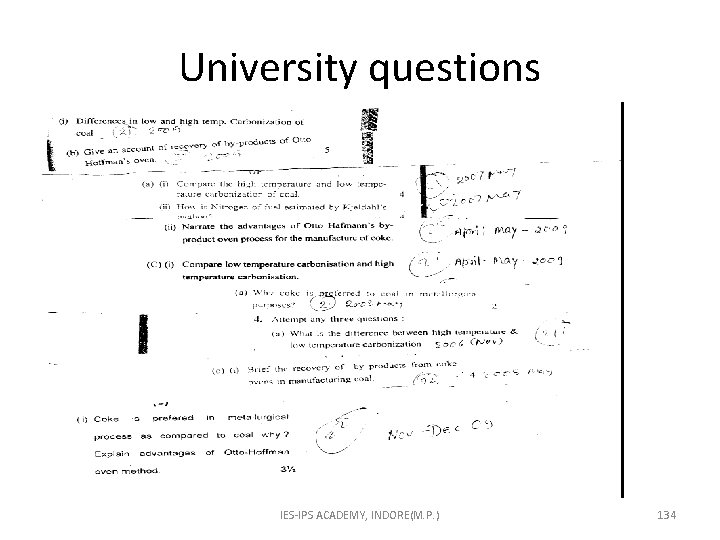
University questions IES-IPS ACADEMY, INDORE(M. P. ) 134
Objective Questions • What are three difference between low & high temperature carbonization? • Give the name of by product of otto Hoffman method. • What is carbonization ? IES-IPS ACADEMY, INDORE(M. P. ) 135
Next Day Topic Liquid Fuel 1. Fractional Distillation 2. Orsat's Apparatus IES-IPS ACADEMY, INDORE(M. P. ) 136
Liquid Fuel Fractional Distillation- 1. Diagram Orsat's Apparatus 1. Diagram 2. Numericals IES-IPS ACADEMY, INDORE(M. P. ) 137
Topics To Be Covered Liquid Fuel Fractional Distillation- 1. Diagram Orsat's Apparatus 1. Diagram 2. Numericals BOOKS / PAGE NOS. B 173 -75 IES-IPS ACADEMY, INDORE(M. P. ) 138
Summary of previous lecture Carbonization Types: 1. Low Temperature 2. High Tempearture . Manufacturing Process Otto Hoffmann: 1. Diagram 2. Recovery IES-IPS ACADEMY, INDORE(M. P. ) 139
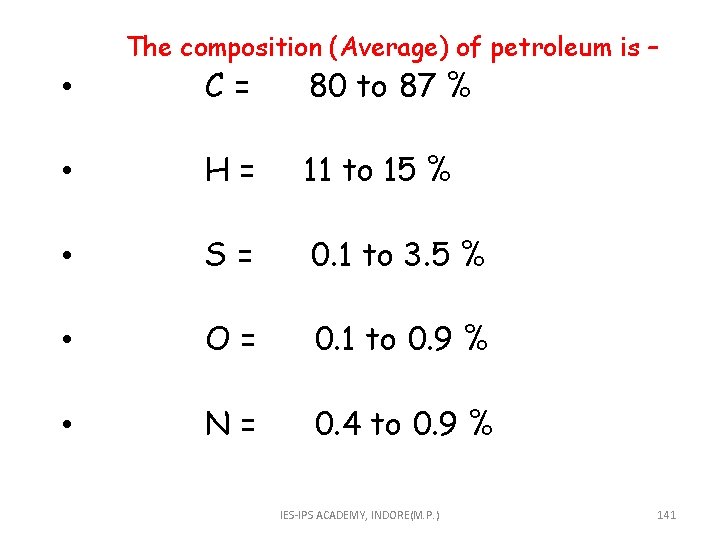
Petroleum • Petra = Rock • Oleum = Oil Dark greenish brown viscous oil found in deep earth crust. It is a complex mixture of paraffin, olefin aromatic hydrocarbons and organic compounds containing N, S, O. IES-IPS ACADEMY, INDORE(M. P. ) 140
The composition (Average) of petroleum is – • C= 80 to 87 % • H= 11 to 15 % • S= 0. 1 to 3. 5 % • O= 0. 1 to 0. 9 % • N= 0. 4 to 0. 9 % IES-IPS ACADEMY, INDORE(M. P. ) 141
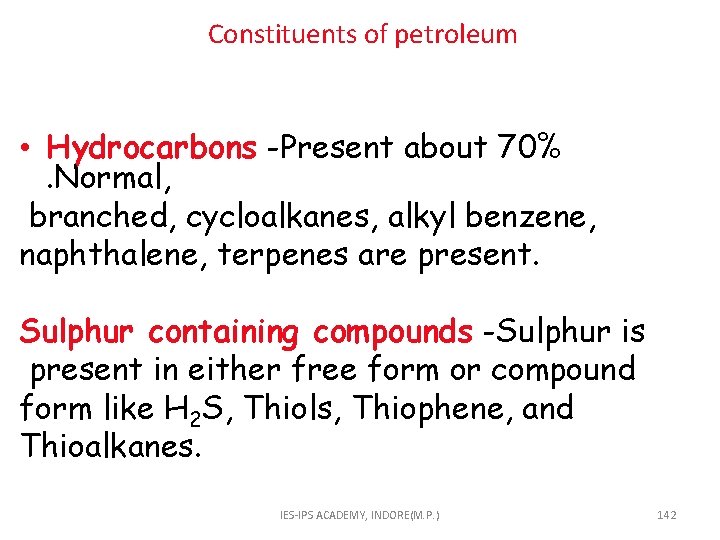
Constituents of petroleum • Hydrocarbons -Present about 70%. Normal, branched, cycloalkanes, alkyl benzene, naphthalene, terpenes are present. Sulphur containing compounds -Sulphur is present in either free form or compound form like H 2 S, Thiols, Thiophene, and Thioalkanes. IES-IPS ACADEMY, INDORE(M. P. ) 142
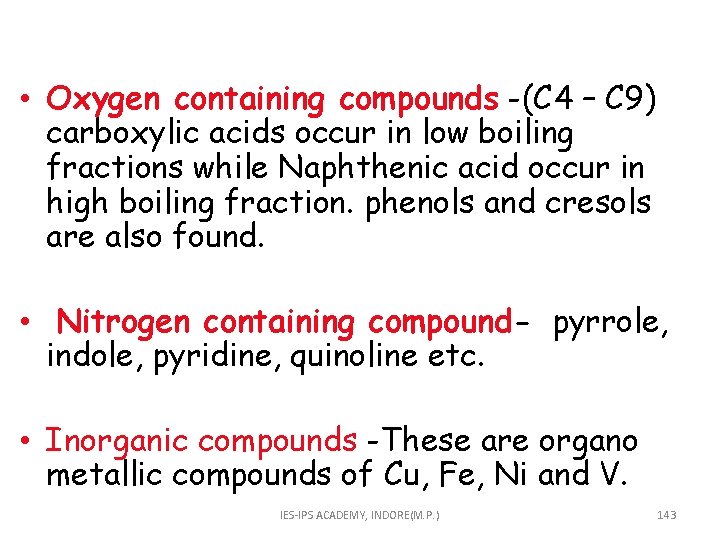
• Oxygen containing compounds -(C 4 – C 9) carboxylic acids occur in low boiling fractions while Naphthenic acid occur in high boiling fraction. phenols and cresols are also found. • Nitrogen containing compound- pyrrole, indole, pyridine, quinoline etc. • Inorganic compounds -These are organo metallic compounds of Cu, Fe, Ni and V. IES-IPS ACADEMY, INDORE(M. P. ) 143
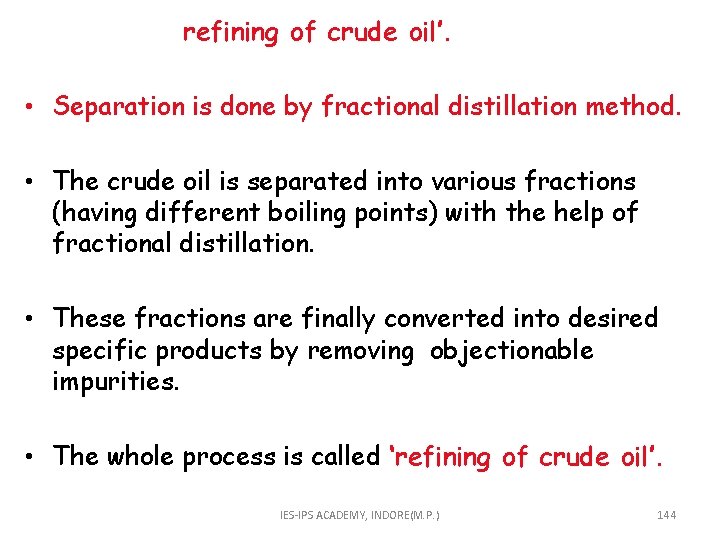
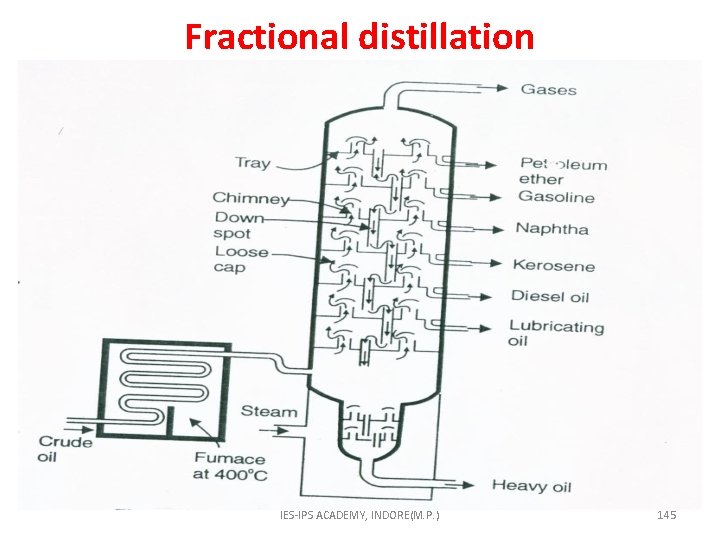
refining of crude oil’. • Separation is done by fractional distillation method. • The crude oil is separated into various fractions (having different boiling points) with the help of fractional distillation. • These fractions are finally converted into desired specific products by removing objectionable impurities. • The whole process is called ‘refining of crude oil’. IES-IPS ACADEMY, INDORE(M. P. ) 144
Fractional distillation IES-IPS ACADEMY, INDORE(M. P. ) 145
Process • The crude oil is heated to about 4000 C in a coil, where all volatile matter are evaporated. • The hot vapors are then passed through a tall cylindrical tower, known as ‘Fractionating Column’. • It is containing a number of horizontal stainless steel trays at short distances. IES-IPS ACADEMY, INDORE(M. P. ) 146
• These trays are provided with individual Chimney which are covered with a loose cap. • As the vapors go up, they gradually cool down and condensation takes place at different heights of column. • Higher boiling fraction condenses first while the lower boiling fractions turn-byturn. IES-IPS ACADEMY, INDORE(M. P. ) 147
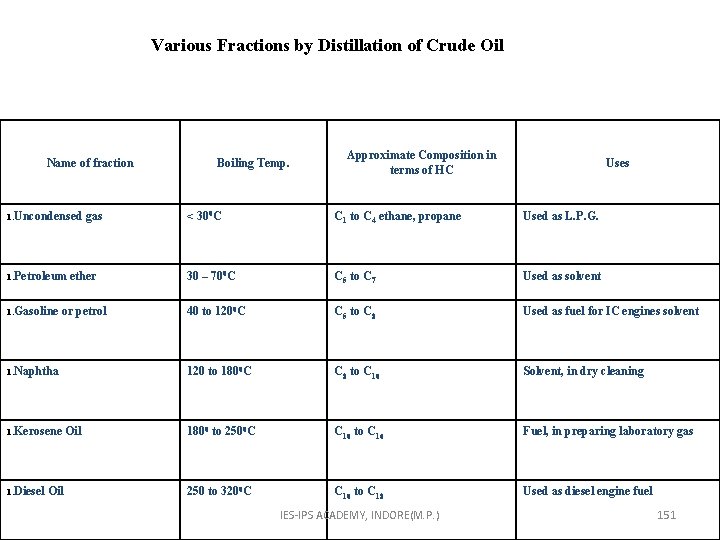
• major important liquids. 1) Gasoline or Petrol Fraction: • It is a mixture of hydrocarbon from pentane to Octane. • This fraction is obtained between 40 to 1200 C. • This fraction is highly volatile and inflammable and used as fuel for internal combustion (IC) engines. • It’s C. V. = 11, 250 cal/gm. IES-IPS ACADEMY, INDORE(M. P. ) 148
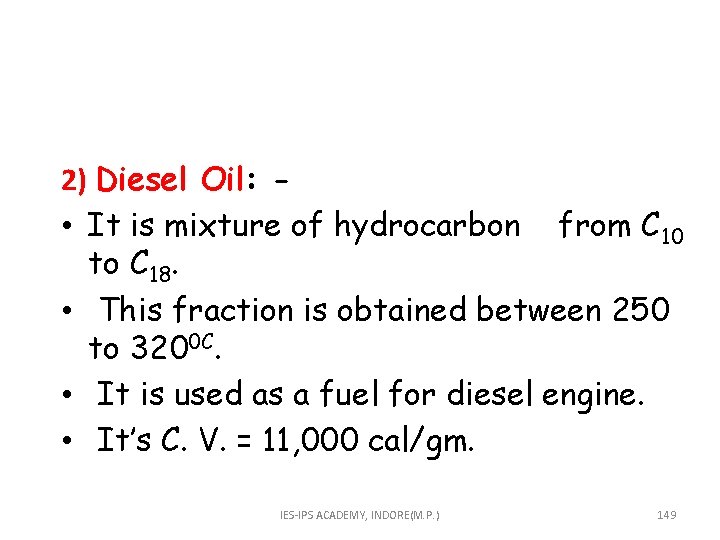
2) Diesel Oil: • It is mixture of hydrocarbon from C 10 to C 18. • This fraction is obtained between 250 to 3200 C. • It is used as a fuel for diesel engine. • It’s C. V. = 11, 000 cal/gm. IES-IPS ACADEMY, INDORE(M. P. ) 149
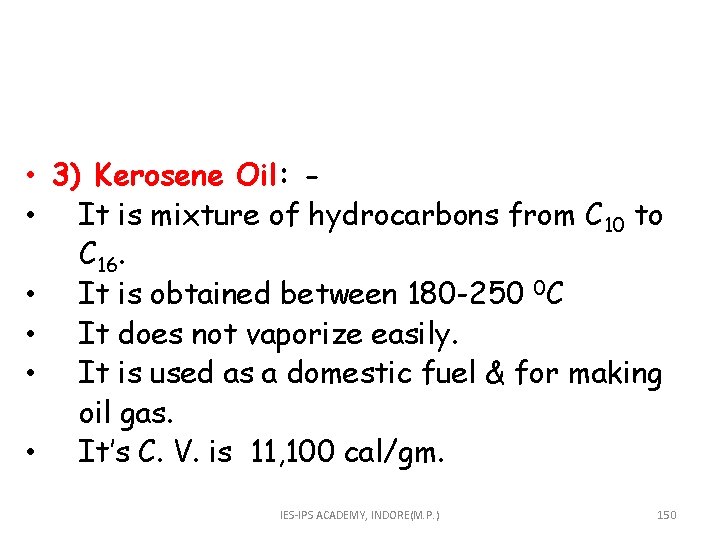
• 3) Kerosene Oil: • It is mixture of hydrocarbons from C 10 to C 16. • It is obtained between 180 -250 0 C • It does not vaporize easily. • It is used as a domestic fuel & for making oil gas. • It’s C. V. is 11, 100 cal/gm. IES-IPS ACADEMY, INDORE(M. P. ) 150
Various Fractions by Distillation of Crude Oil Name of fraction 1. Uncondensed 1. Petroleum 1. Gasoline ether or petrol 1. Naphtha 1. Kerosene 1. Diesel gas Oil Boiling Temp. Approximate Composition in terms of HC Uses < 300 C C 1 to C 4 ethane, propane Used as L. P. G. 30 – 700 C C 5 to C 7 Used as solvent 40 to 1200 C C 5 to C 8 Used as fuel for IC engines solvent 120 to 1800 C C 8 to C 10 Solvent, in dry cleaning 1800 to 2500 C C 10 to C 16 Fuel, in preparing laboratory gas 250 to 3200 C C 10 to C 18 Used as diesel engine fuel IES-IPS ACADEMY, INDORE(M. P. ) 151
FLUE GAS ANALYSIS IES-IPS ACADEMY, INDORE(M. P. ) 152
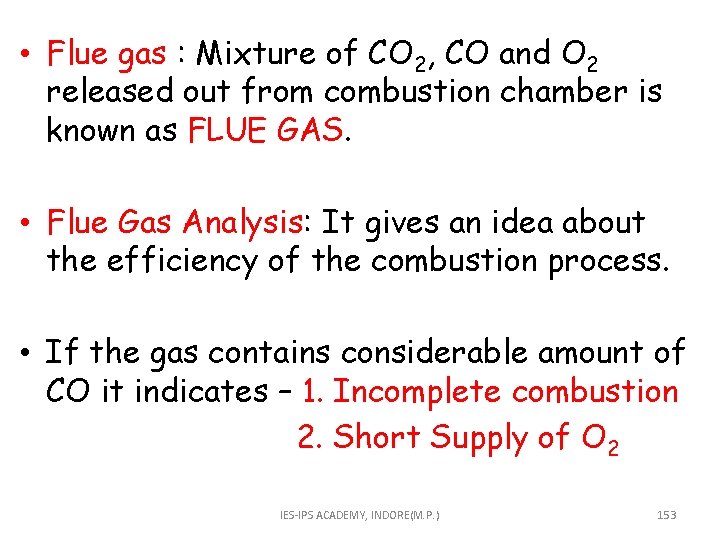
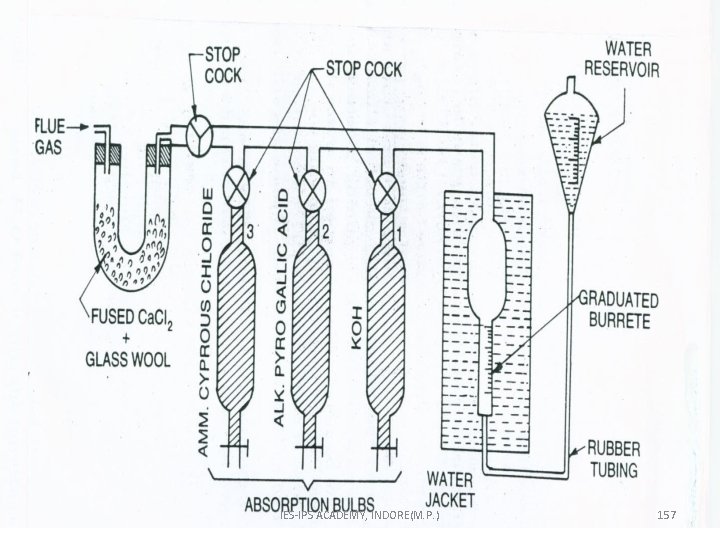
• Flue gas : Mixture of CO 2, CO and O 2 released out from combustion chamber is known as FLUE GAS. • Flue Gas Analysis: It gives an idea about the efficiency of the combustion process. • If the gas contains considerable amount of CO it indicates – 1. Incomplete combustion 2. Short Supply of O 2 IES-IPS ACADEMY, INDORE(M. P. ) 153
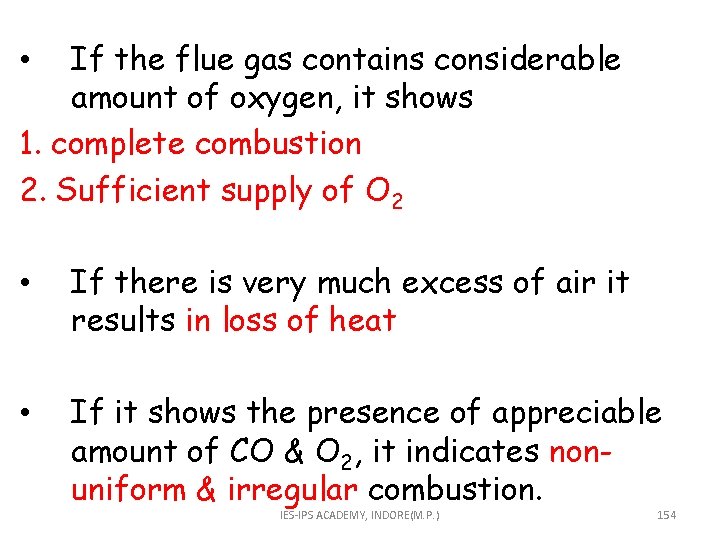
If the flue gas contains considerable amount of oxygen, it shows 1. complete combustion 2. Sufficient supply of O 2 • • If there is very much excess of air it results in loss of heat • If it shows the presence of appreciable amount of CO & O 2, it indicates nonuniform & irregular combustion. IES-IPS ACADEMY, INDORE(M. P. ) 154
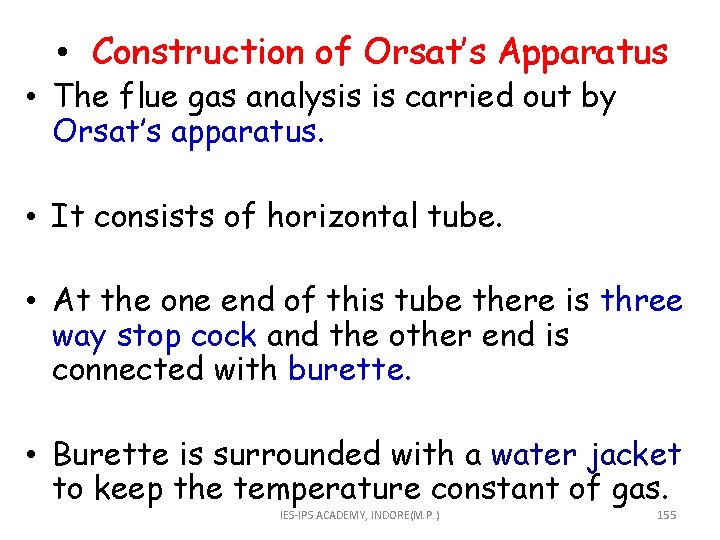
• Construction of Orsat’s Apparatus • The flue gas analysis is carried out by Orsat’s apparatus. • It consists of horizontal tube. • At the one end of this tube there is three way stop cock and the other end is connected with burette. • Burette is surrounded with a water jacket to keep the temperature constant of gas. IES-IPS ACADEMY, INDORE(M. P. ) 155
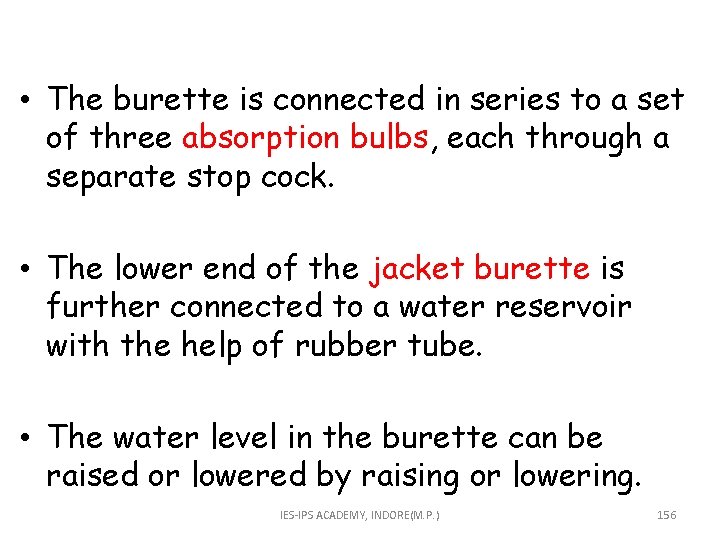
• The burette is connected in series to a set of three absorption bulbs, each through a separate stop cock. • The lower end of the jacket burette is further connected to a water reservoir with the help of rubber tube. • The water level in the burette can be raised or lowered by raising or lowering. IES-IPS ACADEMY, INDORE(M. P. ) 156
IES-IPS ACADEMY, INDORE(M. P. ) 157
• The other end of horizontal tube is connected to a U – tube. • U – tube is packed with fused Ca. Cl 2 and glass wool for drying flue gas and avoiding for smoke particles. • Three absorption bulbs are having solution for absorbing CO 2, O 2 and CO. IES-IPS ACADEMY, INDORE(M. P. ) 158
• The first bulb has KOH solution and it absorbs only CO 2. • The second bulb has alkaline pyrogallic acid and it can absorb O 2 and CO 2. • The third bulb has ammonical cuprous chloride and it can absorb O 2 , CO 2 & CO. IES-IPS ACADEMY, INDORE(M. P. ) 159
• For proper analysis it is necessary that the flue gas is passed through first bulb having KOH, where CO 2 is absorbed. • Then it is passed through second bulb having alkaline pyrogallic acid, where only O 2 will be absorbed. • Finally flue gases are passed through third bulb having Cu. Cl 2 where only CO will be absorbed IES-IPS ACADEMY, INDORE(M. P. ) 160
WORKING STEP – 1 • The whole apparatus is thoroughly cleaned. • The absorption bulbs are filled with their respective solution and stop clock are closed. • The water reservoir and jacket are filled with water. IES-IPS ACADEMY, INDORE(M. P. ) 161
• For the exclusion of air, the three way stop cock should be opened to the atmosphere. • Flue gas is analyzed by lowering the water reservoir and connecting the three way stop cock to flue gas supply. IES-IPS ACADEMY, INDORE(M. P. ) 162
• Air should be expelled by repeating the above process of sucking and expelling the flue gas by lowering and raising the water reservoir. IES-IPS ACADEMY, INDORE(M. P. ) 163
STEP – 2 • 100 ml of flue gas is carefully sucked in the burette for analysis. • The three way stop cock is closed then. • The flue gas is forced in the bulb 1 by opening its stop cock and raising the water reservoir. IES-IPS ACADEMY, INDORE(M. P. ) 164
• Bulb 1 have KOH which absorbs CO 2 for complete absorption of CO 2 the flue gas is sent 2 or 3 times, again and again in bulb 1. IES-IPS ACADEMY, INDORE(M. P. ) 165
STEP – 3 • The unabsorbed gas is finally taken back in the burette and then stop cock for CO 2 absorption bulb is closed. • The levels of water in the reservoir and burette are equalized and the value of residual gas is noted. • The decrease in volume gives the volume of CO 2 in 100 ml of the flue gas sample. IES-IPS ACADEMY, INDORE(M. P. ) 166
• The volumes of O 2 and CO are similarly determined by passing the flue gas through absorption bulbs 2 and 3. IES-IPS ACADEMY, INDORE(M. P. ) 167
Summary of the lecture Liquid Fuel Fractional Distillation- 1. Diagram Orsat's Apparatus 1. Diagram 2. Numericals IES-IPS ACADEMY, INDORE(M. P. ) 168
Assignment Questions • Draw well labellled diagram of orsats apparatus and give its construction and working ? IES-IPS ACADEMY, INDORE(M. P. ) 169
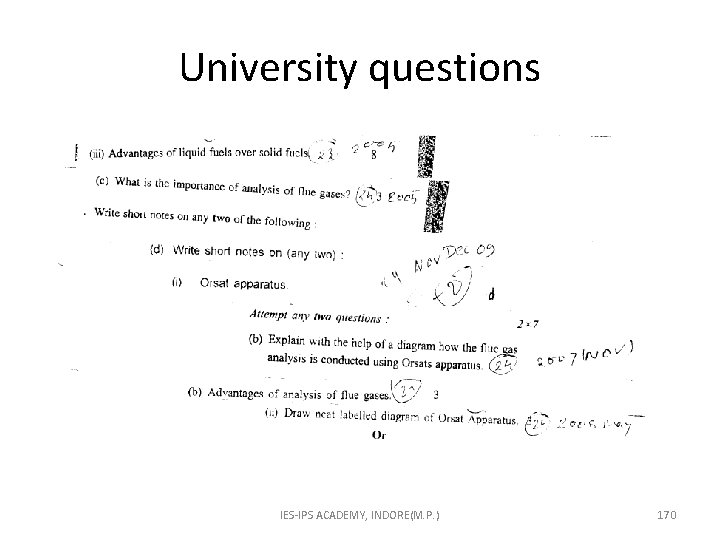
University questions IES-IPS ACADEMY, INDORE(M. P. ) 170
Objective Questions • What is liquid fuel? • What are the chemical used in bulb of Orsat ‘s apparatus ? IES-IPS ACADEMY, INDORE(M. P. ) 171
Knocking 1. Octane Number 2. Cetane Number 3. Power Alcohol IES-IPS ACADEMY, INDORE(M. P. ) 172
Topics To Be Covered Knocking 1. Octane Number 2. Cetane Number 3. Power Alcohol BOOKS / PAGE NOS. B 1, 82 IES-IPS ACADEMY, INDORE(M. P. ) 173
Terminology • Ignition Temperature: - It is the minimum temperature at which the combustion is self supporting. • Compression Ratio: - The power and efficiency of IC engine depends upon compression ratio (C. R. ). IES-IPS ACADEMY, INDORE(M. P. ) 174
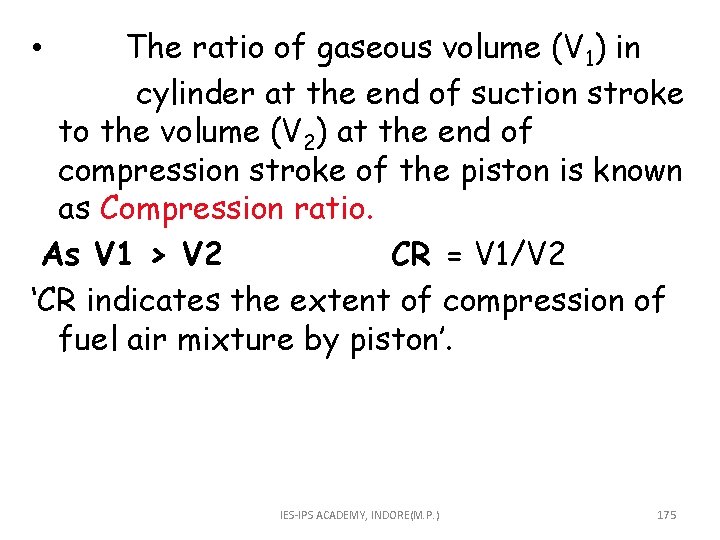
The ratio of gaseous volume (V 1) in cylinder at the end of suction stroke to the volume (V 2) at the end of compression stroke of the piston is known as Compression ratio. As V 1 > V 2 CR = V 1/V 2 ‘CR indicates the extent of compression of fuel air mixture by piston’. • IES-IPS ACADEMY, INDORE(M. P. ) 175
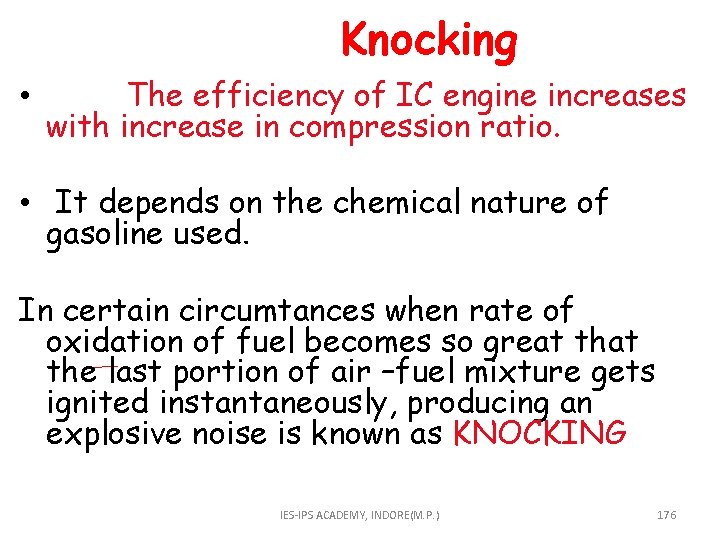
Knocking • The efficiency of IC engine increases with increase in compression ratio. • It depends on the chemical nature of gasoline used. In certain circumtances when rate of oxidation of fuel becomes so great the last portion of air –fuel mixture gets ignited instantaneously, producing an explosive noise is known as KNOCKING IES-IPS ACADEMY, INDORE(M. P. ) 176
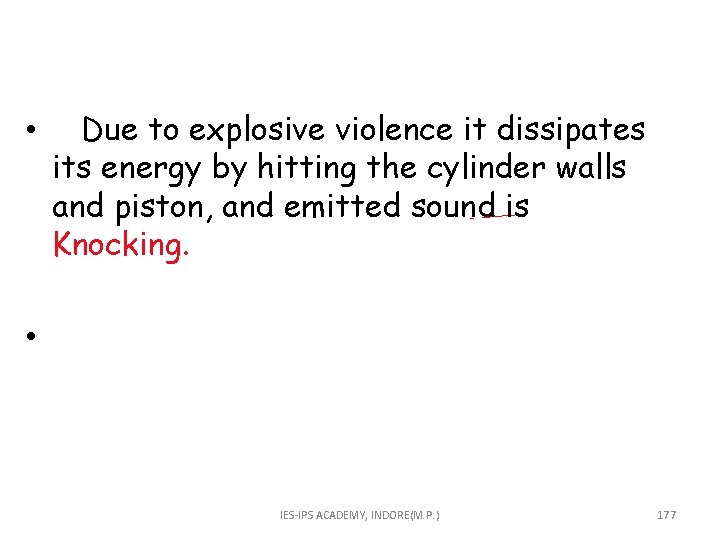
• Due to explosive violence it dissipates its energy by hitting the cylinder walls and piston, and emitted sound is Knocking. • IES-IPS ACADEMY, INDORE(M. P. ) 177
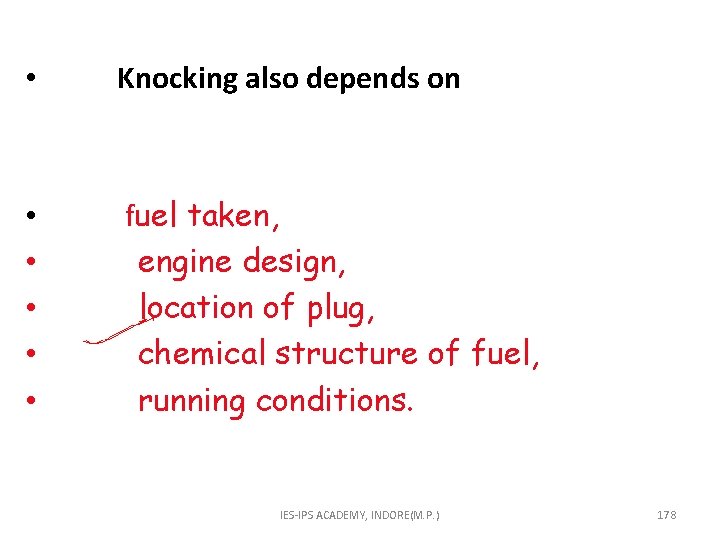
• Knocking also depends on • fuel taken, • engine design, • location of plug, • chemical structure of fuel, • running conditions. IES-IPS ACADEMY, INDORE(M. P. ) 178
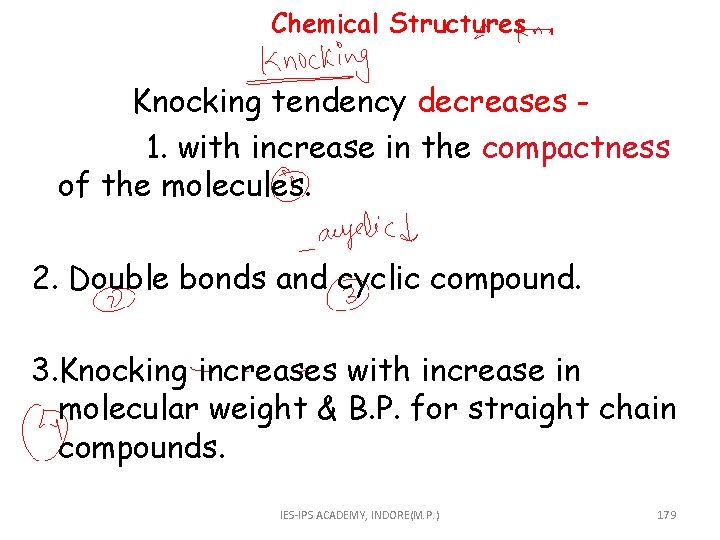
Chemical Structures Knocking tendency decreases 1. with increase in the compactness of the molecules. 2. Double bonds and cyclic compound. 3. Knocking increases with increase in molecular weight & B. P. for straight chain compounds. IES-IPS ACADEMY, INDORE(M. P. ) 179
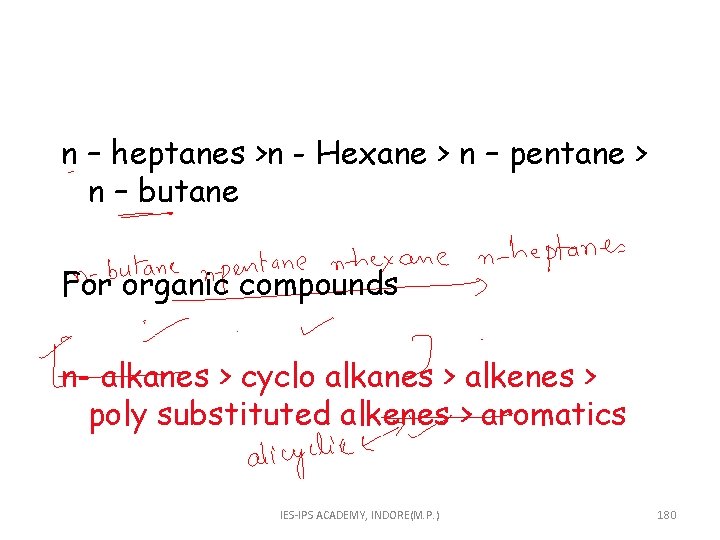
n – heptanes >n - Hexane > n – pentane > n – butane For organic compounds n- alkanes > cyclo alkanes > alkenes > poly substituted alkenes > aromatics IES-IPS ACADEMY, INDORE(M. P. ) 180
• Branched chain paraffin’s have higher anti knocking properties. • Aromatic HCs have higher antinocking properties. IES-IPS ACADEMY, INDORE(M. P. ) 181
• Olefins and aromatic HCs have higher anti – knocking properties. • Aromatic hydrocarbon such as benzene and toluene has high octane number. IES-IPS ACADEMY, INDORE(M. P. ) 182
Consequences of Knocking • Decreased power output • Mechanical damage by overheating of the cylinder parts IES-IPS ACADEMY, INDORE(M. P. ) 183
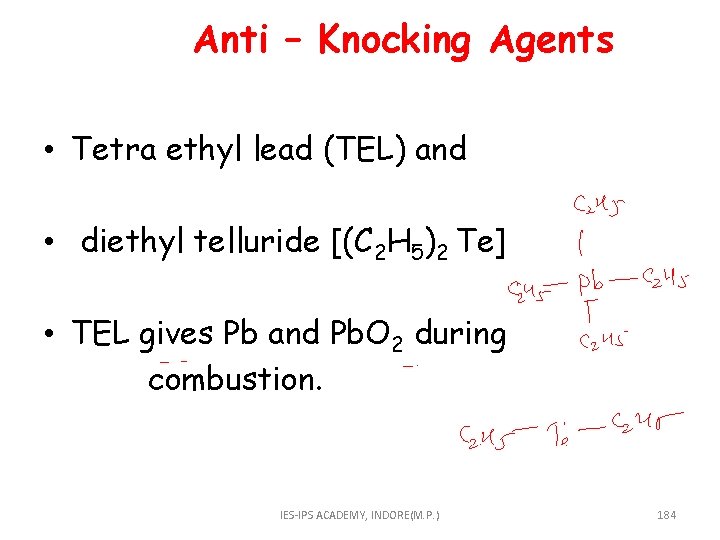
Anti – Knocking Agents • Tetra ethyl lead (TEL) and • diethyl telluride [(C 2 H 5)2 Te] • TEL gives Pb and Pb. O 2 during combustion. IES-IPS ACADEMY, INDORE(M. P. ) 184
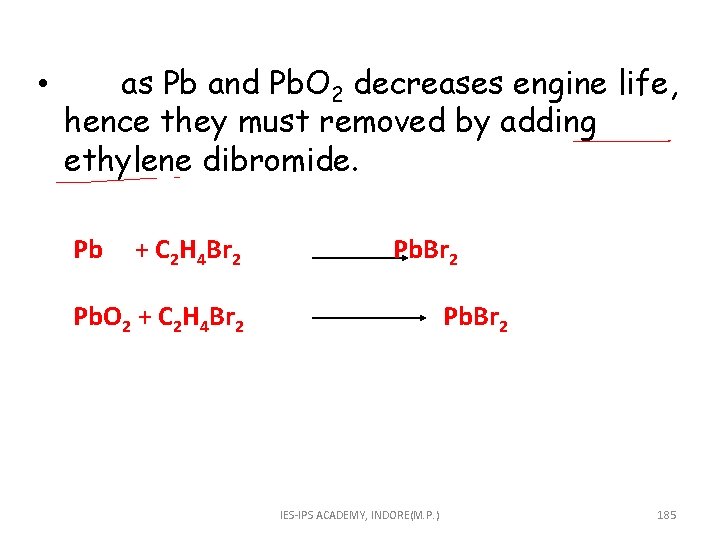
• as Pb and Pb. O 2 decreases engine life, hence they must removed by adding ethylene dibromide. Pb + C 2 H 4 Br 2 Pb. Br 2 Pb. O 2 + C 2 H 4 Br 2 Pb. Br 2 IES-IPS ACADEMY, INDORE(M. P. ) 185
• Pb. Br 2 is volatile and escapes in atmosphere but creates pollution problem. IES-IPS ACADEMY, INDORE(M. P. ) 186
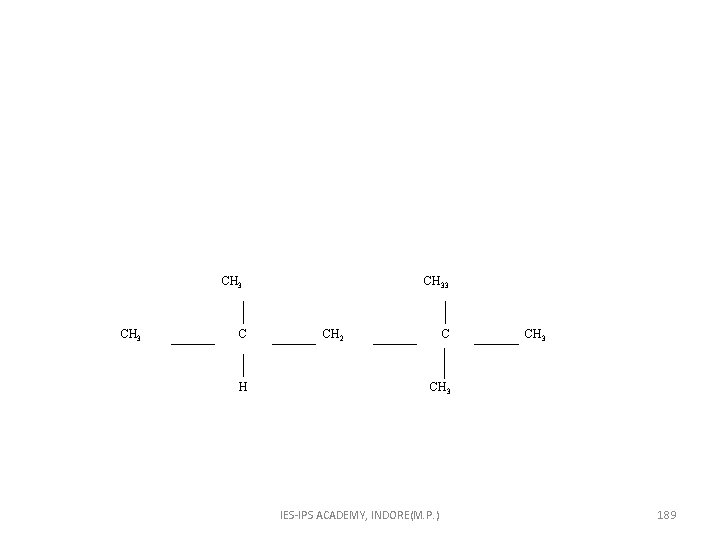
Octane Number • The knocking tendencies of a fuel are expressed by ‘Octane Number’. Octane rating is given by Graham Edgar in 1926. • Octane no of gasoline is is the % of iso octane in a mixture of iso octane and nheptane. IES-IPS ACADEMY, INDORE(M. P. ) 187
• n- heptane knocks very badly and hence its anti knock value is given zero where as iso octane gives very little knocking, thus its anti knocking value is given to 100 IES-IPS ACADEMY, INDORE(M. P. ) 188
CH 3 C H CH 33 CH 2 C CH 3 IES-IPS ACADEMY, INDORE(M. P. ) 189
• This shows very little tendency to detonate (explosion) when mixed with air. Hence Octane number is 100. IES-IPS ACADEMY, INDORE(M. P. ) 190
• On the other hand the straight chain hydrocarbon, n – heptane (C 7 H 16) having formula – • CH 3 -CH 2 - CH 2 -CH 2 CH 3 IES-IPS ACADEMY, INDORE(M. P. ) 191
• Thus if a fuel has octane number 80, it shows that it has same anti – knock quality as the mixture of 80 parts iso octane and 20 parts n – heptane. IES-IPS ACADEMY, INDORE(M. P. ) 192
Cetane Number IES-IPS ACADEMY, INDORE(M. P. ) 193
Diesel Engine Fuel • The knocking tendency of diesel oil are expressed in terms of cetane number. • Diesel engine fuels have a long chain hydrocarbon. • which has a very short ignition time. IES-IPS ACADEMY, INDORE(M. P. ) 194
• In the diesel engine, air is first drawn into cylinder, and compressed temp. is 5000 C. • End of compression stroke, diesel is injected. • The Oil (Diesel) absorbs the heat from the air and it ignites. • interval between the start of fuel injection and its ignition is called the ‘ignition delay’. IES-IPS ACADEMY, INDORE(M. P. ) 195
• If ignition delay is long, it will lead to fuel accumulation in the engine even before the ignition. • When ignites creates explosion. • This is diesel knock. It is shown in ‘Cetane number’. IES-IPS ACADEMY, INDORE(M. P. ) 196
• Saturated hydrocarbon has a short ignition lag so its cetane no. is 100. • Aromatic hydrocarbon has very long ignition lag so its cetane no. is zero (0). IES-IPS ACADEMY, INDORE(M. P. ) 197
POWER ALCOHOL It is a non petroleum fuel. When Ethyl Alcohol is used as an additive to motor fuels to act as a fuel for internal combustion engines, called power alcohol ADVANTAGES: • OCTANE VALUE-ABOVE 90 • ALOCHOL+PETROL HAS LESSER STARTING DIFFICULTY. • ALCOHOL ABSORBS ANY TRACES OF MOISTURE PRESENT. DIS –ADVANTAGES: • • LOW CALORIFIC VALUE • DIFFICULT TO ATOMIZE • ALCOHOL EASILY OXIDISED TO ACIDS MAY CAUSE CORROSION IES-IPS ACADEMY, INDORE(M. P. ) 198
Summary of the lecture Knocking 1. Octane Number 2. Cetane Number 3. Power Alcohol IES-IPS ACADEMY, INDORE(M. P. ) 199
References S. NO. 1. 2. AUTHOR TITLE PUBLISHER Shashi Chawla Engg. Chemistry for BT 1001 Dhanpat Rai & company pvt. Ltd, Delhi. Dr. Sunita Rattan A TEXTBOOK OF S. K. KATARIA & ENGINEERING SONS CHEMISTRY IES-IPS ACADEMY, INDORE(M. P. ) 200