
Learning Aim Intention To use the present perfect

- Slides: 11
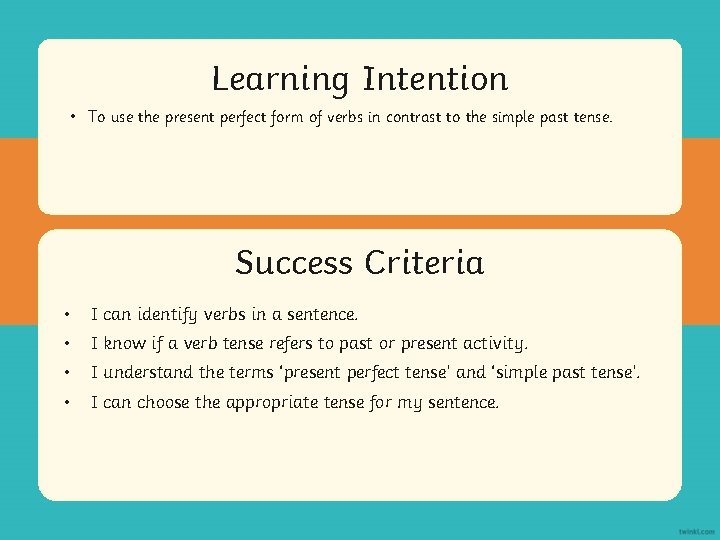
Learning Aim Intention • To use the present perfect form of verbs in contrast to the simple past tense. Success Criteria • Statement 1 Lorem ipsum dolor sit amet, consectetur adipiscing elit. • I can identify verbs in a sentence. • Statement 2 • I know if a verb tense refers to past or present activity. • Sub statement • I understand the terms ‘present perfect tense’ and ‘simple past tense’. • I can choose the appropriate tense for my sentence.
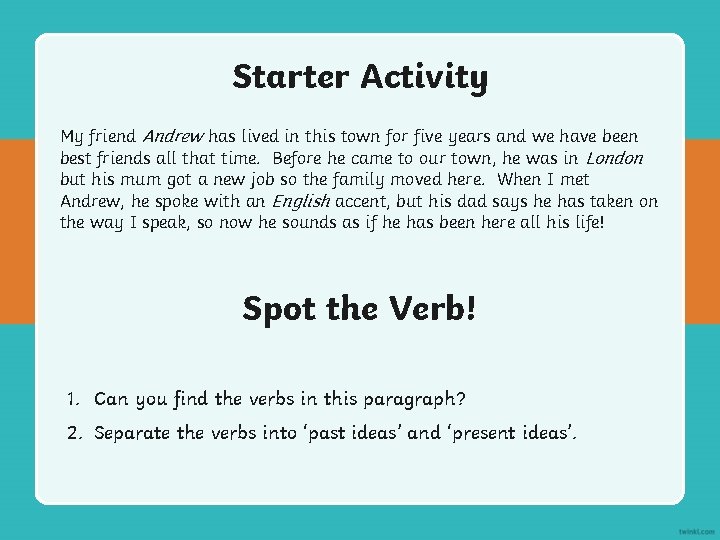
Starter Activity My friend Andrew has lived in this town for five years and we have been best friends all that time. Before he came to our town, he was in London but his mum got a new job so the family moved here. When I met Andrew, he spoke with an English accent, but his dad says he has taken on the way I speak, so now he sounds as if he has been here all his life! Spot the Verb! 1. Can you find the verbs in this paragraph? 2. Separate the verbs into ‘past ideas’ and ‘present ideas’.
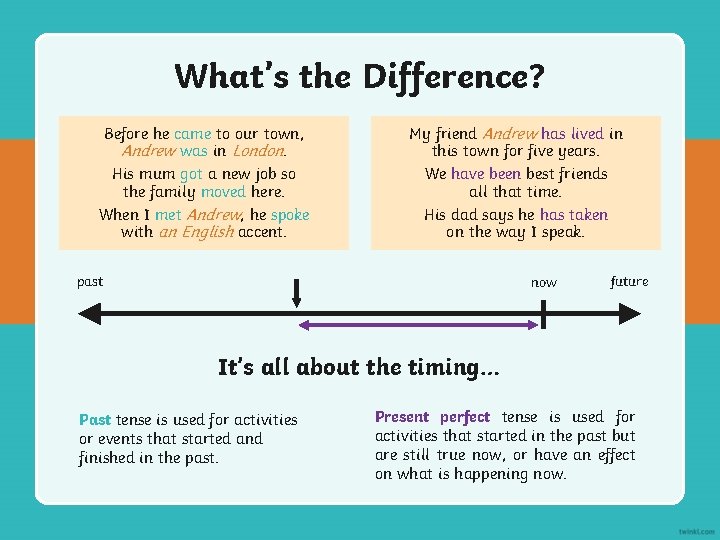
What’s the Difference? Before he came to our town, Andrew was in London. His mum got a new job so the family moved here. When I met Andrew, he spoke with an English accent. My friend Andrew has lived in this town for five years. We have been best friends all that time. His dad says he has taken on the way I speak. past now future It’s all about the timing… Past tense is used for activities or events that started and finished in the past. Present perfect tense is used for activities that started in the past but are still true now, or have an effect on what is happening now.
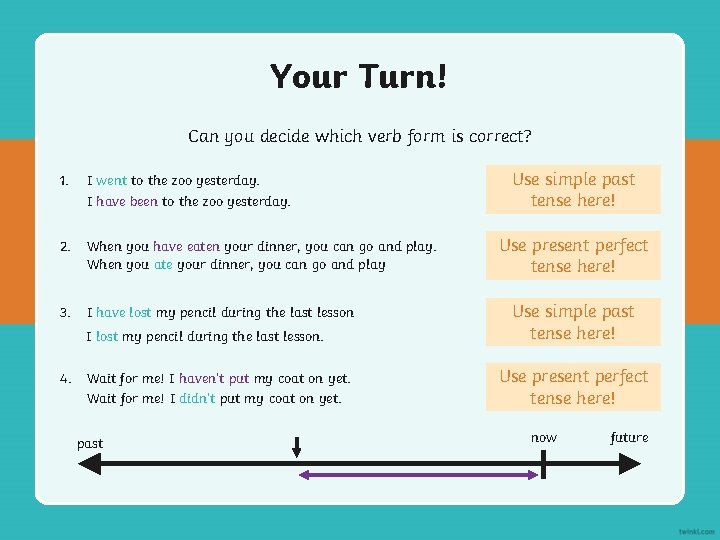
Your Turn! Can you decide which verb form is correct? 1. I went to the zoo yesterday. I have been to the zoo yesterday. 2. When you have eaten your dinner, you can go and play. When you ate your dinner, you can go and play 3. I have lost my pencil during the last lesson I lost my pencil during the last lesson. 4. Wait for me! I haven’t put my coat on yet. Wait for me! I didn’t put my coat on yet. past Use simple past tense here! Use present perfect tense here! now future
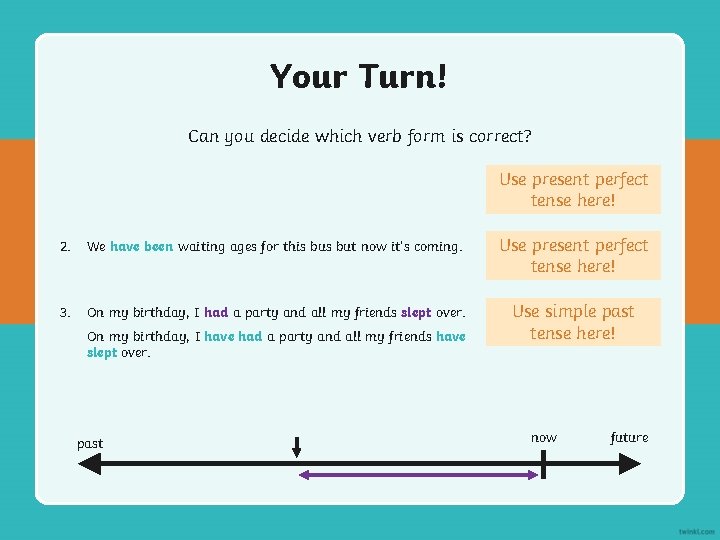
Your Turn! Can you decide which verb form is correct? Use present perfect tense here! 2. We have been waiting ages for this but now it’s coming. Use present perfect tense here! 3. On my birthday, I had a party and all my friends slept over. Use simple past tense here! On my birthday, I have had a party and all my friends have slept over. past now future
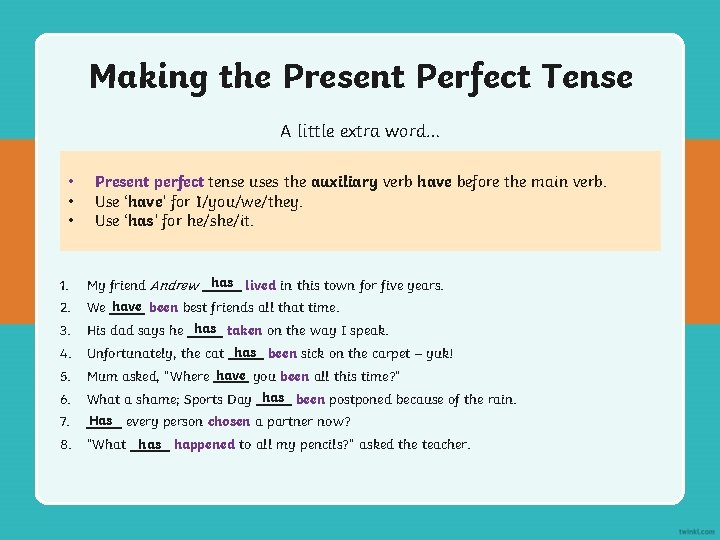
Making the Present Perfect Tense A little extra word… • • • Present perfect tense uses the auxiliary verb have before the main verb. Use ‘have’ for I/you/we/they. Use ‘has’ for he/she/it. 1. My friend Andrew has lived in this town for five years. 2. We have been best friends all that time. 3. His dad says he has taken on the way I speak. 4. Unfortunately, the cat has been sick on the carpet – yuk! 5. Mum asked, “Where have you been all this time? ” 6. What a shame; Sports Day has been postponed because of the rain. 7. Has every person chosen a partner now? 8. “What has happened to all my pencils? ” asked the teacher.
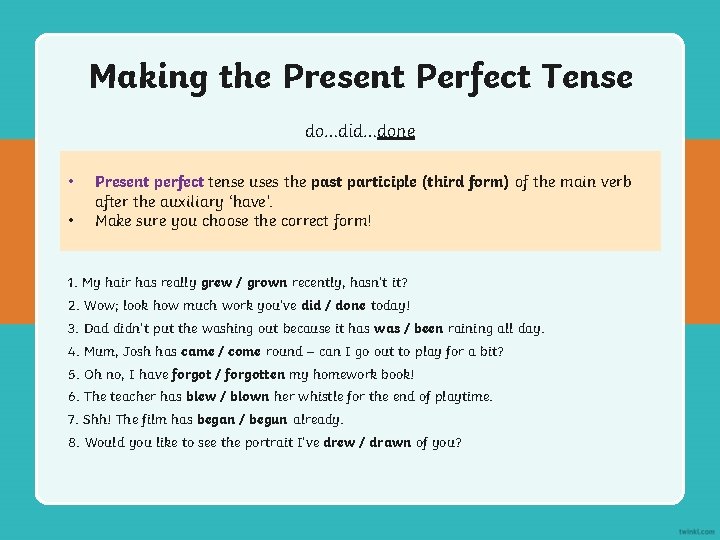
Making the Present Perfect Tense do…did…done • • Present perfect tense uses the past participle (third form) of the main verb after the auxiliary ‘have’. Make sure you choose the correct form! 1. My hair has really grew / grown recently, hasn’t it? 2. Wow; look how much work you’ve did / done today! 3. Dad didn’t put the washing out because it has was / been raining all day. 4. Mum, Josh has came / come round – can I go out to play for a bit? 5. Oh no, I have forgot / forgotten my homework book! 6. The teacher has blew / blown her whistle for the end of playtime. 7. Shh! The film has began / begun already. 8. Would you like to see the portrait I’ve drew / drawn of you?
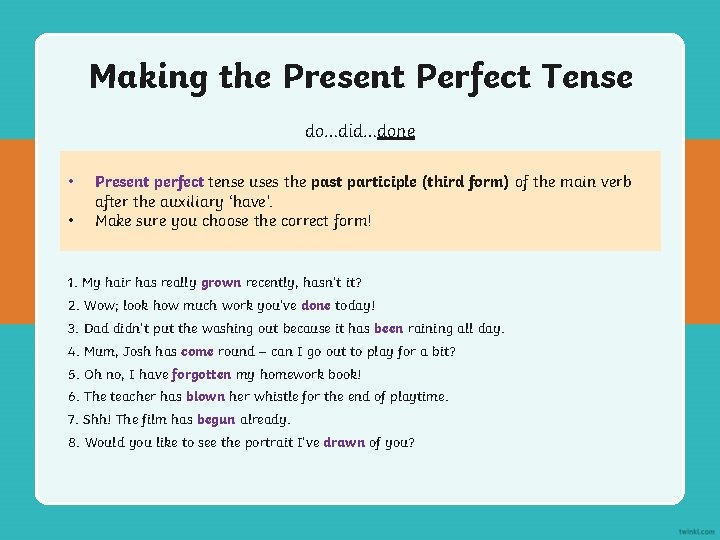
Making the Present Perfect Tense do…did…done • • Present perfect tense uses the past participle (third form) of the main verb after the auxiliary ‘have’. Make sure you choose the correct form! 1. My hair has really grown recently, hasn’t it? 2. Wow; look how much work you’ve done today! 3. Dad didn’t put the washing out because it has been raining all day. 4. Mum, Josh has come round – can I go out to play for a bit? 5. Oh no, I have forgotten my homework book! 6. The teacher has blown her whistle for the end of playtime. 7. Shh! The film has begun already. 8. Would you like to see the portrait I’ve drawn of you?
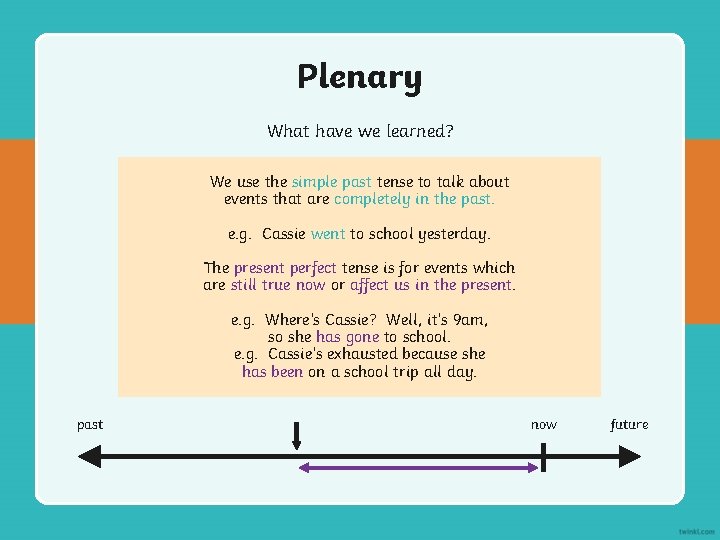
Plenary What have we learned? We use the simple past tense to talk about events that are completely in the past. e. g. Cassie went to school yesterday. The present perfect tense is for events which are still true now or affect us in the present. e. g. Where’s Cassie? Well, it’s 9 am, so she has gone to school. e. g. Cassie’s exhausted because she has been on a school trip all day. past now future