Hello Anas Shawaheen WELCOME TO ENGL 106 Week


- Slides: 12
Hello Anas Shawaheen WELCOME TO ENGL 106, Week Two
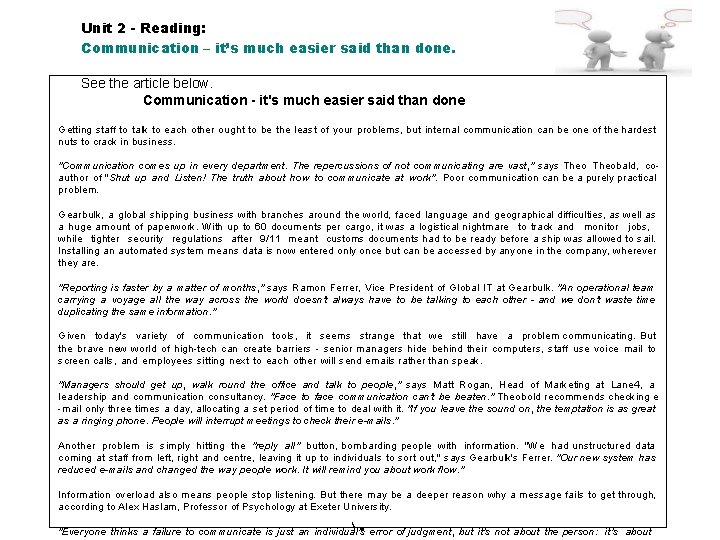
Unit 2 - Reading: Communication – it’s much easier said than done. See the article below. Communication - it's much easier said than done Getting staff to talk to each other ought to be the least of your problems, but internal communication can be one of the hardest nuts to crack in business. "Communication comes up in every department. The repercussions of not communicating are vast, " says Theobald, coauthor of "Shut up and Listen! The truth about how to communicate at work". Poor communication can be a purely practical problem. Gearbulk, a global shipping business with branches around the world, faced language and geographical difficulties, as well as a huge amount of paperwork. With up to 60 documents per cargo, it was a logistical nightmare to track and monitor jobs, while tighter security regulations after 9/11 meant customs documents had to be ready before a ship was allowed to sail. Installing an automated system means data is now entered only once but can be accessed by anyone in the company, wherever they are. "Reporting is faster by a matter of months, " says Ramon Ferrer, Vice President of Global IT at Gearbulk. "An operational team carrying a voyage all the way across the world doesn't always have to be talking to each other - and we don't waste time duplicating the same information. " Given today's variety of communication tools, it seems strange that we still have a problem communicating. But the brave new world of high-tech can create barriers - senior managers hide behind their computers, staff use voice mail to screen calls, and employees sitting next to each other will send emails rather than speak. "Managers should get up, walk round the office and talk to people, " says Matt Rogan, Head of Marketing at Lane 4, a leadership and communication consultancy. "Face to face communication can't be beaten. " Theobold recommends checking e -mail only three times a day, allocating a set period of time to deal with it. "If you leave the sound on, the temptation is as great as a ringing phone. People will interrupt meetings to check their e-mails. " Another problem is simply hitting the "reply all" button, bombarding people with information. "We had unstructured data coming at staff from left, right and centre, leaving it up to individuals to sort out, " says Gearbulk's Ferrer. "Our new system has reduced e-mails and changed the way people work. It will remind you about work flow. " Information overload also means people stop listening. But there may be a deeper reason why a message fails to get through, according to Alex Haslam, Professor of Psychology at Exeter University. ١٠ "Everyone thinks a failure to communicate is just an individual's error of judgment, but it's not about the person: it's about
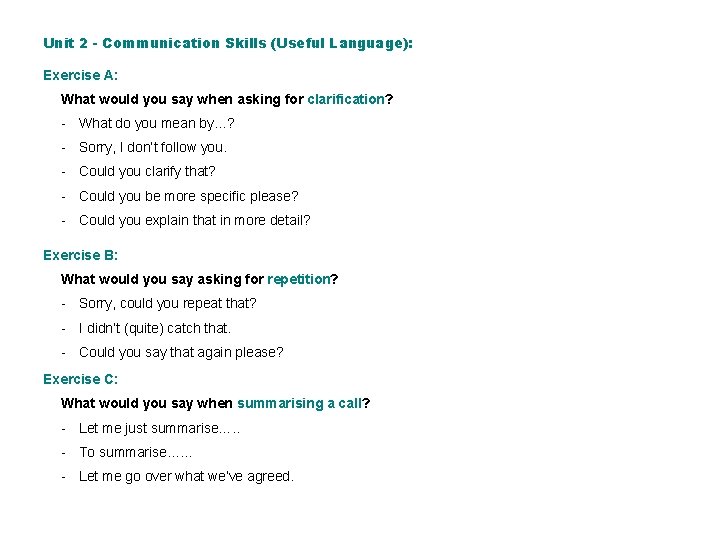
Unit 2 - Communication Skills (Useful Language): Exercise A: What would you say when asking for clarification? - What do you mean by…? - Sorry, I don’t follow you. - Could you clarify that? - Could you be more specific please? - Could you explain that in more detail? Exercise B: What would you say asking for repetition? - Sorry, could you repeat that? - I didn’t (quite) catch that. - Could you say that again please? Exercise C: What would you say when summarising a call? - Let me just summarise…. . - To summarise…… - Let me go over what we’ve agreed.
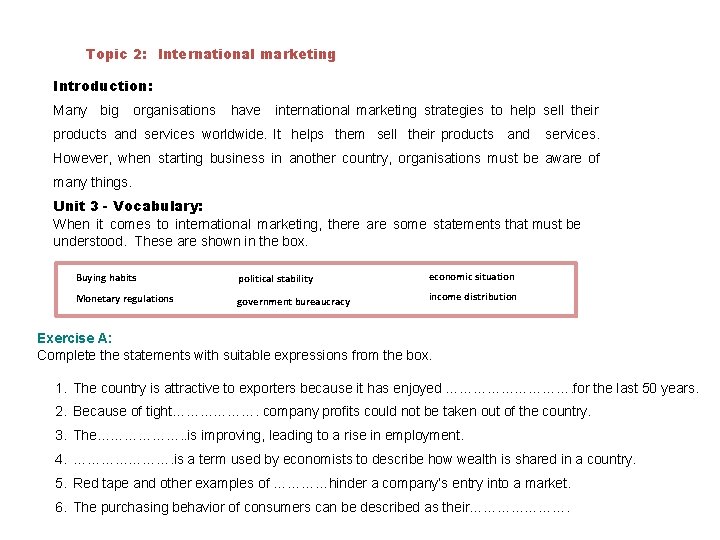
Topic 2: International marketing Introduction: Many big organisations have international marketing strategies to help sell their products and services worldwide. It helps them sell their products and services. However, when starting business in another country, organisations must be aware of many things. Unit 3 - Vocabulary: When it comes to international marketing, there are some statements that must be understood. These are shown in the box. Buying habits political stability Monetary regulations government bureaucracy economic situation income distribution Exercise A: Complete the statements with suitable expressions from the box. 1. The country is attractive to exporters because it has enjoyed ……………. for the last 50 years. 2. Because of tight………………. company profits could not be taken out of the country. 3. The………………. . is improving, leading to a rise in employment. 4. …………………. is a term used by economists to describe how wealth is shared in a country. 5. Red tape and other examples of …………hinder a company’s entry into a market. 6. The purchasing behavior of consumers can be described as their………………….
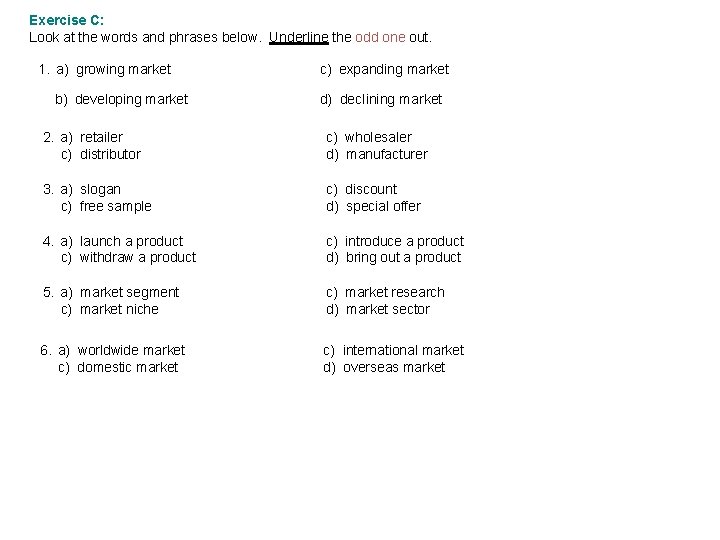
Exercise C: Look at the words and phrases below. Underline the odd one out. 1. a) growing market b) developing market c) expanding market d) declining market 2. a) retailer c) distributor c) wholesaler d) manufacturer 3. a) slogan c) free sample c) discount d) special offer 4. a) launch a product c) withdraw a product c) introduce a product d) bring out a product 5. a) market segment c) market niche c) market research d) market sector 6. a) worldwide market c) domestic market c) international market d) overseas market
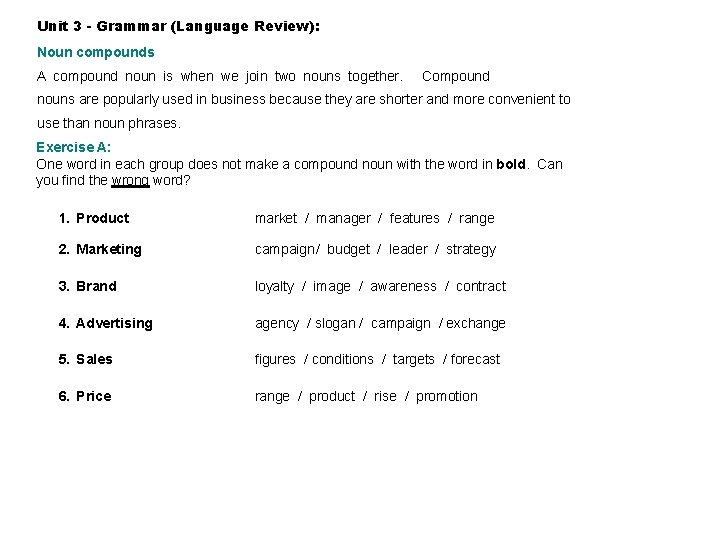
Unit 3 - Grammar (Language Review): Noun compounds A compound noun is when we join two nouns together. Compound nouns are popularly used in business because they are shorter and more convenient to use than noun phrases. Exercise A: One word in each group does not make a compound noun with the word in bold. Can you find the wrong word? 1. Product market / manager / features / range 2. Marketing campaign/ budget / leader / strategy 3. Brand loyalty / image / awareness / contract 4. Advertising agency / slogan / campaign / exchange 5. Sales figures / conditions / targets / forecast 6. Price range / product / rise / promotion
Unit 4 - Reading: Coffee culture comes to coffee-growers COFFEE CULTURE COMES TO COFFEE-GROWERS By John Authers and Mark Mulligan In Chile, they prefer tea to coffee and instant rather than freshly brewed. In Argentina, by contrast, breakfast is with a frothy cappuccino, a heartstarting espresso, or a caffe latte. In Brazil, after-dinner coffee is served free at any self-respecting restaurant. That Latin America is not one great homogeneous culture often surprises travelers. However, even the most subtle differences in the consumer profile of a Columbian and a Venezuelan will not have been lost on Starbucks, one of the fastest-growing global brands. After searches for local partners, and a successful trial run in Mexico City, Starbucks arrived in South America. With no conventional advertising, the Seattle-based company opened stores in Lima and Santiago within 24 hours of each other. Neither Peru nor Chile has a mass-market cafe culture, although European and US-style coffee houses have been springing up in the up- market districts of both capitals. Despite this cultural peculiarity, a Starbucks survey found that Chileans on average drink only 150 cups of coffee a year, compared with 345 in the US and more than twice that number in many European countries. Of the 800 g of coffee per capita bought in supermarkets and from speciality shops each year, 90 % of it is instant. In Argentina, per capita consumption is about 4 kg a year, mostly in whole or ground coffee beans. Despite being a coffee-grower, Peru has a similar pattern of coffee consumption. The irony is not lost on Hulio Gutierrez, head of Latin America at Starbucks Coffee International. "We've been doing business in Latin America for decades, " he says. "We haven't had any stores but we've been buying Latin American coffee since the beginning. Expansion will depend entirely on how long it takes to find the right partner in each of those countries. If we don't find anyone, we may think about going in ourselves". Anyone who knows the Starbucks story can already visualise potential outlets in the most fashionable neighborhoods of the region's capital cities. From a single store in Seattle's Pike Place Market in 1971, Starbucks today owns 3907 stores in North America and licences a further 1378. They also own 437 and franchise 1180 outlets in the rest of the world. It first expanded from its home market to Japan in 1996 and is now present in more than 30 countries. Last year alone, the Starbucks' living-room-in-a-coffee-house format was introduced to Mexico, Germany, Spain, Austria, Puerto Rico, Greece, Oman, Indonesia and China. Starbucks "corners", or mini-outlets, are found in airline offices, sports stadiums, airports, hotels and bookshops. Copy-cat coffee-bar chains have emerged, only to be swallowed by Starbucks or forced to merge with competitors. Fortune and fame, however, have not come without their critics. Some analysts say the company was forced to globalise because it had saturated its home market. Others say the Japanese experience has not been a happy one. In aspiring societies such as Chile and Mexico, American companies are generally well-regarded any novelty from abroad is guaranteed to arouse curiosity. Both the Lima and Santiago Starbucks stores have been packed since opening their doors and the company has rolled out 15 stores in Mexico City since launching its first - cleverly located beside the US embassy - a year ago. Roman Perez-Miranda, head of Latin America for Interbrand, agrees. "Mexico is the closest Latin America gets to the US, both geographically and culturally. It was an obvious starting point for Starbucks in the region. "
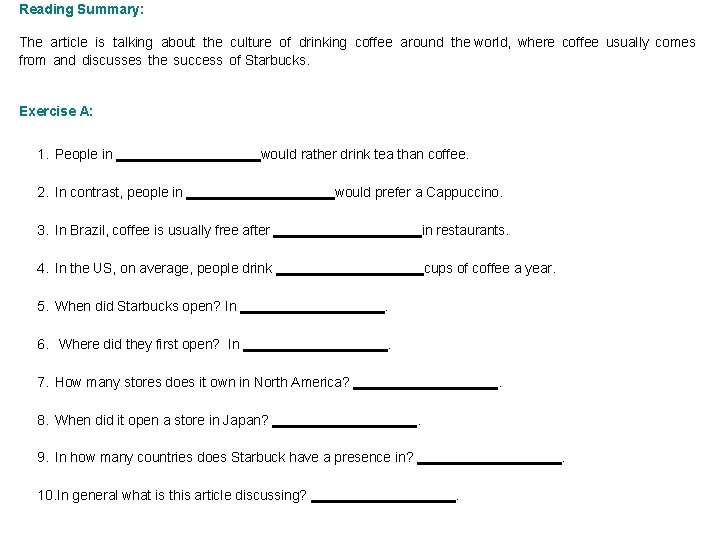
Reading Summary: The article is talking about the culture of drinking coffee around the world, where coffee usually comes from and discusses the success of Starbucks. Exercise A: 1. People in __________would rather drink tea than coffee. 2. In contrast, people in __________ would prefer a Cappuccino. 3. In Brazil, coffee is usually free after __________ in restaurants. 4. In the US, on average, people drink __________ cups of coffee a year. 5. When did Starbucks open? In __________. 6. Where did they first open? In __________. 7. How many stores does it own in North America? __________. 8. When did it open a store in Japan? __________. 9. In how many countries does Starbuck have a presence in? __________. 10. In general what is this article discussing? __________.
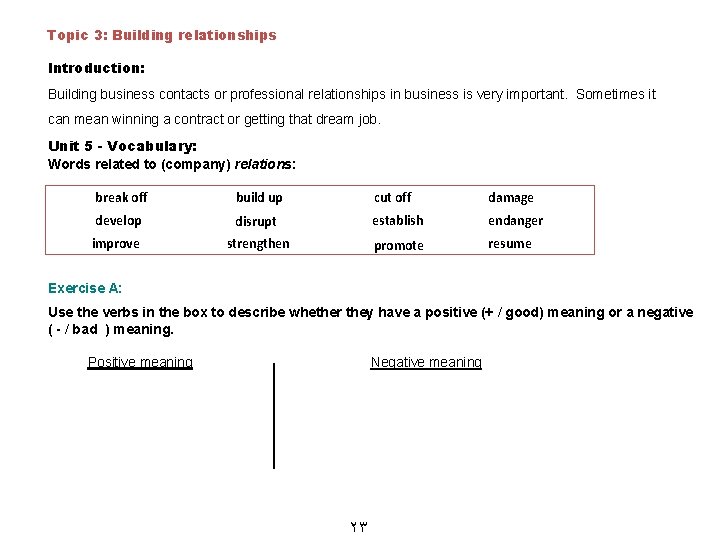
Topic 3: Building relationships Introduction: Building business contacts or professional relationships in business is very important. Sometimes it can mean winning a contract or getting that dream job. Unit 5 - Vocabulary: Words related to (company) relations: break off build up cut off damage develop disrupt establish endanger improve strengthen promote resume Exercise A: Use the verbs in the box to describe whether they have a positive (+ / good) meaning or a negative ( - / bad ) meaning. Positive meaning Negative meaning ٢٣
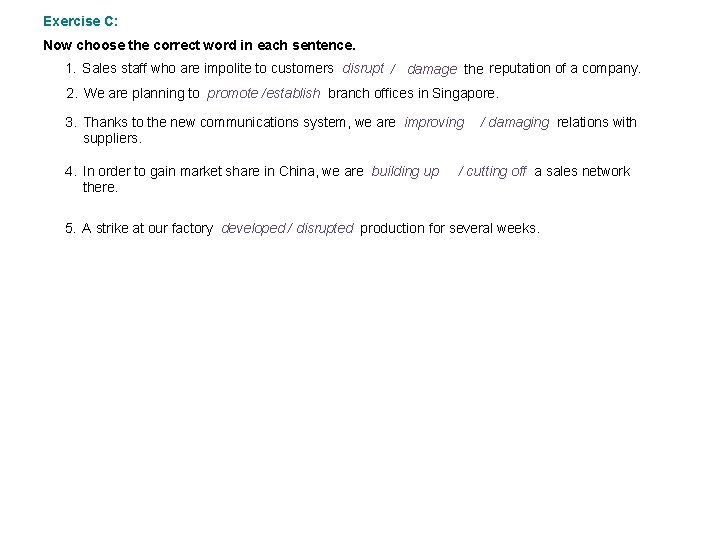
Exercise C: Now choose the correct word in each sentence. 1. Sales staff who are impolite to customers disrupt / damage the reputation of a company. 2. We are planning to promote /establish branch offices in Singapore. 3. Thanks to the new communications system, we are improving suppliers. 4. In order to gain market share in China, we are building up there. / damaging relations with / cutting off a sales network 5. A strike at our factory developed / disrupted production for several weeks.
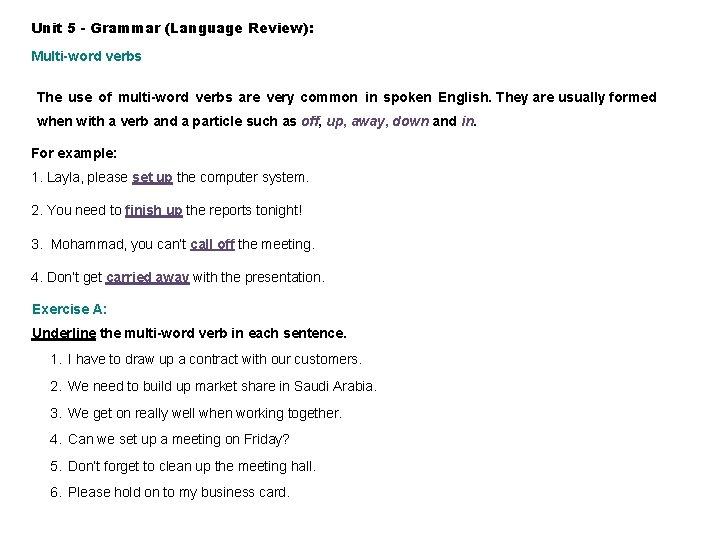
Unit 5 - Grammar (Language Review): Multi-word verbs The use of multi-word verbs are very common in spoken English. They are usually formed when with a verb and a particle such as off, up, away, down and in. For example: 1. Layla, please set up the computer system. 2. You need to finish up the reports tonight! 3. Mohammad, you can’t call off the meeting. 4. Don’t get carried away with the presentation. Exercise A: Underline the multi-word verb in each sentence. 1. I have to draw up a contract with our customers. 2. We need to build up market share in Saudi Arabia. 3. We get on really well when working together. 4. Can we set up a meeting on Friday? 5. Don’t forget to clean up the meeting hall. 6. Please hold on to my business card.