Lindner Center of Hope ASAM Review Course in


- Slides: 92
Lindner Center of Hope ASAM Review Course in Addiction Medicine Dissociatives, Hallucinogens, Steroids & Inhalants Shannon C. Miller, M. D. , FASAM, FAPA, CMRO Staff Psychiatrist Addiction Services Cincinnati VAMC Associate Professor of Clinical Psychiatry Co-Director, Addiction Psychiatry Fellowship Assoc. Dir. for Education in the Addiction Sciences University of Cincinnati Lieutenant Colonel, USAFR Research Physician USAF Research Lab Consultant, Addiction Services Lindner Center of HOPE Hospital
ASAM’s 2008 Review Course in Addiction Medicine ACCME required disclosure of relevant commercial relationships: Dr. Miller has nothing to disclose.
Outline Clubbing Cleaning up “hallucinogens” Dissociatives: PCP-like structure (Arylcyclohexylamines, opioid derivative) – Phencyclidine, Ketamine, Dextromethorphan Hallucinogens: • Serotonin-like structure (Indolealkylamines) – LSD, LSA – Psilocybin, Psilocin, DMT-like … • Amphetamine-like structure (Phenylalkylamines) – Mescaline, Nexus, DOM, DOB, DOI Steroids Inhalants
Anatomy of a Rave • Promoters - ideological theme • Venues - secret, 0400 -daybreak (event now becomes “underground”) “Outlaw” = smaller raves (<50 dancers), portable generator, turntable, $1 -2 admission Medium -Large = legal sites, off-duty cops for security, searching for drugs/cameras/markers/H 2 O bottles, $20 -40 admission, better amenities/DJ’s Large = thousands dancers, “chill-out” rooms, carnival-like amenities
Anatomy of a Rave The Ravers Dissociatives, • Young (15 – 25) Hallucinogens • White, middle class • NYC: 70% white, 20% Hispanic, 10% black • Admission = $10 - $50 • Drugs = $10 - $40/night • Average raver “shelf life” = 2 years
Anatomy of a Rave Clothing • Function > Style • Androgynous (M vs F, attractive vs not) • Theme = Infancy/baby clothes vs aliens • Headbands, b-ball caps, sneakers, baggy pants, backpacks (candies, etc) • Glitter, hair barrettes, infant toys • Safe haven for “nerds”, “geeks” – attracted by computer-driven music and internet promotions
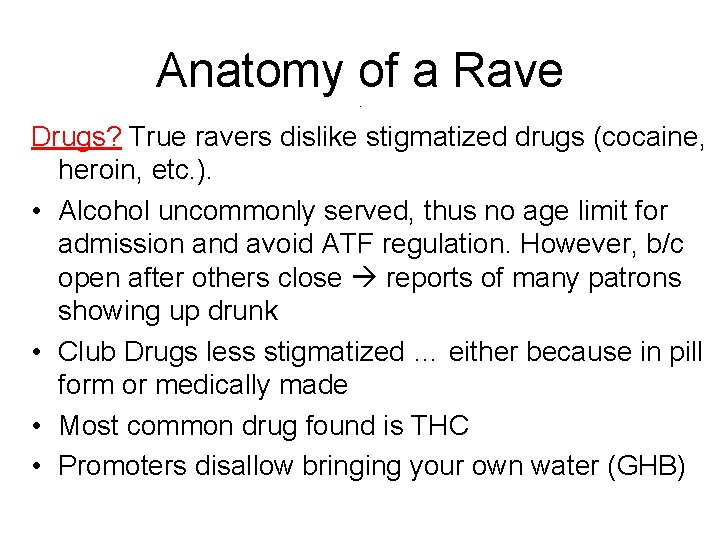
Anatomy of a Rave. Drugs? True ravers dislike stigmatized drugs (cocaine, heroin, etc. ). • Alcohol uncommonly served, thus no age limit for admission and avoid ATF regulation. However, b/c open after others close reports of many patrons showing up drunk • Club Drugs less stigmatized … either because in pill form or medically made • Most common drug found is THC • Promoters disallow bringing your own water (GHB)
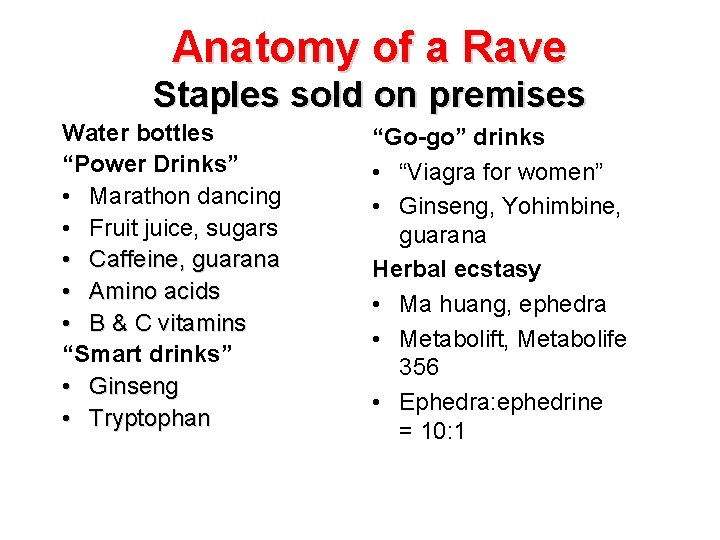
Anatomy of a Rave Staples sold on premises Water bottles “Power Drinks” • Marathon dancing • Fruit juice, sugars • Caffeine, guarana • Amino acids • B & C vitamins “Smart drinks” • Ginseng • Tryptophan “Go-go” drinks • “Viagra for women” • Ginseng, Yohimbine, guarana Herbal ecstasy • Ma huang, ephedra • Metabolift, Metabolife 356 • Ephedra: ephedrine = 10: 1
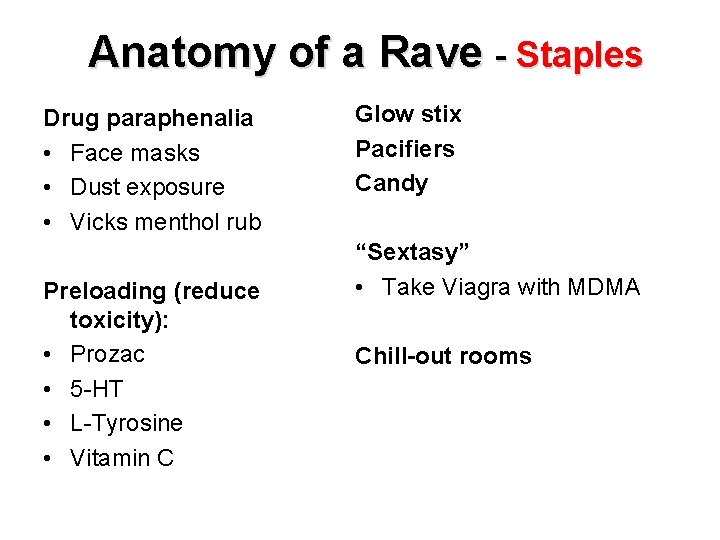
Anatomy of a Rave - Staples Drug paraphenalia • Face masks • Dust exposure • Vicks menthol rub Preloading (reduce toxicity): • Prozac • 5 -HT • L-Tyrosine • Vitamin C Glow stix Pacifiers Candy “Sextasy” • Take Viagra with MDMA Chill-out rooms
“Hallucinogens” a poorly defined term • LSD, psilocins, DMT, Mescaline … PCP, THC, amphetamines • Diagnosis of exclusion • Additional criteria
Hallucinogens Dissociatives • Developed as surgical anesthetics • Distortion of reality – External – Internal (senses) • “Dissociative anesthetics” • Disrupt Glutamate-NMDA – Pain perception – Responses to environment – Memory & Learning
Dissociatives • PCP (Phenyl. Cyclohexyl. Piperidine) • Ketamine • DM (Dextromethorphan)
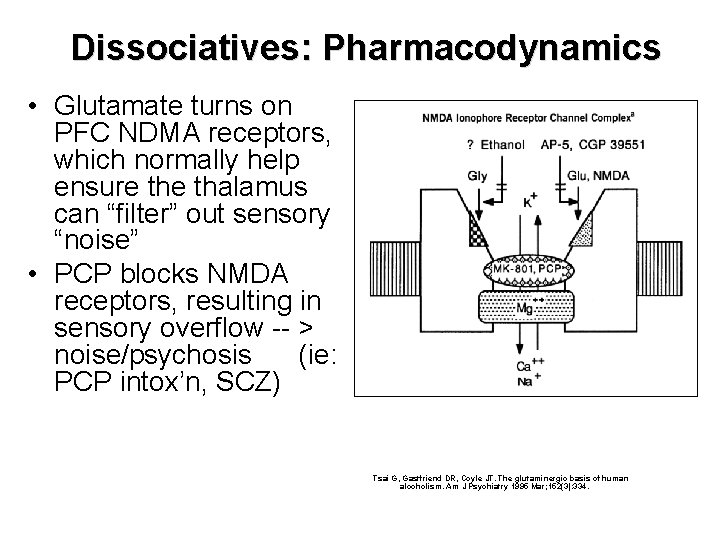
Dissociatives: Pharmacodynamics • Glutamate turns on PFC NDMA receptors, which normally help ensure thalamus can “filter” out sensory “noise” • PCP blocks NMDA receptors, resulting in sensory overflow -- > noise/psychosis (ie: PCP intox’n, SCZ) Tsai G, Gastfriend DR, Coyle JT. The glutaminergic basis of human alcoholism. Am J Psychiatry 1995 Mar; 152(3): 334.
Dissociatives: Pharmacodynamics • NMDA blockade may result in: – Midbrain and PFC D release (? addiction) – Activation of 5 -HT systems, targeting 5 -HT 1 A receptor • PCP proposed to have effects on: – – Acetylcholine DRI SRI Norepinephrine
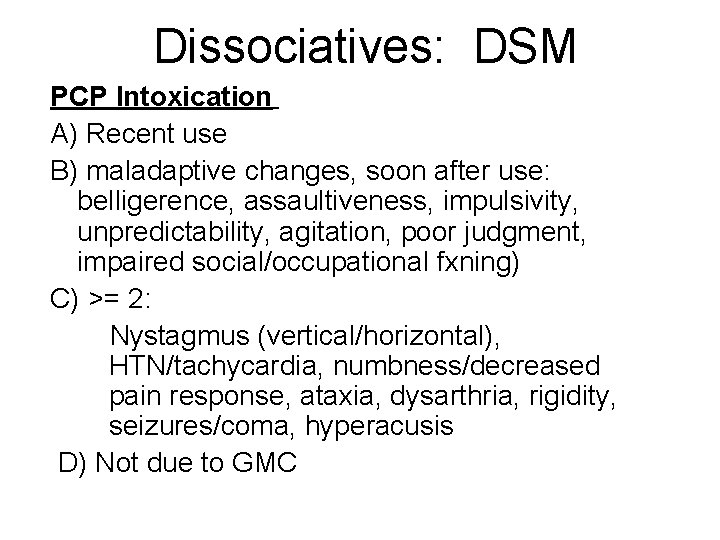
Dissociatives: DSM PCP Intoxication A) Recent use B) maladaptive changes, soon after use: belligerence, assaultiveness, impulsivity, unpredictability, agitation, poor judgment, impaired social/occupational fxning) C) >= 2: Nystagmus (vertical/horizontal), HTN/tachycardia, numbness/decreased pain response, ataxia, dysarthria, rigidity, seizures/coma, hyperacusis D) Not due to GMC
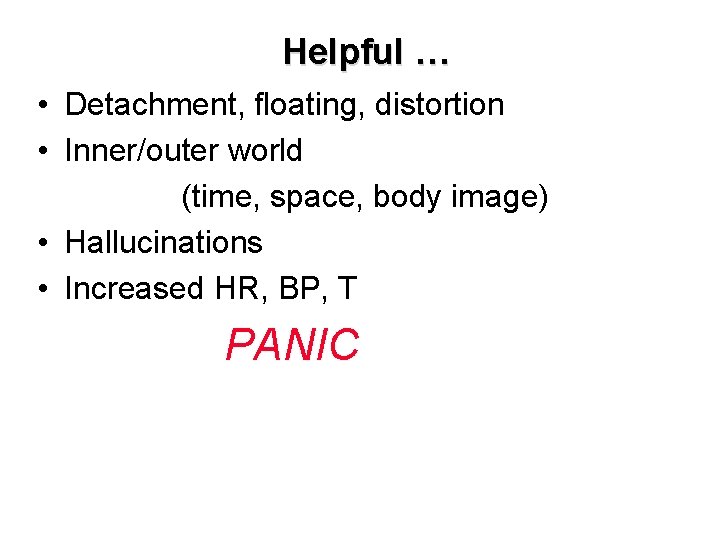
Helpful … • Detachment, floating, distortion • Inner/outer world (time, space, body image) • Hallucinations • Increased HR, BP, T PANIC
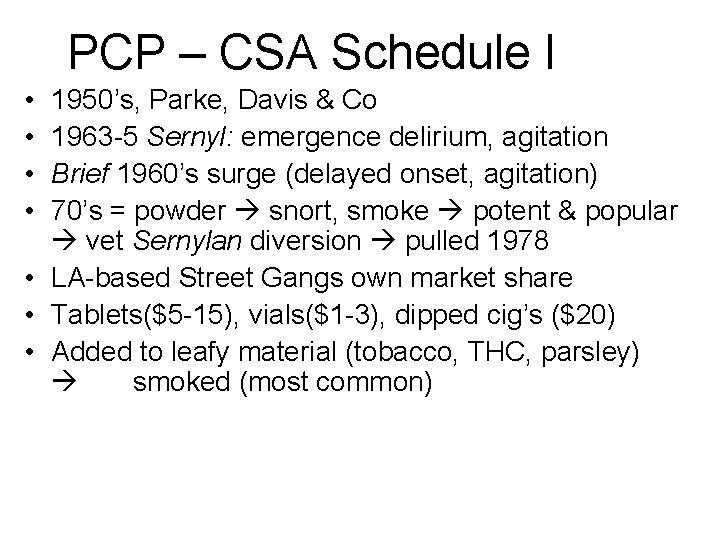
PCP – CSA Schedule I • • 1950’s, Parke, Davis & Co 1963 -5 Sernyl: emergence delirium, agitation Brief 1960’s surge (delayed onset, agitation) 70’s = powder snort, smoke potent & popular vet Sernylan diversion pulled 1978 • LA-based Street Gangs own market share • Tablets($5 -15), vials($1 -3), dipped cig’s ($20) • Added to leafy material (tobacco, THC, parsley) smoked (most common)
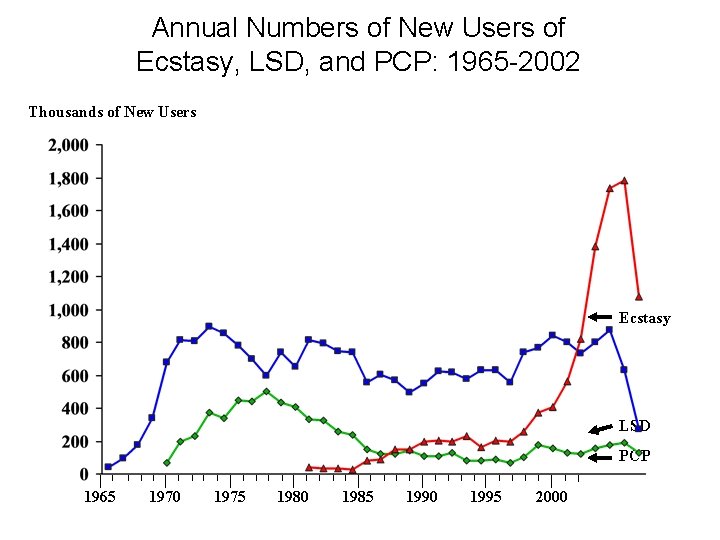
Annual Numbers of New Users of Ecstasy, LSD, and PCP: 1965 -2002 Thousands of New Users Ecstasy LSD PCP 1965 1970 1975 1980 1985 1990 1995 2000
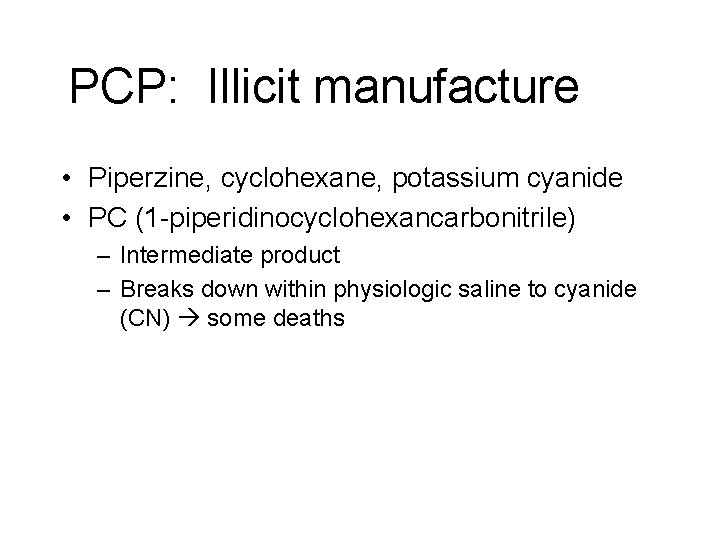
PCP: Illicit manufacture • Piperzine, cyclohexane, potassium cyanide • PC (1 -piperidinocyclohexancarbonitrile) – Intermediate product – Breaks down within physiologic saline to cyanide (CN) some deaths
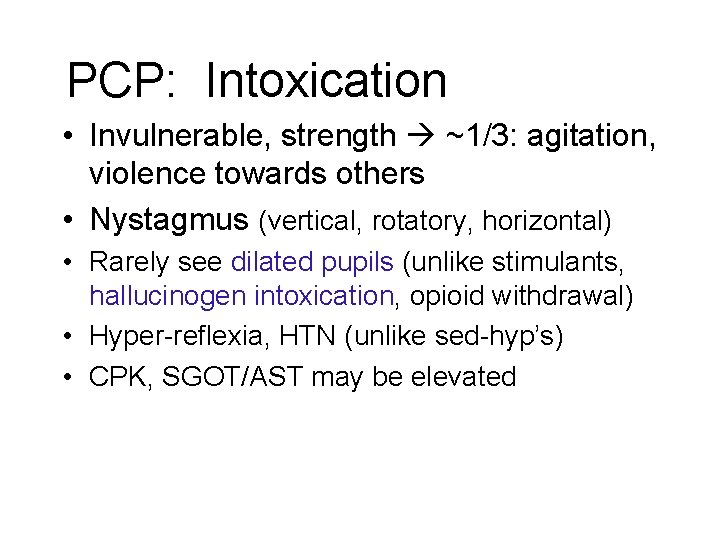
PCP: Intoxication • Invulnerable, strength ~1/3: agitation, violence towards others • Nystagmus (vertical, rotatory, horizontal) • Rarely see dilated pupils (unlike stimulants, hallucinogen intoxication, opioid withdrawal) • Hyper-reflexia, HTN (unlike sed-hyp’s) • CPK, SGOT/AST may be elevated
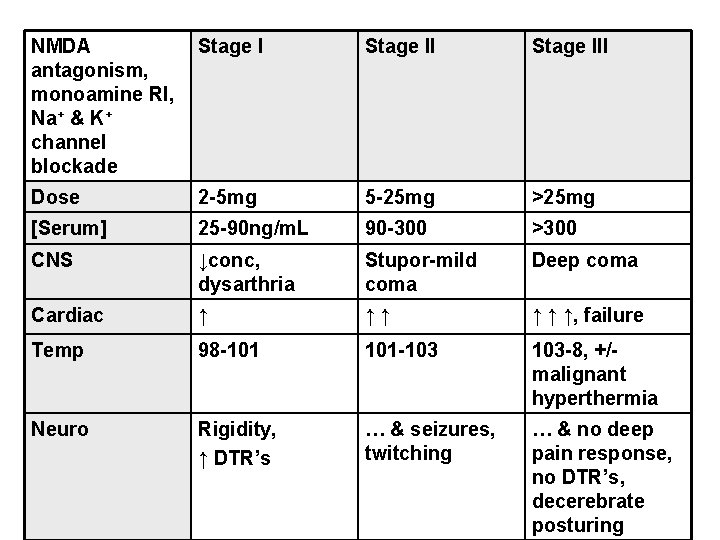
NMDA antagonism, monoamine RI, Na+ & K+ channel blockade Stage III Dose 2 -5 mg 5 -25 mg >25 mg [Serum] 25 -90 ng/m. L 90 -300 >300 CNS ↓conc, dysarthria Stupor-mild coma Deep coma Cardiac ↑ ↑↑ ↑ ↑ ↑, failure Temp 98 -101 101 -103 103 -8, +/malignant hyperthermia Neuro Rigidity, ↑ DTR’s … & seizures, twitching … & no deep pain response, no DTR’s, decerebrate posturing
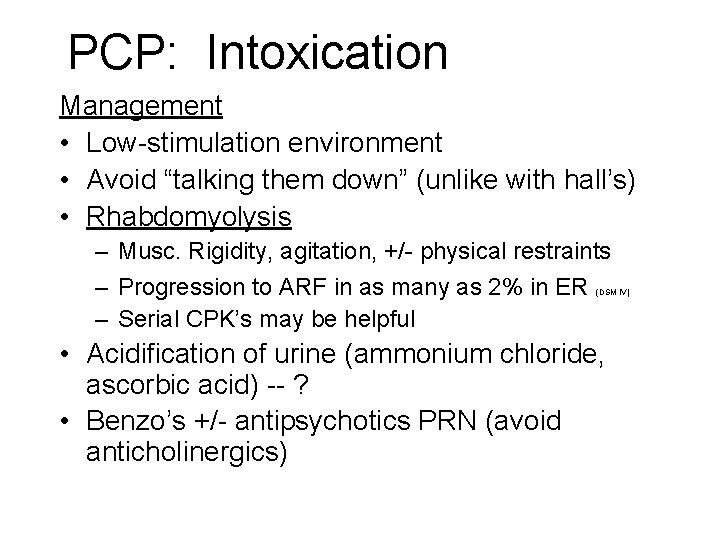
PCP: Intoxication Management • Low-stimulation environment • Avoid “talking them down” (unlike with hall’s) • Rhabdomyolysis – Musc. Rigidity, agitation, +/- physical restraints – Progression to ARF in as many as 2% in ER – Serial CPK’s may be helpful (DSM IV) • Acidification of urine (ammonium chloride, ascorbic acid) -- ? • Benzo’s +/- antipsychotics PRN (avoid anticholinergics)
Dissociatives (PCP) Withdrawal* – Animal models show severe withdrawal: vocalizations, bruxism, oculomotor hyperactivity, diarrhea, piloerection, somnolence, tremor, seizures – Long half life in humans; accum. in fat/brain – It may be that a significant part of what DSM IV attributes to intoxication delirium is actually withdrawal, – *but PCP Withdrawal is NOT a DSM IV diagnosis
PCP: Street Names • • • Rocket fuel Love boat Ozone Hog Embalming Fluid Superweed • • • Angel Dust Dummy Dust Zombie Supergrass Pea. Ce. Pill
Ketamine: CSA Schedule II Injectable dissociative anesthetic (1963) Manufactured for veterinary and pediatric surgery anesthesia (theft) – minimal cardiac, respiratory effects – less agitation, psychoses NMDA receptor blockade Less potent, shorter-acting … Drug facilitated sexual assault (odor, color, taste, amnesia, testing) 90% of legal K sold = vets (street value 6 X this)
Ketamine • Gained popularity for abuse in the 1980’s by New Age spiritualists • Large doses cause effects ~ PCP • K-Hole (helpless detachment), K-slide • Liquid, topical gel, powder snorted; smoked with THC or tobacco products; injected • Lower doses: poor attn, learning, memory • At higher doses: HTN, amnesia, delirium, poor motor control, depression, respiratory decompensation, minimal risk OD (LD 50 is 30 X anesthetic dose)
Ketamine Street Names: • Kit Kat • Cat Valiums • K • Special K • Super K • Vitamin K • Ket nip • Horse trank
PCP and Ketamine Long term adverse effects from chronic use: • Depression/dysphoria • Memory and cognition • Apathy • Irritability • Flashbacks ¼ of pts originally treated for PCP psychosis are diagnosed < 1 yr later with SCZ (without drug use)
Dextromethorphan • At indicated doses, DM inhibits medullary cough centers to approximately the same extent as opiate alkaloids such as codeine, but without other opioid effects such as analgesia, CNS depression, and respiratory suppression • As approved: efficacious, safe for OTC use
Dextromethorphan Maximum/Extra Strength Cough Suppressant: 15 mg Dextromethorphan Hydrobromide per teaspoon [5 m. L] 8 oz bottle = ~711 mg DXM Abuse: 300 to 1, 800 mg (20 -120 X recc’d dose) Cases of 24 oz/d (40 oz/d peak, = 237 x recc dose) Some ongoing for 10– 15 yrs (HCP)
Dextromethorphan • Stigma • Money • Access • Risks • Testing
Dextromethorphan Likely used more than any dissociative, or hallucinogen, today Wide appeal • Teens • Middle-aged workers • Later life (from 1960’s)
Dextromethorphan Powder and the Internet Coricidin ® HBP Cough & Cold – largest/30 mg Gel caps Mixed with heroin, MDMA, or cannabis (“candy blunts”) Intranasal “Robofire” – 2002 Dec. • DM dissolved in lighter fluid crack-like rock smoked (? better hallucinations) • DM drank, then lighter fluid inhaled
Dextromethorphan • DM Readily absorbed from gut • Peak serum levels @ ~2 -3 hrs for immediate release, 6 hrs for sustained release preparations • Dextrorphan (DOR) peak levels @ ~1. 6 -7 hrs • Euphoria and hallucinosis occur within 15 -30 min of ingestion, peak effects in about 2. 5 hrs. “Plateaus” = 3 -6 hrs
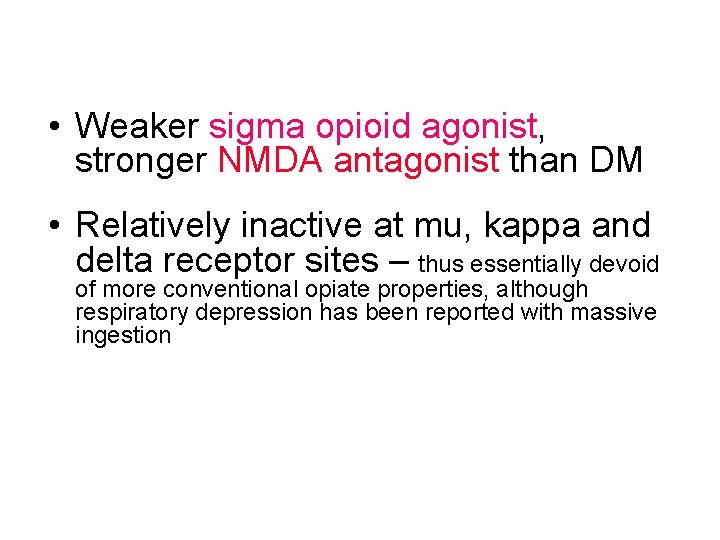
• Weaker sigma opioid agonist, stronger NMDA antagonist than DM • Relatively inactive at mu, kappa and delta receptor sites – thus essentially devoid of more conventional opiate properties, although respiratory depression has been reported with massive ingestion
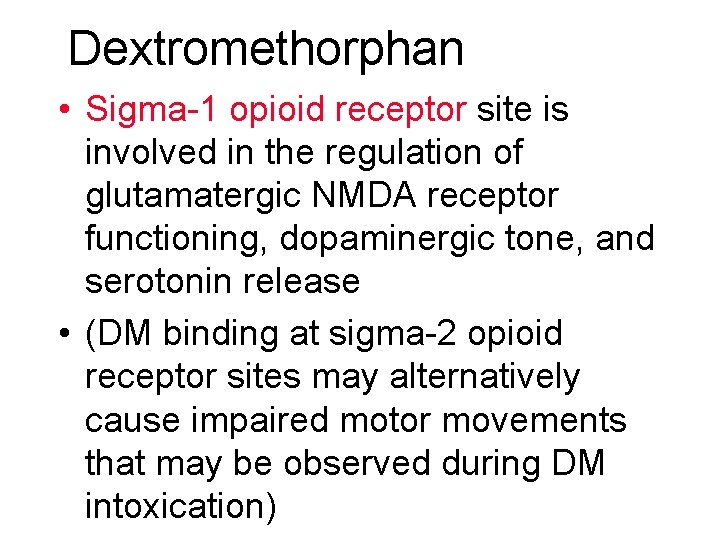
Dextromethorphan • Sigma-1 opioid receptor site is involved in the regulation of glutamatergic NMDA receptor functioning, dopaminergic tone, and serotonin release • (DM binding at sigma-2 opioid receptor sites may alternatively cause impaired motor movements that may be observed during DM intoxication)
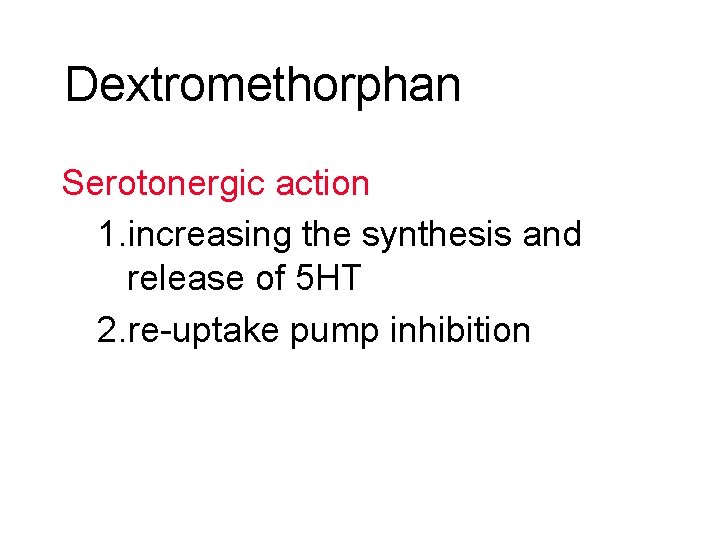
Dextromethorphan Serotonergic action 1. increasing the synthesis and release of 5 HT 2. re-uptake pump inhibition
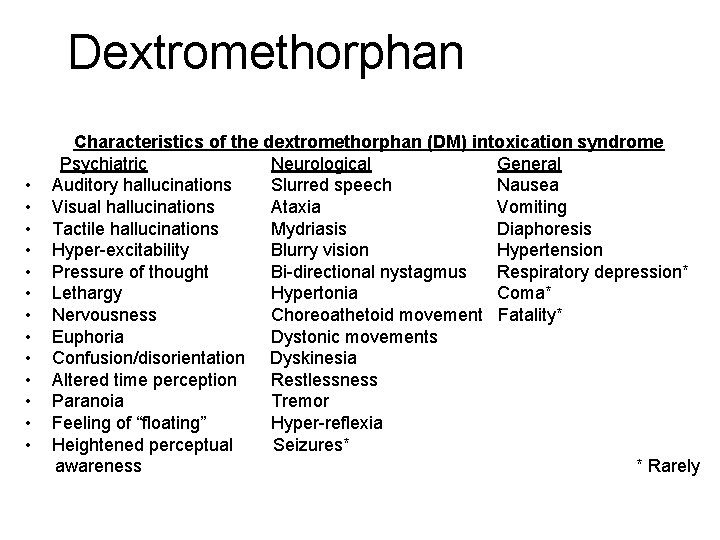
Dextromethorphan • • • • Characteristics of the dextromethorphan (DM) intoxication syndrome Psychiatric Neurological General Auditory hallucinations Slurred speech Nausea Visual hallucinations Ataxia Vomiting Tactile hallucinations Mydriasis Diaphoresis Hyper-excitability Blurry vision Hypertension Pressure of thought Bi-directional nystagmus Respiratory depression* Lethargy Hypertonia Coma* Nervousness Choreoathetoid movement Fatality* Euphoria Dystonic movements Confusion/disorientation Dyskinesia Altered time perception Restlessness Paranoia Tremor Feeling of “floating” Hyper-reflexia Heightened perceptual Seizures* awareness * Rarely
Dextromethorphan Over-the-counter sources of DM + • • • Antihistamines (chlorpheniramine, *) Decongestants (pseudophedrine) - cardiac Pain (acetaminophen) – liver Bromides - Br poisoning Serotonin Syndromes
Truly addictive? Abuse Dependence Rodent & primate animal models • • • Biochemical reinforcement (DOR) ~ to PCP Stimulus discrimination (DOR) Stimulus generalization with PCP • DM strongly self-administered
Dextromethorphan Street Names: • C-C-C • Dex • DMX • DXM • Red devils • Robo • Skittles • Slang robe • Syrup • Triple C’s • Vitamin D
Dextromethorphan Treatment - Pharmacotherapy • Naltrexone
Hallucinogens • • Psychotomimetics (producer of psychoses) Psychedelics (mind manifesting) Intoxicants Inebriants
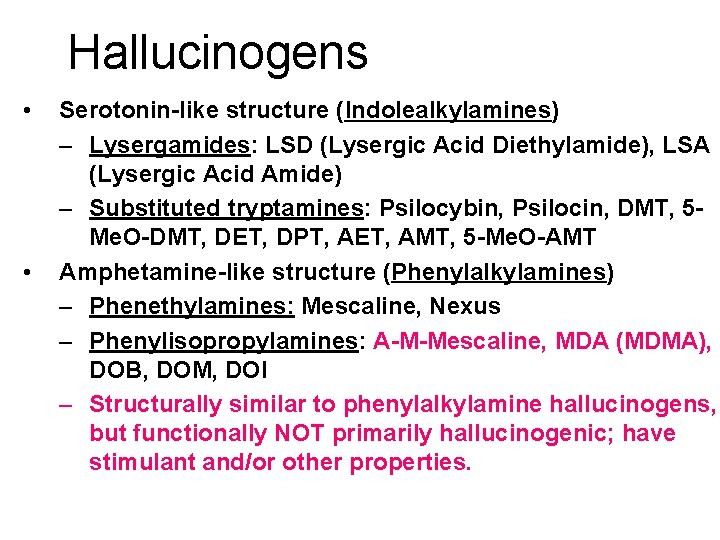
Hallucinogens • • Serotonin-like structure (Indolealkylamines) – Lysergamides: LSD (Lysergic Acid Diethylamide), LSA (Lysergic Acid Amide) – Substituted tryptamines: Psilocybin, Psilocin, DMT, 5 Me. O-DMT, DET, DPT, AET, AMT, 5 -Me. O-AMT Amphetamine-like structure (Phenylalkylamines) – Phenethylamines: Mescaline, Nexus – Phenylisopropylamines: A-M-Mescaline, MDA (MDMA), DOB, DOM, DOI – Structurally similar to phenylalkylamine hallucinogens, but functionally NOT primarily hallucinogenic; have stimulant and/or other properties.
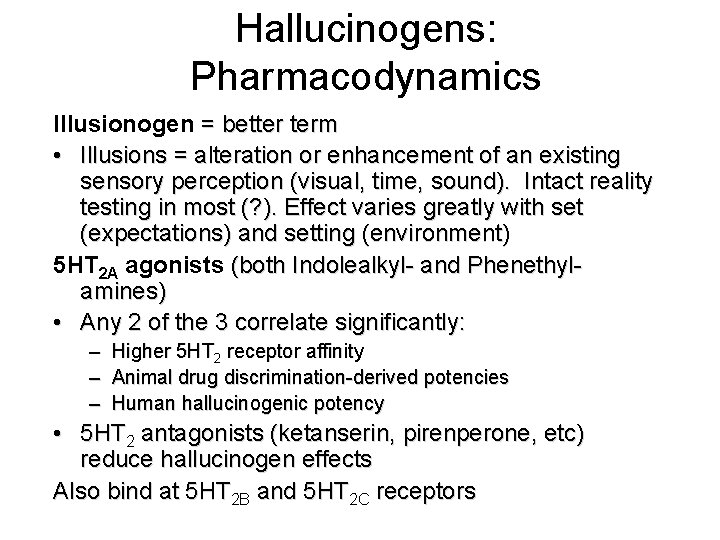
Hallucinogens: Pharmacodynamics Illusionogen = better term • Illusions = alteration or enhancement of an existing sensory perception (visual, time, sound). Intact reality testing in most (? ). Effect varies greatly with set (expectations) and setting (environment) 5 HT 2 A agonists (both Indolealkyl- and Phenethylamines) • Any 2 of the 3 correlate significantly: – – – Higher 5 HT 2 receptor affinity Animal drug discrimination-derived potencies Human hallucinogenic potency • 5 HT 2 antagonists (ketanserin, pirenperone, etc) reduce hallucinogen effects Also bind at 5 HT 2 B and 5 HT 2 C receptors
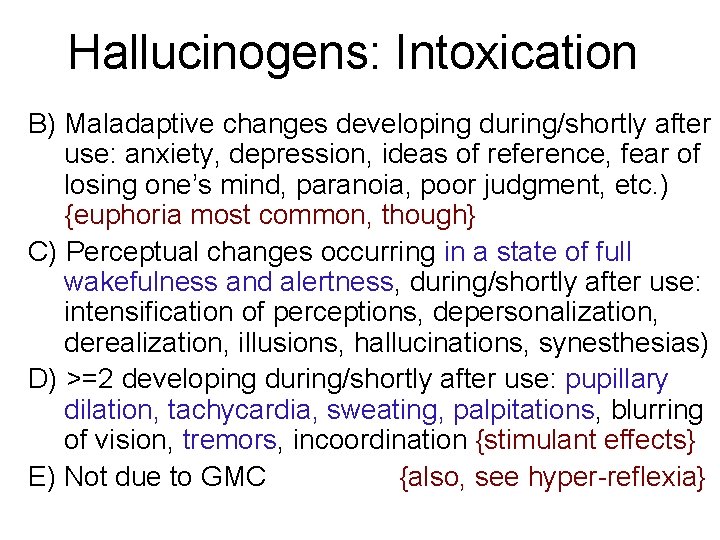
Hallucinogens: Intoxication B) Maladaptive changes developing during/shortly after use: anxiety, depression, ideas of reference, fear of losing one’s mind, paranoia, poor judgment, etc. ) {euphoria most common, though} C) Perceptual changes occurring in a state of full wakefulness and alertness, during/shortly after use: intensification of perceptions, depersonalization, derealization, illusions, hallucinations, synesthesias) D) >=2 developing during/shortly after use: pupillary dilation, tachycardia, sweating, palpitations, blurring of vision, tremors, incoordination {stimulant effects} E) Not due to GMC {also, see hyper-reflexia}
Hallucinogens: Intoxication • • Effect depends upon set and setting Geometric shapes Worse w/eyes closed Afterimages Hyperacuity (not auditory hallucinations) Touch hypersensitivity Time standing still
Hallucinogens: Diff Dx • • • Clear sensorium (delirium) Intact remote and recent memory Fairly oriented (delirium) Hyperalert (drowzy in THC) Intact reality testing – usually (otherwise, consider dx of a primary Psychotic D/O NOS, SCZ, or A intox) thus, “talking down” might prove beneficial • Visual >>> auditory (SCZ, mood, etc) • EEG = arousal (delirium = slowing) • SPECT = hyperfrontal (hypo- in SCZ)
Hallucinogens Withdrawal None (per DSM)
Serotonin-like structure (Indolealkylamines)
LSD • Most potent hallucinogen (micrograms) • Hallucinogen (Illusionogen) - 5 HT 2 A partial agonist • Difficult to make (ingredients = CSA III) • California groups owned market share, protect it • Potency ? Much less than 1960’s
LSD • Albert Hofmann (Sandoz chemist) 1938 • Lysergic acid compounds derived from a rye fungus, ergot • “Accident, ” 1943
LSD • Water soluble; clear, white, odorless crystals • Sold in plastic, opaque canisters (film) – oxidation/degrades discolors (distributors use colored paper for the blotter art) • Pressed into pills = “microdots”. . . thin gelatin squares = “window panes” • Breath mints, sugar cubes (dropping acid), blotter paper (most common) • Street dose = 70 -300 mcg, effects reported from as little as 20 mcg
LSD • Marketed as Delysid in 1947: – Rx’d for schizophrenia, alcoholism, criminal behavior, sexual perversion – Medical students, help understand SCZ • Schedule I, CSA: 1. High abuse potential 2. No legitimate medical indication 3. Lack of accepted safety under medical supervision
LSD • • • Readily absorbed from gut Diffuses to all tissues; brain, placenta, fetus Onset 30 -60 min (oral) Peak = 2 -4 hours Resolves 8 -12 hrs
LSD: Street names Often based on carrier: • • • Acid Bart Simpsons Liquid A Lucy in the sky with diamonds Microdots Dots Mind detergent Blue unicorn • • • Orange cubes, micro. Tabs Barrels Paper acid Sandoz Sugar, sugar cubes Sunshine Twenty five (-th) Windowpanes
LSD • Hallucinogen Persisting Perception Disorder (Flashbacks) – Unrelated to dose, # exposures – Usually none after 1 -2 years (cases of after 5 years) – beltway bumper – High lifetime prevalence of mood d/o’s vs non-LSD using substance users • Rapid (psychological) tolerance; crosses with psilocybins, mescaline –> lower f of use
LSA (Ly. Sergic acid Amide) • Morning Glory Seeds grind up • 5 -10% the potency of LSD • 20 -30 mcg LSD ~ 100 -300 morning glory seeds (in
Psilocybins, Psilocins • Use dates back to 1000 - 500 BC • Aztecs • 1957 Sandoz assisted researchers in extracting it • Synthesis technique developed • May 13, 1957 LIFE issue: described Mazatech velada, 7 varieties of mush’s • “Magic Mushrooms” in the 1960’s (Psilocybe mexicana)
Psilocybins, Psilocins • Central America, Mexico • Both psychoactive (psilocin more) -ratio varies among mushrooms • Psilocin less stable, oxidized upon drying • Dried mushrooms = 0. 2% - 0. 4% psilocybin, only trace psilocin • 4 -8 mg of mixed psilocin/cybins = hallucinations (~2 gm of mushrooms)
Psilocybins, Psilocins • Intoxication duration = 2 hours • Synesthesias • Detachment from reality, Enmeshment with surroundings • Inability to discern fantasy from reality --> panic attacks, psychoses • More “natural” high than w/LSD • Rapid tolerance … cross tolerance w/LSD
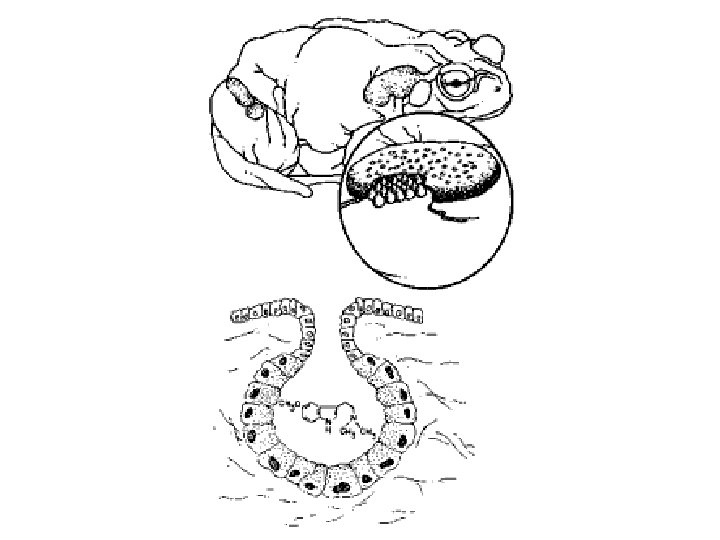
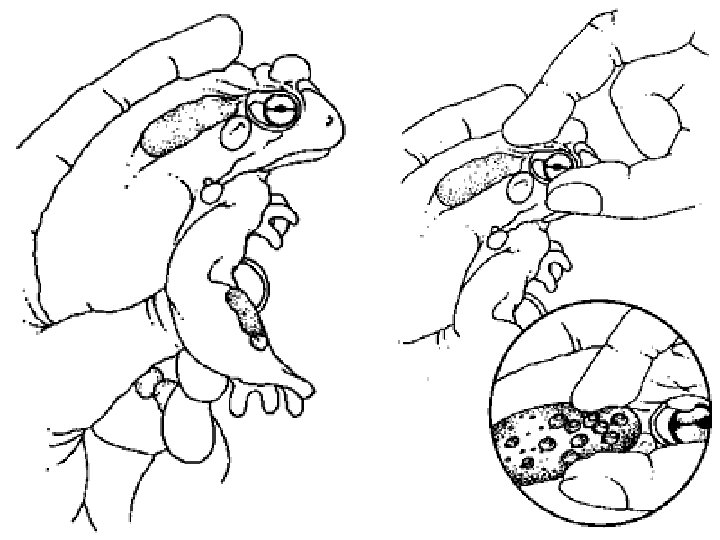
DMT Naturally occurring – Plants: Phalaris aruninacea = DMT + 5 -Me. O-DMT (Me. O- increases lipid solubility, 10 X potent) • “Businessman’s Trip” – rapid onset, short duration (<60 min) – snorted/ IV/smoked (oral – inactivated) • MAOI enables oral use (lengthens catabolism) – Toads: Bufo alvarius (Sonoran Desert Toad) • • Glandular venom = 6 -16% 5 -Me. O-DMT Skin contains 5 -Me. O-DMT (50 -160 mg/g skin) 3 -5 mg = psychoactive effect 1959: predominant alkaloid in the hallucinogenic snuffs of several tribes in South America
DMT user’s account … Within thirty seconds, there will be an onset of almost overwhelming psychedelic effects. You will be completely absorbed in a complex chemical event characterized by an overload of thoughts and perception, brief collapse of the EGO, and loss of the space-time continuum. Relax, breathe regularly, and flow with the experience. After two to three minutes, the initial intensity fades to a pleasant LSD-like sensation in which visual illusions, hallucinations, and perceptual distortions are common. You may sense a distortion in your perceived body image or notice the world shrinking or expanding. You may notice that colors seem brighter and more beautiful than usual. And, most likely, you will experience a euphoric mood interspersed with bursts of unmotivated laughter.
DET, DPT, AET • • Substituted tryptamines Similar in effect to DMT Less potent Schedule I of CSA
Amphetamine-like structure (Phenethylamines)
Mescaline • Principal psychoactive agent found naturally in the peyote cactus • 3, 4, 5 -trimethoxy-phenethylamine • 1 st hallucinogen isolated (Arthur Heffter 1896) • Peyote cactus: central Mexico – south Texas • 300 BC – religious rites • Comanche, Kiowa, Navajo, Sioux • Supreme Court protects religious use within Native American Church (no synthetics) • Canada
Mescaline • • • Peyote cactus Crown (top) contains buttons Buttons are cut off, dried 1 -6% of dried button = mescaline 6 -10 buttons = intoxication (100– 350 mg required) • Chewed or soaked in water
Mescaline: Intoxication • 30 min delay • 2 phases: First hour – Minor perceptual changes – Adrenergic stimulation (increased resp. rate; face & neck muscular tension) – Nausea (can be severe) -- other alkaloids Next several hours (as much as 5 -10) – Visual illusions, hallucinations – synesthesias
Importance of set, setting • Religious rituals, guides Mescaline – A&E documentary (father gives drug to son); religious leader Beta-carbolines – Harmaline +/- DMT, 5 -Me. O-DMT – Sting’s memoir (exploring personal life meaning) – ayahuasca (South American ritual beverage) – Mestre
Nexus • • “ 2 -CB” “CB’s” Similar in structure to mescaline Analog of DOB
DOM, DOB, DOI • DOM (“STP”)= “model”/reference hallucinogen in drug discrimination studies • dimethoxymethylamphetamine
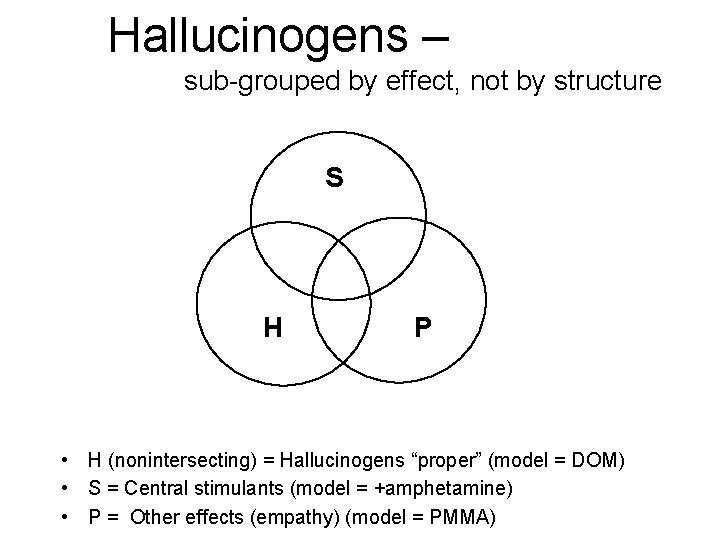
Hallucinogens – sub-grouped by effect, not by structure S H P • H (nonintersecting) = Hallucinogens “proper” (model = DOM) • S = Central stimulants (model = +amphetamine) • P = Other effects (empathy) (model = PMMA)
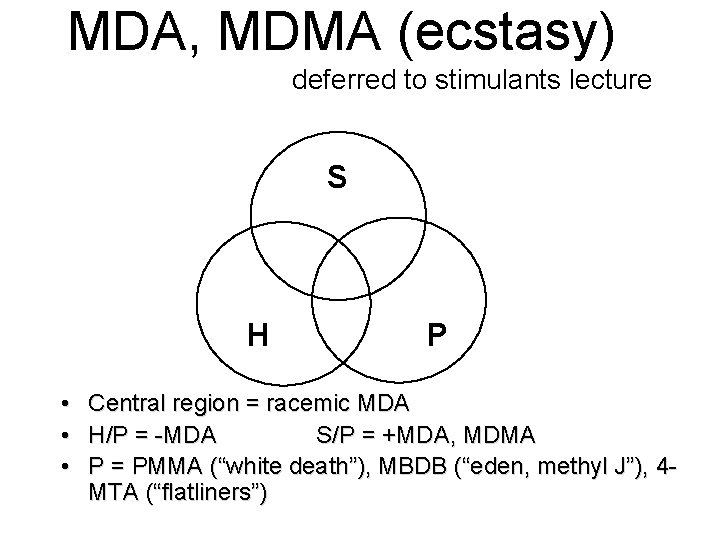
MDA, MDMA (ecstasy) deferred to stimulants lecture S H • • • P Central region = racemic MDA H/P = -MDA S/P = +MDA, MDMA P = PMMA (“white death”), MBDB (“eden, methyl J”), 4 MTA (“flatliners”)
Steroids • Synthetic derivatives of the male hormone testosterone • Rx uses: delayed puberty, impotence, wasting due to HIV, etc. • 2 effects: 1. Anabolic (maximize): skeletal muscle growth (via retaining N, directly stimulate protein production, increase availability of ATP to muscles, increased Hct) 2. Androgenic (minimize): male sexual char’s
Steroids • 1930’s: testosterone synthesized • 1940’s-50’s: use in sports • 1950’s: brought to US by Dr John Zeigler, nat’l weightlifting team doc; f/Eastern Bloc countries after 1952 Olympics success • 1968: drug testing at Olympics • 1975: banned by IOC • 1990: CSA Schedule III
Steroids • Purpose of abuse: muscle, appearance – Triad: athletes, aesthetes, fighting elite • Doses: abused @ up to 100 X recc’d dose • Routes: – Oral: Anadrol (oxymetholone), Oxandrin (oxandrolone), Dianabol (methandrostenolone), Winstrol (stanozolol), etc. – IM: Deca-Durabolin (nandrolone decanoate), Durabolin (nandrolone phenpropionate), Depo-Testosterone (testosteronecypionate), Equipoise (boldenone undecylenate), etc • “reward” = delayed • Many case reports of “dependence”
Steroids: Terminology • Stacking: taking 2 or more (a) steroids/stimulants/pain killers and/or (b) routes {po, IM}. “The whole is greater than the sum of the parts. ” • Pyramiding: taper-up the doses over 6 -12 weeks, then taper-down over next 6 -12 weeks just before the event • Plateauing: when a drug becomes ineffective at a certain level • Cycling: different drugs/times
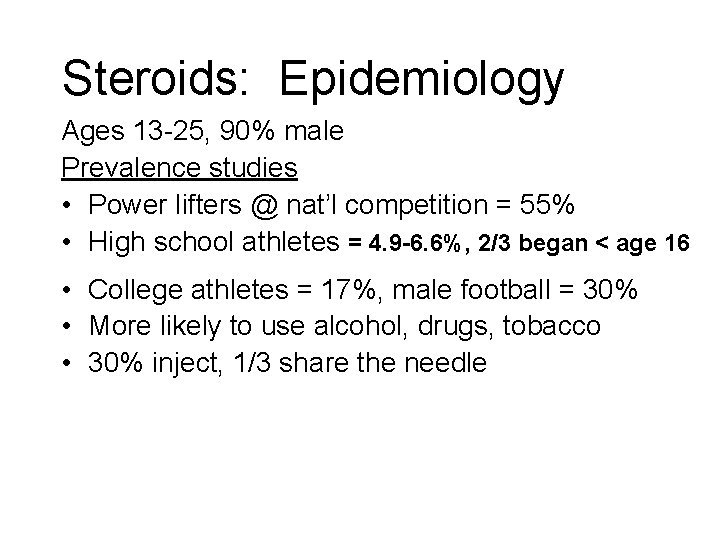
Steroids: Epidemiology Ages 13 -25, 90% male Prevalence studies • Power lifters @ nat’l competition = 55% • High school athletes = 4. 9 -6. 6%, 2/3 began < age 16 • College athletes = 17%, male football = 30% • More likely to use alcohol, drugs, tobacco • 30% inject, 1/3 share the needle
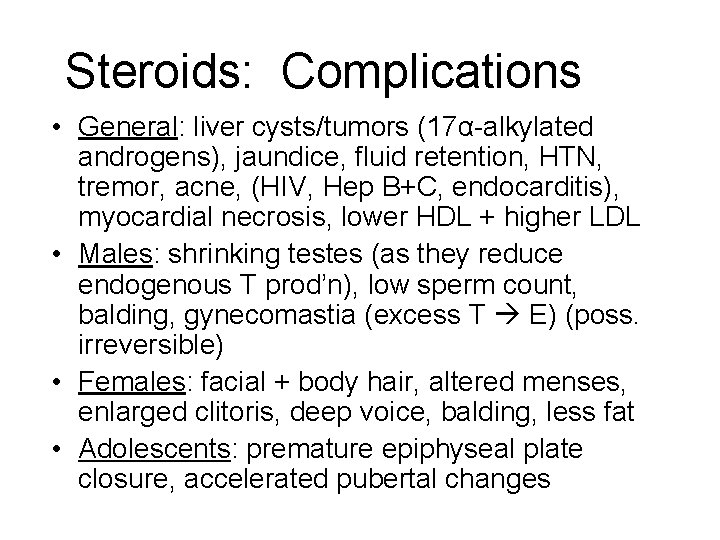
Steroids: Complications • General: liver cysts/tumors (17α-alkylated androgens), jaundice, fluid retention, HTN, tremor, acne, (HIV, Hep B+C, endocarditis), myocardial necrosis, lower HDL + higher LDL • Males: shrinking testes (as they reduce endogenous T prod’n), low sperm count, balding, gynecomastia (excess T E) (poss. irreversible) • Females: facial + body hair, altered menses, enlarged clitoris, deep voice, balding, less fat • Adolescents: premature epiphyseal plate closure, accelerated pubertal changes
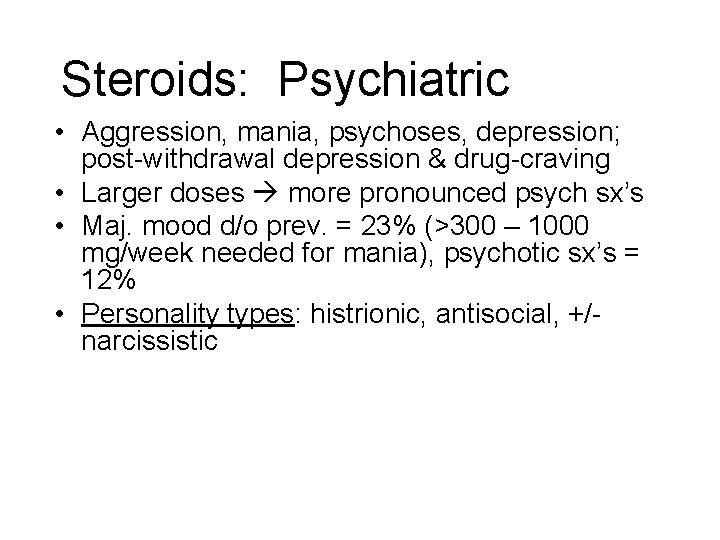
Steroids: Psychiatric • Aggression, mania, psychoses, depression; post-withdrawal depression & drug-craving • Larger doses more pronounced psych sx’s • Maj. mood d/o prev. = 23% (>300 – 1000 mg/week needed for mania), psychotic sx’s = 12% • Personality types: histrionic, antisocial, +/narcissistic
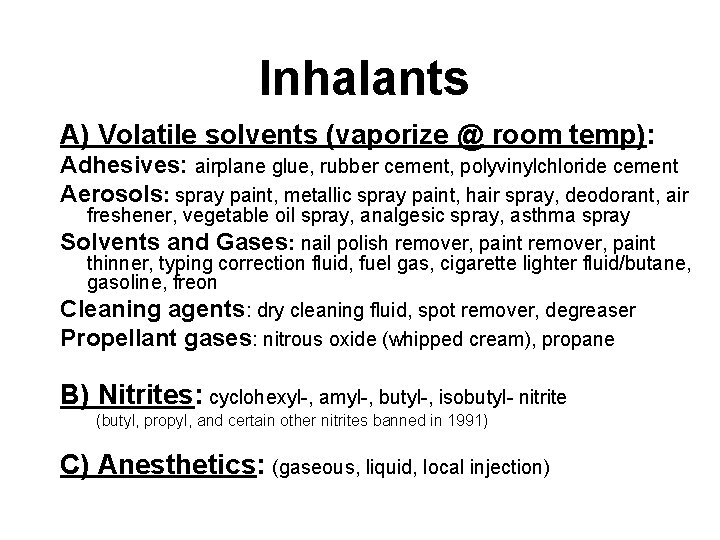
Inhalants A) Volatile solvents (vaporize @ room temp): Adhesives: airplane glue, rubber cement, polyvinylchloride cement Aerosols: spray paint, metallic spray paint, hair spray, deodorant, air freshener, vegetable oil spray, analgesic spray, asthma spray Solvents and Gases: nail polish remover, paint thinner, typing correction fluid, fuel gas, cigarette lighter fluid/butane, gasoline, freon Cleaning agents: dry cleaning fluid, spot remover, degreaser Propellant gases: nitrous oxide (whipped cream), propane B) Nitrites: cyclohexyl-, amyl-, butyl-, isobutyl- nitrite (butyl, propyl, and certain other nitrites banned in 1991) C) Anesthetics: (gaseous, liquid, local injection)
Inhalants • 1/6 adolescents tries inhalants, most 1 -5 x • Males, non-Hispanic white youths • Inhalant Dependence is uncommon (0. 3% prevalence, 1 in 27 lifetime users) • Not passing fad, 10% use > 6 years • Strong assoc. with ASPD, PSA, later IVDA (5 -9 X) • Developing countries
Inhalants • Highly lipophyllic HC chains, cross into brain Pharmacodynamics • Unknown, ~ to dissociatives (NMDA) and alcohol/sedatives (GABA) • Drowsiness settles in for several hours • Toluene increases extracellular D in PFC • Toluene, nitrous oxide, & chloroform have reinforcing properties in self-administration studies.
Inhalants: Terminology • Sniffing • Huffing: cloth (or mask) (soaked with substance) applied to face and breathed in • Bagging: enclosing the substance in a bag and breathing it in • Poppers, snappers: ampules of amyl nitrite Rx’d for angina (broken and inhaled). 1960 FDA allowed OTC use. Increase in abuse (gay men: smooth muscle relaxation, vasodilation sexual enhancement). FDA restored Rx requirement. Also: butyl/isobutyl nitrite/cyclohexyl (nowadays find them sold as video head cleaner or room deodorizer in adult sex shops) • Whippet: balloons/bags filled w/ N 2 O (laughing gas) • Torch, fire-breathing: exhaling + igniting volatile gases (propane, butane) • Texas shoe shine: toluene-containing spray paint
Inhalants: PE, lab • Odor of paint, solvents (clothes, breath) • Residues, burns, related traumas • ‘Glue sniffer’s rash” around nose & mouth, conjunctival irritation • Cough, sinus discharge, dyspnea, rales, rhonchi • Neuro: weakness, peripheral neuropathy, cerebral/cerebellar/brain stem atrophy, white matter lesions, MS-like syndrome, dementia, delirium • Hepatitis, cirrhosis • Metabolic acidosis with distal renal tubular acidosis, CRF • Bone marrow suppression • Neuropsychological testing problems in chronic inhalant users
Inhalants Intoxication A) Recent use/exposure B) Maladaptive changes developing during or shortly after use: belligerence, assaultiveness, apathy, impaired judgment, etc. C) >=2 developing within 2 hours of use: dizziness, nystagmus, incoordination, slurred speech, unsteady gait, lethargy, depressed reflexes, psychomotor retardation, tremor, gen. muscle weakness, blurred vision/diplopia, stupor/coma, euphoria D) Not due to GMC
Inhalants Withdrawal None, per DSM. However, a mild syndrome beginning 1 -2 day after last use and extending for 2 -5 days has been described. Symptoms may include sleep problems, tremor, irritability, diaphoresis, nausea, fleeting illusions. Abuse, dependence, and tolerance are confirmed
Inhalants: “Sudden sniffing death” Falling unconscious on source/rag; “hands-free” use during sex Acute arrhythmia *** Heart failure (from butane or chlorofluorocarbons associated hyper-excitability to NE) Hypoxia ** Suffocation (as substance replaces oxygen) Methyl chloride carbon monoxide Poppers (ampules of amyl/butyl/isobutyl nitrite ) – reduce oxygen carrying capacity CNS, respiratory depression Electrolyte abnormalities *
Inhalants: Fetal effects • Cross placenta renal tubular acidosis • Data primarily from occupational exposures – – – Cleft malformations, gastroschisis, esophageal stenosis Omphalocele Ventricular septal defects CNS defects Spontaneous abortions • Inhalant using women create higher exposure levels – – Limb abnormalities Growth retardation Craniofacial defects Developmental delays, language • Toluene in animals – Neuronal migration, proliferation affected
Lindner Center of Hope Summary Dissociatives: Phencyclidine, Ketamine, Dextromethorphan Hallucinogens: Serotonin-like structure – LSD, LSA – Psilocybin, Psilocin, DMT-like … Amphetamine-like structure – Mescaline, Nexus, DOM, DOB, DOI Steroids Inhalants