
Pacific Behavioral Health Collaborating Council Alcohol and Drug
Pacific Behavioral Health Collaborating Council Alcohol and Drug Counselor (ADC) Academy, Day 2 Core Competencies of Addiction Counselors: Knowledge and Skill Acquisition of Screening, Intake, Orientation, Assessment, Treatment Planning, and Counseling Enter location here Enter dates here Enter trainer names and credentials here
Acknowledgements This training was developed by Dr. Thomas E. Freese, Ph. D (Director of Training of UCLA ISAP and Director of the Pacific Southwest ATTC), Alex R. Ngiraingas, MEd, CSAC II, ICADC, ICPS, and Dr. Christopher C. C. Rocchio, Ph. D, LCSW, CSAC, ICADC (Clinical Specialist, UCLA) in August of 2018 under contract number 2018 -002 by the University of California Los Angeles, Integrated Substance Abuse Programs (UCLA ISAP) and the Pacific Southwest Addiction Technology Center (PSATTC) for the Pacific Behavioral Health Collaborating Council (PBHCC). Additional resource provided by SAMHSA, grant number UR 1 TI 080211. 2
Disclaimer for Training The UCLA, its employees, contractors, and affiliates shall not be liable for any damages, claims, liabilities, costs, or obligations arising from the use or misuse of materials or information contained in this presentation. Any use, copying, or distribution without written permission from the UCLA and the PBHCC is prohibited. 3
Today’s Agenda (1) • Review and check-in • Twelve Core Functions – Screening – Intake – Orientation – Assessment – Treatment Planning – Counseling 4
Agenda for Screening • • Definition of screening Importance of establishing rapport Importance of using diagnostic criteria DSM-5 Criteria for Substance Use Disorders Context of treatment settings Common screening tasks Global Criteria 5
Definition of Screening • “Screening is the process by which the counselor, the client, and available significant others review the current situation, symptoms, and other available information to determine the most appropriate initial course of action, given the clients needs and characteristics and the available resources within the community” (CSAT, 2006, p. 39). • “The process by which a client is determined to be appropriate and eligible for admission to a particular program” (IC&RC) Reference Center for Substance Abuse Treatment. (2006). Addiction counseling competencies: the knowledge, skills, and attitudes of professional practice. Technical Assistance Publication (TAP) Series 21 (HHS Publication No. (SMA) 15 -4171). Rockville, MD: Substance Abuse and Mental Health Services Administration. Herdman, J. W. (2018). Global criteria: the 12 core functions of the substance abuse counselor (7 th ed. ). Lincoln, NE: Parallels: Pathways to Change. 6
Importance of Establishing Rapport • Consider the different pathways the client has arrived in your agency. • Screening presents hope. • Screening provides an opportunity to establish rapport. • Screening may influence how the individual engages the SUD system of care. 7
Establishing Rapport (continued) • Orient the client to the meeting/screening agenda • Listen to understand: use active listening – Use open, non-threatening and non-judgmental questions – Use simple reflections – Use encouraging prompts (e. g. , tell me more about that) – Use a warm tone of voice – Ask clarifying or follow-up questions 8
Importance of Using Diagnostic Criteria • All counselors must use objective criteria to determine whether the applicant’s alcohol and drug use constitutes a substance use disorder (SUD). • All counselors must be familiar with and recognize specific examples of the various psychological, physiological, and social signs and symptoms of SUDs. 9
DSM-5 Criteria and Substance Use Disorders • Substance-related disorders – Alcohol; Caffeine; Cannabis; Hallucinogens; Inhalants; Opioids; Sedatives, hypnotics, and anxiolytics; Stimulants; Tobacco; Other or Unknown • Substance-Related Disorders are divided into 2 groups: – Substance Use Disorders – Substance-Induced Disorders (intoxication, withdrawal, and other substance/medication-induced mental disorders) Reference American Psychiatric Association. (2013). Diagnostic and statistical manual of mental disorders (5 th ed. ). Washington, DC: Author. 10
DSM-5 Criteria (continued) • “Cluster of cognitive, behavioral, and physiological symptoms indicating that the individual continues using the substance despite significant substance-related problems” (APA, 2013, p. 483). • Eleven (11) criteria organized into four groupings: – Impaired control (criteria 1 – 4), – Social impairment (criteria 5 – 7), – Risky use (criteria 8 - 9), and – Pharmacological criteria (criteria 10 – 11) Reference American Psychiatric Association. (2013). Diagnostic and statistical manual of mental disorders (5 th ed. ). Washington, DC: Author. 11
Impaired Control / Loss of Control • Criterion 1: Increased amounts over longer periods of time. The substance is often taken in larger amounts or over a longer period than was intended. • Criterion 2: Individual may express desire to cut down or regulate substance use or describe unsuccessful efforts to decrease or quit the substance. • Criterion 3: A great deal of time is dedicated to obtaining, using, or recovering from the effects of the substance. • Criterion 4: Cravings – an intense desire or urge for the substance. Reference American Psychiatric Association. (2013). Diagnostic and statistical manual of mental disorders (5 th ed. ). Washington, DC: Author. 12
Social Impairment • Criterion 5: Recurrent use of the substance may result in a failure to fulfill major obligations at work, school, or home. • Criterion 6: Continued use of the substance despite persistent or recurrent social and interpersonal problems cause or exacerbated by the effect of the substance. • Criterion 7: Reduction or end to social, recreational, or occupational activities because of substance use. Reference American Psychiatric Association. (2013). Diagnostic and statistical manual of mental disorders (5 th ed. ). Washington, DC: Author. 13
Risky Use • Criterion 8: Recurrent use in situations where it is physically hazardous to use the substance. • Criterion 9: Continued use of the substance despite knowledge of having a persistent or recurrent physical or psychological problems likely to have been caused or exacerbated by the substance. Reference American Psychiatric Association. (2013). Diagnostic and statistical manual of mental disorders (5 th ed. ). Washington, DC: Author. 14
Pharmacological Criteria • Criterion 10: Tolerance – Increased dose to achieve desired effect. – Reduced effect when usual dose is consumed. – Tolerance may be difficult to determine by history alone, consider laboratory tests or other methods (e. g. , alcohol). – Individual variability of the initial sensitivity to the effects of different substances. Reference American Psychiatric Association. (2013). Diagnostic and statistical manual of mental disorders (5 th ed. ). Washington, DC: Author. 15
Pharmacological Criteria (continued) • Criterion 11: Withdrawal – Blood or tissue concentrations of a substance decline…prolonged heavy use. – Use to maintain homeostasis or to relieve symptoms. – Variability in symptoms across different classes of substances. – Marked and measurable physiological signs common in some substances (e. g. , alcohol) whereas none in others (e. g. , hallucinogens). • Neither tolerance or withdrawal are necessary for a diagnosis of a substance use disorder. Reference American Psychiatric Association. (2013). Diagnostic and statistical manual of mental disorders (5 th ed. ). Washington, DC: Author. 16
Severity and Specifiers • Severity is based on the number of symptom criteria endorsed: – Mild: Presence of 2 – 3 symptoms – Moderate: Presence of 4 – 5 symptoms – Severe: Presence of 6 or more symptoms • Severity may change over time. • Specifiers – In early remission (e. g. , individual just stopped using) – In sustained remission – On maintenance therapy (e. g. , methadone) – In a controlled environment (e. g. , hospital or residential treatment center) Reference American Psychiatric Association. (2013). Diagnostic and statistical manual of mental disorders (5 th ed. ). Washington, DC: Author. 17
Recording Procedures and the DSM-5 • Record the name of the specific substance. • Substances not categorized into 10 classes should be recorded as other substance use disorder, and specify the specific substance. • Identify and record ALL substance use disorders. Reference American Psychiatric Association. (2013). Diagnostic and statistical manual of mental disorders (5 th ed. ). Washington, DC: Author. 18
Context of Treatment Setting • Understanding the context of the treatment setting is critical! • What is the treatment modality, environment, and philosophy of the program? • What is the level of care? 19
Context (continued) • The determination of a potential client’s appropriateness for a program requires a great degree of judgment and skill. • Important factors include: – Physical health condition of the client – The psychological functioning of the client – Outside supports and resources – Previous treatment efforts – Motivation for change Reference Herdman, J. W. (2018). Global criteria: the 12 core functions of the substance abuse counselor (7 th ed. ). Lincoln, NE: Parallels: Pathways to Change. 20
Common Screening Tasks • Assemble and complete screening forms. • Screening forms generally ask questions regarding the client’s demographics (age, sex, residence), presenting problems, previous treatment efforts, level of commitment to change, outside recovery supports, and insurance. • Analyze all information to determine client eligibility and appropriateness for program. • If client is appropriate, begin arrangements for intake. • If client is not appropriate, investigate referral options and discuss options with the client (see Referral). 21
Global Criteria for Screening 1. Evaluate the psychological, social, and physiological signs & symptoms of alcohol and other drug abuse. 2. Determine the client’s appropriateness for admission or referral. 3. Determine the client’s eligibility for admission or referral. 4. Identify any coexisting conditions (medical, psychiatric, physical, etc. ) that indicate the need for additional assessment and/or services. 5. Adhere to applicable laws, regulations, and agency policies governing alcohol and drug abuse services. Reference Herdman, J. W. (2018). Global criteria: the 12 core functions of the substance abuse counselor (7 th ed. ). Lincoln, NE: Parallels: Pathways to Change. 22
Group Activity for Screening • • • Establish your own outpatient treatment center. What is the name of your outpatient treatment center? Who does your center serve? What screening tools and processes will you use? Be prepared to report out Be prepared to ask questions and offer suggestions to support your colleagues 23
Today’s Agenda (2) • Review and check-in • Twelve Core Functions – Screening – Intake – Orientation – Assessment – Treatment Planning – Counseling 24
Agenda for Intake • • Definition Common tasks at intake Importance of confidentiality Global Criteria 25
Definition of Intake • The IC&RC defines intake as “the administrative and initial procedures for admission into a program” Reference Herdman, J. W. (2018). Global criteria: the 12 core functions of the substance abuse counselor (7 th ed. ). Lincoln, NE: Parallels: Pathways to Change. 26
Common Tasks at Intake • Complete agency-specific intake forms. • Conduct intake interview. • Assign primary counselor and other members of the treatment team. • Discuss privacy and confidentiality. 27
Importance of Confidentiality and Intake • Educate the client to various state and federal rules and regulations protecting their identity. – Explain in both oral and written form. – Explained in a way that can be easily understood • Addressing confidentiality builds trust and rapport. • Addressing confidentiality minimizes anxiety. 28

Global Criteria for Intake 6. Complete the required documents for admission. 7. Complete the required documents for program eligibility and appropriateness. 8. Obtain appropriately signed consents when soliciting information from, or providing information to, outside sources to protect client confidentiality and rights. Reference Herdman, J. W. (2018). Global criteria: the 12 core functions of the substance abuse counselor (7 th ed. ). Lincoln, NE: Parallels: Pathways to Change. 29
Group Activity for Intake • What does intake look like in your outpatient center? • What specific forms do clients need to complete at intake? • What processes will you employ to ensure clients know what they are signing? • Be prepared to report out to the larger group. • Be prepared to ask questions and offer suggestions to support your colleagues. 30
Today’s Agenda (3) • Review and check-in • Twelve Core Functions – Screening – Intake – Orientation – Assessment – Treatment Planning – Counseling 31
Agenda for Orientation • • Definition Designing an orientation process Common orientation tasks Global Criteria 32
Definition of Orientation • The IC&RC defines orientation as “describing to the client the general nature and goals of the program; the rules governing client conduct and infractions that can lead to disciplinary action or discharge from the program; in a non-residential program, the hours during which services are available; the treatment costs that are to be borne by the client, if any; and the client rights” Reference Herdman, J. W. (2018). Global criteria: the 12 core functions of the substance abuse counselor (7 th ed. ). Lincoln, NE: Parallels: Pathways to Change. 33
Designing an Orientation Process • Describing essential information about the program to support clients with assimilating into the program so that the client can focus on treatment. • Choosing culturally-and linguistically-informed processes for presenting information to diverse client groups. • Presenting rules, regulations, and consequences for program infractions that is easily understood by clients. 34
Designing a Process (continued) • Aim to create a safe, warm and welcoming space where clients may discuss their fears and misconceptions about treatment. • Aim to create a safe and secure space where clients are encouraged to ask questions about rules, regulations, and expectations. • Aim to create a process to ensure clients understand their rights and responsibilities. 35
Common Orientation Tasks • If applicable, complete an orientation checklist which may include, but not be limited to the following: – Overview of program philosophy and treatment modalities used, program expectations and client responsibilities, and program rules and regulations – Provide a tour of the facility. – If residential or inpatient, assign bed and screen clothing and personal belonging for contraband materials. 36
Common Orientation Tasks (continued) • Review and have clients sign an acknowledgement form that they have reviewed, understand, and have received a copy of their rights. • Client rights should include, but not be limited to: – Assurance of privacy and confidentiality – Right to review and participate in treatment planning – Impartial access to treatment – Recognition of personal property – Visits, mail, and telephone calls 37
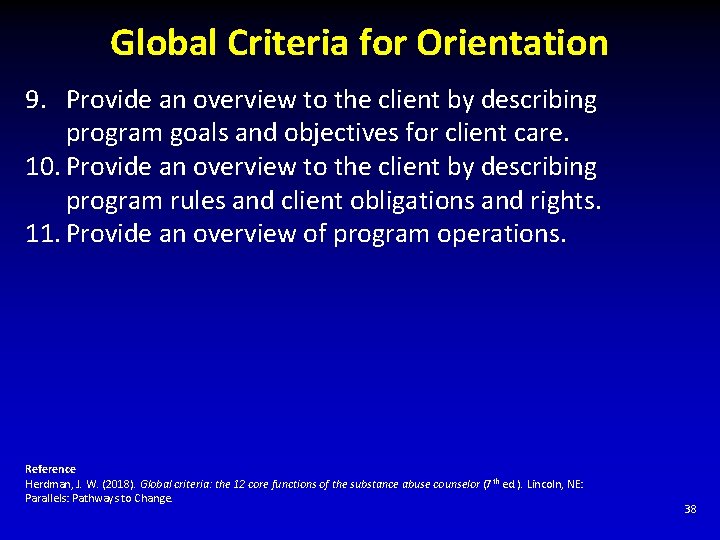
Global Criteria for Orientation 9. Provide an overview to the client by describing program goals and objectives for client care. 10. Provide an overview to the client by describing program rules and client obligations and rights. 11. Provide an overview of program operations. Reference Herdman, J. W. (2018). Global criteria: the 12 core functions of the substance abuse counselor (7 th ed. ). Lincoln, NE: Parallels: Pathways to Change. 38
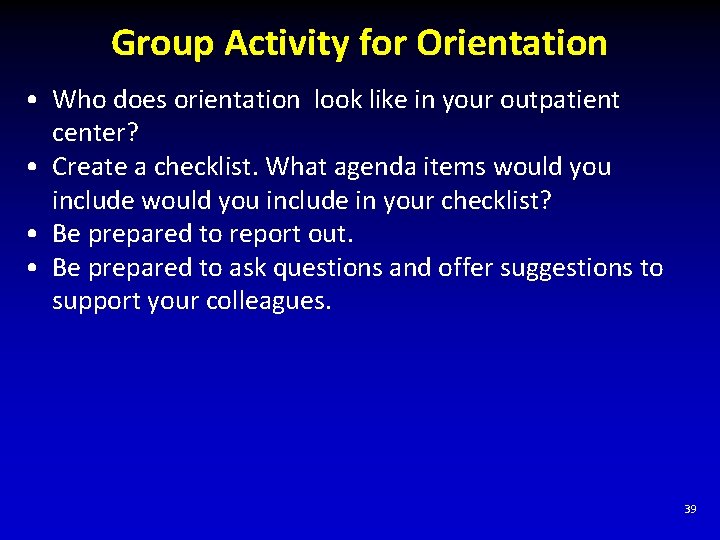
Group Activity for Orientation • Who does orientation look like in your outpatient center? • Create a checklist. What agenda items would you include in your checklist? • Be prepared to report out. • Be prepared to ask questions and offer suggestions to support your colleagues. 39
Today’s Agenda (4) • Review and check-in • Twelve Core Functions – Screening – Intake – Orientation – Assessment – Treatment Planning – Counseling 40
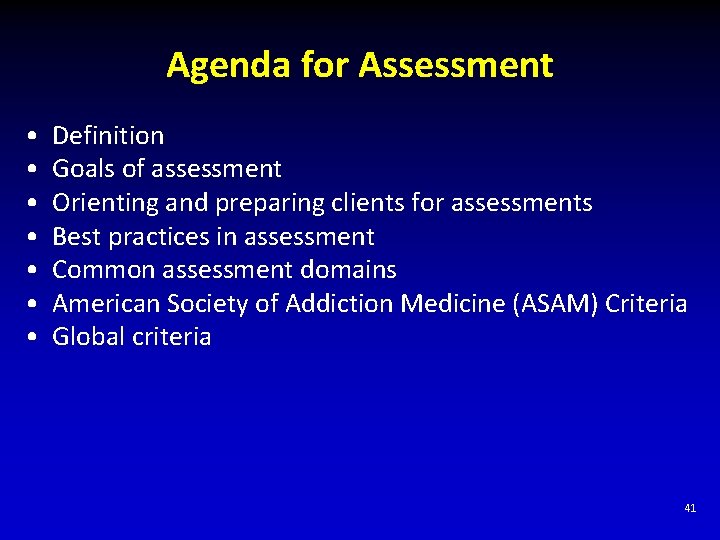
Agenda for Assessment • • Definition Goals of assessment Orienting and preparing clients for assessments Best practices in assessment Common assessment domains American Society of Addiction Medicine (ASAM) Criteria Global criteria 41
Definition of Assessment • “Assessment is an ongoing process through which the counselor collaborates with the client and others to gather and interpret information necessary for planning treatment and evaluating client progress” (CSAT, 2006, p. 46). • Assessment is defined by the IC&RC as “those procedures by which a counselor/program identifies and evaluates an individual’s strengths, weaknesses, problems and needs for the development of the treatment plan” Reference Center for Substance Abuse Treatment. (2006). Addiction counseling competencies: the knowledge, skills, and attitudes of professional practice. Technical Assistance Publication (TAP) Series 21 (HHS Publication No. (SMA) 15 -4171). Rockville, MD: Substance Abuse and Mental Health Services Administration. Herdman, J. W. (2018). Global criteria: the 12 core functions of the substance abuse counselor (7 th ed. ). Lincoln, NE: Parallels: Pathways to Change. 42
Goals of Assessment • Synthesize, integrate, analyze and interpret information necessary for planning treatment and evaluating client progress. • First step in shared decision making. • Ensure that the client is matched to the right level of care within the SUD treatment continuum. • Identify client strengths and resources that may support them in their own recovery. • Identify the client’s unique needs and preferences. • Identify potential and real barriers to treatment. • Communicate findings and treatment recommendations to clients, their supporters, and to others involved in their care. Reference Adams, N. & Grieder, D. M. (2014). Treatment planning for person-centered care: shared decision making for whole health (2 nd ed. ). Waltham, MA: Elsevier Inc. 43
Goals of Assessment (continued) • In a recovery-oriented, strengths-based, personcentered, culturally-and linguistically-informed approach to care, the focus is on action rather than on emphasizing and cataloging all deficits and problem areas. • Individualized treatment requires comprehensive assessments. • Assessment is more than gathering data – it is the initiation of building a trusting, helping, healing and therapeutic relationship. • Assessments are not static. Reference Adams, N. & Grieder, D. M. (2014). Treatment planning for person-centered care: shared decision making for whole health (2 nd ed. ). Waltham, MA: Elsevier Inc. 44
Orienting and Preparing the Client for the Assessment • Orient the client to the assessment process: – How long? – What kinds of questions will be asked? – What are the limits to confidentiality? • Orienting the client to the use of laboratory testing. Reference Morrison, J. (2014). The first interview (4 th ed. ). New York, NY: Guilford Press 45
Best Practices in Assessment • • • Be present Minimize potential distractions Be accepting and encouraging Be sensitive to culture and gender Ask for clarification Use a combination of open questions and reflections Allow for silence Focus on balancing present behavior with history If permitted and with consent, seek out information from collateral contacts Reference Substance Abuse and Mental Health Services Administration. (2005). Substance abuse treatment for persons with co-occurring disorders. Treatment Improvement Protocol (TIP) Series 42 (HHS Publication No. (SMA) 13 -3992). Rockville, MD: Substance Abuse and Mental Health Services Administration. 46
Common Assessment Domains • History (comprehensive and longitudinal) and current use of substances • SUD treatment history • Acute safety risk related to intoxication or withdrawal • Sociocultural history • Interpersonal and family history, including parenting and caregiver history Reference Center for Substance Abuse Treatment. (2009). Substance abuse treatment: addressing the specific behavioral health needs of women. Treatment Improvement Protocol (TIP) Series 55 (HHS Publication No. (SMA) 09 -4426). Rockville, MD: Substance Abuse and Mental Health Services Administration. (2013). Addressing the specific behavioral health needs of men. Treatment Improvement Protocol (TIP) Series 55 (HHS Publication No. (SMA) 13 -4736). Rockville, MD: Substance Abuse and Mental Health Services Administration. (2005). Substance abuse treatment for persons with co-occurring disorders. Treatment Improvement Protocol (TIP) Series 42 (HHS Publication No. (SMA) 13 -3992). Rockville, MD: Substance Abuse and Mental Health Services Administration. 47
Assessment Domains (continued) • • Educational, vocational, and military history Legal history Housing status Spirituality and religiousness Medical history and physical health Mental health and treatment history Motivation Strengths and coping skills Reference Center for Substance Abuse Treatment. (2009). Substance abuse treatment: addressing the specific behavioral health needs of women. Treatment Improvement Protocol (TIP) Series 55 (HHS Publication No. (SMA) 09 -4426). Rockville, MD: Substance Abuse and Mental Health Services Administration. (2013). Addressing the specific behavioral health needs of men. Treatment Improvement Protocol (TIP) Series 55 (HHS Publication No. (SMA) 13 -4736). Rockville, MD: Substance Abuse and Mental Health Services Administration. 48
Assessment and Matching Clients Using ASAM Criteria • Dimension I – Acute Intoxication and/or Withdrawal Potential (withdrawal management services) • Dimension II – Bio-Medical Conditions & Complications (physical health services) • Dimension III – Emotional, Behavioral or Cognitive Conditions & Complications (mental health services) Reference Mee-Lee, David. (Eds. ) (2013) The ASAM criteria: treatment for addictive, substance-related, and co-occurring conditions. Chevy Chase, MD: American Society of Addiction Medicine 49
Assessment and Matching Clients (continued) • Dimension IV – Readiness to Change (motivational services) • Dimension V – Relapse, Continued Use, Continued Problems Potential (relapse and prevention services) • Dimension VI – Recovery and Living Environment (recovery support services) Reference Mee-Lee, David. (Eds. ) (2013) The ASAM criteria: treatment for addictive, substance-related, and co-occurring conditions. Chevy Chase, MD: American Society of Addiction Medicine 50
Assessing Risk for Each Dimension Severity and Level of Functioning Profile • Four: Utmost severity. Critical impairments/symptoms indicating imminent danger • Three: Serious issue or difficulty coping. High risk or near imminent danger • Two: Moderate difficulty in functioning with some persistent chronic Issues • One: Mild difficulty, signs, or symptoms. Any chronic issue likely to resolve soon • Zero: Non-issue, or very low-risk issue. No current risk and any chronic issues likely to be mostly or entirely resolved Reference Mee-Lee, David. (Eds. ) (2013) The ASAM criteria: treatment for addictive, substance-related, and co-occurring conditions. Chevy Chase, MD: American Society of Addiction Medicine 51
Assessing Imminent Danger • The strong probability that certain behaviors will occur (e. g. , continued alcohol or drug use), • That such behaviors will present a significant risk of serious adverse consequences to individual and/or others (e. g. , driving while intoxicated, neglect of child), and • The likelihood that adverse events will occur in the very near future (within hours or days, not weeks or months). Reference Mee-Lee, David. (Eds. ) (2013) The ASAM criteria: treatment for addictive, substance-related, and co-occurring conditions. Chevy Chase, MD: American Society of Addiction Medicine 52
Assessment and Matching Clients with Appropriate Treatment American Society for Addiction Medicine (ASAM) Criteria 0. 5 Early Intervention 1. Outpatient Treatment 2. Intensive Outpatient and Partial Hospitalization 3. Residential/Inpatient Treatment 4. Medically-Managed Intensive Inpatient Treatment Reference Mee-Lee, David. (Eds. ) (2013) The ASAM criteria: treatment for addictive, substance-related, and co-occurring conditions. Chevy Chase, MD: American Society of Addiction Medicine 53
Decisional Flow to Match Assessment and Treatment Placement • What does the client want and why now? • What are the client’s immediate needs or imminent risk in each of the dimensions? • What is the DMS-5 SUD diagnosis? • What is the client’s severity and level of functioning profile? • Which dimensions are most important? • What are the targets for each priority? • What services are needed? Reference Mee-Lee, David. (Eds. ) (2013) The ASAM criteria: treatment for addictive, substance-related, and co-occurring conditions. Chevy Chase, MD: American Society of Addiction Medicine 54
Decisional Flow to Match Assessment and Treatment Placement (continued) • What intensity of services is needed? • Where are these services located (least intensive, but appropriate level of care)? • What is the client’s progress regarding the established treatment plan and placement decision? Reference Mee-Lee, David. (Eds. ) (2013) The ASAM criteria: treatment for addictive, substance-related, and co-occurring conditions. Chevy Chase, MD: American Society of Addiction Medicine 55
Global Criteria for Assessment 12. Explain the rationale for the use of assessment techniques in order to facilitate understanding. 13. Gather relevant history, including alcohol and other drug abuse using appropriate interview techniques. 14. Identify methods and procedures for obtaining corroborative information from significant secondary sources regarding client’s alcohol and other drug abuse and psychosocial history. 15. Identify appropriate assessment tools. 16. Develop a diagnostic evaluation of the client’s substance abuse and coexisting conditions based on the results of all assessments in order to provide and integrated approach to treatment planning based on the client’s strengths, weaknesses, and identified problems and needs. Reference Herdman, J. W. (2018). Global criteria: the 12 core functions of the substance abuse counselor (7 th ed. ). Lincoln, NE: Parallels: Pathways to Change. 56
Group Activity for Assessment • • What would you include in your initial assessment? What assessment domains would be included? What would you prioritize? If time allows, what assessment tools would you incorporate into your assessment OR how would you go about finding a valid and reliable assessment tool for your agency? • Be prepared to report out. • Be prepared to ask questions and offer suggestions to support your colleagues. 57
Today’s Agenda (5) • Review and check-in • Twelve Core Functions – Screening – Intake – Orientation – Assessment – Treatment Planning – Counseling 58
Agenda for Treatment Planning • Definition • Developing client-centered, collaborative service (i. e. , , treatment) plans • Goals, objectives, interventions • Global Criteria 59
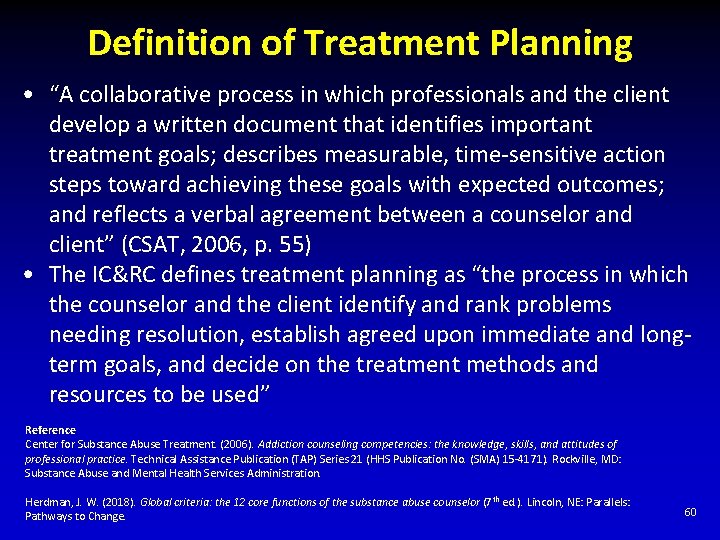
Definition of Treatment Planning • “A collaborative process in which professionals and the client develop a written document that identifies important treatment goals; describes measurable, time-sensitive action steps toward achieving these goals with expected outcomes; and reflects a verbal agreement between a counselor and client” (CSAT, 2006, p. 55) • The IC&RC defines treatment planning as “the process in which the counselor and the client identify and rank problems needing resolution, establish agreed upon immediate and longterm goals, and decide on the treatment methods and resources to be used” Reference Center for Substance Abuse Treatment. (2006). Addiction counseling competencies: the knowledge, skills, and attitudes of professional practice. Technical Assistance Publication (TAP) Series 21 (HHS Publication No. (SMA) 15 -4171). Rockville, MD: Substance Abuse and Mental Health Services Administration. Herdman, J. W. (2018). Global criteria: the 12 core functions of the substance abuse counselor (7 th ed. ). Lincoln, NE: Parallels: Pathways to Change. 60
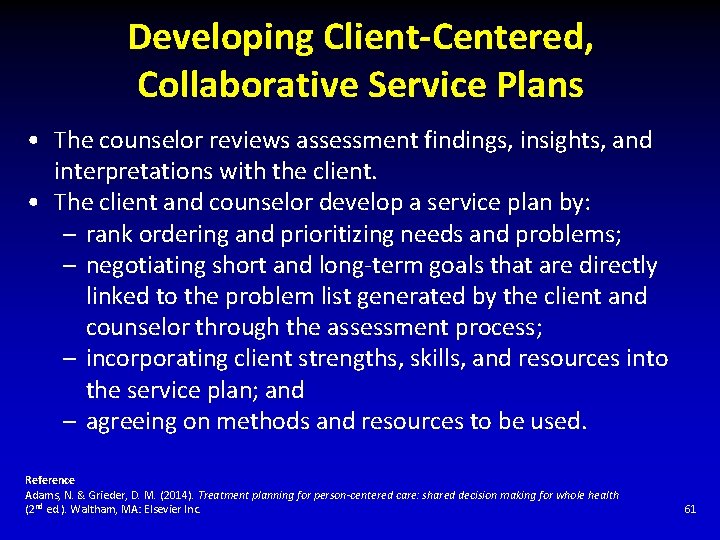
Developing Client-Centered, Collaborative Service Plans • The counselor reviews assessment findings, insights, and interpretations with the client. • The client and counselor develop a service plan by: – rank ordering and prioritizing needs and problems; – negotiating short and long-term goals that are directly linked to the problem list generated by the client and counselor through the assessment process; – incorporating client strengths, skills, and resources into the service plan; and – agreeing on methods and resources to be used. Reference Adams, N. & Grieder, D. M. (2014). Treatment planning for person-centered care: shared decision making for whole health (2 nd ed. ). Waltham, MA: Elsevier Inc. 61
Developing Client-Centered, Collaborative Service Plans (continued) • Service plans should be regularly reviewed and updated. • Service plans should be flexible. • Service plans should include agreed-upon end points. Reference Adams, N. & Grieder, D. M. (2014). Treatment planning for person-centered care: shared decision making for whole health (2 nd ed. ). Waltham, MA: Elsevier Inc. 62
What are Goals? • Goals capture the essence of the client’s desire for change. • Two types of goals: life goals and service goals. • Service goals reflect resolution of a problem. • Service goals should be used as a measure for determining readiness for discharge or transition. • Goals should be written in the client’s own words, but understood by all those involved in their care. • Strive for parsimony. • Goals are often comprised of specific objectives. Reference Adams, N. & Grieder, D. M. (2014). Treatment planning for person-centered care: shared decision making for whole health (2 nd ed. ). Waltham, MA: Elsevier Inc. 63
What are Objectives? • Objectives are focused, specific, incremental changes or manageable tasks that support clients with moving forward towards attaining or accomplishing specific goal(s). • Objectives use action words. • Objectives are time-specific. • Objectives aim to organize a client’s goal into smaller manageable steps. • Objectives are NOT services, intervention, or action steps. • Objective describe the meaningful change in behavior, status or function that is recognized as a step towards reaching a larger goal. Reference Adams, N. & Grieder, D. M. (2014). Treatment planning for person-centered care: shared decision making for whole health (2 nd ed. ). Waltham, MA: Elsevier Inc. 64
What are SMART Objectives? • • • Simple, straightforward, and stage-appropriate Measurable Attainable Realistic Time-specific (change is expected) Reference Adams, N. & Grieder, D. M. (2014). Treatment planning for person-centered care: shared decision making for whole health (2 nd ed. ). Waltham, MA: Elsevier Inc. 65
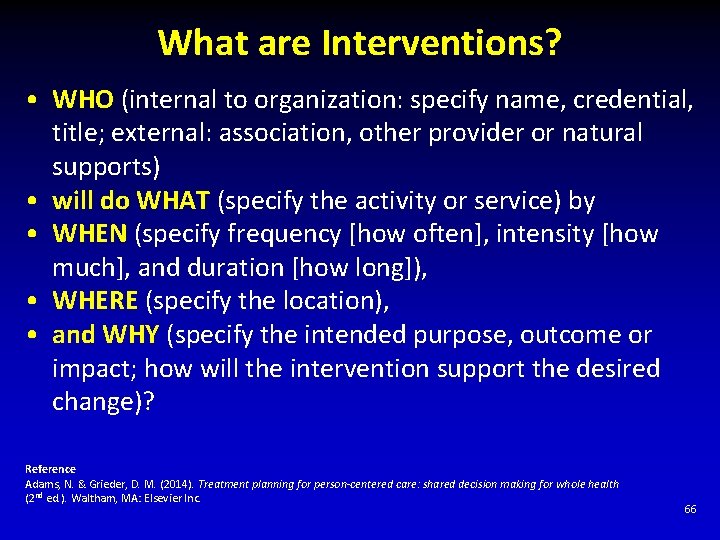
What are Interventions? • WHO (internal to organization: specify name, credential, title; external: association, other provider or natural supports) • will do WHAT (specify the activity or service) by • WHEN (specify frequency [how often], intensity [how much], and duration [how long]), • WHERE (specify the location), • and WHY (specify the intended purpose, outcome or impact; how will the intervention support the desired change)? Reference Adams, N. & Grieder, D. M. (2014). Treatment planning for person-centered care: shared decision making for whole health (2 nd ed. ). Waltham, MA: Elsevier Inc. 66
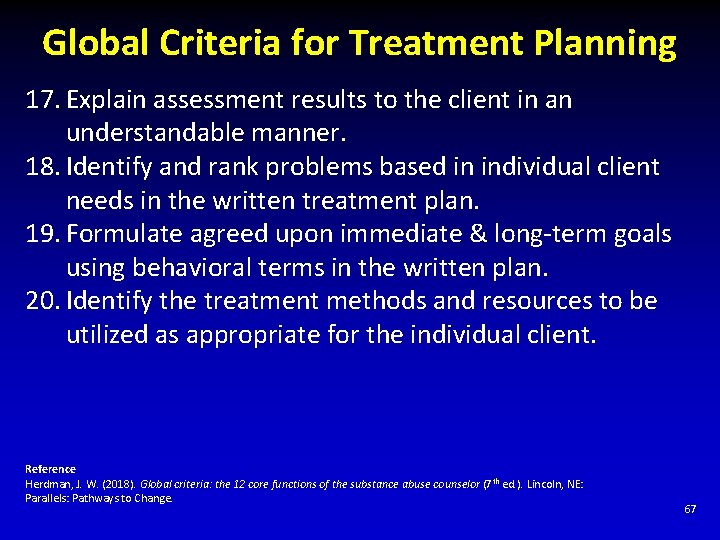
Global Criteria for Treatment Planning 17. Explain assessment results to the client in an understandable manner. 18. Identify and rank problems based in individual client needs in the written treatment plan. 19. Formulate agreed upon immediate & long-term goals using behavioral terms in the written plan. 20. Identify the treatment methods and resources to be utilized as appropriate for the individual client. Reference Herdman, J. W. (2018). Global criteria: the 12 core functions of the substance abuse counselor (7 th ed. ). Lincoln, NE: Parallels: Pathways to Change. 67
Group Activity for Treatment Planning • Create a checklist or outline to guide you and others in your agency to create client-centered, collaborative service plans. • Be prepared to report out. • Be prepared to ask questions and offer suggestions to support your colleagues. 68
Today’s Agenda (6) • Review and check-in • Twelve Core Functions – Screening – Intake – Orientation – Assessment – Treatment Planning – Counseling 69
Agenda for Counseling • • • Definition Influence of models and use of theory Counseling models General counseling guidelines Global criteria 70
Definition of Counseling • The IC&RC defines counseling as “the utilization of special skills to assist individuals, families, or group in achieving objectives through exploration of a problem and its ramifications; examination of attitudes and feelings; consideration of alternative solutions; and decision making” • The CSAT defines counseling as, “a collaborative process that facilitates the client’s progress toward mutually determined treatment goals and objectives” Reference Center for Substance Abuse Treatment. (2006). Addiction counseling competencies: the knowledge, skills, and attitudes of professional practice. Technical Assistance Publication (TAP) Series 21 (HHS Publication No. (SMA) 15 -4171). Rockville, MD: Substance Abuse and Mental Health Services Administration. Herdman, J. W. (2018). Global criteria: the 12 core functions of the substance abuse counselor (7 th ed. ). Lincoln, NE: Parallels: Pathways to Change. 71
Influence of Models and Use of Theory • Models of addiction influence how counselors view their clients; the cause of their client’s substance use disorders; and the approaches, modalities, and perspectives they endorse/utilize for treating substance use disorders. • “Models impact our selection of theories and techniques used in treating” substance use disorders (Miller, 2015, p. 34). • Theories help us to understand, explain, and predict phenomena. Reference Corey, G. (2017). Theory and practice of counseling and psychotherapy (10 th ed). Boston, MA: Cengage. Miller, G. (2015). Learning the language of addiction counseling (4 th ed. ). Hoboken, NJ: John Wiley & Sons, Inc. 72
Three Contemporary Counseling Models • Psychodynamic Approaches • Humanistic, Experiential and Existential Therapies • Cognitive Behavioral Approaches Reference Corey, G. (2017). Theory and practice of counseling and psychotherapy (10 th ed). Boston, MA: Cengage. Miller, G. (2015). Learning the language of addiction counseling (4 th ed. ). Hoboken, NJ: John Wiley & Sons, Inc. 73
Psychodynamic Approaches • Psychodynamic theories posit different explanations of personality formation, psychopathology, and techniques to use in SUD counseling. • Unconscious motives and unresolved past conflicts are central in present behavior. • Key concepts include: (1) therapeutic alliance, (2) developmental stages and personality structure, (3) insight, (4) transference and countertransference, and (5) defense mechanisms. Reference Center for Substance Abuse Treatment (2012). Brief interventions and brief therapies for substance abuse. Treatment Improvement Protocol (TIP) Series No. 34 HHS Publication No. (SMA) 12 -3952. Rockville, MD: Substance Abuse and Mental Health Services Administration Corey, G. (2017). Theory and practice of counseling and psychotherapy (10 th ed). Boston, MA: Cengage. Miller, G. (2015). Learning the language of addiction counseling (4 th ed. ). Hoboken, NJ: John Wiley & Sons, Inc. 74
Defense Mechanisms • • • Compensation Denial Displacement Identification Projection Rationalization Reaction formation Regression Repression Sublimation Reference Center for Substance Abuse Treatment (2012). Brief interventions and brief therapies for substance abuse. Treatment Improvement Protocol (TIP) Series No. 34 HHS Publication No. (SMA) 12 -3952. Rockville, MD: Substance Abuse and Mental Health Services Administration Corey, G. (2017). Theory and practice of counseling and psychotherapy (10 th ed). Boston, MA: Cengage. Miller, G. (2015). Learning the language of addiction counseling (4 th ed. ). Hoboken, NJ: John Wiley & Sons, Inc. 75
Application of Psychodynamic Approaches in Counseling • Invest in therapeutic relationship. • Examine and explore culturally-appropriate/sanctioned developmental tasks at each stage of life. • Offer psychoeducation and behavioral interventions. • Examine the possibility of transference and countertransference. • Help clients discern and recognize how defense mechanisms inhibit recovery. Reference Center for Substance Abuse Treatment (2012). Brief interventions and brief therapies for substance abuse. Treatment Improvement Protocol (TIP) Series No. 34 HHS Publication No. (SMA) 12 -3952. Rockville, MD: Substance Abuse and Mental Health Services Administration Corey, G. (2017). Theory and practice of counseling and psychotherapy (10 th ed). Boston, MA: Cengage. Miller, G. (2015). Learning the language of addiction counseling (4 th ed. ). Hoboken, NJ: John Wiley & Sons, Inc. 76
Humanistic, Experiential and Existential Therapies • Person-centered Therapy – Unconditional positive regard, accurate empathy, and genuineness – Actualizing tendency • Existential Therapy – Emphasis on freedom and choice • Gestalt Therapy – Emphasis on the present - the here and now Reference Center for Substance Abuse Treatment (2012). Brief interventions and brief therapies for substance abuse. Treatment Improvement Protocol (TIP) Series No. 34 HHS Publication No. (SMA) 12 -3952. Rockville, MD: Substance Abuse and Mental Health Services Administration Corey, G. (2017). Theory and practice of counseling and psychotherapy (10 th ed). Boston, MA: Cengage. Miller, G. (2015). Learning the language of addiction counseling (4 th ed. ). Hoboken, NJ: John Wiley & Sons, Inc. 77
Application Humanistic, Experiential and Existential Therapies • Accept clients for who they are and where they are in their recovery process. • Believe that clients are their own experts and that they have the innate capacity for change. • Focus on the present. • Be fully present. Reference Center for Substance Abuse Treatment (2012). Brief interventions and brief therapies for substance abuse. Treatment Improvement Protocol (TIP) Series No. 34 HHS Publication No. (SMA) 12 -3952. Rockville, MD: Substance Abuse and Mental Health Services Administration Corey, G. (2017). Theory and practice of counseling and psychotherapy (10 th ed). Boston, MA: Cengage. Miller, G. (2015). Learning the language of addiction counseling (4 th ed. ). Hoboken, NJ: John Wiley & Sons, Inc. 78
Cognitive Behavioral Approaches • Cognitive behavioral approaches posit that cognitions (thoughts, beliefs, attitudes, assumptions), behaviors, feelings/emotions, and physical reactions are reciprocally linked. • Behavior Therapy • Cognitive Behavioral Therapy – Key concepts include: attributions, cognitive appraisals, and self-efficacy expectancies Reference Center for Substance Abuse Treatment (2012). Brief interventions and brief therapies for substance abuse. Treatment Improvement Protocol (TIP) Series No. 34 HHS Publication No. (SMA) 12 -3952. Rockville, MD: Substance Abuse and Mental Health Services Administration Corey, G. (2017). Theory and practice of counseling and psychotherapy (10 th ed). Boston, MA: Cengage. Miller, G. (2015). Learning the language of addiction counseling (4 th ed. ). Hoboken, NJ: John Wiley & Sons, Inc. 79
Application of Cognitive Behavioral Approaches • • Negotiate and establish agreed-upon goals. Determine which behaviors are the targets of change. Identify triggers. Individualize and introduce a variety of behavioral and cognitive coping strategies. • Focus on relapse prevention. Reference Center for Substance Abuse Treatment (2012). Brief interventions and brief therapies for substance abuse. Treatment Improvement Protocol (TIP) Series No. 34 HHS Publication No. (SMA) 12 -3952. Rockville, MD: Substance Abuse and Mental Health Services Administration Corey, G. (2017). Theory and practice of counseling and psychotherapy (10 th ed). Boston, MA: Cengage. Miller, G. (2015). Learning the language of addiction counseling (4 th ed. ). Hoboken, NJ: John Wiley & Sons, Inc. 80
General Counseling Guidelines • • • Ask open questions Offer reflections Avoid the question-answer trap Refrain from making assumptions – listen to understand rather than be understood Be yourself Refrain from using professional jargon and acronyms Ask permission before giving information or advice Our nonverbal behaviors are as important, if not important, than our verbal behaviors If and when you choose to self-disclose or share an aspect of yourself with the client, ask yourself whether it is benefiting you or the client? 81
Global Criteria for Counseling 21. Select the counseling theory(ies) that apply(ies). 22. Apply techniques to assist the client, group, and/or family in exploring problems and ramifications. 23. Apply techniques to assist the client, group, and/or family in examining the client’s behaviors, attitudes, and/or feelings in the treatment setting. 24. Individualize counseling in accordance with cultural, gender, and lifestyle differences. 25. Interact with the client in a therapeutic manner. 26. Elicit alternative solutions and decisions from the client. 27. Implement the treatment plan. Reference Herdman, J. W. (2018). Global criteria: the 12 core functions of the substance abuse counselor (7 th ed. ). Lincoln, NE: Parallels: Pathways to Change. 82
Group Activity for Counseling • • What prevents us from actively listening to our clients? What are different roadblocks to active listening? Write down your list on the paper provided to you. All groups will report out. 83
Questions 84
- Slides: 84