ESE 535 Electronic Design Automation Day 2 January
- Slides: 80
ESE 535: Electronic Design Automation Day 2: January 23, 2008 Covering 1 Penn ESE 535 Spring 2008 -- De. Hon
Problem • Implement a “gate-level” netlist in terms of some library of primitives • General – easy to change technology – easy to experiment with library requirements • Evaluate benefits of new cells… • Evaluate architecture with different primitives 2 Penn ESE 535 Spring 2008 -- De. Hon
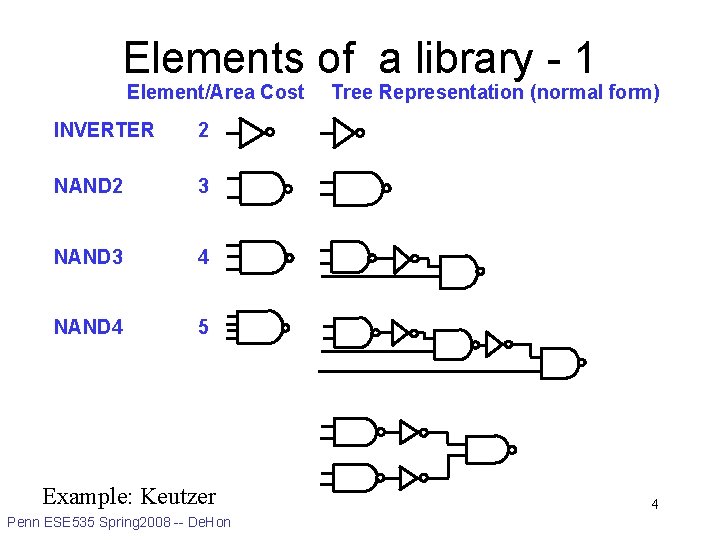
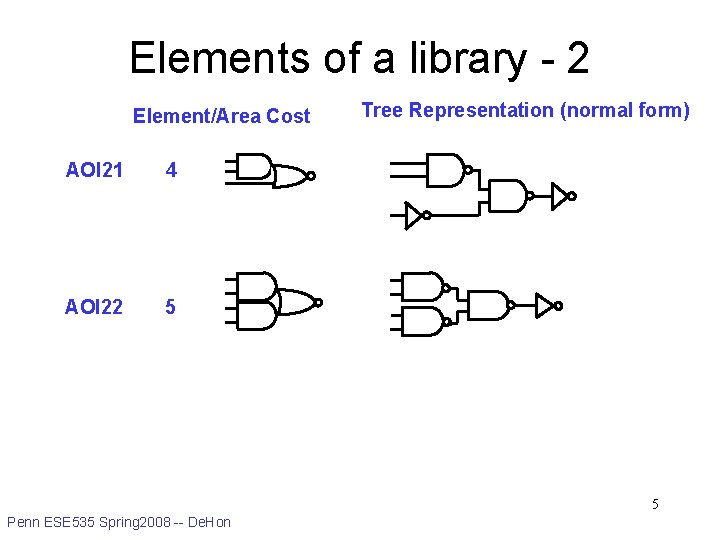
Input • netlist • library • represent both in normal form: – nand gate – inverters 3 Penn ESE 535 Spring 2008 -- De. Hon
Elements of a library - 1 Element/Area Cost INVERTER 2 NAND 2 3 NAND 3 4 NAND 4 5 Example: Keutzer Penn ESE 535 Spring 2008 -- De. Hon Tree Representation (normal form) 4
Elements of a library - 2 Element/Area Cost AOI 21 4 AOI 22 5 Tree Representation (normal form) 5 Penn ESE 535 Spring 2008 -- De. Hon
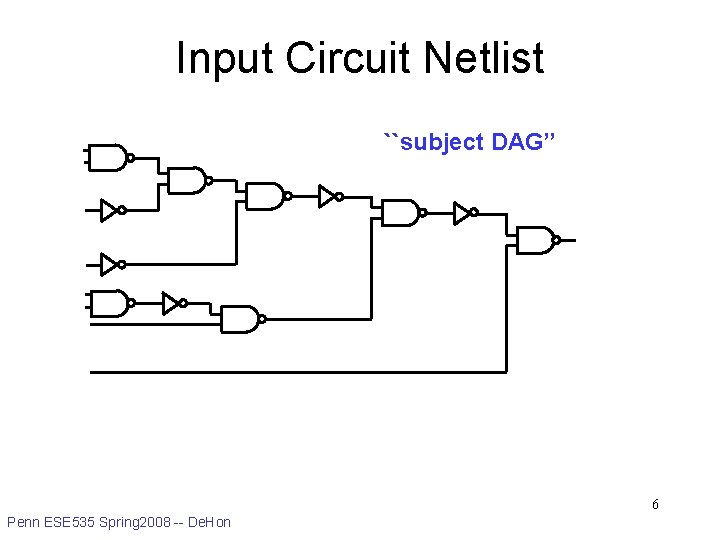
Input Circuit Netlist ``subject DAG’’ 6 Penn ESE 535 Spring 2008 -- De. Hon
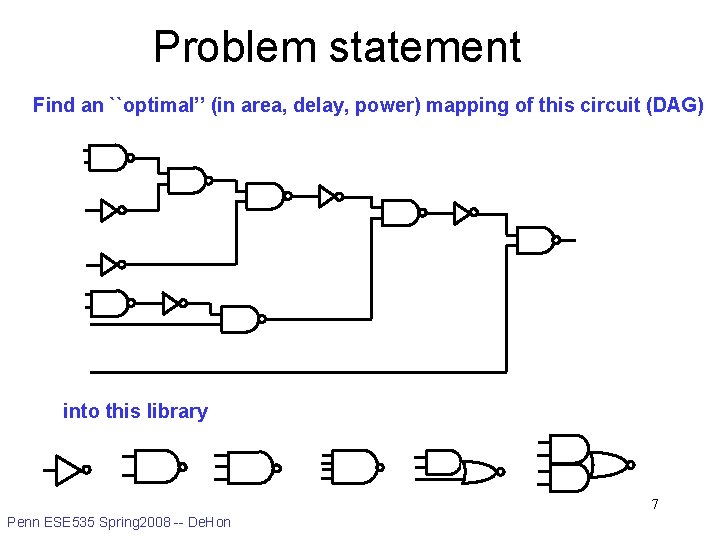
Problem statement Find an ``optimal’’ (in area, delay, power) mapping of this circuit (DAG) into this library 7 Penn ESE 535 Spring 2008 -- De. Hon
Why covering now? • Nice/simple cost model • problem can be solved well – somewhat clever solution • general/powerful technique • show off special cases – harder/easier cases • show off things that make hard • show off bounding 8 Penn ESE 535 Spring 2008 -- De. Hon
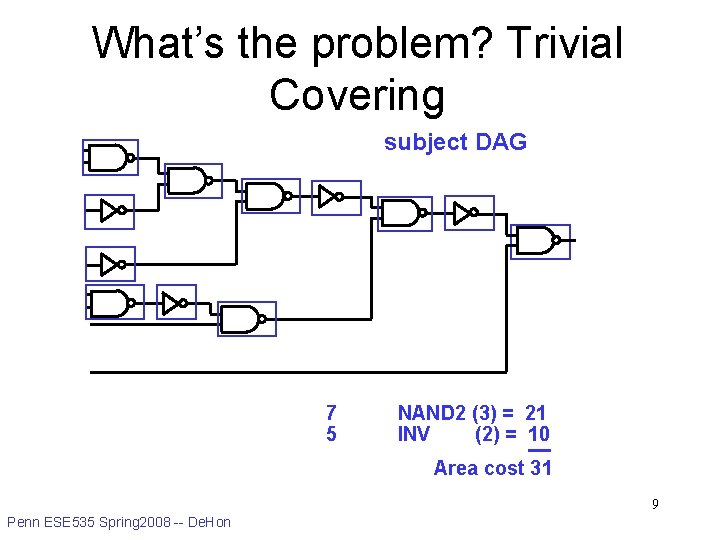
What’s the problem? Trivial Covering subject DAG 7 5 NAND 2 (3) = 21 INV (2) = 10 Area cost 31 9 Penn ESE 535 Spring 2008 -- De. Hon
Cost Models 10 Penn ESE 535 Spring 2008 -- De. Hon
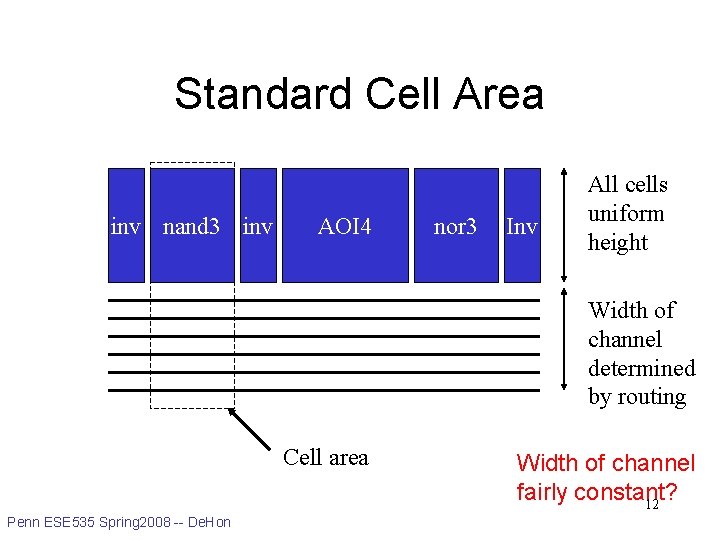
Cost Model: Area • Assume: Area in gates • or, at least, can pick an area/gate – so proportional to gates • e. g. – Standard Cell design – Standard Cell/route over cell – gate array 11 Penn ESE 535 Spring 2008 -- De. Hon
Standard Cell Area inv nand 3 inv AOI 4 nor 3 Inv All cells uniform height Width of channel determined by routing Cell area Penn ESE 535 Spring 2008 -- De. Hon Width of channel fairly constant? 12
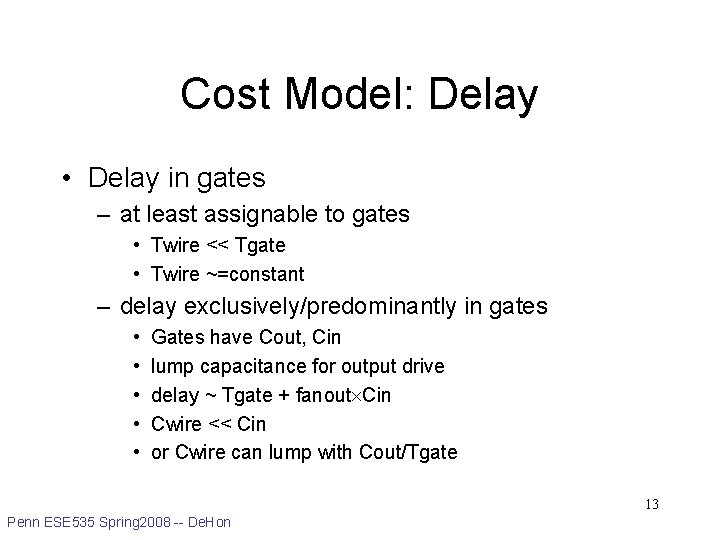
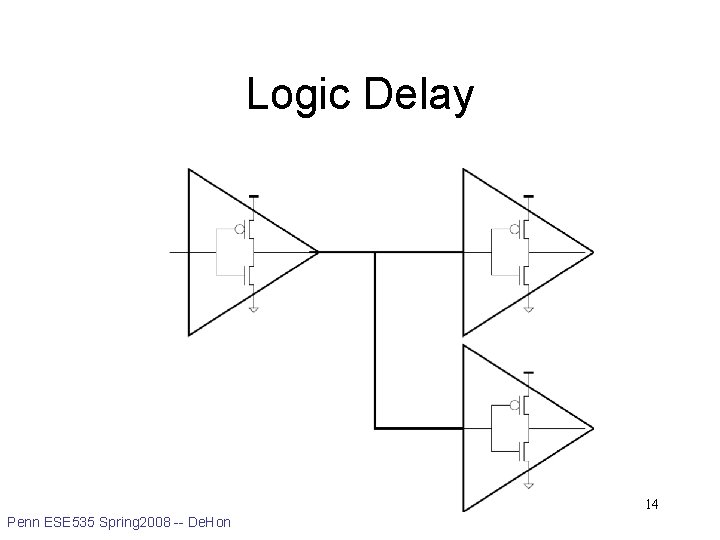
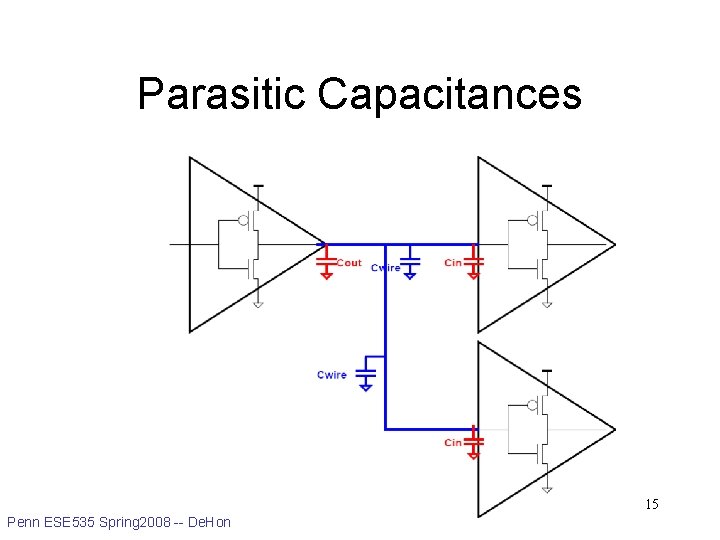
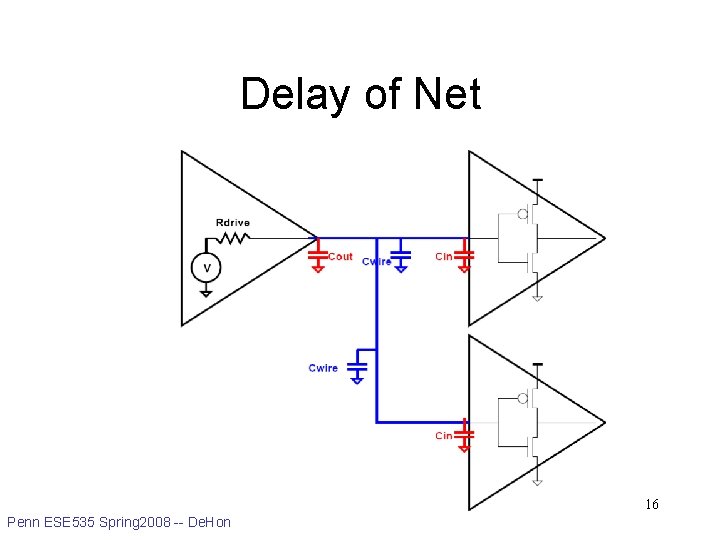
Cost Model: Delay • Delay in gates – at least assignable to gates • Twire << Tgate • Twire ~=constant – delay exclusively/predominantly in gates • • • Gates have Cout, Cin lump capacitance for output drive delay ~ Tgate + fanout Cin Cwire << Cin or Cwire can lump with Cout/Tgate 13 Penn ESE 535 Spring 2008 -- De. Hon
Logic Delay 14 Penn ESE 535 Spring 2008 -- De. Hon
Parasitic Capacitances 15 Penn ESE 535 Spring 2008 -- De. Hon
Delay of Net 16 Penn ESE 535 Spring 2008 -- De. Hon
Cost Model: Delay • Delay in gates – at least assignable to gates • Twire << Tgate • Twire ~=constant – delay exclusively/predominantly in gates • • • Gates have Cout, Cin lump capacitance for output drive delay ~ Tgate + fanout Cin Cwire << Cin or Cwire can lump with Cout/Tgate 17 Penn ESE 535 Spring 2008 -- De. Hon
Cost Models • Why do I show you models? – not clear there’s one “right” model – changes over time – you’re going to encounter many different kinds of problems – want you to see formulations so can critique and develop own – simple cost models make problems tractable • are surprisingly adequate – simple, at least, help bound solutions – may be wrong today…need to rethink 18 Penn ESE 535 Spring 2008 -- De. Hon
Approaches 19 Penn ESE 535 Spring 2008 -- De. Hon
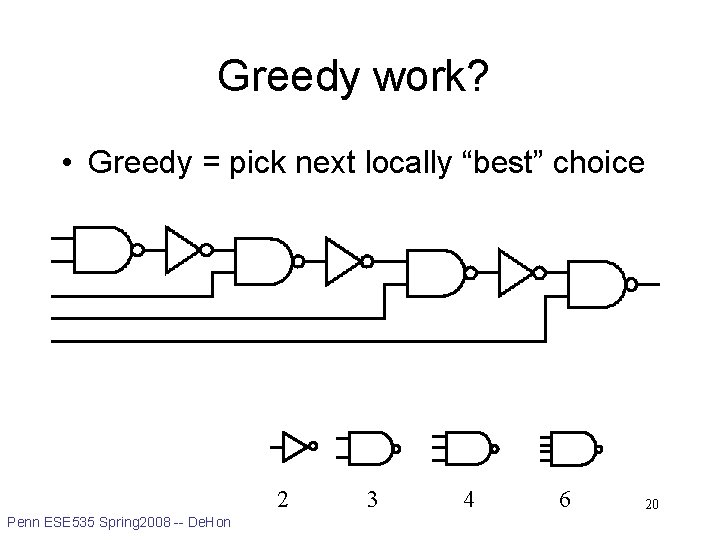
Greedy work? • Greedy = pick next locally “best” choice 2 Penn ESE 535 Spring 2008 -- De. Hon 3 4 6 20
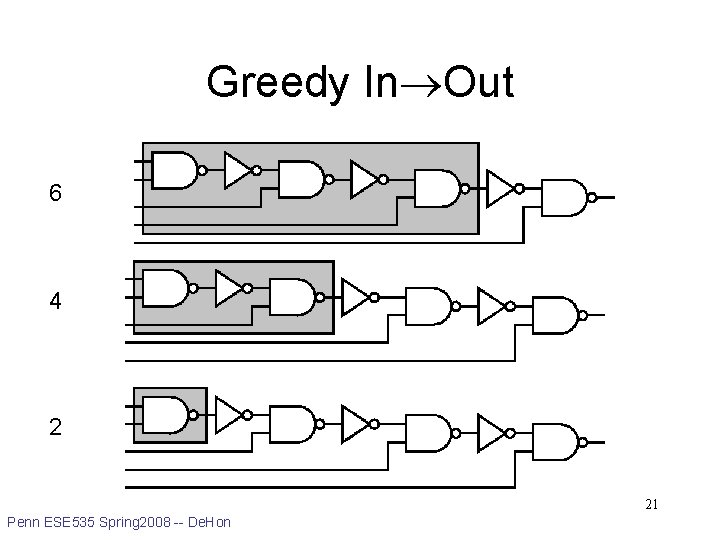
Greedy In Out 6 4 2 21 Penn ESE 535 Spring 2008 -- De. Hon
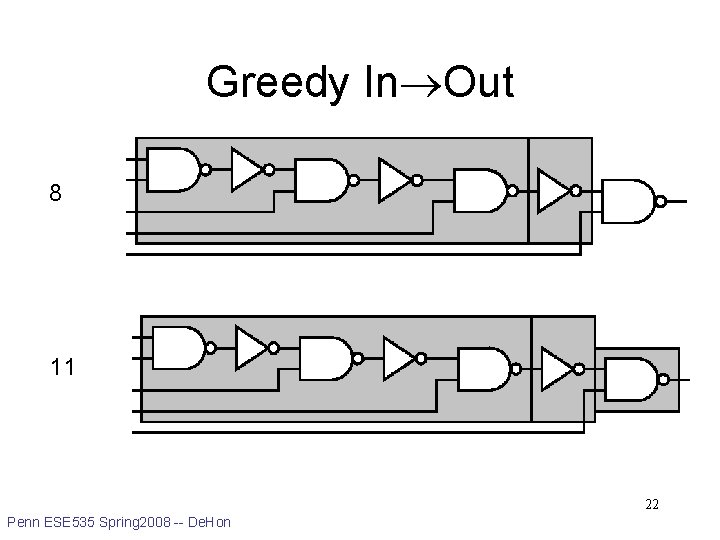
Greedy In Out 8 11 22 Penn ESE 535 Spring 2008 -- De. Hon
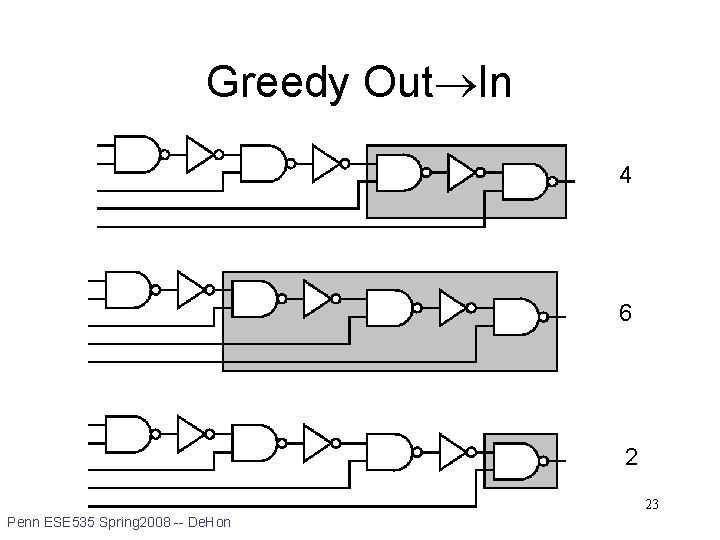
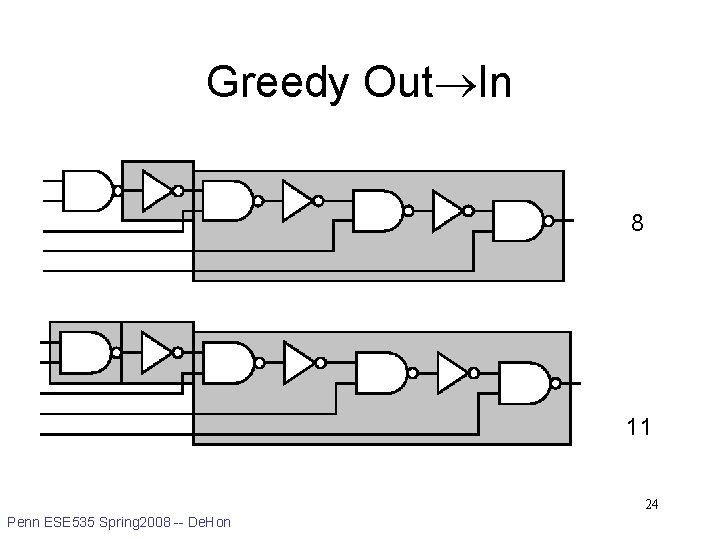
Greedy Out In 4 6 2 23 Penn ESE 535 Spring 2008 -- De. Hon
Greedy Out In 8 11 24 Penn ESE 535 Spring 2008 -- De. Hon
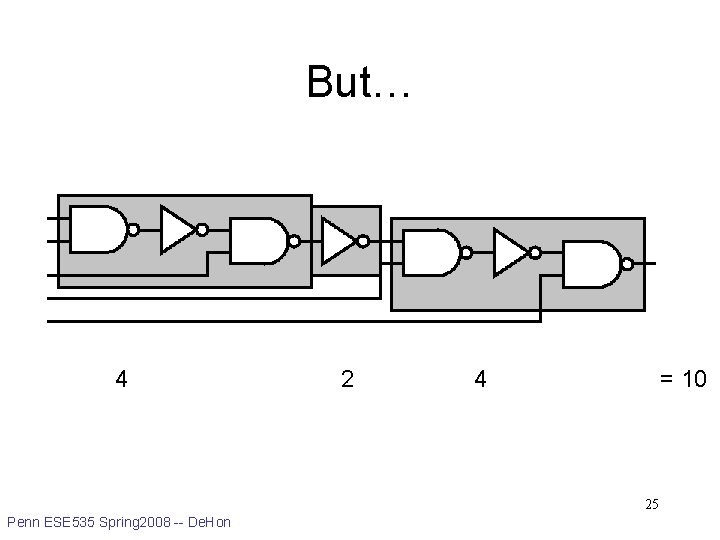
But… 4 2 4 = 10 25 Penn ESE 535 Spring 2008 -- De. Hon
Greedy Problem • What happens in the future (elsewhere in circuit) will determine what should be done at this point in the circuit. • Can’t just pick best thing for now and be done. 26 Penn ESE 535 Spring 2008 -- De. Hon
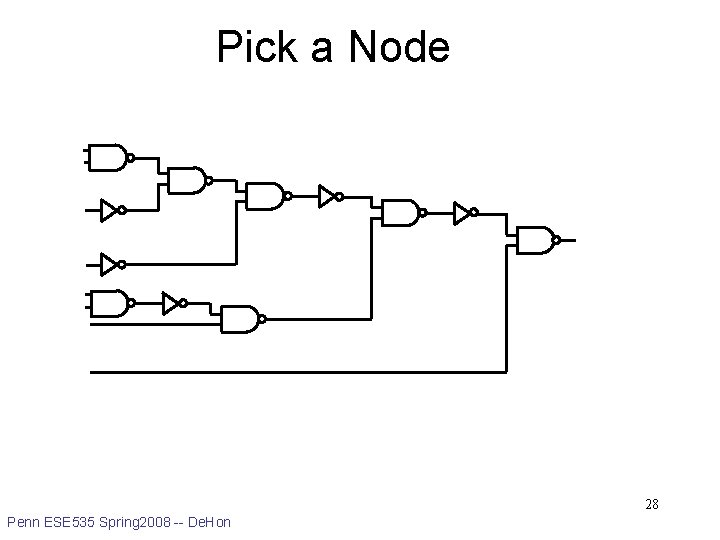
Brute force? • Pick a node (output) • Consider – all possible gates which may cover that node – branch on all inputs after cover – pick least cost node 27 Penn ESE 535 Spring 2008 -- De. Hon
Pick a Node 28 Penn ESE 535 Spring 2008 -- De. Hon
Brute force? • Pick a node (output) • Consider – all possible gates which may cover that node – recurse on all inputs after cover – pick least cost node • Explore all possible covers – can find optimum 29 Penn ESE 535 Spring 2008 -- De. Hon
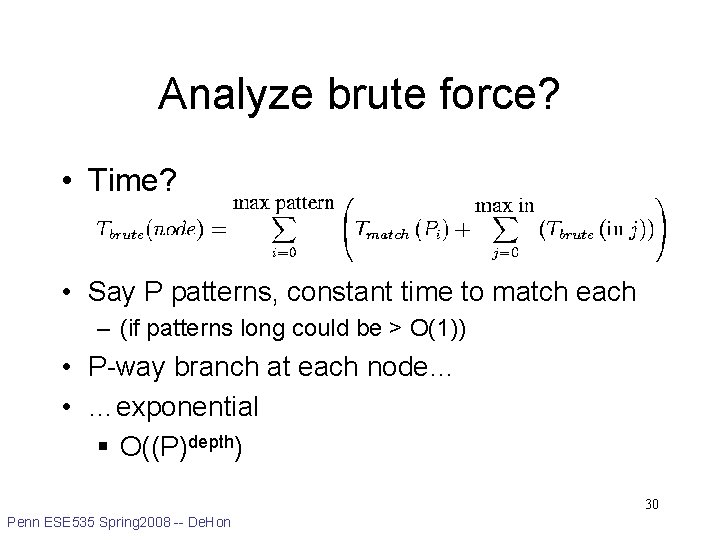
Analyze brute force? • Time? • Say P patterns, constant time to match each – (if patterns long could be > O(1)) • P-way branch at each node… • …exponential § O((P)depth) 30 Penn ESE 535 Spring 2008 -- De. Hon
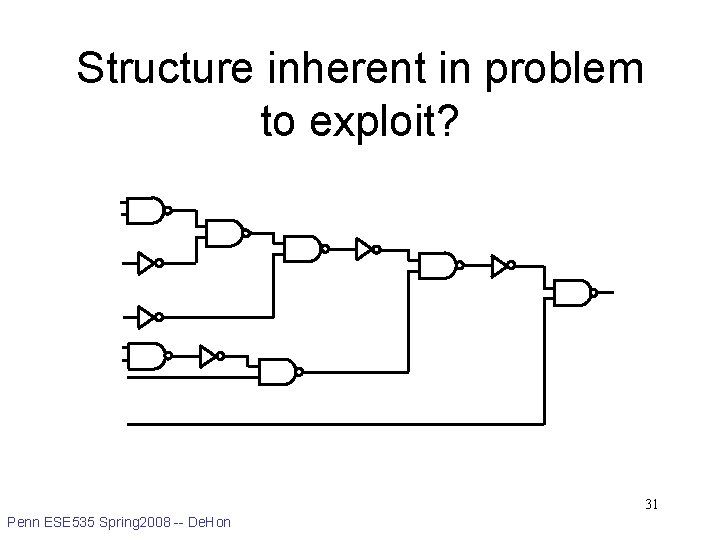
Structure inherent in problem to exploit? 31 Penn ESE 535 Spring 2008 -- De. Hon
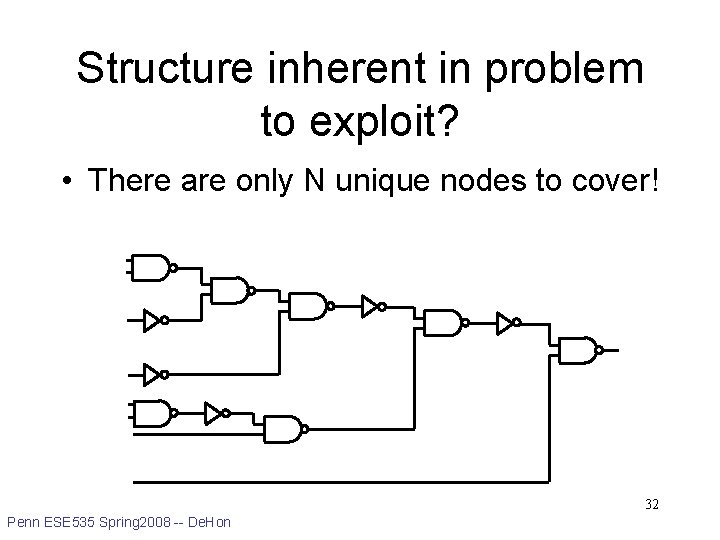
Structure inherent in problem to exploit? • There are only N unique nodes to cover! 32 Penn ESE 535 Spring 2008 -- De. Hon
Structure • If subtree solutions do not depend on what happens outside of its subtree – separate tree – farther up tree • Should only have to look at N nodes. • Time(N) = N*P*T(match) – w/ P fixed/bounded linear in N – w/ cleverness work isn’t P*T(match) at every node 33 Penn ESE 535 Spring 2008 -- De. Hon
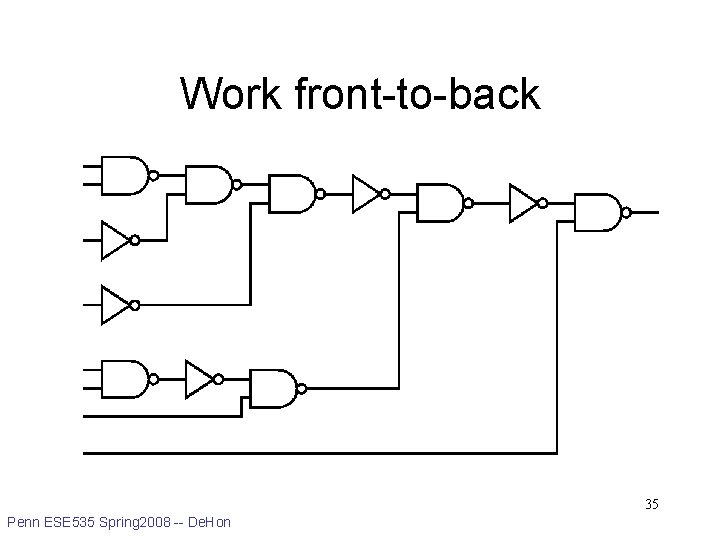
Idea Re-iterated • Work from inputs • Optimal solution to subproblem is contained in optimal, global solution • Find optimal cover for each node • Optimal cover: – examine all gates at this node – look at cost of gate and its inputs – pick least 34 Penn ESE 535 Spring 2008 -- De. Hon
Work front-to-back 35 Penn ESE 535 Spring 2008 -- De. Hon
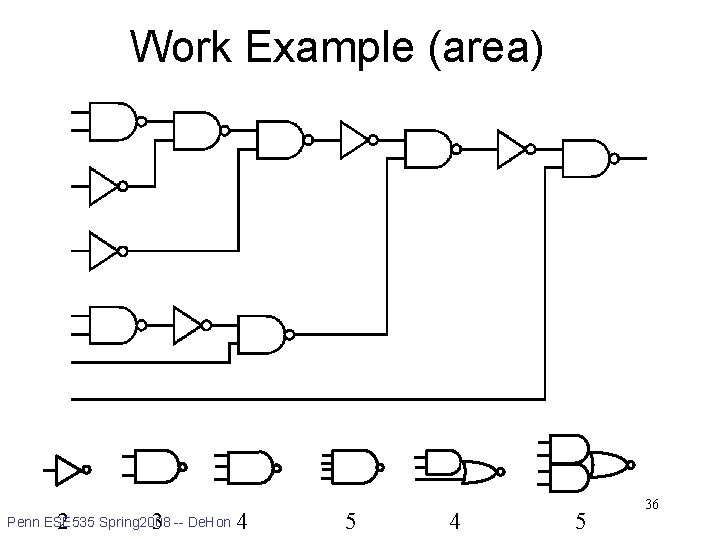
Work Example (area) library 2 3 Penn ESE 535 Spring 2008 -- De. Hon 4 5 36
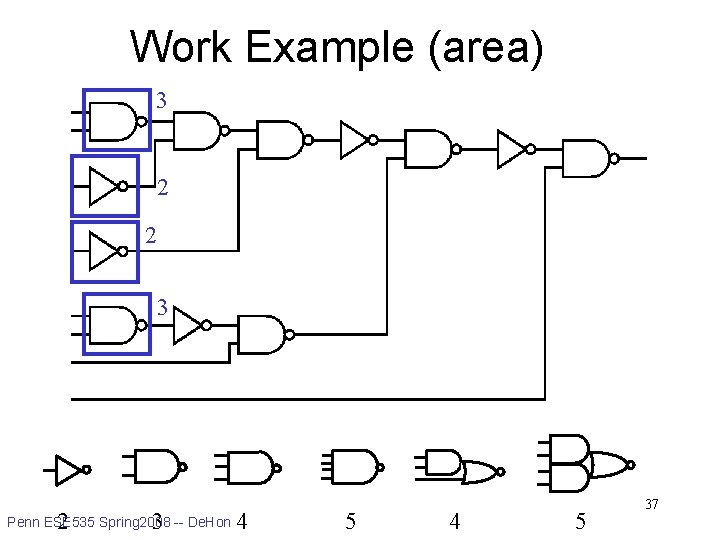
Work Example (area) 3 2 2 3 library 2 3 Penn ESE 535 Spring 2008 -- De. Hon 4 5 37
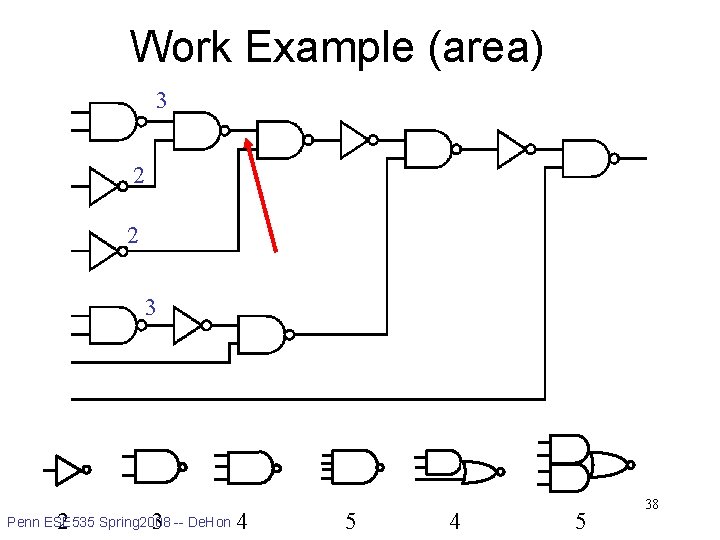
Work Example (area) 3 2 2 3 library 2 3 Penn ESE 535 Spring 2008 -- De. Hon 4 5 38
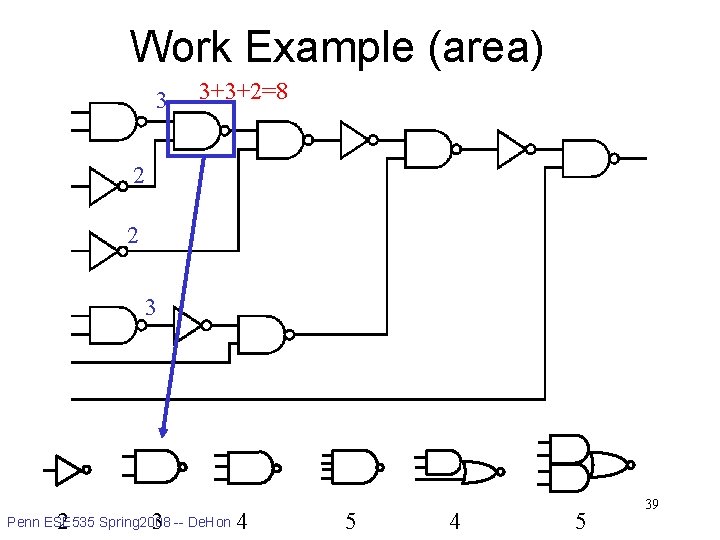
Work Example (area) 3 3+3+2=8 2 2 3 library 2 3 Penn ESE 535 Spring 2008 -- De. Hon 4 5 39
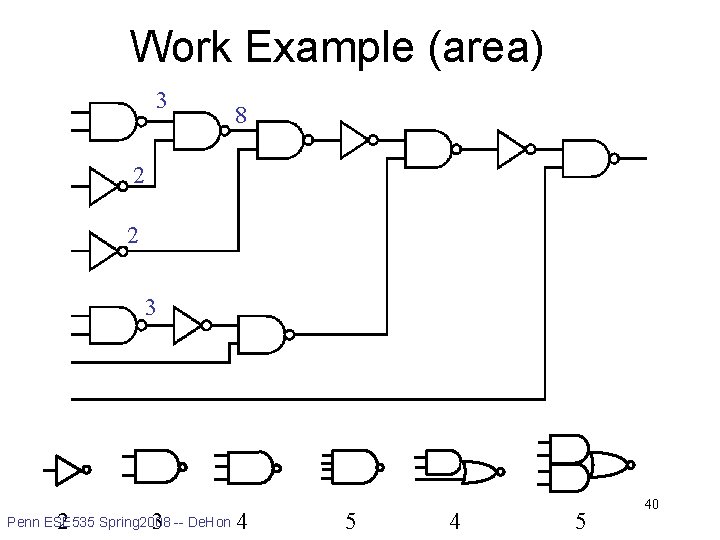
Work Example (area) 3 8 2 2 3 library 2 3 Penn ESE 535 Spring 2008 -- De. Hon 4 5 40
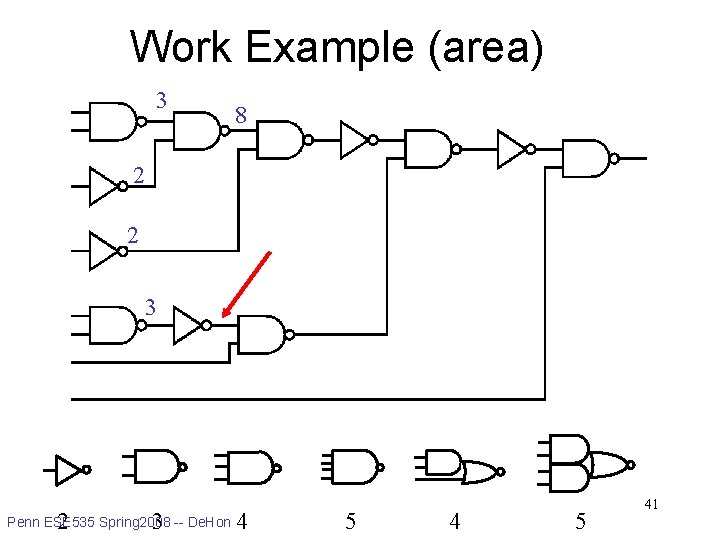
Work Example (area) 3 8 2 2 3 library 2 3 Penn ESE 535 Spring 2008 -- De. Hon 4 5 41
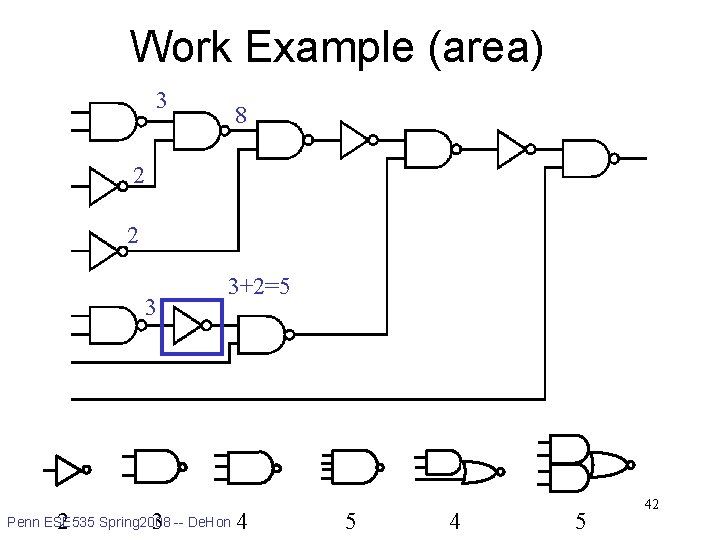
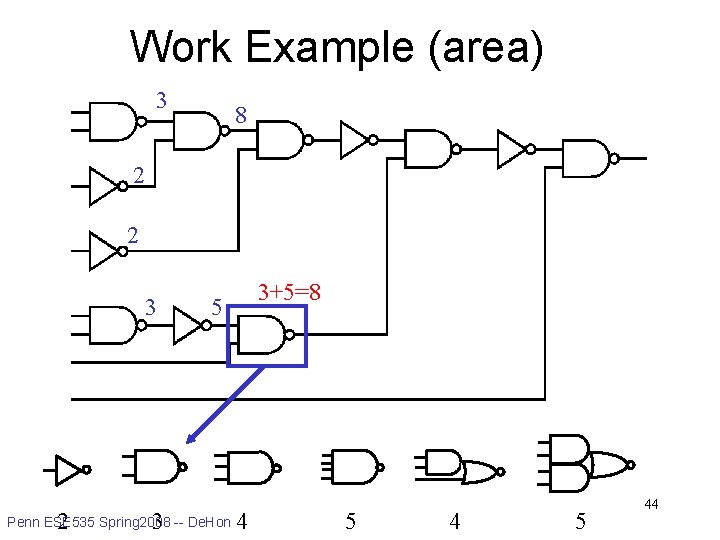
Work Example (area) 3 8 2 2 3 3+2=5 library 2 3 Penn ESE 535 Spring 2008 -- De. Hon 4 5 42
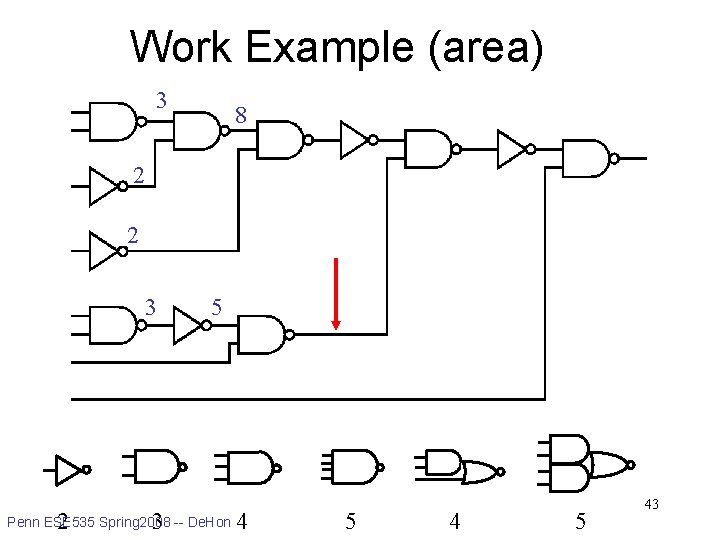
Work Example (area) 3 8 2 2 3 5 library 2 3 Penn ESE 535 Spring 2008 -- De. Hon 4 5 43
Work Example (area) 3 8 2 2 3 3+5=8 5 library 2 3 Penn ESE 535 Spring 2008 -- De. Hon 4 5 44
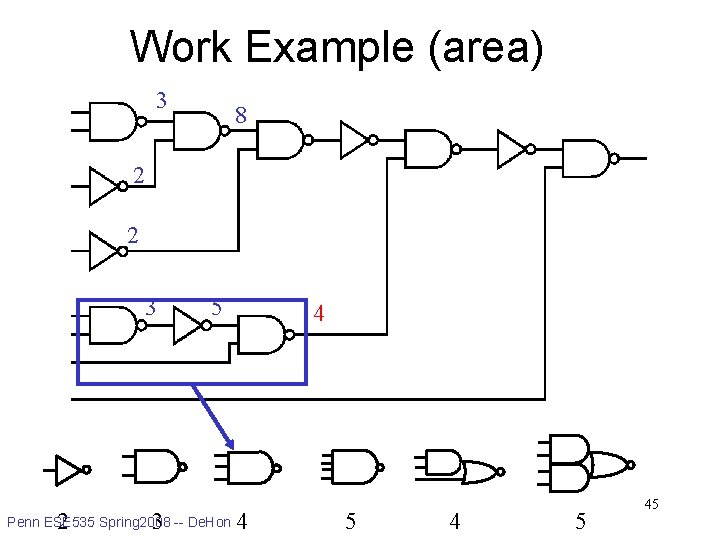
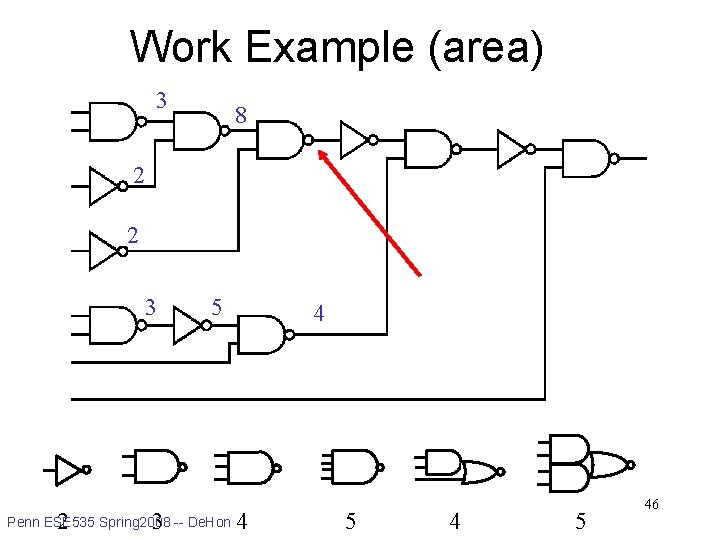
Work Example (area) 3 8 2 2 3 5 4 library 2 3 Penn ESE 535 Spring 2008 -- De. Hon 4 5 45
Work Example (area) 3 8 2 2 3 5 4 library 2 3 Penn ESE 535 Spring 2008 -- De. Hon 4 5 46
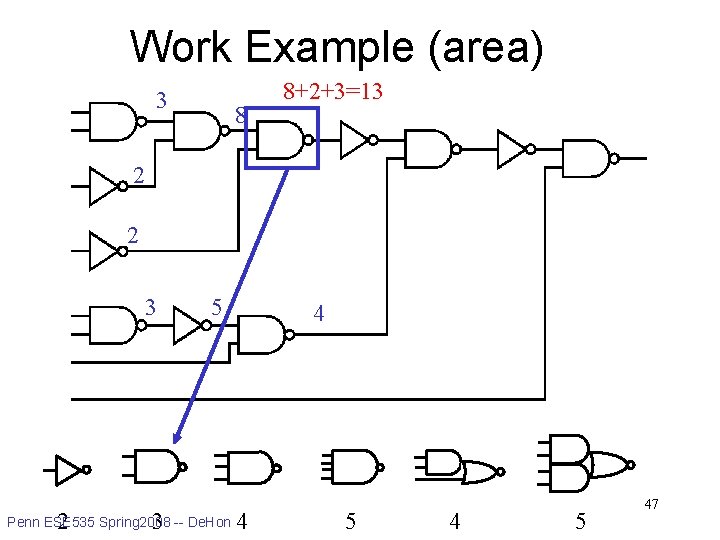
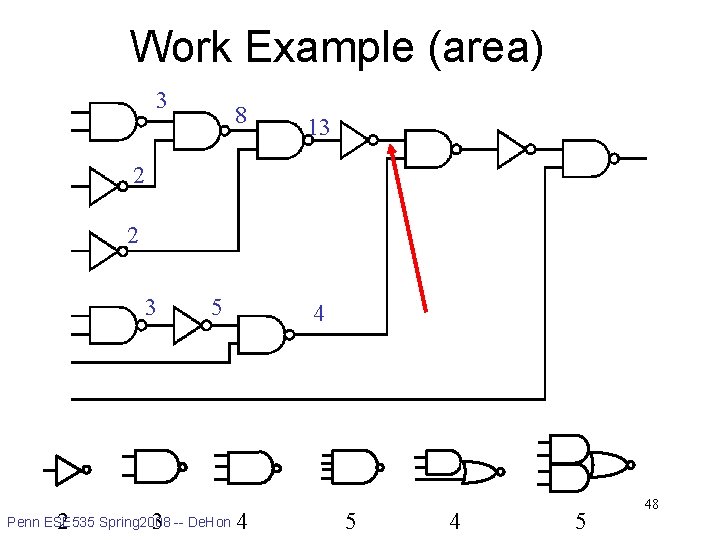
Work Example (area) 3 8 8+2+3=13 2 2 3 5 4 library 2 3 Penn ESE 535 Spring 2008 -- De. Hon 4 5 47
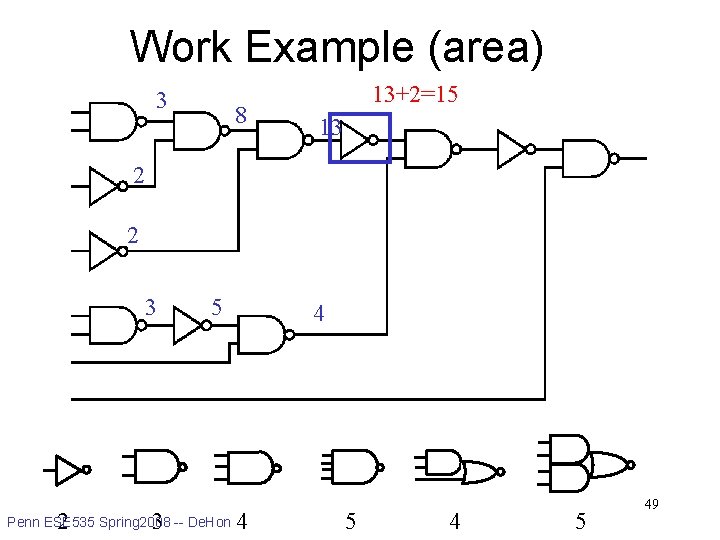
Work Example (area) 3 8 13 2 2 3 5 4 library 2 3 Penn ESE 535 Spring 2008 -- De. Hon 4 5 48
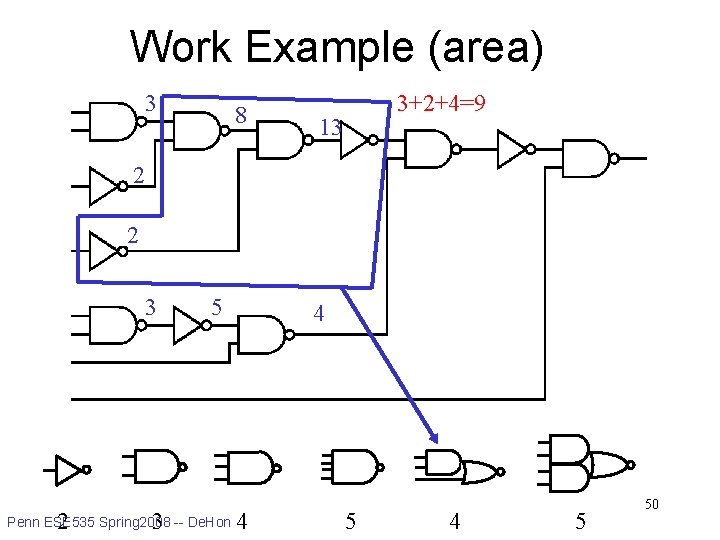
Work Example (area) 3 8 13+2=15 13 2 2 3 5 4 library 2 3 Penn ESE 535 Spring 2008 -- De. Hon 4 5 49
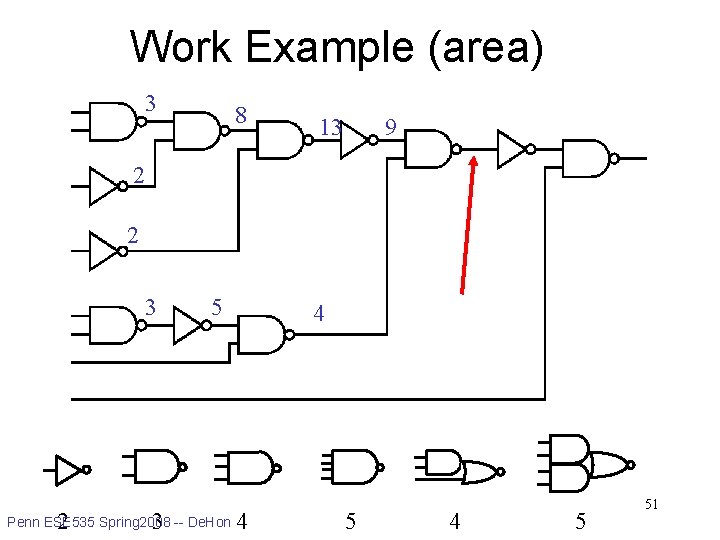
Work Example (area) 3 8 3+2+4=9 13 2 2 3 5 4 library 2 3 Penn ESE 535 Spring 2008 -- De. Hon 4 5 50
Work Example (area) 3 8 13 9 2 2 3 5 4 library 2 3 Penn ESE 535 Spring 2008 -- De. Hon 4 5 51
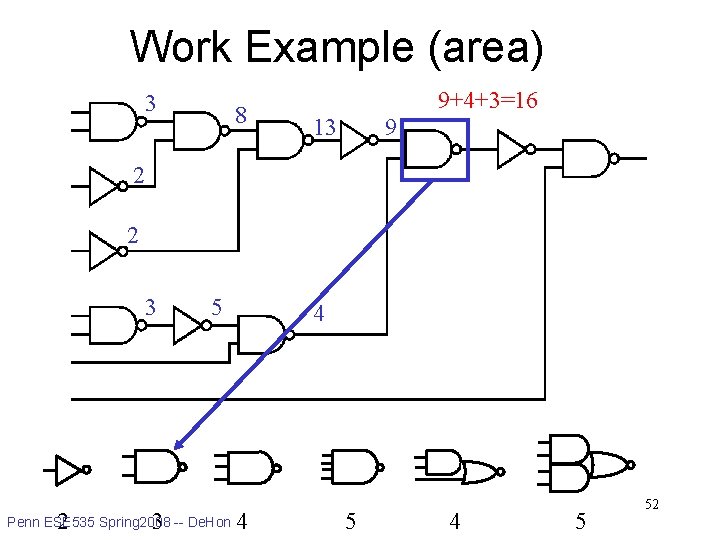
Work Example (area) 3 8 9+4+3=16 13 9 2 2 3 5 4 library 2 3 Penn ESE 535 Spring 2008 -- De. Hon 4 5 52
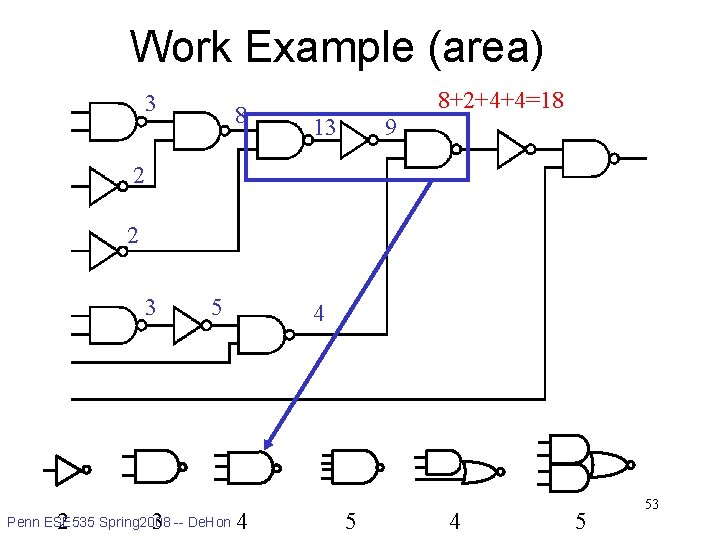
Work Example (area) 3 8 8+2+4+4=18 13 9 2 2 3 5 4 library 2 3 Penn ESE 535 Spring 2008 -- De. Hon 4 5 53
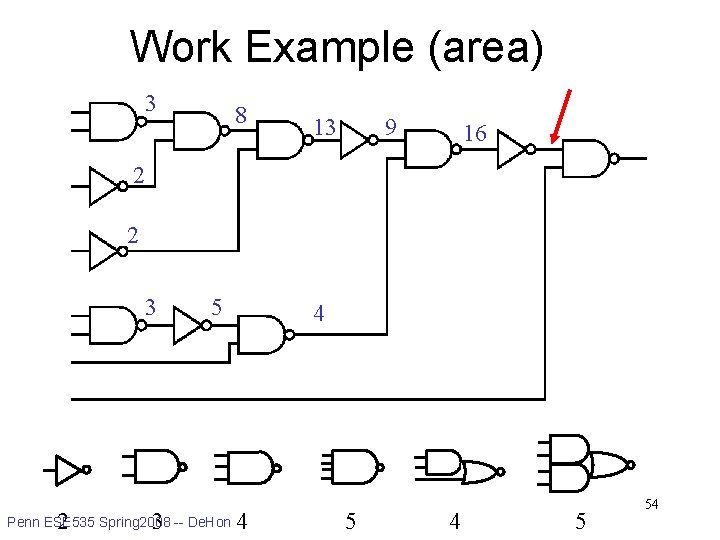
Work Example (area) 3 8 13 9 16 2 2 3 5 4 library 2 3 Penn ESE 535 Spring 2008 -- De. Hon 4 5 54
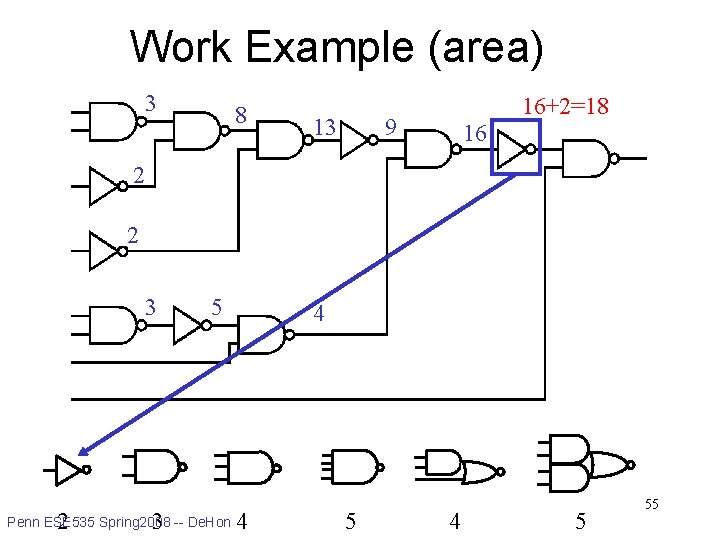
Work Example (area) 3 8 13 16+2=18 9 16 2 2 3 5 4 library 2 3 Penn ESE 535 Spring 2008 -- De. Hon 4 5 55
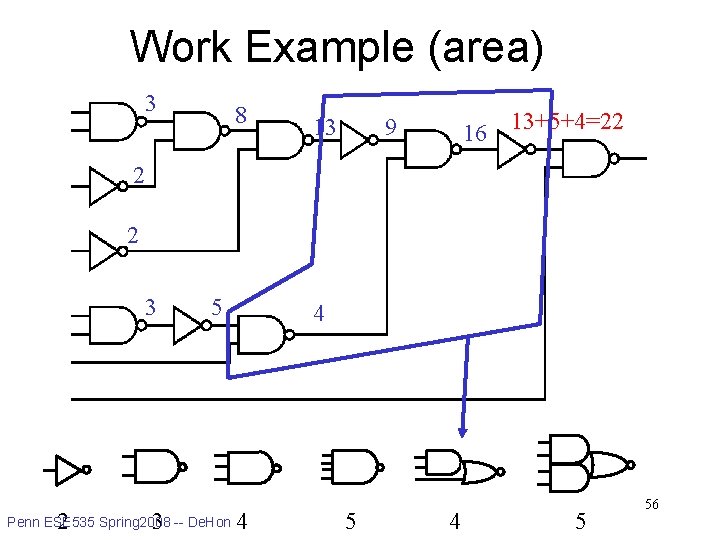
Work Example (area) 3 8 13 9 16 13+5+4=22 2 2 3 5 4 library 2 3 Penn ESE 535 Spring 2008 -- De. Hon 4 5 56
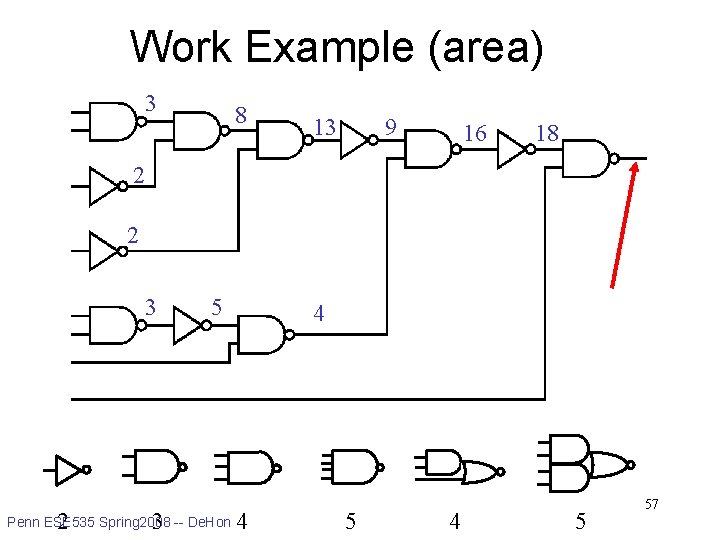
Work Example (area) 3 8 13 9 16 18 2 2 3 5 4 library 2 3 Penn ESE 535 Spring 2008 -- De. Hon 4 5 57
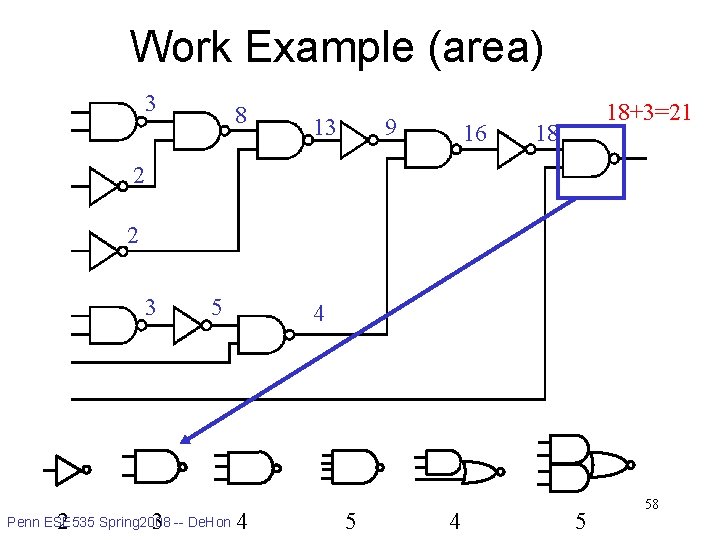
Work Example (area) 3 8 13 9 16 18+3=21 18 2 2 3 5 4 library 2 3 Penn ESE 535 Spring 2008 -- De. Hon 4 5 58
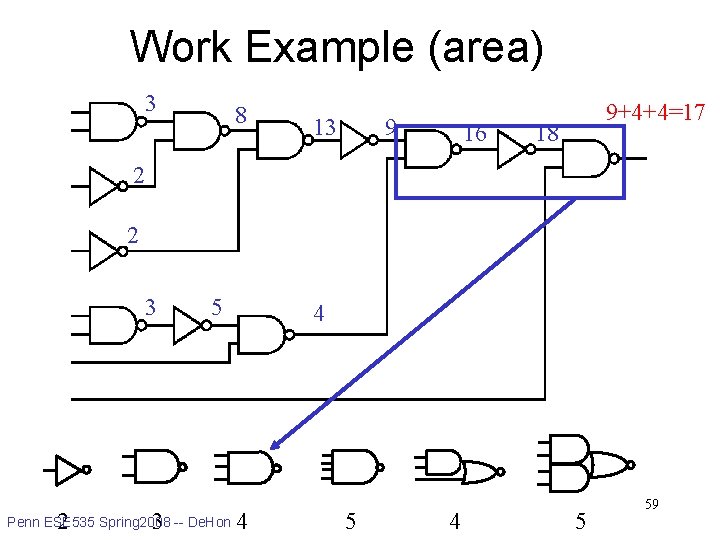
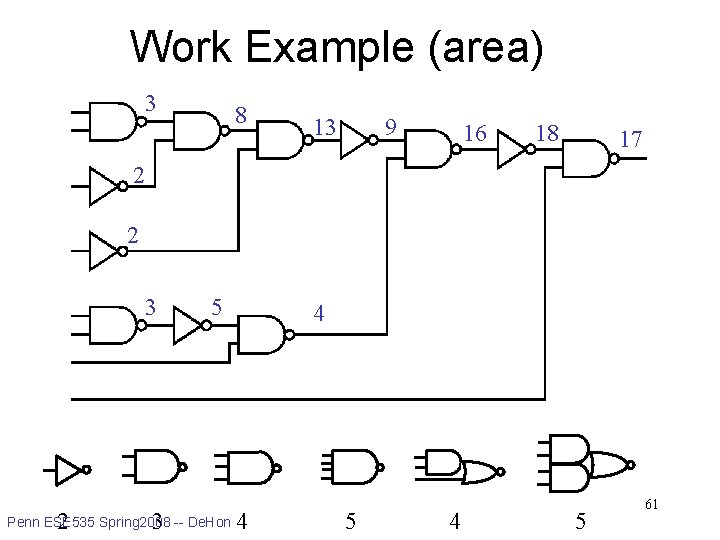
Work Example (area) 3 8 13 9 16 9+4+4=17 18 2 2 3 5 4 library 2 3 Penn ESE 535 Spring 2008 -- De. Hon 4 5 59
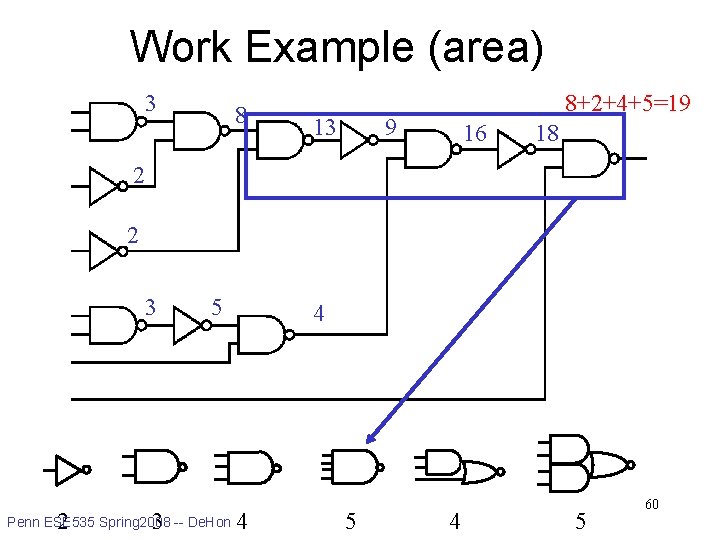
Work Example (area) 3 8 13 8+2+4+5=19 9 16 18 2 2 3 5 4 library 2 3 Penn ESE 535 Spring 2008 -- De. Hon 4 5 60
Work Example (area) 3 8 13 9 16 18 17 2 2 3 5 4 library 2 3 Penn ESE 535 Spring 2008 -- De. Hon 4 5 61
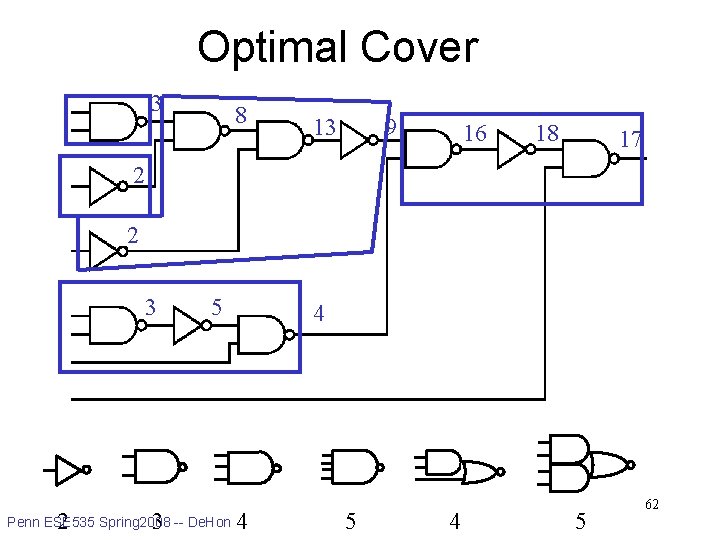
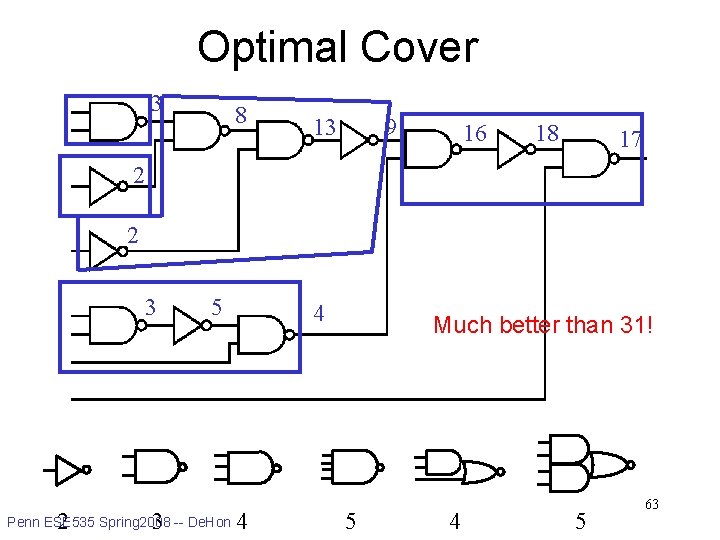
Optimal Cover 3 8 13 9 16 18 17 2 2 3 5 4 library 2 3 Penn ESE 535 Spring 2008 -- De. Hon 4 5 62
Optimal Cover 3 8 13 9 16 18 17 2 2 3 5 4 Much better than 31! library 2 3 Penn ESE 535 Spring 2008 -- De. Hon 4 5 63
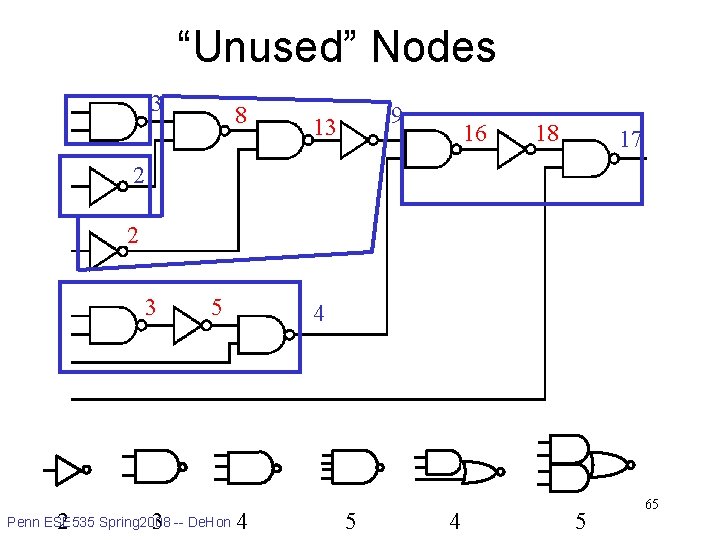
Note • There are nodes we cover which will not appear in final solution. 64 Penn ESE 535 Spring 2008 -- De. Hon
“Unused” Nodes 3 8 9 13 16 18 17 2 2 3 5 4 library 2 3 Penn ESE 535 Spring 2008 -- De. Hon 4 5 65
Dynamic Programming Solution • Solution described is general instance of dynamic programming • Require: – optimal solution to subproblems is optimal solution to whole problem – (all optimal solutions equally good) – divide-and-conquer gets same (finite/small) number of subproblems • Same technique used for instruction selection 66 Penn ESE 535 Spring 2008 -- De. Hon
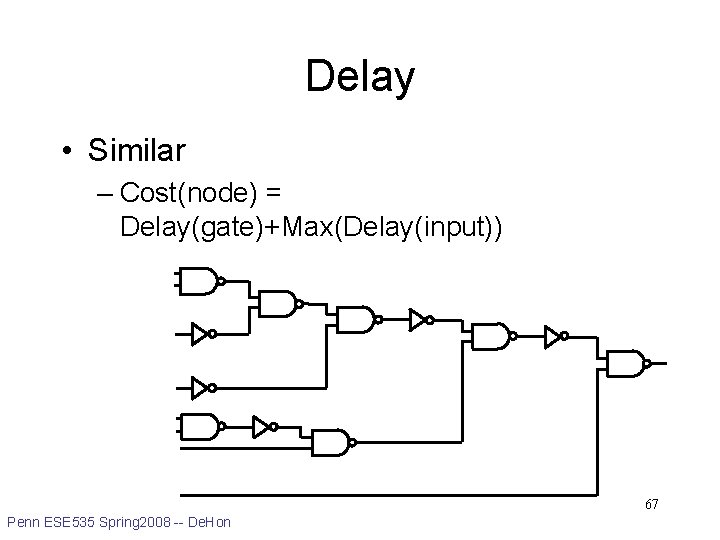
Delay • Similar – Cost(node) = Delay(gate)+Max(Delay(input)) 67 Penn ESE 535 Spring 2008 -- De. Hon
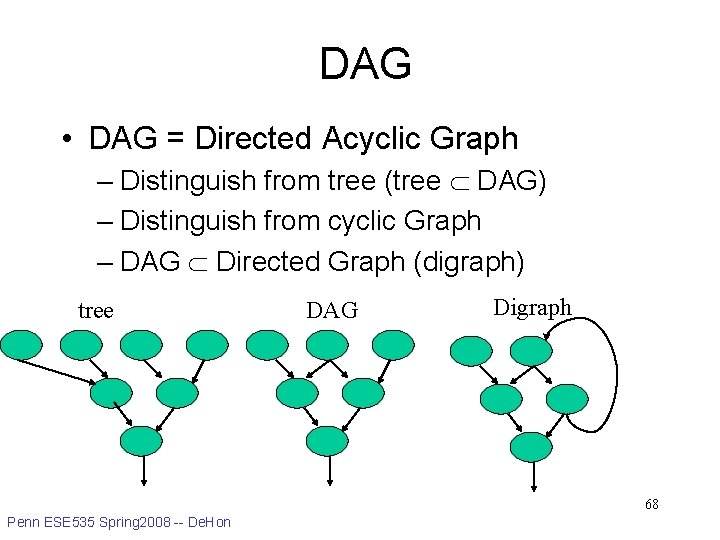
DAG • DAG = Directed Acyclic Graph – Distinguish from tree (tree DAG) – Distinguish from cyclic Graph – DAG Directed Graph (digraph) tree DAG Digraph 68 Penn ESE 535 Spring 2008 -- De. Hon
Trees vs. DAGs • Optimal for trees – why? • Area • Delay 69 Penn ESE 535 Spring 2008 -- De. Hon
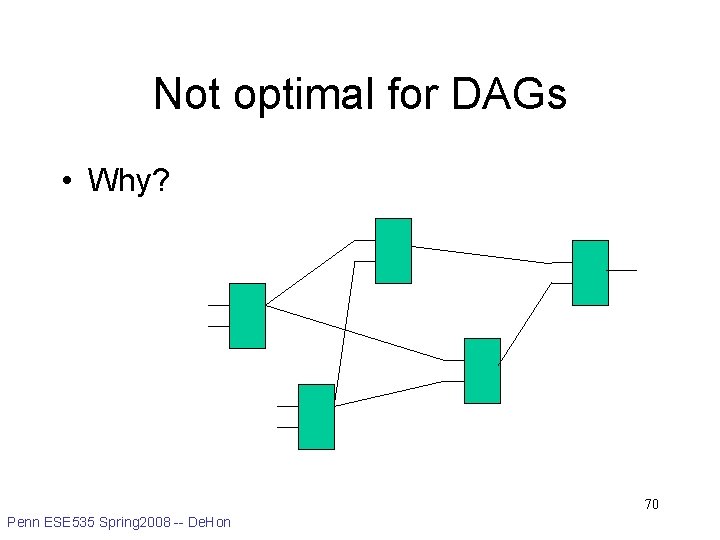
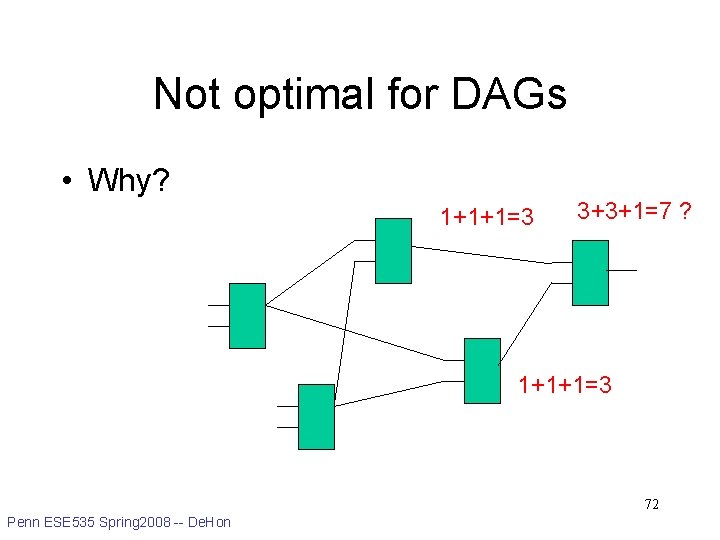
Not optimal for DAGs • Why? 70 Penn ESE 535 Spring 2008 -- De. Hon
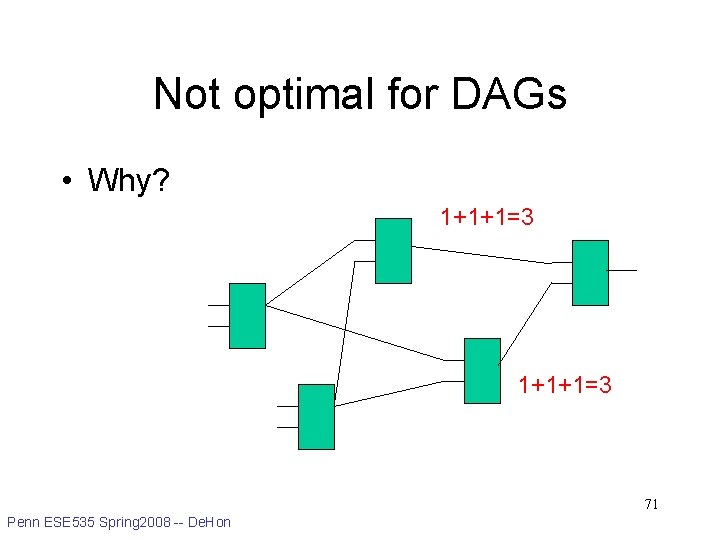
Not optimal for DAGs • Why? 1+1+1=3 71 Penn ESE 535 Spring 2008 -- De. Hon
Not optimal for DAGs • Why? 1+1+1=3 3+3+1=7 ? 1+1+1=3 72 Penn ESE 535 Spring 2008 -- De. Hon
Not Optimal for DAGs (area) • Cost(N) = Cost(gate) + Cost(input nodes) • think of sets • cost is magnitude of set union • Problem: minimum cost (magnitude) solution isn’t necessarily the best pick – get interaction between subproblems – subproblem optimum not global. . . 73 Penn ESE 535 Spring 2008 -- De. Hon
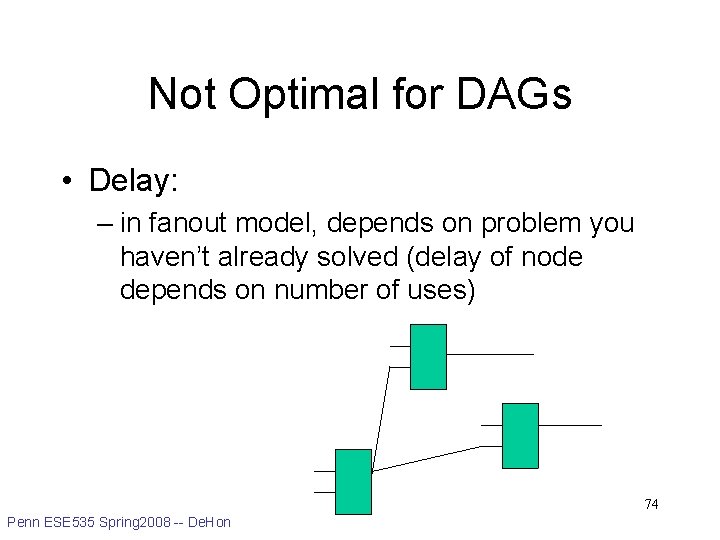
Not Optimal for DAGs • Delay: – in fanout model, depends on problem you haven’t already solved (delay of node depends on number of uses) 74 Penn ESE 535 Spring 2008 -- De. Hon
What do people do? • Cut DAGs at fanout nodes • optimally solve resulting trees • Area – guarantees covered once • get accurate costs in covering trees, made “premature” assignment of nodes to trees • Delay – know where fanout is 75 Penn ESE 535 Spring 2008 -- De. Hon
Bounding • Tree solution give bounds (esp. for delay) – single path, optimal covering for delay – (also make tree by replicating nodes at fanout points) • no fanout cost give bounds – know you can’t do better • delay bounds useful, too – know what you’re giving up for area – when delay matters 76 Penn ESE 535 Spring 2008 -- De. Hon
(Multiple Objectives? ) • Like to say, get delay, then area – won’t get minimum area for that delay – algorithm only keep best delay – …but best delay on off critical path piece not matter • …could have accepted more delay there – don’t know if on critical path while building subtree – (iterate, keep multiple solutions) 77 Penn ESE 535 Spring 2008 -- De. Hon
Many more details. . . • Implement well • Combine criteria – (touch on some later) • …see literature – (put some refs on web) 78 Penn ESE 535 Spring 2008 -- De. Hon
Admin • Reminder: Reading for Monday – Flowmap classic FPGA-mapping paper – (will mail pointers this afternoon) • Assignment 1 out today 79 Penn ESE 535 Spring 2008 -- De. Hon
Big Ideas • • • simple cost models problem formulation identifying structure in the problem special structure characteristics that make problems hard bounding solutions 80 Penn ESE 535 Spring 2008 -- De. Hon