ESE 680 002 ESE 534 Computer Organization Day
- Slides: 55
ESE 680 -002 (ESE 534): Computer Organization Day 14: February 28, 2007 Interconnect 2: Wiring Requirements and Implications Penn ESE 680 -002 Spring 2007 --De. Hon 1
Previously • Identified need for Interconnect • Saw why simplest things don’t work – Bus – Crossbar • Identified need to understand/exploit structure in our interconnect problem Penn ESE 680 -002 Spring 2007 --De. Hon 2
Today • Wiring Requirements • Rent’s Rule – A model of structure • Implications Penn ESE 680 -002 Spring 2007 --De. Hon 3
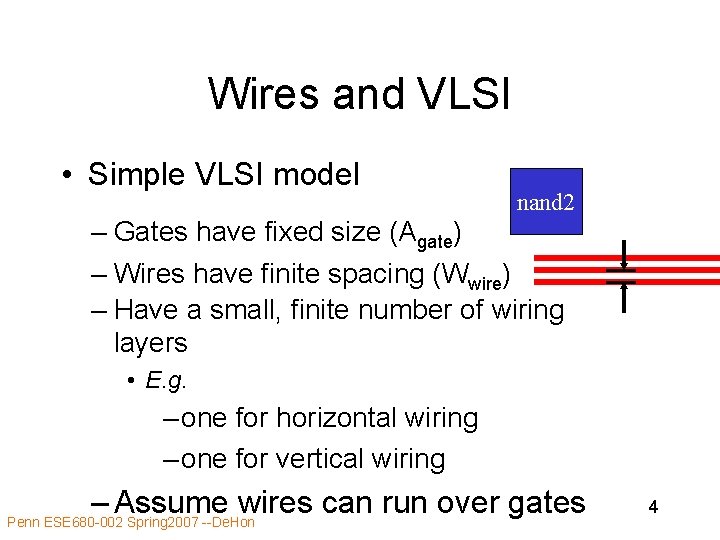
Wires and VLSI • Simple VLSI model nand 2 – Gates have fixed size (Agate) – Wires have finite spacing (Wwire) – Have a small, finite number of wiring layers • E. g. – one for horizontal wiring – one for vertical wiring – Assume wires can run over gates Penn ESE 680 -002 Spring 2007 --De. Hon 4
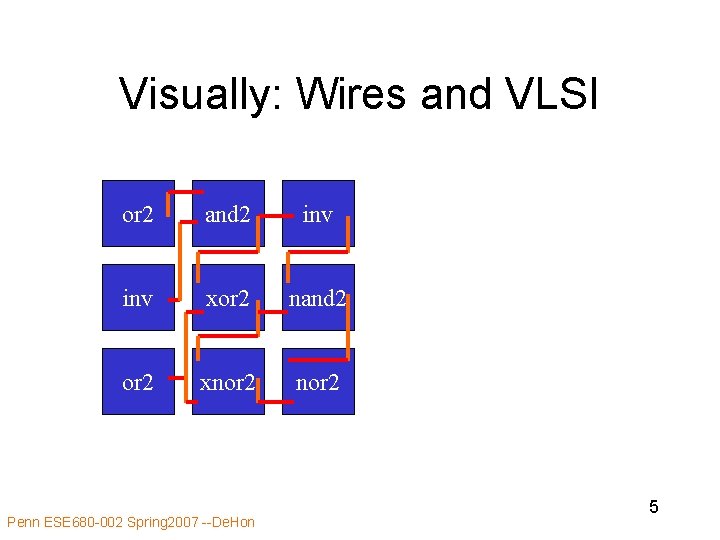
Visually: Wires and VLSI or 2 and 2 inv xor 2 nand 2 or 2 xnor 2 Penn ESE 680 -002 Spring 2007 --De. Hon 5
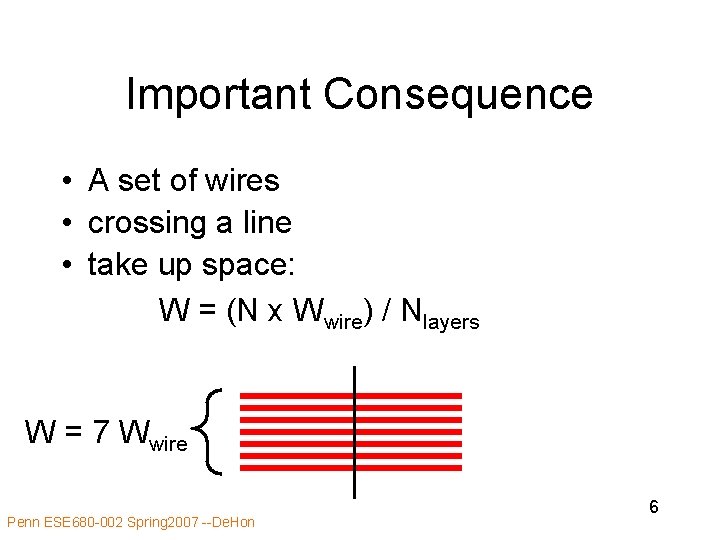
Important Consequence • A set of wires • crossing a line • take up space: W = (N x Wwire) / Nlayers W = 7 Wwire Penn ESE 680 -002 Spring 2007 --De. Hon 6
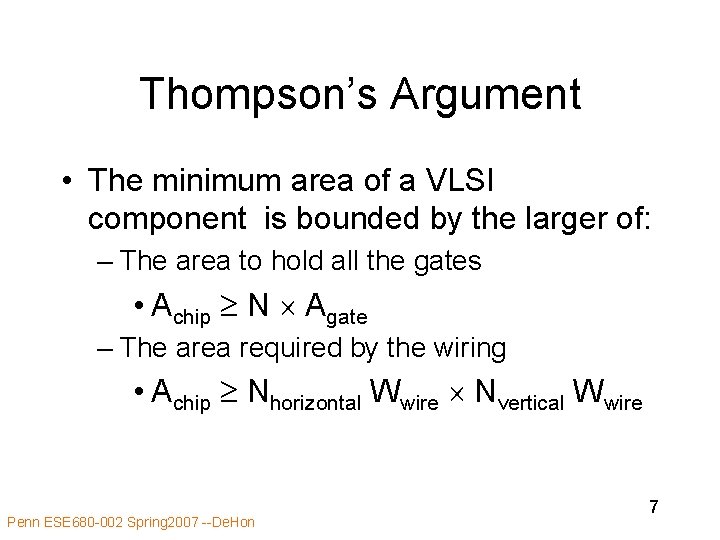
Thompson’s Argument • The minimum area of a VLSI component is bounded by the larger of: – The area to hold all the gates • Achip N Agate – The area required by the wiring • Achip Nhorizontal Wwire Nvertical Wwire Penn ESE 680 -002 Spring 2007 --De. Hon 7
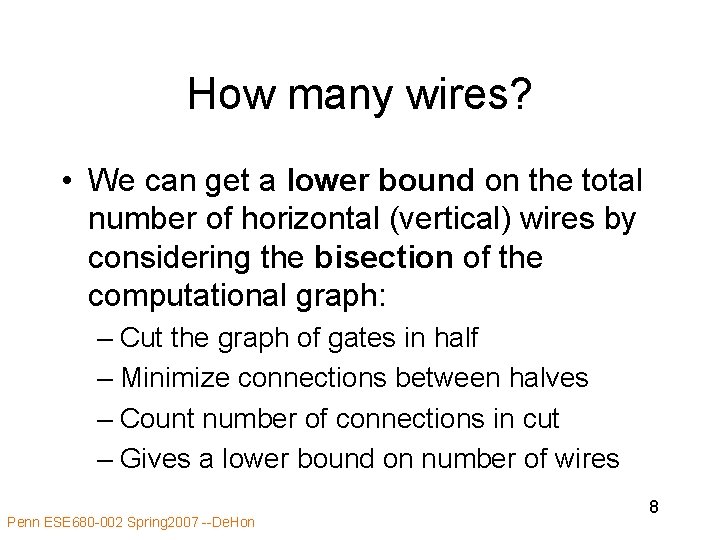
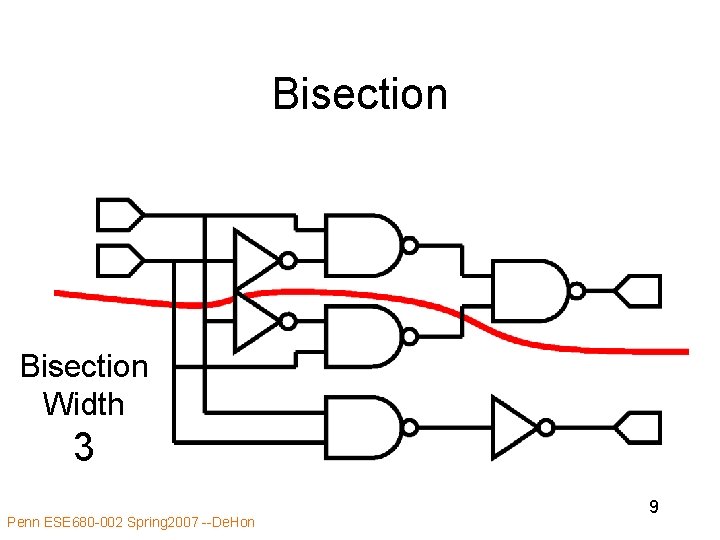
How many wires? • We can get a lower bound on the total number of horizontal (vertical) wires by considering the bisection of the computational graph: – Cut the graph of gates in half – Minimize connections between halves – Count number of connections in cut – Gives a lower bound on number of wires Penn ESE 680 -002 Spring 2007 --De. Hon 8
Bisection Width 3 Penn ESE 680 -002 Spring 2007 --De. Hon 9
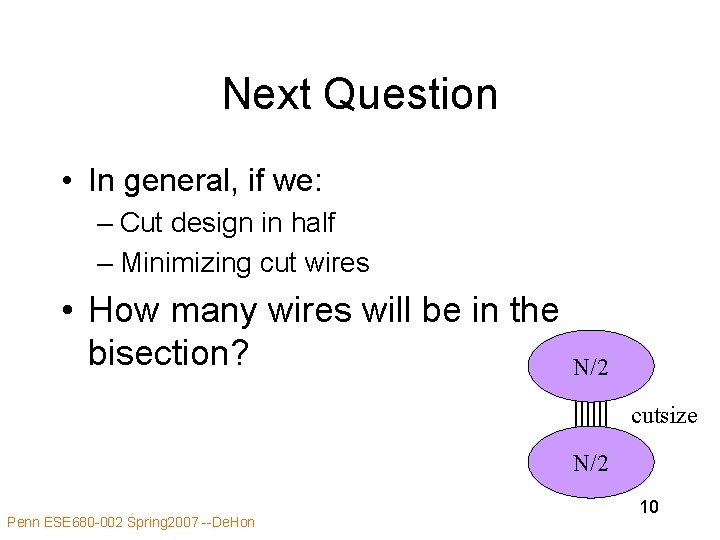
Next Question • In general, if we: – Cut design in half – Minimizing cut wires • How many wires will be in the bisection? N/2 cutsize N/2 Penn ESE 680 -002 Spring 2007 --De. Hon 10
Arbitrary Graph • Graph with N nodes • Cut in half – N/2 gates on each side • Worst-case: – Every gate output on each side – Is used somewhere on other side – Cut contains N wires Penn ESE 680 -002 Spring 2007 --De. Hon 11
Arbitrary Graph • For a random graph – Something proportional to this is likely • That is: – Given a random graph with N nodes – The number of wires in the bisection is likely to be: c N Penn ESE 680 -002 Spring 2007 --De. Hon 12
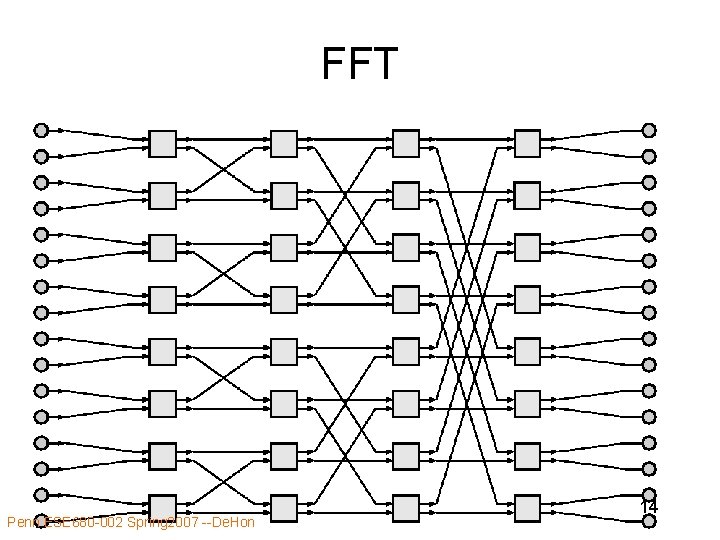
Particular Computational Graphs • Some important computations have exactly this property – FFT (Fast Fourier Transform) – Sorting Penn ESE 680 -002 Spring 2007 --De. Hon 13
FFT Penn ESE 680 -002 Spring 2007 --De. Hon 14
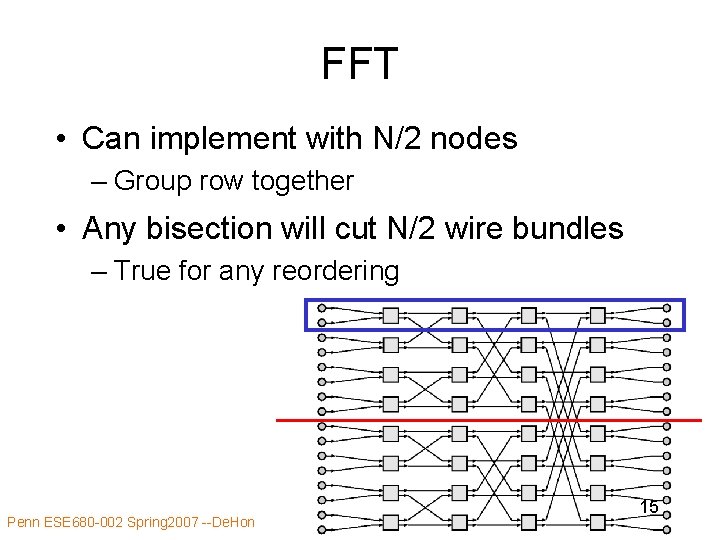
FFT • Can implement with N/2 nodes – Group row together • Any bisection will cut N/2 wire bundles – True for any reordering Penn ESE 680 -002 Spring 2007 --De. Hon 15
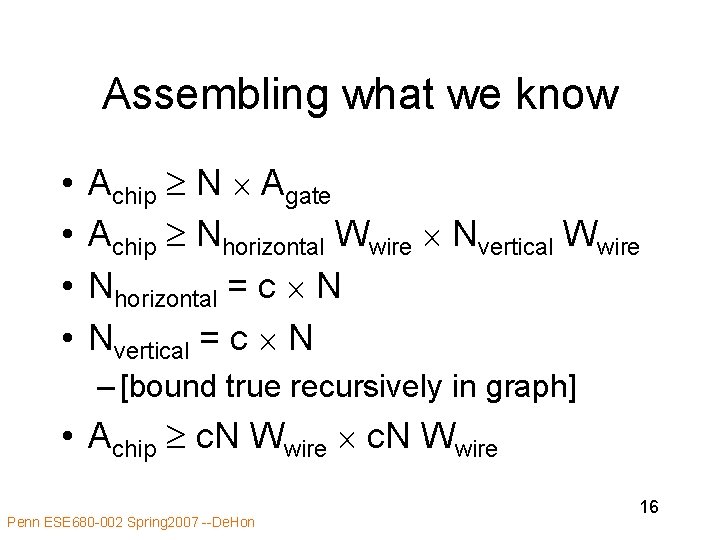
Assembling what we know • • Achip N Agate Achip Nhorizontal Wwire Nvertical Wwire Nhorizontal = c N Nvertical = c N – [bound true recursively in graph] • Achip c. N Wwire Penn ESE 680 -002 Spring 2007 --De. Hon 16
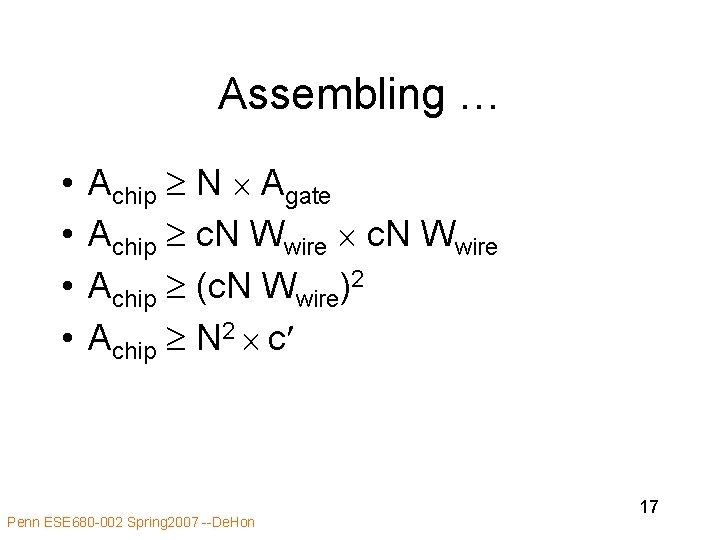
Assembling … • • Achip N Agate Achip c. N Wwire Achip (c. N Wwire)2 Achip N 2 c Penn ESE 680 -002 Spring 2007 --De. Hon 17
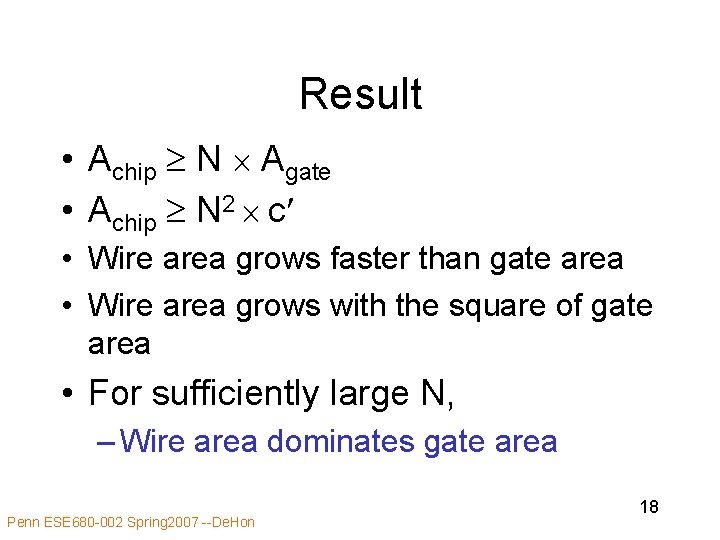
Result • Achip N Agate • Achip N 2 c • Wire area grows faster than gate area • Wire area grows with the square of gate area • For sufficiently large N, – Wire area dominates gate area Penn ESE 680 -002 Spring 2007 --De. Hon 18
Intuitive Version • Consider a region of a chip • Gate capacity in the region goes as area (s 2) • Wiring capacity into region goes as perimeter (4 s) • Perimeter grows more slowly than area – Wire capacity saturates before gate Penn ESE 680 -002 Spring 2007 --De. Hon 19
Result • Achip N 2 c • Wire area grows with the square of gate area • Troubling: – To double the size of our computation – Must quadruple the size of our chip! Penn ESE 680 -002 Spring 2007 --De. Hon 20
So what? What do we do with this observation? Penn ESE 680 -002 Spring 2007 --De. Hon 21
First Observation • Not all designs have this large of a bisection • What is typical? Penn ESE 680 -002 Spring 2007 --De. Hon 22
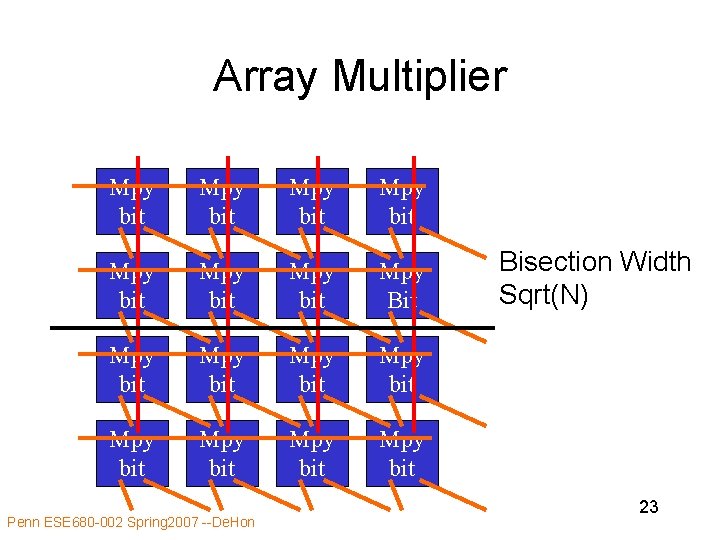
Array Multiplier Mpy bit Mpy bit Mpy Bit Mpy bit Mpy bit Penn ESE 680 -002 Spring 2007 --De. Hon Bisection Width Sqrt(N) 23
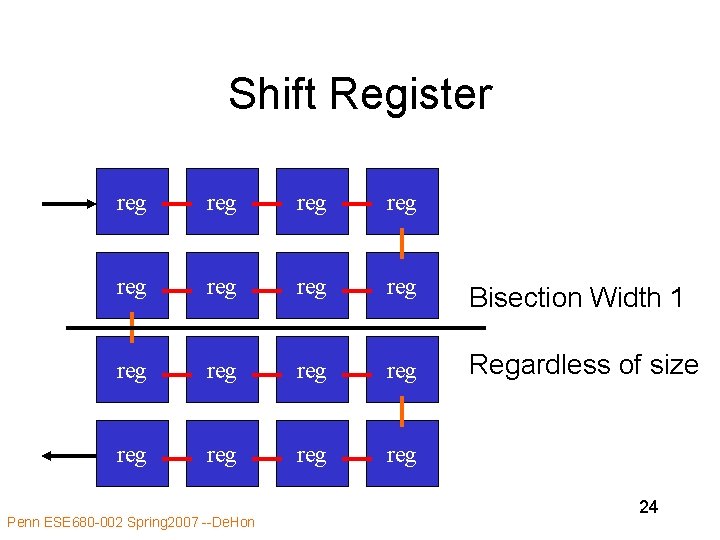
Shift Register reg reg Bisection Width 1 reg reg Regardless of size reg reg Penn ESE 680 -002 Spring 2007 --De. Hon 24
Architecture Structure • Typical architecture trick: – exploit expected problem structure • What structure do we have? • Impact on resources required? Penn ESE 680 -002 Spring 2007 --De. Hon 25
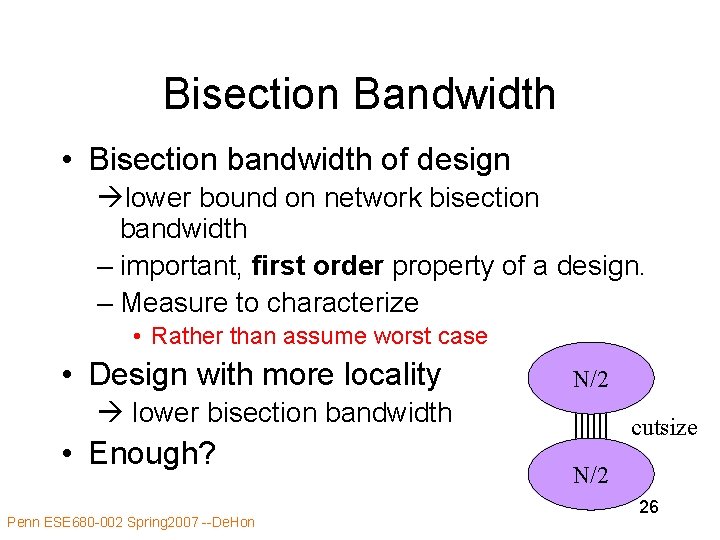
Bisection Bandwidth • Bisection bandwidth of design lower bound on network bisection bandwidth – important, first order property of a design. – Measure to characterize • Rather than assume worst case • Design with more locality N/2 lower bisection bandwidth • Enough? Penn ESE 680 -002 Spring 2007 --De. Hon cutsize N/2 26
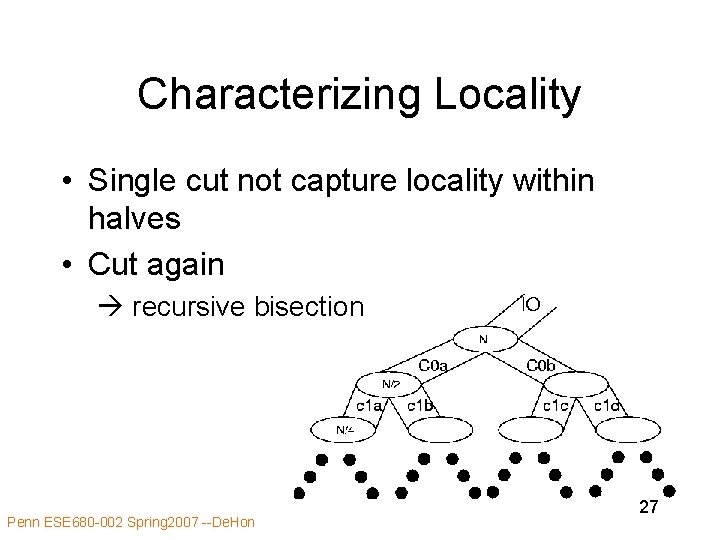
Characterizing Locality • Single cut not capture locality within halves • Cut again recursive bisection Penn ESE 680 -002 Spring 2007 --De. Hon 27
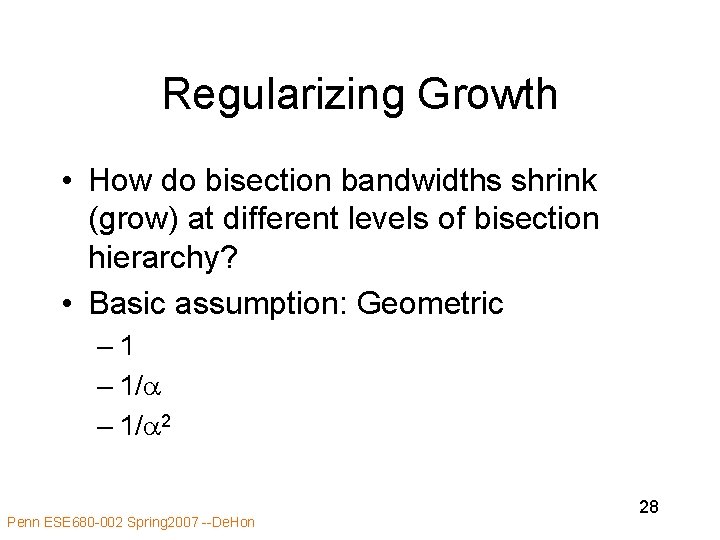
Regularizing Growth • How do bisection bandwidths shrink (grow) at different levels of bisection hierarchy? • Basic assumption: Geometric – 1/ 2 Penn ESE 680 -002 Spring 2007 --De. Hon 28
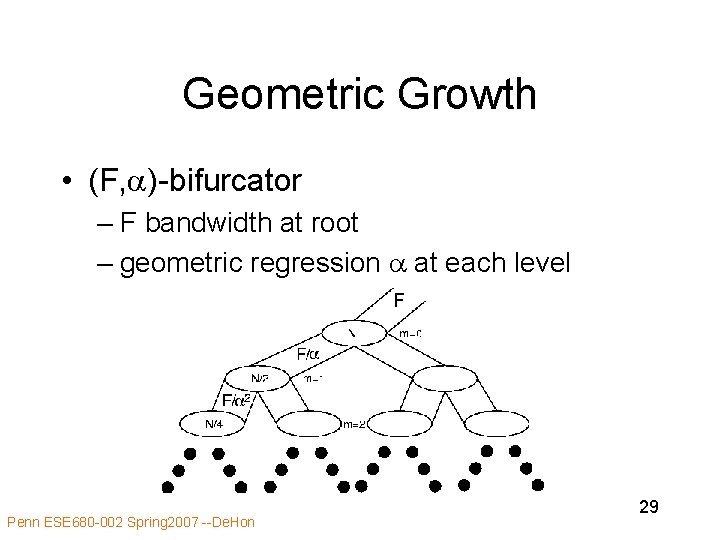
Geometric Growth • (F, )-bifurcator – F bandwidth at root – geometric regression at each level Penn ESE 680 -002 Spring 2007 --De. Hon 29
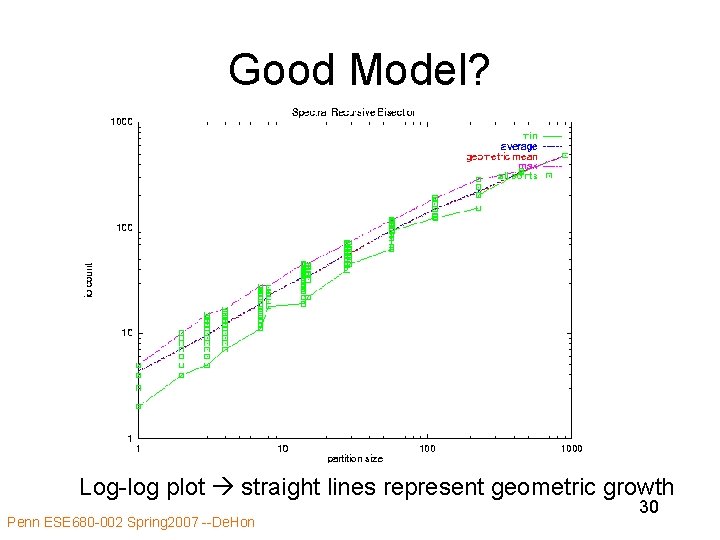
Good Model? Log-log plot straight lines represent geometric growth Penn ESE 680 -002 Spring 2007 --De. Hon 30
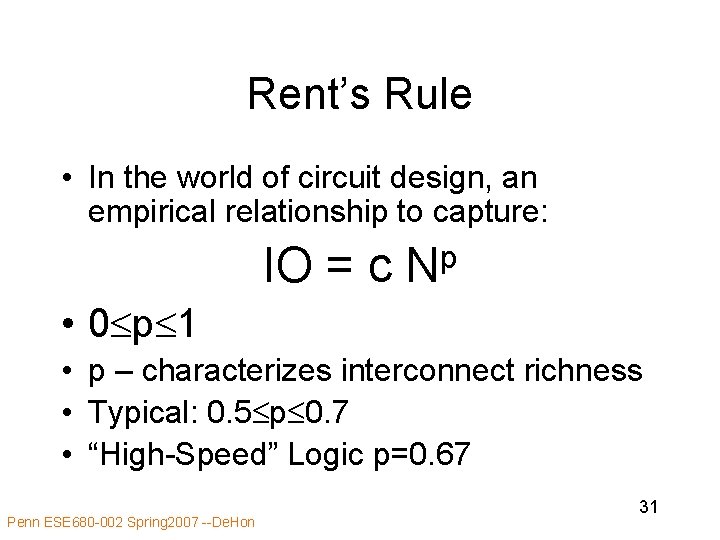
Rent’s Rule • In the world of circuit design, an empirical relationship to capture: p IO = c N • 0 p 1 • p – characterizes interconnect richness • Typical: 0. 5 p 0. 7 • “High-Speed” Logic p=0. 67 Penn ESE 680 -002 Spring 2007 --De. Hon 31
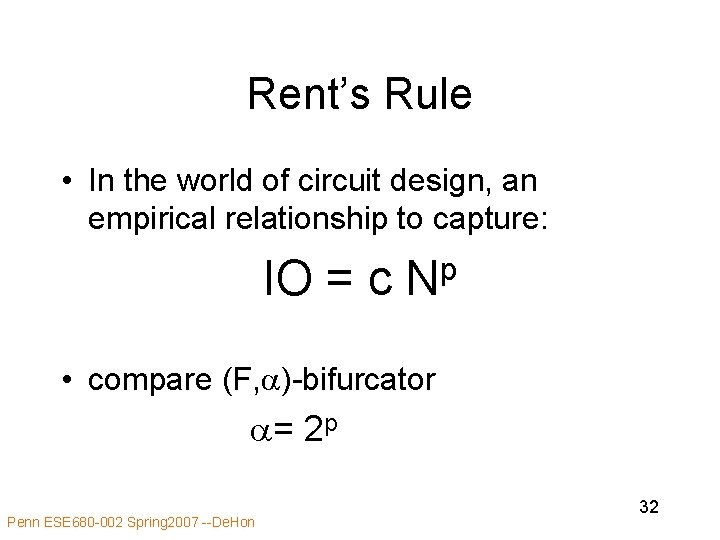
Rent’s Rule • In the world of circuit design, an empirical relationship to capture: IO = c Np • compare (F, )-bifurcator = 2 p Penn ESE 680 -002 Spring 2007 --De. Hon 32
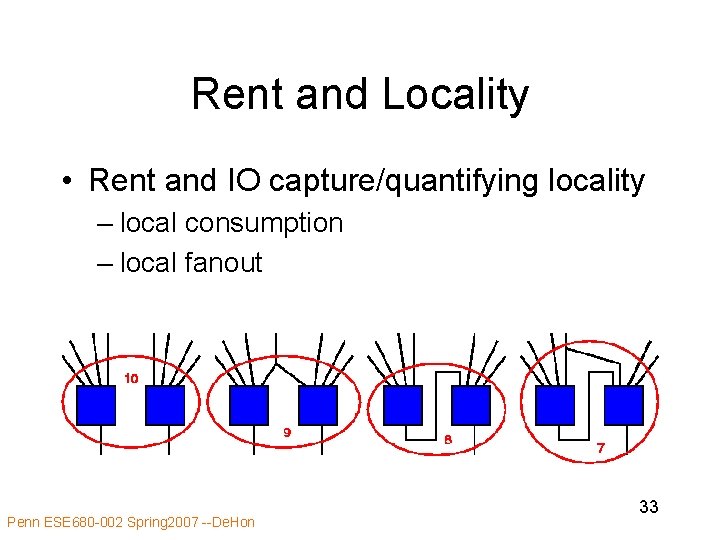
Rent and Locality • Rent and IO capture/quantifying locality – local consumption – local fanout Penn ESE 680 -002 Spring 2007 --De. Hon 33
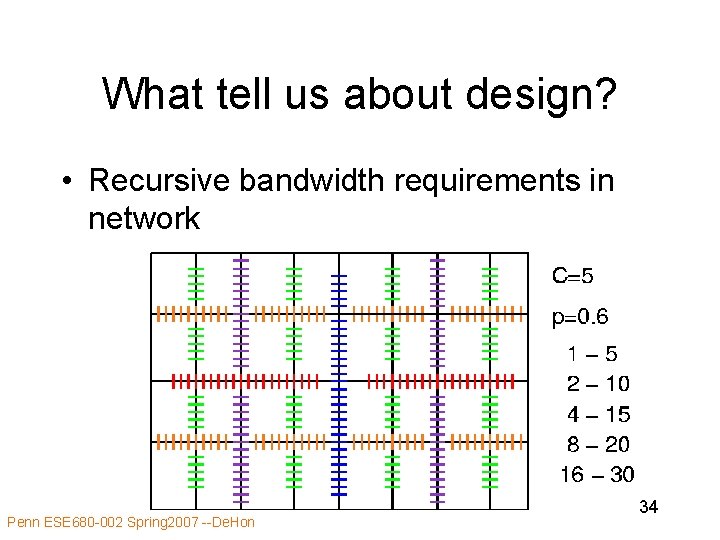
What tell us about design? • Recursive bandwidth requirements in network Penn ESE 680 -002 Spring 2007 --De. Hon 34
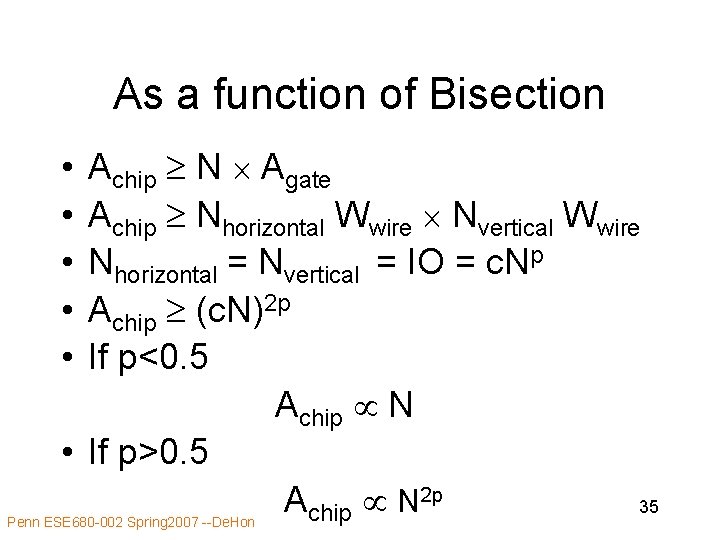
As a function of Bisection Achip N Agate Achip Nhorizontal Wwire Nvertical Wwire Nhorizontal = Nvertical = IO = c. Np Achip (c. N)2 p If p<0. 5 Achip N • If p>0. 5 Achip N 2 p 35 • • • Penn ESE 680 -002 Spring 2007 --De. Hon
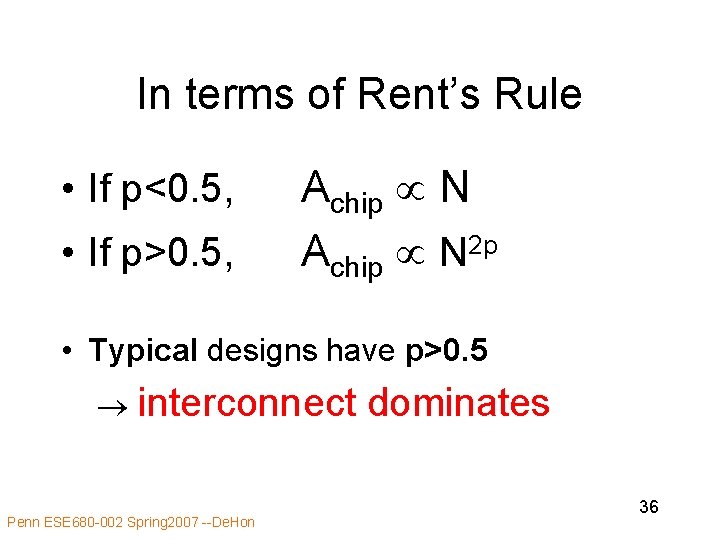
In terms of Rent’s Rule • If p<0. 5, • If p>0. 5, Achip N 2 p • Typical designs have p>0. 5 ® interconnect Penn ESE 680 -002 Spring 2007 --De. Hon dominates 36
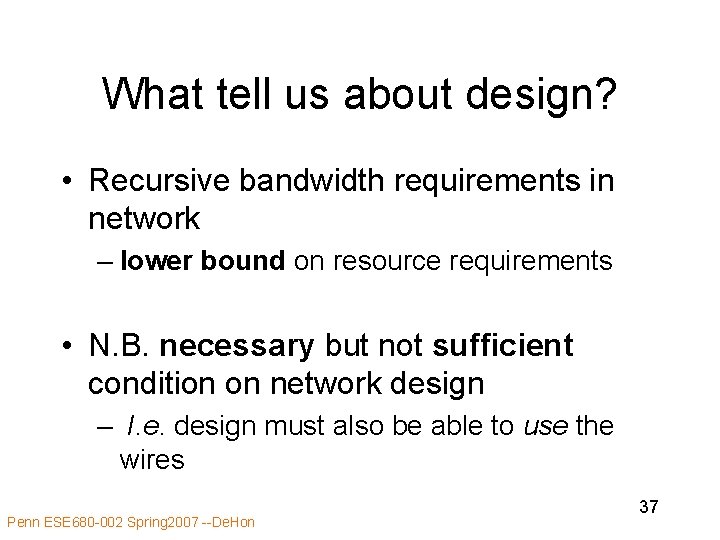
What tell us about design? • Recursive bandwidth requirements in network – lower bound on resource requirements • N. B. necessary but not sufficient condition on network design – I. e. design must also be able to use the wires Penn ESE 680 -002 Spring 2007 --De. Hon 37
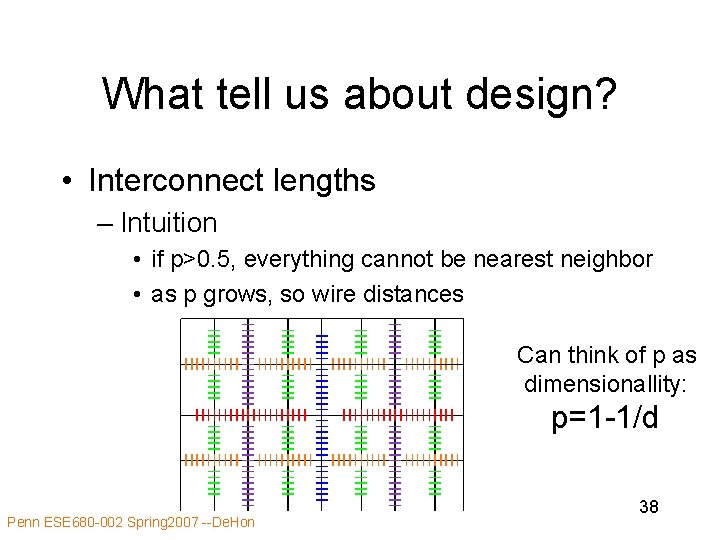
What tell us about design? • Interconnect lengths – Intuition • if p>0. 5, everything cannot be nearest neighbor • as p grows, so wire distances Can think of p as dimensionallity: p=1 -1/d Penn ESE 680 -002 Spring 2007 --De. Hon 38
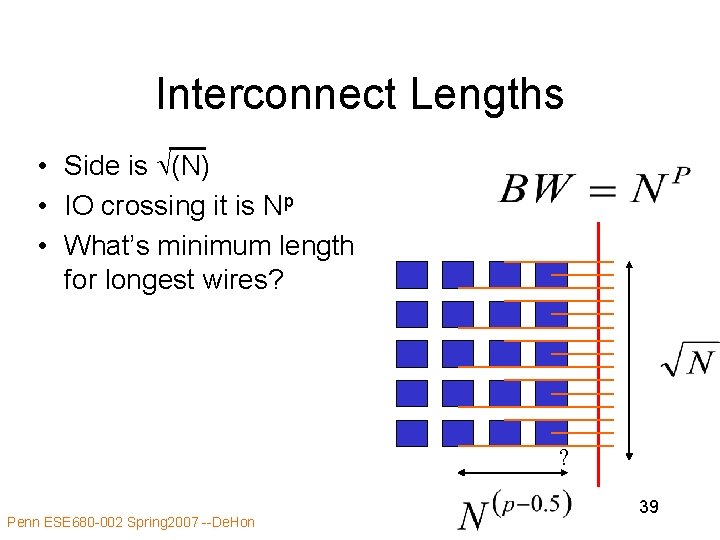
Interconnect Lengths • Side is (N) • IO crossing it is Np • What’s minimum length for longest wires? ? Penn ESE 680 -002 Spring 2007 --De. Hon 39
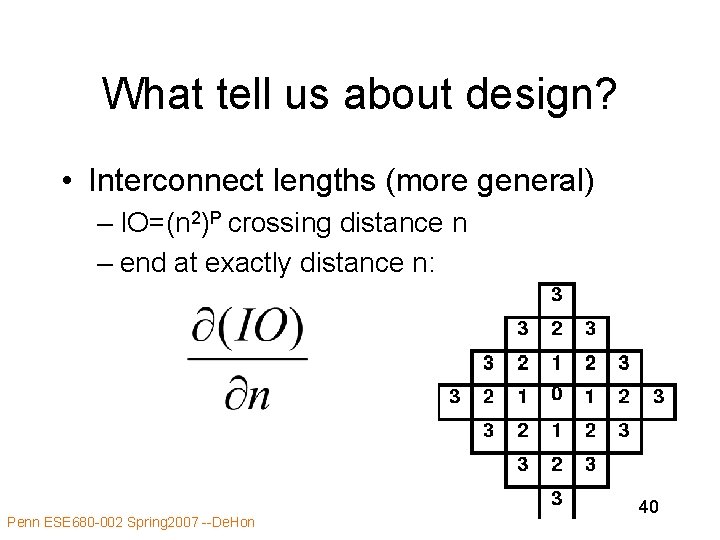
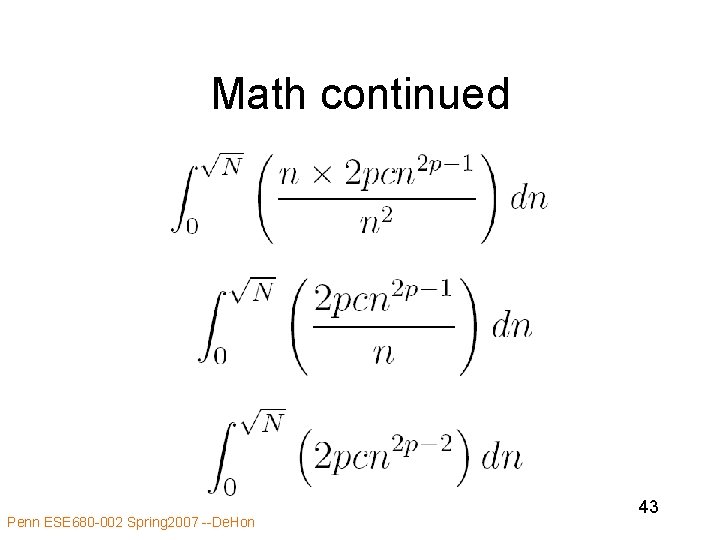
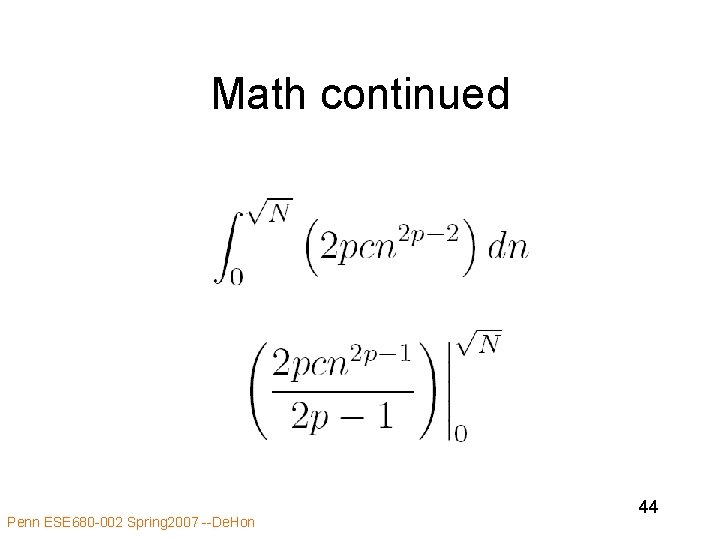
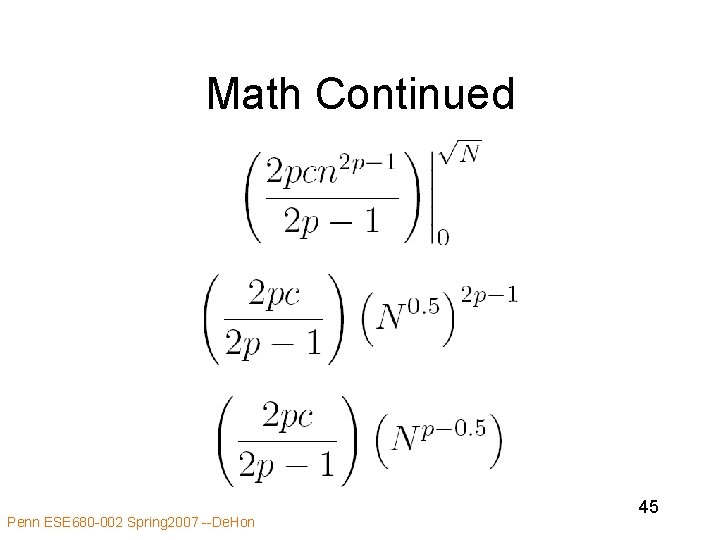
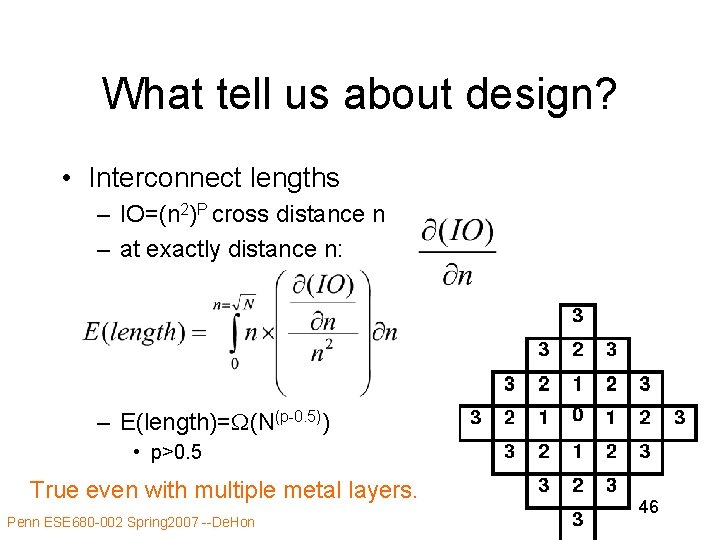
What tell us about design? • Interconnect lengths (more general) – IO=(n 2)P crossing distance n – end at exactly distance n: Penn ESE 680 -002 Spring 2007 --De. Hon 40
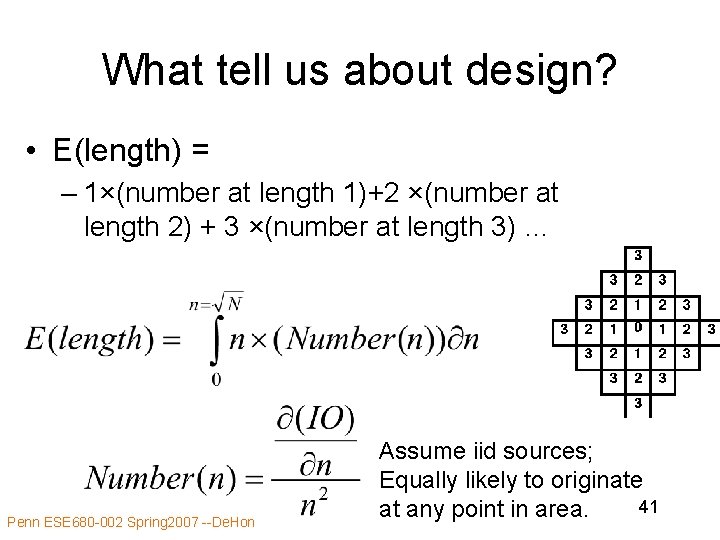
What tell us about design? • E(length) = – 1×(number at length 1)+2 ×(number at length 2) + 3 ×(number at length 3) … Penn ESE 680 -002 Spring 2007 --De. Hon Assume iid sources; Equally likely to originate 41 at any point in area.
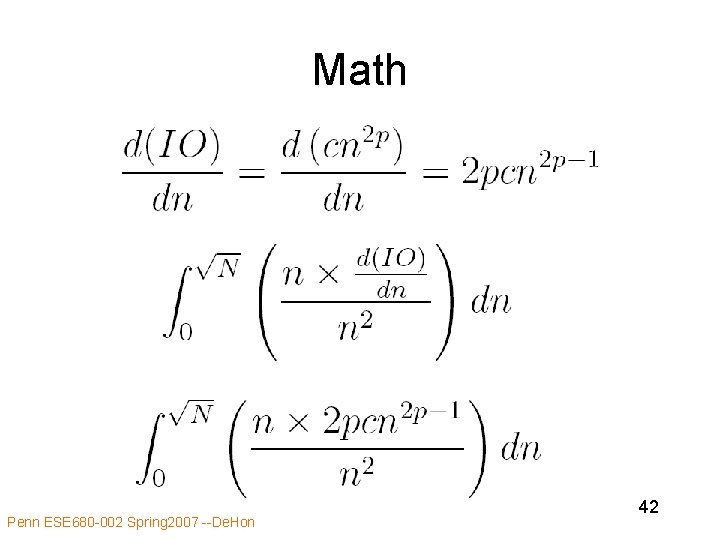
Math Penn ESE 680 -002 Spring 2007 --De. Hon 42
Math continued Penn ESE 680 -002 Spring 2007 --De. Hon 43
Math continued Penn ESE 680 -002 Spring 2007 --De. Hon 44
Math Continued Penn ESE 680 -002 Spring 2007 --De. Hon 45
What tell us about design? • Interconnect lengths – IO=(n 2)P cross distance n – at exactly distance n: – E(length)=W(N(p-0. 5)) • p>0. 5 True even with multiple metal layers. Penn ESE 680 -002 Spring 2007 --De. Hon 46
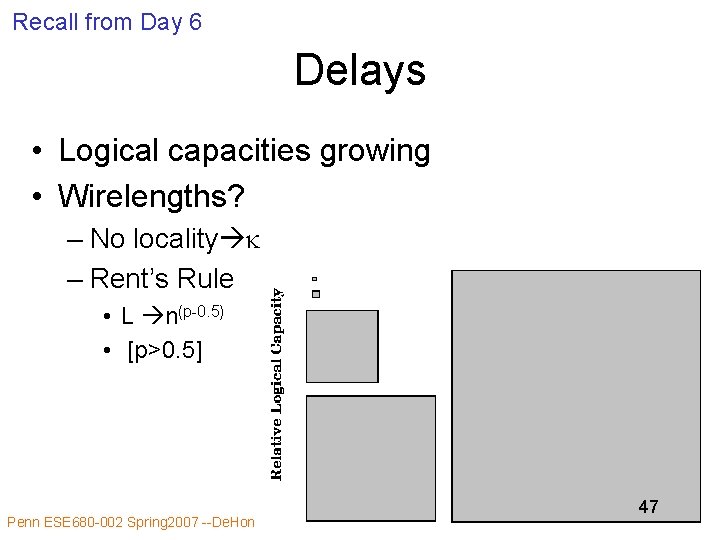
Recall from Day 6 Delays • Logical capacities growing • Wirelengths? – No locality k – Rent’s Rule • L n(p-0. 5) • [p>0. 5] Penn ESE 680 -002 Spring 2007 --De. Hon 47
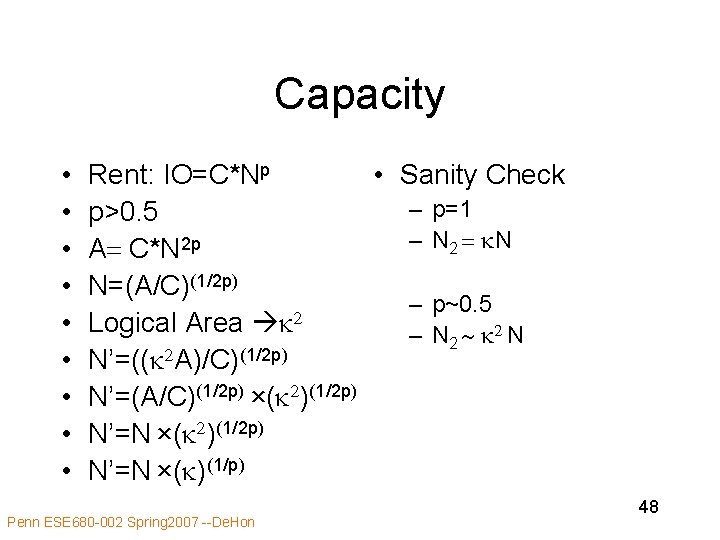
Capacity • • • Rent: IO=C*Np • Sanity Check – p=1 p>0. 5 – N 2 = k. N A= C*N 2 p N=(A/C)(1/2 p) – p~0. 5 2 Logical Area k – N 2 ~ k 2 N N’=((k 2 A)/C)(1/2 p) N’=(A/C)(1/2 p) ×(k 2)(1/2 p) N’=N ×(k)(1/p) Penn ESE 680 -002 Spring 2007 --De. Hon 48
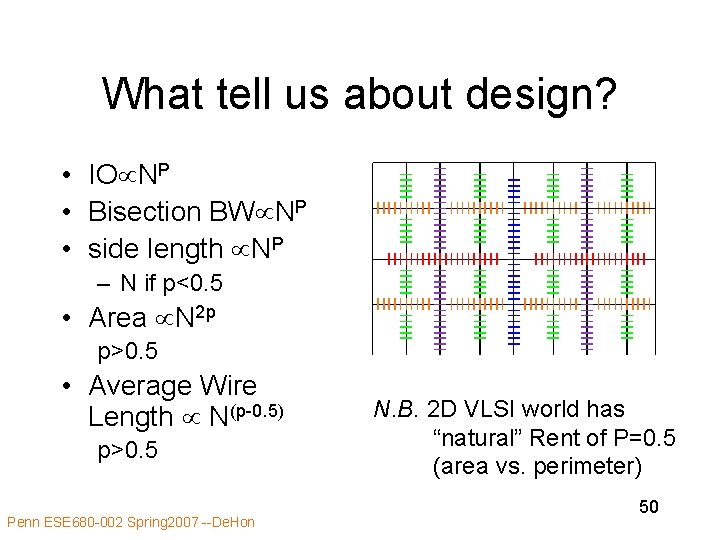
What tell us about design? • IO NP • Bisection BW NP • side length NP – N if p<0. 5 • Area N 2 p p>0. 5 • Average Wire Length N(p-0. 5) p>0. 5 Penn ESE 680 -002 Spring 2007 --De. Hon N. B. 2 D VLSI world has “natural” Rent of P=0. 5 (area vs. perimeter) 50
Rent’s Rule Caveats • Modern “systems” on a chip -- likely to contain subcomponents of varying Rent complexity • Less I/O at certain “natural” boundaries • System close – (Rent’s Rule apply to workstation, PC, PDA? ) Penn ESE 680 -002 Spring 2007 --De. Hon 51
Area/Wire Length • Bad news – Area ~ W(N 2 p) • faster than N – Avg. Wire Length ~ W (N(p-0. 5)) • grows with N • Can designers/CAD control p (locality) once appreciate its effects? • I. e. maybe this cost changes design style/criteria so we mitigate effects? 52 Penn ESE 680 -002 Spring 2007 --De. Hon
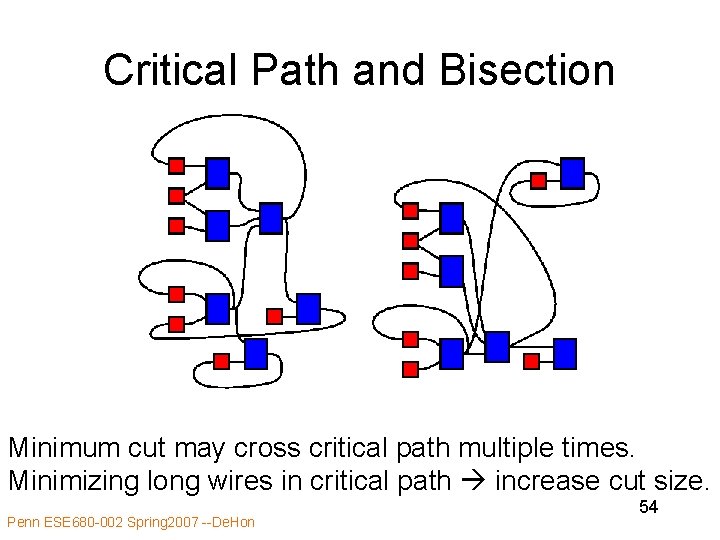
What Rent didn’t tell us • Bisection bandwidth purely geometrical • No constraint for delay – I. e. a partition may leave critical path weaving between halves Penn ESE 680 -002 Spring 2007 --De. Hon 53
Critical Path and Bisection Minimum cut may cross critical path multiple times. Minimizing long wires in critical path increase cut size. Penn ESE 680 -002 Spring 2007 --De. Hon 54
Rent Weakness • Not account for path topology • ? Can we define a “Temporal” Rent which takes into consideration? – Promising research topic Penn ESE 680 -002 Spring 2007 --De. Hon 55
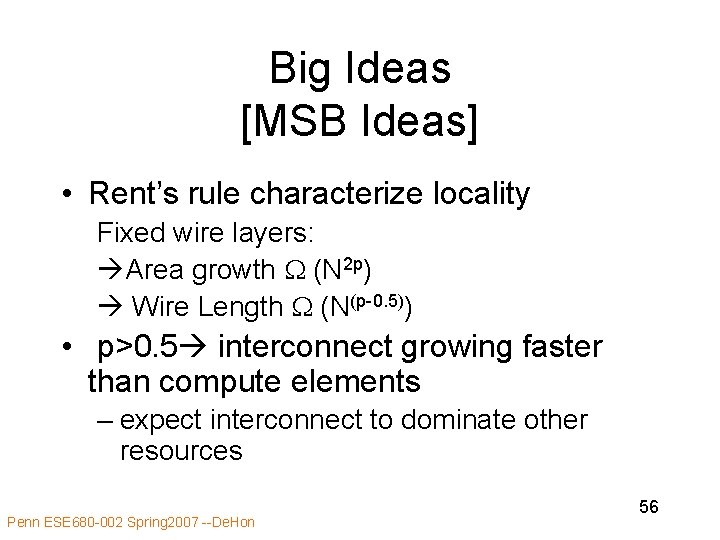
Big Ideas [MSB Ideas] • Rent’s rule characterize locality Fixed wire layers: Area growth W (N 2 p) Wire Length W (N(p-0. 5)) • p>0. 5 interconnect growing faster than compute elements – expect interconnect to dominate other resources Penn ESE 680 -002 Spring 2007 --De. Hon 56