Long Term Care Regulations and Guidance Overview and
- Slides: 92
Long Term Care Regulations and Guidance Overview and Key Components Division of Nursing Homes, Centers for Medicare & Medicaid Services
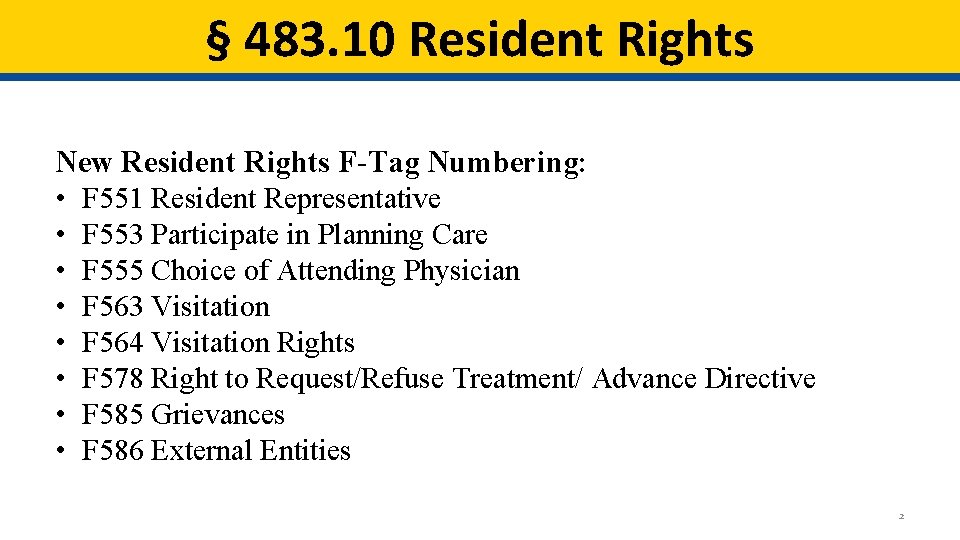
§ 483. 10 Resident Rights New Resident Rights F-Tag Numbering: • F 551 Resident Representative • F 553 Participate in Planning Care • F 555 Choice of Attending Physician • F 563 Visitation • F 564 Visitation Rights • F 578 Right to Request/Refuse Treatment/ Advance Directive • F 585 Grievances • F 586 External Entities 2
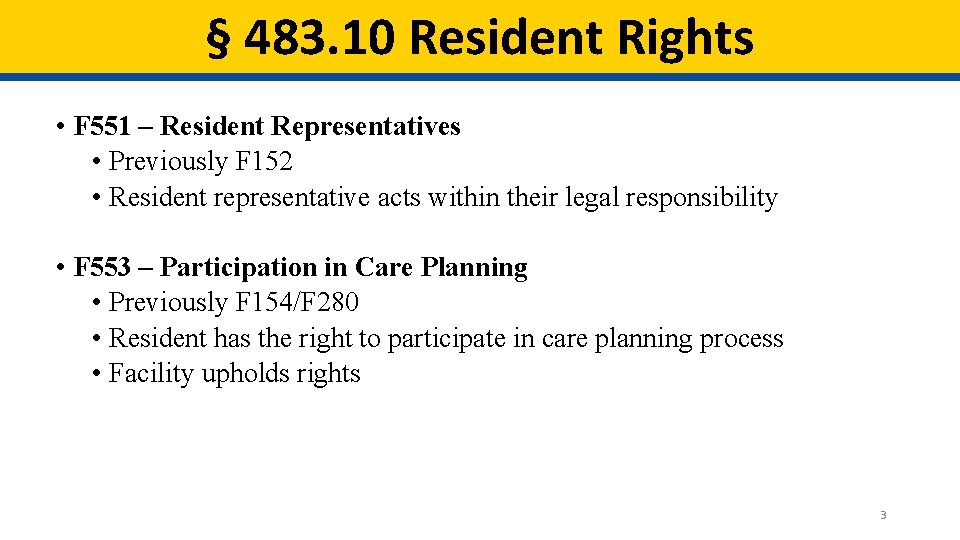
§ 483. 10 Resident Rights • F 551 – Resident Representatives • Previously F 152 • Resident representative acts within their legal responsibility • F 553 – Participation in Care Planning • Previously F 154/F 280 • Resident has the right to participate in care planning process • Facility upholds rights 3
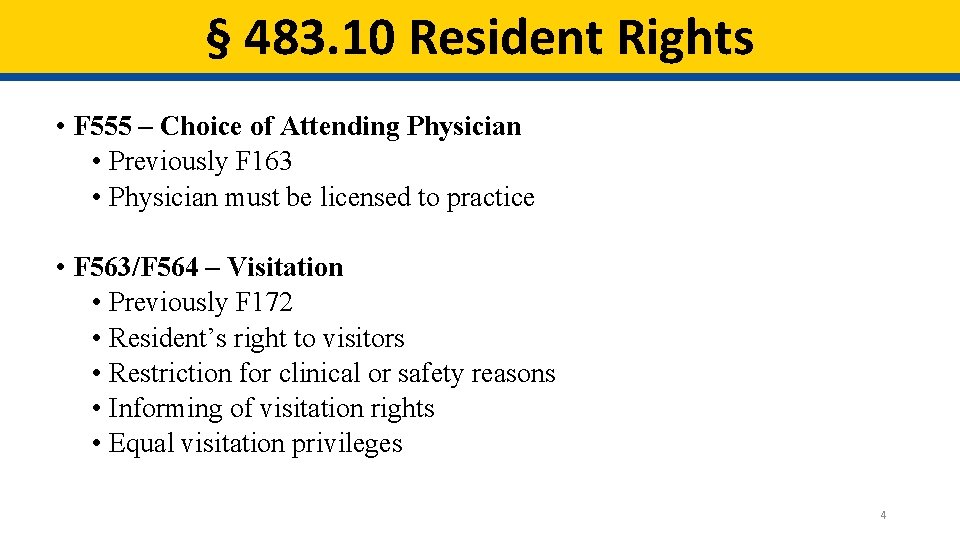
§ 483. 10 Resident Rights • F 555 – Choice of Attending Physician • Previously F 163 • Physician must be licensed to practice • F 563/F 564 – Visitation • Previously F 172 • Resident’s right to visitors • Restriction for clinical or safety reasons • Informing of visitation rights • Equal visitation privileges 4
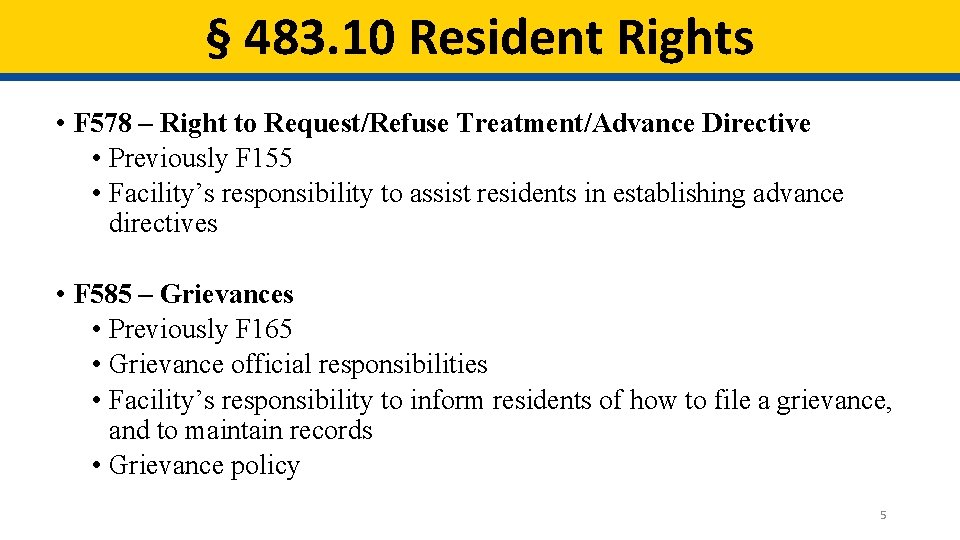
§ 483. 10 Resident Rights • F 578 – Right to Request/Refuse Treatment/Advance Directive • Previously F 155 • Facility’s responsibility to assist residents in establishing advance directives • F 585 – Grievances • Previously F 165 • Grievance official responsibilities • Facility’s responsibility to inform residents of how to file a grievance, and to maintain records • Grievance policy 5
§ 483. 10 Resident Rights • F 586 – External Entities • Previously F 168 • Communication with Federal, State, or local officials must be allowed 6
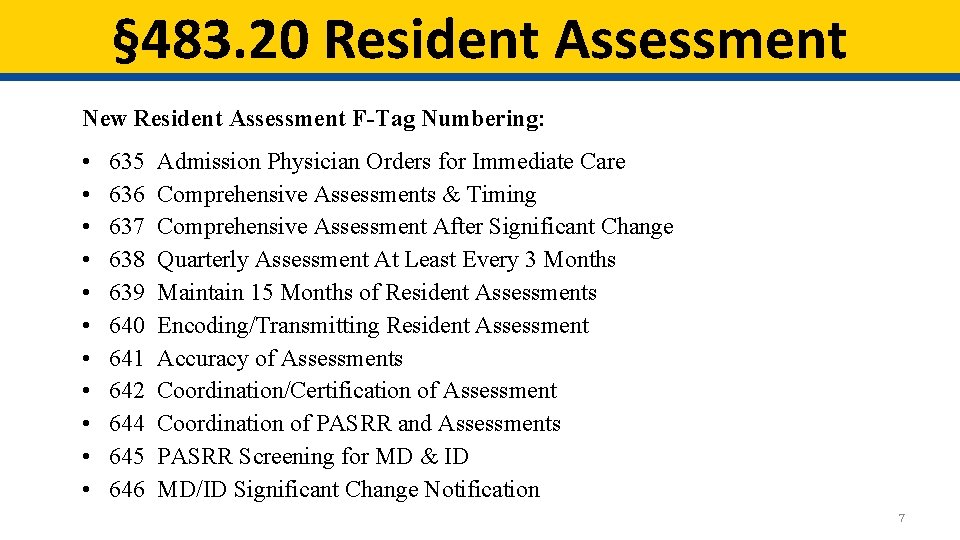
§ 483. 20 Resident Assessment New Resident Assessment F-Tag Numbering: • • • 635 Admission Physician Orders for Immediate Care 636 Comprehensive Assessments & Timing 637 Comprehensive Assessment After Significant Change 638 Quarterly Assessment At Least Every 3 Months 639 Maintain 15 Months of Resident Assessments 640 Encoding/Transmitting Resident Assessment 641 Accuracy of Assessments 642 Coordination/Certification of Assessment 644 Coordination of PASRR and Assessments 645 PASRR Screening for MD & ID 646 MD/ID Significant Change Notification 7
§ 483. 20 Resident Assessment Regulatory Changes in Resident Assessment § Comprehensive Assessment requirement updated to include resident strengths, goals, life history and preferences in the Resident Assessment Instrument § Discharge Planning § Requires direct observation and communication with the resident, as well as with licensed and unlicensed direct care staff on all shifts § Inclusion of the requirement that the facility use the results of the resident’s assessments to develop, review and revise the resident’s comprehensive care plan § Resident Assessment Critical Element (CE) Pathway 8
§ 483. 20 Resident Assessment Regulatory Changes in Resident Assessment cont. § New requirement to include PASRR evaluation and determination information in the resident’s comprehensive assessment, care planning and transitions of care § New requirement to refer residents with a level II PASRR and newly evident or possible mental disorder, intellectual disability or related condition to the appropriate state authority upon a significant change in status § All occurrences of the term “mental illness” have been updated to “mental disorder” and the term “intellectually disabled” has been updated to “intellectual disability” 9
§ 483. 20 Resident Assessment Regulatory Changes in Resident Assessment cont. § Inclusion of allowable Exceptions to the PASRR process § New requirement that a nursing facility must promptly notify the appropriate state authority when a resident with a mental disorder or intellectual disability has a significant change in his/her mental or physical condition § PASRR CE Pathway 10
§ 483. 21 Comprehensive Person-Centered Care Planning New Comprehensive Care Plan F-Tag Numbering: • F 655 Baseline Care Plan • F 656 Develop/Implement Comprehensive Care Plan • F 657 Care Plan Timing and Revision • F 658 Services Provided Meet Professional Standards • F 659 Qualified Persons • F 660 Discharge Planning Process • F 661 Discharge Summary 11
F 655 Baseline Care Plan – New Requirement § 483. 21(a)(1) Baseline Care Plan developed within 48 hours of resident admission and contain the minimum healthcare information necessary to care for resident, which includes: • Initial goals • Physician/Dietary orders • Therapy services • Social services • Applicable PASRR recommendations 12
F 655 Baseline Care Plan § 483. 21(a)(2) A Comprehensive Care Plan may be developed in place of Baseline Care Plan, but must be developed within 48 hours of admission and meet all requirements for the Comprehensive Care Plan. § 483. 21(a)(3) A written summary of the baseline care plan must be provided to the resident and their representative, if applicable. 13
F 656 Comprehensive Person-Centered Care Plan § 483. 21(b) (Formerly F 279) Develop and implement a comprehensive, person-centered care plan • Surveyors previously cited care plan implementation at F 282, Qualified Professional. • Person-centered means to focus on the resident as the locus of control and support the resident in making their own choices and having control over their daily lives. 14
F 656 Comprehensive Person-Centered Care Plan § 483. 21(b) (Formerly F 279) New provisions require the Comprehensive Care Plan describe: • Resident goals & preferences • Potential for discharge, including referrals to local contact agency • Discharge plan if applicable • Specialized services from PASRR recommendations or rationale for disagreement 15
F 657 Care Plan Timing and Revision § 483. 21(b)(2)(i) (Formerly F 280) Comprehensive care plan must be developed within 7 days after completion of the comprehensive assessment. 16
F 657 Care Plan Timing and Revision § 483. 21(b)(2)(ii) New Requirements for who must be on the interdisciplinary team: • Attending physician • A registered nurse with responsibility for the resident • A nurse aide with responsibility for the resident - new • A member of food/nutrition services - new • The resident or, if applicable, their representative - new • Other appropriate staff or professionals as determined by the resident or their needs New requirement to document an explanation in the medical record if attendance by the resident or their representative is determined not practicable. 17
F 657 Care Plan Timing and Revision § 483. 21(b)(2)(iii) New requirement: The comprehensive care plan must be reviewed/revised after each RAI assessment. 18
F 658 Services Provided Meet Professional Standards § 483. 21(b)(3)(i) (Formerly F 281) • Expanded guidance – no requirement to cite a reference/source related to care or services provided within professional scopes of practice • Consider whether failure to meet professional standards is the result of a lack of competent or skilled nursing staff (F 726) 19
F 659 Qualified Persons § 483. 21(b)(3)(ii) (Formerly F 282) • Facility must ensure care/services are provided by individuals who have the skills, experience and knowledge to do a particular task or activity. • Concerns involving the competency or skills of nursing staff should be investigated under F 726. • Culturally-competent and trauma-informed care and services is a Phase 3 requirement. 20
F 660 Discharge Planning Process § 483. 21(c)(1) (Formerly F 284) • Expanded new requirements and guidance • Ensures an effective discharge process that focuses on the resident’s goals, and prepares the resident to transition to post-discharge care by reducing factors which may lead to re-hospitalizations or readmissions. 21
F 661 Discharge Summary § 483. 21(c)(2) (Formerly F 283) • Expanded new requirements and guidance • Intends to ensure facilities communicate necessary information to the resident, continuing care provider and other authorized persons at the time of discharge. 22
483. 24 Quality of Life New Quality of Life F-Tags: • • • F 675 Quality of Life F 676 Activities of Daily Living F 677 ADL Care Provided for Dependent Residents F 678 Cardio-Pulmonary Resuscitation (CPR) F 679 Activities Meet Interest/Needs of Each Resident F 680 Qualifications of Activity Professional 23
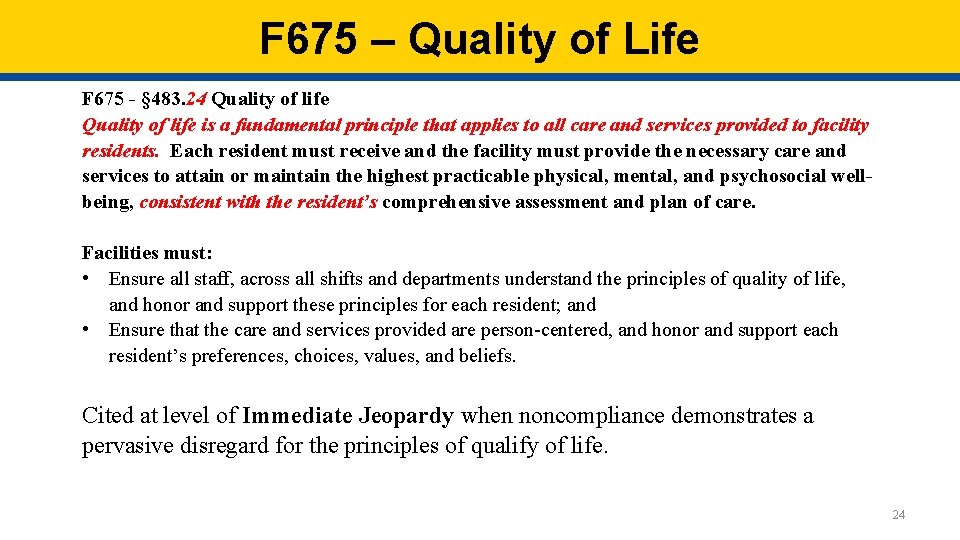
F 675 – Quality of Life F 675 - § 483. 24 Quality of life is a fundamental principle that applies to all care and services provided to facility residents. Each resident must receive and the facility must provide the necessary care and services to attain or maintain the highest practicable physical, mental, and psychosocial wellbeing, consistent with the resident’s comprehensive assessment and plan of care. Facilities must: • Ensure all staff, across all shifts and departments understand the principles of quality of life, and honor and support these principles for each resident; and • Ensure that the care and services provided are person-centered, and honor and support each resident’s preferences, choices, values, and beliefs. Cited at level of Immediate Jeopardy when noncompliance demonstrates a pervasive disregard for the principles of qualify of life. 24
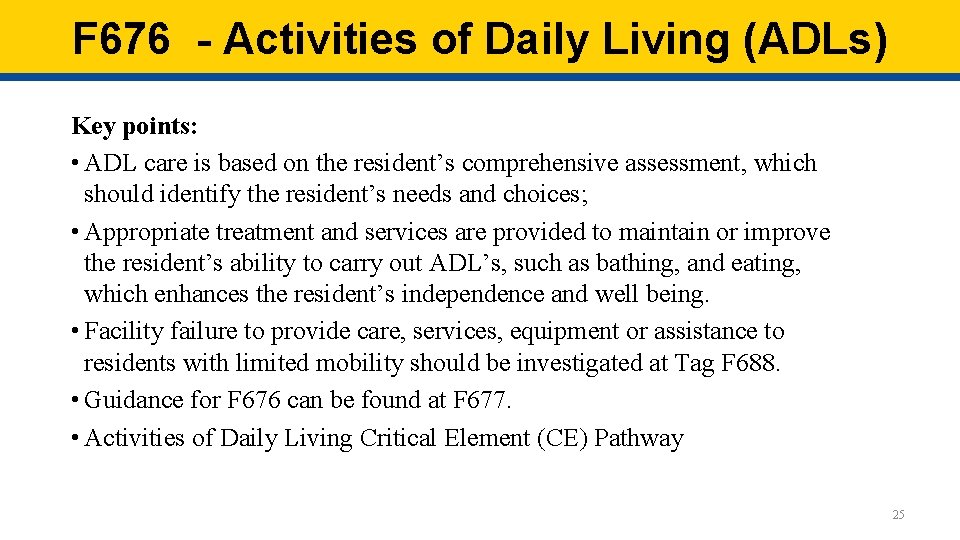
F 676 - Activities of Daily Living (ADLs) Key points: • ADL care is based on the resident’s comprehensive assessment, which should identify the resident’s needs and choices; • Appropriate treatment and services are provided to maintain or improve the resident’s ability to carry out ADL’s, such as bathing, and eating, which enhances the resident’s independence and well being. • Facility failure to provide care, services, equipment or assistance to residents with limited mobility should be investigated at Tag F 688. • Guidance for F 676 can be found at F 677. • Activities of Daily Living Critical Element (CE) Pathway 25
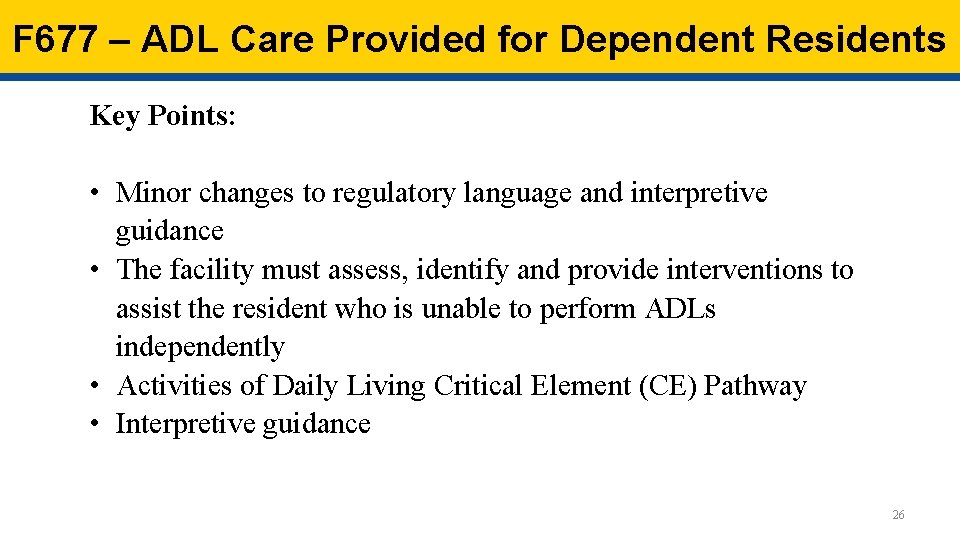
F 677 – ADL Care Provided for Dependent Residents Key Points: • Minor changes to regulatory language and interpretive guidance • The facility must assess, identify and provide interventions to assist the resident who is unable to perform ADLs independently • Activities of Daily Living Critical Element (CE) Pathway • Interpretive guidance 26
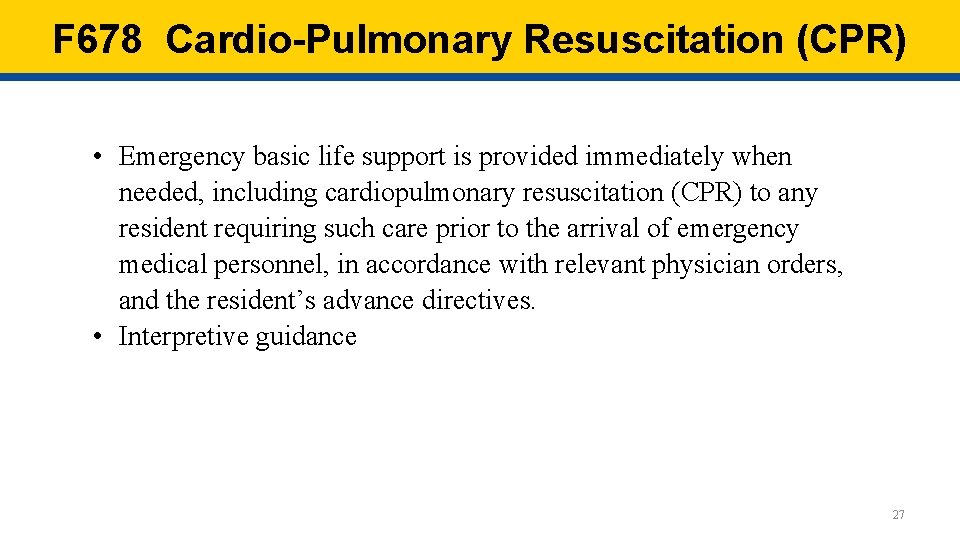
F 678 Cardio-Pulmonary Resuscitation (CPR) • Emergency basic life support is provided immediately when needed, including cardiopulmonary resuscitation (CPR) to any resident requiring such care prior to the arrival of emergency medical personnel, in accordance with relevant physician orders, and the resident’s advance directives. • Interpretive guidance 27
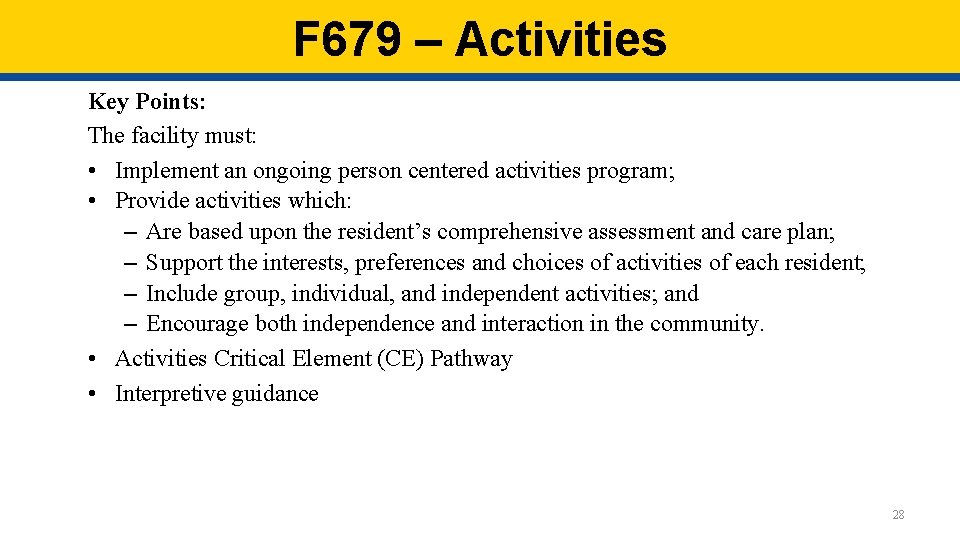
F 679 – Activities Key Points: The facility must: • Implement an ongoing person centered activities program; • Provide activities which: – Are based upon the resident’s comprehensive assessment and care plan; – Support the interests, preferences and choices of activities of each resident; – Include group, individual, and independent activities; and – Encourage both independence and interaction in the community. • Activities Critical Element (CE) Pathway • Interpretive guidance 28
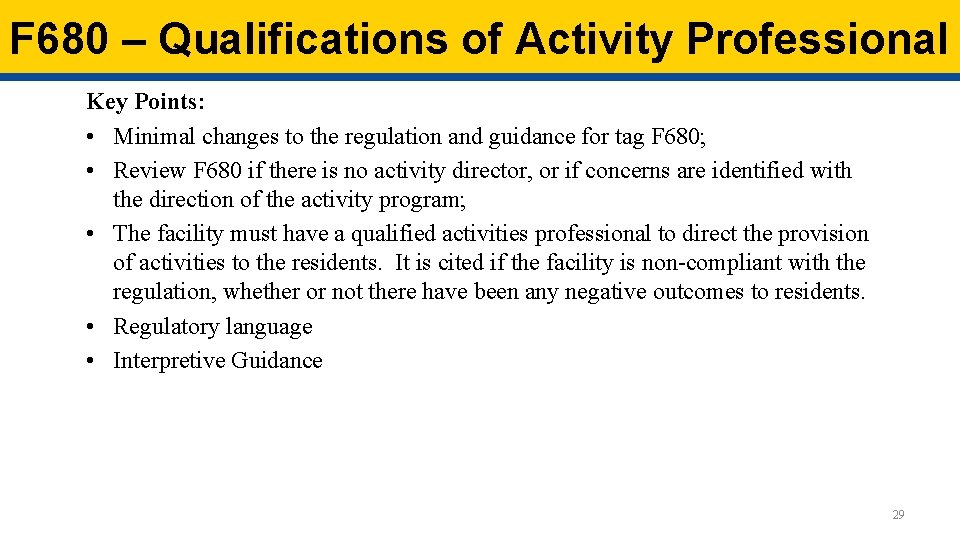
F 680 – Qualifications of Activity Professional Key Points: • Minimal changes to the regulation and guidance for tag F 680; • Review F 680 if there is no activity director, or if concerns are identified with the direction of the activity program; • The facility must have a qualified activities professional to direct the provision of activities to the residents. It is cited if the facility is non-compliant with the regulation, whether or not there have been any negative outcomes to residents. • Regulatory language • Interpretive Guidance 29
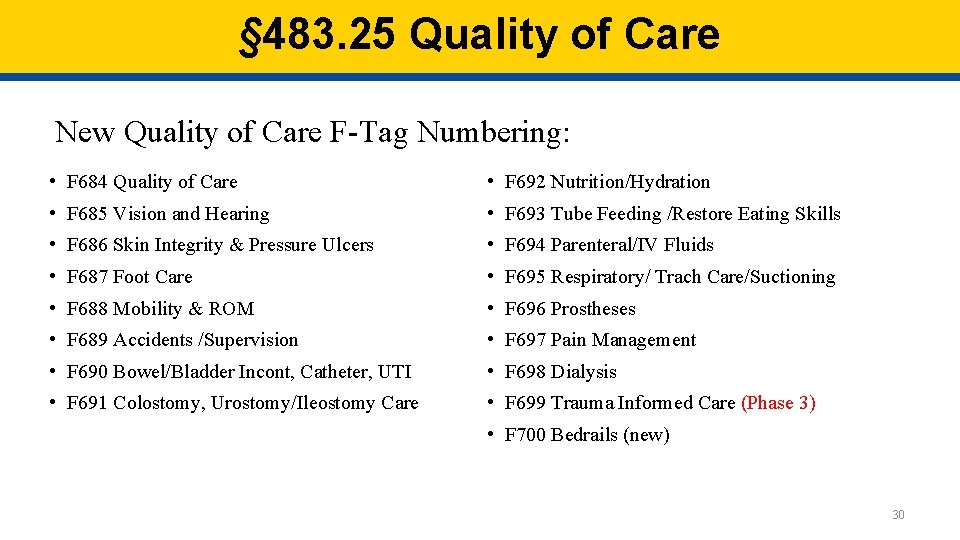
§ 483. 25 Quality of Care New Quality of Care F-Tag Numbering: • F 684 Quality of Care • F 692 Nutrition/Hydration • F 685 Vision and Hearing • F 693 Tube Feeding /Restore Eating Skills • F 686 Skin Integrity & Pressure Ulcers • F 694 Parenteral/IV Fluids • F 687 Foot Care • F 695 Respiratory/ Trach Care/Suctioning • F 688 Mobility & ROM • F 696 Prostheses • F 689 Accidents /Supervision • F 697 Pain Management • F 690 Bowel/Bladder Incont, Catheter, UTI • F 698 Dialysis • F 691 Colostomy, Urostomy/Ileostomy Care • F 699 Trauma Informed Care (Phase 3) • F 700 Bedrails (new) 30
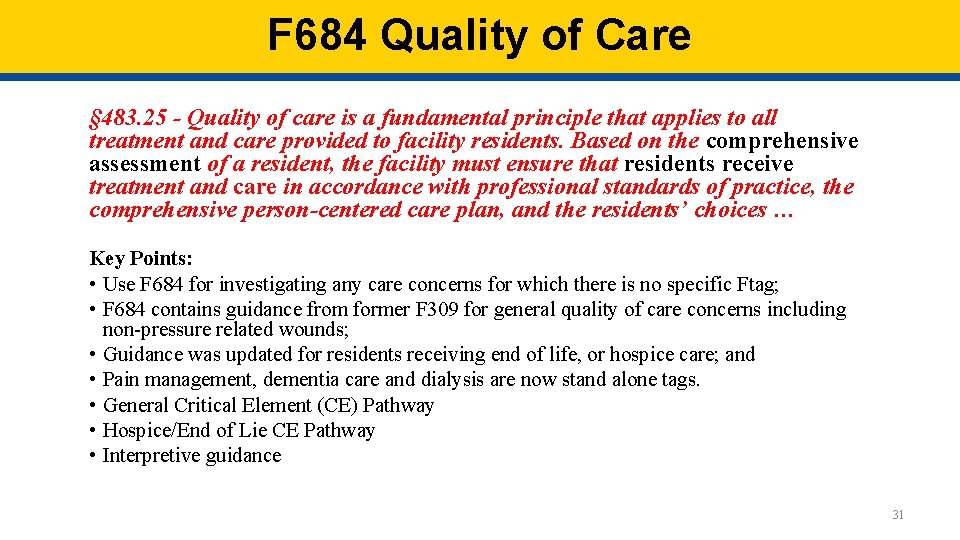
F 684 Quality of Care § 483. 25 - Quality of care is a fundamental principle that applies to all treatment and care provided to facility residents. Based on the comprehensive assessment of a resident, the facility must ensure that residents receive treatment and care in accordance with professional standards of practice, the comprehensive person-centered care plan, and the residents’ choices … Key Points: • Use F 684 for investigating any care concerns for which there is no specific Ftag; • F 684 contains guidance from former F 309 for general quality of care concerns including non-pressure related wounds; • Guidance was updated for residents receiving end of life, or hospice care; and • Pain management, dementia care and dialysis are now stand alone tags. • General Critical Element (CE) Pathway • Hospice/End of Lie CE Pathway • Interpretive guidance 31
F 685 - Vision and Hearing Key Points: • No regulatory language change; • The Facility must assist residents and their representative in gaining access to vision and hearing services; and • Assist in making appointments and arranging for transportation. • Activities of Daily Living and Communication-Sensory Critical Element Pathways • Interpretive Guidance 32
F 686 – Pressure Ulcers Key Points: • New regulatory language requiring preventive care, consistent with professional standards of practice, to residents who may be at risk for development of pressure ulcers. • Provide treatment for existing pressure ulcers, consistent with professional standards of practice, to promote healing, prevent infection and prevent a new ulcer from developing; • Interpretive guidance has been updated and expanded to address staging. • Pressure Ulcer Critical Element (CE) Pathway • Interpretive guidelines 33
F 687 - Foot Care Key Points: • New F- tag formerly located at F 328. • Provide proper treatment and foot care in accordance with professional standards of practice to maintain mobility along with good foot health; • If necessary, assist the resident in making appointments with a qualified person; and • Assist in arranging for transportation to and from such appointments. • Interpretive Guidance 34
F 688 -Mobility and Range of Motion Key Points: • New regulatory language was added to this tag to include care for a resident with limited mobility: – “A resident with limited mobility receives appropriate services, equipment, and assistance to maintain and improve mobility with the maximum practicable independence unless a reduction in mobility is demonstrably unavoidable. ” • Mobility is also part of the requirements for F 676 - Activities of Daily Living, in the Quality of Life section, however …All concerns related to the physical, mental and/or psychosocial aspects of range of motion or mobility are to be reviewed at this tag, F 688. • Positioning, Mobility & Range of Motion (ROM) Critical Element (CE) Pathway • Interpretive Guidance 35
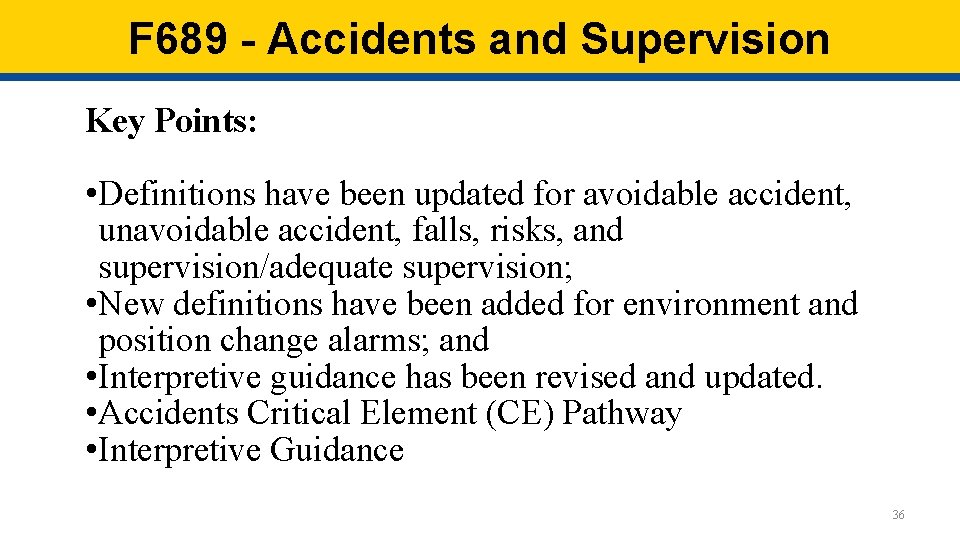
F 689 - Accidents and Supervision Key Points: • Definitions have been updated for avoidable accident, unavoidable accident, falls, risks, and supervision/adequate supervision; • New definitions have been added for environment and position change alarms; and • Interpretive guidance has been revised and updated. • Accidents Critical Element (CE) Pathway • Interpretive Guidance 36
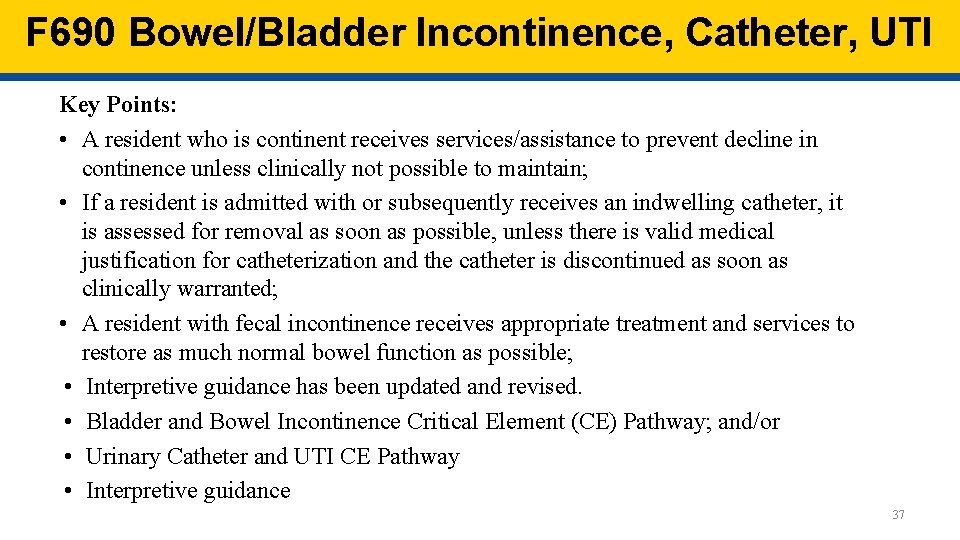
F 690 Bowel/Bladder Incontinence, Catheter, UTI Key Points: • A resident who is continent receives services/assistance to prevent decline in continence unless clinically not possible to maintain; • If a resident is admitted with or subsequently receives an indwelling catheter, it is assessed for removal as soon as possible, unless there is valid medical justification for catheterization and the catheter is discontinued as soon as clinically warranted; • A resident with fecal incontinence receives appropriate treatment and services to restore as much normal bowel function as possible; • Interpretive guidance has been updated and revised. • Bladder and Bowel Incontinence Critical Element (CE) Pathway; and/or • Urinary Catheter and UTI CE Pathway • Interpretive guidance 37
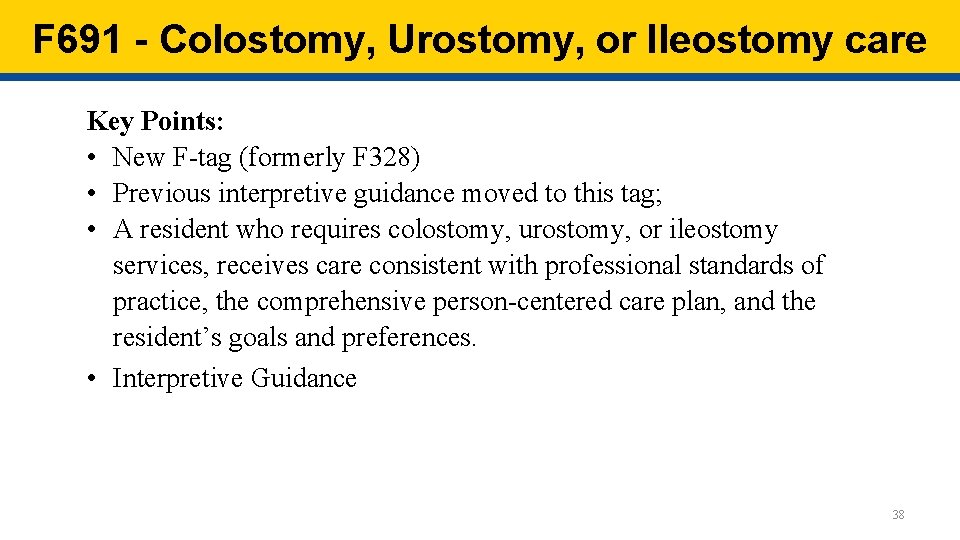
F 691 - Colostomy, Urostomy, or Ileostomy care Key Points: • New F-tag (formerly F 328) • Previous interpretive guidance moved to this tag; • A resident who requires colostomy, urostomy, or ileostomy services, receives care consistent with professional standards of practice, the comprehensive person-centered care plan, and the resident’s goals and preferences. • Interpretive Guidance 38
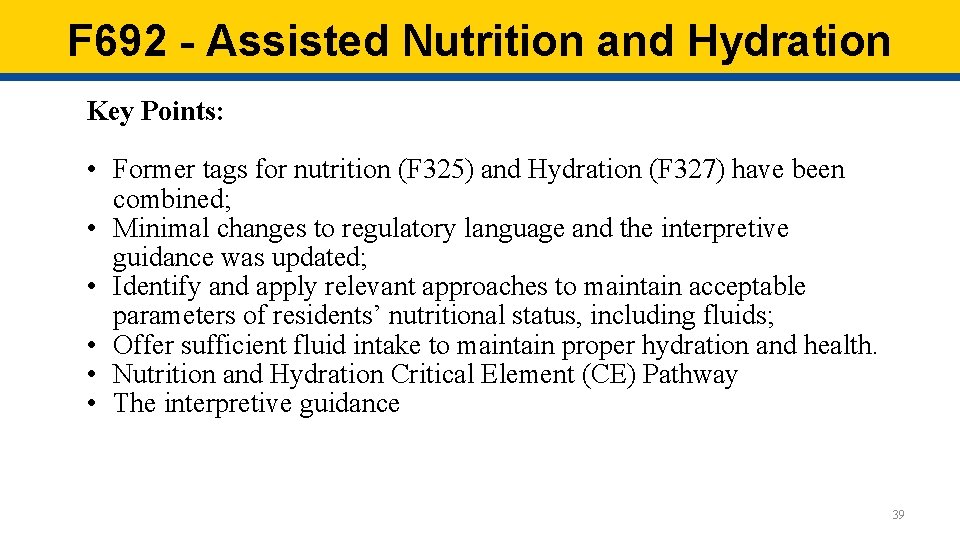
F 692 - Assisted Nutrition and Hydration Key Points: • Former tags for nutrition (F 325) and Hydration (F 327) have been combined; • Minimal changes to regulatory language and the interpretive guidance was updated; • Identify and apply relevant approaches to maintain acceptable parameters of residents’ nutritional status, including fluids; • Offer sufficient fluid intake to maintain proper hydration and health. • Nutrition and Hydration Critical Element (CE) Pathway • The interpretive guidance 39
F 693 - Tube Feeding Management Restore Eating Skills Key Points: • F 693 combined two tags, formerly located at F 321 and F 322, for tube feeding. This included some additional regulatory language; • The regulation includes tube feeding management for nasogastric, gastrostomy tubes, both percutaneous endoscopic gastrostomy and percutaneous endoscopic jejunostomy; • The regulation requires that a feeding tube is clinically indicated and consented to by the resident • A resident fed by enteral means receives treatment and services to restore, if possible eating skills; and • Treatment and services are provided to prevent complications of enteral feeding. • Use the Tube Feeding Critical Element (CE) Pathway • Interpretive guidance and regulatory language. 40
F 694 Parenteral/IV Fluids Key Points: • F 694 is a new tag formerly located at F 328 to address Parenteral/IV fluids. • Nursing homes are not required to provide IV therapy, however, if they do provide this service, they must comply with this requirement; and • Safe administration of parenteral fluids must be provided in accordance with professional standards of practice , and by qualified, competent and trained staff in accordance with State laws and practice acts; • Interpretive Guidance 41
F 695 - Respiratory Care, including Tracheostomy Care and Tracheal Suctioning Key Points: • New F-tag (formerly at F 328) and regulation requiring respiratory care and services are based on professional standards of practice and expanded guidance; • Facilities are not required to offer specialized respiratory care services such as mechanical ventilation or tracheostomy care; • Based on professional standards of practice, care must be provided by a sufficient number of qualified and trained staff according to State laws and Nurse Practice Acts; • The regulatory language also refers to tag F 825 for Specialized Rehabilitative Services and Qualified Respiratory Therapists/Staff; • Respiratory Care CE Pathway • Interpretive Guidance 42
F 696 - Prostheses Key Points: • New regulatory language and F-tag for prostheses formerly located at F 328; • For a resident with a prosthesis, care and assistance must be provided, consistent with professional standards of practice, the comprehensive, person-centered care plan and be based on resident preferences and goals to wear and be able to use the prosthetic device. • Interpretive guidance 43
F 697 - Pain Management Key Points: • New F-tag and regulatory language for pain management; • Minimal changes to interpretive guidance which was formerly located at F 309; and • Pain management must be provided to a resident who require such services, consistent with professional standards of practice, the comprehensive personcentered care plan, and the residents’ goals and preferences. • Pain Recognition and Management Critical Element (CE) Pathway; • Interpretive guidance 44
F 698 – Dialysis Key Points: • New F-tag (formerly F 309) regulatory language and guidance; • Facilities are not required to provide dialysis services; • Surveyors must know if State laws allow home hemodialysis (HHD) or peritoneal dialysis (PD) to be provided in a nursing home and if State laws or Nurse practice Acts address who may provide the treatments; • Facilities must identify type of dialysis services provided (Hemodialysis, HHD and/or PD); • Facilities must coordinate services with the Medicare certified End Stage Renal Dialysis (ESRD) Facility; • Dialysis care must be based on professional standards of practice, provided by a sufficient number of qualified and trained staff, and in accordance with State laws and Nurse Practice Acts; • Interpretive guidance revised to address policies for dialysis care, treatments and services and qualifications and training for individuals providing HHD/PD in a nursing home; • Dialysis CE Pathway • Interpretive Guidance 45
F 699 Trauma Informed Care Trauma-informed care will not be implemented until November 28, 2019 (Phase 3) 46
F 700 Bedrails Key Points: • F-tag 700 Bedrails is a new tag with new guidance; • Facilities must: – Attempt to use appropriate alternatives prior to installing a side or bed rail; – Ensure correct installation, use, and maintenance; – Assess the resident for risk of entrapment from bed rails prior to installation; – Review the risks and benefits of bed rails with the resident or resident representative; – Obtain informed consent prior to installation; – Ensure that the bed’s dimensions are appropriate for the resident’s size and weight; and – Follow the manufacturers’ recommendations and specifications for installing and maintaining bed rails. • Regulatory language • Interpretive guidance 47
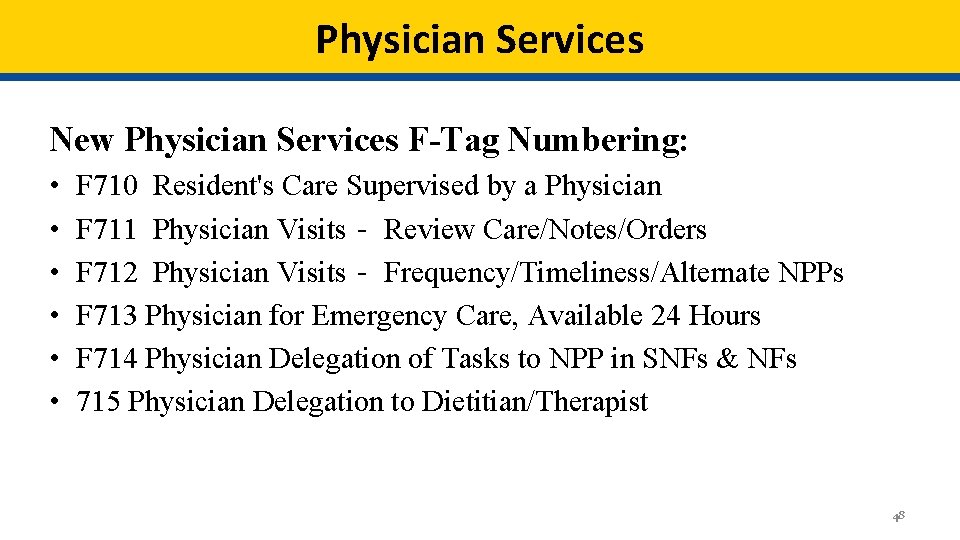
Physician Services New Physician Services F-Tag Numbering: • • • F 710 Resident's Care Supervised by a Physician F 711 Physician Visits‐ Review Care/Notes/Orders F 712 Physician Visits‐ Frequency/Timeliness/Alternate NPPs F 713 Physician for Emergency Care, Available 24 Hours F 714 Physician Delegation of Tasks to NPP in SNFs & NFs 715 Physician Delegation to Dietitian/Therapist 48
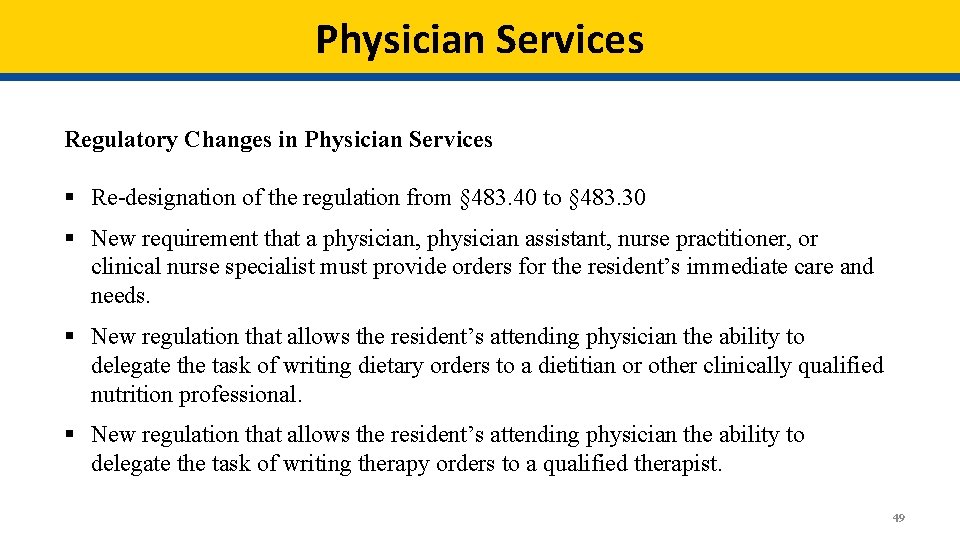
Physician Services Regulatory Changes in Physician Services § Re-designation of the regulation from § 483. 40 to § 483. 30 § New requirement that a physician, physician assistant, nurse practitioner, or clinical nurse specialist must provide orders for the resident’s immediate care and needs. § New regulation that allows the resident’s attending physician the ability to delegate the task of writing dietary orders to a dietitian or other clinically qualified nutrition professional. § New regulation that allows the resident’s attending physician the ability to delegate the task of writing therapy orders to a qualified therapist. 49
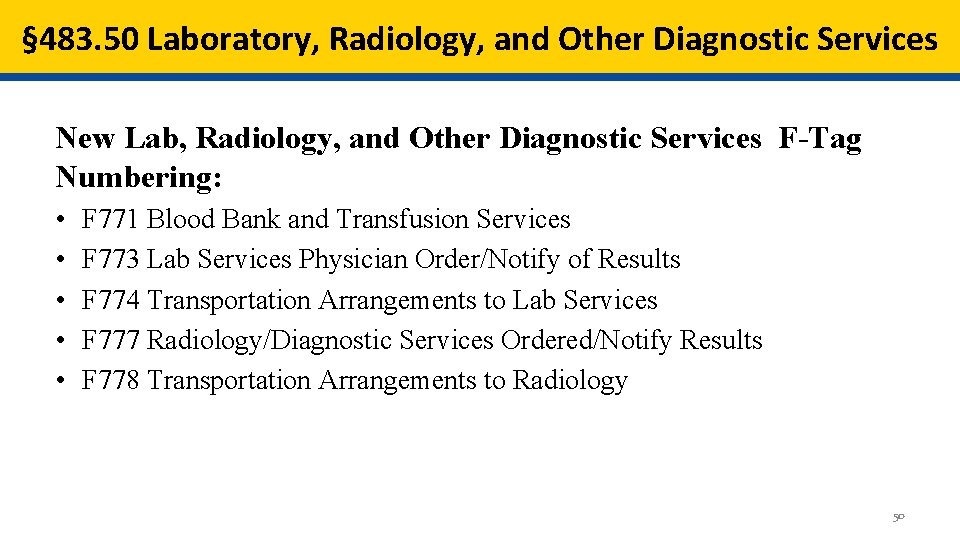
§ 483. 50 Laboratory, Radiology, and Other Diagnostic Services New Lab, Radiology, and Other Diagnostic Services F-Tag Numbering: • • • F 771 Blood Bank and Transfusion Services F 773 Lab Services Physician Order/Notify of Results F 774 Transportation Arrangements to Lab Services F 777 Radiology/Diagnostic Services Ordered/Notify Results F 778 Transportation Arrangements to Radiology 50
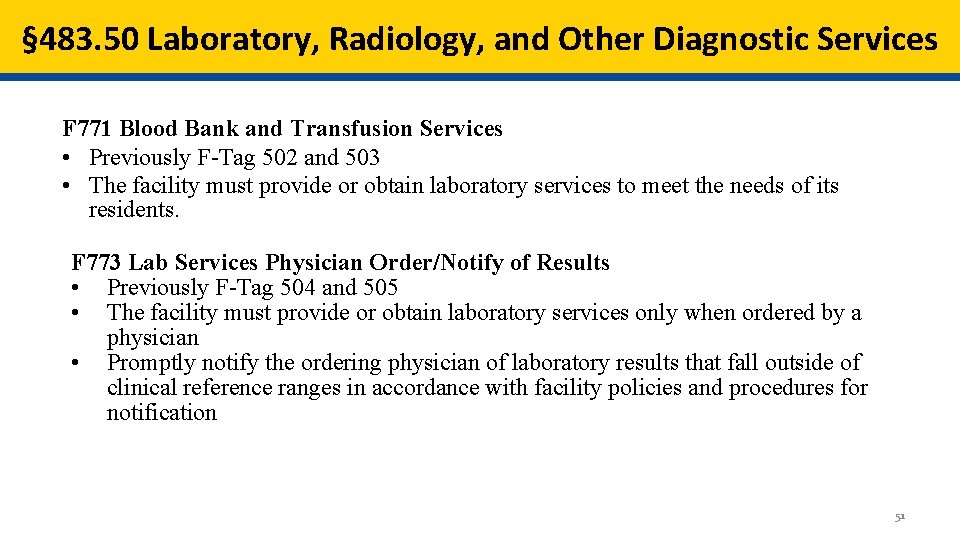
§ 483. 50 Laboratory, Radiology, and Other Diagnostic Services F 771 Blood Bank and Transfusion Services • Previously F-Tag 502 and 503 • The facility must provide or obtain laboratory services to meet the needs of its residents. F 773 Lab Services Physician Order/Notify of Results • Previously F-Tag 504 and 505 • The facility must provide or obtain laboratory services only when ordered by a physician • Promptly notify the ordering physician of laboratory results that fall outside of clinical reference ranges in accordance with facility policies and procedures for notification 51
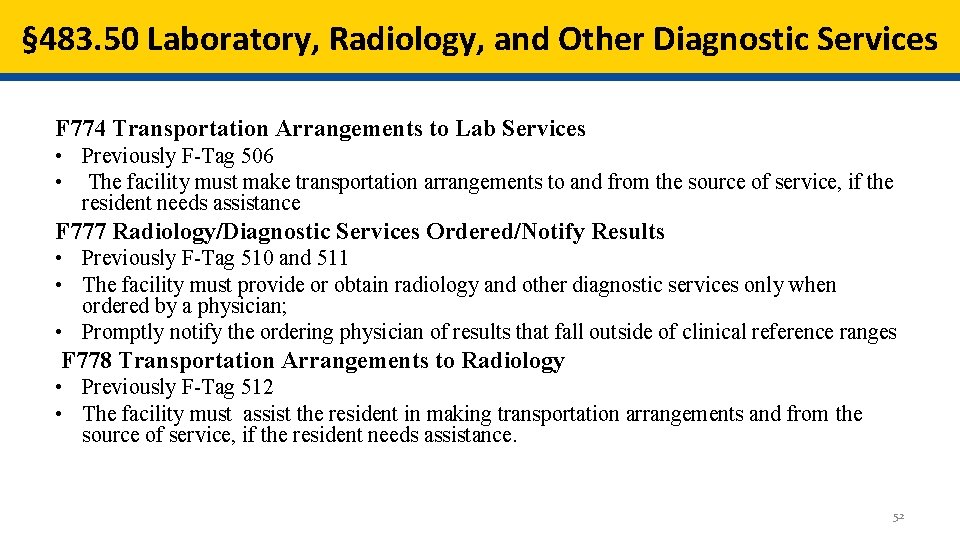
§ 483. 50 Laboratory, Radiology, and Other Diagnostic Services F 774 Transportation Arrangements to Lab Services • Previously F-Tag 506 • The facility must make transportation arrangements to and from the source of service, if the resident needs assistance F 777 Radiology/Diagnostic Services Ordered/Notify Results • Previously F-Tag 510 and 511 • The facility must provide or obtain radiology and other diagnostic services only when ordered by a physician; • Promptly notify the ordering physician of results that fall outside of clinical reference ranges F 778 Transportation Arrangements to Radiology • Previously F-Tag 512 • The facility must assist the resident in making transportation arrangements and from the source of service, if the resident needs assistance. 52
§ 483. 55 Dental Services New Dental Services F-Tag Numbering: • F 790 Routine/Emergency Dental Services for SNFs • F 791 Routine/Emergency Dental Services for NFs 53
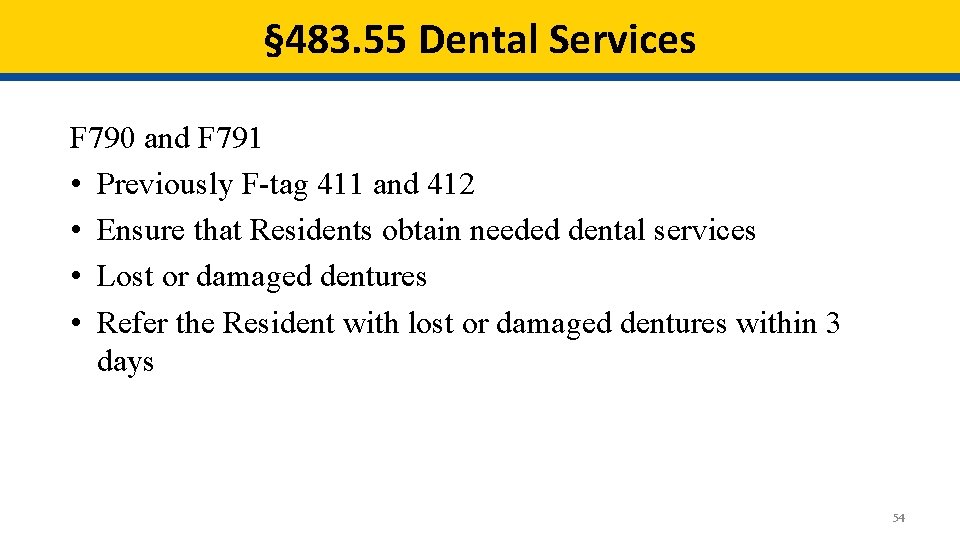
§ 483. 55 Dental Services F 790 and F 791 • Previously F-tag 411 and 412 • Ensure that Residents obtain needed dental services • Lost or damaged dentures • Refer the Resident with lost or damaged dentures within 3 days 54
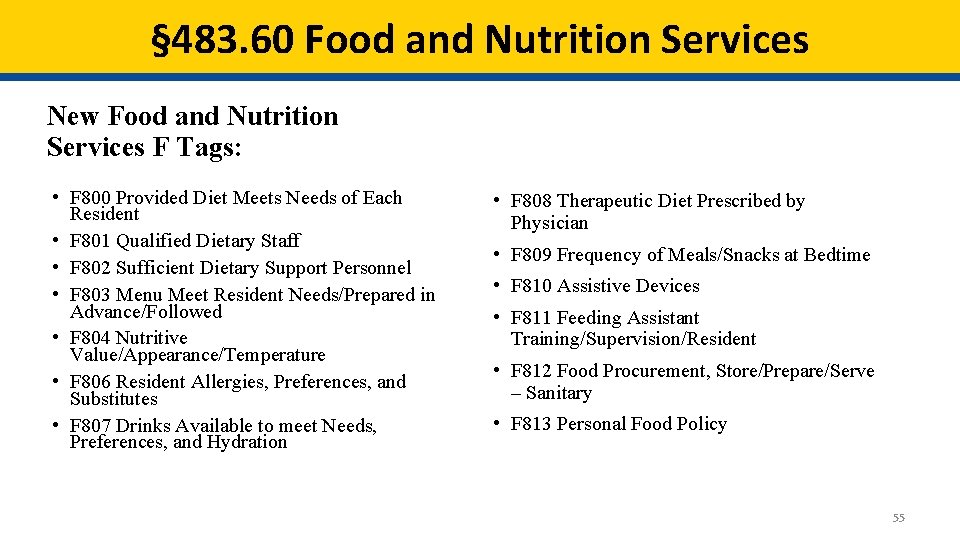
§ 483. 60 Food and Nutrition Services New Food and Nutrition Services F Tags: • F 800 Provided Diet Meets Needs of Each Resident • F 801 Qualified Dietary Staff • F 802 Sufficient Dietary Support Personnel • F 803 Menu Meet Resident Needs/Prepared in Advance/Followed • F 804 Nutritive Value/Appearance/Temperature • F 806 Resident Allergies, Preferences, and Substitutes • F 807 Drinks Available to meet Needs, Preferences, and Hydration • F 808 Therapeutic Diet Prescribed by Physician • F 809 Frequency of Meals/Snacks at Bedtime • F 810 Assistive Devices • F 811 Feeding Assistant Training/Supervision/Resident • F 812 Food Procurement, Store/Prepare/Serve – Sanitary • F 813 Personal Food Policy 55
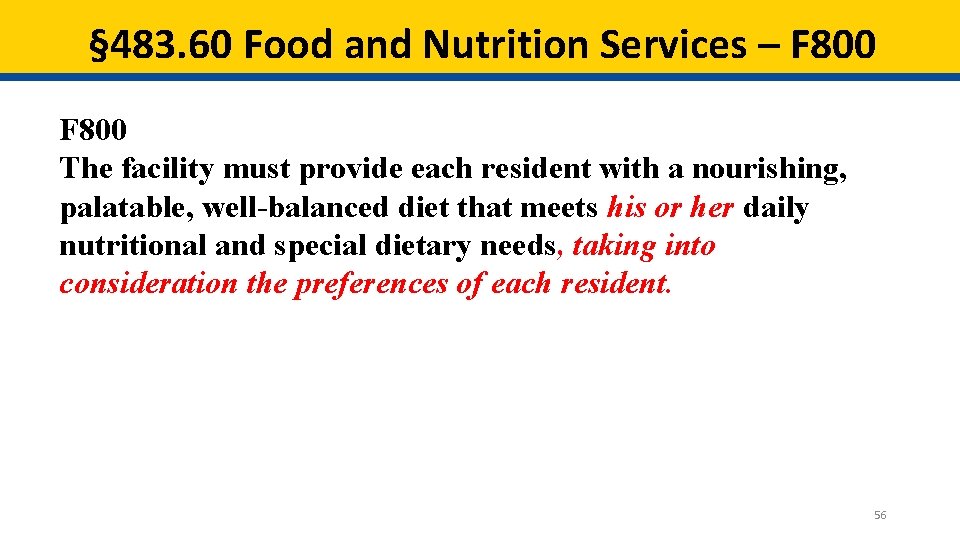
§ 483. 60 Food and Nutrition Services – F 800 The facility must provide each resident with a nourishing, palatable, well-balanced diet that meets his or her daily nutritional and special dietary needs, taking into consideration the preferences of each resident. 56
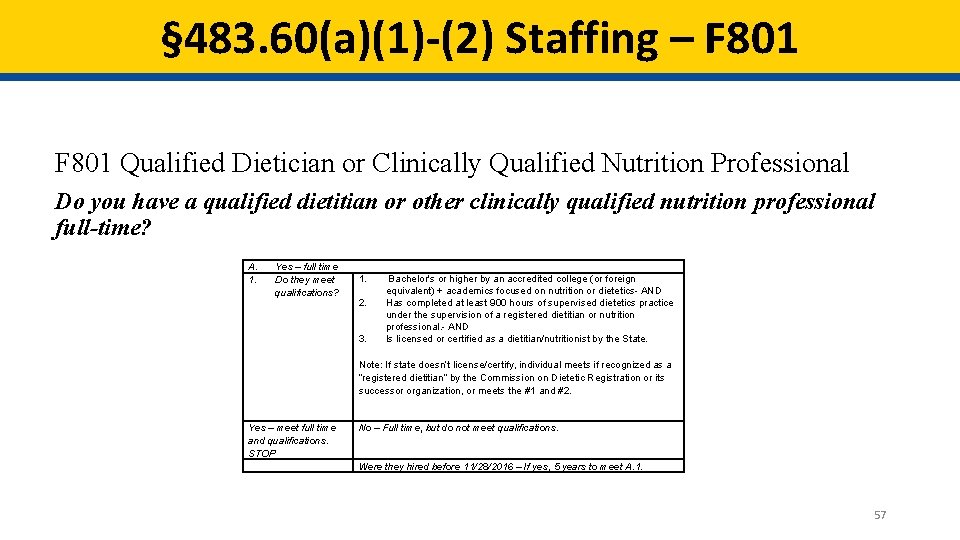
§ 483. 60(a)(1)-(2) Staffing – F 801 Qualified Dietician or Clinically Qualified Nutrition Professional Do you have a qualified dietitian or other clinically qualified nutrition professional full-time? A. 1. Yes – full time Do they meet qualifications? 1. 2. Bachelor's or higher by an accredited college (or foreign equivalent) + academics focused on nutrition or dietetics- AND Has completed at least 900 hours of supervised dietetics practice under the supervision of a registered dietitian or nutrition professional. - AND Is licensed or certified as a dietitian/nutritionist by the State. 3. Note: If state doesn’t license/certify, individual meets if recognized as a “registered dietitian” by the Commission on Dietetic Registration or its successor organization, or meets the #1 and #2. Yes – meet full time and qualifications. STOP No – Full time, but do not meet qualifications. Were they hired before 11/28/2016 – If yes, 5 years to meet A. 1. 57
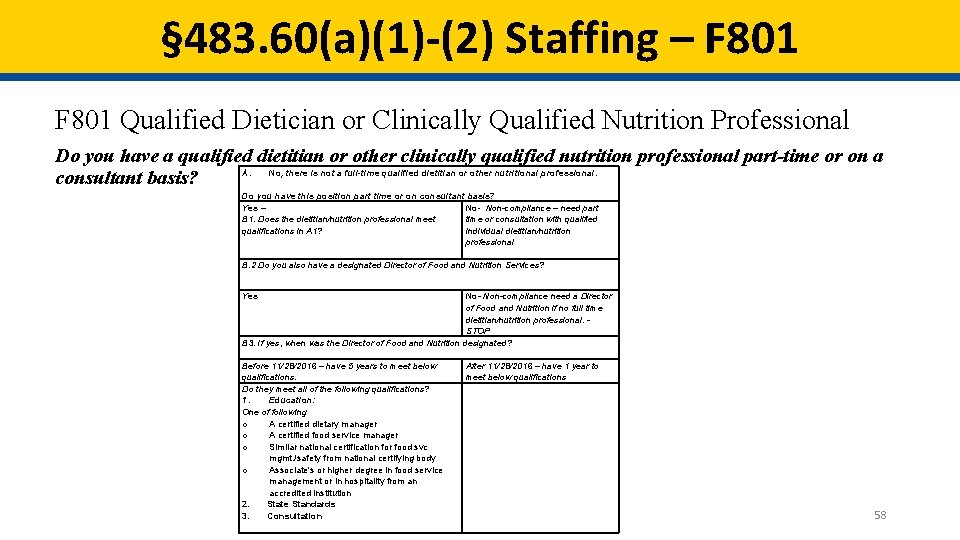
§ 483. 60(a)(1)-(2) Staffing – F 801 Qualified Dietician or Clinically Qualified Nutrition Professional Do you have a qualified dietitian or other clinically qualified nutrition professional part-time or on a A. No, there is not a full-time qualified dietitian or other nutritional professional. consultant basis? Do you have this position part time or on consultant basis? Yes – No- Non-compliance – need part B 1. Does the dietitian/nutrition professional meet time or consultation with qualified qualifications in A 1? individual dietitian/nutrition professional B. 2 Do you also have a designated Director of Food and Nutrition Services? Yes No- Non-compliance need a Director of Food and Nutrition if no full time dietitian/nutrition professional. - STOP B 3. If yes, when was the Director of Food and Nutrition designated? Before 11/28/2016 – have 5 years to meet below After 11/28/2016 – have 1 year to qualifications. meet below qualifications Do they meet all of the following qualifications? 1. Education: One of following o A certified dietary manager o A certified food service manager o Similar national certification for food svc mgmt. /safety from national certifying body o Associate's or higher degree in food service management or in hospitality from an accredited institution 2. State Standards 3. Consultation 58
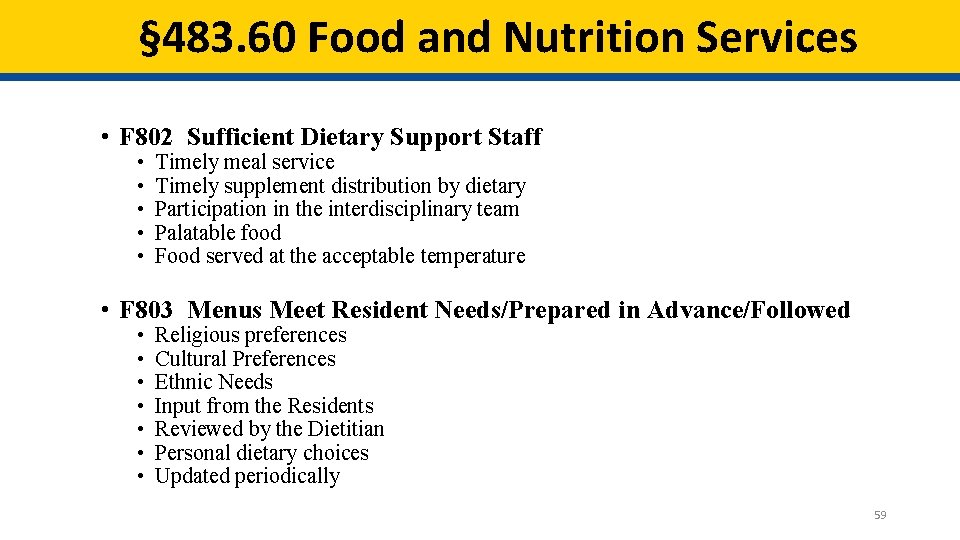
§ 483. 60 Food and Nutrition Services • F 802 Sufficient Dietary Support Staff • • • Timely meal service Timely supplement distribution by dietary Participation in the interdisciplinary team Palatable food Food served at the acceptable temperature • F 803 Menus Meet Resident Needs/Prepared in Advance/Followed • • Religious preferences Cultural Preferences Ethnic Needs Input from the Residents Reviewed by the Dietitian Personal dietary choices Updated periodically 59
§ 483. 60(d) Food and Drink • F 804 Nutritive Value, Appearance and Temperature • • Food and Drink Safe and Appetizing Temperatures Following recipes Resident complaints • F 806 Resident Allergies, Preferences and Substitutes • Allergies • Appealing options • Choice 60
§ 483. 60(d) Food and drink – F 807 • F 807 Drinks Available to meet needs, Preferences, Hydration • • Drinks and fluids provided between meals Resident preference of drinks Other options or fluid intake Choices 61
§ 483. 60(e) Therapeutic Diets – F 808 • F 808 Therapeutic Diets • Delegation of orders to Dietitian • Physician must supervise nutritional care • Written policy and procedures 62
§ 483. 60(f) Frequency of Meals – F 809 • F 809 Frequency of Meals and Snacks • • Choices Preferences Requests Resident Centered 63
§ 483. 60(g) Assistive Devices – F 810 § 483. 60(g) Assistive devices The facility must provide special eating equipment and utensils for residents who need them and appropriate assistance to ensure that the resident can use the assistive devices when consuming meals and snacks. 64
§ 483. 60(h) Paid Feeding Assistants – F 811 “Paid feeding assistant” is defined in the regulation at 42 CFR § 488. 301 as “an individual who meets the requirements specified at 42 CFR § 483. 60(h)(1)(i) and who is paid by the facility to feed residents, or who is used under an arrangement with another agency or organization. ” 65
§ 483. 60(i) Food Safety Requirements – F 812 • F 812 Food Safety Requirements • Local Produce Vendors • Facility grown produce • Food safety with culture change • Off-site Kitchens • Potluck Events • Nursing Home Gardens 66
§ 483. 60(i) Food Safety Requirements – F 813 • F 813 Food Safety Requirements • Personal Food Items • Written policy and procedures • Facility responsibility for storing food brought by family or friends • Inform visitors of safe practices • Personal Refrigerators 67
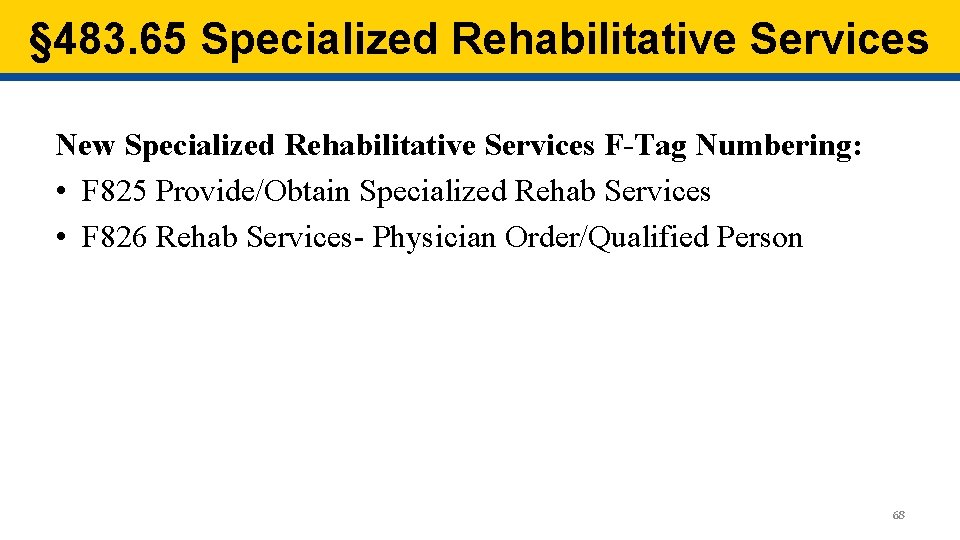
§ 483. 65 Specialized Rehabilitative Services New Specialized Rehabilitative Services F-Tag Numbering: • F 825 Provide/Obtain Specialized Rehab Services • F 826 Rehab Services- Physician Order/Qualified Person 68
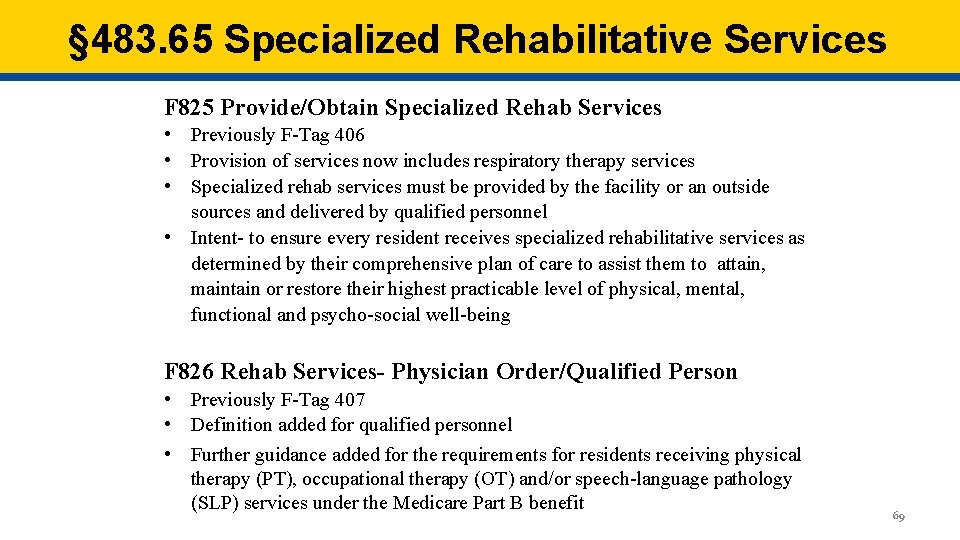
§ 483. 65 Specialized Rehabilitative Services F 825 Provide/Obtain Specialized Rehab Services • Previously F-Tag 406 • Provision of services now includes respiratory therapy services • Specialized rehab services must be provided by the facility or an outside sources and delivered by qualified personnel • Intent- to ensure every resident receives specialized rehabilitative services as determined by their comprehensive plan of care to assist them to attain, maintain or restore their highest practicable level of physical, mental, functional and psycho-social well-being F 826 Rehab Services- Physician Order/Qualified Person • Previously F-Tag 407 • Definition added for qualified personnel • Further guidance added for the requirements for residents receiving physical therapy (PT), occupational therapy (OT) and/or speech-language pathology (SLP) services under the Medicare Part B benefit 69
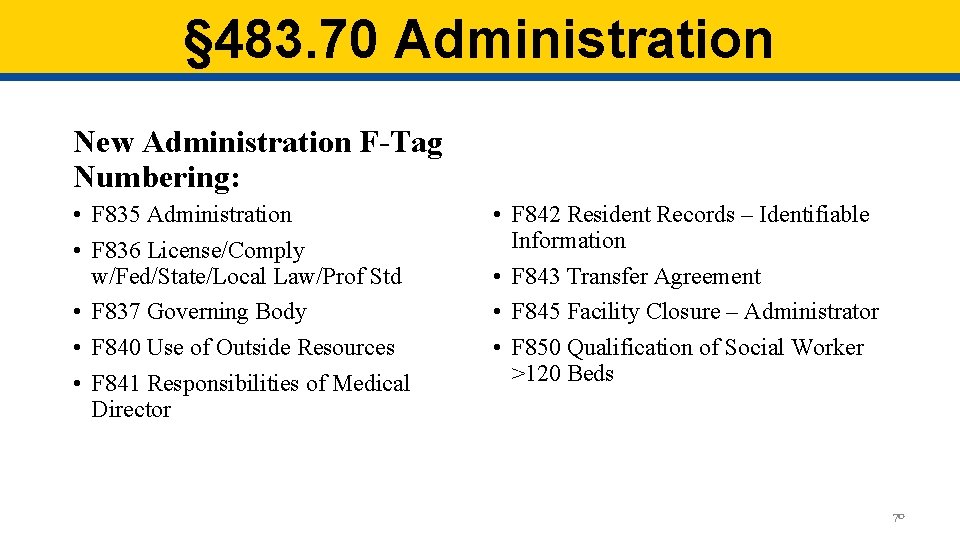
§ 483. 70 Administration New Administration F-Tag Numbering: • F 835 Administration • F 836 License/Comply w/Fed/State/Local Law/Prof Std • F 837 Governing Body • F 840 Use of Outside Resources • F 841 Responsibilities of Medical Director • F 842 Resident Records – Identifiable Information • F 843 Transfer Agreement • F 845 Facility Closure – Administrator • F 850 Qualification of Social Worker >120 Beds 70
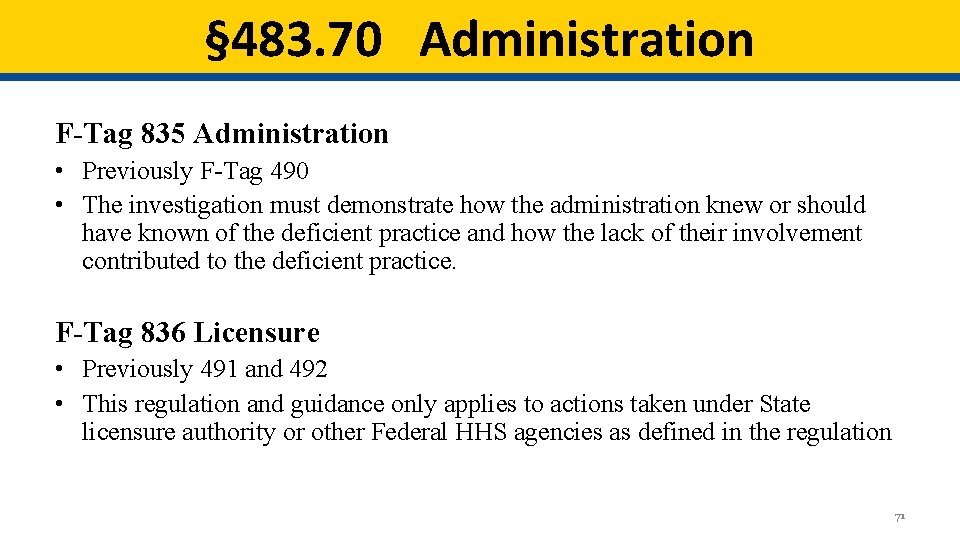
§ 483. 70 Administration F-Tag 835 Administration • Previously F-Tag 490 • The investigation must demonstrate how the administration knew or should have known of the deficient practice and how the lack of their involvement contributed to the deficient practice. F-Tag 836 Licensure • Previously 491 and 492 • This regulation and guidance only applies to actions taken under State licensure authority or other Federal HHS agencies as defined in the regulation 71
§ 483. 70 Administration F-Tag 837 Governing Body • • Previously F-Tag 493 Phase 3 implementation The governing body is responsible and accountable for the QAPI program Governing body responsibility of QAPI program will be implemented beginning November 28, 2019 (Phase 3) F-Tag 839 Staff Qualifications • Previously F-Tag 499 • Guidance provided to surveyors for concerns with the qualifications or competencies of Staff 72
§ 483. 70 Administration F-Tag 840 Use of Outside Resources • Previously F-Tag 500 • Definition added for “timeliness” F-Tag 841 Responsibilities of Medical Director • Previously F-Tag 501 • Identifies how the Medical Director will fulfill his/her responsibilities • Medical Director responsibilities 73
§ 483. 70 Administration F-Tag 842 Medical Records • Previously F-Tags 164 and 514 -516 • “clinical” record, we now say “medical” record. • Additional regulation language to outline instances when the facility would not keep confidential all information contained in the resident’s records • Information that must be contained in the medical record F-Tag 843 Transfer Agreement • Previously F-Tag 519 • New guidance has been added to determine if the facility met the requirements of this regulation • A good faith effort is considered to have been made if the nursing home has exhausted all reasonable means and taken every necessary and appropriate step to enter into an agreement with a hospital sufficiently close to the facility to make the transfer of residents safe and orderly. 74
§ 483. 70 Administration F-Tag 845 Facility closure – Administrator • Previously F-Tag 523 • A closure plan is developed when a facility knows it is closing or upon involuntary termination of the Medicare/Medicaid provider agreement • The closure plan should be based on policies and procedures as required by § 483. 70(m) F-Tag 850 Social Worker • Previously F-Tag 251 • Any facility with more than 120 beds must employ a qualified social worker on a full-time basis • A qualified Social Worker is an individual with a minimum of a bachelor’s degree in social work or a bachelor’s degree in a human services field and one year of supervised social work experience in a health care setting working directly with individuals. 75
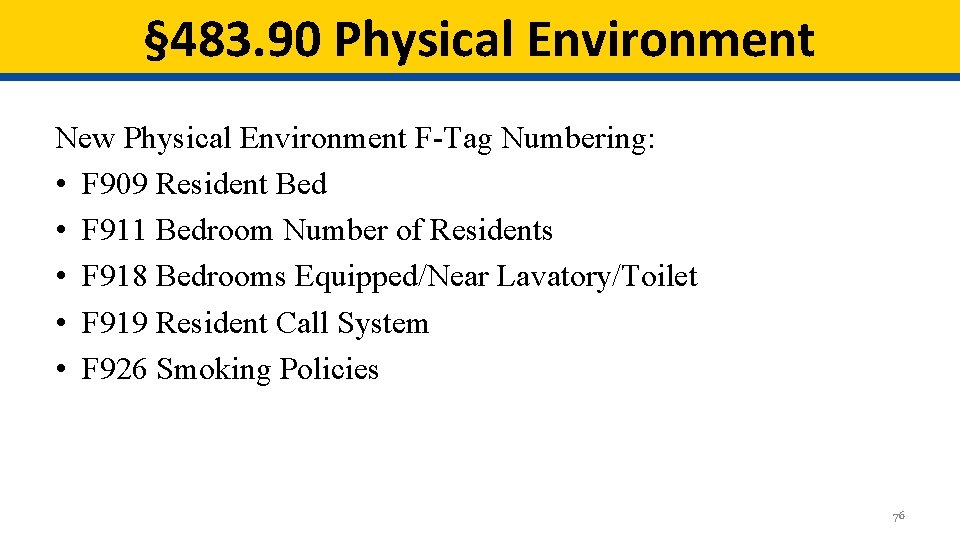
§ 483. 90 Physical Environment New Physical Environment F-Tag Numbering: • F 909 Resident Bed • F 911 Bedroom Number of Residents • F 918 Bedrooms Equipped/Near Lavatory/Toilet • F 919 Resident Call System • F 926 Smoking Policies 76
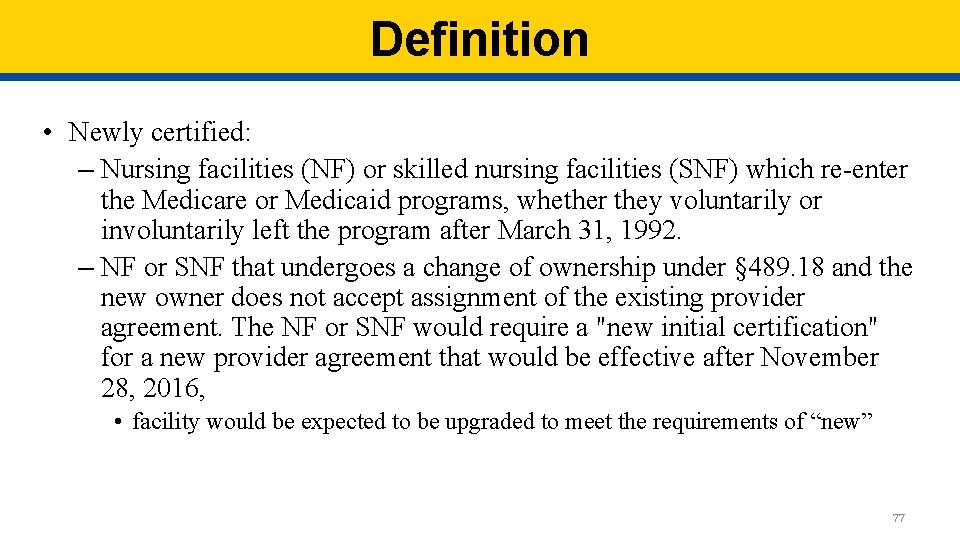
Definition • Newly certified: – Nursing facilities (NF) or skilled nursing facilities (SNF) which re-enter the Medicare or Medicaid programs, whether they voluntarily or involuntarily left the program after March 31, 1992. – NF or SNF that undergoes a change of ownership under § 489. 18 and the new owner does not accept assignment of the existing provider agreement. The NF or SNF would require a "new initial certification" for a new provider agreement that would be effective after November 28, 2016, • facility would be expected to be upgraded to meet the requirements of “new” 77
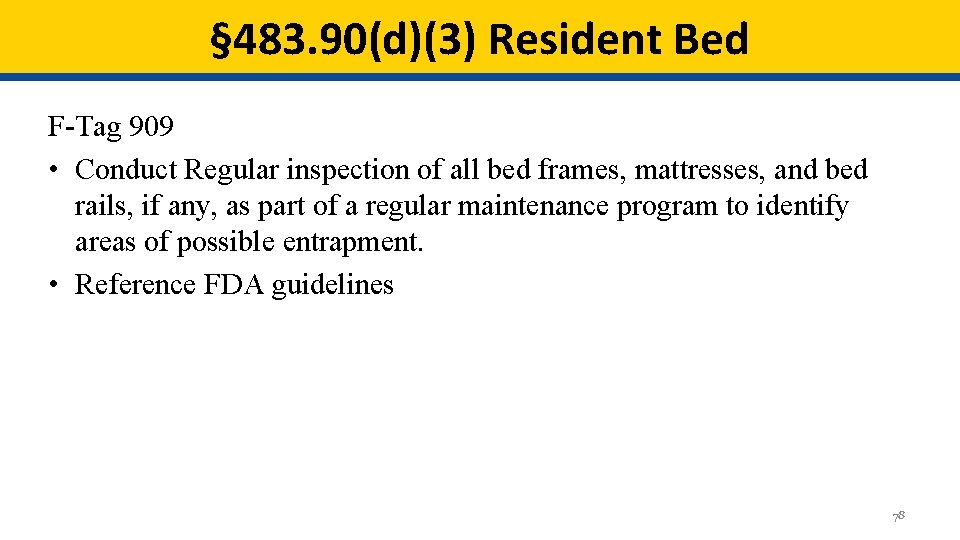
§ 483. 90(d)(3) Resident Bed F-Tag 909 • Conduct Regular inspection of all bed frames, mattresses, and bed rails, if any, as part of a regular maintenance program to identify areas of possible entrapment. • Reference FDA guidelines 78
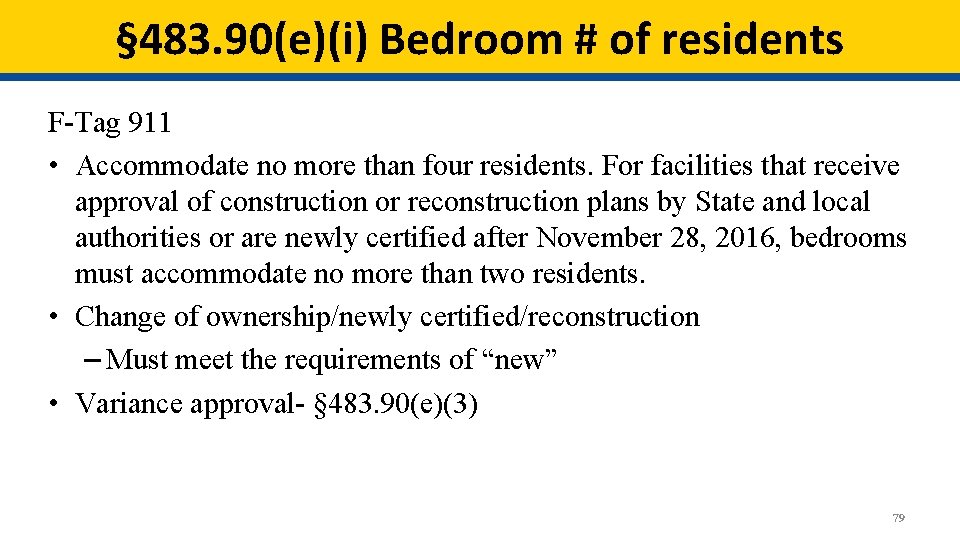
§ 483. 90(e)(i) Bedroom # of residents F-Tag 911 • Accommodate no more than four residents. For facilities that receive approval of construction or reconstruction plans by State and local authorities or are newly certified after November 28, 2016, bedrooms must accommodate no more than two residents. • Change of ownership/newly certified/reconstruction – Must meet the requirements of “new” • Variance approval- § 483. 90(e)(3) 79
§ 483. 90(f) Bedrooms equipped/near lavatory/toilet F-Tag 918 • Each resident room must be equipped with or located near toilet and bathing facilities. For facilities that receive approval of construction plans from State and local authorities or are newly certified after November 28, 2016, each residential room must have its own bathroom equipped with at least a commode and sink. • Change of ownership/newly certified/reconstruction 80
§ 483. 90(g)(1)-(2) Resident Call System F-Tag 919 • Equipped to allow residents to call for staff assistance through a communication system which relays the call directly to a staff member or to a centralized staff work area. • Toilet and bathing facilities. 81
§ 483. 90(i)(5) F-Tag 926 • Smoking policies: – Establish policies, in accordance with applicable Federal, State, and local laws and regulations, regarding smoking, smoking areas, and smoking safety that also take into account nonsmoking residents. • The use of oxygen while smoking is PROHIBITED • Reference Tag 689 for additional smoking guidance 82
§ 483. 95 Training Requirements New Training Requirements FTag Numbering: • • F 940 Training Requirements-General F 941 Communication Training F 942 Resident’s Rights Training F 943 Abuse, Neglect, and Exploitation Training • F 944 QAPI Training • F 945 Infection Control Training • F 946 Compliance and Ethics Training • F 947 Required In-service Training for Nurse Aides • F 948 Training for Feeding Assistants • F 949 Behavioral Health Training 83
Training Requirements Regulation F-Tag 940 • New tag • Will be implemented in Phase 3 • A facility must develop, implement, and maintain an effective training program for all new and existing staff; individuals providing services under a contractual arrangement; and volunteers, consistent with their expected roles. • A facility must determine the amount and types of training necessary based on a facility assessment as specified at § 483. 70(e). 84
§ 483. 95 Training Requirements F-Tag 941 Communication • New requirement • A facility must include effective communications as mandatory training for direct care staff. • Phase 3 implementation F-Tag 942 Resident’s Rights • New requirement • A facility must ensure that staff members are educated on the rights of the resident and the responsibilities of a facility to properly care for its residents • Phase 3 implementation 85
§ 483. 95 Training Requirements F-Tag 943 Abuse, Neglect, and Exploitation • Old F-Tag 226 • Phase 1 requirement • A facility must provide training for its staff on the freedom from abuse, neglect, and exploitation F-Tag 944 QAPI Training • New requirement • Phase 3 requirement • A facility must include as part of its QAPI program mandatory training that outlines and informs staff of the elements and goals of the facility’s QAPI program. 86
§ 483. 95 Training Requirements F-Tag 945 Infection Control Training • New requirement • Phase 3 implementation • A facility must include as part of its infection prevention and control program mandatory training that includes the written standards, policies, and procedures for the program F-Tag 946 Compliance and Ethics Training • New requirement • Phase 3 implementation • The operating organization for each facility must include compliance and ethics training for staff 87
§ 483. 95 Training Requirements F-Tag 947 In-Service Training for Nurse Aides • Old F-Tag 498 • Phase 1 requirement • Required in-service training for nurse aides F-Tag 948 Training for Feeding Assistants • Old F-Tag 373 • Phase 1 requirement • A facility must not use any individual working in the facility as a paid feeding assistant unless that individual has successfully completed a Stateapproved training program for feeding assistants, as specified in § 483. 160. 88
§ 483. 95 Training Requirements F-Tag 949 Behavioral Health Training • New requirement • Phase 3 implementation • A facility must provide behavioral health training consistent with the requirements at § 483. 40 and as determined by the facility assessment 89
Conclusion • • • This training has provided you with an overview and key concepts of the new Long Term Care Regulations and Guidance For additional questions please submit to NH Survey Development Mailbox at NHSurvey. Development@cms. hhs. gov Link to the LTC Survey Process SME Videos: o o o Overview Abuse and Neglect Admission, Transfers, and Discharge Behavioral Health Services Facility Assessment Infection Control Nursing Services Person Centered Care Pharmacy Services Quality Assurance and Performance Improvement Quality of Life/Quality of Care https: //surveyortraining. cms. hhs. gov/pubs/Course. Menu. aspx? cid=0 CMSLTCSME_VID 90
THANK YOU For all of your hard work in assuring the health, safety, needs and choices of residents that reside in Nursing Homes 91
Acknowledgement On behalf of CMS Central Office we would like to acknowledge and thank, the CMS Team, Key Stakeholders, Contractors, Consultants, and Subject Matter Experts for your collaboration, support, knowledge and skills in helping us develop the new Long Term Care Regulations and Guidance. 92