
Break it Down to Build it Better Part
Break it Down to Build it Better Part II Tips and techniques not found in grant writing guides
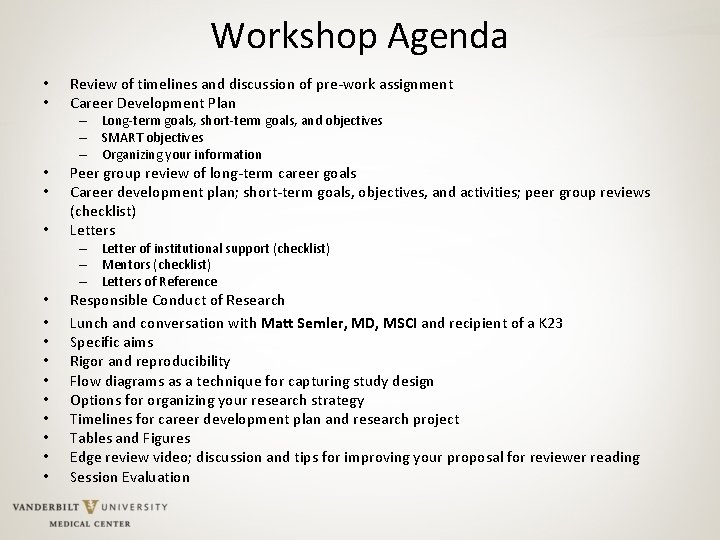
Workshop Agenda • • • • Review of timelines and discussion of pre-work assignment Career Development Plan – Long-term goals, short-term goals, and objectives – SMART objectives – Organizing your information Peer group review of long-term career goals Career development plan; short-term goals, objectives, and activities; peer group reviews (checklist) Letters – Letter of institutional support (checklist) – Mentors (checklist) – Letters of Reference Responsible Conduct of Research Lunch and conversation with Matt Semler, MD, MSCI and recipient of a K 23 Specific aims Rigor and reproducibility Flow diagrams as a technique for capturing study design Options for organizing your research strategy Timelines for career development plan and research project Tables and Figures Edge review video; discussion and tips for improving your proposal for reviewer reading Session Evaluation
Discussion of timelines and prework
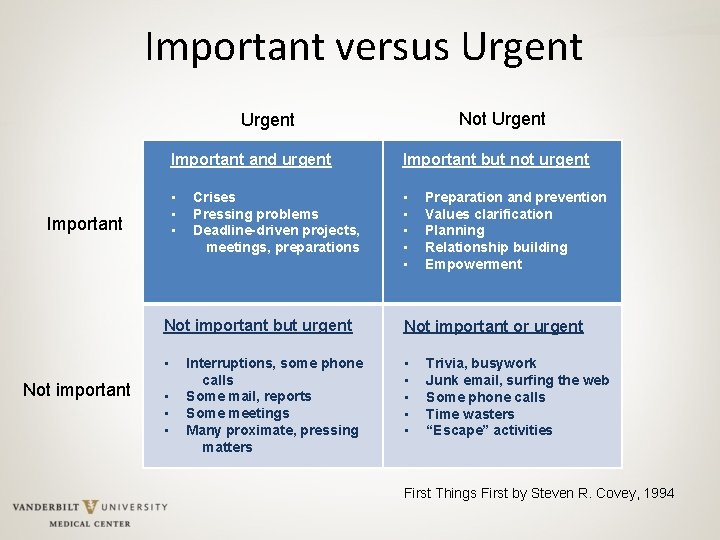
Important versus Urgent Not Urgent Important Not important Important and urgent Important but not urgent • • Crises Pressing problems Deadline-driven projects, meetings, preparations Preparation and prevention Values clarification Planning Relationship building Empowerment Not important but urgent Not important or urgent • • • Interruptions, some phone calls Some mail, reports Some meetings Many proximate, pressing matters Trivia, busywork Junk email, surfing the web Some phone calls Time wasters “Escape” activities First Things First by Steven R. Covey, 1994
Long-term goals
Long-term goal • The long-term goal is a broad statement about where you want to be in the future (eg, 10 years from now) • The goal should describe the following: – – – What you want to be What you want to do In what area How, and To what end

Long-term career goal examples • My long-term career goal is to advance methods used in measuring and reducing hospital-acquired injury among older hospitalized patients. • My goal as a reproductive epidemiologist is to conduct large-scale population-based cohort studies in order to identify gene-by-environment interactions associated with adverse pregnancy outcomes, with an emphasis on exposures that are susceptible to public health intervention.
Long-term career goal example • My long-term career goal is to become a community-engaged physician-researcher with expertise in mixed qualitativequantitative methods. I intend to have a diverse portfolio of epidemiologic, health disparities, and health services research related to improving primary care delivery and clinical outcomes for patients with cardiovascular disease. The ultimate outcome of my career is to contribute to a more refined and nuanced understanding of how social contextual factors (eg, the family and broader community environment) contribute to variations in health status, influence health behaviors, and clinical outcomes for vulnerable patients.
Peer group reviews Long-term career goals
Career Development Plans Short term goals, objectives, relationships, and organization
Short-term goals/objectives • Short-term goals or objectives are more immediate steps that lead to your goal • Objectives are SMART – – – Specific Measurable Attainable Relevant Time-bound • Need to show relationship between long-term goal, shortterm goals and objectives, and activities, and describe how your mentors relate
Short-term goals/objectives: example • My long-term career goal is to become a community-engaged physician-researcher with expertise in mixed qualitative-quantitative methods. I intend to have a diverse portfolio of epidemiologic, health disparities, and health services research related to improving primary care delivery and clinical outcomes for patients with cardiovascular disease. The ultimate outcome of my career is to contribute to a more refined and nuanced understanding of how social contextual factors (eg, the family and broader community environment) contribute to variations in health status, influence health behaviors, and clinical outcomes for vulnerable patients. • Together with my mentors, I have identified four gaps in my knowledge and skills that need to be addressed as I move toward independence. My short term goals are to close these gaps by: – Enhancing my skills in measurement and interpretation of data regarding triadic and dyadic communication and patient/family experiences with care. – Developing knowledge of theoretical and practical applications in social epidemiology – Gaining proficiency in qualitative research methods and analysis – Developing competency in the planning, design, and execution of high-quality clinical trials, involving behavioral interventions
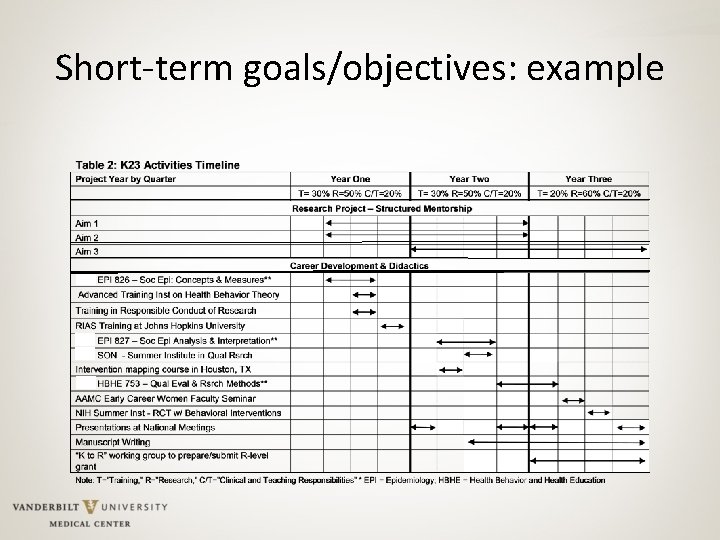
Short-term goals/objectives: example
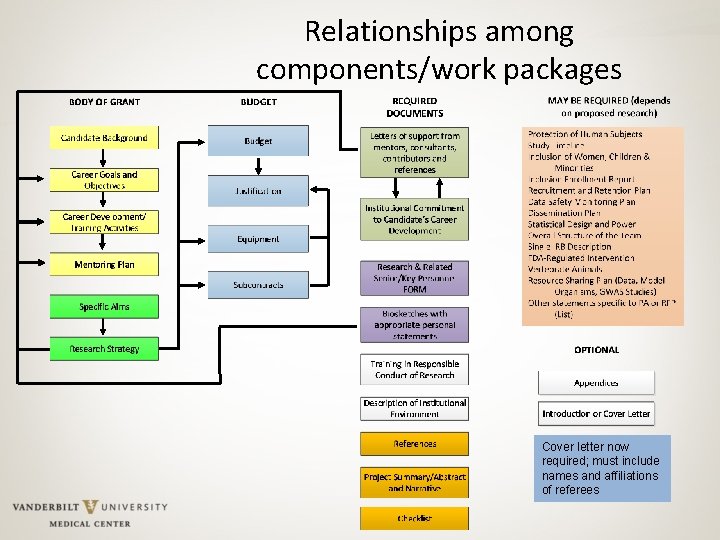
Relationships among components/work packages Cover letter now required; must include names and affiliations of referees
Organizing your information (organize, then write)
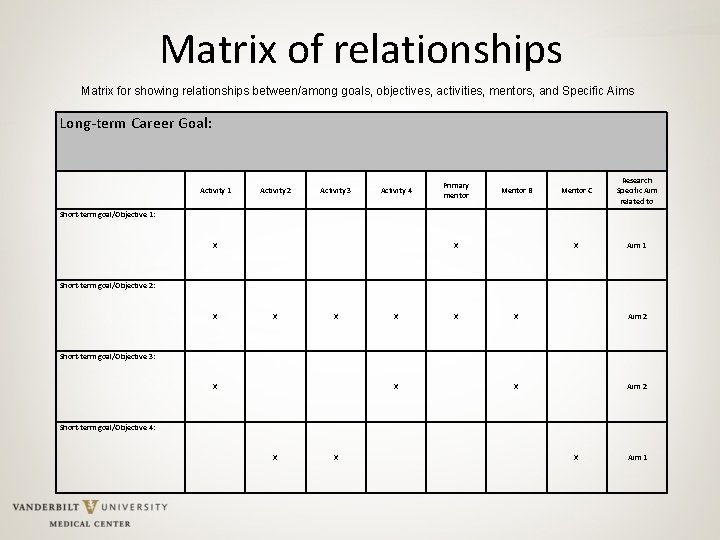
Matrix of relationships Matrix for showing relationships between/among goals, objectives, activities, mentors, and Specific Aims Long-term Career Goal: Activity 1 Activity 2 Activity 3 Activity 4 Primary mentor Mentor B Mentor C Research Specific Aim related to X X X Aim 1 X X X Aim 2 X X X Aim 1 Short-term goal/Objective 1: Short-term goal/Objective 2: Short-term goal/Objective 3: Short-term goal/Objective 4:
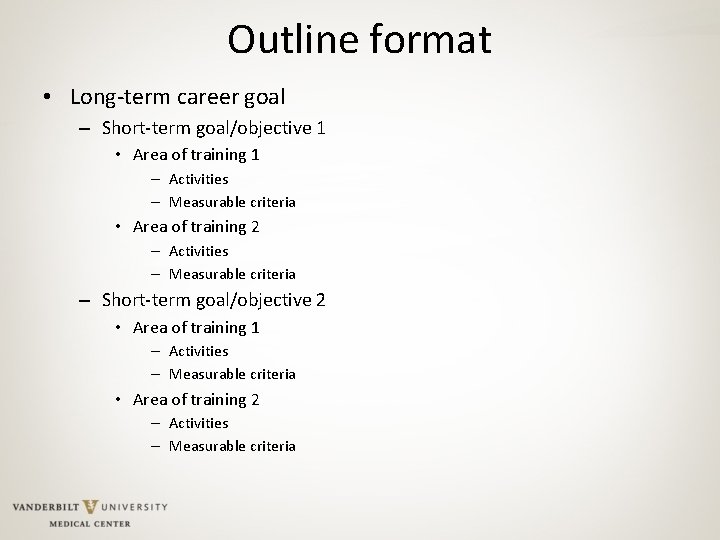
Outline format • Long-term career goal – Short-term goal/objective 1 • Area of training 1 – Activities – Measurable criteria • Area of training 2 – Activities – Measurable criteria – Short-term goal/objective 2 • Area of training 1 – Activities – Measurable criteria • Area of training 2 – Activities – Measurable criteria
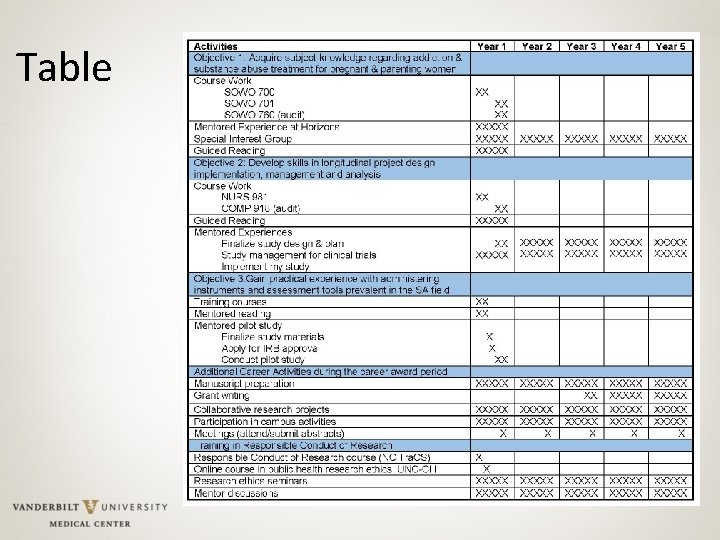
Table
Career development plans Peer group reviews
Letters Mentors Institutional Support References
Mentor letters • Not the same as Letter of Institutional Support or Letters of Reference • Mentor letters: – Provide some context information about you, your career to date at VU, your contributions, and your “bona fides” – Clearly state what role the letter writer will play on the mentor team – Provide qualifications of letter writer to be a mentor – Provide evidence of sufficient research support of mentor to cover costs of proposed research project (yours) in excess of allowable costs – Describe clearly and specifically what mentor will provide – Describe how mentoring will be coordinated – Couple of specific items for the K 99 • Plan for transitioning to R 00 • Mentor agrees to review and comment on R 00
Letter of Institutional Support • Come from the person who can commit resources and your time (typically your Chair) • Letters of institutional support: – Provide a statement of commitment to your development into a productive, independent investigator, and to meeting the requirements of the award – Make clear that the commitment to the candidate is not contingent on receiving the award – Assure that you will be able to devote the appropriate amount of time to research as specified by the award (typically 75%) – Assure that facilities, resources (office, lab space, equipment, etc. ) and training opportunities to support your career development plans will be available – Provide appropriate time and support for proposed mentor(s) and other staff in your proposed plan • If you are using CTSA resources, include a letter of support from the Program Director or PI in addition; this does not take the place of the letter of institutional support
Letters of Reference Review your PA to determine whether letters of reference are required Different from mentor letters and letters of institutional support Separate process from submitting an application electronically Submitted through e. RA Commons Referee Information Link and not through grants. gov • Use a specific format • Due at the same time as your proposal (as of 2016) • See http: //grants. nih. gov/grants/Electronic. Receipt/faq_full. htm#12 and NOT-OD-11 -036 at http: //grants. nih. gov/grants/guide/notice-files/NOT- OD-11 -036. html for additional guidance • •
Letters of Reference • People to consider Big name someone you know well Someone from the team that recruited you Division chair (if not doing letter of support) Someone you know well but who is more junior or less well known – Thesis/dissertation chair – Someone on a national agenda group with whom you may have served – –
Letters of Reference • Writer must certify this is his/her perception, so do not send draft of LOR • Good practice to send bulleted list to provide useful information and/or reminders – – – – Where met under what circumstances How long person has known you Your strengths (What are you really good at? ) Specific points to emphasize if possible Provide link to the LOR page on e. RA Commons When LOR is due (same time as proposal due date) Express appreciation for their serving as a reference
Peer Review of Letters (checklist)
Responsible Conduct of Research (RCR)
Responsible Conduct of Research (NIH Update, 2011) • Definition: the practice of scientific investigation with integrity; involves awareness and application of established professional norms and ethical principles in performance of all activities related to scientific research • Format: substantial face-to-face discussions; combination of didactic and small-group discussions (eg, case studies), and participation of research training faculty members. Online courses acceptable but not sufficient. • Faculty participation: contribute to both formal and informal instruction; serve as speakers, discussion leaders, lecturers, and/or course directors
Responsible Conduct of Research (NIH Update, 2011) • Subject matter—specific topics not required, but include – Conflict of interest – Policies regarding human subjects, live vertebrate animals, and safe laboratory practices – Mentor/mentee responsibilities and relationships – Peer review – Data acquisition and laboratory tools—management, sharing, ownership – Collaborative research, including with industry – Research misconduct and policies for handling – Responsible authorship and publication – Scientist as a responsible member of society, contemporary ethical issues in biomedical research, environmental and societal impacts of scientific research
Responsible Conduct of Research (NIH Update, 2011) • Duration of instruction: involve substantive contact hours among trainees/fellows/scholars/participant/participating faculty; instruction should allow for indepth learning with subject matter synthesized within a broader conceptual framework • Frequency of instruction: continue throughout scientist’s career at all levels. Instruction must be undertaken at least once during each career stage (eg, baccalaureate, predoc, postdoc, faculty); instruction to be tailored to the needs of the individual https: //grants. nih. gov/grants/guide/notice-files/NOT-OD-10 -019. html
Your RCR Plan • Resource at Vanderbilt is Sam Gannon, Ed. D (sam. gannon@Vanderbilt. edu) • Include a variety of media – Self study online (eg, CITI) – Seminars/didactics – Group discussions/case studies – Individual discussions • Include topic to be covered, along with leader, lecturer, instructor, mentor • Indicate timeframe within which activity will be done
Example 1: RCR Plan Narrative with use of outline • Training prior to award period • Training during award period – Format • Classical lecture format instruction mixed with interactive discussion • Weekly ongoing discussions in area of specialty • Face-to-face meetings with primary mentor and discuss COI, commitment, collaboration, authorship, etc. – Subject matter—Targets areas of COI, human and vertebrate animal research, mentoring relationships, peer review, data management, etc. – Faculty participation—Provides description and names of faculty involved – Duration of instruction—Provides number of estimated hours based on plan presented – Frequency of instruction—Defines at least monthly and includes informal meetings
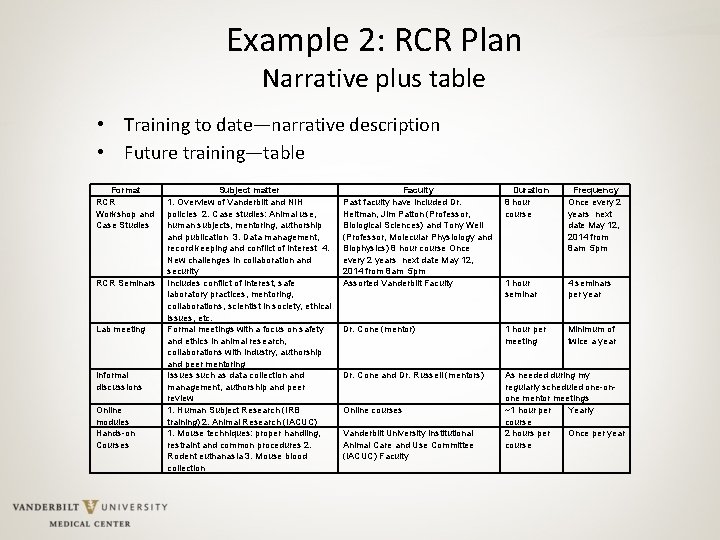
Example 2: RCR Plan Narrative plus table • Training to date—narrative description • Future training—table Format RCR Workshop and Case Studies RCR Seminars Lab meeting Informal discussions Online modules Hands-on Courses Subject matter 1. Overview of Vanderbilt and NIH policies 2. Case studies: Animal use, human subjects, mentoring, authorship and publication 3. Data management, record keeping and conflict of interest 4. New challenges in collaboration and security Includes conflict of interest, safe laboratory practices, mentoring, collaborations, scientist in society, ethical issues, etc. Formal meetings with a focus on safety and ethics in animal research, collaborations with industry, authorship and peer mentoring Issues such as data collection and management, authorship and peer review 1. Human Subject Research (IRB training) 2. Animal Research (IACUC) 1. Mouse techniques: proper handling, restraint and common procedures 2. Rodent euthanasia 3. Mouse blood collection Faculty Past faculty have included Dr. Heitman, Jim Patton (Professor, Biological Sciences) and Tony Weil (Professor, Molecular Physiology and Biophysics) 8 hour course Once every 2 years next date May 12, 2014 from 8 am 5 pm Assorted Vanderbilt Faculty Duration 8 hour course Frequency Once every 2 years next date May 12, 2014 from 8 am 5 pm 1 hour seminar 4 seminars per year Dr. Cone (mentor) 1 hour per meeting Minimum of twice a year Dr. Cone and Dr. Russell (mentors) As needed during my regularly scheduled one-onone mentor meetings ~1 hour per Yearly course 2 hours per Once per year course Online courses Vanderbilt University Institutional Animal Care and Use Committee (IACUC) Faculty
Example 3: RCR Plan Narrative with headers • Brief introduction – Statement of numbers of hours training to date; plan to further my development through continuing education in RCR and demonstrate mastery by teaching others about RCR as it relates to my work and research in emergency medicine • Narrative of previous training • Narrative of ongoing training • Narrative of planned future training
Conversation with Matthew Semler, MD, MSCI Assistant Professor, Biomedical Informatics Recipient of a K 23 Oxygen Saturation Targets During Mechanical Ventilation of Critically Ill Adults: A Clinical Trial
Research Strategy
Research strategy component should: • Be a project consistent with candidate’s level of research development and with objectives of career development plan • Demonstrate quality of candidate’s research to date • Demonstrate novelty, significance, and creativity • Describe a logical approach to the research question(s) • Demonstrate ability of candidate to carry out proposed research • Describe relationship between mentor’s research and candidate’s proposed plan • Include respective areas of expertise and responsibilities of mentors • K 99 proposal describes what candidate will accomplish during the mentored phase, and addresses the R 00 phase research plan; also describes how candidate will gain independence from mentors and achieve separation of his/her scientific research program from that of mentor
Rigor and Reproducibility (new in 2016)
Rigor and reproducibility • New reviewer guidelines – The scientific premise of the proposed research • State the strengths and weakness of published research or preliminary data crucial to the support of your application – Rigorous experimental design for robust and unbiased results • Describe how your experimental design and methods will achieve robust and unbiased results – Consideration of relevant biological variables • Explain how biological variables, such as sex, are factored into research design and provide justification if only one sex is used • New form – Authentication of key biological and/or chemical resources http: //grants. nih. gov/reproducibility/index. htm
Specific Aims
Specific Aims • Vital part of the proposal • Reviewers need to like your idea by the time they finish reading your aims • Aims page provides an overview of entire project • Needs to persuade reviewers that your project is important, that yours is the right team to do it, and that it will advance the state of the science • Must be carefully written, clear, and concise http: //www. biosciencewriters. com/NIH-Grant-Applications-The-Anatomy-of-a-Specific -Aims-Page. aspx
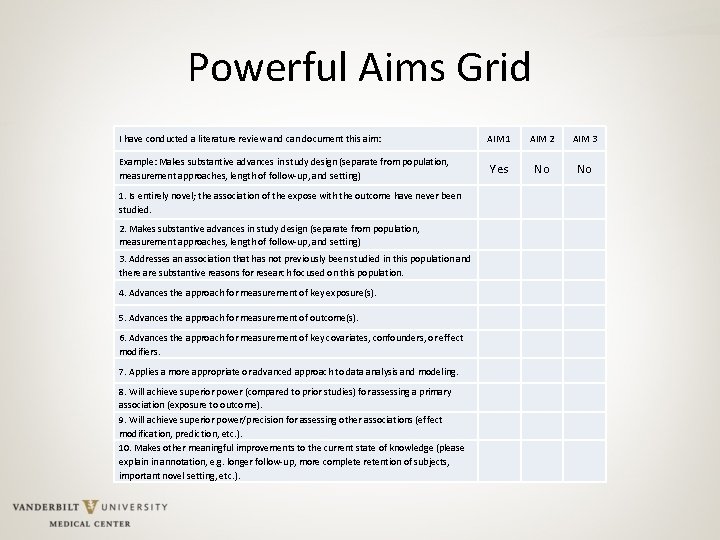
Powerful Aims Grid I have conducted a literature review and can document this aim: Example: Makes substantive advances in study design (separate from population, measurement approaches, length of follow-up, and setting) AIM 1 AIM 2 AIM 3 Yes No No 1. Is entirely novel; the association of the expose with the outcome have never been studied. 2. Makes substantive advances in study design (separate from population, measurement approaches, length of follow-up, and setting) 3. Addresses an association that has not previously been studied in this population and there are substantive reasons for research focused on this population. 4. Advances the approach for measurement of key exposure(s). 5. Advances the approach for measurement of outcome(s). 6. Advances the approach for measurement of key covariates, confounders, or effect modifiers. 7. Applies a more appropriate or advanced approach to data analysis and modeling. 8. Will achieve superior power (compared to prior studies) for assessing a primary association (exposure to outcome). 9. Will achieve superior power/precision for assessing other associations (effect modification, prediction, etc. ). 10. Makes other meaningful improvements to the current state of knowledge (please explain in annotation, e. g. longer follow-up, more complete retention of subjects, important novel setting, etc. ).
Flow diagrams and other cartoons to help organize research design
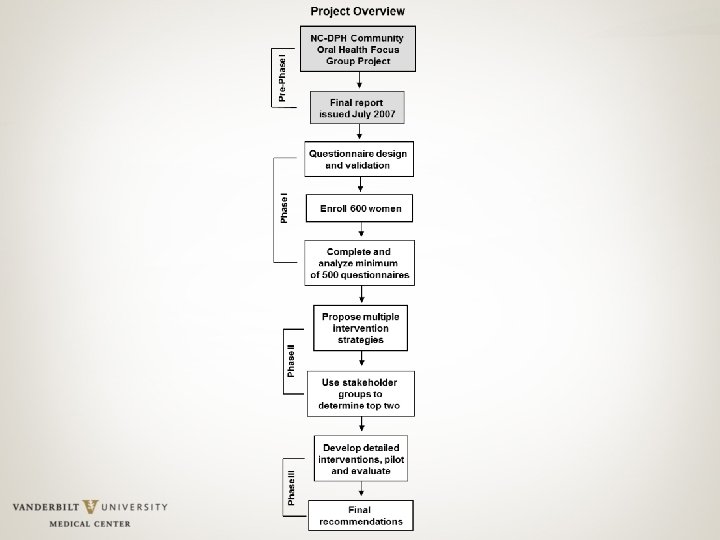
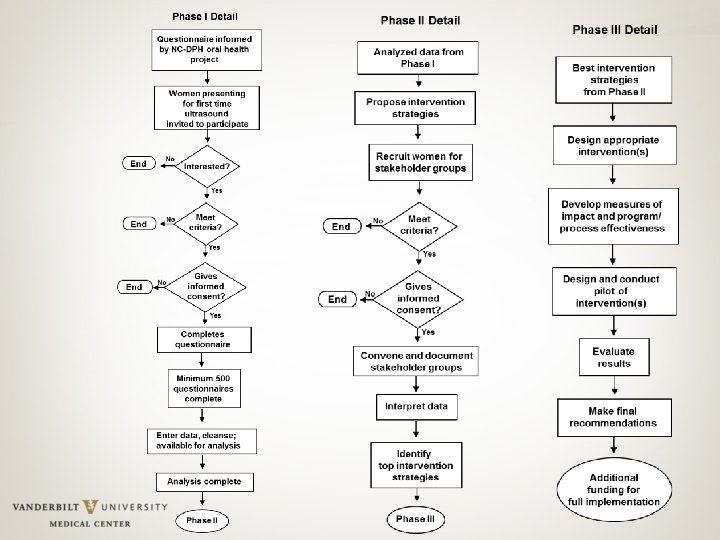
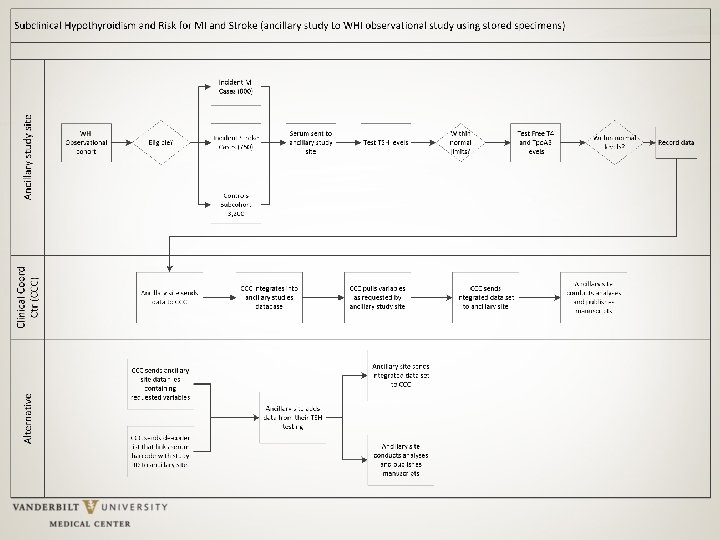
Flow Diagrams • Combination of techniques borrowed from process engineering and Information Technology • Use standard set of 6 symbols to capture the flow of a study (plus 1 optional) • Why do flow diagrams? – Linear, step-by-step logic; help organize thinking – Identify areas needing clarification – Provide framework for writing narrative (good clue as to how to organize your research strategy section) – May or may not use in the proposal (thought process is most important element)
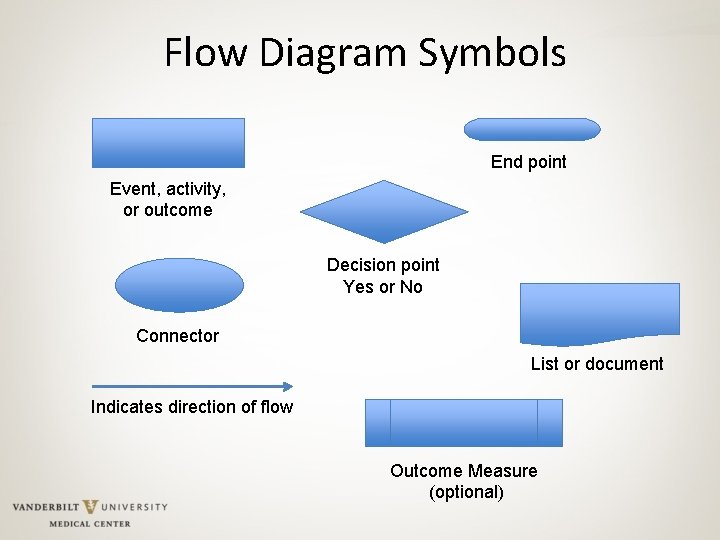
Flow Diagram Symbols End point Event, activity, or outcome Decision point Yes or No Connector List or document Indicates direction of flow Outcome Measure (optional)
Examples of Flow Diagrams
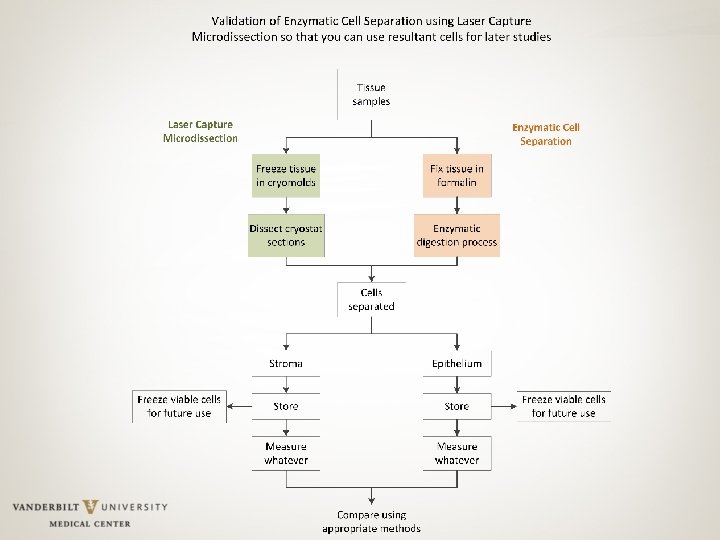
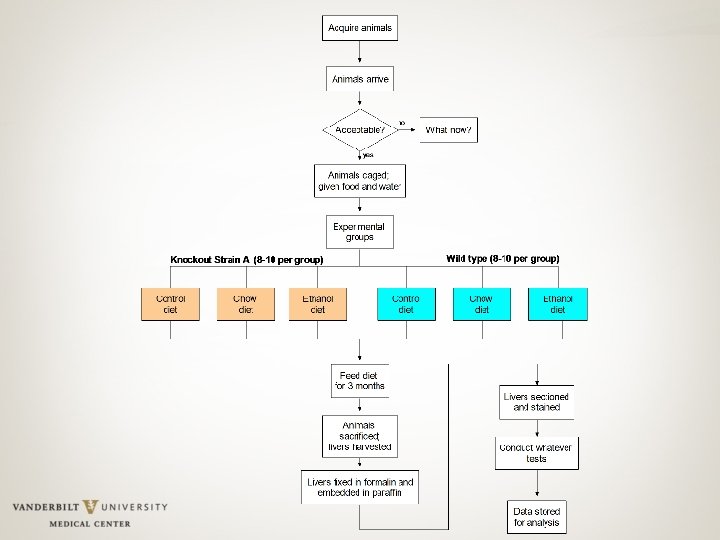
Hybrids of flow diagrams and other cartoons
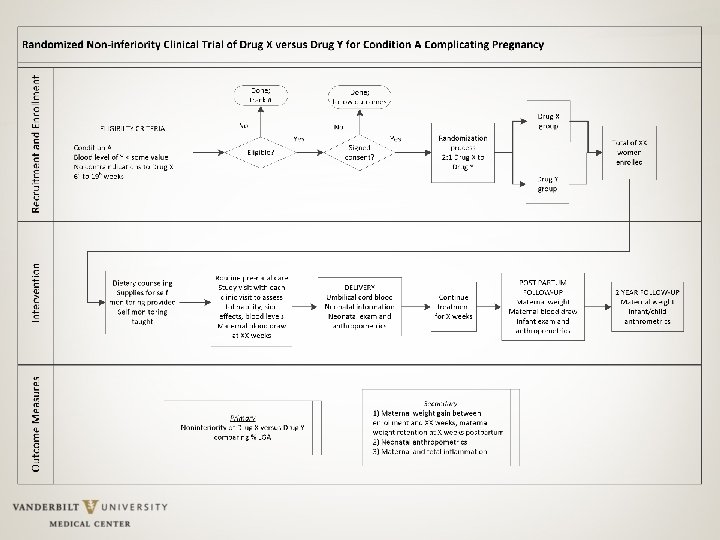
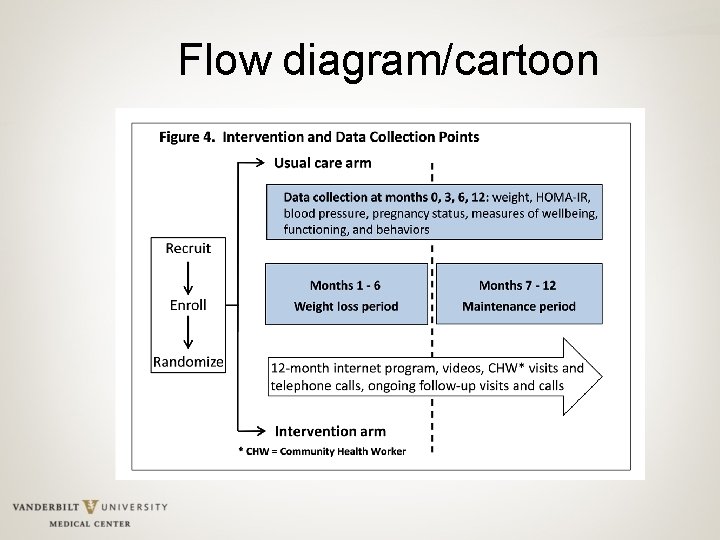
Flow diagram/cartoon
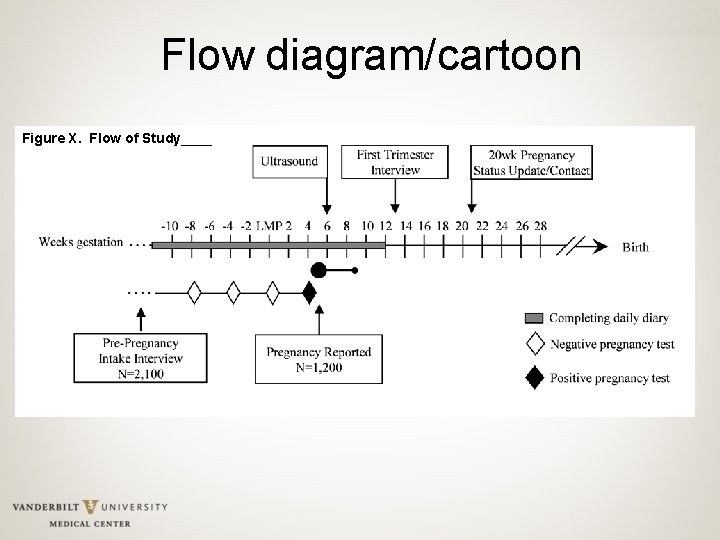
Flow diagram/cartoon Figure X. Flow of Study____
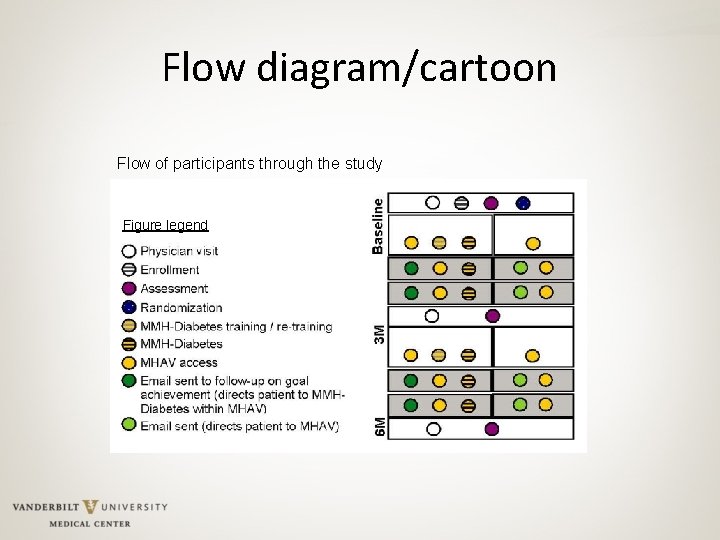
Flow diagram/cartoon Flow of participants through the study Figure legend
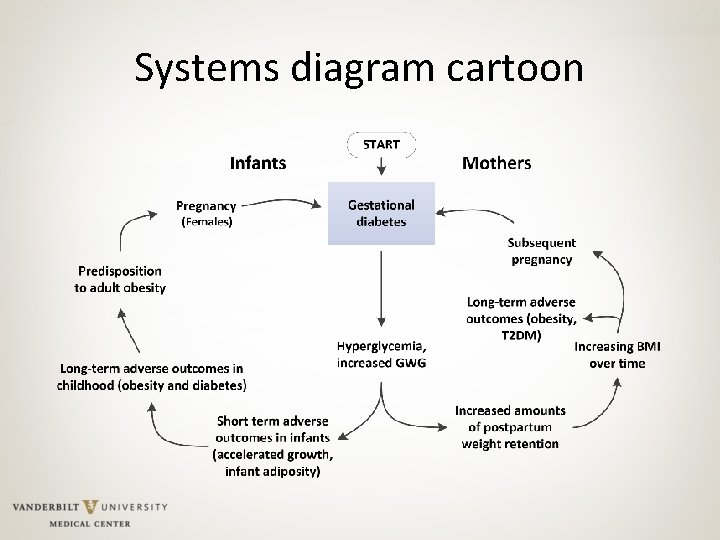
Systems diagram cartoon
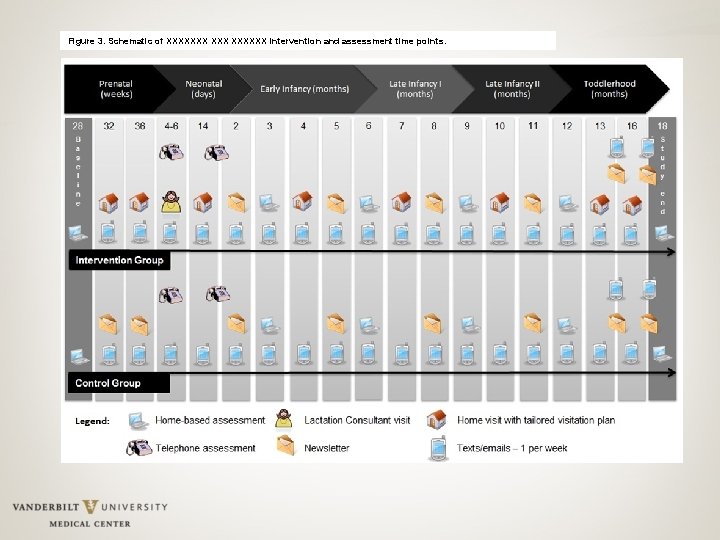
Figure 3. Schematic of XXXXXXX intervention and assessment time points.
Developing your flow diagrams
Peer review of flow diagrams
Organizing your research strategy
Organizing your research strategy • Look at your flow diagram(s) • Did you do a separate flow diagram for each specific aim? • If yes, consider organizing your research strategy by specific aim • If no, and you did a single flow diagram for the entire study, consider organizing your research strategy by your study design as a whole
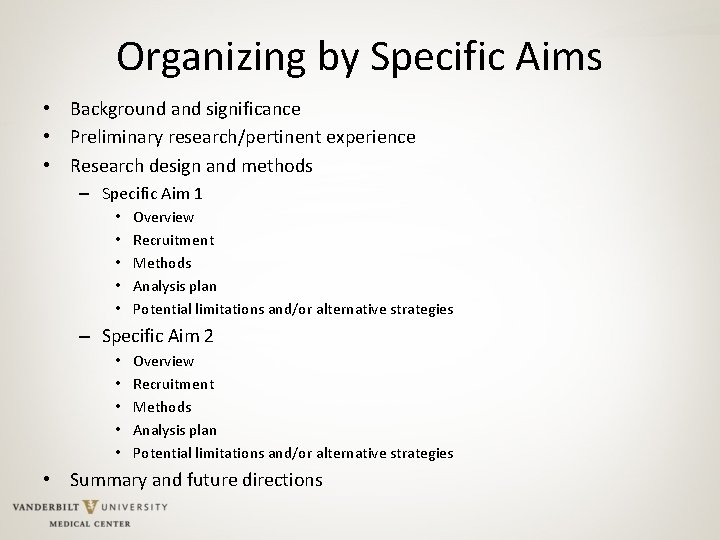
Organizing by Specific Aims • Background and significance • Preliminary research/pertinent experience • Research design and methods – Specific Aim 1 • • • Overview Recruitment Methods Analysis plan Potential limitations and/or alternative strategies – Specific Aim 2 • • • Overview Recruitment Methods Analysis plan Potential limitations and/or alternative strategies • Summary and future directions
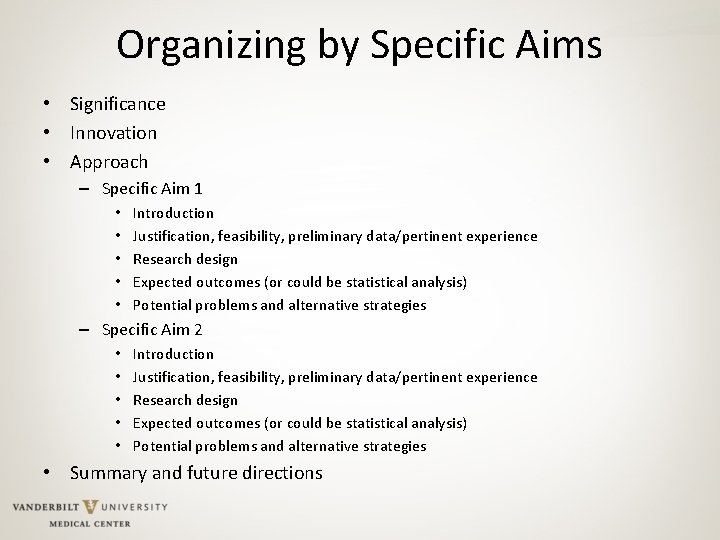
Organizing by Specific Aims • Significance • Innovation • Approach – Specific Aim 1 • • • Introduction Justification, feasibility, preliminary data/pertinent experience Research design Expected outcomes (or could be statistical analysis) Potential problems and alternative strategies – Specific Aim 2 • • • Introduction Justification, feasibility, preliminary data/pertinent experience Research design Expected outcomes (or could be statistical analysis) Potential problems and alternative strategies • Summary and future directions
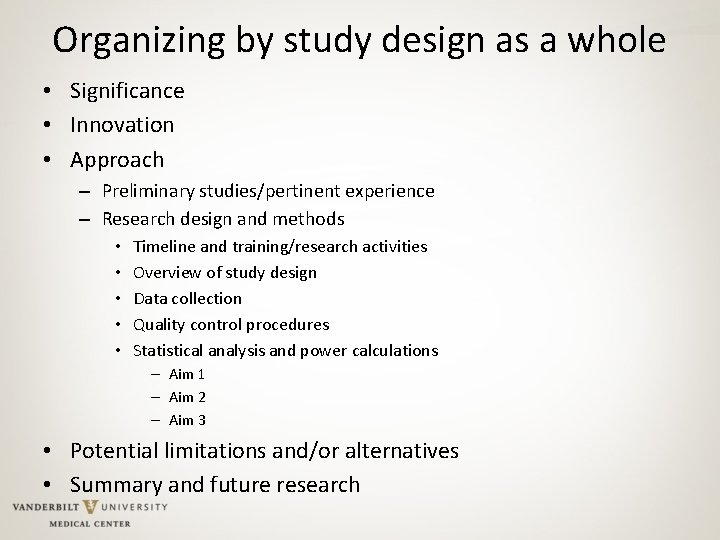
Organizing by study design as a whole • Significance • Innovation • Approach – Preliminary studies/pertinent experience – Research design and methods • • • Timeline and training/research activities Overview of study design Data collection Quality control procedures Statistical analysis and power calculations – Aim 1 – Aim 2 – Aim 3 • Potential limitations and/or alternatives • Summary and future research
Timelines Career development plans Research projects
Checklist for Approach Section of Research Strategy
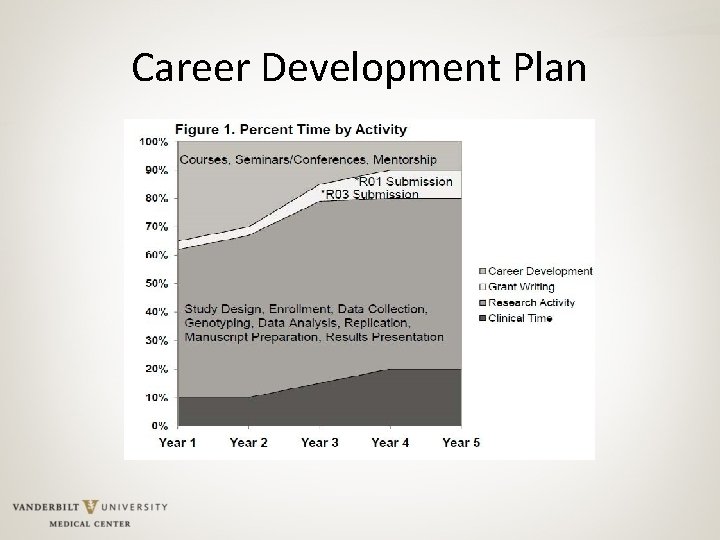
Examples of timelines for career development plans
Career Development Plan
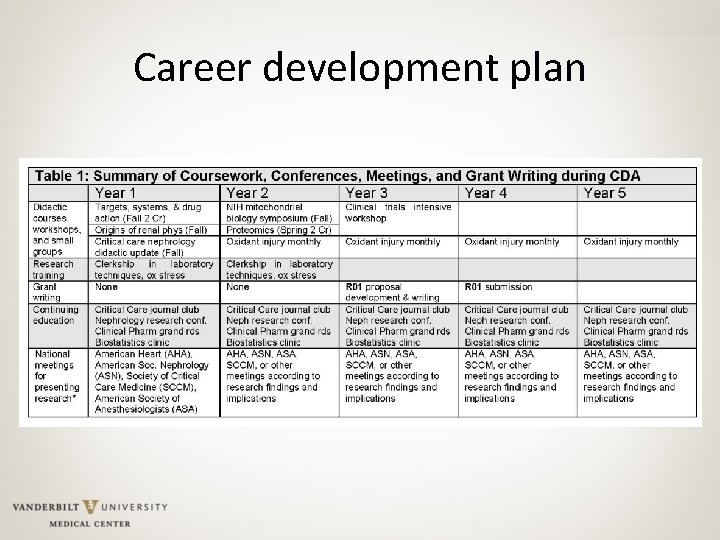
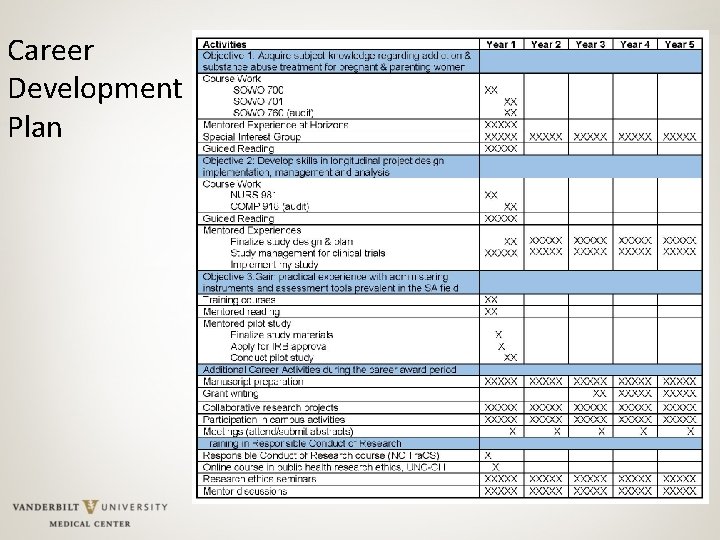
Career development plan
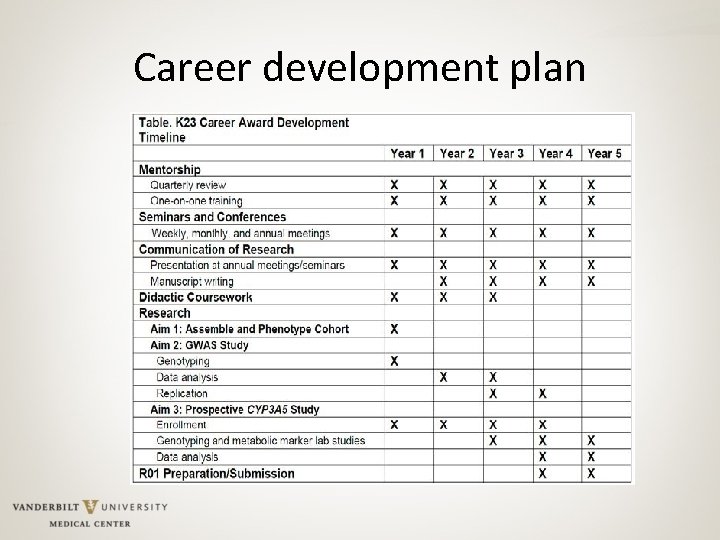
Career development plan
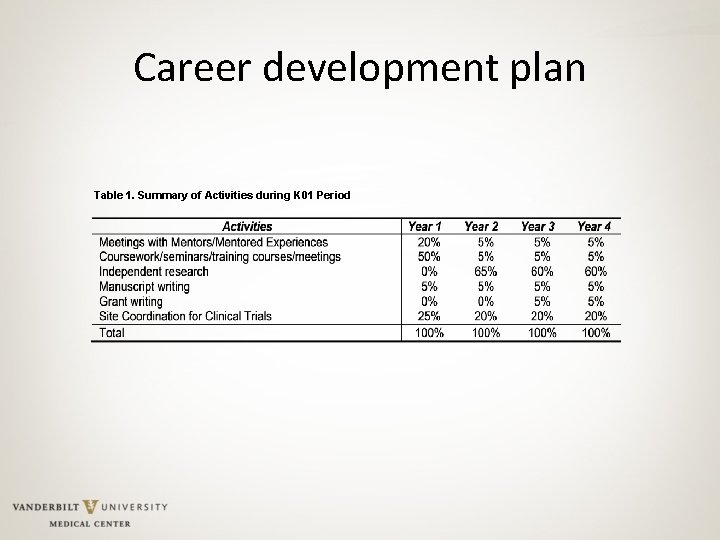
Career development plan Table 1. Summary of Activities during K 01 Period
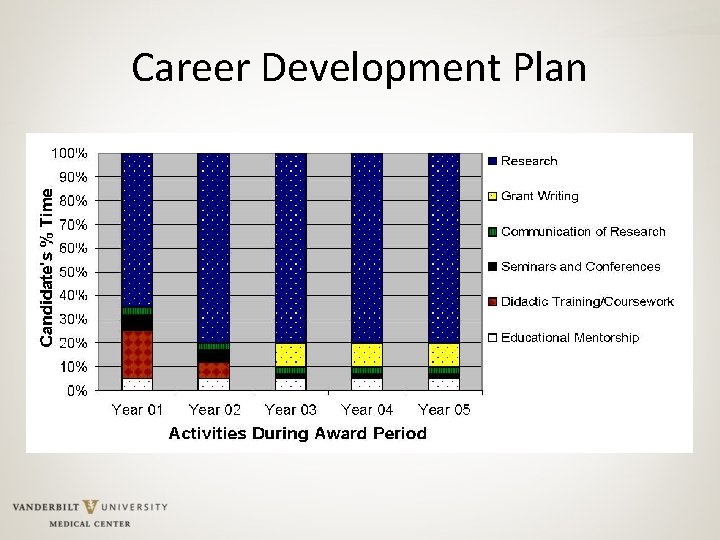
Career Development Plan
Career Development Plan
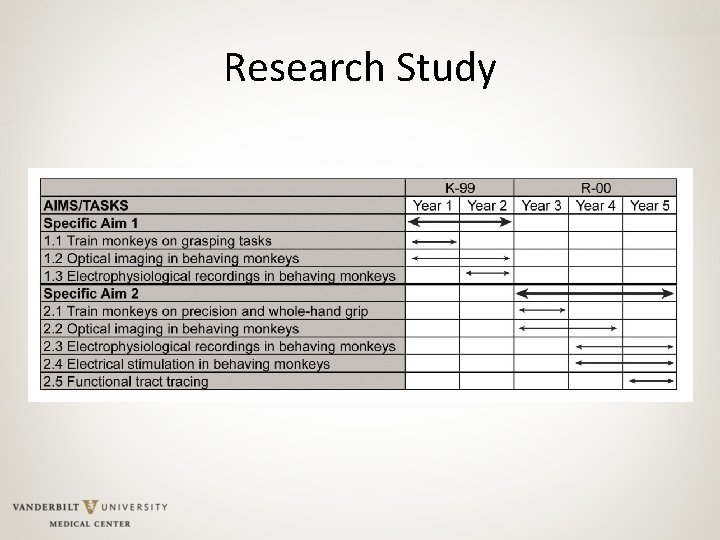
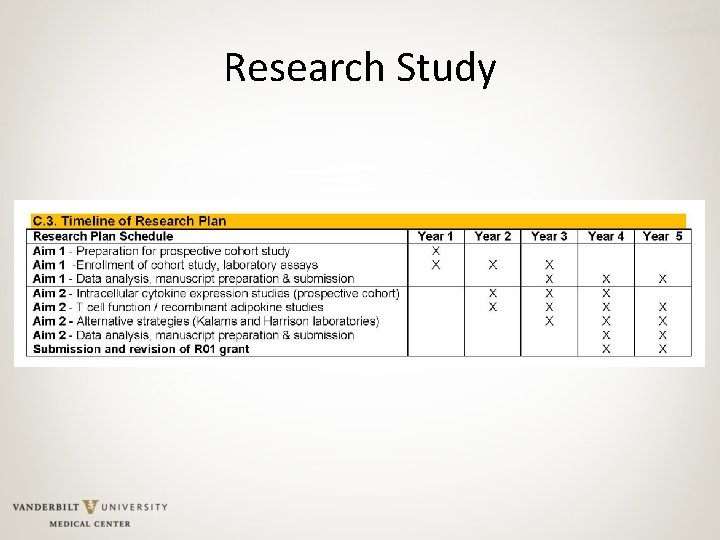
Examples of timelines for research studies
Research Study
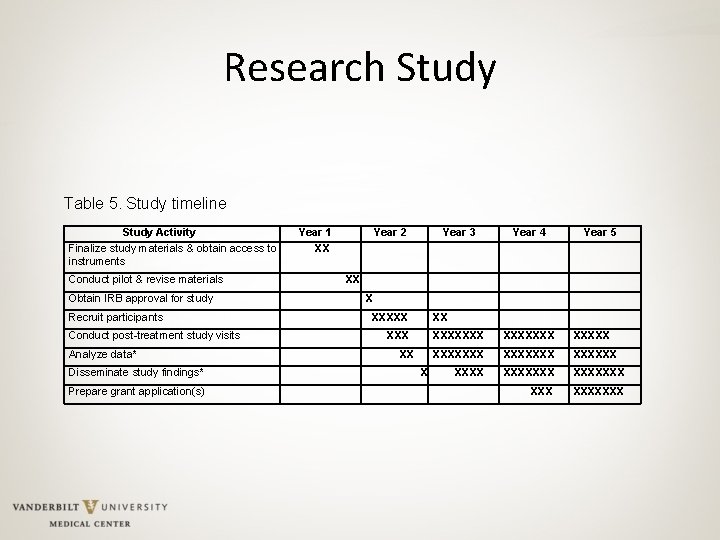
Research Study Table 5. Study timeline Study Activity Finalize study materials & obtain access to instruments Conduct pilot & revise materials Year 1 XX Year 2 Year 3 Year 4 Year 5 XX Obtain IRB approval for study X Recruit participants XXXXX Conduct post-treatment study visits XXX Analyze data* Disseminate study findings* Prepare grant application(s) XX XX X XXXXXXX XXXXXXX XXX XXXXXXX
Research Study
Research Study
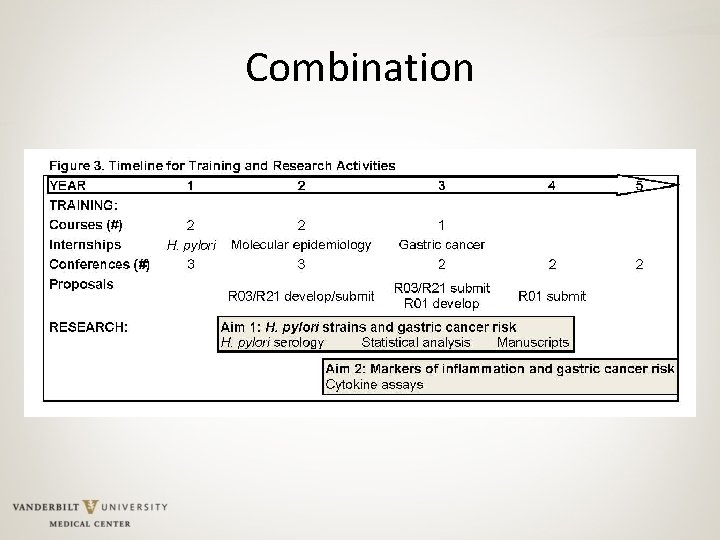
Combination examples
Combination
Combination
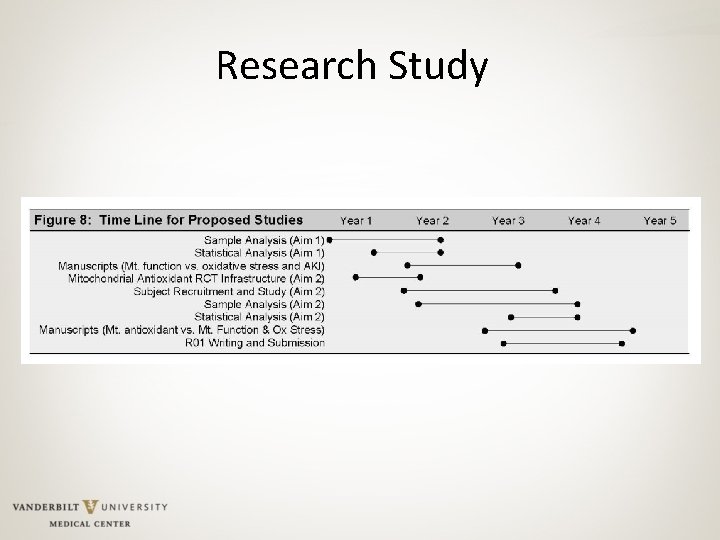
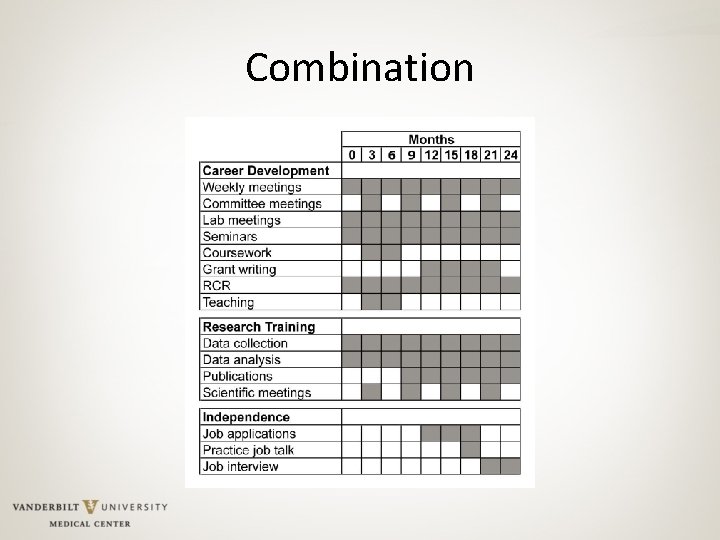
Tips for timelines • Simple is better • Label appropriately • Refer to the timeline in the text and give some information about it • Use gray scale and patterns; may or may not be printed in color by recipient • Ensure your narrative matches the timeline
Work on your study timelines; peer review
Tables and Figures
Tables versus graphs • Graphs – Immediate impact – Good for showing trends/patterns or highlighting differences between two sets of data • Tables – More precise and exact – Use when individual or summarized values are more important than trends
Tables • Can present qualitative or quantitative data • Can contain words, symbols, numbers, or a combination • Allow side-by-side comparison of data • Good for presenting large amounts of information too cumbersome or confusing to place in main text
Tables should… • Draw attention to the information and not the table itself • Have clear and concise titles • Augment, amplify, or provide greater detail than what appears in the narrative; table and narrative should work together to get your point across • Contain data deserving to be in a table rather than in the main text
Table components • • • Title Column headings Row headings (stubs) Data fields Footnotes Spanners (optional)
General rules format and alignment • Left justify row headers (stubs) • In data fields, left justify words, right justify whole numbers • Data fields with symbols such as decimals, plus/minus signs, slashes, hyphens, or parentheses should align in those elements • Text in row headings that wraps to a second line should align with the top line of that row heading
Tips for tables • Create a format for your tables and use it consistently • Create each table as its own document; use placeholder in document, then copy and paste tables into main document • Incorporate title and footnotes into table itself • Number tables and figures independently, in the sequence in which they appear • Do not split a table over two pages • Keep your tables small
Reference for previous six slides http: //www. clinchem. org/cgi/collection/guidetowriting http: //www. ncsu. edu/labwrite/res/gh/gh-tables. html
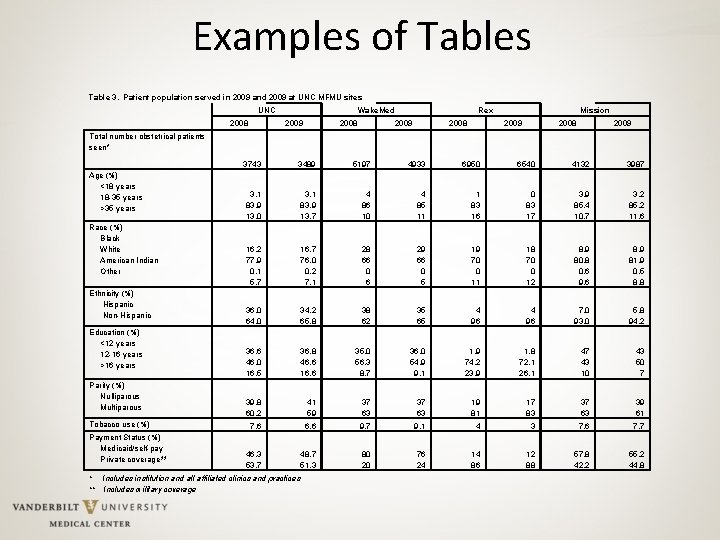
Examples of Tables Table 3. Patient population served in 2009 and 2009 at UNC MFMU sites UNC 2008 Wake. Med 2009 2008 Rex 2009 2008 Mission 2009 2008 2009 Total number obstetrical patients seen* Age (%) <18 years 18 -35 years >35 years Race (%) Black White American Indian Other Ethnicity (%) Hispanic Non-Hispanic Education (%) <12 years 12 -16 years >16 years Parity (%) Nulliparous Multiparous Tobacco use (%) Payment Status (%) Medicaid/self-pay Private coverage** 3743 3489 5197 4933 6950 6540 4132 3987 3. 1 83. 9 13. 0 3. 1 83. 9 13. 7 4 86 10 4 85 11 1 83 16 0 83 17 3. 9 85. 4 10. 7 3. 2 85. 2 11. 6 16. 2 77. 9 0. 1 5. 7 16. 7 76. 0 0. 2 7. 1 28 66 0 6 29 66 0 5 19 70 0 11 18 70 0 12 8. 9 80. 8 0. 6 9. 6 8. 9 81. 9 0. 5 8. 8 36. 0 64. 0 34. 2 65. 8 38 62 35 65 4 96 7. 0 93. 0 5. 8 94. 2 36. 6 46. 0 16. 5 36. 8 46. 6 16. 6 35. 0 56. 3 8. 7 36. 0 54. 9 9. 1 1. 9 74. 2 23. 9 1. 8 72. 1 26. 1 47 43 10 43 50 7 39. 8 60. 2 41 59 37 63 19 81 17 83 37 63 39 61 7. 6 6. 6 9. 7 9. 1 4 3 7. 6 7. 7 46. 3 53. 7 48. 7 51. 3 80 20 76 24 14 86 12 88 57. 8 42. 2 55. 2 44. 8 * Includes institution and all affiliated clinics and practices ** Includes military coverage
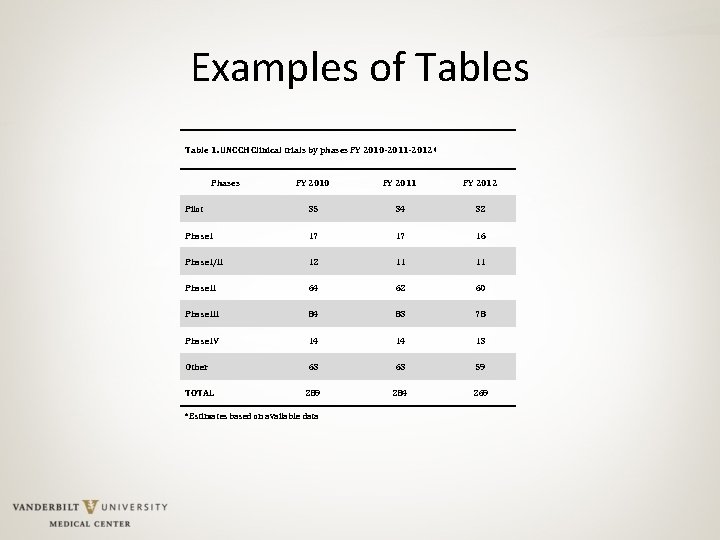
Examples of Tables Table 1. UNCCH Clinical trials by phases FY 2010 -2011 -2012* Phases FY 2010 FY 2011 FY 2012 Pilot 35 34 32 Phase I 17 17 16 Phase I/II 12 11 11 Phase II 64 62 60 Phase III 84 83 78 Phase IV 14 14 13 Other 63 63 59 TOTAL 289 284 269 *Estimates based on available data

Examples of Tables
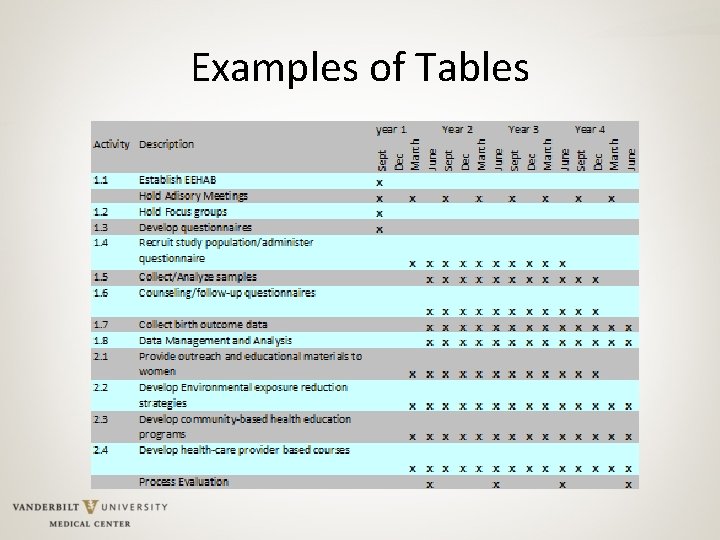
Examples of Tables
Figures • Visual representations – Graphs, diagrams, photos, drawings, schematics, maps, etc. • Refer to figures within the text • Avoid using a sentence that gives the reader no information other than directing them to the figure • Number tables and figures independently, in the sequence in which they appear • Strive for simplicity • If using color, be sure everything is readable if printed in grayscale • Incorporate the legend and footnotes into the figure itself if at all possible, particularly if using Power. Point • Recommendation: construct figures as their own documents, use placeholder in text, insert in text when you are ready
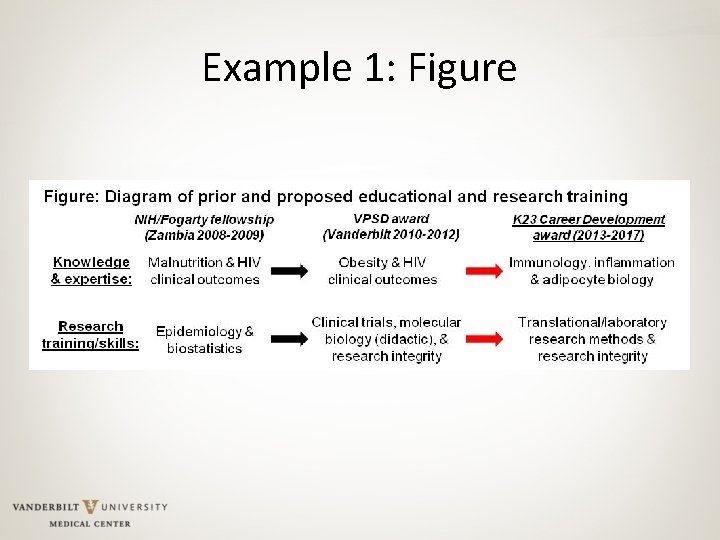
Example 1: Figure
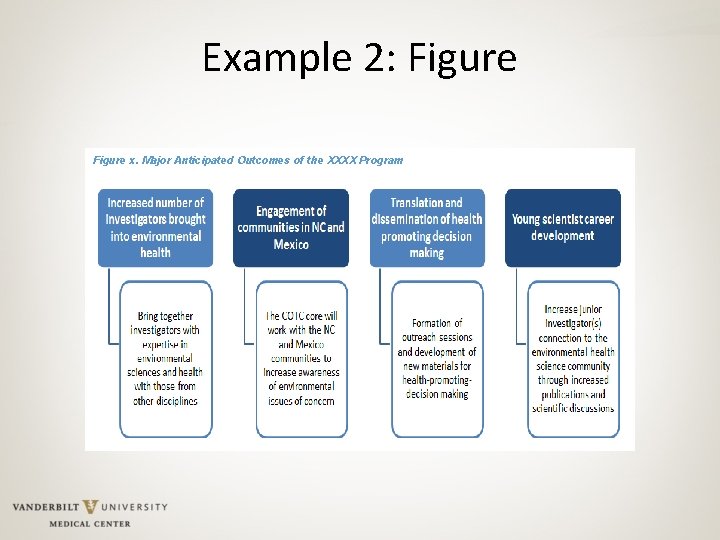
Example 2: Figure x. Major Anticipated Outcomes of the XXXX Program
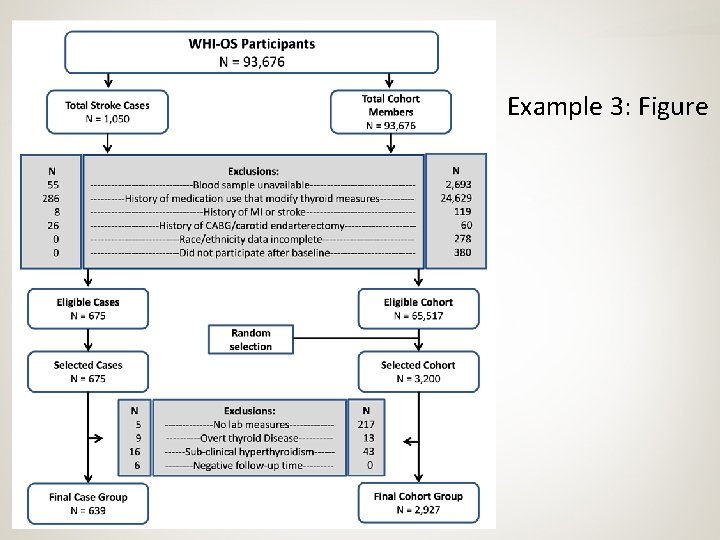
Example 3: Figure
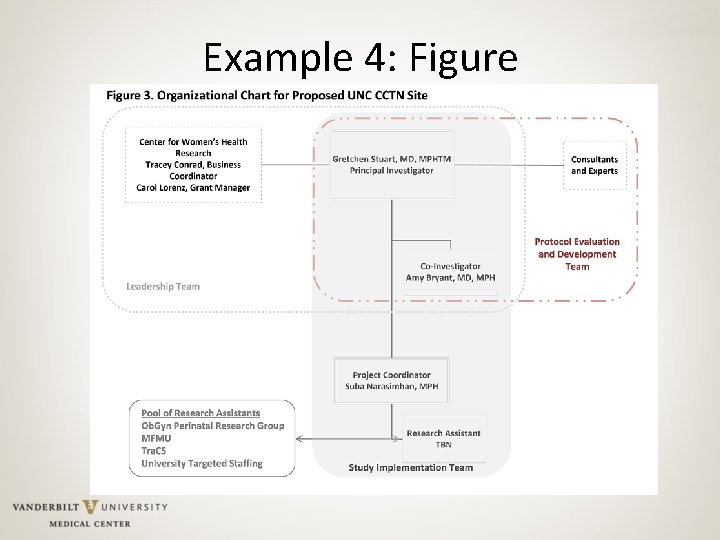
Example 4: Figure
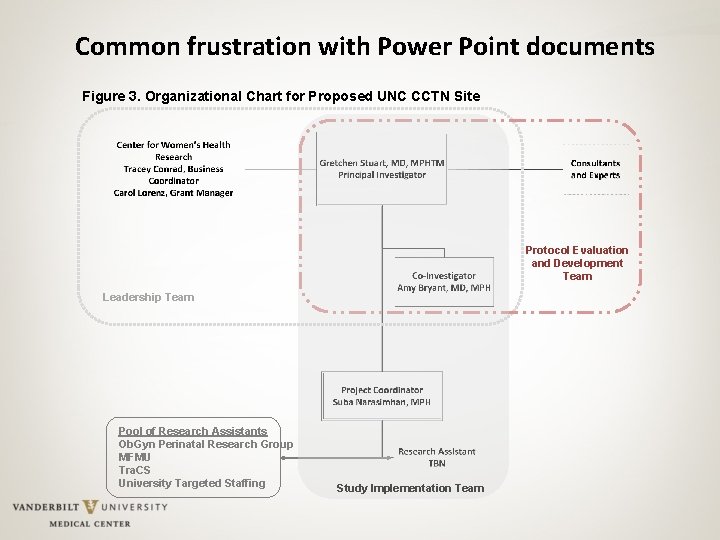
Common frustration with Power Point documents Figure 3. Organizational Chart for Proposed UNC CCTN Site Protocol Evaluation and Development Team Leadership Team Pool of Research Assistants Ob. Gyn Perinatal Research Group MFMU Tra. CS University Targeted Staffing Study Implementation Team
Reviewer perspective Edge Review
Video K Edge Review
Improving a proposal’s quality from the reviewer’s perspective • Know your audience • Much of the quality of a proposal pertains to the way you present your background, career development plan, and mentor section—remember, they are funding the scientist, not the science • However, your science cannot be sloppy or poorly thought-out • Write clearly and succinctly – Use active voice wherever possible – Provide context for the reader – Connect your ideas within sentences and paragraphs, then between paragraphs and sections – Present a logical argument – Do not make your reader “hunt” for information – Pay attention to formatting – Leave white space on the page(s) – Break up dense text with tables and/or figures
An appropriate saying (attributed to various famous people) • If you want me to talk for an hour, I’m ready now • If you want me to talk for 30 minutes, I’ll need two days to prepare • If you want me to talk for 10 minutes, I’ll need a week to prepare • The same is true for writing clearly, logically, and succinctly; it takes time and thought
Final exercise Identify the two most important action items you need to do this week to move your grant proposal forward
Resources • Figures and tables – – • Otto Yang in Guide to Effective Grant Writing, Second Edition (2012) pages 25 -29 http: //abacus. bates. edu/~ganderso/biology/resources/writing/HTWtablefigs. html http: //www. plosone. org/static/figure. Guidelines. action Works by Edward Tufte on effective presentation of data Work breakdown – Gregory T. Haugan; Effective work breakdown structures. Vienna, Va; Management Concepts (2002) • NIH sites – http: //grants. nih. gov/grants/Electronic. Receipt/faq_full. htm#12 (Letters of reference) – http: //grants. nih. gov/grants/guide/notice-files/NOT- OD-11 -036. html (Letters of reference) – http: //grants. nih. gov/training/careerdevelopmentawards. htm (General information on career development awards with links to specific sites) – Open Mike https: //nexus. od. nih. gov/all/2015/10/19/welcome-to-the-open-mike-blog-at-nih/ (updates on NIH extramural funding) • Effective writing/grantsmanship – – Expectations; Writing from the Reader’s Perspective, by George D. Gopen, Duke University (2004) Otto Yang, Guide to Effective Grant Writing, Second Edition (2012) Helen Sword, The Writer’s Diet: A Guide to Fit Prose (2016) Morgan Giddings, 4 Steps to Funding (2011)
Session evaluation
Thank you and good luck with your proposal writing
- Slides: 110