2140702 Operating System Unit2 Process Management Prof Firoz


- Slides: 39
2140702 Operating System Unit-2 Process Management Prof. Firoz A. Sherasiya 9879879861 firoz. sherasiya@darshan. ac. in
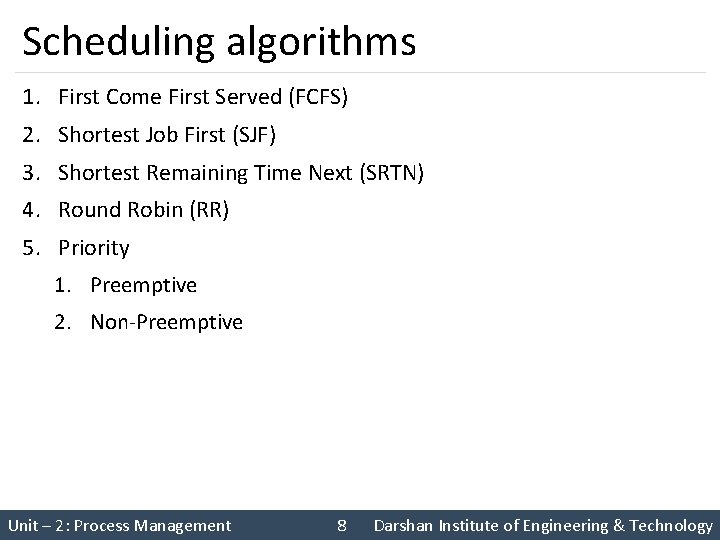
Topics to be covered § § § What is scheduling Objectives of scheduling Types of scheduler Scheduling criteria Scheduling algorithms • First Come First Served (FCFS) • Shortest Job First (SJF) • Shortest Remaining Time Next (SRTN) • Round Robin (RR) • Priority ü Preemptive Priority ü Non-Preemptive Priority Unit – 2: Process Management 2 Darshan Institute of Engineering & Technology
What is Process scheduling? § Process scheduling is the activity of the process manager that handles suspension of running process from CPU and selection of another process on the basis of a particular strategy. § The part of operating system that makes the choice is called scheduler. § The algorithm used by this scheduler is called scheduling algorithm. § Process scheduling is an essential part of a multiprogramming operating systems. Unit – 2: Process Management 3 Darshan Institute of Engineering & Technology
Objectives (goals) of scheduling § Fairness: giving each process a fair share of the CPU. § Balance: keeping all the parts of the system busy (Maximize). § Throughput: no of processes that are completed per time unit (Maximize). § Turnaround time: time to execute a process from submission to completion (Minimize). • Turnaround time = Process finish time – Process arrival time Unit – 2: Process Management 4 Darshan Institute of Engineering & Technology
Objectives (goals) of scheduling § CPU utilization: It is percent of time that the CPU is busy in executing a process. • keep CPU as busy as possible (Maximized). § Response time: time between issuing a command getting the result (Minimized). § Waiting time: amount of time a process has been waiting in the ready queue (Minimize). • Waiting time = Turnaround time – Actual execution time Unit – 2: Process Management 5 Darshan Institute of Engineering & Technology
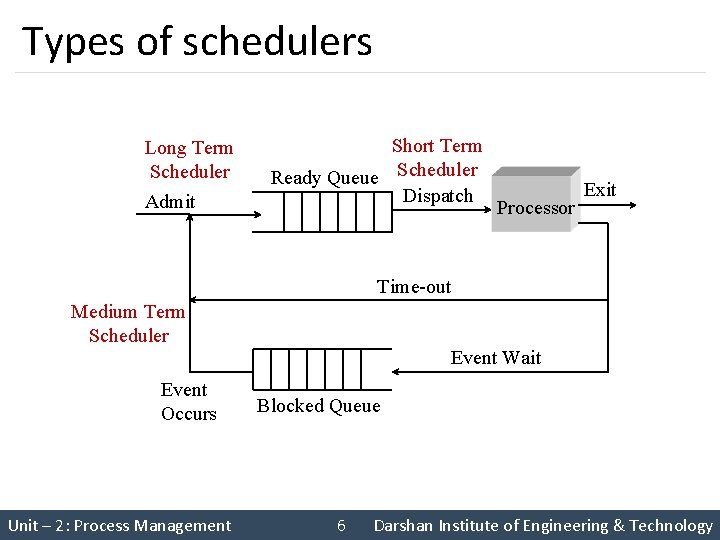
Types of schedulers Long Term Scheduler Admit Short Term Ready Queue Scheduler Dispatch Processor Exit Time-out Medium Term Scheduler Event Wait Event Occurs Unit – 2: Process Management Blocked Queue 6 Darshan Institute of Engineering & Technology
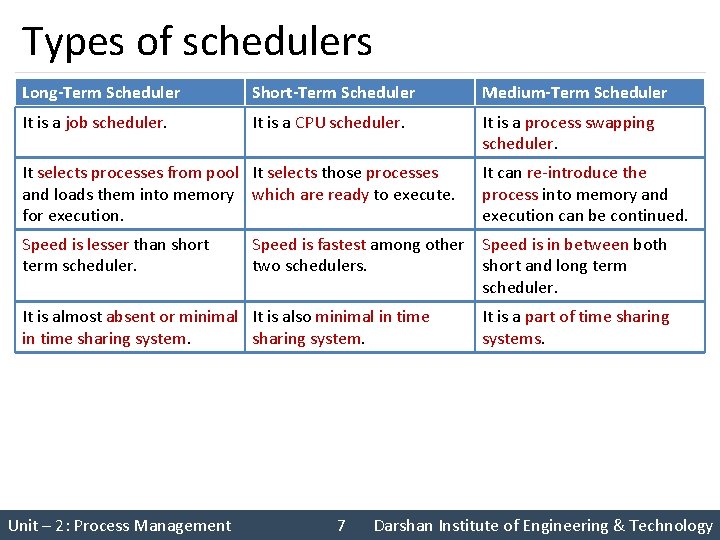
Types of schedulers Long-Term Scheduler Short-Term Scheduler Medium-Term Scheduler It is a job scheduler. It is a CPU scheduler. It is a process swapping scheduler. It selects processes from pool It selects those processes and loads them into memory which are ready to execute. for execution. Speed is lesser than short term scheduler. Speed is fastest among other Speed is in between both two schedulers. short and long term scheduler. It is almost absent or minimal It is also minimal in time sharing system. Unit – 2: Process Management It can re-introduce the process into memory and execution can be continued. 7 It is a part of time sharing systems. Darshan Institute of Engineering & Technology
Scheduling algorithms 1. First Come First Served (FCFS) 2. Shortest Job First (SJF) 3. Shortest Remaining Time Next (SRTN) 4. Round Robin (RR) 5. Priority 1. Preemptive 2. Non-Preemptive Unit – 2: Process Management 8 Darshan Institute of Engineering & Technology
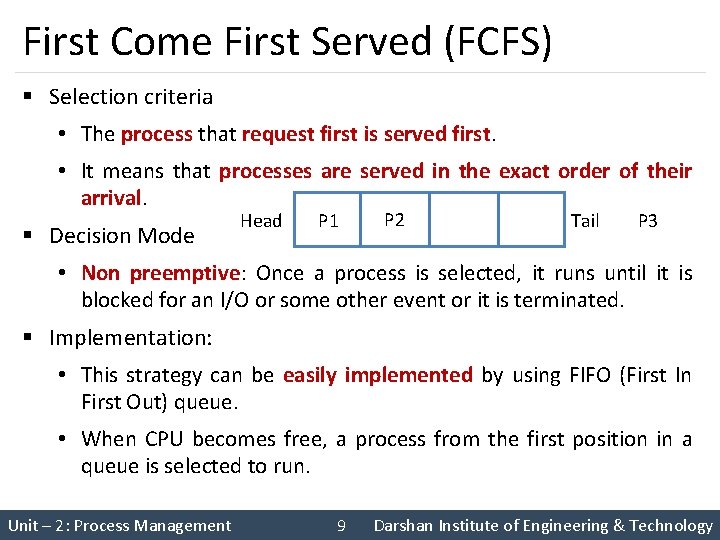
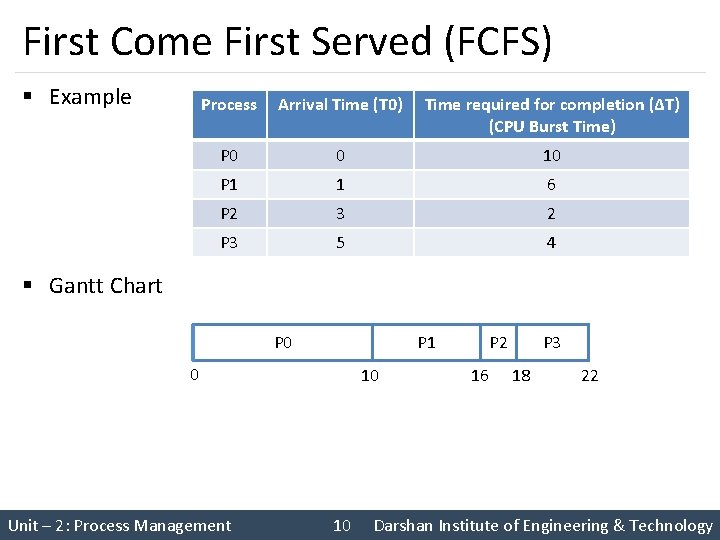
First Come First Served (FCFS) § Selection criteria • The process that request first is served first. • It means that processes are served in the exact order of their arrival. § Decision Mode Head P 1 P 2 Tail P 3 • Non preemptive: Once a process is selected, it runs until it is blocked for an I/O or some other event or it is terminated. § Implementation: • This strategy can be easily implemented by using FIFO (First In First Out) queue. • When CPU becomes free, a process from the first position in a queue is selected to run. Unit – 2: Process Management 9 Darshan Institute of Engineering & Technology
First Come First Served (FCFS) § Example Process Arrival Time (T 0) Time required for completion (∆T) (CPU Burst Time) P 0 0 10 P 1 1 6 P 2 3 2 P 3 5 4 § Gantt Chart P 0 P 1 0 Unit – 2: Process Management 10 10 P 2 16 P 3 18 22 Darshan Institute of Engineering & Technology
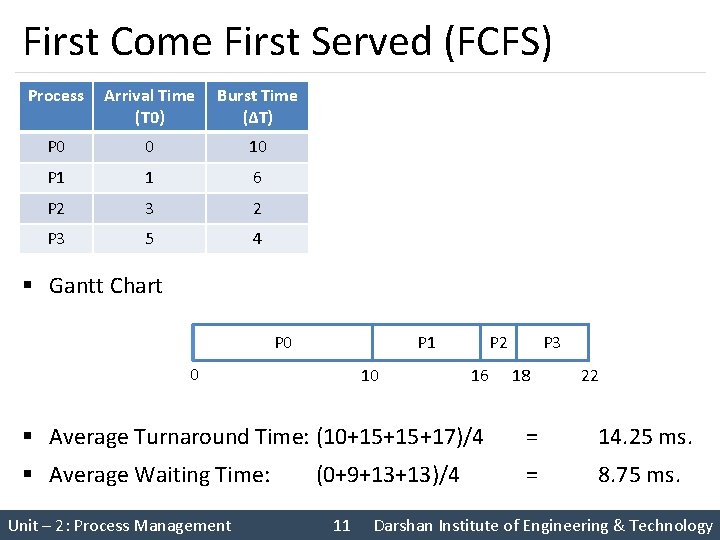
First Come First Served (FCFS) Arrival Time §Process Example (T 0) Burst Time (∆T) Finish Time (T 1) Turnaround Time (TAT = T 1 -T 0) Waiting Time (WT = TAT-∆T) P 0 0 10 10 10 0 P 1 1 6 16 15 9 P 2 3 2 18 15 13 P 3 5 4 22 17 13 § Gantt Chart P 0 P 1 0 10 P 2 16 P 3 18 22 § Average Turnaround Time: (10+15+15+17)/4 = 14. 25 ms. § Average Waiting Time: = 8. 75 ms. Unit – 2: Process Management (0+9+13+13)/4 11 Darshan Institute of Engineering & Technology
First Come First Served (FCFS) § Advantages • Simple and fair. • Easy to understand implement. • Every process will get a chance to run, so starvation doesn't occur. § Disadvantages • Not efficient because average waiting time is too high. • Convoy effect is possible. All small I/O bound processes wait for one big CPU bound process to acquire CPU. • CPU utilization may be less efficient especially when a CPU bound process is running with many I/O bound processes. Unit – 2: Process Management 12 Darshan Institute of Engineering & Technology
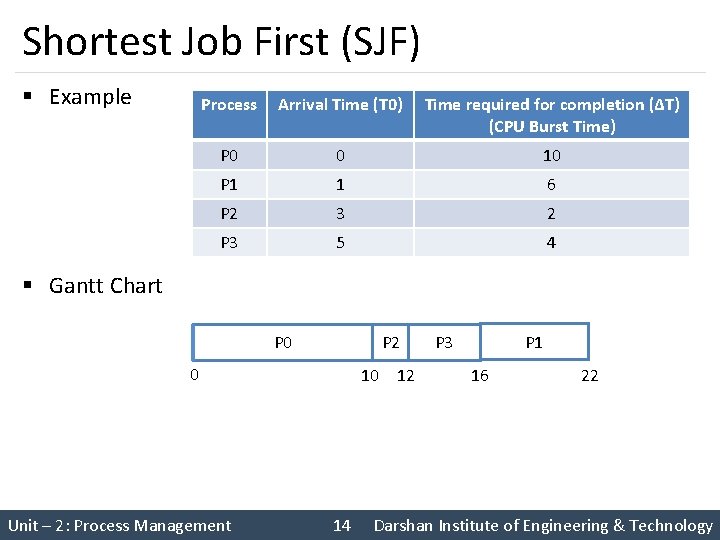
Shortest Job First (SJF) § Selection criteria • The process, that requires shortest time to complete execution, is served first. § Decision Mode • Non preemptive: Once a process is selected, it runs until either it is blocked for an I/O or some other event or it is terminated. § Implementation: • This strategy can be easily implemented by using FIFO (First In First Out) queue. • All processes in a queue are sorted in ascending order based on their required CPU bursts. • When CPU becomes free, a process from the first position in a queue is selected to run. Unit – 2: Process Management 13 Darshan Institute of Engineering & Technology
Shortest Job First (SJF) § Example Process Arrival Time (T 0) Time required for completion (∆T) (CPU Burst Time) P 0 0 10 P 1 1 6 P 2 3 2 P 3 5 4 § Gantt Chart P 0 P 2 0 Unit – 2: Process Management 10 12 14 P 1 P 3 16 22 Darshan Institute of Engineering & Technology
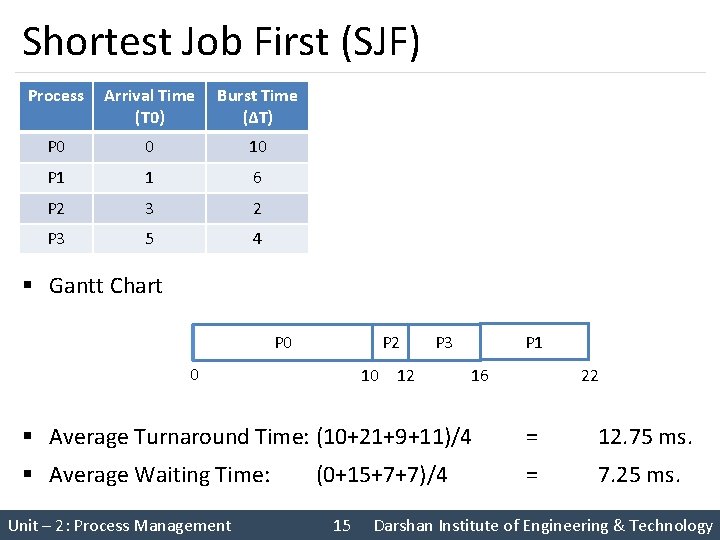
Shortest Job First (SJF) Process Arrival Time (T 0) Burst Time (∆T) Finish Time (T 1) Turnaround Time (TAT = T 1 -T 0) Waiting Time (WT = TAT-∆T) P 0 0 10 10 10 0 P 1 1 6 22 21 15 P 2 3 2 12 9 7 P 3 5 4 16 11 7 § Gantt Chart P 0 P 2 0 P 1 P 3 10 12 22 16 § Average Turnaround Time: (10+21+9+11)/4 = 12. 75 ms. § Average Waiting Time: = 7. 25 ms. Unit – 2: Process Management (0+15+7+7)/4 15 Darshan Institute of Engineering & Technology
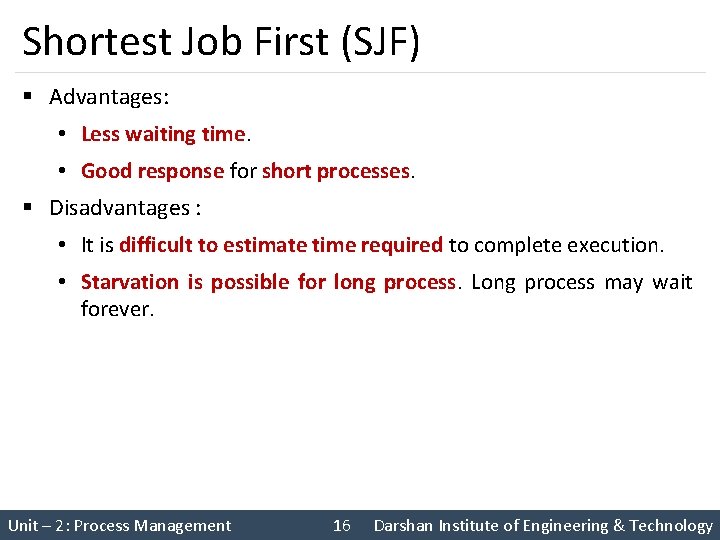
Shortest Job First (SJF) § Advantages: • Less waiting time. • Good response for short processes. § Disadvantages : • It is difficult to estimate time required to complete execution. • Starvation is possible for long process. Long process may wait forever. Unit – 2: Process Management 16 Darshan Institute of Engineering & Technology
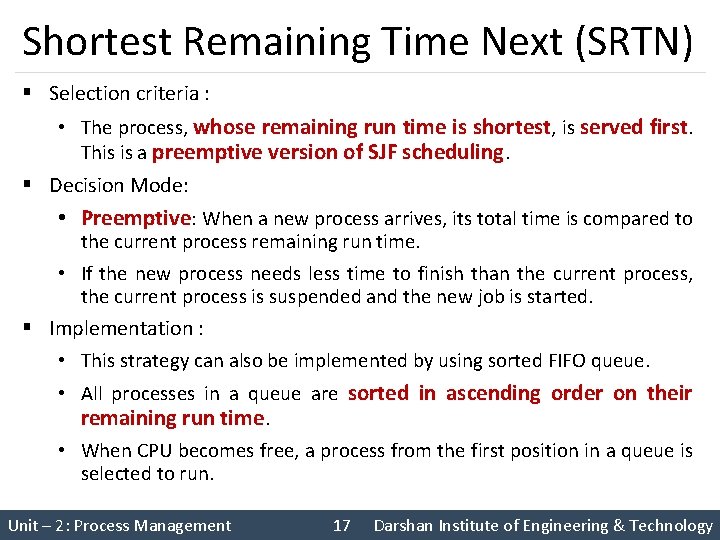
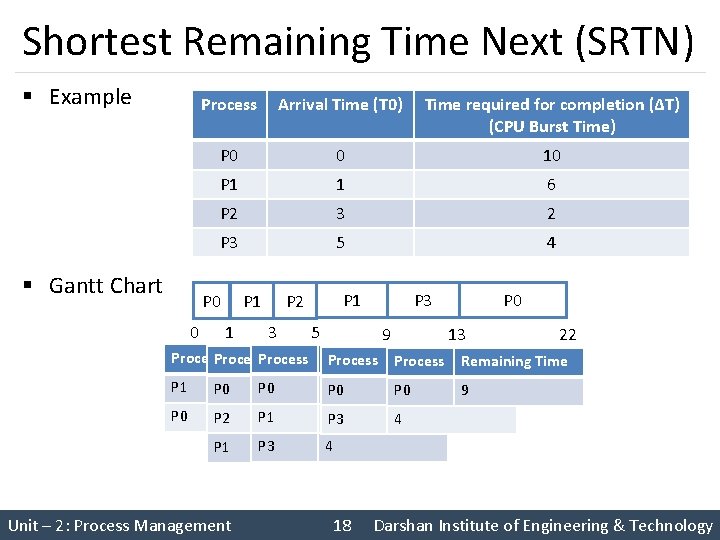
Shortest Remaining Time Next (SRTN) § Selection criteria : • The process, whose remaining run time is shortest, is served first. This is a preemptive version of SJF scheduling. § Decision Mode: • Preemptive: When a new process arrives, its total time is compared to the current process remaining run time. • If the new process needs less time to finish than the current process, the current process is suspended and the new job is started. § Implementation : • This strategy can also be implemented by using sorted FIFO queue. • All processes in a queue are sorted in ascending order on their remaining run time. • When CPU becomes free, a process from the first position in a queue is selected to run. Unit – 2: Process Management 17 Darshan Institute of Engineering & Technology
Shortest Remaining Time Next (SRTN) § Example § Gantt Chart Process Arrival Time (T 0) Time required for completion (∆T) (CPU Burst Time) P 0 0 10 P 1 1 6 P 2 3 2 P 3 5 4 P 0 0 P 1 1 P 2 3 5 P 0 P 3 9 13 22 Process Remaining Time Remaining Process Time Process Remaining Time P 1 P 0 6 P 0 9 9 P 0 9 P 0 P 2 9 P 1 2 4 P 3 4 P 1 Unit – 2: Process Management P 3 4 9 4 18 Darshan Institute of Engineering & Technology
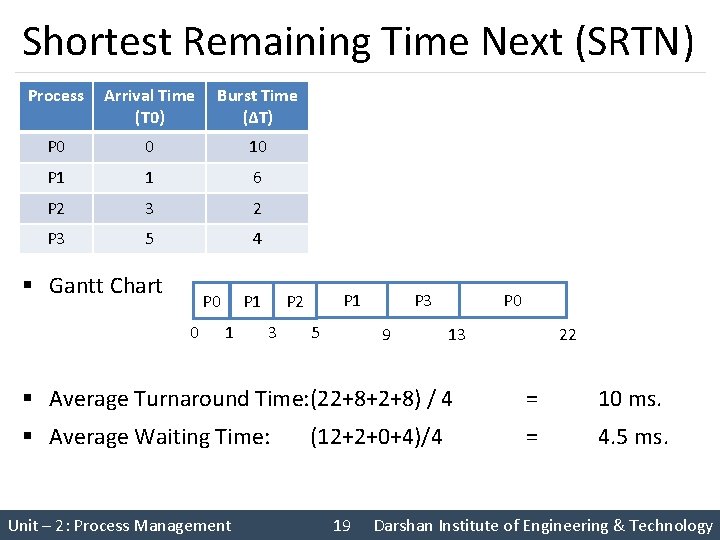
Shortest Remaining Time Next (SRTN) Process Arrival Time (T 0) Burst Time (∆T) Finish Time (T 1) Turnaround Time (TAT = T 1 -T 0) Waiting Time (WT = TAT-∆T) P 0 0 10 22 22 12 P 1 1 6 9 8 2 P 2 3 2 5 2 0 P 3 5 4 13 8 4 § Gantt Chart P 0 0 P 1 1 P 2 3 5 P 0 P 3 9 22 13 § Average Turnaround Time: (22+8+2+8) / 4 = 10 ms. § Average Waiting Time: = 4. 5 ms. Unit – 2: Process Management (12+2+0+4)/4 19 Darshan Institute of Engineering & Technology
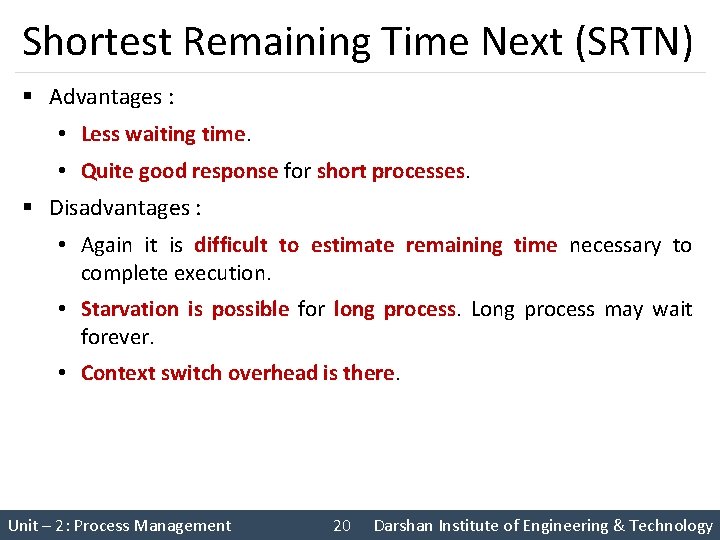
Shortest Remaining Time Next (SRTN) § Advantages : • Less waiting time. • Quite good response for short processes. § Disadvantages : • Again it is difficult to estimate remaining time necessary to complete execution. • Starvation is possible for long process. Long process may wait forever. • Context switch overhead is there. Unit – 2: Process Management 20 Darshan Institute of Engineering & Technology
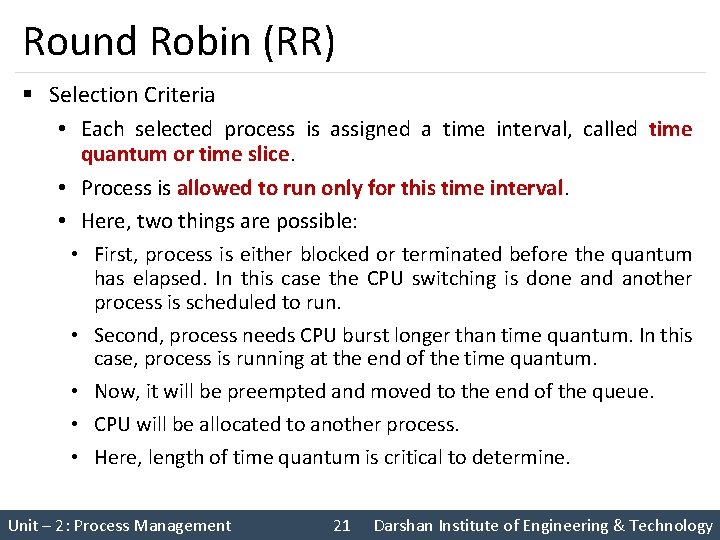
Round Robin (RR) § Selection Criteria • Each selected process is assigned a time interval, called time quantum or time slice. • Process is allowed to run only for this time interval. • Here, two things are possible: • First, process is either blocked or terminated before the quantum has elapsed. In this case the CPU switching is done and another process is scheduled to run. • Second, process needs CPU burst longer than time quantum. In this case, process is running at the end of the time quantum. • Now, it will be preempted and moved to the end of the queue. • CPU will be allocated to another process. • Here, length of time quantum is critical to determine. Unit – 2: Process Management 21 Darshan Institute of Engineering & Technology
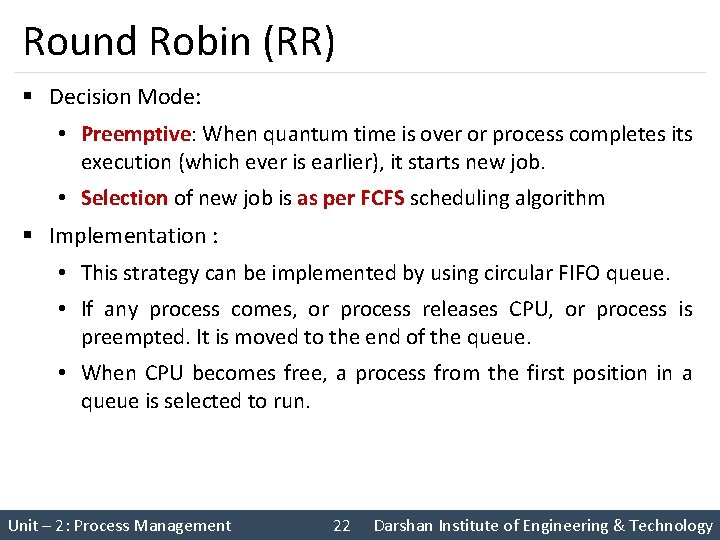
Round Robin (RR) § Decision Mode: • Preemptive: When quantum time is over or process completes its execution (which ever is earlier), it starts new job. • Selection of new job is as per FCFS scheduling algorithm § Implementation : • This strategy can be implemented by using circular FIFO queue. • If any process comes, or process releases CPU, or process is preempted. It is moved to the end of the queue. • When CPU becomes free, a process from the first position in a queue is selected to run. Unit – 2: Process Management 22 Darshan Institute of Engineering & Technology
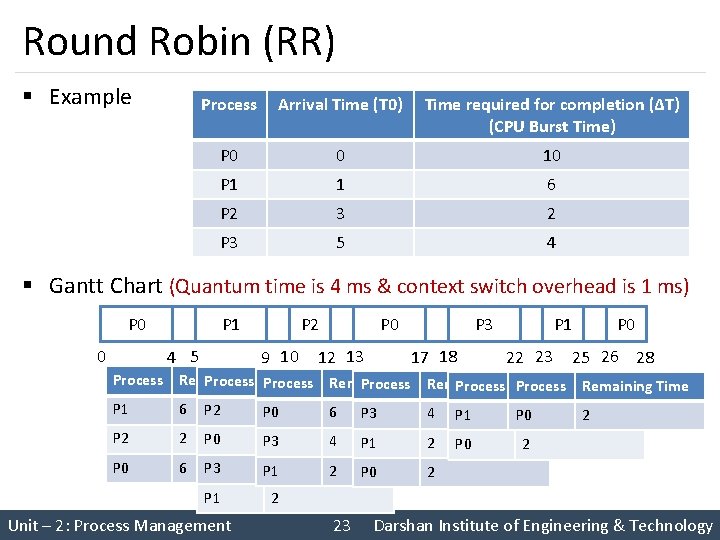
Round Robin (RR) § Example Process Arrival Time (T 0) Time required for completion (∆T) (CPU Burst Time) P 0 0 10 P 1 1 6 P 2 3 2 P 3 5 4 § Gantt Chart (Quantum time is 4 ms & context switch overhead is 1 ms) P 1 P 0 9 10 4 5 0 P 2 P 0 12 13 P 3 17 18 P 1 22 23 P 0 25 26 28 Process Remaining Process. Time Remaining Time Process Remaining Time P 1 6 P 2 2 P 0 6 P 3 4 P 1 2 P 0 2 P 1 2 Unit – 2: Process Management 23 2 Darshan Institute of Engineering & Technology
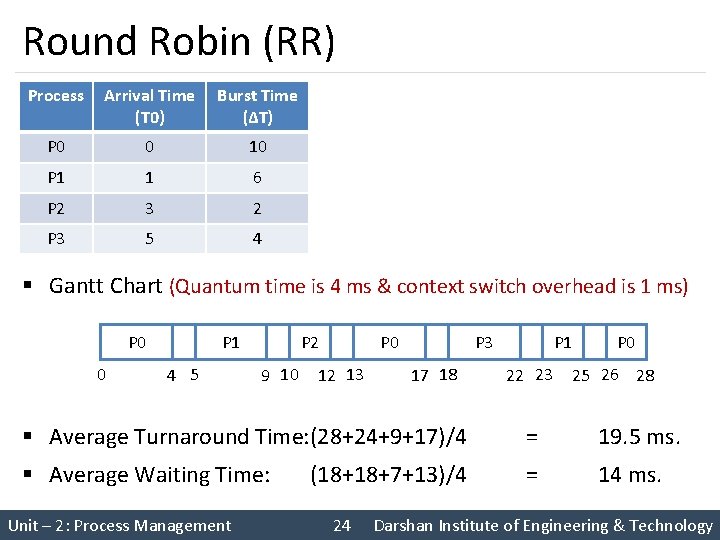
Round Robin (RR) Process Arrival Time (T 0) Burst Time (∆T) Finish Time (T 1) Turnaround Time (TAT = T 1 -T 0) Waiting Time (WT = TAT-∆T) P 0 0 10 28 28 18 P 1 1 6 25 24 18 P 2 3 2 12 9 7 P 3 5 4 22 17 13 § Gantt Chart (Quantum time is 4 ms & context switch overhead is 1 ms) P 1 P 0 0 4 5 P 2 9 10 P 0 12 13 P 3 17 18 P 1 22 23 P 0 25 26 28 § Average Turnaround Time: (28+24+9+17)/4 = 19. 5 ms. § Average Waiting Time: = 14 ms. Unit – 2: Process Management (18+18+7+13)/4 24 Darshan Institute of Engineering & Technology
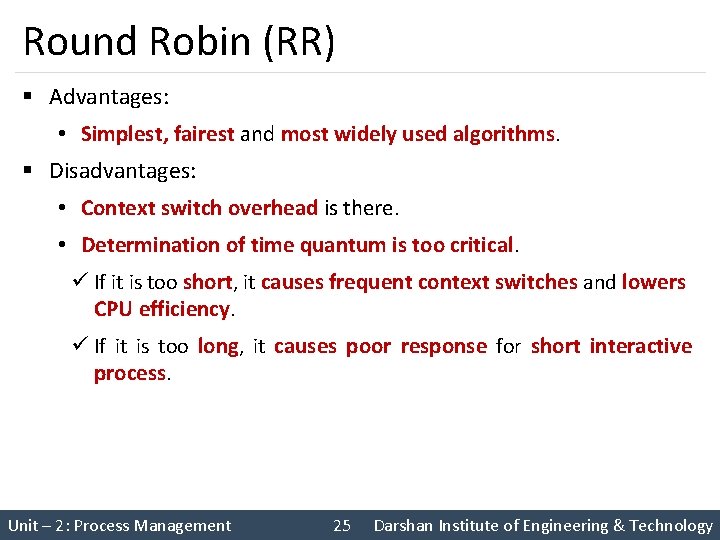
Round Robin (RR) § Advantages: • Simplest, fairest and most widely used algorithms. § Disadvantages: • Context switch overhead is there. • Determination of time quantum is too critical. ü If it is too short, it causes frequent context switches and lowers CPU efficiency. ü If it is too long, it causes poor response for short interactive process. Unit – 2: Process Management 25 Darshan Institute of Engineering & Technology
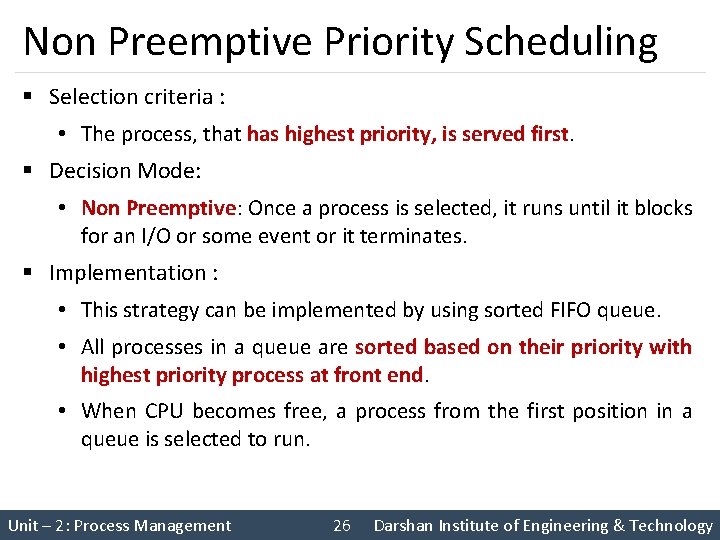
Non Preemptive Priority Scheduling § Selection criteria : • The process, that has highest priority, is served first. § Decision Mode: • Non Preemptive: Once a process is selected, it runs until it blocks for an I/O or some event or it terminates. § Implementation : • This strategy can be implemented by using sorted FIFO queue. • All processes in a queue are sorted based on their priority with highest priority process at front end. • When CPU becomes free, a process from the first position in a queue is selected to run. Unit – 2: Process Management 26 Darshan Institute of Engineering & Technology
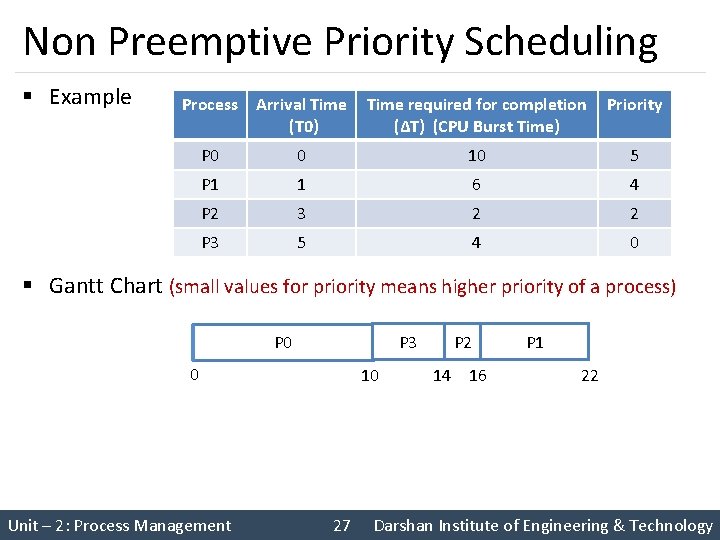
Non Preemptive Priority Scheduling § Example Process Arrival Time (T 0) Time required for completion (∆T) (CPU Burst Time) Priority P 0 0 10 5 P 1 1 6 4 P 2 3 2 2 P 3 5 4 0 § Gantt Chart (small values for priority means higher priority of a process) P 3 P 0 0 Unit – 2: Process Management 10 27 P 2 14 16 P 1 22 Darshan Institute of Engineering & Technology
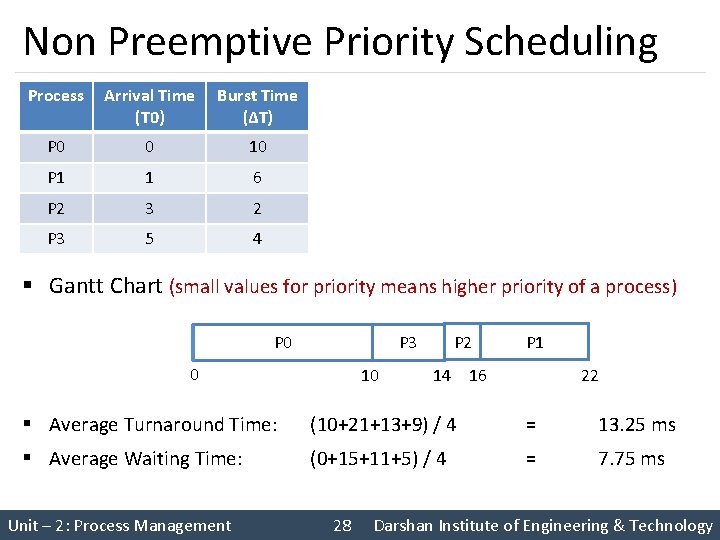
Non Preemptive Priority Scheduling Process Arrival Time (T 0) Burst Time (∆T) Finish Time (T 1) Turnaround Time (TAT = T 1 -T 0) Waiting Time (WT = TAT-∆T) P 0 0 10 10 10 0 P 1 1 6 22 21 15 P 2 3 2 16 13 11 P 3 5 4 14 9 5 § Gantt Chart (small values for priority means higher priority of a process) P 0 P 2 P 3 0 10 P 1 22 14 16 § Average Turnaround Time: (10+21+13+9) / 4 = 13. 25 ms § Average Waiting Time: (0+15+11+5) / 4 = 7. 75 ms Unit – 2: Process Management 28 Darshan Institute of Engineering & Technology
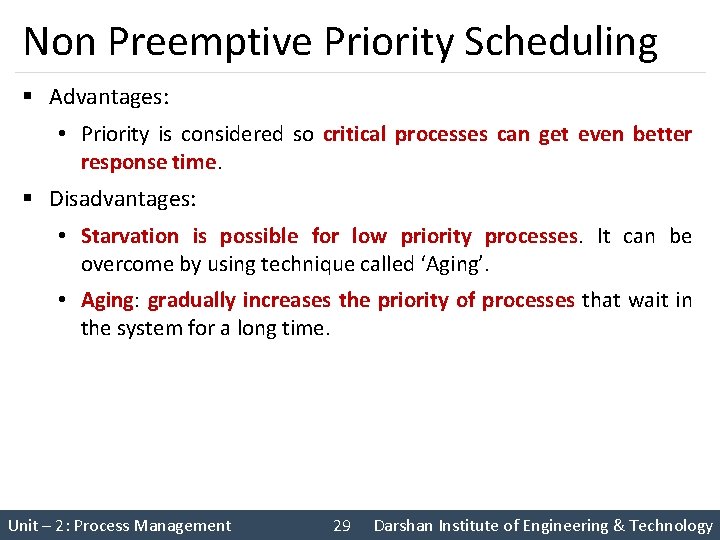
Non Preemptive Priority Scheduling § Advantages: • Priority is considered so critical processes can get even better response time. § Disadvantages: • Starvation is possible for low priority processes. It can be overcome by using technique called ‘Aging’. • Aging: gradually increases the priority of processes that wait in the system for a long time. Unit – 2: Process Management 29 Darshan Institute of Engineering & Technology
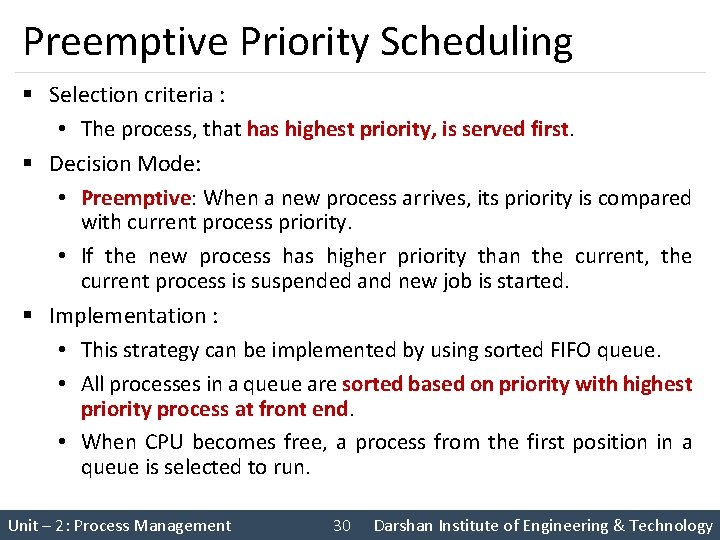
Preemptive Priority Scheduling § Selection criteria : • The process, that has highest priority, is served first. § Decision Mode: • Preemptive: When a new process arrives, its priority is compared with current process priority. • If the new process has higher priority than the current, the current process is suspended and new job is started. § Implementation : • This strategy can be implemented by using sorted FIFO queue. • All processes in a queue are sorted based on priority with highest priority process at front end. • When CPU becomes free, a process from the first position in a queue is selected to run. Unit – 2: Process Management 30 Darshan Institute of Engineering & Technology
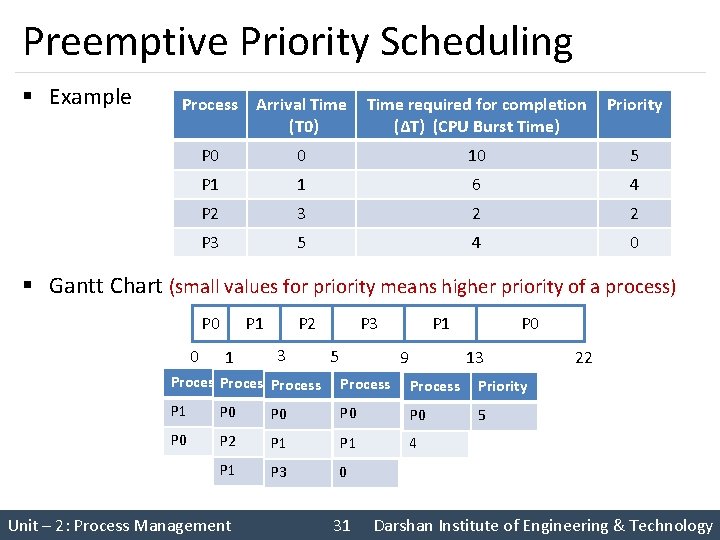
Preemptive Priority Scheduling § Example Process Arrival Time (T 0) Time required for completion (∆T) (CPU Burst Time) Priority P 0 0 10 5 P 1 1 6 4 P 2 3 2 2 P 3 5 4 0 § Gantt Chart (small values for priority means higher priority of a process) P 0 0 P 1 1 P 2 3 5 P 0 P 1 P 3 9 13 Process Priority Process Priority P 1 P 0 4 P 0 5 5 P 0 5 P 0 P 2 5 P 1 2 4 P 1 4 P 1 P 3 4 0 Unit – 2: Process Management 31 22 Darshan Institute of Engineering & Technology
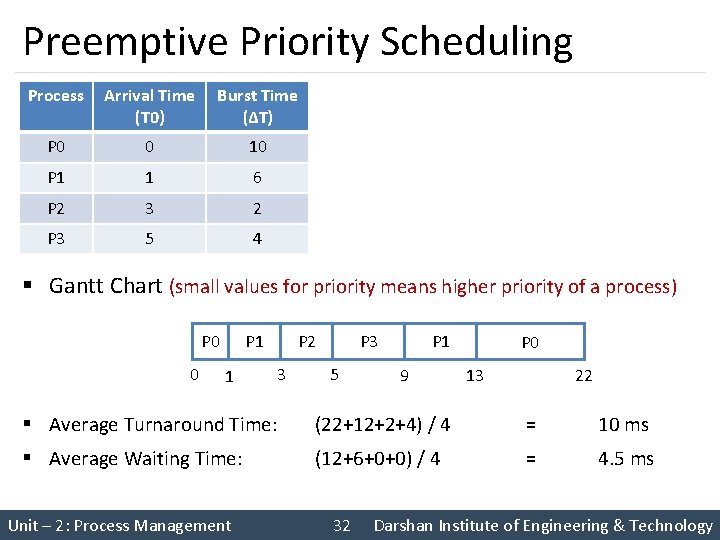
Preemptive Priority Scheduling Process Arrival Time (T 0) Burst Time (∆T) Finish Time (T 1) Turnaround Time (TAT = T 1 -T 0) Waiting Time (WT = TAT-∆T) P 0 0 10 22 22 12 P 1 1 6 13 12 6 P 2 3 2 5 2 0 P 3 5 4 9 4 0 § Gantt Chart (small values for priority means higher priority of a process) P 0 0 P 1 1 P 2 3 P 1 P 3 5 9 P 0 22 13 § Average Turnaround Time: (22+12+2+4) / 4 = 10 ms § Average Waiting Time: (12+6+0+0) / 4 = 4. 5 ms Unit – 2: Process Management 32 Darshan Institute of Engineering & Technology
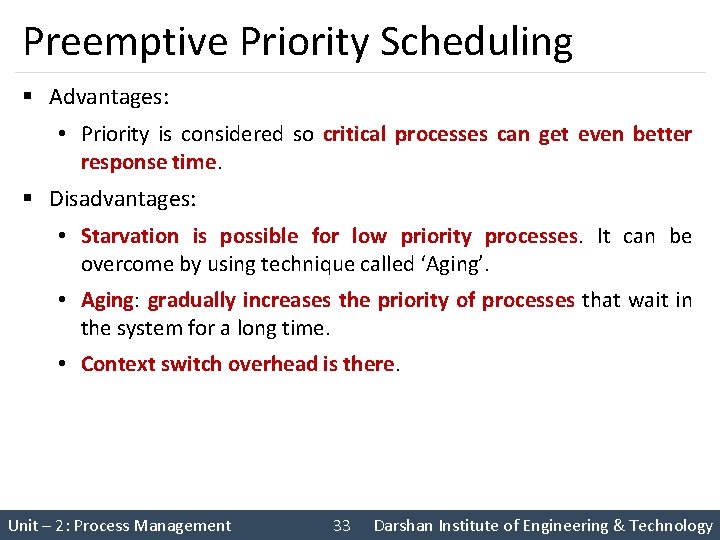
Preemptive Priority Scheduling § Advantages: • Priority is considered so critical processes can get even better response time. § Disadvantages: • Starvation is possible for low priority processes. It can be overcome by using technique called ‘Aging’. • Aging: gradually increases the priority of processes that wait in the system for a long time. • Context switch overhead is there. Unit – 2: Process Management 33 Darshan Institute of Engineering & Technology
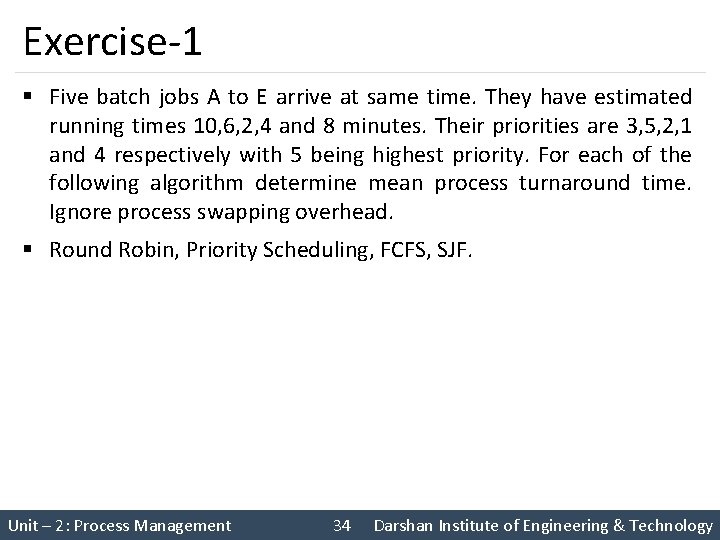
Exercise-1 § Five batch jobs A to E arrive at same time. They have estimated running times 10, 6, 2, 4 and 8 minutes. Their priorities are 3, 5, 2, 1 and 4 respectively with 5 being highest priority. For each of the following algorithm determine mean process turnaround time. Ignore process swapping overhead. § Round Robin, Priority Scheduling, FCFS, SJF. Unit – 2: Process Management 34 Darshan Institute of Engineering & Technology
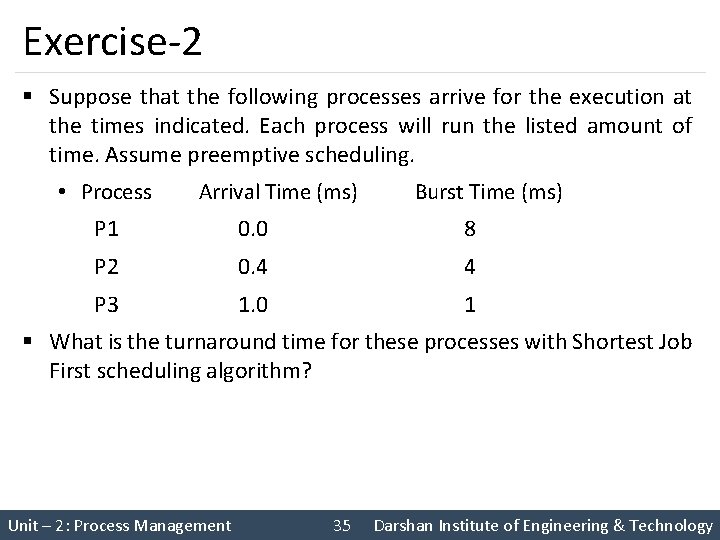
Exercise-2 § Suppose that the following processes arrive for the execution at the times indicated. Each process will run the listed amount of time. Assume preemptive scheduling. • Process Arrival Time (ms) Burst Time (ms) P 1 0. 0 8 P 2 0. 4 4 P 3 1. 0 1 § What is the turnaround time for these processes with Shortest Job First scheduling algorithm? Unit – 2: Process Management 35 Darshan Institute of Engineering & Technology
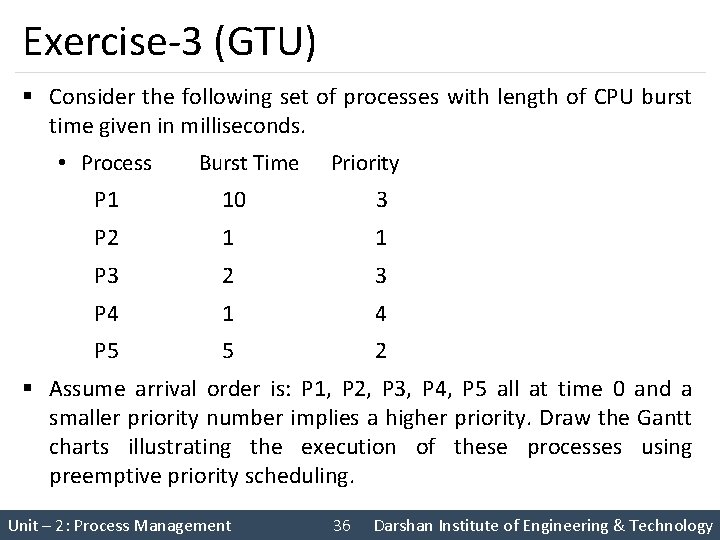
Exercise-3 (GTU) § Consider the following set of processes with length of CPU burst time given in milliseconds. • Process Burst Time Priority P 1 10 3 P 2 1 1 P 3 2 3 P 4 1 4 P 5 5 2 § Assume arrival order is: P 1, P 2, P 3, P 4, P 5 all at time 0 and a smaller priority number implies a higher priority. Draw the Gantt charts illustrating the execution of these processes using preemptive priority scheduling. Unit – 2: Process Management 36 Darshan Institute of Engineering & Technology
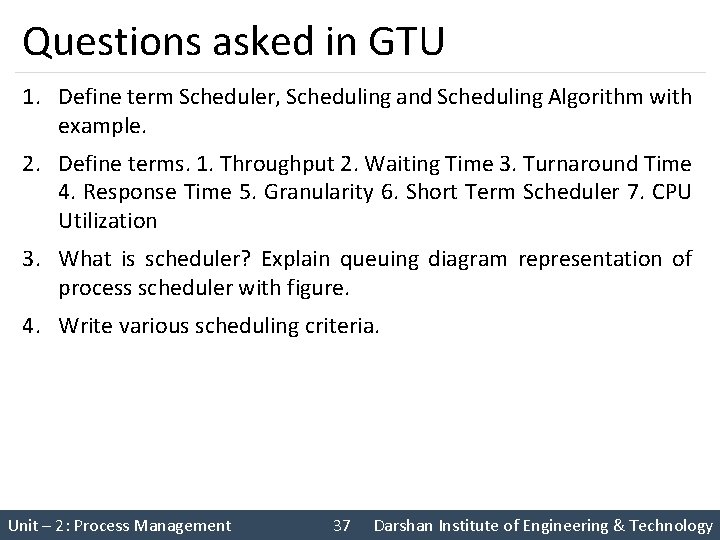
Questions asked in GTU 1. Define term Scheduler, Scheduling and Scheduling Algorithm with example. 2. Define terms. 1. Throughput 2. Waiting Time 3. Turnaround Time 4. Response Time 5. Granularity 6. Short Term Scheduler 7. CPU Utilization 3. What is scheduler? Explain queuing diagram representation of process scheduler with figure. 4. Write various scheduling criteria. Unit – 2: Process Management 37 Darshan Institute of Engineering & Technology
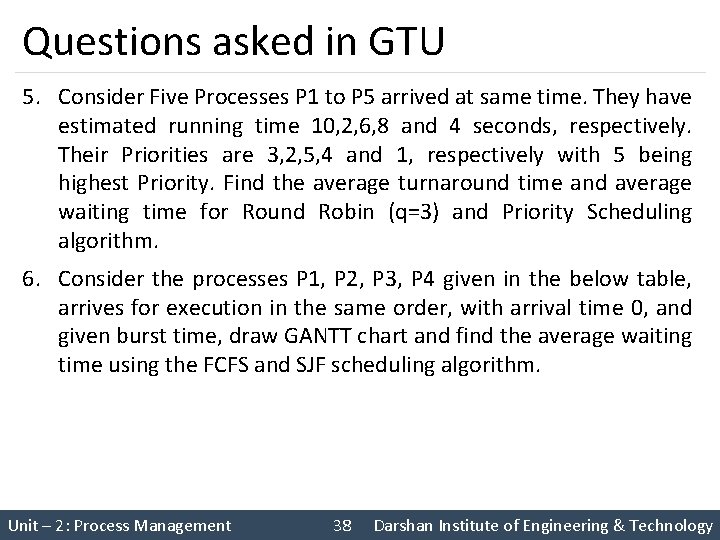
Questions asked in GTU 5. Consider Five Processes P 1 to P 5 arrived at same time. They have estimated running time 10, 2, 6, 8 and 4 seconds, respectively. Their Priorities are 3, 2, 5, 4 and 1, respectively with 5 being highest Priority. Find the average turnaround time and average waiting time for Round Robin (q=3) and Priority Scheduling algorithm. 6. Consider the processes P 1, P 2, P 3, P 4 given in the below table, arrives for execution in the same order, with arrival time 0, and given burst time, draw GANTT chart and find the average waiting time using the FCFS and SJF scheduling algorithm. Unit – 2: Process Management 38 Darshan Institute of Engineering & Technology