
MEDICAL EQUIPMENT MANAGEMENT AMEK DINNER TALK 680 HOTEL
- Slides: 34
MEDICAL EQUIPMENT MANAGEMENT AMEK DINNER TALK, 680 HOTEL, 24 th November 2009 Eng. Martin Owino Head Biomedical Engineering Division- MOMS/AMEK 1 12/6/2020
Outline of the Presentation Introduction and definition of terms l Examples of health technology l Target of Health Technology l Challenges of HT l Role of Biomedical Engineering l HT planning and programmes l Biomedical Engineering challenges in Kenya l Way forward l Conclusion l MOMS/AMEK 2 12/6/2020
Introduction and definition of terms Medical equipment/Devices are devices developed to solve a health problem and improve quality of life. l Health care providers require Medical Devices for effective and efficient preventive, diagnosis, treatment and rehabilitation services. l Therefore Medical Devices are indispensible for attainment of health related goals including MDG’s l MOMS/AMEK 3 12/6/2020
Introduction Cont. l Due to the importance of Medical Devices the WHO expanded its scope and replaced the term with Health technologies. l According to WHA 60. 29 Health technologies refers to “application of organized knowledge and skills in the form of devices, medicines, vaccines, procedures and systems developed to solve a health problem and improve quality of lives” l Health technology is widely used in modern health care. MOMS/AMEK 4 12/6/2020
Examples of health technologies Electrosurgical machines with argon gasreduction of length of stay in hospitals l Autoclaves- infection prevention (Fluid and thermo technology) l Patient monitors ECG, Temp, Pulse Oximetry- fibre optic technology and Bio electric sensor technology) l Defibrillators l – External - (AED) – implantable (ICD) MOMS/AMEK 5 12/6/2020
CT technology Ultrasound- Doppler (piezo electric technology) l MRI technology l Laser technology- non invasive surgery l E- health ( telemedicine)- Digital images can be transmitted on line – via internet etc l Digital X Ray Image printing- Now replacing the conventional type and is environmental friendly l Use of computer software in HT management e. g (IHTP) l l MOMS/AMEK 6 12/6/2020
Target of Health Technology Improve quality of Health delivery service l Improve efficiency l Improve effectiveness l Reduce costs l Improve accessibly of health services l What are the objectives of your health services providers? l MOMS/AMEK 7 12/6/2020
Challenges of Health technology l l Any good thing must have a bad side HT has a life cycle and therefore a life span – Invention (conception) – Production – Installation, commissioning and training – Operation/ maintenance and repair – Decommissioning – Disposal – Replacement or new technology MOMS/AMEK 8 12/6/2020
l Each stage must be managed properly to ensure quality of performance, safety of both patients and users and prolong the life span and therefore ensuring value for money l HT are very expensive and if not properly managed results to – wastage, no impact on burden of diseases, cannot function properly l How is HT life cycle managed? l Big headaches for biomeds MOMS/AMEK 9 12/6/2020
Role of Biomedical Engineering l l There is a difference between Biomedical Engineering and Clinical Engineering Maintenance management of clinical equipment only. Equipment used directly on patients e. g anaesthetic machines, Defibrillators etc MOMS/AMEK 10 12/6/2020
l Biomedical engineering refers to maintenance management of clinical equipment and other equipment not directly used on patients such as – Hospital trolleys, – Bedside lockers, – Electrical plants/works, – Civil works/systems, mechanical plants/ works etc. – Therefore clinical engineering is a subset of Biomedical Engineering. MOMS/AMEK 11 12/6/2020
l Clinical Engineering is practiced in developed countries with enough resources and employ clinical engineers, biomedical engineers and facility maintenance engineers within their health system. l Most of the developing countries can only afford Biomedical engineering staff whom they assigned all these duties. MOMS/AMEK 12 12/6/2020
l Biomedical engineering is a multidisciplinary field – Electrical Engineering – Mechanical Engineering – Computer Engineering – Information technology – Industrial Engineering – Civil Engineering – Architects – And Others, so long as the knowledge is applied to solve a health problem – i. e Health Technology. – The proposed scheme of service reflects this multidisciplinary approach. MOMS/AMEK 13 12/6/2020
Role of Biomedical Engineering l Manage all health technologies in the hospital and particularly medical equipment as pertains to assessment, acquisition, installation, operation and maintenance, and disposal with the objective of solving health problems and improving quality of lives MOMS/AMEK 14 12/6/2020
The Division of Biomedical Engineering and Maintenance Services in the Ministry of Medical Services is responsible for health technology management. l It consists of a tree tier system – Central level – Provincial Level – Health facility level (Provincial and District hospitals) l MOMS/AMEK 15 12/6/2020
Function of Levels l Central Level – Policy and guidelines – HR Development and other HR issues – Strategic Planning – Supervision , monitoring and Evaluation. l Provincial Level – Operationalization of policy and guidelines – Planning, Supervision, monitoring and evaluation – Approval of work plans l Hospital Level – Implementation of planned activities (Actual work) MOMS/AMEK 16 12/6/2020
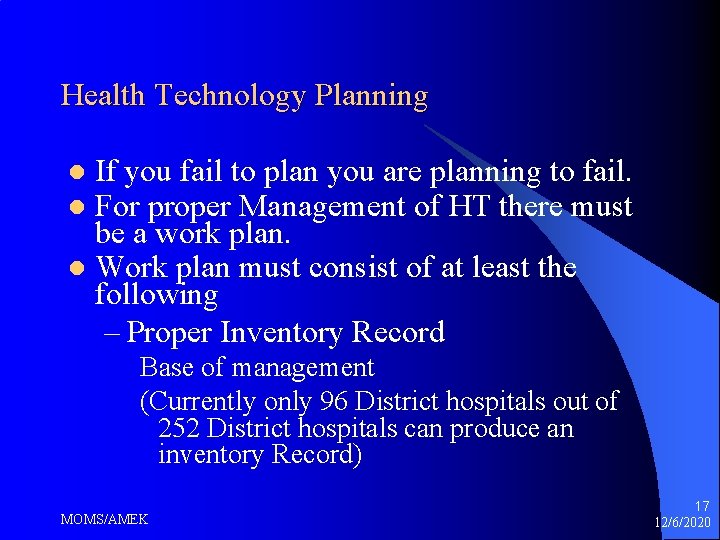
Health Technology Planning If you fail to plan you are planning to fail. For proper Management of HT there must be a work plan. l Work plan must consist of at least the following – Proper Inventory Record l l Base of management (Currently only 96 District hospitals out of 252 District hospitals can produce an inventory Record) MOMS/AMEK 17 12/6/2020
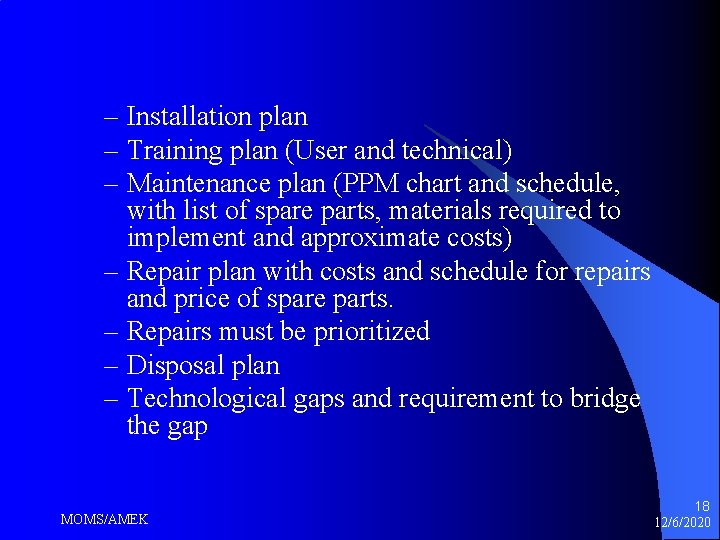
– Installation plan – Training plan (User and technical) – Maintenance plan (PPM chart and schedule, with list of spare parts, materials required to implement and approximate costs) – Repair plan with costs and schedule for repairs and price of spare parts. – Repairs must be prioritized – Disposal plan – Technological gaps and requirement to bridge the gap MOMS/AMEK 18 12/6/2020
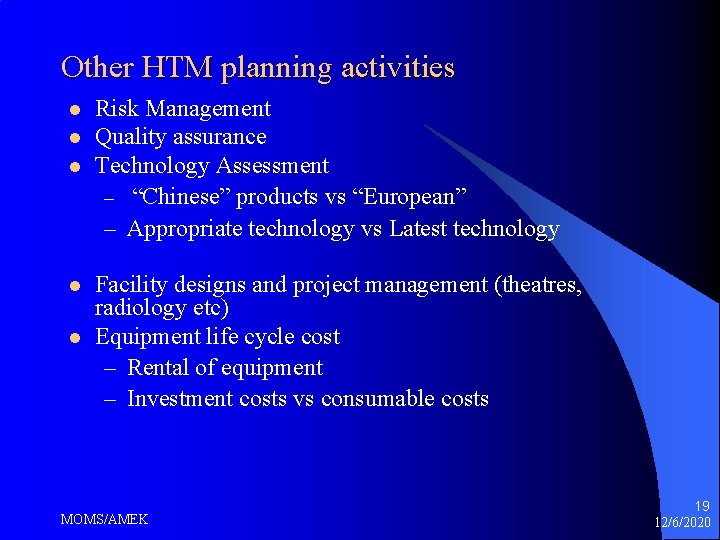
Other HTM planning activities l l l Risk Management Quality assurance Technology Assessment – “Chinese” products vs “European” – Appropriate technology vs Latest technology Facility designs and project management (theatres, radiology etc) Equipment life cycle cost – Rental of equipment – Investment costs vs consumable costs MOMS/AMEK 19 12/6/2020
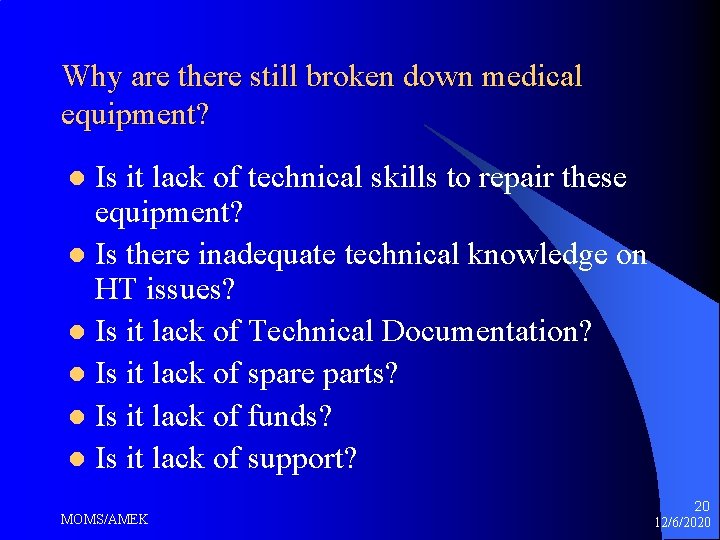
Why are there still broken down medical equipment? Is it lack of technical skills to repair these equipment? l Is there inadequate technical knowledge on HT issues? l Is it lack of Technical Documentation? l Is it lack of spare parts? l Is it lack of funds? l Is it lack of support? l MOMS/AMEK 20 12/6/2020
Challenges Biomedical Engineering / HTM practice in Kenya Random sampling of few public hospitals raised the following issues of concern; l Biomeds are still not fully integrated into our health systems l Budgetary allocation for maintenance and investment in medical equipment/health technology is very low and not based on any data (irrational) l Technical competence of Biomeds to repair/ provide maintenance service is questionable (level of training) MOMS/AMEK 21 12/6/2020
Most Health facilities are managed poorly l Some health workers are not willing to adapted new technology- continue to use old obsolete procedures and technology. l Most Health facility managers do not understand HT issues. l Lack of technical documentations l Inadequate testing and measuring equipment and knowledge on use of these equipment l MOMS/AMEK 22 12/6/2020
l l Vendors/ dealers are unwilling to sale spare parts to hospitals or selling at exorbitant prices in an attempt to push for maintenance contracts Sabotage – Users grounding equipment in order to refer patients to their clinics – Biomeds grounding equipment for selfish gains – Vendors grounding other vendors equipment in order to discrete their competitors MOMS/AMEK 23 12/6/2020
l Donated used equipment – These are not controlled resulting to inappropriate equipment, cannot be installed or used – Remaining life span unknown – dumping – Not cost effective – Safety and performance unknown – Is it worth? MOMS/AMEK 24 12/6/2020
Summary of issues Lack of regulations and standards l Lack of professional ethics and code of regulation l Lack of Health policy and guidelines l Inadequate technical training l Hospital Management issue l MOMS/AMEK 25 12/6/2020
Way forward Policy and guideline - Drafting to commence next month with support from WHO and other Development partners. E-mail your ideas to medeng@health. go. ke – Draft to be ready by March 2009 for discussion MOMS/AMEK 26 12/6/2020
Guidelines l Operational guidelines have been completed – Available from our officers l Management guidelines have been drafted – consultations are going on l Donation of used medical equipment guidelines, completed. MOMS/AMEK 27 12/6/2020
Professional ethics and standards – AMEK to deal with this for now – Continuous professional Development (CPD) – Dressing code – Behaviour at workplace – How many members of AMEK? Is there growth? Are members satisfied? MOMS/AMEK 28 12/6/2020
Training institution l l l Improve on curriculum development Train on how to think rather than how to pass exams Improve capacity of your trainers- bring in other professional on board l KMTC – make use of Fonty’s University l Mombasa Polytechnic –WHO collaborating centre what happened Egerton university – Is HTM part of your curriculum Audit of performance of your trainees l l MOMS/AMEK 29 12/6/2020
Innovation in health Technology l Biomeds needs to be innovative – Why same problems each year – Come up with innovative solutions and you will be supported – Keep up with technology and make proper technology decision – New innovative health technology continue to be available for solving health problems – Select what is “Appropriate” and not always the latest technology – Embrace self study MOMS/AMEK 30 12/6/2020
l You are in business – your business is to provide technological solutions to health problems and to continually improve on these solutions l You must understand the problems and requirements of your clients/customers (equipment users, patients and community) and embrace the culture of satisfying their needs/expectations l Team work is necessary and to share ideas with each other MOMS/AMEK 31 12/6/2020
Conclusion l Health technology will bring a revolutionary change in the health sector. Health workers need to start embracing technology as quick as possible. l Patients are also increasingly becoming aware of their health rights and this is a threat to doctors. (Information available in the internet, information centers, etc) l Microchips have been developed which can store very large data including patient records MOMS/AMEK 32 12/6/2020
l l l l Microchips are available in the range of; – Terabytes ( 1000 GB) – Exabytes (EB), (1000 TB) – Zettabytes (ZB), (1000 EB) – Yottabytes (YB), (1000 ZB) Computer, telephony and radio technology are the most expanding field. Diseases can by diagnosis without human contacts( e. g use of mobile telephone to transmit B/S lab requests. Parents Don’t like videogames since their kids are more experts. Most IT lecturer’s have to update properly before teaching. Remember the world is becoming a global village. Globalization What happened to BML? (Olivetti type writers) MOMS/AMEK 33 12/6/2020
Bon Apetite THANK YOU MOMS/AMEK 34 12/6/2020