
BME 680 Temperature Sensor By Cecilia Joseph Shoham
BME 680 Temperature Sensor By: Cecilia, Joseph, Shoham, Tirth
BME 680 Overview ● BME 680 measures temperature, pressure, humidity, and VOC gas. ● The temperature that it can detect ranges from -40 to 85 degrees celsius. ● We can skip the measurement of temperature, but it is not recommended because the temperature measurement is used to compensate for the other parameters. This is only applied to the temperature.
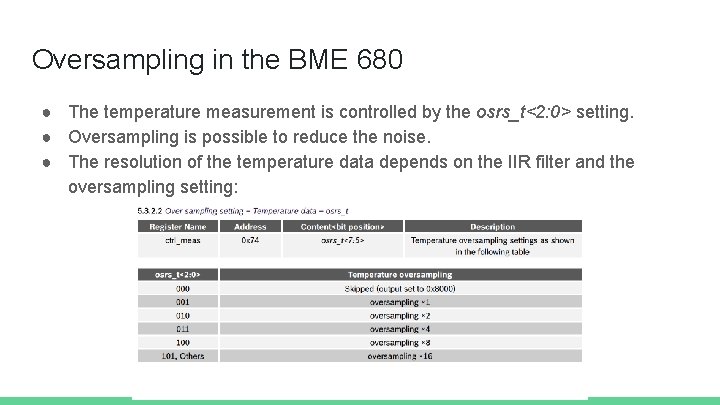
Oversampling in the BME 680 ● The temperature measurement is controlled by the osrs_t<2: 0> setting. ● Oversampling is possible to reduce the noise. ● The resolution of the temperature data depends on the IIR filter and the oversampling setting:
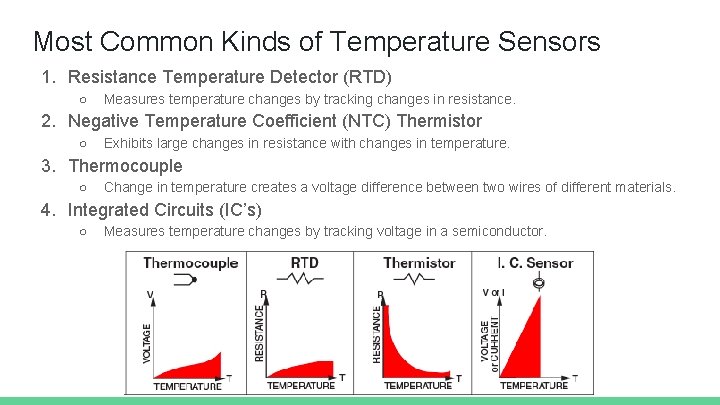
Most Common Kinds of Temperature Sensors 1. Resistance Temperature Detector (RTD) ○ Measures temperature changes by tracking changes in resistance. 2. Negative Temperature Coefficient (NTC) Thermistor ○ Exhibits large changes in resistance with changes in temperature. 3. Thermocouple ○ Change in temperature creates a voltage difference between two wires of different materials. 4. Integrated Circuits (IC’s) ○ Measures temperature changes by tracking voltage in a semiconductor.
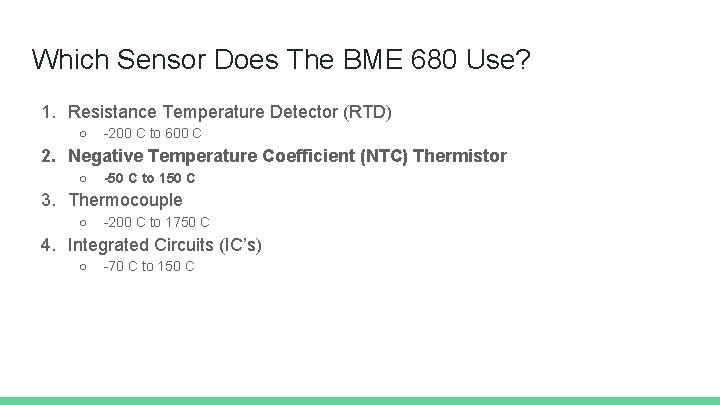
Which Sensor Does The BME 680 Use? 1. Resistance Temperature Detector (RTD) ○ -200 C to 600 C 2. Negative Temperature Coefficient (NTC) Thermistor ○ -50 C to 150 C 3. Thermocouple ○ -200 C to 1750 C 4. Integrated Circuits (IC’s) ○ -70 C to 150 C
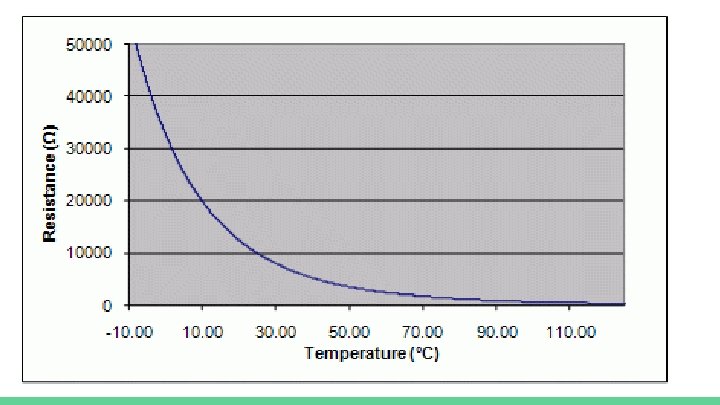
How does Thermistor work? A thermistor is an inexpensive and easily obtainable temperature sensitive resistor, thermistor working principle is, it’s resistance depends upon the temperature. When temperature changes, the resistance of thermistor changes in a predictable way. The benefits of using a thermistor is accuracy and stability.
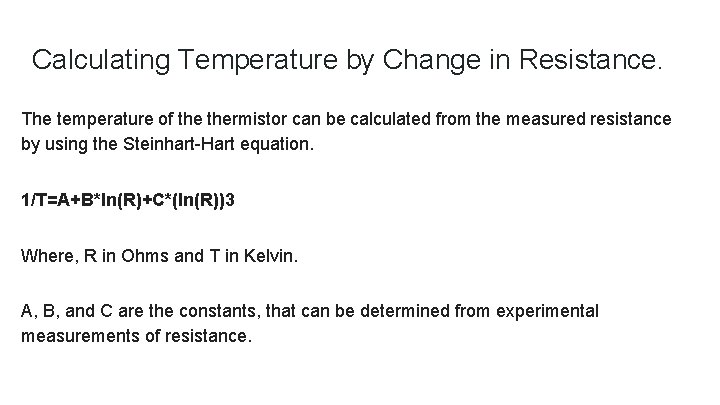
Calculating Temperature by Change in Resistance. The temperature of thermistor can be calculated from the measured resistance by using the Steinhart-Hart equation. 1/T=A+B*ln(R)+C*(ln(R))3 Where, R in Ohms and T in Kelvin. A, B, and C are the constants, that can be determined from experimental measurements of resistance.
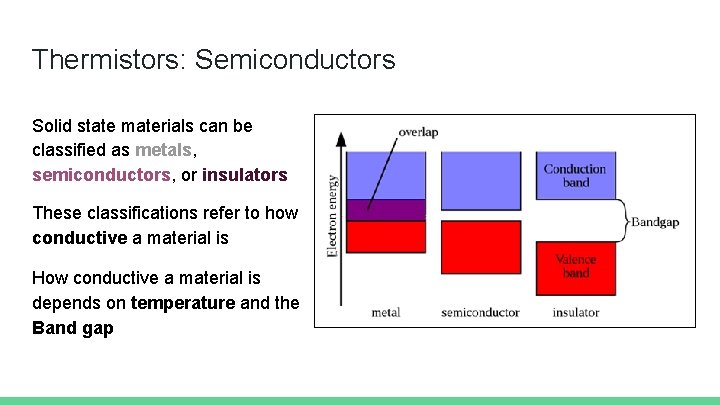
Thermistors: Semiconductors Solid state materials can be classified as metals, semiconductors, or insulators These classifications refer to how conductive a material is How conductive a material is depends on temperature and the Band gap
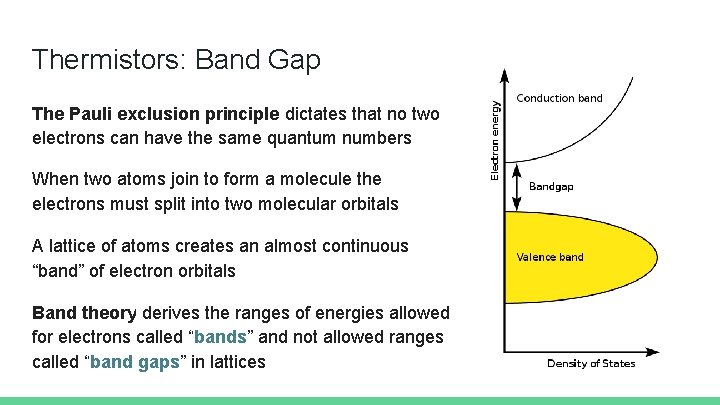
Thermistors: Band Gap The Pauli exclusion principle dictates that no two electrons can have the same quantum numbers When two atoms join to form a molecule the electrons must split into two molecular orbitals A lattice of atoms creates an almost continuous “band” of electron orbitals Band theory derives the ranges of energies allowed for electrons called “bands” and not allowed ranges called “band gaps” in lattices
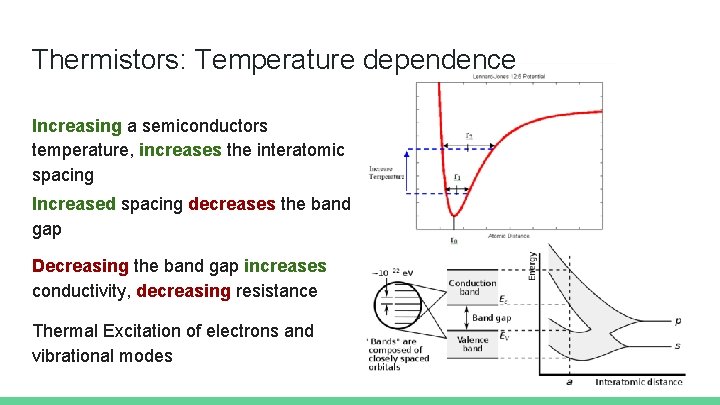
Thermistors: Temperature dependence Increasing a semiconductors temperature, increases the interatomic spacing Increased spacing decreases the band gap Decreasing the band gap increases conductivity, decreasing resistance Thermal Excitation of electrons and vibrational modes

Sources https: //www. bosch-sensortec. com/products/environmental-sensors/gas-sensors-bme 680/ http: //solarcellcentral. com/junction_page. html https: //en. wikipedia. org/wiki/Band_gap https: //en. wikipedia. org/wiki/Electronic_band_structure https: //en. wikipedia. org/wiki/Steinhart%E 2%80%93 Hart_equation http: //web. mit. edu/mbuehler/www/SIMS/Thermal%20 Expansion. html https: //www. watelectrical. com/thermistor-working-principle-with-applications/ https: //www. arroyoinstruments. com/thermistors. html https: //in. omega. com/prodinfo/Integrated-Circuit-Sensors. html
- Slides: 15