
ESE 532 SystemonaChip Architecture Day 9 October 1
ESE 532: System-on-a-Chip Architecture Day 9: October 1, 2018 Real Time Penn ESE 532 Fall 2018 -- De. Hon 1
Today Real Time • Demands • Challenges – Algorithms – Architecture • Disciplines to achieve Penn ESE 532 Fall 2018 -- De. Hon 2
Message • Real-Time applications demand different discipline from best-effort tasks • Look more like synchronous circuits • Can sequentialize, like processor – But must avoid/rethink typical generalpurpose processor common-case optimizations Penn ESE 532 Fall 2018 -- De. Hon 3
Real Time • “Real” – refers to physical time – Connection to Real or Physical World • Contrast with “virtual” or “variable” time • Handles events with absolute guarantees on timing Penn ESE 532 Fall 2018 -- De. Hon 4
Real-Time Tasks • What timing guarantees might you like for the following tasks? – Push a fire button on a video game • Delay to recognize and shoots bullet – Turn steering wheel on a drive-by-wire car • Delay to recognized and car turns – Self-driving car detects an object in its path • Delay from object appearing to detection – Pacemaker stimulates your heart – Video playback (frame to frame delay) Penn ESE 532 Fall 2018 -- De. Hon 5
Real-Time Guarantees • Attention/processing within fixed interval – Sample new value every XX ms – Produce new frame every 30 ms – Both: schedule to act and complete action • Bounded response time – Respond to keypress within 20 ms – Detect object within 100 ms – Return search results within 200 ms Penn ESE 532 Fall 2018 -- De. Hon 6
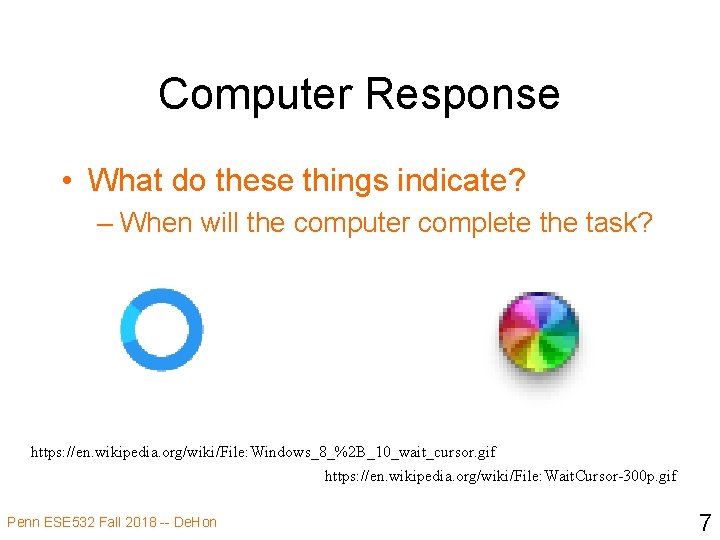
Computer Response • What do these things indicate? – When will the computer complete the task? https: //en. wikipedia. org/wiki/File: Windows_8_%2 B_10_wait_cursor. gif https: //en. wikipedia. org/wiki/File: Wait. Cursor-300 p. gif Penn ESE 532 Fall 2018 -- De. Hon 7
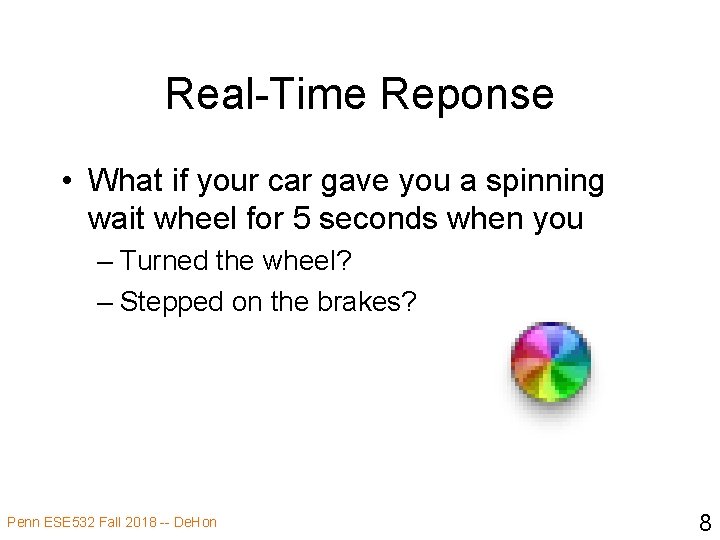
Real-Time Reponse • What if your car gave you a spinning wait wheel for 5 seconds when you – Turned the wheel? – Stepped on the brakes? Penn ESE 532 Fall 2018 -- De. Hon 8
Synchronous Circuit Model • A simple synchronous circuit is a good “model” for real-time task – Run at fixed clock rate – Take input every “cycle” – Produce output every “cycle” – Complete computation between input and output – Designed to run at fixed-frequency • Critical path meets frequency requirement Penn ESE 532 Fall 2018 -- De. Hon 9
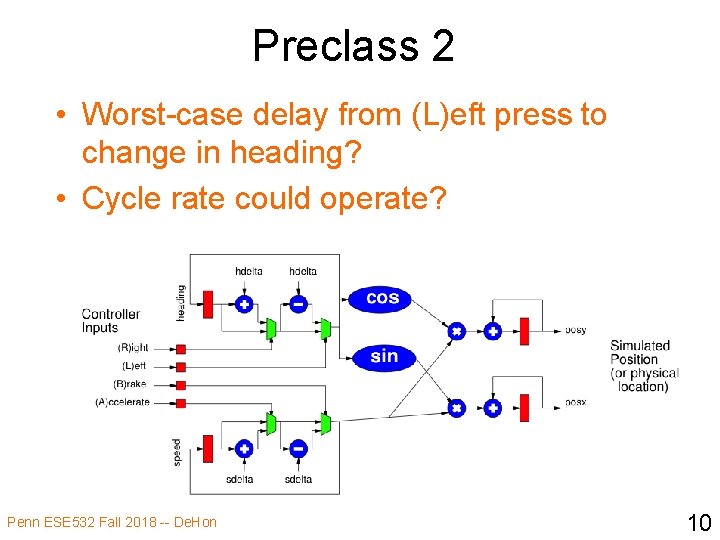
Preclass 2 • Worst-case delay from (L)eft press to change in heading? • Cycle rate could operate? Penn ESE 532 Fall 2018 -- De. Hon 10
Historically • Real-Time concerns grew up in EE – Because an analog circuit was the only way could meet frequency demands – …later a dedicated digital circuit… • Applications – Signal processing, video, control, … Penn ESE 532 Fall 2018 -- De. Hon 11
Technological Change • Why not be satisfied with this answer today? – That is, for real-time task need dedicated synchronous circuit? – Hint: What does preclass 2 b suggest? Penn ESE 532 Fall 2018 -- De. Hon 12
Performance Scaling • As circuit speeds increased – Can meet real-time performance demands with heavy sequentialization • Circuit and processor clocks – from MHz to GHz • Many real-time task rates unchanged – 44 KHz audio, 33 frames/second video • Even 100 MHz processor – Can implement audio in a small fraction of its computational throughput capacity Penn ESE 532 Fall 2018 -- De. Hon 13
HW/SW Co-Design • Computer Engineers – know can implement anything as hardware or software • Want freedom to move between hardware and software to meet requirements – Performance, costs, energy Penn ESE 532 Fall 2018 -- De. Hon 14
Real-Time Challenge • Meet real-time demands / guarantees – Economically using programmable architectures • Sequentialize and share resources with deterministic, guaranteed timing Penn ESE 532 Fall 2018 -- De. Hon 15
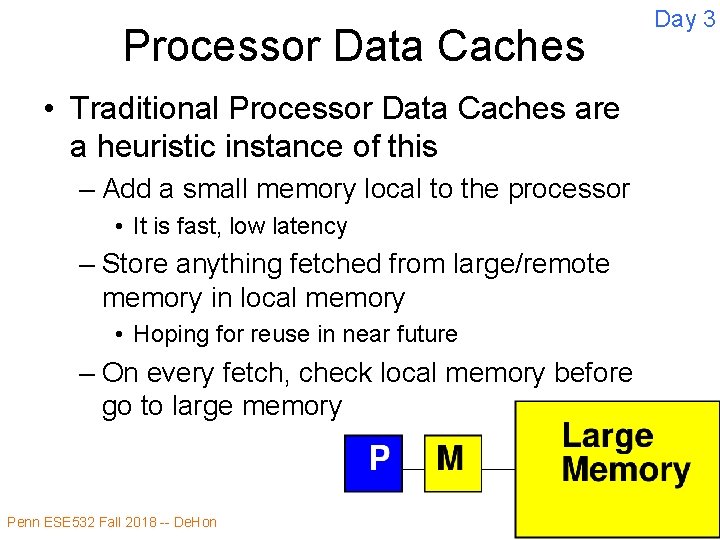
Processor Data Caches Day 3 • Traditional Processor Data Caches are a heuristic instance of this – Add a small memory local to the processor • It is fast, low latency – Store anything fetched from large/remote memory in local memory • Hoping for reuse in near future – On every fetch, check local memory before go to large memory Penn ESE 532 Fall 2018 -- De. Hon 16
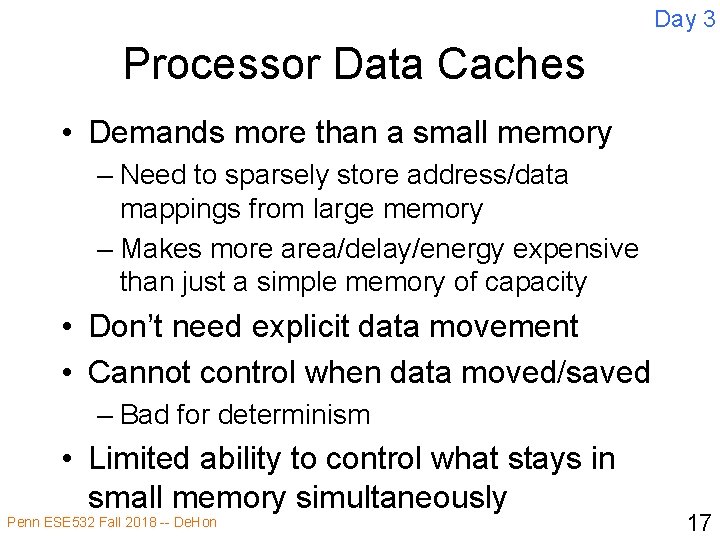
Day 3 Processor Data Caches • Demands more than a small memory – Need to sparsely store address/data mappings from large memory – Makes more area/delay/energy expensive than just a simple memory of capacity • Don’t need explicit data movement • Cannot control when data moved/saved – Bad for determinism • Limited ability to control what stays in small memory simultaneously Penn ESE 532 Fall 2018 -- De. Hon 17
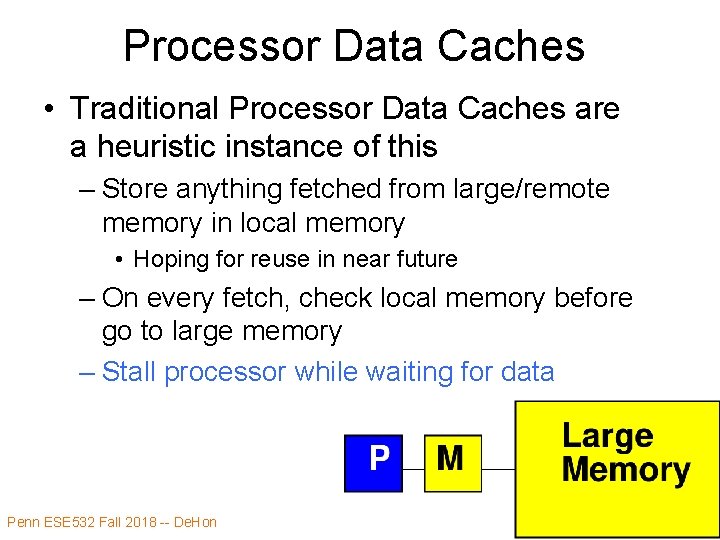
Processor Data Caches • Traditional Processor Data Caches are a heuristic instance of this – Store anything fetched from large/remote memory in local memory • Hoping for reuse in near future – On every fetch, check local memory before go to large memory – Stall processor while waiting for data Penn ESE 532 Fall 2018 -- De. Hon 18
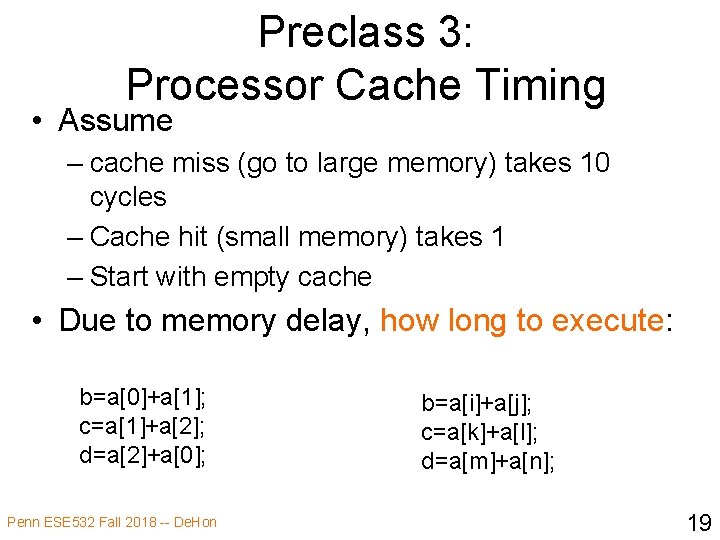
Preclass 3: Processor Cache Timing • Assume – cache miss (go to large memory) takes 10 cycles – Cache hit (small memory) takes 1 – Start with empty cache • Due to memory delay, how long to execute: b=a[0]+a[1]; c=a[1]+a[2]; d=a[2]+a[0]; Penn ESE 532 Fall 2018 -- De. Hon b=a[i]+a[j]; c=a[k]+a[l]; d=a[m]+a[n]; 19
Observe • Instructions on “General Purpose” processors take variable number of cycles Penn ESE 532 Fall 2018 -- De. Hon 20
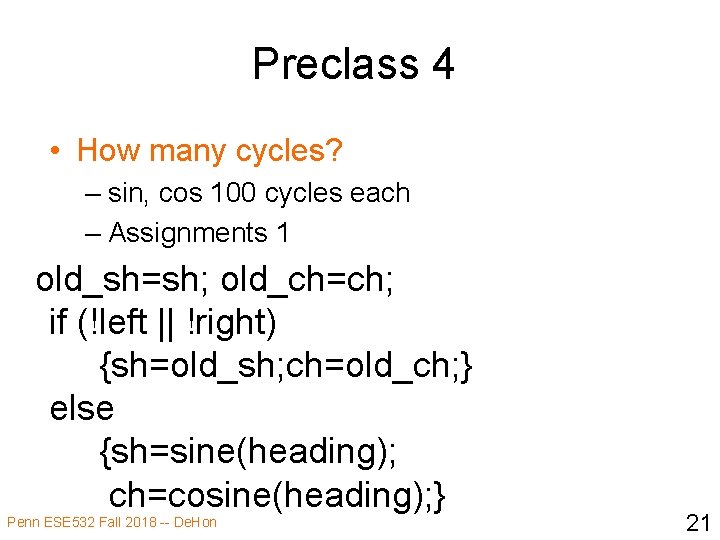
Preclass 4 • How many cycles? – sin, cos 100 cycles each – Assignments 1 old_sh=sh; old_ch=ch; if (!left || !right) {sh=old_sh; ch=old_ch; } else {sh=sine(heading); ch=cosine(heading); } Penn ESE 532 Fall 2018 -- De. Hon 21
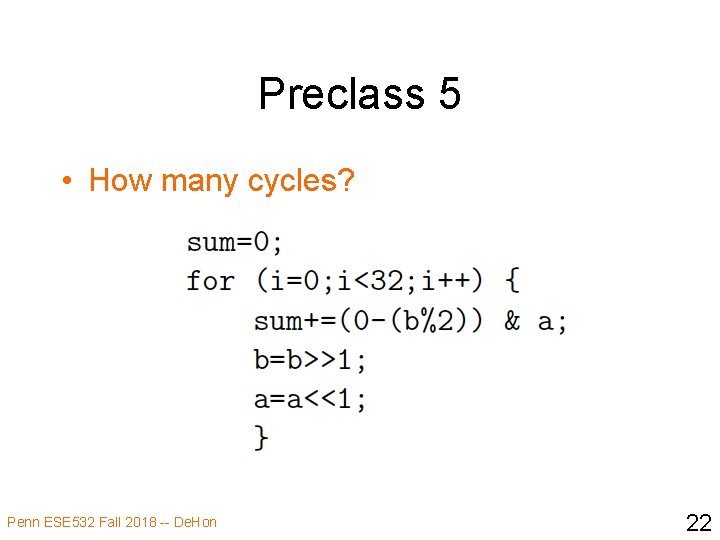
Preclass 5 • How many cycles? Penn ESE 532 Fall 2018 -- De. Hon 22
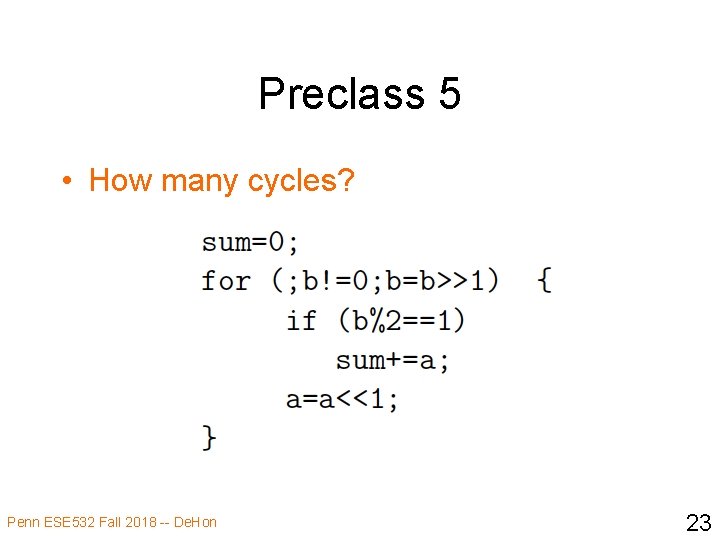
Preclass 5 • How many cycles? Penn ESE 532 Fall 2018 -- De. Hon 23
Observe • Data-dependent branching, looping – Means variable time for operations Penn ESE 532 Fall 2018 -- De. Hon 24
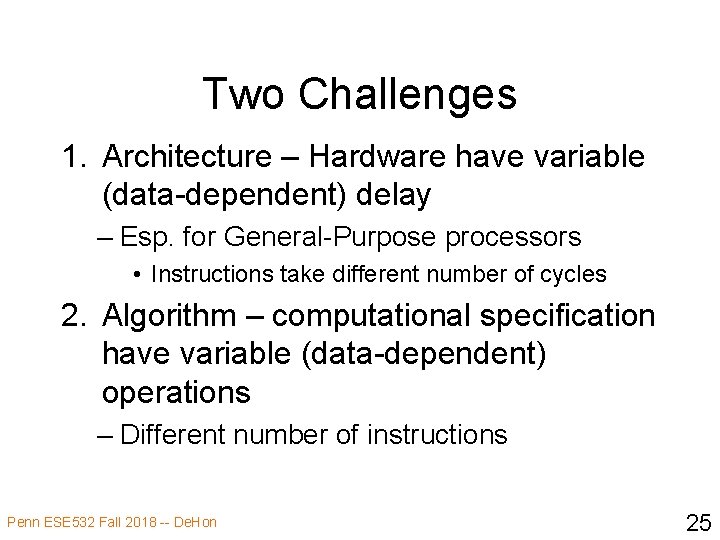
Two Challenges 1. Architecture – Hardware have variable (data-dependent) delay – Esp. for General-Purpose processors • Instructions take different number of cycles 2. Algorithm – computational specification have variable (data-dependent) operations – Different number of instructions Penn ESE 532 Fall 2018 -- De. Hon 25
Algorithm • What programming constructs are datadependent (variable delay)? Penn ESE 532 Fall 2018 -- De. Hon 26
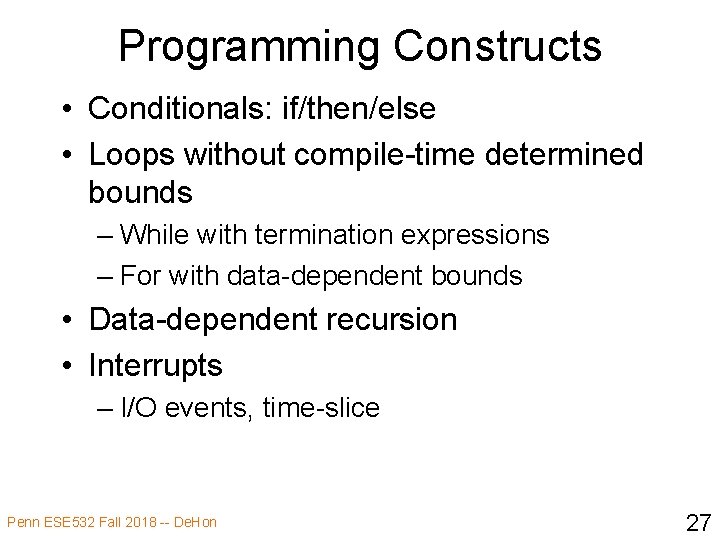
Programming Constructs • Conditionals: if/then/else • Loops without compile-time determined bounds – While with termination expressions – For with data-dependent bounds • Data-dependent recursion • Interrupts – I/O events, time-slice Penn ESE 532 Fall 2018 -- De. Hon 27
Architecture • What processor constructs are variable delay? Penn ESE 532 Fall 2018 -- De. Hon 29
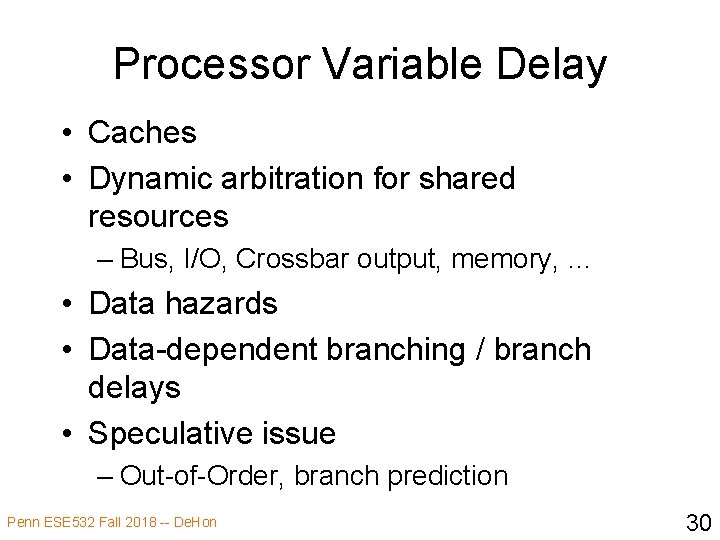
Processor Variable Delay • Caches • Dynamic arbitration for shared resources – Bus, I/O, Crossbar output, memory, … • Data hazards • Data-dependent branching / branch delays • Speculative issue – Out-of-Order, branch prediction Penn ESE 532 Fall 2018 -- De. Hon 30
Hardware Architecture • Some typical (371, 501) processor “optimizations” can cause variable delay – Caches – Common-case optimizations – Pipeline stalls Penn ESE 532 Fall 2018 -- De. Hon 31
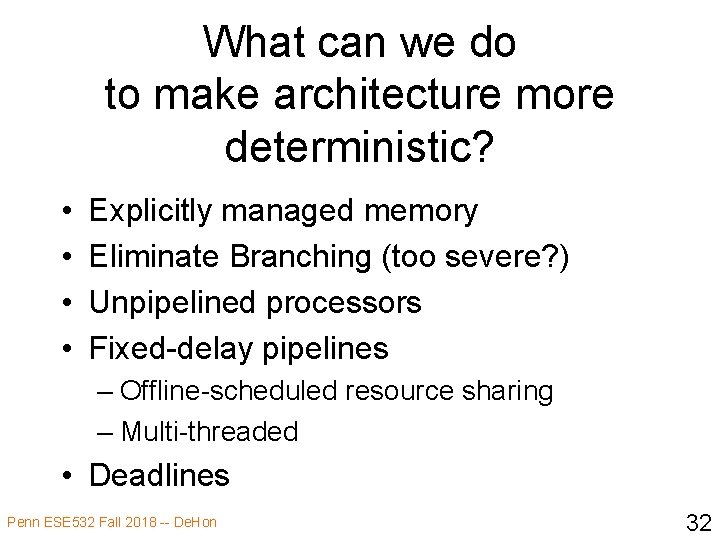
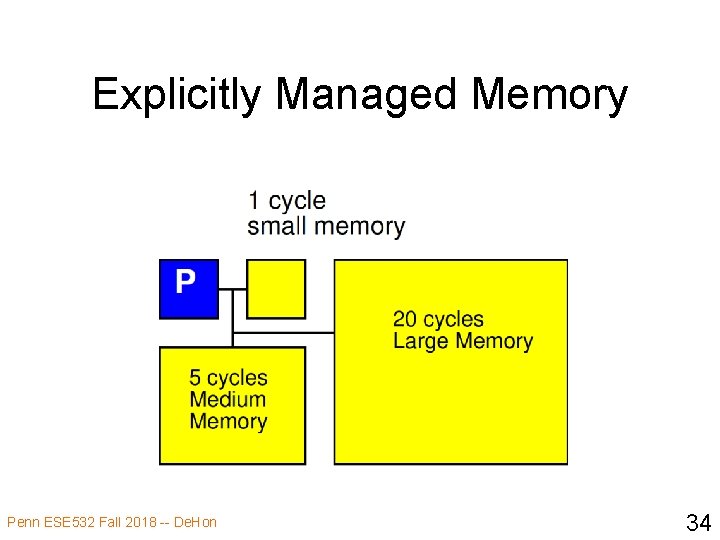
What can we do to make architecture more deterministic? • • Explicitly managed memory Eliminate Branching (too severe? ) Unpipelined processors Fixed-delay pipelines – Offline-scheduled resource sharing – Multi-threaded • Deadlines Penn ESE 532 Fall 2018 -- De. Hon 32
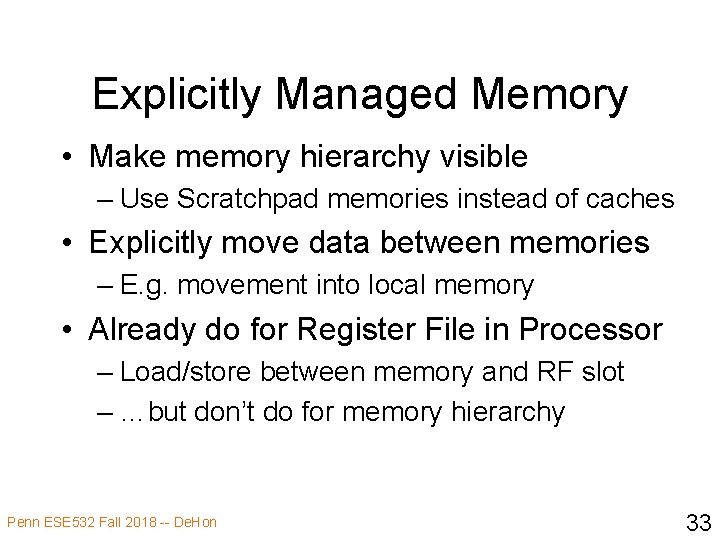
Explicitly Managed Memory • Make memory hierarchy visible – Use Scratchpad memories instead of caches • Explicitly move data between memories – E. g. movement into local memory • Already do for Register File in Processor – Load/store between memory and RF slot – …but don’t do for memory hierarchy Penn ESE 532 Fall 2018 -- De. Hon 33
Explicitly Managed Memory Penn ESE 532 Fall 2018 -- De. Hon 34
Offline Schedule Resource Sharing • Don’t arbitrate • Decide up-front when each shared resource can be used by each thread or processor – Simple fixed schedule – Detailed Schedule • What – Memory bank, bus, I/O, network link, … Penn ESE 532 Fall 2018 -- De. Hon 35
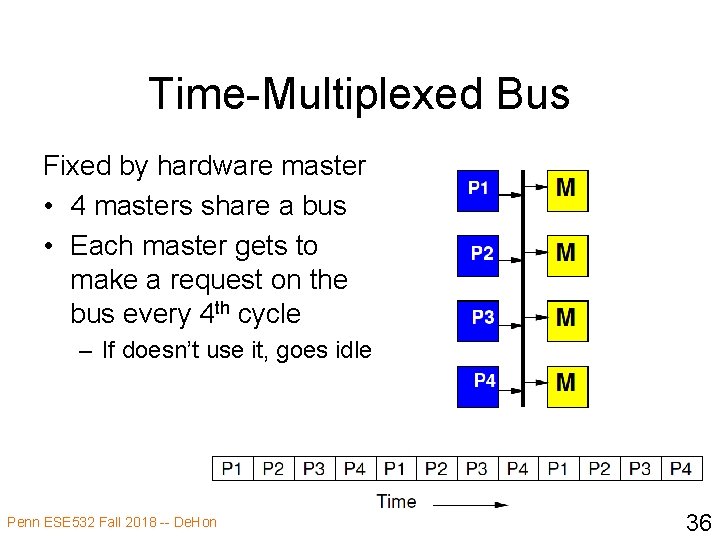
Time-Multiplexed Bus Fixed by hardware master • 4 masters share a bus • Each master gets to make a request on the bus every 4 th cycle – If doesn’t use it, goes idle Penn ESE 532 Fall 2018 -- De. Hon 36
Time-Multiplexed Bus • Regular schedule • Fixed bus slot schedule of length N > masters – (probably a multiple) • Assign owner for each slot – Can assign more slots to one • E. g. N=8, for 4 masters – Schedule (1 2 1 3 1 2 1 4) Penn ESE 532 Fall 2018 -- De. Hon 37
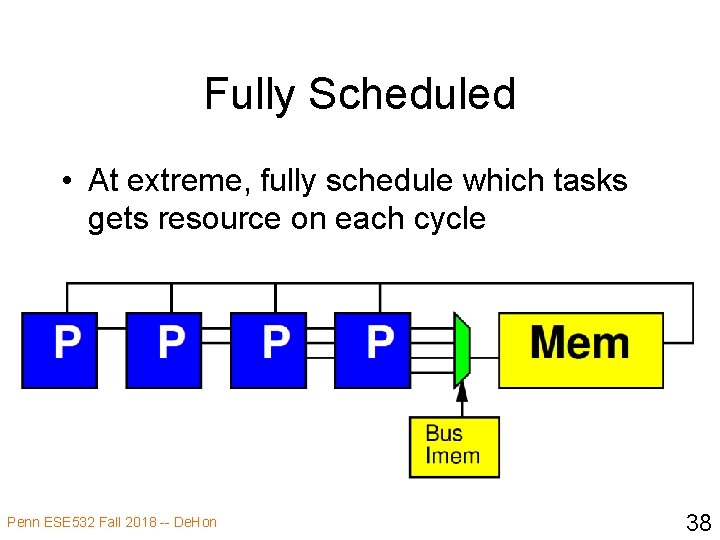
Fully Scheduled • At extreme, fully schedule which tasks gets resource on each cycle Penn ESE 532 Fall 2018 -- De. Hon 38
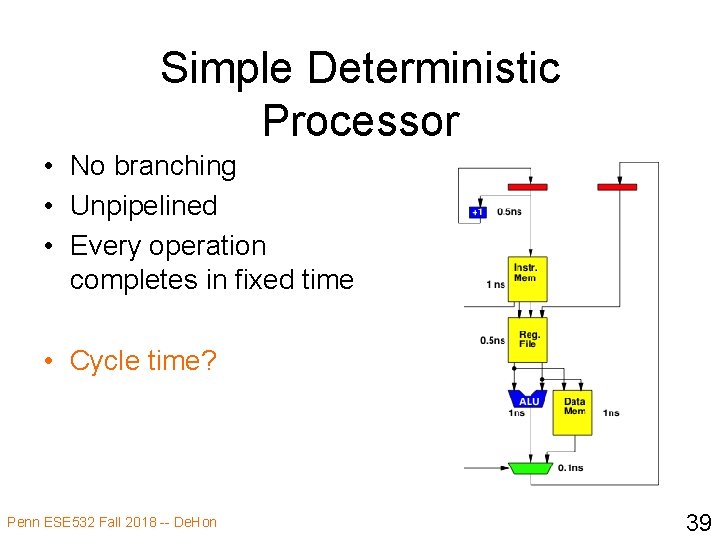
Simple Deterministic Processor • No branching • Unpipelined • Every operation completes in fixed time • Cycle time? Penn ESE 532 Fall 2018 -- De. Hon 39
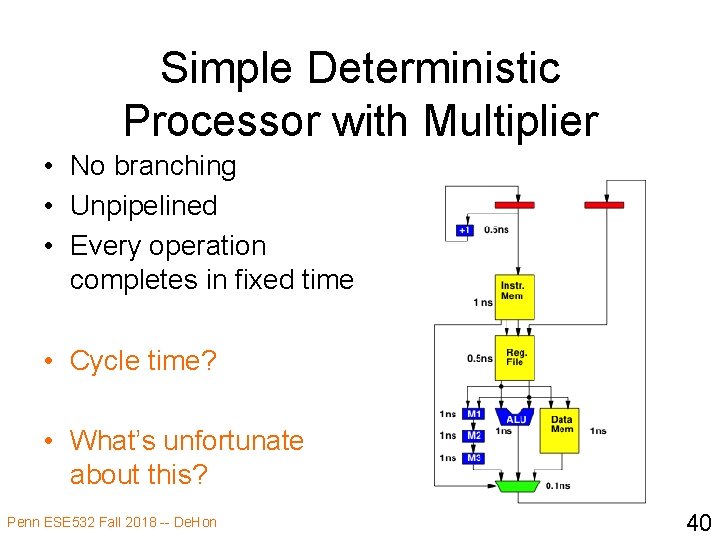
Simple Deterministic Processor with Multiplier • No branching • Unpipelined • Every operation completes in fixed time • Cycle time? • What’s unfortunate about this? Penn ESE 532 Fall 2018 -- De. Hon 40
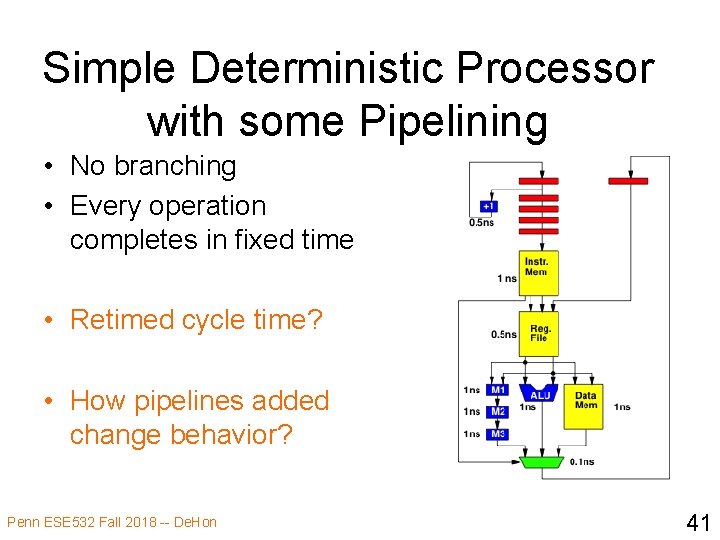
Simple Deterministic Processor with some Pipelining • No branching • Every operation completes in fixed time • Retimed cycle time? • How pipelines added change behavior? Penn ESE 532 Fall 2018 -- De. Hon 41
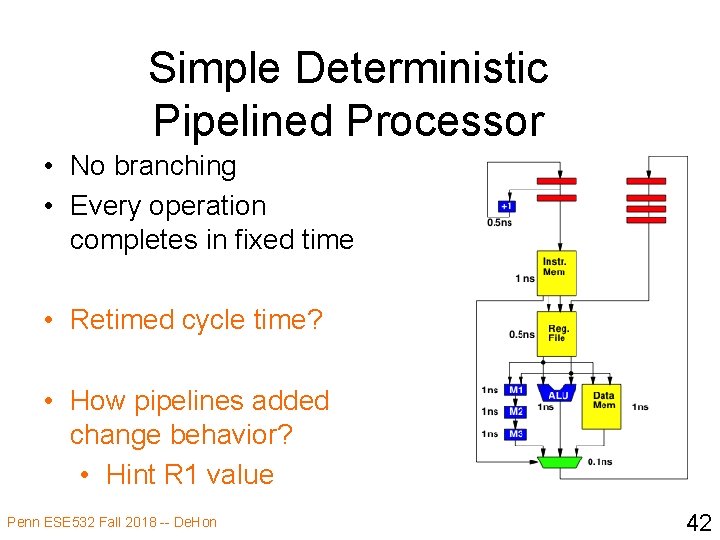
Simple Deterministic Pipelined Processor • No branching • Every operation completes in fixed time • Retimed cycle time? • How pipelines added change behavior? • Hint R 1 value Penn ESE 532 Fall 2018 -- De. Hon 42
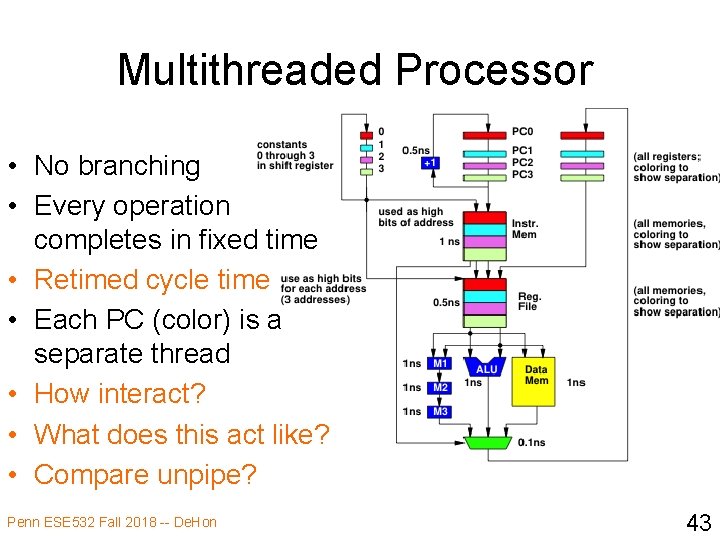
Multithreaded Processor • No branching • Every operation completes in fixed time • Retimed cycle time • Each PC (color) is a separate thread • How interact? • What does this act like? • Compare unpipe? Penn ESE 532 Fall 2018 -- De. Hon 43
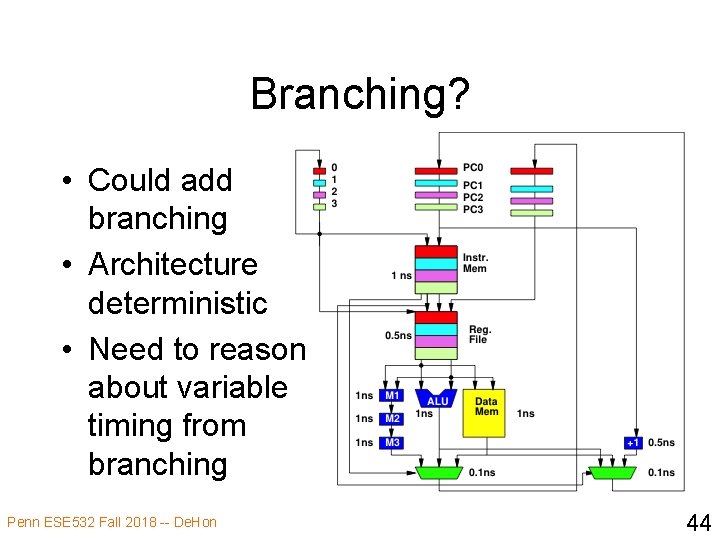
Branching? • Could add branching • Architecture deterministic • Need to reason about variable timing from branching Penn ESE 532 Fall 2018 -- De. Hon 44
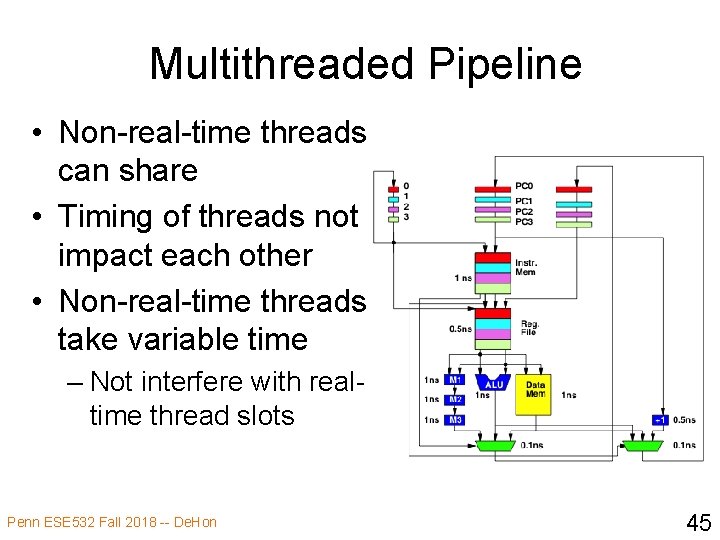
Multithreaded Pipeline • Non-real-time threads can share • Timing of threads not impact each other • Non-real-time threads take variable time – Not interfere with realtime thread slots Penn ESE 532 Fall 2018 -- De. Hon 45
Deadline Instruction • Deal with algorithmic (branching) variability • Set a hardware counter for thread • Demand counter reach 0 before thread allowed to continue at deadline instruction • Model: fixed rate of attention – Stall if get there early – Similar to flip-flop on a logic path • Wait for clock edge to change or sample value • Model: fixed execution time Penn ESE 532 Fall 2018 -- De. Hon 46
WCET • WCET – Worst-Case Execution Time • Analysis when working with algorithms and architectures with data-dependent delay – Need to meet real time – Calculate the worst-case runtime of a task • • Like calculating the critical path (but harder) Worst-case delay of instructions Worst-case path through code Worst-case # loop iterations – Rationale for setting Deadlines • (like a cycle time) Penn ESE 532 Fall 2018 -- De. Hon 47
Deterministic Pipelines • Not how ARM, Intel (371, 501) processor are piplined • Those include operations that make timing variable – dynamic data hazards, branch speculation • Here, data becomes available after a predictable time • Branches take effect at a fixed time – Likely delayed • Schedule to delays to get correct data Penn ESE 532 Fall 2018 -- De. Hon 48
Different Goals Real-Time • Willing to recompile to new hardware • Want time on hardware predictable • Willing to schedule for delays in particular hardware Penn ESE 532 Fall 2018 -- De. Hon General Purpose/Best Effort • ISA fixed • Want to run same assembly on different implementations • Tolerate different delays for different hardware • Run faster on newer, larger implementations 49
So. C Opportunity • Can choose which resources are shared • Can dedicate resources to tasks • Isolate real-time tasks/portions of tasks from best-effort – Separate hardware/processors – Separate memories, network Penn ESE 532 Fall 2018 -- De. Hon 50
Big Ideas: • Real-Time applications demand different discipline from best-effort tasks • Look more like synchronous circuits and hardware discipline • Avoid or use care with variable delay programming constructs • Can sequentialize, like processor – But must avoid/rethink typical processor common-case optimizations – Offline calculate static schedule for computation and sharing Penn ESE 532 Fall 2018 -- De. Hon • Instead of dynamic arbitration, interlocks 51
Admin • Wednesday/Day 10 reading on Canvas + Zynq Book • We are here Wednesday – Do have office hours Monday, Tuesday • Fall Break – Thursday and Friday – No Office Hours Thursday (10/4) – No HW due this Friday (10/5) • HW 5 due 10/12 – Will involve some long Vivado HLS/SDSo. C tool times Penn ESE 532 Fall 2018 -- De. Hon 52
- Slides: 51