
ESE 532 SystemonaChip Architecture Day 12 October 11
ESE 532: System-on-a-Chip Architecture Day 12: October 11, 2017 Orchestrating Data in Memories Penn ESE 532 Fall 2017 -- De. Hon 1
Today • DRAM Implications • Tricks for working with DRAM and generally minimizing use of large memories Penn ESE 532 Fall 2017 -- De. Hon 2
Message • How we access data matters • Reuse data to avoid access to large memories • Encourage think about how organize computation and data to minimize – Use of large memory – Data movement • …and to think about what you expect, so can diagnose unnecessary data bottlenecks Penn ESE 532 Fall 2017 -- De. Hon 3
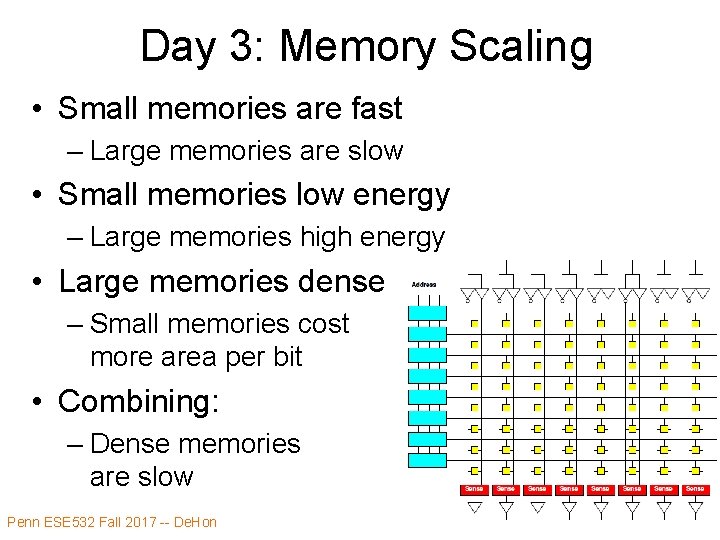
Day 3: Memory Scaling • Small memories are fast – Large memories are slow • Small memories low energy – Large memories high energy • Large memories dense – Small memories cost more area per bit • Combining: – Dense memories are slow Penn ESE 532 Fall 2017 -- De. Hon 4
Day 3: Lesson • Cheaper to access wide/contiguous blocks memory – In hardware – From the architectures typically build • Can achieve higher bandwidth on large block data transfer – Than random access of small data items Penn ESE 532 Fall 2017 -- De. Hon 5
DRAM Usually the largest memory Penn ESE 532 Fall 2017 -- De. Hon 6
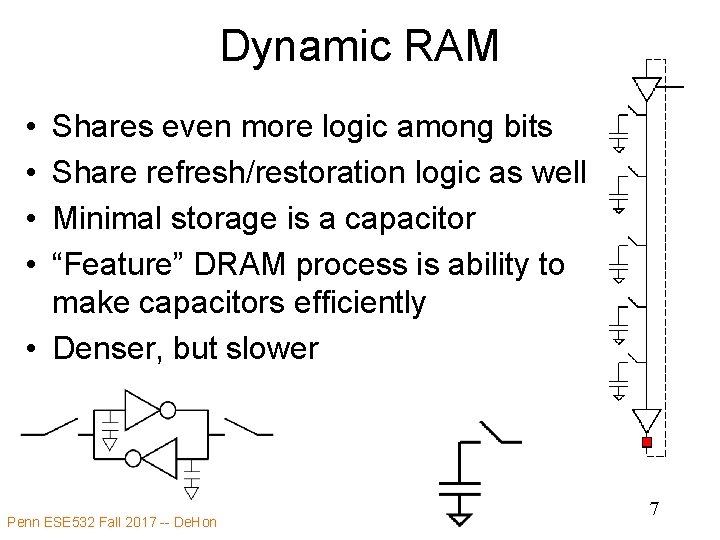
Dynamic RAM • • Shares even more logic among bits Share refresh/restoration logic as well Minimal storage is a capacitor “Feature” DRAM process is ability to make capacitors efficiently • Denser, but slower Penn ESE 532 Fall 2017 -- De. Hon 7
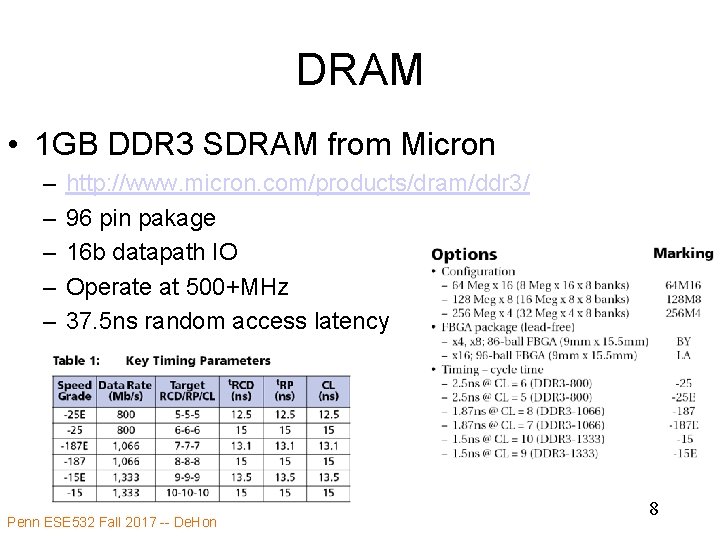
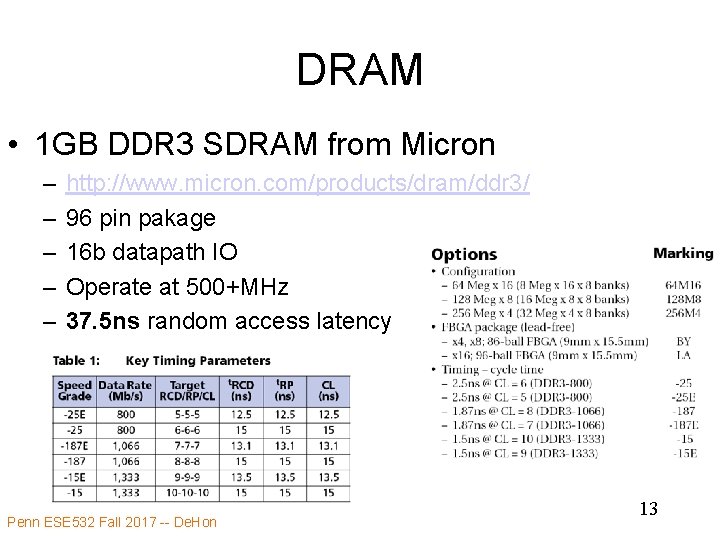
DRAM • 1 GB DDR 3 SDRAM from Micron – – – http: //www. micron. com/products/dram/ddr 3/ 96 pin pakage 16 b datapath IO Operate at 500+MHz 37. 5 ns random access latency Penn ESE 532 Fall 2017 -- De. Hon 8
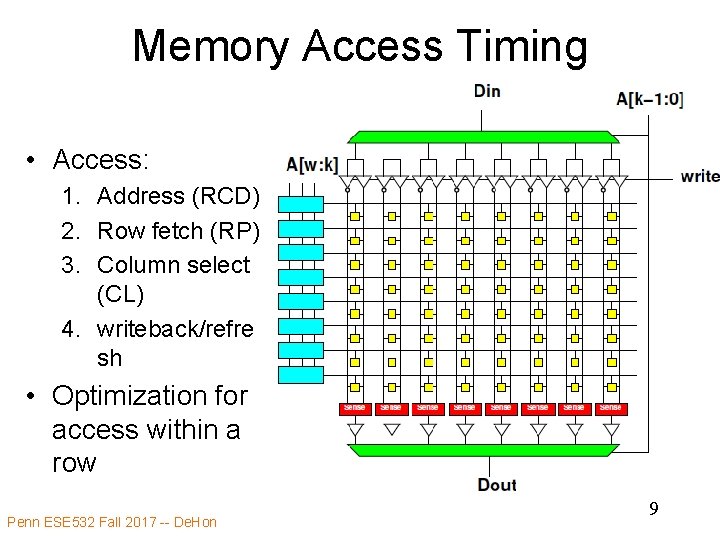
Memory Access Timing • Access: 1. Address (RCD) 2. Row fetch (RP) 3. Column select (CL) 4. writeback/refre sh • Optimization for access within a row Penn ESE 532 Fall 2017 -- De. Hon 9
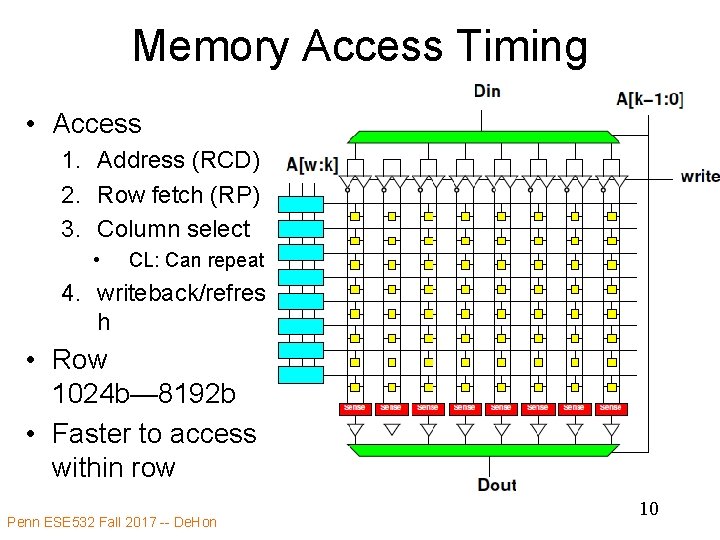
Memory Access Timing • Access 1. Address (RCD) 2. Row fetch (RP) 3. Column select • CL: Can repeat 4. writeback/refres h • Row 1024 b— 8192 b • Faster to access within row Penn ESE 532 Fall 2017 -- De. Hon 10
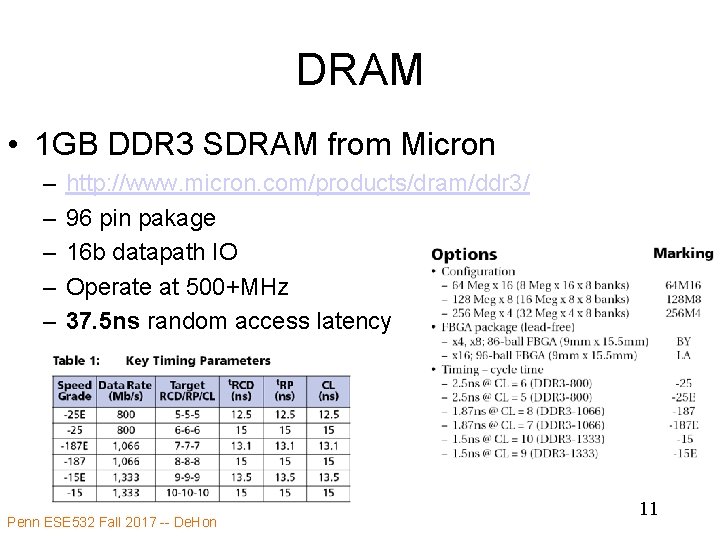
DRAM • 1 GB DDR 3 SDRAM from Micron – – – http: //www. micron. com/products/dram/ddr 3/ 96 pin pakage 16 b datapath IO Operate at 500+MHz 37. 5 ns random access latency Penn ESE 532 Fall 2017 -- De. Hon 11
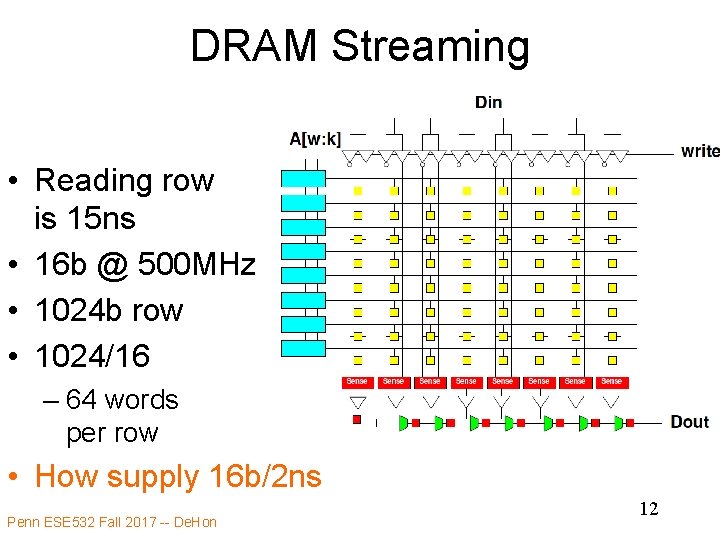
DRAM Streaming • Reading row is 15 ns • 16 b @ 500 MHz • 1024 b row • 1024/16 – 64 words per row • How supply 16 b/2 ns Penn ESE 532 Fall 2017 -- De. Hon 12
DRAM • 1 GB DDR 3 SDRAM from Micron – – – http: //www. micron. com/products/dram/ddr 3/ 96 pin pakage 16 b datapath IO Operate at 500+MHz 37. 5 ns random access latency Penn ESE 532 Fall 2017 -- De. Hon 13
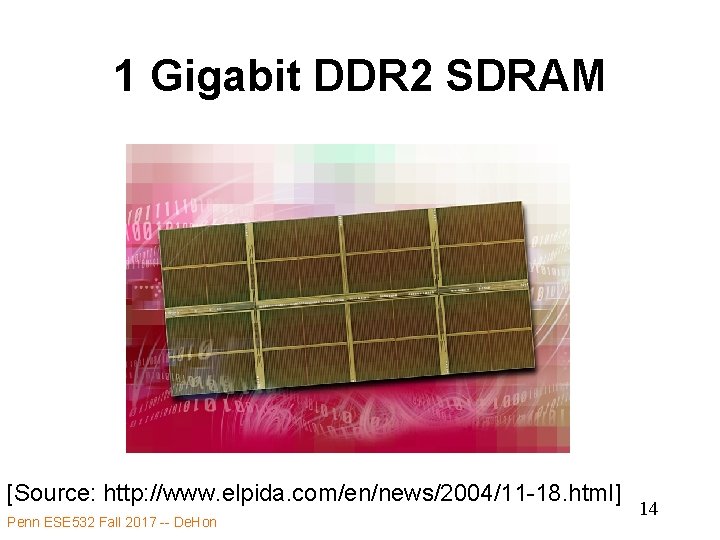
1 Gigabit DDR 2 SDRAM [Source: http: //www. elpida. com/en/news/2004/11 -18. html] Penn ESE 532 Fall 2017 -- De. Hon 14
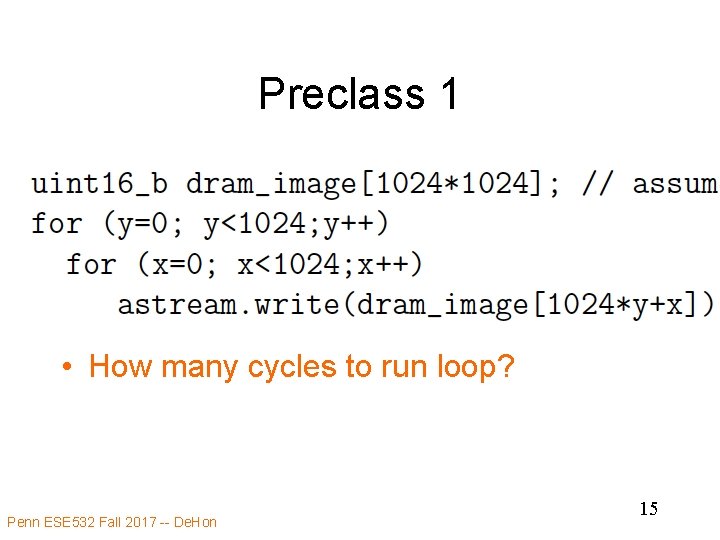
Preclass 1 • How many cycles to run loop? Penn ESE 532 Fall 2017 -- De. Hon 15
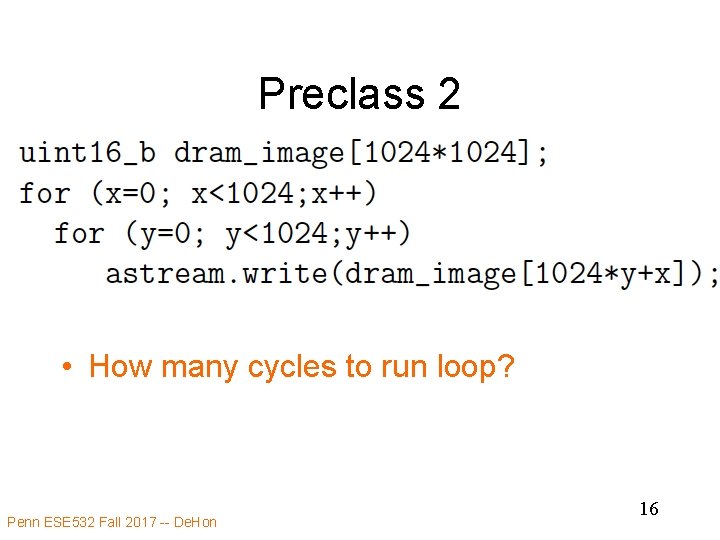
Preclass 2 • How many cycles to run loop? Penn ESE 532 Fall 2017 -- De. Hon 16
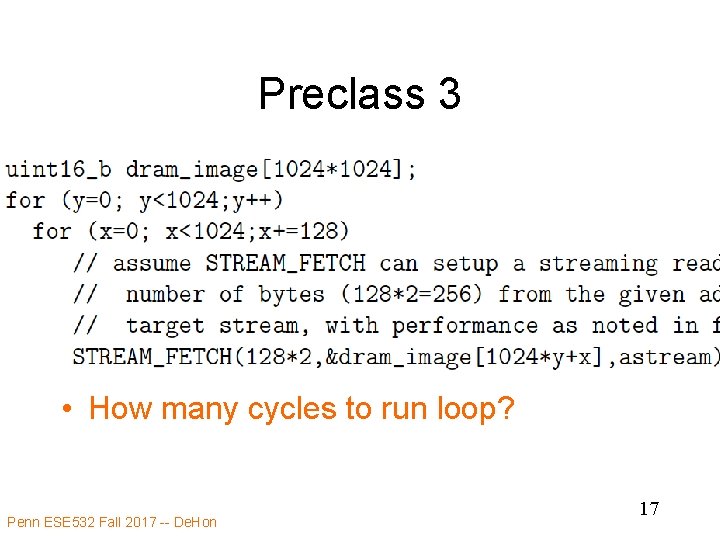
Preclass 3 • How many cycles to run loop? Penn ESE 532 Fall 2017 -- De. Hon 17
DRAM • Latency is large (10 s of ns) • Throughput can be high (GB/s) – If accessed sequentially – If exploit wide word block transfers • Throughput low on random accesses – As we saw for random access on wideword memory Penn ESE 532 Fall 2017 -- De. Hon 18
Maximize Reuse Minimize need to go to large memory Penn ESE 532 Fall 2017 -- De. Hon 19
Data Management • Large, central memory – Bottleneck – High energy • Minimize need to return to it Penn ESE 532 Fall 2017 -- De. Hon 20
Window Filter • Compute based on neighbors – F(d[y-1][x-1], d[y-1][x+1], d[y][x-1], d[y][x+1], d[y+1][x-1], d[y+1][x+1]) • Common idiom – Image filtering – Numerical simulation – Cellular automata – Search, matching Penn ESE 532 Fall 2017 -- De. Hon 21
Window Filter • Compute based on neighbors – F(d[y-1][x-1], d[y-1][x+1], d[y][x-1], d[y][x+1], d[y+1][x-1], d[y+1][x+1]) • Generalize for different neighborhood sizes – For (yoff=YMIN; yoff<YMAX; yoff++) For (xoff=XMIN; xoff<XMAX; xoff++) res=fun(res, d[y+yoff][x+xoff]); Penn ESE 532 Fall 2017 -- De. Hon 22
Window Filter • Compute based on neighbors • For (y=0; y<YMAX; y++) For (x=0; x<XMAX; x++) o[y][x]=F(d[y-1][x-1], d[y-1][x+1], d[y][x-1], d[y][x+1], d[y+1][x-1], d[y+1][x+1]) • How work with image in DRAM? Penn ESE 532 Fall 2017 -- De. Hon 23
Window Filter • Compute based on neighbors • For (y=0; y<YMAX; y++) For (x=0; x<XMAX; x++) o[y][x]=F(d[y-1][x-1], d[y-1][x+1], d[y][x-1], d[y][x+1], d[y+1][x-1], d[y+1][x+1]) • How work with image in DRAM? – As written references – Reads per row Penn ESE 532 Fall 2017 -- De. Hon 24
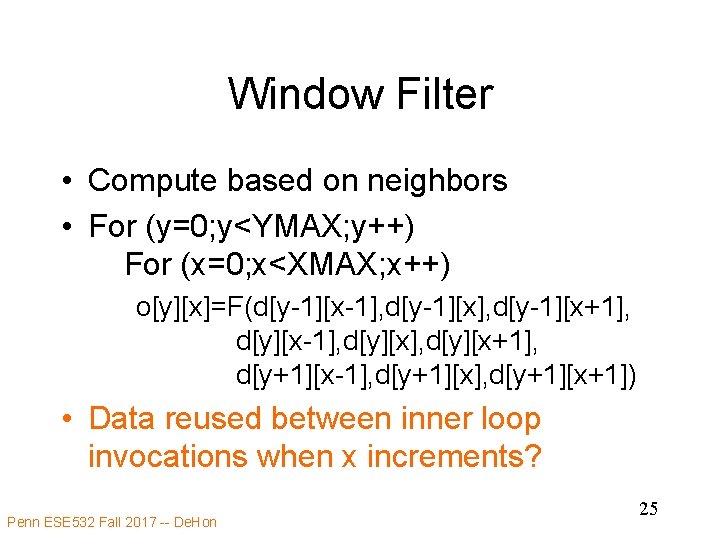
Window Filter • Compute based on neighbors • For (y=0; y<YMAX; y++) For (x=0; x<XMAX; x++) o[y][x]=F(d[y-1][x-1], d[y-1][x+1], d[y][x-1], d[y][x+1], d[y+1][x-1], d[y+1][x+1]) • Data reused between inner loop invocations when x increments? Penn ESE 532 Fall 2017 -- De. Hon 25
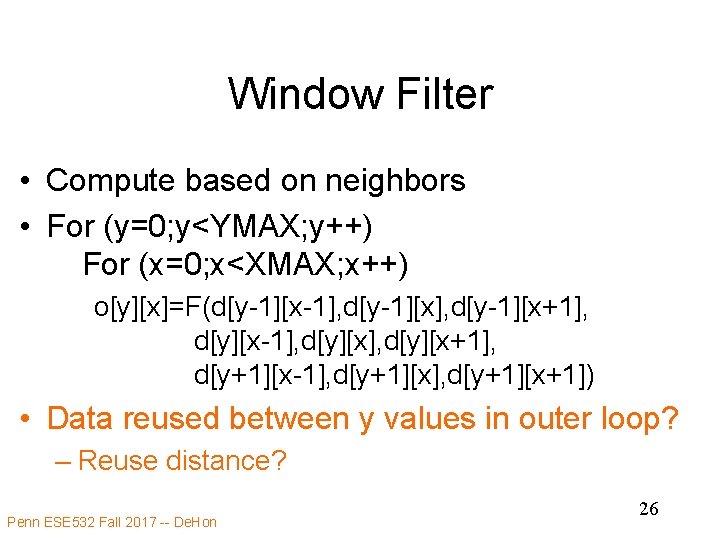
Window Filter • Compute based on neighbors • For (y=0; y<YMAX; y++) For (x=0; x<XMAX; x++) o[y][x]=F(d[y-1][x-1], d[y-1][x+1], d[y][x-1], d[y][x+1], d[y+1][x-1], d[y+1][x+1]) • Data reused between y values in outer loop? – Reuse distance? Penn ESE 532 Fall 2017 -- De. Hon 26
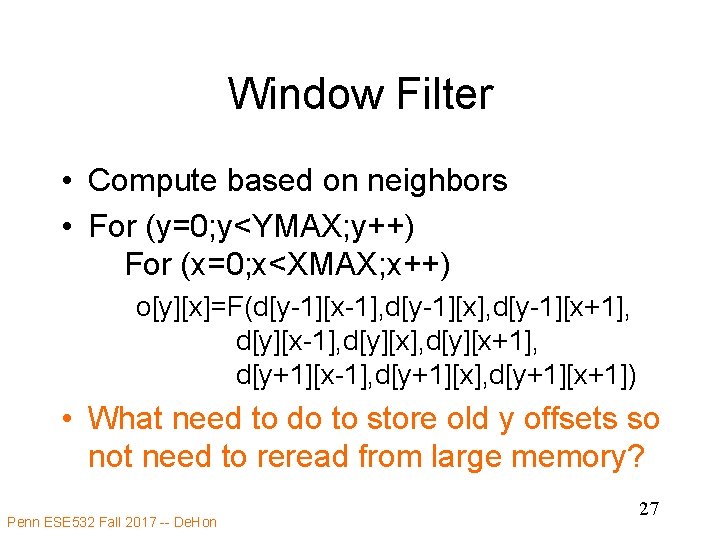
Window Filter • Compute based on neighbors • For (y=0; y<YMAX; y++) For (x=0; x<XMAX; x++) o[y][x]=F(d[y-1][x-1], d[y-1][x+1], d[y][x-1], d[y][x+1], d[y+1][x-1], d[y+1][x+1]) • What need to do to store old y offsets so not need to reread from large memory? Penn ESE 532 Fall 2017 -- De. Hon 27
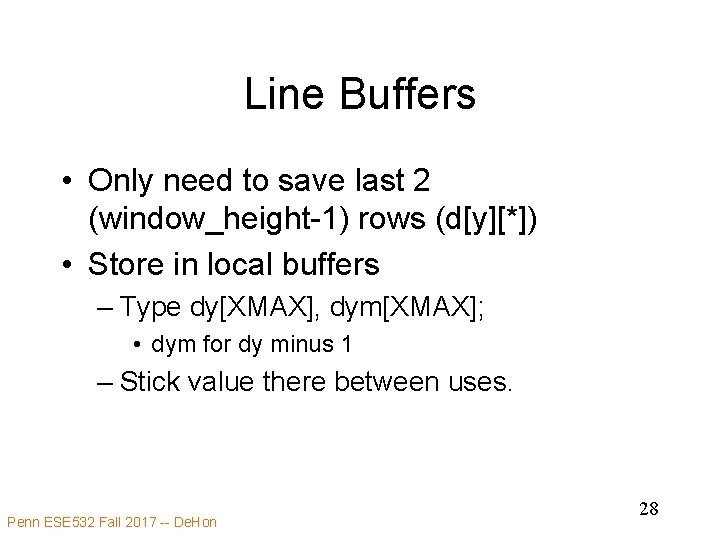
Line Buffers • Only need to save last 2 (window_height-1) rows (d[y][*]) • Store in local buffers – Type dy[XMAX], dym[XMAX]; • dym for dy minus 1 – Stick value there between uses. Penn ESE 532 Fall 2017 -- De. Hon 28
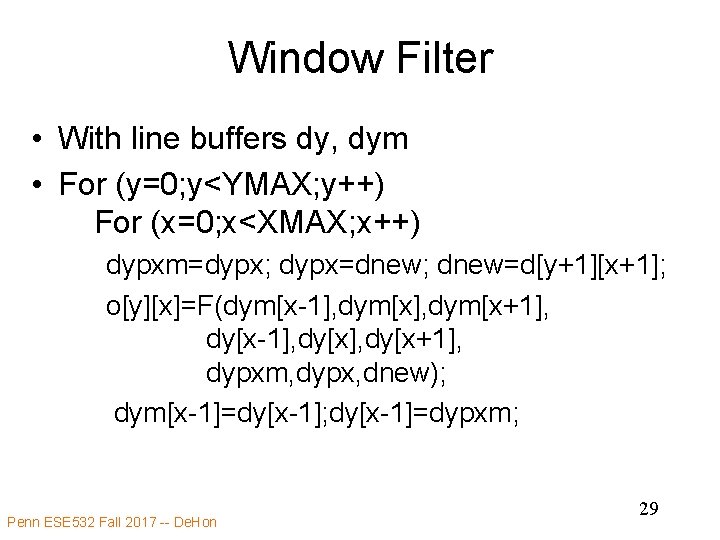
Window Filter • With line buffers dy, dym • For (y=0; y<YMAX; y++) For (x=0; x<XMAX; x++) dypxm=dypx; dypx=dnew; dnew=d[y+1][x+1]; o[y][x]=F(dym[x-1], dym[x+1], dy[x-1], dy[x+1], dypxm, dypx, dnew); dym[x-1]=dy[x-1]; dy[x-1]=dypxm; Penn ESE 532 Fall 2017 -- De. Hon 29
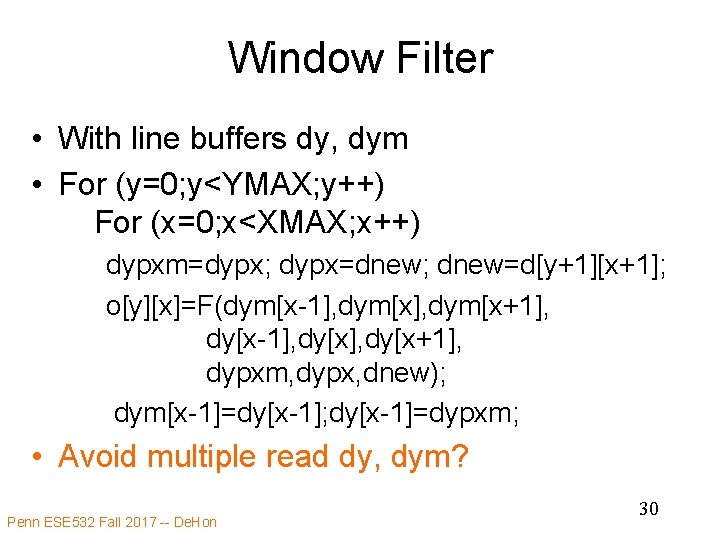
Window Filter • With line buffers dy, dym • For (y=0; y<YMAX; y++) For (x=0; x<XMAX; x++) dypxm=dypx; dypx=dnew; dnew=d[y+1][x+1]; o[y][x]=F(dym[x-1], dym[x+1], dy[x-1], dy[x+1], dypxm, dypx, dnew); dym[x-1]=dy[x-1]; dy[x-1]=dypxm; • Avoid multiple read dy, dym? Penn ESE 532 Fall 2017 -- De. Hon 30
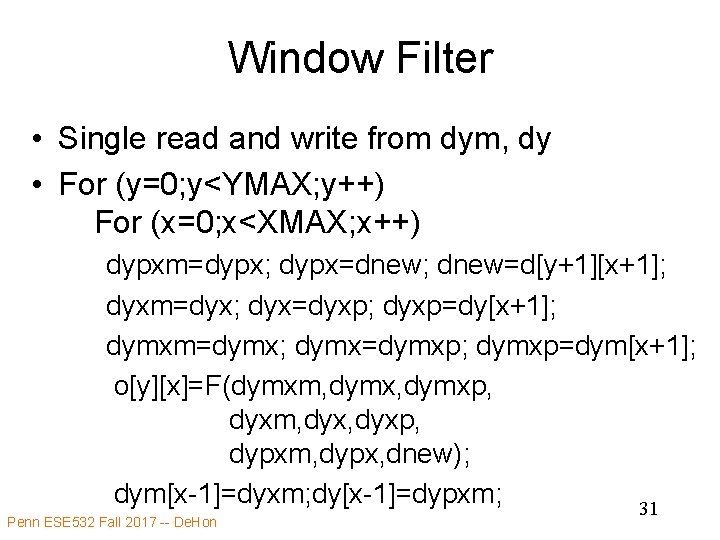
Window Filter • Single read and write from dym, dy • For (y=0; y<YMAX; y++) For (x=0; x<XMAX; x++) dypxm=dypx; dypx=dnew; dnew=d[y+1][x+1]; dyxm=dyx; dyx=dyxp; dyxp=dy[x+1]; dymxm=dymx; dymx=dymxp; dymxp=dym[x+1]; o[y][x]=F(dymxm, dymxp, dyxm, dyxp, dypxm, dypx, dnew); dym[x-1]=dyxm; dy[x-1]=dypxm; 31 Penn ESE 532 Fall 2017 -- De. Hon
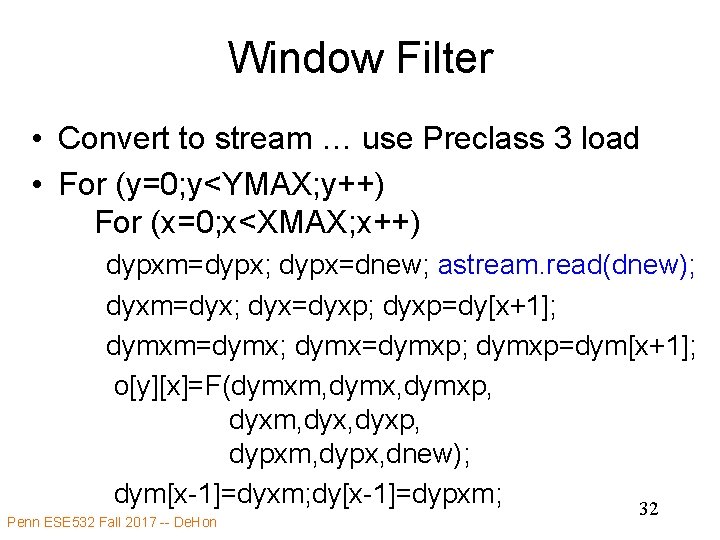
Window Filter • Convert to stream … use Preclass 3 load • For (y=0; y<YMAX; y++) For (x=0; x<XMAX; x++) dypxm=dypx; dypx=dnew; astream. read(dnew); dyxm=dyx; dyx=dyxp; dyxp=dy[x+1]; dymxm=dymx; dymx=dymxp; dymxp=dym[x+1]; o[y][x]=F(dymxm, dymxp, dyxm, dyxp, dypxm, dypx, dnew); dym[x-1]=dyxm; dy[x-1]=dypxm; 32 Penn ESE 532 Fall 2017 -- De. Hon
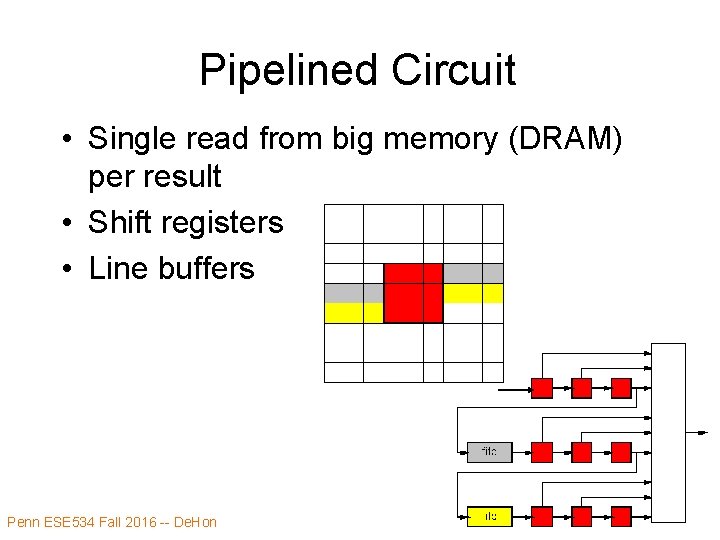
Pipelined Circuit • Single read from big memory (DRAM) per result • Shift registers • Line buffers Penn ESE 534 Fall 2016 -- De. Hon 33
Multiple Filters • What if want to run multiple filters? • for (f=0; f<FMAX; f++) for (y=0; y<YMAX; y++) for (x=0; x<XMAX; x++) o[f][y][x]=fun[f](d[y-1][x-1], d[y-1][x+1], d[y][x-1], d[y][x+1], d[y+1][x-1], d[y+1][x+1]); • Forces multiple reads through d • Avoidable? Penn ESE 532 Fall 2017 -- De. Hon 34
Sort Penn ESE 532 Fall 2017 -- De. Hon 35
Sort • Order data – 73421980 01234789 • Data movement can be challenging – Last value may become first (vice-versa) – Especially when not fit in small memories • Many sequential sort solutions access data irregularly – Want to avoid with DRAM Penn ESE 532 Fall 2017 -- De. Hon 36
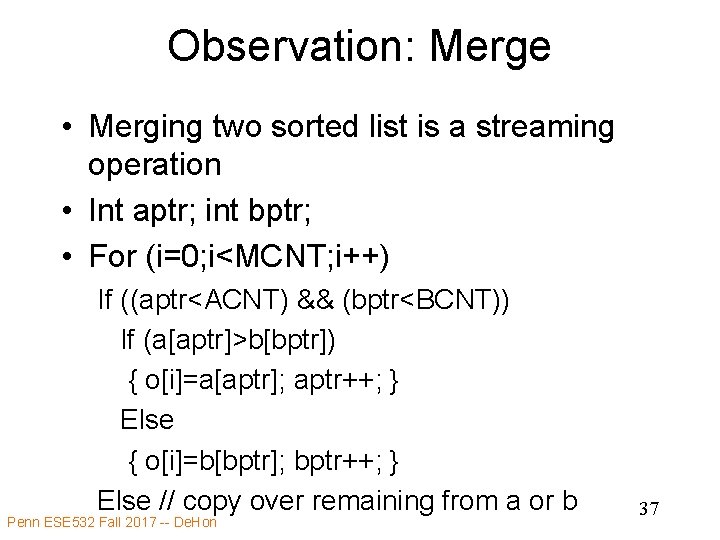
Observation: Merge • Merging two sorted list is a streaming operation • Int aptr; int bptr; • For (i=0; i<MCNT; i++) If ((aptr<ACNT) && (bptr<BCNT)) If (a[aptr]>b[bptr]) { o[i]=a[aptr]; aptr++; } Else { o[i]=b[bptr]; bptr++; } Else // copy over remaining from a or b Penn ESE 532 Fall 2017 -- De. Hon 37
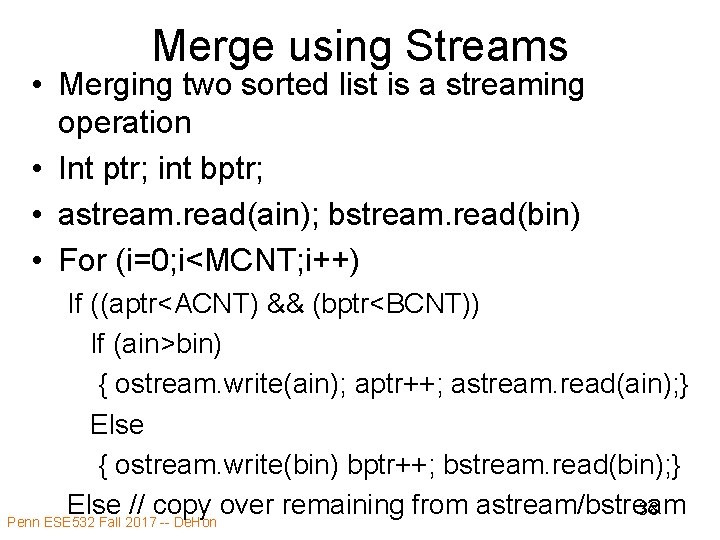
Merge using Streams • Merging two sorted list is a streaming operation • Int ptr; int bptr; • astream. read(ain); bstream. read(bin) • For (i=0; i<MCNT; i++) If ((aptr<ACNT) && (bptr<BCNT)) If (ain>bin) { ostream. write(ain); aptr++; astream. read(ain); } Else { ostream. write(bin) bptr++; bstream. read(bin); } Else // copy over remaining from astream/bstream 38 Penn ESE 532 Fall 2017 -- De. Hon
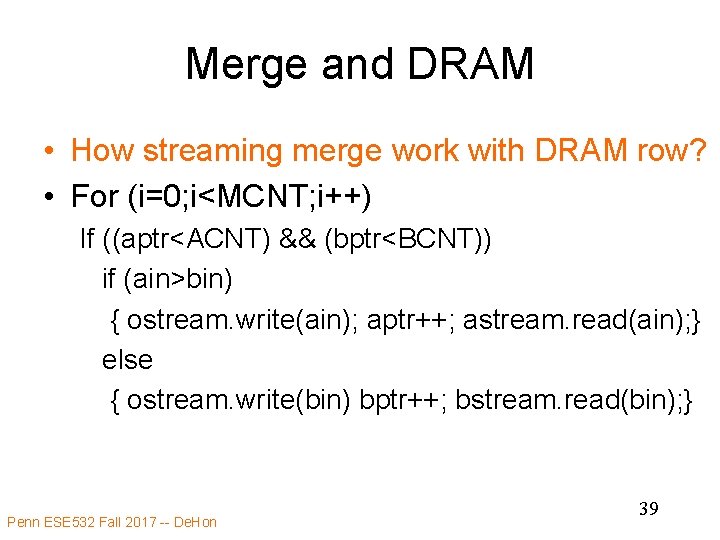
Merge and DRAM • How streaming merge work with DRAM row? • For (i=0; i<MCNT; i++) If ((aptr<ACNT) && (bptr<BCNT)) if (ain>bin) { ostream. write(ain); aptr++; astream. read(ain); } else { ostream. write(bin) bptr++; bstream. read(bin); } Penn ESE 532 Fall 2017 -- De. Hon 39
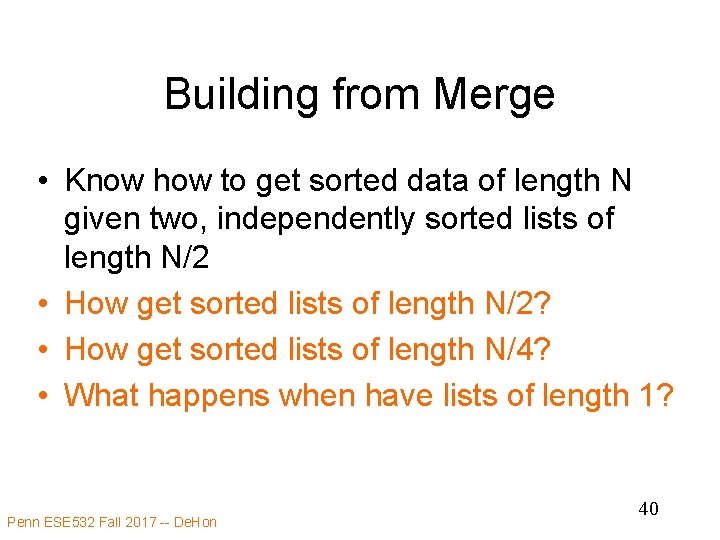
Building from Merge • Know how to get sorted data of length N given two, independently sorted lists of length N/2 • How get sorted lists of length N/2? • How get sorted lists of length N/4? • What happens when have lists of length 1? Penn ESE 532 Fall 2017 -- De. Hon 40
Merge Sort • Strategy – For i=1 to passes • Pass over data creating merged sequences of length 2 i from pairs of length 2 i-1 – What is passes? • Can, at least, limit to passes reads through data from large memory. Penn ESE 532 Fall 2017 -- De. Hon 41
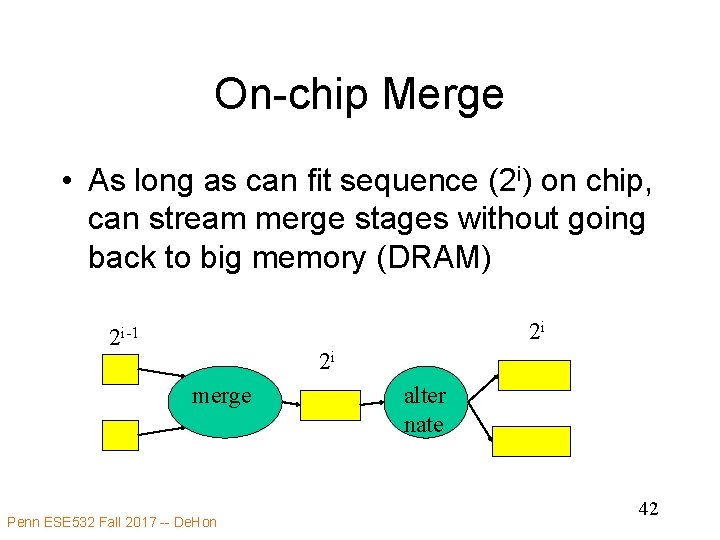
On-chip Merge • As long as can fit sequence (2 i) on chip, can stream merge stages without going back to big memory (DRAM) 2 i 2 i-1 2 i merge Penn ESE 532 Fall 2017 -- De. Hon alter nate 42
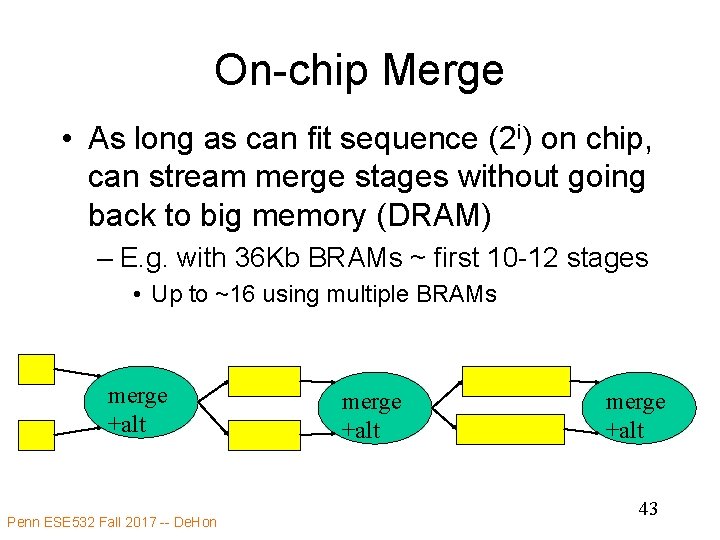
On-chip Merge • As long as can fit sequence (2 i) on chip, can stream merge stages without going back to big memory (DRAM) – E. g. with 36 Kb BRAMs ~ first 10 -12 stages • Up to ~16 using multiple BRAMs merge +alt Penn ESE 532 Fall 2017 -- De. Hon merge +alt 43
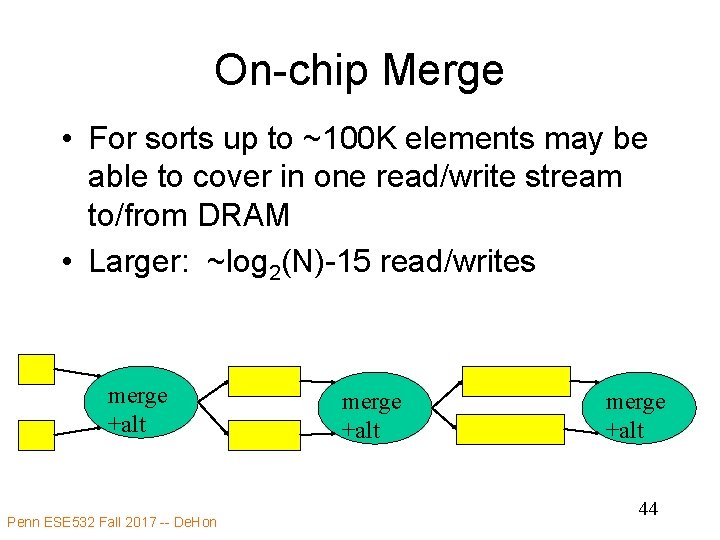
On-chip Merge • For sorts up to ~100 K elements may be able to cover in one read/write stream to/from DRAM • Larger: ~log 2(N)-15 read/writes merge +alt Penn ESE 532 Fall 2017 -- De. Hon merge +alt 44

Big Ideas • Must pay attention to orchestrate data movement – How we access and reuse data • Minimize use of large memories • Regular access to large memories higher performance – Easier to get bandwidth on wide-word reads Penn ESE 532 Fall 2017 -- De. Hon 45
Admin • Reading for Monday on web • HW 5 due Friday • HW 6 out – Does into 8 full FPGA builds – Plan for that build time Penn ESE 532 Fall 2017 -- De. Hon 46
- Slides: 46