Chapter Focus Section 1 President and Vice President


- Slides: 134
Chapter Focus Section 1 President and Vice President Section 2 Electing the President Section 3 The Cabinet Section 4 The Executive Office Chapter Assessment
Chapter Objectives • President and Vice President Describe the requirements for the office of president and the role of the vice president. • Electing the President Discuss the historical foundations of the Electoral College and its advantages and disadvantages. • The Cabinet Evaluate how politics influences cabinet appointments and relationships. • The Executive Office Describe the components of the Executive Office of the President.
President and Vice President Key Terms compensation, presidential succession Find Out • What qualifications for the office of president do you think are most necessary for carrying out the duties of the office? • What are the constitutional provisions for filling the executive office if the president is unable to perform those duties?
President and Vice President Understanding Concepts Growth of Democracy Why are personal qualities of candidates for president more demanding than the constitutional qualifications? Section Objective Describe the requirements for the office of president and the role of the vice president.
Getting elected is expensive. For example, after the presidential election of 1996, it was revealed that both parties had raised many millions of dollars in campaign funds from sources in other countries. Many members of Congress argued that the laws governing campaign financing needed to be reformed. The Bipartisan Campaign Reform Act of 2000 was an effort to reform campaign fundraising.
I. Duties of the President (pages 213– 214) A. Presidents have enormous power and responsibility in government. B. Presidents make sure the national laws are fully executed; serve as commander in chief of the armed forces; appoint top officials, federal judges, and ambassadors; and meet with heads of foreign governments.
I. Duties of the President (pages 213– 214) Compare the president’s duties in foreign policy with his duties in domestic policy. For a list of foreign and domestic policy responsibilities, see text pages 213– 214.
II. President’s Term and Salary (pages 214– 215) A. The Twenty-second Amendment limited presidents to two terms. B. Congress determines the president’s salary ($400, 000 beginning in 2001); in addition, many benefits are provided for presidents while in office and in retirement.
II. President’s Term and Salary (pages 214– 215) Why are so many benefits available to presidents while they are in office? Because of a president’s travel and security costs plus many other official expenses.
III. Presidential Qualifications (pages 215– 217) A. The Constitution sets several requirements for the president: 1. a candidate must be a natural-born citizen; 2. at least 35 years old; 3. a resident of the United States for 14 years. B. Experience in government is an unwritten but important qualification.
III. Presidential Qualifications (pages 215– 217) C. Candidates for office must have access to sources for raising large amounts of money in the presidential election campaign. D. Successful presidential candidates usually hold moderate political beliefs. E. Most presidents have shared similar backgrounds—ethnic, economic, racial, and gender. F. Being president underscores personal strengths and weaknesses.
III. Presidential Qualifications (pages 215– 217) What do you consider the most important qualification for the office of president? Explain. Answers will vary. Students should be aware of the responsibilities of the office.
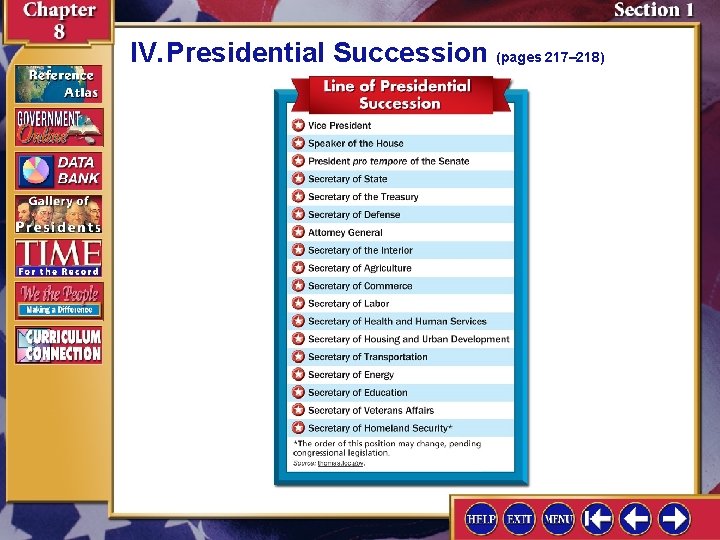
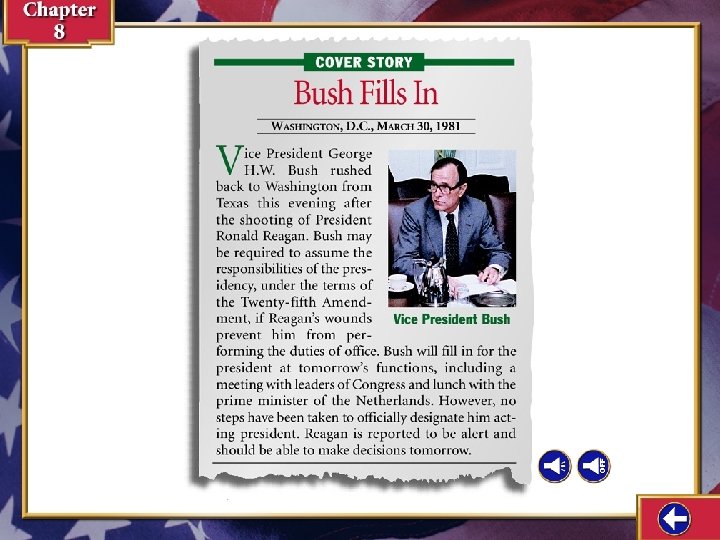
IV. Presidential Succession (pages 217– 218) A. The Twenty-fifth Amendment established the order of succession to the presidency (vice president, Speaker of the House, president pro tempore of the Senate, secretary of state, other cabinet members) and spelled out what happens when the vice presidency is vacant. B. The Twenty-fifth Amendment also set forth rules to be followed if a president becomes disabled.
IV. Presidential Succession (pages 217– 218)
IV. Presidential Succession (pages 217– 218) In 1967 why was the Twenty-fifth Amendment added to the Constitution? President Kennedy’s assassination helped show that the rules for succession were inadequate.
V. The Vice President’s Role (pages 218– 219) A. The vice president’s work depends on what jobs, if any, the president assigns. B. Although presidents before Eisenhower generally ignored their vice presidents, presidents since then have tried to give their vice presidents more responsibility.
V. The Vice President’s Role (pages 218– 219) Why have recent presidents tried to give their vice presidents more responsibility? Answers may include: to promote them as future presidential candidates, to use their expertise, to prepare them for the highest office.
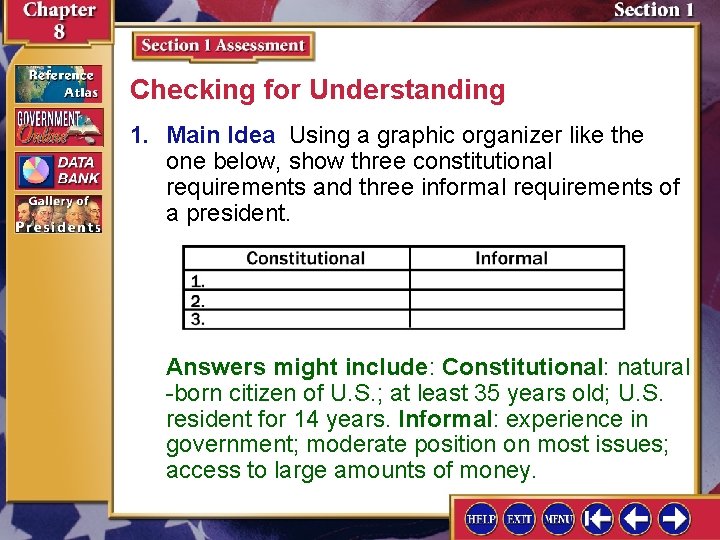
Checking for Understanding 1. Main Idea Using a graphic organizer like the one below, show three constitutional requirements and three informal requirements of a president. Answers might include: Constitutional: natural -born citizen of U. S. ; at least 35 years old; U. S. resident for 14 years. Informal: experience in government; moderate position on most issues; access to large amounts of money.
Checking for Understanding Fill in the blank with the correct term. 1. Compensation ______ refers to a person’s salary. 2. __________ is the order in which Presidential succession officials fill the office of president in case of a vacancy.
Checking for Understanding 3. Identify Twenty-second Amendment, Twentyfifth Amendment. The Twenty-second Amendment is the amendment that secured the traditional presidential limitation of two terms, while allowing a vice president who takes over the presidency and serves two years or less of the former president’s terms to serve two additional terms. The Twenty-fifth Amendment is the amendment that established the order of succession to the presidency and spelled out what happens when the vice presidency becomes vacant.
Checking for Understanding 4. Who are the first four officers in the line of succession to the presidency? The first four officers in the line of succession to the presidency are the vice president, Speaker of the House, president pro tempore of the Senate, and secretary of state.
Critical Thinking 5. Drawing Conclusions Why do you think presidential candidates who represent moderate views usually win elections? Answers will vary but should point out that most voters hold moderate views; if candidates express extreme views, they may isolate themselves from the majority of voters.
Growth of Democracy Conduct a survey using the following questions: In your opinion, when will the United States have its first female president? Its first minority president? Tabulate the results on graphs and display them in class.
Electing the President Key Terms elector, electoral vote Find Out • What evidence suggests that the Founders did not anticipate the effects of political parties on presidential elections? • Based on the historical record of elections, how well has the Electoral College performed in selecting presidents the nation wanted?
Electing the President Understanding Concepts Constitutional Interpretations How has the method of electing a president changed to make the process more democratic? Section Objective Discuss the historical foundations of the Electoral College and its advantages and disadvantages.
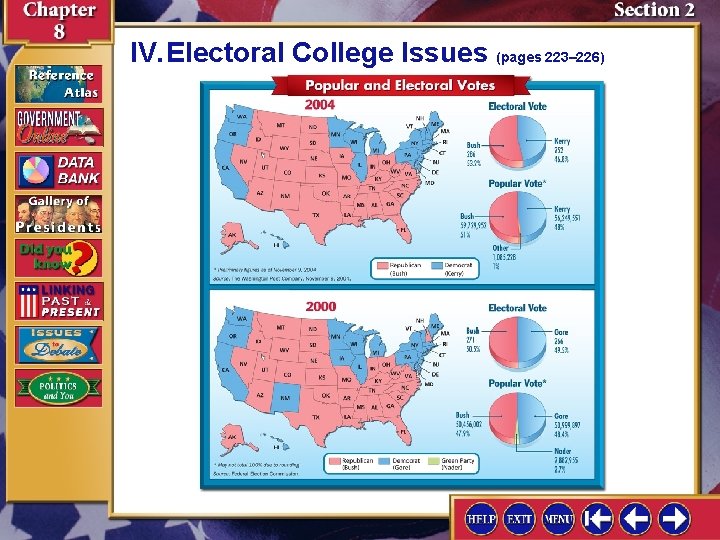
In the presidential election of 1992, thirdparty candidate Ross Perot received 19. 7 million popular votes. President George Bush received 39. 1 million popular votes, and the winning candidate, Democrat Bill Clinton, received 44. 9 million popular votes. The results in the electoral college vote, however, were very different. Ross Perot did not win a single electoral vote, while Clinton received 370 electoral votes and Bush, 168 electoral votes.
I. The Original System (pages 220– 221) A. Article II, Section 1, of the Constitution provided that the candidate receiving the majority of the electoral votes became the president. B. The candidate with the second-highest number of votes became vice president.
I. The Original System (pages 220– 221) What political problem could result from the vice president being the person with the second-highest electoral vote? The vice president may be a political foe of the president.
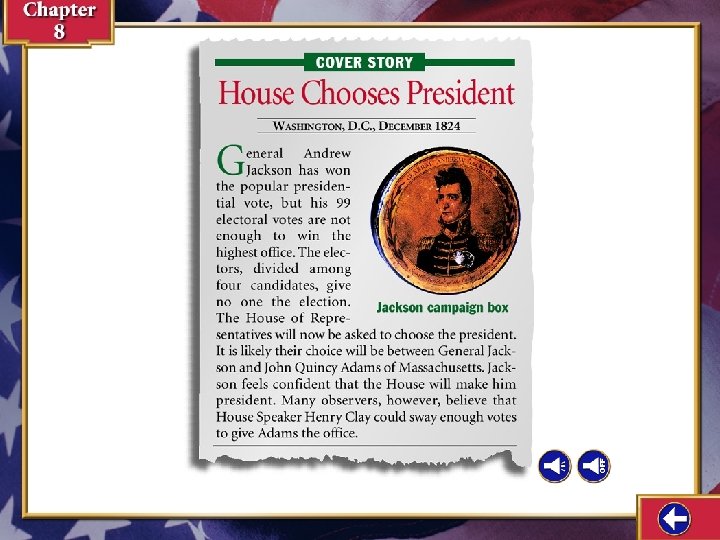
II. The Impact of Political Parties (page 221) A. The election of 1800 was decided by the House of Representatives. B. To prevent a tie vote for president in the Electoral College, the Twelfth Amendment, added to the Constitution in 1804, provided that electors must cast separate ballots for president and vice president.
II. The Impact of Political Parties (page 221) Delegates to the Constitutional Convention did not anticipate political parties. Should they have? Answers will vary. Division of opinion was apparent during the struggle for ratification.
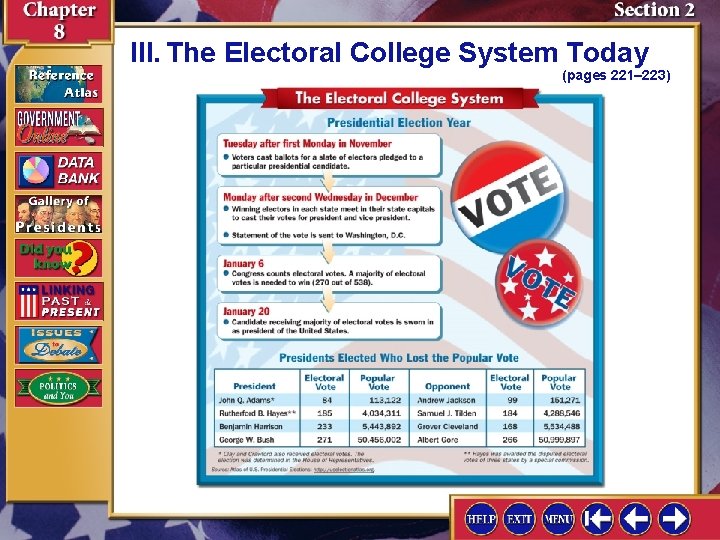
III. The Electoral College System Today (pages 221– 223) A. The Electoral College is still used to choose the president and vice president. B. The College uses a winner-take-all system; all of a state’s (except Maine and Nebraska) electoral votes go to the candidate receiving the largest popular vote. C. The Electoral College vote is cast in December.
III. The Electoral College System Today (pages 221– 223)
III. The Electoral College System Today (pages 221– 223) Should an elector be required to vote for the candidate who won that state’s popular vote? Explain. Answers will vary. “Faithless electors” have never changed election results.
IV. Electoral College Issues (pages 223– 226) A. Critics say that the Electoral College’s winner-take-all system is unfair. B. The Electoral College system also makes it possible for a candidate who loses the total popular vote to win the electoral vote. C. A third-party candidate could win enough electoral votes to prevent either major party candidate from receiving a majority in the Electoral College.
IV. Electoral College Issues (pages 223– 226) D. When the House of Representatives must decide a presidential election, it may face several serious problems. E. Critics of the electoral system have offered suggestions to improve it. F. Other critics believe the Electoral College should be replaced with direct election of the president and vice president.
IV. Electoral College Issues (pages 223– 226)
IV. Electoral College Issues (pages 223– 226) Do you agree or disagree with critics who argue that the Electoral College system should be abolished? Explain. Answers will vary. See discussion of this issue on text pages 223– 225.
V. The Inauguration (page 226) A. The new president is sworn into office in an inauguration ceremony. B. All leading officials from the three branches of government attend the January ceremony.
V. The Inauguration (page 226) Are elaborate inauguration ceremonies desirable? Explain. They are a celebration of democracy and the achievements of a political party and its candidates.
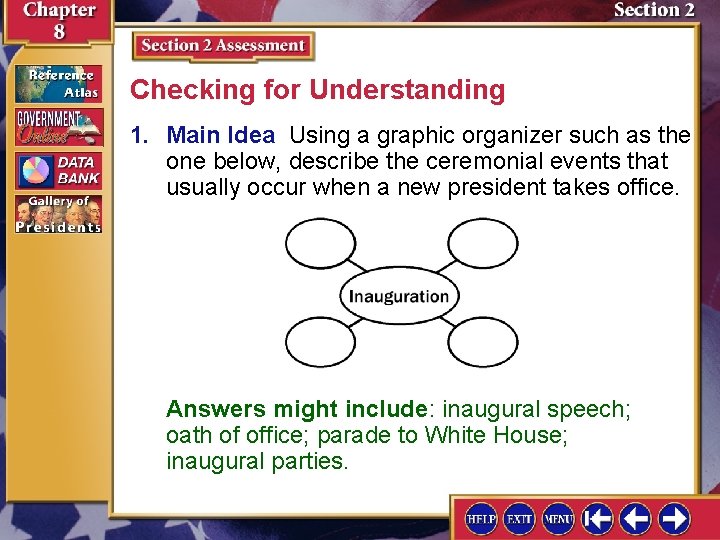
Checking for Understanding 1. Main Idea Using a graphic organizer such as the one below, describe the ceremonial events that usually occur when a new president takes office. Answers might include: inaugural speech; oath of office; parade to White House; inaugural parties.
Checking for Understanding Fill in the blank with the correct term. 1. A(n) ______ is a member of a party chosen in elector each state to formally elect the president and vice president. 2. electoral vote A(n) ______ is the official vote for president and vice president by electors in each state.
Checking for Understanding 3. Identify Electoral College, Twelfth Amendment. The Electoral College is an indirect method of election whereby a group of representatives from each state elect the president and vice president. The Twelfth Amendment is an amendment that requires electors to cast separate ballots for president and vice president.
Checking for Understanding 4. Why do presidential candidates spend more time in states with large populations? States with large populations have more electoral votes, and the candidate with the most popular votes wins all that state’s electoral votes.
Checking for Understanding 5. What does the phrase “winner take all” mean in presidential elections? The party whose candidate wins the most popular votes in a state takes all of that state’s electoral votes.
Critical Thinking 6. Determining Relevance In judging the Electoral College, how important is it to know that on several occasions an elector broke with custom and voted independently? Answers should point out that in most states, electors are not bound to vote for the winner of the popular vote and therefore can affect the election outcome if enough electors break with custom.
Constitutional Interpretations Imagine that you are a member of an interest group. Choose a position for your group: keep the Electoral College, or abolish it. Then write a persuasive speech explaining your position.
The Electoral College Key Terms cabinet, leak Find Out • What role does politics play in the appointment of cabinet secretaries? • How have factors that limit the role of the cabinet as an advisory body affected the relationship between cabinet officers and the presidents they serve?
The Electoral College Understanding Concepts Political Processes Why are cabinet secretaries who administer large executive departments often not insiders at the White House? Section Objective Evaluate how politics influences cabinet appointments and relationships.
A liberal magazine opposed to President Eisenhower’s conservative policies also criticized his cabinet. It said the cabinet was made up of” eight millionaires and a plumber. ” In fact, the “plumber” was president of the plumbers union, and the “millionaires” were successful executives from well-known businesses and major corporations. Since then, of course, presidents have picked many other wealthy cabinet members with business backgrounds.
I. The Selection of the Cabinet (pages 228– 230) A. The president must consider many factors in selecting the members of the cabinet. B. The president must consider whether potential cabinet members’ backgrounds suit their cabinet posts, whether they bring geographical balance to the cabinet, whether they satisfy interest groups, whether they have high-level administrative skills, and whether they include ethnic and racial minorities and women.
I. The Selection of the Cabinet (pages 228– 230) C. Cabinet members today usually are college graduates and leaders in various professional fields. D. The Senate must approve cabinet appointees, and it usually does so out of courtesy to the president.
I. The Selection of the Cabinet (pages 228– 230) What are some advantages and disadvantages in selecting cabinet members who provide geographical, racial, and gender balance? Advantages: serving political and fairness issues. Disadvantages: qualifications for the position and personal preferences of presidents.
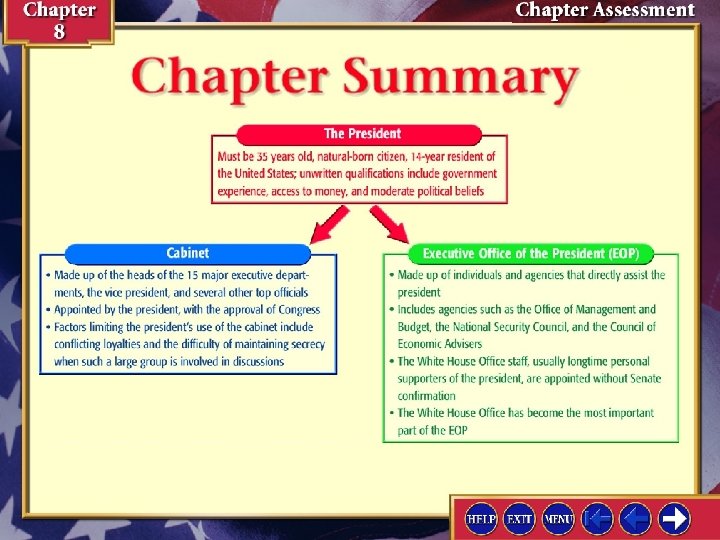
II. The Role of the Cabinet (pages 230– 232) A. Cabinet members are heads of the executive departments. B. The cabinet’s role has always been determined by the president. C. Modern presidents usually have not depended on the cabinet for advice in decision making but have turned to White House staff and close friends as their advisors. D. Certain cabinet members—the secretaries of state, defense, and treasury, plus the attorney general—form the “inner cabinet” and influence the president’s decisions on matters related to their departments’ areas of interest.
II. The Role of the Cabinet (pages 230– 232) Do you think the president might benefit from having a smaller cabinet? A larger cabinet? Explain. Answers will vary. Students should balance need for expertise and manageability.
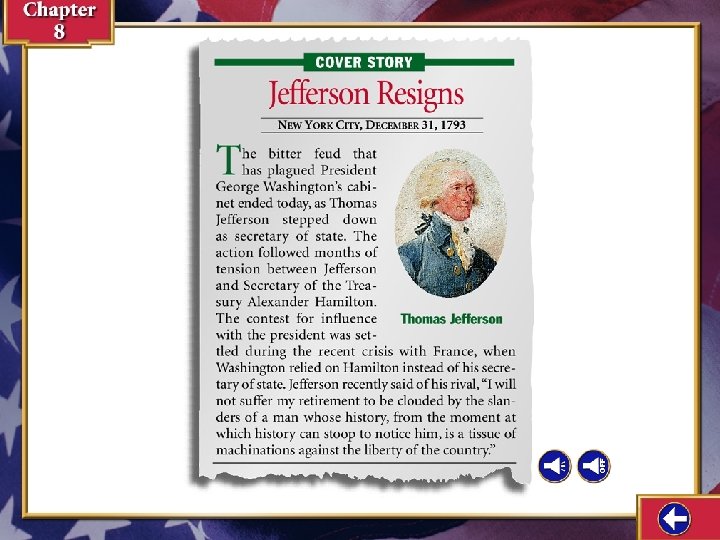
III. Factors Limiting the Cabinet’s Role (page 232) A. The president does not command the full loyalty of cabinet members, even though he appoints them. B. Cabinet members are pressured by career officials in their departments, interest groups, and members of Congress. This pressure may result in disagreements within the cabinet over the president’s policies and plans.
III. Factors Limiting the Cabinet’s Role (page 232) C. With 14 cabinet members, it is difficult to maintain secrecy in matters the president considers sensitive. D. The president may not know and trust all the members of the cabinet because the president must weigh so many factors in appointing them.
III. Factors Limiting the Cabinet’s Role (page 232)
III. Factors Limiting the Cabinet’s Role (page 232) Do you think the president should appoint to cabinet positions people he knows and trusts or relative strangers who have specialized expertise? Explain. Answers will vary, depending on how the students perceive the president’s use of the cabinet.
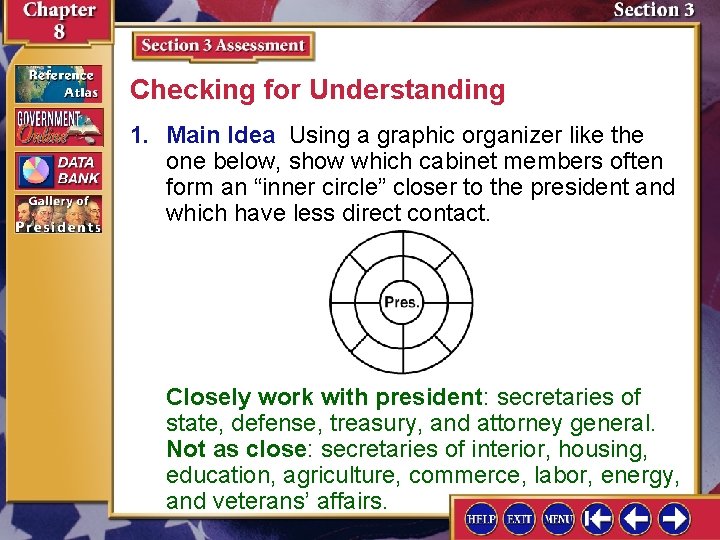
Checking for Understanding 1. Main Idea Using a graphic organizer like the one below, show which cabinet members often form an “inner circle” closer to the president and which have less direct contact. Closely work with president: secretaries of state, defense, treasury, and attorney general. Not as close: secretaries of interior, housing, education, agriculture, commerce, labor, energy, and veterans’ affairs.
Checking for Understanding 2. Define cabinet, leak. A cabinet are secretaries of the executive departments, the vice president, and other top officials that help the president make decisions and policy. A leak is the release of secret information by anonymous government officials to the media.
Checking for Understanding 3. Identify Robert Weaver, Frances Perkins. Robert Weaver was the first African-American department secretary, appointed by President Lyndon Johnson to lead HUD. Frances Perkins was the first woman named to a president’s cabinet, appointed by President Franklin D. Roosevelt as the Secretary of Labor.
Checking for Understanding 4. What five factors do presidents consider when choosing cabinet officers? When naming cabinet officers, presidents consider compatible background; geographic balance; acceptability to interest groups; highlevel administrative skills and experience; race, ethnic, and gender balance; and party loyalty.
Checking for Understanding 5. Explain how the decline of the cabinet as an advisory body to the president weakens the system of checks and balances. It reduces Congress’s ability to influence presidential policy making by eliminating its control of the cabinet through its oversight, appropriations, and confirmation powers.
Critical Thinking 6. Identifying Alternatives What could a president do when choosing cabinet members to increase their value as advisers? Answers will vary, but should address the politics of the selection process and suggest that personal ties and loyalty be a bigger factor in selection.
Political Processes Search library resources for information about the major responsibilities of one of the 15 executive departments. Then prepare a list of interview questions that you think would help to determine the competence of a potential secretary of the executive department you chose.
The Executive Office Key Terms central clearance, national security adviser, press secretary Find Out • What historic changes have made the Executive Office of the President necessary? • In what ways are the members of the White House Office similar to and different from the president’s cabinet?
The Executive Office Understanding Concepts Political Processes Who are among the president’s closest advisers on administration policy? Section Objective Describe the components of the Executive Office of the President.
President Clinton’s press secretary appeared before reporters with a paper bag over his head in the fall of 1997. Mike Mc. Curry, Clinton’s press secretary and a key member of the White House staff, did this as a joke to get reporters in a good mood. Why? The president’s press secretary works hard to present the president’s views, and he wants representatives from the media to report them as favorably as possible. Establishing a rapport with reporters is part of the press secretary’s job.
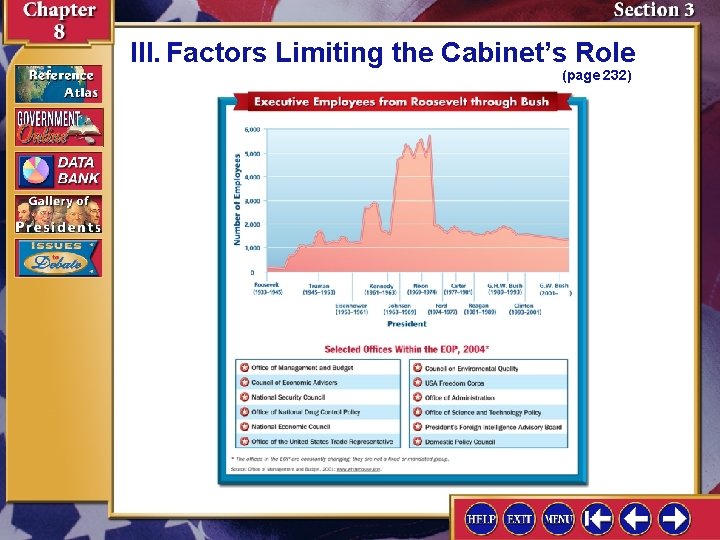
I. Executive Office Agencies (pages 234– 238) A. The Executive Office of the President (EOP) was created in 1939 by Congress. B. The EOP has grown rapidly for three reasons: 1. presidents keep adding new agencies to it as problems arise; 2. presidents want experts nearby to advise them about complex issues; 3. federal programs sometimes require special staff to coordinate the efforts of several executive departments and other agencies working together.
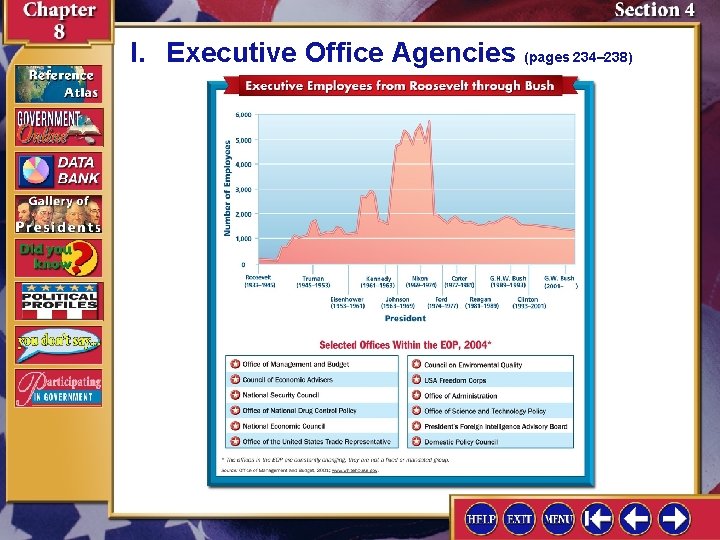
I. Executive Office Agencies (pages 234– 238) C. The Office of Management and Budget (OMB) is the largest agency in the EOP; it prepares the national budget that the president submits to Congress each year. D. The National Security Council advises the president and helps coordinate the nation’s military and foreign policy. E. The Council of Economic Advisers helps the president formulate the nation’s economic policy. F. Presidents add and sometimes eliminate agencies to the EOP to help carry out policy.
I. Executive Office Agencies (pages 234– 238)
I. Executive Office Agencies (pages 234– 238) Compare the duties of the Office of Management and Budget with those of the Council of Economic Advisers. See text pages 236– 237.
II. The White House Office (pages 238– 239) A. The president appoints White House staff without Senate confirmation. B. The White House Office has become the most important part of the Executive Office of the President.
II. The White House Office (pages 238– 239) C. The White House staff perform whatever duties the president assigns them: 1. gathering information and providing advice on key issues; 2. ensuring that executive departments and agencies carry out key directives from the president; 3. presenting the president’s views to the outside world; 4. deciding who and what information gets through to the president.
II. The White House Office (pages 238– 239) How does the increased size of the White House staff reflect the growing responsibilities of the presidency? Staffers handle many responsibilities such as overseeing agencies, addressing political issues, etc.
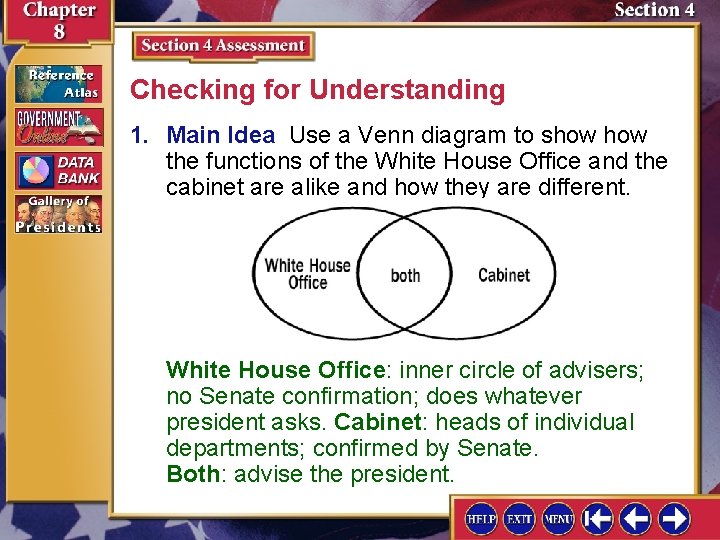
Checking for Understanding 1. Main Idea Use a Venn diagram to show the functions of the White House Office and the cabinet are alike and how they are different. White House Office: inner circle of advisers; no Senate confirmation; does whatever president asks. Cabinet: heads of individual departments; confirmed by Senate. Both: advise the president.
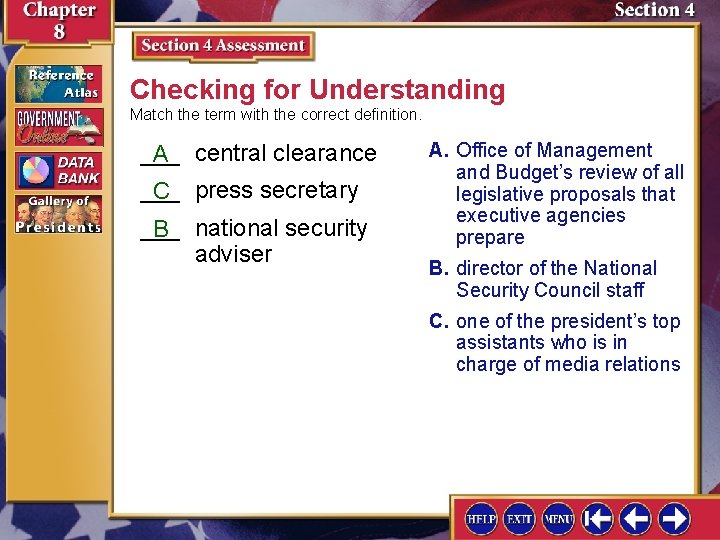
Checking for Understanding Match the term with the correct definition. ___ A central clearance ___ C press secretary ___ B national security adviser A. Office of Management and Budget’s review of all legislative proposals that executive agencies prepare B. director of the National Security Council staff C. one of the president’s top assistants who is in charge of media relations
Checking for Understanding 3. Identify EOP, OMB, NSC. The Executive Office of the President, or EOP, consists of individuals and agencies that directly assist the president. The Office of Management and Budget, or OMB, is the largest agency of the EOP and is responsible for preparing the national budget that the president proposes to Congress each year. The National Security Council, or NSC, advises the president and helps coordinate American military and foreign policy.
Checking for Understanding 4. List three reasons why the EOP has grown. Each president has reorganized it; presidents wanted experts to advise them on complex issues; huge federal programs required several executive agencies.
Checking for Understanding 5. What are three oldest agencies in the EOP, and what roles do they play? OMB: reviews executive agencies’ budgets, prepares national budget; Council of Economic Advisers: coordinates military and foreign policy; National Economic Council: assesses current and future economic conditions, advises president.
Critical Thinking 6. Synthesizing Information How does the influence of key presidential aides affect the checks and balances established by the Constitution? The growing power of appointees reduces Congress’s influence over presidential decision making.
Political Processes Find out who the following presidential advisers are: chief of staff, deputy chief of staff, White House counsel, and press secretary. Research the background of each adviser and present your findings in a chart.
Reviewing Key Terms Fill in the blank with the correct term listed below. compensation central clearance elector leak electoral vote cabinet presidential succession national security adviser press secretary Presidential succession 1. ___________ is the order in which officials fill the office of president in case of a vacancy. Compensation 2. __________ is a salary. elector 3. A(n) __________ is a member of a party chosen in each state to formally elect the president and vice president. cabinet 4. The __________ are secretaries of the executive departments, the vice president, and other top officials who help the president make decisions and policy. press secretary 5. A(n) __________ is one of the president’s top assistants who is in charge of media relations.
Reviewing Key Terms Fill in the blank with the correct term listed below. compensation central clearance elector leak electoral vote cabinet presidential succession national security adviser press secretary leak 6. A(n) __________ is the release of secret information by anonymous government officials to the media. 7. __________ is the Office of Management and Central clearance Budget’s review of all legislative proposals that executive agencies prepare. 8. The ___________ is the director of the national security adviser National Security Council staff. electoral vote 9. The __________ is the official vote for president and vice president by electors in each state.
Recalling Facts 1. List four special benefits that the president receives while in office. Any four: use of Air Force One and other transportation; free medical, dental and health care; use of White House with free entertainment; use of White House staff, free office space; free mailing services; funds for office help. 2. How does the winner-take-all system of the Electoral College operate? The candidate who wins the most popular votes in a state wins all of that state’s electoral votes.
Recalling Facts 3. What is the process by which cabinet members are selected and appointed? Key presidential aides screen candidates and make recommendations to the president. The president selects a nominee and sends that name to the Senate, which holds hearings with testimony for and against the nominee. The Senate votes and most often confirms the nominee.
Recalling Facts 4. What are the two major functions of the Office of Management and Budget? The two major functions are to prepare the president’s budget proposals and review legislation proposed by executive departments and agencies for compliance with president’s policies. 5. What are the four key positions on the White House Office staff? The four key positions are chief of staff, deputy chief of staff, White House counsel, and press secretary.
Understanding Concepts 1. Growth of Democracy Why do some people criticize plans for the direct popular election of the president? It eliminates the role of the states, thus undermining federalism, and forces candidates to concentrate their efforts in densely populated areas.
Understanding Concepts 2. Constitutional Interpretations The youngest elected president was John Kennedy at 43. Why do you think the Framers of the Constitution in 1787 set the minimum age for president at 35? Answers will vary but should point out that the Framers believed that a person was mature enough at 35 to handle the duties of the president.
Understanding Concepts 3. Political Processes Unlike heads of executive departments, White House staff members are not required to receive congressional approval. What are the advantages and disadvantages of this policy? Advantages: presidents can put together a group of advisers who are supportive and trustworthy. Disadvantages: Congress will have less control over presidential policy making, nominees do not undergo public scrutiny, it bypasses the checks and balances system.
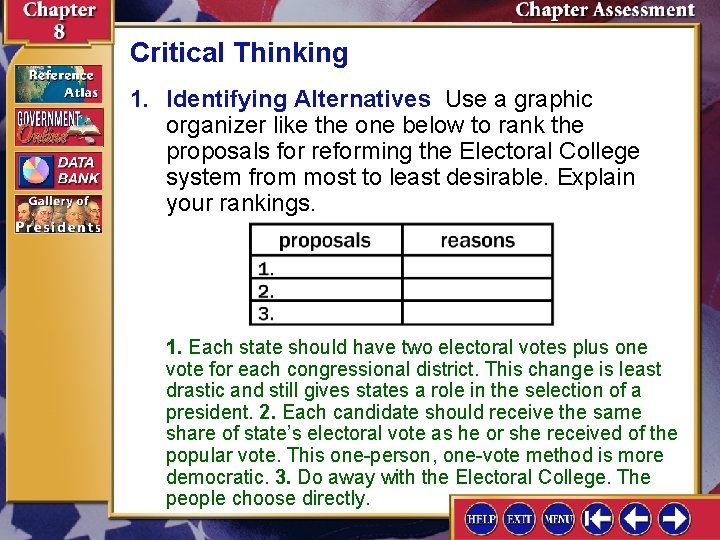
Critical Thinking 1. Identifying Alternatives Use a graphic organizer like the one below to rank the proposals for reforming the Electoral College system from most to least desirable. Explain your rankings. 1. Each state should have two electoral votes plus one vote for each congressional district. This change is least drastic and still gives states a role in the selection of a president. 2. Each candidate should receive the same share of state’s electoral vote as he or she received of the popular vote. This one-person, one-vote method is more democratic. 3. Do away with the Electoral College. The people choose directly.
Critical Thinking 2. Synthesizing Information Will a president who relies on the cabinet for advice be more or less informed than one who depends on close White House advisers? Explain your answer. Answers will vary, but should point out that the president would be exposed to ideas and influences from departments’ constituencies, debate among cabinet members, and so on. Students should defend their opinions.
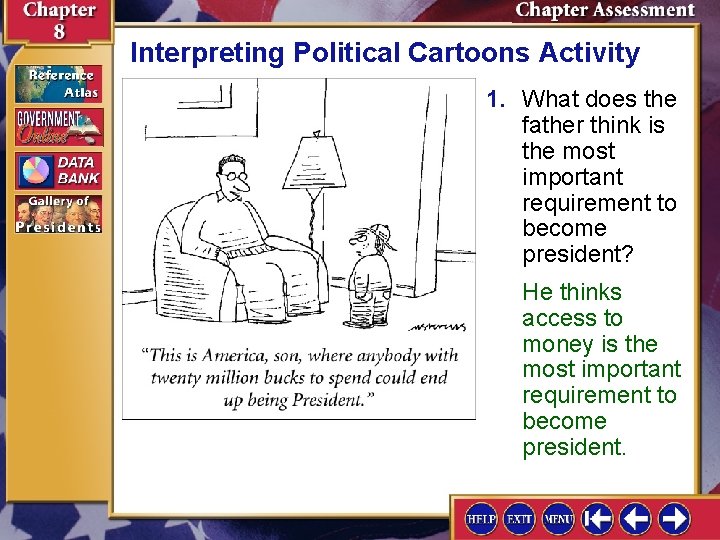
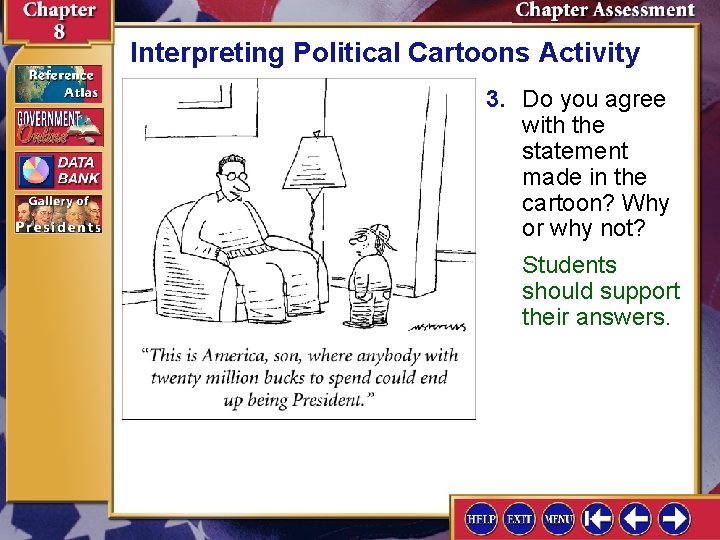
Interpreting Political Cartoons Activity 1. What does the father think is the most important requirement to become president? He thinks access to money is the most important requirement to become president.
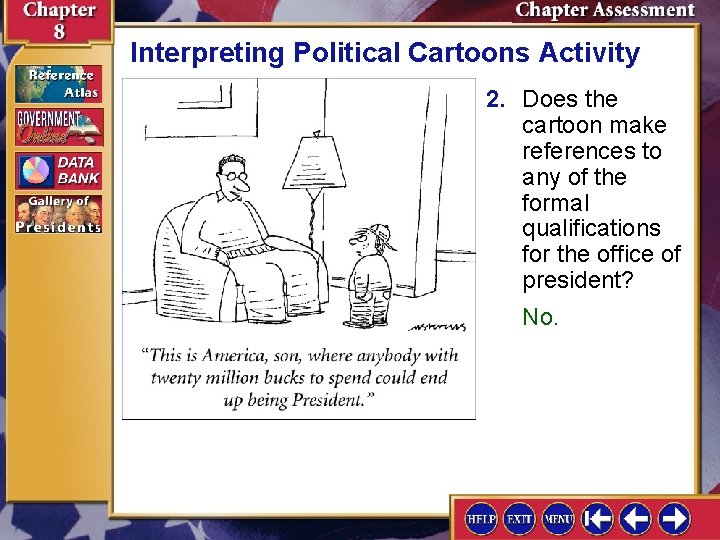
Interpreting Political Cartoons Activity 2. Does the cartoon make references to any of the formal qualifications for the office of president? No.
Interpreting Political Cartoons Activity 3. Do you agree with the statement made in the cartoon? Why or why not? Students should support their answers.
What three inaugural parades were canceled and why? 1921, by president-elect Warren Harding, out of concern for outgoing president Woodrow Wilson’s health; 1945, because of World War II; 1985, because of extremely cold weather that not only caused Ronald Reagan’s second inaugural parade to be canceled but also forced his swearing-in ceremony to be held inside the Capitol.
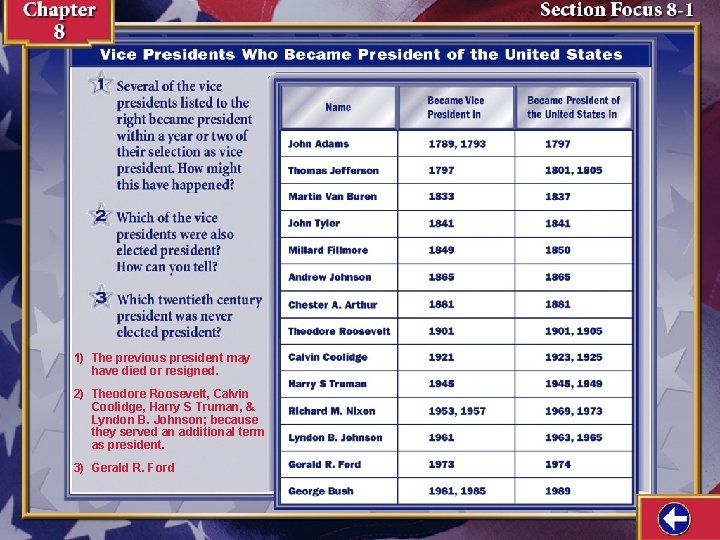
1) The previous president may have died or resigned. 2) Theodore Roosevelt, Calvin Coolidge, Harry S Truman, & Lyndon B. Johnson; because they served an additional term as president. 3) Gerald R. Ford
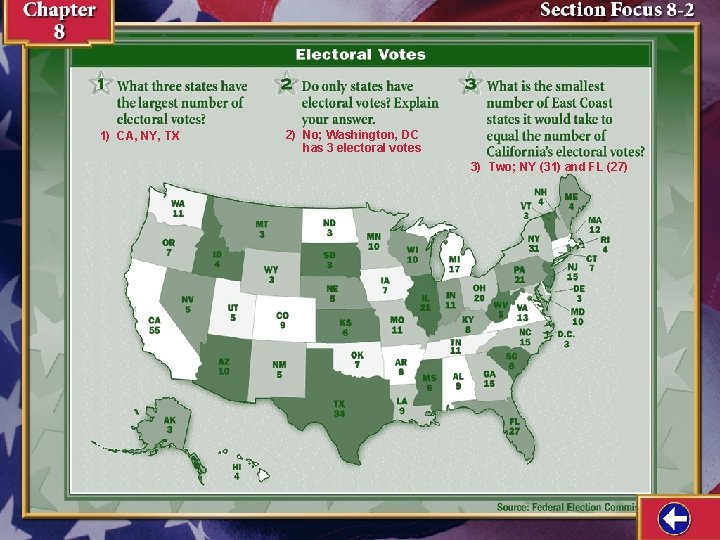
1) CA, NY, TX 2) No; Washington, DC has 3 electoral votes 3) Two; NY (31) and FL (27)
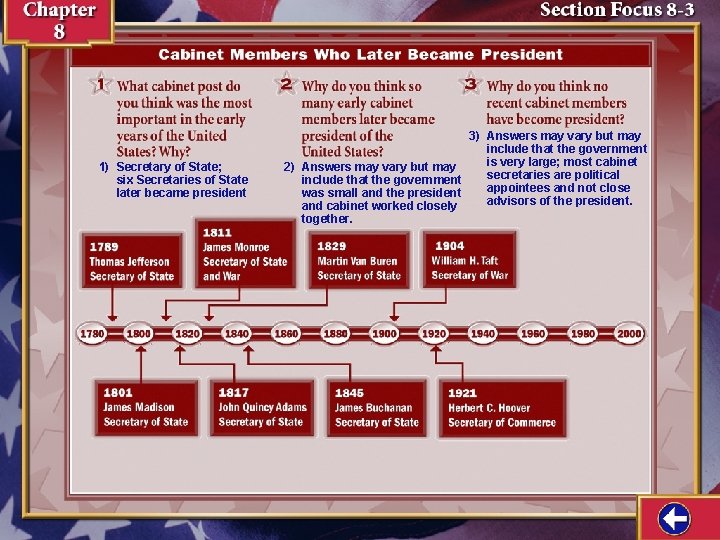
1) Secretary of State; six Secretaries of State later became president 3) Answers may vary but may include that the government is very large; most cabinet 2) Answers may vary but may secretaries are political include that the government appointees and not close was small and the president advisors of the president. and cabinet worked closely together.
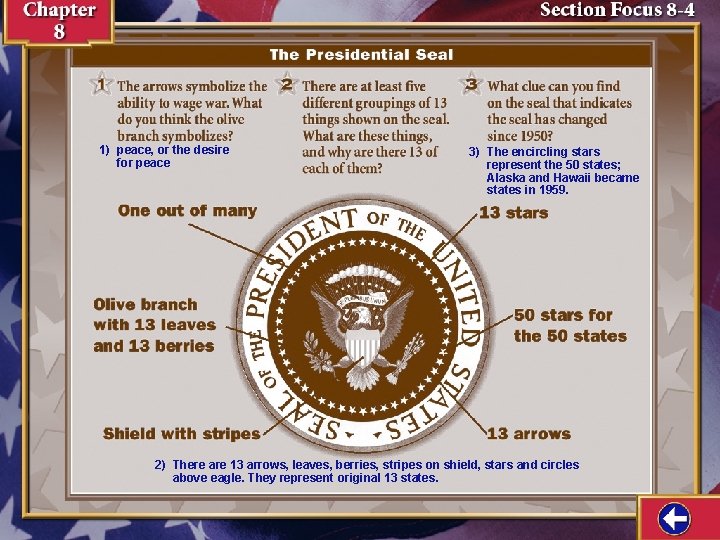
1) peace, or the desire for peace 3) The encircling stars represent the 50 states; Alaska and Hawaii became states in 1959. 2) There are 13 arrows, leaves, berries, stripes on shield, stars and circles above eagle. They represent original 13 states.
Creating a “Who’s Who” Booklet Research the people who currently hold each executive branch position mentioned in this unit. Write a brief paragraph about each official, providing background information and major accomplishments while in office. Include a picture or a drawing of each person in their “Who’s Who” booklet. Share booklets with the class.
Election by Commission The 1876 presidential election was the only time the presidency was decided by a special commission. Democrat Samuel J. Tilden won the popular vote, receiving 4, 288, 546 votes to Republican Rutherford B. Hayes’ 4, 034, 311 votes. The result was that Tilden had 184 electoral votes to Hayes’ 165, with 20 other electoral votes being contested by both parties. Tilden needed only 1 more electoral vote to capture the presidency and Hayes needed all 20. Two sets of election returns existed—one from the Democrats and one from the Republicans. Congress had to determine the authenticity of the disputed returns. Unable to decide, Congress established a 15 -member, “nonpartisan” commission, which eventually accepted the Republicans’ count giving Hayes the presidency.
Thomas Nast “Favorite Sons” First Vice President
Political cartoonist Thomas Nast popularized the donkey and elephant as national political symbols in Harper’s Weekly in the late 1870 s.
In order to prevent electors from voting only for “favorite sons” of their home state, at least one of their votes must be for a person outside their state. However, this is seldom a problem, since parties usually nominate presidential and vice-presidential candidates from different states.
The United States had its first vice president before it had its first president. John Adams took the oath of office as vice president nine days before George Washington was sworn in as president.
When Marian Anderson was denied the use of Constitution Hall for a concert because of her race, Eleanor Roosevelt arranged for her to sing at the Lincoln Memorial. The concert attracted more than 75, 000 people.
More About Rock the Vote In response to what they considered political attacks on freedom of speech and artistic expression, members of the recording industry founded Rock the Vote in 1990. This group focused on registering young people to vote and getting them to participate in the political process. In 1991 the organization expanded, advocating legislation that would have a positive effect on 18 - to 24 -year-olds.
White House User fee
White House is one Washington, D. C. , term that has existed “officially” only since the beginning of the twentieth century. The original building plans referred to the president’s home as “the Palace. ” Oddly enough the building was unofficially called the White House, although it was built of unadorned gray Virginia freestone and was later painted white to cover smoke stains after the British ransacked and partly burned it in 1814. President Theodore Roosevelt made the name White House official when he began printing it on the executive mansion stationery sometime after 1901.
User fee became the political doublespeak for tax when the Office of Management and Budget (OMB) first called a four-cents-a-gallon increase in the federal gasoline tax a “user’s fee. ”
The First House The White House, the president’s official residence, is located at 1600 Pennsylvania Avenue in Washington, D. C. President Washington selected the 18 -acre site, as well as its architect, Irish-born James Hoban. However, Washington never lived in the White House —President John Adams and his wife, Abigail, became its first residents in November of 1800. The White House has changed quite a bit since the Adams family lived there. The West Wing, site of the Oval Office, was built in 1902, the East Wing in 1942, and a penthouse and a bomb shelter were added in 1952. The inside of the White House was rebuilt and the walls were made stronger during the presidency of Harry Truman.
Should the Electoral College Be Replaced? Create charts listing the advantages and disadvantages of the Electoral College and of a direct election. Evaluate your charts and decide whether they support the Electoral College or direct election of the president. Then form two groups accordingly. Have group members merge their charts into a group chart showing the advantages of the system they support. Allow each group to explain one advantage at a time and the other group to debate that advantage until all advantages have been explained and debated. Tally the number of students in each group and note which system each group supported. Concluding the Debate Hold a secret-ballot vote for the Electoral College or for direct election, and tally the results. Compare these totals with the total number of students in each group. Discuss the changes in number of votes and number of group members. Ask who originally supported one system and later voted for another to evaluate why they changed their views.
Senate Confirmation Throughout history, the Senate has rejected very few nominees. Because the press scrutinizes and reports on nominees, the public also judges their qualifications. Research recent Senate confirmation hearings. Then hold an open-forum debate on whether the Senate should continue to hold this check.
Analyzing Leadership Qualities Review the qualities needed for effective presidential leadership. List the qualities you consider most important. Then research contenders (or possible contenders) for an upcoming local, state, or national election. Analyze how the candidates have demonstrated effective leadership qualities in various areas. Work individually or in groups to complete a voters’ guide for the upcoming election, focusing on the candidates’ leadership qualities.
Economics For most of the nineteenth century, the president received a salary of $25, 000 a year. He paid for everything himself except for the actual maintenance of the White House. President James K. Polk had the first government-paid secretary. During that time presidents were responsible for paying the 14 to 20 servants who worked in the White House. By the twentieth century the president paid only his valet, his wife’s maid, and any child care providers his children might need. Today the White House staff are federal employees, but they serve at the pleasure of the president, without the job protection of the civil service.
Eugene M. Lang The national “I Have a Dream” Foundation (IHAD) in New York supports local IHAD projects, which adopt entire grades from elementary schools or entire agegroups from public housing developments. Each local project provides recipients with academic support, cultural and recreational activities, and individual attention for 10 to 12 years. IHAD’s goal is to see that every Dreamer graduates from high school as a functional, literate person, prepared for employment or further education. Activity: Have students use IHAD’s home page at http: //www. ihad. org/ to find out how individual projects are funded and how a young person can become a Dreamer.
Andrew Card President George W. Bush appointed Andrew Card as chief of staff in 2001. Card served as a member of the Massachusetts House of Representatives from 1975 to 1983 and as Secretary of Transportation under President George H. W. Bush from 1992 to 1993. He is best known for his ability to reach across party lines and “search for the common thread among people. ” He began his job in January 2001 working on the transition in the White House from the Clinton administration to the Bush administration.
To navigate within this Presentation Plus! product: Click the Forward button to go to the next slide. Click the Previous button to return to the previous slide. Click the Section Back button return to the beginning of the section you are in. Click the Menu button to return to the Chapter Menu. Click the Help button to access this screen. Click the Audio On button where it appears to listen to relevant audio. Click the Audio Off button to stop any playing audio. Click the Exit button to end the slide show. You also may press the Escape key [Esc] to exit the slide show. Presentation Plus! features such as the Reference Atlas, Government Online, and others are located in the left margin of most screens. Click on any of these buttons to access a specific feature.
This slide is intentionally blank.