
Leadership Pathway Focus and Coherence in Grades 8



- Slides: 62
Leadership Pathway Focus and Coherence in Grades 8– 6 Summer 2018
We know from experience the hard work teachers face every day as they strive to help all of their students meet the challenges set by higher Standards. We are a diverse team of current and former classroom teachers, curriculum writers, school leaders, and education experts who have worked in the public, private, and nonprofit sectors. We are dedicated to empowering teachers by providing free, high-quality, Standards-aligned resources for the classroom, the opportunity for unbiased and immersive training through our Institutes, and the option of support through our website offerings. 2
UNBOUNDED STANDARDS INSTITUTE Introduction: Who I Am Name 1 • • Name 2 • • • 3
UNBOUNDED STANDARDS INSTITUTE We Will. . . Our overall approach is to blend the CONCEPTUAL with the PRACTICAL Four Strands: • Focus on the Standards & SHIFTS • Go deep with the CONTENT (Do the math; Read analyze the texts) • Analyze instruction and curriculum for ALIGNMENT • Understand use CURRICULUM to best support all learners Practice Standards-based observations, including: • How to best prepare before going into classrooms • What to look for when in a classroom • Questions to ask when following up with a teacher or leader Think about how we can ensure equitable instruction for all students Plan for how what we do this week impacts what we will do at home 4
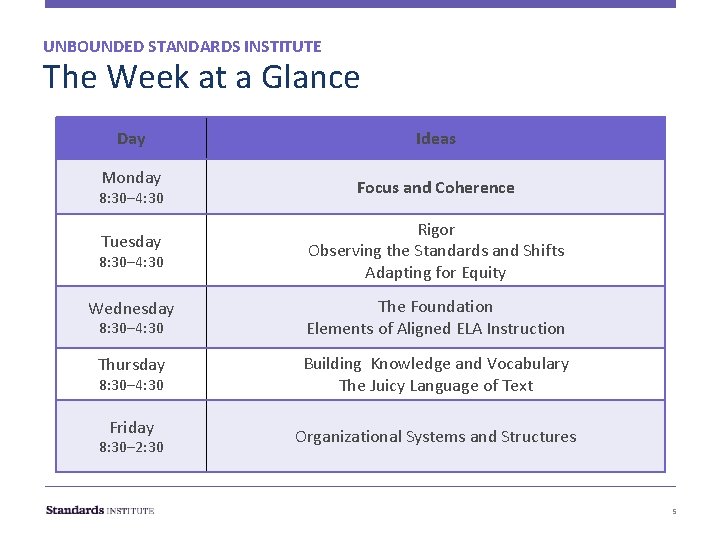
UNBOUNDED STANDARDS INSTITUTE The Week at a Glance Day Monday 8: 30– 4: 30 Tuesday 8: 30– 4: 30 Ideas Focus and Coherence Rigor Observing the Standards and Shifts Adapting for Equity Wednesday The Foundation Elements of Aligned ELA Instruction Thursday Building Knowledge and Vocabulary The Juicy Language of Text 8: 30– 4: 30 Friday 8: 30– 2: 30 Organizational Systems and Structures 5
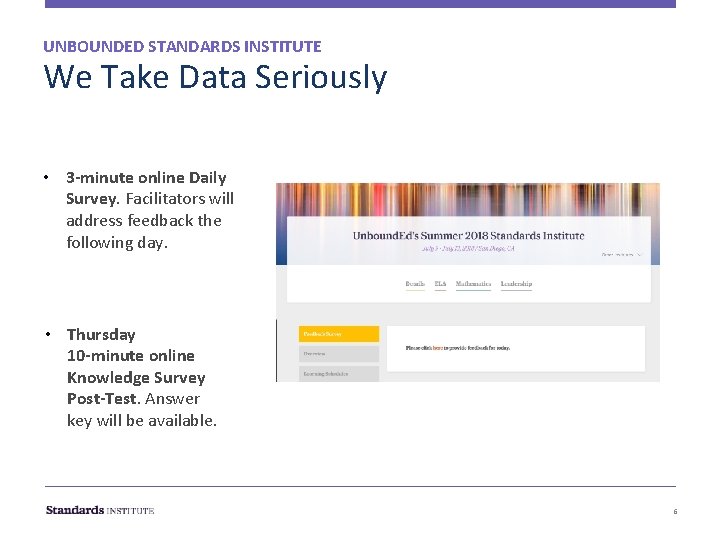
UNBOUNDED STANDARDS INSTITUTE We Take Data Seriously • 3 -minute online Daily Survey. Facilitators will address feedback the following day. • Thursday 10 -minute online Knowledge Survey Post-Test. Answer key will be available. 6
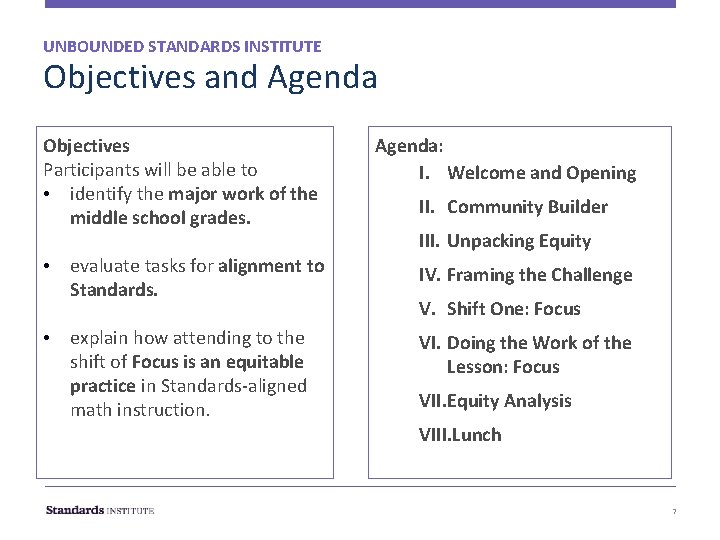
UNBOUNDED STANDARDS INSTITUTE Objectives and Agenda Objectives Participants will be able to • identify the major work of the middle school grades. • • Agenda: I. Welcome and Opening II. Community Builder III. Unpacking Equity evaluate tasks for alignment to Standards. IV. Framing the Challenge explain how attending to the shift of Focus is an equitable practice in Standards-aligned math instruction. VI. Doing the Work of the Lesson: Focus V. Shift One: Focus VII. Equity Analysis VIII. Lunch 7
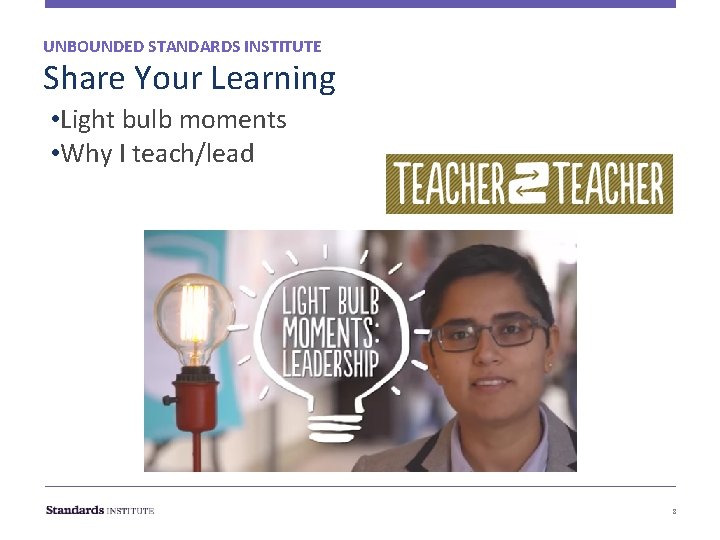
UNBOUNDED STANDARDS INSTITUTE Share Your Learning • Light bulb moments • Why I teach/lead 8
Building the Container 9
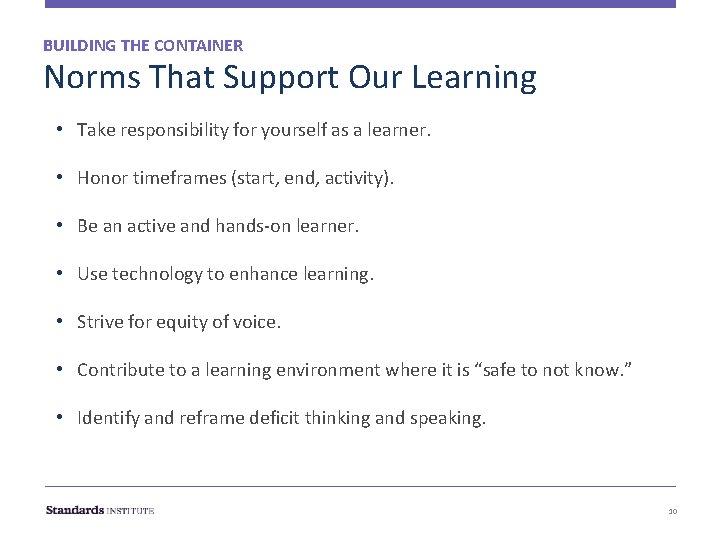
BUILDING THE CONTAINER Norms That Support Our Learning • Take responsibility for yourself as a learner. • Honor timeframes (start, end, activity). • Be an active and hands-on learner. • Use technology to enhance learning. • Strive for equity of voice. • Contribute to a learning environment where it is “safe to not know. ” • Identify and reframe deficit thinking and speaking. 10
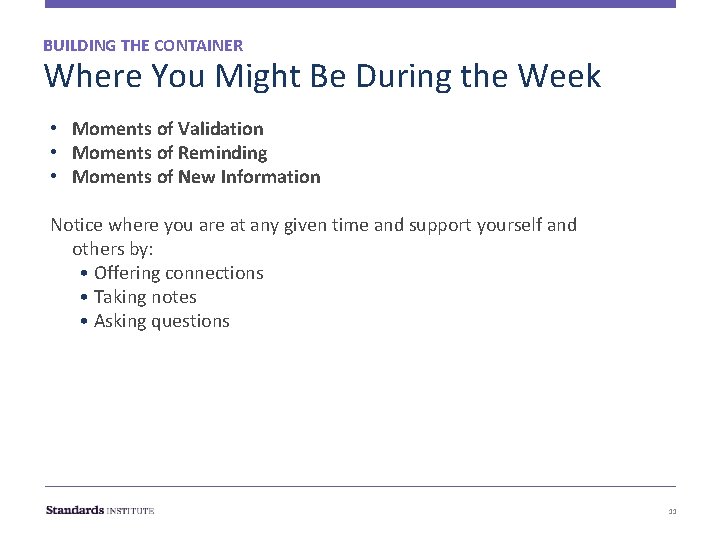
BUILDING THE CONTAINER Where You Might Be During the Week • Moments of Validation • Moments of Reminding • Moments of New Information Notice where you are at any given time and support yourself and others by: • Offering connections • Taking notes • Asking questions 11
BUILDING THE CONTAINER Community Builder Introduce yourself to your table: Share your name, city, role, and organization, and one goal for the week. Raise your hand if. . . • You are a school leader. • You are a district leader. • You work for a nonprofit. • You support schools. • You coach and develop others. • You consider yourself a “math person. ” • You consider yourself a “literacy person. ” 12 12
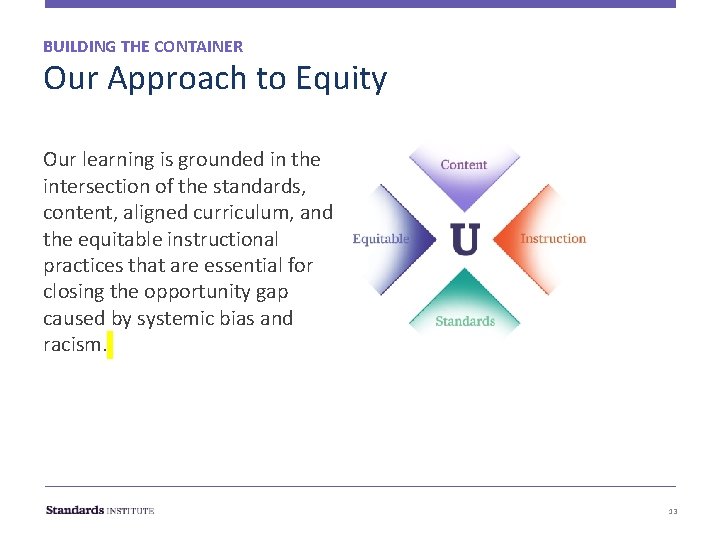
BUILDING THE CONTAINER Our Approach to Equity Our learning is grounded in the intersection of the standards, content, aligned curriculum, and the equitable instructional practices that are essential for closing the opportunity gap caused by systemic bias and racism. 13
BUILDING THE CONTAINER Unpacking Equity • Equity exists when the biases derived from dominant cultural norms and values no longer predict or influence how one fares in society. • Equity systematically promotes fair and impartial access to rights and opportunities. • Equity may look like adding supports and scaffolds that result in fair access to opportunities, or creating opportunities for all voices to be heard. • Educational Equity ensures that all children – regardless of circumstances – are receiving high-quality, grade- level, and Standards-aligned instruction with access to high-quality materials and resources. • We become change agents for educational equity when we acknowledge that we are part of an educational system that holds policies and practices that are inherently racist and that we have participated in this system. We now commit to ensuring that all students, regardless of how we think they come to us, leave us having grown against grade-level standards and confident in their value and abilities. 14
BUILDING THE CONTAINER Unpacking Equity in Our Roles Gorksi and Salwell provide 5 Principles to guide you. Take 5 minutes to skim back through the reading with consideration for your role in education. ● Administration and Leadership—How can I direct resources to improve states of equity in schools and in classrooms? What building conditions must exist to support equity in schools and in classrooms? ● Coaches—How can I emphasize equity in coaching teachers as they revise instruction, protocols, classroom management? ● Teachers—Which aspects of my instructional practice provide all students with access to equity, and which aspects do not? ● Partners—How does our organization’s theory of action and activities with districts and partners support equity? 15
Framing the Challenge 16
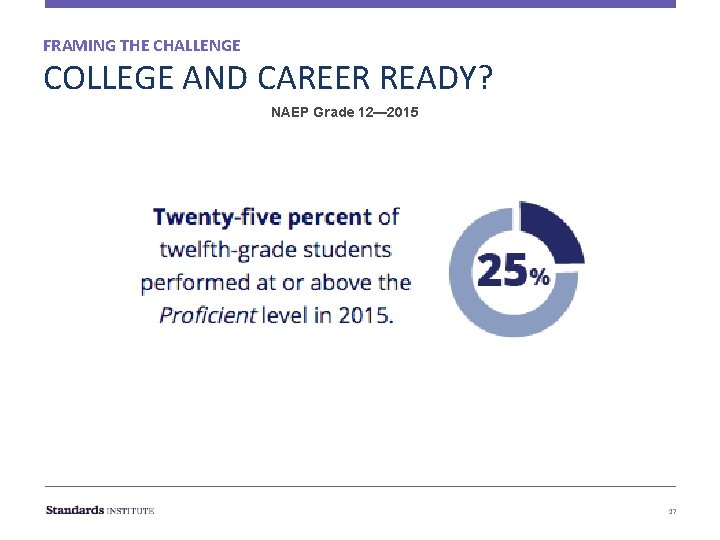
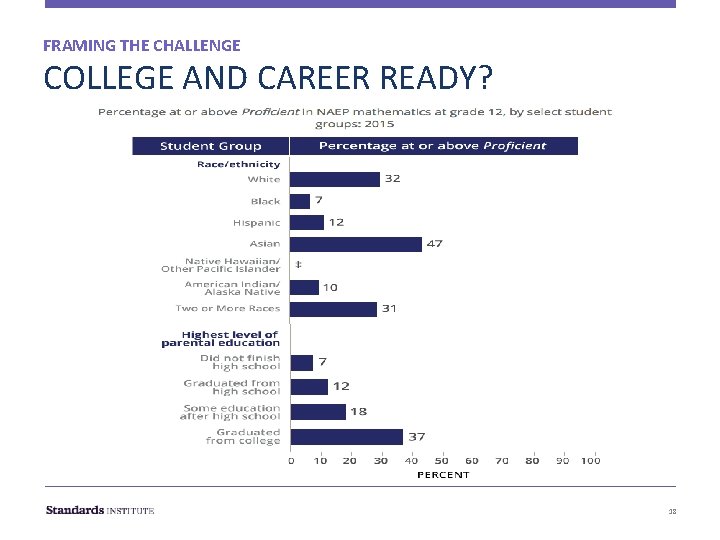
FRAMING THE CHALLENGE COLLEGE AND CAREER READY? NAEP Grade 12— 2015 17
FRAMING THE CHALLENGE COLLEGE AND CAREER READY? 18
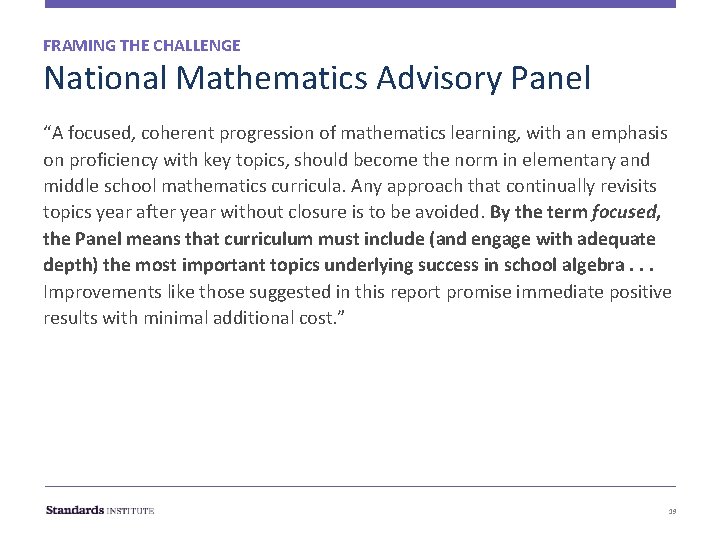
FRAMING THE CHALLENGE National Mathematics Advisory Panel “A focused, coherent progression of mathematics learning, with an emphasis on proficiency with key topics, should become the norm in elementary and middle school mathematics curricula. Any approach that continually revisits topics year after year without closure is to be avoided. By the term focused, the Panel means that curriculum must include (and engage with adequate depth) the most important topics underlying success in school algebra. . . Improvements like those suggested in this report promise immediate positive results with minimal additional cost. ” 19
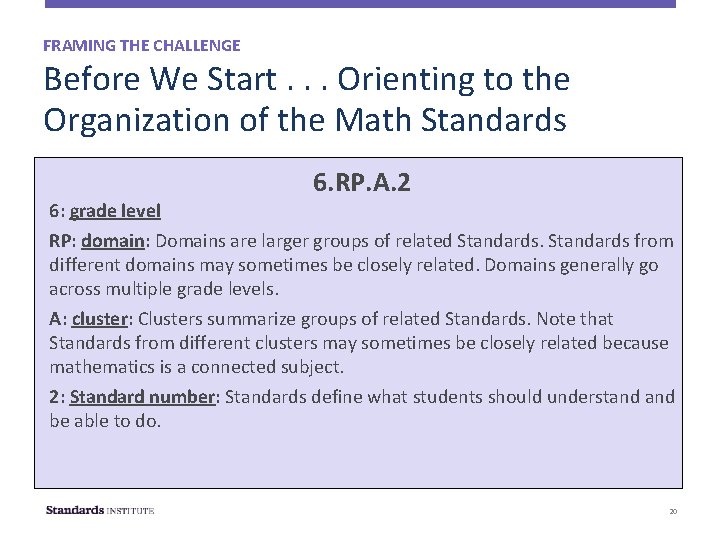
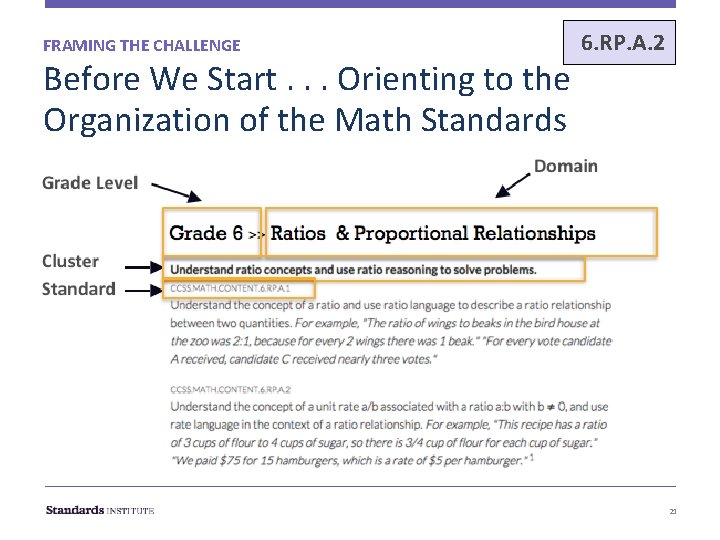
FRAMING THE CHALLENGE Before We Start. . . Orienting to the Organization of the Math Standards 6. RP. A. 2 6: grade level RP: domain: Domains are larger groups of related Standards from different domains may sometimes be closely related. Domains generally go across multiple grade levels. A: cluster: Clusters summarize groups of related Standards. Note that Standards from different clusters may sometimes be closely related because mathematics is a connected subject. 2: Standard number: Standards define what students should understand be able to do. 20
FRAMING THE CHALLENGE Before We Start. . . Orienting to the Organization of the Math Standards 6. RP. A. 2 21
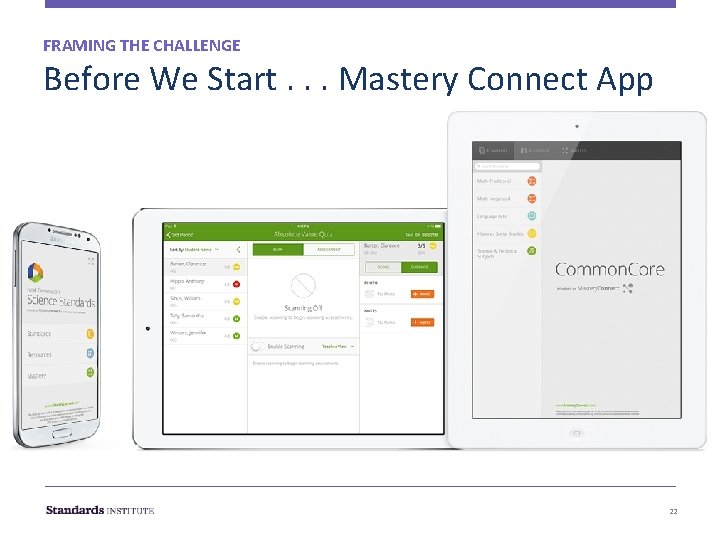
FRAMING THE CHALLENGE Before We Start. . . Mastery Connect App 22
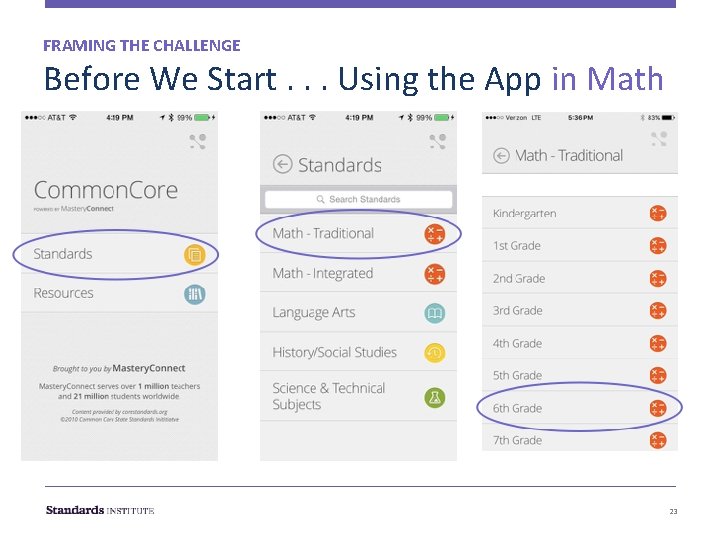
FRAMING THE CHALLENGE Before We Start. . . Using the App in Math 23
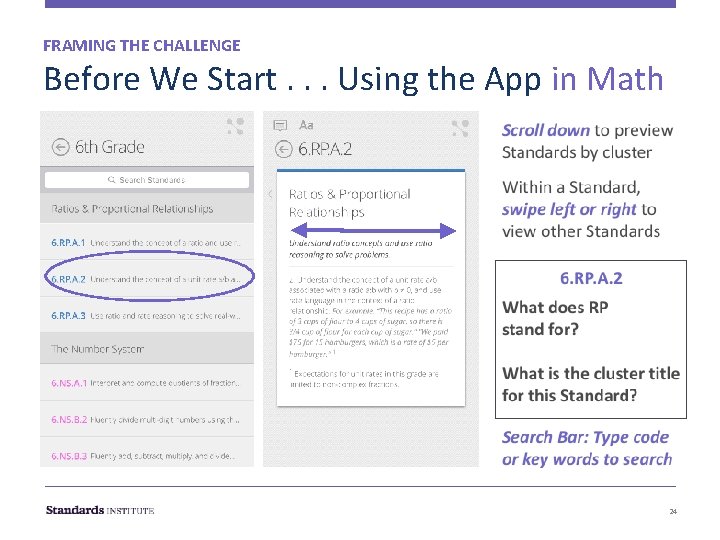
FRAMING THE CHALLENGE Before We Start. . . Using the App in Math 24
FRAMING THE CHALLENGE Quick Task: Using the App You are in a 7 th grade classroom, and students are writing an expression for the sequence of operations in each of the following: • • Add 3 to x, subtract the result from 1, then double what you have. Add 3 to x, double what you have, then subtract 1 from the result. Navigate the app to find the Standard students are likely addressing. 25
Leadership Pathway: Focus in Grades 6– 8 Summer 2018
SHIFT ONE: FOCUS “The Common Core calls for greater focus in mathematics. Rather than racing to cover many topics in a mile-wide, inch-deep curriculum, the Standards ask math teachers to significantly narrow and deepen the way time and energy are spent in the classroom. ” 27
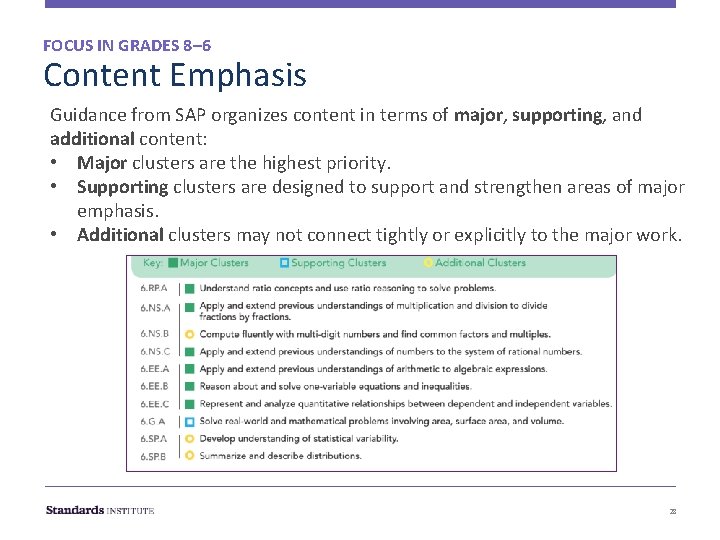
FOCUS IN GRADES 8– 6 Content Emphasis Guidance from SAP organizes content in terms of major, supporting, and additional content: • Major clusters are the highest priority. • Supporting clusters are designed to support and strengthen areas of major emphasis. • Additional clusters may not connect tightly or explicitly to the major work. 28
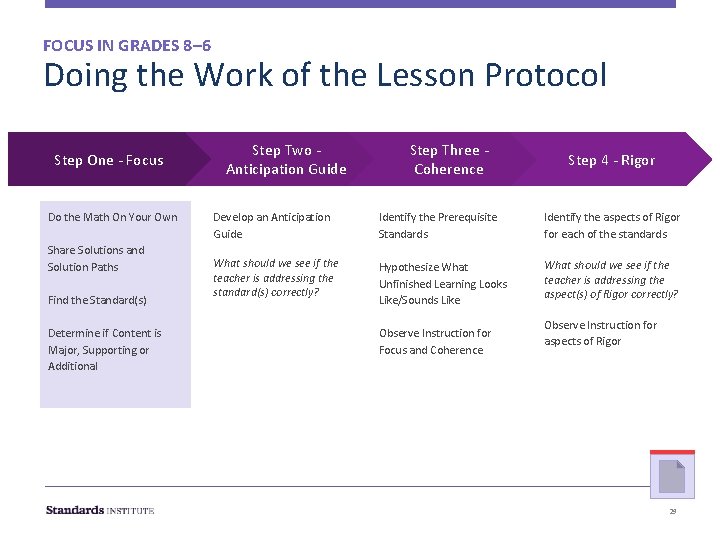
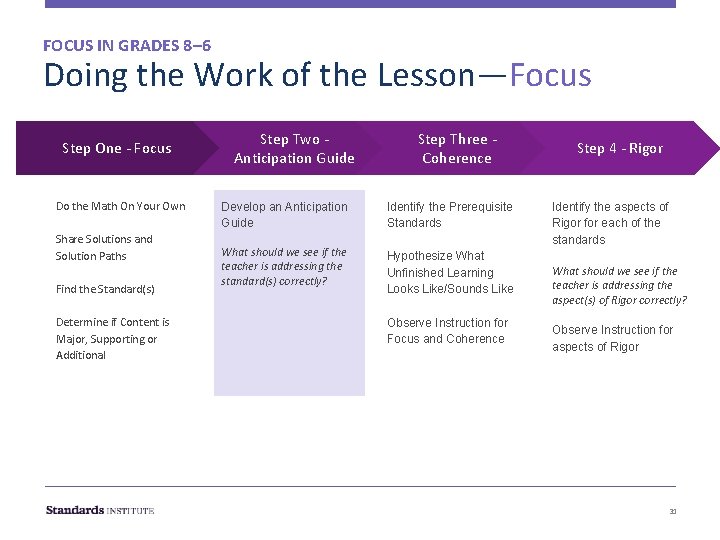
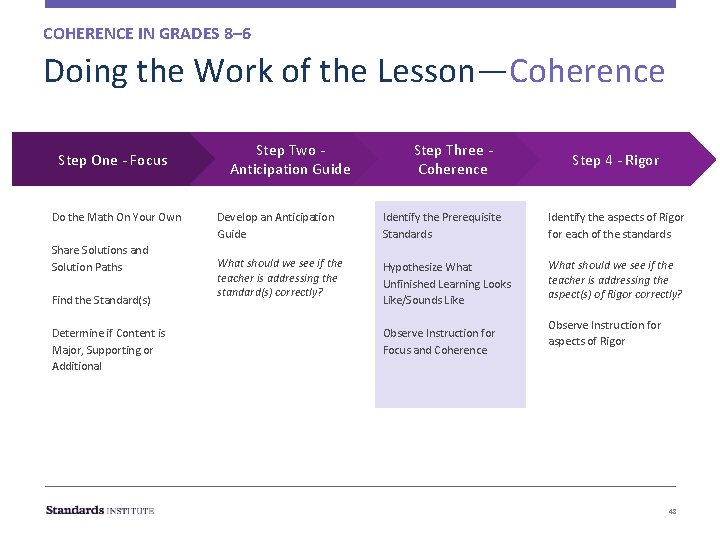
FOCUS IN GRADES 8– 6 Doing the Work of the Lesson Protocol Step One - Focus Do the Math On Your Own Share Solutions and Solution Paths Find the Standard(s) Determine if Content is Major, Supporting or Additional Step Two - Anticipation Guide Step Three - Coherence Step 4 - Rigor Develop an Anticipation Guide Identify the Prerequisite Standards Identify the aspects of Rigor for each of the standards What should we see if the teacher is addressing the standard(s) correctly? Hypothesize What Unfinished Learning Looks Like/Sounds Like What should we see if the teacher is addressing the aspect(s) of Rigor correctly? Observe Instruction for Focus and Coherence Observe Instruction for aspects of Rigor 29
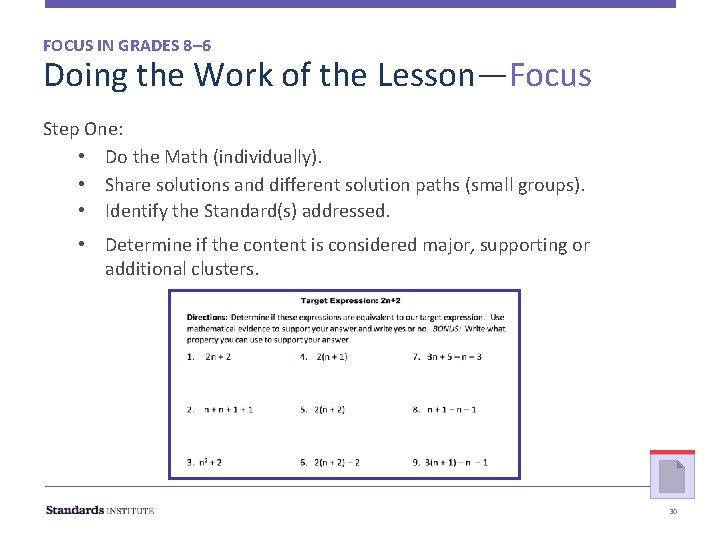
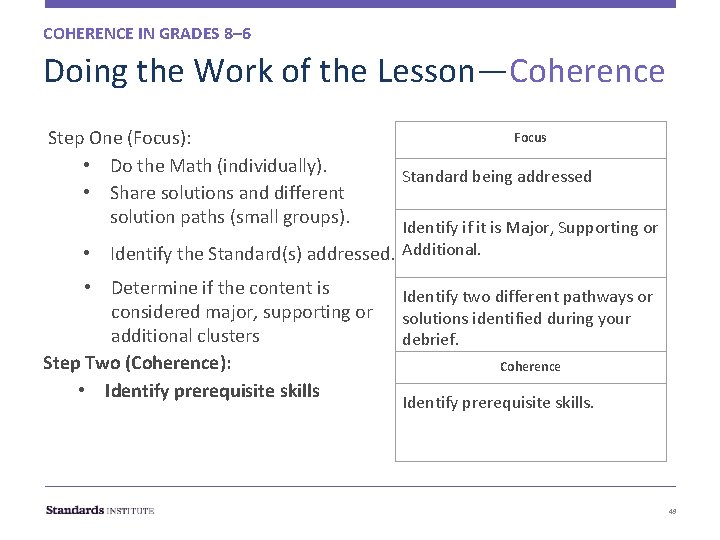
FOCUS IN GRADES 8– 6 Doing the Work of the Lesson—Focus Step One: • Do the Math (individually). • Share solutions and different solution paths (small groups). • Identify the Standard(s) addressed. • Determine if the content is considered major, supporting or additional clusters. 30
FOCUS IN GRADES 8– 6 Doing the Work of the Lesson—Focus Step One - Focus Do the Math On Your Own Share Solutions and Solution Paths Find the Standard(s) Determine if Content is Major, Supporting or Additional Step Two - Anticipation Guide Step Three - Coherence Develop an Anticipation Guide Identify the Prerequisite Standards What should we see if the teacher is addressing the standard(s) correctly? Hypothesize What Unfinished Learning Looks Like/Sounds Like Observe Instruction for Focus and Coherence Step 4 - Rigor Identify the aspects of Rigor for each of the standards What should we see if the teacher is addressing the aspect(s) of Rigor correctly? Observe Instruction for aspects of Rigor 31
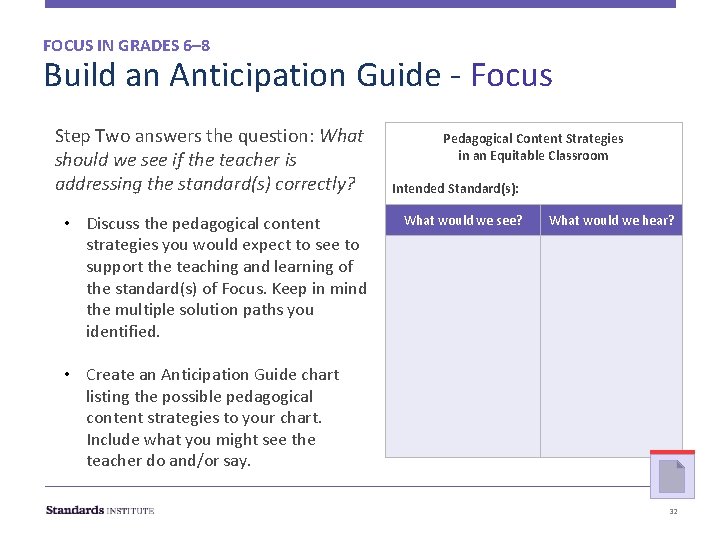
FOCUS IN GRADES 6– 8 Build an Anticipation Guide - Focus Step Two answers the question: What should we see if the teacher is addressing the standard(s) correctly? • Discuss the pedagogical content strategies you would expect to see to support the teaching and learning of the standard(s) of Focus. Keep in mind the multiple solution paths you identified. Pedagogical Content Strategies in an Equitable Classroom Intended Standard(s): What would we see? What would we hear? • Create an Anticipation Guide chart listing the possible pedagogical content strategies to your chart. Include what you might see the teacher do and/or say. 32
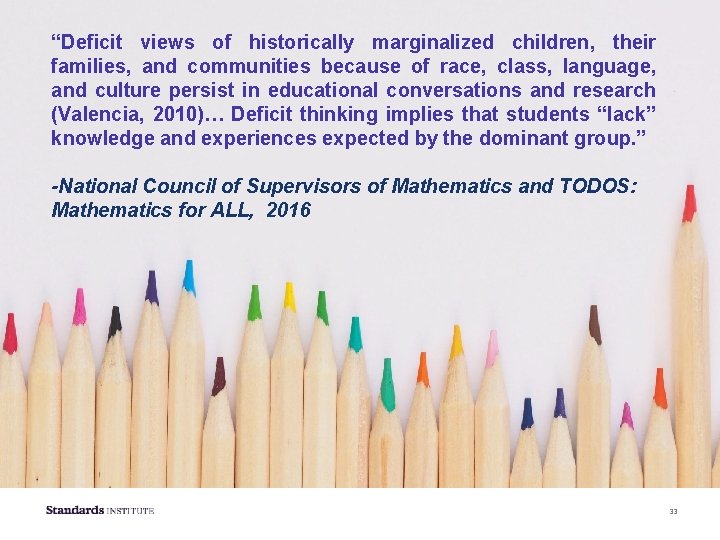
“Deficit views of historically marginalized children, their families, and communities because of race, class, language, and culture persist in educational conversations and research (Valencia, 2010)… Deficit thinking implies that students “lack” knowledge and experiences expected by the dominant group. ” -National Council of Supervisors of Mathematics and TODOS: Mathematics for ALL, 2016 33
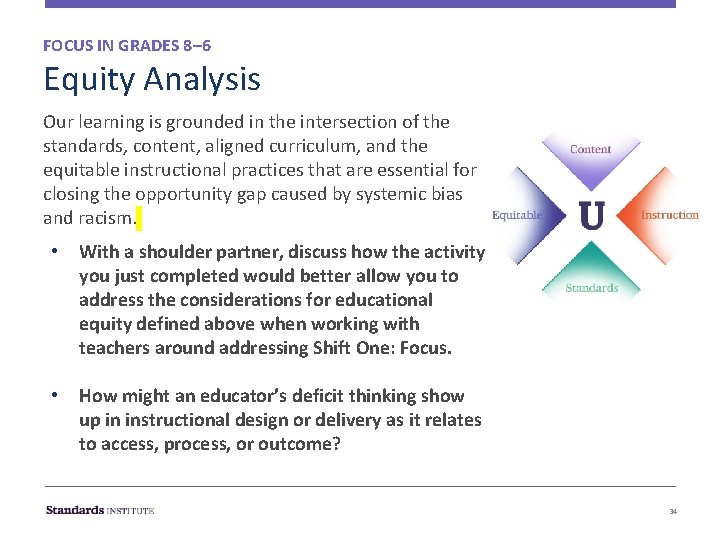
FOCUS IN GRADES 8– 6 Equity Analysis Our learning is grounded in the intersection of the standards, content, aligned curriculum, and the equitable instructional practices that are essential for closing the opportunity gap caused by systemic bias and racism. • With a shoulder partner, discuss how the activity you just completed would better allow you to address the considerations for educational equity defined above when working with teachers around addressing Shift One: Focus. • How might an educator’s deficit thinking show up in instructional design or delivery as it relates to access, process, or outcome? 34
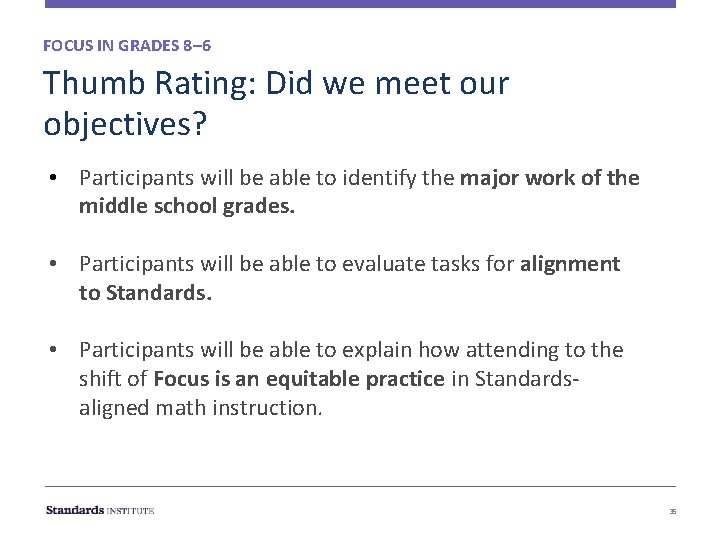
FOCUS IN GRADES 8– 6 Thumb Rating: Did we meet our objectives? • Participants will be able to identify the major work of the middle school grades. • Participants will be able to evaluate tasks for alignment to Standards. • Participants will be able to explain how attending to the shift of Focus is an equitable practice in Standardsaligned math instruction. 35
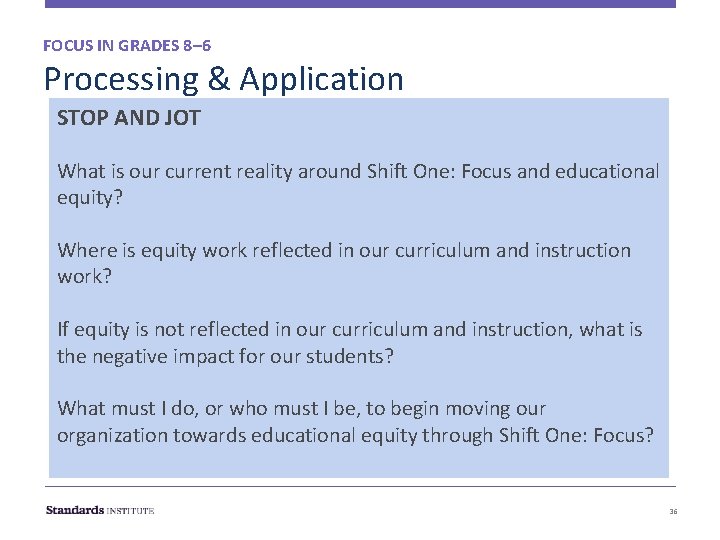
FOCUS IN GRADES 8– 6 Processing & Application STOP AND JOT What is our current reality around Shift One: Focus and educational equity? Where is equity work reflected in our curriculum and instruction work? If equity is not reflected in our curriculum and instruction, what is the negative impact for our students? What must I do, or who must I be, to begin moving our organization towards educational equity through Shift One: Focus? 36
Lunch 37
Leadership Pathway: Coherence in Grades 6– 8 Summer 2018
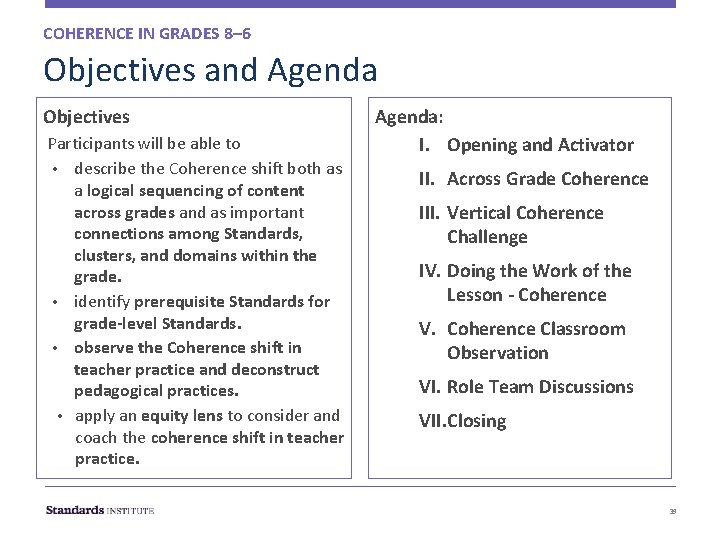
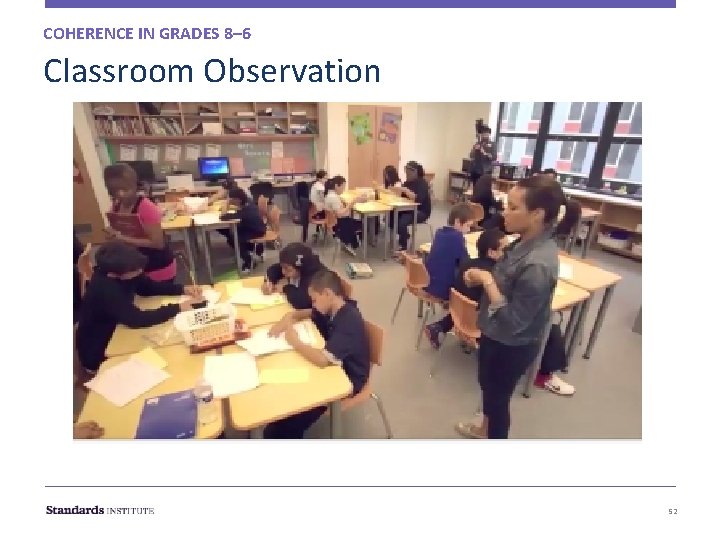
COHERENCE IN GRADES 8– 6 Objectives and Agenda Objectives Participants will be able to describe the Coherence shift both as a logical sequencing of content across grades and as important connections among Standards, clusters, and domains within the grade. • identify prerequisite Standards for grade-level Standards. • observe the Coherence shift in teacher practice and deconstruct pedagogical practices. • apply an equity lens to consider and coach the coherence shift in teacher practice. • Agenda: I. Opening and Activator II. Across Grade Coherence III. Vertical Coherence Challenge IV. Doing the Work of the Lesson - Coherence V. Coherence Classroom Observation VI. Role Team Discussions VII. Closing 39
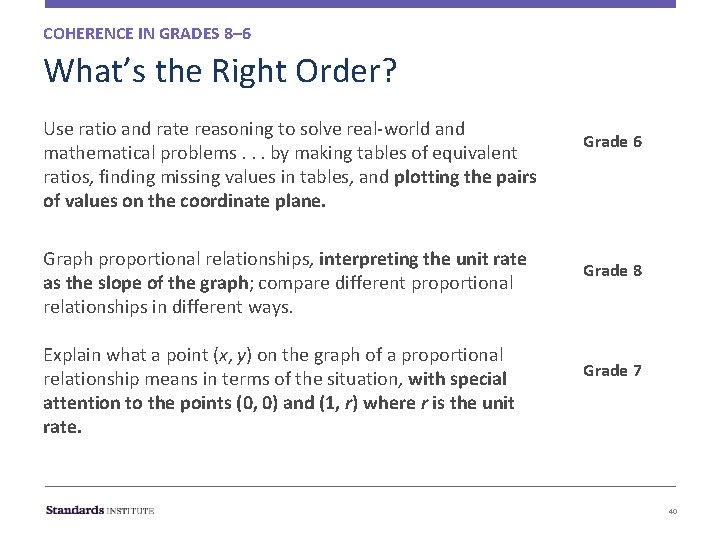
COHERENCE IN GRADES 8– 6 What’s the Right Order? Use ratio and rate reasoning to solve real-world and mathematical problems. . . by making tables of equivalent ratios, finding missing values in tables, and plotting the pairs of values on the coordinate plane. Graph proportional relationships, interpreting the unit rate as the slope of the graph; compare different proportional relationships in different ways. Explain what a point (x, y) on the graph of a proportional relationship means in terms of the situation, with special attention to the points (0, 0) and (1, r) where r is the unit rate. Grade 6 Grade 8 Grade 7 40
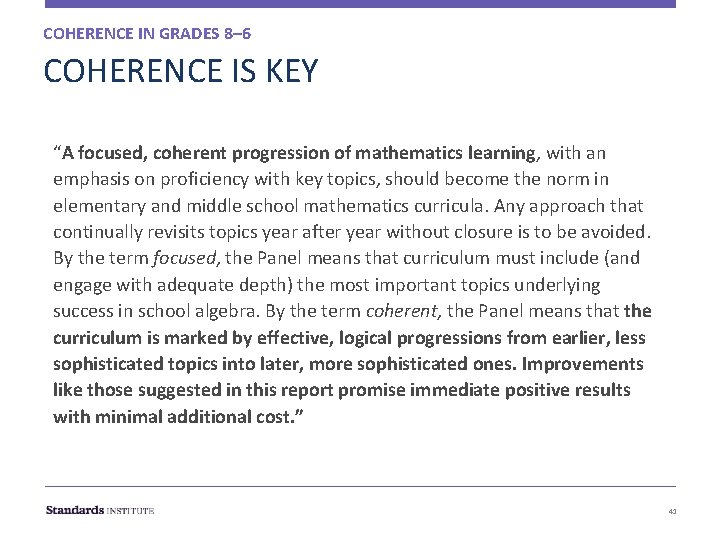
COHERENCE IN GRADES 8– 6 COHERENCE IS KEY “A focused, coherent progression of mathematics learning, with an emphasis on proficiency with key topics, should become the norm in elementary and middle school mathematics curricula. Any approach that continually revisits topics year after year without closure is to be avoided. By the term focused, the Panel means that curriculum must include (and engage with adequate depth) the most important topics underlying success in school algebra. By the term coherent, the Panel means that the curriculum is marked by effective, logical progressions from earlier, less sophisticated topics into later, more sophisticated ones. Improvements like those suggested in this report promise immediate positive results with minimal additional cost. ” 41
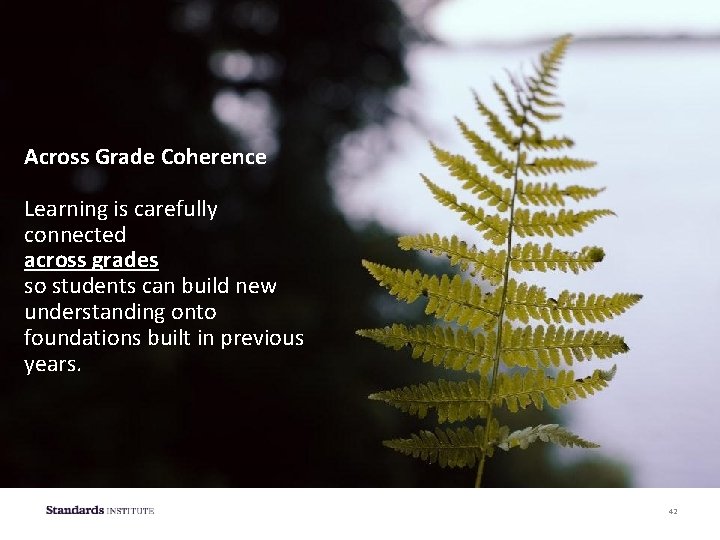
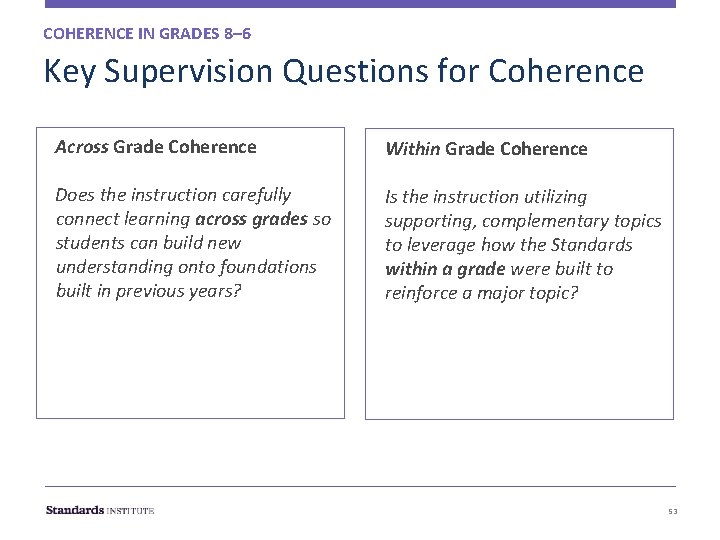
Across Grade Coherence Learning is carefully connected across grades so students can build new understanding onto foundations built in previous years. 42
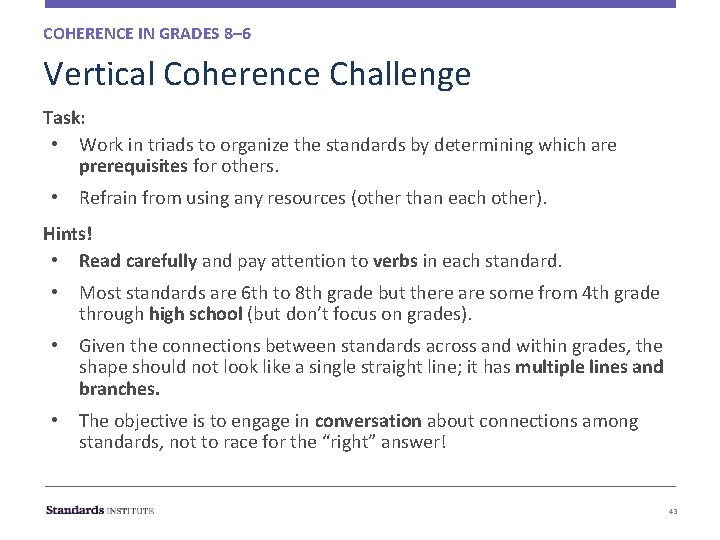
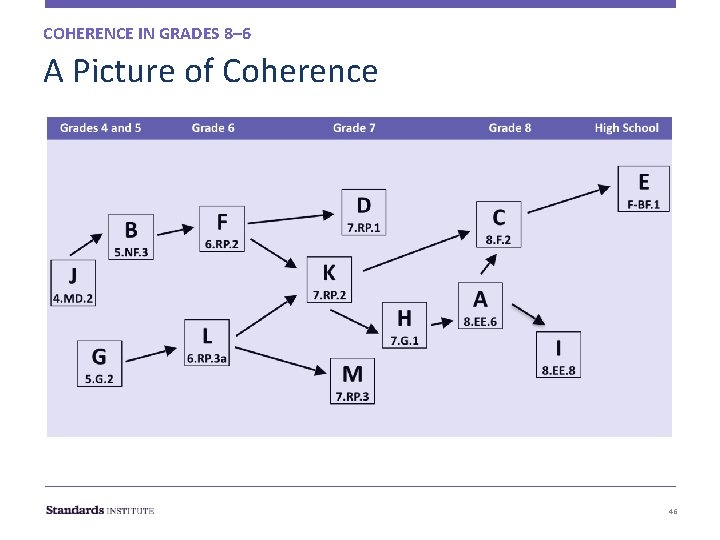
COHERENCE IN GRADES 8– 6 Vertical Coherence Challenge Task: • Work in triads to organize the standards by determining which are prerequisites for others. • Refrain from using any resources (other than each other). Hints! • Read carefully and pay attention to verbs in each standard. • Most standards are 6 th to 8 th grade but there are some from 4 th grade through high school (but don’t focus on grades). • Given the connections between standards across and within grades, the shape should not look like a single straight line; it has multiple lines and branches. • The objective is to engage in conversation about connections among standards, not to race for the “right” answer! 43
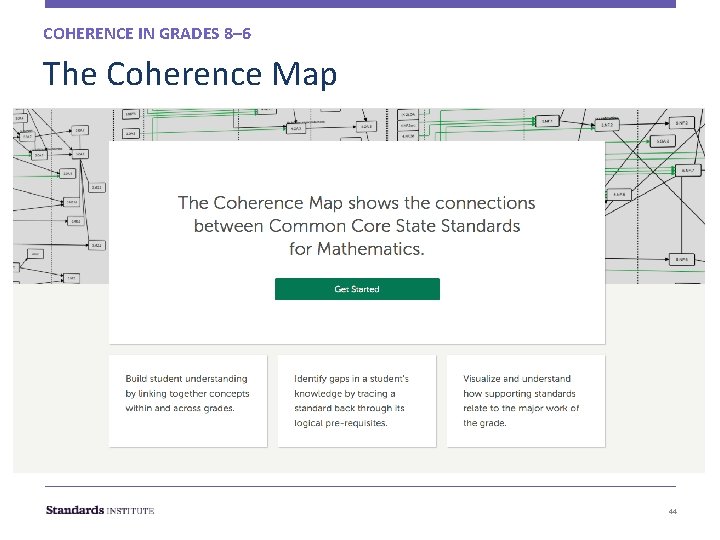
COHERENCE IN GRADES 8– 6 The Coherence Map 44
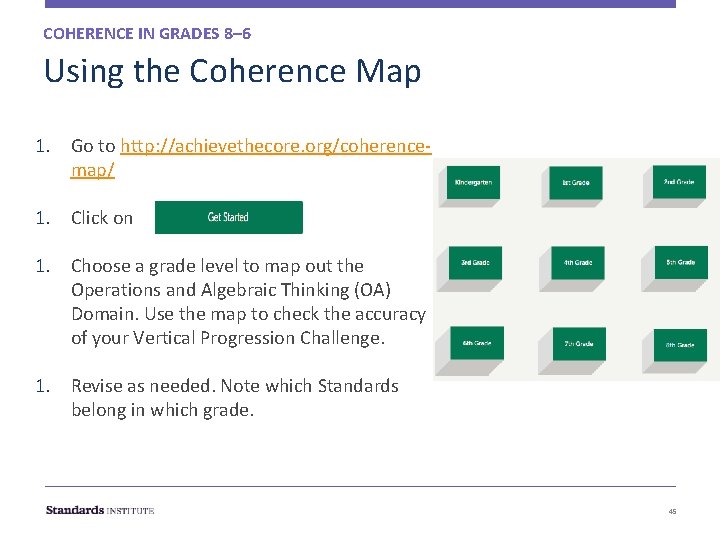
COHERENCE IN GRADES 8– 6 Using the Coherence Map 1. Go to http: //achievethecore. org/coherencemap/ 1. Click on 1. Choose a grade level to map out the Operations and Algebraic Thinking (OA) Domain. Use the map to check the accuracy of your Vertical Progression Challenge. 1. Revise as needed. Note which Standards belong in which grade. 45
COHERENCE IN GRADES 8– 6 A Picture of Coherence 46
Within Grade Coherence is also built into the Standards in how they reinforce a major topic in a grade by utilizing supporting, complementary topics. 47
COHERENCE IN GRADES 8– 6 Doing the Work of the Lesson—Coherence Step One - Focus Do the Math On Your Own Share Solutions and Solution Paths Find the Standard(s) Determine if Content is Major, Supporting or Additional Step Two - Anticipation Guide Step Three - Coherence Step 4 - Rigor Develop an Anticipation Guide Identify the Prerequisite Standards Identify the aspects of Rigor for each of the standards What should we see if the teacher is addressing the standard(s) correctly? Hypothesize What Unfinished Learning Looks Like/Sounds Like What should we see if the teacher is addressing the aspect(s) of Rigor correctly? Observe Instruction for Focus and Coherence Observe Instruction for aspects of Rigor 48
COHERENCE IN GRADES 8– 6 Doing the Work of the Lesson—Coherence Step One (Focus): • Do the Math (individually). • Share solutions and different solution paths (small groups). • Standard being addressed Identify if it is Major, Supporting or Identify the Standard(s) addressed. Additional. Determine if the content is considered major, supporting or additional clusters Step Two (Coherence): • Identify prerequisite skills • Focus Identify two different pathways or solutions identified during your debrief. Coherence Identify prerequisite skills. 49
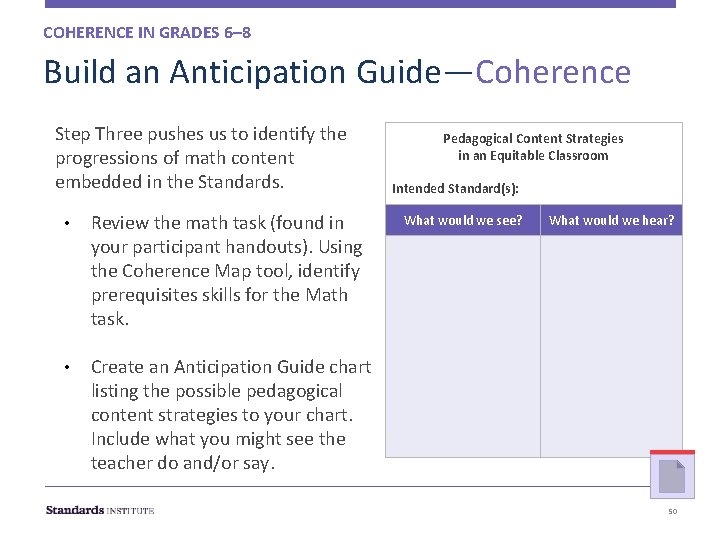
COHERENCE IN GRADES 6– 8 Build an Anticipation Guide—Coherence Step Three pushes us to identify the progressions of math content embedded in the Standards. • Review the math task (found in your participant handouts). Using the Coherence Map tool, identify prerequisites skills for the Math task. • Create an Anticipation Guide chart listing the possible pedagogical content strategies to your chart. Include what you might see the teacher do and/or say. Pedagogical Content Strategies in an Equitable Classroom Intended Standard(s): What would we see? What would we hear? 50
Break 51
COHERENCE IN GRADES 8– 6 Classroom Observation 52
COHERENCE IN GRADES 8– 6 Key Supervision Questions for Coherence Across Grade Coherence Within Grade Coherence Does the instruction carefully connect learning across grades so students can build new understanding onto foundations built in previous years? Is the instruction utilizing supporting, complementary topics to leverage how the Standards within a grade were built to reinforce a major topic? 53
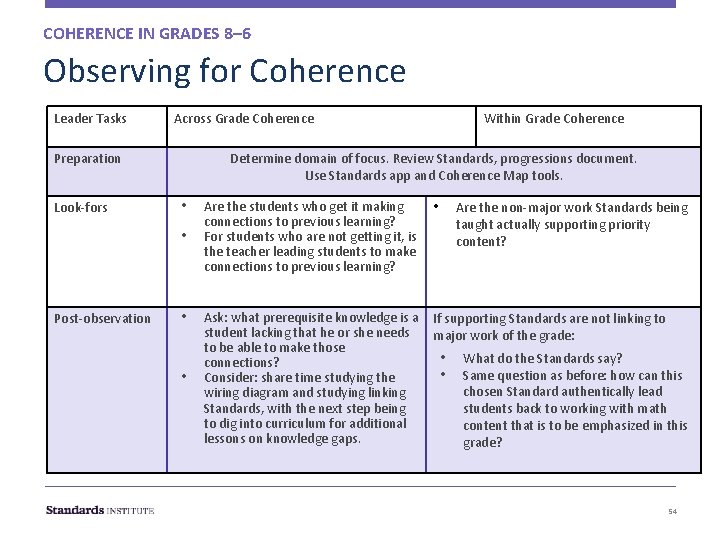
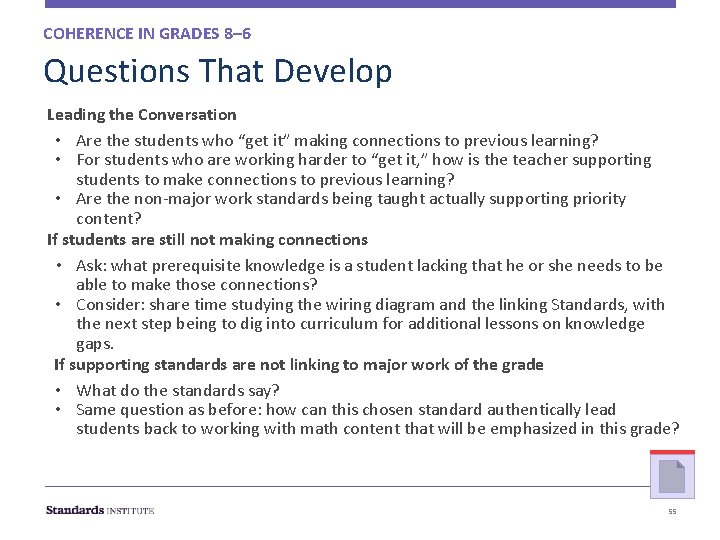
COHERENCE IN GRADES 8– 6 Observing for Coherence Leader Tasks Across Grade Coherence Preparation Look-fors Determine domain of focus. Review Standards, progressions document. Use Standards app and Coherence Map tools. • • Post-observation Within Grade Coherence • • Are the students who get it making • connections to previous learning? For students who are not getting it, is the teacher leading students to make connections to previous learning? Are the non-major work Standards being taught actually supporting priority content? Ask: what prerequisite knowledge is a If supporting Standards are not linking to student lacking that he or she needs major work of the grade: to be able to make those • What do the Standards say? connections? • Same question as before: how can this Consider: share time studying the chosen Standard authentically lead wiring diagram and studying linking Standards, with the next step being students back to working with math to dig into curriculum for additional content that is to be emphasized in this lessons on knowledge gaps. grade? 54
COHERENCE IN GRADES 8– 6 Questions That Develop Leading the Conversation • Are the students who “get it” making connections to previous learning? • For students who are working harder to “get it, ” how is the teacher supporting students to make connections to previous learning? • Are the non-major work standards being taught actually supporting priority content? If students are still not making connections • Ask: what prerequisite knowledge is a student lacking that he or she needs to be able to make those connections? • Consider: share time studying the wiring diagram and the linking Standards, with the next step being to dig into curriculum for additional lessons on knowledge gaps. If supporting standards are not linking to major work of the grade • What do the standards say? • Same question as before: how can this chosen standard authentically lead students back to working with math content that will be emphasized in this grade? 55
COHERENCE IN GRADES 8– 6 Role Team Time—Implications for Practice What is the state of Coherence in curriculum, planning, and professional development in your school or context? Curriculum • Does your curriculum identify the prerequisite skills needed for a unit or lesson? • Is across grade Coherence evident, helping students deepen understanding by making links between domains and clusters? Planning • Is Coherence a regular consideration in teacher and team lesson planning? • How and when are prerequisite skills addressed when students are below grade level? Professional Development • What professional development has occurred for teachers? Do they know Coherence well enough to effectively include it in planning and instruction? 56
COHERENCE IN GRADES 8– 6 Thumb Rating: Did We Meet Our Objectives? Objectives • Participants will be able to describe the Coherence shift both as a logical sequencing of content across grades and as important connections among Standards, clusters, and domains within the grade. • Participants will be able to identify prerequisite Standards for grade- level Standards. • Participants will be able to observe the Coherence shift in teacher practice and deconstruct pedagogical practices. • Participants will be able to apply an equity lens to consider and coach the coherence shift in teacher practice. 57
COHERENCE IN GRADES 8– 6 Processing and Application STOP AND JOT • What is your current reality around Shift Two: Coherence and educational equity? • What is the impact on your students if teachers do not strategically design scaffolds to provide access to grade-level standards for students with unfinished learning? • What must I do, or who must I be, to begin moving our organization towards educational equity through Shift Two: Coherence?
59
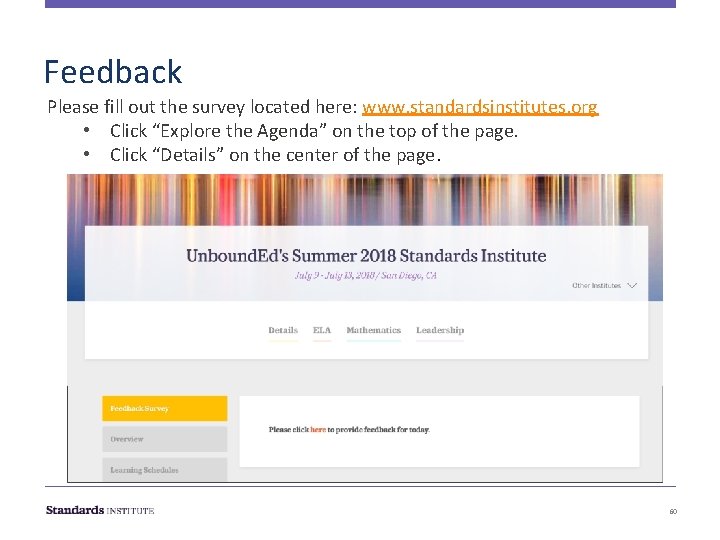
Feedback Please fill out the survey located here: www. standardsinstitutes. org • Click “Explore the Agenda” on the top of the page. • Click “Details” on the center of the page. 60
About this Deck • Copyright © 2018 Unbound. Ed Learning, Inc. • This work is licensed under a Creative Commons Attribution Non. Commerical Share. Alike 4. 0 International License. • Unbound. Ed Learning, Inc. is the copyright holder of the images and content, except where otherwise indicated in the slide notes. • More information on Creative Commons’ licenses can be found here: https: //creativecommons. org/licenses/ 61
How You Can Use this Deck The materials that we create, unless otherwise cited in the slide notes, are licensed under the Creative Commons Attribution-Non. Commercial-Share. Alike 4. 0 International license (CC BY-NC-SA 4. 0). This means you may: • Share — copy and redistribute the material in any medium or format • Adapt — remix, transform, and build upon the material As long as you follow the license terms: • Provide Attribution — You must give appropriate credit, provide a link to the license, and indicate if changes were made. You may do so in any reasonable manner, but not in any way that suggests that Unbound. Ed or any third party creator endorses you or your use. • No Commercial Use — You may not use the material for commercial purposes • Share. Alike — If you remix, transform, or build upon the material, you must distribute your contributions under the same license as the original. • Add no additional restrictions — You may not apply legal terms or technological measures that legally restrict others from doing anything the license permits. 62