
The Executive Branch Great Expectations Consider these statements
The Executive Branch
Great Expectations • Consider these statements… – The president must live up to the expectations of the American people to ensure peace, prosperity, and security. – Americans want to believe in a powerful president but at the same time do not like a concentration of power.
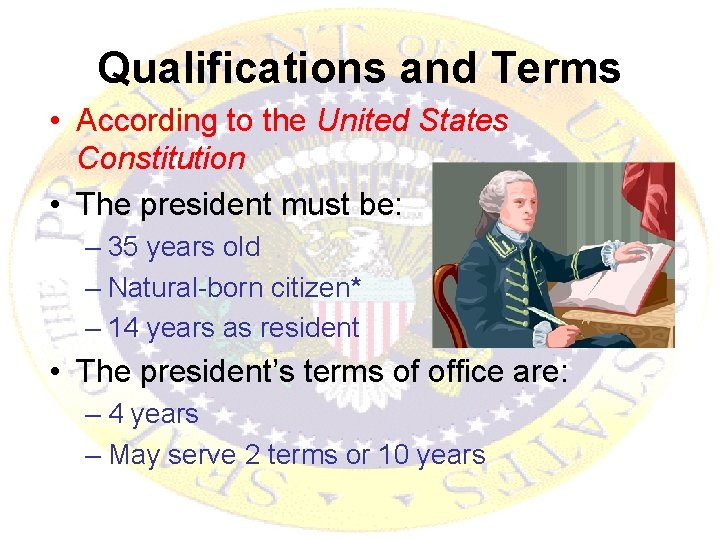
Qualifications and Terms • According to the United States Constitution • The president must be: – 35 years old – Natural-born citizen* – 14 years as resident • The president’s terms of office are: – 4 years – May serve 2 terms or 10 years
From Title 8 of the U. S. Code Section 1401 A natural-born* citizen is • Anyone born inside the US • Any Indian or Eskimo born in the US provided being a citizen of the US does not impair the person's status as a citizen of the tribe • Anyone born outside the US, both of whose parents are citizens of the US as long as one parent has lived in the US • Any one born outside the US, if one parent is a citizen and lived in the US for at least one year and other parent is a US National • Any one born in a US possession, if one parent is a citizen and lived in the US for a least one year; • Any one found in the US under the age of five, whose parentage cannot be determined, as long as proof of non-citizenship is not provided by age 21; • Any one born outside the US, if one parent is an alien and as long as the other parent is a citizen of the US who lived in the US for at least five years (with military and diplomatic service included in this time) • A final, historical condition: a person born before 5/24/1934 of an alien father and a U. S. citizen mother who has lived in the U. S
Constitutional Powers • The Constitution says little about presidential power. – Presidents share executive, legislative, and judicial power with other branches of government. – The framers placed checks on powers they believed to be most dangerous while protecting the general spheres of authority from encroachment.
The Expansion of Presidential Power: Good or Bad for the Country? ? • Today presidential power is greater than the Constitution suggests. – Many presidents enlarged the power of the presidency by expanding the president’s responsibilities and political resources. • In the 1950 s and 1960 s scholars tended to favor the idea of a strong presidency. – However, after the abuses of power during the Vietnam War and Watergate, scholars argued that the presidency had become too powerful for the good of the nation.
Formal Presidential Powers Found in Constitution (Article II) • • • Executing (carrying out) laws; veto/pocket veto laws Commander-in-chief Negotiates/makes/signs treaties (NOT ratify!) Appoint federal justices and judges (NOT confirm!) Appoints ambassadors and foreign policy officials (NOT confirm!) Fill vacant government posts when the Senate is in recess May pardon individuals Recognizes nations Receives ambassadors and other heads of state May convene and/or adjourn both houses of Congress Must give message to Congress from time to time – Has become the State of the Union Address`
Informal Presidential Powers Not in found in the U. S. Constitution • Crisis manager • Has access to expert – National Spokesman knowledge and expertise Makes executive orders and • De facto political party agreements – Does not have to be approved leader by Congress! • Recognized as global leader Access to media • Conducts foreign policy Sets domestic/economic agenda initiative Sets foreign policy agenda • Meets with world leaders Helps to set and guide • Builds coalitions with legislative agenda international community • The “First Citizen” • • • FYI…this is not a finite list! There are many more!
In Other Words the President is the…. Chief Executive Commander in Chief Diplomat Chief Legislator
Presidential Powers 1. Chief Executive • • • 2. Commander in Chief • • 3. In charge of armed forces May send troops without declaration of war after seeking approval from Congress Chief Diplomat • • • 4. Runs the Government and is officially in charge of the 3 million-plus executive branch employees Appoints department heads, federal judges, ambassadors Pardons individuals of concern (usually at end of term) Deals with foreign governments Makes executive agreements with foreign heads of state Signs treaties with advice and consent of the Senate Chief Legislator • • In charge of economic management Makes certain that laws are carried out- “…shall Take Care that the laws be carefully carried out…” (Take Care Clause) Sets agenda and budget with approval from Congress • “The Buck stops here”- Harry Truman Can veto or pocket veto legislation
The Chief Executive • One of the president’s most important roles is presiding over the administration of government. • One of the resources for controlling this bureaucracy is the presidential power to appoint top-level administrators. – Presidents have recently taken more interest in the regulations issued by agencies, thus centralizing decision-making in the White House.
Commander in Chief • The framers made the president the commander in chief of the armed forces. • As such he is the commander in chief of more than 1. 5 million uniformed men and women.
Chief Diplomat • The Constitution allocates certain national security powers to the president. • He alone extends diplomatic recognition, negotiates treaties, and negotiates executive agreements with heads of foreign governments. • The president must try to lead America’s allies on matters of economics and defense.
Chief Legislator • The president is the nation’s key agenda builder; what the administration wants strongly influences the parameters of debate. – In general, presidential legislative skill must compete with other factors that affect congressional voting behavior. • Presidential legislative skills include bargaining, making personal appeals, consulting with Congress, setting priorities, exploiting “honeymoon” periods, and structuring congressional votes.
Presidential Approval • The higher the president stands in the polls, the easier it is to persuade others to support presidential initiatives. – The president’s standing in the polls is monitored closely. – Presidents frequently do not have widespread support. • Public approval of the president sometimes reacts to rally events and takes sudden jumps. • The criteria on which the public evaluates presidents are open to many interpretations.
Presidential Approval • Presidential approval is the product of many factors including the predisposition of many people to support the president, political party identification, and “honeymoon” periods. – Changes in approval levels appear to reflect the public’s evaluation of how the president is handling policy. – Citizens seem to focus on the president’s efforts and stands on issues rather than on personality or simply how presidential policies affect them.
Checks and Balances to Know • Presidential Check on Legislative Branch • Presidential Check on Judicial Branches • Congressional Checks on Executive Branch • Judicial Checks on Executive Branch
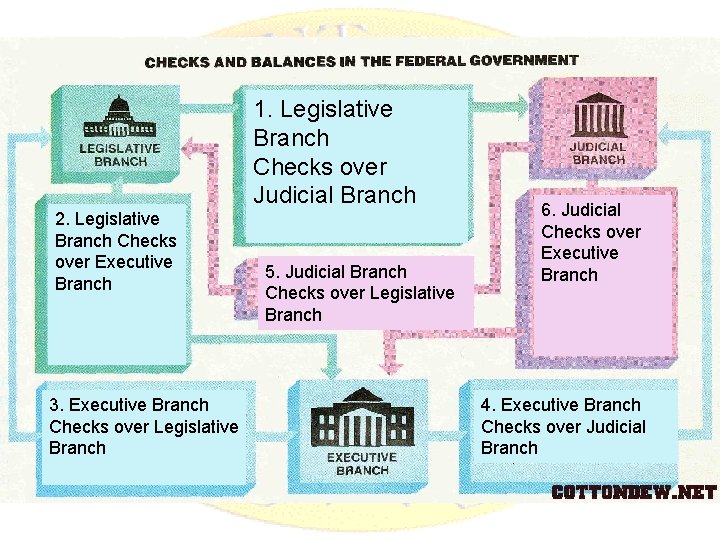
1. Legislative Branch Checks over Judicial Branch 2. Legislative Branch Checks over Executive Branch 3. Executive Branch Checks over Legislative Branch 5. Judicial Branch Checks over Legislative Branch 6. Judicial Checks over Executive Branch 4. Executive Branch Checks over Judicial Branch
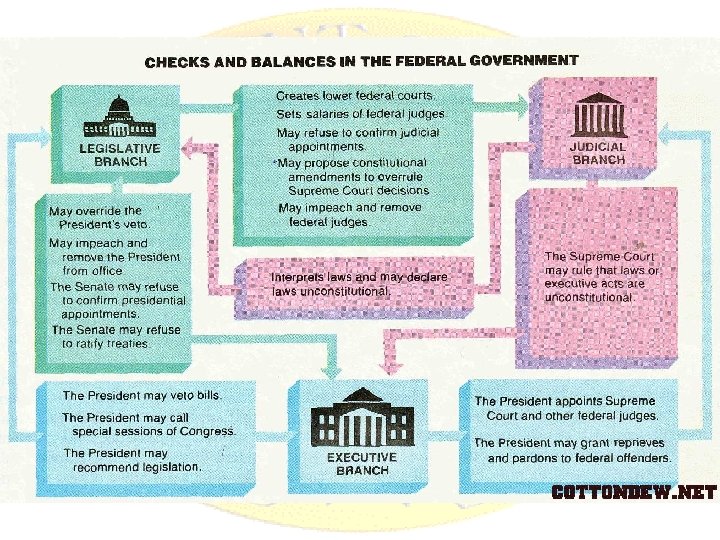
Checks and Balances to Know • Executive Check on Legislative Branch – Veto – May call special sessions or recommend legislation/budget • Executive Check on Judicial Branch – Nominations of Federal Judges • Legislative Checks on Executive Branch – – – Refusal to pass a presidential bill and/or presidential budget Overriding a Veto Impeachment (House) and Conviction (Senate) Refusal to approve Presidential appointees (Senate) Refusal to ratify treaty (Senate) May also conduct investigations • (Special Counselors Ken Starr and Patrick Fitzsimmons) • Judicial Checks on Executive Branch – Declaration of presidential acts as unconstitutional • Judicial Review
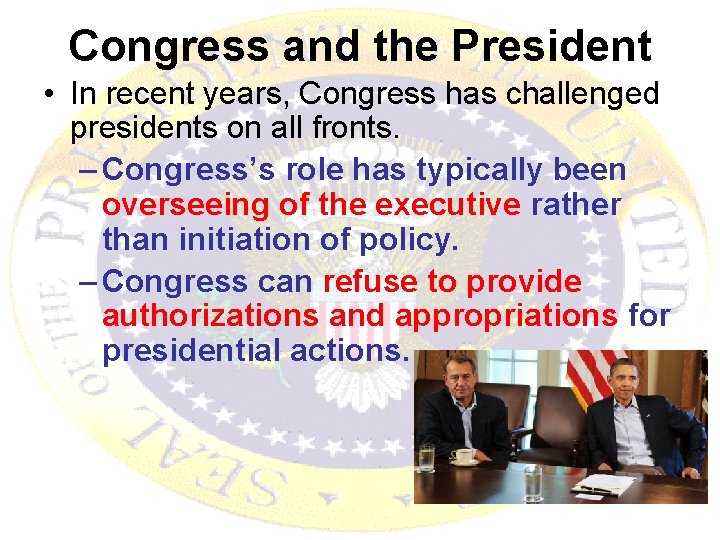
Congress and the President • In recent years, Congress has challenged presidents on all fronts. – Congress’s role has typically been overseeing of the executive rather than initiation of policy. – Congress can refuse to provide authorizations and appropriations for presidential actions.
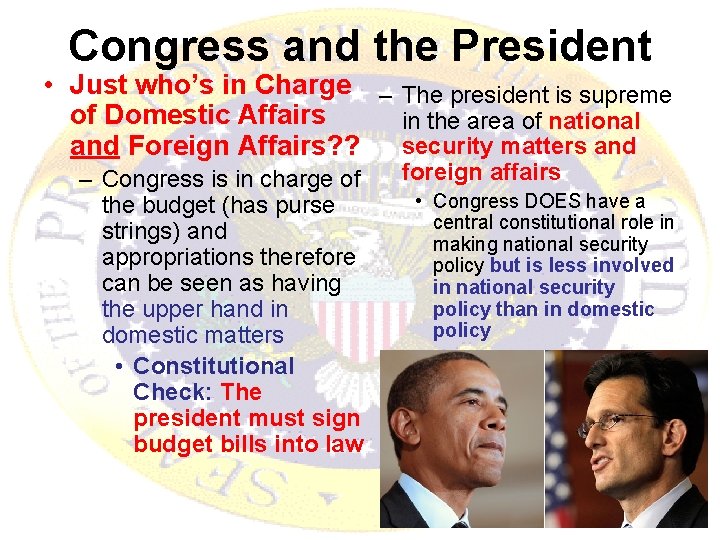
Congress and the President • Just who’s in Charge – The president is supreme of Domestic Affairs in the area of national and Foreign Affairs? ? security matters and – Congress is in charge of the budget (has purse strings) and appropriations therefore can be seen as having the upper hand in domestic matters • Constitutional Check: The president must sign budget bills into law foreign affairs • Congress DOES have a central constitutional role in making national security policy but is less involved in national security policy than in domestic policy
22 nd Amendment • Limits presidents to 2 terms or 10 years – “No person shall be elected to the office of the President more than twice, and no person who has held the office of President, or acted as President, for more than two years of a term to which some other person was elected President shall be elected to the office of the President more than once. " • Criticism sometimes made of the 22 nd Amendment is that it can seriously erode a second-term president's power and influence. • Difficulties have been faced by every President during their second terms since the amendment's ratification. – Such a president is often referred to as a lame duck.
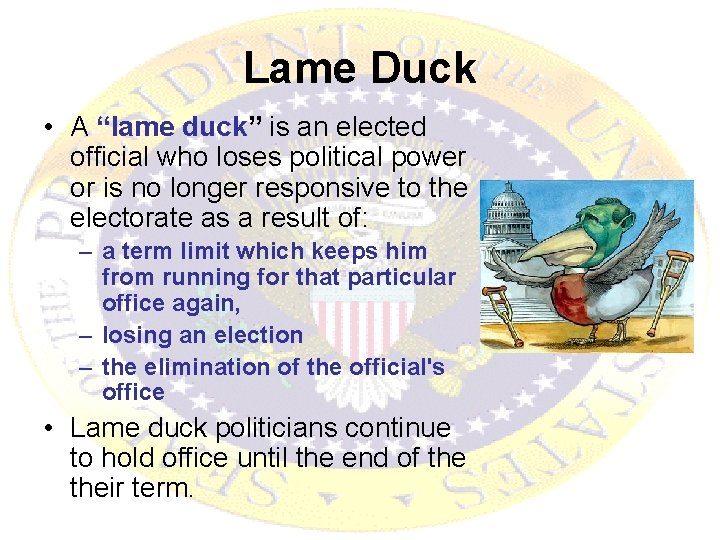
Lame Duck • A “lame duck” is an elected official who loses political power or is no longer responsive to the electorate as a result of: – a term limit which keeps him from running for that particular office again, – losing an election – the elimination of the official's office • Lame duck politicians continue to hold office until the end of their term.
25 th Amendment Presidential Succession and Disability In case of death or resignation In case of disability 1. Vice-President takes over 2. Speaker of House 3. President Pro Tempore of the Senate 4. Cabinet secretaries in order of creation – – President signs away authority to VP If VP and majority of cabinet find President “unfit” they can take power
Also in 25 th Amendment • Vice-Presidential Succession and Disability – President nominates new candidate – Nominee confirmed by majority of both houses • Nixon selected Senator Gerald Ford as the Vice. President • President Ford selected Nelson Rockefeller as his Vice-President
The Vice-Presidency • The Vice President must be a natural-born citizen of the United States, at least thirty-five years of age and a resident of the U. S. for 14 years. – The Constitution also forbids the vice president from being from the same state as the president • The Twelfth Amendment to the United States Constitution requires vice presidents to meet the same requirements as presidents. – For example the 22 nd amendment limits presidents to being elected to only two terms, so a former 2 -term president CAN NOT be elected as vice-president.
The “really dumb” Original Plan • Under the original terms of the Constitution, the members of the U. S. Electoral College voted only for office of President rather than for both President and Vice President. • The person receiving the greatest number of votes (provided that such a number was a majority of electors) would be President, while the individual who was in second place became Vice President.
And now the “Really dumb” results • In the election of 1796 Federalist John Adams came in first, and Democratic-Republican Thomas Jefferson came second. – Thus, the President and Vice President were from different parties. • An even greater problem occurred in the election of 1800, when Democratic-Republicans Jefferson and Aaron Burr tied the vote. – While it was intended that Jefferson was the Presidential contender and Burr was the Vice Presidential one, the electors did not and could not differentiate between the two under the system of the time. – After 35 unsuccessful votes in the U. S. House of Representatives, Thomas Jefferson finally won on the 36 th ballot and Burr became Vice President.
The 12 th Amendment • The tumultuous affair led to the adoption of the Twelfth amendment in 1804, which directed the electors to use separate ballots to vote for the President and Vice President. • While this solved the problem at hand, it ultimately had the effect of lowering the prestige of the Vice Presidency, as the Vice President was no longer the second choice for President.
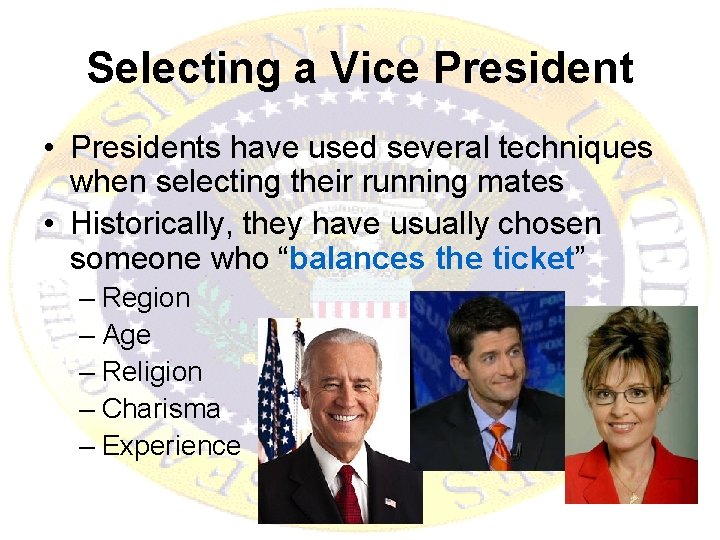
Selecting a Vice President • Presidents have used several techniques when selecting their running mates • Historically, they have usually chosen someone who “balances the ticket” – Region – Age – Religion – Charisma – Experience
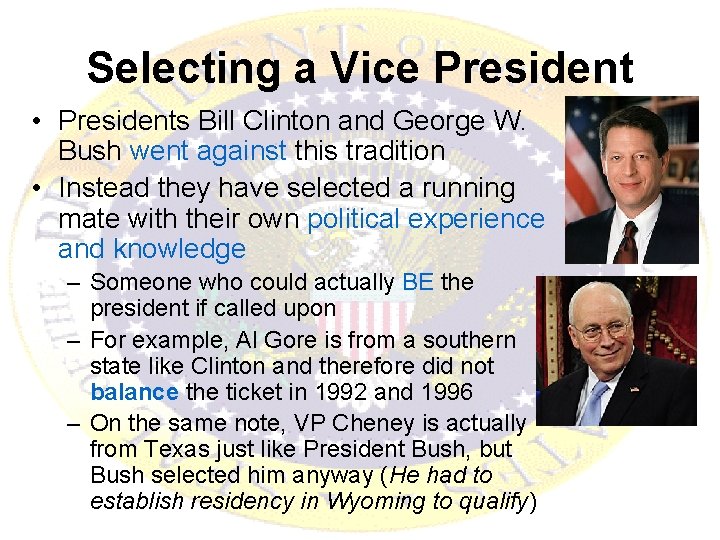
Selecting a Vice President • Presidents Bill Clinton and George W. Bush went against this tradition • Instead they have selected a running mate with their own political experience and knowledge – Someone who could actually BE the president if called upon – For example, Al Gore is from a southern state like Clinton and therefore did not balance the ticket in 1992 and 1996 – On the same note, VP Cheney is actually from Texas just like President Bush, but Bush selected him anyway (He had to establish residency in Wyoming to qualify)
The Role of the President in Law Making • He can take a bill that has passed both side of Congress and: 1. Sign it into law 2. Let it become law (if Congress is in session) 3. Veto it 4. Pocket veto (Kills bill if Congress is not in session) ** Congress can override presidential veto with a 2/3 vote of each house
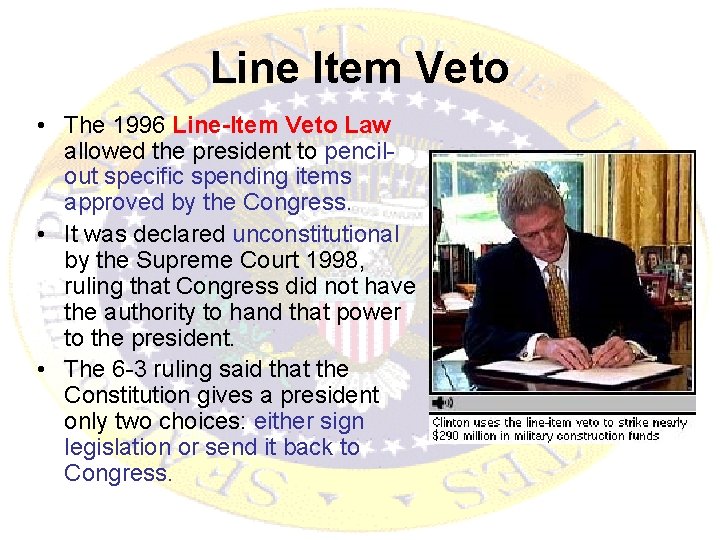
Line Item Veto • The 1996 Line-Item Veto Law allowed the president to pencilout specific spending items approved by the Congress. • It was declared unconstitutional by the Supreme Court 1998, ruling that Congress did not have the authority to hand that power to the president. • The 6 -3 ruling said that the Constitution gives a president only two choices: either sign legislation or send it back to Congress.
Alexander Hamilton’s View of the Presidency • Hamilton proposed a president who would be elected for life, "on good behavior. " – That idea went nowhere as most delegate were fearful of a powerful monarch-like executive • Hamilton vigorously defended the strongexecutive plan in the essays that became known as The Federalist Papers. (Federalist 70) – "Energy in the executive is a leading character in the definition of good government, "
19 th Century Presidents • Dominated by Congress • Exceptions: – Washington • Gave Presidency Legitimacy – Jackson • First President to expand the powers of the Presidency – Lincoln • Set the foundations for the modern Presidency
20 th Century Presidents • Extremely powerful • The Media – Began with TR and -More attention to FDR president • What Caused This? • Weak Congresses – The Great -Infighting and Depression partisanship • New Deal legislation • Other ideas…? – The Cold War • National Security issues
Two Modern Views of the Presidency 1. The Imperial presidency • • Rossiter and Schlesinger articles Can be defined, as the use (or misuse!) of discretionary power by the Chief Executive – Categorized by the large staffs of most modern presidents • Comparisons to the royal courts of Europe – Emphasis on the executive branch replacing Congress as “the most powerful branch • Hamilton would have LOVED this! – Also includes the decline in importance of the cabinet
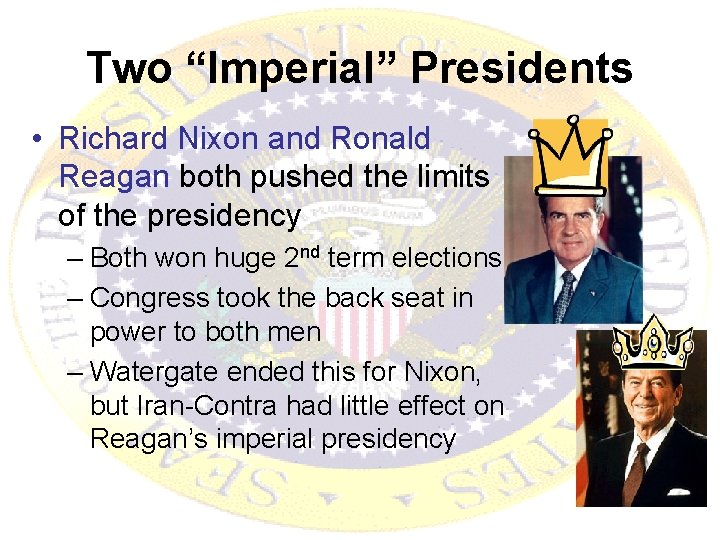
Two “Imperial” Presidents • Richard Nixon and Ronald Reagan both pushed the limits of the presidency – Both won huge 2 nd term elections – Congress took the back seat in power to both men – Watergate ended this for Nixon, but Iran-Contra had little effect on Reagan’s imperial presidency
Examples of the Imperial Presidency: • Congress has ceded its budget-making authority to the president. • Presidents make agreements with foreign nations without congressional approval by substituting executive agreements for treaties which required the approval of the Senate. • The Commander-in-Chief role has also been expanded even though Congress is empowered to declare war. – Gulf of Tonkin Resolution
Presidential Power Today • Some of the most noteworthy presidents in the past several decades century successfully advocated substantial increases in the role of the national government. – All seven of the presidents since Lyndon Johnson have championed constraints on government and limits on spending. • FYI… – It has been the president more often than Congress who has said “no” to government growth.
Presidents and the Press • Presidents do not directly reach the American people on a daily basis. – The press is the principal intermediary between the president and the public, and relations with the press are an important aspect of the president’s efforts to lead public opinion. • Presidents and the press tend to be in conflict. – The White House monitors the media closely and tries to encourage the media to project a positive image of the president.
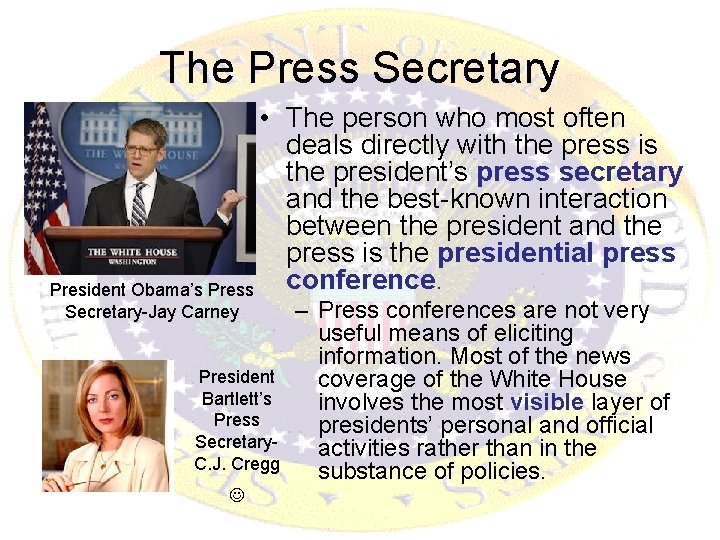
The Press Secretary • The person who most often deals directly with the press is the president’s press secretary and the best-known interaction between the president and the press is the presidential press conference. President Obama’s Press Secretary-Jay Carney President Bartlett’s Press Secretary. C. J. Cregg – Press conferences are not very useful means of eliciting information. Most of the news coverage of the White House involves the most visible layer of presidents’ personal and official activities rather than in the substance of policies.
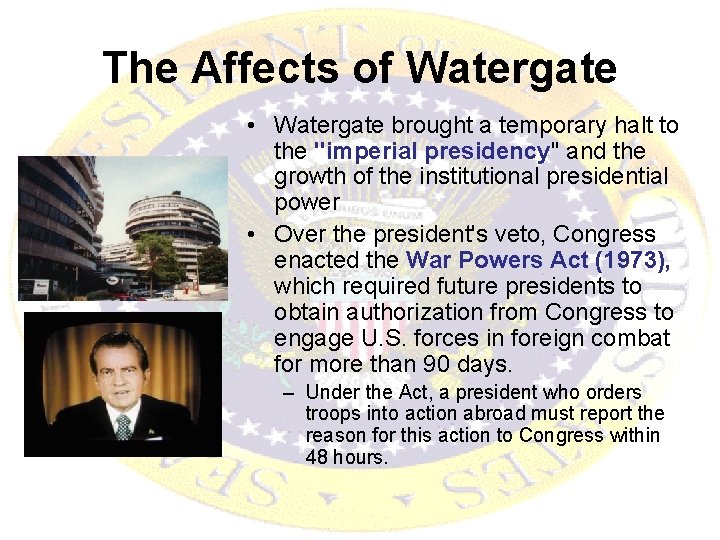
The Affects of Watergate • Watergate brought a temporary halt to the "imperial presidency" and the growth of the institutional presidential power • Over the president's veto, Congress enacted the War Powers Act (1973), which required future presidents to obtain authorization from Congress to engage U. S. forces in foreign combat for more than 90 days. – Under the Act, a president who orders troops into action abroad must report the reason for this action to Congress within 48 hours.
Two Modern Views of the Presidency 2. The Institutional presidency (Neustadt article) – The role of each new president in organizing and managing the Executive Branch – Includes the: • Executive Office of the President (EOP) • The White House Staff – Chief of Staff as gatekeeper – The Cabinet – Most modern presidents have attempted to change the Executive Office of the Presidency by adding new offices and employees OR deleting or firing employees
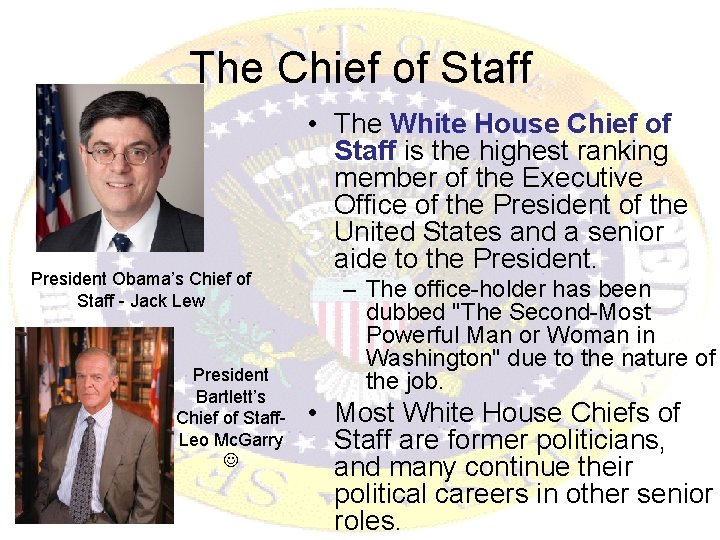
The Chief of Staff President Obama’s Chief of Staff - Jack Lew President Bartlett’s Chief of Staff. Leo Mc. Garry • The White House Chief of Staff is the highest ranking member of the Executive Office of the President of the United States and a senior aide to the President. – The office-holder has been dubbed "The Second-Most Powerful Man or Woman in Washington" due to the nature of the job. • Most White House Chiefs of Staff are former politicians, and many continue their political careers in other senior roles.
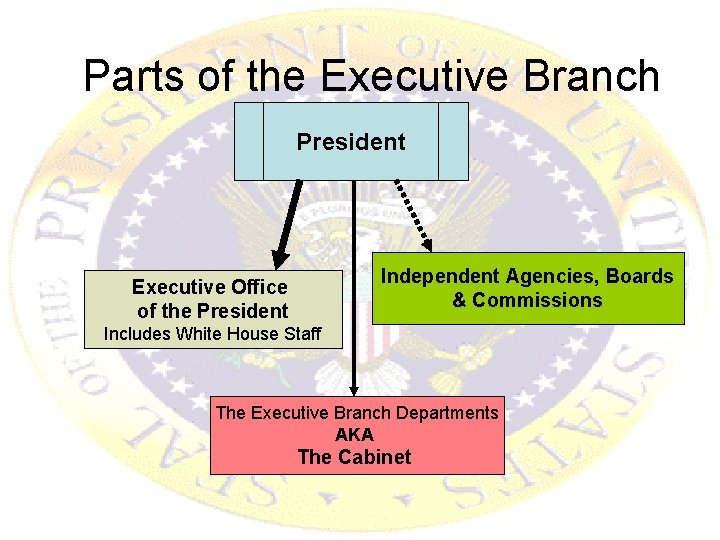
Parts of the Executive Branch President Independent Agencies, Boards & Commissions Executive Office of the President Includes White House Staff The Executive Branch Departments AKA The Cabinet
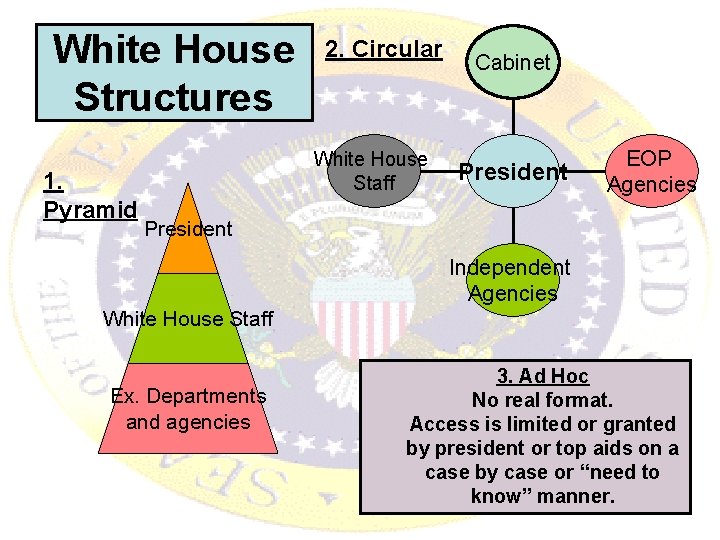
White House Structures 1. Pyramid 2. Circular White House Staff Cabinet President EOP Agencies President Independent Agencies White House Staff Ex. Departments and agencies 3. Ad Hoc No real format. Access is limited or granted by president or top aids on a case by case or “need to know” manner.
Important Acts and Cases • • Federalist 70 Budget Reform Act of 1974 Tonkin Gulf Resolution War Powers Act NAFTA Panama Canal Treaty US v Nixon
The War Powers Act • Presidents have customarily made short-term military commitments of troops or naval vessels that have occasionally become long-term (Korea and Vietnam). • The War Powers Resolution (1973) required presidents to consult with Congress before using military force and mandated the withdrawal of forces after sixty days unless Congress declared war or granted an extension. – The War Powers Resolution has not been a success and may be considered a legislative veto and a violation of the doctrine of separation of powers. • Congress has found it difficult to challenge the president.
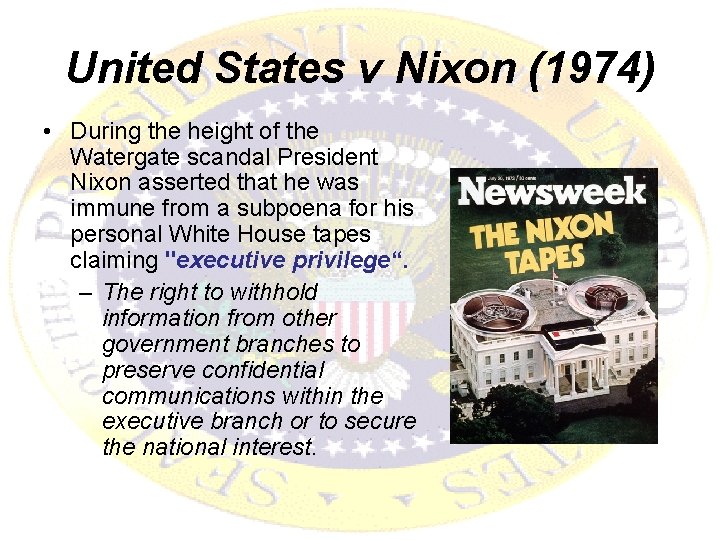
United States v Nixon (1974) • During the height of the Watergate scandal President Nixon asserted that he was immune from a subpoena for his personal White House tapes claiming "executive privilege“. – The right to withhold information from other government branches to preserve confidential communications within the executive branch or to secure the national interest.
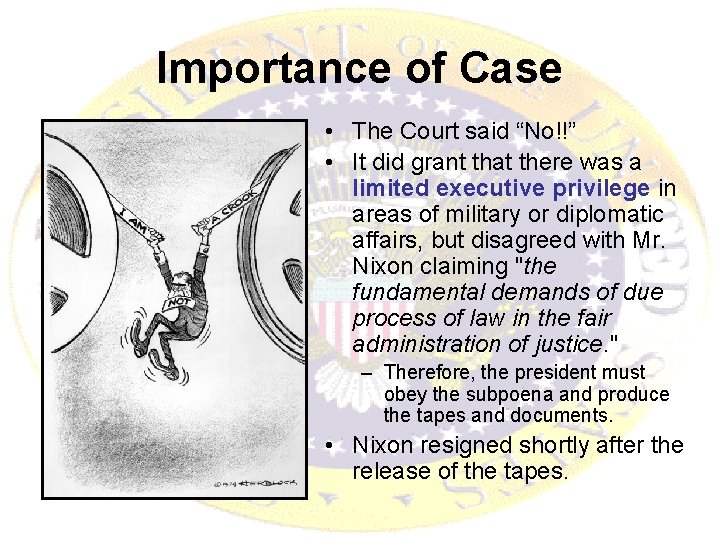
Importance of Case • The Court said “No!!” • It did grant that there was a limited executive privilege in areas of military or diplomatic affairs, but disagreed with Mr. Nixon claiming "the fundamental demands of due process of law in the fair administration of justice. " – Therefore, the president must obey the subpoena and produce the tapes and documents. • Nixon resigned shortly after the release of the tapes.
The Electoral College Review • The Electoral College is the assembly that formally elects the President and Vice President – Our votes simply elect the electors that vote for the President • Number of electoral votes – 538 Total – 270 Needed to get elected
Electoral College (continued) • Electoral votes are divided up by state • Number of state electoral votes is equal to the state’s number of House Representatives and Senators – Exception: – Washington, DC gets 3 Votes
Electors Review • How selected? – Varies with each state – Usually selected by state parties or committees • Who are they? – Party loyalists – Party leaders – Friends of the candidate
Contingency Election for President • If one candidate does not win 270 votes, it goes to the House of Representatives • Top three candidates receiving electoral votes • Each state has one vote • Need a majority of states to elect the President
Contingency Election for Vice-President • Goes to the Senate for a vote • Two candidates with the most electoral vote compete • Members vote as individuals rather than states.
Electoral College Criticism • Faithless Electors – Electors may change their votes – Some state laws do not allow this • Winner take all system – Gives big states an advantage – Encourages fraud – Enhances power of third party candidates to split the vote (Green’s and Nader in 2000)
Electoral College Criticism (continued) • All states get at least three electoral votes – Gives small states more power relative to their population • Uncertainty of the Winner Winning – Winner of the popular vote does not equal winner of the electoral vote • Contingency Election Procedures – Deadlock in the House – Increased power of third parties to control election
Virtues of the Electoral College • • It is a Proven System Makes Campaigns More Manageable Discourages Election Fraud Preserves Moderate Two-Party System
Don’t forget to read Chapters 8 and 9!!
- Slides: 61