Chapter 2 Computer Evolution and Performance The evolution
- Slides: 68
Chapter 2 Computer Evolution(演变) and Performance § The evolution of computers has been characterized by increasing processor speed, decreasing component size, increasing memory size, and increasing I/O capacity(容量) and speed.
Chapter 2 Computer Evolution and Performance § One factor responsible for the great increase in processor speed is the shrinking size of microprocessor components; this reduces the distance between components and hence increases speed. However, the true gains in speed in recent years have come from the organization of the processor, including heavy(大规模) use of pipelining and parallel execution techniques and the use of speculative(推测) execution techniques, which results in the tentative(试探) execution of future instructions that might be needed. All of these techniques are designed to keep the processor busy as much of the time as possible.
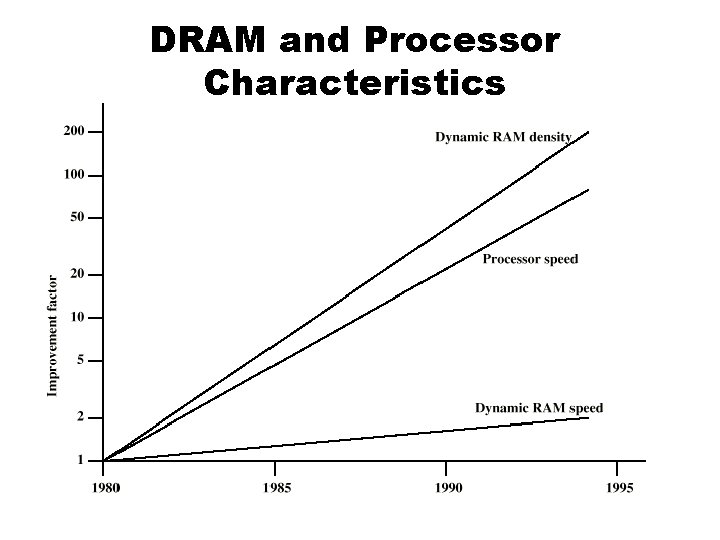
Chapter 2 Computer Evolution and Performance § A critical issue in computer system design is balancing the performance of the various elements, so that gains in performance in one area are not handicapped(妨碍) by a lag(延迟) in other areas. in particular, processor speed has increased more rapidly than memory access(存取) time. A variety of techniques are used to compensate for(弥补) this mismatch, including caches, wider data paths from memory to processor, and more intelligent memory chips.
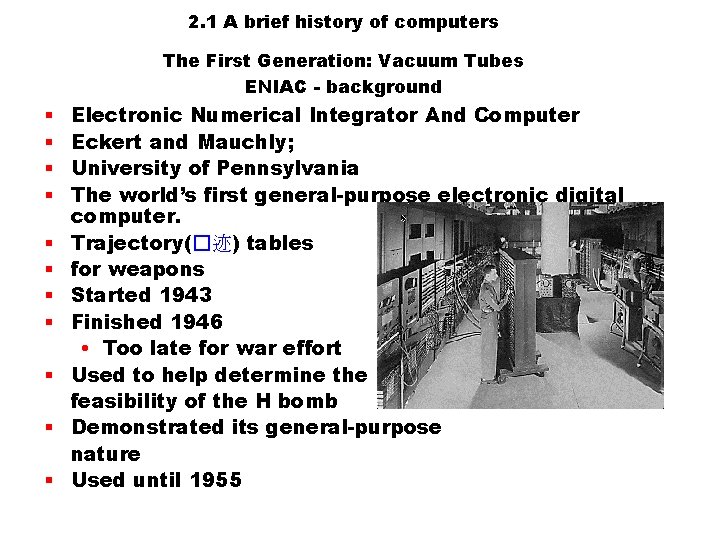
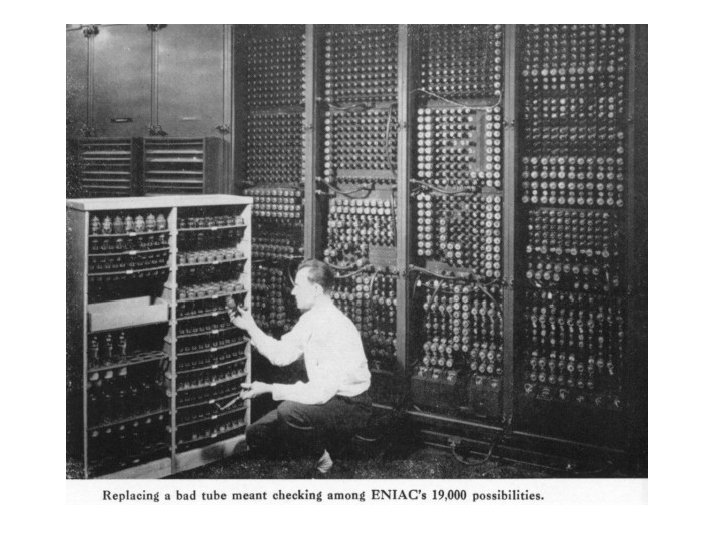
2. 1 A brief history of computers The First Generation: Vacuum Tubes ENIAC - background § § § Electronic Numerical Integrator And Computer Eckert and Mauchly; University of Pennsylvania The world’s first general-purpose electronic digital computer. Trajectory(�迹) tables for weapons Started 1943 Finished 1946 • Too late for war effort Used to help determine the feasibility of the H bomb Demonstrated its general-purpose nature Used until 1955
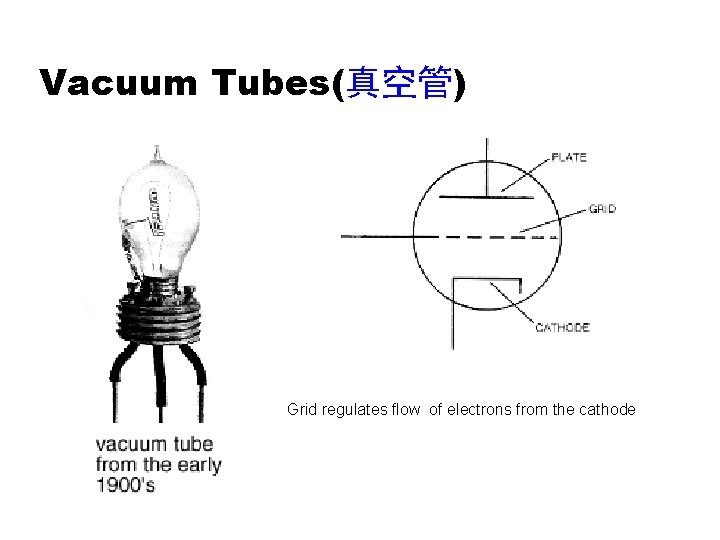
Vacuum Tubes(真空管) Grid regulates flow of electrons from the cathode
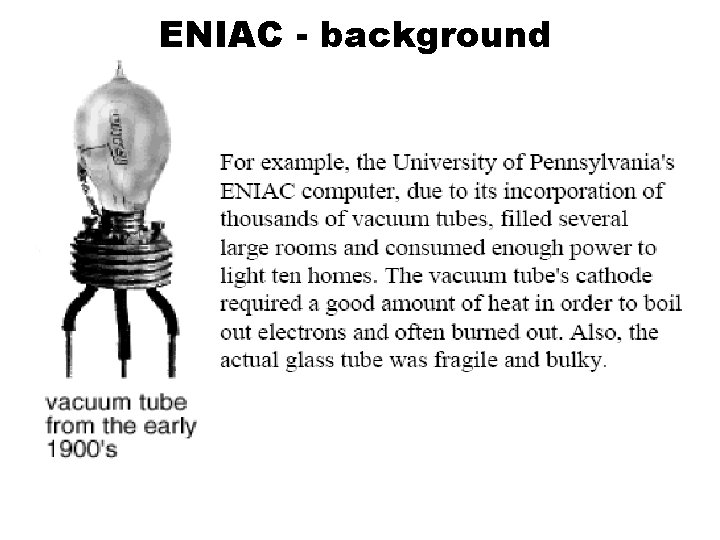
ENIAC - background
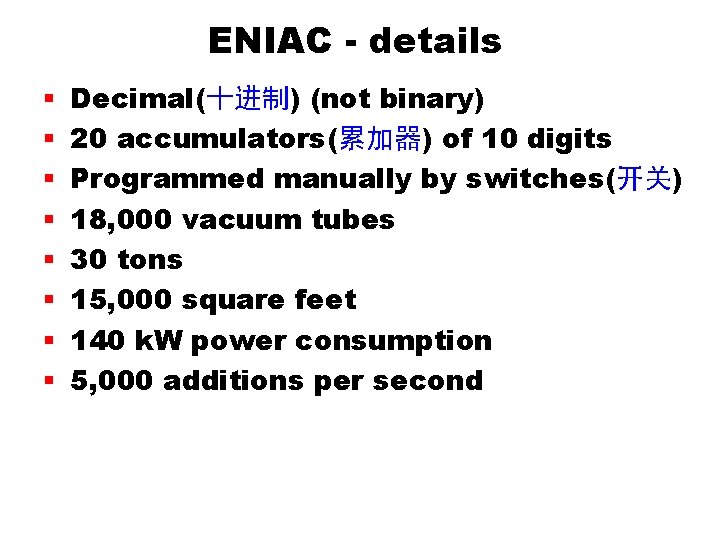
ENIAC - details § § § § Decimal(十进制) (not binary) 20 accumulators(累加器) of 10 digits Programmed manually by switches(开关) 18, 000 vacuum tubes 30 tons 15, 000 square feet 140 k. W power consumption 5, 000 additions per second
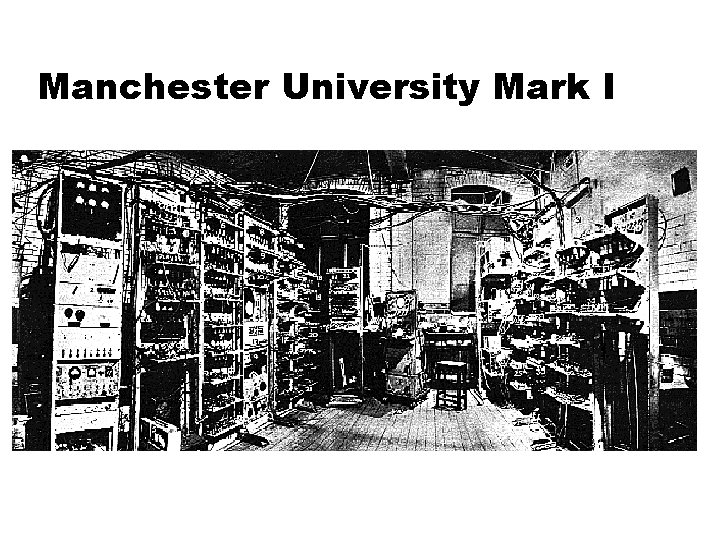
Manchester University Mark I
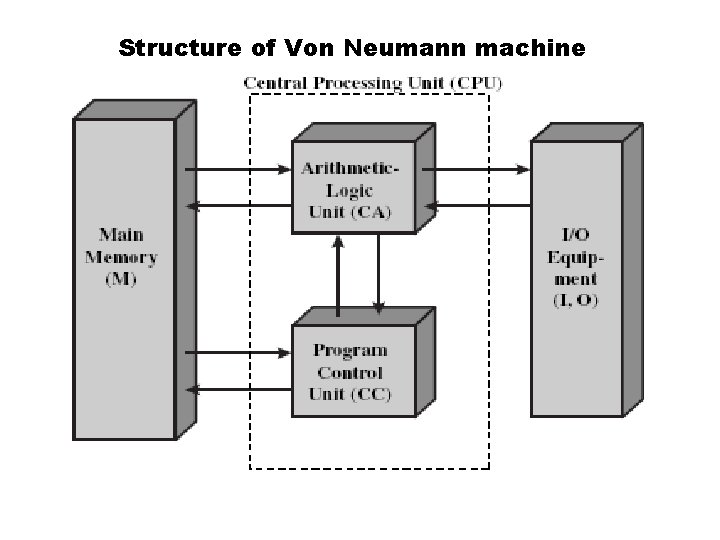
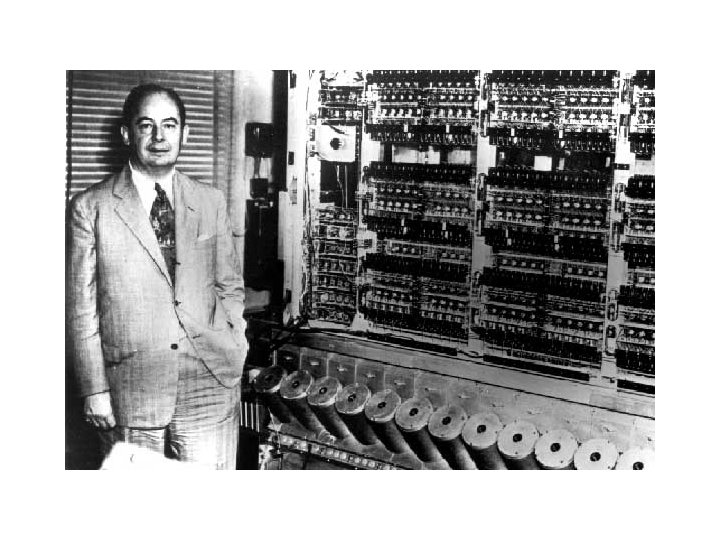
Von Neumann/Turing § Stored Program(存储程序) concept(the first publication of the idea was in a 1945 proposal(提议) by Von Neumann for the EDVAC: Electronic Discrete(离散) Variable(变量) Computer) § Main memory storing programs and data § ALU operating on binary data § Control unit interpreting instructions from memory and executing(执行) § Input and output equipment operated by control unit(控制器) § Princeton Institute for Advanced Studies • IAS § Completed 1952
Structure of Von Neumann machine
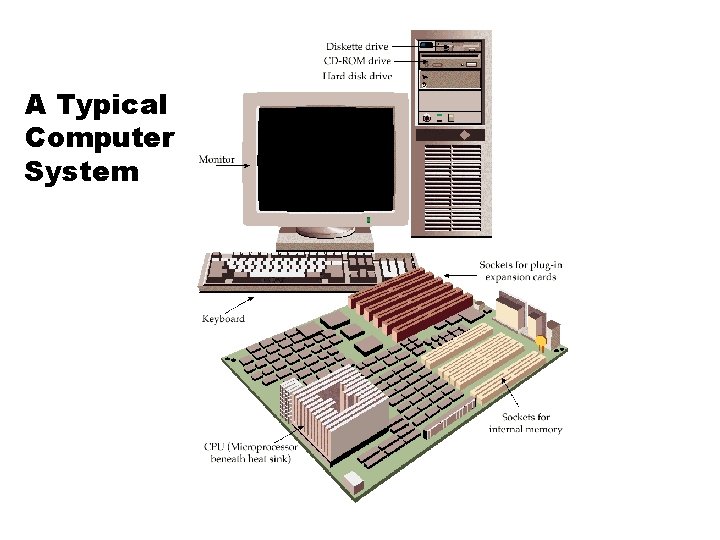
A Typical Computer System
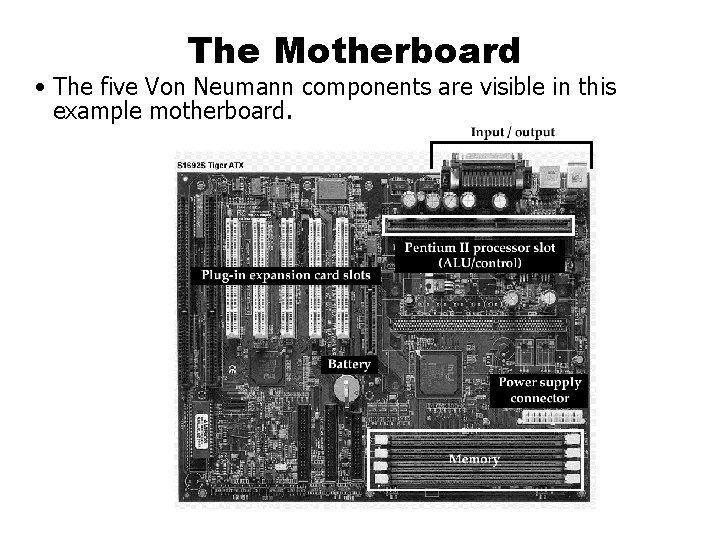
The Motherboard • The five Von Neumann components are visible in this example motherboard.
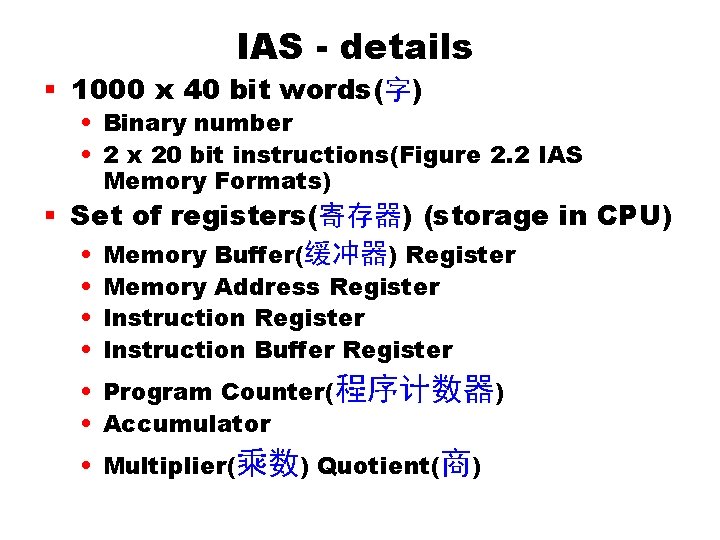
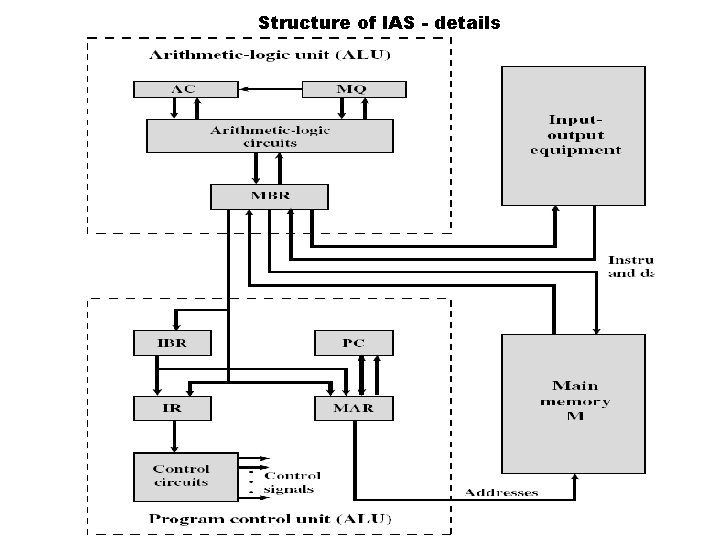
IAS - details § 1000 x 40 bit words(字) • Binary number • 2 x 20 bit instructions(Figure 2. 2 IAS Memory Formats) § Set of registers(寄存器) (storage in CPU) • Memory Buffer(缓冲器) Register • Memory Address Register • Instruction Buffer Register • Program Counter(程序计数器) • Accumulator • Multiplier(乘数) Quotient(商)
Structure of IAS - details
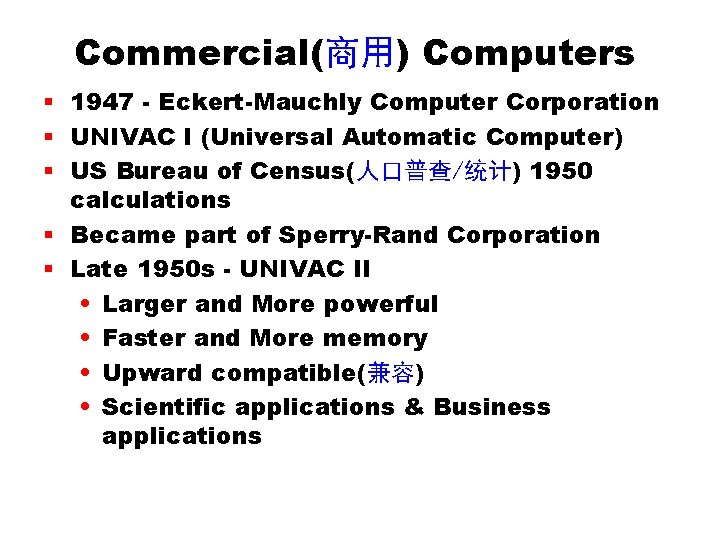
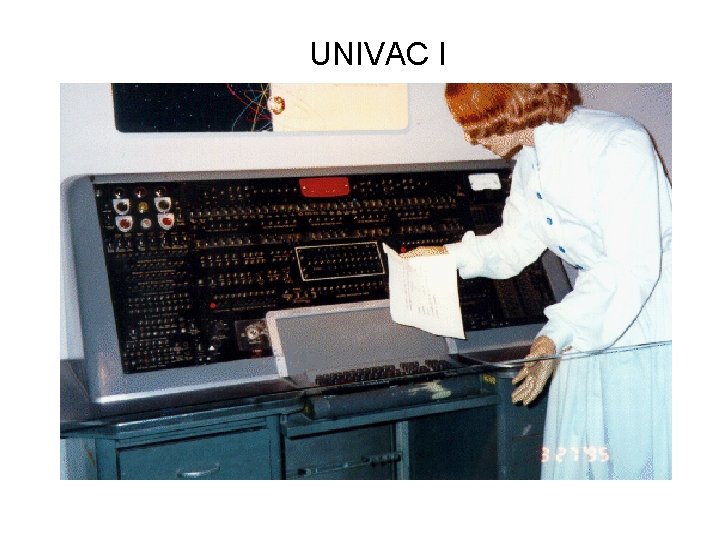
Commercial(商用) Computers § 1947 - Eckert-Mauchly Computer Corporation § UNIVAC I (Universal Automatic Computer) § US Bureau of Census(人口普查/统计) 1950 calculations § Became part of Sperry-Rand Corporation § Late 1950 s - UNIVAC II • Larger and More powerful • Faster and More memory • Upward compatible(兼容) • Scientific applications & Business applications
UNIVAC I
IBM § Punched-card(穿孔-卡片) processing equipment § 1953 - the 701 • IBM’s first stored program computer • Scientific calculations § 1955 - the 702 • Business applications § Lead to 700/7000 series
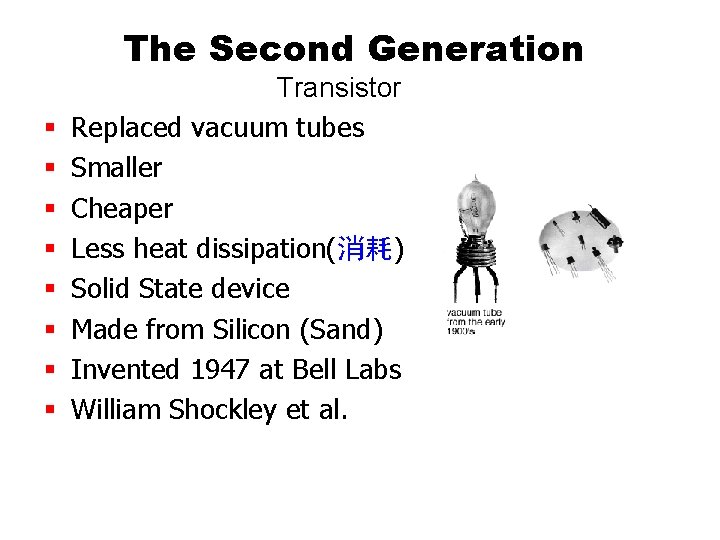
The Second Generation § § § § Transistor Replaced vacuum tubes Smaller Cheaper Less heat dissipation(消耗) Solid State device Made from Silicon (Sand) Invented 1947 at Bell Labs William Shockley et al.
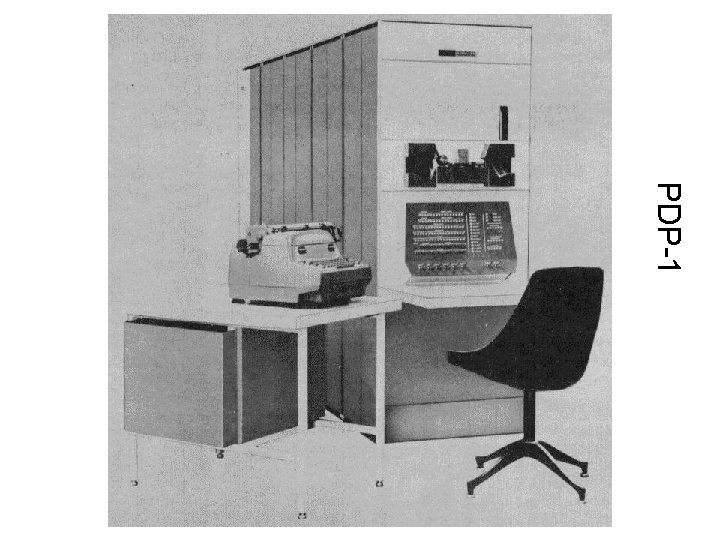
Transistor-Based Computers § § Second generation machines NCR & RCA produced small transistor machines IBM 7000 DEC - 1957 • Produced PDP-1
PDP-1
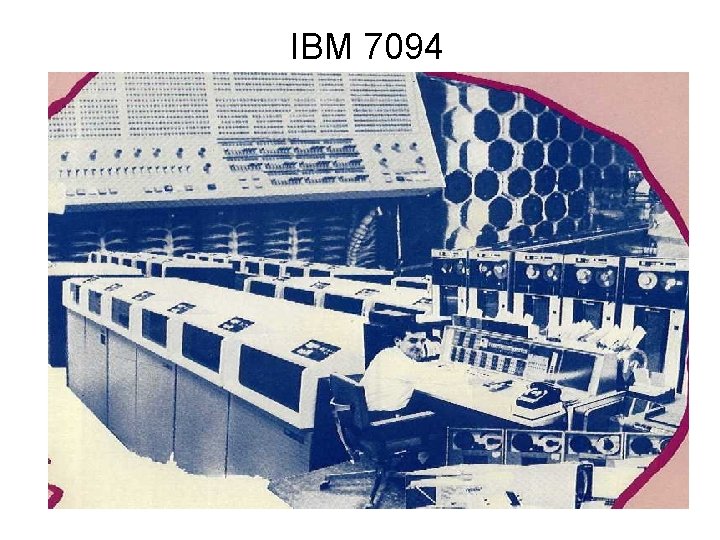
IBM 7094
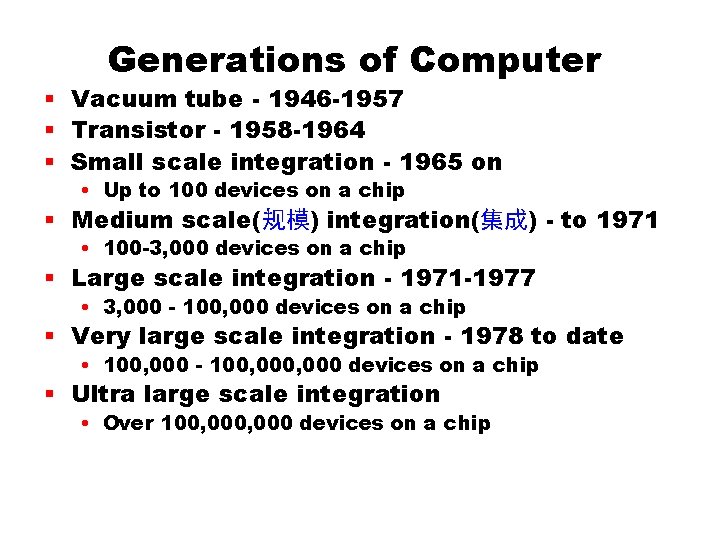
Generations of Computer § Vacuum tube - 1946 -1957 § Transistor - 1958 -1964 § Small scale integration - 1965 on • Up to 100 devices on a chip § Medium scale(规模) integration(集成) - to 1971 • 100 -3, 000 devices on a chip § Large scale integration - 1971 -1977 • 3, 000 - 100, 000 devices on a chip § Very large scale integration - 1978 to date • 100, 000 - 100, 000 devices on a chip § Ultra large scale integration • Over 100, 000 devices on a chip
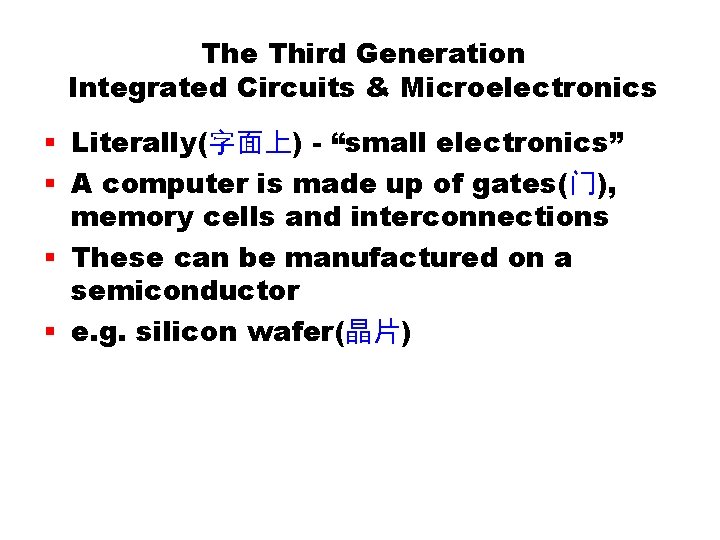
The Third Generation Integrated Circuits & Microelectronics § Literally(字面上) - “small electronics” § A computer is made up of gates(门), memory cells and interconnections § These can be manufactured on a semiconductor § e. g. silicon wafer(晶片)
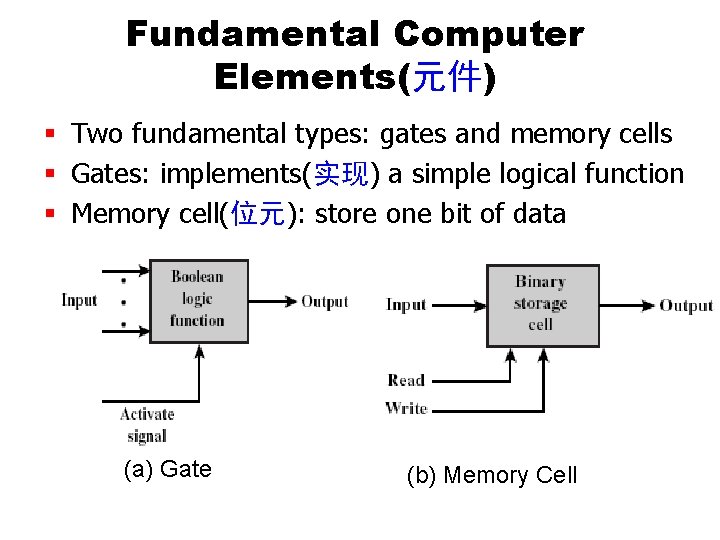
Fundamental Computer Elements(元件) § Two fundamental types: gates and memory cells § Gates: implements(实现) a simple logical function § Memory cell(位元): store one bit of data (a) Gate (b) Memory Cell
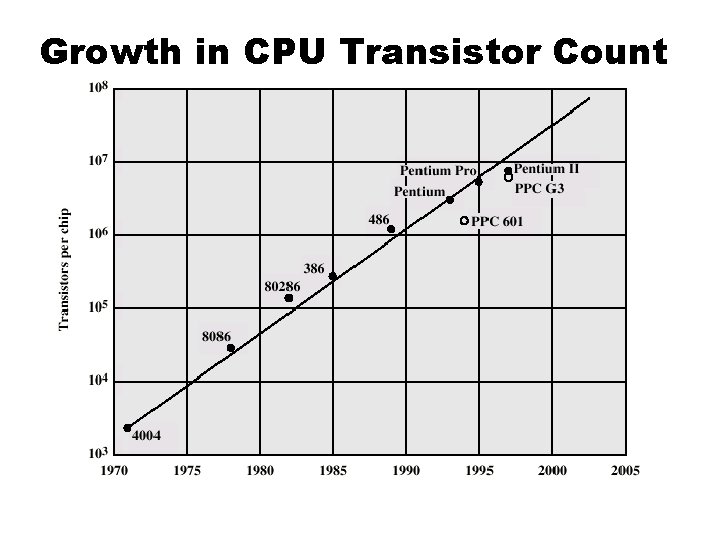
Moore’s Law § Increased density(密度) of components on chip § Gordon Moore – cofounder(联合创建者) of Intel § Number of transistors(晶体管) on a chip will double every year § Since 1970’s development has slowed a little • Number of transistors doubles every 18 months § Cost of a chip has remained almost unchanged § Higher packing density means shorter electrical paths, giving higher performance § Smaller size gives increased flexibility § Reduced power and cooling requirements § Fewer interconnections increases reliability
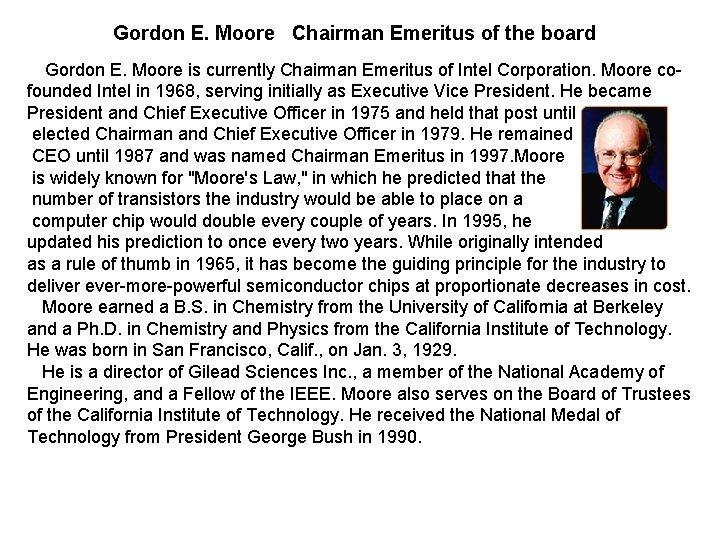
Gordon E. Moore Chairman Emeritus of the board Gordon E. Moore is currently Chairman Emeritus of Intel Corporation. Moore co- founded Intel in 1968, serving initially as Executive Vice President. He became President and Chief Executive Officer in 1975 and held that post until elected Chairman and Chief Executive Officer in 1979. He remained CEO until 1987 and was named Chairman Emeritus in 1997. Moore is widely known for "Moore's Law, " in which he predicted that the number of transistors the industry would be able to place on a computer chip would double every couple of years. In 1995, he updated his prediction to once every two years. While originally intended as a rule of thumb in 1965, it has become the guiding principle for the industry to deliver ever-more-powerful semiconductor chips at proportionate decreases in cost. Moore earned a B. S. in Chemistry from the University of California at Berkeley and a Ph. D. in Chemistry and Physics from the California Institute of Technology. He was born in San Francisco, Calif. , on Jan. 3, 1929. He is a director of Gilead Sciences Inc. , a member of the National Academy of Engineering, and a Fellow of the IEEE. Moore also serves on the Board of Trustees of the California Institute of Technology. He received the National Medal of Technology from President George Bush in 1990.
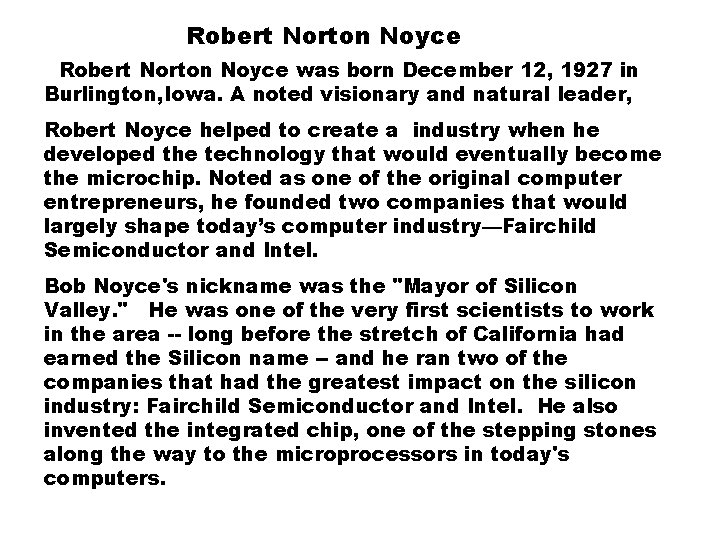
Robert Norton Noyce was born December 12, 1927 in Burlington, Iowa. A noted visionary and natural leader, Robert Noyce helped to create a industry when he developed the technology that would eventually become the microchip. Noted as one of the original computer entrepreneurs, he founded two companies that would largely shape today’s computer industry—Fairchild Semiconductor and Intel. Bob Noyce's nickname was the "Mayor of Silicon Valley. " He was one of the very first scientists to work in the area -- long before the stretch of California had earned the Silicon name -- and he ran two of the companies that had the greatest impact on the silicon industry: Fairchild Semiconductor and Intel. He also invented the integrated chip, one of the stepping stones along the way to the microprocessors in today's computers.
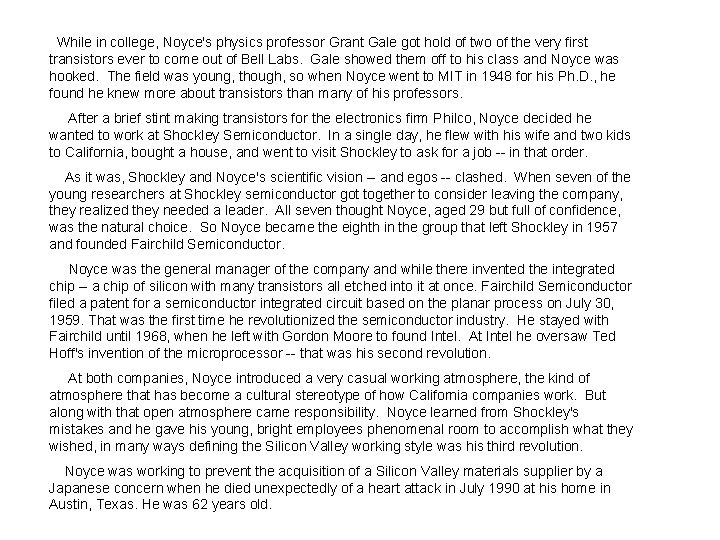
While in college, Noyce's physics professor Grant Gale got hold of two of the very first transistors ever to come out of Bell Labs. Gale showed them off to his class and Noyce was hooked. The field was young, though, so when Noyce went to MIT in 1948 for his Ph. D. , he found he knew more about transistors than many of his professors. After a brief stint making transistors for the electronics firm Philco, Noyce decided he wanted to work at Shockley Semiconductor. In a single day, he flew with his wife and two kids to California, bought a house, and went to visit Shockley to ask for a job -- in that order. As it was, Shockley and Noyce's scientific vision -- and egos -- clashed. When seven of the young researchers at Shockley semiconductor got together to consider leaving the company, they realized they needed a leader. All seven thought Noyce, aged 29 but full of confidence, was the natural choice. So Noyce became the eighth in the group that left Shockley in 1957 and founded Fairchild Semiconductor. Noyce was the general manager of the company and while there invented the integrated chip -- a chip of silicon with many transistors all etched into it at once. Fairchild Semiconductor filed a patent for a semiconductor integrated circuit based on the planar process on July 30, 1959. That was the first time he revolutionized the semiconductor industry. He stayed with Fairchild until 1968, when he left with Gordon Moore to found Intel. At Intel he oversaw Ted Hoff's invention of the microprocessor -- that was his second revolution. At both companies, Noyce introduced a very casual working atmosphere, the kind of atmosphere that has become a cultural stereotype of how California companies work. But along with that open atmosphere came responsibility. Noyce learned from Shockley's mistakes and he gave his young, bright employees phenomenal room to accomplish what they wished, in many ways defining the Silicon Valley working style was his third revolution. Noyce was working to prevent the acquisition of a Silicon Valley materials supplier by a Japanese concern when he died unexpectedly of a heart attack in July 1990 at his home in Austin, Texas. He was 62 years old.
Growth in CPU Transistor Count
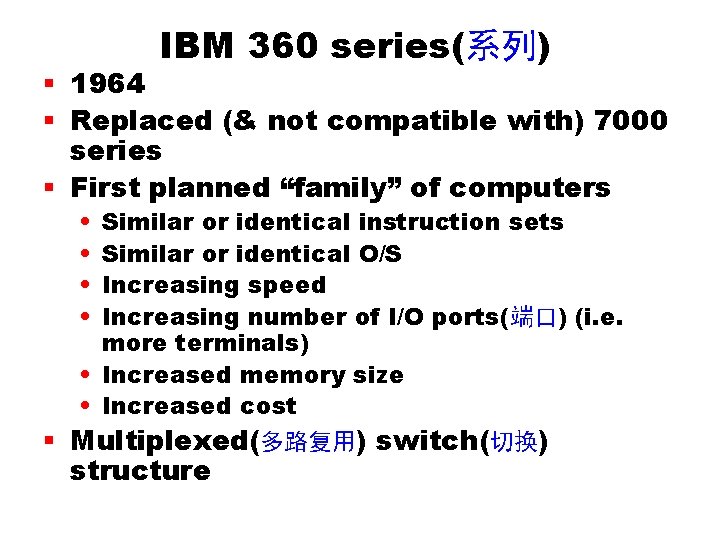
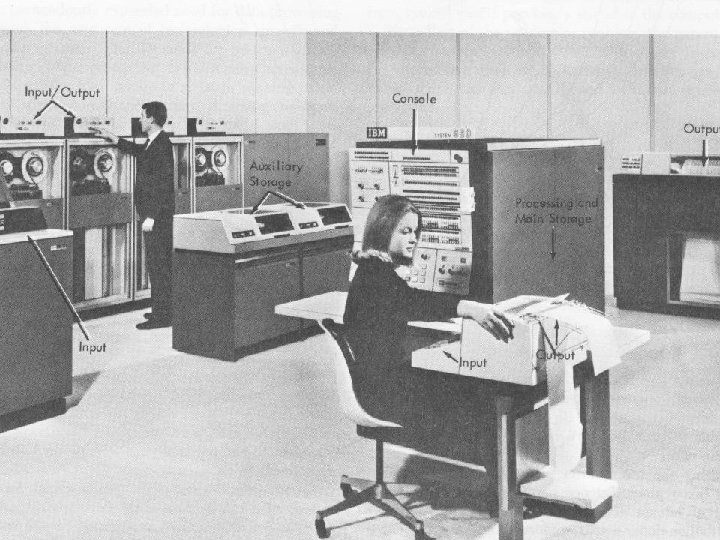
IBM 360 series(系列) § 1964 § Replaced (& not compatible with) 7000 series § First planned “family” of computers • • Similar or identical instruction sets Similar or identical O/S Increasing speed Increasing number of I/O ports(端口) (i. e. more terminals) • Increased memory size • Increased cost § Multiplexed(多路复用) switch(切换) structure
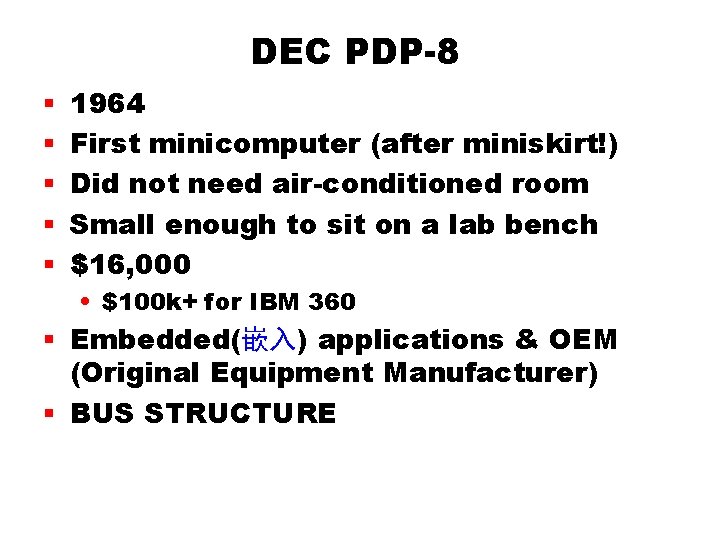
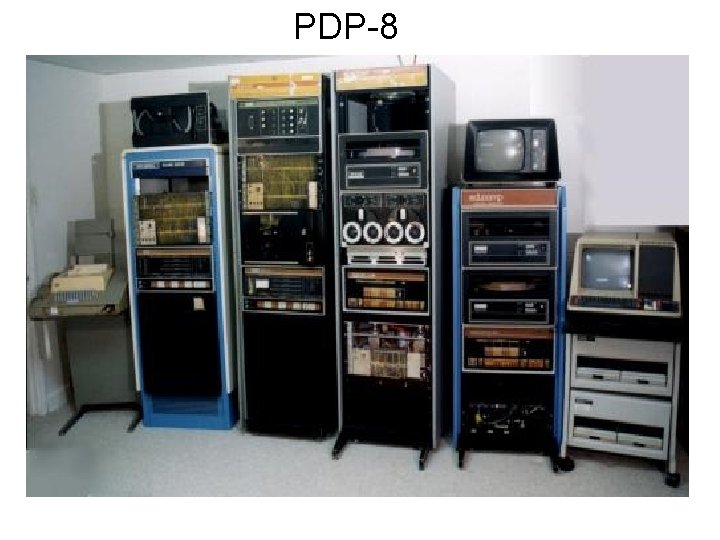
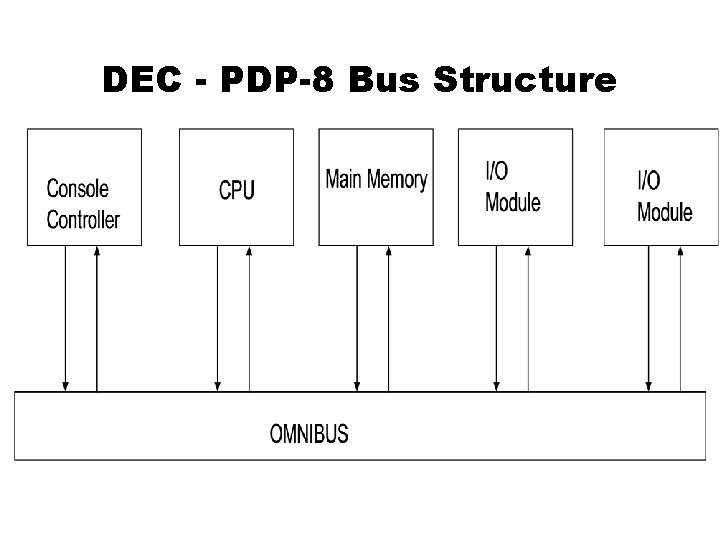
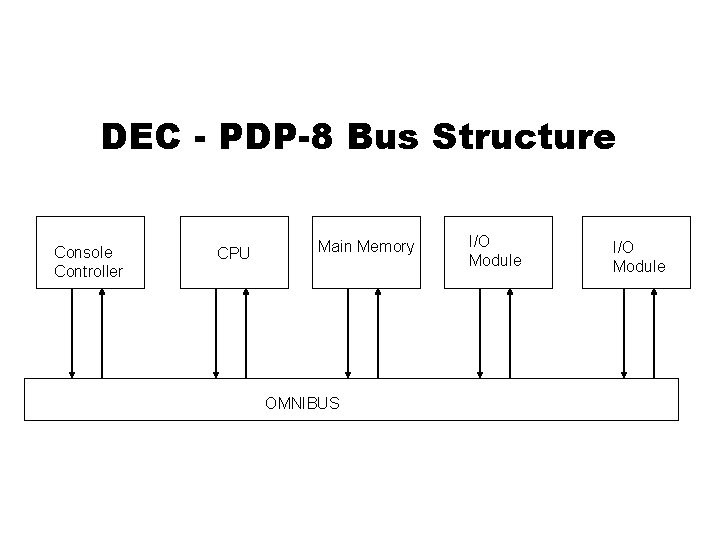
DEC PDP-8 § § § 1964 First minicomputer (after miniskirt!) Did not need air-conditioned room Small enough to sit on a lab bench $16, 000 • $100 k+ for IBM 360 § Embedded(嵌入) applications & OEM (Original Equipment Manufacturer) § BUS STRUCTURE
PDP-8
DEC - PDP-8 Bus Structure
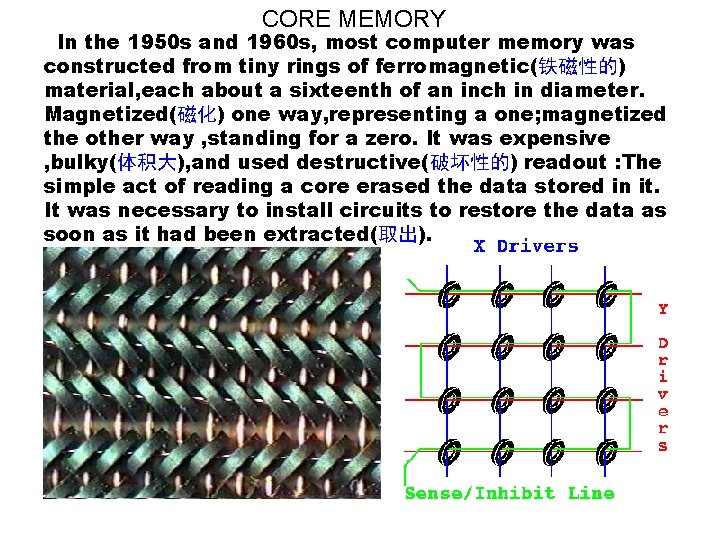
In CORE MEMORY the 1950 s and 1960 s, most computer memory was constructed from tiny rings of ferromagnetic(铁磁性的) material, each about a sixteenth of an inch in diameter. Magnetized(磁化) one way, representing a one; magnetized the other way , standing for a zero. It was expensive , bulky(体积大), and used destructive(破坏性的) readout : The simple act of reading a core erased the data stored in it. It was necessary to install circuits to restore the data as soon as it had been extracted(取出).
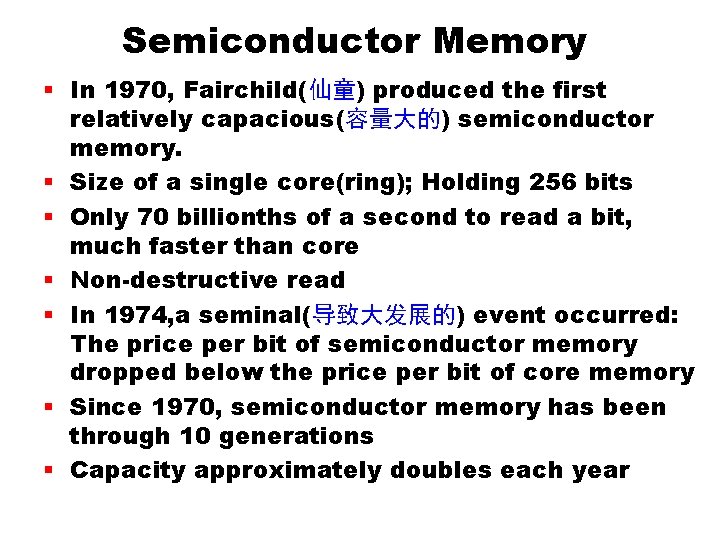
Semiconductor Memory § In 1970, Fairchild(仙童) produced the first relatively capacious(容量大的) semiconductor memory. § Size of a single core(ring); Holding 256 bits § Only 70 billionths of a second to read a bit, much faster than core § Non-destructive read § In 1974, a seminal(导致大发展的) event occurred: The price per bit of semiconductor memory dropped below the price per bit of core memory § Since 1970, semiconductor memory has been through 10 generations § Capacity approximately doubles each year
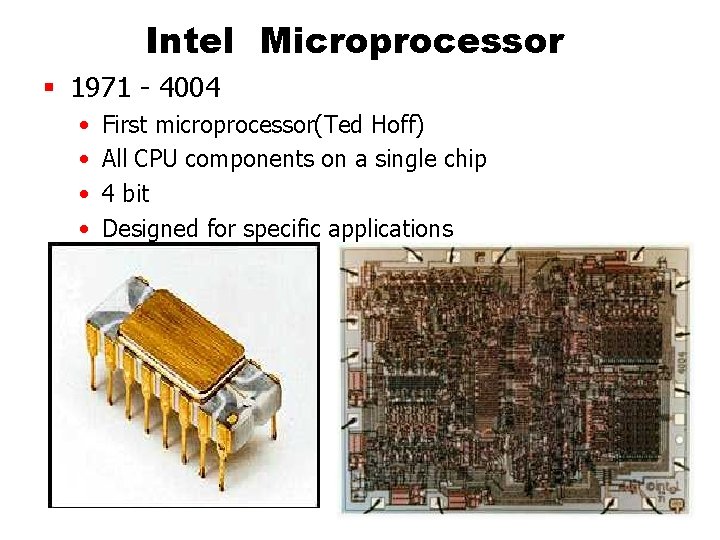
Intel Microprocessor § 1971 - 4004 • • First microprocessor(Ted Hoff) All CPU components on a single chip 4 bit Designed for specific applications
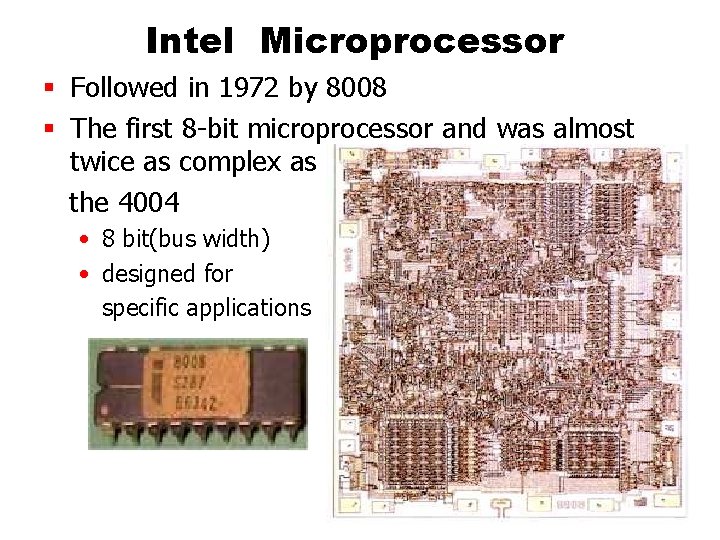
Intel Microprocessor § Followed in 1972 by 8008 § The first 8 -bit microprocessor and was almost twice as complex as the 4004 • 8 bit(bus width) • designed for specific applications
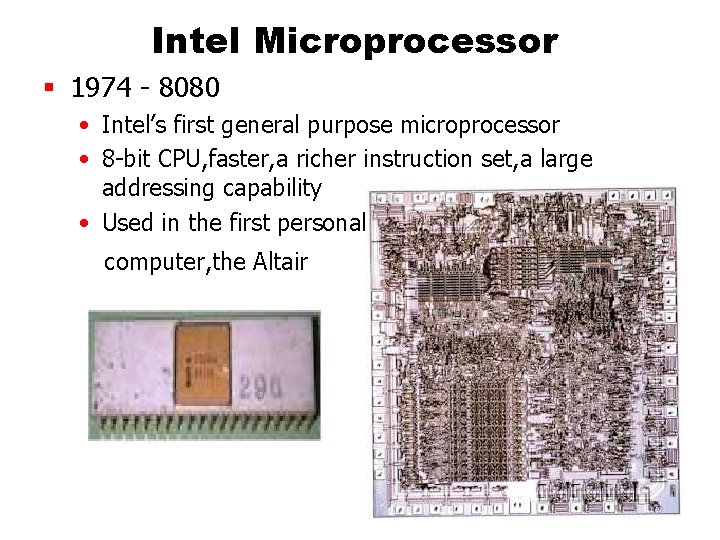
Intel Microprocessor § 1974 - 8080 • Intel’s first general purpose microprocessor • 8 -bit CPU, faster, a richer instruction set, a large addressing capability • Used in the first personal computer, the Altair
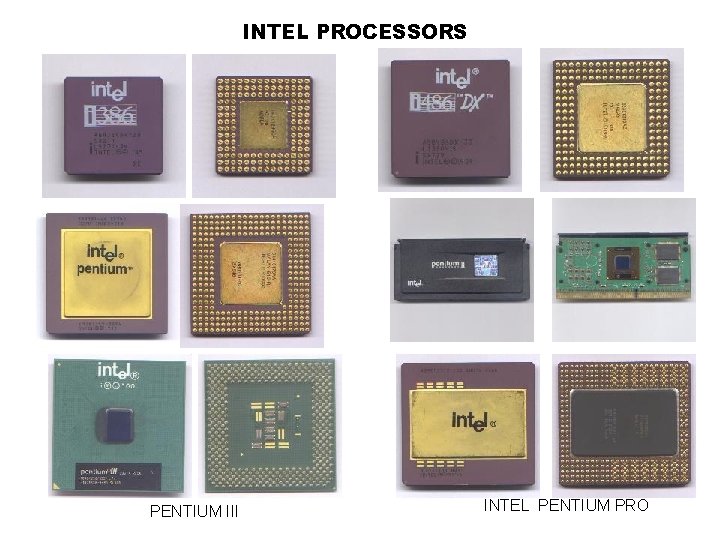
INTEL PROCESSORS PENTIUM III INTEL PENTIUM PRO
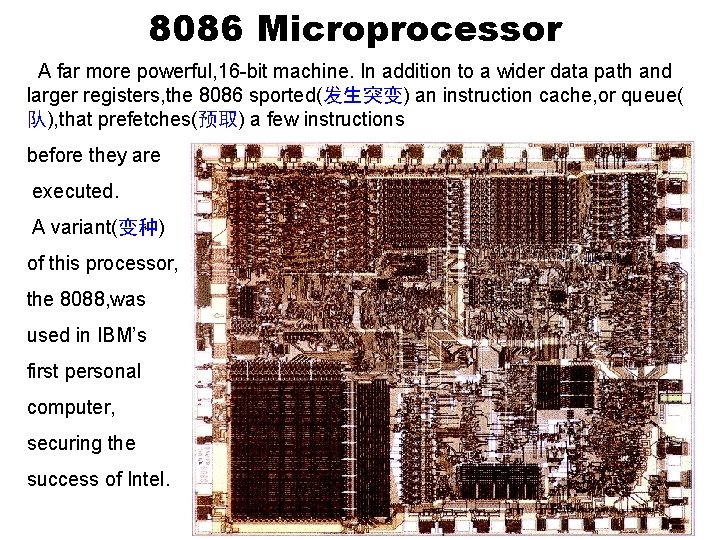
8086 Microprocessor A far more powerful, 16 -bit machine. In addition to a wider data path and larger registers, the 8086 sported(发生突变) an instruction cache, or queue( 队), that prefetches(预取) a few instructions before they are executed. A variant(变种) of this processor, the 8088, was used in IBM’s first personal computer, securing the success of Intel.
Intel Microprocessor • 80286: This extension of the 8086 enabled addressing(寻址) a 16 -MByte memory instead of just 1 MByte. • 80386: Intel’s first 32 -bit machine, and a major overhaul(大换班) of the product. With a 32 -bit architecture, the 80386 rivaled(比得上) the complexity and power of minicomputers and mainframes introduced just a few years earlier. This was the first Intel processor to support multitasking(多任务), meaning it could run multiple programs at the same time.
Intel Microprocessor • 80486: The 80486 introduced the use of much more sophisticated and powerful cache technology and sophisticated instruction pipelining. The 486 also offered a built-in(内建的) math coprocessor(协处理器), offloading complex math operations from the main CPU. • Pentium: With the Pentium, Intel introduced the use of superscalar(超标量) techniques, which allow multiple instructions to be executed in parallel.
Intel Microprocessor • Pentium: With the Pentium, Intel introduced the use of superscalar techniques, which allow multiple instructions to be executed in parallel. • Pentium Pro: The Pentium Pro continued the move into superscalar organization begun with the Pentium, with aggressive use of register renaming, branch prediction, data flow analysis, and speculative execution. • Pentium II: The Pentium II incorporated Intel MMX (Multi. Media e. Xtension) technology, which is designed specifically to process video, audio, and graphics data efficiently. • Pentium III: The Pentium III incorporated additional floating-point instructions to support 3 D graphics software.
2000: Intel® Pentium® 4 Processor Users of Intel® Pentium® 4 processor-based PCs can create professional-quality movies; deliver TV-like video via the Internet; communicate with real-time video and voice; render 3 D graphics in real time; quickly encode music for MP 3 players; and simultaneously run several multimedia applications while connected to the Internet. The processor debuted with 42 million transistors and circuit lines of 0. 18 microns. Intel's first microprocessor, the 4004, ran at 108 kilohertz (108, 000 hertz), compared to the Intel® Pentium® 4 processor's initial speed of 1. 5 gigahertz (1. 5 billion hertz). If automobile speed had increased similarly over the same period, you could now drive from San Francisco to New York in about 13 seconds
2001: Intel® Xeon™ Processor The Intel® Xeon™ processor is targeted for highperformance and mid-range, dual-processor workstations, dual and multi-processor server configurations coming in the future. The platform offers customers a choice of operating systems and applications, along with high performance at affordable prices. Intel Xeon processor-based workstations are expected to achieve performance increases between 30 and 90 percent over systems featuring Intel® Pentium® III Xeon™ processors depending on applications and configurations. The processor is based on the Intel Net. Burst™ architecture, which is designed to deliver the processing power needed for video and audio applications, advanced Internet technologies, and complex 3 -D graphics.
2001: Intel® Itanium™ Processor The Itanium™ processor is the first in a family of 64 -bit products from Intel. Designed for high-end, enterprise-class servers and workstations, the processor was built from the ground up with an entirely new architecture based on Intel's Explicitly Parallel Instruction Computing (EPIC) design technology. The processor delivers worldclass performance for the most demanding enterprise and high-performance computing applications, including e-Commerce security transactions, large databases, mechanical computer-aided engineering, and sophisticated scientific and engineering computing.
2003: Intel® Pentium® M Processor The Intel® Pentium® M processor, the Intel® 855 chipset family, and the Intel® PRO/Wireless 2100 network connection are three components of Intel® Centrino™ mobile technology. Intel Centrino mobile technology is designed specifically for portable computing, with built-in wireless LAN capability and breakthrough mobile performance. It enables extended battery life and thinner, lighter mobile computers
Intel® Pentium® 4 Processor with HT Technology Hyper-Threading(超线程 )Technology enables multi -threaded software applications to execute threads in parallel. This level of threading technology has never been seen before in a general-purpose microprocessor. Internet, e-Business, and enterprise software applications continue to put higher demands on processors. To improve performance in the past, threading was enabled in the software by splitting instructions into multiple streams so that multiple processors could act upon them. Today with Hyper -Threading Technology, processor-level threading can be utilized which offers more efficient use of resources for greater parallelism and performance on today's multithreaded software.
2. 2 Designing For Performance § Desktop applications that require the great power of today’s microprocessorbased systems include • • • Image processing Speech recognition(语音识别) Videoconferencing(视频会议) Multimedia authoring(多媒体创作) Voice and video annotation of files(档案的语 音视频注释) • Simulation modeling(仿真建模)
Designing For Performance § § Workstation systems now support highly sophisticated engineering and scientific applications, as well as simulation systems, and the ability to apply workgroup principles to image and video applications. Businesses are relying on increasingly powerful servers to handle transaction and database processing and to support massive client-sever networks that have replaced the huge mainframe computer centers of yesteryear.
Microprocessor Speed § § What gives the Pentium or Power. PC such mindboggling power is the relentless pursuit of speed by processor chip manufacturers. The evolution of these machines continues to bear out Moore’s law. So long as this law holds, chipmakers can unleash a new generation of chips every three years—with four times as many transistors. In memory chips, this has quadrupled the capacity of DRAM, still the basic technology for computer main memory , every three years.
Microprocessor Speed § § In microprocessors, the addition of new circuits, and the speed boost that comes from reducing the distances between them, has improved performance four-or fivefold every three years or so since Intel launched its X 86 family in 1978. While the chipmakers have been busy learning how to fabricate chips of greater and greater density, the processor designers must come up with ever more elaborate techniques for feeding the monster.
The techniques built into contemporary processors § Branch prediction: The processor looks ahead in the software and predicts which branches, or groups of instructions, are likely to be executed next. If the processor guesses right most of the time, it can prefetch the correct instructions and buffer them so that the processor is kept busy. Thus, branch prediction increases the amount of work available for the processor to execute.
The techniques built into contemporary processors : § Data flow analysis: The processor analyzes which instructions are dependent on each other’s results, or data, to create an optimized schedule of instructions. In fact, instructions are scheduled to be executed when ready, independent of the original program order. § Speculative execution: Using branch prediction and data flow analysis, some processors speculatively execute instructions ahead of their actual appearance in the program execution, holding the results in temporary locations. This enables the processor to keep its execution engines as busy as possible by executing instructions that are likely to be needed.
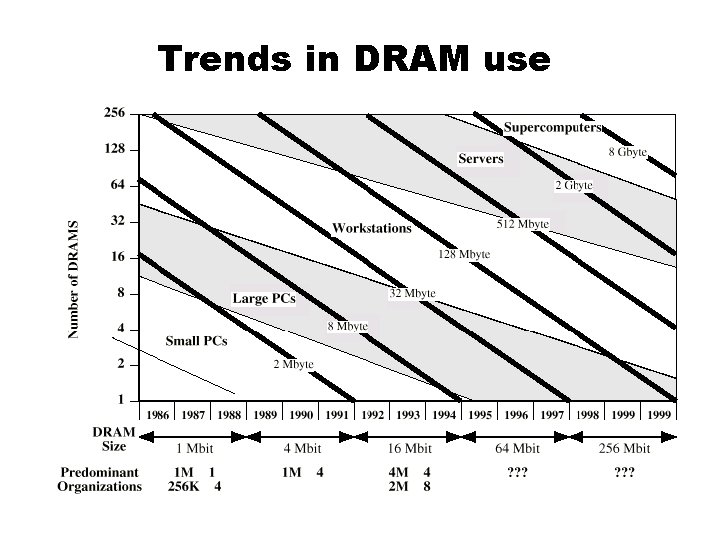
Performance Mismatch Processor speed increased Memory capacity increased Memory speed lags behind processor speed The interface between processor and main memory is the most crucial pathway in the entire computer, because it is responsible for carrying a constant flow of program instructions and data between memory chips and the processor. § If memory or the pathway fails to keep pace with the processor’s insistent demands, the processor stalls in a wait state, and valuable processing time is lost. § §
DRAM and Processor Characteristics
Trends in DRAM use
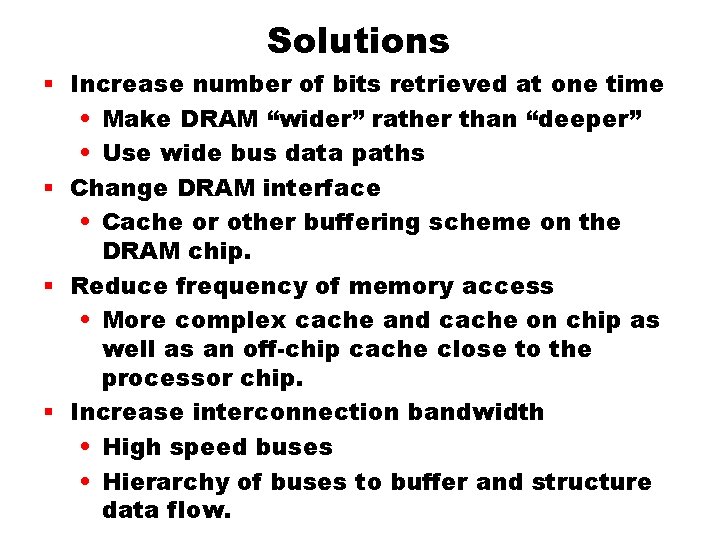
Solutions § Increase number of bits retrieved at one time • Make DRAM “wider” rather than “deeper” • Use wide bus data paths § Change DRAM interface • Cache or other buffering scheme on the DRAM chip. § Reduce frequency of memory access • More complex cache and cache on chip as well as an off-chip cache close to the processor chip. § Increase interconnection bandwidth • High speed buses • Hierarchy of buses to buffer and structure data flow.
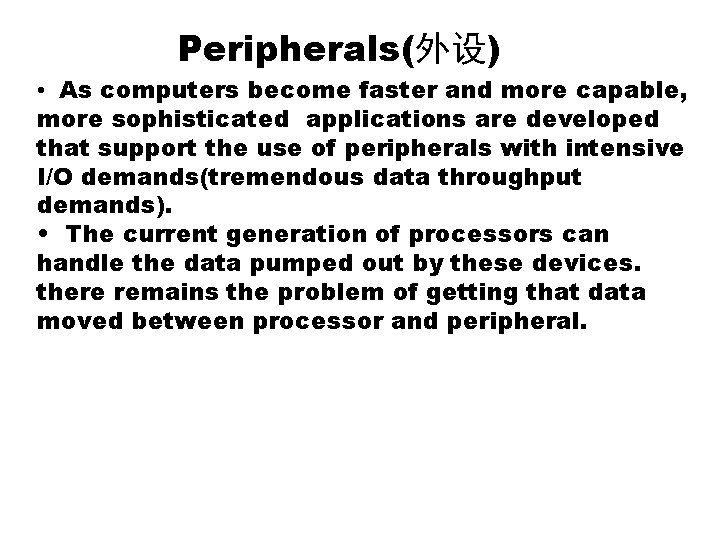
Peripherals(外设) • As computers become faster and more capable, more sophisticated applications are developed that support the use of peripherals with intensive I/O demands(tremendous data throughput demands). • The current generation of processors can handle the data pumped out by these devices. there remains the problem of getting that data moved between processor and peripheral.
Peripherals • Strategies here include caching and buffering schemes plus the use of higher-speed interconnection buses and more elaborate structures of buses. In addition, the use of multiple-processor configurations can aid in satisfying I/O demands. • The key in all this is balance. Designers constantly strive to balance throughput and processing demands of the processor, main memory, I/O devices, and interconnection structures.
This design must constantly be rethought to cope with two constantly evolving factors: • The rate at which performance is changing in the various technology areas differs greatly from one type of element to another. • New applications and new peripheral devices constantly change the nature of the demand on the system in terms of typical instruction profile and the data access patterns.
Internet Resources § http: //www. intel. com/ • Search for the Intel Museum § § § http: //www. ibm. com http: //www. dec. com Charles Babbage Institute Power. PC Intel Developer Home
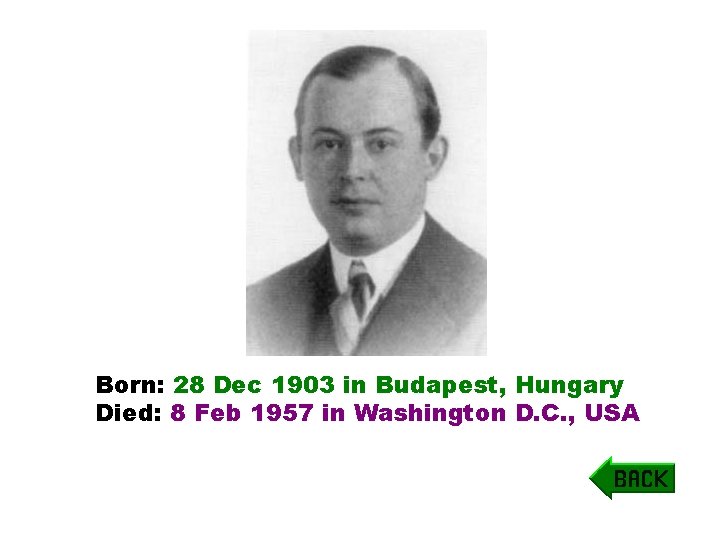
Born: 28 Dec 1903 in Budapest, Hungary Died: 8 Feb 1957 in Washington D. C. , USA
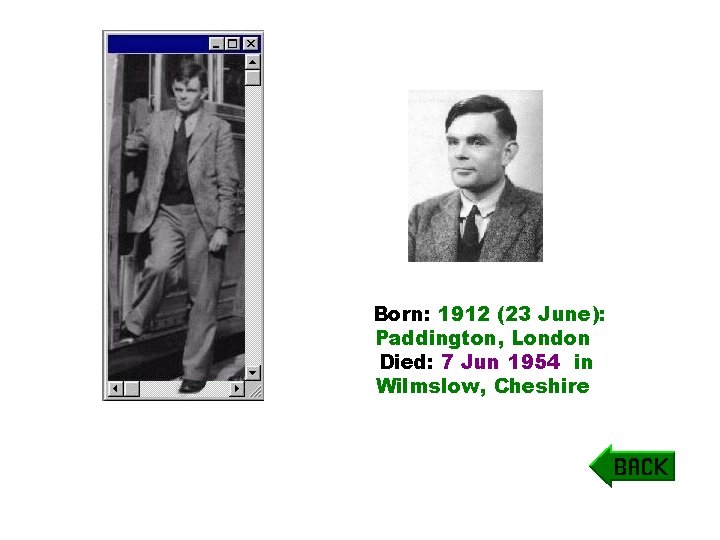
Born: 1912 (23 June): Paddington, London Died: 7 Jun 1954 in Wilmslow, Cheshire
DEC - PDP-8 Bus Structure Console Controller CPU Main Memory OMNIBUS I/O Module