Welcome to the National Center on Intensive Intervention






- Slides: 66
Welcome to the National Center on Intensive Intervention webinar! Our presentation will begin at 3: 00 pm Eastern Time. To access the audio portion of this presentation on your phone, dial: 1 -866 -244 -8528 When prompted, enter participant code: 117937 Your phone line will be muted. Please type questions into the chat box located on your screen.
Bringing Families to the Table: Family Engagement for Struggling Students Kate Augustyn Debra Jennings Kelly Orginski October, 2013
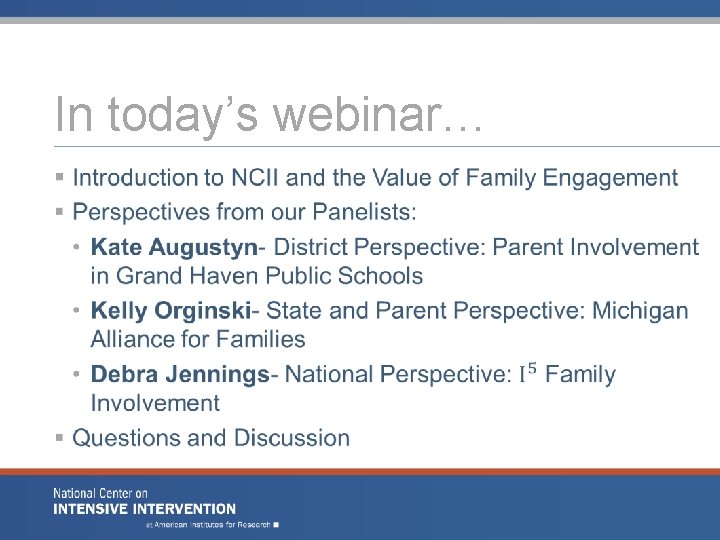
In today’s webinar… §
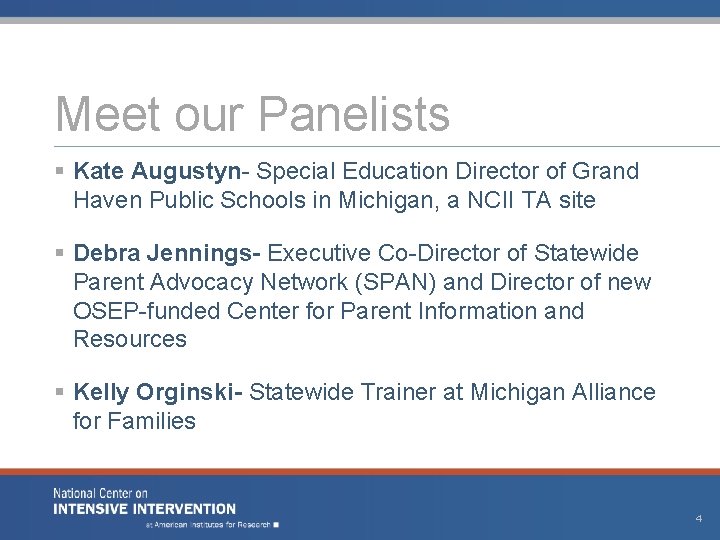
Meet our Panelists § Kate Augustyn- Special Education Director of Grand Haven Public Schools in Michigan, a NCII TA site § Debra Jennings- Executive Co-Director of Statewide Parent Advocacy Network (SPAN) and Director of new OSEP-funded Center for Parent Information and Resources § Kelly Orginski- Statewide Trainer at Michigan Alliance for Families 4
Introduction to NCII and the Value of Family Engagement
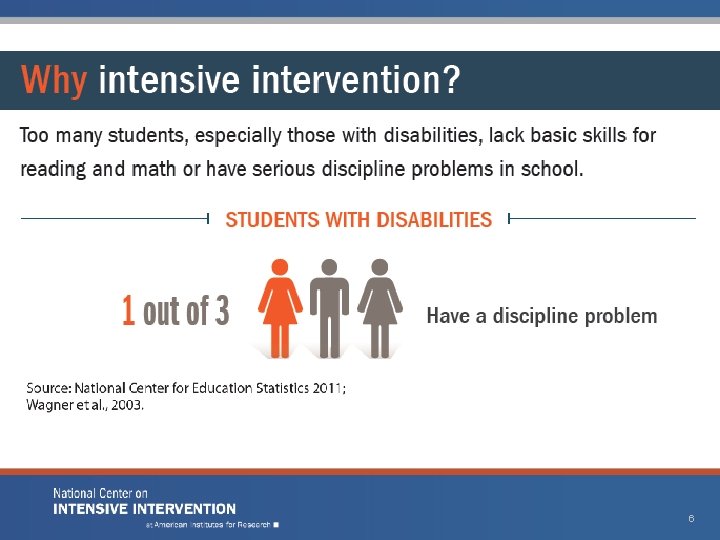
6
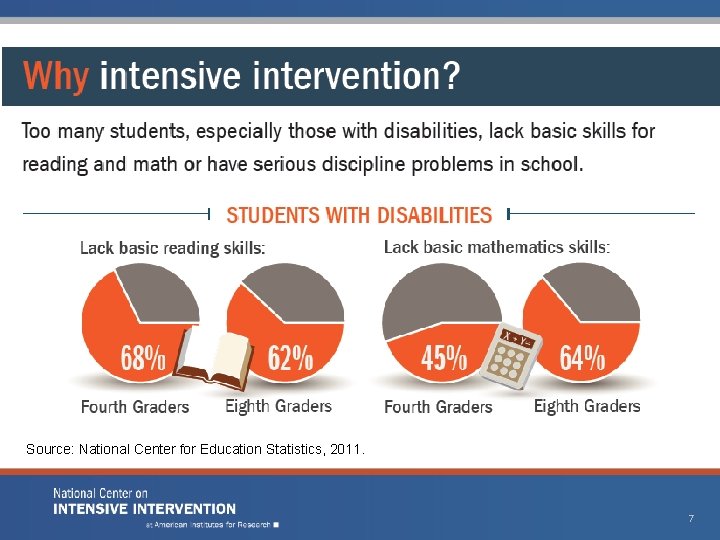
Source: National Center for Education Statistics, 2011. 7
Our Mission… to build district and school capacity to support implementation of data-based individualization in reading, mathematics, and behavior for students with severe and persistent learning and behavioral needs.
The Value of Family Engagement for Students with Intensive Needs
Lessons Learned from our Knowledge Development Sites § Finding: Meaningful engagement and involvement of families in decisions about program planning was important for supporting implementation of intensive intervention. • Regular and systematic communication with families • Address home life challenges 10
Parent Involvement in Grand Haven Area Public Schools Kate Augustyn
Parent Involvement in MTSS § Each of the elementary schools in Grand Haven has a different way to incorporate parents into their MTSS system. § These presentations and or meetings are often based on the character of the school and the mindset of the administrator and the building teams.
Parent Involvement in 5/6 Building § Based on the premise of Parent Connect and are interactive § Team members present curriculum overview and then work with parents to help them understand the curriculum and how to work with their students at home § The system is based on a positive model § Child care is provided § Treats and prizes are available
Parent Involvement in 7/8 Building § Team presents MTSS model and intervention model at orientation § Team works individually with parents to explain how they incorporate students into groups for both academic and social interventions when needed § Parents are encouraged to visit and ask questions about groups
Our District Commitment to Including Parents and Community § District has been involved with the MTSS model since 2008 when our seven elementary buildings joined the Mi. BLSi project § Established a Mi. BLSI Leadership Team made up of parents, community members, school staff and administrators § Team meets 3 times per year to review current trends in MTSS within the district
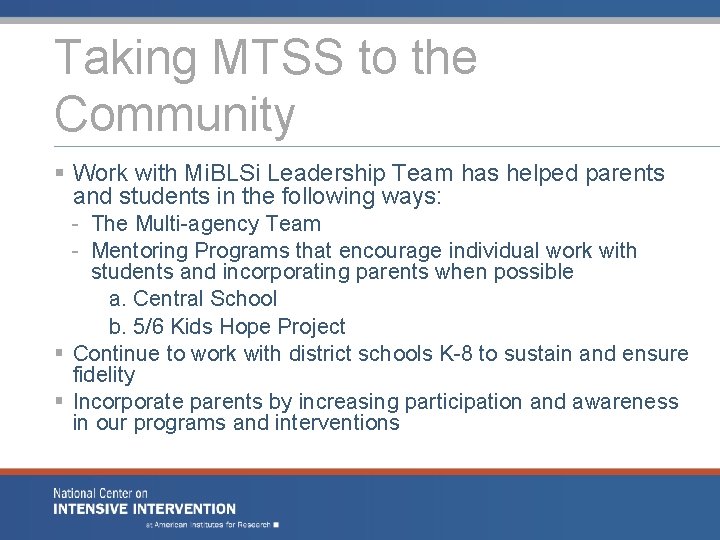
Taking MTSS to the Community § Work with Mi. BLSi Leadership Team has helped parents and students in the following ways: - The Multi-agency Team - Mentoring Programs that encourage individual work with students and incorporating parents when possible a. Central School b. 5/6 Kids Hope Project § Continue to work with district schools K-8 to sustain and ensure fidelity § Incorporate parents by increasing participation and awareness in our programs and interventions
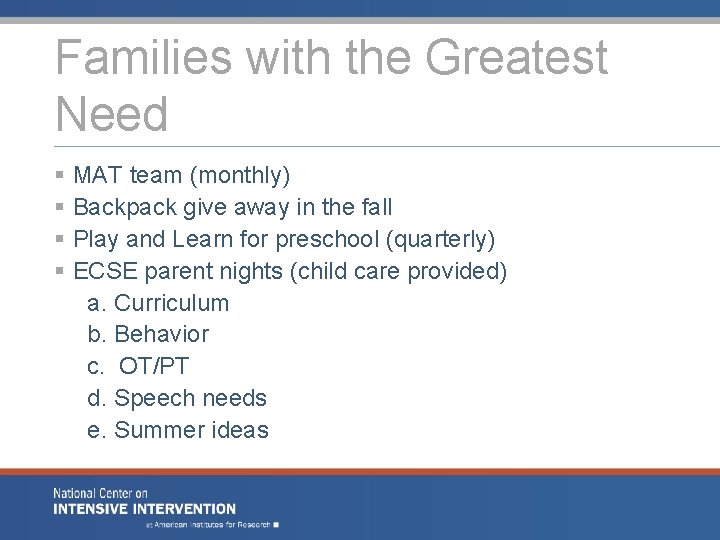
Families with the Greatest Need § MAT team (monthly) § Backpack give away in the fall § Play and Learn for preschool (quarterly) § ECSE parent nights (child care provided) a. Curriculum b. Behavior c. OT/PT d. Speech needs e. Summer ideas
Who We Are And What We Do Kelly Orginski 18
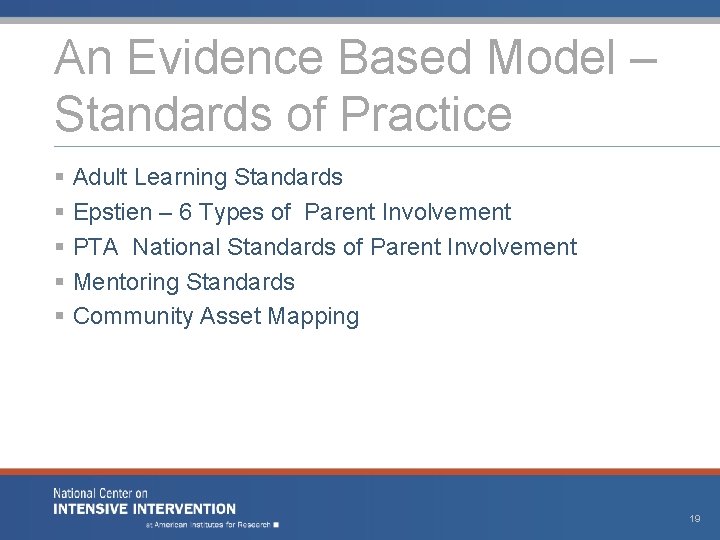
An Evidence Based Model – Standards of Practice § Adult Learning Standards § Epstien – 6 Types of Parent Involvement § PTA National Standards of Parent Involvement § Mentoring Standards § Community Asset Mapping 19
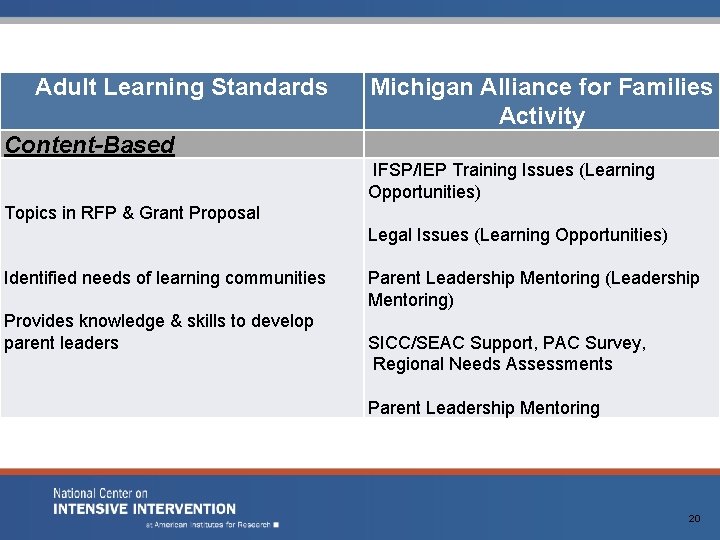
Adult Learning Standards Michigan Alliance for Families Activity Content-Based IFSP/IEP Training Issues (Learning Opportunities) Topics in RFP & Grant Proposal Legal Issues (Learning Opportunities) Identified needs of learning communities Provides knowledge & skills to develop parent leaders Parent Leadership Mentoring (Leadership Mentoring) SICC/SEAC Support, PAC Survey, Regional Needs Assessments Parent Leadership Mentoring 20
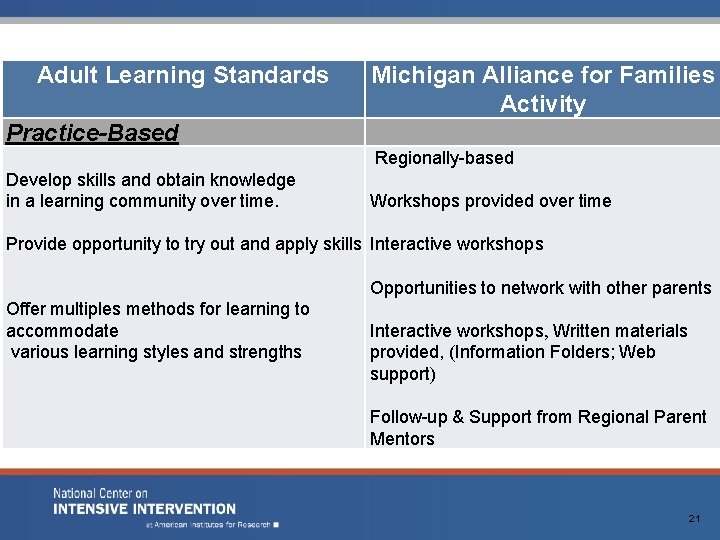
Adult Learning Standards Michigan Alliance for Families Activity Practice-Based Regionally-based Develop skills and obtain knowledge in a learning community over time. Workshops provided over time Provide opportunity to try out and apply skills Interactive workshops Opportunities to network with other parents Offer multiples methods for learning to accommodate various learning styles and strengths Interactive workshops, Written materials provided, (Information Folders; Web support) Follow-up & Support from Regional Parent Mentors 21
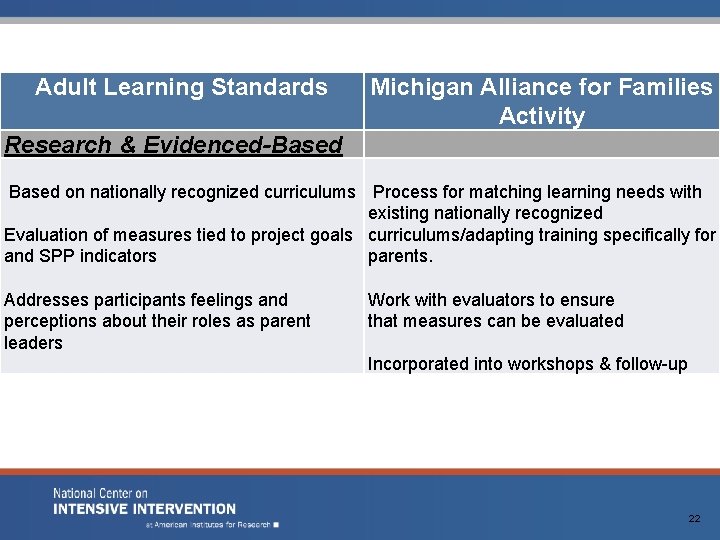
Adult Learning Standards Michigan Alliance for Families Activity Research & Evidenced-Based on nationally recognized curriculums Process for matching learning needs with existing nationally recognized Evaluation of measures tied to project goals curriculums/adapting training specifically for and SPP indicators parents. Addresses participants feelings and perceptions about their roles as parent leaders Work with evaluators to ensure that measures can be evaluated Incorporated into workshops & follow-up 22
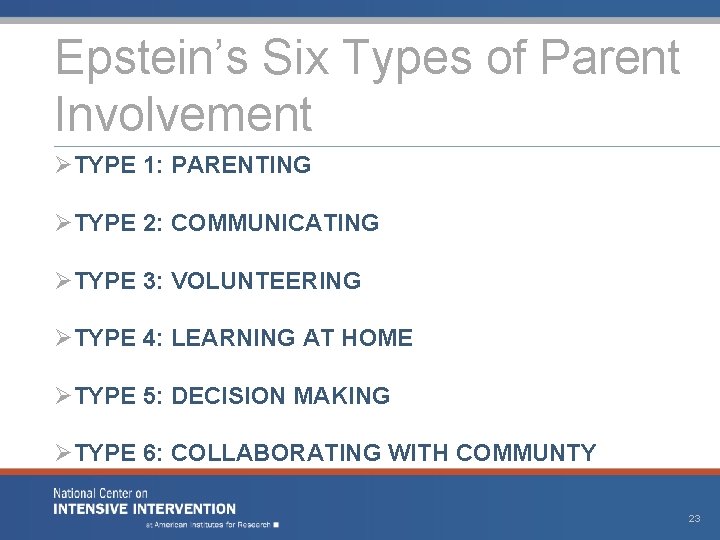
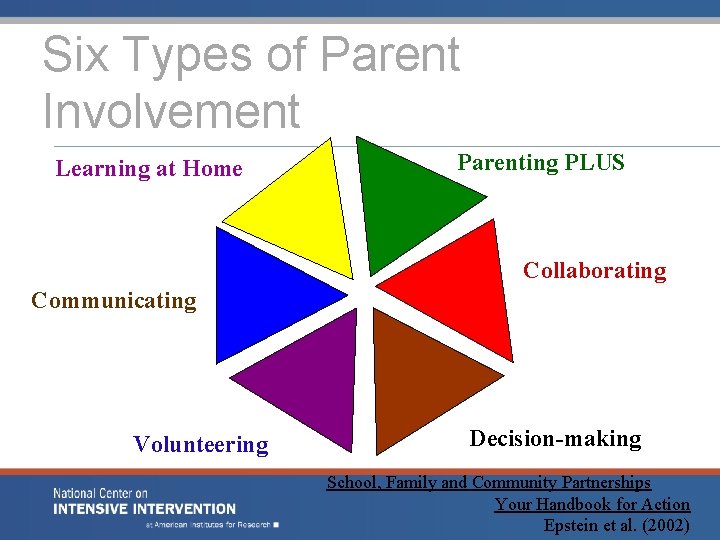
Epstein’s Six Types of Parent Involvement ØTYPE 1: PARENTING ØTYPE 2: COMMUNICATING ØTYPE 3: VOLUNTEERING ØTYPE 4: LEARNING AT HOME ØTYPE 5: DECISION MAKING ØTYPE 6: COLLABORATING WITH COMMUNTY 23
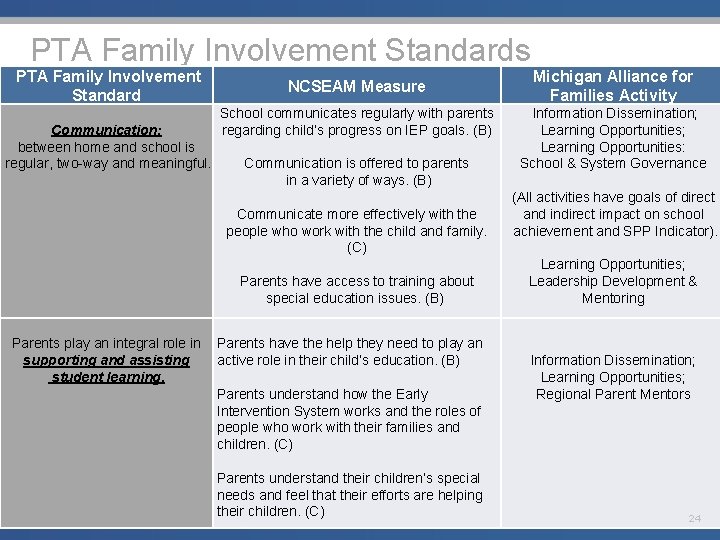
PTA Family Involvement Standards PTA Family Involvement Standard Communication: between home and school is regular, two-way and meaningful. NCSEAM Measure School communicates regularly with parents regarding child’s progress on IEP goals. (B) Communication is offered to parents in a variety of ways. (B) Communicate more effectively with the people who work with the child and family. (C) Parents have access to training about special education issues. (B) Parents play an integral role in supporting and assisting student learning. Parents have the help they need to play an active role in their child’s education. (B) Parents understand how the Early Intervention System works and the roles of people who work with their families and children. (C) Parents understand their children’s special needs and feel that their efforts are helping their children. (C) Michigan Alliance for Families Activity Information Dissemination; Learning Opportunities: School & System Governance (All activities have goals of direct and indirect impact on school achievement and SPP Indicator). Learning Opportunities; Leadership Development & Mentoring Information Dissemination; Learning Opportunities; Regional Parent Mentors 24
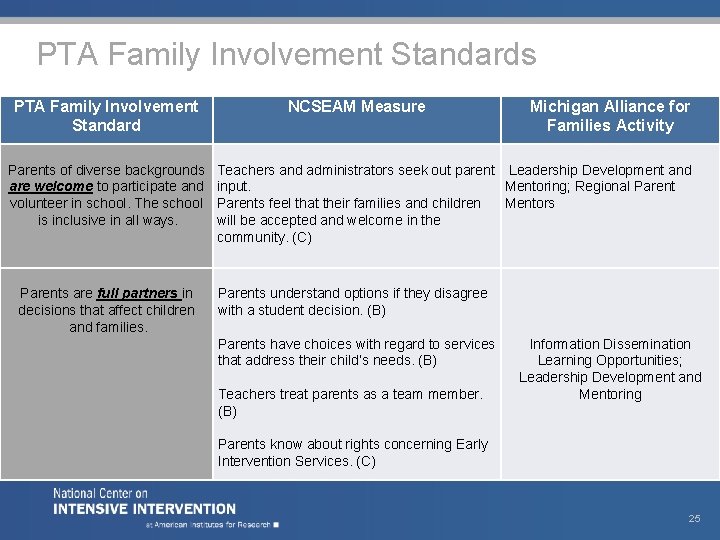
PTA Family Involvement Standards PTA Family Involvement Standard Parents of diverse backgrounds are welcome to participate and volunteer in school. The school is inclusive in all ways. Parents are full partners in decisions that affect children and families. NCSEAM Measure Michigan Alliance for Families Activity Teachers and administrators seek out parent Leadership Development and input. Mentoring; Regional Parents feel that their families and children Mentors will be accepted and welcome in the community. (C) Parents understand options if they disagree with a student decision. (B) Parents have choices with regard to services that address their child’s needs. (B) Teachers treat parents as a team member. (B) Information Dissemination Learning Opportunities; Leadership Development and Mentoring Parents know about rights concerning Early Intervention Services. (C) 25
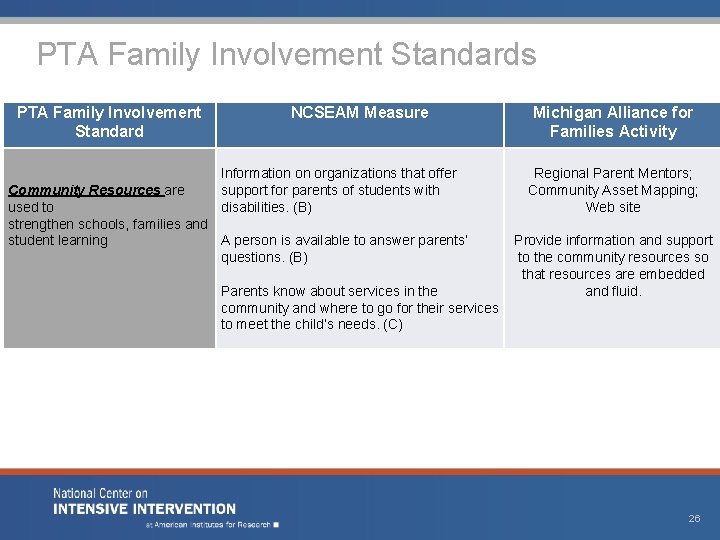
PTA Family Involvement Standards PTA Family Involvement Standard NCSEAM Measure Information on organizations that offer support for parents of students with disabilities. (B) Community Resources are used to strengthen schools, families and student learning A person is available to answer parents’ questions. (B) Parents know about services in the community and where to go for their services to meet the child’s needs. (C) Michigan Alliance for Families Activity Regional Parent Mentors; Community Asset Mapping; Web site Provide information and support to the community resources so that resources are embedded and fluid. 26
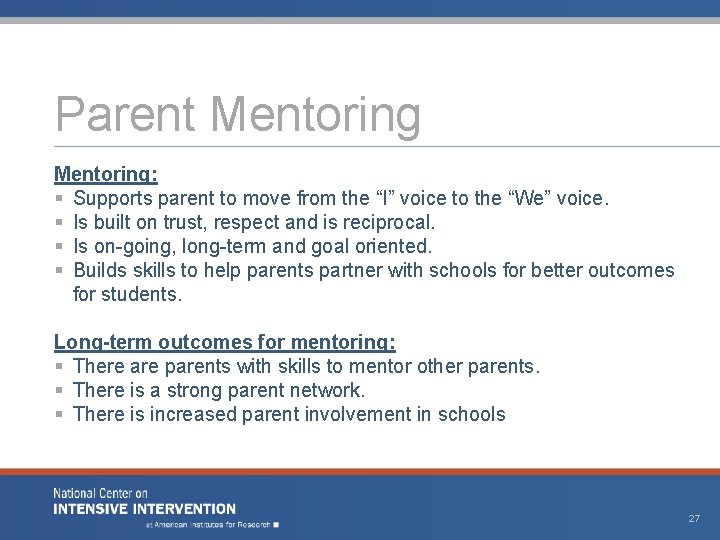
Parent Mentoring: § Supports parent to move from the “I” voice to the “We” voice. § Is built on trust, respect and is reciprocal. § Is on-going, long-term and goal oriented. § Builds skills to help parents partner with schools for better outcomes for students. Long-term outcomes for mentoring: § There are parents with skills to mentor other parents. § There is a strong parent network. § There is increased parent involvement in schools 27
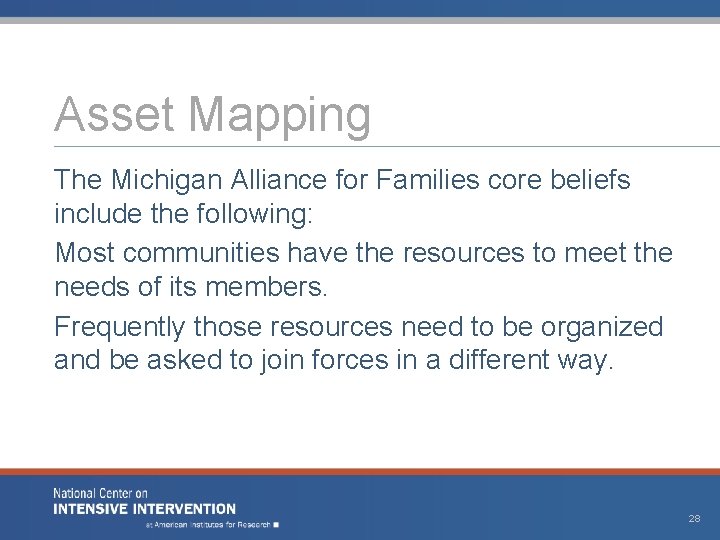
Asset Mapping The Michigan Alliance for Families core beliefs include the following: Most communities have the resources to meet the needs of its members. Frequently those resources need to be organized and be asked to join forces in a different way. 28
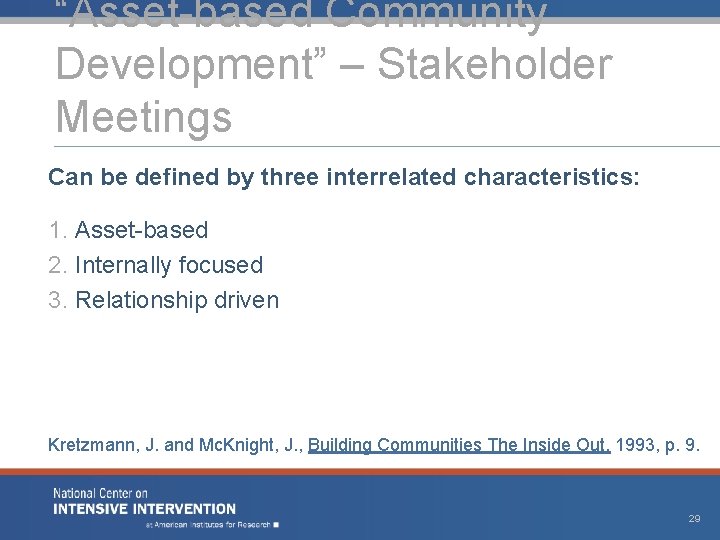
“Asset-based Community Development” – Stakeholder Meetings Can be defined by three interrelated characteristics: 1. Asset-based 2. Internally focused 3. Relationship driven Kretzmann, J. and Mc. Knight, J. , Building Communities The Inside Out, 1993, p. 9. 29
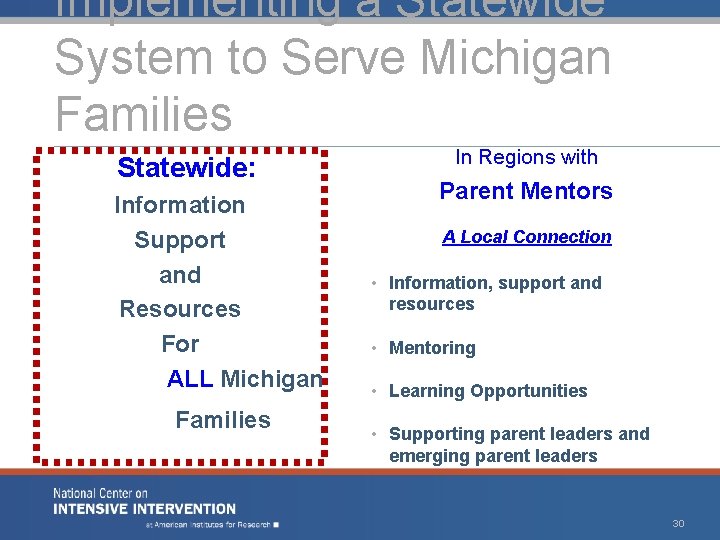
Implementing a Statewide System to Serve Michigan Families Statewide: Information Support and Resources For ALL Michigan Families In Regions with Parent Mentors A Local Connection • Information, support and resources • Mentoring • Learning Opportunities • Supporting parent leaders and emerging parent leaders 30
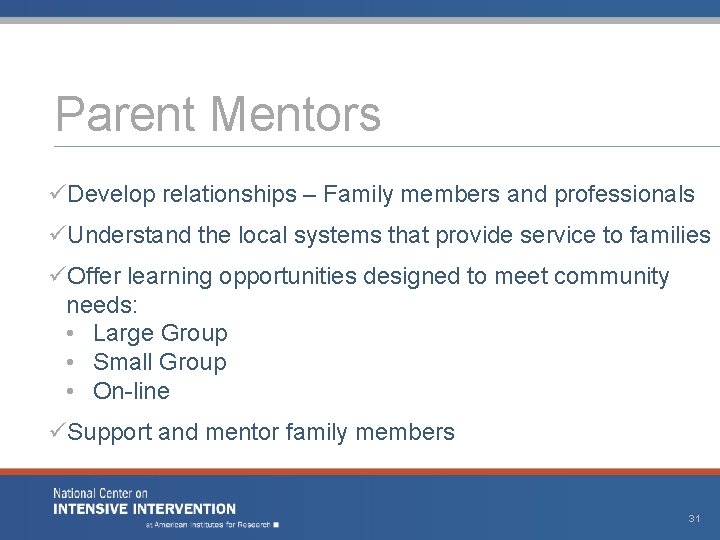
Parent Mentors üDevelop relationships – Family members and professionals üUnderstand the local systems that provide service to families üOffer learning opportunities designed to meet community needs: • Large Group • Small Group • On-line üSupport and mentor family members 31
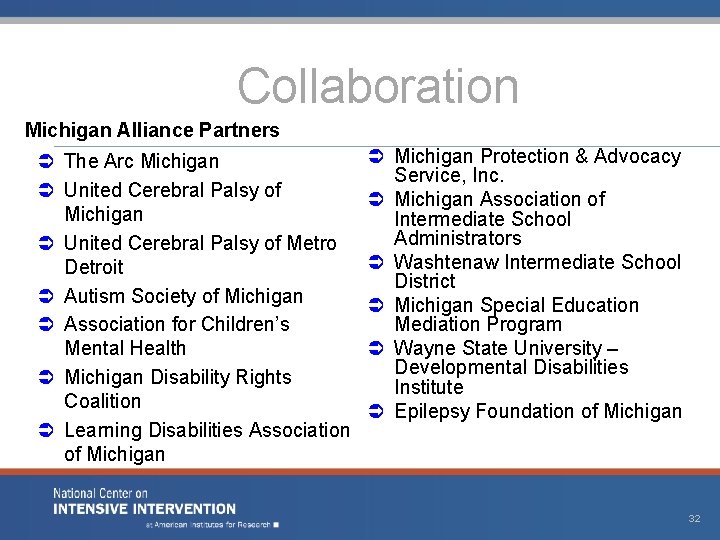
Collaboration Michigan Alliance Partners Ü The Arc Michigan Ü United Cerebral Palsy of Metro Detroit Ü Autism Society of Michigan Ü Association for Children’s Mental Health Ü Michigan Disability Rights Coalition Ü Learning Disabilities Association of Michigan Ü Michigan Protection & Advocacy Service, Inc. Ü Michigan Association of Intermediate School Administrators Ü Washtenaw Intermediate School District Ü Michigan Special Education Mediation Program Ü Wayne State University – Developmental Disabilities Institute Ü Epilepsy Foundation of Michigan 32
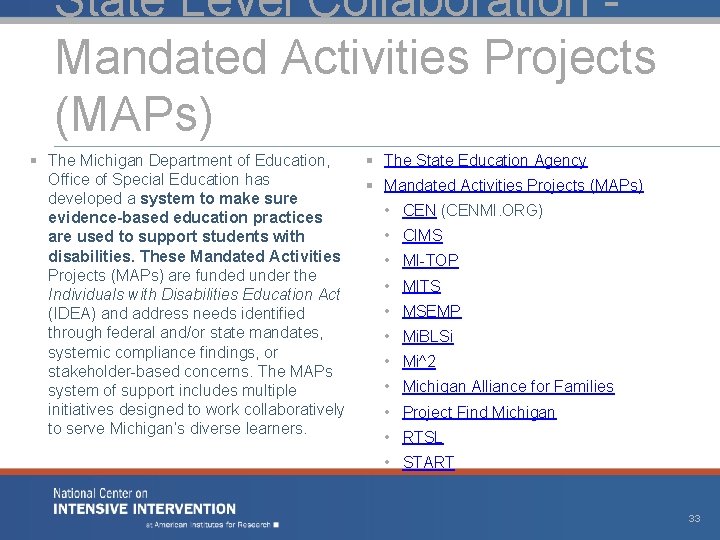
State Level Collaboration Mandated Activities Projects (MAPs) § The Michigan Department of Education, Office of Special Education has developed a system to make sure evidence-based education practices are used to support students with disabilities. These Mandated Activities Projects (MAPs) are funded under the Individuals with Disabilities Education Act (IDEA) and address needs identified through federal and/or state mandates, systemic compliance findings, or stakeholder-based concerns. The MAPs system of support includes multiple initiatives designed to work collaboratively to serve Michigan’s diverse learners. § The State Education Agency § Mandated Activities Projects (MAPs) • CEN (CENMI. ORG) • CIMS • MI-TOP • MITS • MSEMP • Mi. BLSi • Mi^2 • Michigan Alliance for Families • Project Find Michigan • RTSL • START 33
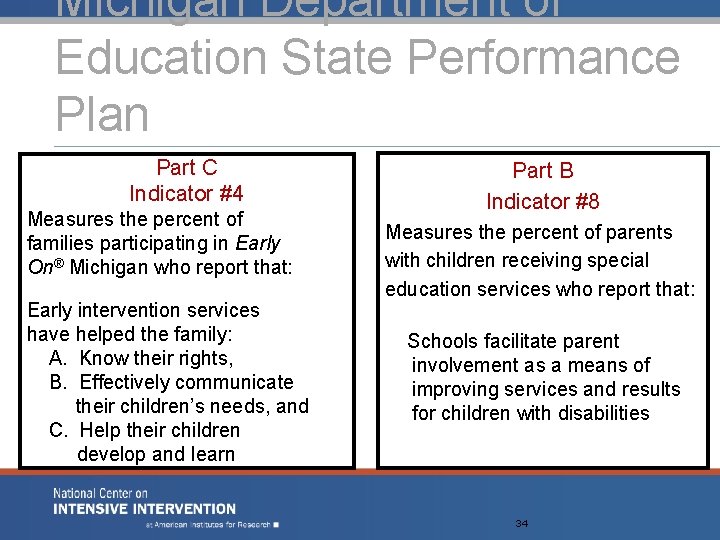
Michigan Department of Education State Performance Plan Part C Indicator #4 Measures the percent of families participating in Early On® Michigan who report that: Early intervention services have helped the family: A. Know their rights, B. Effectively communicate their children’s needs, and C. Help their children develop and learn Part B Indicator #8 Measures the percent of parents with children receiving special education services who report that: Schools facilitate parent involvement as a means of improving services and results for children with disabilities 34
Climb To The Top Working to increase the involvement of Michigan’s families in the growth and development of their infants and toddlers www. michiganallianceforfamilies. org/eo
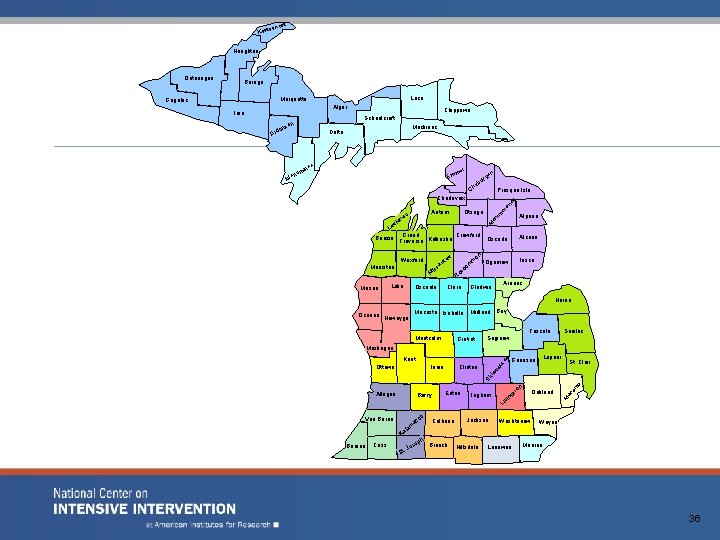
w eena Kew Houghton Baraga Luce Marquette Alger Iron Mackinac Delta e ine t me Em n ga oy b he Presque Isle C Benzie en Alpena on tm ela Le or Otsego Antrim u na cy Charlevoix M Grand Crawford Traverse Kalkaska Alcona Oscoda e on Iosco m Ogemaw kkeee aauu om s s c s i s o MMis R Arenac Gladwin Osceola Clare Wexford Manistee Lake Mason Huron Oceana Mecosta Isabella Newaygo Midland Bay Tuscola Montcalm Gratiot Sanilac Saginaw Muskegon Kent Genesee e Ionia Ottawa Clinton Lapeer St. Clair oo Van Buren az m a al K Berrien Cass Calhoun ph Branch e os J St. Eaton Ingham Jackson Hillsdale b on st ng Oakland vi Li Washtenaw Lenawee om Barry ac Allegan M om n Me as se ki Dic Chippewa Schoolcraft n nso iaw Gogebic Sh Ontonagon Wayne Monroe 36
Working Together to Help Families 800 -552 -4821 www. michiganallianceforfamilies. org 37
I 5 Family Involvement Implementing Intensive Interventions with the Intentional Involvement of Parents, Families & Communities Debra A. Jennings, Director Center for Parent Information & Resources @SPAN debra. jennings@spannj. org Website: Under Construction
Your takeaways: § A Construct for looking at the strengths and gaps of your family involvement initiatives. § A Tool for designing and implementing intentional family engagement strategies in the context of Tier III Intensive Interventions. § Resources for further information and ideas. § Connections to OSEP-funded Parent Centers (PTIs, CPRCs & PTACs) as partners in your efforts.
However, unless parent and community involvement in education is deliberately planned and connected to a school’s and district’s academic goals for students, such efforts may not produce the desired results. - California Action Team Plan 2009
Involving the community and engaging parents in the education of their children is critical for the successful implementation of any intervention associated with closing the achievement gap and increasing graduation rates.
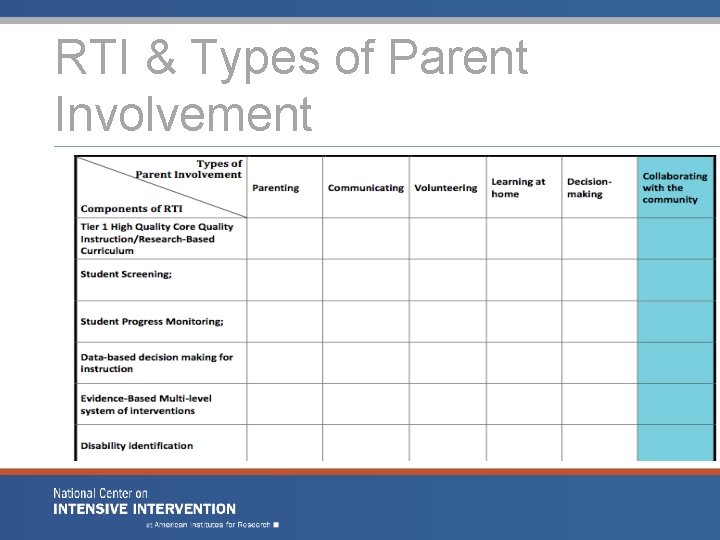
Six Types of Parent Involvement Learning at Home Parenting PLUS Collaborating Communicating Volunteering Decision-making School, Family and Community Partnerships Your Handbook for Action Epstein et al. (2002)
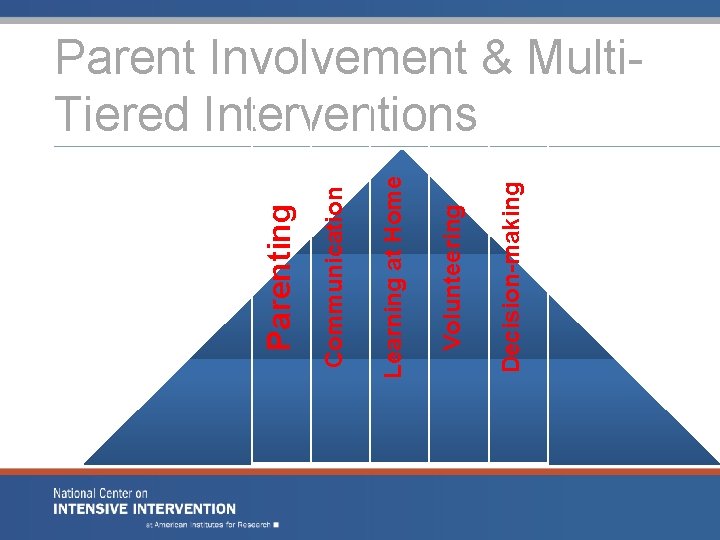
Decision-making Volunteering Learning at Home Communication Parenting Parent Involvement & Multi. Tiered Interventions
Examples of Effective Strategies
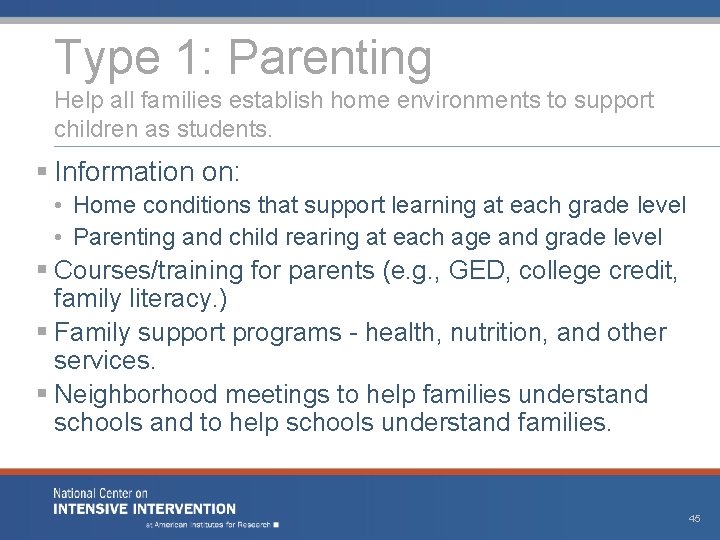
Type 1: Parenting Help all families establish home environments to support children as students. § Information on: • Home conditions that support learning at each grade level • Parenting and child rearing at each age and grade level § Courses/training for parents (e. g. , GED, college credit, family literacy. ) § Family support programs - health, nutrition, and other services. § Neighborhood meetings to help families understand schools and to help schools understand families. 45
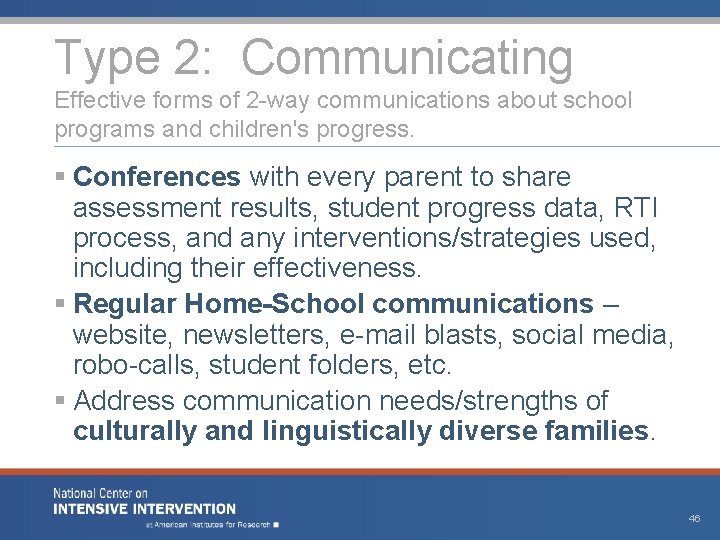
Type 2: Communicating Effective forms of 2 -way communications about school programs and children's progress. § Conferences with every parent to share assessment results, student progress data, RTI process, and any interventions/strategies used, including their effectiveness. § Regular Home-School communications – website, newsletters, e-mail blasts, social media, robo-calls, student folders, etc. § Address communication needs/strengths of culturally and linguistically diverse families. 46
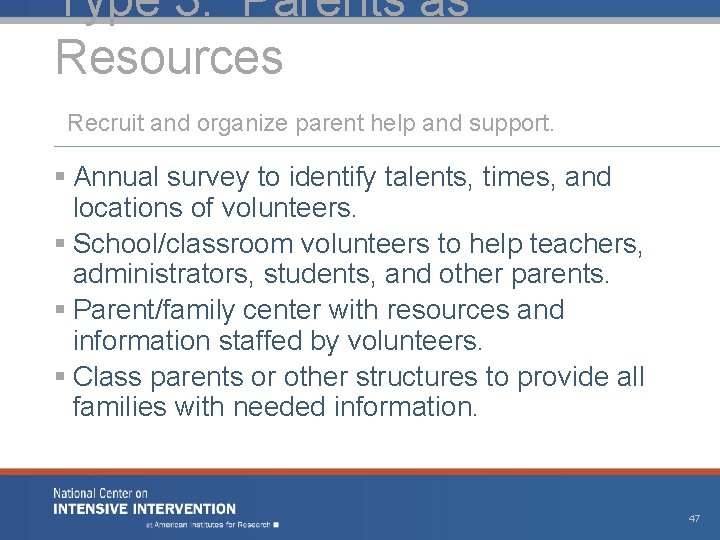
Type 3: Parents as Resources Recruit and organize parent help and support. § Annual survey to identify talents, times, and locations of volunteers. § School/classroom volunteers to help teachers, administrators, students, and other parents. § Parent/family center with resources and information staffed by volunteers. § Class parents or other structures to provide all families with needed information. 47
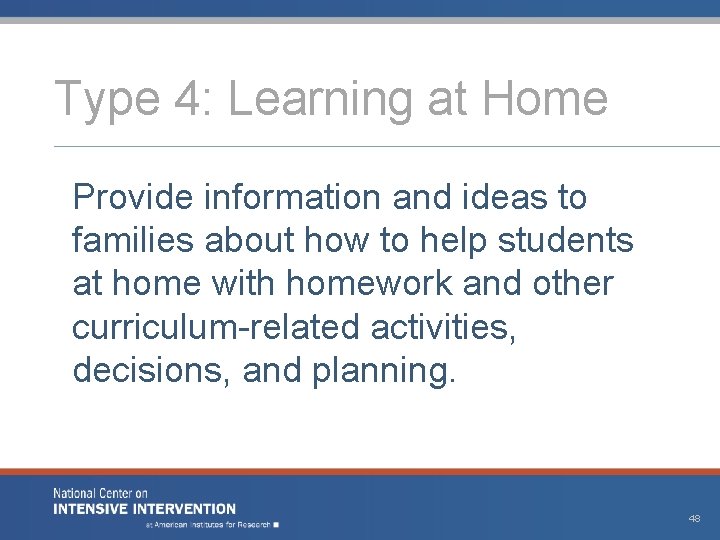
Type 4: Learning at Home Provide information and ideas to families about how to help students at home with homework and other curriculum-related activities, decisions, and planning. 48
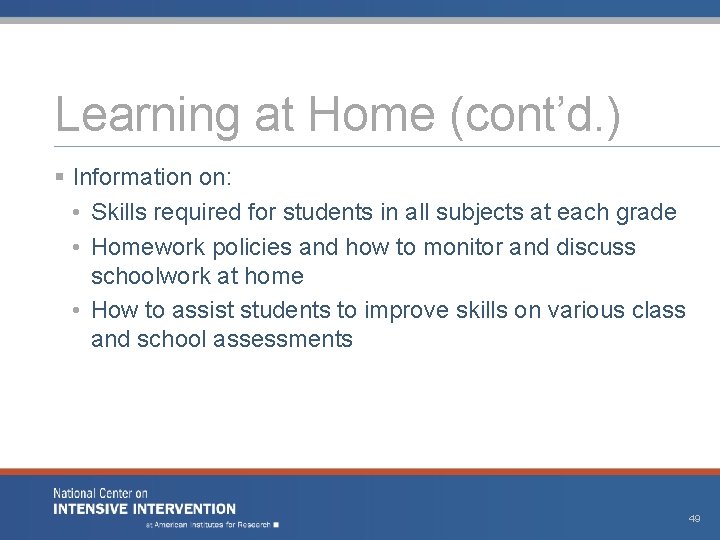
Learning at Home (cont’d. ) § Information on: • Skills required for students in all subjects at each grade • Homework policies and how to monitor and discuss schoolwork at home • How to assist students to improve skills on various class and school assessments 49
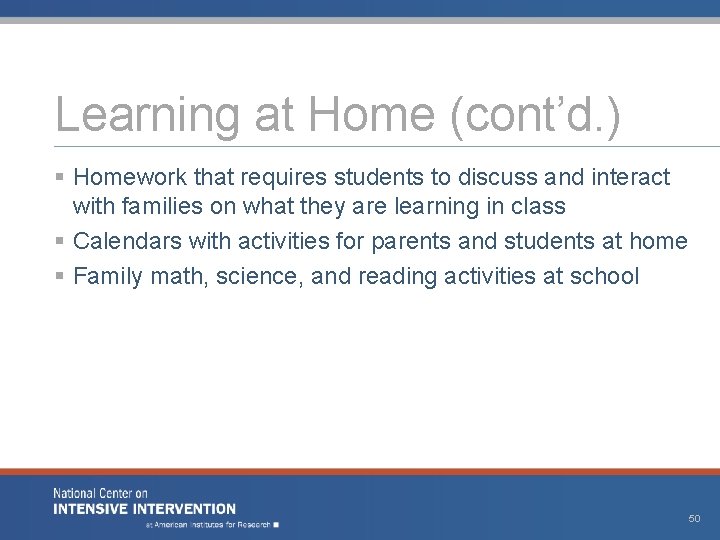
Learning at Home (cont’d. ) § Homework that requires students to discuss and interact with families on what they are learning in class § Calendars with activities for parents and students at home § Family math, science, and reading activities at school 50
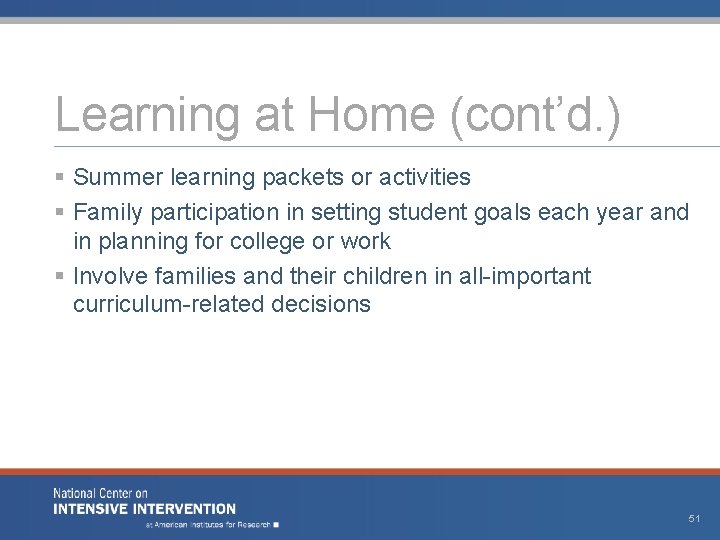
Learning at Home (cont’d. ) § Summer learning packets or activities § Family participation in setting student goals each year and in planning for college or work § Involve families and their children in all-important curriculum-related decisions 51
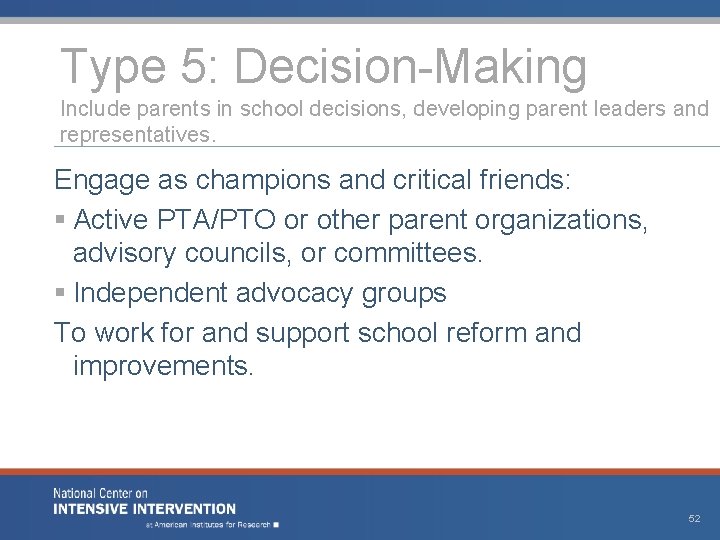
Type 5: Decision-Making Include parents in school decisions, developing parent leaders and representatives. Engage as champions and critical friends: § Active PTA/PTO or other parent organizations, advisory councils, or committees. § Independent advocacy groups To work for and support school reform and improvements. 52
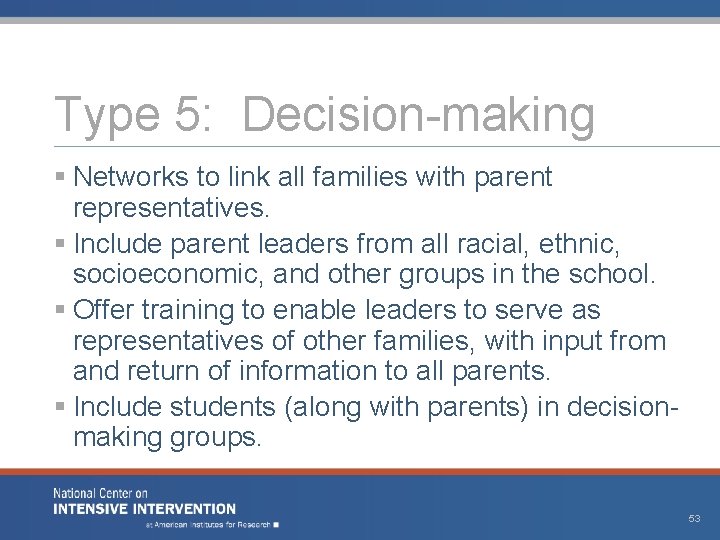
Type 5: Decision-making § Networks to link all families with parent representatives. § Include parent leaders from all racial, ethnic, socioeconomic, and other groups in the school. § Offer training to enable leaders to serve as representatives of other families, with input from and return of information to all parents. § Include students (along with parents) in decisionmaking groups. 53
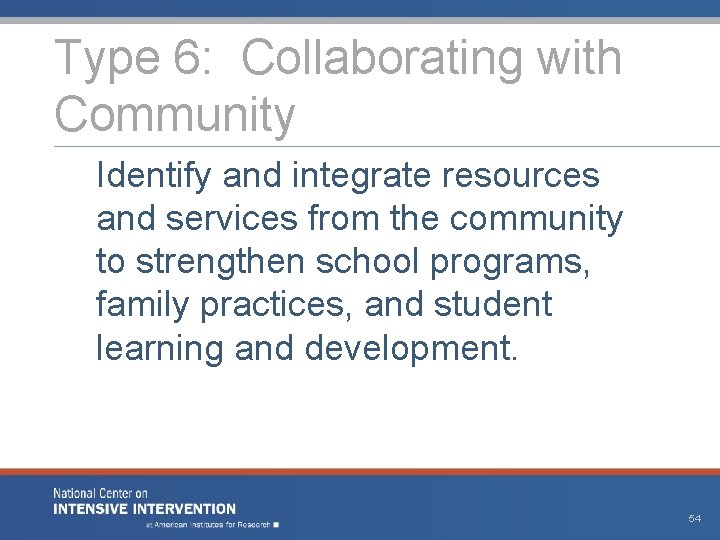
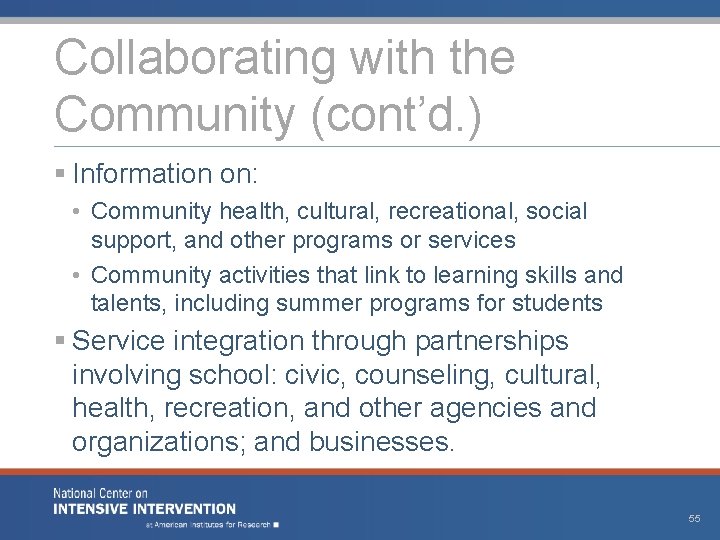
Type 6: Collaborating with Community Identify and integrate resources and services from the community to strengthen school programs, family practices, and student learning and development. 54
Collaborating with the Community (cont’d. ) § Information on: • Community health, cultural, recreational, social support, and other programs or services • Community activities that link to learning skills and talents, including summer programs for students § Service integration through partnerships involving school: civic, counseling, cultural, health, recreation, and other agencies and organizations; and businesses. 55
RTI & Types of Parent Involvement
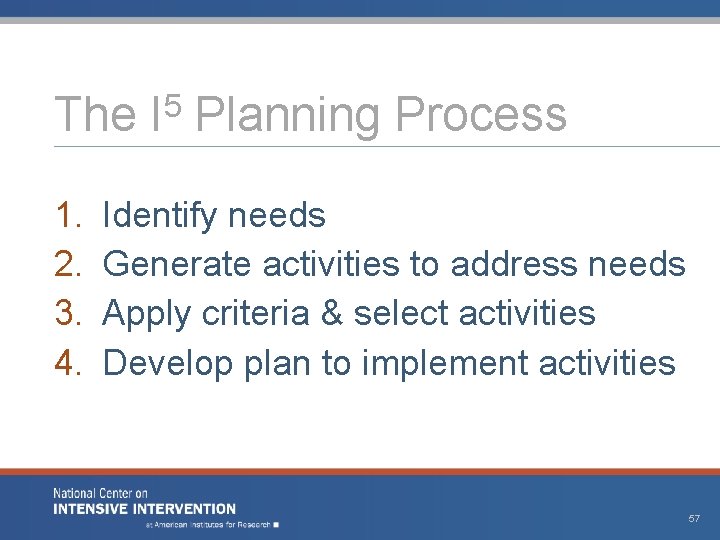
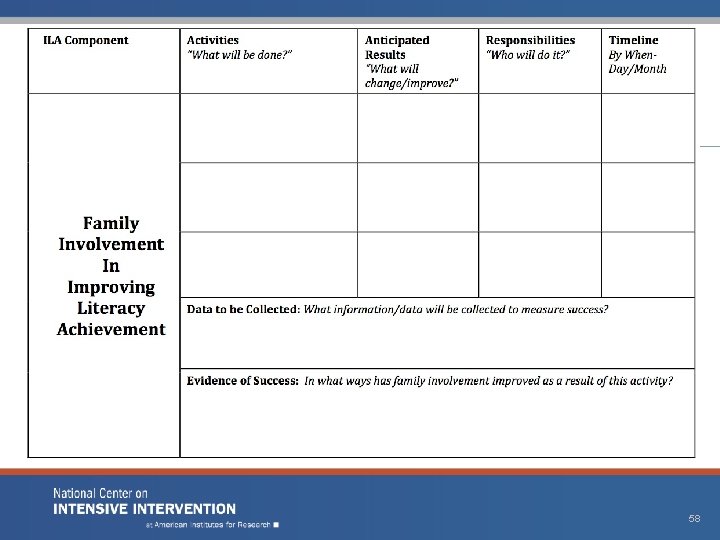
The I 5 Planning Process 1. 2. 3. 4. Identify needs Generate activities to address needs Apply criteria & select activities Develop plan to implement activities 57
58
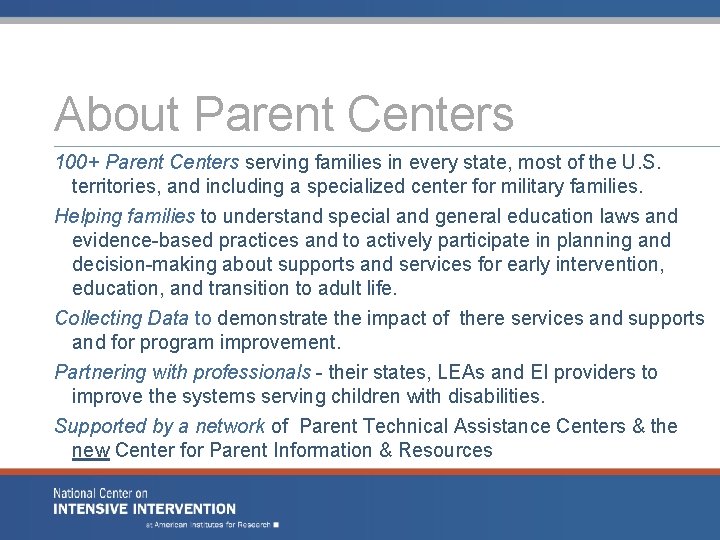
About Parent Centers 100+ Parent Centers serving families in every state, most of the U. S. territories, and including a specialized center for military families. Helping families to understand special and general education laws and evidence-based practices and to actively participate in planning and decision-making about supports and services for early intervention, education, and transition to adult life. Collecting Data to demonstrate the impact of there services and supports and for program improvement. Partnering with professionals - their states, LEAs and EI providers to improve the systems serving children with disabilities. Supported by a network of Parent Technical Assistance Centers & the new Center for Parent Information & Resources
Resources § Find the Parent Center serving families in your area: http: //www. parentcenternetwork. org/parentcenterlisting. html § Parent Guide to Response to Intervention, National Center on Learning Disabilities: http: //www. ncld. org § Center for School, Family & Community Partnerships: www. csos. jhu. edu/p 2000 § SEDL National Center for Family & Community Connections: www. sedl. org/connections § Harvard Family Research Project: www. hrfp. org § Henderson et al, Beyond the Bake Sale, 2007 § Kovaleski et al. RTI Approach to Evaluating LD. Chapter 8, “Parent Involvement in an RTI System. ” 2013. Debra Jennings, Director, Center for Parent Information and Resources, debra. jennings@spannj. org
Questions and Discussion 61
Please complete our survey We want to ensure that our webinar met your expectations, and we’d love to hear your feedback to inform our work with future webinars. 62
References National Center for Education Statistics. (2011). The nation’s report card: Reading 2011 (NCES 2012– 457). Washington, DC: National Center for Education Statistics, Institute of Education Sciences, U. S. Department of Education. National Center for Education Statistics (2011). The nation’s report card: Mathematics 2011 (NCES 2012– 458). Washington, DC: National Center for Education Statistics, Institute of Education Sciences, U. S. Department of Education. National Center on Intensive Intervention (2013). Data-Based Individualization: A Framework for Intensive Intervention. Retrieved from http: //www. intensiveintervention. org/sites/default/files/DBI%20 a%20 Framework%20 for% 20 Intensive%20 Intervention. pdf Wagner, M. , Marder, C. , Blackorby, J. , Cameto, R. , Newman, L. , & Levine, P. , et al. (2003). The achievements of youth with disabilities during secondary school. A report from the National Longitudinal Transition Study-2 (NLTS 2). Menlo Park, CA: SRI International. Retrieved from: www. nlts 2. org/reports/2003_11/nlts 2_report_2003_11_complete. pdf
National Center on Intensive Intervention This webinar was produced under the U. S. Department of Education, Office of Special Education Programs, Award No. H 326 Q 110005. Celia Rosenquist serves as the project officer. The views expressed herein do not necessarily represent the positions or policies of the U. S. Department of Education. No official endorsement by the U. S. Department of Education of any product, commodity, service or enterprise mentioned in this presentation is intended or should be inferred.
National Center on Intensive Intervention (NCII) E-Mail: NCII@air. org 1050 Thomas Jefferson Street, NW Washington, DC 20007 - 3835 Website: www. intensiveintervention. org
While permission to redistribute this webinar is not necessary, the citation should be: National Center on Intensive Intervention. (2013). Bringing Families to the Table: Family Engagement for Struggling Students. Washington, DC: U. S. Department of Education, Office of Special Education Programs, National Center on Intensive Intervention