Treatment Planning M A T R S Utilising






- Slides: 129
Treatment Planning M. A. T. R. S: Utilising the ASI Treatnet Training Volume A: Module 3 – Updated 12 February 2008
Module 3 Workshops Workshop 1: Understanding Treatment Planning and the ASI Workshop 2: Treatment Plans Workshop 3: Prioritising Problems Workshop 4: Putting Treatment Planning M. A. T. R. S. into Practise 2
Module 3 training goals 1. Increase familiarity with treatment planning process 2. Increase understanding of guidelines and legal considerations in documenting client status 3. Increase skills in using the Addiction Severity Index (ASI) in developing treatment plans and documenting activities 3
Workshop 1: Understanding Treatment Planning and the ASI
Pre-assessment 10 Min. Please respond to the pre-assessment questions in your workbook. (Your responses are strictly confidential. ) 5
Icebreaker How do you define treatment planning? 6
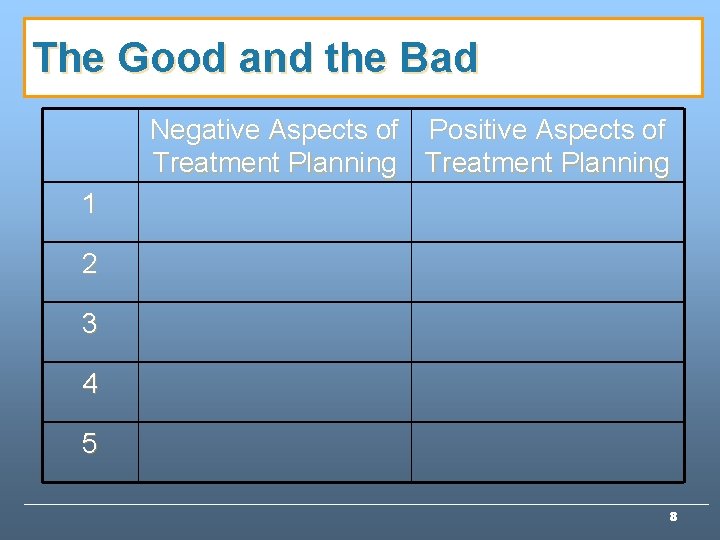
Icebreaker: The Good and the Bad 7
The Good and the Bad Negative Aspects of Positive Aspects of Treatment Planning 1 2 3 4 5 8
Workshop 1: Training objectives (1) At the end of this workshop, you will be able to: 1. Use ASI information to develop individualised treatment plans 2. Identify characteristics of a programmedriven and an individualised treatment plan 3. Understand how individualised treatment plans help to keep people in treatment and lead to better outcomes Continued 9
Workshop 1: Training objectives (2) At the end of this workshop, you will be able to: 4. Use Master Problem List (provided) to formulate treatment plans and develop: § § Problem statements Goals based on problem statements Objectives based on goals Interventions based on objectives 5. Practise writing documentation notes reflecting how treatment plan is progressing (or not progressing) 10
What is not included in training Ø Administering and scoring the ASI Ø Administering any other standardised screening / assessment tool Ø Training on clinical interviewing 11
The goal of this training is… To bring together the assessment and treatment planning processes 12
Treatment plans are often. . . “Meaningless & time consuming. ” “Same plan, different names. ” “Ignored. ” 13
The What, Who, When, and How of Treatment Planning
What is a treatment plan? A written document that: Ø Identifies the client’s most important goals for treatment Ø Describes measurable, time-sensitive steps towards achieving those goals Ø Reflects a verbal agreement between the counselor and client (Source: Center for Substance Abuse Treatment, 2002) 15
Who develops the treatment plan? Client works with treatment providers to identify and agree on treatment goals and identify strategies for achieving them. 16
When is the treatment plan developed? Ø At the time of admission Ø And continually updated and revised throughout treatment 17
How does assessment guide treatment planning? Ø The Addiction Severity Index (ASI), for example, identifies client needs or problems by using a semi-structured interview format Ø The ASI guides delivery of services that the client needs 18
How does assessment guide treatment planning? Ø Treatment goals address those problems identified by the assessment Ø Then, the treatment plan guides the delivery of services needed 19
What is the ASI? ØA reliable and valid instrument, widely used both nationally and internationally Ø Conducted in a semi-structured interview format Ø Can be effectively integrated into clinical care (Sources: Cacciola et al. , 1999; Carise et al. , 2004; Kosten et al. , 1987; Mc. Lellan et al. , 1980; 1985; 1992) 20
What is the ASI? Identifies 7 potential problem areas: 1. 2. 3. 4. 5. 6. 7. Medical status Employment and support Drug use Alcohol use Legal status Family/social status Psychiatric status 21
The ASI is NOT… Ø A personality test Ø A medical test Ø A projective test such as the Rorschach Inkblot Test Ø A tool that gives you a diagnosis 22
Why use the ASI? 1. Clinical applications 2. Evaluation uses 23
Recent developments e r o m I S A e t h t n e g m n t i a k e a r t m k r o m o f n t r I e o t o AS n s d w o y e al ng i t S s a u ic si k c r m r n U o o i f cl le: o f w t s n t or i e p r I N fo ul f xam ing) S f n A E ef o E i n ( s e t n e a Ø s a v s u u i l pl t u a re a v r r E 24
ASI is now more clinically useful! e r a w t f o e S l b i S s N s E o D. p de n e d a i l n e i u p f v g e t o r d n d p e n o t a tm t Im n a p o m tre d i t n a o a r a m p w r g e 5) o d n f n pi n 0 a i 20 ts elo SI 25
Clinical application Why use the ASI? Ø Uses a semi-structured interview to gather information a clinician generally collects during assessment Ø Shown to be an accurate or valid measure of the nature and severity of client problems (Sources: Kosten et al. , 1987; Mc. Lellan et al. , 1980; 1985; 1992) 26
Clinical application Why use the ASI? Ø Prompts clinician to focus session on important problems, goals, and objectives Ø Basis for reviews of progress during treatment and documentation Ø Basis for discharge plan 27
Clinical application Why use the ASI? NIDA Principle 3: “To be effective, treatment must address the individual’s drug use and any associated medical, psychological, social, vocational, and legal problems. ” The ASI assesses all these dimensions. 28
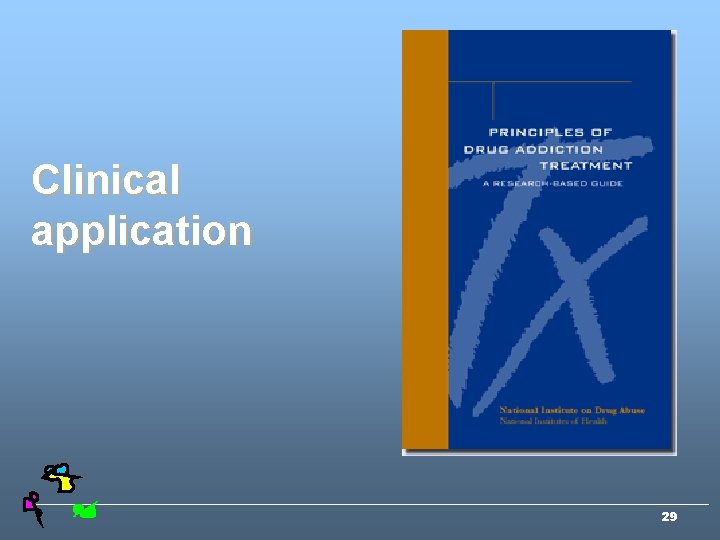
Clinical application 29
Clinical application Clinical use of ASI improves rapport “. . . If patients’ problems are accurately assessed, they may feel ‘heard’ by their counsellor, potentially leading to the development of rapport and even a stronger helping alliance. ” (Sources: Barber et al. , 1999, 2001; Luborsky et al. , 1986, 1996) 30
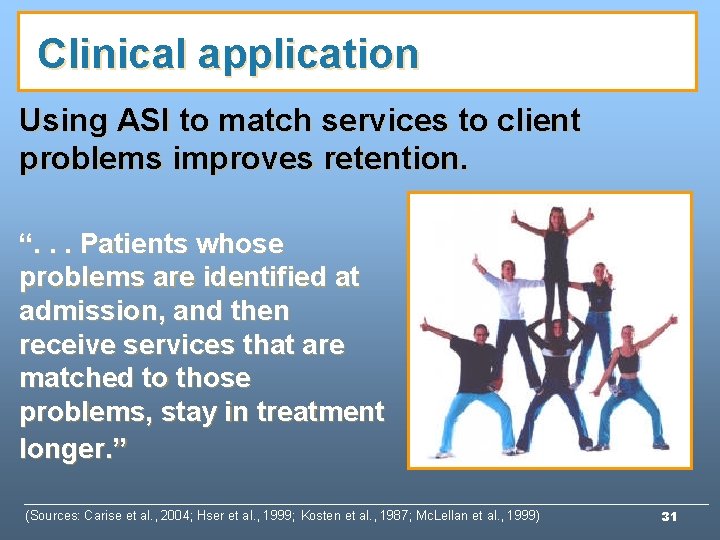
Clinical application Using ASI to match services to client problems improves retention. “. . . Patients whose problems are identified at admission, and then receive services that are matched to those problems, stay in treatment longer. ” (Sources: Carise et al. , 2004; Hser et al. , 1999; Kosten et al. , 1987; Mc. Lellan et al. , 1999) 31
Evaluation uses For Programme Directors: Ø Identifies types of client problems not addressed through the programme’s treatment services Ø Quantifies client problems Ø Identifies trends over time Continued 32
with level-of-care choices Ø Provides measure of programme success Ø Documents unmet client service needs Ø Includes data needed for reports to various stakeholders ed Ø Assists tinu For Programme Directors: 33 Evaluation uses
Evaluation uses For Programme Directors Ø Positions programmes for increased funding though participation in clinical trials and other research opportunities 34
Evaluation uses For Clinical Supervisors ASI data can be used to l Identify counsellor strengths and training needs l Match clients to counsellor strengths l Identify trends in client problems 35
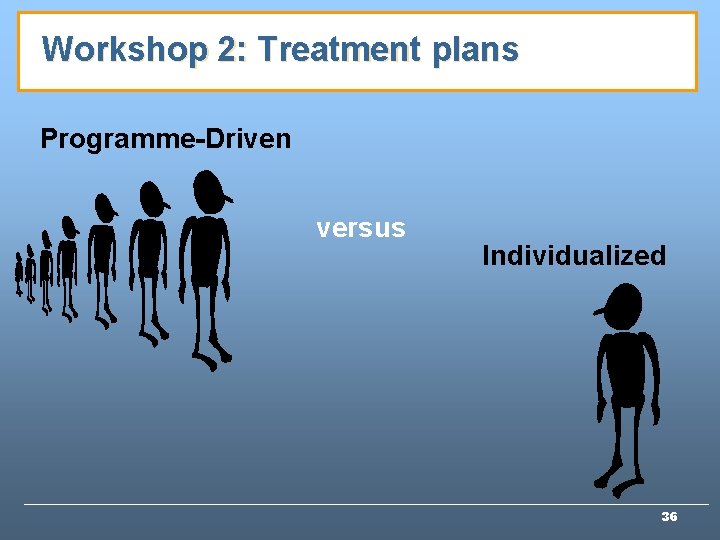
Workshop 2: Treatment plans Programme-Driven versus Individualized 36
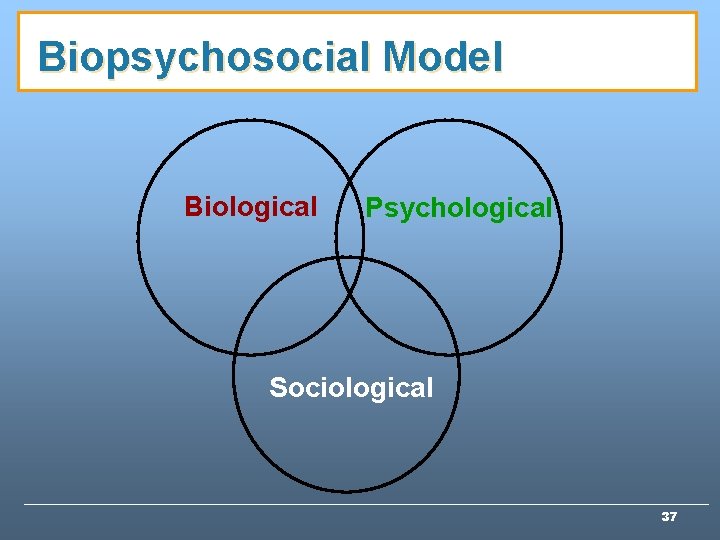
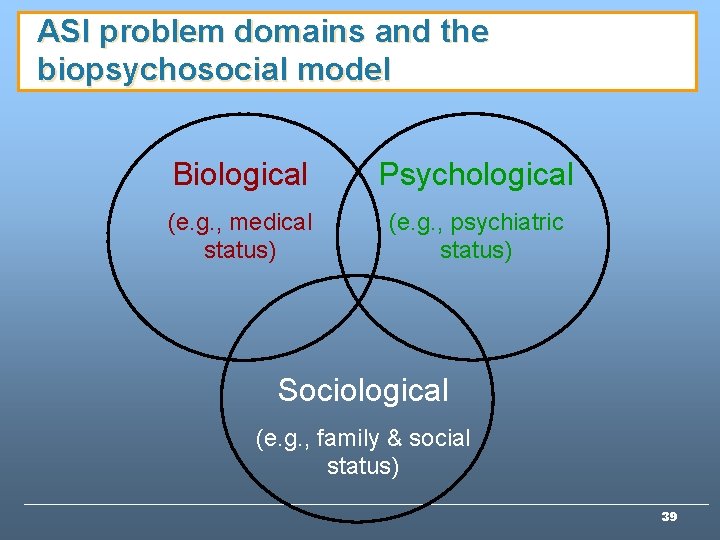
Biopsychosocial Model Biological Psychological Sociological 37
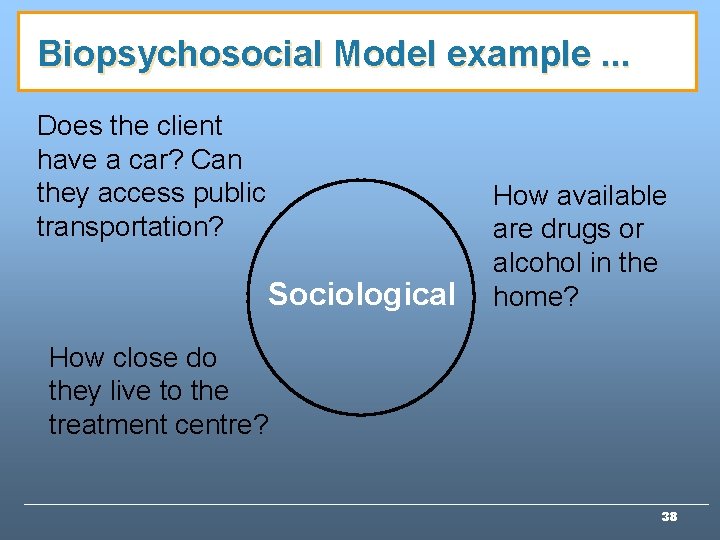
Biopsychosocial Model example. . . Does the client have a car? Can they access public transportation? Sociological How available are drugs or alcohol in the home? How close do they live to the treatment centre? 38
ASI problem domains and the biopsychosocial model Biological Psychological (e. g. , medical status) (e. g. , psychiatric status) Sociological (e. g. , family & social status) 39
Field of substance abuse treatment: Early work Programme-Driven Plans “One size fits all” 40
Programme-driven plans Ø Client needs are not important as the client is “fit” into the standard treatment programme regimen Ø Plan often includes only standard programme components (e. g. , group, individual sessions) Ø Little difference among clients’ treatment plans 41
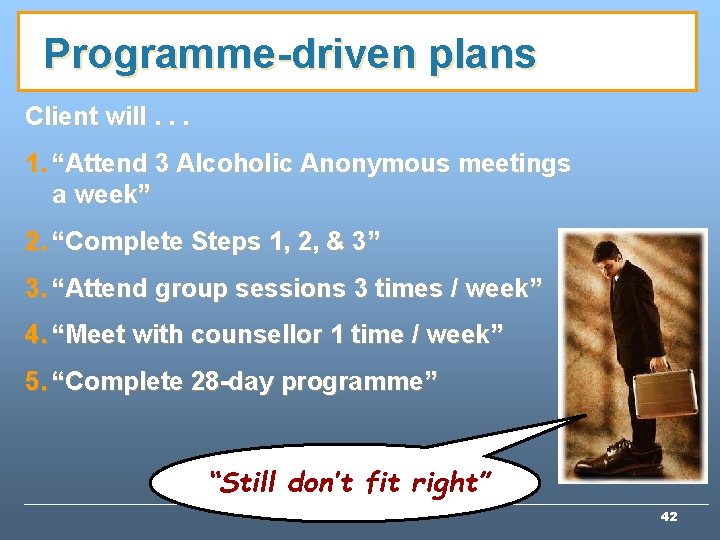
Programme-driven plans Client will. . . 1. “Attend 3 Alcoholic Anonymous meetings a week” 2. “Complete Steps 1, 2, & 3” 3. “Attend group sessions 3 times / week” 4. “Meet with counsellor 1 time / week” 5. “Complete 28 -day programme” “Still don’t fit right” 42
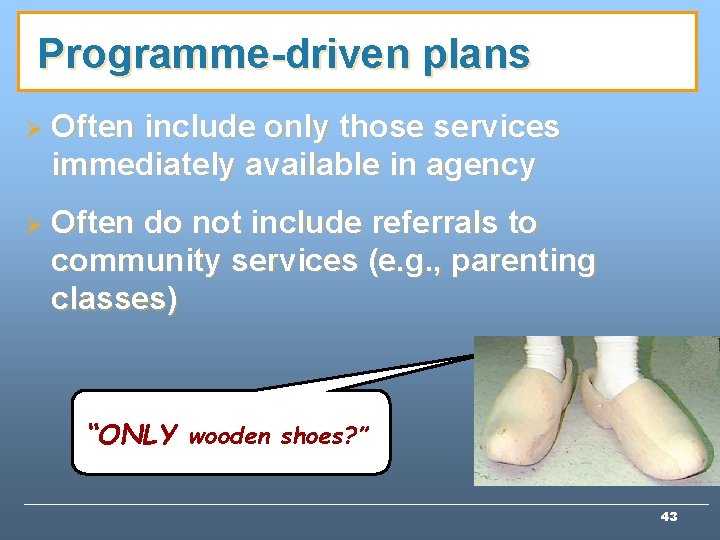
Programme-driven plans Ø Often include only those services immediately available in agency Ø Often do not include referrals to community services (e. g. , parenting classes) “ONLY wooden shoes? ” 43
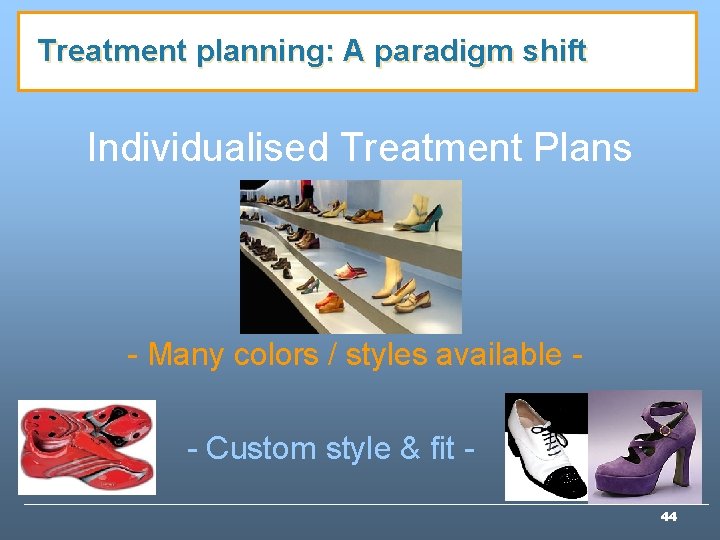
Treatment planning: A paradigm shift Individualised Treatment Plans - Many colors / styles available - Custom style & fit 44
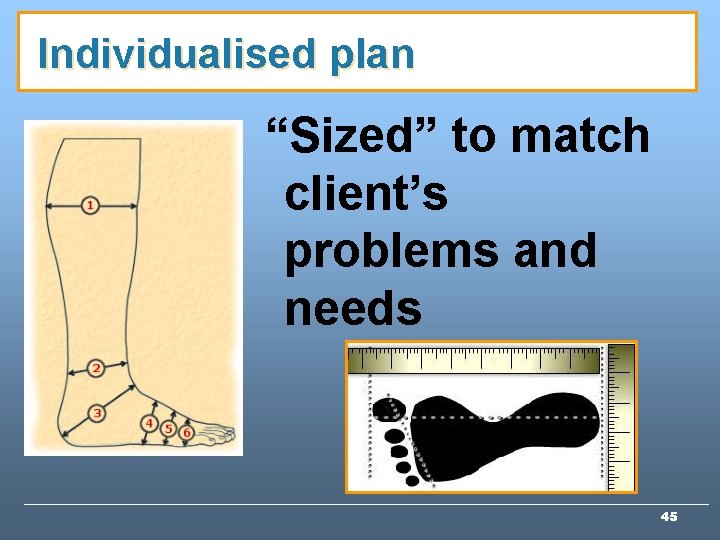
Individualised plan “Sized” to match client’s problems and needs 45
To individualise a plan, what information is needed? 1. What does a counsellor need to discuss with a client before developing a treatment plan? 2. Where do you get the information, guidelines, tools, etc. ? 46
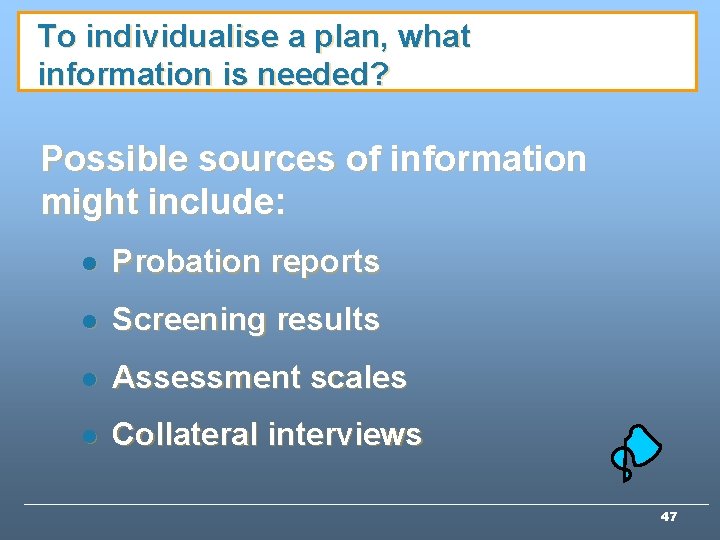
To individualise a plan, what information is needed? Possible sources of information might include: l Probation reports l Screening results l Assessment scales l Collateral interviews 47
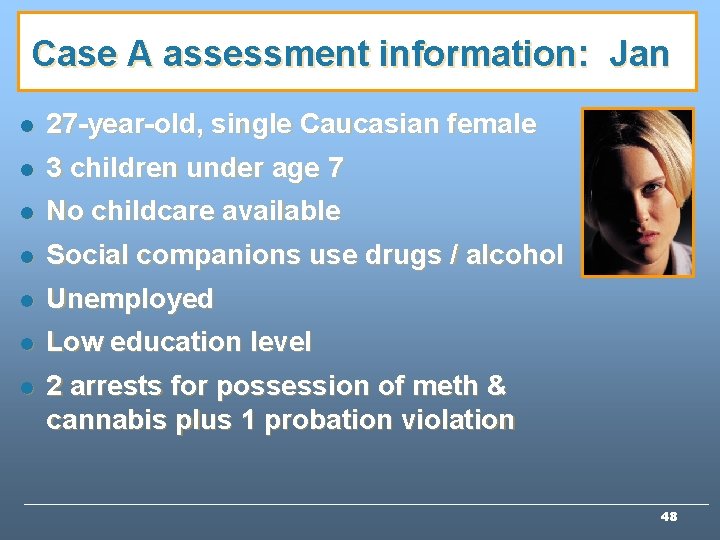
Case A assessment information: Jan l 27 -year-old, single Caucasian female l 3 children under age 7 l No childcare available l Social companions use drugs / alcohol l Unemployed l Low education level l 2 arrests for possession of meth & cannabis plus 1 probation violation 48
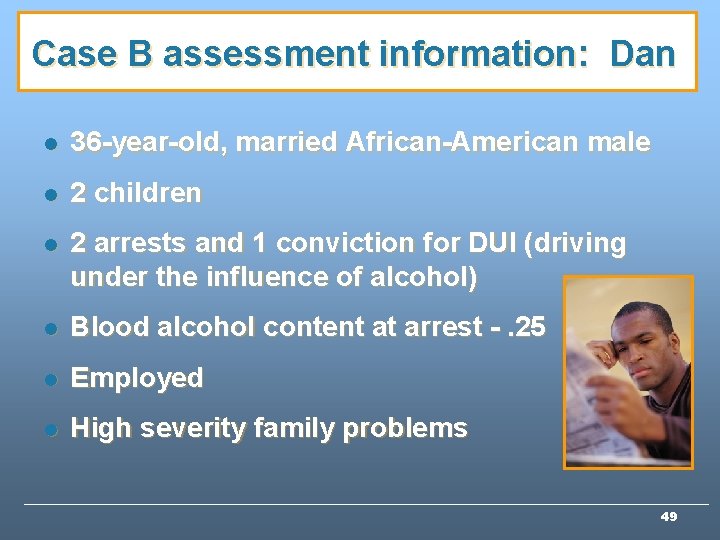
Case B assessment information: Dan l 36 -year-old, married African-American male l 2 children l 2 arrests and 1 conviction for DUI (driving under the influence of alcohol) l Blood alcohol content at arrest -. 25 l Employed l High severity family problems 49
The “Old Method”: (Programme-Driven) Problem Statement “Alcohol dependence” l Not individualised l Not a complete sentence l Doesn’t provide enough information l A diagnosis is not a complete problem statement 50
The “Old Method”: (Programme-Driven) Goal Statement “Will refrain from all substance use now and in the future” l Not specific for Jan or Dan l Not helpful for treatment planning l Cannot be accomplished by programme discharge 51
The “Old Method”: (Programme-Driven) Objective Statement “Will participate in outpatient programme” l Again, not specific for Jan or Dan l A level of care is not an objective 52
The “Old Method”: (Programme-Driven) Intervention Statement “Will see a counsellor once a week and attend group on Monday nights for 12 weeks” l This sounds specific, but it describes a programme component 53
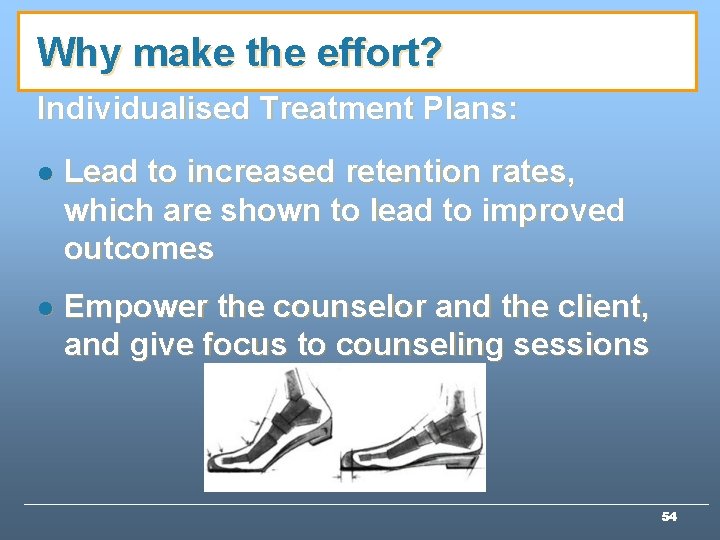
Why make the effort? Individualised Treatment Plans: l Lead to increased retention rates, which are shown to lead to improved outcomes l Empower the counselor and the client, and give focus to counseling sessions 54
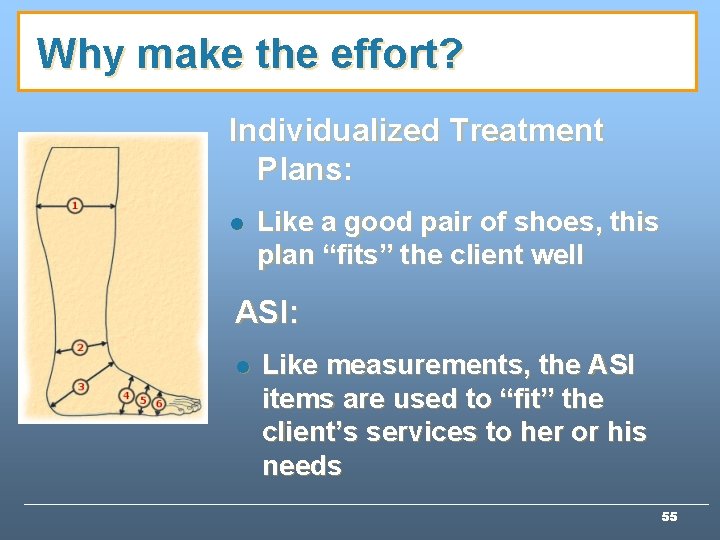
Why make the effort? Individualized Treatment Plans: l Like a good pair of shoes, this plan “fits” the client well ASI: l Like measurements, the ASI items are used to “fit” the client’s services to her or his needs 55
What is included in any treatment plan?
Treatment plan components
1. Problem Statements are based on information collected during the assessment 58 a c t i v e
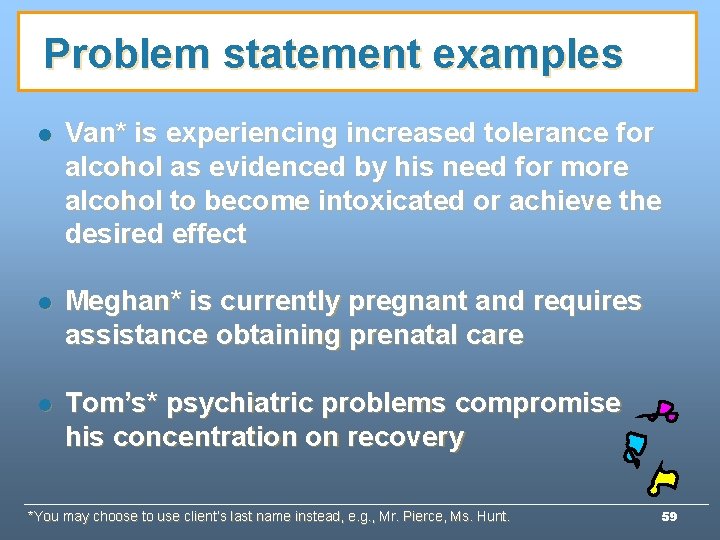
Problem statement examples l Van* is experiencing increased tolerance for alcohol as evidenced by his need for more alcohol to become intoxicated or achieve the desired effect l Meghan* is currently pregnant and requires assistance obtaining prenatal care l Tom’s* psychiatric problems compromise his concentration on recovery *You may choose to use client’s last name instead, e. g. , Mr. Pierce, Ms. Hunt. 59
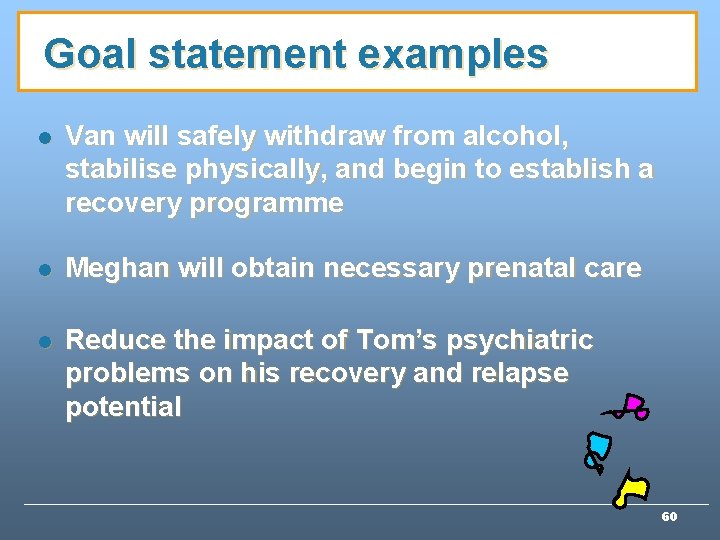
Goal statement examples l Van will safely withdraw from alcohol, stabilise physically, and begin to establish a recovery programme l Meghan will obtain necessary prenatal care l Reduce the impact of Tom’s psychiatric problems on his recovery and relapse potential 60
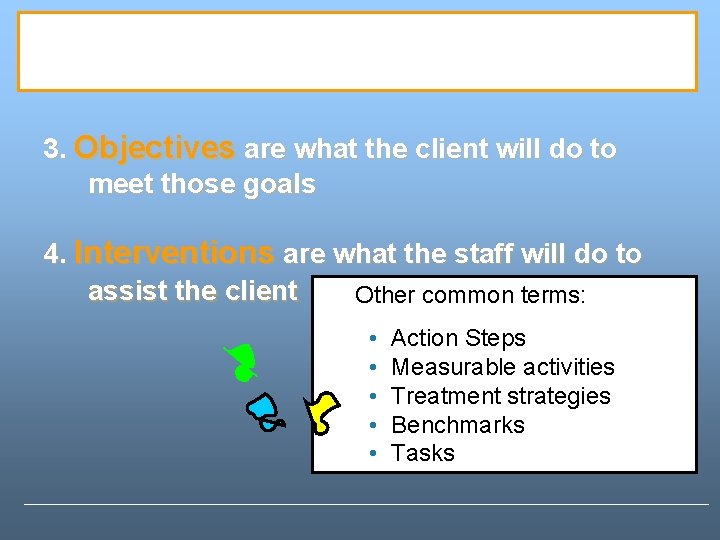
3. Objectives are what the client will do to meet those goals 4. Interventions are what the staff will do to assist the client Other common terms: • • • Action Steps Measurable activities Treatment strategies Benchmarks Tasks
Examples of objectives l Van will report acute withdrawal symptoms l Van will begin activities that involve a substance-free lifestyle and support his recovery goals l Meghan will visit an OB/GYN physician or nurse for prenatal care l Tom will list 3 times when psychological symptoms increased the likelihood of relapse 62
Intervention examples l Staff medical personnel will evaluate Van’s need for medical monitoring or medications l Staff will call a medical service provider or clinic with Meghan to make an appointment for necessary medical services l Staff will review Tom’s list of 3 times when symptoms increased the likelihood of relapse and discuss effective ways of managing those feelings 63
Review: Treatment Plan Components
65 ftw a re nin g * a re 1. Client Strengths* are reflected
nd tive a t Narra m Lis roble ster P
Master Problem List 67 Refer to ASI Narrative Report (Workshop 2, Handout 1) l Review case study l Focus on problems identified in the: l alcohol/drug domain l medical domain l family/social domain
ASI Master Problem List 68 Master Problem List
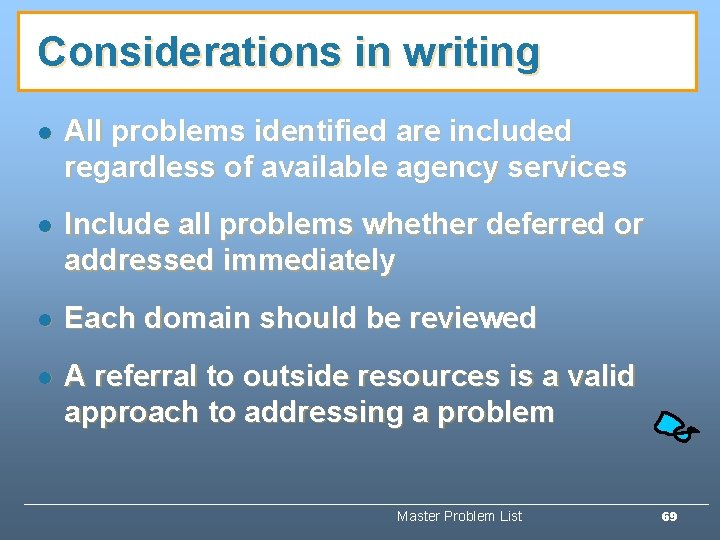
Considerations in writing l All problems identified are included regardless of available agency services l Include all problems whether deferred or addressed immediately l Each domain should be reviewed l A referral to outside resources is a valid approach to addressing a problem Master Problem List 69
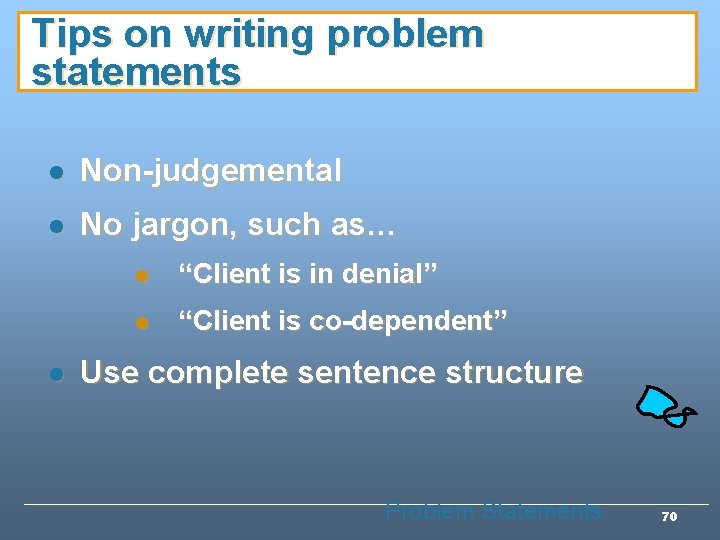
Tips on writing problem statements l Non-judgemental l No jargon, such as… l l “Client is in denial” l “Client is co-dependent” Use complete sentence structure Problem Statements 70
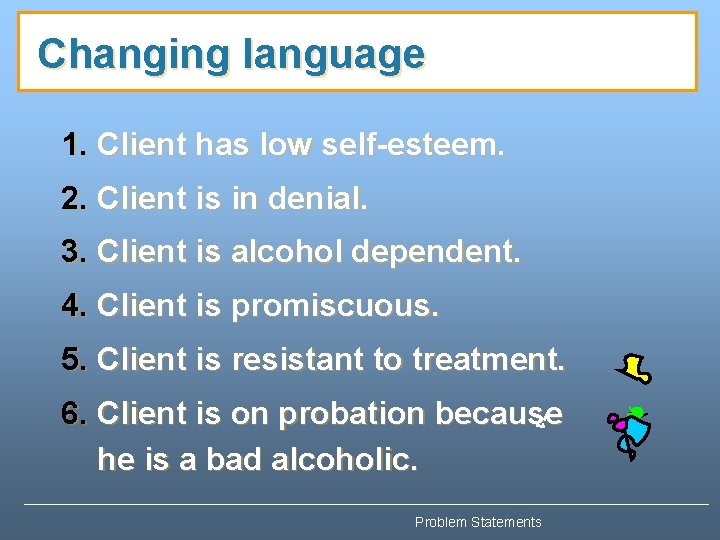
Changing language 1. Client has low self-esteem. 2. Client is in denial. 3. Client is alcohol dependent. 4. Client is promiscuous. 5. Client is resistant to treatment. 71 6. Client is on probation because he is a bad alcoholic. Problem Statements
Changing language: Pick two 72 ge Problem Statements
e n t s d aily in g w h ile t e s t h a t a l co h o l u s e h d r a ue wal, l n o c s e s s d ue C ed ont inu 73
S enc eh a b a v a io es d b u e r c a u s e P rob lem s ent tate m 74
in e a c h d o m a i n. Case study problem statements 75 Problem Statements
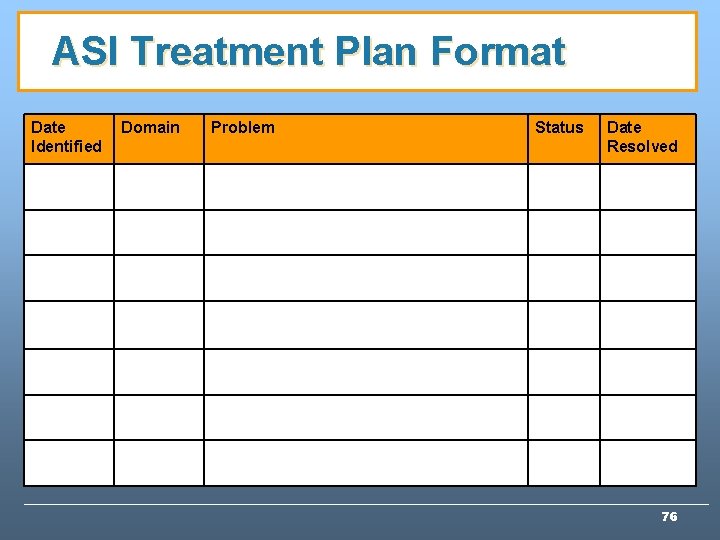
ASI Treatment Plan Format Date Identified Domain Problem Status Date Resolved 76
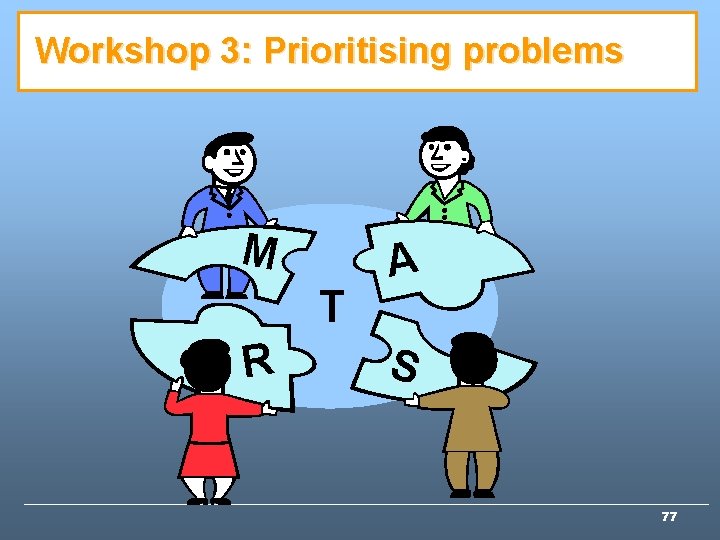
Workshop 3: Prioritising problems M T R A S 77
Now that we have the problems identified…how do we prioritise them?
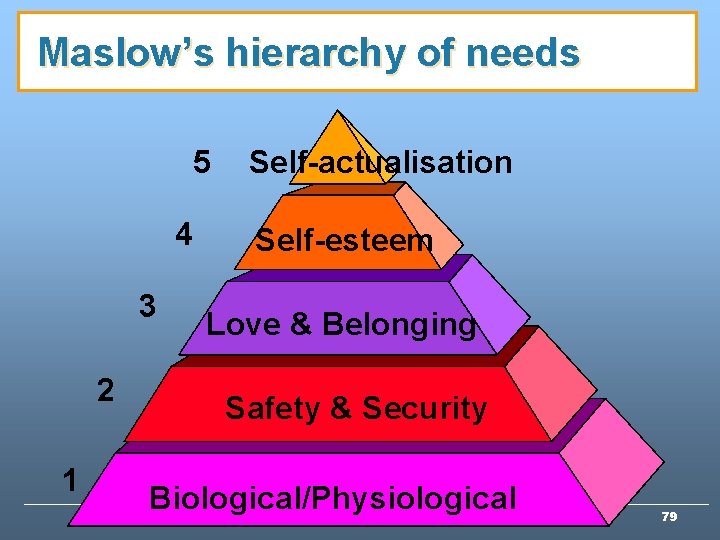
Maslow’s hierarchy of needs 5 4 3 2 1 Self-actualisation Self-esteem Love & Belonging Safety & Security Biological/Physiological 79
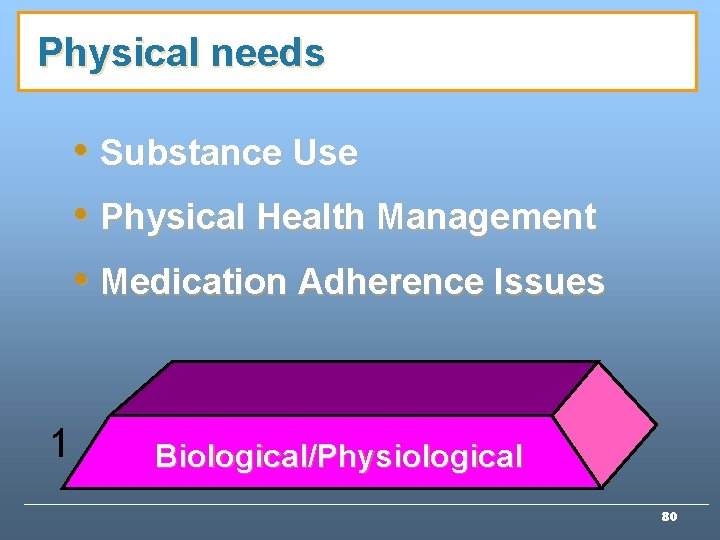
Physical needs • Substance Use • Physical Health Management • Medication Adherence Issues 1 PHYSIOLOGICAL Biological/Physiological 80
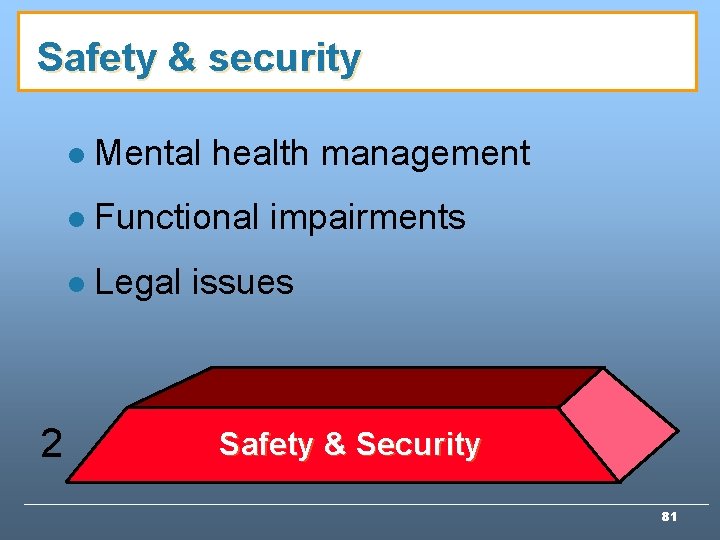
Safety & security l Mental health management l Functional l Legal 2 impairments issues Safety & Security 81
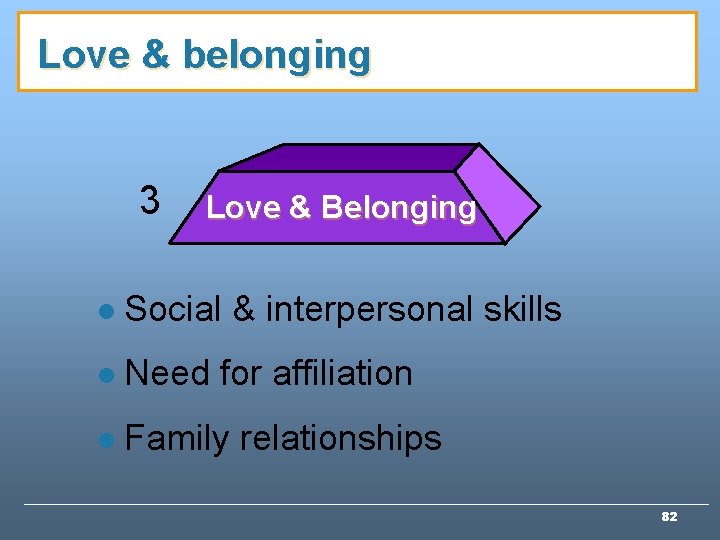
Love & belonging 3 Love & Belonging l Social l Need & interpersonal skills for affiliation l Family relationships 82
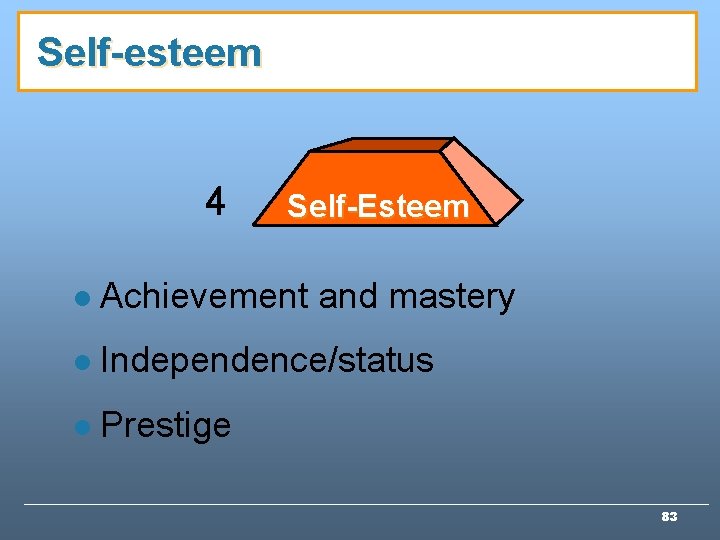
Self-esteem 4 Self-Esteem l Achievement and mastery l Independence/status l Prestige 83
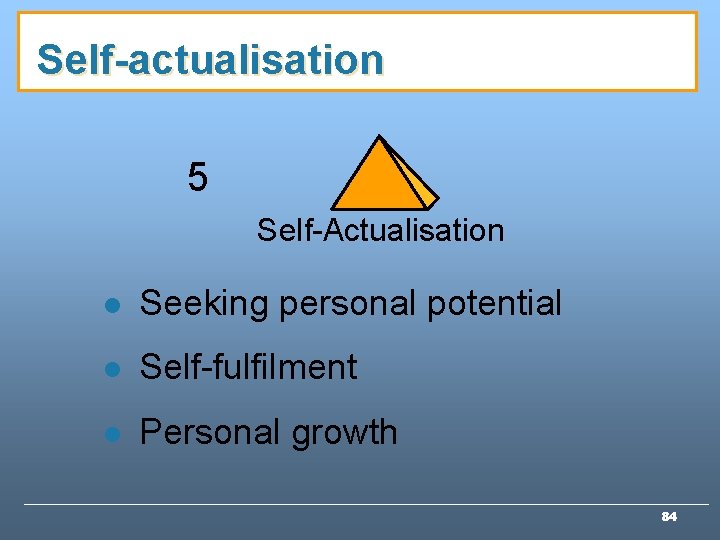
Self-actualisation 5 Self-Actualisation l Seeking personal potential l Self-fulfilment l Personal growth 84
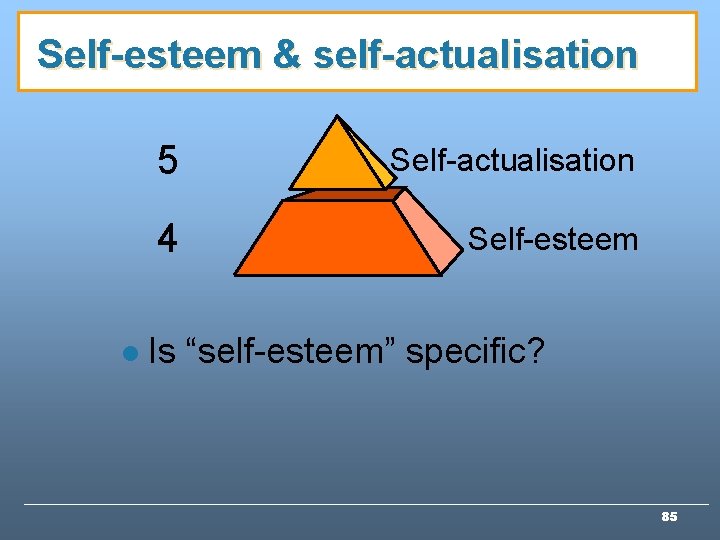
Self-esteem & self-actualisation l 5 Self-actualisation 4 Self-esteem Is “self-esteem” specific? 85
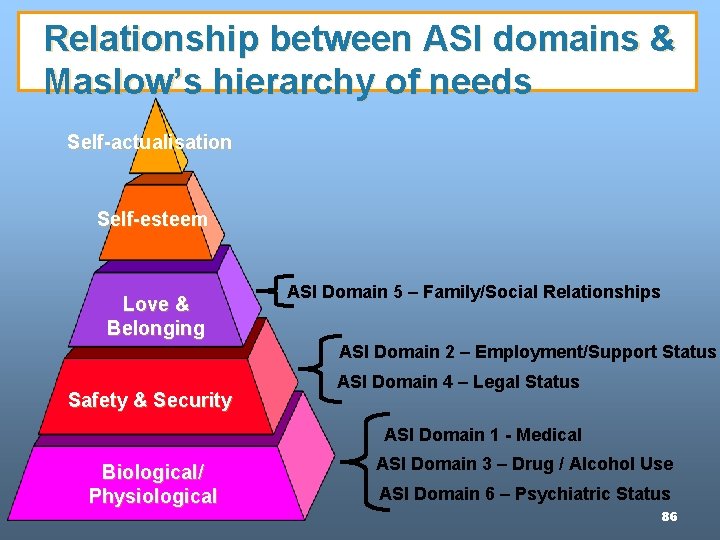
Relationship between ASI domains & Maslow’s hierarchy of needs Self-actualisation Self-esteem Love & Belonging ASI Domain 5 – Family/Social Relationships ASI Domain 2 – Employment/Support Status Safety & Security ASI Domain 4 – Legal Status ASI Domain 1 - Medical Biological/ Physiological ASI Domain 3 – Drug / Alcohol Use ASI Domain 6 – Psychiatric Status 86
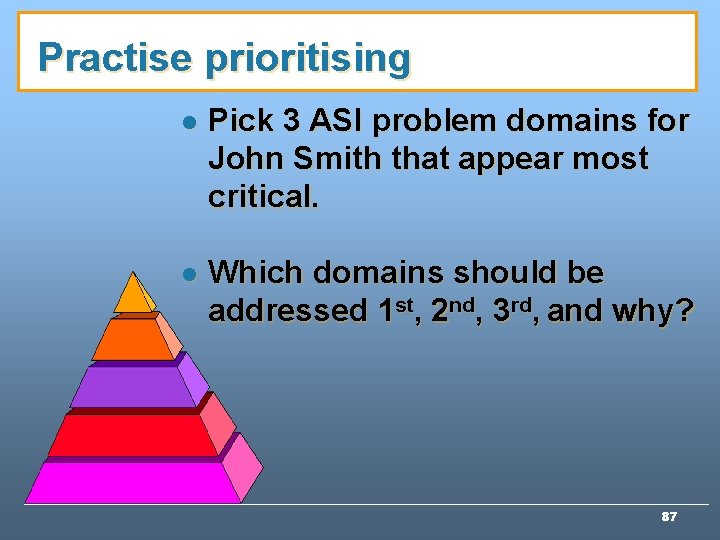
Practise prioritising l Pick 3 ASI problem domains for John Smith that appear most critical. l Which domains should be addressed 1 st, 2 nd, 3 rd, and why? 87
re a c h 88
Check-in discussion 89
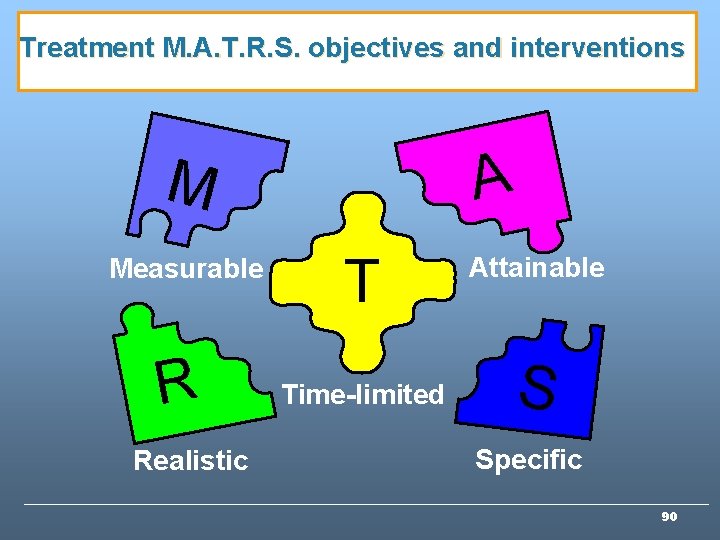
Treatment M. A. T. R. S. objectives and interventions M A Measurable T R Time-limited Realistic Attainable S Specific 90
M. AT. R. S. objectives & interventions Measurable M l Objectives and interventions are measurable l Achievement is observable l Indicators of client progress are measurable l Assessment l Client scales / scores report l Behavioural and mental health status changes 91
M. AT. R. S. objectives & interventions Attainable l Identify objectives and interventions attainable during active treatment phase l Focus on “improved functioning” rather than cure l Identify goals attainable in level of care provided l Revise goals when client moves from one level of care to another A 92
M. AT. R. S. objectives & interventions Time-limited T l Focus on time-limited or short-term goals and objectives l Objectives and interventions can be reviewed within a specific time period 93
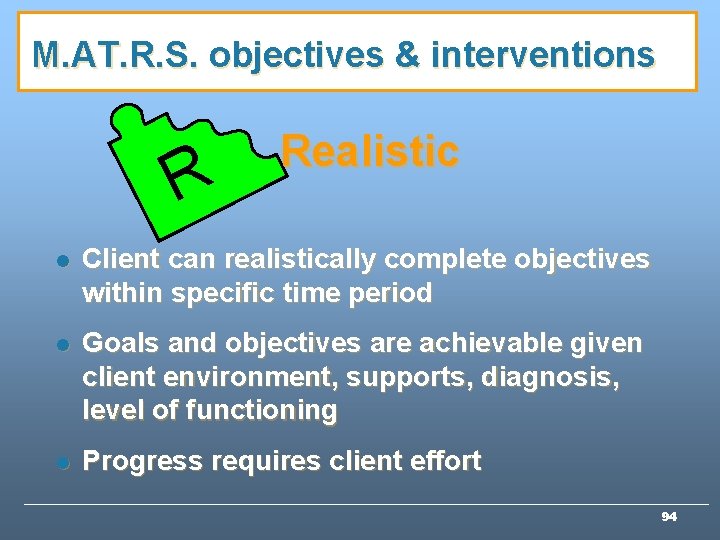
M. AT. R. S. objectives & interventions R Realistic l Client can realistically complete objectives within specific time period l Goals and objectives are achievable given client environment, supports, diagnosis, level of functioning l Progress requires client effort 94
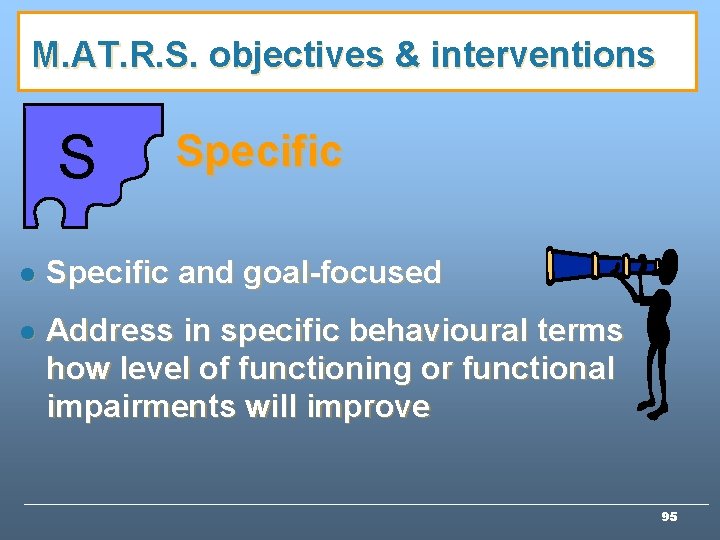
M. AT. R. S. objectives & interventions S Specific l Specific and goal-focused l Address in specific behavioural terms how level of functioning or functional impairments will improve 95
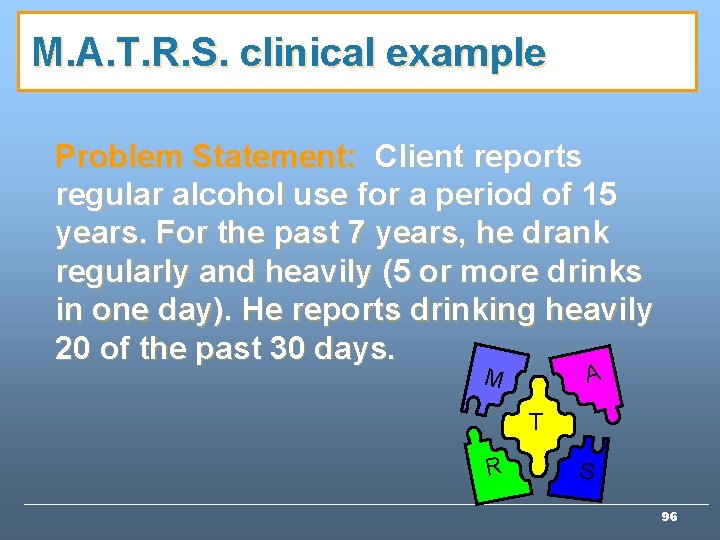
M. A. T. R. S. clinical example Problem Statement: Client reports regular alcohol use for a period of 15 years. For the past 7 years, he drank regularly and heavily (5 or more drinks in one day). He reports drinking heavily 20 of the past 30 days. A M T R S 96
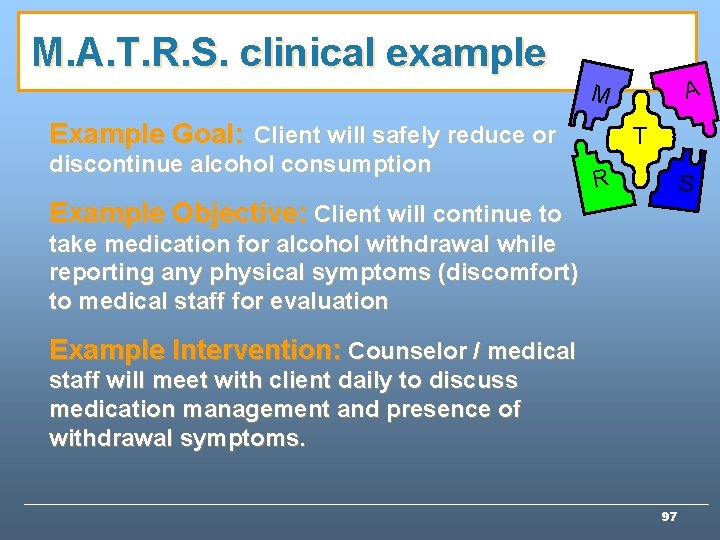
M. A. T. R. S. clinical example A M Example Goal: Client will safely reduce or discontinue alcohol consumption T R S Example Objective: Client will continue to take medication for alcohol withdrawal while reporting any physical symptoms (discomfort) to medical staff for evaluation Example Intervention: Counselor / medical staff will meet with client daily to discuss medication management and presence of withdrawal symptoms. 97
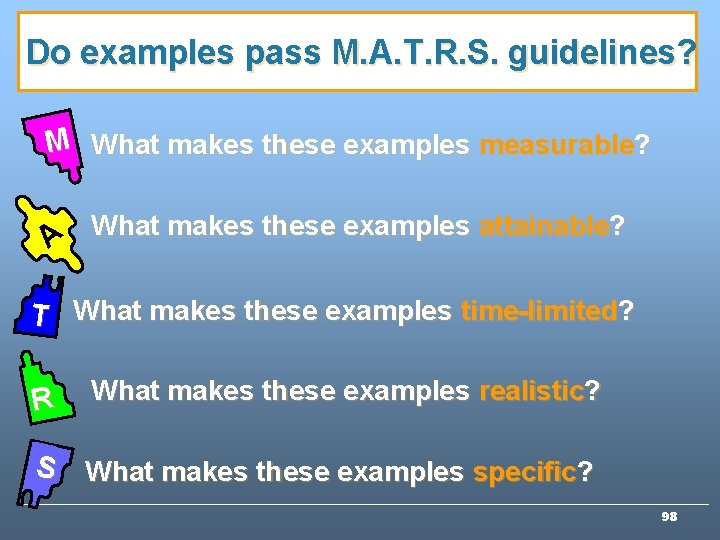
Do examples pass M. A. T. R. S. guidelines? M What makes these examples measurable? What makes these examples attainable ? A T What makes these examples time-limited? R What makes these examples realistic? S What makes these examples specific? 98
Workshop 4: Putting Treatment Planning M. A. T. R. S. into Practise
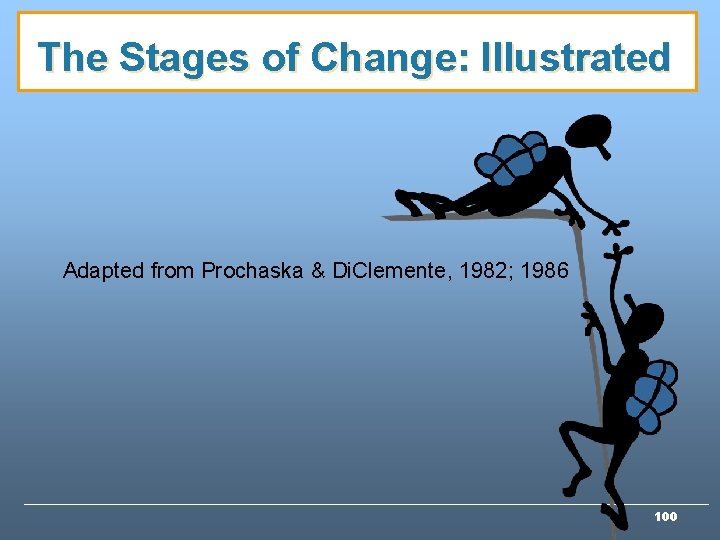
The Stages of Change: Illustrated Adapted from Prochaska & Di. Clemente, 1982; 1986 100
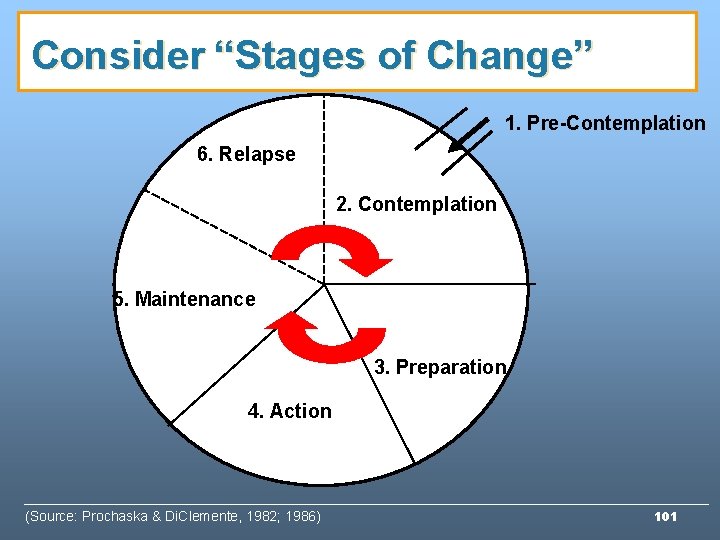
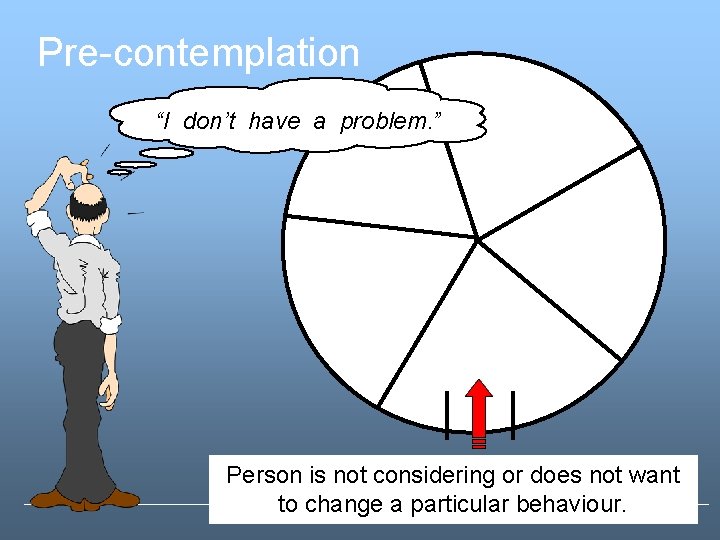
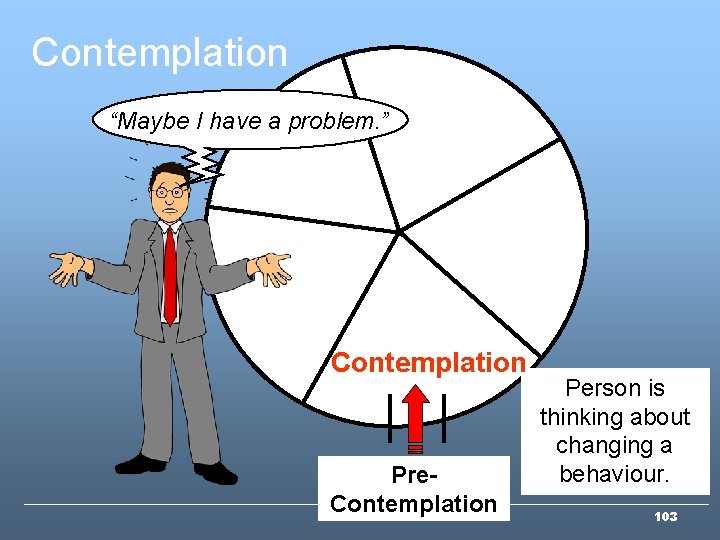
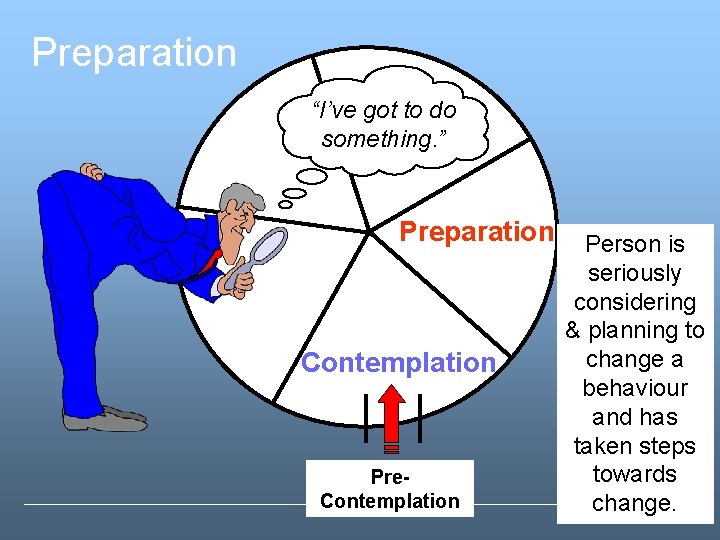
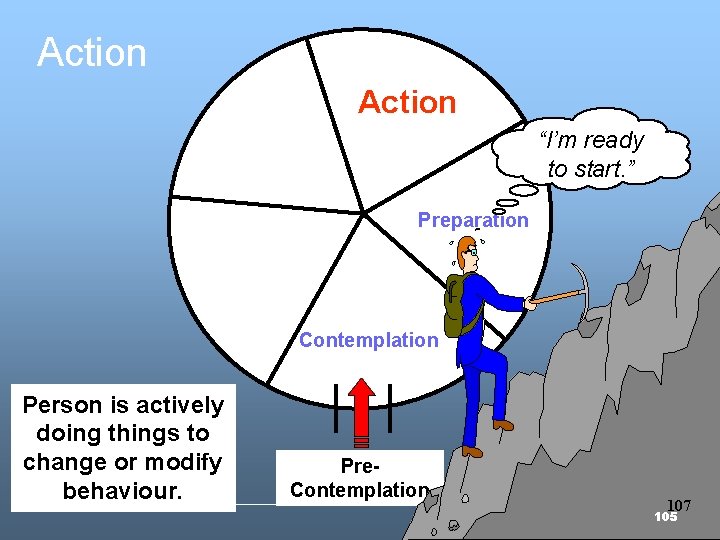
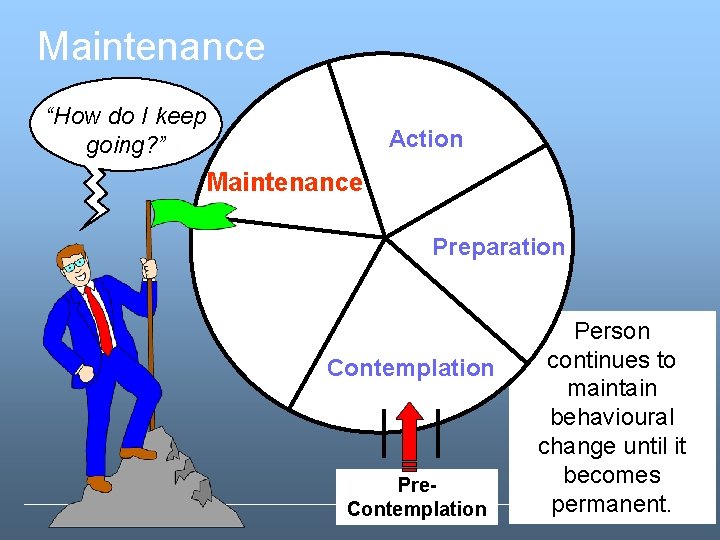
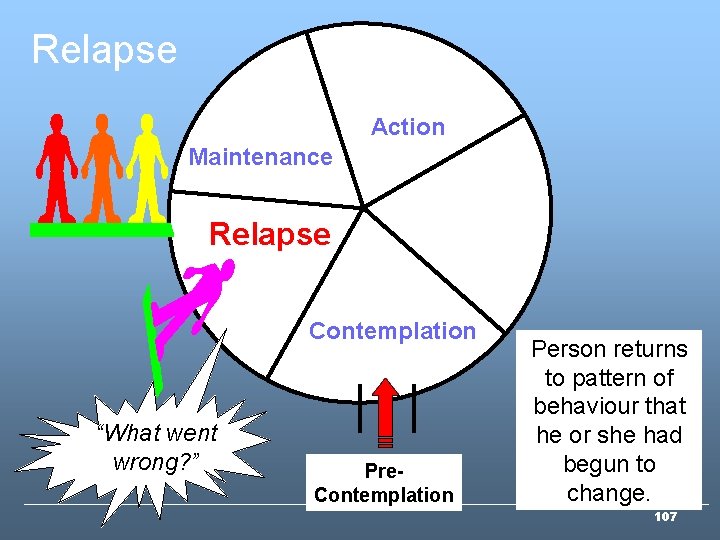
Consider “Stages of Change” 1. Pre-Contemplation 6. Relapse 2. Contemplation 5. Maintenance 3. Preparation 4. Action (Source: Prochaska & Di. Clemente, 1982; 1986) 101
Pre-contemplation “I don’t have a problem. ” Person is not considering or does not want to change a particular behaviour. 102
Contemplation “Maybe I have a problem. ” Contemplation Pre. Contemplation Person is thinking about changing a behaviour. 103
Preparation “I’ve got to do something. ” Preparation Contemplation Pre. Contemplation Person is seriously considering & planning to change a behaviour and has taken steps towards change. 104
Action “I’m ready to start. ” Preparation Contemplation Person is actively doing things to change or modify behaviour. Pre. Contemplation 107 105
Maintenance “How do I keep going? ” Action Maintenance Preparation Contemplation Pre. Contemplation Person continues to maintain behavioural change until it becomes permanent. 106
Relapse Action Maintenance Relapse Preparation Contemplation “What went wrong? ” Pre. Contemplation Person returns to pattern of behaviour that he or she had begun to change. 107
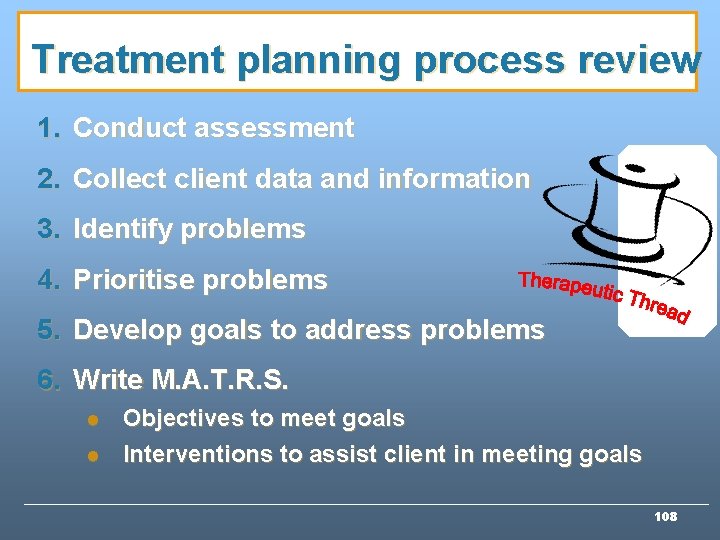
Treatment planning process review 1. Conduct assessment 2. Collect client data and information 3. Identify problems 4. Prioritise problems 5. Develop goals to address problems 6. Write M. A. T. R. S. l l Objectives to meet goals Interventions to assist client in meeting goals 108
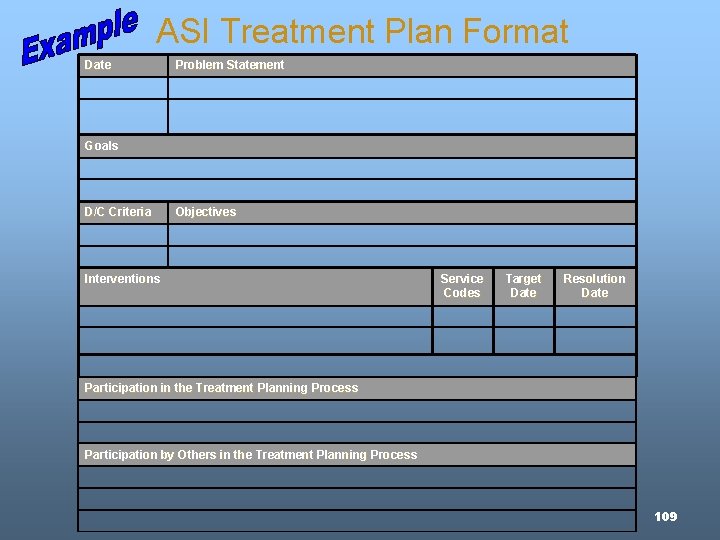
ASI Treatment Plan Format Date Problem Statement Goals D/C Criteria Objectives Interventions Service Codes Target Date Resolution Date Participation in the Treatment Planning Process Participation by Others in the Treatment Planning Process 109
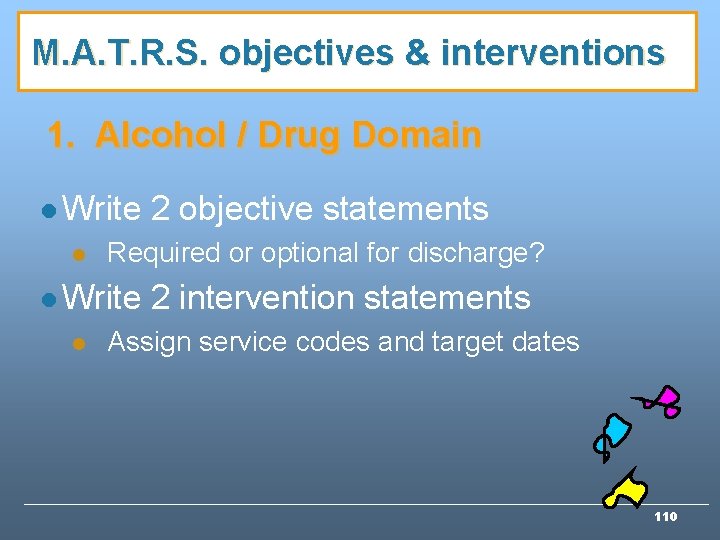
M. A. T. R. S. objectives & interventions 1. Alcohol / Drug Domain l Write l Required or optional for discharge? l Write l 2 objective statements 2 intervention statements Assign service codes and target dates 110
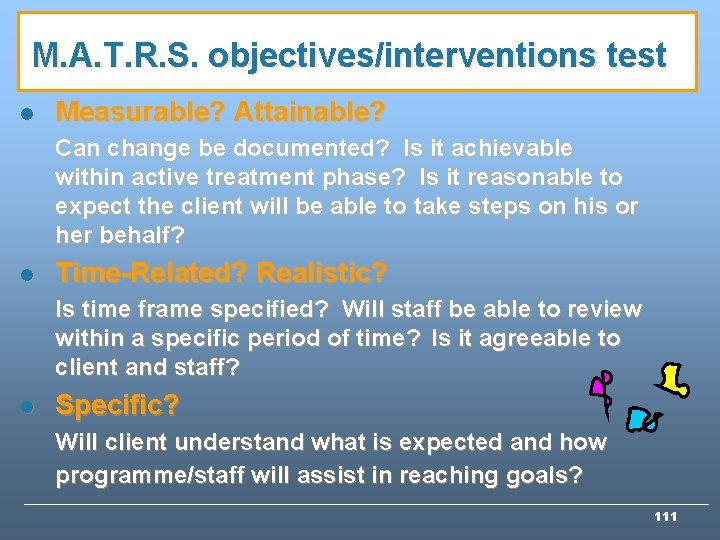
M. A. T. R. S. objectives/interventions test l Measurable? Attainable? Can change be documented? Is it achievable within active treatment phase? Is it reasonable to expect the client will be able to take steps on his or her behalf? l Time-Related? Realistic? Is time frame specified? Will staff be able to review within a specific period of time? Is it agreeable to client and staff? l Specific? Will client understand what is expected and how programme/staff will assist in reaching goals? 111
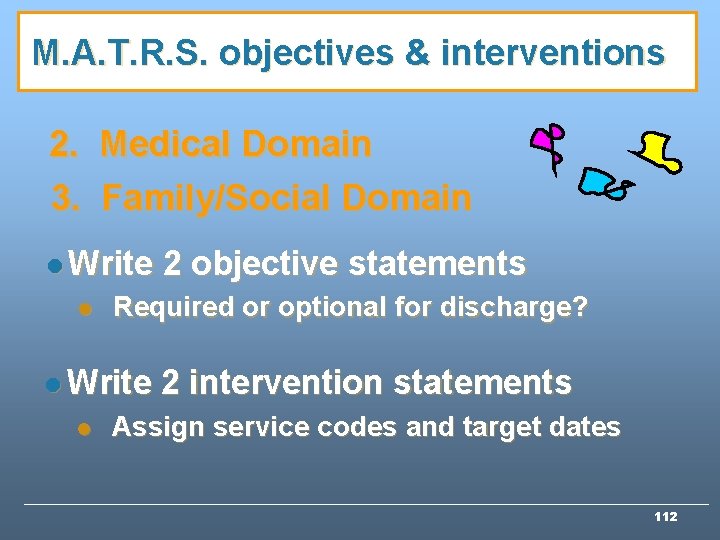
M. A. T. R. S. objectives & interventions 2. Medical Domain 3. Family/Social Domain l Write l Required or optional for discharge? l Write l 2 objective statements 2 intervention statements Assign service codes and target dates 112
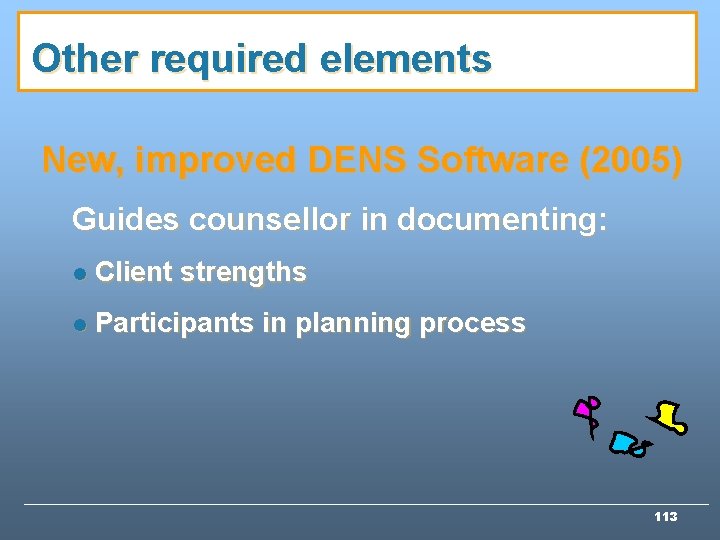
Other required elements New, improved DENS Software (2005) Guides counsellor in documenting: l Client strengths l Participants in planning process 113
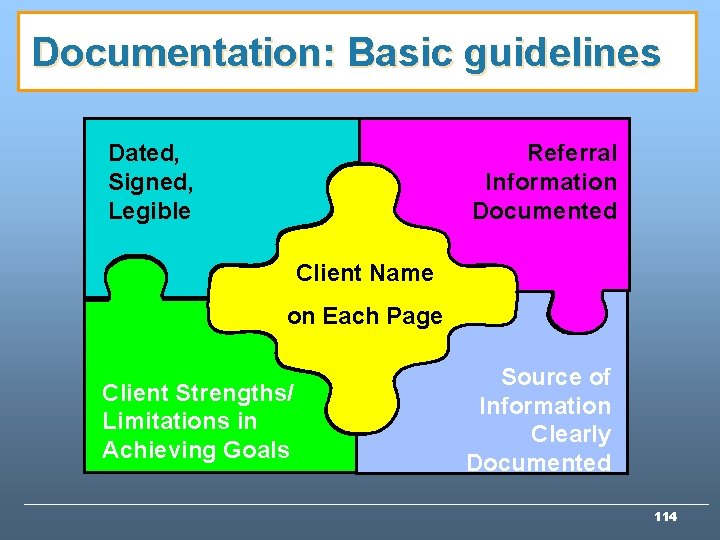
Documentation: Basic guidelines Dated, Signed, Legible Referral Information Documented Client Name on Each Page Client Strengths/ Limitations in Achieving Goals Source of Information Clearly Documented 114
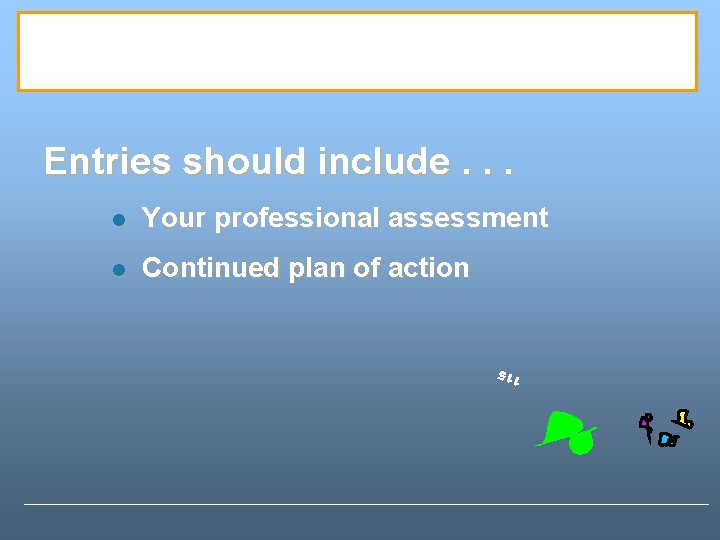
Entries should include. . . l Your professional assessment l Continued plan of action 115
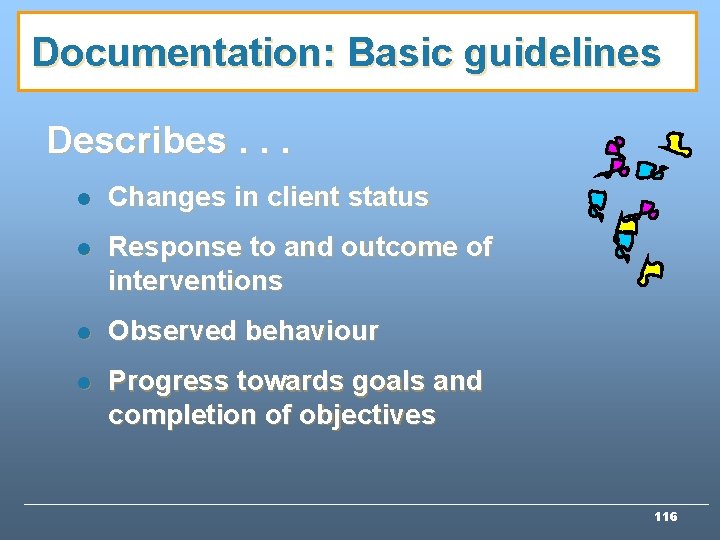
Documentation: Basic guidelines Describes. . . l Changes in client status l Response to and outcome of interventions l Observed behaviour l Progress towards goals and completion of objectives 116
Documentation: Basic guidelines The client’s treatment record is a legal document Clinical Example: Agency Trip 117
Documentation: Basic guidelines Legal Issues & Recommendations: l Document non-routine calls, missed sessions, and consultations with other professionals l Avoid reporting staff problems in case notes, including staff conflicts and rivalries l Chart client’s non-conforming behaviour l Record premature discharges l Note limitations of the treatment provided to the client 118
Method of Documentation 119
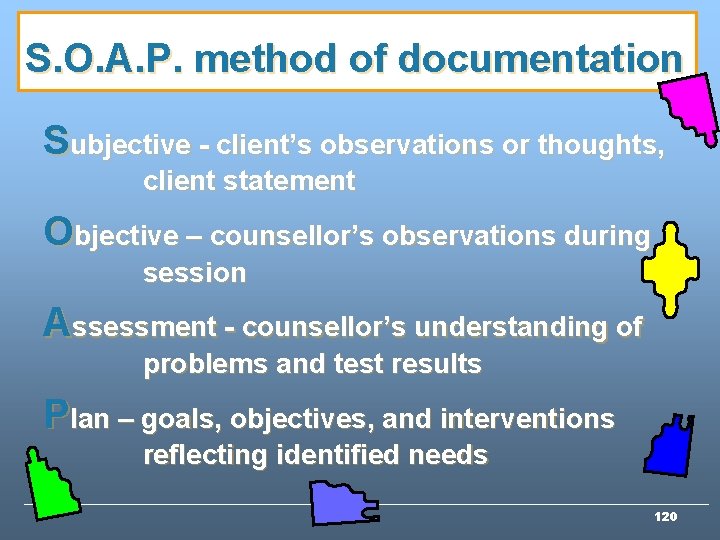
S. O. A. P. method of documentation Subjective - client’s observations or thoughts, client statement Objective – counsellor’s observations during session Assessment - counsellor’s understanding of problems and test results Plan – goals, objectives, and interventions reflecting identified needs 120
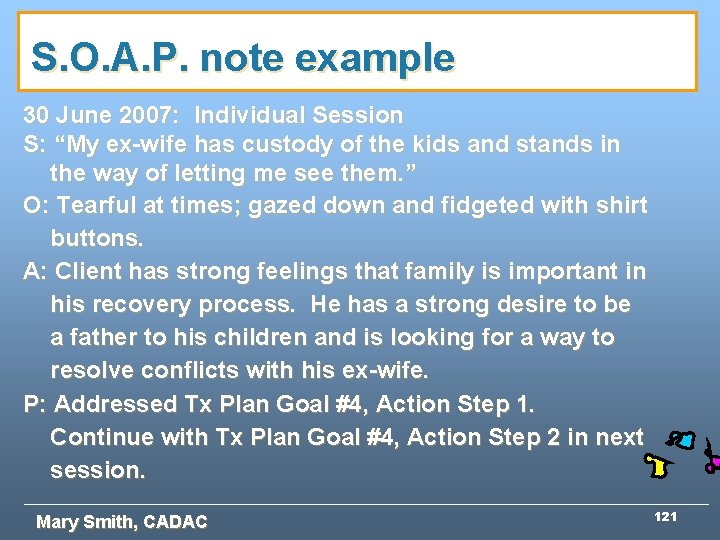
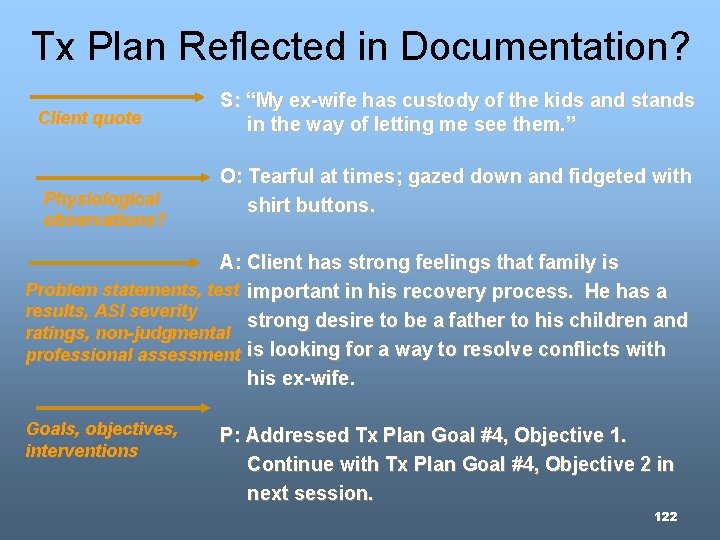
S. O. A. P. note example 30 June 2007: Individual Session S: “My ex-wife has custody of the kids and stands in the way of letting me see them. ” O: Tearful at times; gazed down and fidgeted with shirt buttons. A: Client has strong feelings that family is important in his recovery process. He has a strong desire to be a father to his children and is looking for a way to resolve conflicts with his ex-wife. P: Addressed Tx Plan Goal #4, Action Step 1. Continue with Tx Plan Goal #4, Action Step 2 in next session. Mary Smith, CADAC 121
Tx Plan Reflected in Documentation? Client quote Physiological observations? S: “My ex-wife has custody of the kids and stands in the way of letting me see them. ” O: Tearful at times; gazed down and fidgeted with shirt buttons. A: Client has strong feelings that family is Problem statements, test important in his recovery process. He has a results, ASI severity strong desire to be a father to his children and ratings, non-judgmental professional assessment is looking for a way to resolve conflicts with his ex-wife. Goals, objectives, interventions P: Addressed Tx Plan Goal #4, Objective 1. Continue with Tx Plan Goal #4, Objective 2 in next session. 122
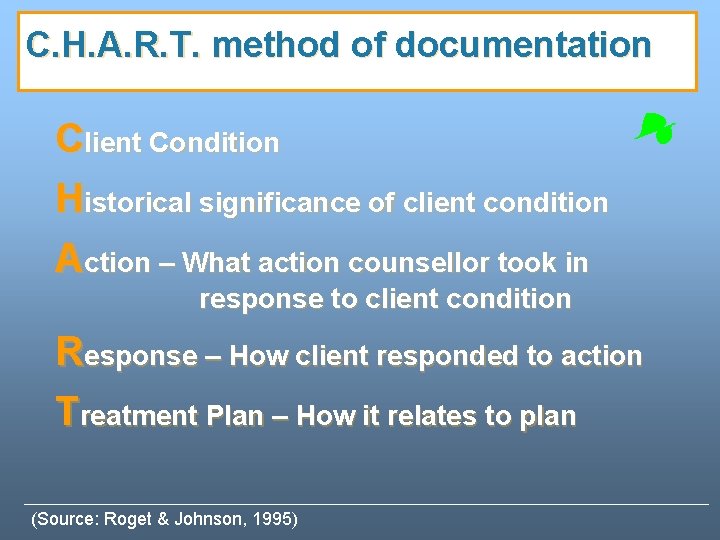
C. H. A. R. T. method of documentation Client Condition Historical significance of client condition Action – What action counsellor took in response to client condition Response – How client responded to action Treatment Plan – How it relates to plan (Source: Roget & Johnson, 1995)
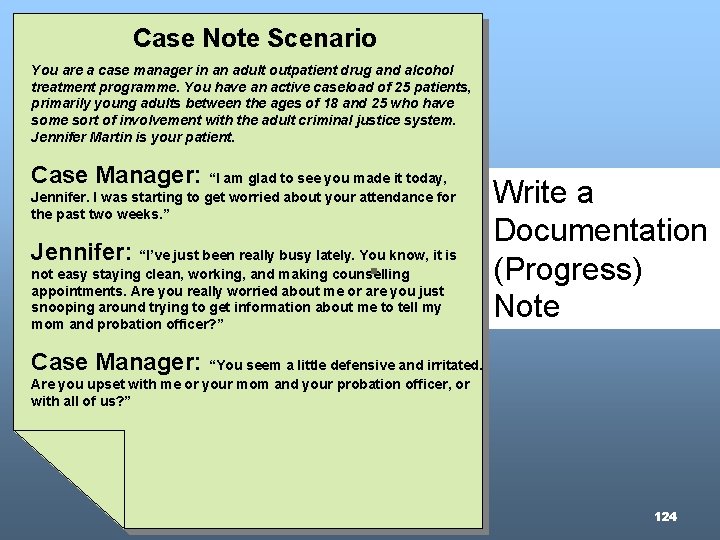
Case Note Scenario You are a case manager in an adult outpatient drug and alcohol treatment programme. You have an active caseload of 25 patients, primarily young adults between the ages of 18 and 25 who have some sort of involvement with the adult criminal justice system. Jennifer Martin is your patient. Case Manager: “I am glad to see you made it today, Jennifer. I was starting to get worried about your attendance for the past two weeks. ” Jennifer: “I’ve just been really busy lately. You know, it is not easy staying clean, working, and making counselling appointments. Are you really worried about me or are you just snooping around trying to get information about me to tell my mom and probation officer? ” Write a Documentation (Progress) Note Case Manager: “You seem a little defensive and irritated. Are you upset with me or your mom and your probation officer, or with all of us? ” 124
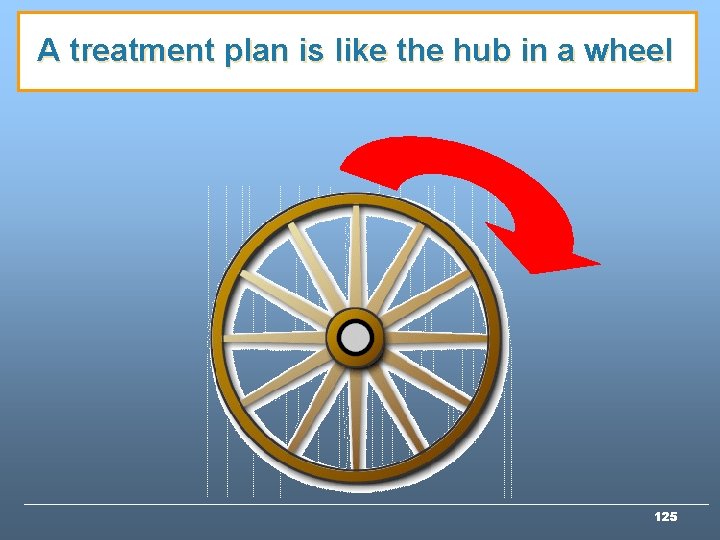
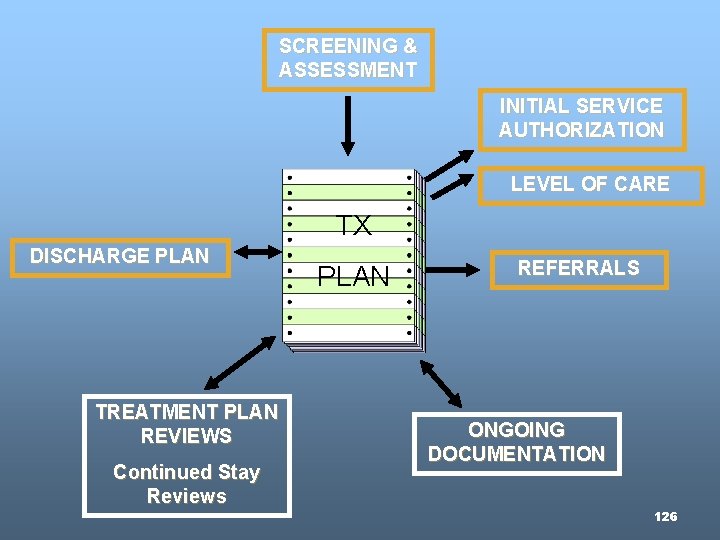
A treatment plan is like the hub in a wheel 125
SCREENING & ASSESSMENT INITIAL SERVICE AUTHORIZATION LEVEL OF CARE TX DISCHARGE PLAN TREATMENT PLAN REVIEWS Continued Stay Reviews PLAN REFERRALS ONGOING DOCUMENTATION 126
Other organisational considerations 1. Information requirements of funding entities / managed care? 2. Is there duplication of information collected? 3. Is technology used effectively? 4. Is paperwork useful in treatment planning process? 127
Post-assessment 10 Min. Please respond to the post-assessment questions in your workbook. (Your responses are strictly confidential. ) 128
Thank you for your time!