
VII Water Treatment A Treatment of wastewater and
- Slides: 33
VII. Water Treatment A. Treatment of wastewater and B. Treatment of drinking water
Objectives - students should: b List and describe treatment methods for wastewater. b List and describe treatment methods for drinking water. b Compare and contrast treatment methods and goals of wastewater and drinking water.
Justification for wastewater treatment: b Pollution from sewage is a primary environmental health hazard (wastewater effluent). b The purpose of municipal wastewater treatment is to limit pollution of the receiving watercourse. b The receiving watercourse may also be a source of drinking water.
Goals of wastewater treatment: b Reduction of organic load of the wastewater effluent to limit eutrophication (BOD, COD limits), b Reduction of microbiological contamination that may transmit infectious disease.
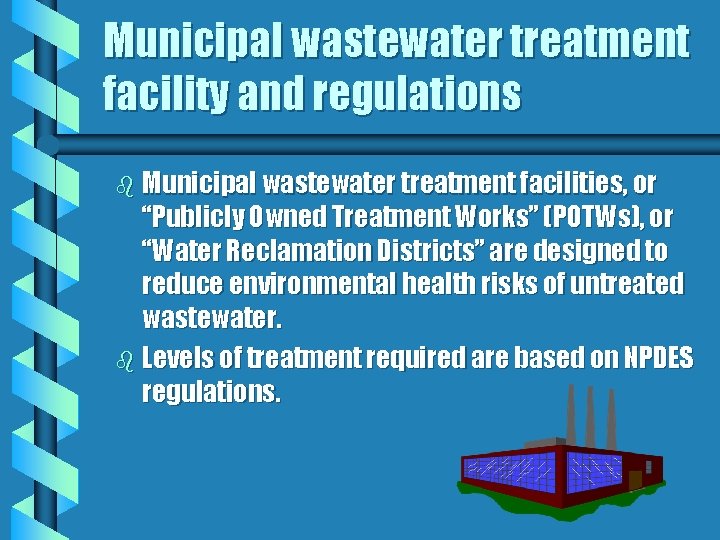
Municipal wastewater treatment facility and regulations b Municipal wastewater treatment facilities, or “Publicly Owned Treatment Works” (POTWs), or “Water Reclamation Districts” are designed to reduce environmental health risks of untreated wastewater. b Levels of treatment required are based on NPDES regulations.
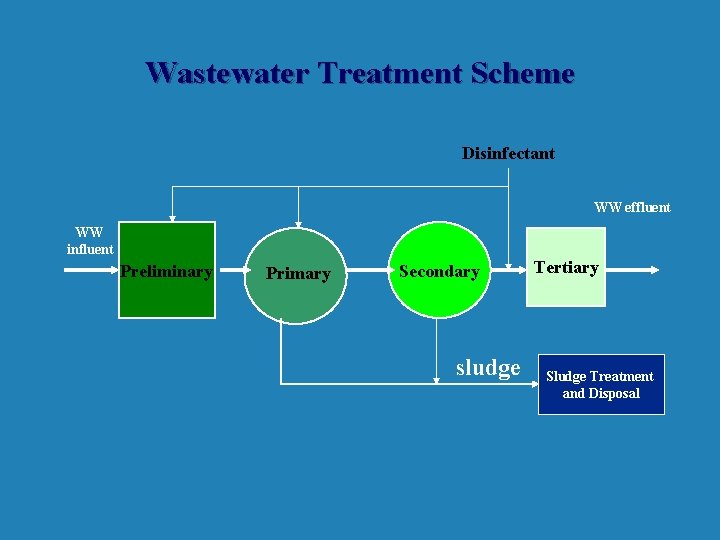
Wastewater Treatment Scheme Disinfectant WW effluent WW influent Preliminary Primary Secondary sludge Tertiary Sludge Treatment and Disposal
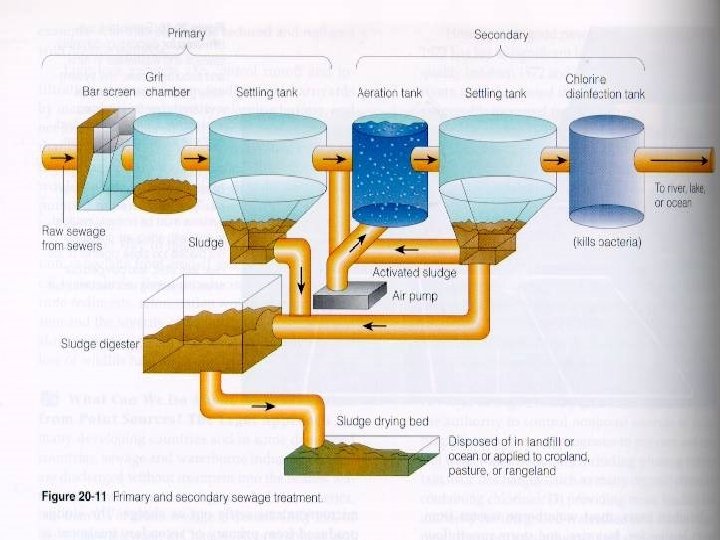
Wastewater treatment processes: b Preliminary treatment is a physical process that removes large contaminants. b Primary treatment involves physical sedimentation of particulates. b Secondary treatment involves physical and biological treatment to reduce organic load of wastewater. b Tertiary or advanced treatments.
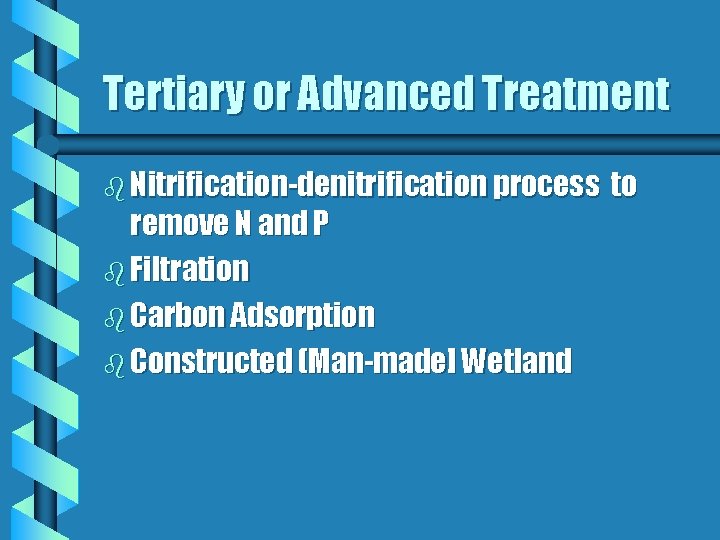
Tertiary or Advanced Treatment b Nitrification-denitrification process remove N and P b Filtration b Carbon Adsorption b Constructed (Man-made] Wetland to
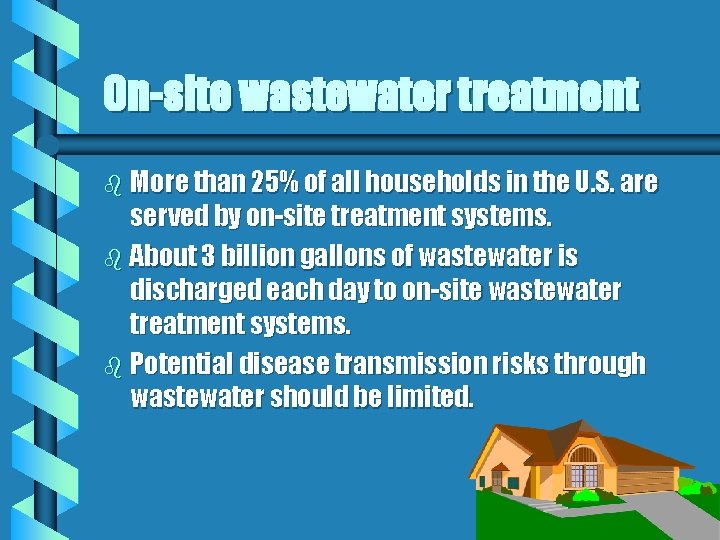
On-site wastewater treatment b More than 25% of all households in the U. S. are served by on-site treatment systems. b About 3 billion gallons of wastewater is discharged each day to on-site wastewater treatment systems. b Potential disease transmission risks through wastewater should be limited.
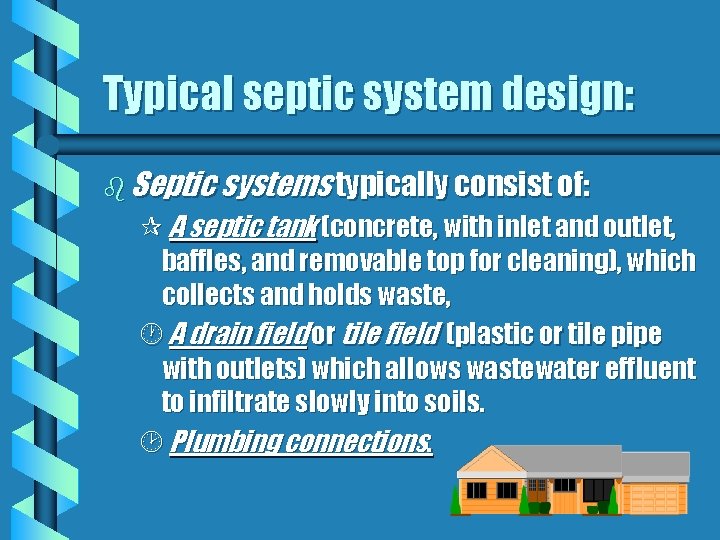
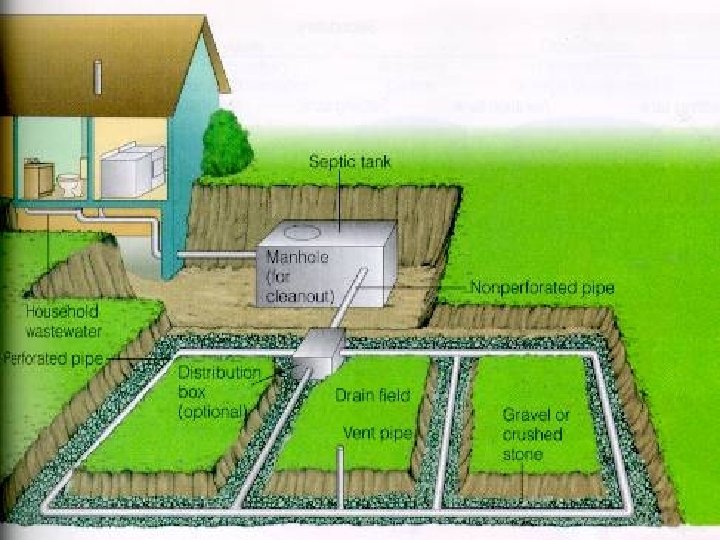
Typical septic system design: b Septic systems typically consist of: A septic tank (concrete, with inlet and outlet, baffles, and removable top for cleaning), which collects and holds waste, A drain field or tile field (plastic or tile pipe with outlets) which allows wastewater effluent to infiltrate slowly into soils. Plumbing connections.
Periodic summery b Treatment of wastewater is necessary to protect the environment and preserve the quality of water for drinking. b Treatment of municipal wastewater typically includes preliminary, primary treatment, secondary treatment, and tertiary treatment. b On-site wastewater treatment is facilitated by septic tank systems.
B. Drinking water treatment: b Clarification - primarily a physical process, but may be aided by addition of chemicals. b Filtration - also primarily physical, but chemicals may aid the process. b Disinfection - typically a chemical process that reduces pathogenic microorganisms.
B 1. Clarification of drinking water: b Clarification removes particulates that contribute to turbidity and contamination of water. b Clarification is aided by chemicals which cause particulates to aggregate, precipitate, and form sediment (sludge).
B 2. Filtration: b Separate nonsettleable solids from water. b Combined with coagulation/clarification, filtration can remove 84%-96% turbidity, coliform bacteria 97 -99. 95%, and >99% Giardia.
Type of Filtration b Rapid filtration - uses gravity (faster flow). b Slow filtration - uses gravity [slower flow]. b Pressure sand filters-use water pressure. • Diatomaceous earth (DE) filtration b Microstraining - uses fine steel fabric (sometimes used prior to other filtrations).
Filter Media b Filter media should be: • coarse enough to retain large quantities of floc • sufficiently fine to prevent passage of suspended solids • deep enough to allow relative long filter runs b Granular-medium filters (Rapid Sand Filters] • Anthracite on the very top (least dense), • fine sand on top of supporting coarse sand(less dense), which lays on top of • gravel layer (highest density).
Cleaning (backwashing) filters b Determination of how often to back-wash can be made on the basis of: • Head loss (pressure loss), • Loss of water quality (e. g. , increased turbidity), or • Time since last backwash.
Backwashing process b Water flow is reversed through the filter bed. • The rate of backwash is designed to partially expand (fluidize) the filter bed. • Suspended matter is removed by shear forces as the water moves through the fluidized bed. • Additional cleaning occurs when particles of the bed abrade against each other.
Flow control through filters b Constant-rate filtration • Flow rate is controlled by limiting the discharge rate, limiting the rate of inflow by a weir, or • by pumping or use of influent flow-splitting weir. b Declining-rate filtration • Rate of flow declines as the rate of head loss builds (influent- or effluent-controlled).
Periodic Summary: b Drinking water treatment typically include clarification, filtration and disinfection. b Drinking water treatment should make water both potable and palatable. b Wastewater and drinking water treatment processes are similar in several ways.
VII. Water Treatment B 3. Disinfection of drinking water
Objectives - students should: b Define and give examples of types of disinfection techniques for drinking water. b Distinguish between physical and chemical disinfection techniques. b Evaluate the safety, cost, effectiveness, and popularity of various disinfection techniques.
Types of disinfection: b Physical disinfection techniques include boiling and irradiation with ultraviolet light. b Chemical disinfection techniques include adding chlorine, bromine, iodine, and ozone to water.
Physical disinfection (boiling): b Boiling kills vegetative bacterial cells, but spores, viruses, and some protozoa may survive long periods of boiling. b Boiling may also volatilize VOC’s. b Boiling is an effective method for small batches of water during water emergencies. b Boiling is prohibitively expensive for large quantities of water.
Physical disinfection (UV radiation): b Ultraviolet radiation is an effective and relatively safe disinfection method, but is relatively expensive and not widely used. b UV light disrupts DNA of microbial cells, preventing reproduction. b Specific wavelengths, intensities, distances, flow rates, and retention times are required.
Chemical disinfection: b Chemicals added to water for disinfection include chlorine, bromine, and iodine. b Bromine is not recommended for drinking water disinfection, but may be used for pool water. b Iodine is sometimes used for drinking water disinfection, but causes a bad aftertaste.
Chlorine disinfection: b Chlorination is a cheap, effective, relatively harmless (and therefore most popular) disinfection method. b Chlorine is added as a gas or hypochlorite solution. b Hypochlorous acid and hypochlorite ions form in solution, which are strong chemical oxidants, and kill microbes.
Chlorine disinfection (cont. ): b Combined chlorine is the proportion that combines with organic matter. b Free chlorine is the amount that remains to kill microbes in the distribution system (0. 5 ppm, 10 min. ) b Total chlorine is the combined concentration of combined and free chlorine.
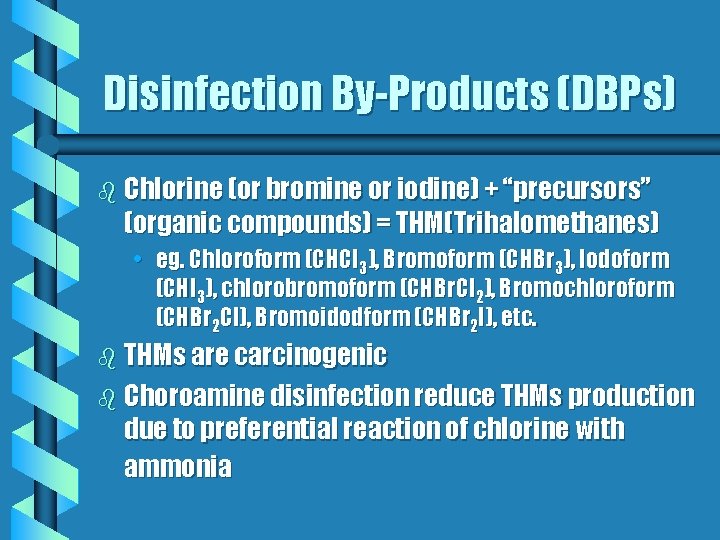
Disinfection By-Products (DBPs) b Chlorine (or bromine or iodine) + “precursors” (organic compounds) = THM(Trihalomethanes) • eg. Chloroform (CHCl 3), Bromoform (CHBr 3), Iodoform (CHI 3), chlorobromoform (CHBr. Cl 2), Bromochloroform (CHBr 2 Cl), Bromoidodform (CHBr 2 I), etc. b THMs are carcinogenic b Choroamine disinfection reduce THMs production due to preferential reaction of chlorine with ammonia
Ozonation: b Ozone (O 3) is an effective, relatively harmless disinfection method, but is expensive (and therefore less popular than chlorine). b Ozone is a strong oxidant, that produces hydroxyl free radicals that react with organic and inorganic molecules in water to kill microbes.
Summary: b Disinfection is the destruction of microorganisms in drinking water to safe levels. b Disinfection techniques include physical (boiling, ultraviolet light) and chemical methods (chlorine, bromine, iodine, and ozone).