
Lecture 6 Definitive Treatment Phase ODRP 726 Patient

- Slides: 84
Lecture 6: Definitive Treatment Phase ODRP 726 Patient Diagnosis and Treatment Planning
Definitive Treatment Phase axi. Um Phases 4 -6 � Objective is to rehabilitate the patient’s oral condition � Includes procedures to improve function and appearance ◦ ◦ ◦ Perio surgery Ortho treatment Occlusal therapy Elective oral surgery Replacement of missing teeth Cosmetic or esthetic procedures
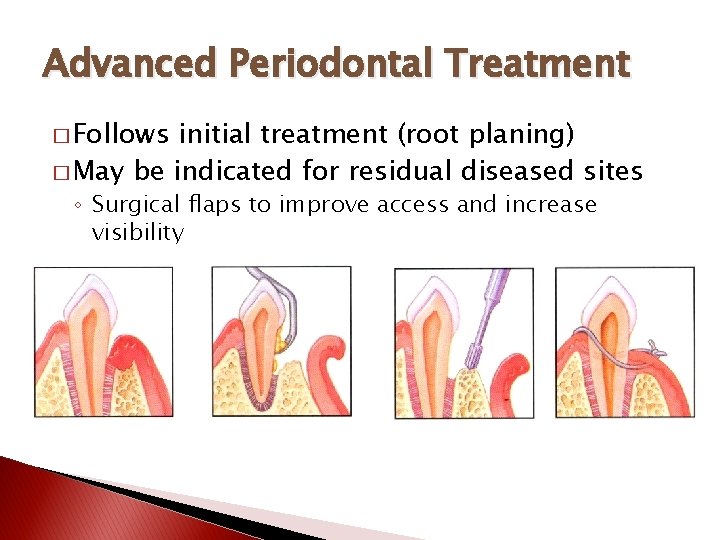
Advanced Periodontal Treatment � Follows initial treatment (root planing) � May be indicated for residual diseased sites ◦ Surgical flaps to improve access and increase visibility
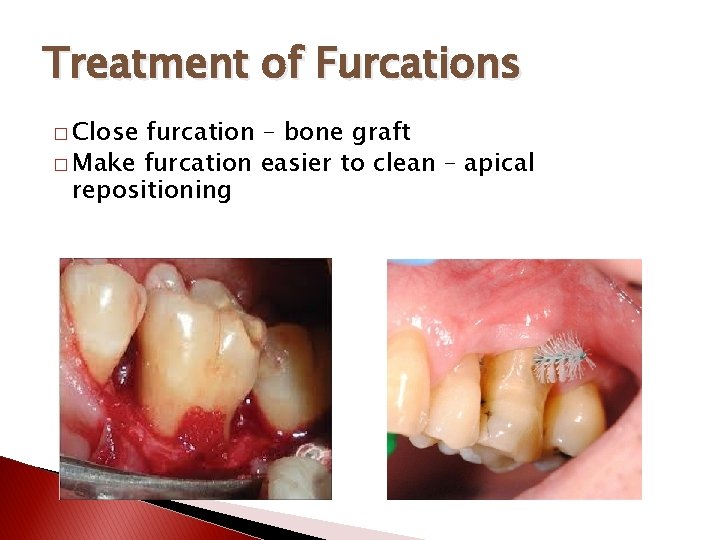
Treatment of Furcations � Close furcation – bone graft � Make furcation easier to clean – apical repositioning
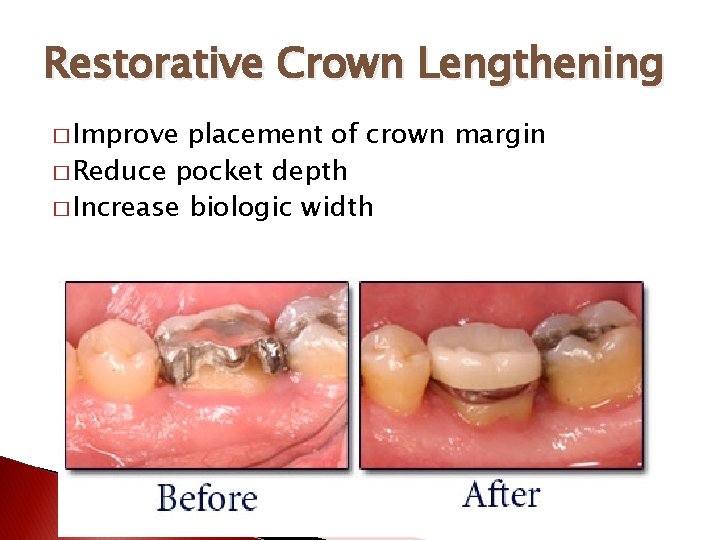
Restorative Crown Lengthening � Improve placement of crown margin � Reduce pocket depth � Increase biologic width
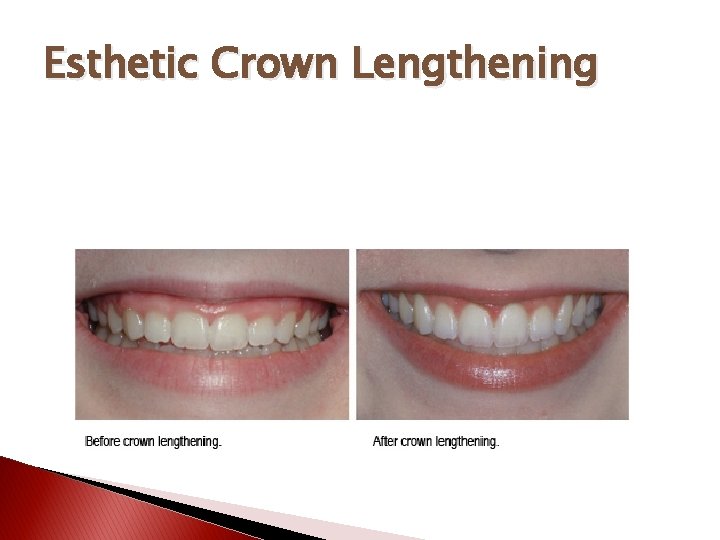
Esthetic Crown Lengthening
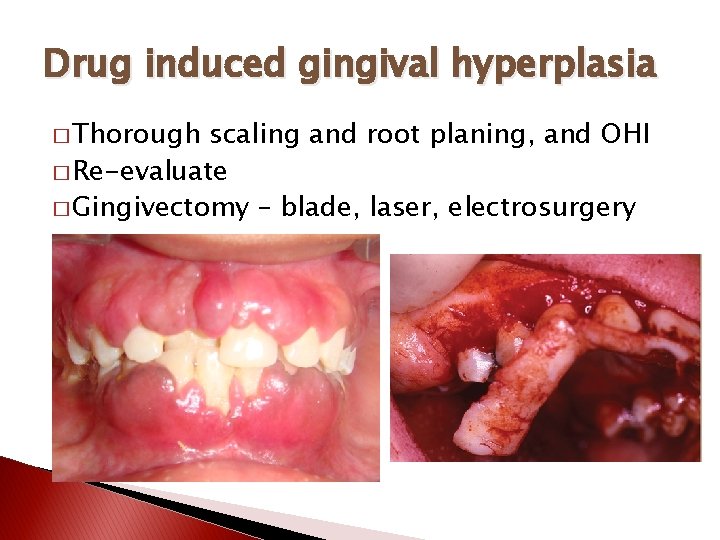
Drug induced gingival hyperplasia � Thorough scaling and root planing, and OHI � Re-evaluate � Gingivectomy – blade, laser, electrosurgery
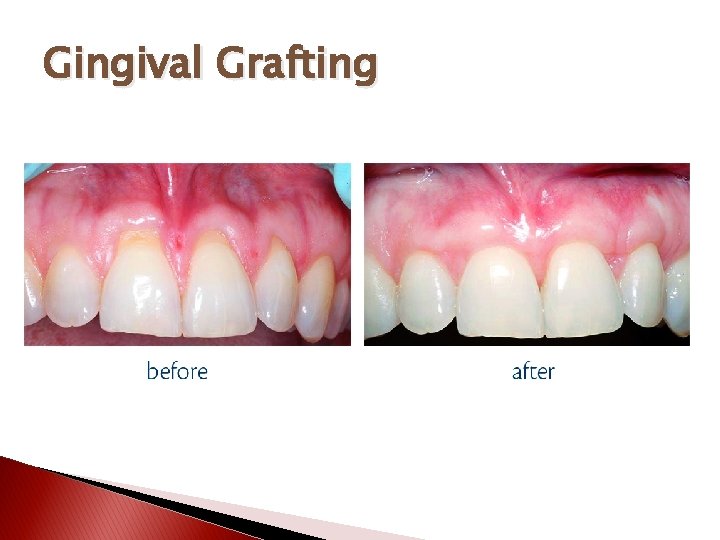
Gingival Grafting
Advanced Periodontal Treatment Important Patient Modifiers � Healthy lifestyle ◦ Good nutrition ◦ Good control of systemic disease � Use of tobacco products � Patient motivation for treatment � Willingness to follow through with treatment
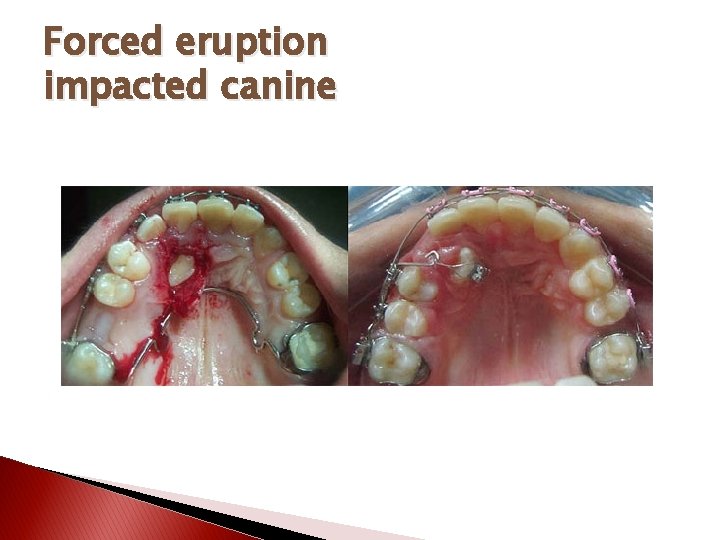
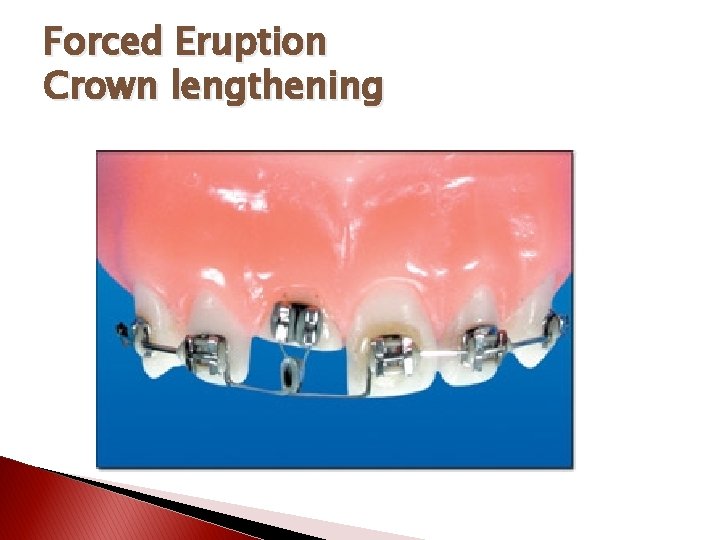
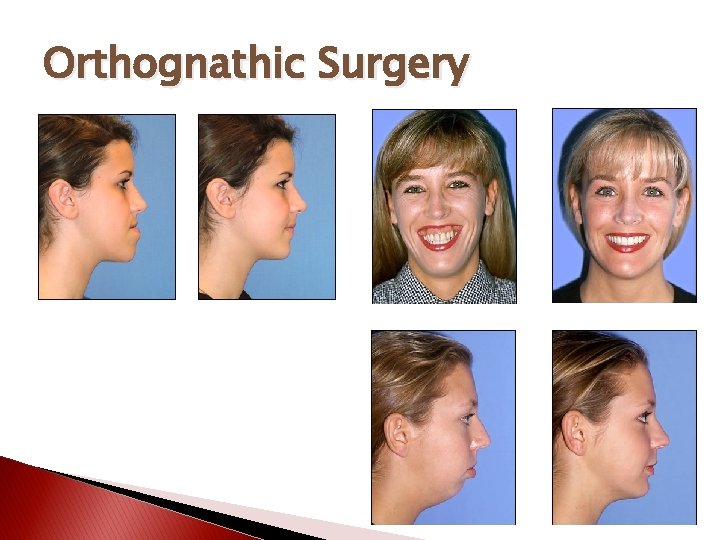
Orthodontic Treatment � Comprehensive orthodontics � Limited orthodontic movement ◦ Forced eruption – compromised biologic width ◦ Molar uprighting ◦ Minor tooth movement – 6 or fewer teeth � Orthognathic surgery
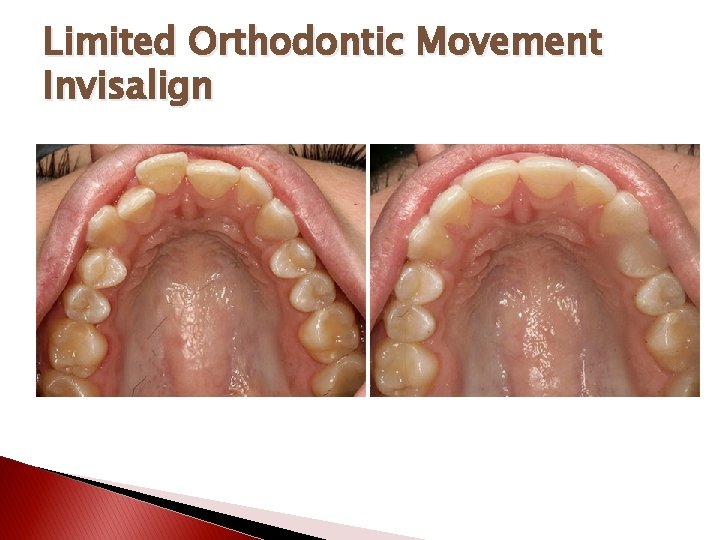
Limited Orthodontic Movement Invisalign
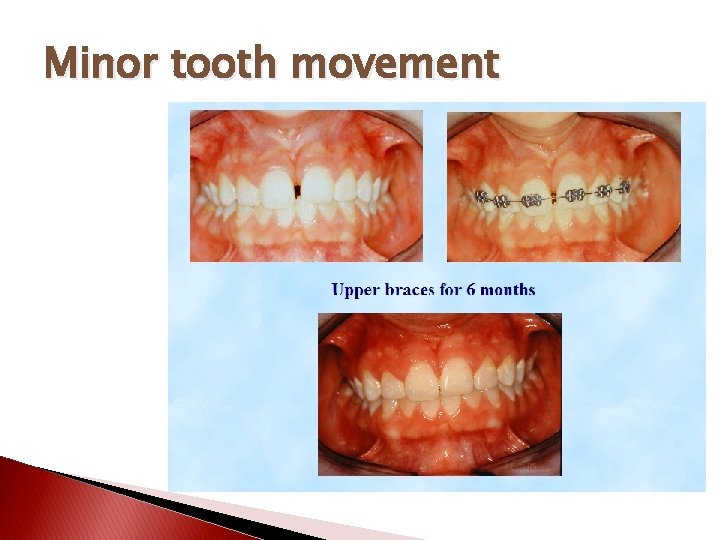
Minor tooth movement
Forced eruption impacted canine
Forced Eruption Crown lengthening
Orthognathic Surgery
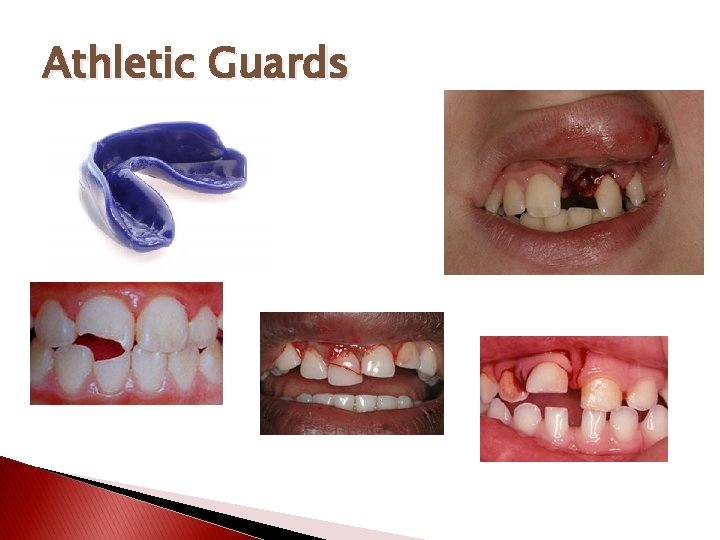
Occlusal Therapy � Indications ◦ ◦ ◦ ◦ Severe attrition Abnormal occlusal planes Malposed teeth Occlusion-related periodontal attachment loss Parafunctional habits Temporomandibular disorders Participates in contact sports
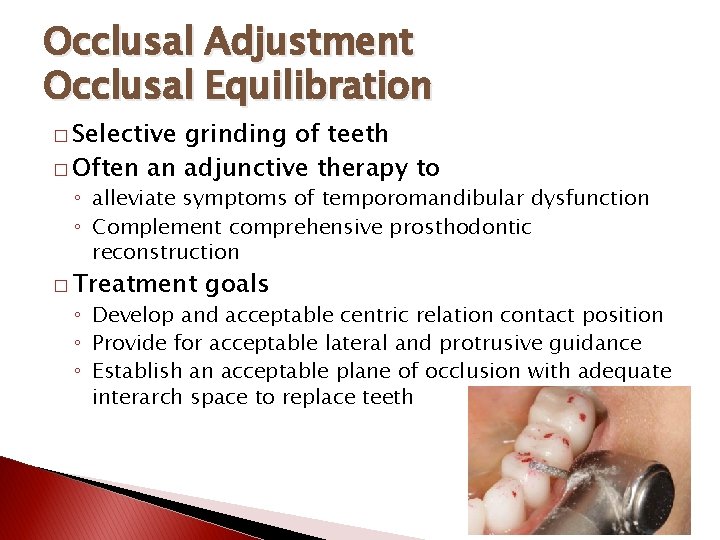
Occlusal Adjustment Occlusal Equilibration � Selective grinding of teeth � Often an adjunctive therapy to ◦ alleviate symptoms of temporomandibular dysfunction ◦ Complement comprehensive prosthodontic reconstruction � Treatment goals ◦ Develop and acceptable centric relation contact position ◦ Provide for acceptable lateral and protrusive guidance ◦ Establish an acceptable plane of occlusion with adequate interarch space to replace teeth
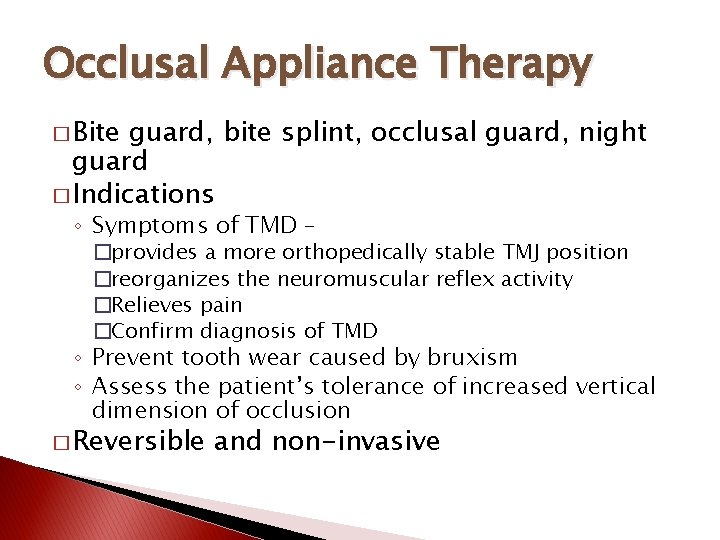
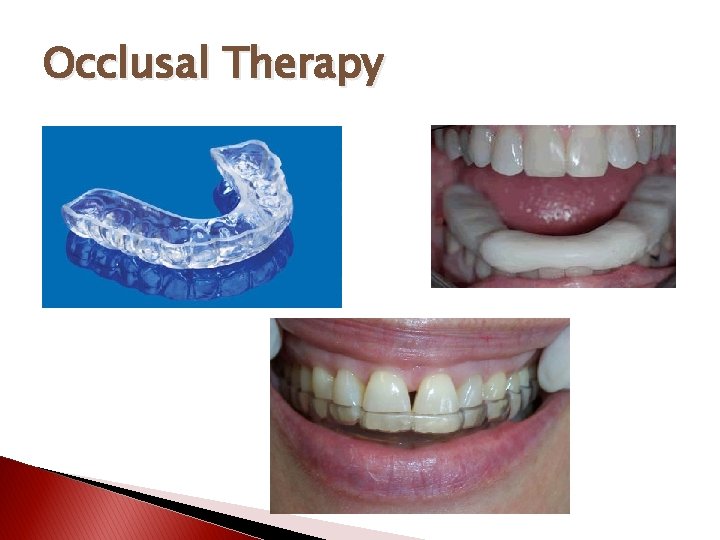
Occlusal Appliance Therapy � Bite guard, bite splint, occlusal guard, night guard � Indications ◦ Symptoms of TMD – �provides a more orthopedically stable TMJ position �reorganizes the neuromuscular reflex activity �Relieves pain �Confirm diagnosis of TMD ◦ Prevent tooth wear caused by bruxism ◦ Assess the patient’s tolerance of increased vertical dimension of occlusion � Reversible and non-invasive
Occlusal Therapy
Athletic Guards
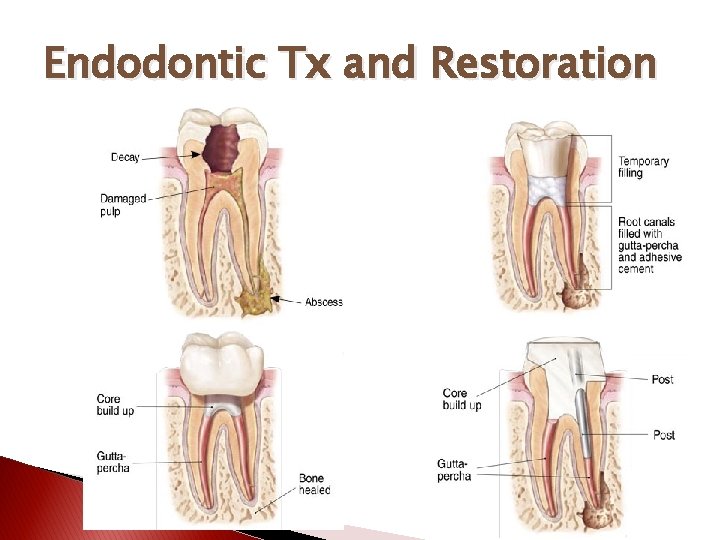
Restoring Individual Teeth � Protect remaining tooth structure � After placement of large restorations (core build-up) ◦ Caries control ◦ Fractures ◦ Replacement of large restoration � Restoration after root canal treatment
Restoring Individual Teeth � Gold or porcelain inlay � Intracoronal restoration � Used instead of amalgam or composite � Increased longevity
Partial Coverage Crown � Covers one or more cusps of posterior tooth to strengthen remaining tooth � Onlay, MOD onlay, ¾ gold crown, 7/8 gold crown, inlay-onlay � Can be gold or ceramic � Used to preserve unaffected tooth structure
Full coverage crowns � Full gold ◦ Best against natural teeth and gold ◦ Best longevity ◦ No likelihood of fracture � PFM ◦ Best strength ◦ Esthetic � All-ceramic ◦ Best esthetics ◦ Least strength ◦ Can be one-appointment
Endodontic Tx and Restoration
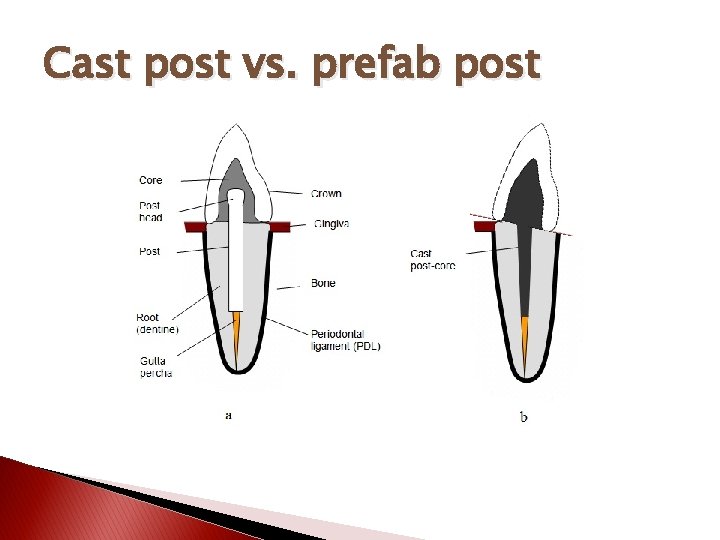
Cast post vs. prefab post
Cast post vs. prefab post � Studies show decreased fracture resistance with cast post � Cast post has added expense and added appointment � Indications ◦ Multiple post and core restorations planned on the same arch ◦ Smaller teeth (mandibular incisor) prefab posts difficult to fit ◦ If the angle of the core relative to the tooth must be changed
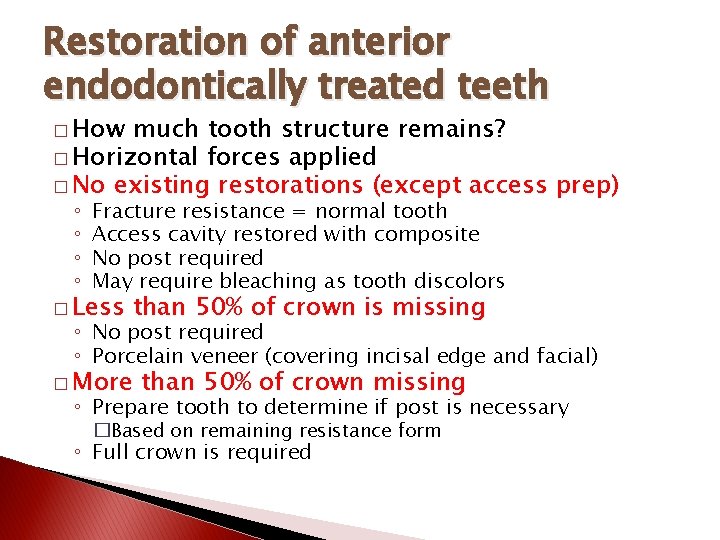
Restoration of anterior endodontically treated teeth � How much tooth structure remains? � Horizontal forces applied � No existing restorations (except access prep) ◦ ◦ Fracture resistance = normal tooth Access cavity restored with composite No post required May require bleaching as tooth discolors � Less than 50% of crown is missing ◦ No post required ◦ Porcelain veneer (covering incisal edge and facial) � More than 50% of crown missing ◦ Prepare tooth to determine if post is necessary �Based on remaining resistance form ◦ Full crown is required
Restoration of posterior Endodontically treated teeth � Vertical forces � Fracture resistance decreases as amount of dentin removed increases � Post is only recommended when more conservative retention and resistance features are not possible � Amalcore is effective ◦ Amalgam placed in the entire pulp chamber area and in the coronal 2. 0 – 3. 0 mm of each canal. � Threaded pins � Adhesive materials � Post should be used if the tooth is to be used as an abutment for an RPD – increased horizontal forces – when placing and removing RPD
Restoration of posterior Endodontically treated teeth � Post should be used if there is inadequate pulp chamber for retention of core � Posts are placed only in: ◦ Palatal canal for maxillary molars ◦ Distal canal for mandibular molars � Never more than one post is required � Posts NEVER strengthen a tooth � Posts improve retention of crown
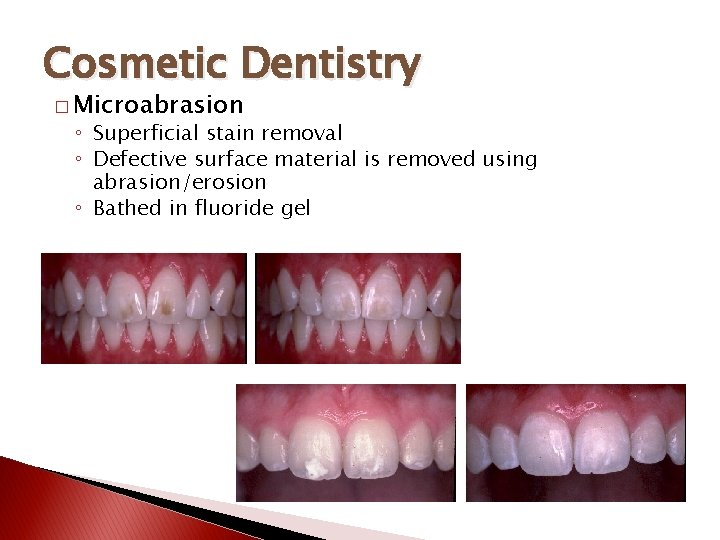
Cosmetic Dentistry � Microabrasion ◦ Superficial stain removal ◦ Defective surface material is removed using abrasion/erosion ◦ Bathed in fluoride gel
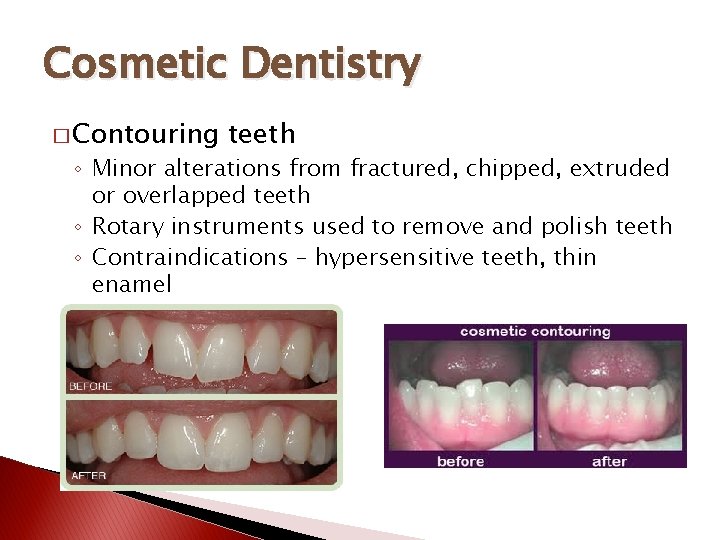
Cosmetic Dentistry � Contouring teeth ◦ Minor alterations from fractured, chipped, extruded or overlapped teeth ◦ Rotary instruments used to remove and polish teeth ◦ Contraindications – hypersensitive teeth, thin enamel
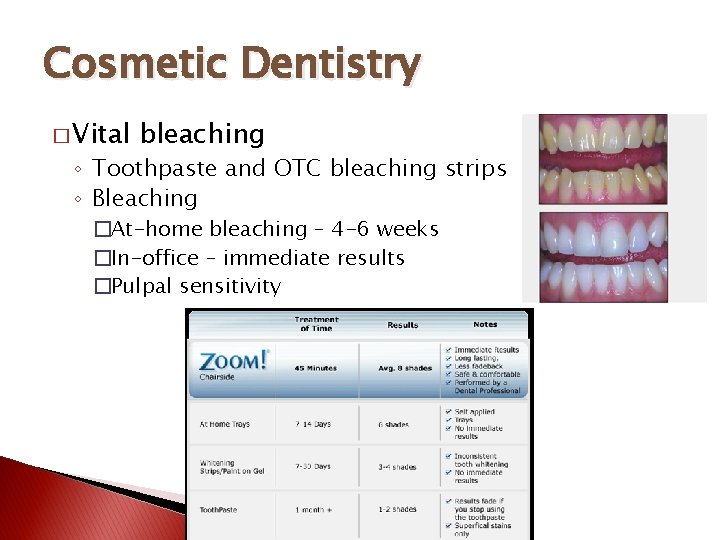
Cosmetic Dentistry � Vital bleaching ◦ Toothpaste and OTC bleaching strips ◦ Bleaching �At-home bleaching – 4 -6 weeks �In-office – immediate results �Pulpal sensitivity
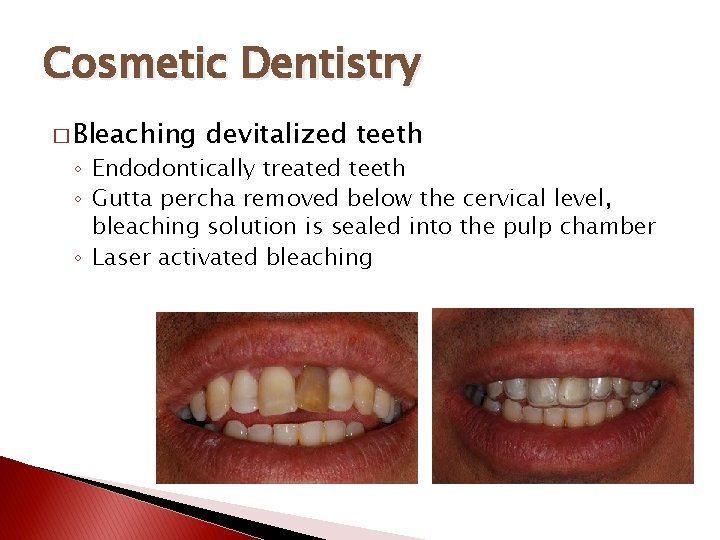
Cosmetic Dentistry � Bleaching devitalized teeth ◦ Endodontically treated teeth ◦ Gutta percha removed below the cervical level, bleaching solution is sealed into the pulp chamber ◦ Laser activated bleaching
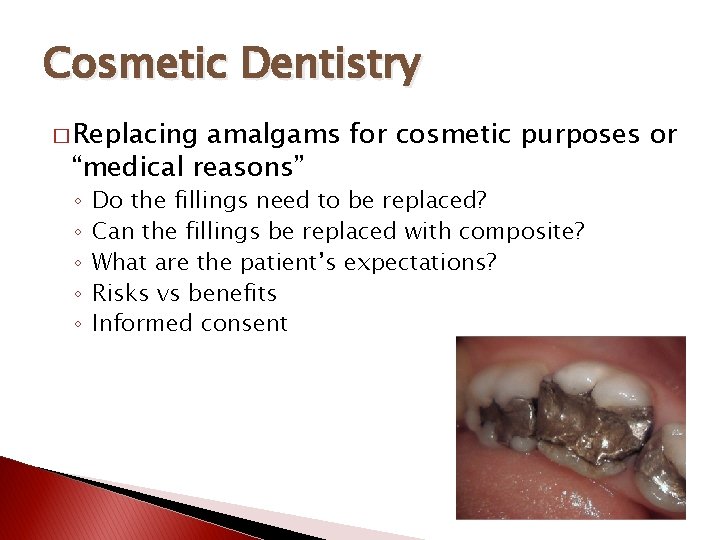
Cosmetic Dentistry � Replacing amalgams for cosmetic purposes or “medical reasons” ◦ ◦ ◦ Do the fillings need to be replaced? Can the fillings be replaced with composite? What are the patient’s expectations? Risks vs benefits Informed consent
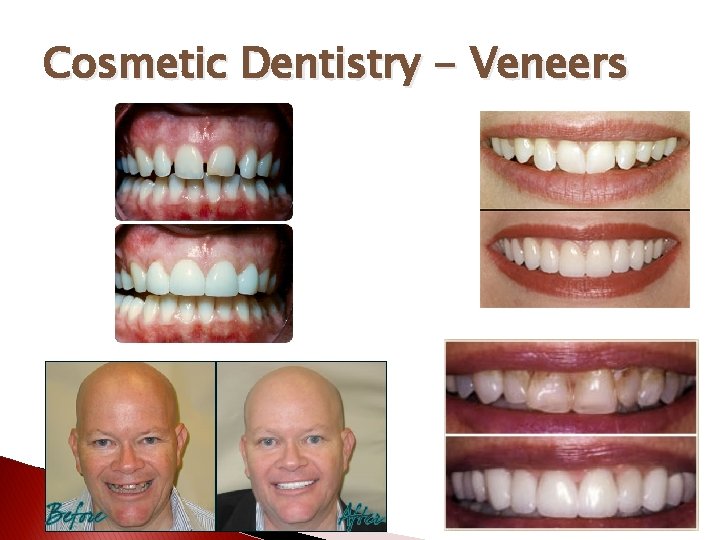
Cosmetic Dentistry � Veneers ◦ Change color, contour or size of tooth ◦ Composite chairside (direct) or lab processed (indirect) – more conservative ◦ Porcelain lab processed � 0. 3 – 0. 7 mm enamel is removed from incisal and/or facial surfaces �Extreme discoloration (tetracycline or fluorosis) �Strong and stable �Contraindicated in bruxers �Best on virgin teeth
Cosmetic Dentistry - Veneers
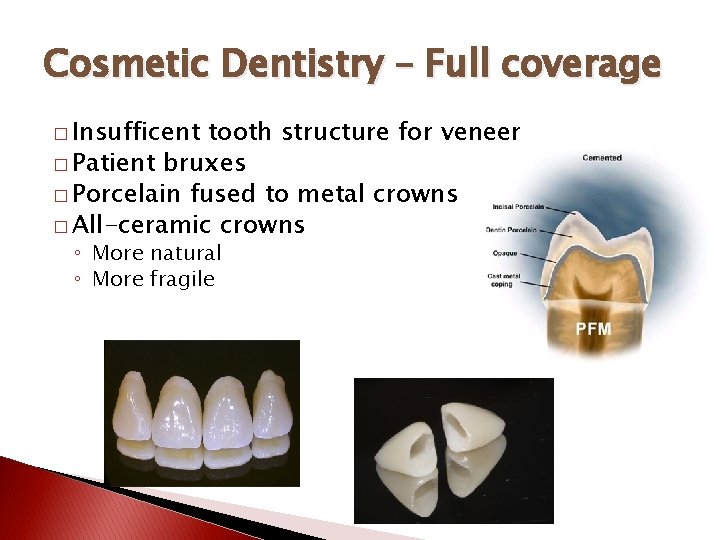
Cosmetic Dentistry – Full coverage � Insufficent tooth structure for veneer � Patient bruxes � Porcelain fused to metal crowns � All-ceramic crowns ◦ More natural ◦ More fragile
Extraction of asymptomatic 3 rd molars � Healthy patient ◦ Aged 19 -25 �Repeated episodes of pain from pericornitis �No reasonable prospect for erupted properly aligned fully functional 3 rds, and desire by patient to avoid future problems ◦ Any age �Poor periodontal and/or restorative prognosis and patient is unmotivated
Extraction of asymptomatic 3 rd molars � Additional guidelines ◦ Younger, healthier patients have an easier surgery, heal faster with more normal bony architecture ◦ When the risk of future caries, periodontal, pericornitis is high – more weight to extraction ◦ When possibility for complications (dry socket, parasthesias, fracture or infection) is high – more weight to not extracting ◦ Reasonable probability that teeth may be needed in future as abutments or to maintain occlusal plane – weight to not extracting
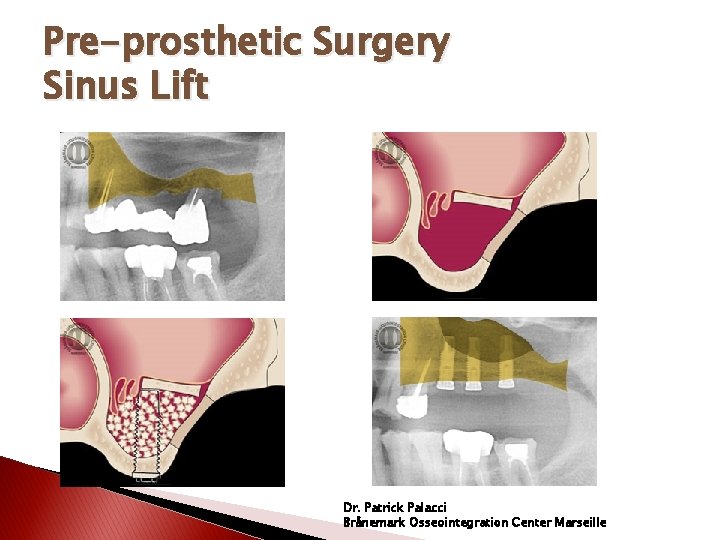
Pre-prosthetic Surgery Sinus Lift Dr. Patrick Palacci Brånemark Osseointegration Center Marseille
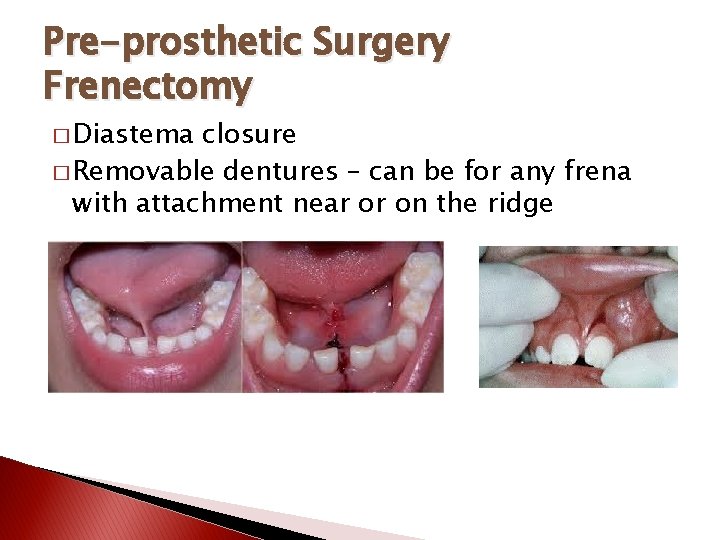
Pre-prosthetic Surgery Frenectomy � Diastema closure � Removable dentures – can be for any frena with attachment near or on the ridge
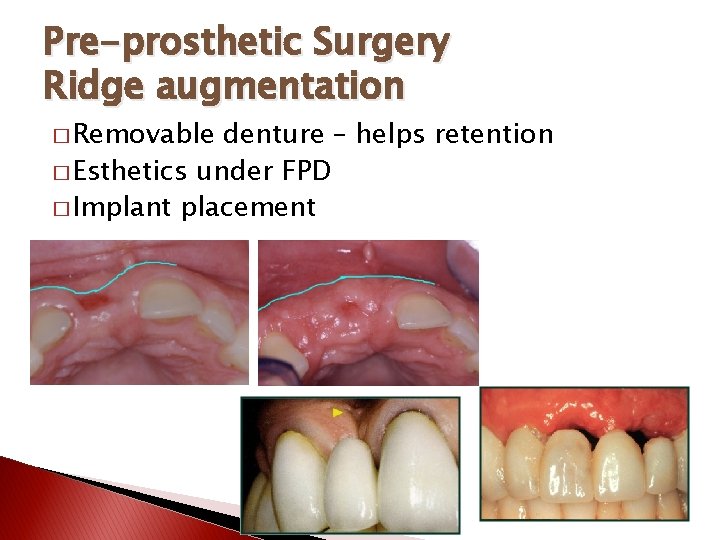
Pre-prosthetic Surgery Ridge augmentation � Removable denture – helps retention � Esthetics under FPD � Implant placement
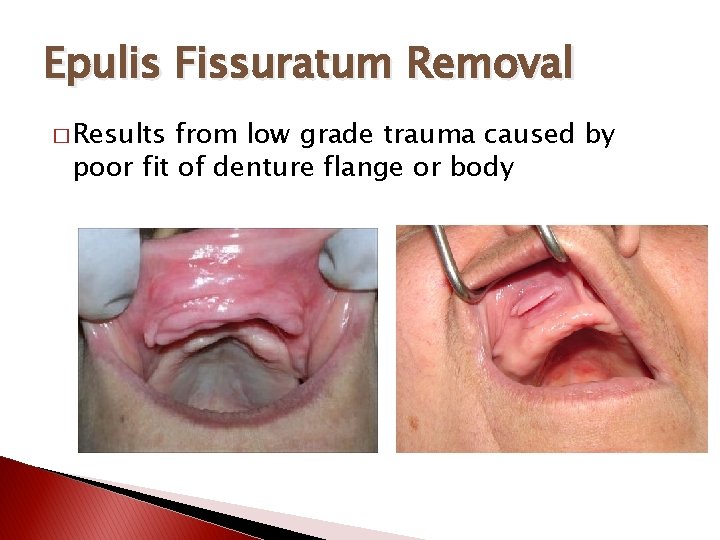
Epulis Fissuratum Removal � Results from low grade trauma caused by poor fit of denture flange or body
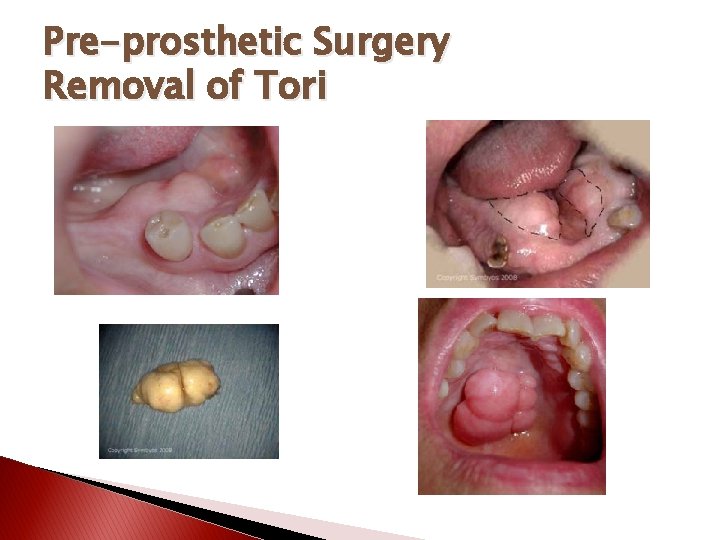
Pre-prosthetic Surgery Removal of Tori
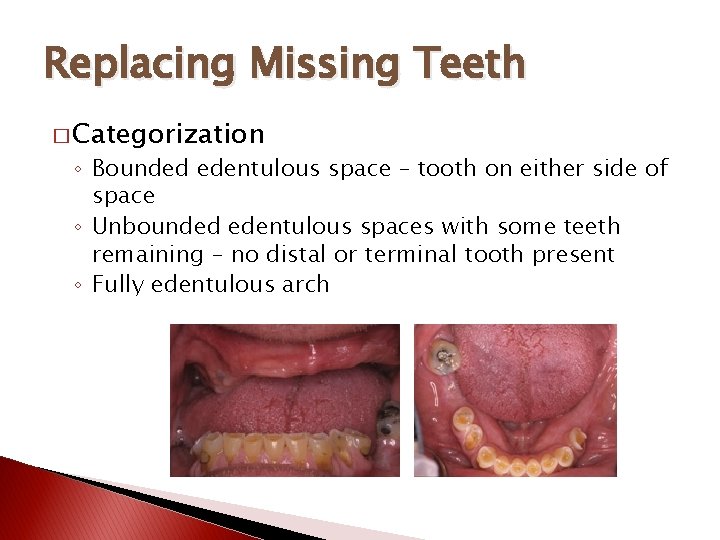
Replacing Missing Teeth � Categorization ◦ Bounded edentulous space – tooth on either side of space ◦ Unbounded edentulous spaces with some teeth remaining – no distal or terminal tooth present ◦ Fully edentulous arch
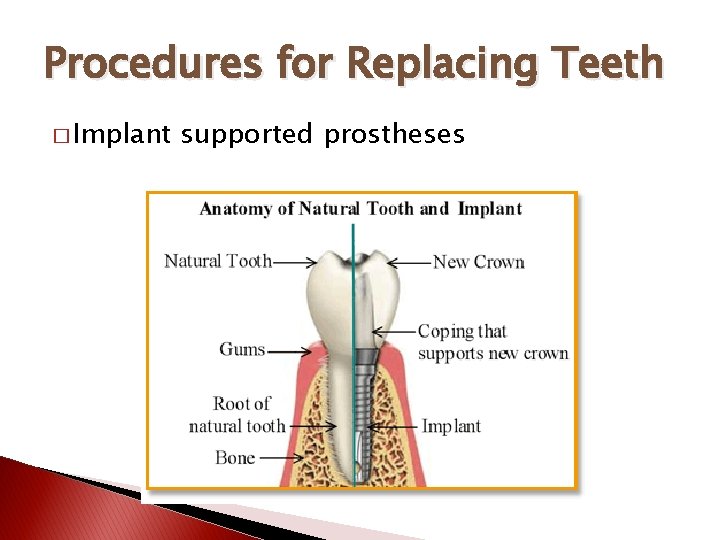
Procedures for Replacing Teeth � Implant supported prostheses
Stages of Implant Placement � Implant placed in bone and healing cap screwed into place � Healing time � Abutment placed and impression taken � Crown, fixed partial denture or other prosthesis is fabricated for the implant � Implant placed in bone at time of extraction = immediate placement � Implant, abutment and provisional restoration placed at time of extraction = immediate loading
Advantages of Implant � Improved function � Preservation of remaining teeth and bone � Increased stability � Longevity � Realistic and esthetic appearance
Disadvantages of Implant � Cost � Length of healing period after extraction for non-immediate and non-healing implant ◦ 8 weeks � Length of healing period after placement of non-immediate, non-loading implant ◦ 3 months to allow for osteointegration � Immediate placement and loading ◦ Healing and osteointegration periods are eliminated
Single missing tooth Unrestored adjacent teeth � Implant should be the primary option � Advantages (compared to FPD) ◦ ◦ Stability Longevity Easier cleaning/maintenance Health tooth structure not sacrificed � Challenges ◦ Esthetic zone placement in three dimensions �Contraindications for placement in esthetic zone �Inadequate bone density or volume �Inadequate buccal-lingual width (perio surgery) �Insufficient mesial-distal tooth replacement bone width (ortho) �Insufficient interarch space (ortho) �Mobility of adjacent teeth
Single missing tooth Unrestored adjacent teeth � Matching the soft tissue contours of adjacent natural teeth to those around the implant ◦ Esthetic periodontal surgery may be needed before at or after implant placement � Evaluation for these problems must occur before treatment planning so that patient is aware of all contingencies
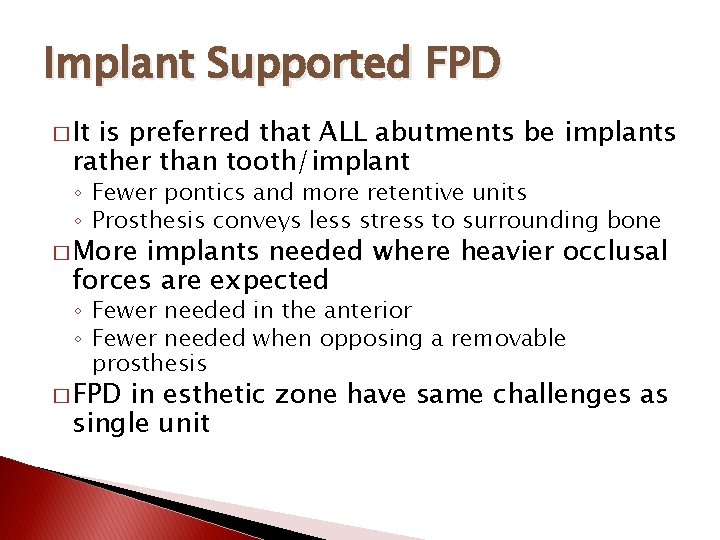
Implant Supported FPD � It is preferred that ALL abutments be implants rather than tooth/implant ◦ Fewer pontics and more retentive units ◦ Prosthesis conveys less stress to surrounding bone � More implants needed where heavier occlusal forces are expected ◦ Fewer needed in the anterior ◦ Fewer needed when opposing a removable prosthesis � FPD in esthetic zone have same challenges as single unit
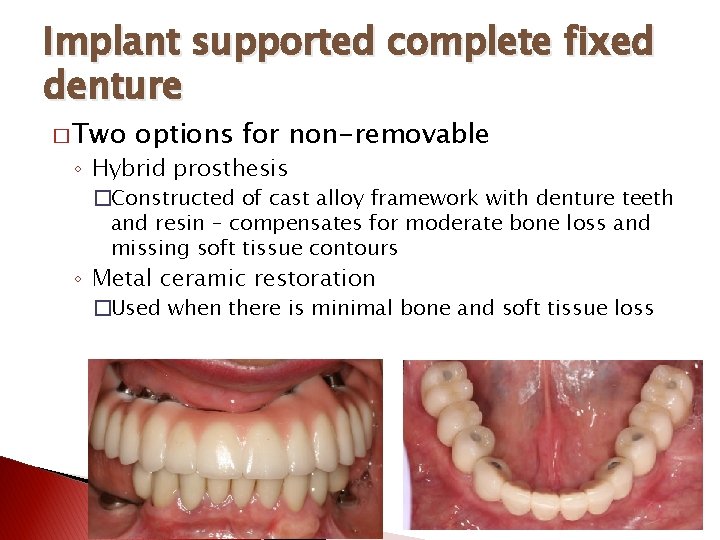
Implant supported complete fixed denture � Two options for non-removable ◦ Hybrid prosthesis �Constructed of cast alloy framework with denture teeth and resin – compensates for moderate bone loss and missing soft tissue contours ◦ Metal ceramic restoration �Used when there is minimal bone and soft tissue loss
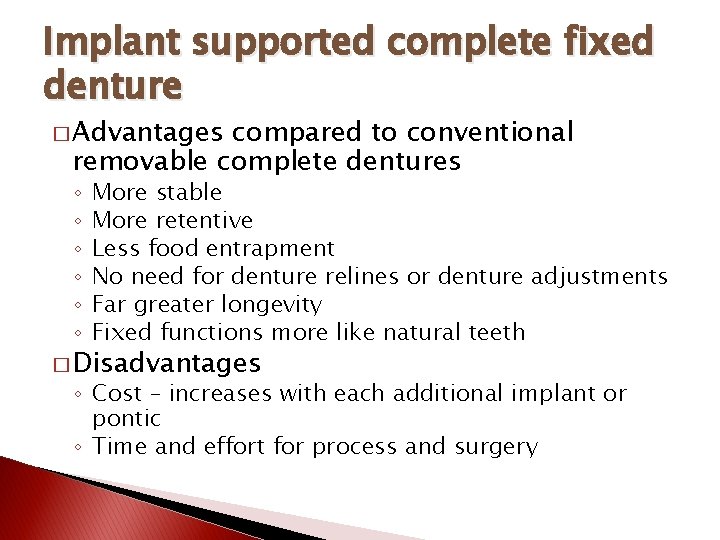
Implant supported complete fixed denture � Advantages compared to conventional removable complete dentures ◦ ◦ ◦ More stable More retentive Less food entrapment No need for denture relines or denture adjustments Far greater longevity Fixed functions more like natural teeth � Disadvantages ◦ Cost – increases with each additional implant or pontic ◦ Time and effort for process and surgery
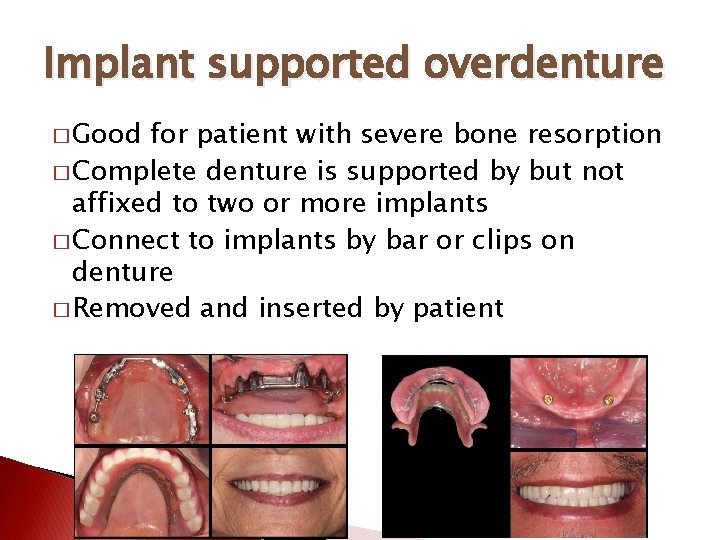
Implant supported overdenture � Good for patient with severe bone resorption � Complete denture is supported by but not affixed to two or more implants � Connect to implants by bar or clips on denture � Removed and inserted by patient
Implant supported overdenture � Advantages ◦ Facial esthetics are enhanced by the support of the labial flanges ◦ Removal at night facilitates daily cleaning ◦ Avoids destructive forces from nocturnal bruxing ◦ Fewer implants needed ◦ Less expensive option
Patient Assessment for Implants � Systemic diseases that are contraindications for implant placement ◦ ◦ ◦ Poorly controlled diabetes Osteoporosis Radiation therapy to head and neck Immunocompromising conditions Cigarette smoking
Patient Assessment for Implants � Assessment of intraoral conditions ◦ Site evaluation for single implant �Bone height, width, contour and density �Mesial-distal interdental space �Interarch space �Relationship to anatomic structures �Maxillary sinus �Mental foramen �Mandibular canal �Submandibular gland fossa �Esthetic zone �Lip line �Shade, form and alignment of the surrounding teeth �Facial gingival and bone architecture �Height and density of facial gingiva
Patient Assessment for Implants � Assessment of intraoral conditions for implant retained FPD, fixed complete dentures or overdentures � All of the previous plus ◦ ◦ Lip support Location and size of edentulous areas TMJ evaluation Maxillomandibular relationship, VDO, occlusal plane, arch form and size, occlusal relationships, guidance patterns in excursive movements
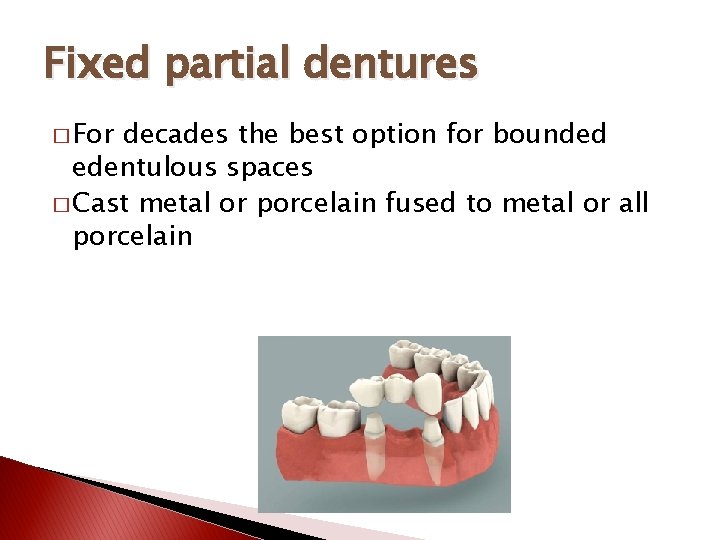
Fixed partial dentures � For decades the best option for bounded edentulous spaces � Cast metal or porcelain fused to metal or all porcelain
Fixed partial dentures � Advantages ◦ Replacement teeth are fixed in place and provide a stable and natural looking alternative to a removable prosthesis ◦ Good esthetics ◦ Good function ◦ Preservation of arch form � Disadvantages ◦ Margins, along with poor oral health care increases risk for recurrent decay and periodontal disease ◦ Difficult to keep clean ◦ FPD can compromise the abutment teeth increasing risk for future root canal or tooth loss ◦ Is not indicated if restorative and periodontal condition of abutment teeth are poor
Fixed partial dentures � Notable indications for fixed partial denture ◦ Bounded edentulous space present and �Abutment teeth are heavily restored and are good candidates for full coverage restorations �Medical challenges against surgery �Financial challenges �Patient does not want surgery
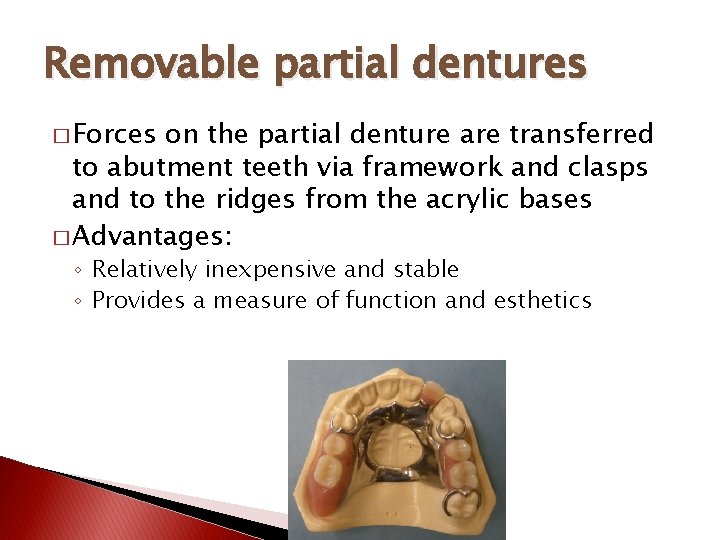
Removable partial dentures � Forces on the partial denture are transferred to abutment teeth via framework and clasps and to the ridges from the acrylic bases � Advantages: ◦ Relatively inexpensive and stable ◦ Provides a measure of function and esthetics
Removable partial dentures � Advantages: ◦ Relatively inexpensive and stable ◦ Provides a measure of function and esthetics � Disadvantages ◦ ◦ Must be removed for cleaning Visible portions of framework and clasps Abutment teeth at risk for caries and periodontal disease Can cause �Traumatic ulcers �Stomatitis �Bone atrophy �Epuli formation ◦ Denture is prone to wear, fatigue of clasps, loss of denture teeth, poor fit ◦ Significantly reduced function when compared with natural teeth, FPD or implant retained prosthesis
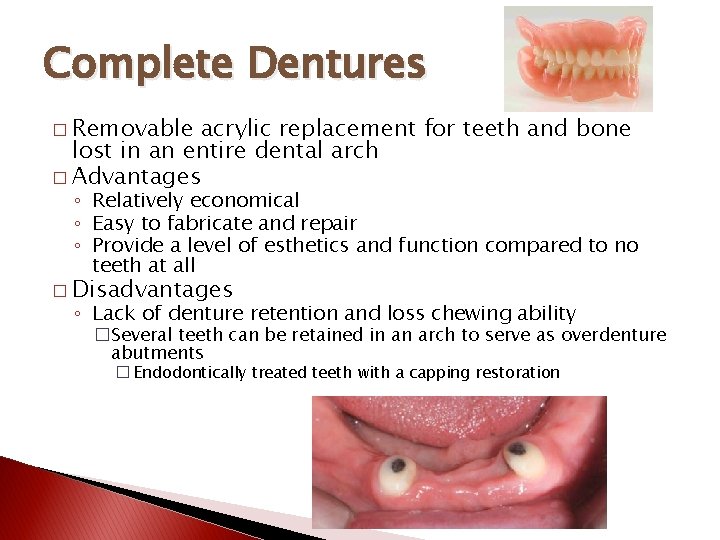
Complete Dentures � Removable acrylic replacement for teeth and bone lost in an entire dental arch � Advantages ◦ Relatively economical ◦ Easy to fabricate and repair ◦ Provide a level of esthetics and function compared to no teeth at all � Disadvantages ◦ Lack of denture retention and loss chewing ability �Several teeth can be retained in an arch to serve as overdenture abutments � Endodontically treated teeth with a capping restoration
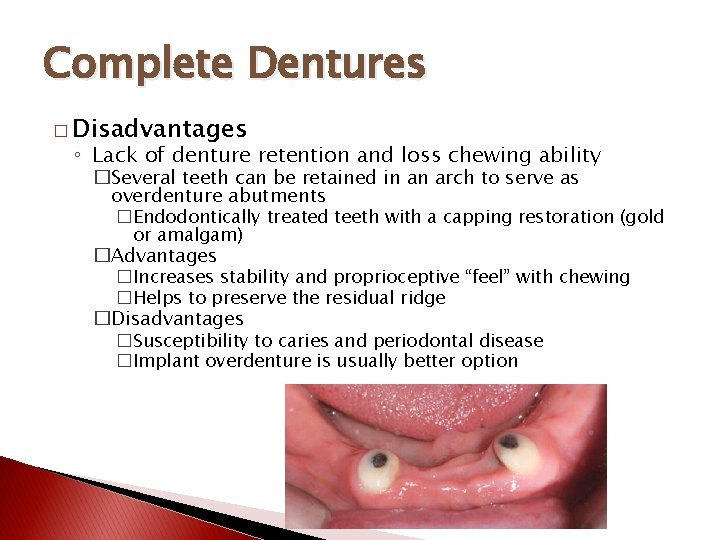
Complete Dentures � Disadvantages ◦ Lack of denture retention and loss chewing ability �Several teeth can be retained in an arch to serve as overdenture abutments �Endodontically treated teeth with a capping restoration (gold or amalgam) �Advantages �Increases stability and proprioceptive “feel” with chewing �Helps to preserve the residual ridge �Disadvantages �Susceptibility to caries and periodontal disease �Implant overdenture is usually better option
Maintenance Care Phase axi. Um Phase 7 � The objective is to prevent relapse and recurrence of disease � More than a “check-up” � A personalized plan designed to maintain the patient in optimum oral health � Periodic exam, periodontal maintenance, oral hygiene instructions, risk reassessment
Tx Plan Presentation � Throughout examination you have been communicating with the patient, developing trust and rapport � With the Tx Plan Presentation, you must use communication skills to reach a consensus with the patient on the final treatment plan
Tx Plan Presentation � If handled well – you will be respected and seen as a professional � If handled poorly – you may be perceived as uncertain, lacking confidence, self-serving, arrogant or incompetent.
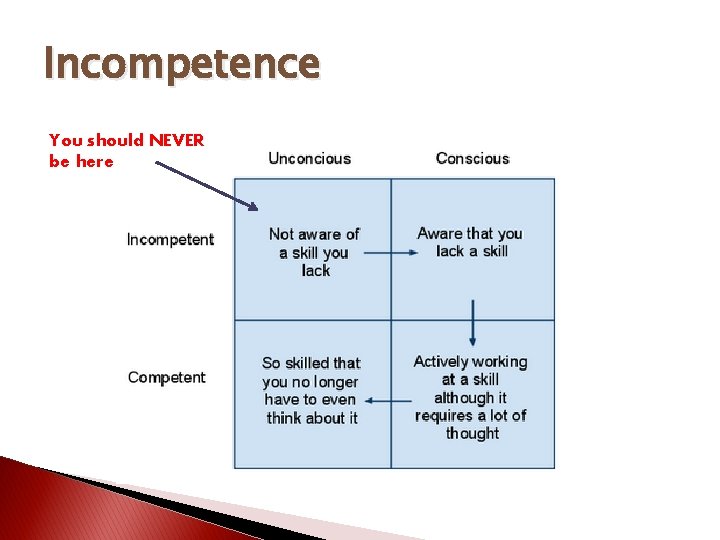
Incompetence You should NEVER be here
Treatment Plan Presentation
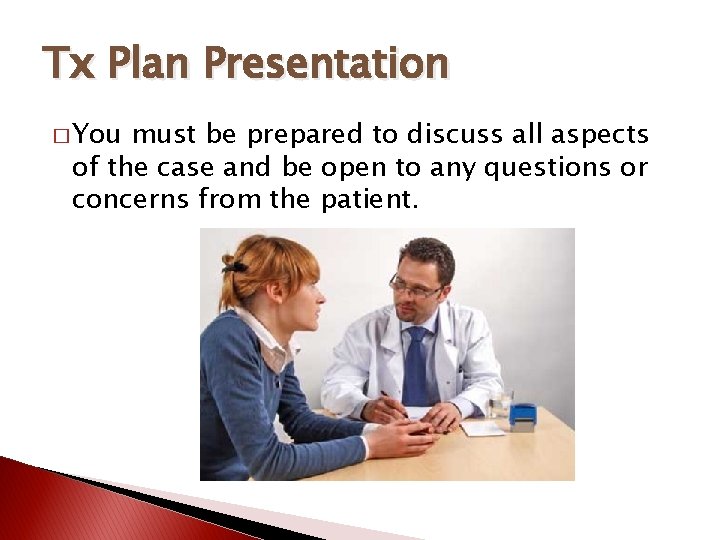
Tx Plan Presentation � You must be prepared to discuss all aspects of the case and be open to any questions or concerns from the patient.
Tx Plan Presentation 1. Educate the patient about their problems and diagnoses • • Start with the chief complaint Use mounted casts, photos, radiographs, drawings, informational pamphlets Use terminology the patient will understand Encourage questions, periodically verify that the patient understands what you have said
Tx Plan Presentation 2. Discuss treatment options • • Advantages and disadvantages of each option Short and long-term prognosis for each Outcome if now treatment is provided The importance of patient cooperation on the overall prognosis Plaque control Smoking cessation Reducing parafunctional habits Returning for maintenance therapy
Tx Plan Presentation 3. Cost of services, number of appointments, length of time • In practice you may have staff do most of this
Health Belief Model � Argues that patients must hold four beliefs before they will accept treatment for a particular disease 1. That they are susceptible to the disease 2. That contracting the disease has serious consequences 3. That the disease can be prevented or limited if the patient engages in certain activities or receives treatment 4. That engaging in treatment is preferable to suffering from the disease
Perceived Susceptibility � This comes from a thorough discussion of the patient’s problems � The patient must understand believe in the doctor’s diagnosis before treatment will be accepted
Perceived Severity � The patient must recognize that there is some level of severity to his oral condition � Especially important if the patient has no symptoms and has been unaware of the problem � Emphasize what may happen if the patient does NOT have the treatment
Perceived Benefits � The patient MUST believe that the treatment plan will help solve his problems � Spend time discussing prognosis
Perceived Barriers � It may be necessary to convince the patient that accepting the treatment plan is better than living with the dental problems. � The most common barriers: ◦ Pain ◦ Cost ◦ Time � The dentist should always address these three issues
Communication � Patients prefer to receive information in an interaction in which they do not feel that the dentist is attempting to dominate them � When the patient is calm, trustful, and free of anxiety she is more likely to comply with the dentist’s suggestions. � When treatment planning is shared with the patient, the patient is more likely to perceive that she has a vested interest in the process and comply with the proposed treatment
Questions? ? ?