
EMS DRUG REVIEW Dan Muse MD 1 CARDIAC




- Slides: 137
EMS DRUG REVIEW Dan Muse, MD 1
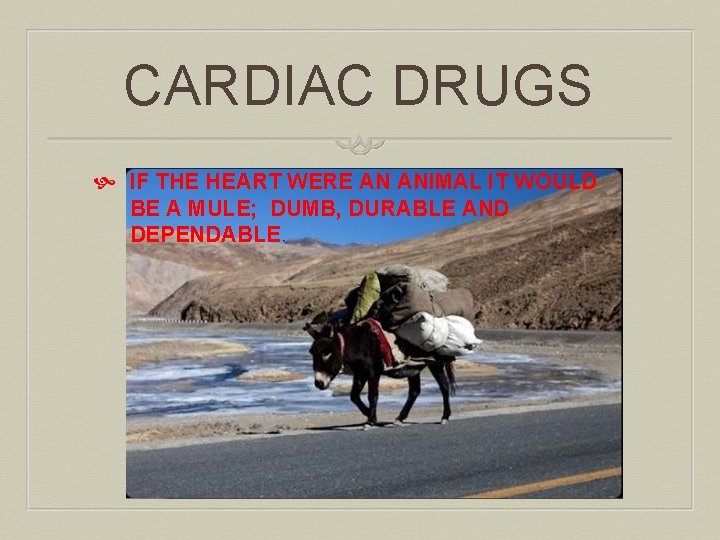
CARDIAC DRUGS IF THE HEART WERE AN ANIMAL IT WOULD BE A MULE; DUMB, DURABLE AND DEPENDABLE. 2
CARDIAC DRUGS WITHOUT THE HEART, THE BODY DOES NOT HAVE THE PUMP TO KEEP IT ALIVE. 70 bpm x 60 minutes x 24 hours x 365 days x 80 years EQUALS 2, 943, 360, 000 IN A LIFETIME 3
CARDIAC DRUGS THE GOAL OF CARDIAC DRUGS IS TO RESTORE BLOOD PRESSURE (A functioning pump) SO THAT THE BRAIN IS PERFUSED. 4
BLOOD PRESSURE The pressure exerted by the blood against the walls of the arteries. It varies with the strength of contraction (force), the elasticity of the arterial walls (resistance), viscosity of the blood (resistance), and the volume (flow). 5
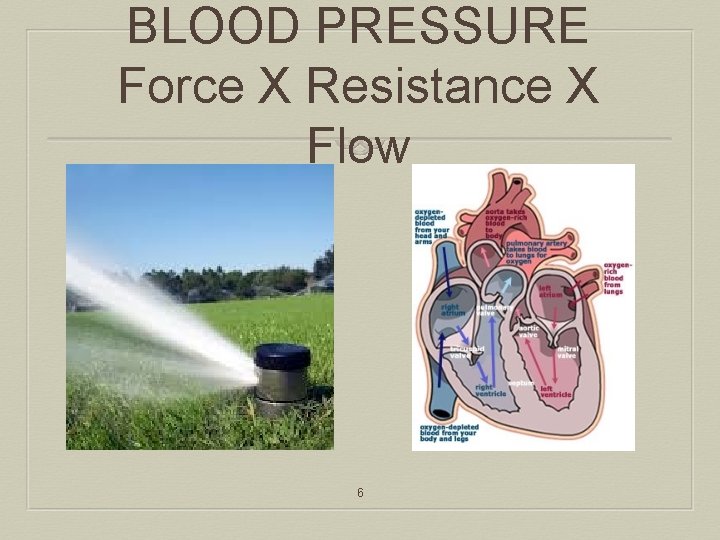
BLOOD PRESSURE Force X Resistance X Flow 6
BLOOD PRESSURE Force X Resistance X Flow Contraction (Force) changes with arrhythmias or loss of heart muscle. Arrhythmias cause change in flow by preventing the chambers from contracting efficiently Heart attacks reduce the strength of contraction by destroying heart muscle Myopathy cause the heart muscle to stretch and lose the contractility 7
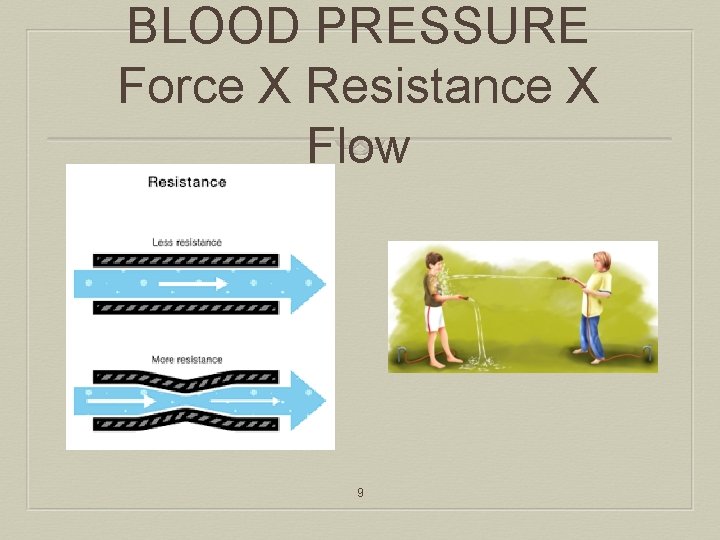
BLOOD PRESSURE Force X Resistance X Flow Resistance is changed by constricting or dilating the vessels. 8
BLOOD PRESSURE Force X Resistance X Flow 9
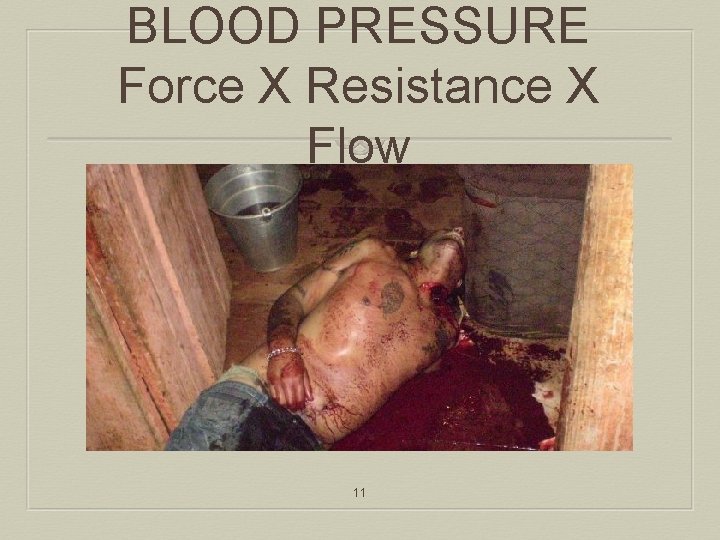
BLOOD PRESSURE Force X Resistance X Flow Volume (Flow) change reduces or increases flow and in turn the blood pressure. 10
BLOOD PRESSURE Force X Resistance X Flow 11
BLOOD PRESSURE Force X Resistance X Flow 12
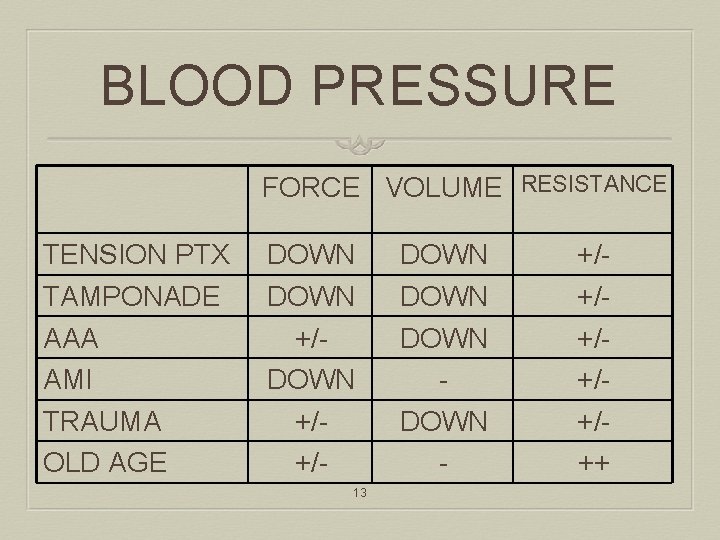
BLOOD PRESSURE FORCE VOLUME RESISTANCE TENSION PTX TAMPONADE AAA AMI TRAUMA OLD AGE DOWN +/DOWN +/+/13 DOWN - +/+/+/++
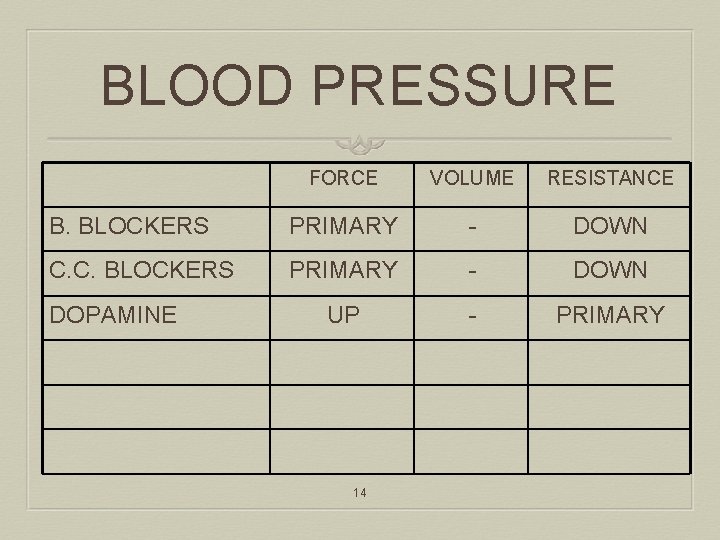
BLOOD PRESSURE FORCE VOLUME RESISTANCE B. BLOCKERS PRIMARY - DOWN C. C. BLOCKERS PRIMARY - DOWN UP - PRIMARY DOPAMINE 14
ADRENERGIC RECEPTORS CONSIST OR ALPHA AND BETA RECEPTORS FOUND THROUGHOUT THE BODY 15
ADRENERGIC RECEPTORS Alpha 1 and Alpha 2: Cause vasoconstriction. 16
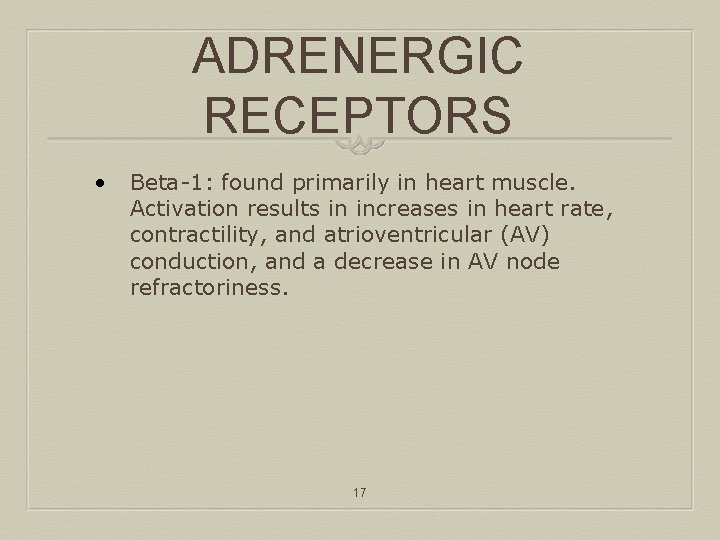
ADRENERGIC RECEPTORS • Beta-1: found primarily in heart muscle. Activation results in increases in heart rate, contractility, and atrioventricular (AV) conduction, and a decrease in AV node refractoriness. 17
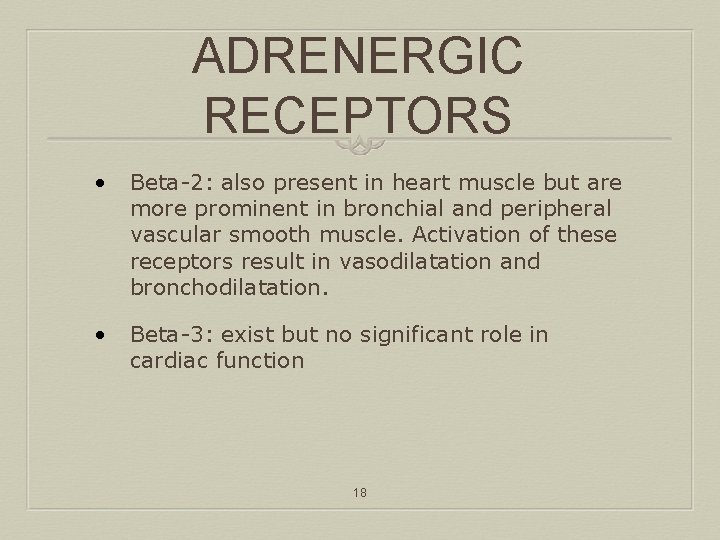
ADRENERGIC RECEPTORS • Beta-2: also present in heart muscle but are more prominent in bronchial and peripheral vascular smooth muscle. Activation of these receptors result in vasodilatation and bronchodilatation. • Beta-3: exist but no significant role in cardiac function 18
DRUG EFFECTS
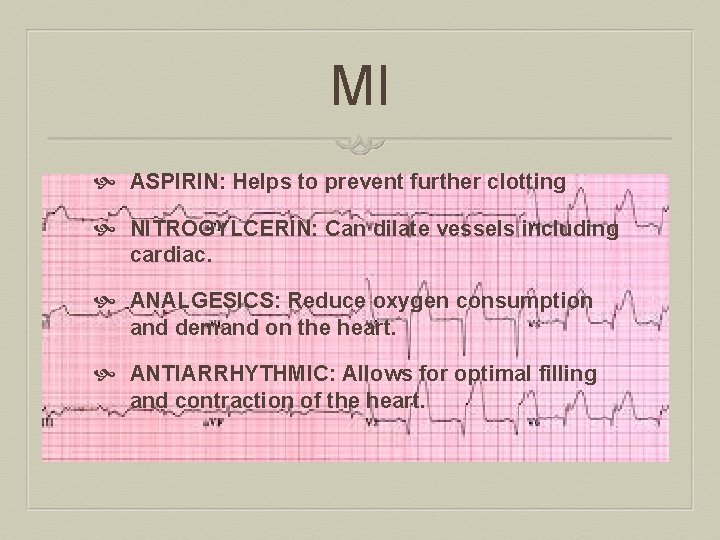
MI ASPIRIN: Helps to prevent further clotting NITROGYLCERIN: Can dilate vessels including cardiac. ANALGESICS: Reduce oxygen consumption and demand on the heart. ANTIARRHYTHMIC: Allows for optimal filling and contraction of the heart.
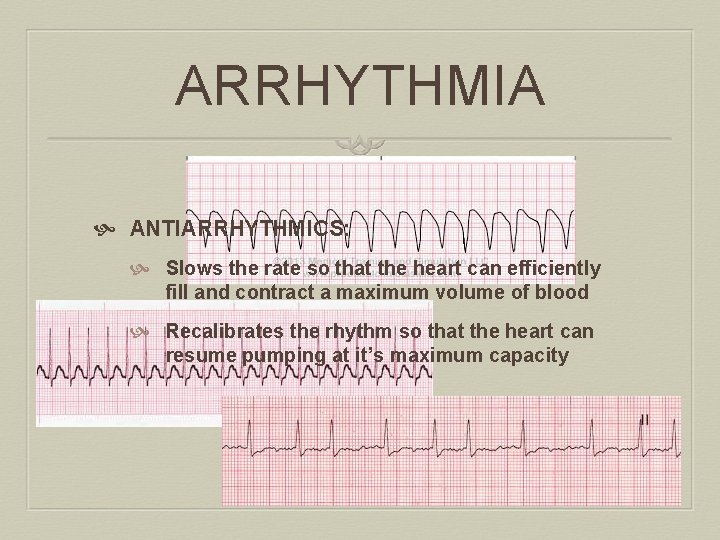
ARRHYTHMIA ANTIARRHYTHMICS: Slows the rate so that the heart can efficiently fill and contract a maximum volume of blood Recalibrates the rhythm so that the heart can resume pumping at it’s maximum capacity
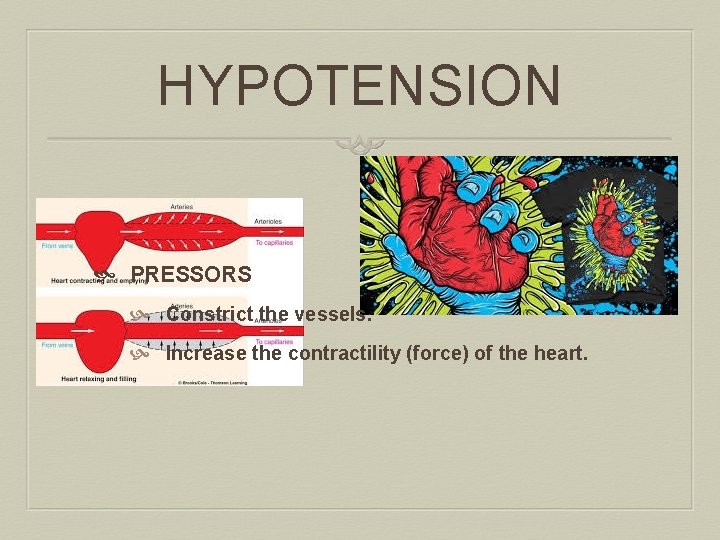
HYPOTENSION PRESSORS Constrict the vessels. Increase the contractility (force) of the heart.
PHARMACOKINETIC S 23
ASPIRIN Class: Platelet inhibitor, anti-inflammatory agent. Indications: New onset chest pain suggestive of Acute Myocardial Infarction. Mechanism of Action: Prostaglandin inhibition. 24
ASPIRIN Dosage and Administration: 324 mg chewed. 25
METOPROLOL (Lopressor) CATEGORY: Beta Blocker, Beta 1 selective INDICATION: Rate control for patients already on a beta blocker SIDE EFFECTS: Hypotension, bronchospasm INTERACTIONS: May enhance bradycardia in conjunction with other class 26 IV drugs
METOPROLOL beta blocker MECHANISM OF ACTION — Selective inhibitor of beta 1 -adrenergic receptors. • Beta-1: found primarily in heart muscle. Activation results in increases in heart rate, contractility, and atrioventricular (AV) conduction, and a decrease in AV node refractoriness. Antagonizes the above effects. 27
METOPROLOL beta blocker Dosage and Administration: 2. 5 mg to 5 mg slow IV over 2 -5 minutes. May repeat every 5 minutes to a total of 15 mg IV beta blockers are not to be used with IV calcium channel blockers. 28
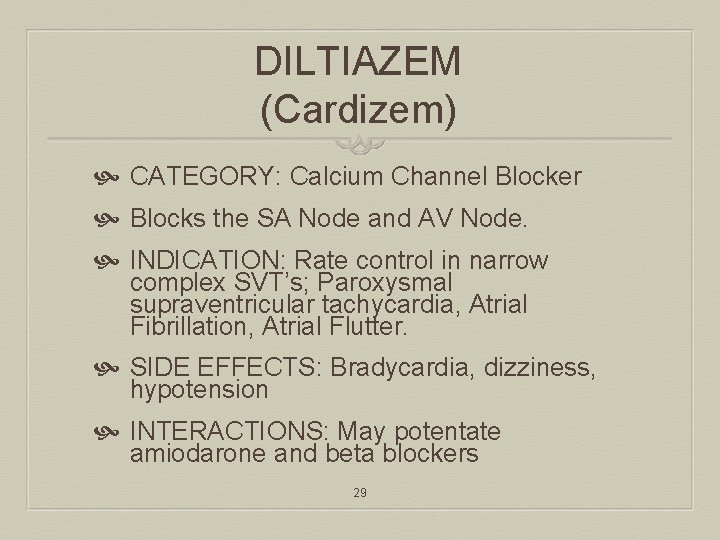
DILTIAZEM (Cardizem) CATEGORY: Calcium Channel Blocker Blocks the SA Node and AV Node. INDICATION: Rate control in narrow complex SVT’s; Paroxysmal supraventricular tachycardia, Atrial Fibrillation, Atrial Flutter. SIDE EFFECTS: Bradycardia, dizziness, hypotension INTERACTIONS: May potentate amiodarone and beta blockers 29
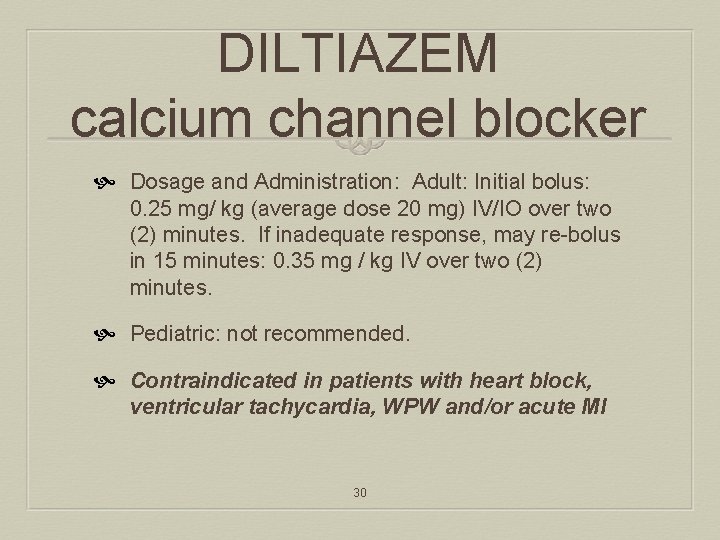
DILTIAZEM calcium channel blocker Dosage and Administration: Adult: Initial bolus: 0. 25 mg/ kg (average dose 20 mg) IV/IO over two (2) minutes. If inadequate response, may re-bolus in 15 minutes: 0. 35 mg / kg IV over two (2) minutes. Pediatric: not recommended. Contraindicated in patients with heart block, ventricular tachycardia, WPW and/or acute MI 30
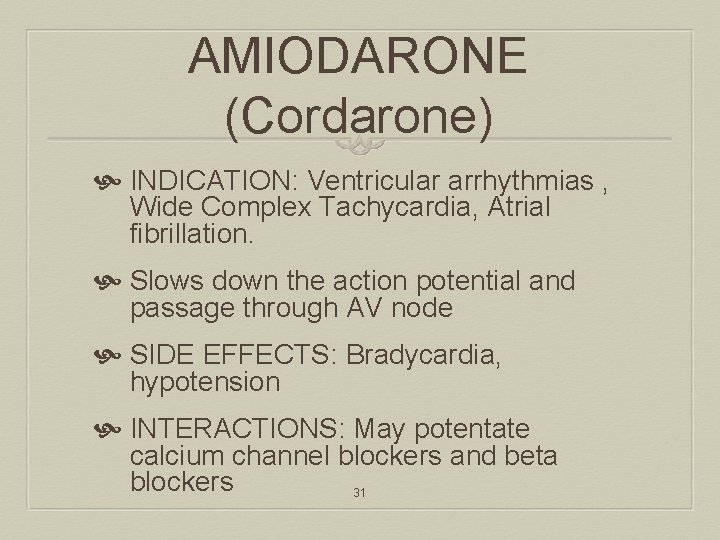
AMIODARONE (Cordarone) INDICATION: Ventricular arrhythmias , Wide Complex Tachycardia, Atrial fibrillation. Slows down the action potential and passage through AV node SIDE EFFECTS: Bradycardia, hypotension INTERACTIONS: May potentate calcium channel blockers and beta blockers 31
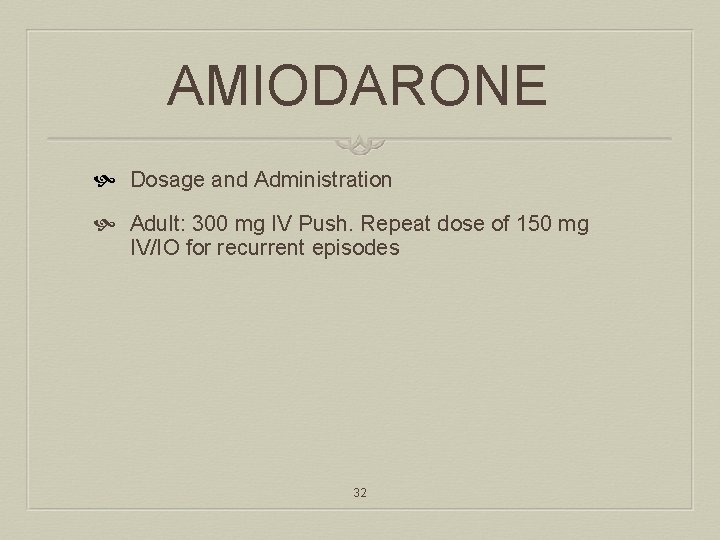
AMIODARONE Dosage and Administration Adult: 300 mg IV Push. Repeat dose of 150 mg IV/IO for recurrent episodes 32
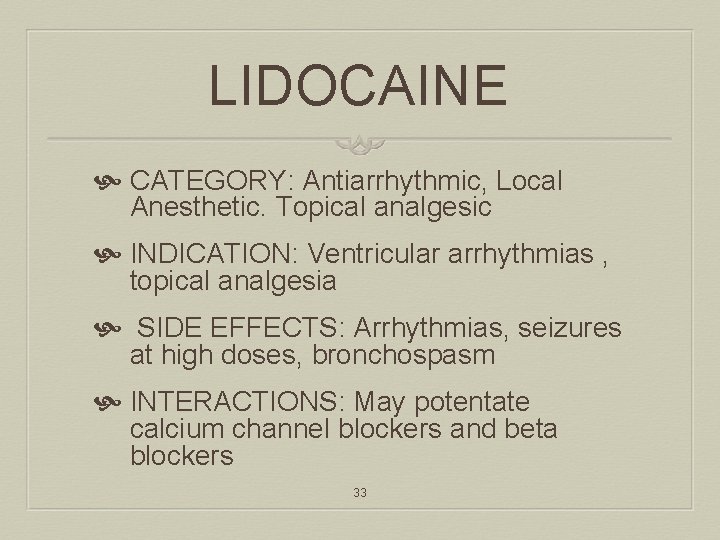
LIDOCAINE CATEGORY: Antiarrhythmic, Local Anesthetic. Topical analgesic INDICATION: Ventricular arrhythmias , topical analgesia SIDE EFFECTS: Arrhythmias, seizures at high doses, bronchospasm INTERACTIONS: May potentate calcium channel blockers and beta blockers 33
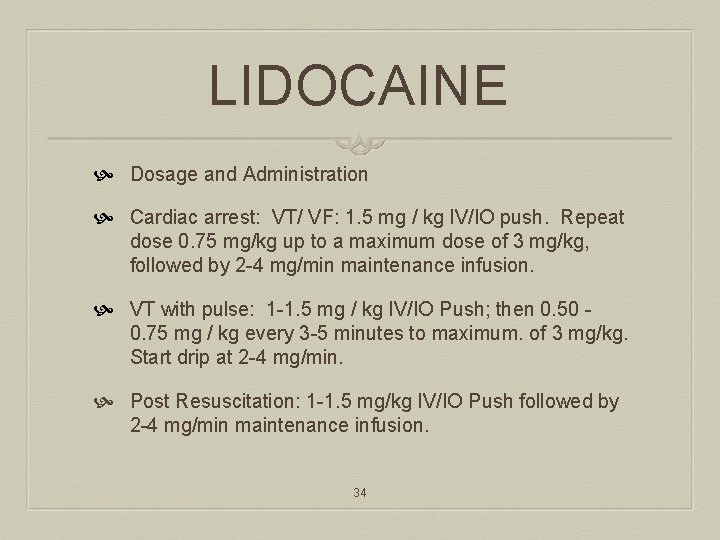
LIDOCAINE Dosage and Administration Cardiac arrest: VT/ VF: 1. 5 mg / kg IV/IO push. Repeat dose 0. 75 mg/kg up to a maximum dose of 3 mg/kg, followed by 2 -4 mg/min maintenance infusion. VT with pulse: 1 -1. 5 mg / kg IV/IO Push; then 0. 50 - 0. 75 mg / kg every 3 -5 minutes to maximum. of 3 mg/kg. Start drip at 2 -4 mg/min. Post Resuscitation: 1 -1. 5 mg/kg IV/IO Push followed by 2 -4 mg/min maintenance infusion. 34
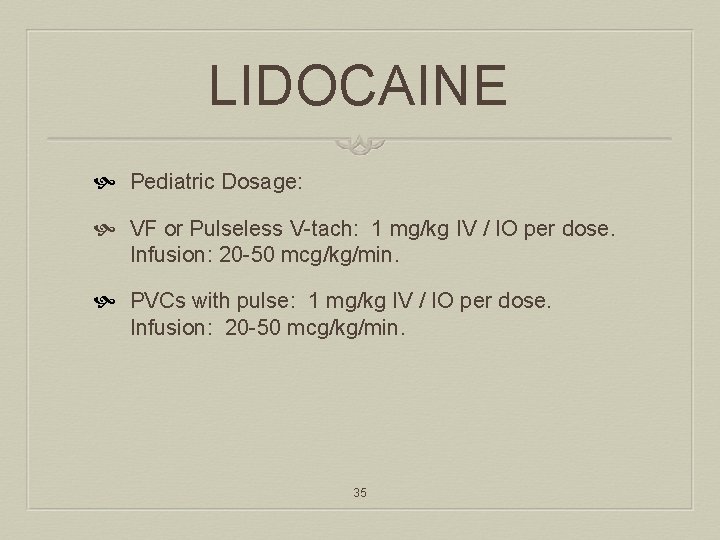
LIDOCAINE Pediatric Dosage: VF or Pulseless V-tach: 1 mg/kg IV / IO per dose. Infusion: 20 -50 mcg/kg/min. PVCs with pulse: 1 mg/kg IV / IO per dose. Infusion: 20 -50 mcg/kg/min. 35
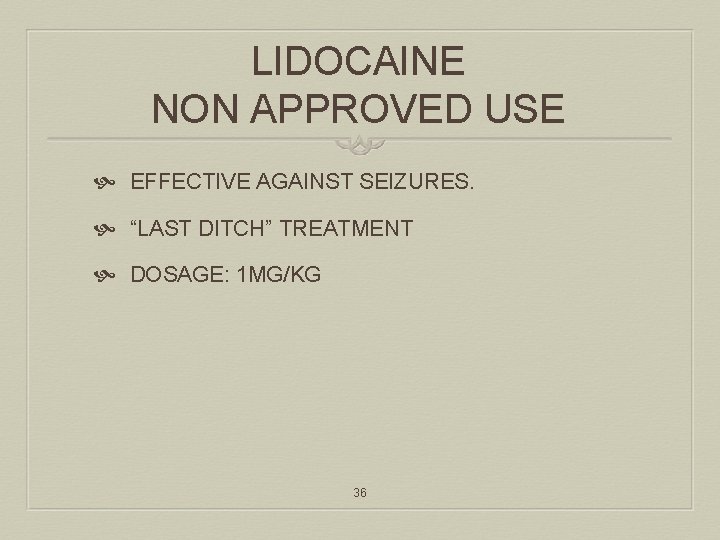
LIDOCAINE NON APPROVED USE EFFECTIVE AGAINST SEIZURES. “LAST DITCH” TREATMENT DOSAGE: 1 MG/KG 36
ADENOSINE (Adenocard) Blocks SA and AV node. Calcium channel blockers: verapamil and dilitiazem, Adenosine INDICATION: Paroxysmal supraventricular tachycardia. Can be used in regular and wide complex tachycardia. SIDE EFFECTS: Hypotension, AV blocks INTERACTIONS: Carbamazepine may increase heart block. 37
ADENOSINE Dosage and Administration Adult: 6 mg IV/IO rapid push over 1 -3 seconds. If no response after 1 -2 minutes, administer 12 mg over 1 -3 seconds. May repeat 12 mg dose. Maximum total dose = 30 mgs. Pediatric: 0. 1 - 0. 2 mg/kg rapid IV; maximum single dose = 12 mgs. 38
EPINEPHRINE CATEGORY: Alpha/Beta agonist. Antidote. At low doses dilates and at higher doses constricts INDICATION: Cardiac: Asystole VT/VF, Bradycardia. Respiratory: Bronchodilator SIDE EFFECTS: Angina, cardiac arrhythmia INTERACTIONS: Increased toxicity: Increased cardiac irritability if administered concurrently with beta-blocking agents, 39 alpha-blocking agents
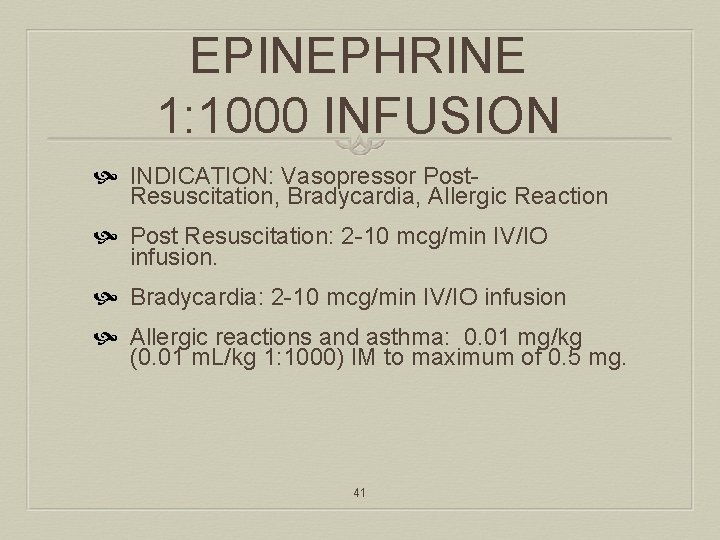
EPINEPHRINE (1: 1000) INDICATION: Bronchodilation in Asthma and COPD exacerbation. Primary treatment in anadphylaxis Allergic Reaction: 0. 3 mg IM. May repeat every five minutes for a total of 3 doses. Asthma/COPD/RAD 40
EPINEPHRINE 1: 1000 INFUSION INDICATION: Vasopressor Post. Resuscitation, Bradycardia, Allergic Reaction Post Resuscitation: 2 -10 mcg/min IV/IO infusion. Bradycardia: 2 -10 mcg/min IV/IO infusion Allergic reactions and asthma: 0. 01 mg/kg (0. 01 m. L/kg 1: 1000) IM to maximum of 0. 5 mg. 41
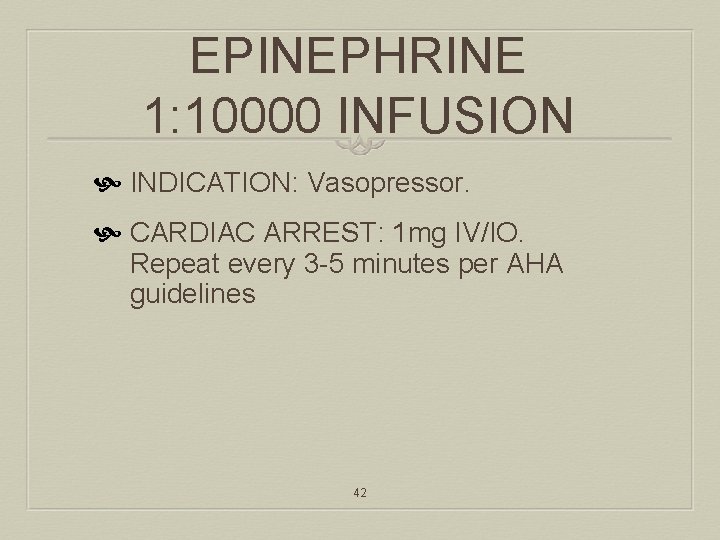
EPINEPHRINE 1: 10000 INFUSION INDICATION: Vasopressor. CARDIAC ARREST: 1 mg IV/IO. Repeat every 3 -5 minutes per AHA guidelines 42
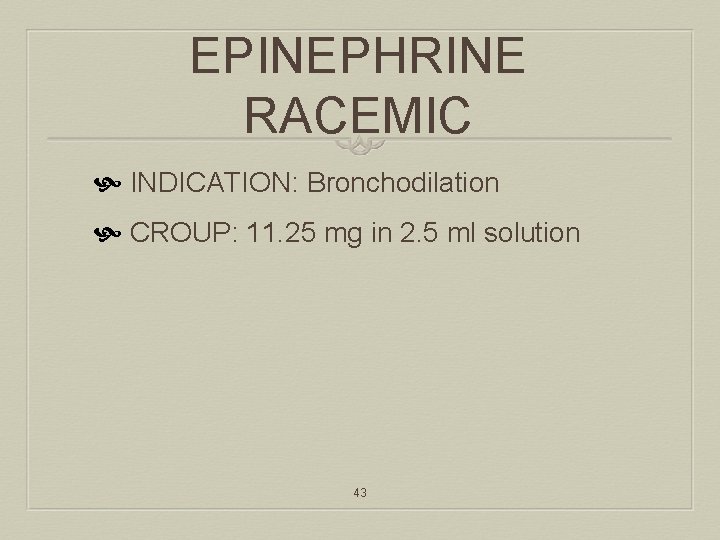
EPINEPHRINE RACEMIC INDICATION: Bronchodilation CROUP: 11. 25 mg in 2. 5 ml solution 43
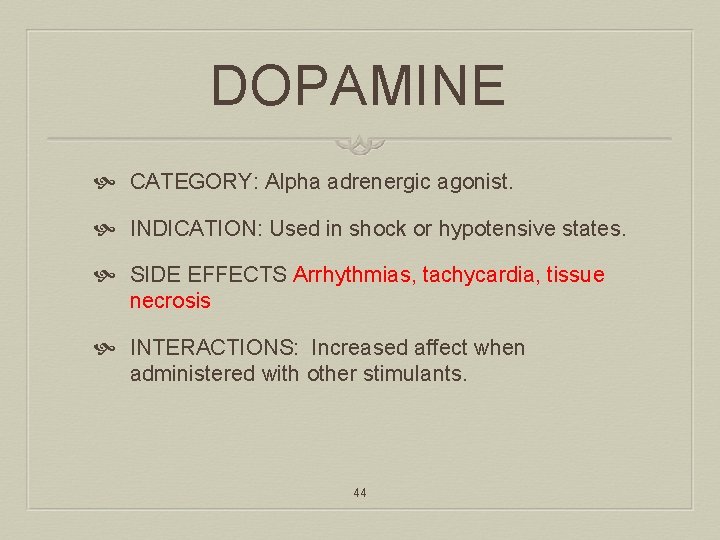
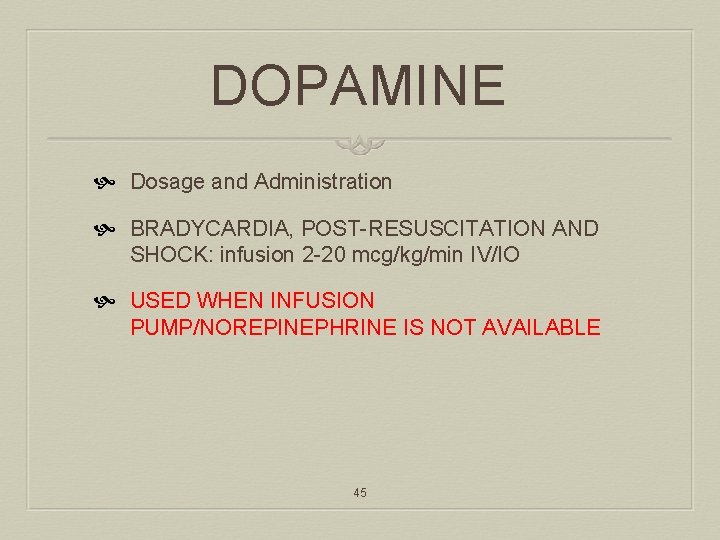
DOPAMINE CATEGORY: Alpha adrenergic agonist. INDICATION: Used in shock or hypotensive states. SIDE EFFECTS Arrhythmias, tachycardia, tissue necrosis INTERACTIONS: Increased affect when administered with other stimulants. 44
DOPAMINE Dosage and Administration BRADYCARDIA, POST-RESUSCITATION AND SHOCK: infusion 2 -20 mcg/kg/min IV/IO USED WHEN INFUSION PUMP/NOREPINEPHRINE IS NOT AVAILABLE 45
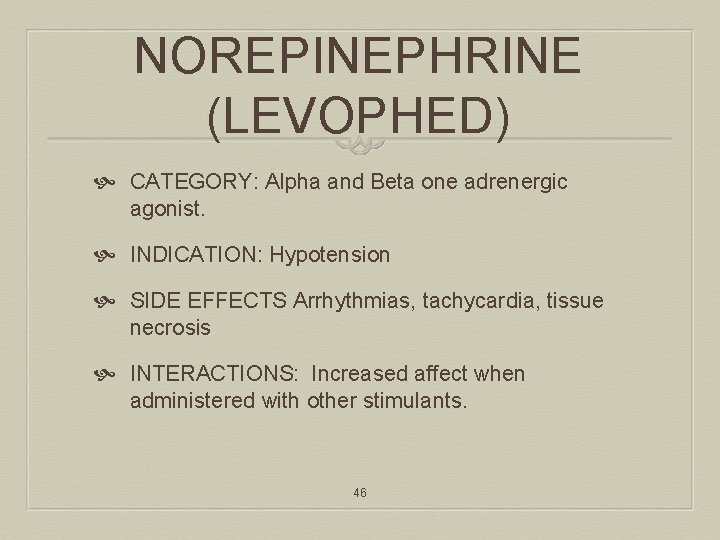
NOREPINEPHRINE (LEVOPHED) CATEGORY: Alpha and Beta one adrenergic agonist. INDICATION: Hypotension SIDE EFFECTS Arrhythmias, tachycardia, tissue necrosis INTERACTIONS: Increased affect when administered with other stimulants. 46
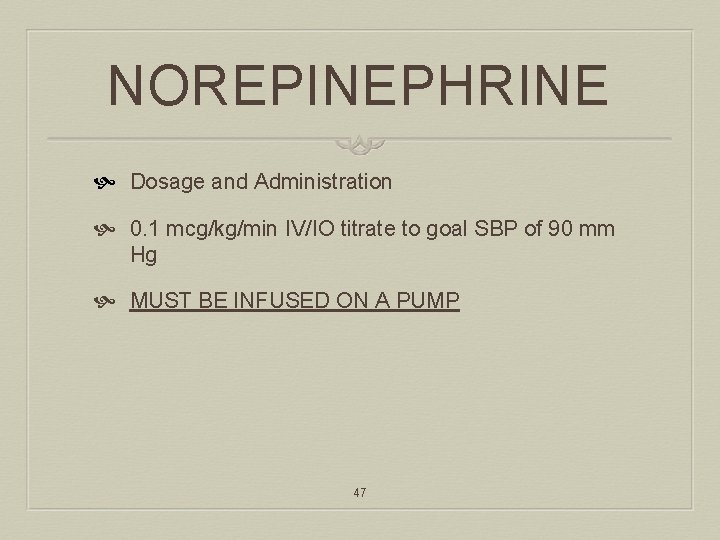
NOREPINEPHRINE Dosage and Administration 0. 1 mcg/kg/min IV/IO titrate to goal SBP of 90 mm Hg MUST BE INFUSED ON A PUMP 47
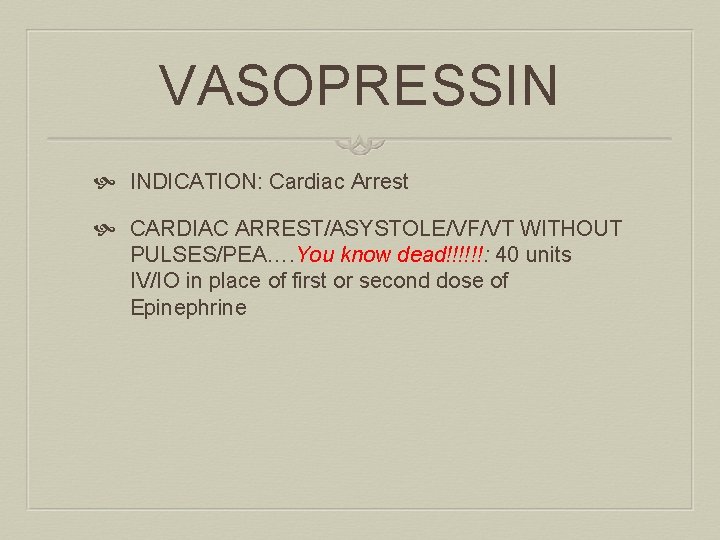
VASOPRESSIN INDICATION: Cardiac Arrest CARDIAC ARREST/ASYSTOLE/VF/VT WITHOUT PULSES/PEA…. You know dead!!!!!!: 40 units IV/IO in place of first or second dose of Epinephrine
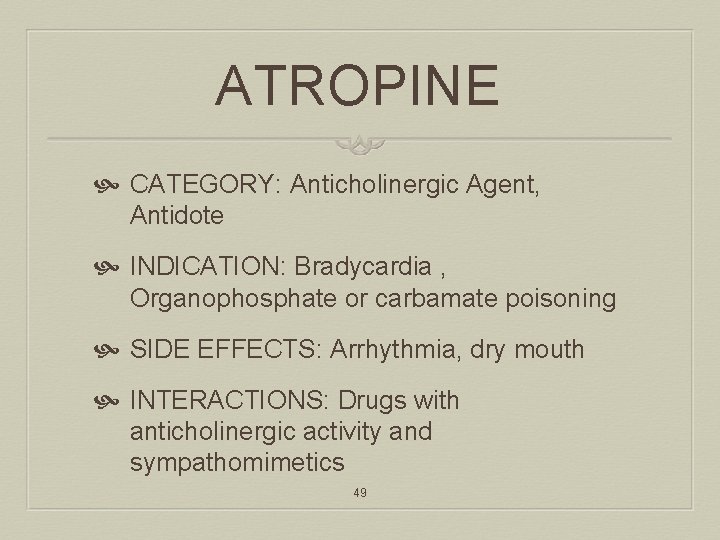
ATROPINE CATEGORY: Anticholinergic Agent, Antidote INDICATION: Bradycardia , Organophosphate or carbamate poisoning SIDE EFFECTS: Arrhythmia, dry mouth INTERACTIONS: Drugs with anticholinergic activity and sympathomimetics 49
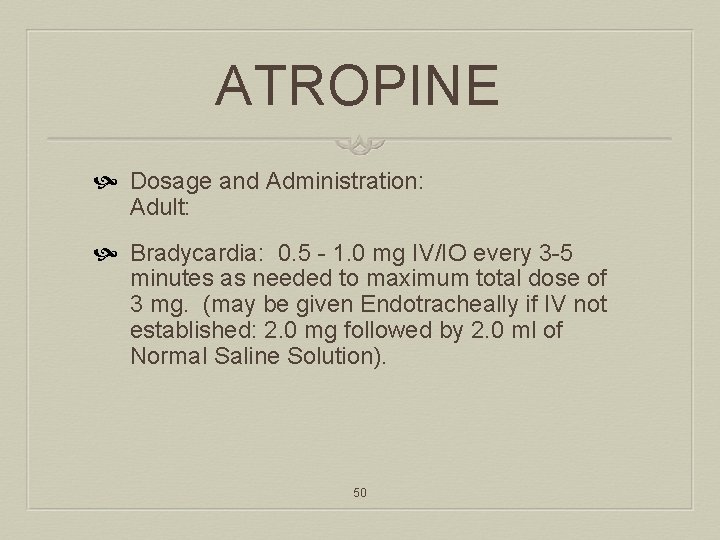
ATROPINE Dosage and Administration: Adult: Bradycardia: 0. 5 - 1. 0 mg IV/IO every 3 -5 minutes as needed to maximum total dose of 3 mg. (may be given Endotracheally if IV not established: 2. 0 mg followed by 2. 0 ml of Normal Saline Solution). 50
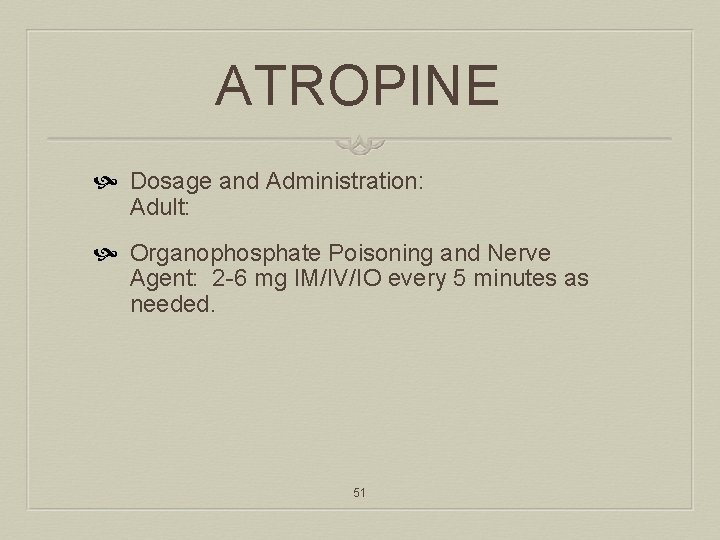
ATROPINE Dosage and Administration: Adult: Organophosphate Poisoning and Nerve Agent: 2 -6 mg IM/IV/IO every 5 minutes as needed. 51
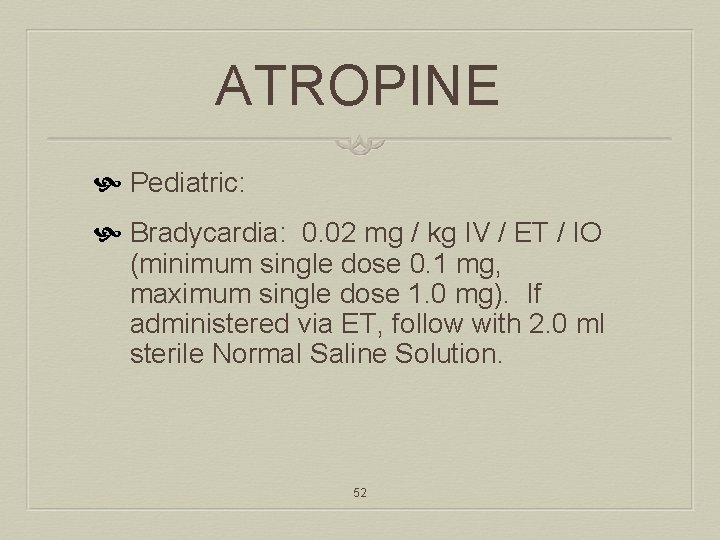
ATROPINE Pediatric: Bradycardia: 0. 02 mg / kg IV / ET / IO (minimum single dose 0. 1 mg, maximum single dose 1. 0 mg). If administered via ET, follow with 2. 0 ml sterile Normal Saline Solution. 52
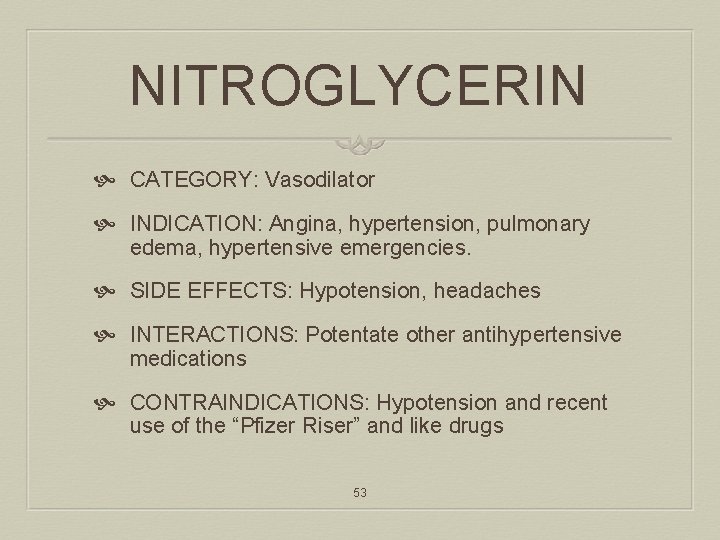
NITROGLYCERIN CATEGORY: Vasodilator INDICATION: Angina, hypertension, pulmonary edema, hypertensive emergencies. SIDE EFFECTS: Hypotension, headaches INTERACTIONS: Potentate other antihypertensive medications CONTRAINDICATIONS: Hypotension and recent use of the “Pfizer Riser” and like drugs 53
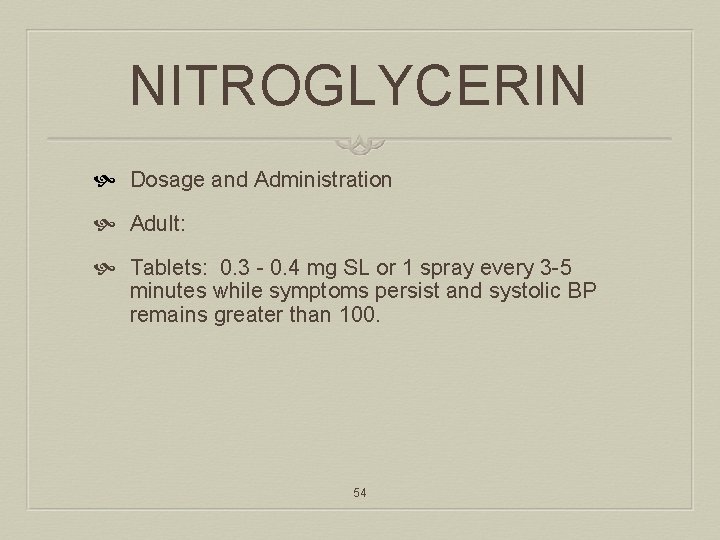
NITROGLYCERIN Dosage and Administration Adult: Tablets: 0. 3 - 0. 4 mg SL or 1 spray every 3 -5 minutes while symptoms persist and systolic BP remains greater than 100. 54
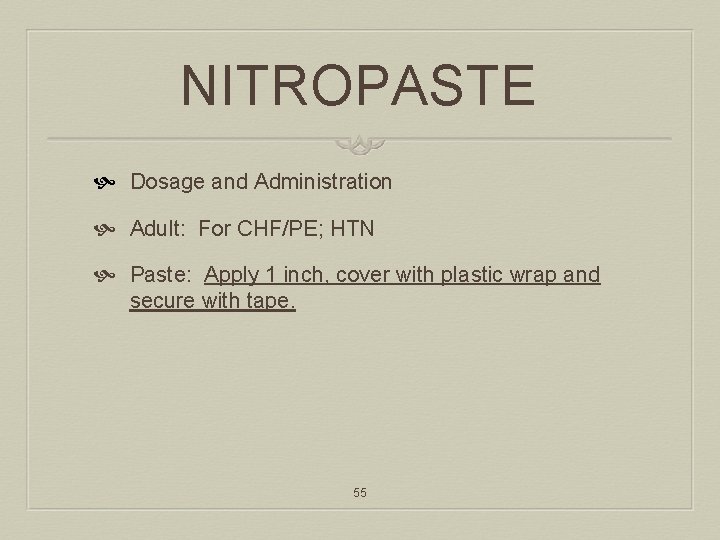
NITROPASTE Dosage and Administration Adult: For CHF/PE; HTN Paste: Apply 1 inch, cover with plastic wrap and secure with tape. 55
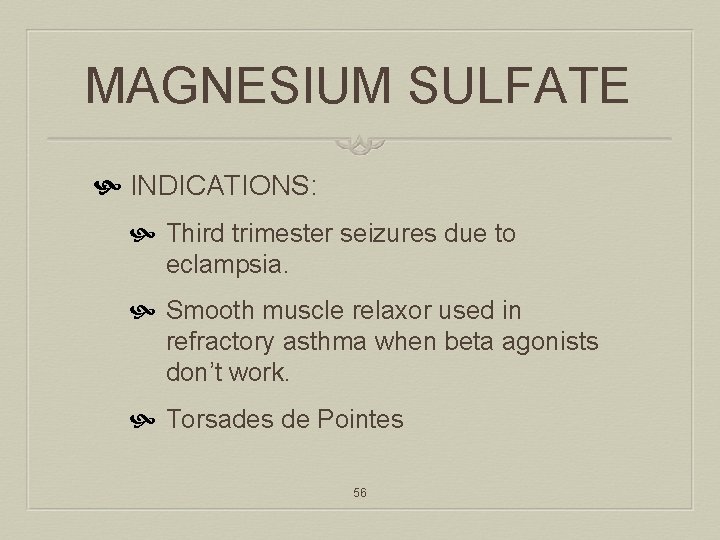
MAGNESIUM SULFATE INDICATIONS: Third trimester seizures due to eclampsia. Smooth muscle relaxor used in refractory asthma when beta agonists don’t work. Torsades de Pointes 56
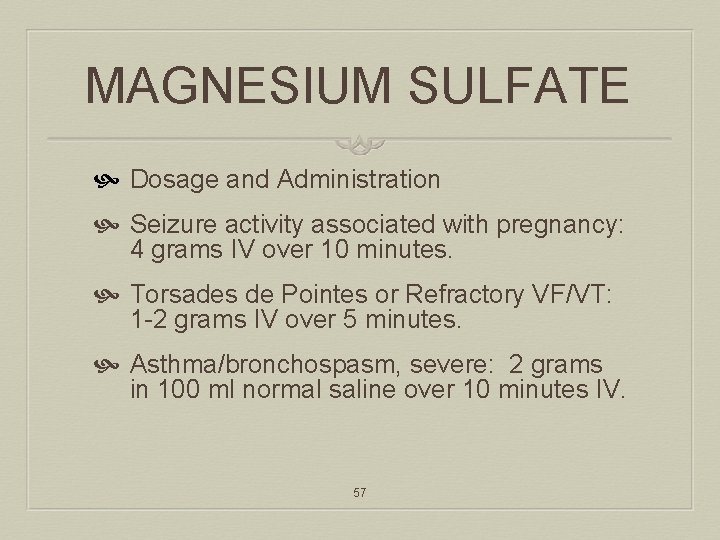
MAGNESIUM SULFATE Dosage and Administration Seizure activity associated with pregnancy: 4 grams IV over 10 minutes. Torsades de Pointes or Refractory VF/VT: 1 -2 grams IV over 5 minutes. Asthma/bronchospasm, severe: 2 grams in 100 ml normal saline over 10 minutes IV. 57
RESPIRATORY DRUGS 58
DYSPNEA OR SHORTNESS OF BREATH Lack of oxygen reaching the lungs Inability to circulate the oxygenated blood in the body
VENTILATION The ability to exchange oxygen for carbon dioxide
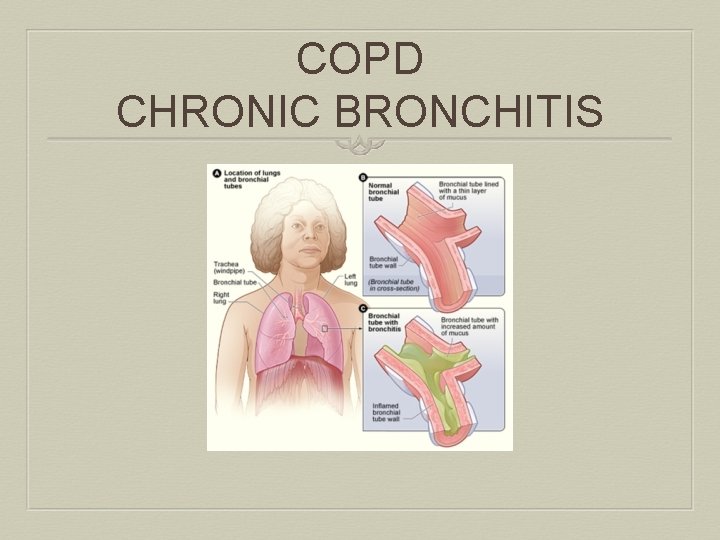
COPD CHRONIC BRONCHITIS
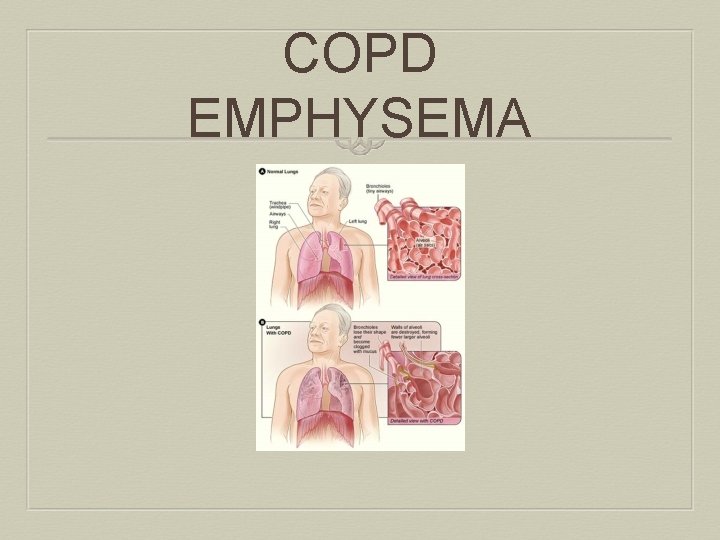
COPD EMPHYSEMA
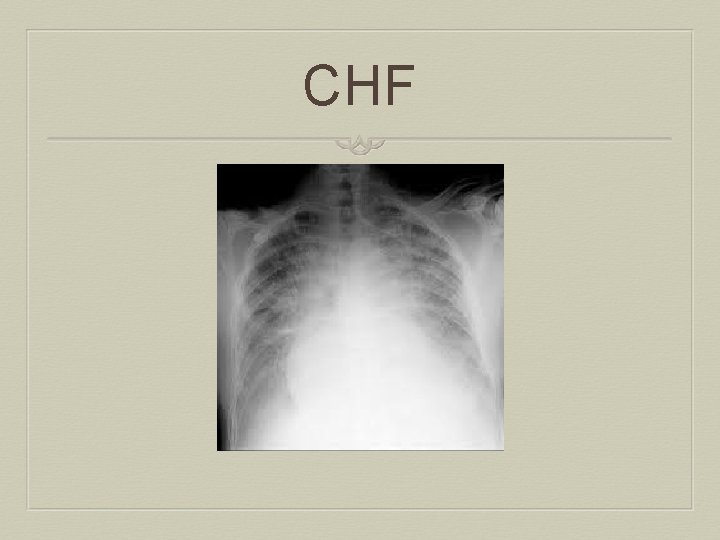
CHF
COPD GOALS Dilate the airways Reduce the inflammation IMPROVE OXYGENATION AND VENTILATION
CHF GOALS Improve the hearts ability to contract Remove the excessive fluid in the lungs.
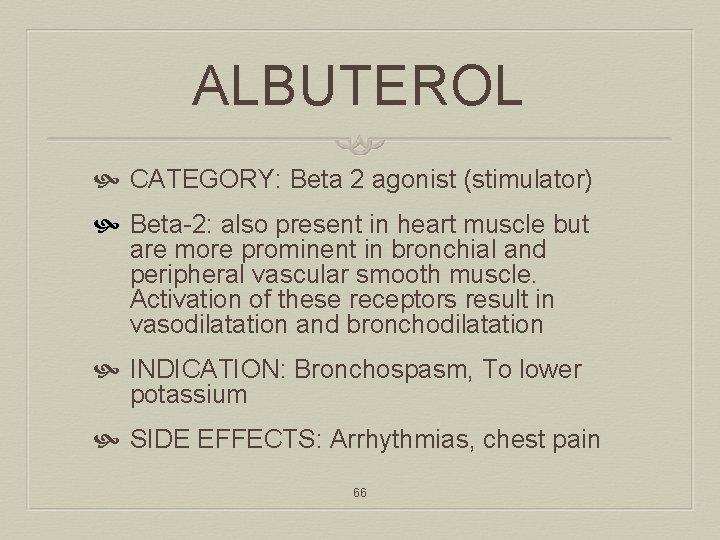
ALBUTEROL CATEGORY: Beta 2 agonist (stimulator) Beta-2: also present in heart muscle but are more prominent in bronchial and peripheral vascular smooth muscle. Activation of these receptors result in vasodilatation and bronchodilatation INDICATION: Bronchospasm, To lower potassium SIDE EFFECTS: Arrhythmias, chest pain 66
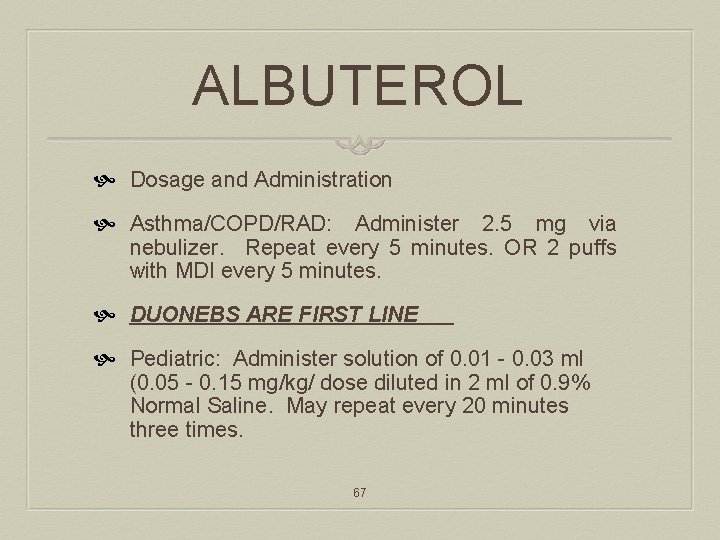
ALBUTEROL Dosage and Administration Asthma/COPD/RAD: Administer 2. 5 mg via nebulizer. Repeat every 5 minutes. OR 2 puffs with MDI every 5 minutes. DUONEBS ARE FIRST LINE Pediatric: Administer solution of 0. 01 - 0. 03 ml (0. 05 - 0. 15 mg/kg/ dose diluted in 2 ml of 0. 9% Normal Saline. May repeat every 20 minutes three times. 67
ALBUTEROL Allergic Reaction/Anaphylaxis: 2. 5 mg via nebulizer. May repeat x 1. 68
ALBUTEROL NON APPROVED USE HIGH DOSE NEBULIZED TREATMENT, 20 MGS FOR HYPERKALEMIA 69
IPRATROPIUM (ATROVENT) CATEGORY: Anticholinergic Agent (antagonist) Is an anticholinergic bronchodilator by blocking the muscarinic receptors of acetylcholine INDICATION: Bronchospasm SIDE EFFECTS: Palpitations, nausea, dry mouth 70
IPRATROPIUM MECHANISM OF ACTION — Blocks the action of acetylcholine at parasympathetic sites in bronchial smooth muscle causing bronchodilation 71
IPRATROPIUM Dosage and Administration: Asthma/COPD/RAD: 2 -3 puffs via MDI in combination with albuterol. Repeat every 5 minutes 0. 5 mg ipratropium with or without 2. 5 mg albuterol every 5 minutes. 72
FUROSEMIDE CATEGORY: Loop diuretic INDICATION: CHF, Pulmonary edema, Hypertensive Emergencies, Toxicology SIDE EFFECTS: Hypotension, Hyper uremia, hypokalemia INTERACTIONS: May impact renal clearance of medications 73
FUROSEMIDE Dosage and Administration Adult: 20 -40 mg IV/IO. 74
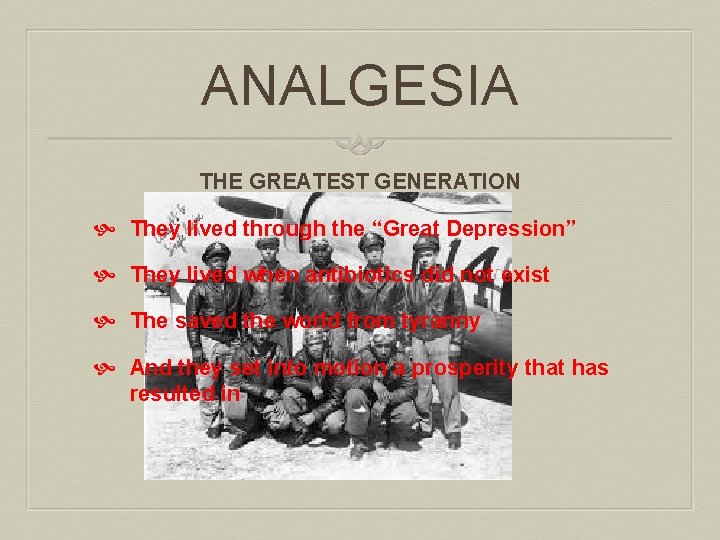
ANALGESIA THE GREATEST GENERATION They lived through the “Great Depression” They lived when antibiotics did not exist The saved the world from tyranny And they set into motion a prosperity that has resulted in
THE WHINY GENERATION
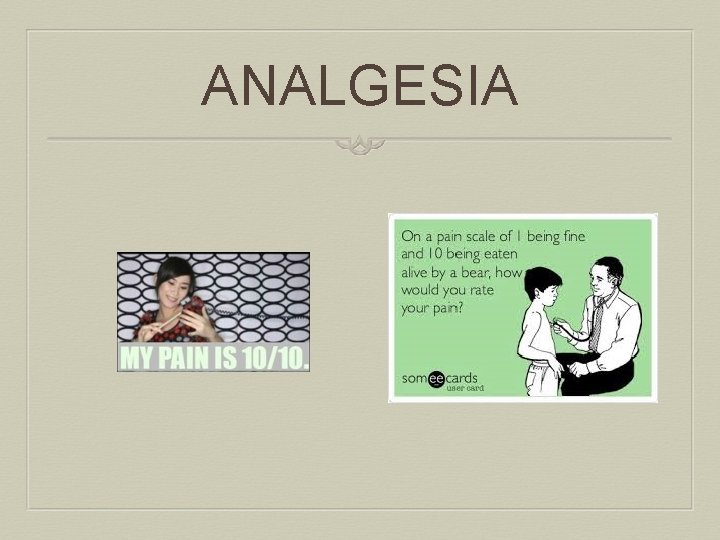
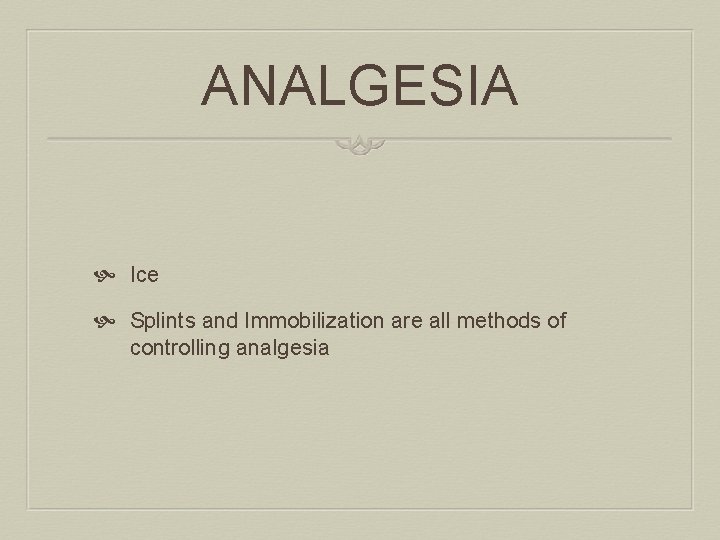
ANALGESIA Not all pain is at least a “ 12 out of 10” AND NOT ALL PAIN NEEDS NARCOTICS!
ANALGESIA
ANALGESIA Ice Splints and Immobilization are all methods of controlling analgesia
NARCOTICS CATEGORY: Analgesic/Opioid; morphine, fentanyl INDICATION: Analgesia SIDE EFFECTS: Hypotension, somulence, apnea INTERACTIONS: Potentates other sedatives. 80
NARCOTIC MECHANISM OF ACTION — Binds to opiate receptors in the CNS, causing inhibition of ascending pain pathways, altering the perception of and response to pain; produces generalized CNS depression 81
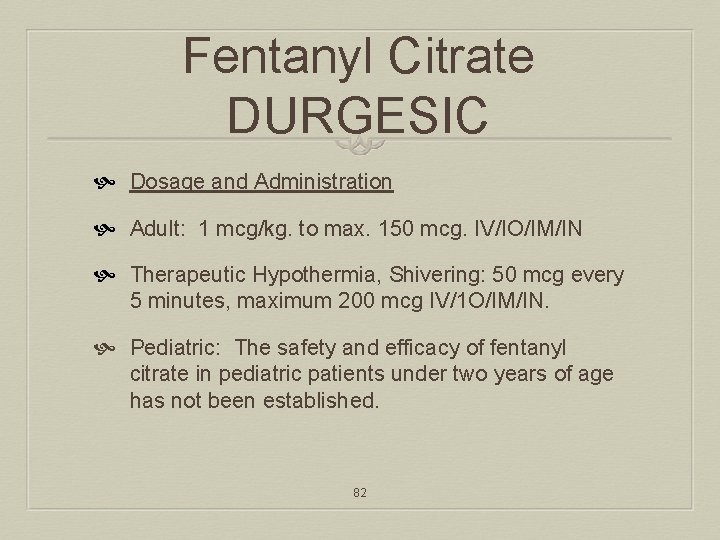
Fentanyl Citrate DURGESIC Dosage and Administration Adult: 1 mcg/kg. to max. 150 mcg. IV/IO/IM/IN Therapeutic Hypothermia, Shivering: 50 mcg every 5 minutes, maximum 200 mcg IV/1 O/IM/IN. Pediatric: The safety and efficacy of fentanyl citrate in pediatric patients under two years of age has not been established. 82
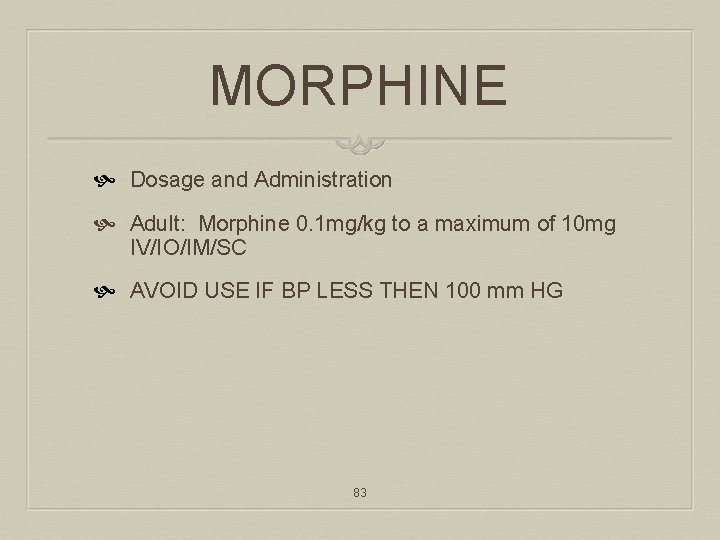
MORPHINE Dosage and Administration Adult: Morphine 0. 1 mg/kg to a maximum of 10 mg IV/IO/IM/SC AVOID USE IF BP LESS THEN 100 mm HG 83
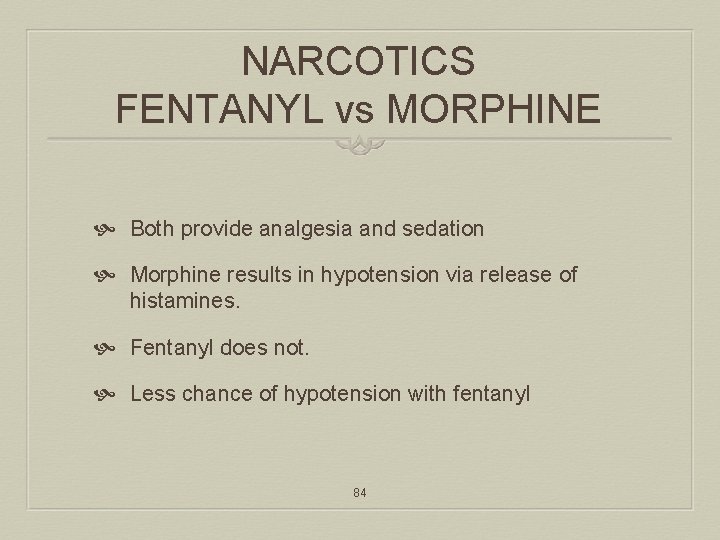
NARCOTICS FENTANYL vs MORPHINE Both provide analgesia and sedation Morphine results in hypotension via release of histamines. Fentanyl does not. Less chance of hypotension with fentanyl 84
ANXIOLYTICS 85
BENZODIAZEPINES Versatile drugs that have many pre-hospital functions 86
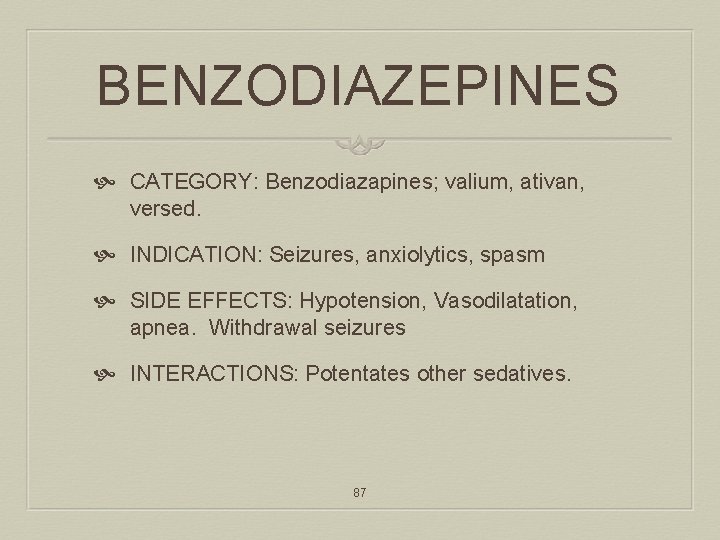
BENZODIAZEPINES CATEGORY: Benzodiazapines; valium, ativan, versed. INDICATION: Seizures, anxiolytics, spasm SIDE EFFECTS: Hypotension, Vasodilatation, apnea. Withdrawal seizures INTERACTIONS: Potentates other sedatives. 87
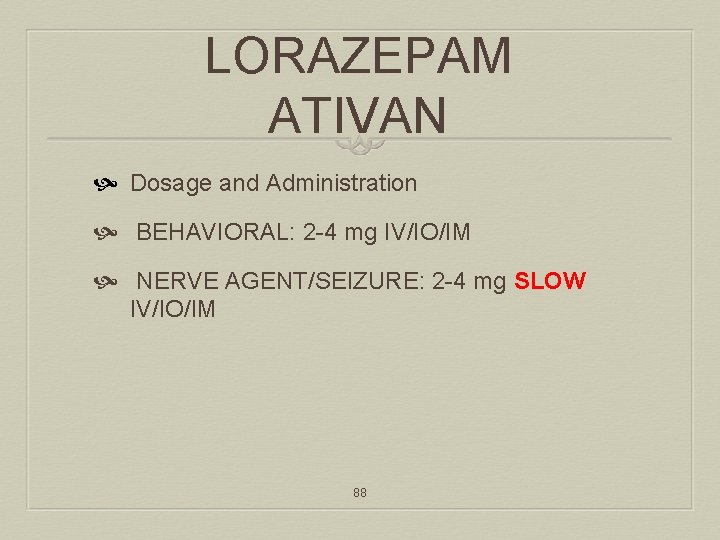
LORAZEPAM ATIVAN Dosage and Administration BEHAVIORAL: 2 -4 mg IV/IO/IM NERVE AGENT/SEIZURE: 2 -4 mg SLOW IV/IO/IM 88
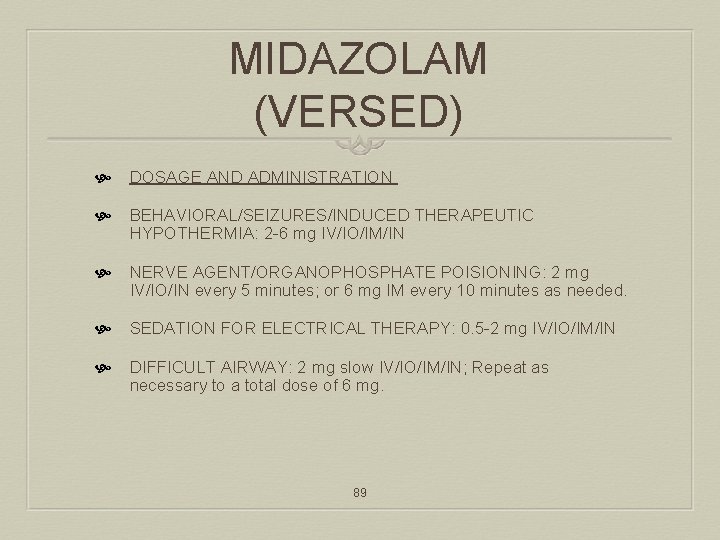
MIDAZOLAM (VERSED) DOSAGE AND ADMINISTRATION BEHAVIORAL/SEIZURES/INDUCED THERAPEUTIC HYPOTHERMIA: 2 -6 mg IV/IO/IM/IN NERVE AGENT/ORGANOPHOSPHATE POISIONING: 2 mg IV/IO/IN every 5 minutes; or 6 mg IM every 10 minutes as needed. SEDATION FOR ELECTRICAL THERAPY: 0. 5 -2 mg IV/IO/IM/IN DIFFICULT AIRWAY: 2 mg slow IV/IO/IM/IN; Repeat as necessary to a total dose of 6 mg. 89
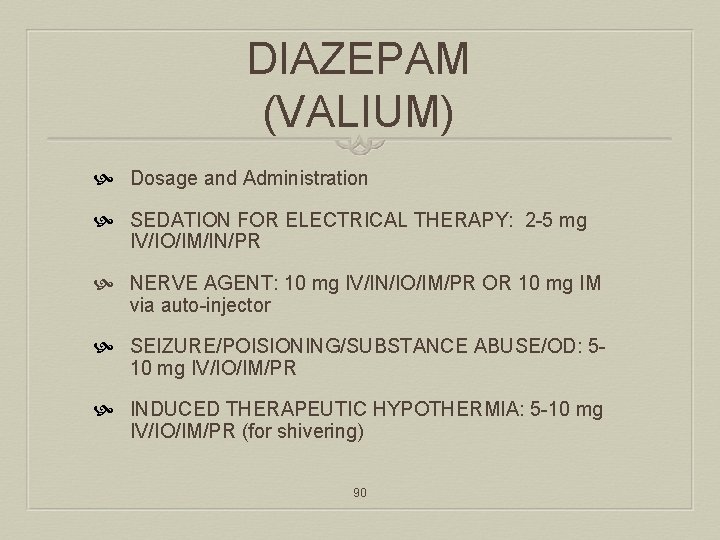
DIAZEPAM (VALIUM) Dosage and Administration SEDATION FOR ELECTRICAL THERAPY: 2 -5 mg IV/IO/IM/IN/PR NERVE AGENT: 10 mg IV/IN/IO/IM/PR OR 10 mg IM via auto-injector SEIZURE/POISIONING/SUBSTANCE ABUSE/OD: 510 mg IV/IO/IM/PR INDUCED THERAPEUTIC HYPOTHERMIA: 5 -10 mg IV/IO/IM/PR (for shivering) 90
MISC DRUGS 91
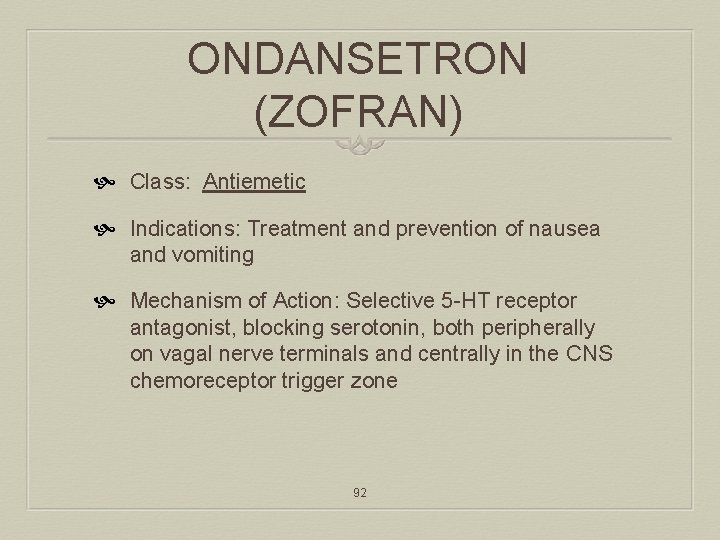
ONDANSETRON (ZOFRAN) Class: Antiemetic Indications: Treatment and prevention of nausea and vomiting Mechanism of Action: Selective 5 -HT receptor antagonist, blocking serotonin, both peripherally on vagal nerve terminals and centrally in the CNS chemoreceptor trigger zone 92
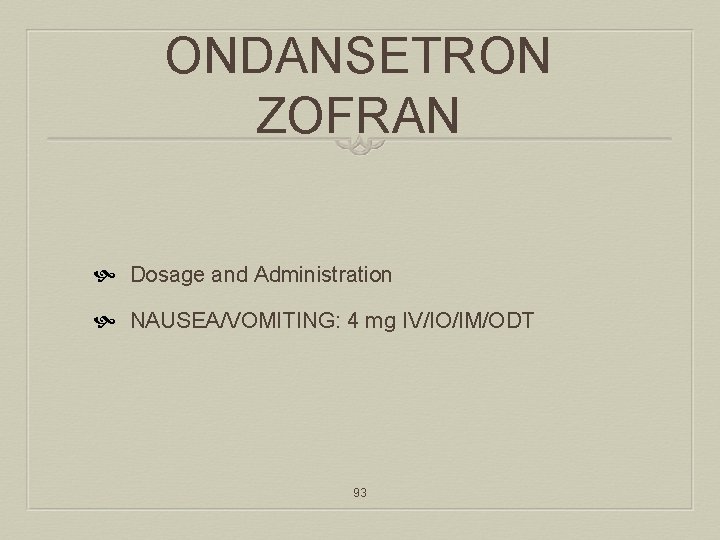
ONDANSETRON ZOFRAN Dosage and Administration NAUSEA/VOMITING: 4 mg IV/IO/IM/ODT 93
ONDANSETRON NAUSEA RESULTING FROM PAIN WILL USUALLY RESPOND TO TREATING THE PAIN AND DOES NOT NEED AN ANTIEMETIC. 94
SODIUM BICARBONATE INDICATION: A buffer use in acidosis to increase the p. H in Cardiac Arrest (doesn’t work), Hyperkalemia (treatment of choice) or TCA overdose (treatment of choice). MECHANISM OF ACTION: Reacts with hydrogen ions to form water and carbon dioxide thereby acting as a buffer for metabolic acidosis. 95
SODIUM BICARBONATE POISONING/SUBSTANCE ABUSE/OD/TOXICOLOGY: 0. 5 – 1 m. Eq/kg IV/IO CARDIAC ARREST/KNOWN HYPERKALEMIA/ACIDOSIS/TCA OVERDOSE: 1 m. Eq/kg IV/IO 96
ANTIDOTES 97
DIPHENHYDRAMINE CATEGORY: Histamine H 1 Antagonist INDICATION: Allergic reaction, dystonic reaction SIDE EFFECTS: Hypotension, dizziness INTERACTIONS: Potentates other sedatives. 98
DIPHENHYDRAMINE MECHANISM OF ACTION — Competes with histamine for H 1 -receptor sites on effector cells in the gastrointestinal tract, blood vessels, and respiratory tract; anticholinergic and sedative effects are also seen 99
DIPHENHYDRAMINE (BENADRYL) Dosage and Administration ALLERGIC REACTION/ANAPHYLAXIS: 25 – 50 mg IV/IO/IM 100
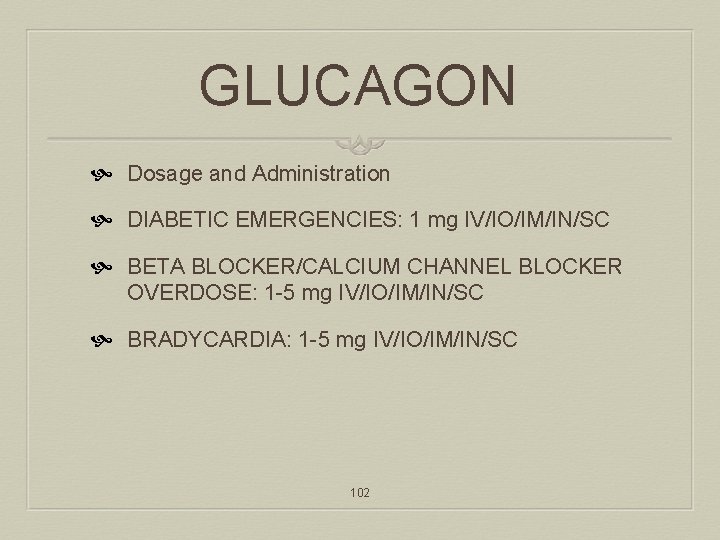
GLUCAGON CATEGORY: Antidote INDICATION: Hypoglycemia, Beta Blocker and calcium channel overdoses SIDE EFFECTS: Hypotension, nausea and vomiting 101
GLUCAGON Dosage and Administration DIABETIC EMERGENCIES: 1 mg IV/IO/IM/IN/SC BETA BLOCKER/CALCIUM CHANNEL BLOCKER OVERDOSE: 1 -5 mg IV/IO/IM/IN/SC BRADYCARDIA: 1 -5 mg IV/IO/IM/IN/SC 102
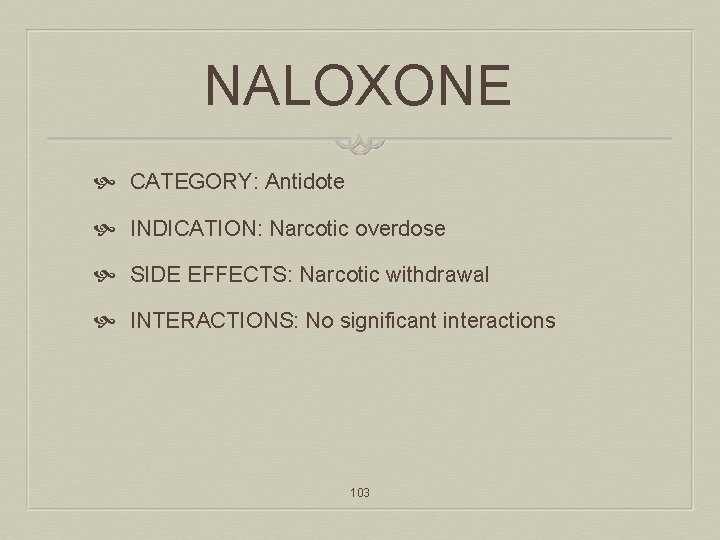
NALOXONE CATEGORY: Antidote INDICATION: Narcotic overdose SIDE EFFECTS: Narcotic withdrawal INTERACTIONS: No significant interactions 103
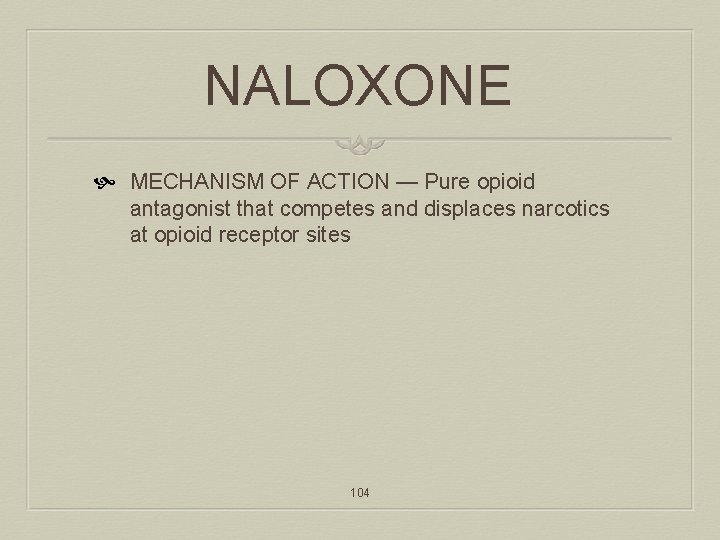
NALOXONE MECHANISM OF ACTION — Pure opioid antagonist that competes and displaces narcotics at opioid receptor sites 104
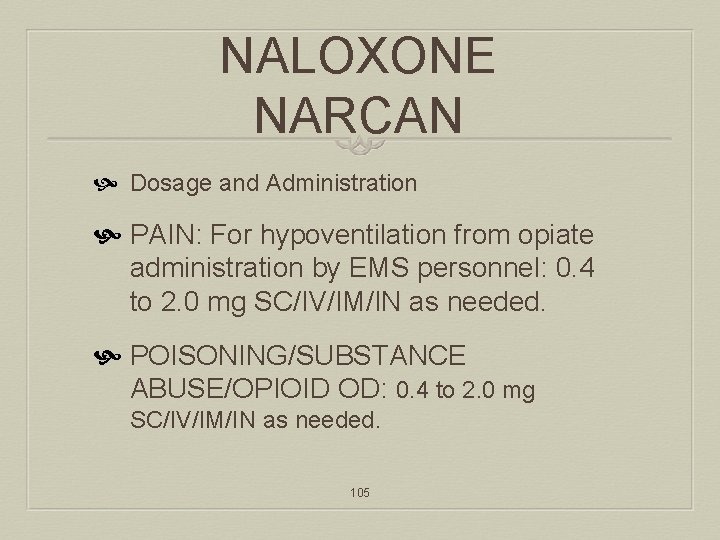
NALOXONE NARCAN Dosage and Administration PAIN: For hypoventilation from opiate administration by EMS personnel: 0. 4 to 2. 0 mg SC/IV/IM/IN as needed. POISONING/SUBSTANCE ABUSE/OPIOID OD: 0. 4 to 2. 0 mg SC/IV/IM/IN as needed. 105
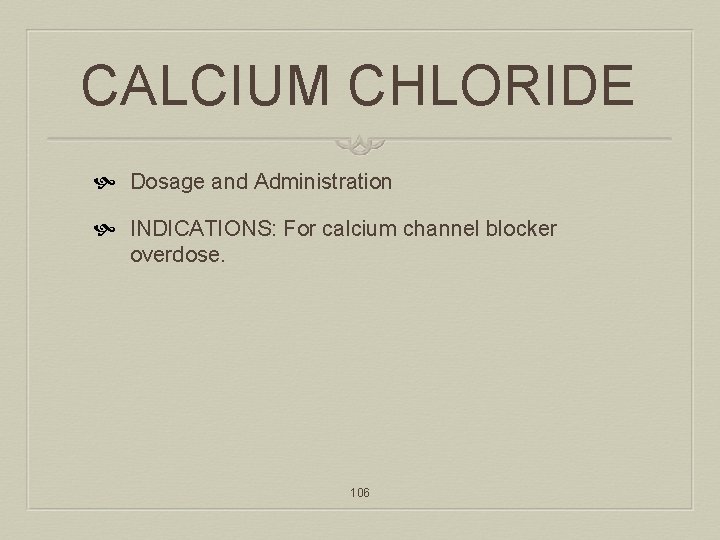
CALCIUM CHLORIDE Dosage and Administration INDICATIONS: For calcium channel blocker overdose. 106
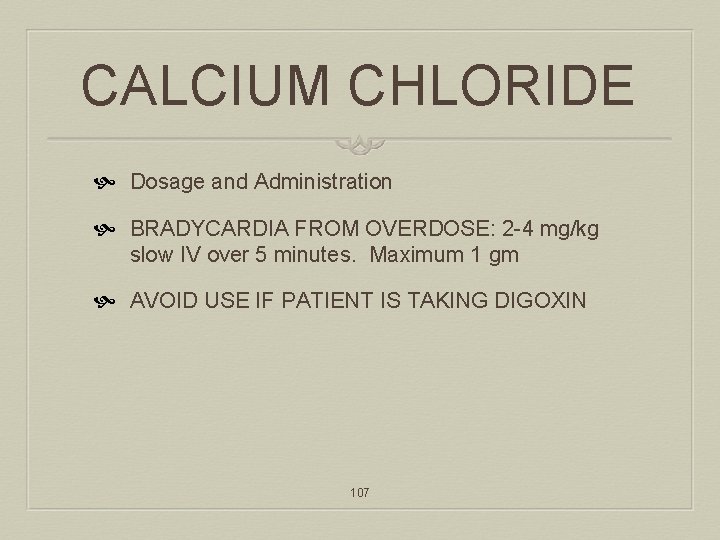
CALCIUM CHLORIDE Dosage and Administration BRADYCARDIA FROM OVERDOSE: 2 -4 mg/kg slow IV over 5 minutes. Maximum 1 gm AVOID USE IF PATIENT IS TAKING DIGOXIN 107
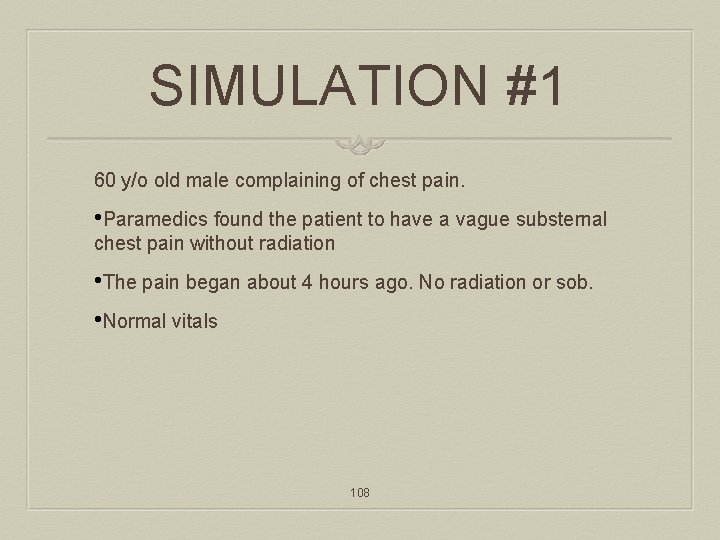
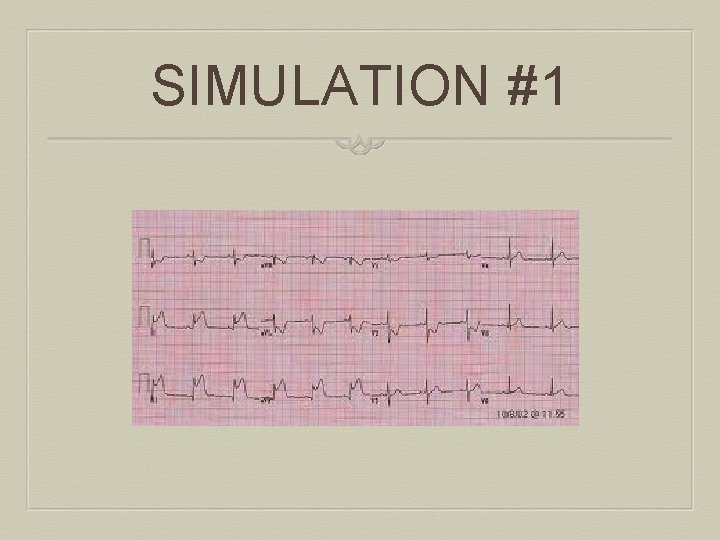
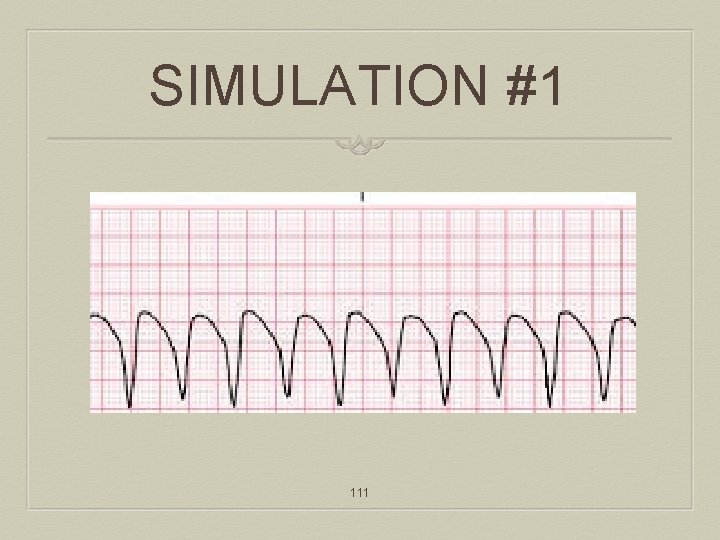
SIMULATION #1 60 y/o old male complaining of chest pain. • Paramedics found the patient to have a vague substernal chest pain without radiation • The pain began about 4 hours ago. No radiation or sob. • Normal vitals 108
SIMULATION #1
SIMULATION #1 MANAGEMENT? 110
SIMULATION #1 111
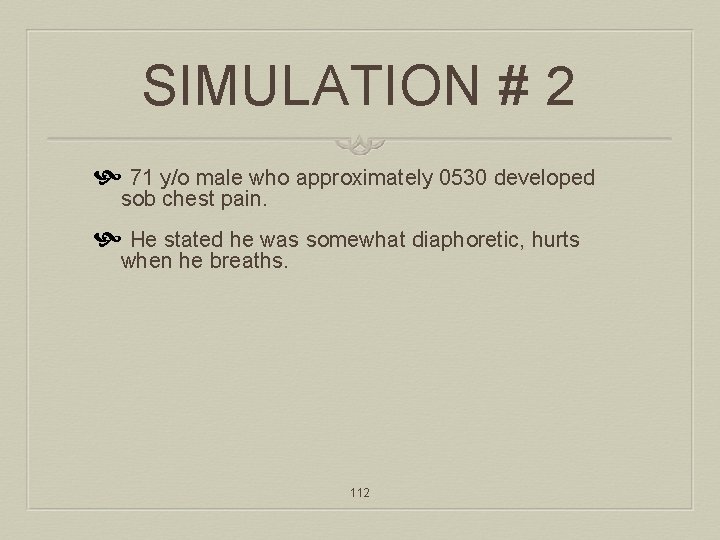
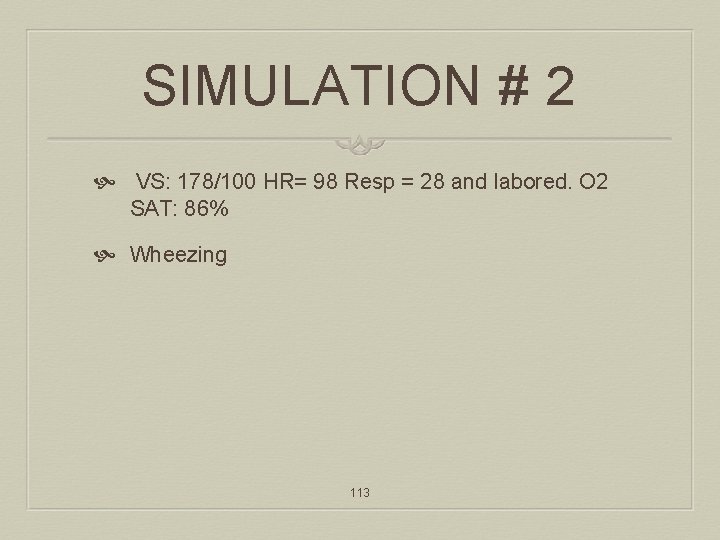
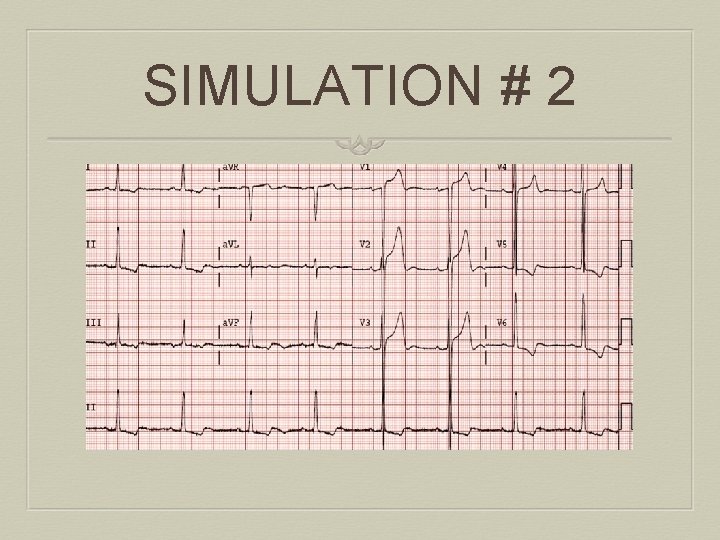
SIMULATION # 2 71 y/o male who approximately 0530 developed sob chest pain. He stated he was somewhat diaphoretic, hurts when he breaths. 112
SIMULATION # 2 VS: 178/100 HR= 98 Resp = 28 and labored. O 2 SAT: 86% Wheezing 113
SIMULATION # 2 MANAGEMENT?
SIMULATION # 2
SIMULATION #3 17 Y/O FEMALE WITH FACEBOOK STATUS: 116
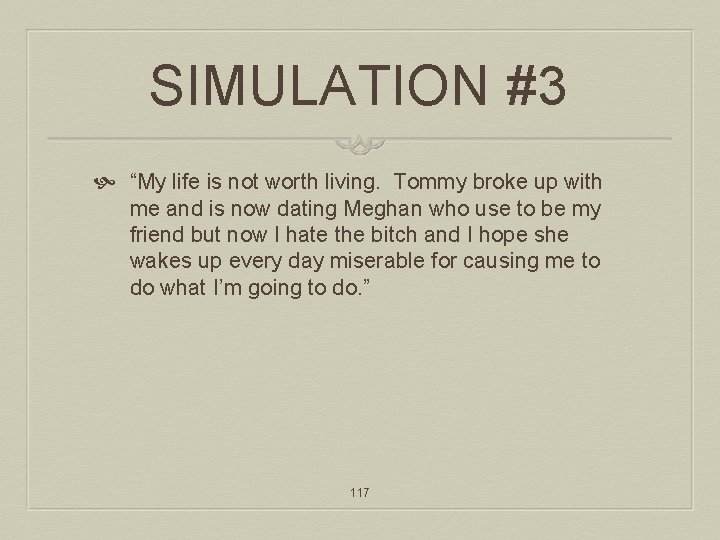
SIMULATION #3 “My life is not worth living. Tommy broke up with me and is now dating Meghan who use to be my friend but now I hate the bitch and I hope she wakes up every day miserable for causing me to do what I’m going to do. ” 117
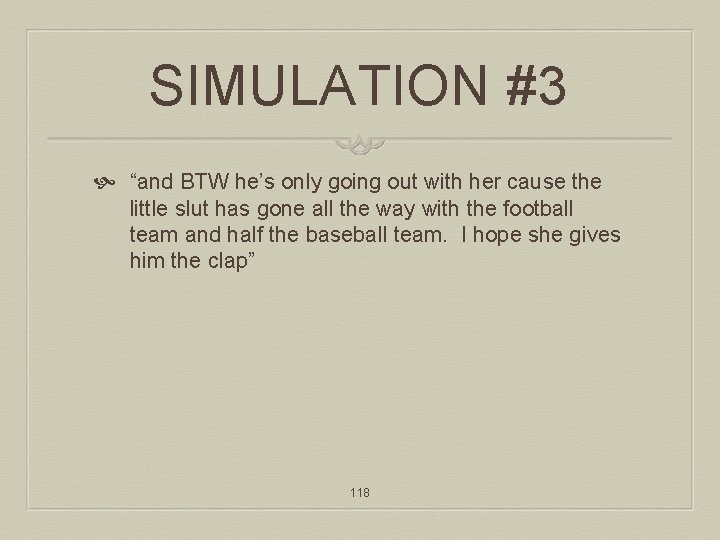
SIMULATION #3 “and BTW he’s only going out with her cause the little slut has gone all the way with the football team and half the baseball team. I hope she gives him the clap” 118
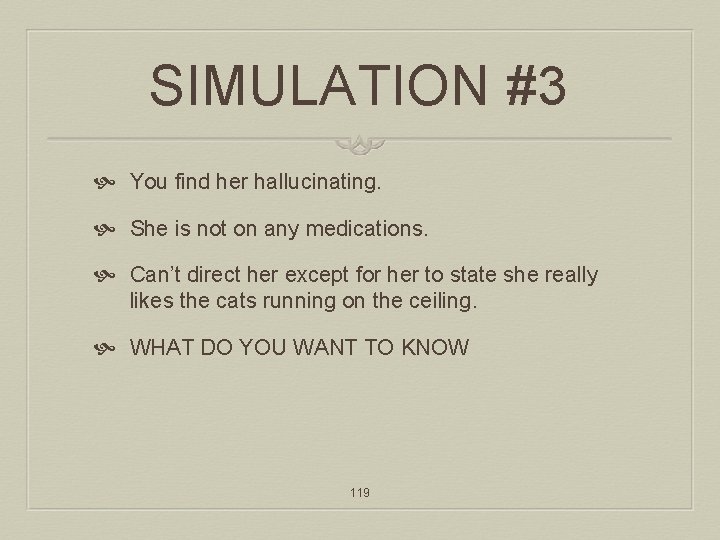
SIMULATION #3 You find her hallucinating. She is not on any medications. Can’t direct her except for her to state she really likes the cats running on the ceiling. WHAT DO YOU WANT TO KNOW 119
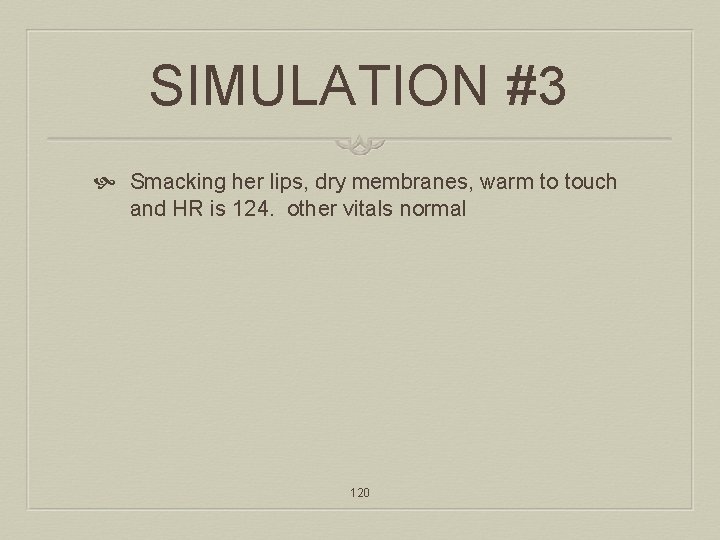
SIMULATION #3 Smacking her lips, dry membranes, warm to touch and HR is 124. other vitals normal 120
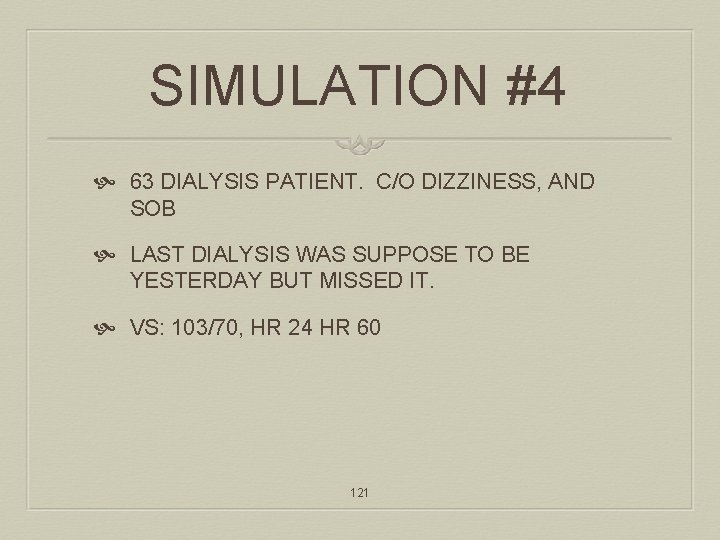
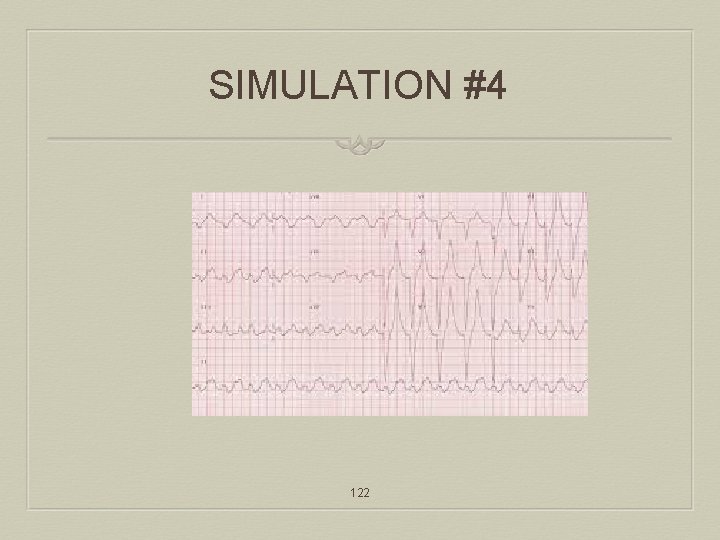
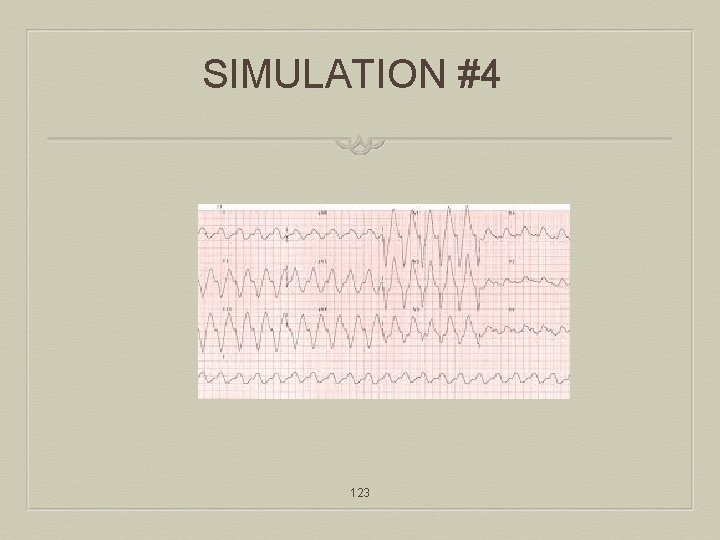
SIMULATION #4 63 DIALYSIS PATIENT. C/O DIZZINESS, AND SOB LAST DIALYSIS WAS SUPPOSE TO BE YESTERDAY BUT MISSED IT. VS: 103/70, HR 24 HR 60 121
SIMULATION #4 122
SIMULATION #4 123
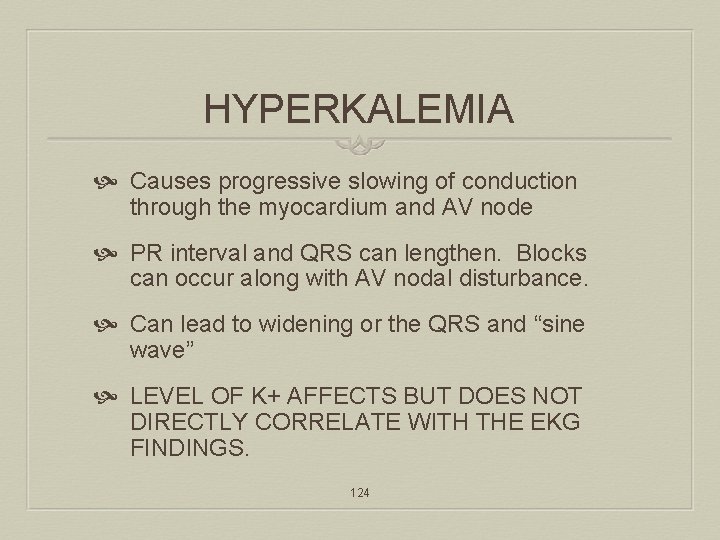
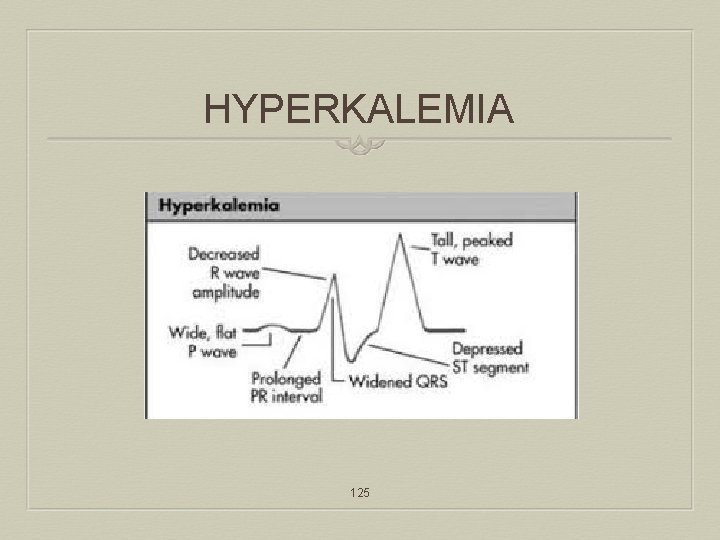
HYPERKALEMIA Causes progressive slowing of conduction through the myocardium and AV node PR interval and QRS can lengthen. Blocks can occur along with AV nodal disturbance. Can lead to widening or the QRS and “sine wave” LEVEL OF K+ AFFECTS BUT DOES NOT DIRECTLY CORRELATE WITH THE EKG FINDINGS. 124
HYPERKALEMIA 125
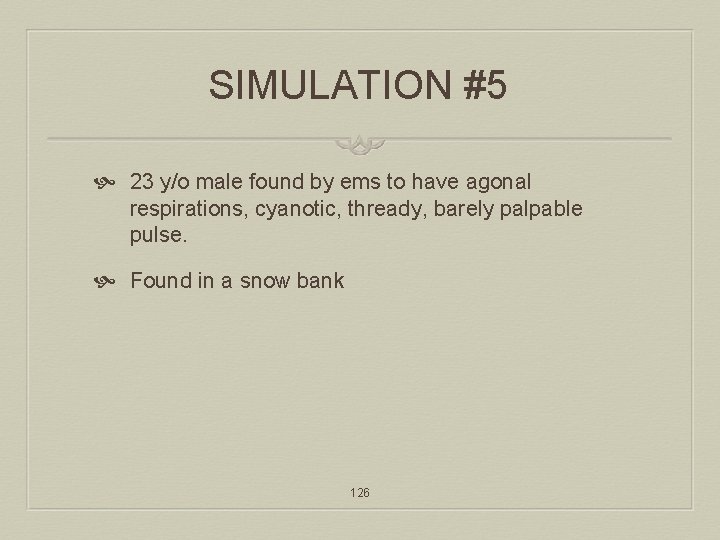
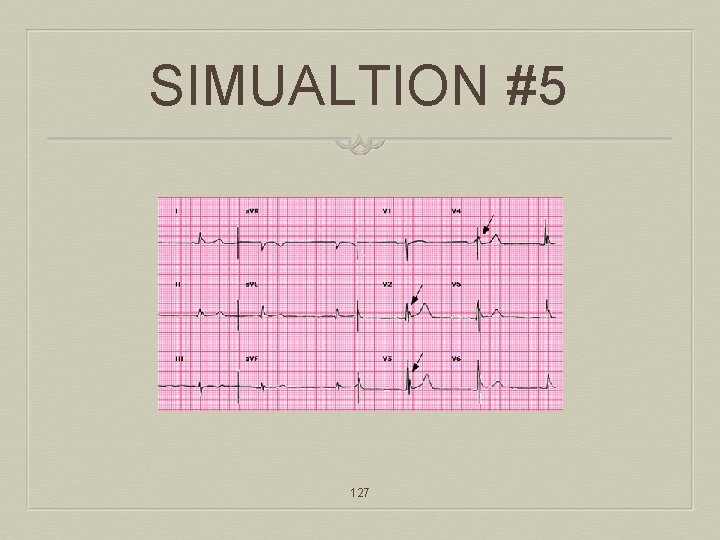
SIMULATION #5 23 y/o male found by ems to have agonal respirations, cyanotic, thready, barely palpable pulse. Found in a snow bank 126
SIMUALTION #5 127
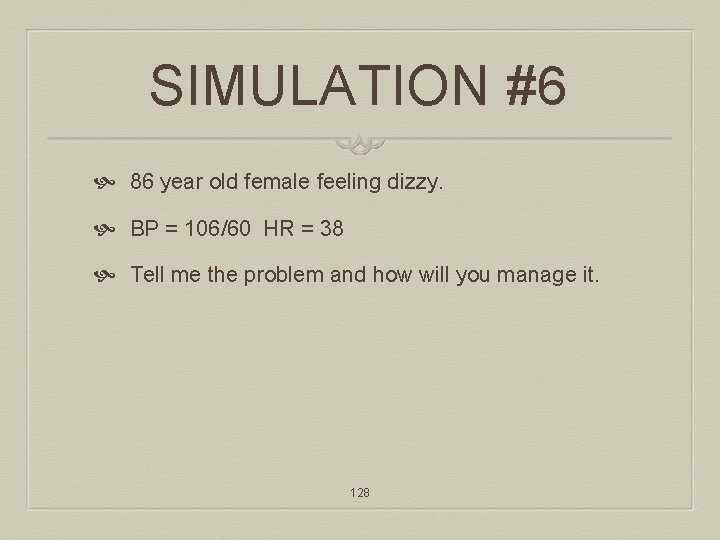
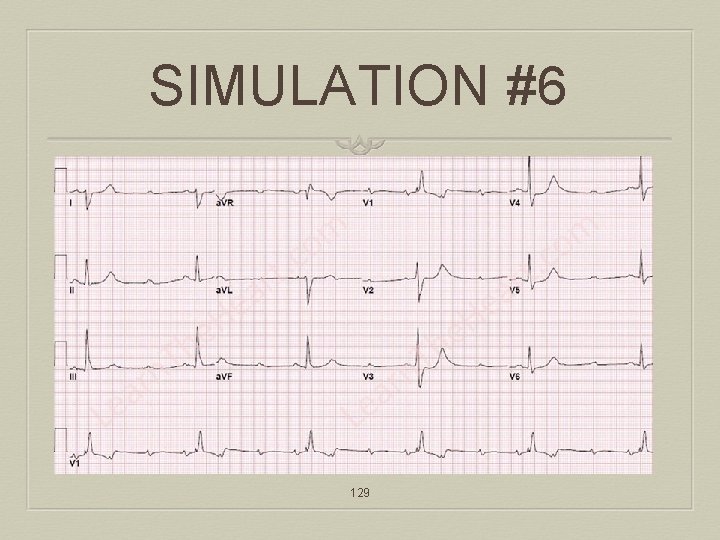
SIMULATION #6 86 year old female feeling dizzy. BP = 106/60 HR = 38 Tell me the problem and how will you manage it. 128
SIMULATION #6 129
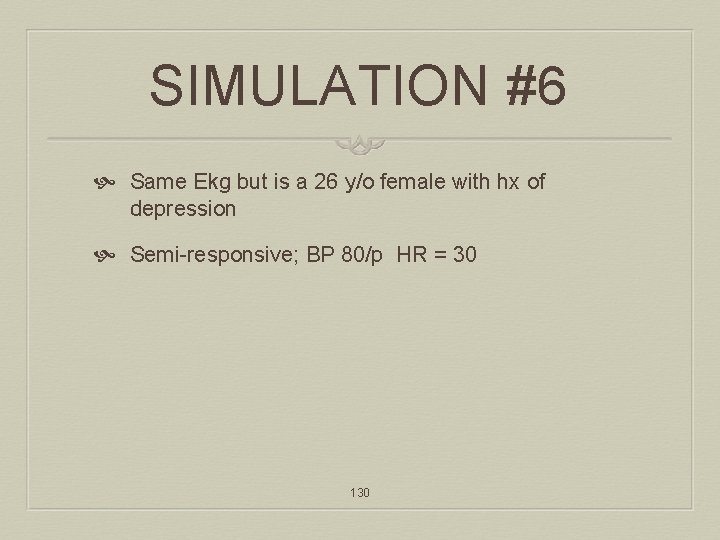
SIMULATION #6 Same Ekg but is a 26 y/o female with hx of depression Semi-responsive; BP 80/p HR = 30 130
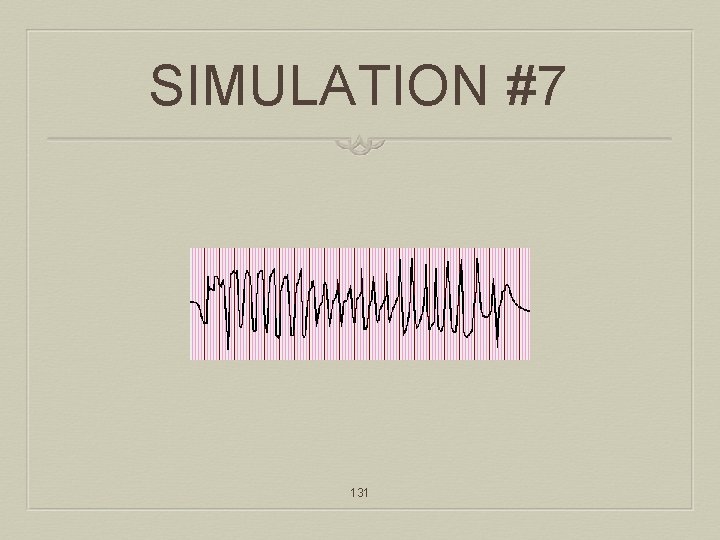
SIMULATION #7 131
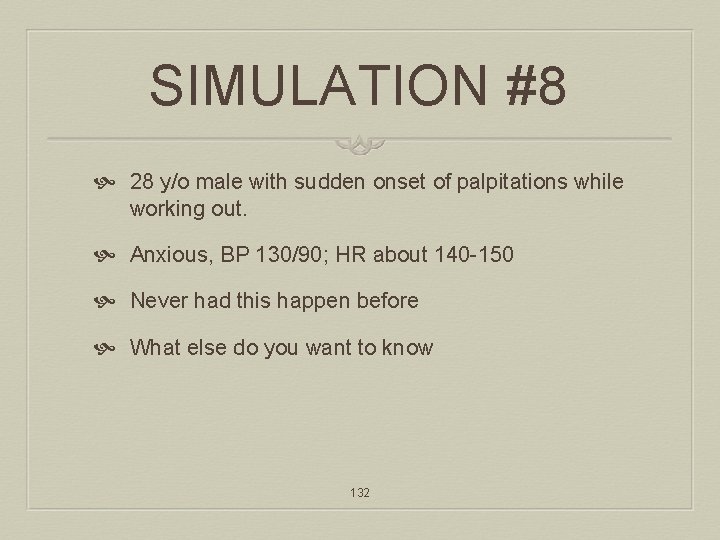
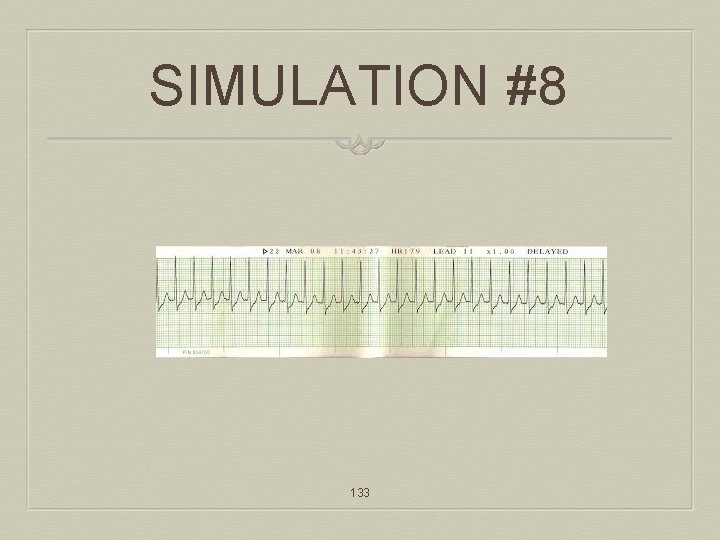
SIMULATION #8 28 y/o male with sudden onset of palpitations while working out. Anxious, BP 130/90; HR about 140 -150 Never had this happen before What else do you want to know 132
SIMULATION #8 133
SIMULATION #8 Same patient but 76 years old. Feeling dizzy. 134
REMEMBER THE ILLICIT USE OF DRUGS ARE BAD FOR YOUR HEALTH
AND IF YOU DO USE DRUGS YOU MAY LOOK LIKE THIS SOME DAY