
MME 294 EXPERIMENT 6 Heat Treatment of Steels









- Slides: 28
MME 294 EXPERIMENT 6
Heat Treatment of Steels
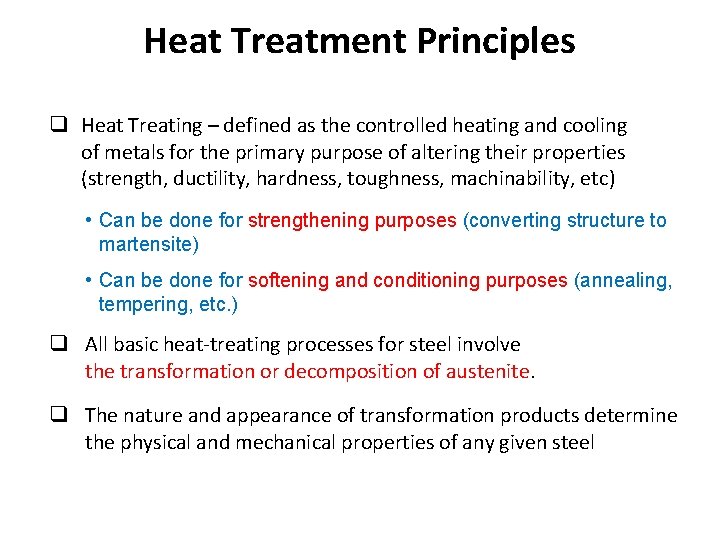
Heat Treatment Principles Heat Treating – defined as the controlled heating and cooling of metals for the primary purpose of altering their properties (strength, ductility, hardness, toughness, machinability, etc) • Can be done for strengthening purposes (converting structure to martensite) • Can be done for softening and conditioning purposes (annealing, tempering, etc. ) All basic heat-treating processes for steel involve the transformation or decomposition of austenite. The nature and appearance of transformation products determine the physical and mechanical properties of any given steel
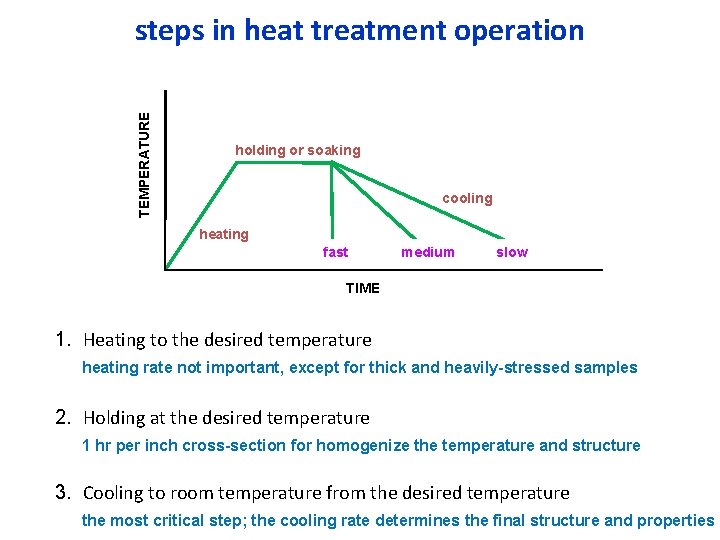
TEMPERATURE steps in heat treatment operation holding or soaking cooling heating fast medium slow TIME 1. Heating to the desired temperature heating rate not important, except for thick and heavily-stressed samples 2. Holding at the desired temperature 1 hr per inch cross-section for homogenize the temperature and structure 3. Cooling to room temperature from the desired temperature the most critical step; the cooling rate determines the final structure and properties o
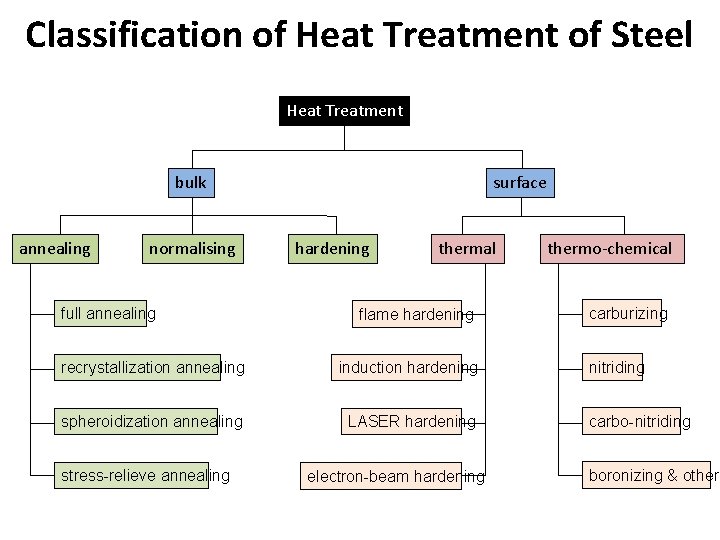
Classification of Heat Treatment of Steel Heat Treatment bulk annealing normalising full annealing surface hardening thermal flame hardening recrystallization annealing induction hardening spheroidization annealing LASER hardening stress-relieve annealing electron-beam hardening thermo-chemical carburizing nitriding carbo-nitriding boronizing & others
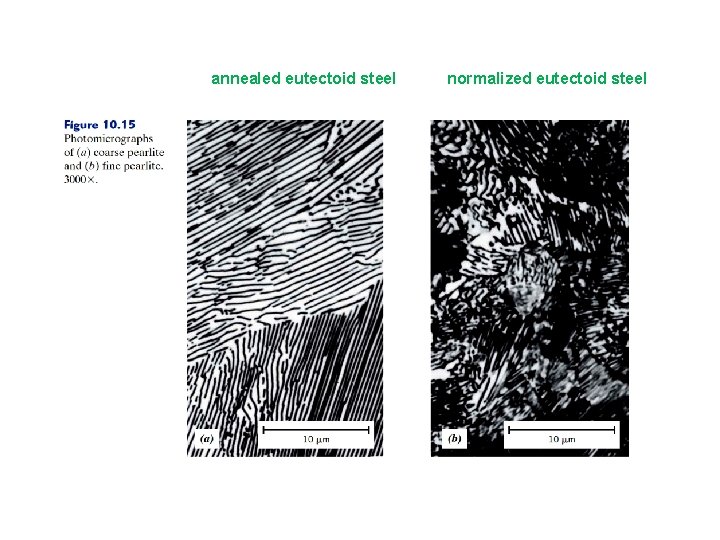
Annealing or, Full Annealing Makes a metal as soft as possible Cool slowly (preferably inside the furnace) from the austenitizing temperature. A microstructure with coarse pearlite (i. e. , pearlite having high interlamellar spacing) is resulted. Coarse pearlite has low hardness but high ductility. Hypoeutectoid steels (less than 0. 8% C) are heated above upper critical (A 3) temperature, soaked and cooled slowly Hypereutectoid steels (above 0. 80% C) are heated above lower critical (A 3, 1) temperature, soaked and cooled slowly (heating is not done above Acm to avoid forming thick cementite network due to slow cooling)
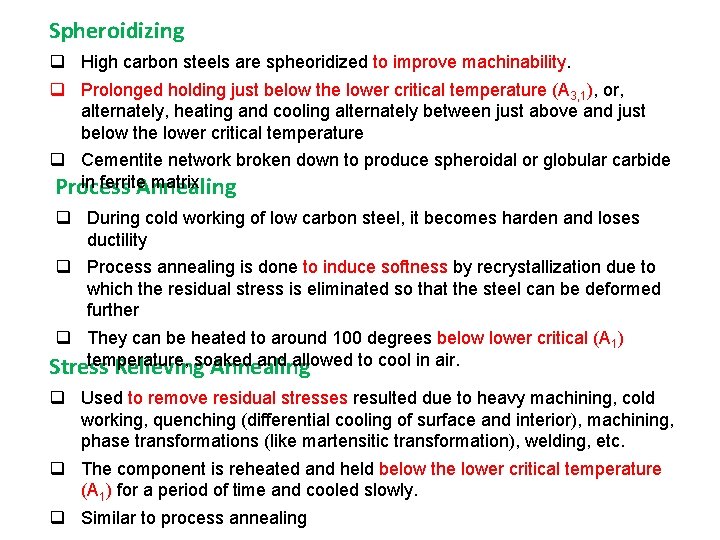
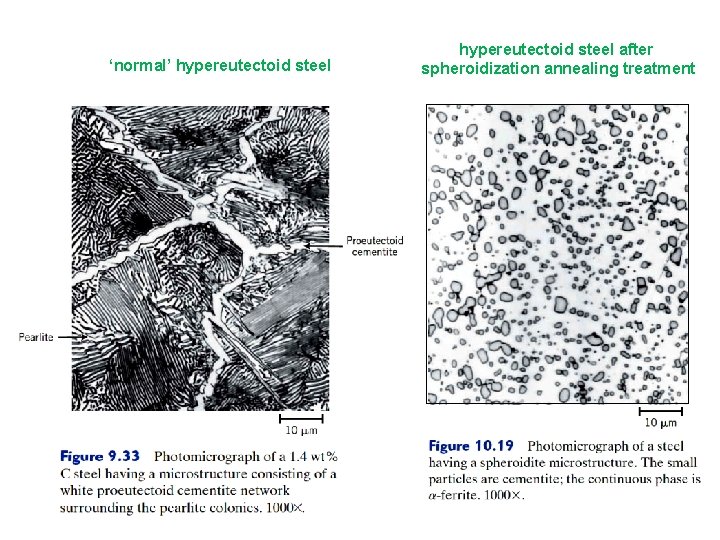
Spheroidizing High carbon steels are spheoridized to improve machinability. Prolonged holding just below the lower critical temperature (A 3, 1), or, alternately, heating and cooling alternately between just above and just below the lower critical temperature Cementite network broken down to produce spheroidal or globular carbide in ferrite matrix Process Annealing During cold working of low carbon steel, it becomes harden and loses ductility Process annealing is done to induce softness by recrystallization due to which the residual stress is eliminated so that the steel can be deformed further They can be heated to around 100 degrees below lower critical (A 1) temperature, and allowed to cool in air. Stress Relievingsoaked Annealing Used to remove residual stresses resulted due to heavy machining, cold working, quenching (differential cooling of surface and interior), machining, phase transformations (like martensitic transformation), welding, etc. The component is reheated and held below the lower critical temperature (A 1) for a period of time and cooled slowly. Similar to process annealing
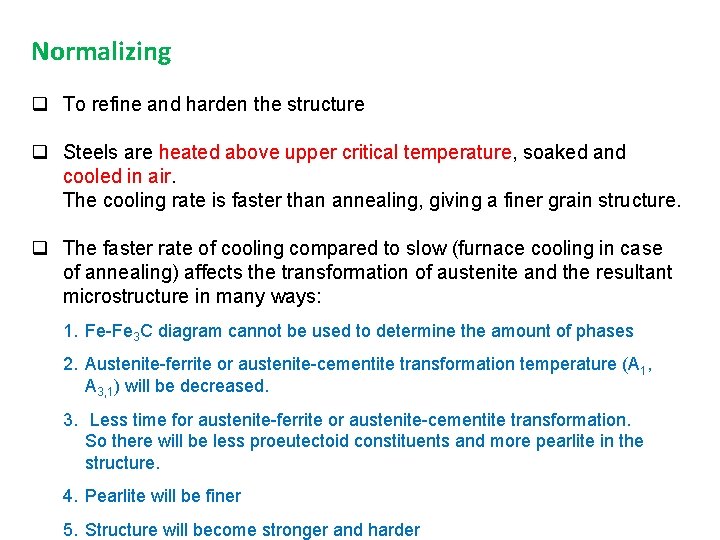
Normalizing To refine and harden the structure Steels are heated above upper critical temperature, soaked and cooled in air. The cooling rate is faster than annealing, giving a finer grain structure. The faster rate of cooling compared to slow (furnace cooling in case of annealing) affects the transformation of austenite and the resultant microstructure in many ways: 1. Fe-Fe 3 C diagram cannot be used to determine the amount of phases 2. Austenite-ferrite or austenite-cementite transformation temperature (A 1, A 3, 1) will be decreased. 3. Less time for austenite-ferrite or austenite-cementite transformation. So there will be less proeutectoid constituents and more pearlite in the structure. 4. Pearlite will be finer 5. Structure will become stronger and harder
selection of temperature Normalizing range up p up er cr iti c AUSTENITE 910°C pe temperature al, A cm 40°C above upper critical line rc rit ica Full annealing range 10°C above critical temperature line l, A 3 lower critical, A 3, 1 lower critical, A 1 723°C FERRITE + PEARLITE Spheroidizing annealing range At or near lower critical temperature line Process annealing / PEARLITE + Stress relieving annealing range. CEMENTITE 540 - 675°C / 540 - 650°C 0. 008 0. 80 wt. % carbon 2. 0
‘normal’ hypereutectoid steel after spheroidization annealing treatment
annealed eutectoid steel normalized eutectoid steel
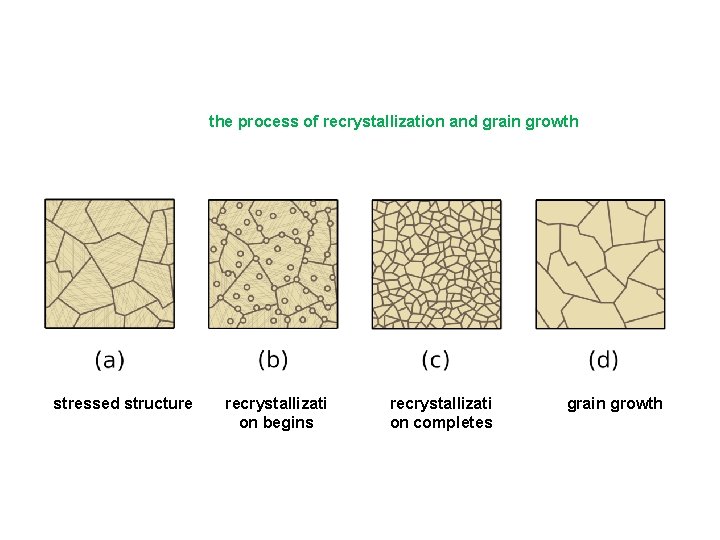
the process of recrystallization and grain growth stressed structure recrystallizati on begins recrystallizati on completes grain growth
Heat Treatment Defects 1. 2. 3. 4. Insufficient hardness Deformation / distortion Cracking Fracture during cooling
Annealing and Normalising Problem Recommend temperatures for the process annealing, normalizing, and spheroidizing of 1020, 1077, and 10120 steels.
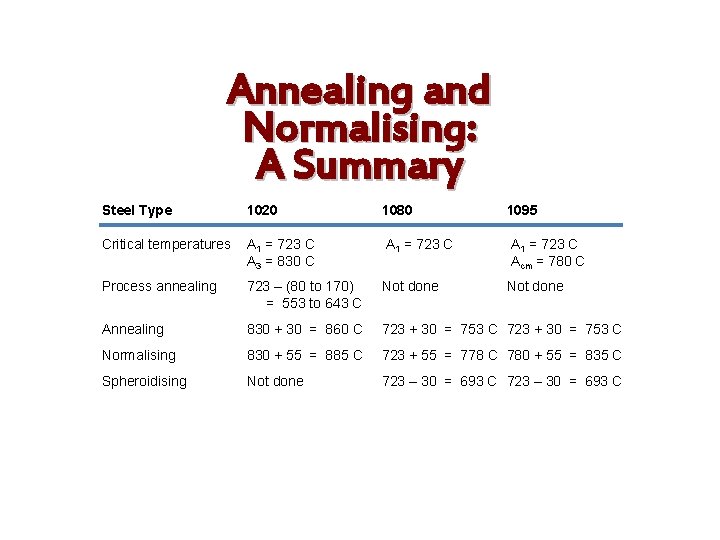
Annealing and Normalising: A Summary Steel Type 1020 1080 1095 Critical temperatures A 1 = 723 C A 3 = 830 C A 1 = 723 C Acm = 780 C Process annealing 723 – (80 to 170) = 553 to 643 C Not done Annealing 830 + 30 = 860 C 723 + 30 = 753 C Normalising 830 + 55 = 885 C 723 + 55 = 778 C 780 + 55 = 835 C Spheroidising Not done 723 – 30 = 693 C
Q. For a 99. 5 wt% Fe – 0. 5 wt% C alloy at a temperature just below the eutectoid, determine the tensile strength of the steel in full annealed condition. == The fractions of proeutectoid ferrite and pearlite are determined by lever rule: W(p) = 0. 5 -0. 025/0. 8 -0. 025 = 0. 61 And W(α) = 0. 8 -0. 5/0. 8 -0. 025 = 0. 39 Now the ultimate tensile strength = fraction of ferrite x 40000 + fraction of pearlite x 120000 = 0. 39 x 40000 + 0. 61 x 120000 = 88800 psi = 612 MPa The YS of the steel = 0. 5 x UTS = 306 MPa psi x 4. 45 / 645 = MPa
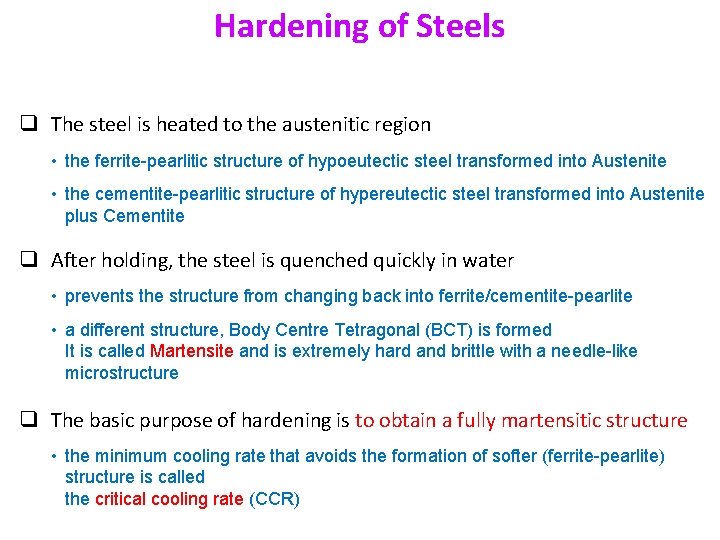
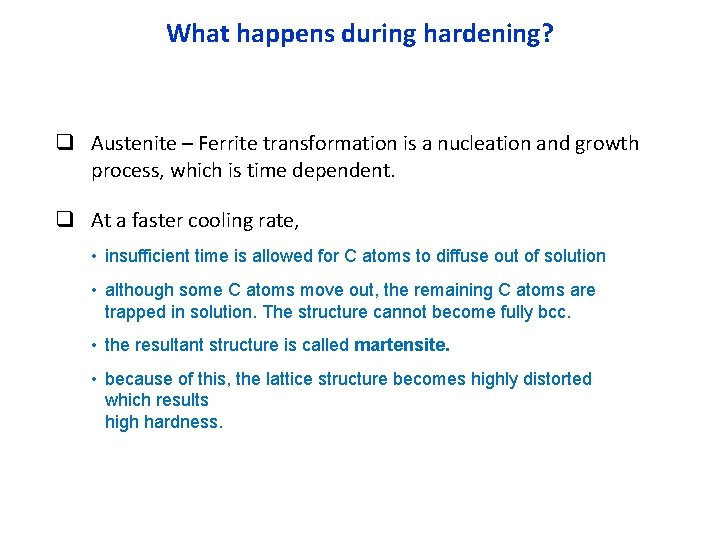
Hardening of Steels The steel is heated to the austenitic region • the ferrite-pearlitic structure of hypoeutectic steel transformed into Austenite • the cementite-pearlitic structure of hypereutectic steel transformed into Austenite plus Cementite After holding, the steel is quenched quickly in water • prevents the structure from changing back into ferrite/cementite-pearlite • a different structure, Body Centre Tetragonal (BCT) is formed It is called Martensite and is extremely hard and brittle with a needle-like microstructure The basic purpose of hardening is to obtain a fully martensitic structure • the minimum cooling rate that avoids the formation of softer (ferrite-pearlite) structure is called the critical cooling rate (CCR)
up p up er cr iti c AUSTENITE 910°C pe temperature al, A cm Heating temperatures for hardening of steels rc rit ica l, A Hardening range 10°C above critical temperature line 3 723°C 0. 008 AISI 1120 steel @ 723 °C lower critical, A 1 lower critical, A 3, 1 FERRITE + PEARLITE + CEMENTITE 0. 80 wt. % carbon Austenite = 93. 2 % Cementite = 6. 8 % 2. 0
What happens during hardening? Austenite – Ferrite transformation is a nucleation and growth process, which is time dependent. At a faster cooling rate, • insufficient time is allowed for C atoms to diffuse out of solution • although some C atoms move out, the remaining C atoms are trapped in solution. The structure cannot become fully bcc. • the resultant structure is called martensite. • because of this, the lattice structure becomes highly distorted which results high hardness.
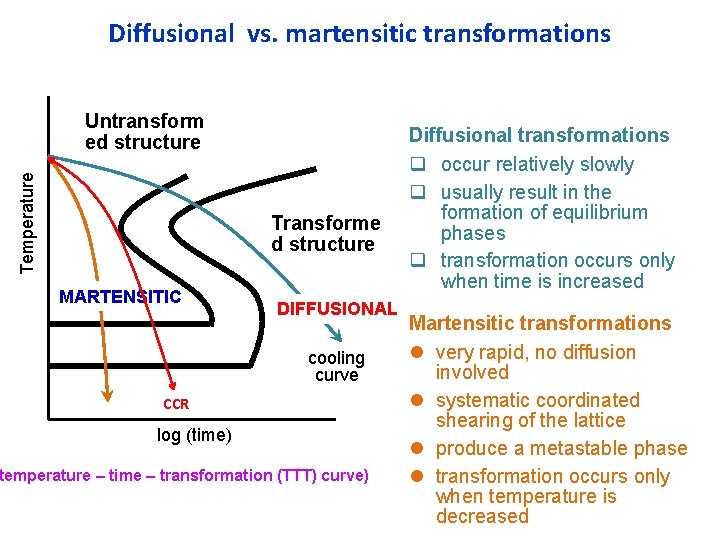
Diffusional vs. martensitic transformations Temperature Untransform ed structure Transforme d structure MARTENSITIC DIFFUSIONAL cooling curve CCR log (time) temperature – time – transformation (TTT) curve) Diffusional transformations occur relatively slowly usually result in the formation of equilibrium phases transformation occurs only when time is increased Martensitic transformations very rapid, no diffusion involved systematic coordinated shearing of the lattice produce a metastable phase transformation occurs only when temperature is decreased
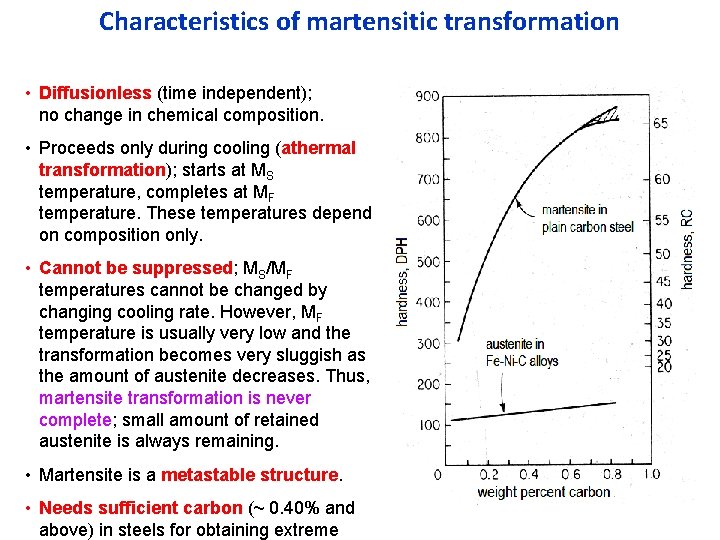
Characteristics of martensitic transformation • Diffusionless (time independent); no change in chemical composition. • Proceeds only during cooling (athermal transformation); starts at MS temperature, completes at MF temperature. These temperatures depend on composition only. • Cannot be suppressed; MS/MF temperatures cannot be changed by changing cooling rate. However, MF temperature is usually very low and the transformation becomes very sluggish as the amount of austenite decreases. Thus, martensite transformation is never complete; small amount of retained austenite is always remaining. • Martensite is a metastable structure. • Needs sufficient carbon (~ 0. 40% and above) in steels for obtaining extreme
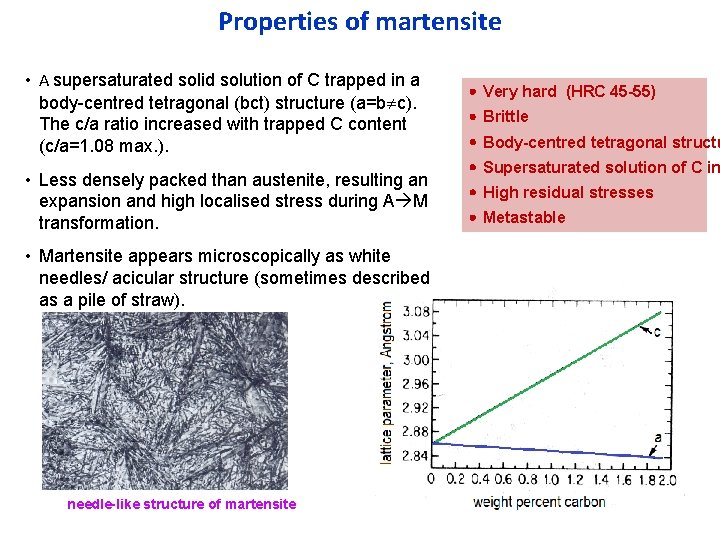
Properties of martensite • A supersaturated solid solution of C trapped in a body-centred tetragonal (bct) structure (a=b c). The c/a ratio increased with trapped C content (c/a=1. 08 max. ). • Less densely packed than austenite, resulting an expansion and high localised stress during A M transformation. • Martensite appears microscopically as white needles/ acicular structure (sometimes described as a pile of straw). needle-like structure of martensite Very hard (HRC 45 -55) Brittle Body-centred tetragonal structu Supersaturated solution of C in High residual stresses Metastable
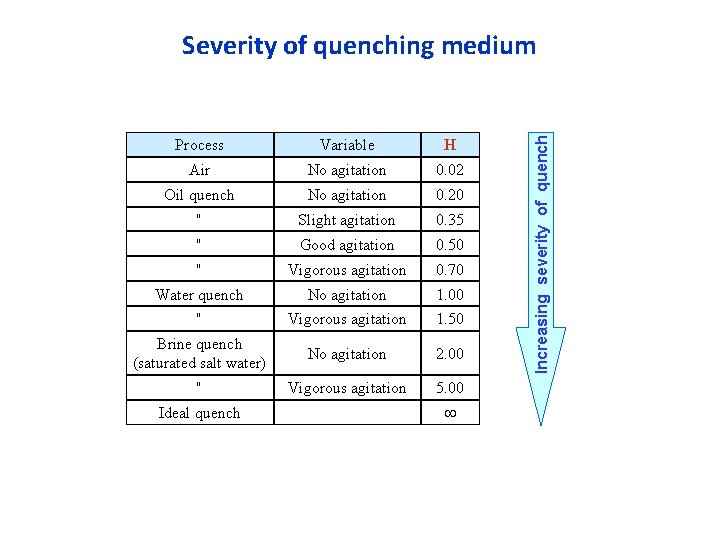
Process Variable H Air No agitation 0. 02 Oil quench No agitation 0. 20 " Slight agitation 0. 35 " Good agitation 0. 50 " Vigorous agitation 0. 70 Water quench No agitation 1. 00 " Vigorous agitation 1. 50 Brine quench (saturated salt water) No agitation 2. 00 " Vigorous agitation 5. 00 Ideal quench Increasing severity of quench Severity of quenching medium
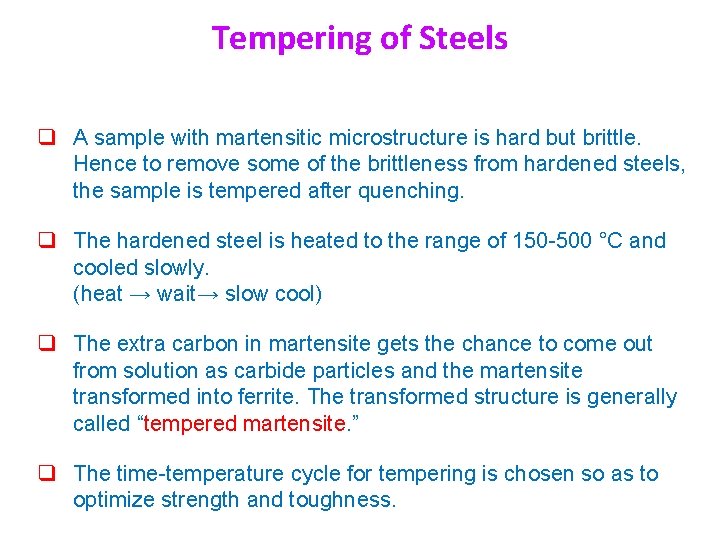
Tempering of Steels A sample with martensitic microstructure is hard but brittle. Hence to remove some of the brittleness from hardened steels, the sample is tempered after quenching. The hardened steel is heated to the range of 150 -500 °C and cooled slowly. (heat → wait→ slow cool) The extra carbon in martensite gets the chance to come out from solution as carbide particles and the martensite transformed into ferrite. The transformed structure is generally called “tempered martensite. ” The time-temperature cycle for tempering is chosen so as to optimize strength and toughness.
Purpose of tempering To reduce hardness (too brittle for most applications) To improve ductility (at the sacrifice of hardness or strength) and toughne To relieve residual stresses
globular carbide precipitate microstructure of tempered martensite
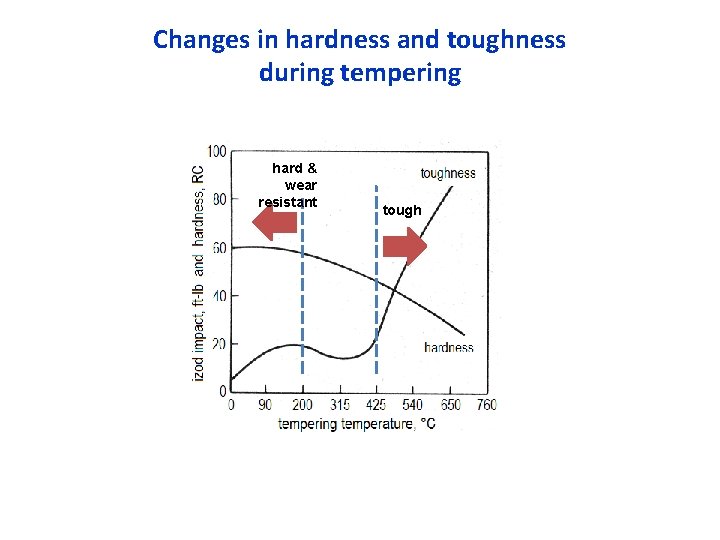
Changes in hardness and toughness during tempering hard & wear resistant tough
(a)What is the principal reason of hardening a steel sample? (b)Indicate why low carbon steels are not hardened. (c) List the salient features of martensitic transformation. (d)Why tempering is necessary after heat treatment? (e)What happens to the hardened structure during tempering?