
2016 Cengage Learning All rights reserved For classroom


- Slides: 67
© 2016. Cengage Learning. All rights reserved. For classroom use only. Diane R. Gehart “The key thread that binds these diverse perspectives [behavioral therapies] is a demand for continual empirical challenge. Every strategy, and every case, is subjected to empirical scrutiny that aims to define the specific therapeutic ingredients that facilitate the achievement of the specific benefits desired by the family. In other words, every family presents a new experiment with the potential to advance therapeutic frontiers. ”—Falloon, 1991, p. 65 Theory and Treatment Planning in Family Therapy Chapter 8: Cognitive. Behavioral and Mindfulness. Based Couple and Family Therapies 1
• • • Behavioral family therapy Cognitive-behavioral family therapy Integrative behavioral couples therapy Gottman method couples therapy Functional family therapy © 2016. Cengage Learning. All rights reserved. For classroom use only. Diane R. Gehart Prominent CBFT Approaches Theory and Treatment Planning in Family Therapy LAY OF THE LAND
Diane R. Gehart Theory and Treatment Planning in Family Therapy BEHAVIORAL AND COGNITIVE-BEHAVIORAL FAMILY THERAPIES © 2016. Cengage Learning. All rights reserved. For classroom use only.
• Roots in behaviorism; the premises of which are still widely used with phobias, anxiety, and parenting • Family CBTs (CBFT) integrate systemic concepts into standard cognitive-behavioral techniques • Examining how family members reinforce one another’s behaviors to maintain symptoms and relational patterns • Therapists assume directive, “teaching” relationship with clients © 2016. Cengage Learning. All rights reserved. For classroom use only. Diane R. Gehart Cognitive-Behavioral Therapies (CBTs): Theory and Treatment Planning in Family Therapy In a Nutshell: The Least You Need to Know
Diane R. Gehart Theory and Treatment Planning in Family Therapy THE JUICE: SIGNIFICANT CONTRIBUTIONS TO THE FIELD © 2016. Cengage Learning. All rights reserved. For classroom use only.
• Reinforcement: positive or negative responses from environment shape future behavior • Consistency: reinforcing every time, is the key, especially in the beginning Parent Training • • • Teaching compliance and socialization Improving parental requests Monitoring and tracking Creating a contingent environment Five-minute work chore © 2016. Cengage Learning. All rights reserved. For classroom use only. Diane R. Gehart Key Principles Theory and Treatment Planning in Family Therapy Parent Training
Diane R. Gehart Theory and Treatment Planning in Family Therapy RUMOR HAS IT: THE PEOPLE AND THEIR STORIES © 2016. Cengage Learning. All rights reserved. For classroom use only.
Gerald Patterson and Marion Forgatch Neil Jacobson and Andrew Christensen Norman Epstein John Gottman Frank Dattilio © 2016. Cengage Learning. All rights reserved. For classroom use only. Diane R. Gehart • • • Theory and Treatment Planning in Family Therapy Significant Contributors
Diane R. Gehart Theory and Treatment Planning in Family Therapy THE BIG PICTURE: OVERVIEW OF TREATMENT © 2016. Cengage Learning. All rights reserved. For classroom use only.
• • Assessment Target behaviors and thoughts for change Educate Replace and retrain © 2016. Cengage Learning. All rights reserved. For classroom use only. Diane R. Gehart 4 Steps To The Process Theory and Treatment Planning in Family Therapy Process for CBFTs
Diane R. Gehart Theory and Treatment Planning in Family Therapy MAKING CONNECTION: THERAPEUTIC RELATIONSHIP © 2016. Cengage Learning. All rights reserved. For classroom use only.
• Expert who directs and educates on how to better manage problems • Empathy in CBT • Used to create rapport • Contemporary Cognitive-behavioral Alliance • 5 practices • Written Contracts • Spell out goals and expectations to help structure the relationship and to increase clients’ motivation © 2016. Cengage Learning. All rights reserved. For classroom use only. Diane R. Gehart • Directive Educator And Expert Theory and Treatment Planning in Family Therapy Therapeutic Relationship
Diane R. Gehart Theory and Treatment Planning in Family Therapy THE VIEWING: CASE CONCEPTUALIZATION AND ASSESSMENT © 2016. Cengage Learning. All rights reserved. For classroom use only.
• Assessment of baseline functioning • Functional analysis and mutually reinforcing behaviors • A-B-C theory • Family schemas and core beliefs • Couple cognition types © 2016. Cengage Learning. All rights reserved. For classroom use only. Diane R. Gehart Defining Problems Theory and Treatment Planning in Family Therapy Defining Problems
Diane R. Gehart Theory and Treatment Planning in Family Therapy TARGETING CHANGE: GOAL SETTING © 2016. Cengage Learning. All rights reserved. For classroom use only.
• Use authoritative role to identify goals that are agreeable to all • Commitment • Obtain explicit commitment from couple or family to complete out-of-therapy assignments, often with a written contract © 2016. Cengage Learning. All rights reserved. For classroom use only. Diane R. Gehart • Behavioral and Measurable • Agreeable Theory and Treatment Planning in Family Therapy General Goals
Diane R. Gehart Theory and Treatment Planning in Family Therapy THE DOING: INTERVENTIONS © 2016. Cengage Learning. All rights reserved. For classroom use only.
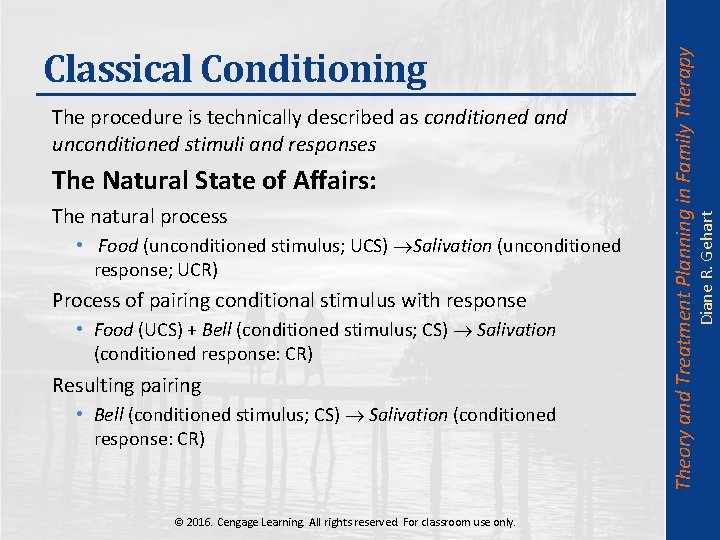
The Natural State of Affairs: The natural process • Food (unconditioned stimulus; UCS) Salivation (unconditioned response; UCR) Process of pairing conditional stimulus with response • Food (UCS) + Bell (conditioned stimulus; CS) Salivation (conditioned response: CR) Resulting pairing • Bell (conditioned stimulus; CS) Salivation (conditioned response: CR) © 2016. Cengage Learning. All rights reserved. For classroom use only. Diane R. Gehart The procedure is technically described as conditioned and unconditioned stimuli and responses Theory and Treatment Planning in Family Therapy Classical Conditioning
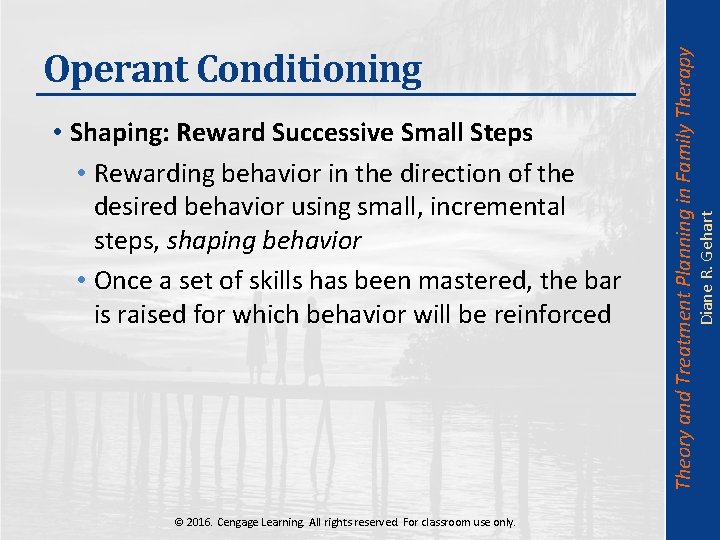
© 2016. Cengage Learning. All rights reserved. For classroom use only. Diane R. Gehart • Shaping: Reward Successive Small Steps • Rewarding behavior in the direction of the desired behavior using small, incremental steps, shaping behavior • Once a set of skills has been mastered, the bar is raised for which behavior will be reinforced Theory and Treatment Planning in Family Therapy Operant Conditioning
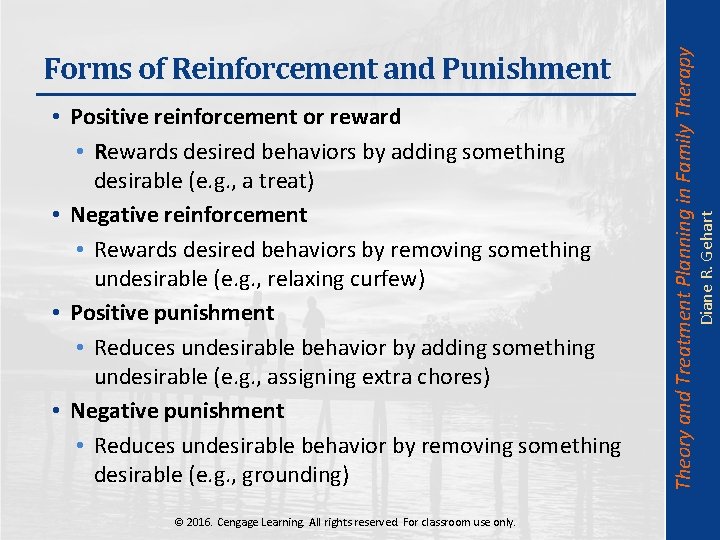
© 2016. Cengage Learning. All rights reserved. For classroom use only. Diane R. Gehart • Positive reinforcement or reward • Rewards desired behaviors by adding something desirable (e. g. , a treat) • Negative reinforcement • Rewards desired behaviors by removing something undesirable (e. g. , relaxing curfew) • Positive punishment • Reduces undesirable behavior by adding something undesirable (e. g. , assigning extra chores) • Negative punishment • Reduces undesirable behavior by removing something desirable (e. g. , grounding) Theory and Treatment Planning in Family Therapy Forms of Reinforcement and Punishment
• The more immediate the reinforcement or punishment, the quicker the learning • Consistency • The more consistent the reinforcement or punishment, the quicker the learning • Intermittent Reinforcement • Random positive reinforcement of well-established desired behaviors helps sustain them © 2016. Cengage Learning. All rights reserved. For classroom use only. Diane R. Gehart • Immediacy Theory and Treatment Planning in Family Therapy Frequency of Reinforcement and Punishment
• Encourage positive reinforcement to increase desired behavior with children • Increase compliments and expressions of appreciation to increase positive reinforcement © 2016. Cengage Learning. All rights reserved. For classroom use only. Diane R. Gehart • Stay Positive Theory and Treatment Planning in Family Therapy Encouragement and Compliments
• Promote new behaviors by creating a contingency that must be met to receive a desired reward • Privileges • Parents can use contingency contracting with children that detail how privileges will be earned and lost • Example • If child’s GPA is above 3. 0, the parents agree to an 11: 00 P. M. curfew on Friday and Saturday © 2016. Cengage Learning. All rights reserved. For classroom use only. Diane R. Gehart • Contingencies Theory and Treatment Planning in Family Therapy Contingency Contracting
• Used to shape and reward positive behaviors by allowing children to build up points or tokens • Rewards should be appropriate and readily approved by the parent • In most cases, punishment is added by the child losing points/tokens for poor behavior © 2016. Cengage Learning. All rights reserved. For classroom use only. Diane R. Gehart • Point Charts/Token Economies Theory and Treatment Planning in Family Therapy Point Charts and Token Economies
• Help partners negotiate relational rules • “If you make dinner, I will do the dishes” • Used Judiciously with Couples • Balance with more affective techniques to to avoid framing marriage as a business deal • Giving vs. Receiving • Have each partner select a behavior to “give” rather than have each “ask” for what he/she wants © 2016. Cengage Learning. All rights reserved. For classroom use only. Diane R. Gehart • Mutual Behavior Exchanges Theory and Treatment Planning in Family Therapy Behavior Exchange and Quid Pro Quo
• • Begin with the positive Single subject Specific, behavioral problems Describe impact Take responsibility Paraphrase Avoid mind-reading Disallow verbal abuse © 2016. Cengage Learning. All rights reserved. For classroom use only. Diane R. Gehart Communication Training Theory and Treatment Planning in Family Therapy Communication and Problem-Solving
• Teaching clients psychological and relational principles about their problems and how best to handle them • Categories • • Problem-oriented Change-oriented Bibliotherapy Cinema therapy © 2016. Cengage Learning. All rights reserved. For classroom use only. Diane R. Gehart • In-Session Education Theory and Treatment Planning in Family Therapy Psychoeducation
• Client is explicitly told that the belief is irrational • Indirect Confrontation • Therapist uses series of questions to help client see how the belief is irrational and/or contributing to the problem © 2016. Cengage Learning. All rights reserved. For classroom use only. Diane R. Gehart • Direct Confrontation Theory and Treatment Planning in Family Therapy Challenging Irrational Beliefs
• Uses inductive reasoning • Gently encourages clients to question own beliefs • Open-ended questions that help clients to “discover” that their beliefs are illogical/dysfunctional • Therapist is neutral, allowing client’s own logic, evidence, and reason to do the convincing © 2016. Cengage Learning. All rights reserved. For classroom use only. Diane R. Gehart Guided Discovery Theory and Treatment Planning in Family Therapy Socratic Method and Guided Discovery
• Clients analyze their own cognitions and behaviors on paper • Thought records generally include the following information: • • Trigger situation “Automatic” or negative thoughts Emotional response Evidence for Evidence against Cognitive distortions Alternative thought © 2016. Cengage Learning. All rights reserved. For classroom use only. Diane R. Gehart • Structured Journal Theory and Treatment Planning in Family Therapy Thought Records
• Tasks are designed to solve the client’s problem • Clients expected to do tasks • Example: To reduce couple’s conflict, therapists may assign communication tasks • In CBFT, the tasks are logical solutions to reported problems © 2016. Cengage Learning. All rights reserved. For classroom use only. Diane R. Gehart • Homework Theory and Treatment Planning in Family Therapy Homework Tasks
Diane R. Gehart Theory and Treatment Planning in Family Therapy MINDFULNESS-BASED THERAPIES © 2016. Cengage Learning. All rights reserved. For classroom use only.
transform them • Compassion • Encourage clients to curiously and compassionately observe difficult thoughts and feelings without the intention to change them • Shift Relationship to Problem • By changing how clients relate to problems, they experience new thoughts, emotions, and behaviors in relation to the problem • Buddhism and Constructivism • Practices rooted in Buddhist psychology, essentially a constructivist philosophy © 2016. Cengage Learning. All rights reserved. For classroom use only. Diane R. Gehart • Mindfulness • Intentional focus on present moment experience without judgement • Acceptance • Involves accepting difficult thoughts and emotions in order to Theory and Treatment Planning in Family Therapy In a Nutshell: The Least You Need to Know
Diane R. Gehart Theory and Treatment Planning in Family Therapy A BRIEF HISTORY OF MINDFULNESS IN MENTAL HEALTH © 2016. Cengage Learning. All rights reserved. For classroom use only.
• Associated with Buddhist forms of meditation • Most world religions have some form of mindfulness (e. g. centering prayer for Christian/Catholic) • Mindfulness-Based Therapies • Mindfulness Based Stress Reduction (MBSR): Original 8 -week group curriculum that teaches mindful breathing, yoga postures, and mindful daily activities • Many similar programs for specific populations: depression, eating disorders, substance, couples, etc. • Mindfulness-Informed Approaches • Dialectic Behavioral Therapy • Acceptance And Commitment Therapy • Use Concepts © 2016. Cengage Learning. All rights reserved. For classroom use only. Diane R. Gehart • Buddhism Theory and Treatment Planning in Family Therapy Mindfulness Origins
Diane R. Gehart Theory and Treatment Planning in Family Therapy MINDFULNESS BASICS © 2016. Cengage Learning. All rights reserved. For classroom use only.
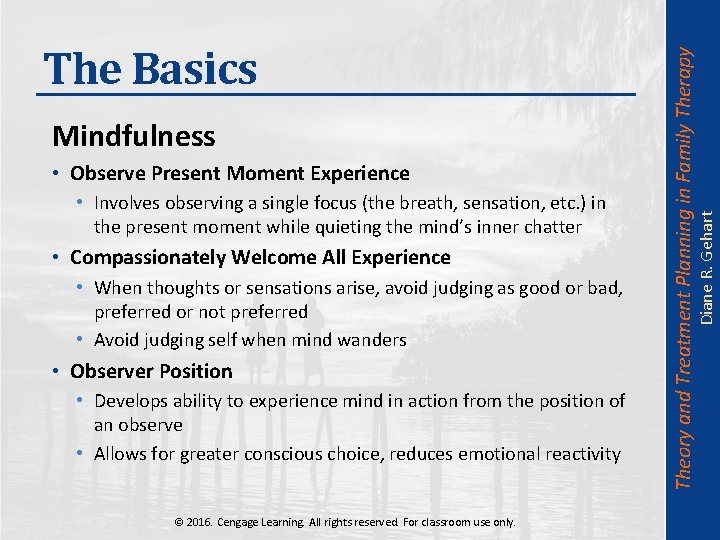
• Observe Present Moment Experience • Involves observing a single focus (the breath, sensation, etc. ) in the present moment while quieting the mind’s inner chatter • Compassionately Welcome All Experience • When thoughts or sensations arise, avoid judging as good or bad, preferred or not preferred • Avoid judging self when mind wanders • Observer Position • Develops ability to experience mind in action from the position of an observe • Allows for greater conscious choice, reduces emotional reactivity © 2016. Cengage Learning. All rights reserved. For classroom use only. Diane R. Gehart Mindfulness Theory and Treatment Planning in Family Therapy The Basics
Diane R. Gehart Theory and Treatment Planning in Family Therapy SPECIFIC MINDFULNESS APPROACHES © 2016. Cengage Learning. All rights reserved. For classroom use only.
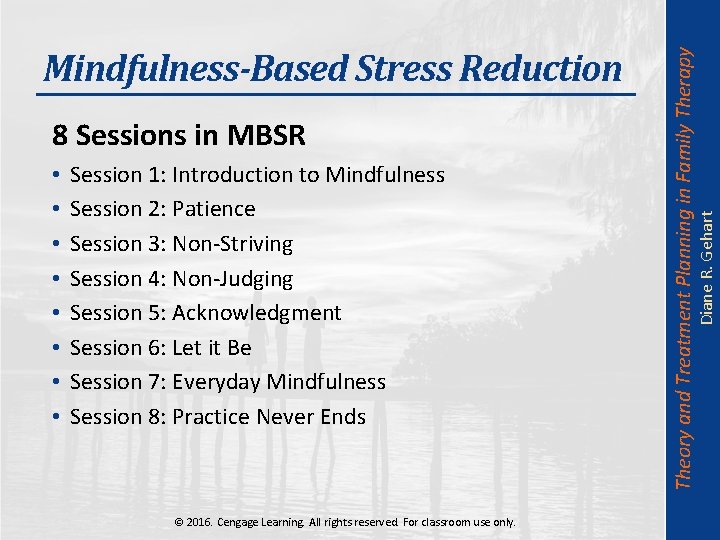
• • Session 1: Introduction to Mindfulness Session 2: Patience Session 3: Non-Striving Session 4: Non-Judging Session 5: Acknowledgment Session 6: Let it Be Session 7: Everyday Mindfulness Session 8: Practice Never Ends © 2016. Cengage Learning. All rights reserved. For classroom use only. Diane R. Gehart 8 Sessions in MBSR Theory and Treatment Planning in Family Therapy Mindfulness-Based Stress Reduction
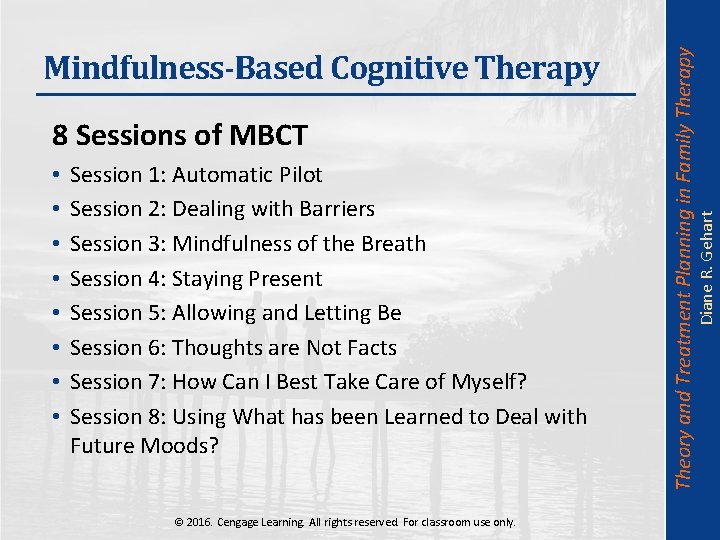
• • Session 1: Automatic Pilot Session 2: Dealing with Barriers Session 3: Mindfulness of the Breath Session 4: Staying Present Session 5: Allowing and Letting Be Session 6: Thoughts are Not Facts Session 7: How Can I Best Take Care of Myself? Session 8: Using What has been Learned to Deal with Future Moods? © 2016. Cengage Learning. All rights reserved. For classroom use only. Diane R. Gehart 8 Sessions of MBCT Theory and Treatment Planning in Family Therapy Mindfulness-Based Cognitive Therapy
• Used to Help clients be present with, tolerate, and accept strong emotions in order to transform them • Client’s attempts to avoid painful emotions are root of the problem • Dialectics • Manage dialectic tension, the tension between two polar opposites • Helps clients increase balance in their lives by managing inherent dialectical tensions © 2016. Cengage Learning. All rights reserved. For classroom use only. Diane R. Gehart • Mindfulness Theory and Treatment Planning in Family Therapy Dialectical Behavior Therapy
• Construct realities through language, which shapes our thoughts, feelings, and behaviors • Attempts to control thoughts/feelings and avoid direct experience • Advocate experiencing to promote acceptance of full range of human emotions Basic Process • A= Accept and embrace difficult thoughts and feelings • C=Choose and commit to a life direction that reflects who the client truly is • T=Take action steps towards this life direction © 2016. Cengage Learning. All rights reserved. For classroom use only. Diane R. Gehart ACT (Pronounced “Act”) Theory and Treatment Planning in Family Therapy Acceptance and Commitment Therapy
• Cultivating mindfulness may be particularly helpful for couples • Predicted greater marital satisfaction, lower emotional stress after conflict, and better communication • Mindfulness-Based Relationship Enhancement: Group for nondistressed couples • Families • Several mindfulness-based parenting programs have been developed and researched • Mindful parenting • Mindfulness-based parenting training • Mindfulness-based childbirth and parenting © 2016. Cengage Learning. All rights reserved. For classroom use only. Diane R. Gehart • Couples Theory and Treatment Planning in Family Therapy Mindfulness in Couple and Family Therapy
• Closely related to mindfulness • Involves sending well wishes to various people • Preferred meditation when working with couples and families Basic Format • “May [Person X] be happy, health, and at peace. ” • Person X = • • • Neutral other (acquaintance) Intimate other Enemy or difficult relationship Self Everyone © 2016. Cengage Learning. All rights reserved. For classroom use only. Diane R. Gehart Compassion Meditation Theory and Treatment Planning in Family Therapy Compassion Meditation
Diane R. Gehart Theory and Treatment Planning in Family Therapy GOTTMAN METHOD COUPLES THERAPY APPROACH © 2016. Cengage Learning. All rights reserved. For classroom use only.
• Developed from observational and longitudinal research on communication differences between couples who stayed together and ones who divorced • The therapist coaches couples to develop interaction patterns that distinguish successful marriages • Grounded entirely in research results rather than theory; not evidence-based but evidence-informed © 2016. Cengage Learning. All rights reserved. For classroom use only. Diane R. Gehart Gottman’s Model Theory and Treatment Planning in Family Therapy In a Nutshell: The Least You Need to Know
Diane R. Gehart Theory and Treatment Planning in Family Therapy DEBUNKING MARITAL MYTHS © 2016. Cengage Learning. All rights reserved. For classroom use only.
FALSE • All married couples engage in defensiveness, criticism, and stonewalling • Contempt, is seen mostly in marriages heading for divorce • Couples who stay together maintain a ratio of 5: 1 positive-to-negative interactions during conflict • 20: 1 during non-conflict conversations • Improving communication not as important as increasing the ratio of positive to negative interactions © 2016. Cengage Learning. All rights reserved. For classroom use only. Diane R. Gehart Communication Training Helps Couples Stay Together : Theory and Treatment Planning in Family Therapy Myth 1: Communication Training Helps
• Expressing anger does not predict divorce • Contempt (feeling superior to one’s partner) and defensiveness do • Anger associated with lower marital satisfaction in the short term, increased marital satisfaction long term © 2016. Cengage Learning. All rights reserved. For classroom use only. Diane R. Gehart Anger is Bad: FALSE Theory and Treatment Planning in Family Therapy Myth 2: Anger Is a Dangerous Emotion
• Quid pro quo actually characterizes unhappy marriages • Contingency contracting is not appropriate when treating couples © 2016. Cengage Learning. All rights reserved. For classroom use only. Diane R. Gehart This for That: NOT ALL THAT Theory and Treatment Planning in Family Therapy Myth 3: Quid Pro Quo Error
Diane R. Gehart Theory and Treatment Planning in Family Therapy THE BIG PICTURE: OVERVIEW OF TREATMENT © 2016. Cengage Learning. All rights reserved. For classroom use only.
• • • A positive affect experience Primarily dyadic experience Emotional learning Easy Non-idealistic © 2016. Cengage Learning. All rights reserved. For classroom use only. Diane R. Gehart Assessment • Highly detailed system with numerous written and oral assessment tools Intervention • Extensive psychoeducation about what works and what does not • Should include: Theory and Treatment Planning in Family Therapy The Process
Diane R. Gehart Theory and Treatment Planning in Family Therapy MAKING CONNECTION: THERAPEUTIC RELATIONSHIP © 2016. Cengage Learning. All rights reserved. For classroom use only.
• Empowers couples to take ownership of their relationship • Therapist does not soothe but coaches couple to soothe themselves and each other © 2016. Cengage Learning. All rights reserved. For classroom use only. Diane R. Gehart Relationship Coach Theory and Treatment Planning in Family Therapist as Coach
Diane R. Gehart Theory and Treatment Planning in Family Therapy THE VIEWING: CASE CONCEPTUALIZATION AND ASSESSMENT © 2016. Cengage Learning. All rights reserved. For classroom use only.
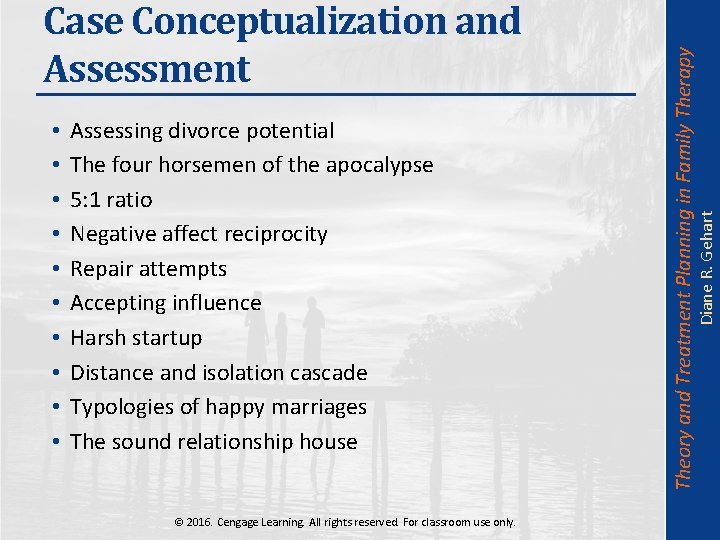
Assessing divorce potential The four horsemen of the apocalypse 5: 1 ratio Negative affect reciprocity Repair attempts Accepting influence Harsh startup Distance and isolation cascade Typologies of happy marriages The sound relationship house © 2016. Cengage Learning. All rights reserved. For classroom use only. Diane R. Gehart • • • Theory and Treatment Planning in Family Therapy Case Conceptualization and Assessment
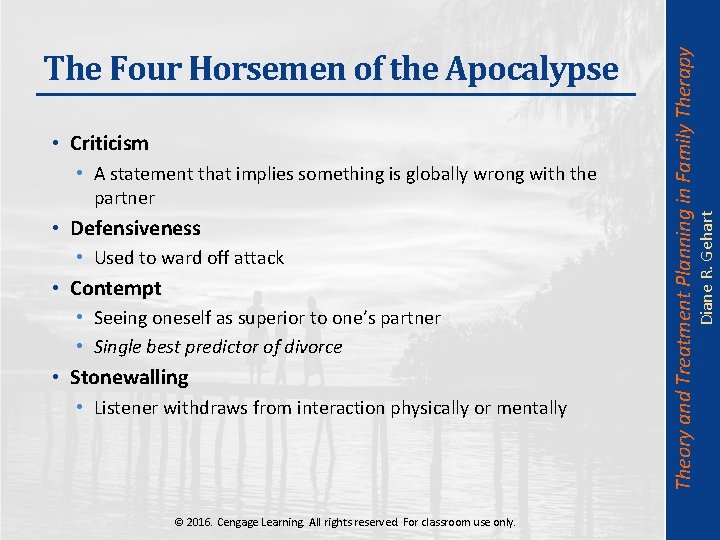
• A statement that implies something is globally wrong with the partner • Defensiveness • Used to ward off attack • Contempt • Seeing oneself as superior to one’s partner • Single best predictor of divorce • Stonewalling • Listener withdraws from interaction physically or mentally © 2016. Cengage Learning. All rights reserved. For classroom use only. Diane R. Gehart • Criticism Theory and Treatment Planning in Family Therapy The Four Horsemen of the Apocalypse
Diane R. Gehart Theory and Treatment Planning in Family Therapy THE DOING: INTERVENTIONS © 2016. Cengage Learning. All rights reserved. For classroom use only.
• • Catchup Pre-intervention marital interaction Give an intervention The spouses make the interventions their own Got resistance? No resistance? Homework © 2016. Cengage Learning. All rights reserved. For classroom use only. Diane R. Gehart Intervention Phase Theory and Treatment Planning in Family Therapy Session Format
Love maps Soften startup Dreams within conflict Negotiating marital power © 2016. Cengage Learning. All rights reserved. For classroom use only. Diane R. Gehart • • Theory and Treatment Planning in Family Therapy Signature Interventions
Diane R. Gehart Theory and Treatment Planning in Family Therapy RESEARCH AND EVIDENCE BASE © 2016. Cengage Learning. All rights reserved. For classroom use only.
© 2016. Cengage Learning. All rights reserved. For classroom use only. Diane R. Gehart • CBFT therapies are some of the best-researched approaches in family therapy • CBFT theorists have modified approach based on research outcomes to incorporate more affective and relational components • Neil Jacobson reformulated his couples therapy to include more affective aspects; integrative behavioral couples therapy • CBT critiqued on basis that it’s claims to superiority rest on the volume of research rather than any substantive advantage Theory and Treatment Planning in Family Therapy Research and the Evidence Base
Diane R. Gehart Theory and Treatment Planning in Family Therapy TAPESTRY WEAVING: WORKING WITH DIVERSE POPULATIONS © 2016. Cengage Learning. All rights reserved. For classroom use only.
© 2016. Cengage Learning. All rights reserved. For classroom use only. Diane R. Gehart • Carefully apply this approach with diverse populations to avoid conflicts in values and relational styles • Men and certain culture groups, such as Latinos, Asians, and Native Americans, often prefer active, directive therapy • Hierarchical difference may cause a rebellious reaction or an overly compliant and withholding response • CBT’s help clients conform to dominant cultural values Theory and Treatment Planning in Family Therapy Ethnic, Racial, and Cultural Diversity
© 2016. Cengage Learning. All rights reserved. For classroom use only. Diane R. Gehart Works with the following specific populations: • Hispanic and Latinos • African-Americans • Chinese Americans • Sexual identity diversity Theory and Treatment Planning in Family Therapy Ethnic, Racial, and Cultural Diversity (cont. )
• Examines how family members reinforce each other’s behaviors, symptoms and relational patters • Main focus on Parental Training • Therapist takes a directive/expert role • Mindfulness-Based Therapies • Change the way client’s relate or view their problem; push toward acceptance • Gottman Method Couples Therapy Approach • Goal is to increase ratio of positive interaction to negative interaction in relationship; 5: 1 • The therapist takes a directive/coach role © 2016. Cengage Learning. All rights reserved. For classroom use only. Diane R. Gehart • Cognitive Behavioral Family Therapy Theory and Treatment Planning in Family Therapy In Conclusion
• Gottman Method Couples Therapy: www. gottman. com • Juvenile Justice Bulletin (Functional Family Therapy): www. ncjrs. org/pdffiles 1/ojjdp/184743. pdf • Mindfulness Awareness Research Center (UCLA): www. marc. ucla. edu • Mindfulness Based Stress Reduction Clinic (Jon Kabat-Zinn): www. umassmed. edu/cfm/mbsr/ • Oregon Social Learning Center (Patterson and Forgatch Parenting Program): www. oslc. org • Substance Abuse and Mental Health Services Administration Registry of Evidenced- Based Practices: www. nrepp. samhsa. gov © 2016. Cengage Learning. All rights reserved. For classroom use only. Diane R. Gehart • Frank Dattilio: www. dattilio. com Theory and Treatment Planning in Family Therapy Online Resources