
Feeding of healthy newborn babies Learning objectives 1
Feeding of healthy newborn babies
Learning objectives - 1 n To list the benefits of breast feeding q Benefits to baby q Benefits to mother n To explain the physiology of lactation q Prolactin reflex q Oxytocin reflex Teaching Aids: ENC NF- 2
Exclusive breastfeeding n n All healthy infants should be breastfed exclusively for the first six months of life Exclusive breastfeeding is defined as "an infant's consumption of human milk with no supplementation of any type (no water, no juice, no nonhuman milk, and no foods) except for vitamins, minerals, and medications. " Teaching Aids: ENC NF- 3
Benefits of breast milk to the baby n n n Breast milk and human colostrum are made for babies and is the best first food Easily digested and well absorbed Contains essential amino acids Rich in essential fatty acids Better bioavailability of iron and calcium Teaching Aids: ENC NF- 4
Benefits of breast milk (contd. ) n n n Prevents under five child deaths Protects against infections Prevents allergies Better intelligence Promotes emotional bonding Less heart disease, diabetes and lymphoma Teaching Aids: ENC NF- 5
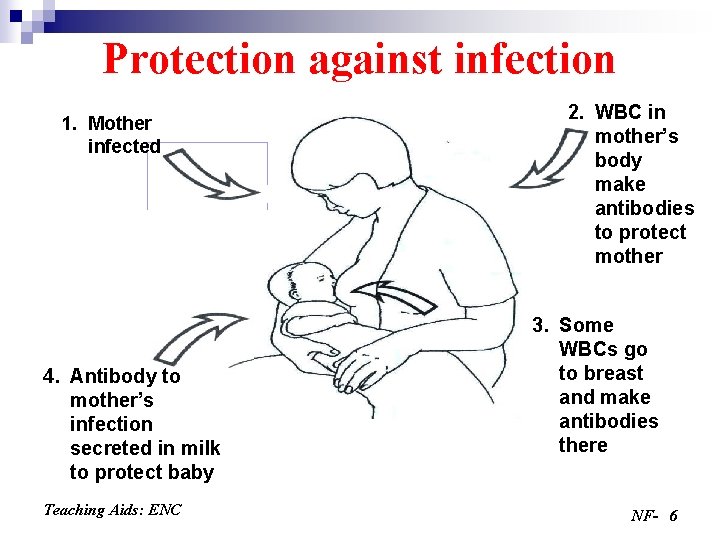
Protection against infection 1. Mother infected 4. Antibody to mother’s infection secreted in milk to protect baby Teaching Aids: ENC 2. WBC in mother’s body make antibodies to protect mother 3. Some WBCs go to breast and make antibodies there NF- 6
Benefits to mother n n n Helps in involution of uterus Delays pregnancy Decreases mother’s workload, saves time and energy Lowers risk of breast and ovarian cancer Helps reduce weight faster Teaching Aids: ENC NF- 7
Benefits to family and society n Contributes to child survival n Saves money n Promotes family planning n Environment friendly Teaching Aids: ENC NF- 8
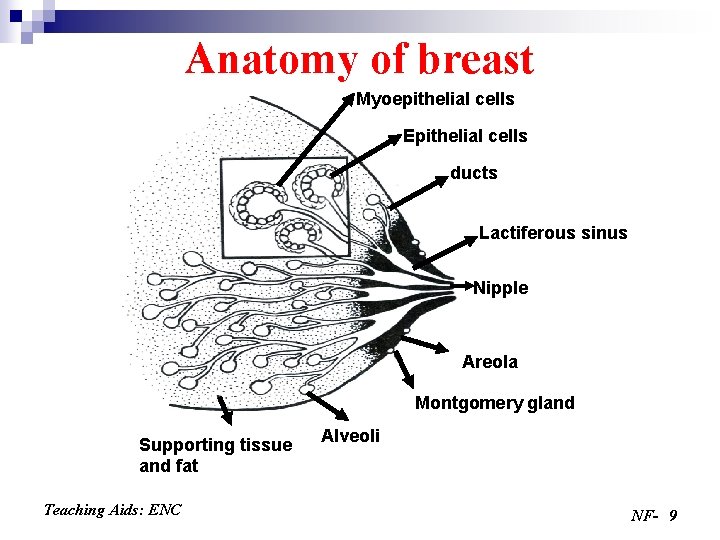
Anatomy of breast Myoepithelial cells Epithelial cells ducts Lactiferous sinus Nipple Areola Montgomery gland Supporting tissue and fat Teaching Aids: ENC Alveoli NF- 9
Physiology of lactation n n Hormonal secretions in the mother ¨ Prolactin helps in production of milk ¨ Oxytocin causes ejection of milk Reflexes in the baby – rooting, sucking & swallowing Teaching Aids: ENC NF- 10
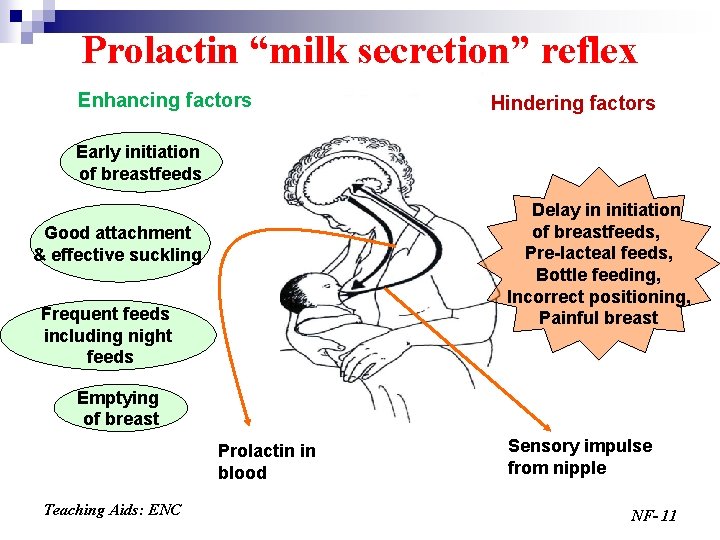
Prolactin “milk secretion” reflex Enhancing factors Hindering factors Early initiation of breastfeeds Delay in initiation of breastfeeds, Pre-lacteal feeds, Bottle feeding, Incorrect positioning, Painful breast Good attachment & effective suckling Frequent feeds including night feeds Emptying of breast Prolactin in blood Teaching Aids: ENC Sensory impulse from nipple NF- 11

Oxytocin “milk ejection” reflex Oxytocin contracts myoepithelial cells Sensory impulse from nipple to brain Baby sucking Teaching Aids: ENC NF- 12
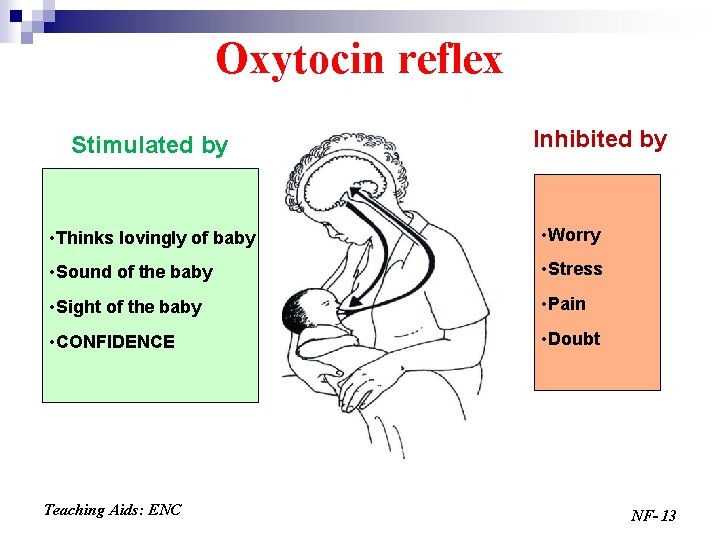
Oxytocin reflex Stimulated by Inhibited by • Thinks lovingly of baby • Worry • Sound of the baby • Stress • Sight of the baby • Pain • CONFIDENCE • Doubt Teaching Aids: ENC NF- 13
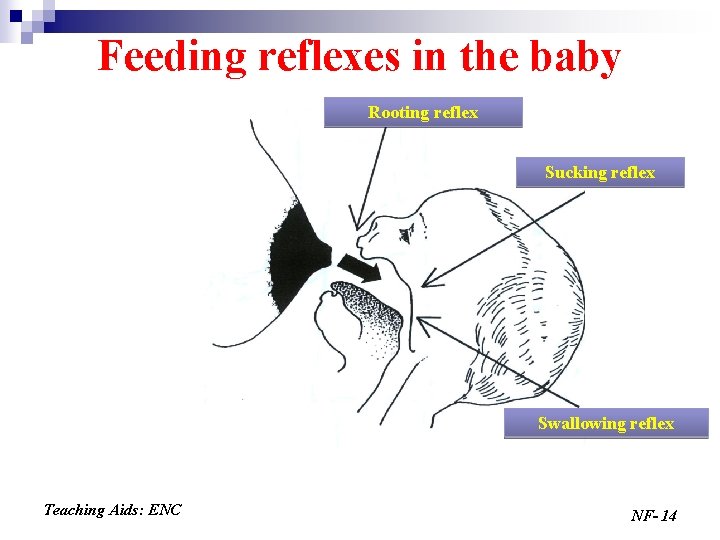
Feeding reflexes in the baby Rooting reflex Sucking reflex Swallowing reflex Teaching Aids: ENC NF- 14
Learning objectives - 2 n Ensuring good start ¨ To be able to describe how breastfeeding works ¨ To recognise good and poor attachment and positioning of a baby feeding at the breast n Overcoming difficulties ¨ To help a mother breastfeed her newborn baby ¨ Help a mother prevent common problems Teaching Aids: ENC NF- 15
For successful breastfeeding n A willing and motivated mother n An active and sucking newborn n A motivator who can bring both mother and newborn together (health professional or relative) Teaching Aids: ENC NF- 16
Key points of positioning Mother: n Make the mother sit in a comfortable and convenient position (she can feed in lying down position) n Ensure that she is relaxed and comfortable Baby: n Baby’s head and body are in a straight line n Baby’s whole body is supported n Baby’s face is opposite the nipple and the breast n Baby’s abdomen touches mother’s abdomen Teaching Aids: ENC NF- 17
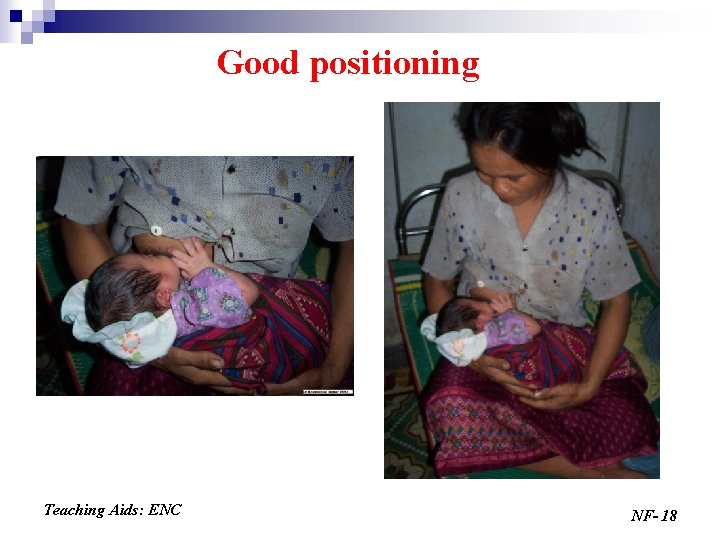
Good positioning Teaching Aids: ENC NF- 18
Key points of good attachment 1. Baby’s mouth is wide open 2. Baby’s chin touches the breast 3. Baby’s lower lip is curled outward 4. Usually the lower portion of the areola is not visible Teaching Aids: ENC NF- 19
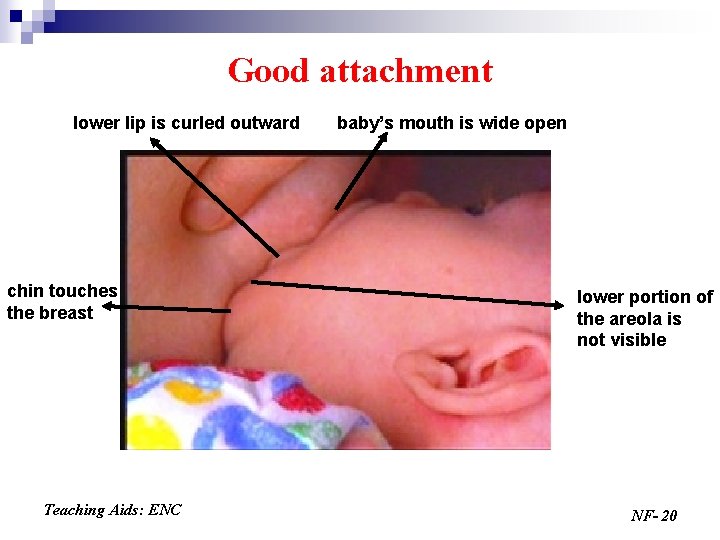
Good attachment lower lip is curled outward chin touches the breast Teaching Aids: ENC baby’s mouth is wide open lower portion of the areola is not visible NF- 20
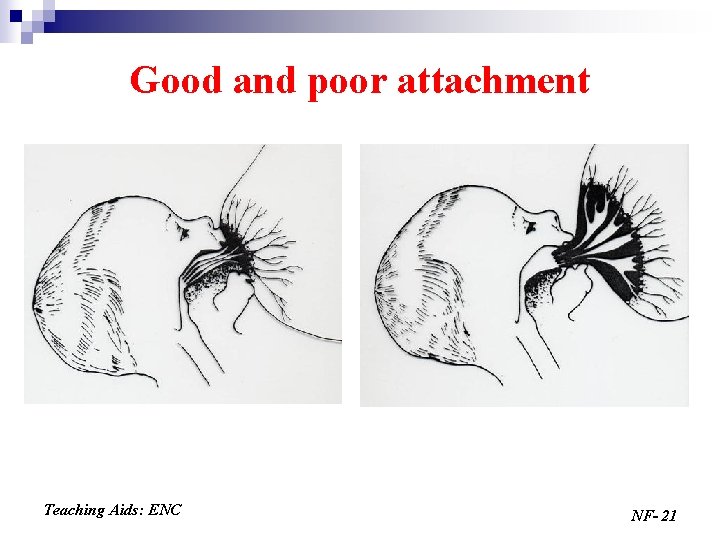
Good and poor attachment Teaching Aids: ENC NF- 21
Effective suckling For an infant who shows signs of good attachment, the next step would be to assess suckling: n If the infant takes several slow deep sucks followed by swallowing and then pauses, then he/she is sucking effectively Teaching Aids: ENC NF- 22
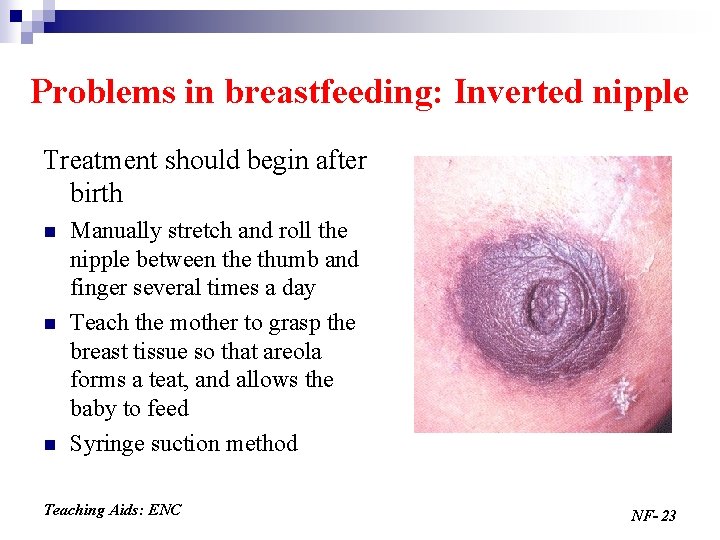
Problems in breastfeeding: Inverted nipple Treatment should begin after birth n n n Manually stretch and roll the nipple between the thumb and finger several times a day Teach the mother to grasp the breast tissue so that areola forms a teat, and allows the baby to feed Syringe suction method Teaching Aids: ENC NF- 23
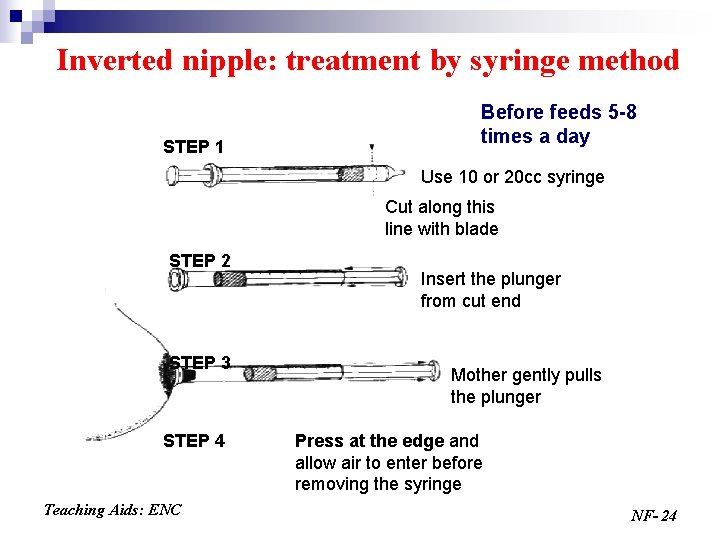
Inverted nipple: treatment by syringe method STEP 1 Before feeds 5 -8 times a day Use 10 or 20 cc syringe Cut along this line with blade STEP 2 STEP 3 STEP 4 Teaching Aids: ENC Insert the plunger from cut end Mother gently pulls the plunger Press at the edge and allow air to enter before removing the syringe NF- 24
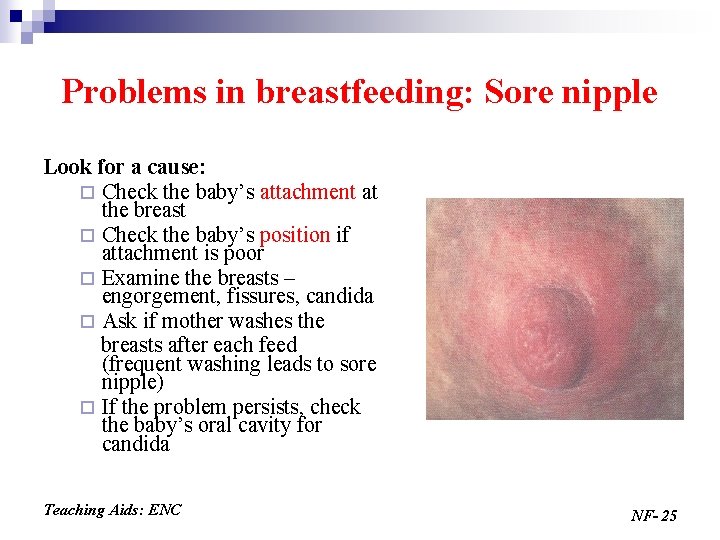
Problems in breastfeeding: Sore nipple Look for a cause: ¨ Check the baby’s attachment at the breast ¨ Check the baby’s position if attachment is poor ¨ Examine the breasts – engorgement, fissures, candida ¨ Ask if mother washes the breasts after each feed (frequent washing leads to sore nipple) ¨ If the problem persists, check the baby’s oral cavity for candida Teaching Aids: ENC NF- 25
Sore nipple: management Give appropriate treatment: ¨ Build mother’s confidence ¨ Improve the baby’s attachment and continue breastfeeding ¨ Reduce engorgement, feed frequently, express breast milk ¨ Treat candida Teaching Aids: ENC Advise the mother to: ¨ Wash breasts only once a day; avoid using soap ¨ Avoid medicated lotions and ointments ¨ Gently apply hind milk onto nipple and areola after each feed NF- 26
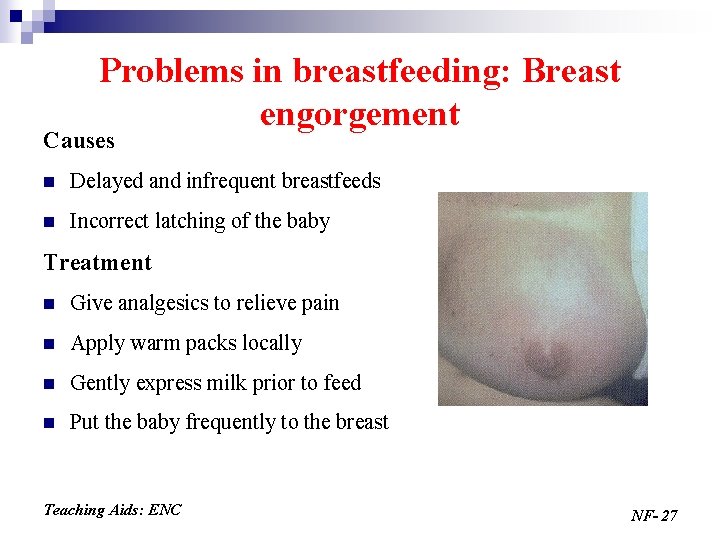
Problems in breastfeeding: Breast engorgement Causes n Delayed and infrequent breastfeeds n Incorrect latching of the baby Treatment n Give analgesics to relieve pain n Apply warm packs locally n Gently express milk prior to feed n Put the baby frequently to the breast Teaching Aids: ENC NF- 27
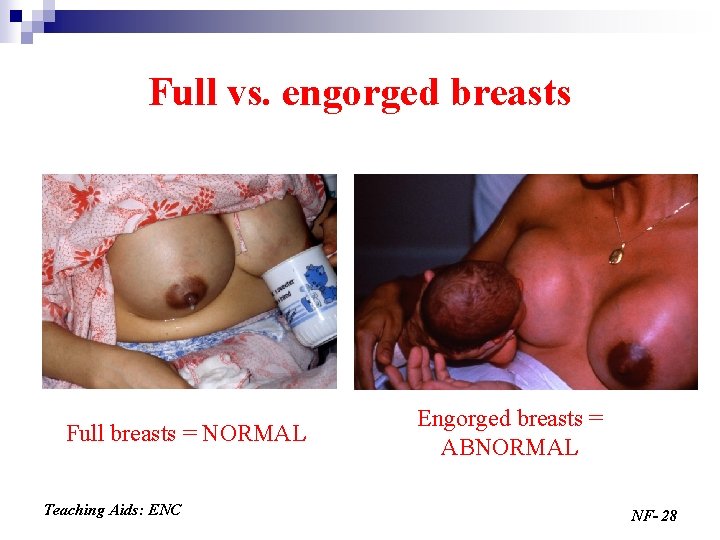
Full vs. engorged breasts Full breasts = NORMAL Teaching Aids: ENC Engorged breasts = ABNORMAL NF- 28
Full vs. engorged breasts Full breasts: Engorged breasts: ¨ can occur at any time during ¨ 36/72 hours after birth. breastfeeding ¨ Hot, heavy, may be hard ¨ Painful; edematous ¨ Milk flowing ¨ Tight, especially nipple area ¨ Fever uncommon ¨ Shiny ¨ May look red ¨ Milk NOT flowing ¨ Fever may occur ¨ May cause a decrease in milk supply if it happens often Teaching Aids: ENC NF- 29
“Not enough milk”: causes n n n Not breastfeeding often enough Too short or hurried breastfeeding Night feeds stopped early Poor suckling position Poor oxytocin reflex (anxiety, lack of confidence) Engorgement or mastitis Teaching Aids: ENC NF- 30
“Not enough milk”: management n n n Put baby to breast frequently Baby to be correctly attached to breast Build mother’s confidence Back massage and relaxation can help Use galactogogues (metaclopropamide) judiciously Adequate weight gain and urine frequency 5 -6 times a day are reliable signs of enough milk intake Teaching Aids: ENC NF- 31
Adequacy of breastfeeding n Breastfeeding is considered adequate if the baby ¨ Goes to sleep for 2 -3 hrs after each feed ¨ Passes urine 6 -8 times in 24 hrs ¨ Gains weight at 10 -15 gm/kg/day ¨ Crosses birth weight by 2 weeks Teaching Aids: ENC NF- 32
Expressed breast milk Indications ¨ Sick mother, local breast problems ¨ Preterm / sick baby ¨ Working mother Storage ¨ Clean ¨ At wide-mouthed container with tight lid room temperature: 6 hrs ¨ Refrigerator: Teaching Aids: ENC 24 hours; Freezer (20°C): for 3 months NF- 33

Teaching Aids: ENC NF- 34
Ten steps to successful breastfeeding Every facility providing maternity services and care for newborn infants should 1. Have a written breastfeeding policy that is routinely communicated to all health care staff 2. Train all health care staff in skills necessary to implement this policy 3. Inform all pregnant women about the benefits and management of breastfeeding Teaching Aids: ENC NF- 35
Ten steps to successful breastfeeding (contd…. ) 4. Help mothers initiate breastfeeding within half hour of birth 5. Show mothers how to breastfeed, and how to maintain lactation even if they are separated from their infants 6. Give no food or drink, unless medically indicated 7. Practice rooming-in : allow mothers and infants to remain together 24 hrs a day Teaching Aids: ENC NF- 36
Ten steps to successful breastfeeding (contd…. ) 8. 9. 10. Encourage breastfeeding on demand Give no artificial teats or pacifiers (also called dummies or soothers) to breastfeeding infants Foster the establishment of breastfeeding support groups and refer mothers to them on discharge from the hospital. Teaching Aids: ENC NF- 37
- Slides: 37